Upgrade to Pro — share decks privately, control downloads, hide ads and more …

Liburd "Copyright Essentials From A to AI: A 20...

Sponsored · Your Podcast. Everywhere. Effortlessly. Share. Educate. Inspire. Entertain. You do you. We'll handle the rest. →

Liburd "Copyright Essentials From A to AI: A 2026 Training Series, Session Eight: Practices and Programs in Your Organization"

This presentation was given by Willa Liburd, Legal Knowledge Management Consultant and Scholarly Communication Professional of Indiana University Bloomington for the final session of the NISO training series "Copyright Essentials From A to AI." Session Eight, "Practices and Programs in Your Organization," was held November 19, 2026.

Transcript

16 slides
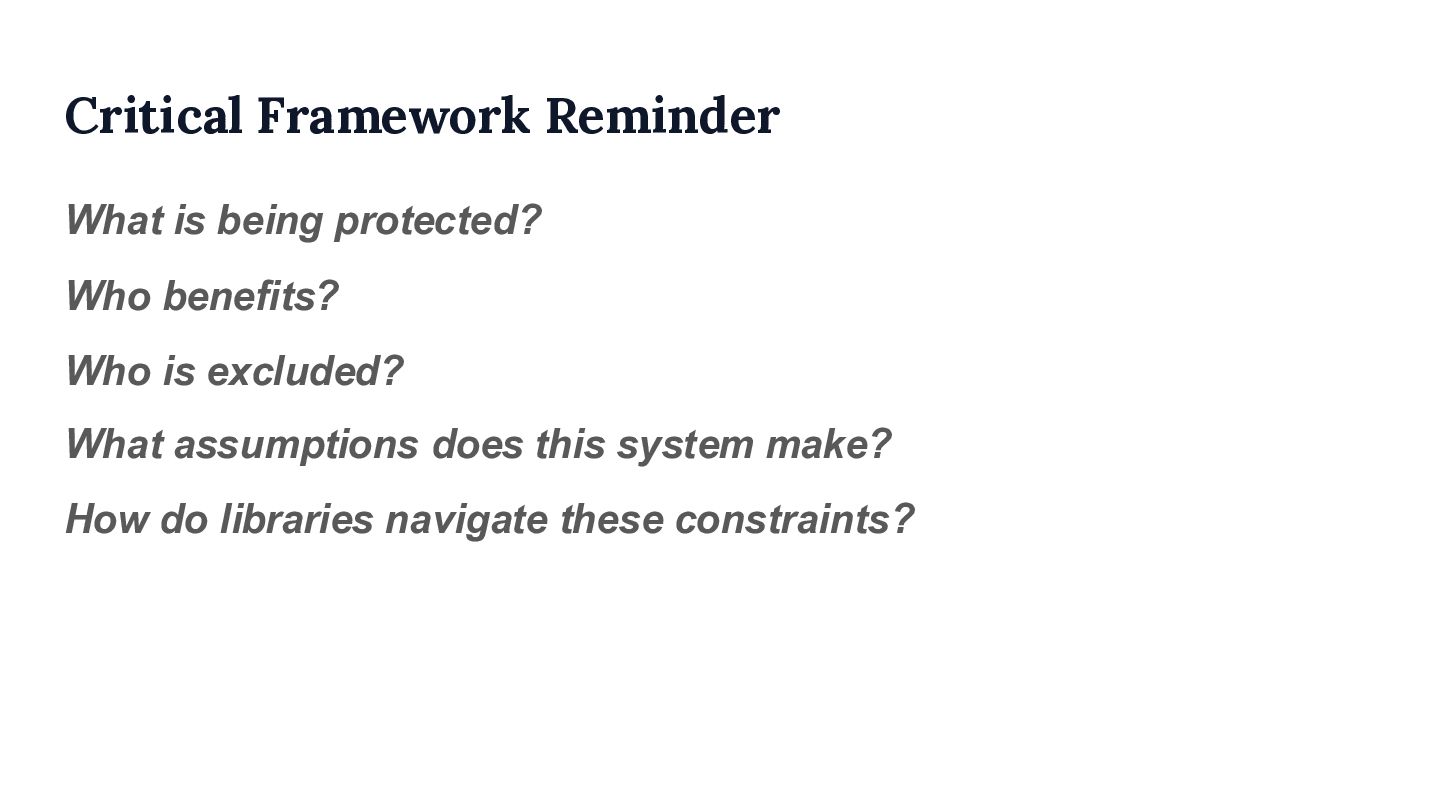
  1. Critical Framework Reminder What is being protected? Who benefits? Who

    is excluded? What assumptions does this system make? How do libraries navigate these constraints?
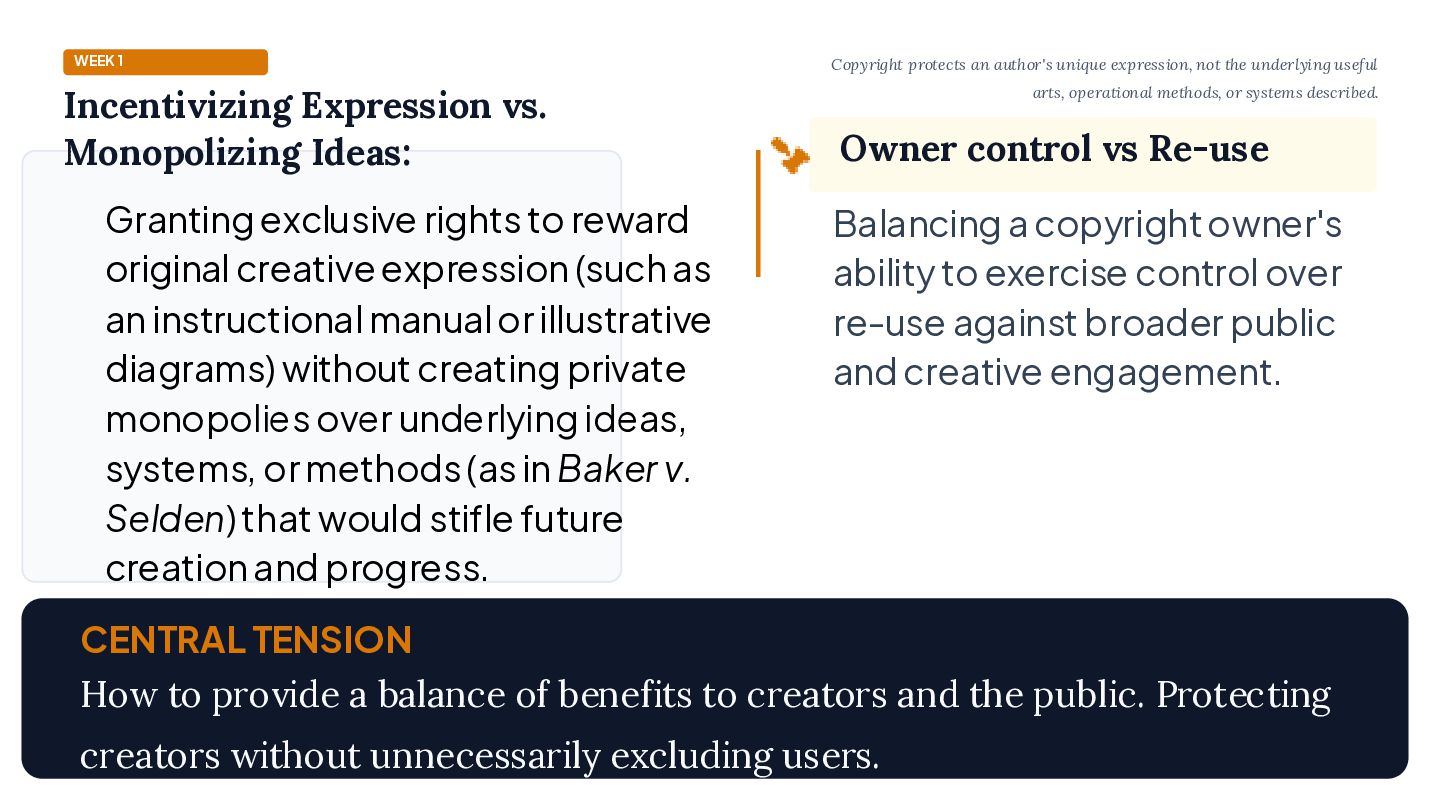
  2. WEEK 1 Incentivizing Expression vs. Monopolizing Ideas: Granting exclusive rights

    to reward original creative expression (such as an instructional manual or illustrative diagrams) without creating private monopolies over underlying ideas, systems, or methods (as in Baker v. Selden) that would stifle future creation and progress. Copyright protects an author's unique expression, not the underlying useful arts, operational methods, or systems described. Owner control vs Re-use Balancing a copyright owner's ability to exercise control over re-use against broader public and creative engagement. CENTRAL TENSION How to provide a balance of benefits to creators and the public. Protecting creators without unnecessarily excluding users.
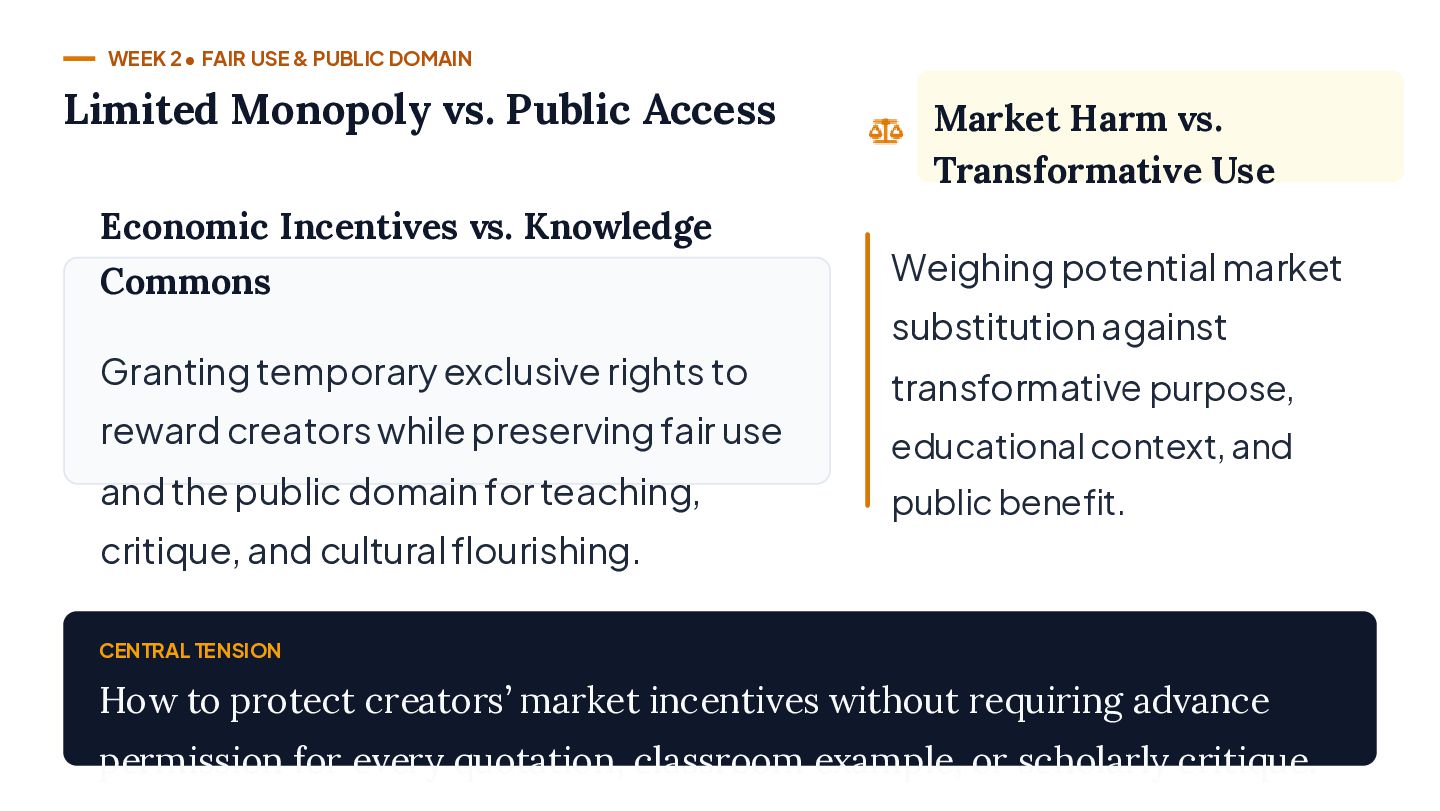
  3. WEEK 2 • FAIR USE & PUBLIC DOMAIN Limited Monopoly

    vs. Public Access Economic Incentives vs. Knowledge Market Harm vs. Transformative Use Commons Weighing potential market Granting temporary exclusive rights to transformative purpose, reward creators while preserving fair use and the public domain for teaching, substitution against educational context, and public benefit. critique, and cultural flourishing. CENTRAL TENSION How to protect creators’ market incentives without requiring advance permission for every quotation, classroom example, or scholarly critique.
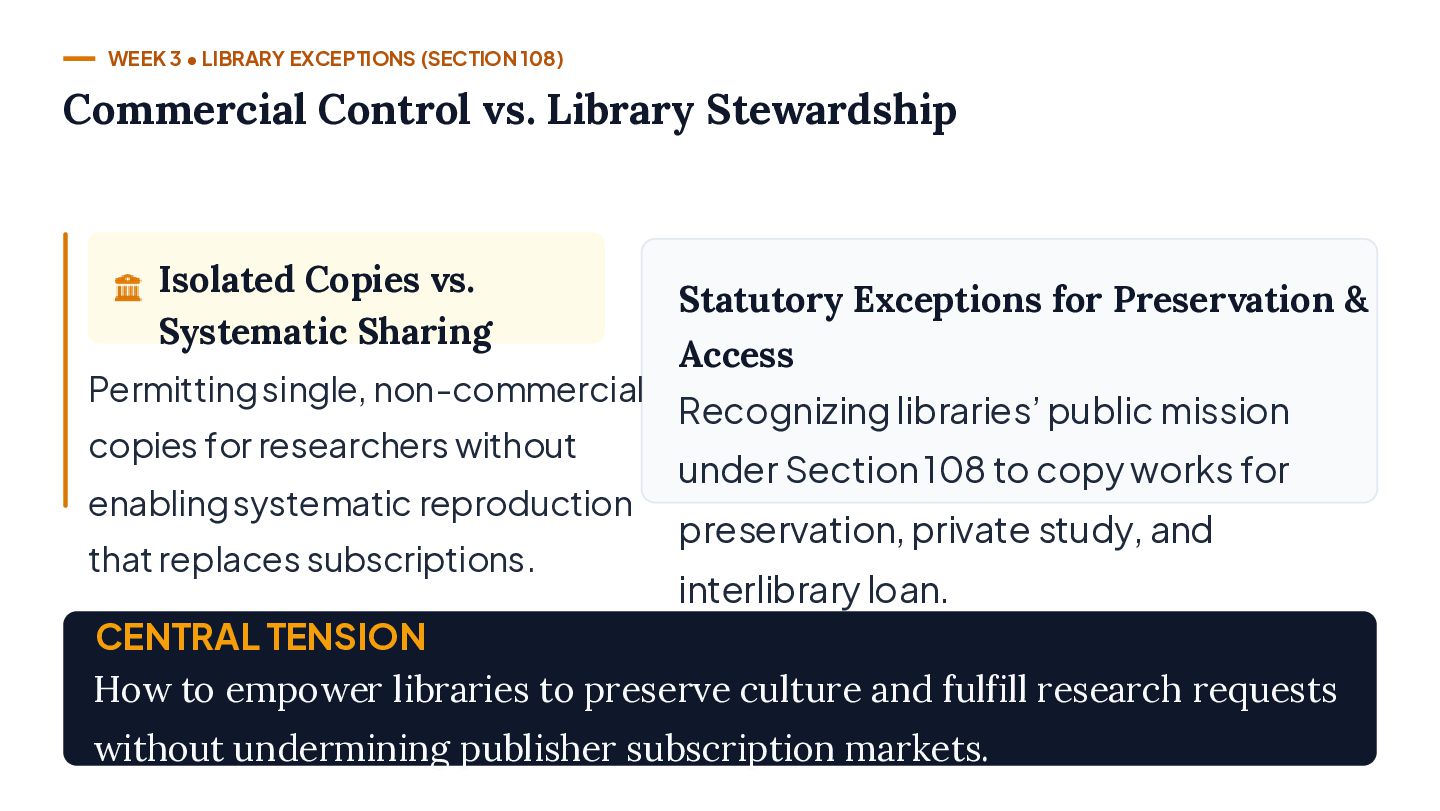
  4. WEEK 3 • LIBRARY EXCEPTIONS (SECTION 108) Commercial Control vs.

    Library Stewardship Isolated Copies vs. Systematic Sharing Permitting single, non-commercial copies for researchers without enabling systematic reproduction that replaces subscriptions. Statutory Exceptions for Preservation & Access Recognizing libraries’ public mission under Section 108 to copy works for preservation, private study, and interlibrary loan. CENTRAL TENSION How to empower libraries to preserve culture and fulfill research requests without undermining publisher subscription markets.
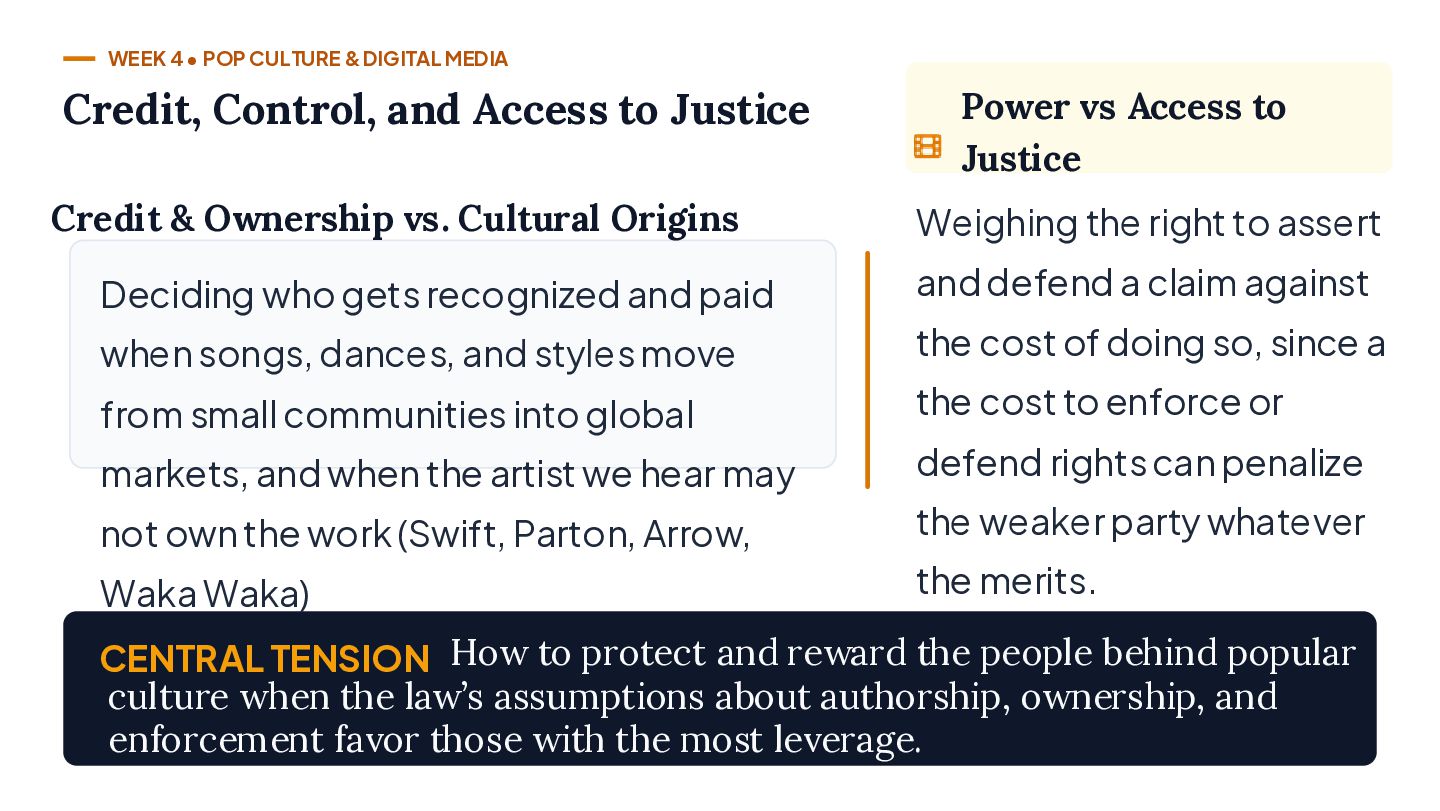
  5. WEEK 4 • POP CULTURE & DIGITAL MEDIA Credit, Control,

    and Access to Justice Credit & Ownership vs. Cultural Origins Power vs Access to Justice Weighing the right to assert Deciding who gets recognized and paid and defend a claim against when songs, dances, and styles move the cost of doing so, since a from small communities into global the cost to enforce or markets, and when the artist we hear may defend rights can penalize not own the work (Swift, Parton, Arrow, the weaker party whatever Waka Waka) the merits. CENTRAL TENSION How to protect and reward the people behind popular culture when the law’s assumptions about authorship, ownership, and enforcement favor those with the most leverage.
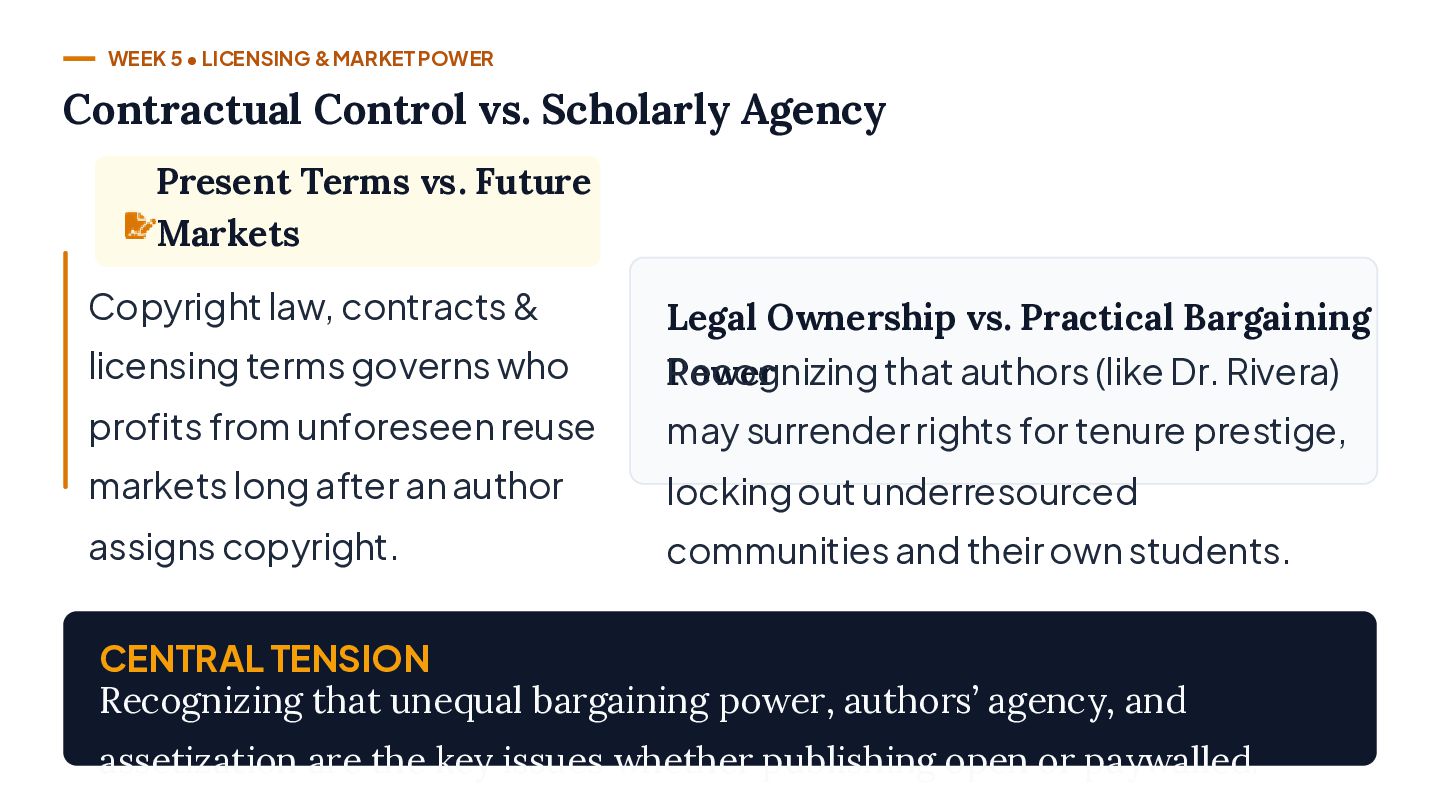
  6. WEEK 5 • LICENSING & MARKET POWER Contractual Control vs.

    Scholarly Agency Present Terms vs. Future Markets Copyright law, contracts & Legal Ownership vs. Practical Bargaining licensing terms governs who Recognizing that authors (like Dr. Rivera) Power profits from unforeseen reuse may surrender rights for tenure prestige, markets long after an author locking out underresourced assigns copyright. communities and their own students. CENTRAL TENSION Recognizing that unequal bargaining power, authors’ agency, and assetization are the key issues whether publishing open or paywalled.
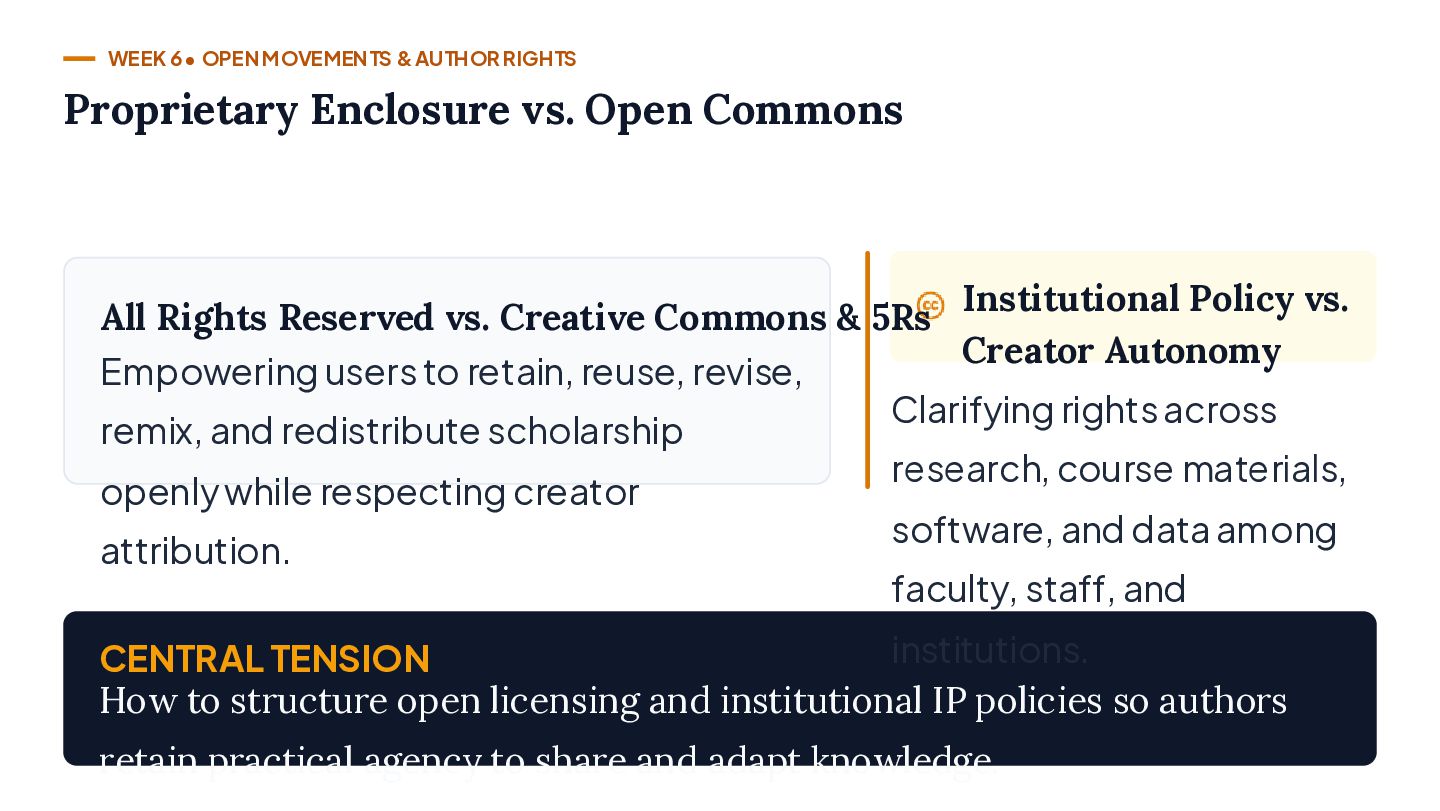
  7. WEEK 6 • OPEN MOVEMENTS & AUTHOR RIGHTS Proprietary Enclosure

    vs. Open Commons All Rights Reserved vs. Creative Commons & 5Rs Empowering users to retain, reuse, revise, remix, and redistribute scholarship openly while respecting creator attribution. Institutional Policy vs. Creator Autonomy Clarifying rights across research, course materials, software, and data among faculty, staff, and institutions. CENTRAL TENSION How to structure open licensing and institutional IP policies so authors retain practical agency to share and adapt knowledge.
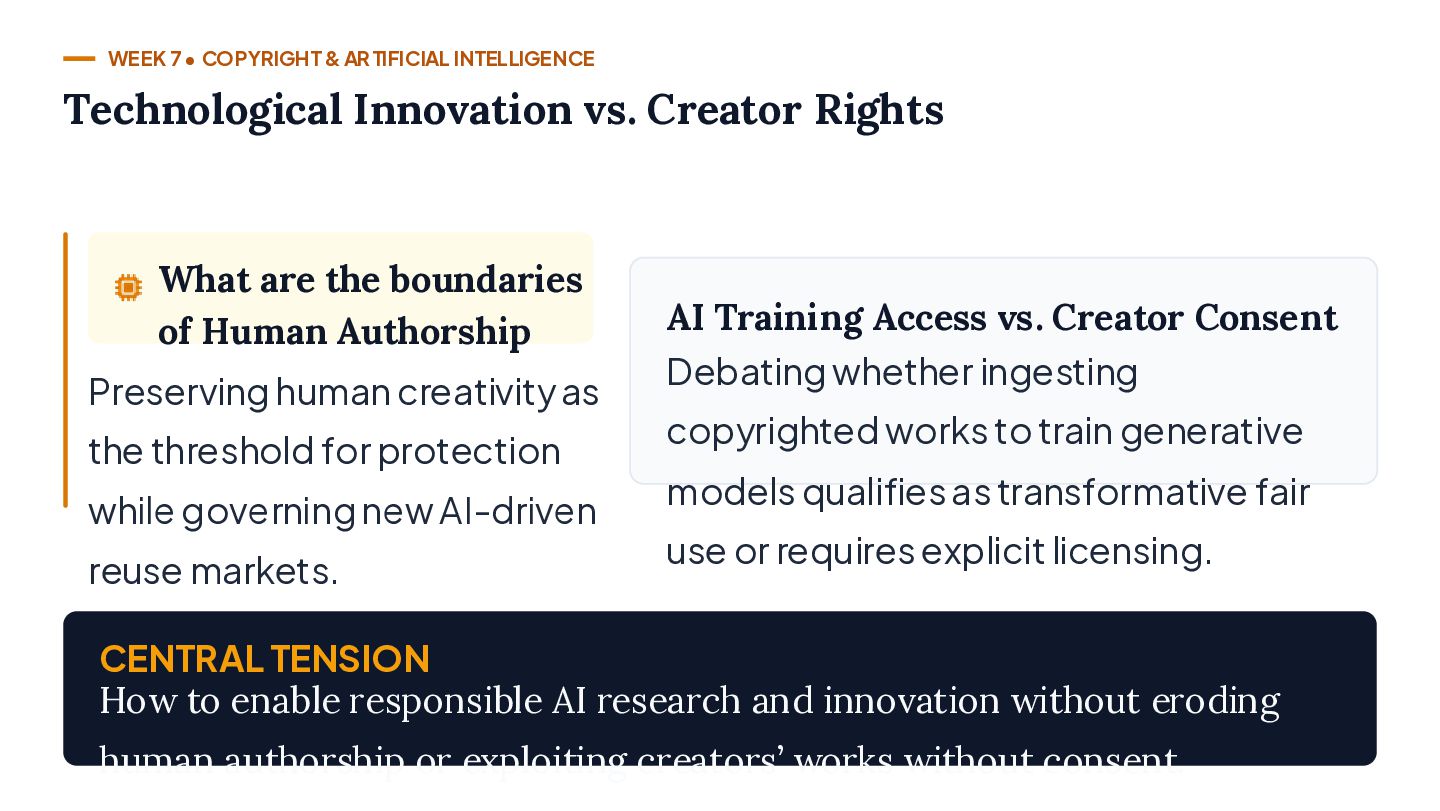
  8. WEEK 7 • COPYRIGHT & ARTIFICIAL INTELLIGENCE Technological Innovation vs.

    Creator Rights What are the boundaries of Human Authorship Preserving human creativity as the threshold for protection while governing new AI-driven reuse markets. AI Training Access vs. Creator Consent Debating whether ingesting copyrighted works to train generative models qualifies as transformative fair use or requires explicit licensing. CENTRAL TENSION How to enable responsible AI research and innovation without eroding human authorship or exploiting creators’ works without consent.
  9. What are 3 areas in which copyright issues arise at

    your institution? What tensions or tradeoffs are involved in these issues?
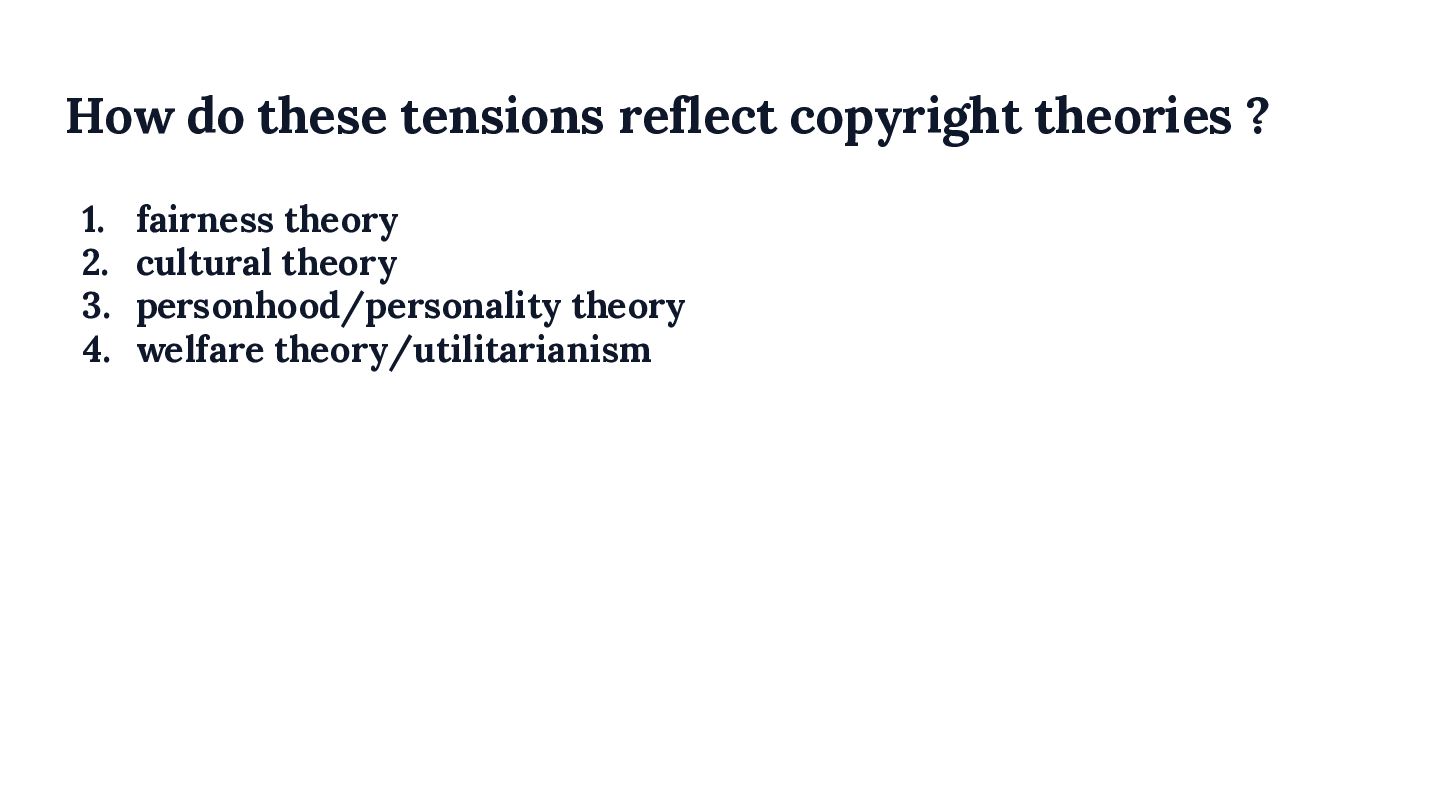
  10. How do these tensions reflect copyright theories ? 1. 2.

    3. 4. fairness theory cultural theory personhood/personality theory welfare theory/utilitarianism
  11. How does your institution approach/resolve these issues? In your view,

    would a different approach be preferable? What prevents this approach from being taken?
  12. How can the issues/obstacles be addressed? Can the issues/obstacle(s) be

    addressed through policy changes, programming or both? Is internal capacity an issue?
  13. Individual work (in groups!) Using the worksheet provided, create a

    document that provides internal guidance addressing the issues, tensions, and recommended approaches for your institution/organization.

More Decks by National Information Standards Organization