Upgrade to Pro — share decks privately, control downloads, hide ads and more …

Breeding, Faith, Kessler, and Quinn "NISO Open ...

Breeding, Faith, Kessler, and Quinn "NISO Open Discovery Initiative (ODI) Webinar: Is There AI in My Search Results, and Why Should I Care?"

This presentation was given by Rachel Kessler of Clarivate analytics, Marshall Breeding of Library Technology Guides, along with Brendan Quinn and Ashleigh Faith both of EBSCO Information Services for the "NISO Open Discovery Initiative (ODI) Webinar: Effect of Generative AI on Library Discovery" This event was the second of a three-series public webinar, held October 15, 2026.

More Decks by National Information Standards Organization

Other Decks in Education

Transcript

  1. O P E N D I S C O V

    E R Y I N I T I AT I V E ( O D I ) Is there AI in my search results and why should I care? 15 OCTOBER 2026 NISO Open Discovery Initiative – Promoting Transparency in Discovery @NISO_ODI
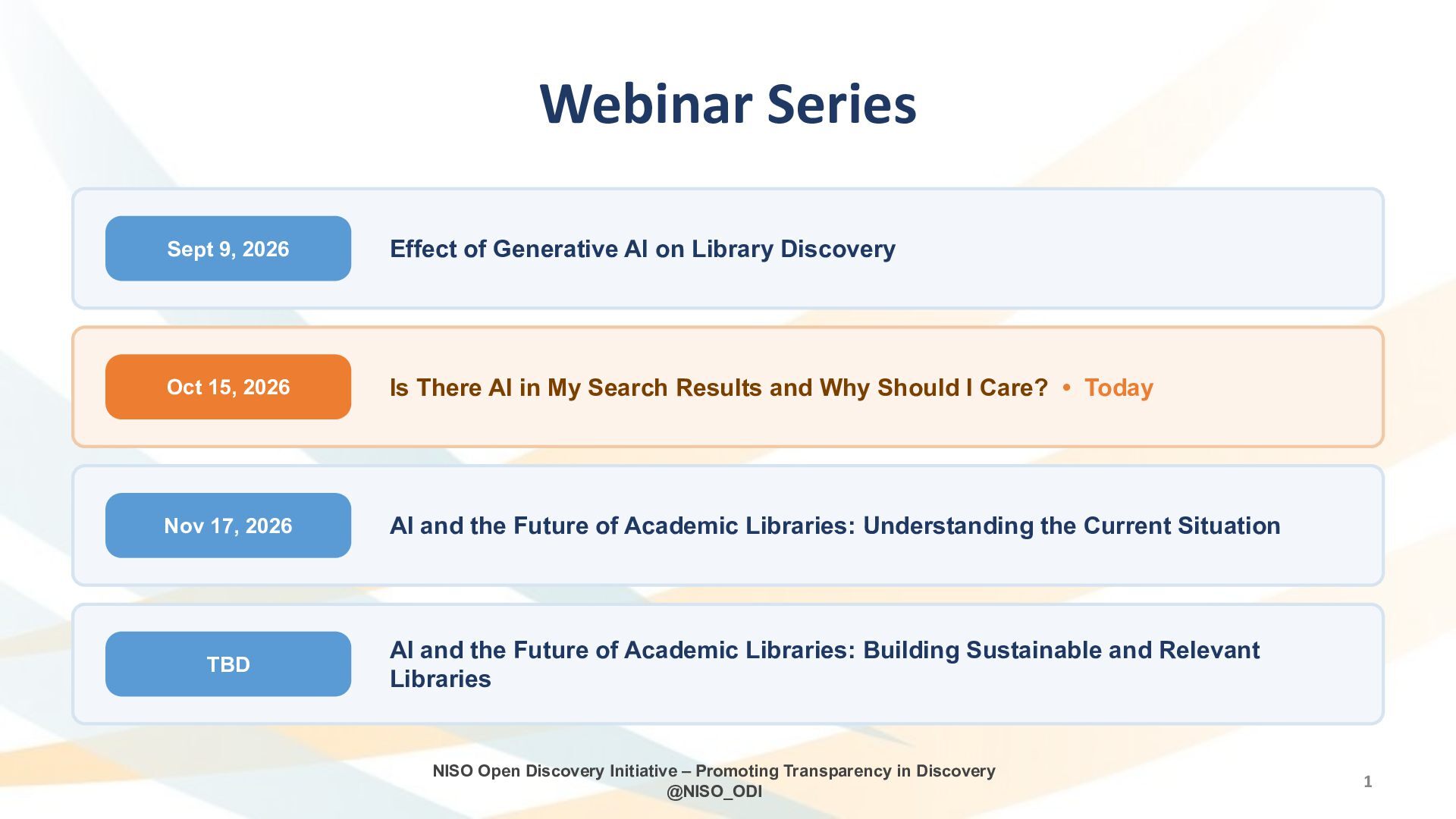
  2. Webinar Series Sept 9, 2026 Effect of Generative AI on

    Library Discovery Oct 15, 2026 Is There AI in My Search Results and Why Should I Care? • Today Nov 17, 2026 AI and the Future of Academic Libraries: Understanding the Current Situation TBD AI and the Future of Academic Libraries: Building Sustainable and Relevant Libraries NISO Open Discovery Initiative – Promoting Transparency in Discovery @NISO_ODI 1
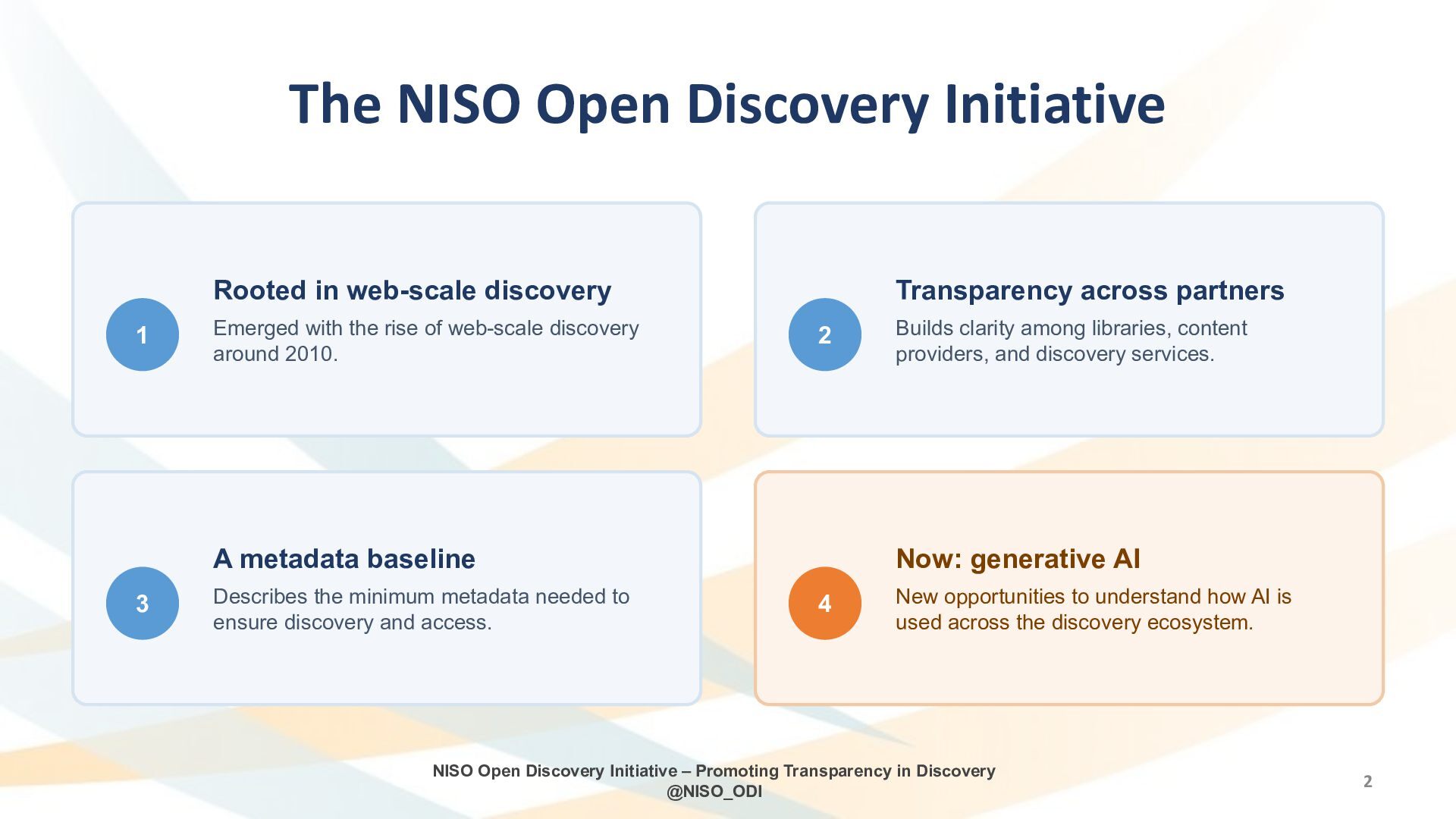
  3. The NISO Open Discovery Initiative Rooted in web-scale discovery 1

    Emerged with the rise of web-scale discovery around 2010. Transparency across partners 2 A metadata baseline 3 Describes the minimum metadata needed to ensure discovery and access. Builds clarity among libraries, content providers, and discovery services. Now: generative AI 4 New opportunities to understand how AI is used across the discovery ecosystem. NISO Open Discovery Initiative – Promoting Transparency in Discovery @NISO_ODI 2
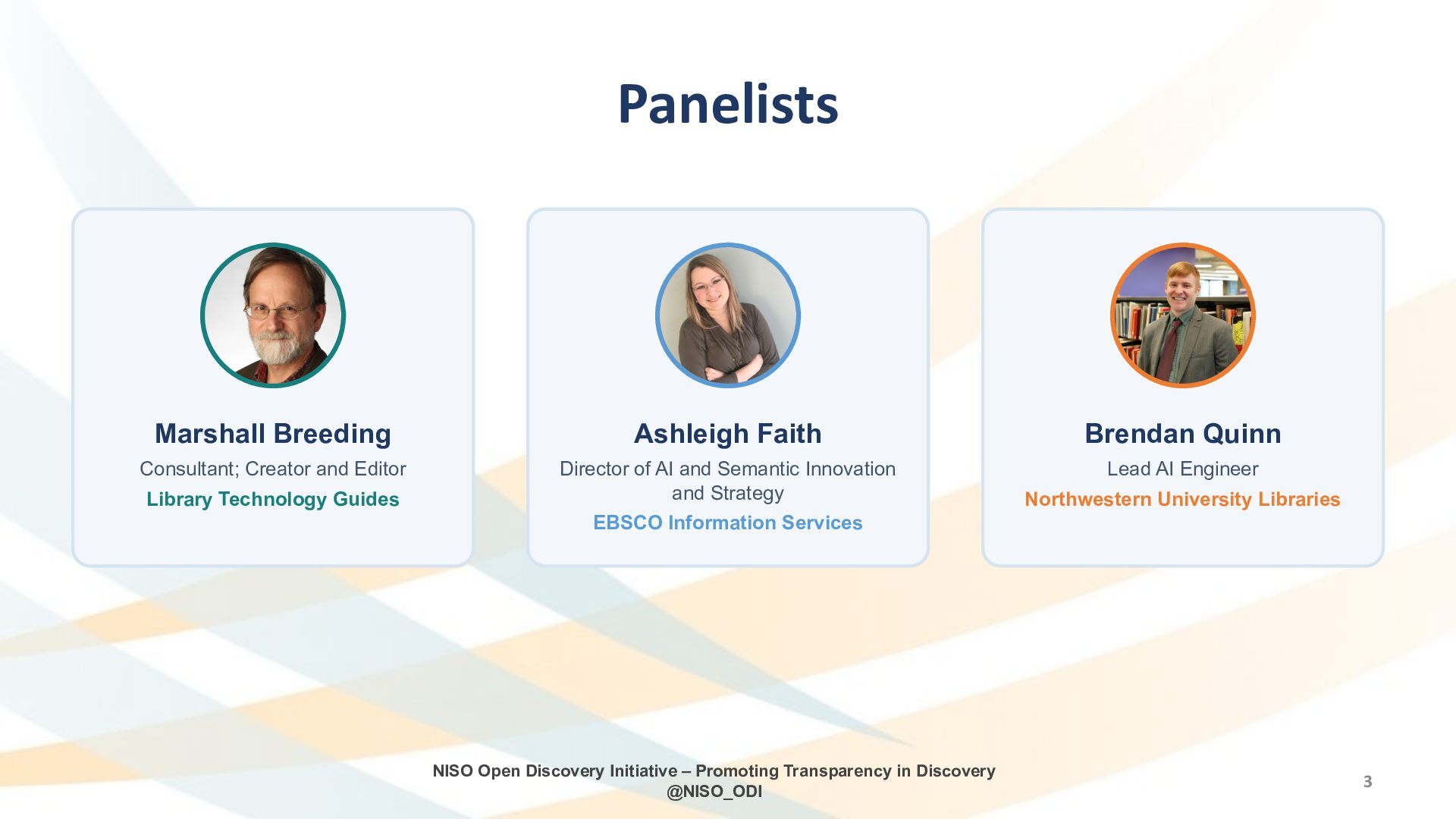
  4. Panelists Marshall Breeding Ashleigh Faith Brendan Quinn Consultant; Creator and

    Editor Director of AI and Semantic Innovation and Strategy Lead AI Engineer Library Technology Guides Northwestern University Libraries EBSCO Information Services NISO Open Discovery Initiative – Promoting Transparency in Discovery @NISO_ODI 3
  5. The need for AI Disclosure Library-provided discovery services come with

    expectations that differ from consumer or commercial services • Disclosing the use of AI in library search services isn’t intended as a statement that it should not be used. • Libraries value providing services to their users with objective and non-biased content. • Users and library staff may have some concern with AI-based processes. • Some institutions prohibit use of AI in coursework or research • NISO Open Discovery Initiative – Promoting Transparency in Discovery @NISO_ODI 4
  6. Keeping it simple The proposed mechanisms for disclosure are not

    meant to be complex • Some visual clue that indicates at a very high level that AI was involved in producing the results • Users interested in more information, can click through to a more detailed page. • Most library discovery services are provided through vendors that control the interface • Cooperating vendors would provide the disclosure mechanism • NISO Open Discovery Initiative – Promoting Transparency in Discovery @NISO_ODI 5
  7. Voluntary As with other ODI initiatives, AI disclosure is voluntary

    • Vendors may be asked to comply to a suggested practice • No enforcement mechanism • NISO Open Discovery Initiative – Promoting Transparency in Discovery @NISO_ODI 6
  8. Status General agreement within the ODI Standing Committee that AI

    disclosure would be welcomed by libraries • Measuring vendor interest • Discussion about the specific characteristics of AI use within scope • Seeking comments and suggestion from the broader committee • Positive feedback may lead to more formal proposal to NISO • NISO Open Discovery Initiative – Promoting Transparency in Discovery @NISO_ODI 7
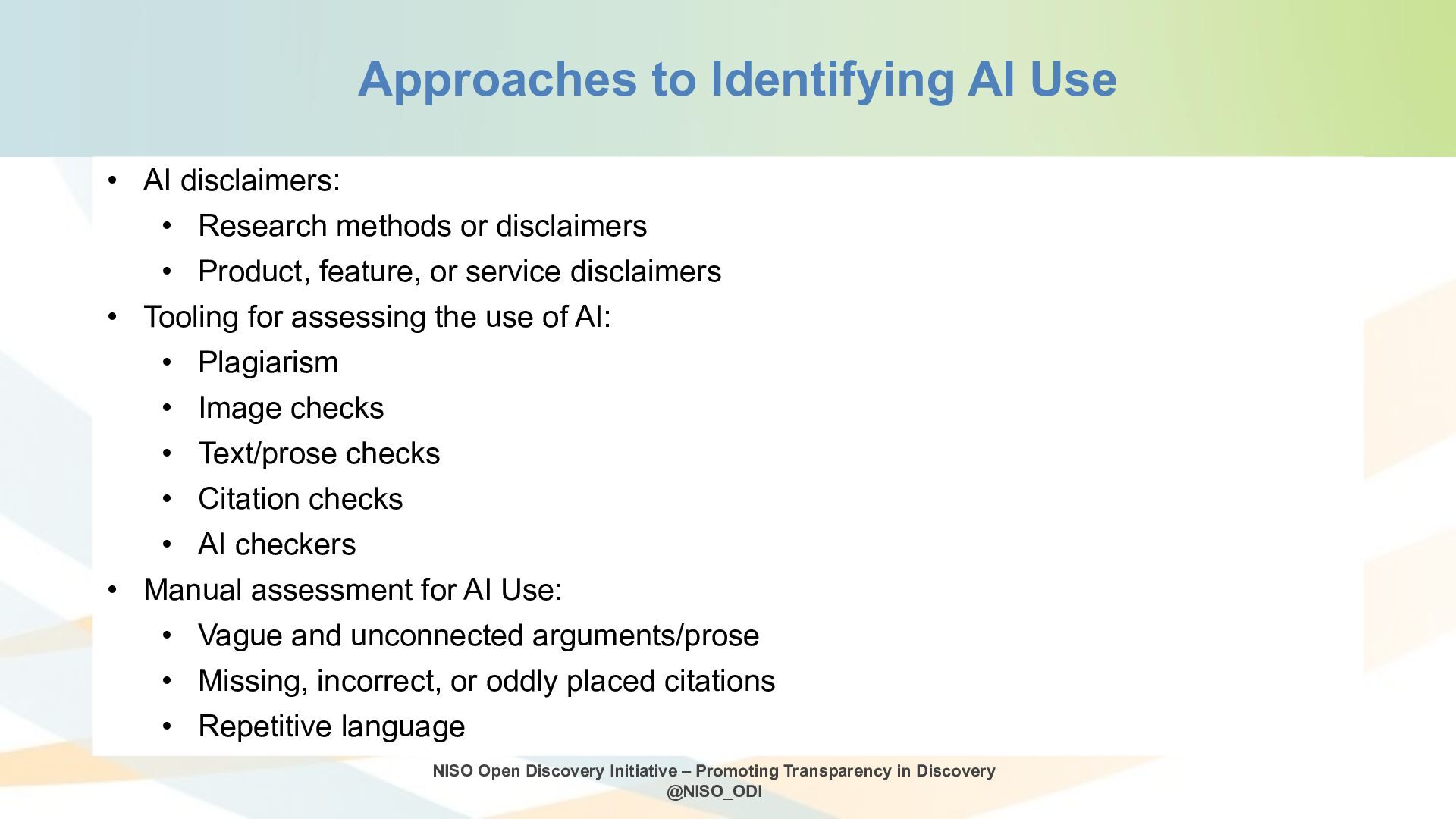
  9. Approaches to Identifying AI Use • AI disclaimers: • Research

    methods or disclaimers • Product, feature, or service disclaimers • Tooling for assessing the use of AI: • Plagiarism • Image checks • Text/prose checks • Citation checks • AI checkers • Manual assessment for AI Use: • Vague and unconnected arguments/prose • Missing, incorrect, or oddly placed citations • Repetitive language NISO Open Discovery Initiative – Promoting Transparency in Discovery @NISO_ODI
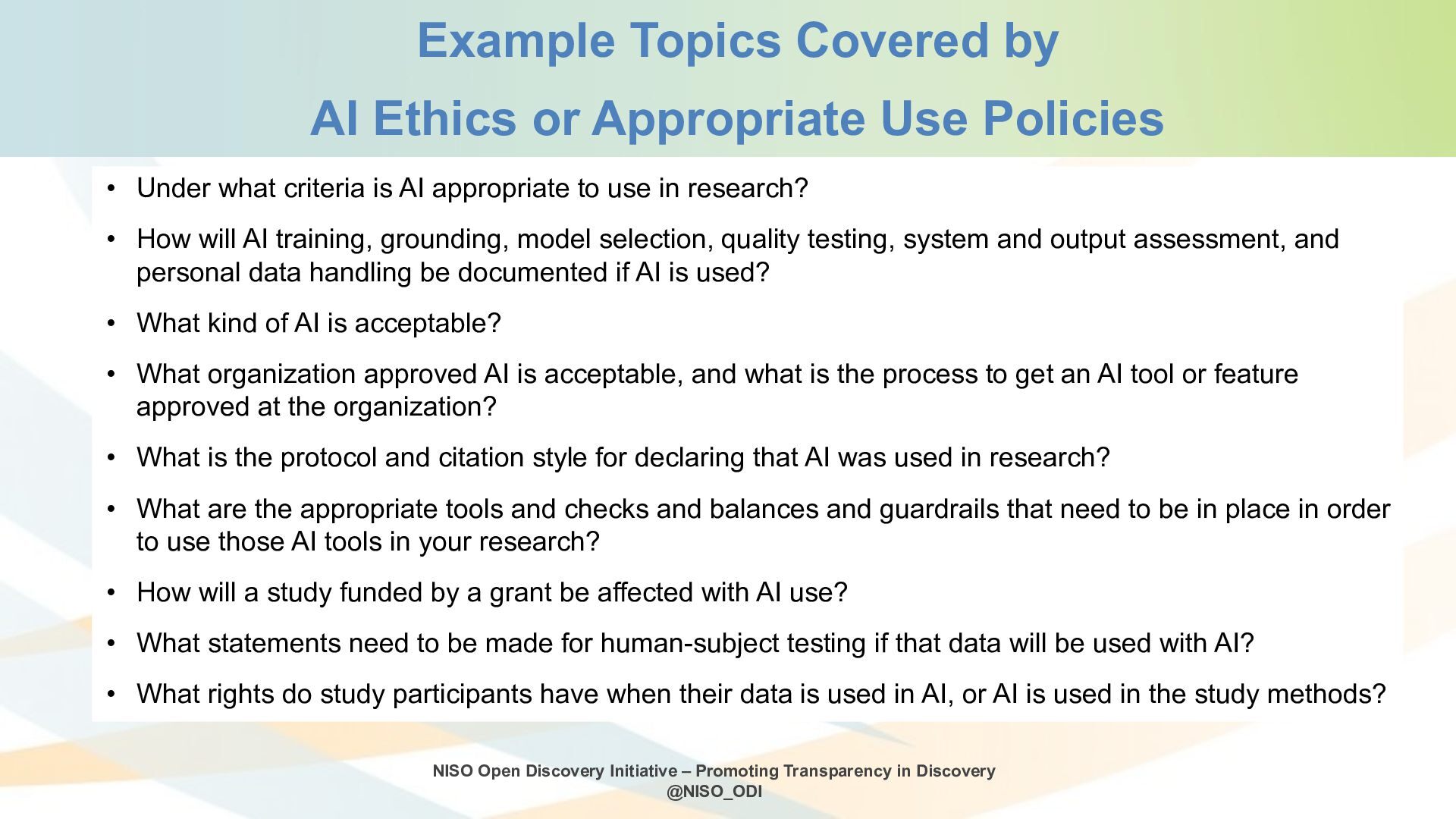
  10. Example Topics Covered by AI Ethics or Appropriate Use Policies

    • Under what criteria is AI appropriate to use in research? • How will AI training, grounding, model selection, quality testing, system and output assessment, and personal data handling be documented if AI is used? • What kind of AI is acceptable? • What organization approved AI is acceptable, and what is the process to get an AI tool or feature approved at the organization? • What is the protocol and citation style for declaring that AI was used in research? • What are the appropriate tools and checks and balances and guardrails that need to be in place in order to use those AI tools in your research? • How will a study funded by a grant be affected with AI use? • What statements need to be made for human-subject testing if that data will be used with AI? • What rights do study participants have when their data is used in AI, or AI is used in the study methods? NISO Open Discovery Initiative – Promoting Transparency in Discovery @NISO_ODI
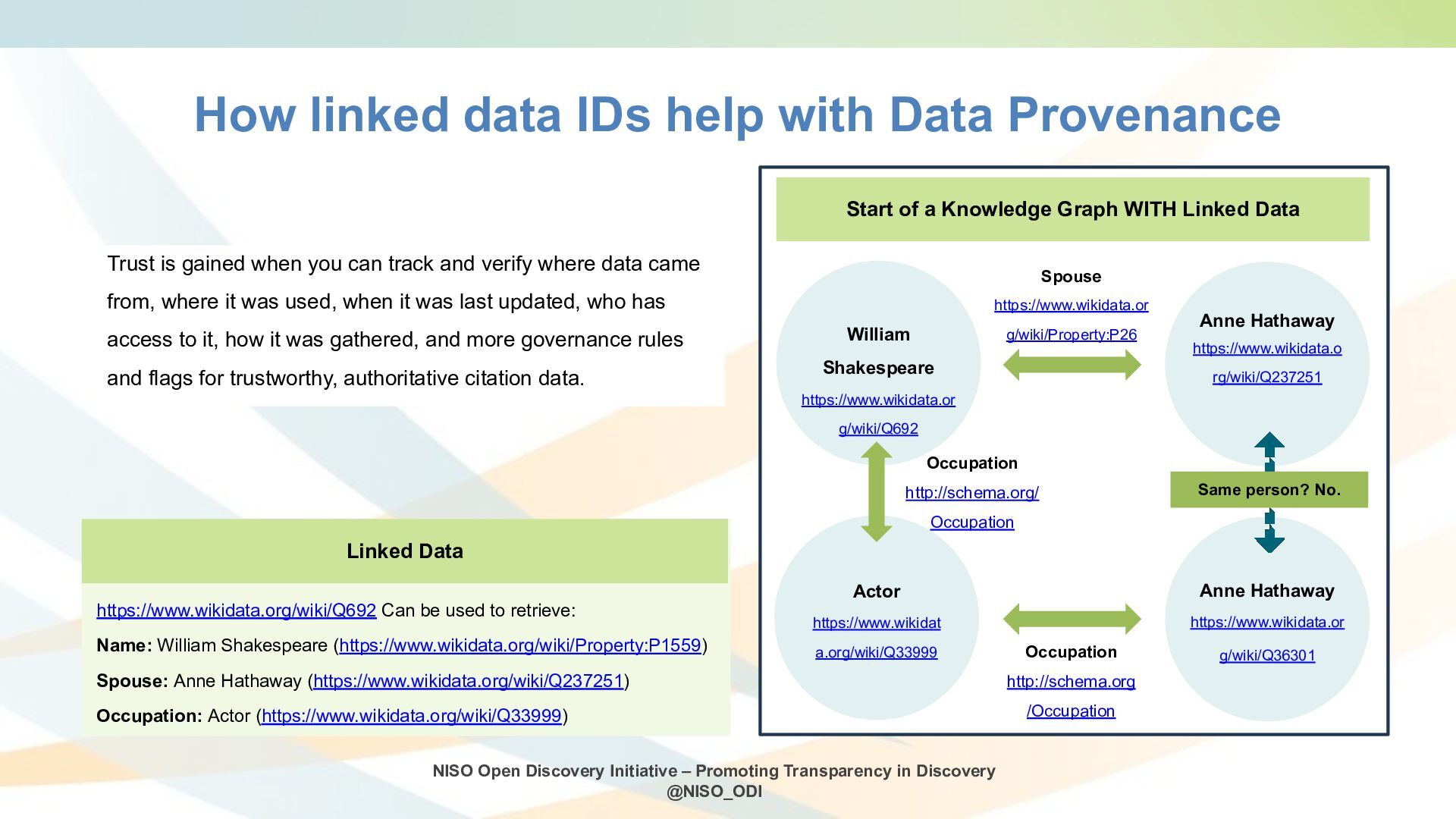
  11. How linked data IDs help with Data Provenance Start of

    a Knowledge Graph WITH Linked Data Trust is gained when you can track and verify where data came Spouse from, where it was used, when it was last updated, who has access to it, how it was gathered, and more governance rules and flags for trustworthy, authoritative citation data. https://www.wikidata.or William g/wiki/Property:P26 Shakespeare Anne Hathaway https://www.wikidata.o rg/wiki/Q237251 https://www.wikidata.or g/wiki/Q692 Occupation http://schema.org/ Same person? No. Occupation Linked Data https://www.wikidata.org/wiki/Q692 Can be used to retrieve: Name: William Shakespeare (https://www.wikidata.org/wiki/Property:P1559) Actor Anne Hathaway https://www.wikidat https://www.wikidata.or a.org/wiki/Q33999 Spouse: Anne Hathaway (https://www.wikidata.org/wiki/Q237251) Occupation: Actor (https://www.wikidata.org/wiki/Q33999) NISO Open Discovery Initiative – Promoting Transparency in Discovery @NISO_ODI Occupation http://schema.org /Occupation g/wiki/Q36301
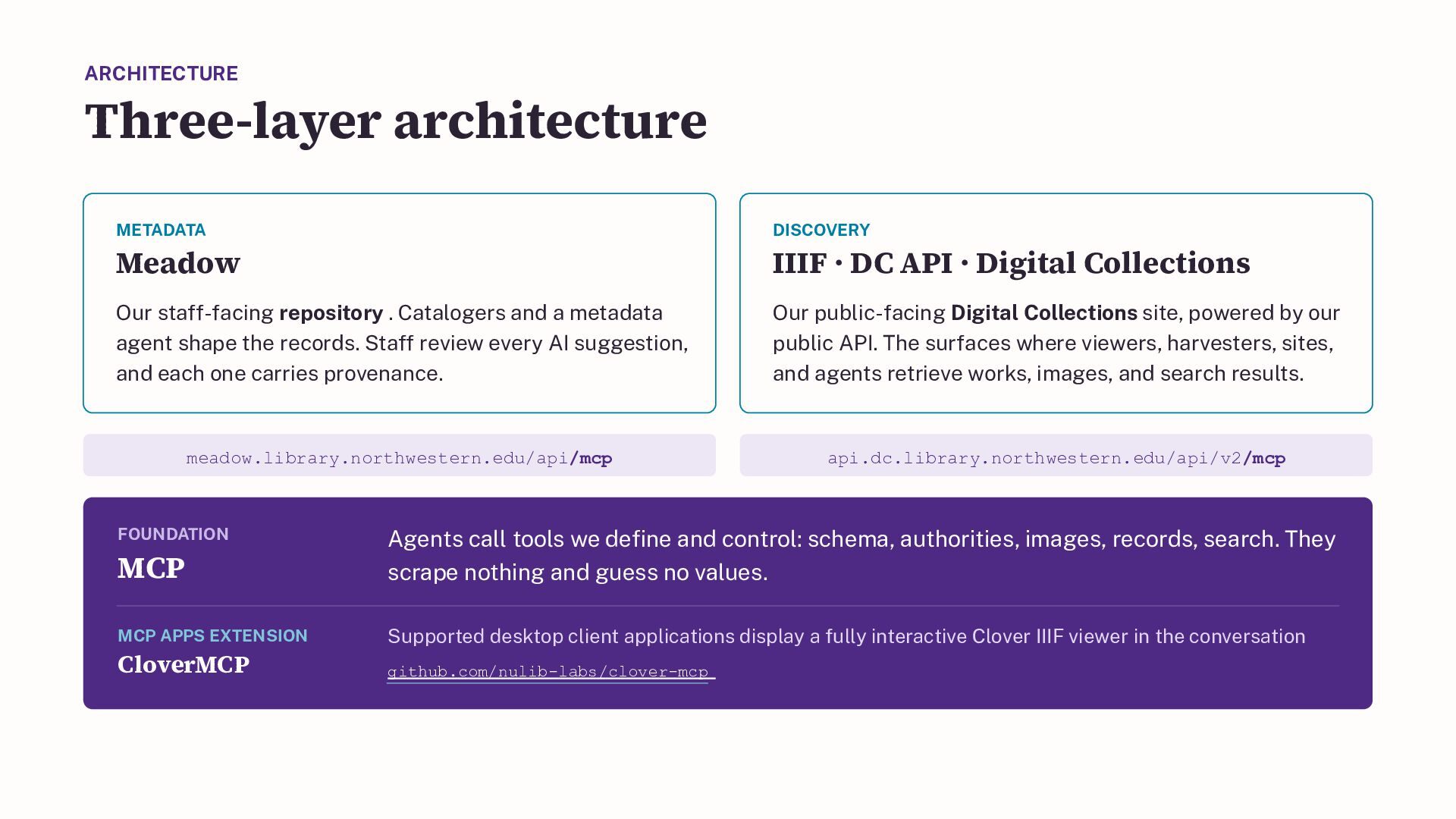
  12. ARCHITECTURE Three-layer architecture METADATA DISCOVERY Meadow IIIF · DC API

    · Digital Collections Our staff-facing repository . Catalogers and a metadata agent shape the records. Staff review every AI suggestion, and each one carries provenance. Our public-facing Digital Collections site, powered by our public API. The surfaces where viewers, harvesters, sites, and agents retrieve works, images, and search results. meadow.library.northwestern.edu/api/mcp api.dc.library.northwestern.edu/api/v2/mcp FOUNDATION MCP Agents call tools we define and control: schema, authorities, images, records, search. They scrape nothing and guess no values. MCP APPS EXTENSION Supported desktop client applications display a fully interactive Clover IIIF viewer in the conversation CloverMCP github.com/nulib-labs/clover-mcp
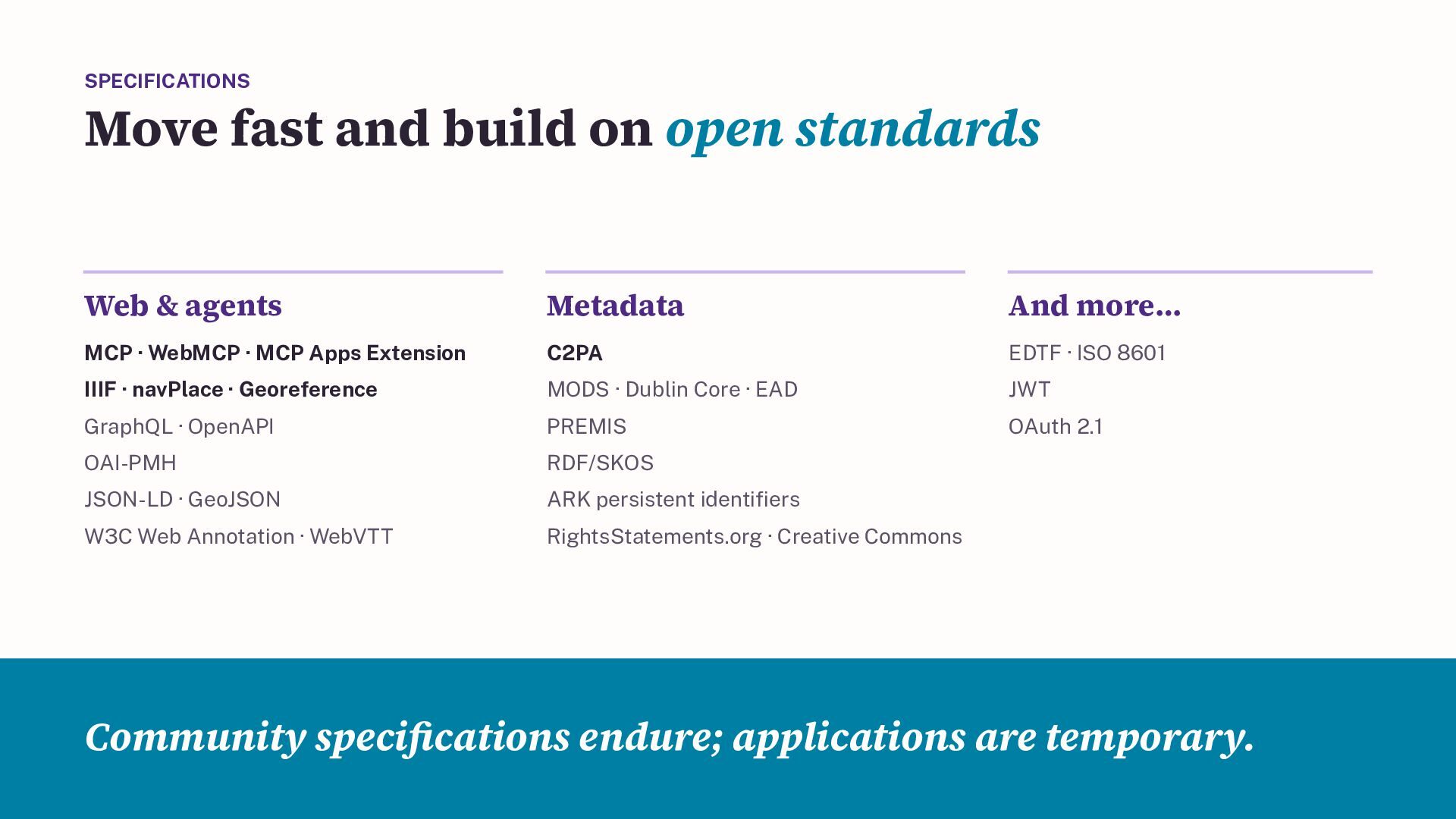
  13. SPECIFICATIONS Move fast and build on open standards Web &

    agents Metadata And more… MCP · WebMCP · MCP Apps Extension C2PA EDTF · ISO 8601 IIIF · navPlace · Georeference MODS · Dublin Core · EAD JWT GraphQL · OpenAPI PREMIS OAuth 2.1 OAI-PMH RDF/SKOS JSON-LD · GeoJSON ARK persistent identifiers W3C Web Annotation · WebVTT RightsStatements.org · Creative Commons Community specifications endure; applications are temporary.
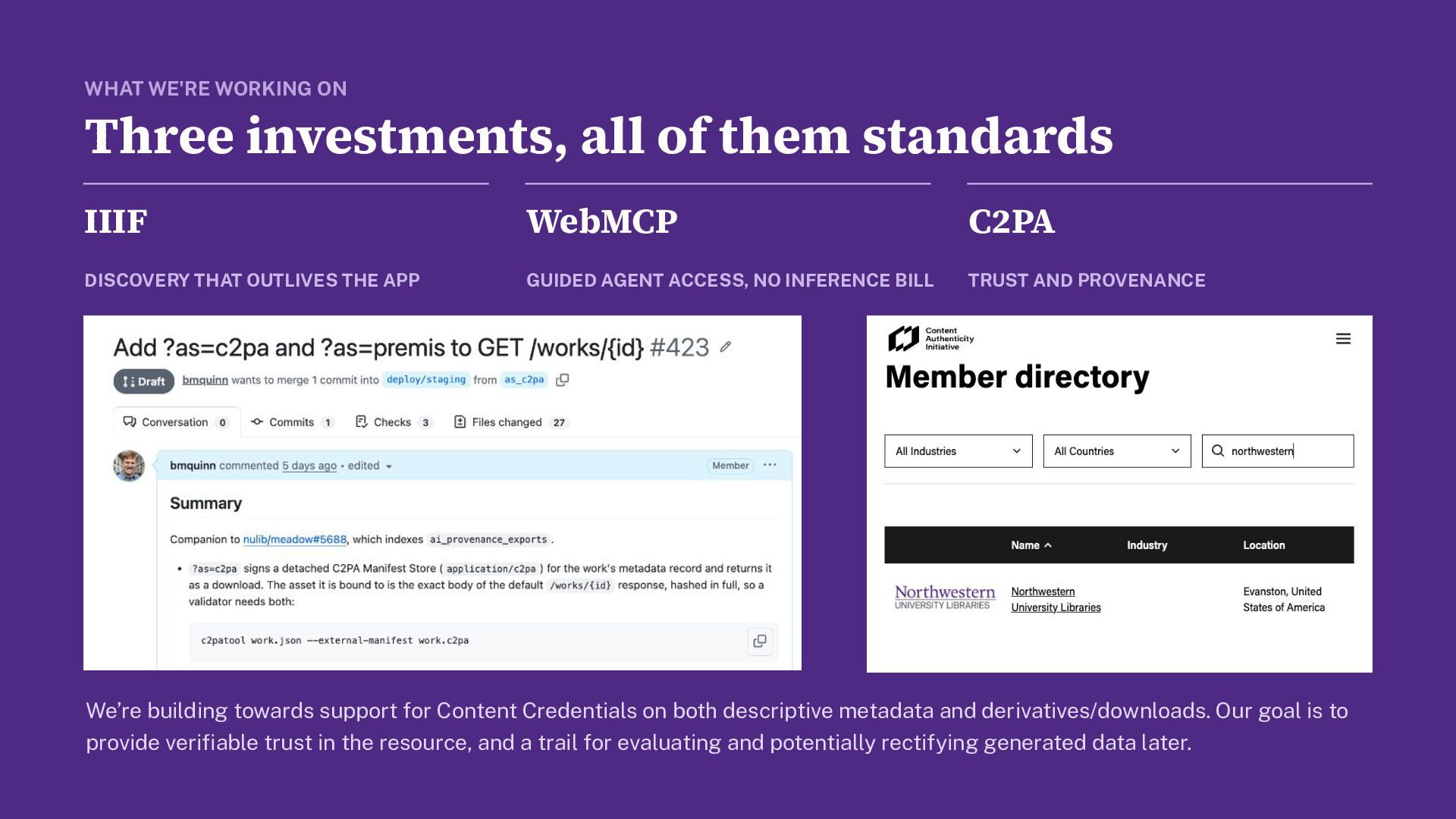
  14. WHAT WE'RE WORKING ON Three investments, all of them standards

    IIIF WebMCP C2PA DISCOVERY THAT OUTLIVES THE APP GUIDED AGENT ACCESS, NO INFERENCE BILL TRUST AND PROVENANCE We’re building towards support for Content Credentials on both descriptive metadata and derivatives/downloads. Our goal is to provide verifiable trust in the resource, and a trail for evaluating and potentially rectifying generated data later.
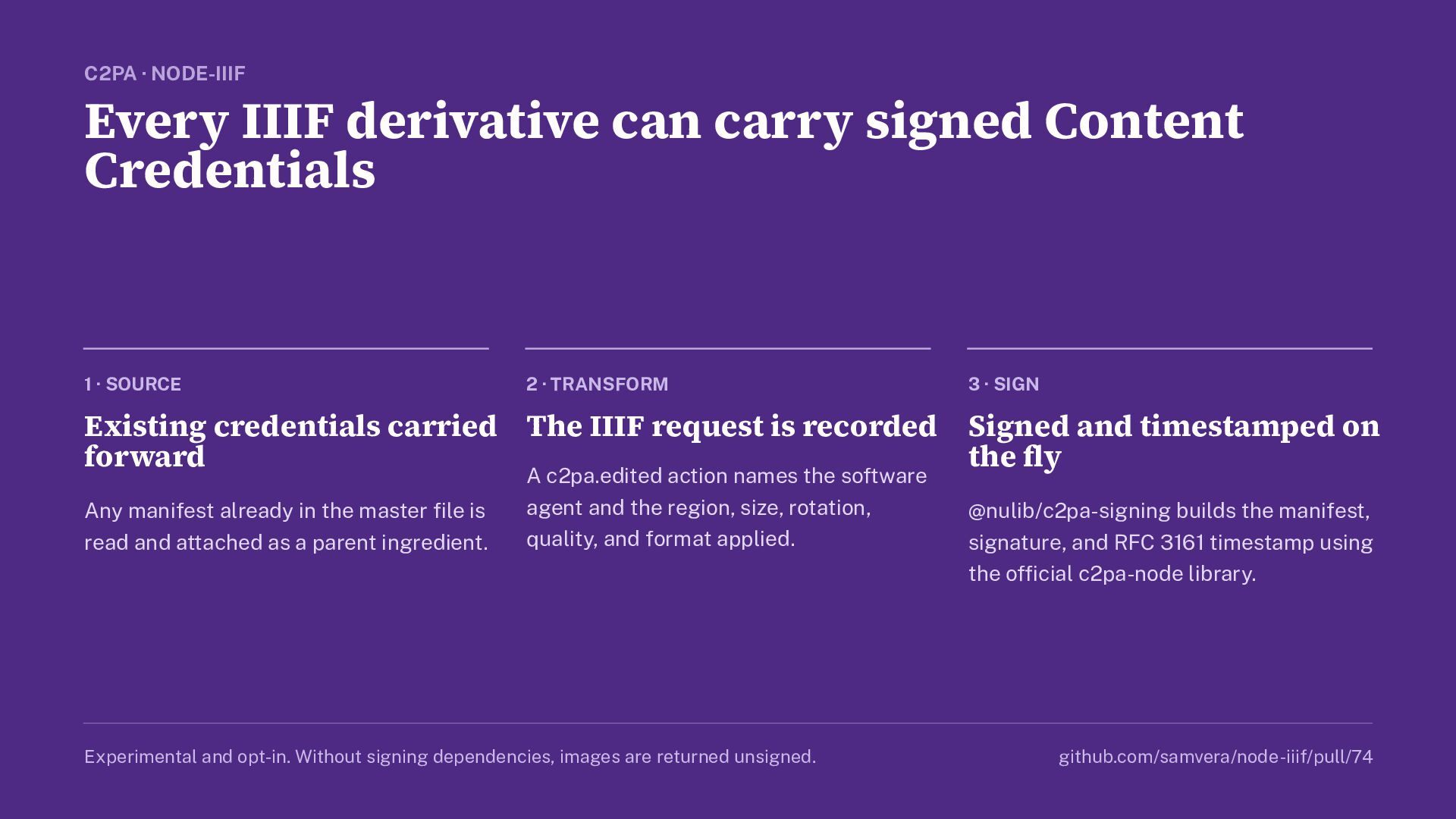
  15. C2PA · NODE-IIIF Every IIIF derivative can carry signed Content

    Credentials 1 · SOURCE 2 · TRANSFORM 3 · SIGN Existing credentials carried The IIIF request is recorded forward Signed and timestamped on the fly Any manifest already in the master file is read and attached as a parent ingredient. @nulib/c2pa-signing builds the manifest, signature, and RFC 3161 timestamp using the official c2pa-node library. A c2pa.edited action names the software agent and the region, size, rotation, quality, and format applied. Experimental and opt-in. Without signing dependencies, images are returned unsigned. github.com/samvera/node-iiif/pull/74
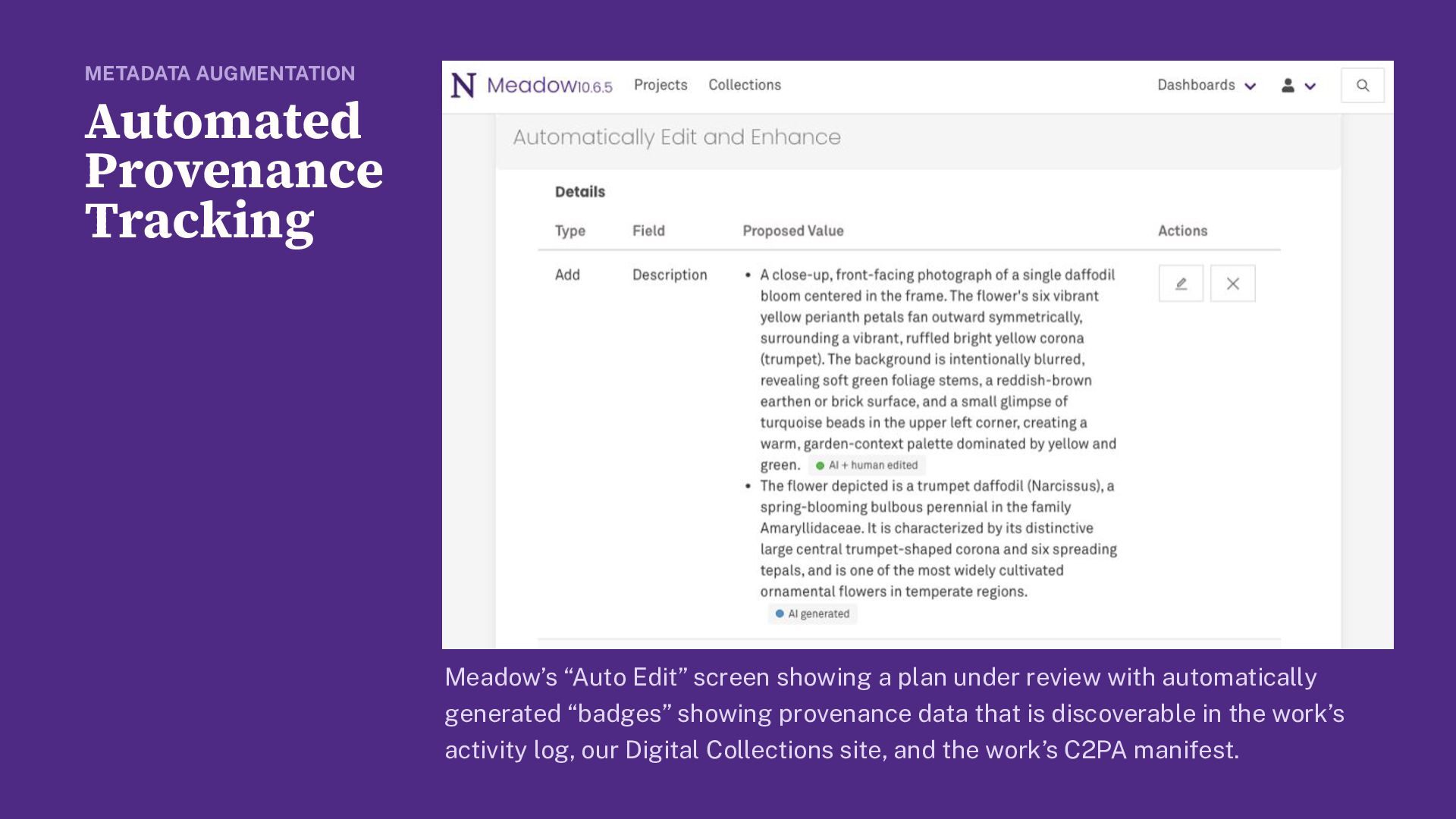
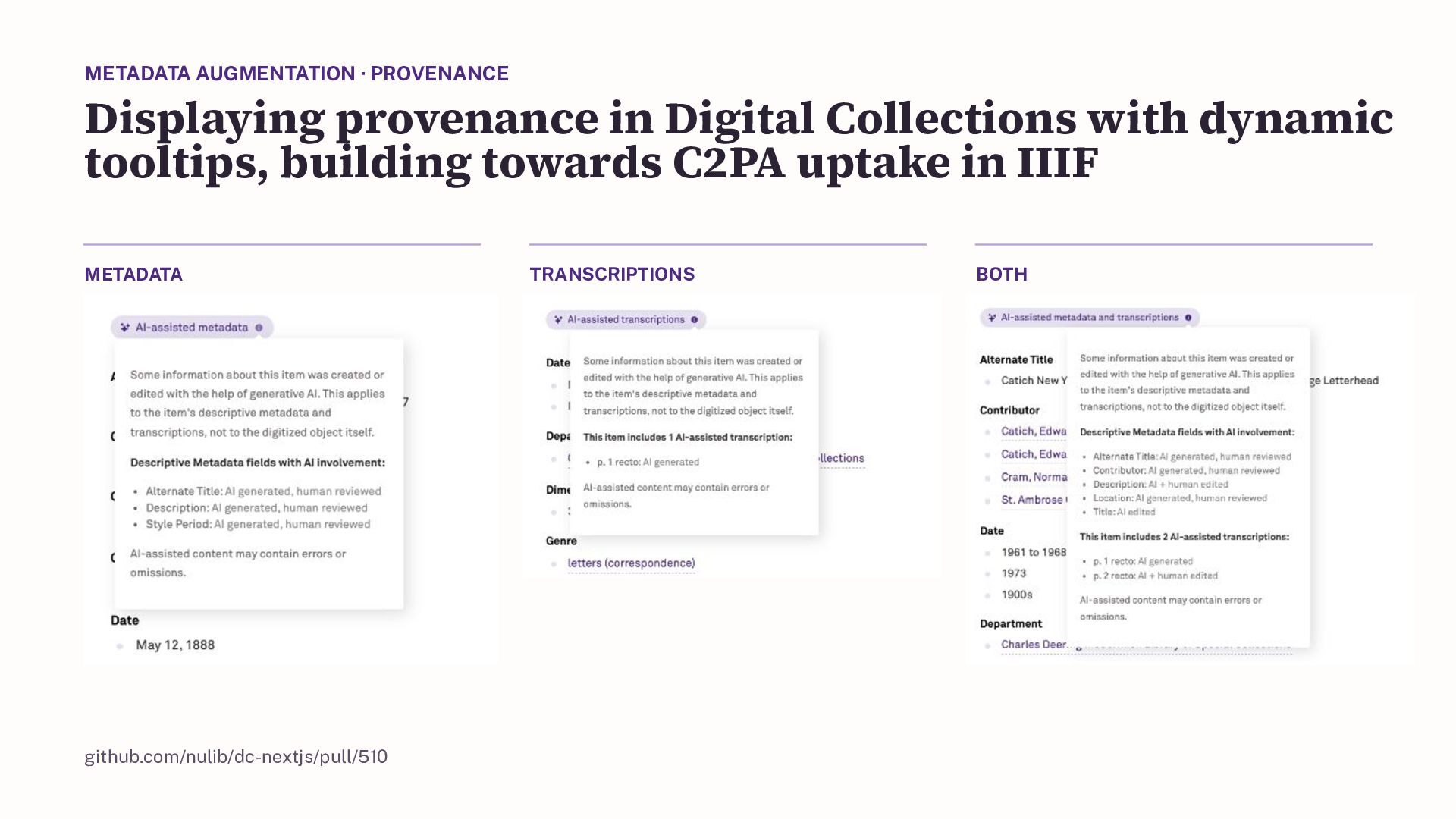
  16. METADATA AUGMENTATION Automated Provenance Tracking Meadow’s “Auto Edit” screen showing

    a plan under review with automatically generated “badges” showing provenance data that is discoverable in the work’s activity log, our Digital Collections site, and the work’s C2PA manifest.
  17. METADATA AUGMENTATION · PROVENANCE Displaying provenance in Digital Collections with

    dynamic tooltips, building towards C2PA uptake in IIIF METADATA github.com/nulib/dc-nextjs/pull/510 TRANSCRIPTIONS BOTH
  18. Thank you! LEARN MORE GET IN TOUCH niso.org/standards-committees/odi [email protected] NISO

    Open Discovery Initiative – Promoting Transparency in Discovery @NISO_ODI