Upgrade to Pro — share decks privately, control downloads, hide ads and more …

Liburd and Stoll Farrell "Copyright Essentials ...

Sponsored · Your Podcast. Everywhere. Effortlessly. Share. Educate. Inspire. Entertain. You do you. We'll handle the rest. →

Liburd and Stoll Farrell "Copyright Essentials From A to AI: A 2026 NISO Training Series, Session Three: Exceptions for Libraries"

This presentation was given by Willa Liburd, Legal Knowledge Management Consultant and Scholarly Communication Professional, and Karen Stoll Farrell, Director, Scholarly Communication and Open Publishing Associate, both of Indiana University Bloomington for the third session of the NISO training series "Copyright Essentials From A to AI." Session Three, "Exceptions for Libraries," was held October 15, 2026.

More Decks by National Information Standards Organization

Other Decks in Education

Transcript

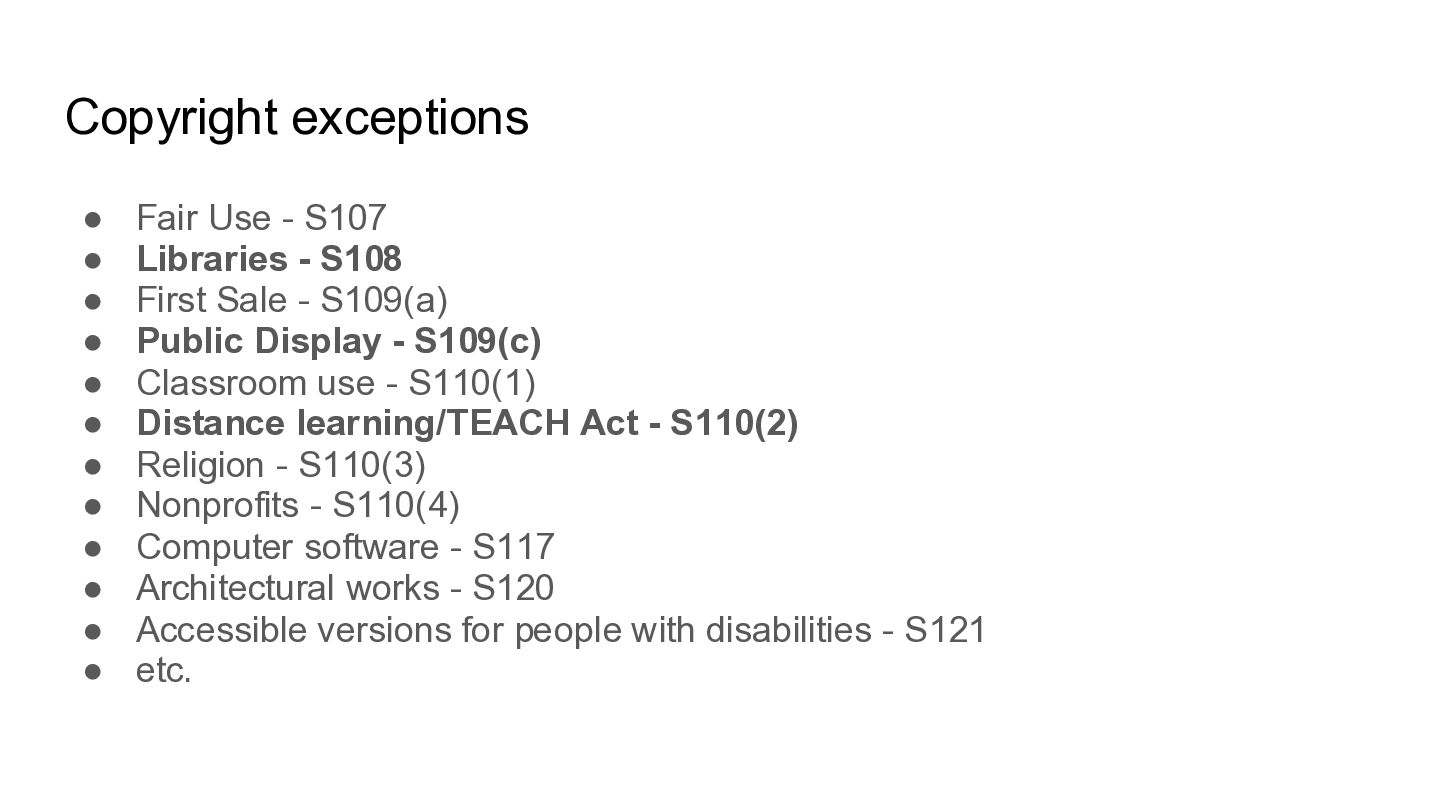
  1. Copyright exceptions • • • • • • • •

    • • • • Fair Use - S107 Libraries - S108 First Sale - S109(a) Public Display - S109(c) Classroom use - S110(1) Distance learning/TEACH Act - S110(2) Religion - S110(3) Nonprofits - S110(4) Computer software - S117 Architectural works - S120 Accessible versions for people with disabilities - S121 etc.
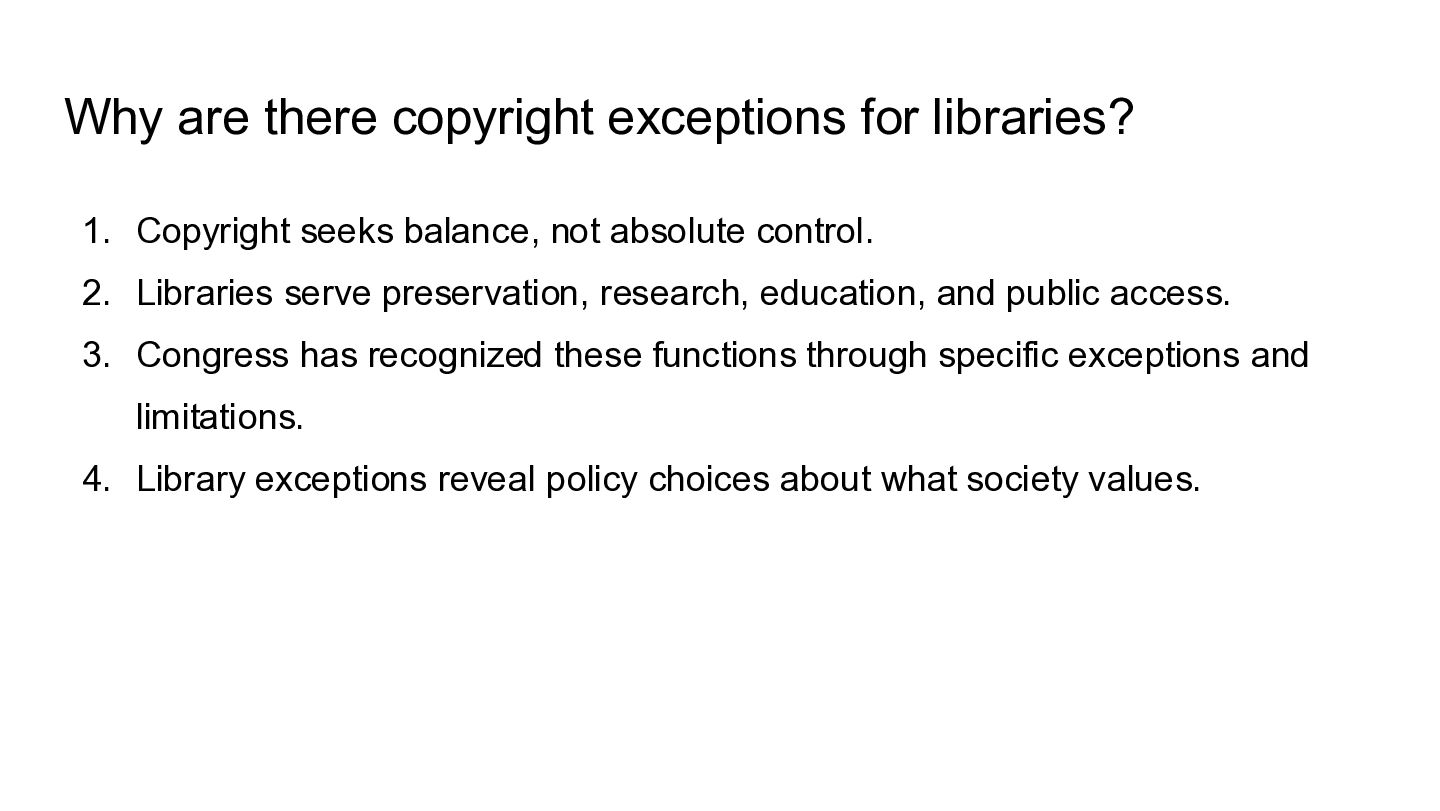
  2. Why are there copyright exceptions for libraries? 1. Copyright seeks

    balance, not absolute control. 2. Libraries serve preservation, research, education, and public access. 3. Congress has recognized these functions through specific exceptions and limitations. 4. Library exceptions reveal policy choices about what society values.
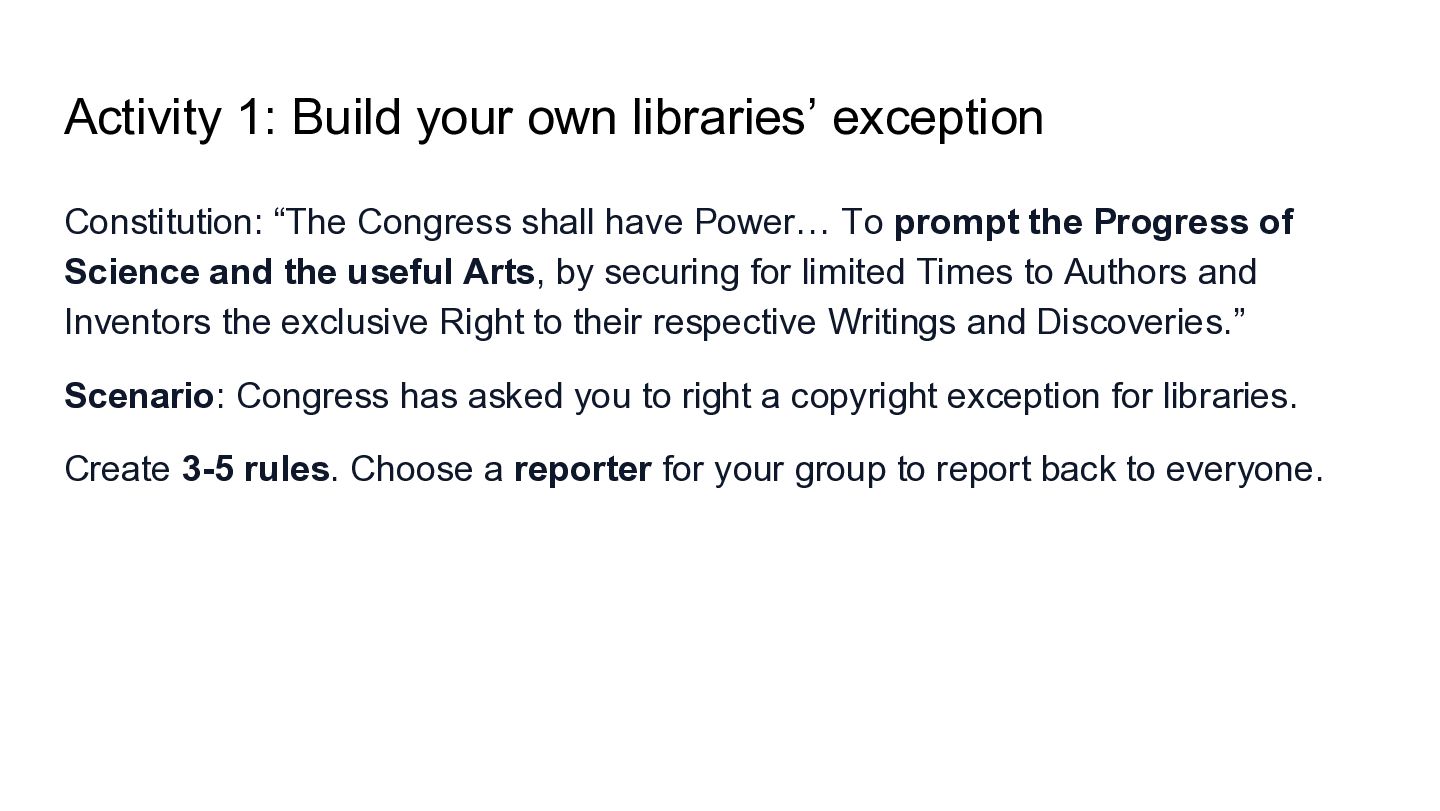
  3. Activity 1: Build your own libraries’ exception Constitution: “The Congress

    shall have Power… To prompt the Progress of Science and the useful Arts, by securing for limited Times to Authors and Inventors the exclusive Right to their respective Writings and Discoveries.” Scenario: Congress has asked you to right a copyright exception for libraries. Create 3-5 rules. Choose a reporter for your group to report back to everyone.
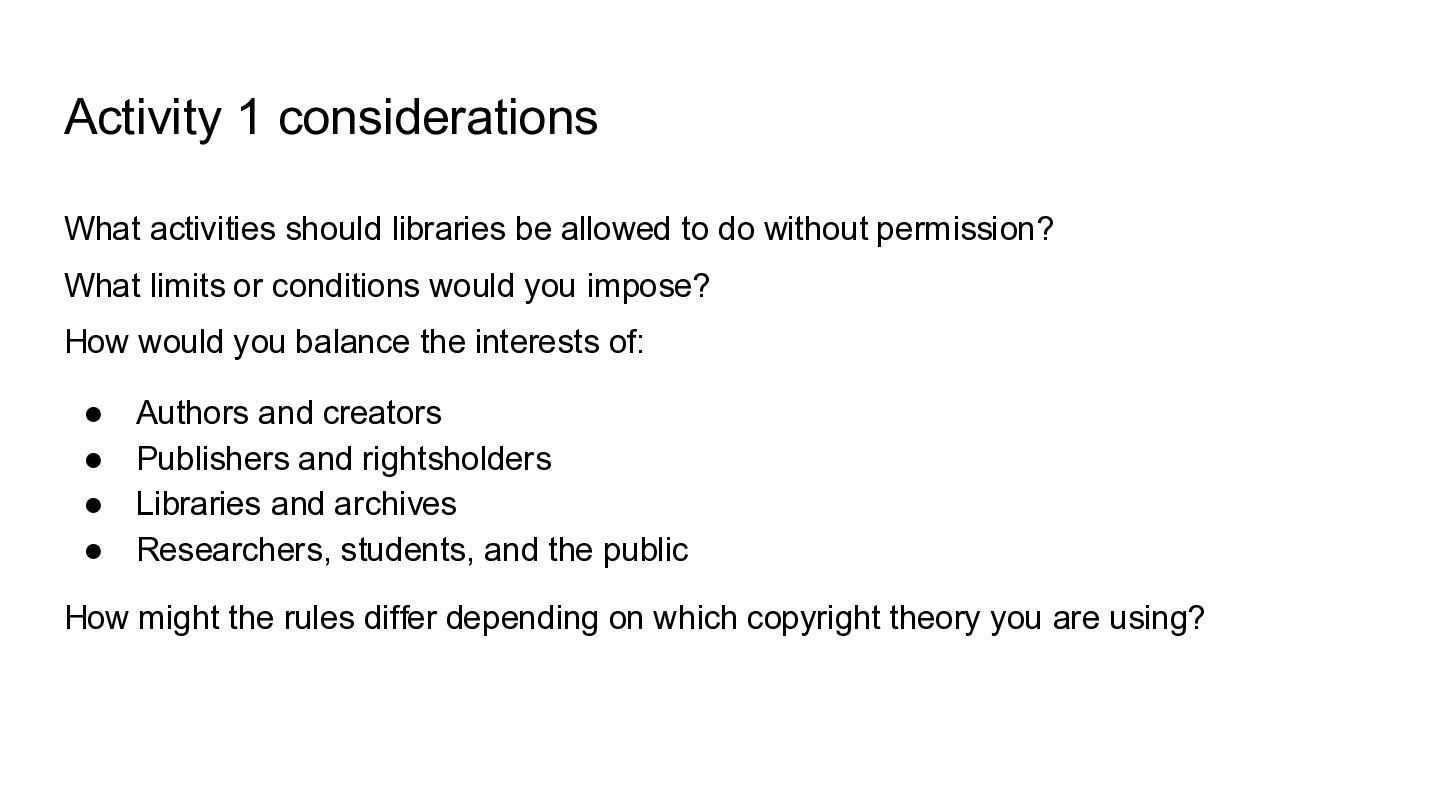
  4. Activity 1 considerations What activities should libraries be allowed to

    do without permission? What limits or conditions would you impose? How would you balance the interests of: • • • • Authors and creators Publishers and rightsholders Libraries and archives Researchers, students, and the public How might the rules differ depending on which copyright theory you are using?
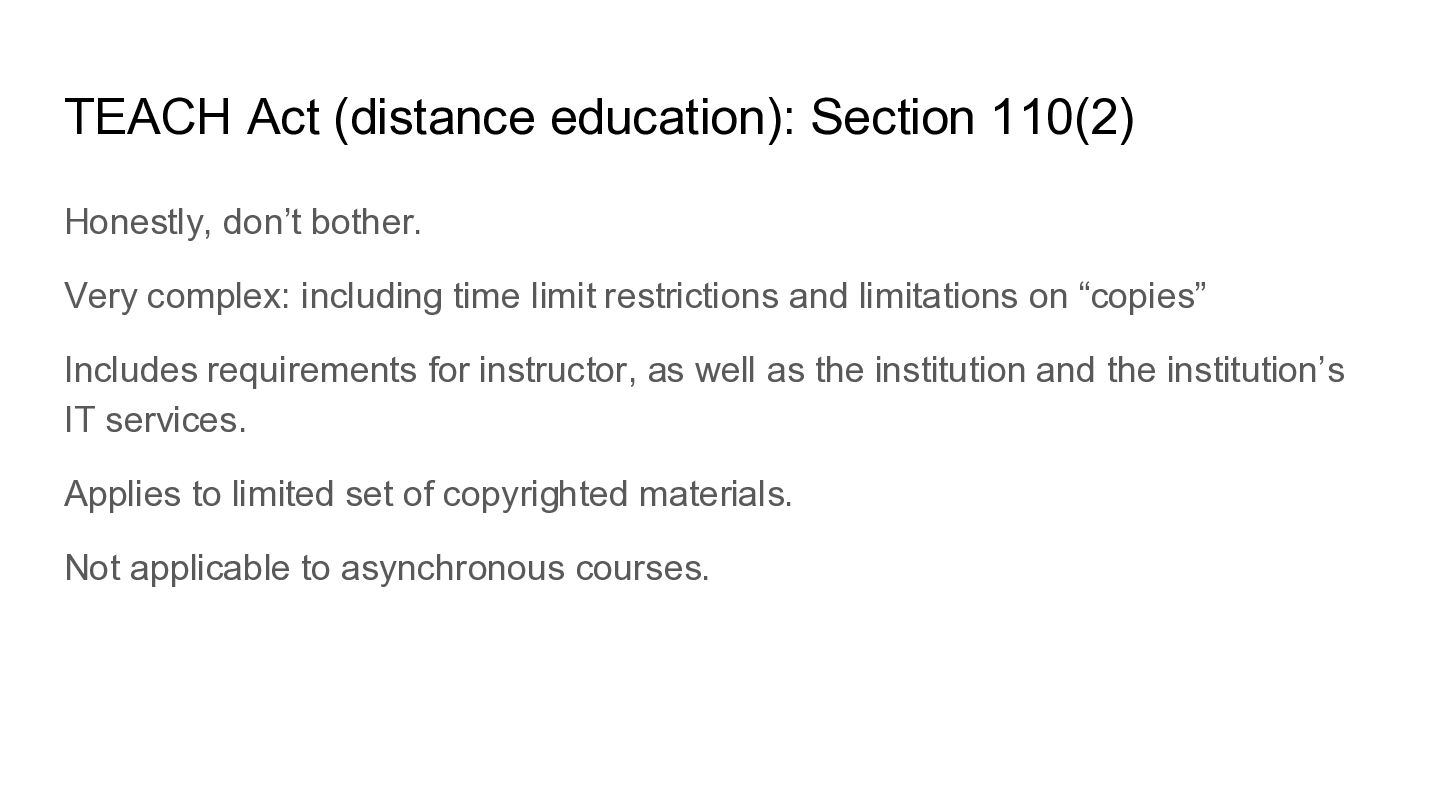
  5. TEACH Act (distance education): Section 110(2) Honestly, don’t bother. Very

    complex: including time limit restrictions and limitations on “copies” Includes requirements for instructor, as well as the institution and the institution’s IT services. Applies to limited set of copyrighted materials. Not applicable to asynchronous courses.
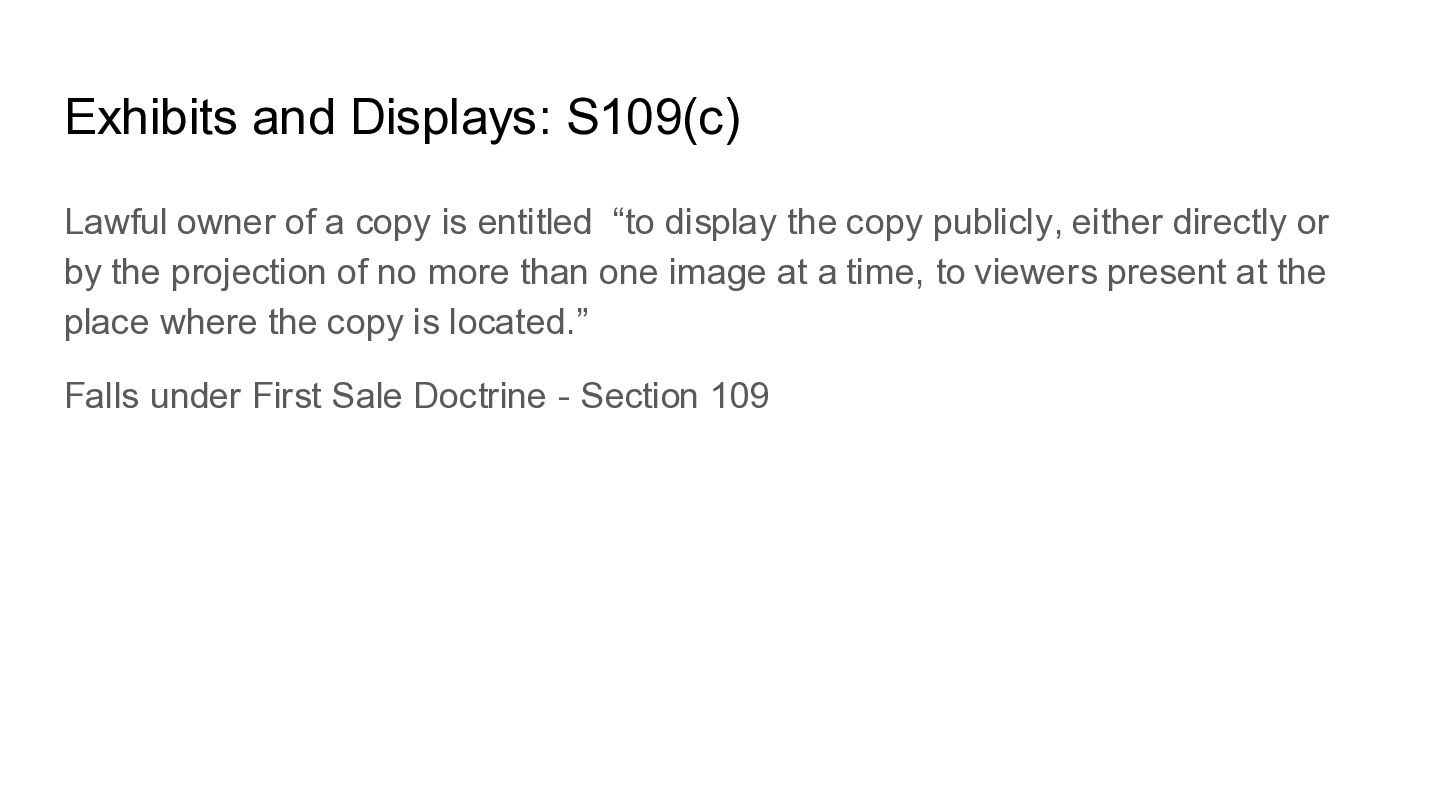
  6. Exhibits and Displays: S109(c) Lawful owner of a copy is

    entitled “to display the copy publicly, either directly or by the projection of no more than one image at a time, to viewers present at the place where the copy is located.” Falls under First Sale Doctrine - Section 109
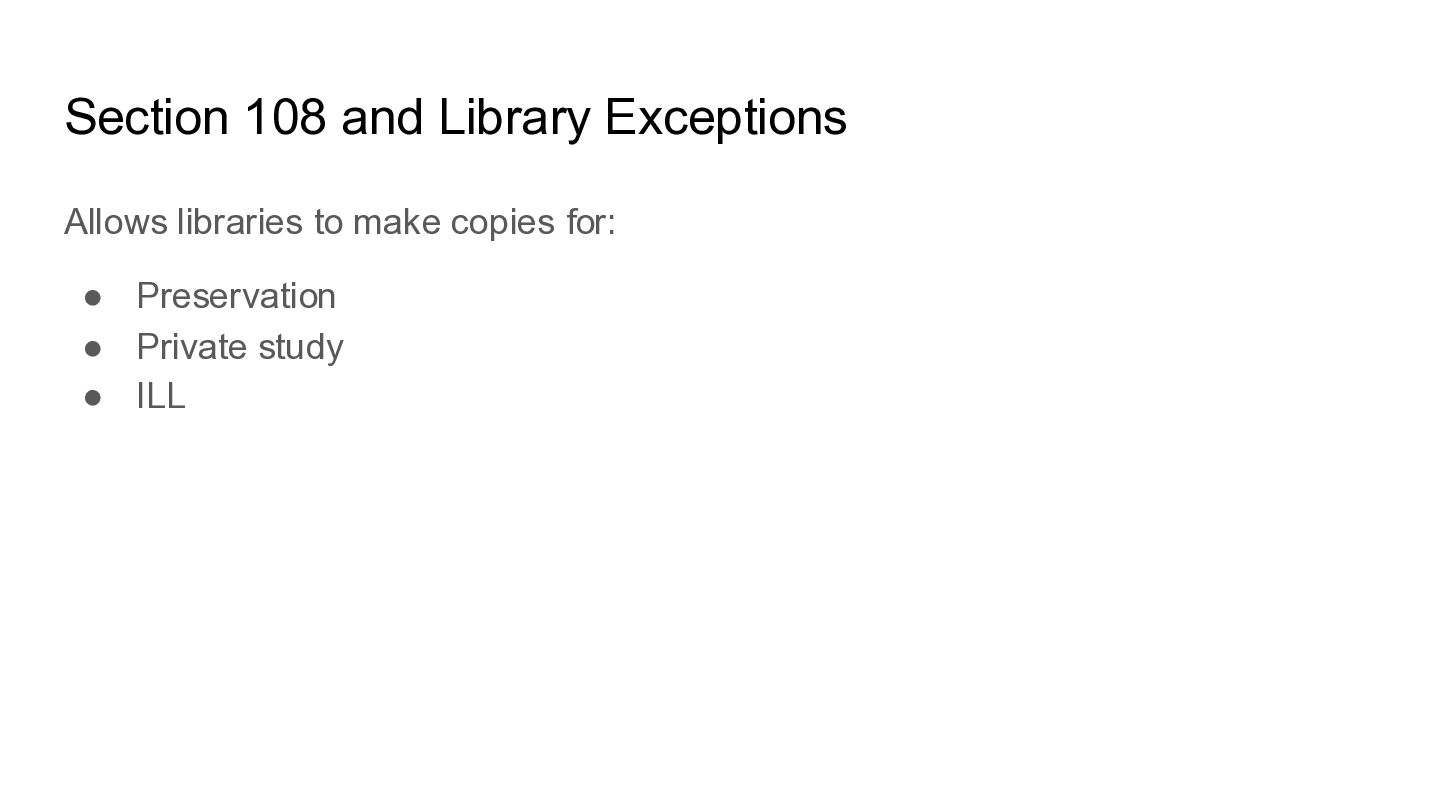
  7. Section 108 and Library Exceptions Allows libraries to make copies

    for: • Preservation • Private study • ILL
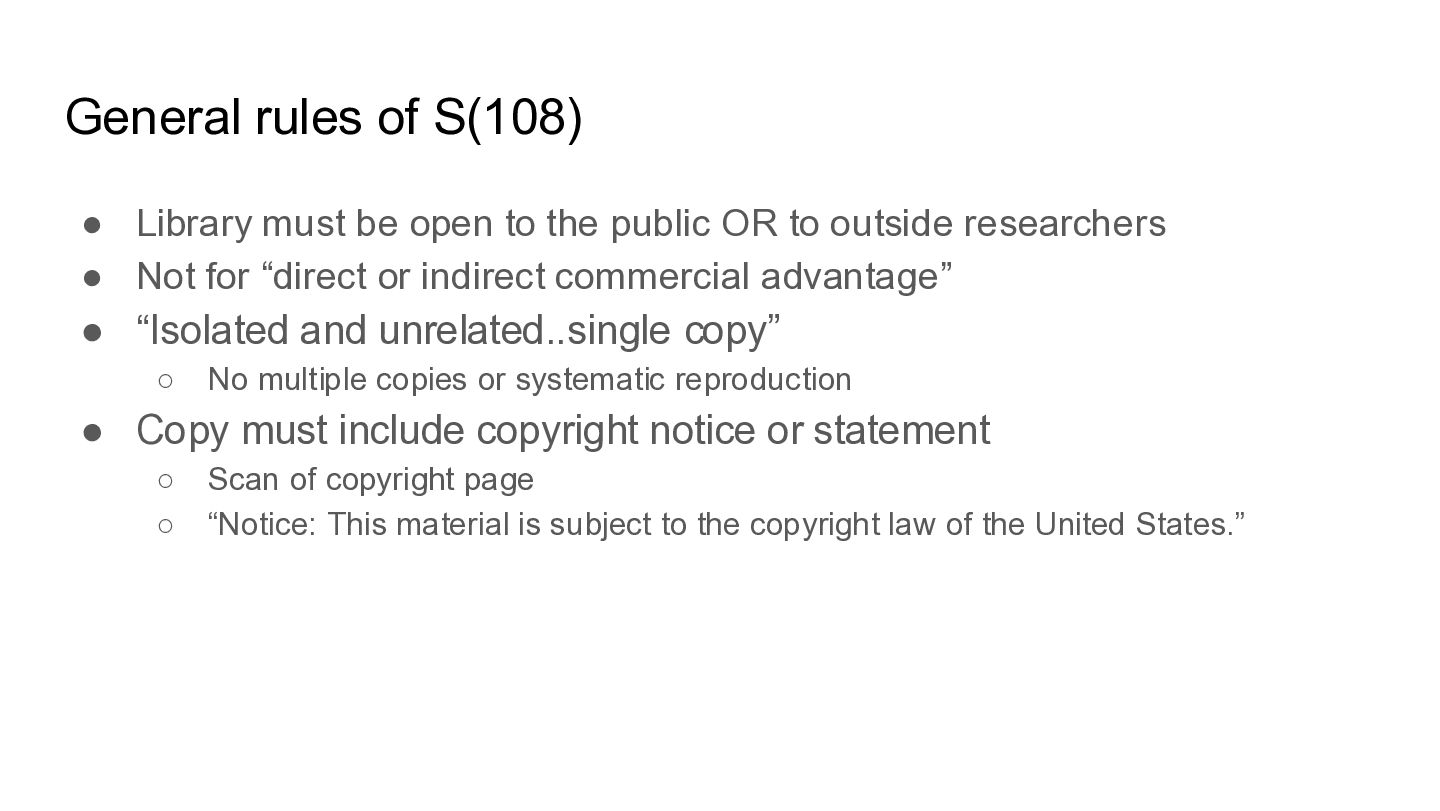
  8. General rules of S(108) • Library must be open to

    the public OR to outside researchers • Not for “direct or indirect commercial advantage” • “Isolated and unrelated..single copy” ◦ No multiple copies or systematic reproduction • Copy must include copyright notice or statement ◦ ◦ Scan of copyright page “Notice: This material is subject to the copyright law of the United States.”
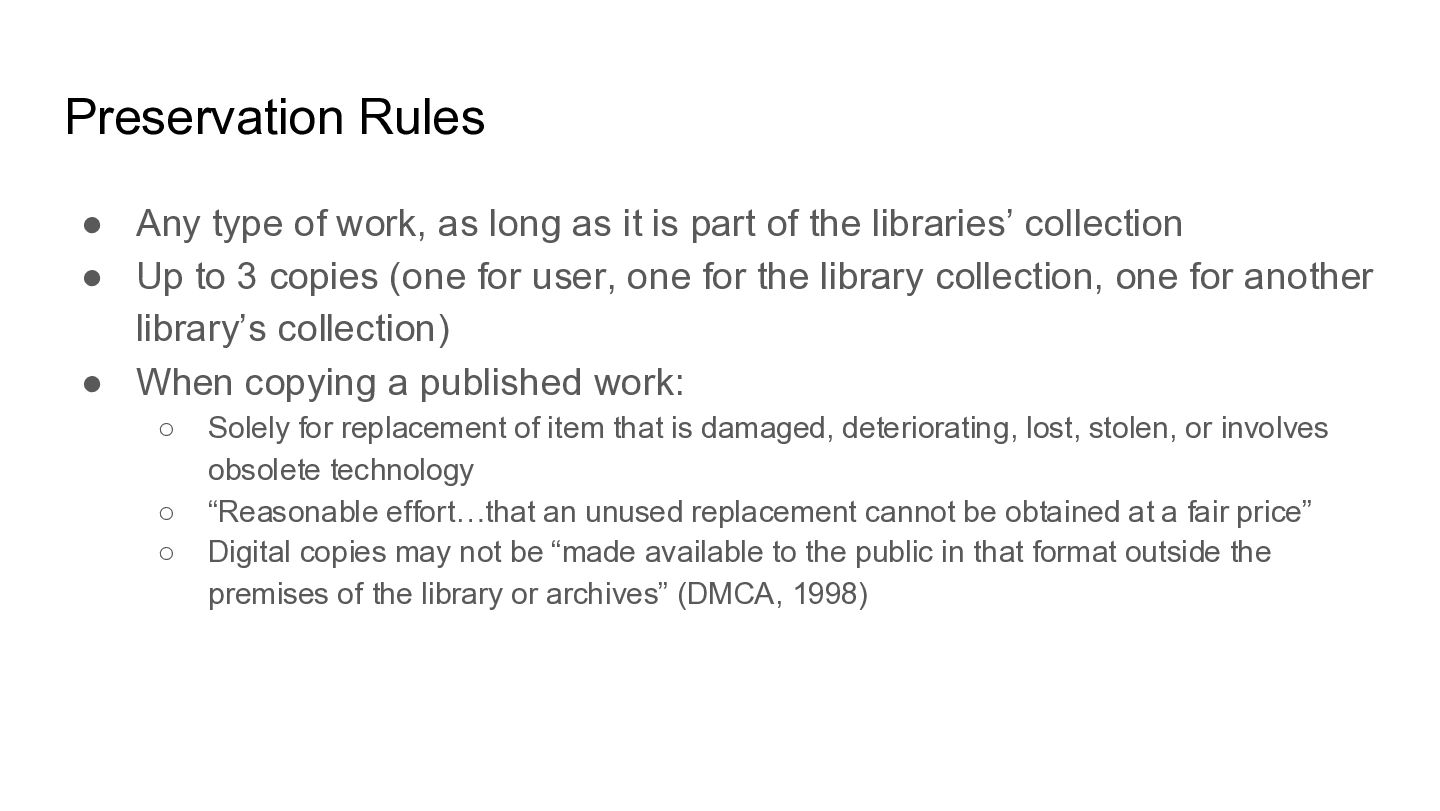
  9. Preservation Rules • Any type of work, as long as

    it is part of the libraries’ collection • Up to 3 copies (one for user, one for the library collection, one for another library’s collection) • When copying a published work: ◦ ◦ ◦ Solely for replacement of item that is damaged, deteriorating, lost, stolen, or involves obsolete technology “Reasonable effort…that an unused replacement cannot be obtained at a fair price” Digital copies may not be “made available to the public in that format outside the premises of the library or archives” (DMCA, 1998)
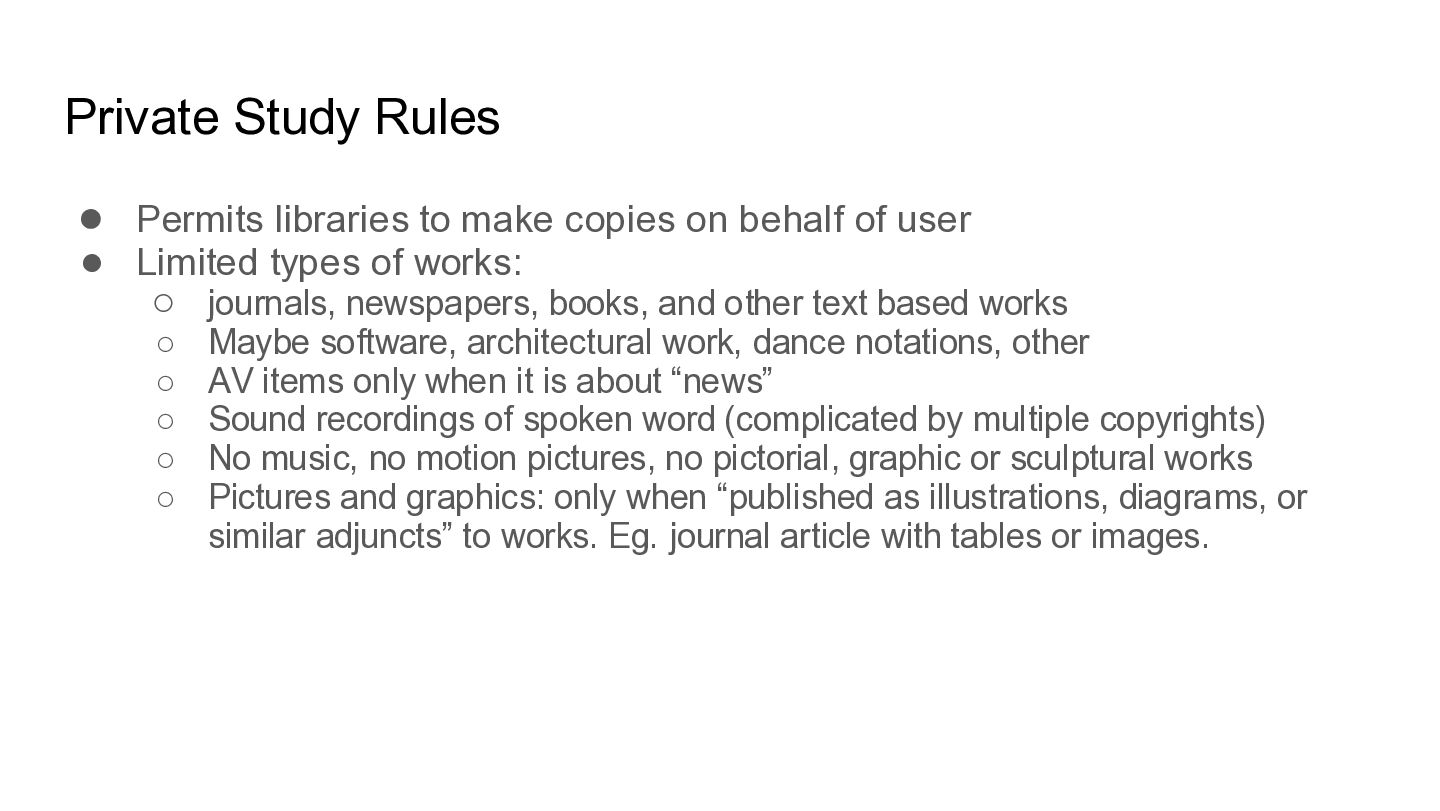
  10. Private Study Rules • Permits libraries to make copies on

    behalf of user • Limited types of works: ◦ journals, newspapers, books, and other text based works ◦ ◦ ◦ ◦ ◦ Maybe software, architectural work, dance notations, other AV items only when it is about “news” Sound recordings of spoken word (complicated by multiple copyrights) No music, no motion pictures, no pictorial, graphic or sculptural works Pictures and graphics: only when “published as illustrations, diagrams, or similar adjuncts” to works. Eg. journal article with tables or images.
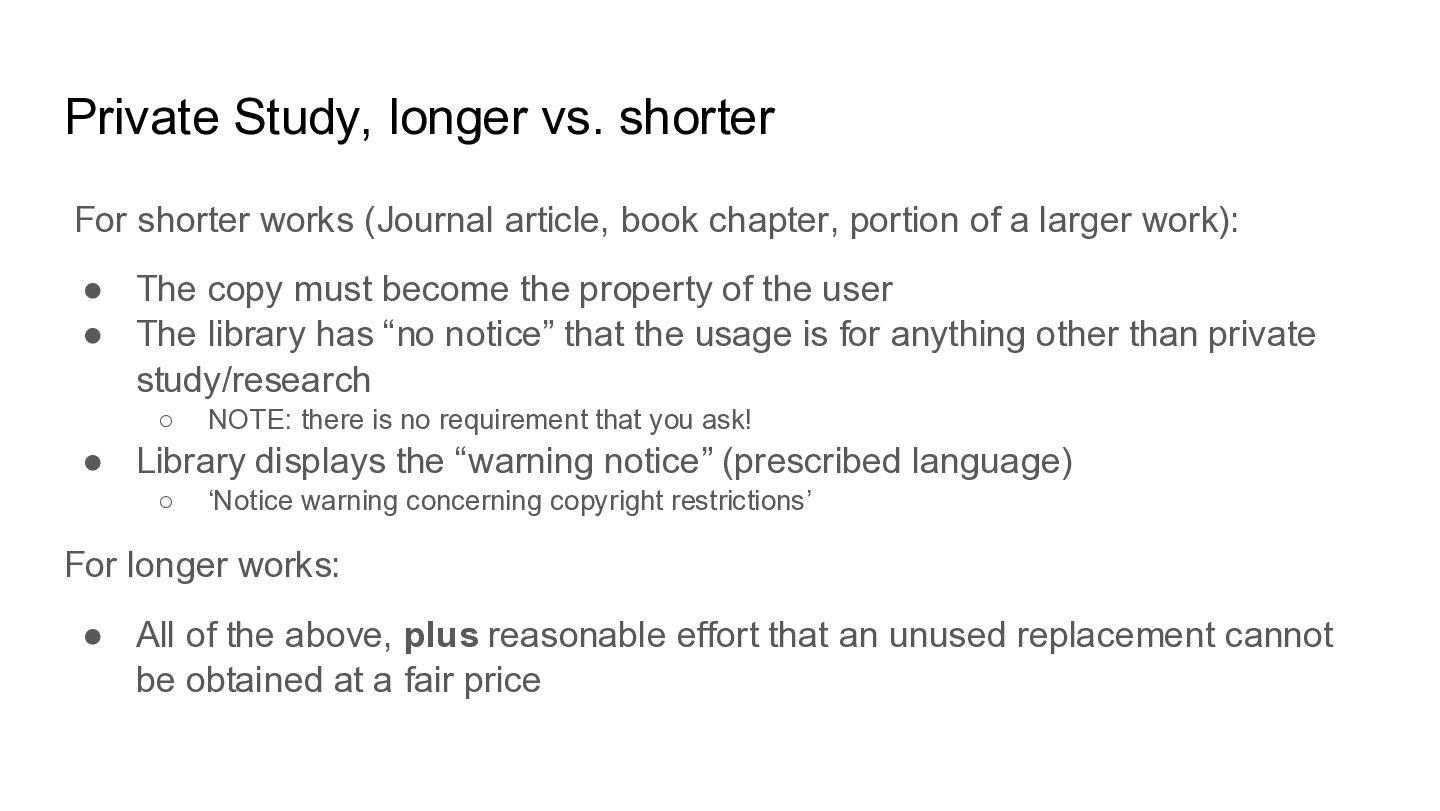
  11. Private Study, longer vs. shorter For shorter works (Journal article,

    book chapter, portion of a larger work): • The copy must become the property of the user • The library has “no notice” that the usage is for anything other than private study/research ◦ NOTE: there is no requirement that you ask! • Library displays the “warning notice” (prescribed language) ◦ ‘Notice warning concerning copyright restrictions’ For longer works: • All of the above, plus reasonable effort that an unused replacement cannot be obtained at a fair price
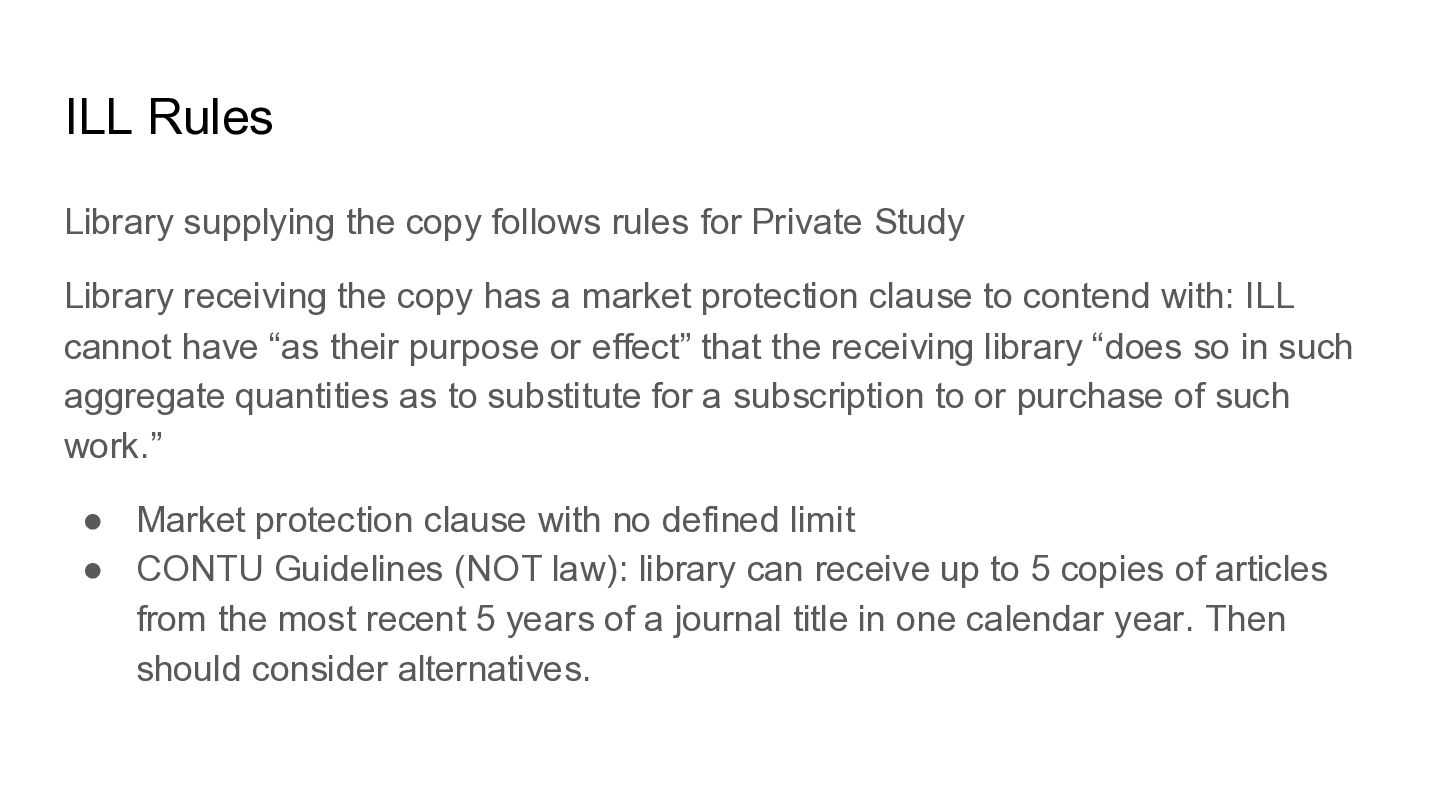
  12. ILL Rules Library supplying the copy follows rules for Private

    Study Library receiving the copy has a market protection clause to contend with: ILL cannot have “as their purpose or effect” that the receiving library “does so in such aggregate quantities as to substitute for a subscription to or purchase of such work.” • Market protection clause with no defined limit • CONTU Guidelines (NOT law): library can receive up to 5 copies of articles from the most recent 5 years of a journal title in one calendar year. Then should consider alternatives.
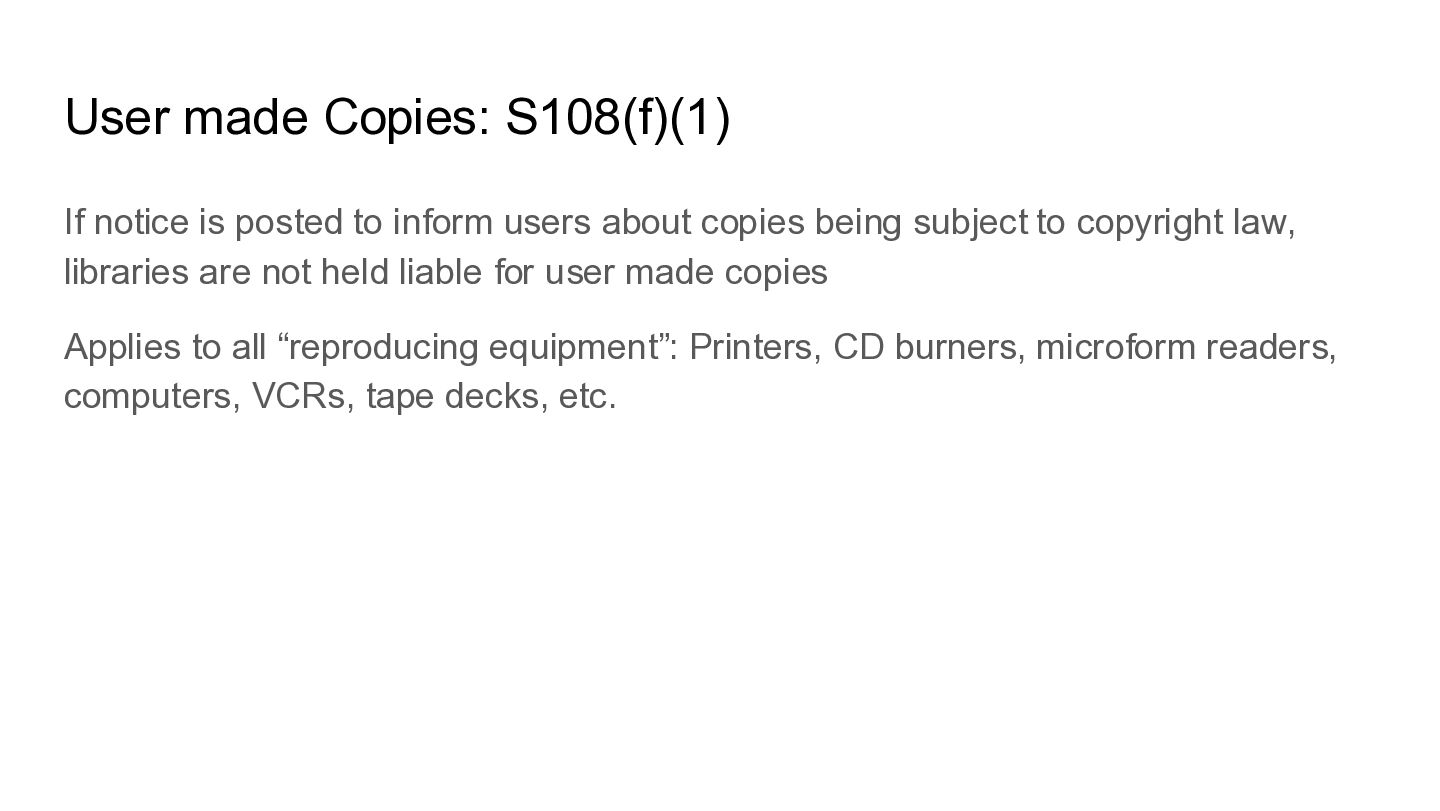
  13. User made Copies: S108(f)(1) If notice is posted to inform

    users about copies being subject to copyright law, libraries are not held liable for user made copies Applies to all “reproducing equipment”: Printers, CD burners, microform readers, computers, VCRs, tape decks, etc.
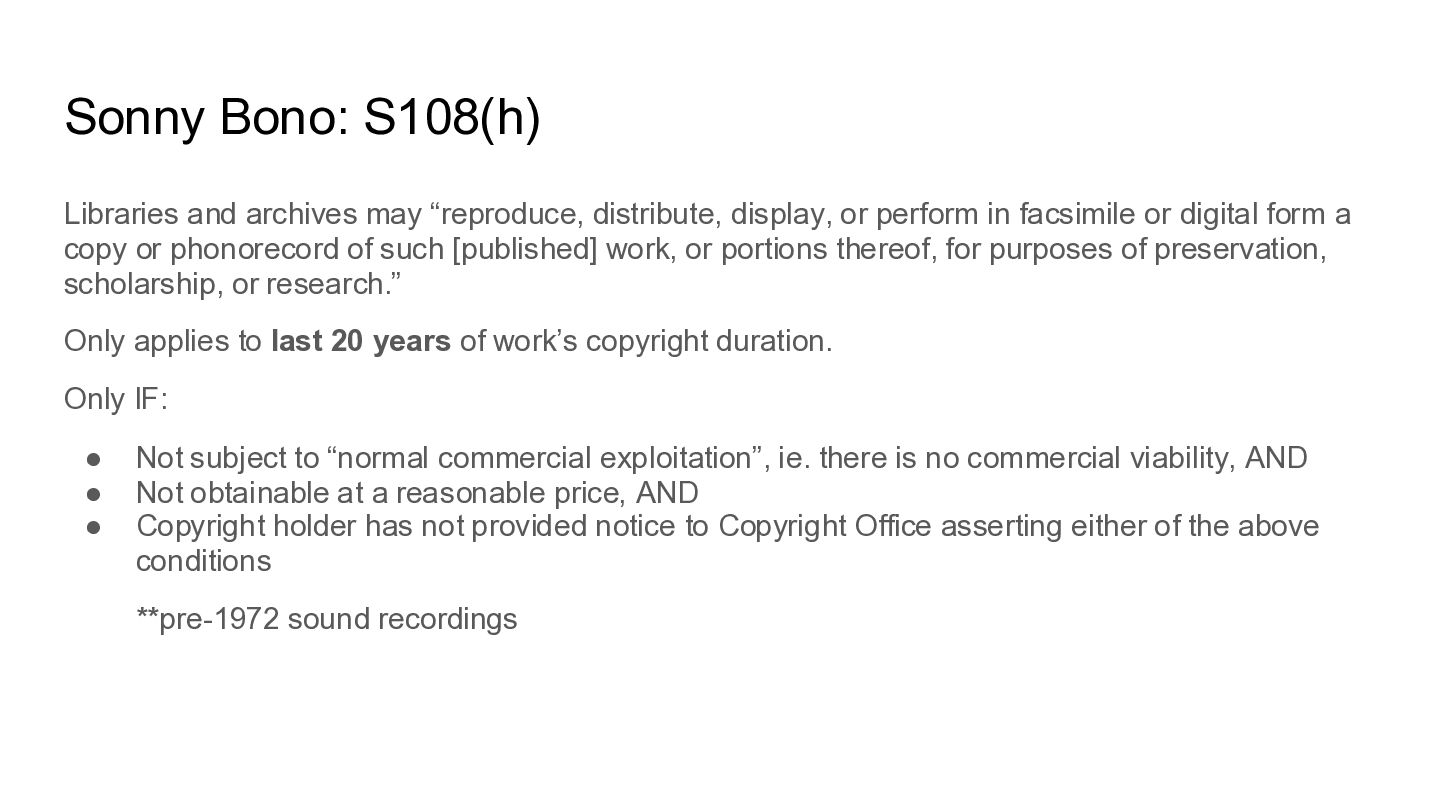
  14. Sonny Bono: S108(h) Libraries and archives may “reproduce, distribute, display,

    or perform in facsimile or digital form a copy or phonorecord of such [published] work, or portions thereof, for purposes of preservation, scholarship, or research.” Only applies to last 20 years of work’s copyright duration. Only IF: • • • Not subject to “normal commercial exploitation”, ie. there is no commercial viability, AND Not obtainable at a reasonable price, AND Copyright holder has not provided notice to Copyright Office asserting either of the above conditions **pre-1972 sound recordings
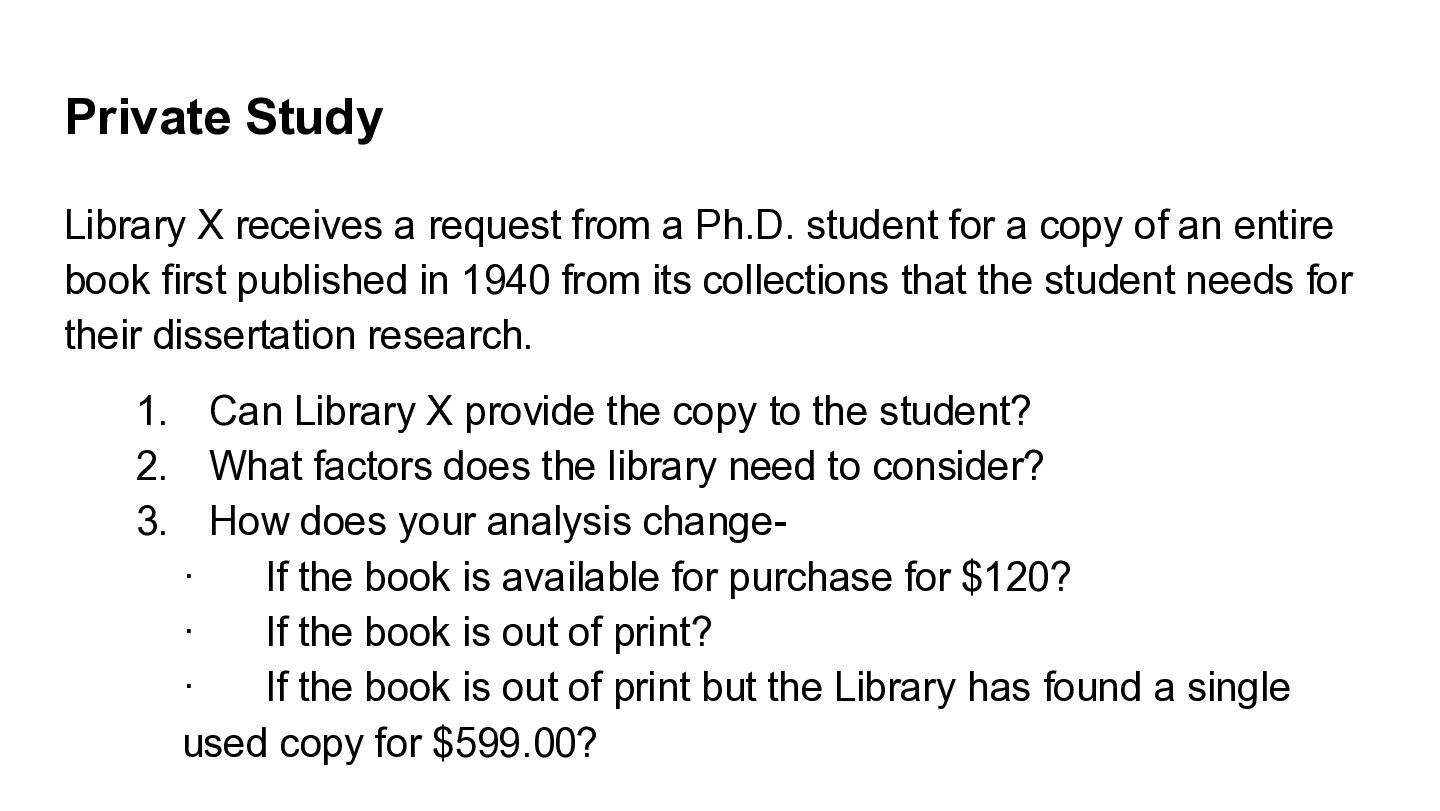
  15. Private Study Library X receives a request from a Ph.D.

    student for a copy of an entire book first published in 1940 from its collections that the student needs for their dissertation research. 1. Can Library X provide the copy to the student? 2. What factors does the library need to consider? 3. How does your analysis change· If the book is available for purchase for $120? · If the book is out of print? · If the book is out of print but the Library has found a single used copy for $599.00?
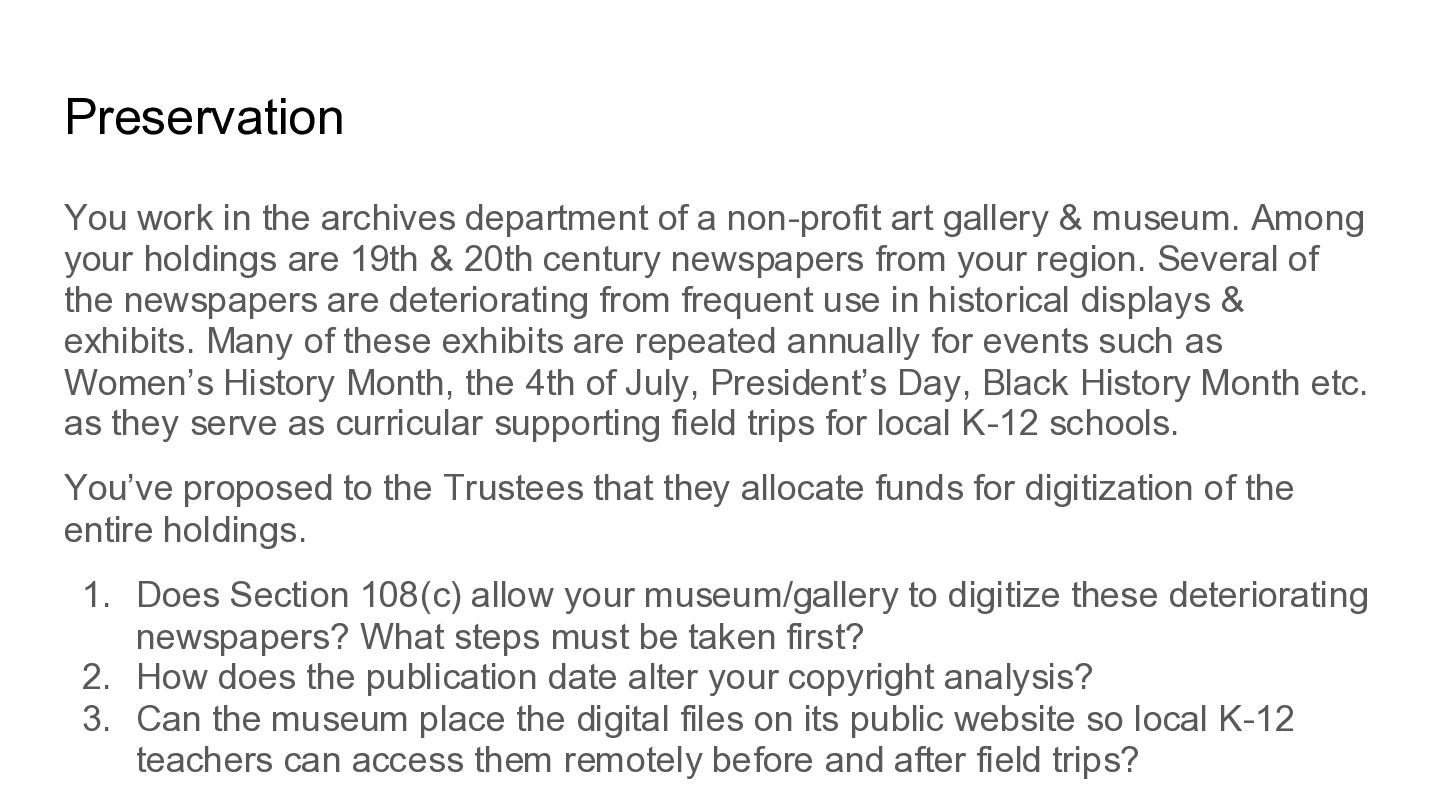
  16. Preservation You work in the archives department of a non-profit

    art gallery & museum. Among your holdings are 19th & 20th century newspapers from your region. Several of the newspapers are deteriorating from frequent use in historical displays & exhibits. Many of these exhibits are repeated annually for events such as Women’s History Month, the 4th of July, President’s Day, Black History Month etc. as they serve as curricular supporting field trips for local K-12 schools. You’ve proposed to the Trustees that they allocate funds for digitization of the entire holdings. 1. Does Section 108(c) allow your museum/gallery to digitize these deteriorating newspapers? What steps must be taken first? 2. How does the publication date alter your copyright analysis? 3. Can the museum place the digital files on its public website so local K-12 teachers can access them remotely before and after field trips?
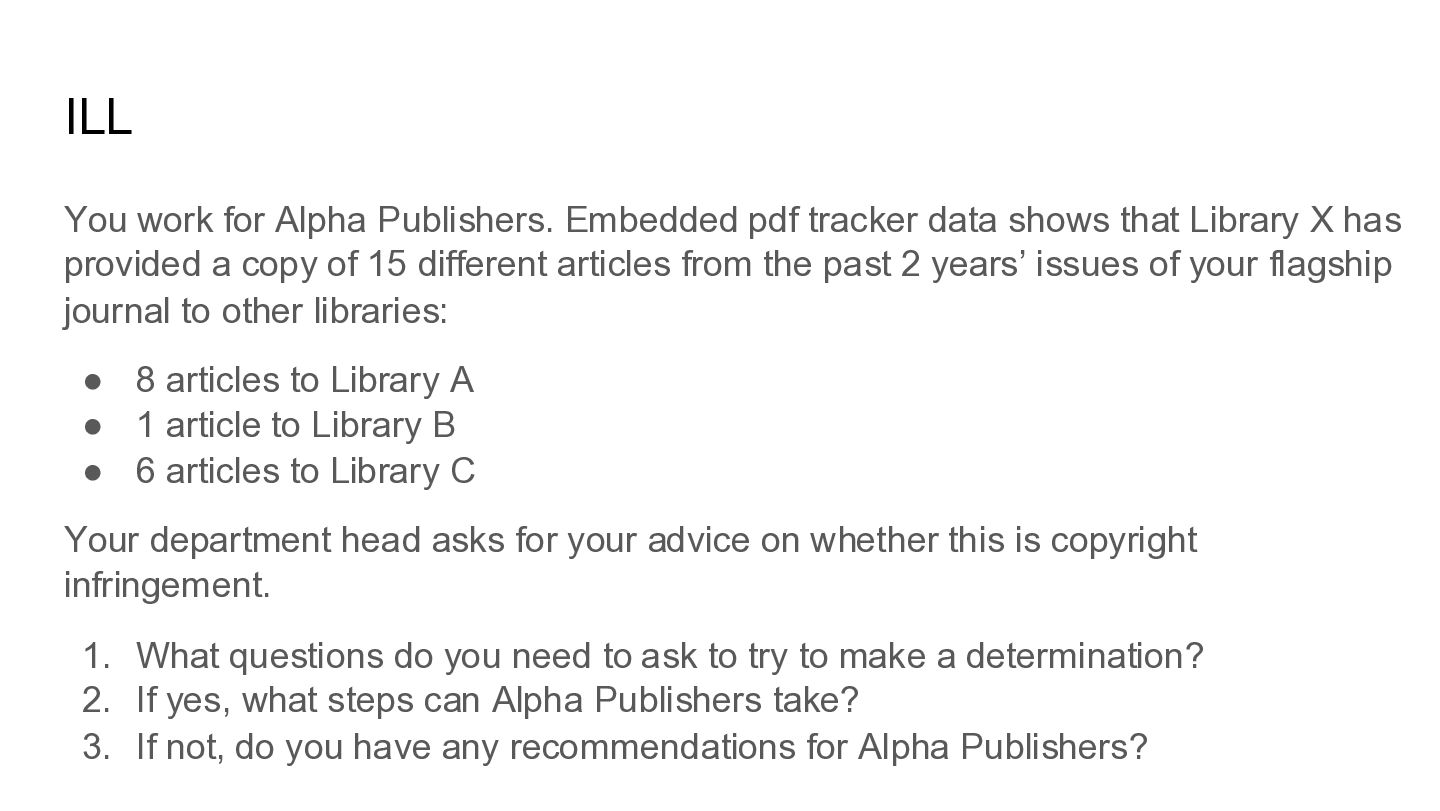
  17. ILL You work for Alpha Publishers. Embedded pdf tracker data

    shows that Library X has provided a copy of 15 different articles from the past 2 years’ issues of your flagship journal to other libraries: • 8 articles to Library A • 1 article to Library B • 6 articles to Library C Your department head asks for your advice on whether this is copyright infringement. 1. What questions do you need to ask to try to make a determination? 2. If yes, what steps can Alpha Publishers take? 3. If not, do you have any recommendations for Alpha Publishers?