Upgrade to Pro — share decks privately, control downloads, hide ads and more …

Climate Change Infographic Presentation

Climate Change Infographic Presentation

For optimal viewing, please access this presentation using a mobile device.

Please complete the survey on this presentation here: https://docs.google.com/forms/d/e/1FAIpQLSeFsF395F77xsHR0mrOID7zJXq4AdQNBlshNuBYT7QHT1lN_g/viewform?usp=sharing&ouid=113320705307942880841

Avatar for Kenny Pooh

Kenny Pooh

April 16, 2026

Other Decks in Education

Transcript

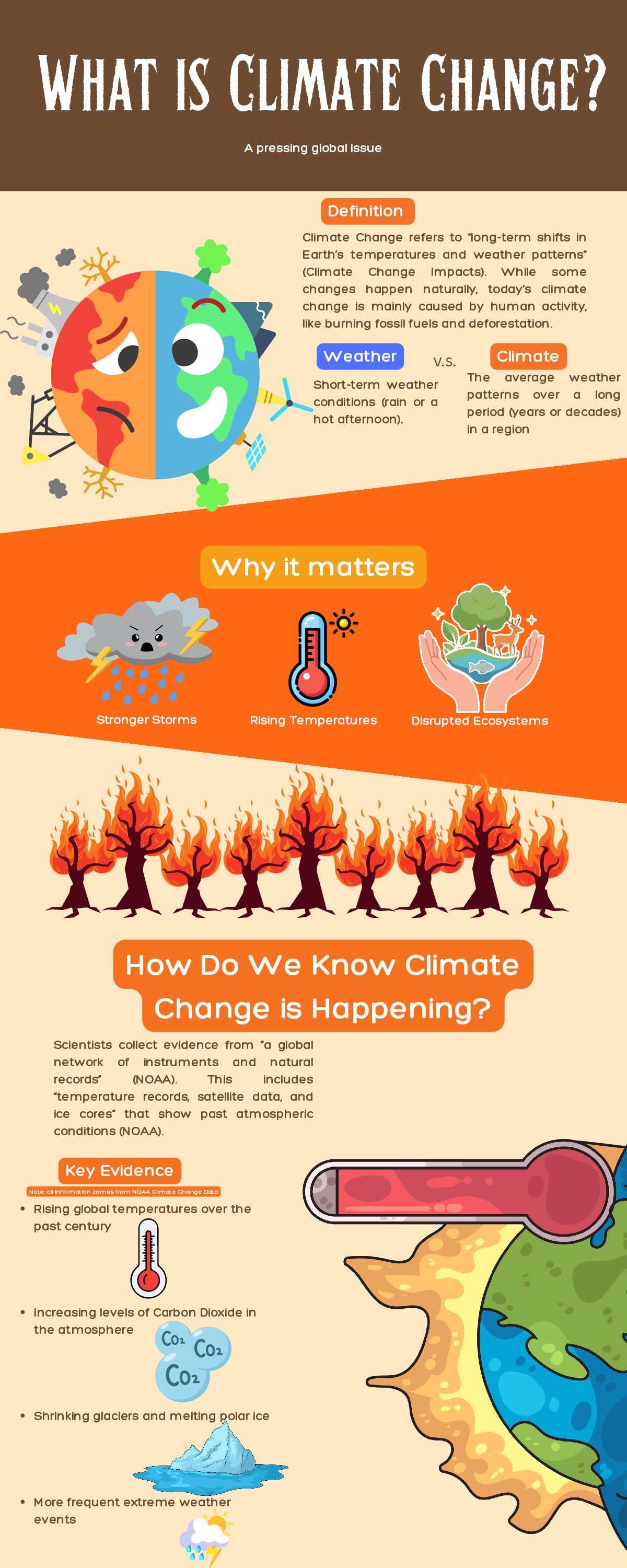
  1. What is Climate Change? Definition Climate Change refers to “long-term

    shifts in Earth’s temperatures and weather patterns” (Climate Change Impacts). While some changes happen naturally, today’s climate change is mainly caused by human activity, like burning fossil fuels and deforestation. Short-term weather conditions (rain or a hot afternoon). Why it matters Stronger Storms Rising Temperatures Disrupted Ecosystems How Do We Know Climate Change is Happening? Scientists collect evidence from “a global network of instruments and natural records” (NOAA). This includes “temperature records, satellite data, and ice cores” that show past atmospheric conditions (NOAA). Key Evidence Rising global temperatures over the past century Increasing levels of Carbon Dioxide in the atmosphere Shrinking glaciers and melting polar ice More frequent extreme weather events A pressing global issue Weather Climate v.s. The average weather patterns over a long period (years or decades) in a region Note: all information comes from NOAA Climate Change Data
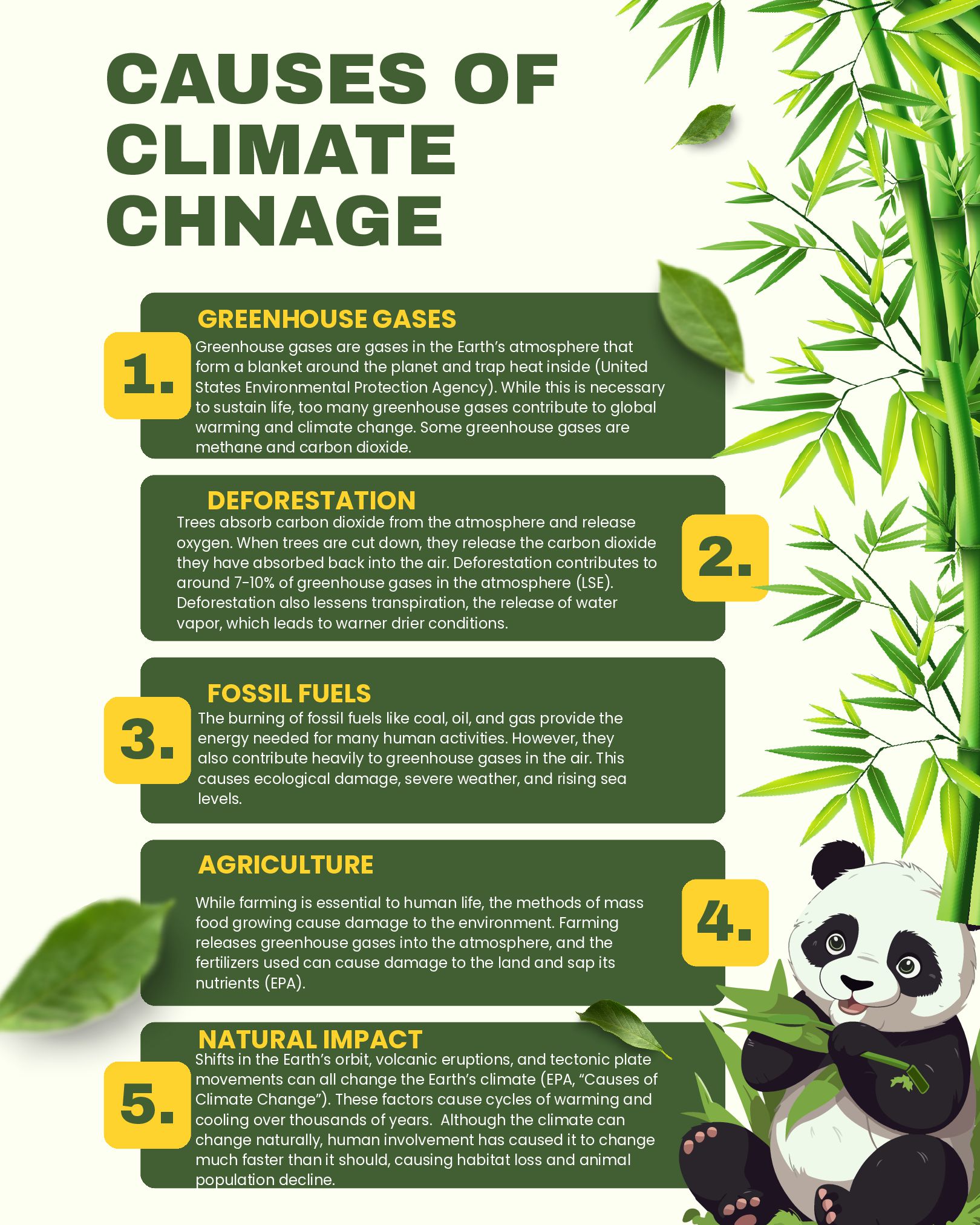
  2. CAUSES OF CLIMATE CHNAGE 1. 3. 5. 2. 4. GREENHOUSE

    GASES FOSSIL FUELS NATURAL IMPACT DEFORESTATION AGRICULTURE Greenhouse gases are gases in the Earth’s atmosphere that form a blanket around the planet and trap heat inside (United States Environmental Protection Agency). While this is necessary to sustain life, too many greenhouse gases contribute to global warming and climate change. Some greenhouse gases are methane and carbon dioxide. The burning of fossil fuels like coal, oil, and gas provide the energy needed for many human activities. However, they also contribute heavily to greenhouse gases in the air. This causes ecological damage, severe weather, and rising sea levels. Shifts in the Earth’s orbit, volcanic eruptions, and tectonic plate movements can all change the Earth’s climate (EPA, “Causes of Climate Change”). These factors cause cycles of warming and cooling over thousands of years. Although the climate can change naturally, human involvement has caused it to change much faster than it should, causing habitat loss and animal population decline. Trees absorb carbon dioxide from the atmosphere and release oxygen. When trees are cut down, they release the carbon dioxide they have absorbed back into the air. Deforestation contributes to around 7-10% of greenhouse gases in the atmosphere (LSE). Deforestation also lessens transpiration, the release of water vapor, which leads to warner drier conditions. While farming is essential to human life, the methods of mass food growing cause damage to the environment. Farming releases greenhouse gases into the atmosphere, and the fertilizers used can cause damage to the land and sap its nutrients (EPA).
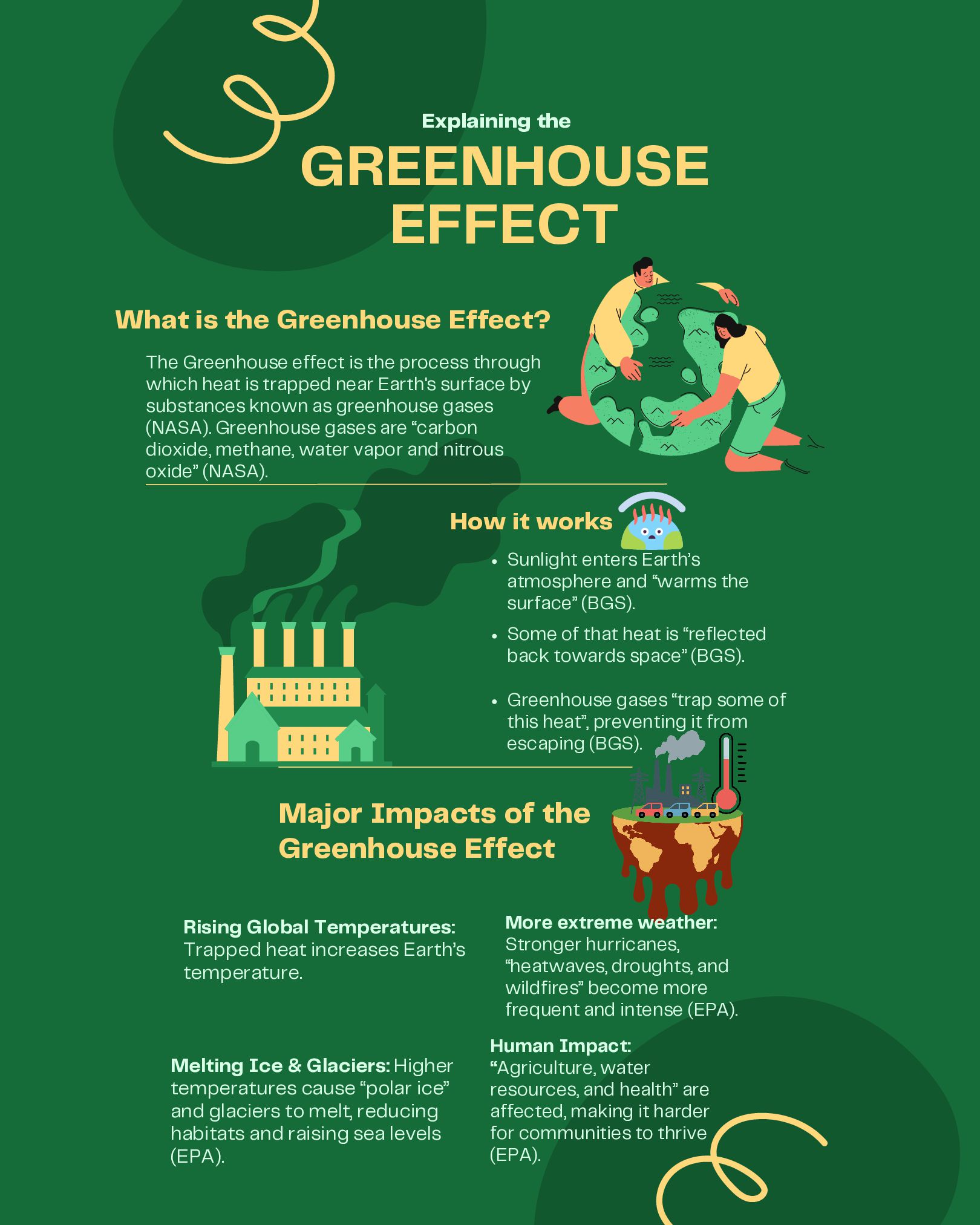
  3. What is the Greenhouse Effect? The Greenhouse effect is the

    process through which heat is trapped near Earth's surface by substances known as greenhouse gases (NASA). Greenhouse gases are “carbon dioxide, methane, water vapor and nitrous oxide” (NASA). GREENHOUSE EFFECT Human Impact: “Agriculture, water resources, and health” are affected, making it harder for communities to thrive (EPA). Explaining the How it works Sunlight enters Earth’s atmosphere and “warms the surface” (BGS). Some of that heat is “reflected back towards space” (BGS). Greenhouse gases “trap some of this heat”, preventing it from escaping (BGS). Major Impacts of the Greenhouse Effect Rising Global Temperatures: Trapped heat increases Earth’s temperature. More extreme weather: Stronger hurricanes, “heatwaves, droughts, and wildfires” become more frequent and intense (EPA). Melting Ice & Glaciers: Higher temperatures cause “polar ice” and glaciers to melt, reducing habitats and raising sea levels (EPA).
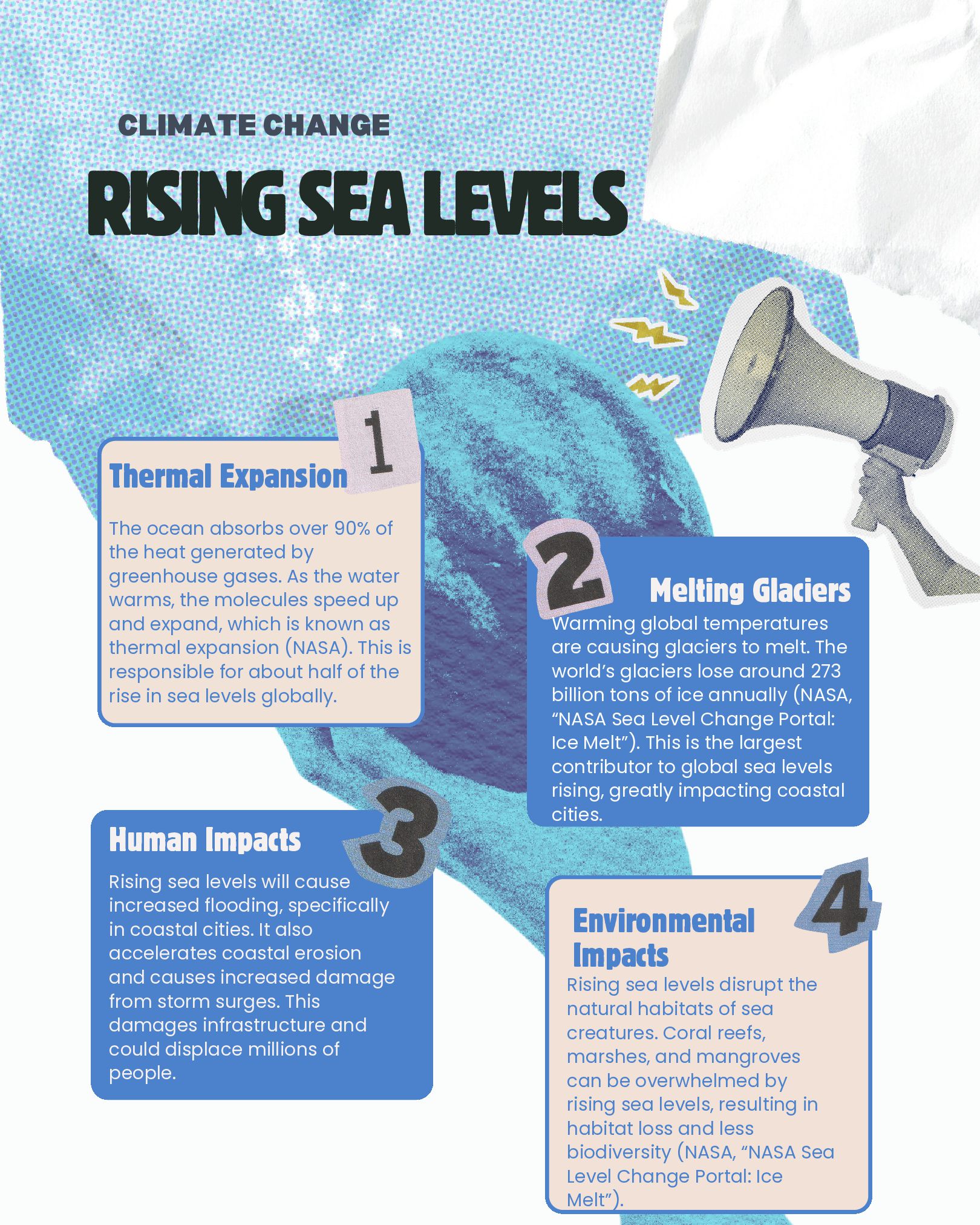
  4. RISING SEA LEVELS CLIMATE CHANGE Thermal Expansion The ocean absorbs

    over 90% of the heat generated by greenhouse gases. As the water warms, the molecules speed up and expand, which is known as thermal expansion (NASA). This is responsible for about half of the rise in sea levels globally. Melting Glaciers Human Impacts Rising sea levels will cause increased flooding, specifically in coastal cities. It also accelerates coastal erosion and causes increased damage from storm surges. This damages infrastructure and could displace millions of people. Environmental Impacts Rising sea levels disrupt the natural habitats of sea creatures. Coral reefs, marshes, and mangroves can be overwhelmed by rising sea levels, resulting in habitat loss and less biodiversity (NASA, “NASA Sea Level Change Portal: Ice Melt”). Warming global temperatures are causing glaciers to melt. The world’s glaciers lose around 273 billion tons of ice annually (NASA, “NASA Sea Level Change Portal: Ice Melt”). This is the largest contributor to global sea levels rising, greatly impacting coastal cities.
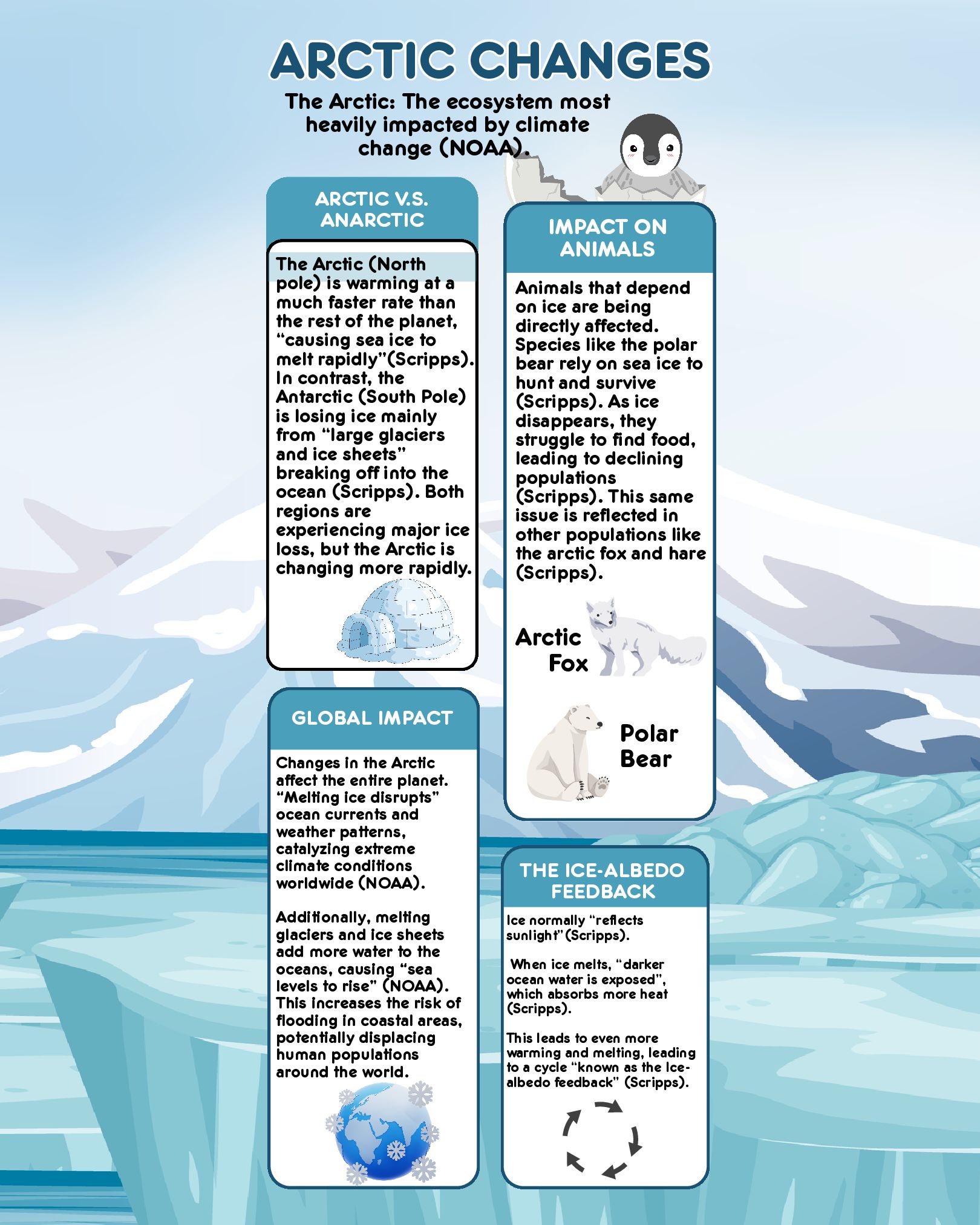
  5. ARCTIC V.S. ANARCTIC ARCTIC CHANGES ARCTIC CHANGES ARCTIC CHANGES The

    Arctic: The ecosystem most heavily impacted by climate change (NOAA). IMPACT ON ANIMALS Animals that depend on ice are being directly affected. Species like the polar bear rely on sea ice to hunt and survive (Scripps). As ice disappears, they struggle to find food, leading to declining populations (Scripps). This same issue is reflected in other populations like the arctic fox and hare (Scripps). Arctic Fox GLOBAL IMPACT Polar Bear THE ICE-ALBEDO FEEDBACK Ice normally “reflects sunlight”(Scripps). When ice melts, “darker ocean water is exposed”, which absorbs more heat (Scripps). This leads to even more warming and melting, leading to a cycle “known as the Ice- albedo feedback” (Scripps). The Arctic (North pole) is warming at a much faster rate than the rest of the planet, “causing sea ice to melt rapidly”(Scripps). In contrast, the Antarctic (South Pole) is losing ice mainly from “large glaciers and ice sheets” breaking off into the ocean (Scripps). Both regions are experiencing major ice loss, but the Arctic is changing more rapidly. Changes in the Arctic affect the entire planet. “Melting ice disrupts” ocean currents and weather patterns, catalyzing extreme climate conditions worldwide (NOAA). Additionally, melting glaciers and ice sheets add more water to the oceans, causing “sea levels to rise” (NOAA). This increases the risk of flooding in coastal areas, potentially displacing human populations around the world.
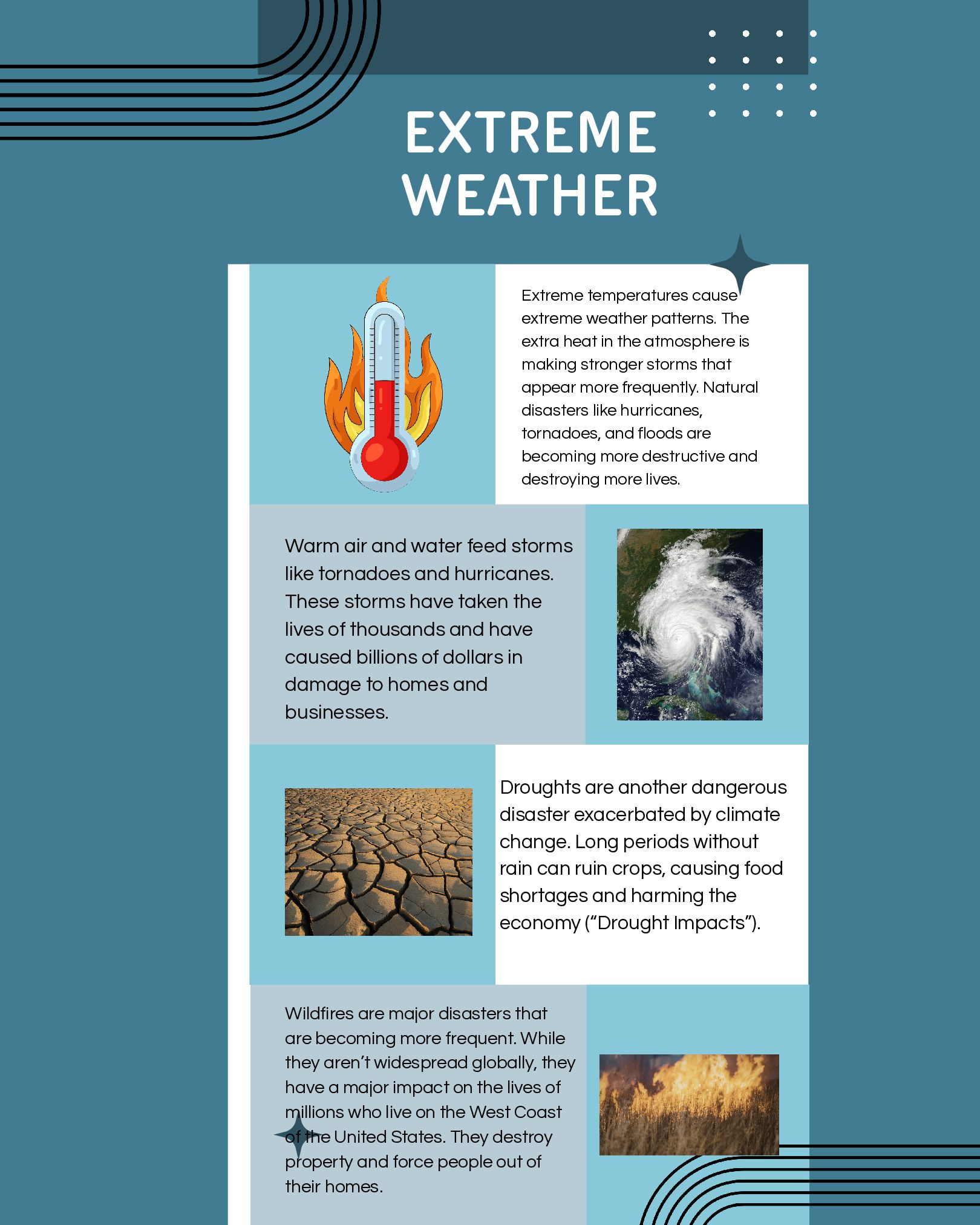
  6. EXTREME WEATHER Extreme temperatures cause extreme weather patterns. The extra

    heat in the atmosphere is making stronger storms that appear more frequently. Natural disasters like hurricanes, tornadoes, and floods are becoming more destructive and destroying more lives. Warm air and water feed storms like tornadoes and hurricanes. These storms have taken the lives of thousands and have caused billions of dollars in damage to homes and businesses. Droughts are another dangerous disaster exacerbated by climate change. Long periods without rain can ruin crops, causing food shortages and harming the economy (“Drought Impacts”). Wildfires are major disasters that are becoming more frequent. While they aren’t widespread globally, they have a major impact on the lives of millions who live on the West Coast of the United States. They destroy property and force people out of their homes.
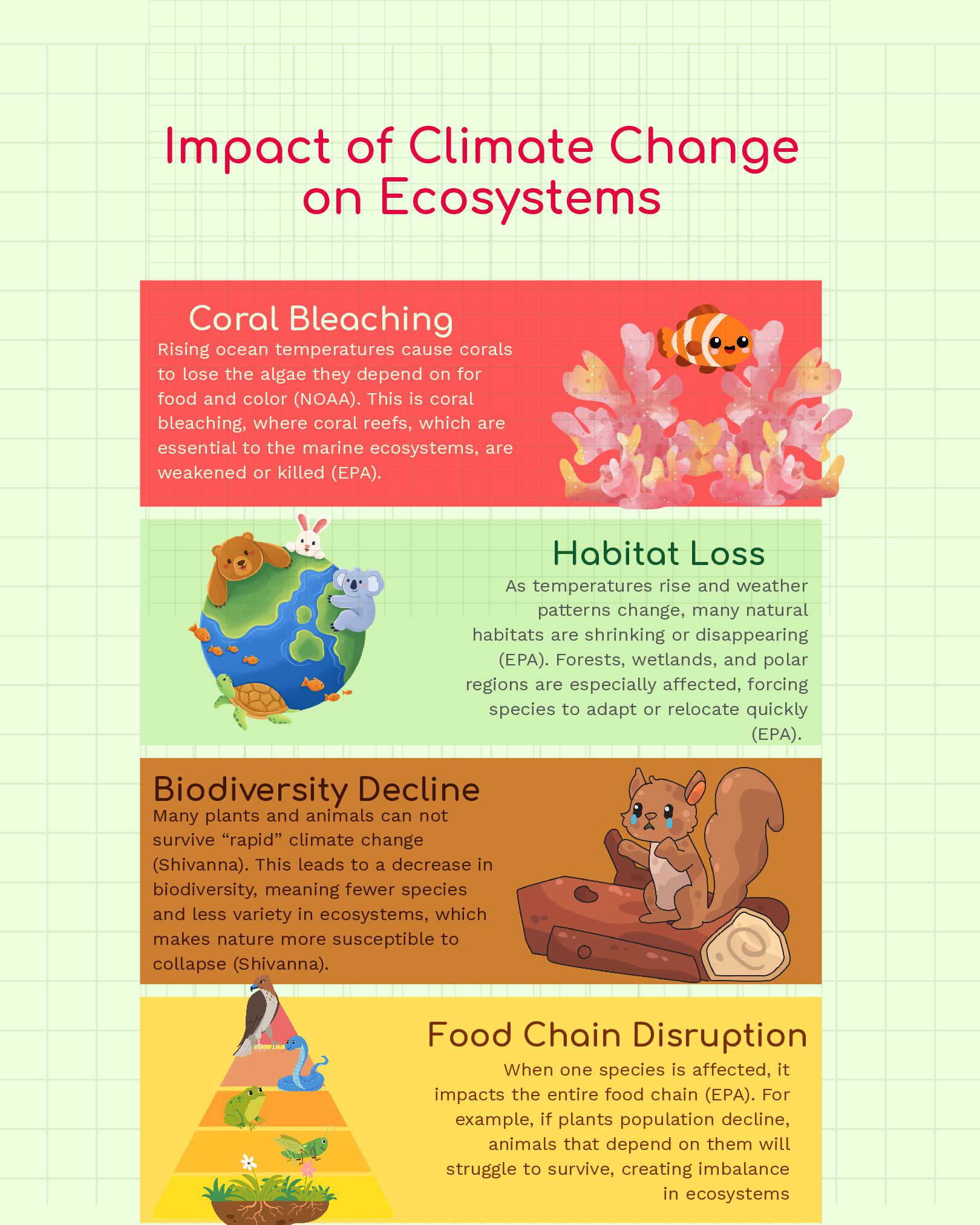
  7. Impact of Climate Change on Ecosystems Coral Bleaching Rising ocean

    temperatures cause corals to lose the algae they depend on for food and color (NOAA). This is coral bleaching, where coral reefs, which are essential to the marine ecosystems, are weakened or killed (EPA). Habitat Loss As temperatures rise and weather patterns change, many natural habitats are shrinking or disappearing (EPA). Forests, wetlands, and polar regions are especially affected, forcing species to adapt or relocate quickly (EPA). Biodiversity Decline Many plants and animals can not survive “rapid” climate change (Shivanna). This leads to a decrease in biodiversity, meaning fewer species and less variety in ecosystems, which makes nature more susceptible to collapse (Shivanna). Food Chain Disruption When one species is affected, it impacts the entire food chain (EPA). For example, if plants population decline, animals that depend on them will struggle to survive, creating imbalance in ecosystems
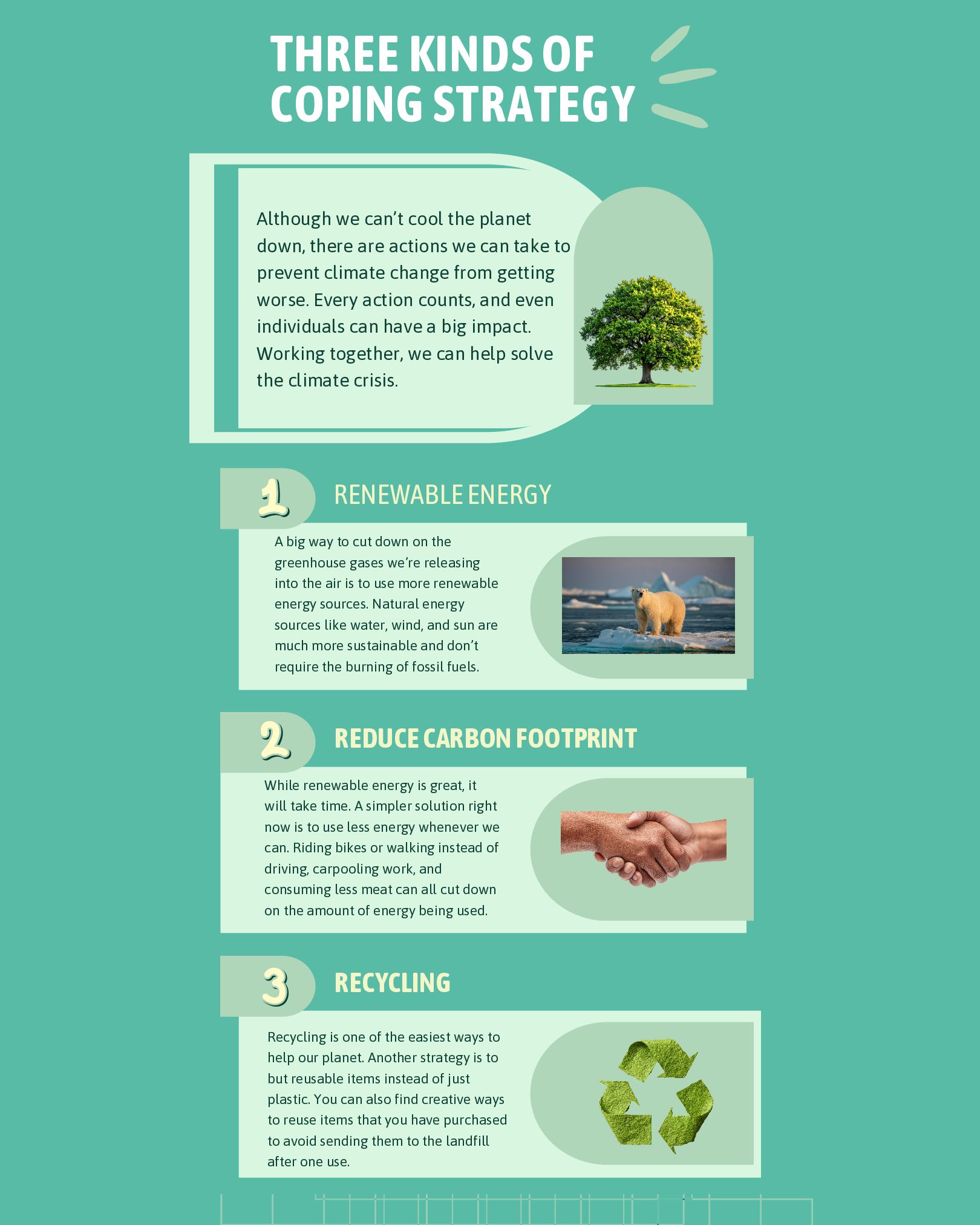
  8. REDUCE CARBON FOOTPRINT RECYCLING Recycling is one of the easiest

    ways to help our planet. Another strategy is to but reusable items instead of just plastic. You can also find creative ways to reuse items that you have purchased to avoid sending them to the landfill after one use. A big way to cut down on the greenhouse gases we’re releasing into the air is to use more renewable energy sources. Natural energy sources like water, wind, and sun are much more sustainable and don’t require the burning of fossil fuels. RENEWABLE ENERGY THREE KINDS OF COPING STRATEGY Although we can’t cool the planet down, there are actions we can take to prevent climate change from getting worse. Every action counts, and even individuals can have a big impact. Working together, we can help solve the climate crisis. While renewable energy is great, it will take time. A simpler solution right now is to use less energy whenever we can. Riding bikes or walking instead of driving, carpooling work, and consuming less meat can all cut down on the amount of energy being used.
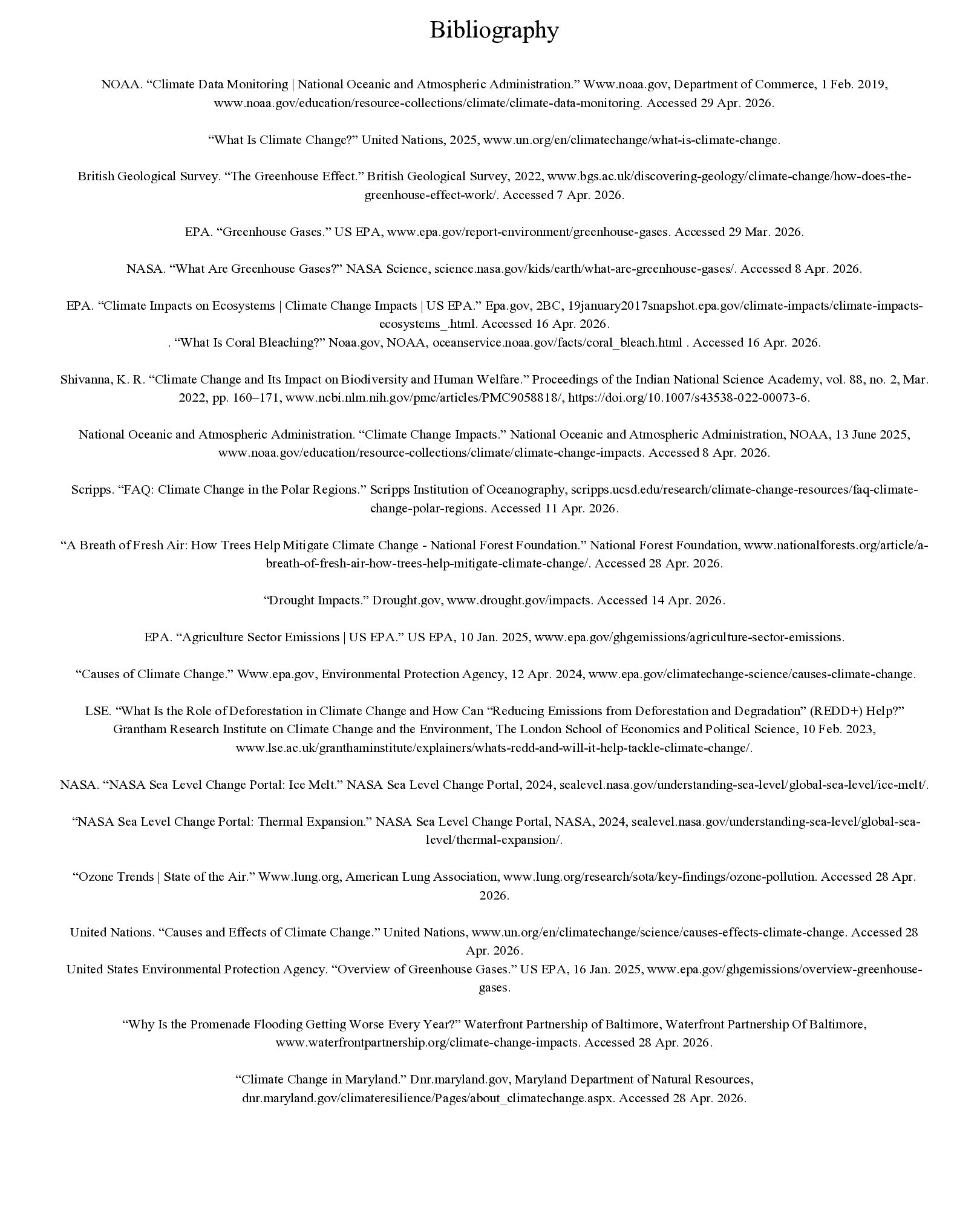
  9. Bibliography NOAA. “Climate Data Monitoring | National Oceanic and Atmospheric

    Administration.” Www.noaa.gov, Department of Commerce, 1 Feb. 2019, www.noaa.gov/education/resource-collections/climate/climate-data-monitoring. Accessed 29 Apr. 2026. “What Is Climate Change?” United Nations, 2025, www.un.org/en/climatechange/what-is-climate-change. British Geological Survey. “The Greenhouse Effect.” British Geological Survey, 2022, www.bgs.ac.uk/discovering-geology/climate-change/how-does-the- greenhouse-effect-work/. Accessed 7 Apr. 2026. EPA. “Greenhouse Gases.” US EPA, www.epa.gov/report-environment/greenhouse-gases. Accessed 29 Mar. 2026. NASA. “What Are Greenhouse Gases?” NASA Science, science.nasa.gov/kids/earth/what-are-greenhouse-gases/. Accessed 8 Apr. 2026. EPA. “Climate Impacts on Ecosystems | Climate Change Impacts | US EPA.” Epa.gov, 2BC, 19january2017snapshot.epa.gov/climate-impacts/climate-impacts- ecosystems_.html. Accessed 16 Apr. 2026. . “What Is Coral Bleaching?” Noaa.gov, NOAA, oceanservice.noaa.gov/facts/coral_bleach.html . Accessed 16 Apr. 2026. Shivanna, K. R. “Climate Change and Its Impact on Biodiversity and Human Welfare.” Proceedings of the Indian National Science Academy, vol. 88, no. 2, Mar. 2022, pp. 160–171, www.ncbi.nlm.nih.gov/pmc/articles/PMC9058818/, https://doi.org/10.1007/s43538-022-00073-6. National Oceanic and Atmospheric Administration. “Climate Change Impacts.” National Oceanic and Atmospheric Administration, NOAA, 13 June 2025, www.noaa.gov/education/resource-collections/climate/climate-change-impacts. Accessed 8 Apr. 2026. Scripps. “FAQ: Climate Change in the Polar Regions.” Scripps Institution of Oceanography, scripps.ucsd.edu/research/climate-change-resources/faq-climate- change-polar-regions. Accessed 11 Apr. 2026. “A Breath of Fresh Air: How Trees Help Mitigate Climate Change - National Forest Foundation.” National Forest Foundation, www.nationalforests.org/article/a- breath-of-fresh-air-how-trees-help-mitigate-climate-change/. Accessed 28 Apr. 2026. “Drought Impacts.” Drought.gov, www.drought.gov/impacts. Accessed 14 Apr. 2026. EPA. “Agriculture Sector Emissions | US EPA.” US EPA, 10 Jan. 2025, www.epa.gov/ghgemissions/agriculture-sector-emissions. “Causes of Climate Change.” Www.epa.gov, Environmental Protection Agency, 12 Apr. 2024, www.epa.gov/climatechange-science/causes-climate-change. LSE. “What Is the Role of Deforestation in Climate Change and How Can “Reducing Emissions from Deforestation and Degradation” (REDD+) Help?” Grantham Research Institute on Climate Change and the Environment, The London School of Economics and Political Science, 10 Feb. 2023, www.lse.ac.uk/granthaminstitute/explainers/whats-redd-and-will-it-help-tackle-climate-change/. NASA. “NASA Sea Level Change Portal: Ice Melt.” NASA Sea Level Change Portal, 2024, sealevel.nasa.gov/understanding-sea-level/global-sea-level/ice-melt/. “NASA Sea Level Change Portal: Thermal Expansion.” NASA Sea Level Change Portal, NASA, 2024, sealevel.nasa.gov/understanding-sea-level/global-sea- level/thermal-expansion/. “Ozone Trends | State of the Air.” Www.lung.org, American Lung Association, www.lung.org/research/sota/key-findings/ozone-pollution. Accessed 28 Apr. 2026. United Nations. “Causes and Effects of Climate Change.” United Nations, www.un.org/en/climatechange/science/causes-effects-climate-change. Accessed 28 Apr. 2026. United States Environmental Protection Agency. “Overview of Greenhouse Gases.” US EPA, 16 Jan. 2025, www.epa.gov/ghgemissions/overview-greenhouse- gases. “Why Is the Promenade Flooding Getting Worse Every Year?” Waterfront Partnership of Baltimore, Waterfront Partnership Of Baltimore, www.waterfrontpartnership.org/climate-change-impacts. Accessed 28 Apr. 2026. “Climate Change in Maryland.” Dnr.maryland.gov, Maryland Department of Natural Resources, dnr.maryland.gov/climateresilience/Pages/about_climatechange.aspx. Accessed 28 Apr. 2026.