Table of Contents 1. Different Types of Air Slide Fabrics and Their Uses 2. The Advantages of Using Air Slide Fabrics for Pneumatic Conveying 3. Pneumatic Conveying with Fluidising Fabrics (How it helps Fluidising Powders) 4. Understanding the Process of Fluidising Dry Powders with Air Slide Fabrics 5. Gas Chamber Effects of Air Slide Fabrics 6. What to Consider When Choosing the Right Fluidising Fabric for Your Operation 7. Help to Choose the Optimum Air Slide Fabric 8. Ways to Improve Efficiency and Reduce Wastage with Air Slide Fabrics 9. Comparing the Pros and Cons of Different Air Slide Fabric Material Types 10. Pros and Cons with Emphasis on Temperature and Air Permeability 11. Operate and Maintaining Air Slide Fabrics for Pneumatic Conveying 12. How to Properly Install and Use Air Slide Fabrics 13. How to Clean and Care for Air Slide Fabrics. 14. Best Practices for Handling Dry Bulk Powders with Air Slide Fabric
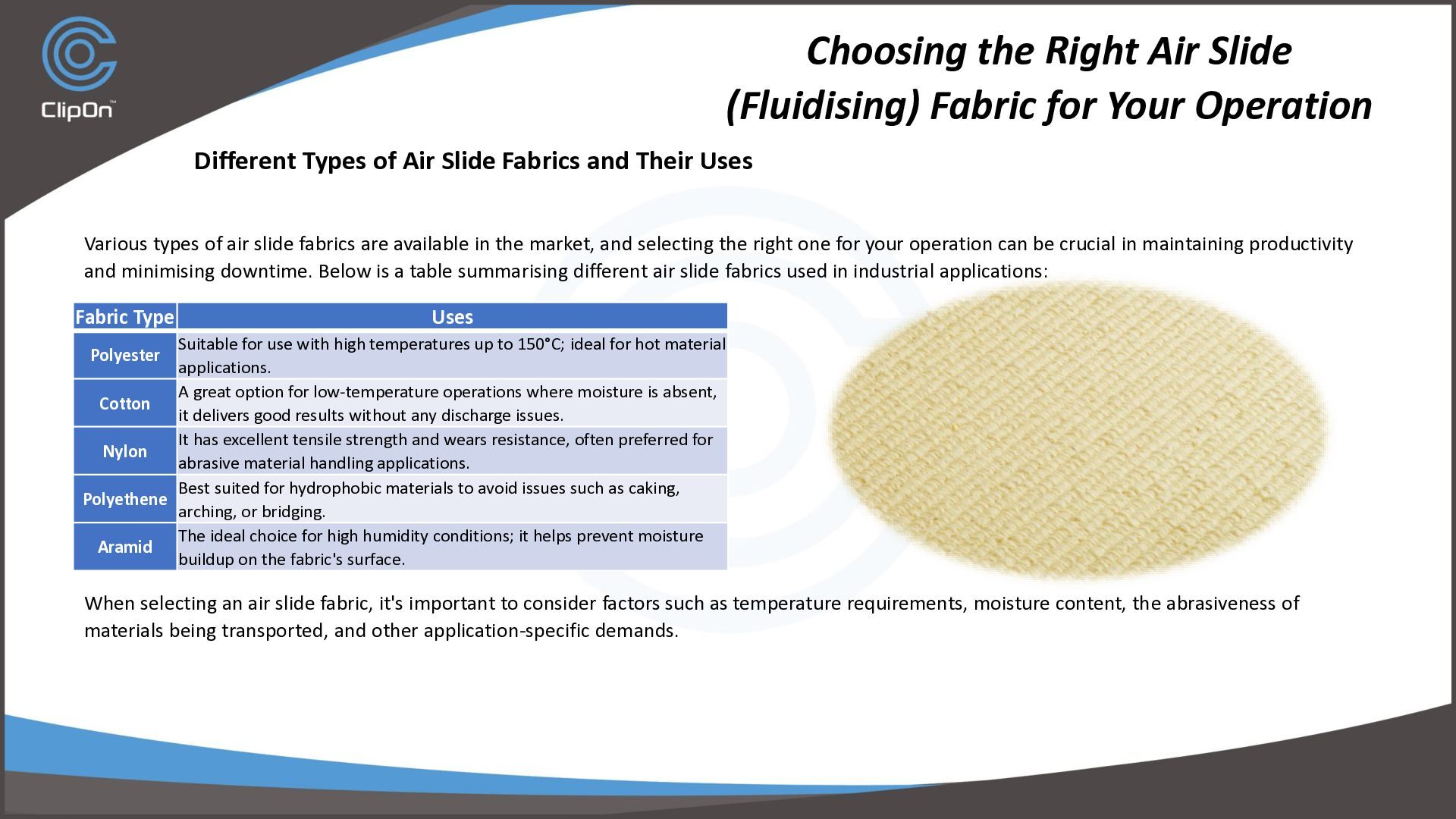
Different Types of Air Slide Fabrics and Their Uses Various types of air slide fabrics are available in the market, and selecting the right one for your operation can be crucial in maintaining productivity and minimising downtime. Below is a table summarising different air slide fabrics used in industrial applications: Fabric Type Uses Suitable for use with high temperatures up to 150°C; ideal for hot material applications. A great option for low-temperature operations where moisture is absent, Cotton it delivers good results without any discharge issues. It has excellent tensile strength and wears resistance, often preferred for Nylon abrasive material handling applications. Best suited for hydrophobic materials to avoid issues such as caking, Polyethene arching, or bridging. The ideal choice for high humidity conditions; it helps prevent moisture Aramid buildup on the fabric's surface. Polyester When selecting an air slide fabric, it's important to consider factors such as temperature requirements, moisture content, the abrasiveness of materials being transported, and other application-specific demands.
The Advantages of Using Air Slide Fabrics for Pneumatic Conveying Air slide fabrics offer efficient and cost-effective solutions for transporting dry bulk materials such as cement, coal, and other powders. Below is a table that outlines the advantages of using air slide fabrics for pneumatic conveying: Advantage Low friction coefficient No moving parts Customisable design High thermal resistance Minimal dust emission Explanation Allows material to flow easily with minimal wear on equipment Low maintenance and reliable operation Can be made to fit specific system requirements Can handle high-temperature materials without degradation Reduces environmental pollution and improves workplace safety One of the principal advantages of using air slide fabrics is their ability to deliver uniform flow rates. The materials are conveyed smoothly due to the pleating effect created by each pocket, allowing for an even distribution across different areas whilst significantly reducing the risk of segregation within a material blend. High levels of uniformity result in greater homogeneity throughout, leading to cost savings by reducing wasted materials from spillage and unnecessary wear on subsequent equipment. Another significant benefit of air slide fabrics is their ability to promote low friction between the fabric and conveyed materials. This smoother flow offers benefits such as reduced energy consumption during delivery, extending the filter life aspect whilst minimising valve/pipeline damage caused by abrasive powders/granules in transport. By using Airslide fabrics, manufacturers can substantially decrease maintenance expenses while maintaining a high product performance level.
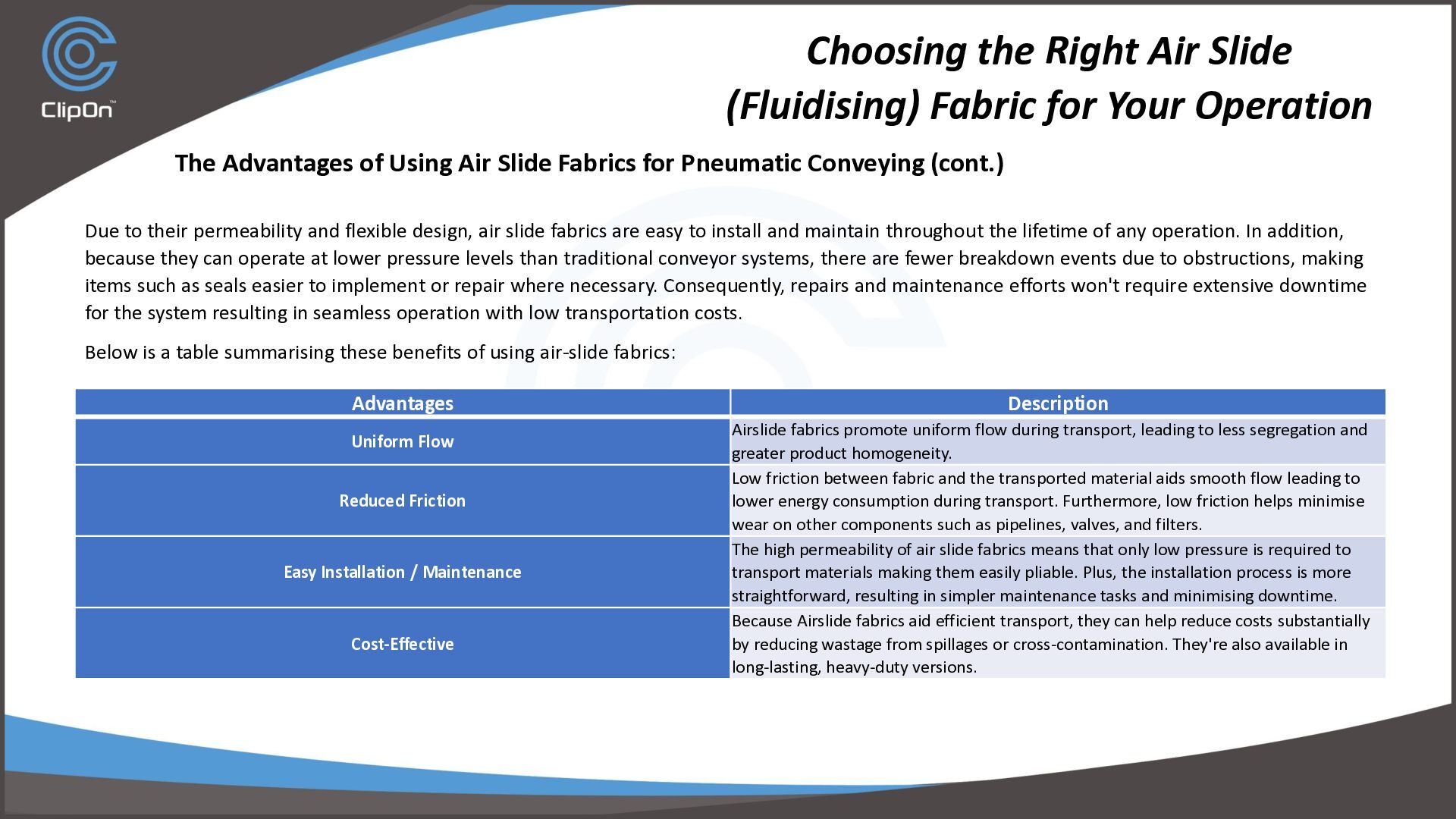
The Advantages of Using Air Slide Fabrics for Pneumatic Conveying (cont.) Due to their permeability and flexible design, air slide fabrics are easy to install and maintain throughout the lifetime of any operation. In addition, because they can operate at lower pressure levels than traditional conveyor systems, there are fewer breakdown events due to obstructions, making items such as seals easier to implement or repair where necessary. Consequently, repairs and maintenance efforts won't require extensive downtime for the system resulting in seamless operation with low transportation costs. Below is a table summarising these benefits of using air-slide fabrics: Advantages Uniform Flow Reduced Friction Easy Installation / Maintenance Cost-Effective Description Airslide fabrics promote uniform flow during transport, leading to less segregation and greater product homogeneity. Low friction between fabric and the transported material aids smooth flow leading to lower energy consumption during transport. Furthermore, low friction helps minimise wear on other components such as pipelines, valves, and filters. The high permeability of air slide fabrics means that only low pressure is required to transport materials making them easily pliable. Plus, the installation process is more straightforward, resulting in simpler maintenance tasks and minimising downtime. Because Airslide fabrics aid efficient transport, they can help reduce costs substantially by reducing wastage from spillages or cross-contamination. They're also available in long-lasting, heavy-duty versions.
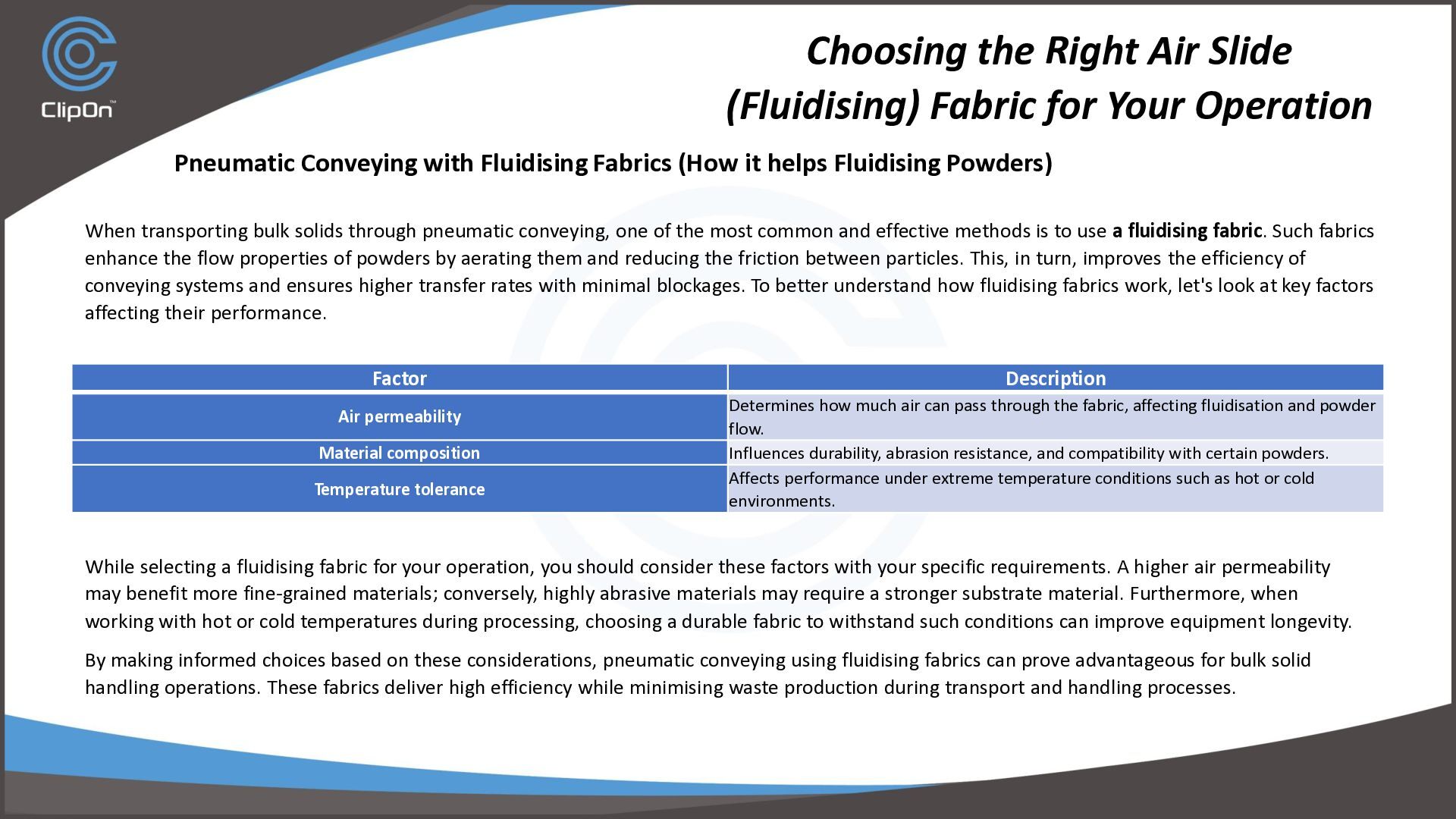
Pneumatic Conveying with Fluidising Fabrics (How it helps Fluidising Powders) When transporting bulk solids through pneumatic conveying, one of the most common and effective methods is to use a fluidising fabric. Such fabrics enhance the flow properties of powders by aerating them and reducing the friction between particles. This, in turn, improves the efficiency of conveying systems and ensures higher transfer rates with minimal blockages. To better understand how fluidising fabrics work, let's look at key factors affecting their performance. Factor Air permeability Material composition Temperature tolerance Description Determines how much air can pass through the fabric, affecting fluidisation and powder flow. Influences durability, abrasion resistance, and compatibility with certain powders. Affects performance under extreme temperature conditions such as hot or cold environments. While selecting a fluidising fabric for your operation, you should consider these factors with your specific requirements. A higher air permeability may benefit more fine-grained materials; conversely, highly abrasive materials may require a stronger substrate material. Furthermore, when working with hot or cold temperatures during processing, choosing a durable fabric to withstand such conditions can improve equipment longevity. By making informed choices based on these considerations, pneumatic conveying using fluidising fabrics can prove advantageous for bulk solid handling operations. These fabrics deliver high efficiency while minimising waste production during transport and handling processes.
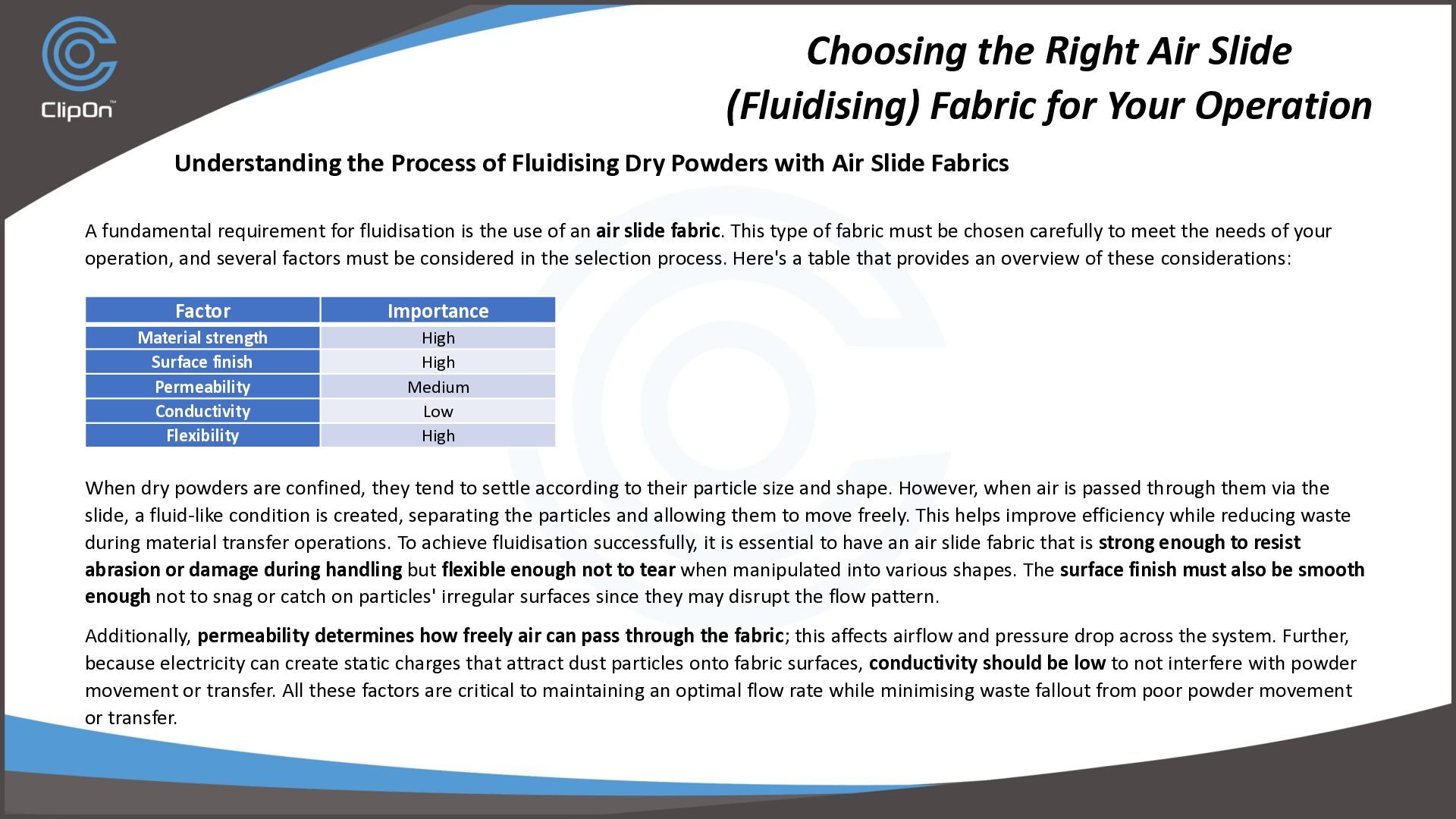
Understanding the Process of Fluidising Dry Powders with Air Slide Fabrics A fundamental requirement for fluidisation is the use of an air slide fabric. This type of fabric must be chosen carefully to meet the needs of your operation, and several factors must be considered in the selection process. Here's a table that provides an overview of these considerations: Factor Importance Material strength Surface finish Permeability Conductivity Flexibility High High Medium Low High When dry powders are confined, they tend to settle according to their particle size and shape. However, when air is passed through them via the slide, a fluid-like condition is created, separating the particles and allowing them to move freely. This helps improve efficiency while reducing waste during material transfer operations. To achieve fluidisation successfully, it is essential to have an air slide fabric that is strong enough to resist abrasion or damage during handling but flexible enough not to tear when manipulated into various shapes. The surface finish must also be smooth enough not to snag or catch on particles' irregular surfaces since they may disrupt the flow pattern. Additionally, permeability determines how freely air can pass through the fabric; this affects airflow and pressure drop across the system. Further, because electricity can create static charges that attract dust particles onto fabric surfaces, conductivity should be low to not interfere with powder movement or transfer. All these factors are critical to maintaining an optimal flow rate while minimising waste fallout from poor powder movement or transfer.
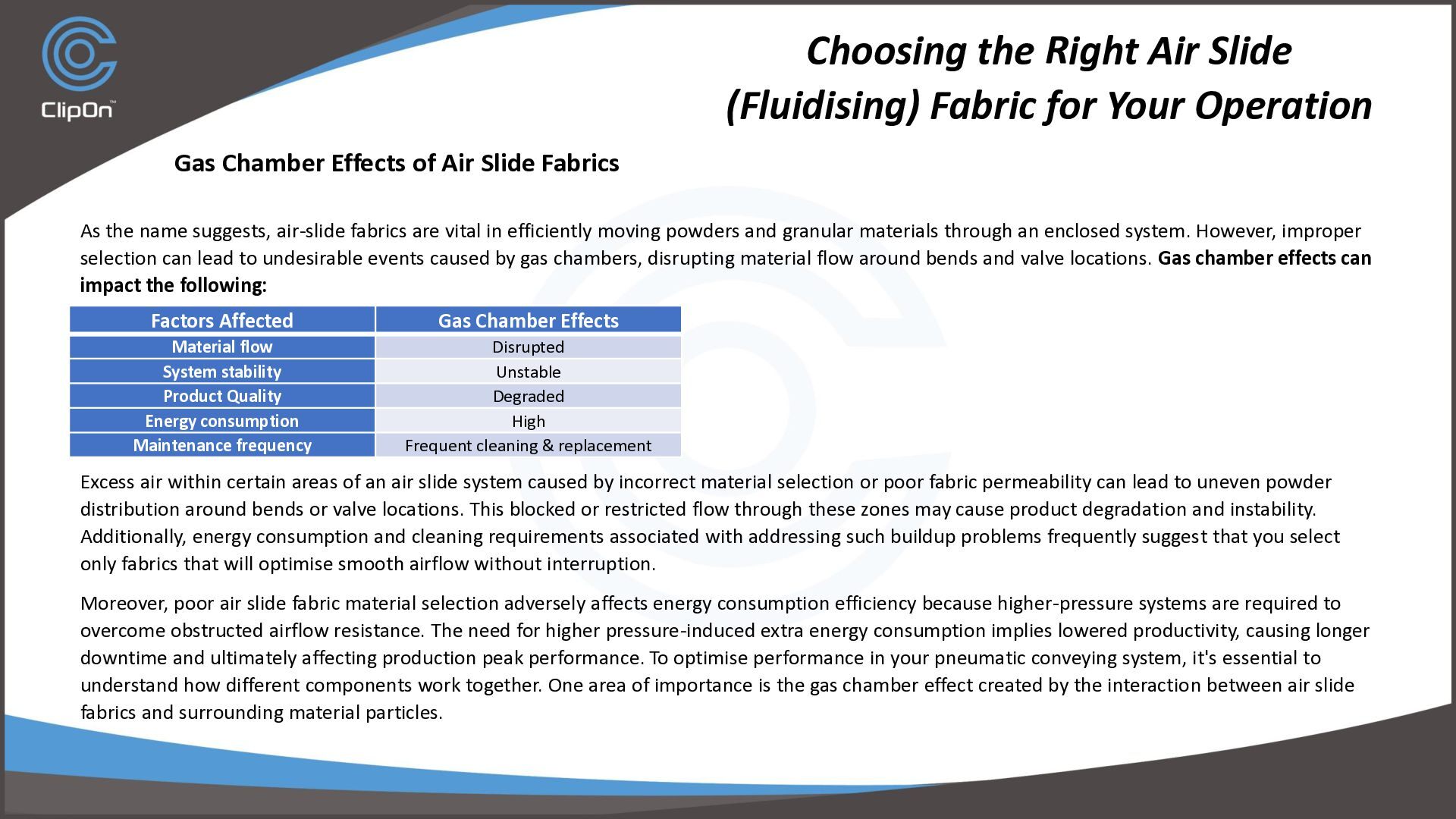
Gas Chamber Effects of Air Slide Fabrics As the name suggests, air-slide fabrics are vital in efficiently moving powders and granular materials through an enclosed system. However, improper selection can lead to undesirable events caused by gas chambers, disrupting material flow around bends and valve locations. Gas chamber effects can impact the following: Factors Affected Gas Chamber Effects Material flow System stability Product Quality Energy consumption Maintenance frequency Disrupted Unstable Degraded High Frequent cleaning & replacement Excess air within certain areas of an air slide system caused by incorrect material selection or poor fabric permeability can lead to uneven powder distribution around bends or valve locations. This blocked or restricted flow through these zones may cause product degradation and instability. Additionally, energy consumption and cleaning requirements associated with addressing such buildup problems frequently suggest that you select only fabrics that will optimise smooth airflow without interruption. Moreover, poor air slide fabric material selection adversely affects energy consumption efficiency because higher-pressure systems are required to overcome obstructed airflow resistance. The need for higher pressure-induced extra energy consumption implies lowered productivity, causing longer downtime and ultimately affecting production peak performance. To optimise performance in your pneumatic conveying system, it's essential to understand how different components work together. One area of importance is the gas chamber effect created by the interaction between air slide fabrics and surrounding material particles.
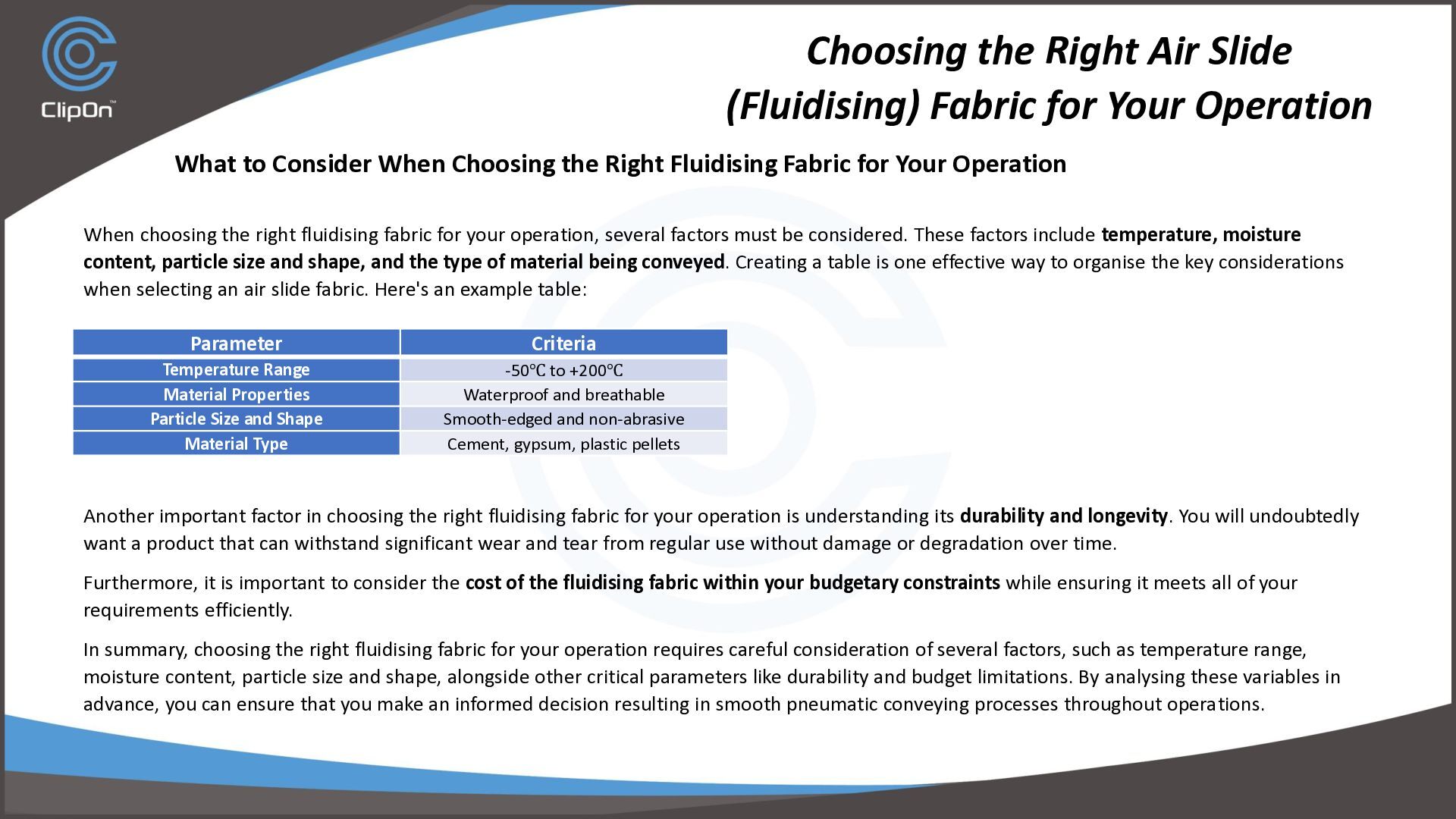
What to Consider When Choosing the Right Fluidising Fabric for Your Operation When choosing the right fluidising fabric for your operation, several factors must be considered. These factors include temperature, moisture content, particle size and shape, and the type of material being conveyed. Creating a table is one effective way to organise the key considerations when selecting an air slide fabric. Here's an example table: Parameter Criteria Temperature Range Material Properties Particle Size and Shape Material Type -50℃ to +200℃ Waterproof and breathable Smooth-edged and non-abrasive Cement, gypsum, plastic pellets Another important factor in choosing the right fluidising fabric for your operation is understanding its durability and longevity. You will undoubtedly want a product that can withstand significant wear and tear from regular use without damage or degradation over time. Furthermore, it is important to consider the cost of the fluidising fabric within your budgetary constraints while ensuring it meets all of your requirements efficiently. In summary, choosing the right fluidising fabric for your operation requires careful consideration of several factors, such as temperature range, moisture content, particle size and shape, alongside other critical parameters like durability and budget limitations. By analysing these variables in advance, you can ensure that you make an informed decision resulting in smooth pneumatic conveying processes throughout operations.
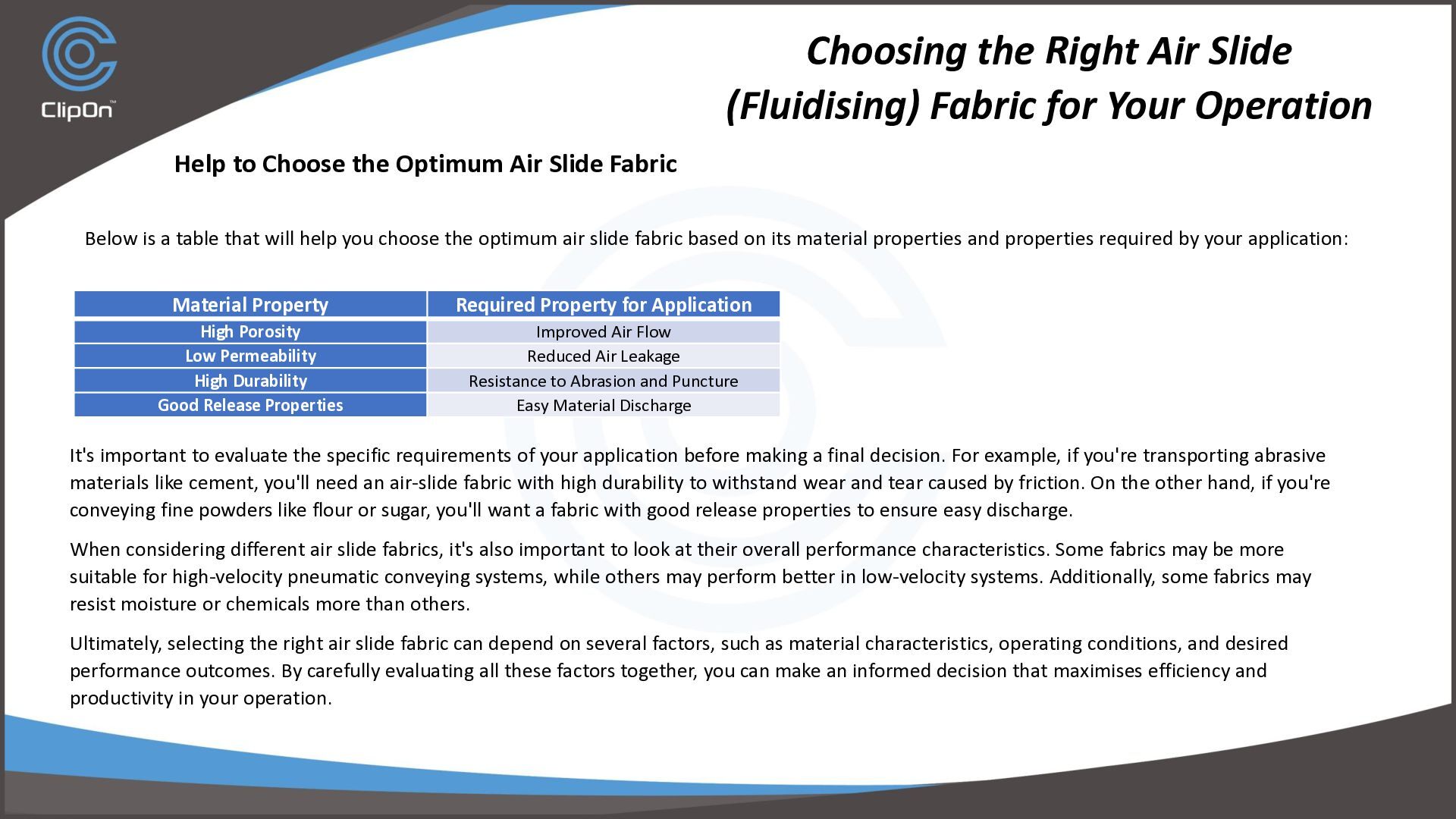
Help to Choose the Optimum Air Slide Fabric Below is a table that will help you choose the optimum air slide fabric based on its material properties and properties required by your application: Material Property Required Property for Application High Porosity Low Permeability High Durability Good Release Properties Improved Air Flow Reduced Air Leakage Resistance to Abrasion and Puncture Easy Material Discharge It's important to evaluate the specific requirements of your application before making a final decision. For example, if you're transporting abrasive materials like cement, you'll need an air-slide fabric with high durability to withstand wear and tear caused by friction. On the other hand, if you're conveying fine powders like flour or sugar, you'll want a fabric with good release properties to ensure easy discharge. When considering different air slide fabrics, it's also important to look at their overall performance characteristics. Some fabrics may be more suitable for high-velocity pneumatic conveying systems, while others may perform better in low-velocity systems. Additionally, some fabrics may resist moisture or chemicals more than others. Ultimately, selecting the right air slide fabric can depend on several factors, such as material characteristics, operating conditions, and desired performance outcomes. By carefully evaluating all these factors together, you can make an informed decision that maximises efficiency and productivity in your operation.
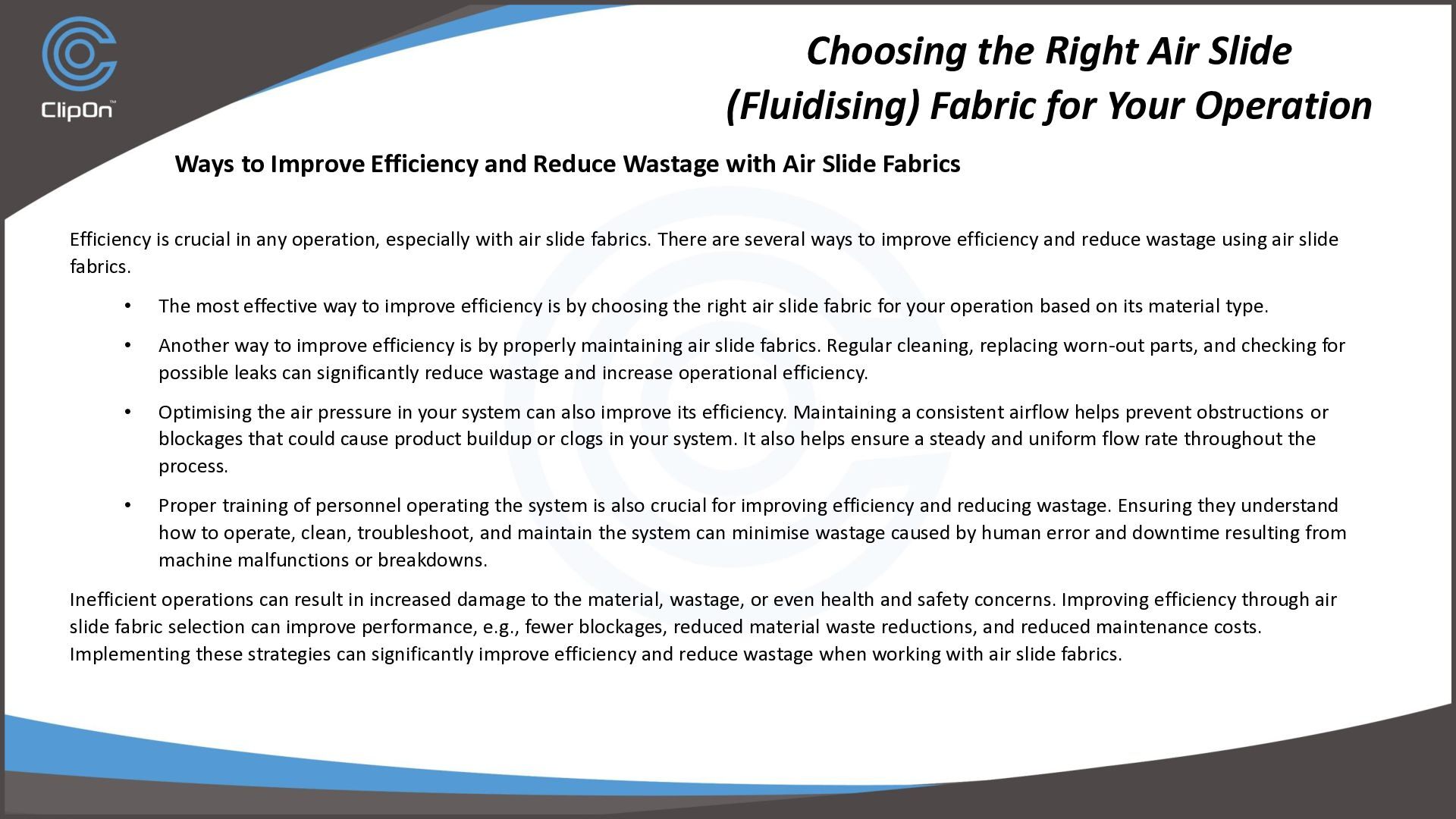
Ways to Improve Efficiency and Reduce Wastage with Air Slide Fabrics Efficiency is crucial in any operation, especially with air slide fabrics. There are several ways to improve efficiency and reduce wastage using air slide fabrics. • The most effective way to improve efficiency is by choosing the right air slide fabric for your operation based on its material type. • Another way to improve efficiency is by properly maintaining air slide fabrics. Regular cleaning, replacing worn-out parts, and checking for possible leaks can significantly reduce wastage and increase operational efficiency. • Optimising the air pressure in your system can also improve its efficiency. Maintaining a consistent airflow helps prevent obstructions or blockages that could cause product buildup or clogs in your system. It also helps ensure a steady and uniform flow rate throughout the process. • Proper training of personnel operating the system is also crucial for improving efficiency and reducing wastage. Ensuring they understand how to operate, clean, troubleshoot, and maintain the system can minimise wastage caused by human error and downtime resulting from machine malfunctions or breakdowns. Inefficient operations can result in increased damage to the material, wastage, or even health and safety concerns. Improving efficiency through air slide fabric selection can improve performance, e.g., fewer blockages, reduced material waste reductions, and reduced maintenance costs. Implementing these strategies can significantly improve efficiency and reduce wastage when working with air slide fabrics.
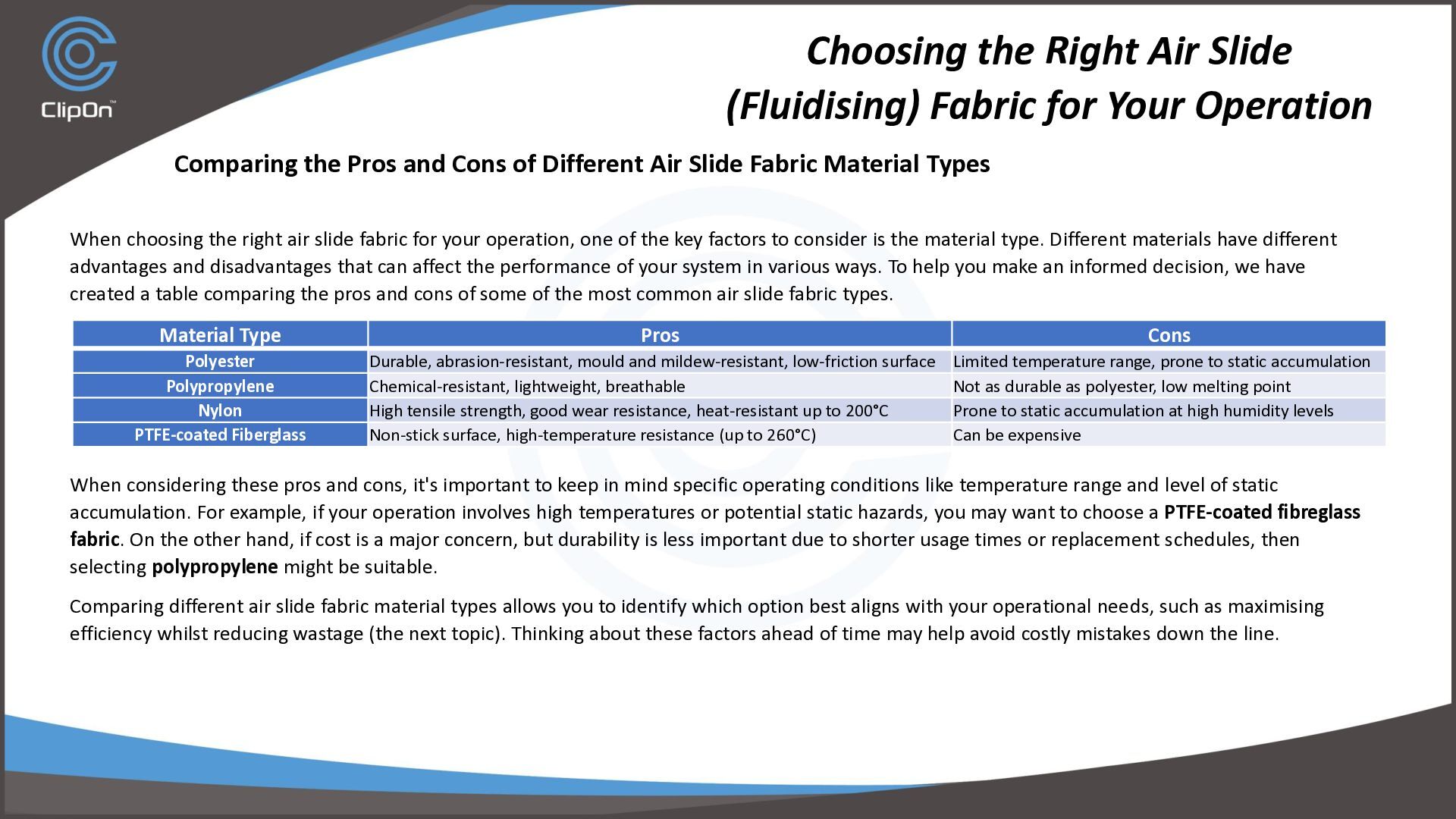
Comparing the Pros and Cons of Different Air Slide Fabric Material Types When choosing the right air slide fabric for your operation, one of the key factors to consider is the material type. Different materials have different advantages and disadvantages that can affect the performance of your system in various ways. To help you make an informed decision, we have created a table comparing the pros and cons of some of the most common air slide fabric types. Material Type Pros Cons Polyester Polypropylene Nylon PTFE-coated Fiberglass Durable, abrasion-resistant, mould and mildew-resistant, low-friction surface Chemical-resistant, lightweight, breathable High tensile strength, good wear resistance, heat-resistant up to 200°C Non-stick surface, high-temperature resistance (up to 260°C) Limited temperature range, prone to static accumulation Not as durable as polyester, low melting point Prone to static accumulation at high humidity levels Can be expensive When considering these pros and cons, it's important to keep in mind specific operating conditions like temperature range and level of static accumulation. For example, if your operation involves high temperatures or potential static hazards, you may want to choose a PTFE-coated fibreglass fabric. On the other hand, if cost is a major concern, but durability is less important due to shorter usage times or replacement schedules, then selecting polypropylene might be suitable. Comparing different air slide fabric material types allows you to identify which option best aligns with your operational needs, such as maximising efficiency whilst reducing wastage (the next topic). Thinking about these factors ahead of time may help avoid costly mistakes down the line.
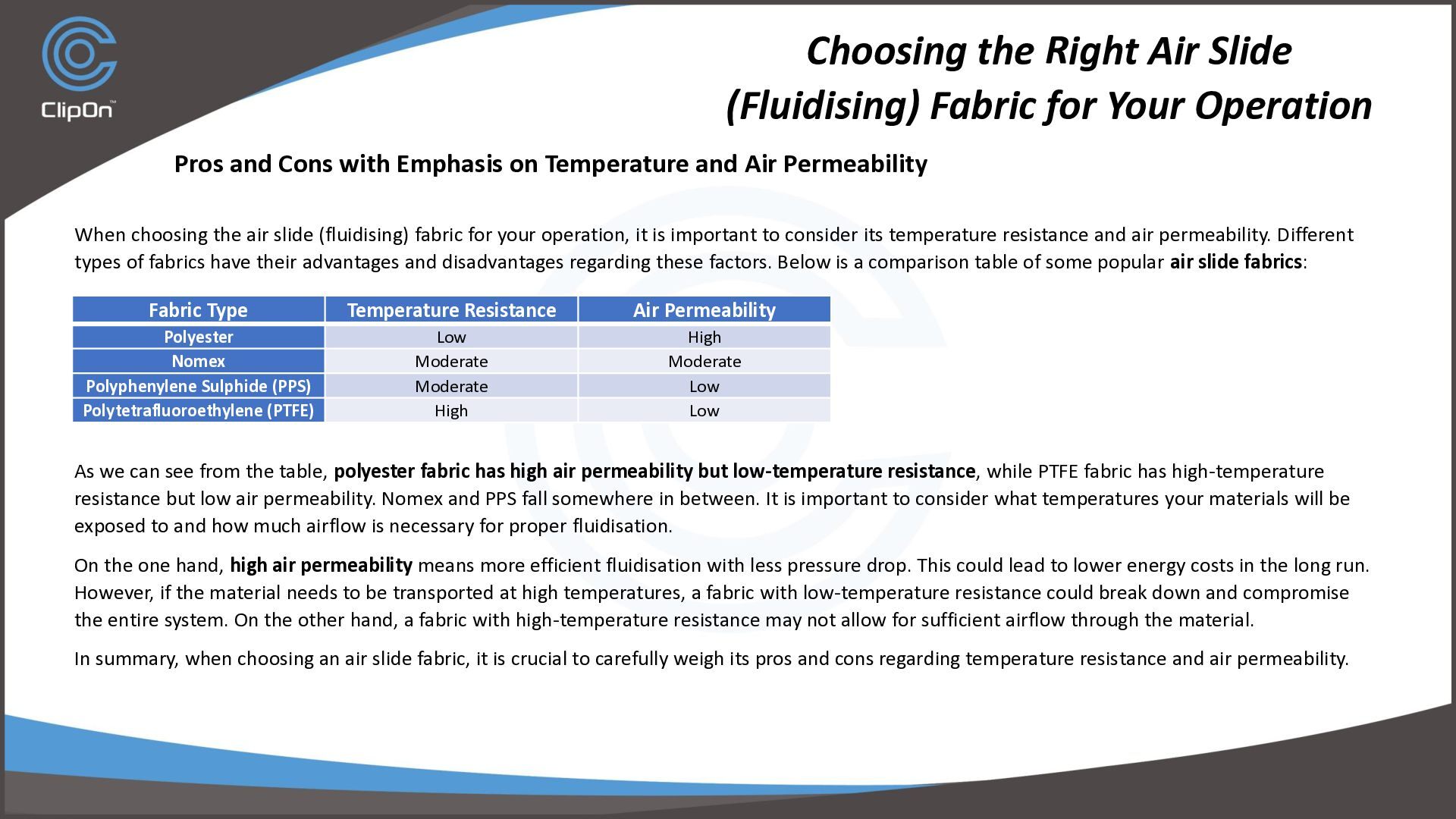
Pros and Cons with Emphasis on Temperature and Air Permeability When choosing the air slide (fluidising) fabric for your operation, it is important to consider its temperature resistance and air permeability. Different types of fabrics have their advantages and disadvantages regarding these factors. Below is a comparison table of some popular air slide fabrics: Fabric Type Temperature Resistance Air Permeability Polyester Nomex Polyphenylene Sulphide (PPS) Polytetrafluoroethylene (PTFE) Low Moderate Moderate High High Moderate Low Low As we can see from the table, polyester fabric has high air permeability but low-temperature resistance, while PTFE fabric has high-temperature resistance but low air permeability. Nomex and PPS fall somewhere in between. It is important to consider what temperatures your materials will be exposed to and how much airflow is necessary for proper fluidisation. On the one hand, high air permeability means more efficient fluidisation with less pressure drop. This could lead to lower energy costs in the long run. However, if the material needs to be transported at high temperatures, a fabric with low-temperature resistance could break down and compromise the entire system. On the other hand, a fabric with high-temperature resistance may not allow for sufficient airflow through the material. In summary, when choosing an air slide fabric, it is crucial to carefully weigh its pros and cons regarding temperature resistance and air permeability.
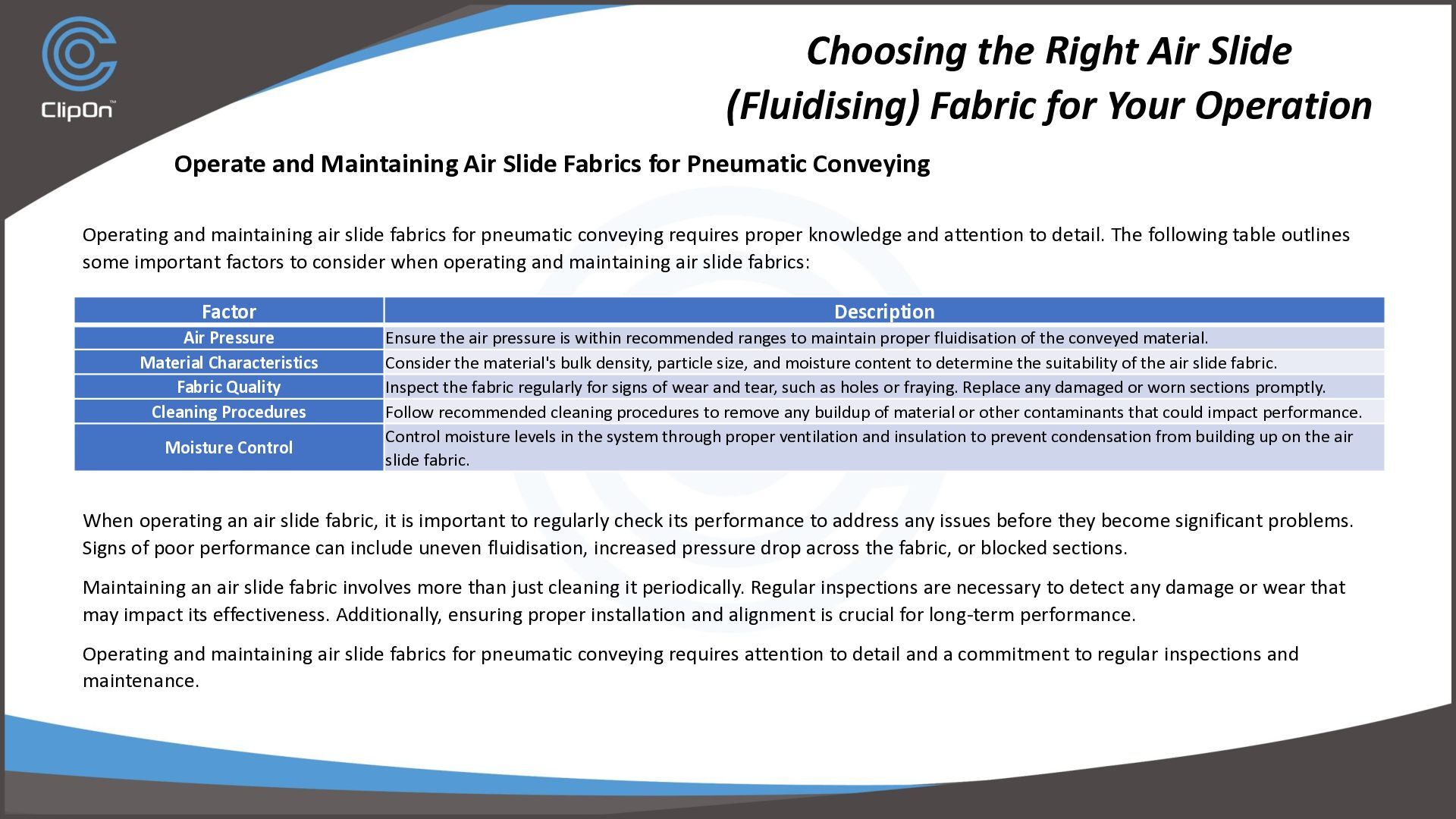
Operate and Maintaining Air Slide Fabrics for Pneumatic Conveying Operating and maintaining air slide fabrics for pneumatic conveying requires proper knowledge and attention to detail. The following table outlines some important factors to consider when operating and maintaining air slide fabrics: Factor Description Air Pressure Material Characteristics Fabric Quality Cleaning Procedures Ensure the air pressure is within recommended ranges to maintain proper fluidisation of the conveyed material. Consider the material's bulk density, particle size, and moisture content to determine the suitability of the air slide fabric. Inspect the fabric regularly for signs of wear and tear, such as holes or fraying. Replace any damaged or worn sections promptly. Follow recommended cleaning procedures to remove any buildup of material or other contaminants that could impact performance. Control moisture levels in the system through proper ventilation and insulation to prevent condensation from building up on the air slide fabric. Moisture Control When operating an air slide fabric, it is important to regularly check its performance to address any issues before they become significant problems. Signs of poor performance can include uneven fluidisation, increased pressure drop across the fabric, or blocked sections. Maintaining an air slide fabric involves more than just cleaning it periodically. Regular inspections are necessary to detect any damage or wear that may impact its effectiveness. Additionally, ensuring proper installation and alignment is crucial for long-term performance. Operating and maintaining air slide fabrics for pneumatic conveying requires attention to detail and a commitment to regular inspections and maintenance.
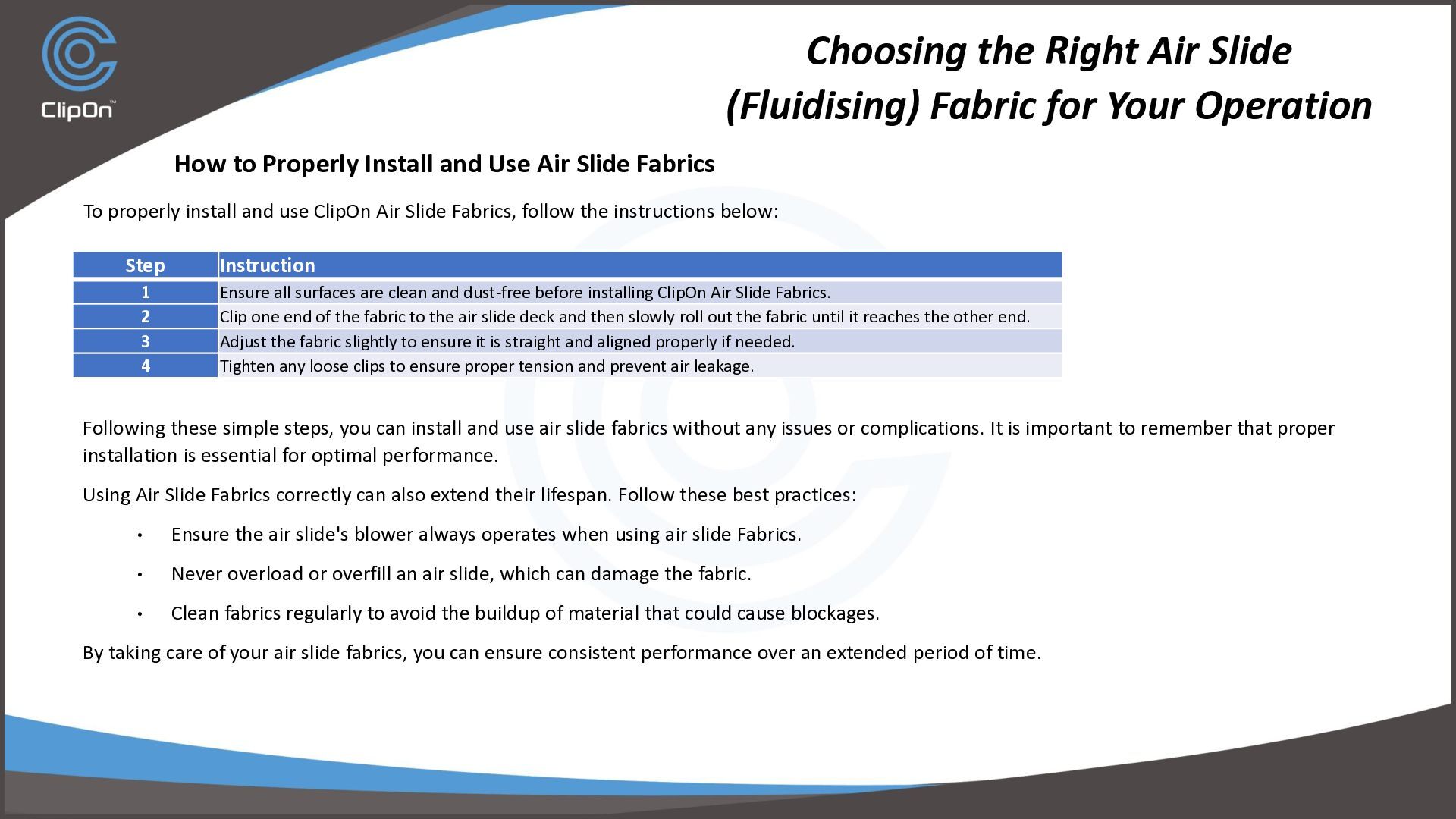
How to Properly Install and Use Air Slide Fabrics To properly install and use ClipOn Air Slide Fabrics, follow the instructions below: Step 1 2 3 4 Instruction Ensure all surfaces are clean and dust-free before installing ClipOn Air Slide Fabrics. Clip one end of the fabric to the air slide deck and then slowly roll out the fabric until it reaches the other end. Adjust the fabric slightly to ensure it is straight and aligned properly if needed. Tighten any loose clips to ensure proper tension and prevent air leakage. Following these simple steps, you can install and use air slide fabrics without any issues or complications. It is important to remember that proper installation is essential for optimal performance. Using Air Slide Fabrics correctly can also extend their lifespan. Follow these best practices: • Ensure the air slide's blower always operates when using air slide Fabrics. • Never overload or overfill an air slide, which can damage the fabric. • Clean fabrics regularly to avoid the buildup of material that could cause blockages. By taking care of your air slide fabrics, you can ensure consistent performance over an extended period of time.
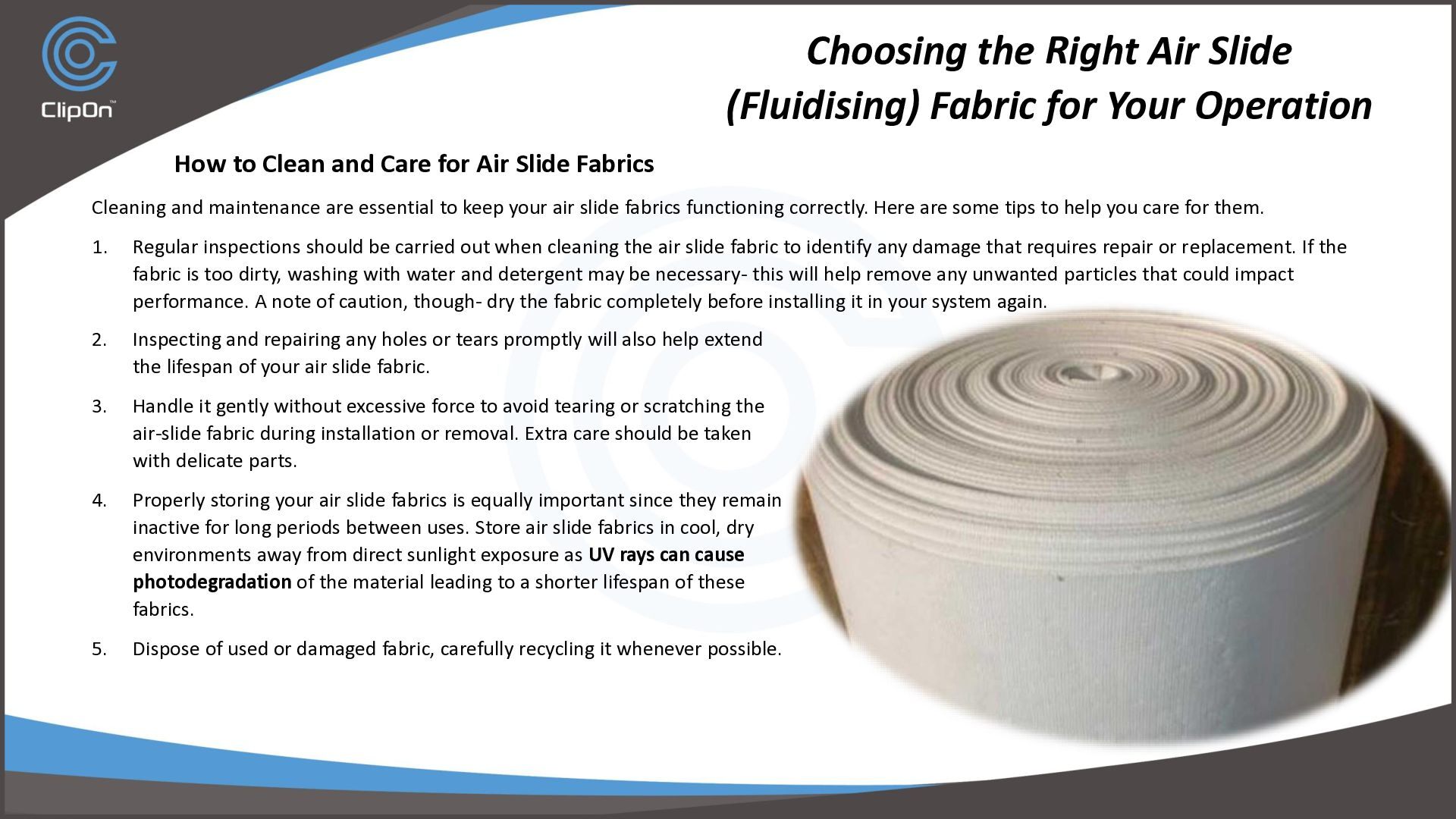
How to Clean and Care for Air Slide Fabrics Cleaning and maintenance are essential to keep your air slide fabrics functioning correctly. Here are some tips to help you care for them. 1. Regular inspections should be carried out when cleaning the air slide fabric to identify any damage that requires repair or replacement. If the fabric is too dirty, washing with water and detergent may be necessary- this will help remove any unwanted particles that could impact performance. A note of caution, though- dry the fabric completely before installing it in your system again. 2. Inspecting and repairing any holes or tears promptly will also help extend the lifespan of your air slide fabric. 3. Handle it gently without excessive force to avoid tearing or scratching the air-slide fabric during installation or removal. Extra care should be taken with delicate parts. 4. Properly storing your air slide fabrics is equally important since they remain inactive for long periods between uses. Store air slide fabrics in cool, dry environments away from direct sunlight exposure as UV rays can cause photodegradation of the material leading to a shorter lifespan of these fabrics. 5. Dispose of used or damaged fabric, carefully recycling it whenever possible.
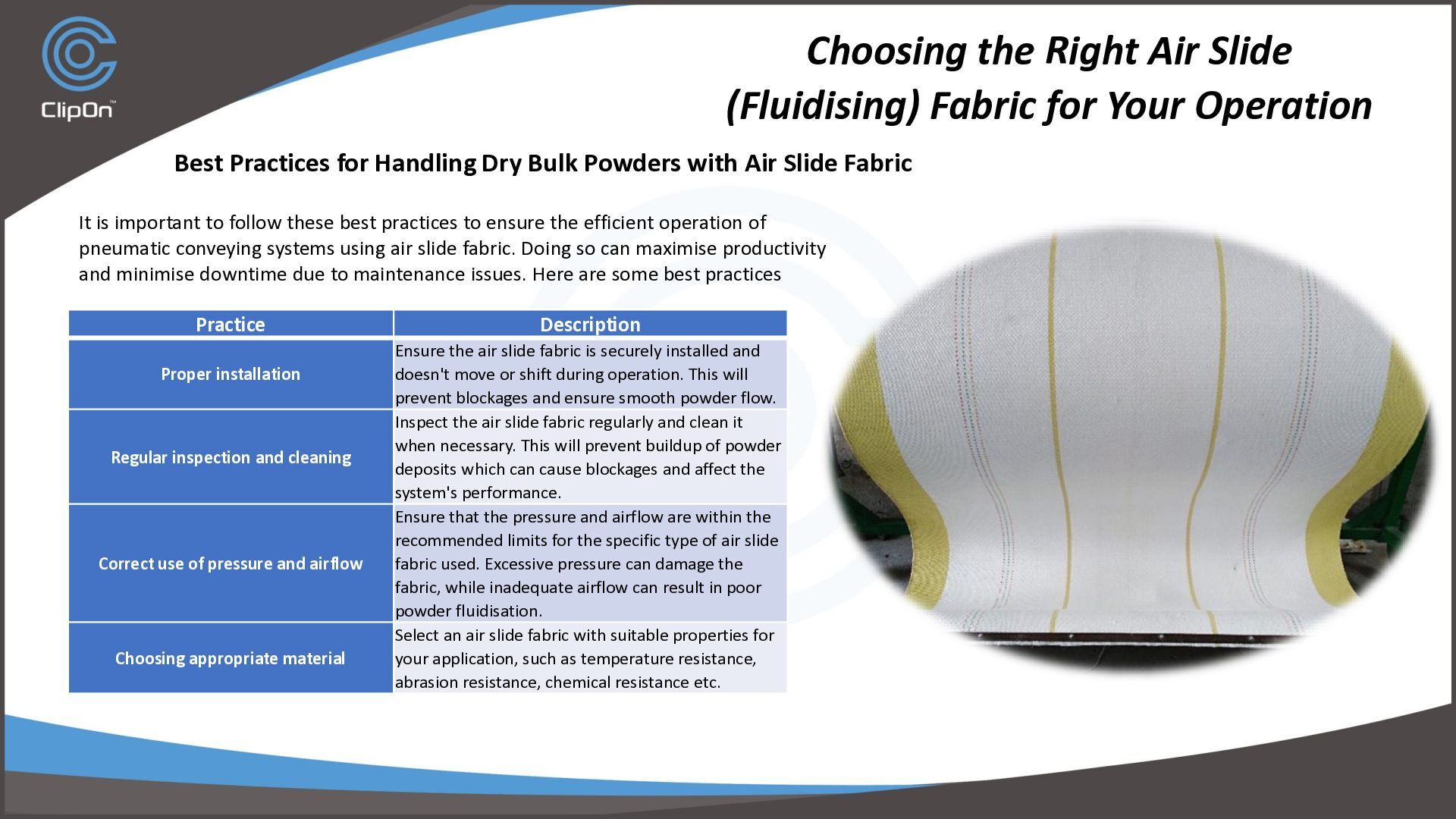
Best Practices for Handling Dry Bulk Powders with Air Slide Fabric It is important to follow these best practices to ensure the efficient operation of pneumatic conveying systems using air slide fabric. Doing so can maximise productivity and minimise downtime due to maintenance issues. Here are some best practices Practice Proper installation Regular inspection and cleaning Correct use of pressure and airflow Choosing appropriate material Description Ensure the air slide fabric is securely installed and doesn't move or shift during operation. This will prevent blockages and ensure smooth powder flow. Inspect the air slide fabric regularly and clean it when necessary. This will prevent buildup of powder deposits which can cause blockages and affect the system's performance. Ensure that the pressure and airflow are within the recommended limits for the specific type of air slide fabric used. Excessive pressure can damage the fabric, while inadequate airflow can result in poor powder fluidisation. Select an air slide fabric with suitable properties for your application, such as temperature resistance, abrasion resistance, chemical resistance etc.
Do You Feel Overwhelmed Choosing the Best Air Slide Fabric for Your Operation? Be sure to consider all the factors from fabric construction to abrasion and temperature resistance. About ClipOn: An artisanal material handling company that provides products and services to companies processing steel, cement, aluminum, copper and other materials helping them to achieve global emission norms and standards. Our comprehensive portfolio includes air-slides, filter bags, dust collectors, fluidising fabrics, and cotton canvas belts. ClipOn offers decades of experience and cost-effective solutions to help you find the right air-slide (fluidising) fabric. Our team will help you save time and money while ensuring optimal performance and extending the life of your system. Contact us today to learn more about our air-slide replacement solutions and get started! Ten Reasons to Consider ClipOn: 1. More Affordable Alternative vs OEM 2. Equal if Not Superior Performance vs OEM 3. Readily Available 4. Customizable 5. Alternative Materials & Coatings 6. Equal if not Superior Warranty 7. Reverse Engineering Capabilities 8. Limited Production Runs 9. Global and Local Logistic Network 10. Prototyping Available