Speed Up Innovation Time Change Move Fast, Break Things Culture of experimentation A 20% vs. 25% Shorten the Feedback Loop Real-time data-driven intelligence & personalization AI / ML Data, Data, Data B
infrastructure Dissolving security perimeter Menacing threat landscape TRADITIONAL NETWORK-BASED DEFENSES ARE NO LONGER ENOUGH SECURING THE ENTERPRISE IS HARDER THAN EVER The way we develop, deploy and manage IT is changing dramatically led by DevOps, Cloud Native Applications, and Hybrid Cloud
[email protected] Scheduling Monitoring Persistence Discovery Lifecycle & health Scaling Aggregation Security CONTAINERS AT SCALE BARE METAL VIRTUAL PRIVATE CLOUD PUBLIC CLOUD
Container Application OS dependencies LINUX VIRTUALIZATION Container Application OS dependencies Virtual Machine LINUX PRIVATE CLOUD Container Application OS dependencies Virtual Machine LINUX PUBLIC CLOUD Container Application OS dependencies Virtual Machine LINUX CONTAINERS - Build Once, Deploy Anywhere Reducing Risk and Improving Security with Improved Consistency
build file • Don’t login to build/configure • Be explicit with versions, not latest • Always list registry pulling FROM • Specify USER, default is root • Each Run creates a new layer BUILD FILE BEST PRACTICES FROM registry.redhat.com/rhel7 RUN groupadd -g 999 appuser && \ useradd -r -u 999 -g appuser appuser USER appuser CMD echo “Hello” Build file
priority security vulnerabilities examples: ShellShock (bash) Heartbleed (OpenSSL) Poodle (OpenSSL) Source: Over 30% of Official Images in Docker Hub Contain High Priority Security Vulnerabilities, Jayanth Gummaraju, Tarun Desikan, and Yoshio Turner, BanyanOps, May 2015 (http://www.banyanops.com/pdf/BanyanOps-AnalyzingDockerHub-WhitePaper.pdf) WHAT’S INSIDE THE CONTAINER MATTERS
for RHEL CCE-27002-5 Set Password Minimum Length Content Scan physical servers, virtual machines, docker images and containers for Security Policy Compliance (CCEs) and known Security Vulnerabilities (CVEs)
Firefox STIG RHEL OSP STIG Red Hat Corporate Profile for Certified Cloud Providers (RH CCP) STIG for Red Hat Enterprise Linux 6, 7 Server STIG for Red Hat Virtualization Hypervisor Common Profile for General-Purpose Debian Systems Common Profile for General-Purpose Fedora Systems Common Profile for General-Purpose Ubuntu Systems Payment Card Industry – Data Security Standard (PCI-DSS) v3 U.S. Government Commercial Cloud Services (C2S) CNSSI 1253 Low/Low/Low Control Baseline for Red Hat Enterprise Linux 7 Criminal Justice Information Services (CJIS) Security Policy Unclassified Information in Non-federal Information Systems and Organizations (NIST 800-171) U.S. Government Configuration Baseline (NIAP OSPP v4.0, USGCB, STIG) Security Policies in SCAP Security Guide (partial)
BLUE GREEN Use Case • Self-contained micro services (data) Cons • Resource overhead • Data synchronization Pros • Low risk, never change production • No downtime • Production like testing • Rollback
a flat SDN model • All pods get IP from same CIDR • And live on same logical network • Assumes all nodes communicate Traditional Physical Network Model • Each layer represents a Zone with increased trust - DMZ > App > DB, interzone flow generally one direction • Intrazone traffic generally unrestricted
Cluster Physical Compute isolation based on Network Zones Kubernete Cluster One Cluster Per Zone Kubernete Cluster B Kubernete Cluster A Kubernetes Cluster B C D https://blog.openshift.com/openshift-and-network-security-zones-coexistence-approaches/
can also have storage isolation requirements: pods in a network zone must use different storage endpoints than pods in other network zones. We can create one storage class per storage endpoint and then control which storage class(es) a project can use


 cvantuin
 techtekt
 keeg
keeg
 ezaki
ezaki
 puhitaku
 carta_engineering
 mhrtech
 daidaidai
 yazm
yazm
 ishikawa_satoru
 takanorip
 takahashim
 hiracky16
 reverentgeek
 aemeredith
 morganepeng
 chrisshort
 addyosmani
 twada
twada
 rasagy
 tammyeverts
 ammeep
 cassininazir
 thoeni
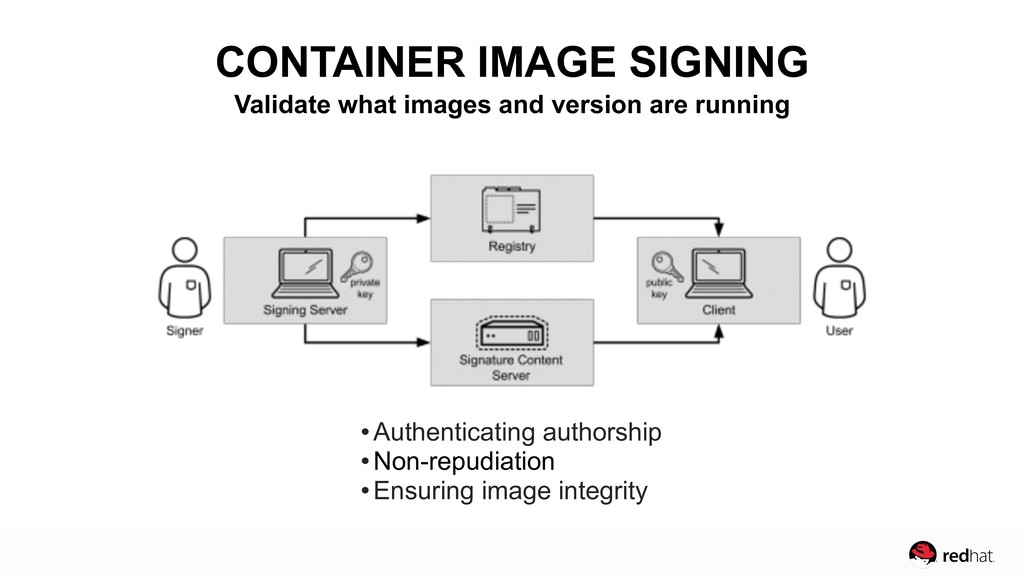
 signer




![THANK YOU linkedin: Chris Van Tuin email: [email protected] twitter: @chrisvantuin](https://files.speakerdeck.com/presentations/d8c78851a5fd4215b8a67cb8e2a2e14c/slide_91.jpg)