Upgrade to Pro — share decks privately, control downloads, hide ads and more …

Retrievable Beats Rankable: Build for Retrieval...

Retrievable Beats Rankable: Build for Retrieval-Based AI

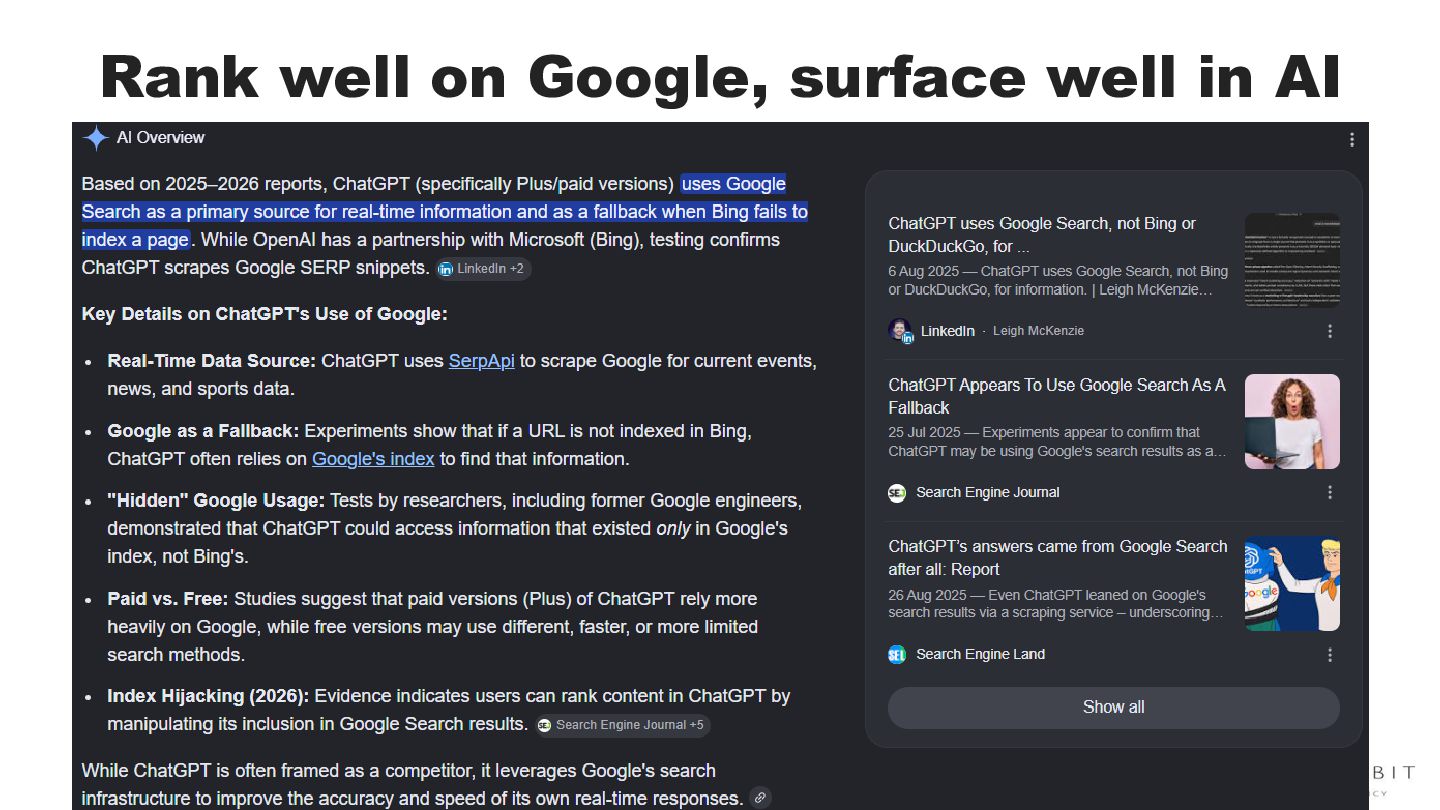
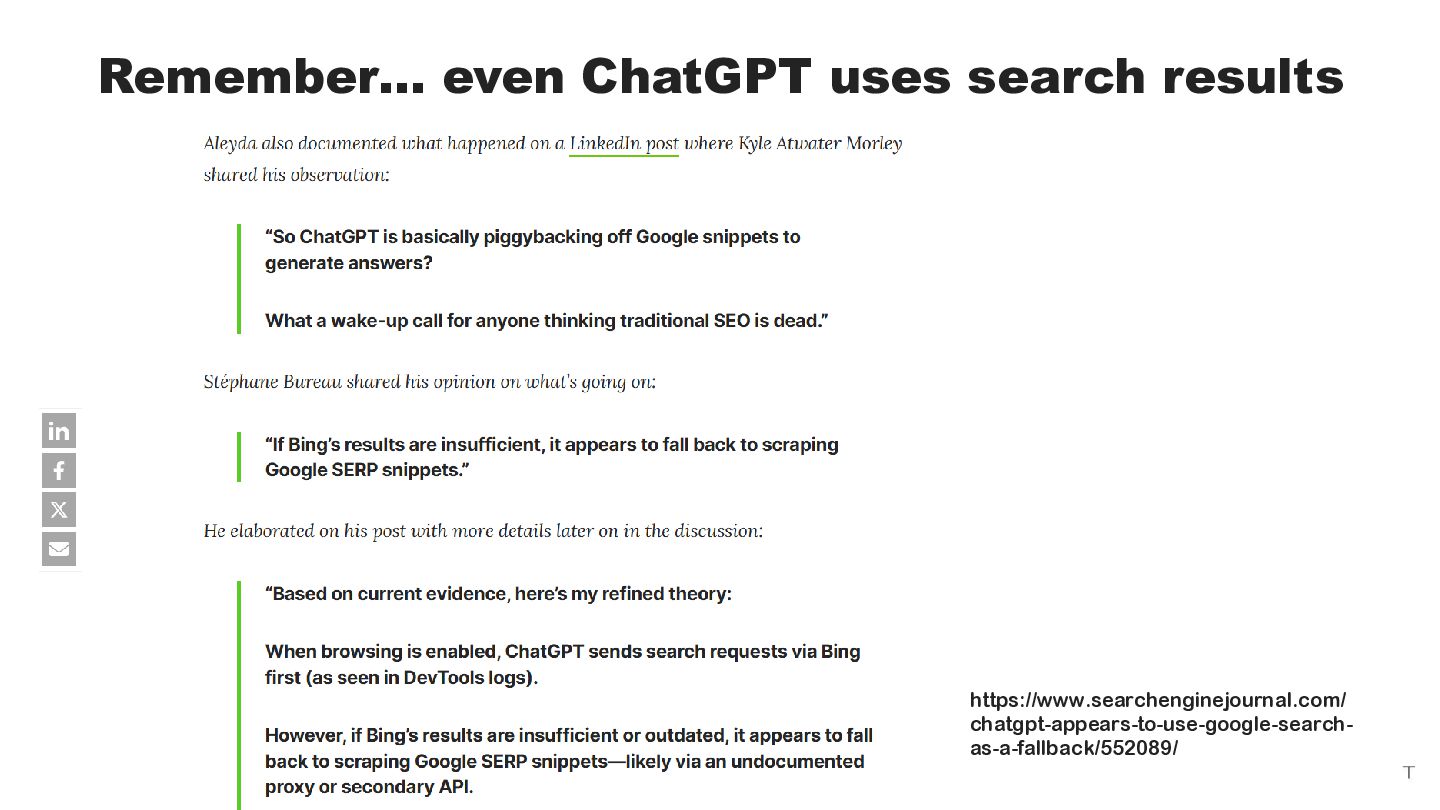
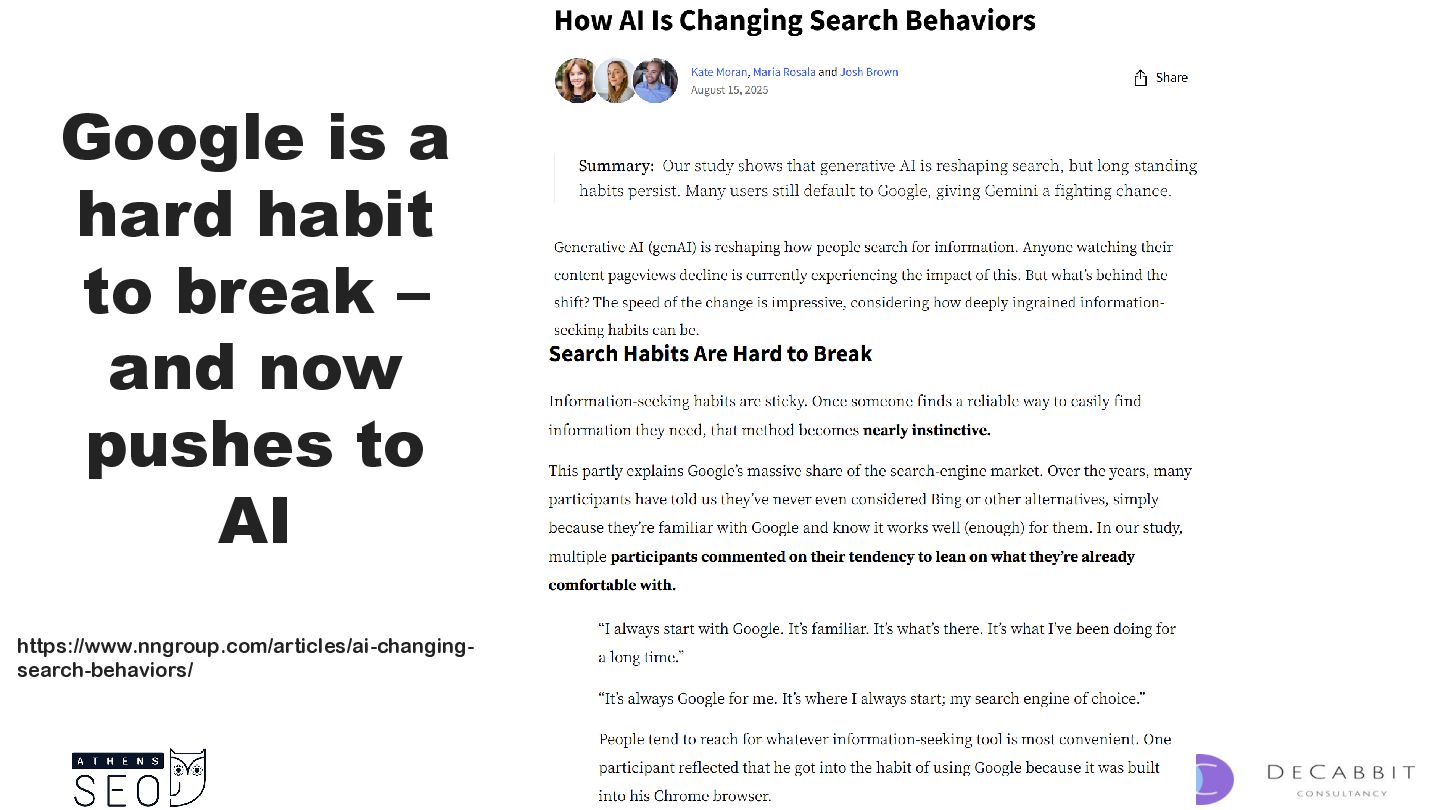
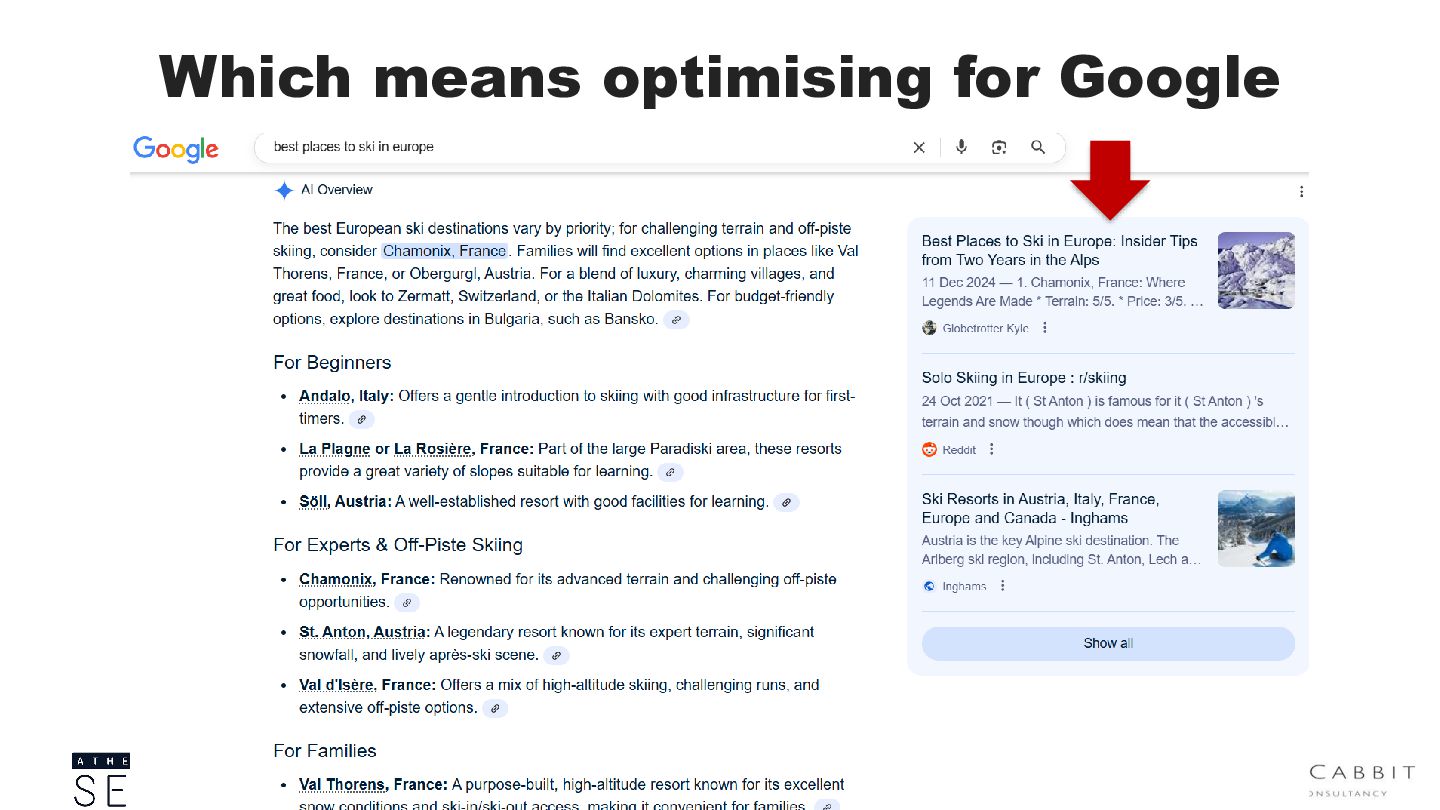
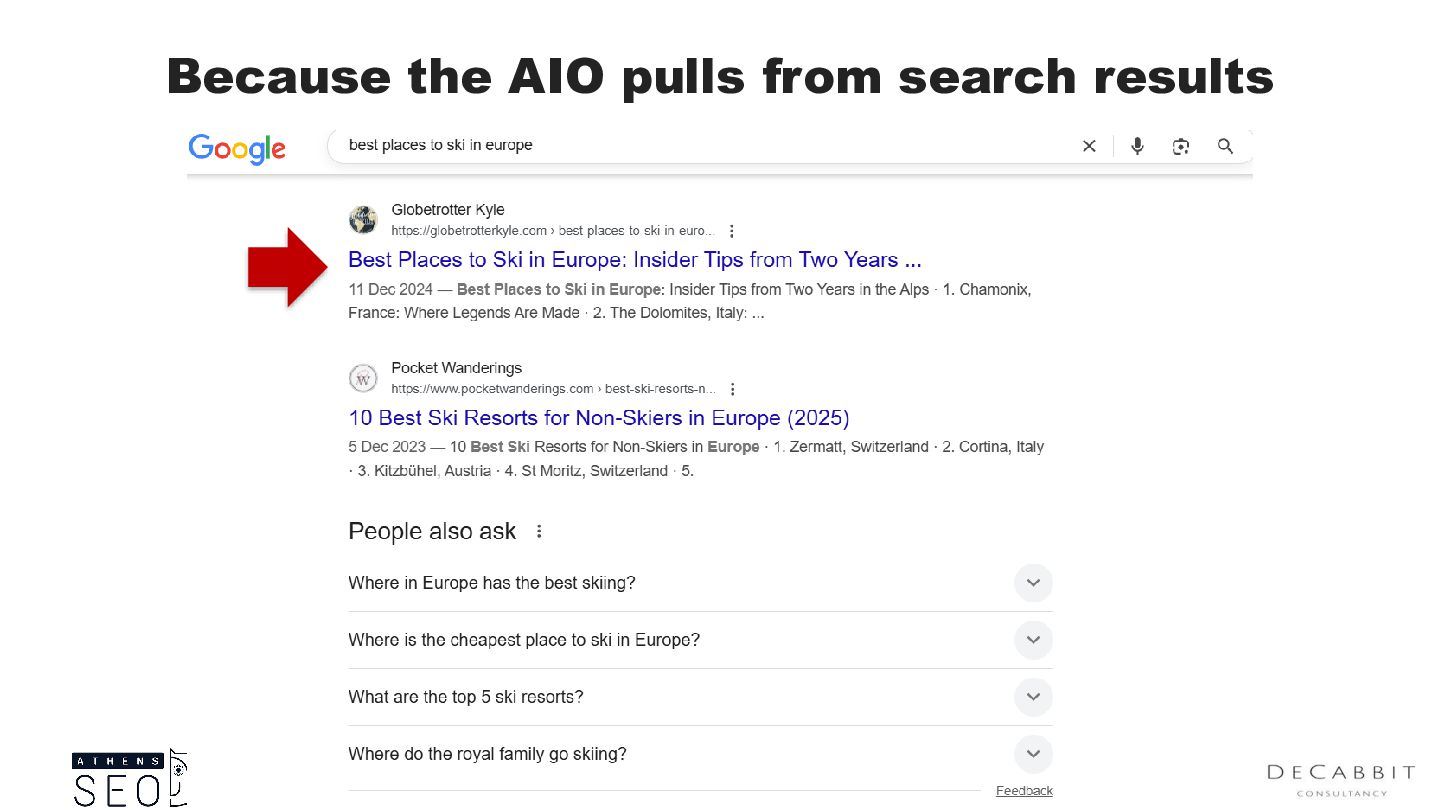
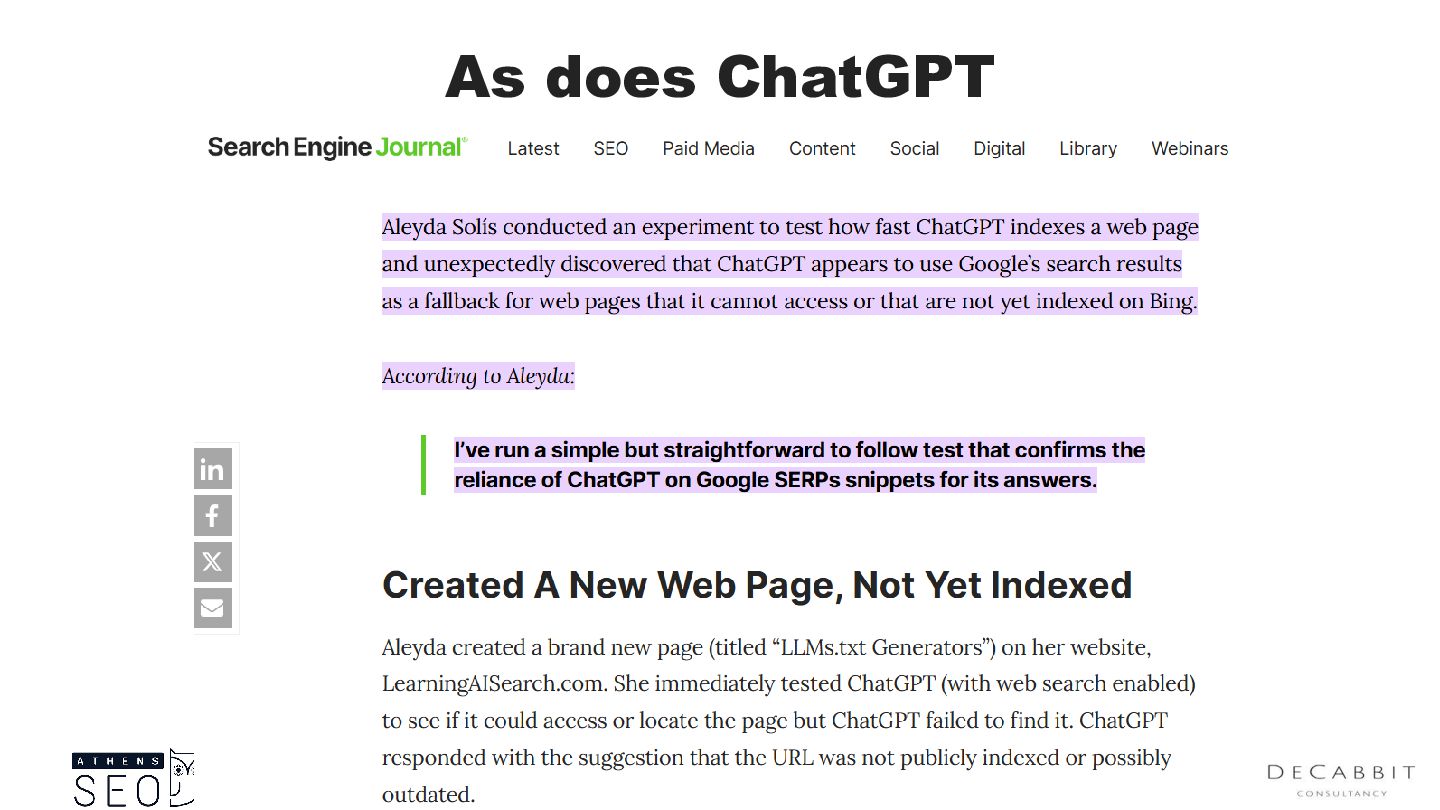
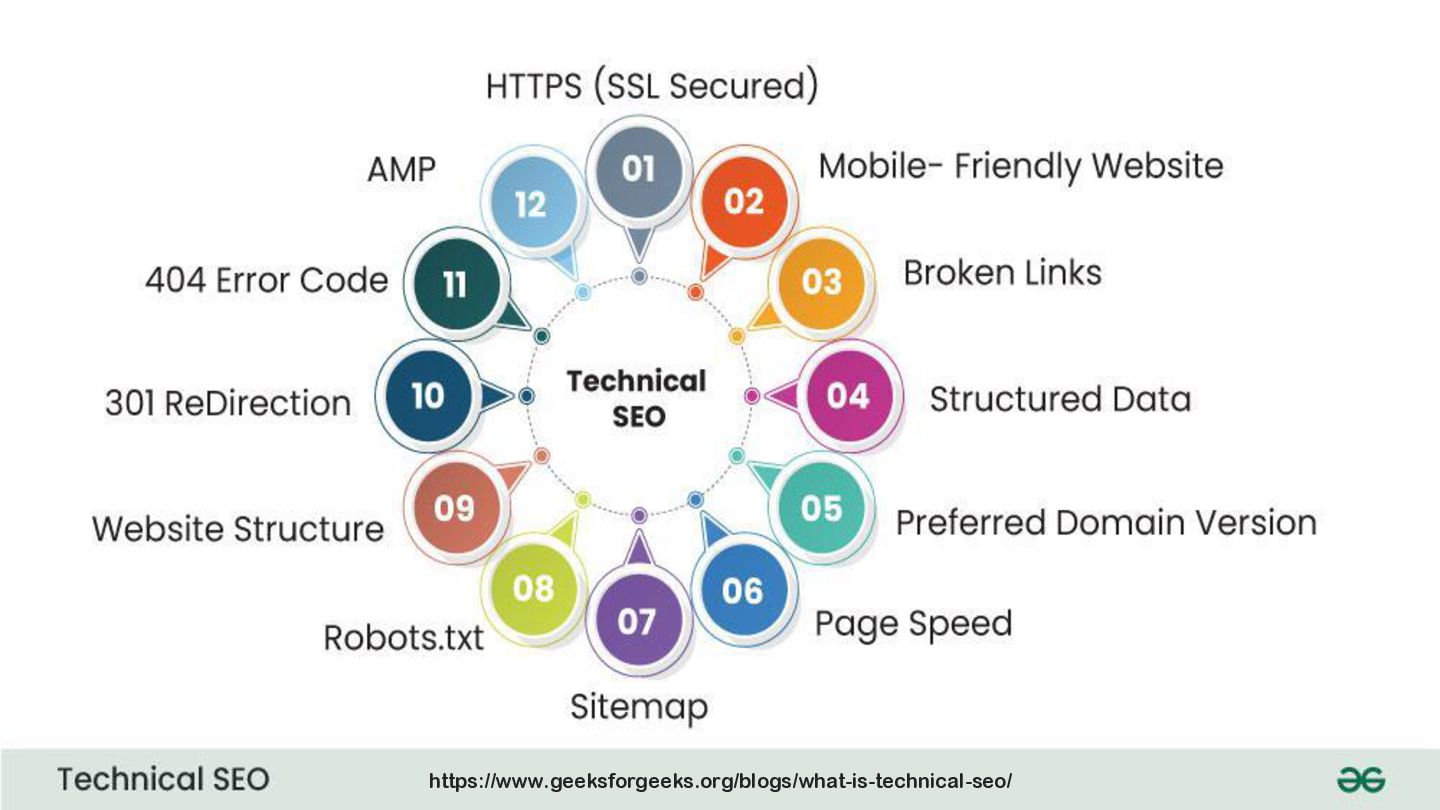
This was so much fun to do at AthenSEO (or as I have been calling it, AthensSEO). I covered how technical SEO is essential (if not critical) for ranking. Whether we look at speed, spiderability, or other forms of optimisation, the essentials of TechSEO are so critical for ranking well in AI that without them, you likely won't appear in the responses AI makes. Add to that the fact that models can and do use search results, this means good optimisation for AI is good SEO.
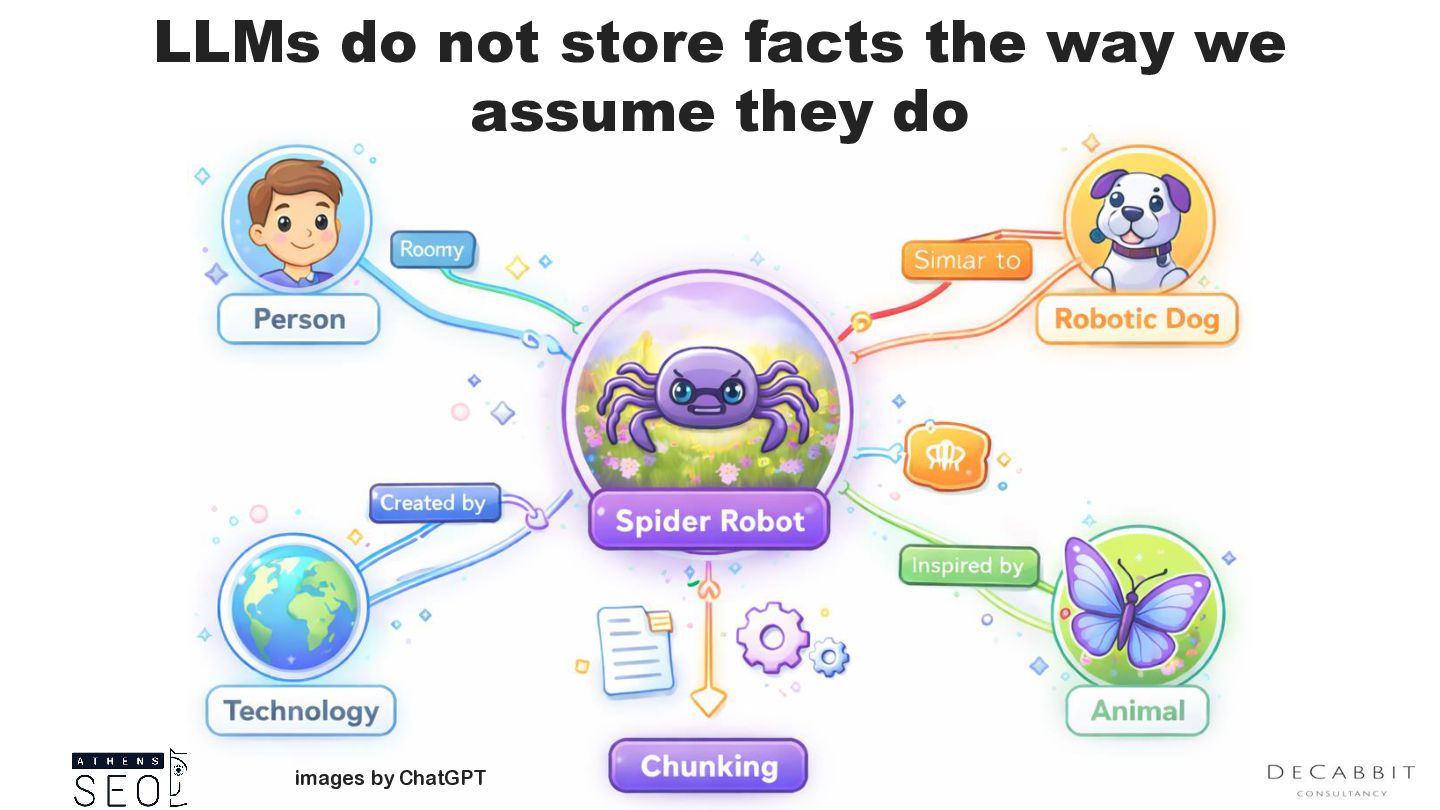
This session covered a bit about how AI works and how there is not storage of facts, what AI needs, llms.txt, and more. It all boiled down to technical SEO in the end.

Avatar for Judith Lewis

Judith Lewis

May 28, 2026

More Decks by Judith Lewis

Other Decks in Marketing & SEO

Transcript

  1. #AthensSEO Expert trainer, speaker, fractional CMO, MC and compère Run

    DeCabbit Consultancy specialising in global digital marketing consultancy Non-Executive Director (NED) of the Academy of Chocolate Technical Lead of the WBA think tank in Switzerland working on AI in viticulture Contact: [email protected] Who I Am & What I Do
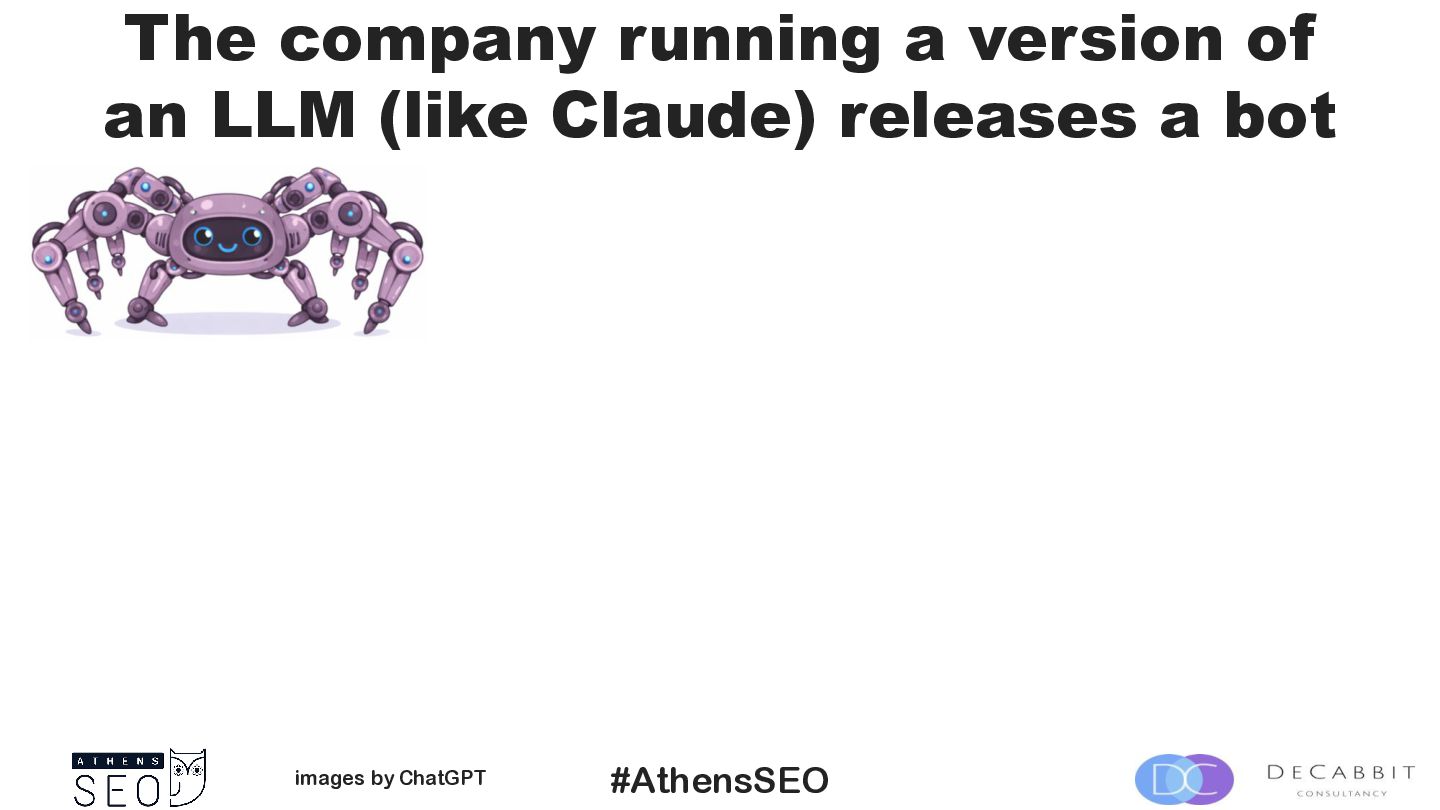
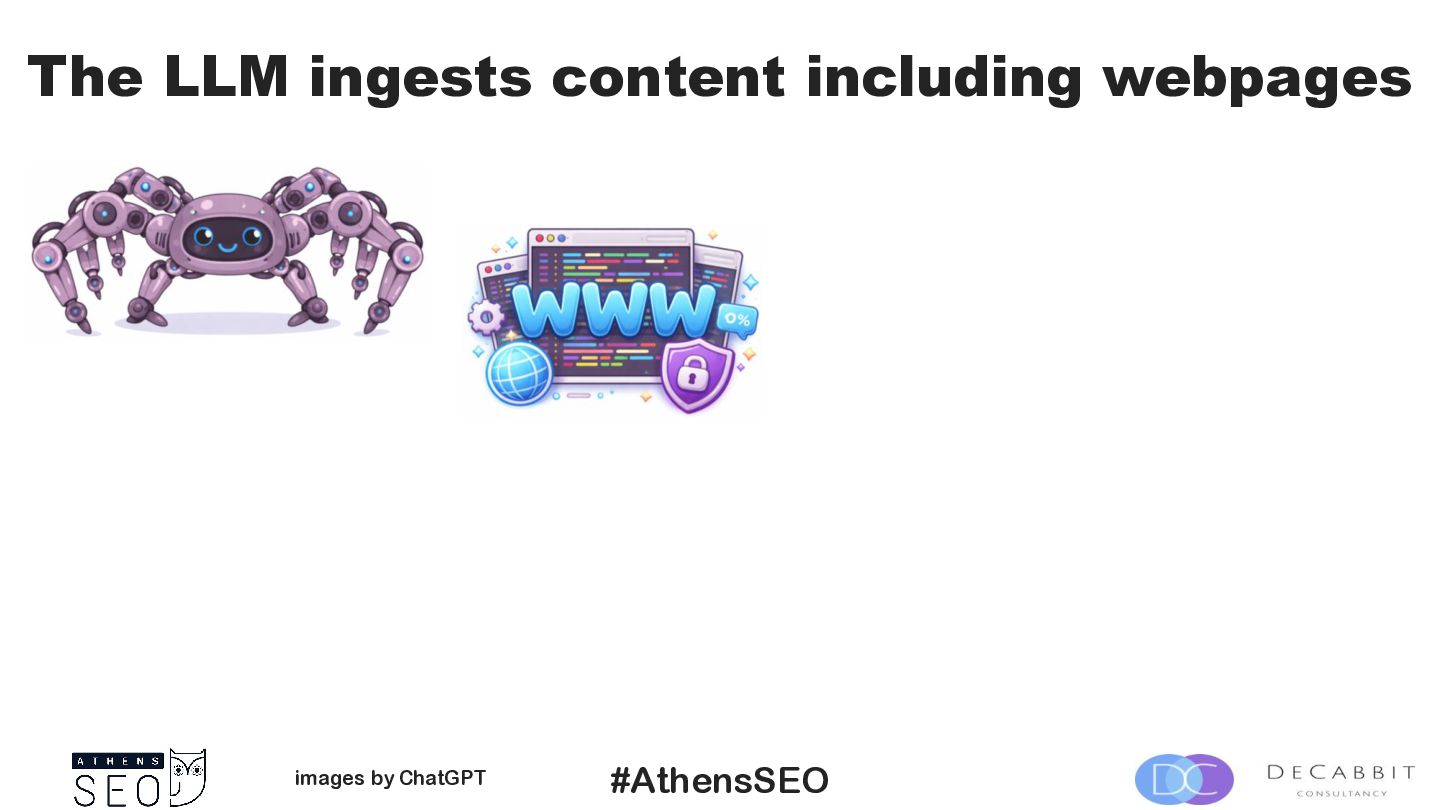
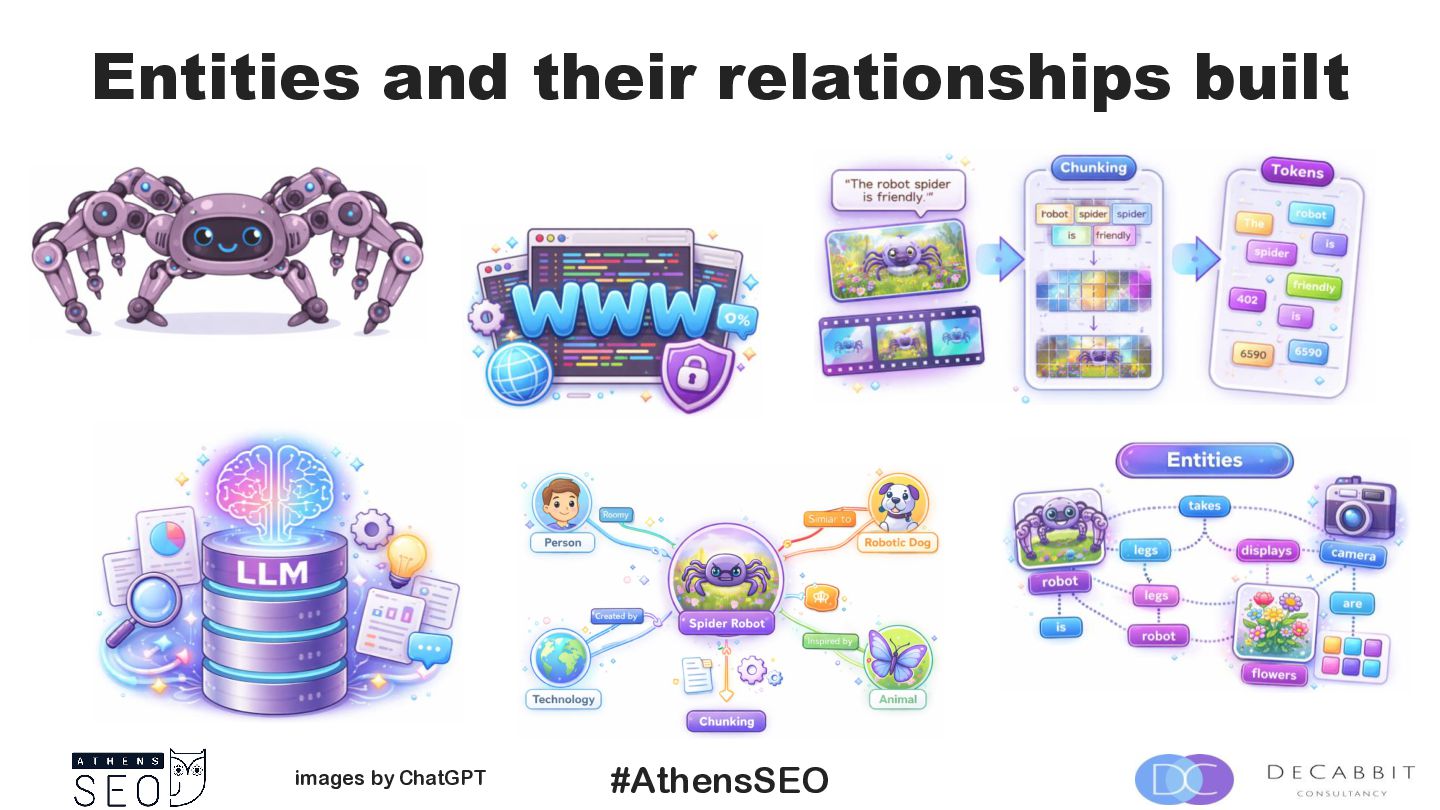
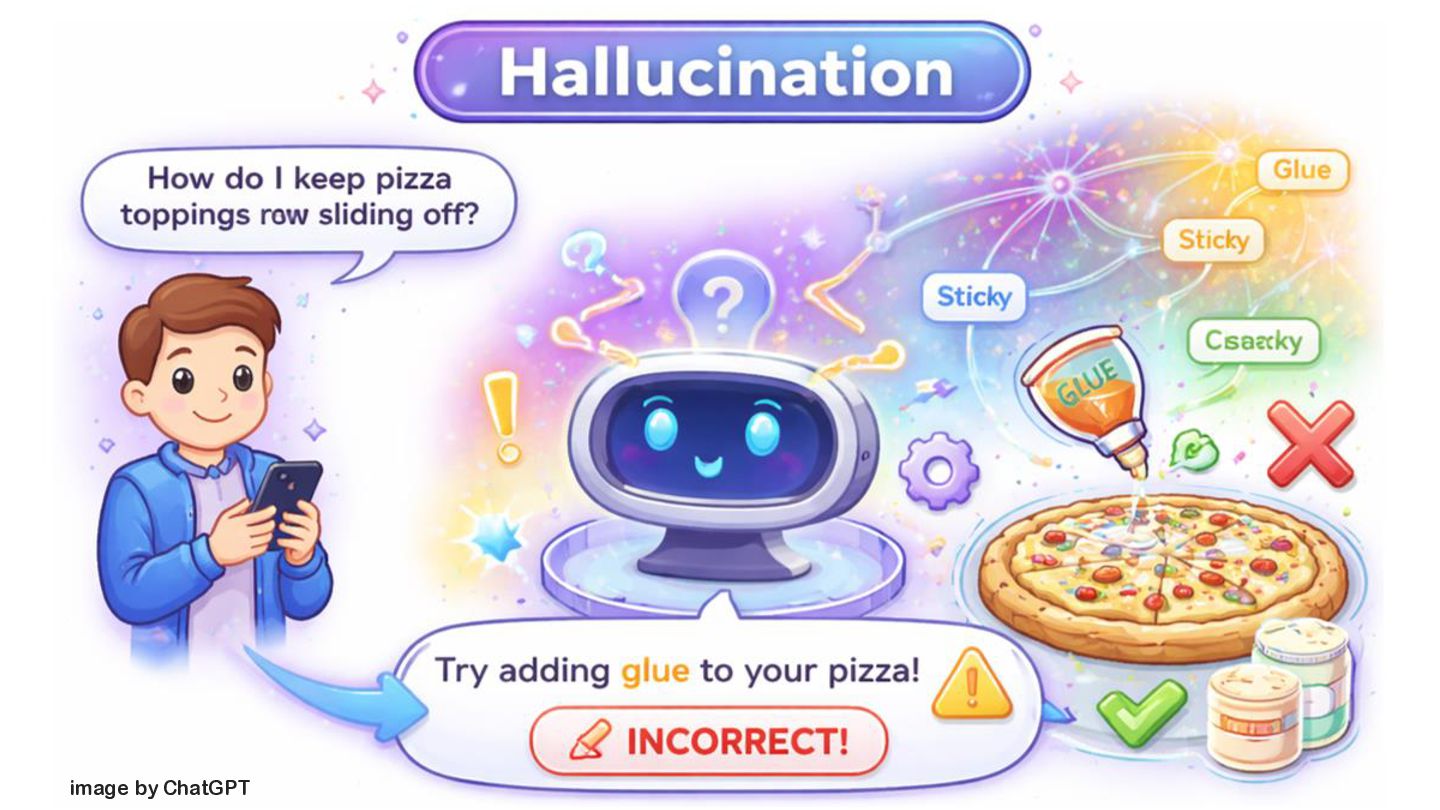
  2. #AthensSEO The company running a version of an LLM (like

    Claude) releases a bot images by ChatGPT
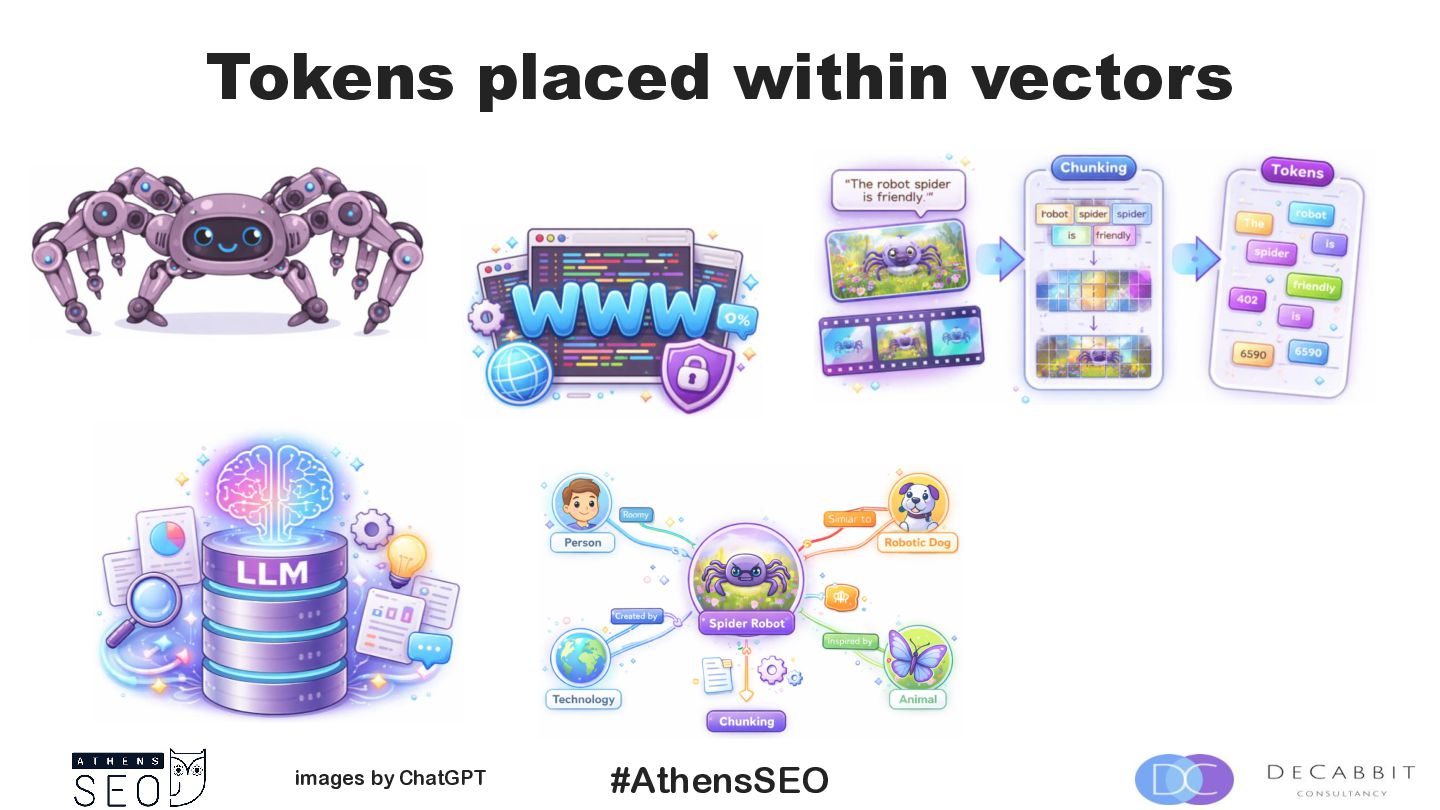
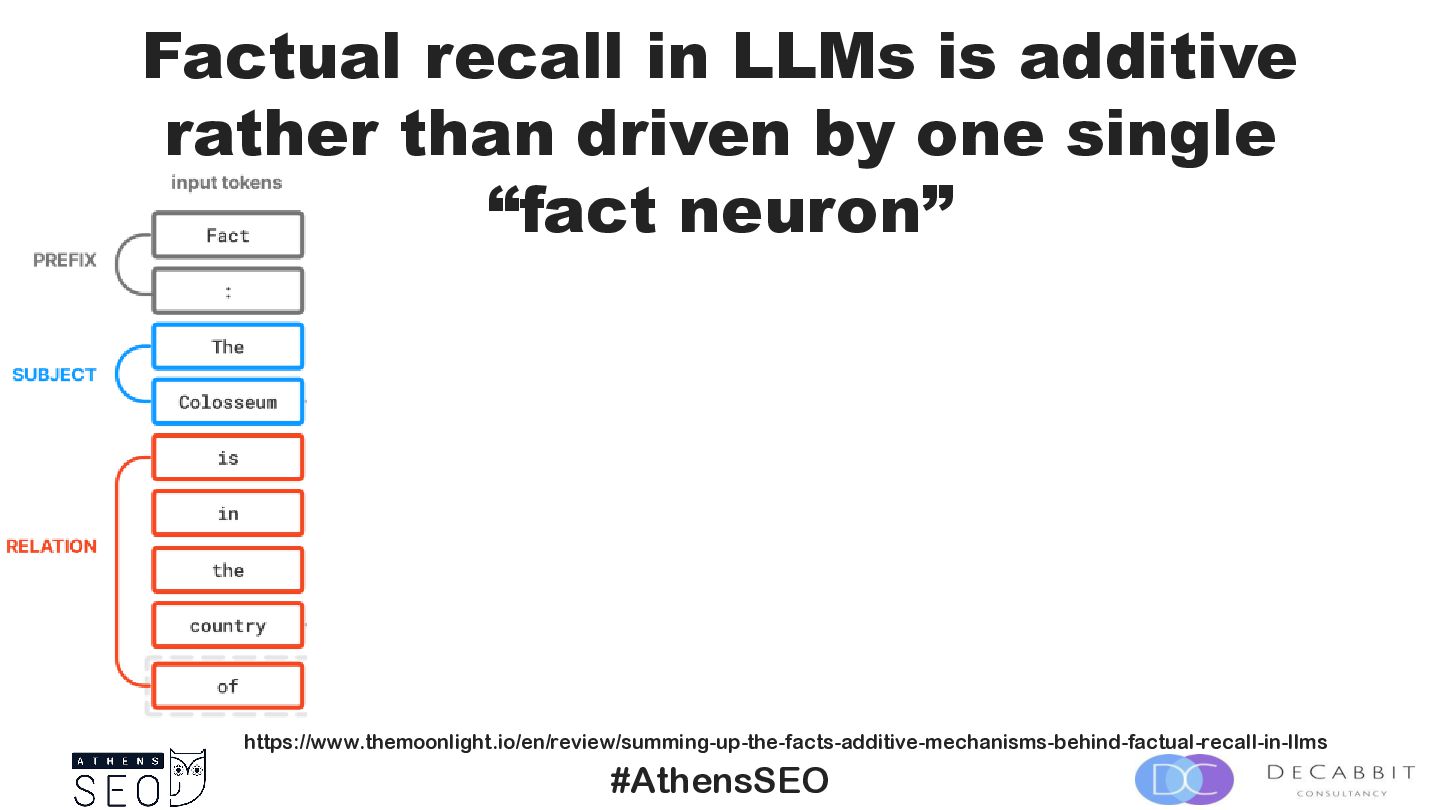
  3. #AthensSEO Factual recall in LLMs is additive rather than driven

    by one single “fact neuron” https://www.themoonlight.io/en/review/summing-up-the-facts-additive-mechanisms-behind-factual-recall-in-llms
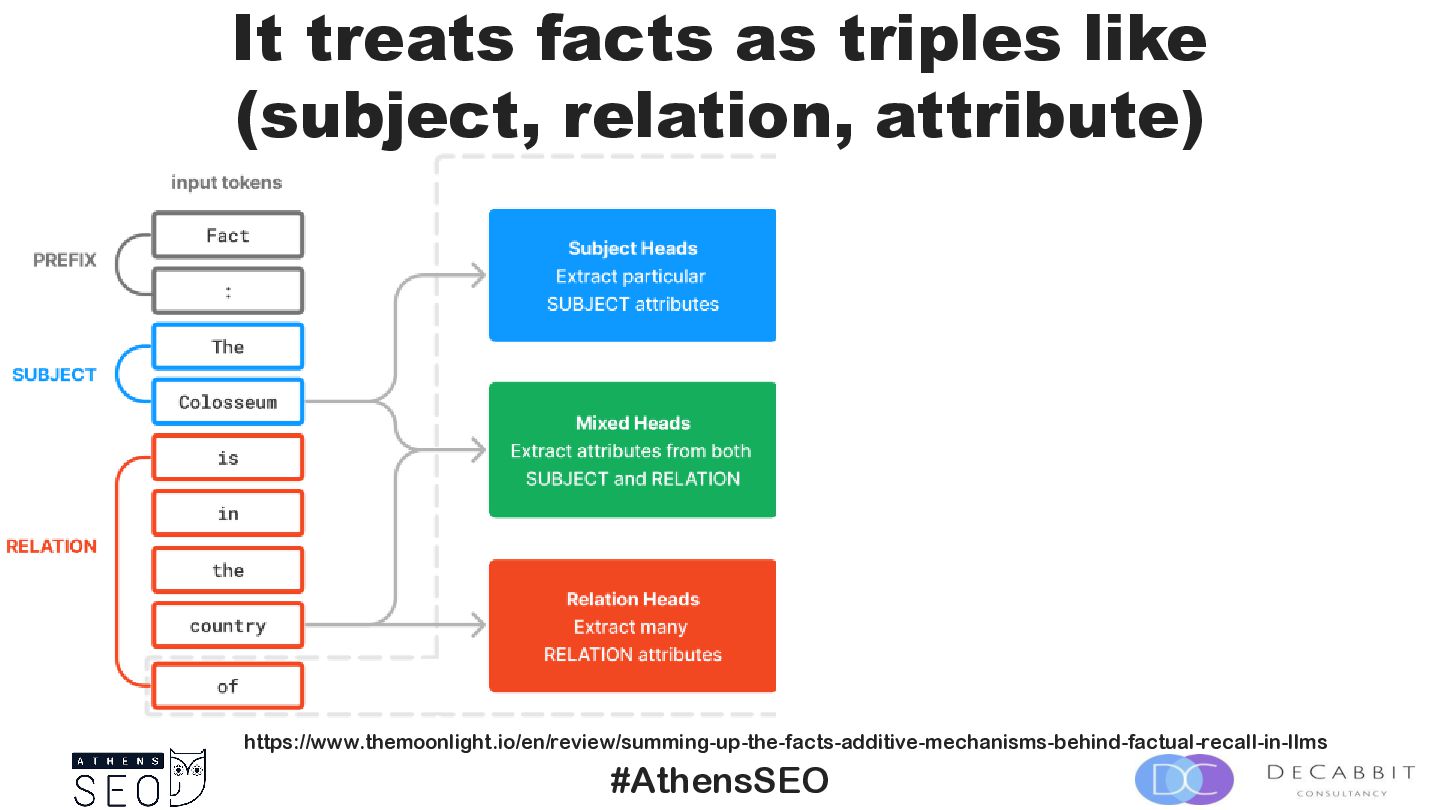
  4. #AthensSEO It treats facts as triples like (subject, relation, attribute)

    https://www.themoonlight.io/en/review/summing-up-the-facts-additive-mechanisms-behind-factual-recall-in-llms
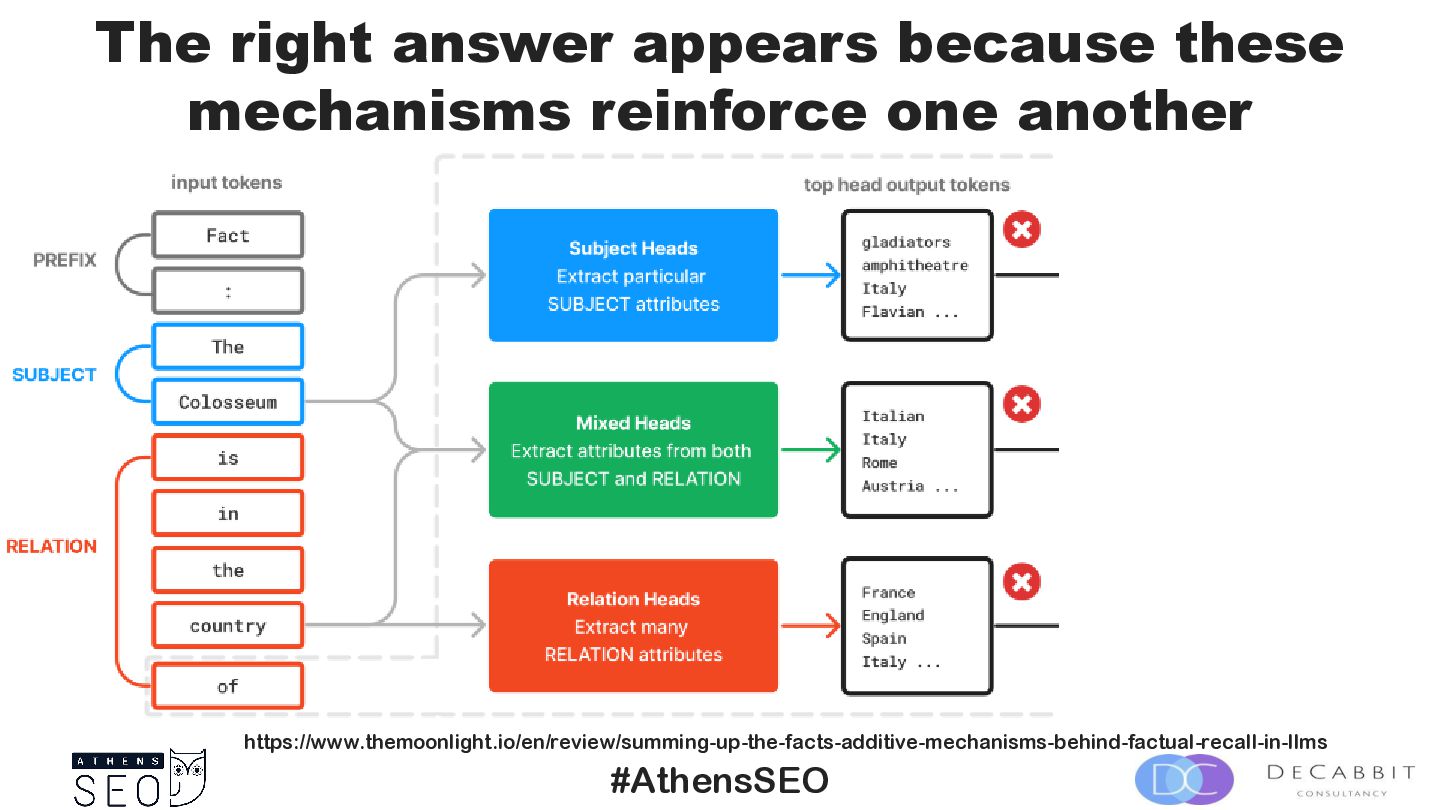
  5. #AthensSEO The right answer appears because these mechanisms reinforce one

    another https://www.themoonlight.io/en/review/summing-up-the-facts-additive-mechanisms-behind-factual-recall-in-llms
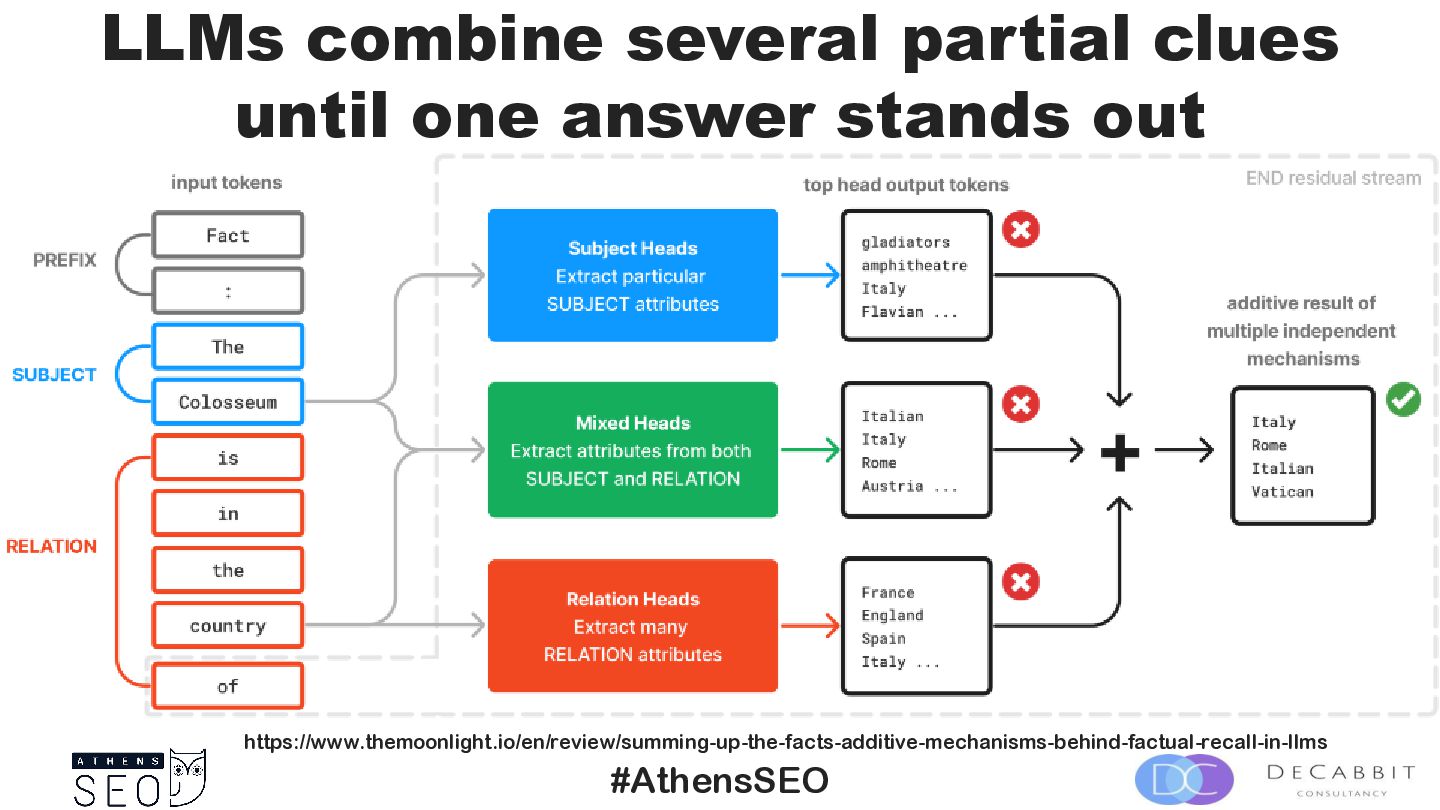
  6. #AthensSEO LLMs combine several partial clues until one answer stands

    out https://www.themoonlight.io/en/review/summing-up-the-facts-additive-mechanisms-behind-factual-recall-in-llms
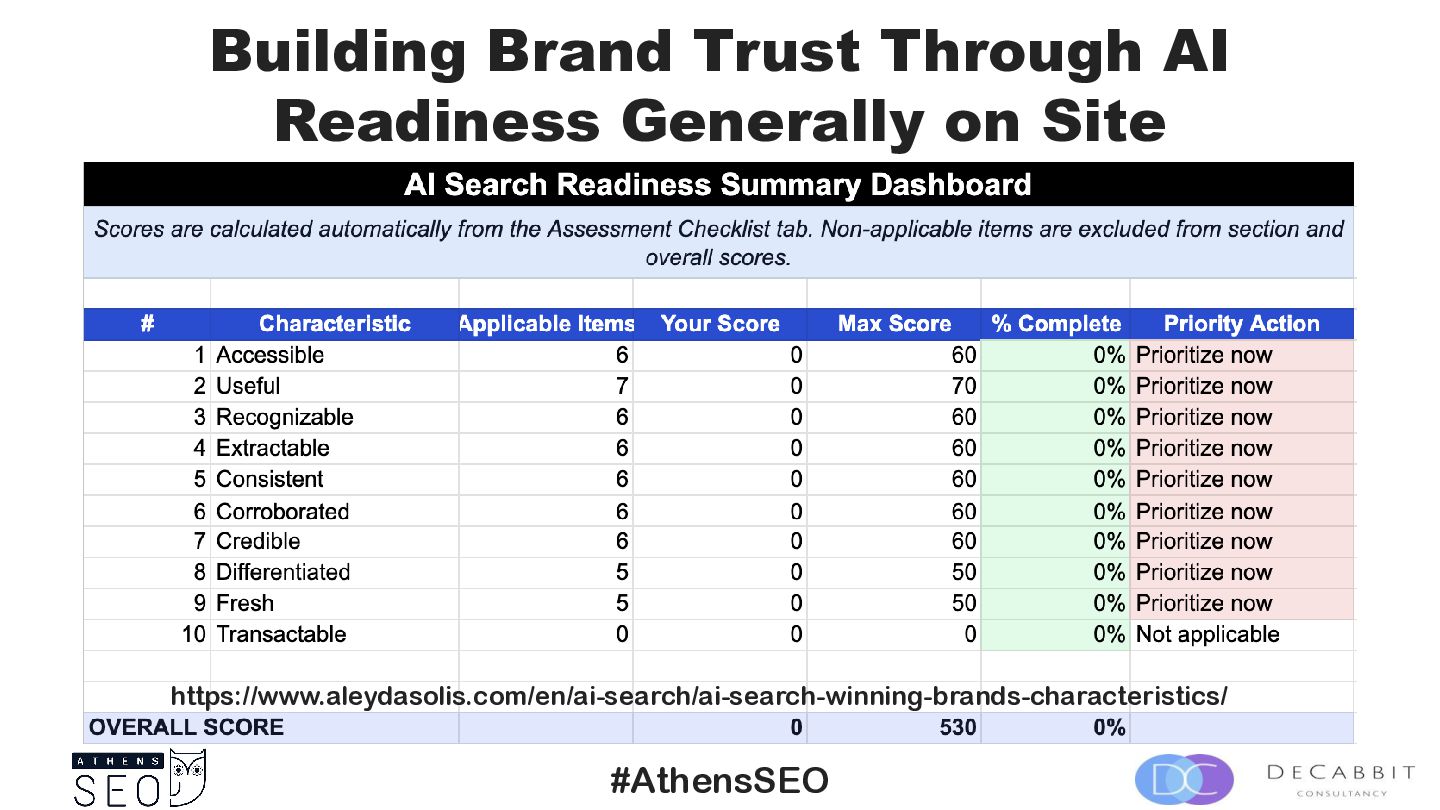
  7. #AthensSEO Building Brand Trust Through AI Readiness Generally on Site

    https://www.aleydasolis.com/en/ai-search/ai-search-winning-brands-characteristics/
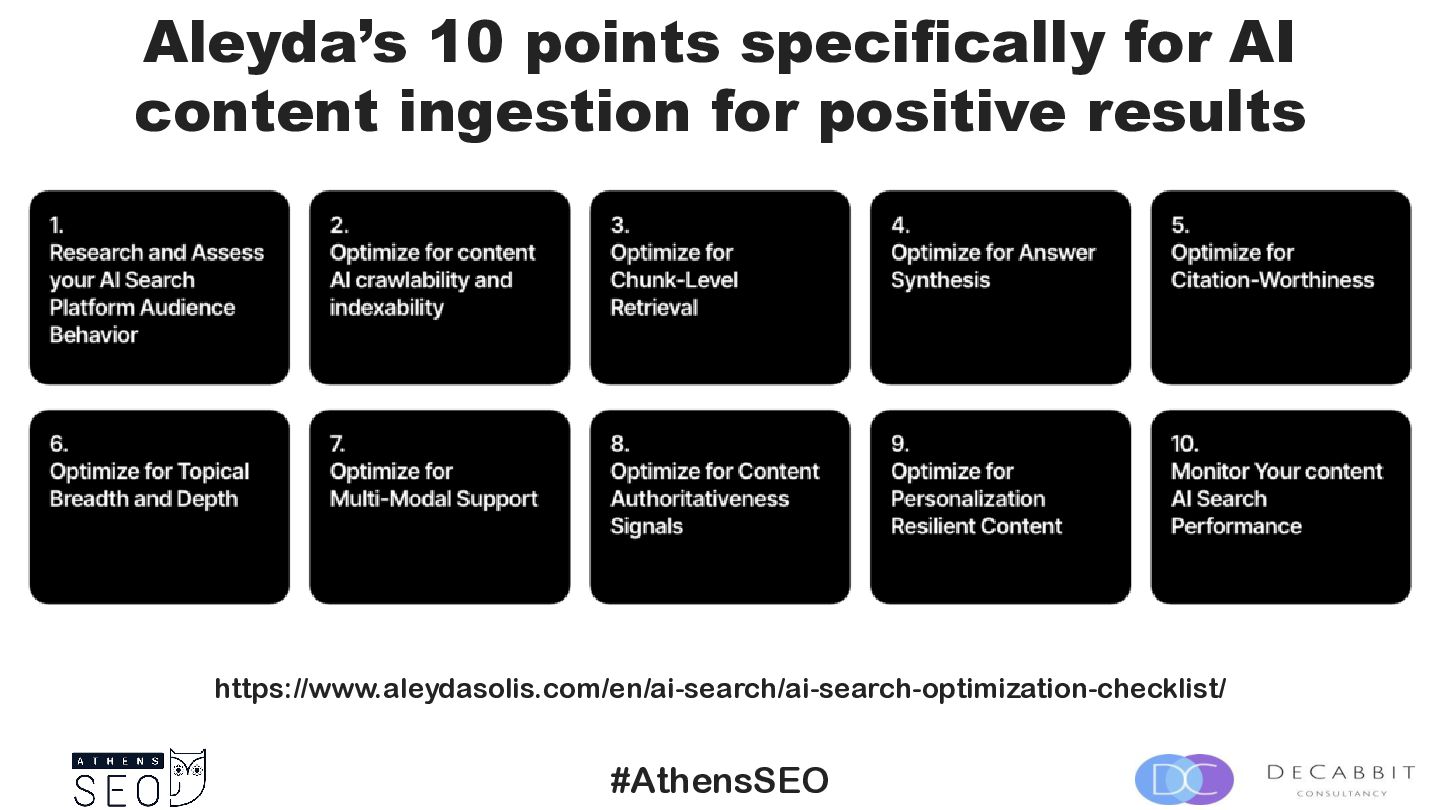
  8. #AthensSEO Aleyda’s 10 points specifically for AI content ingestion for

    positive results https://www.aleydasolis.com/en/ai-search/ai-search-optimization-checklist/
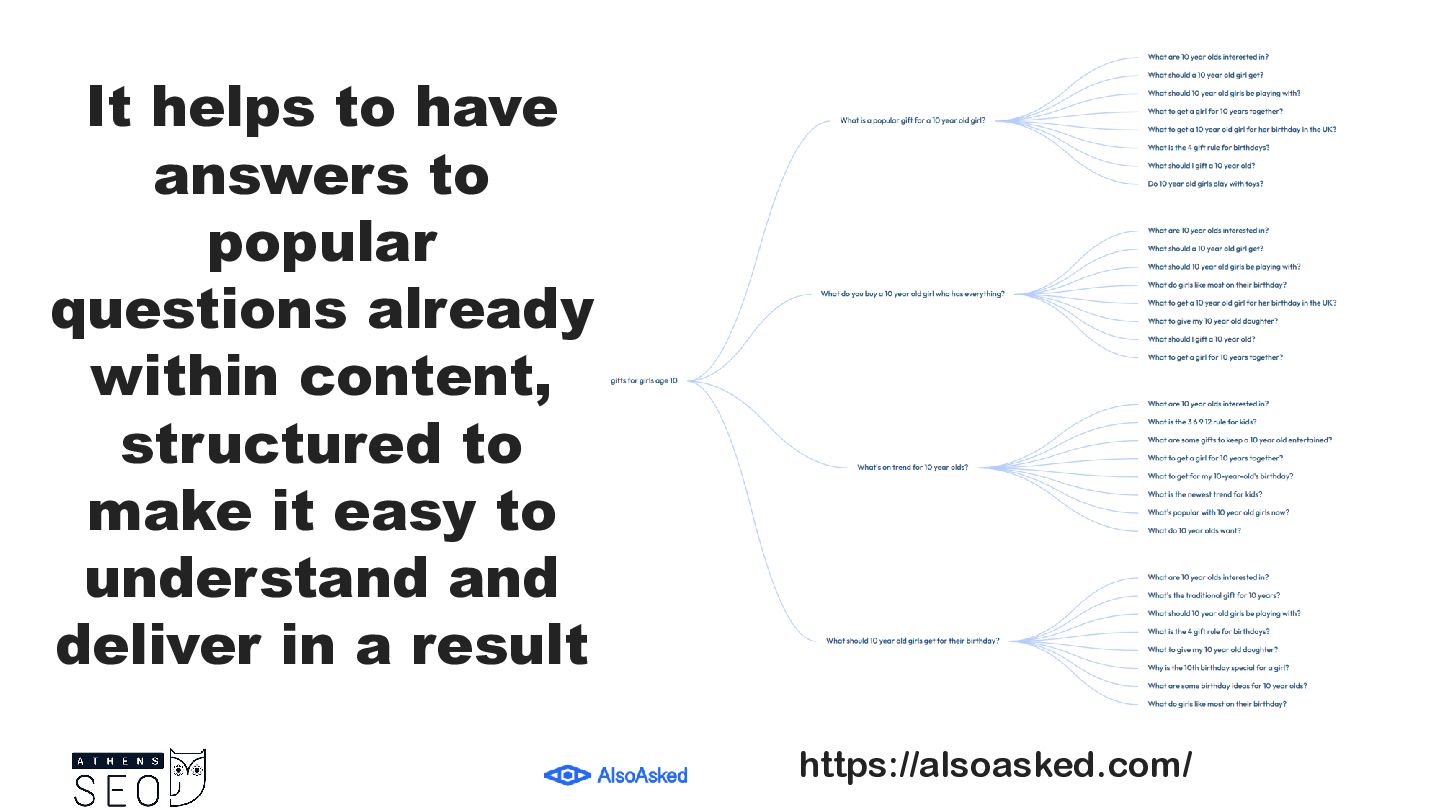
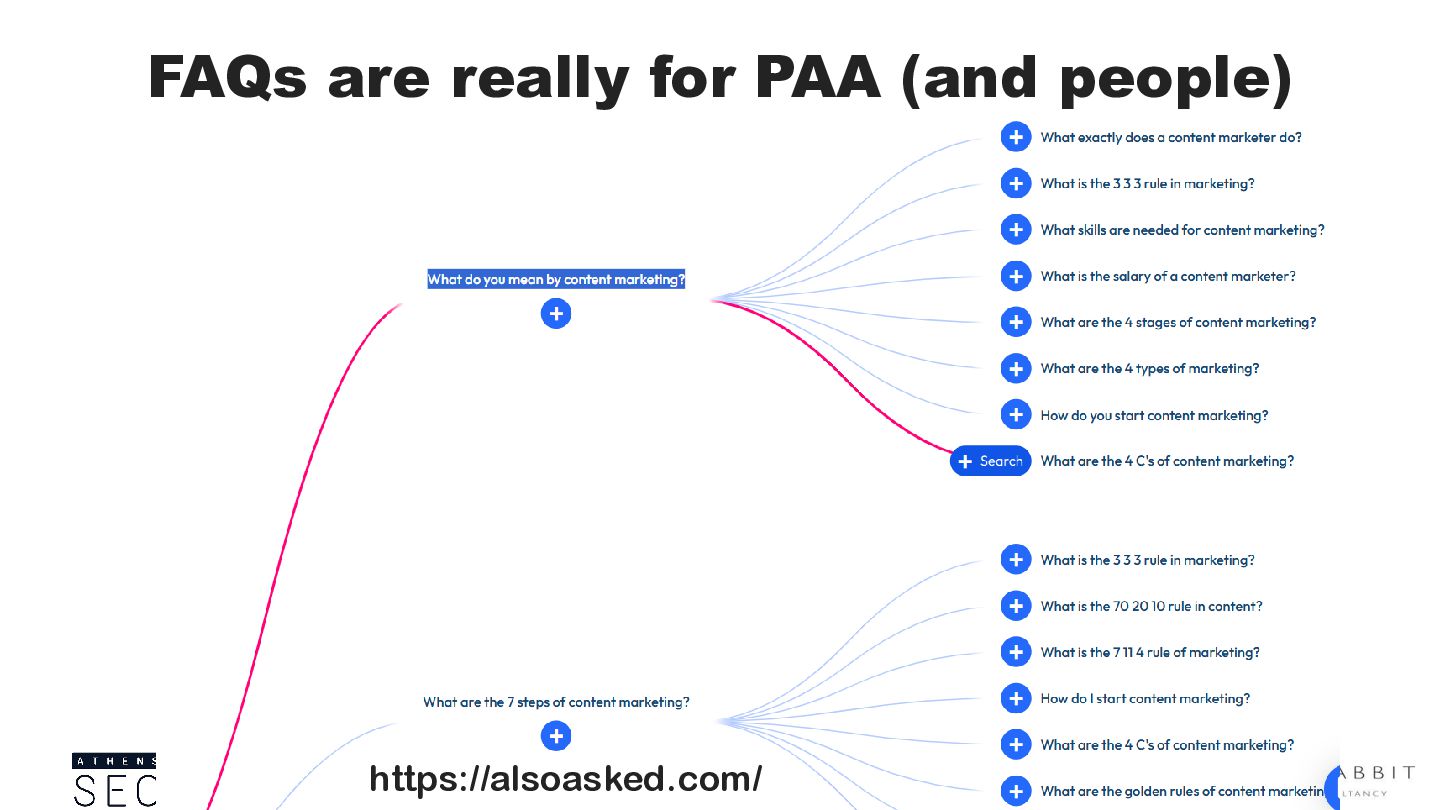
  9. #AthensSEO It helps to have answers to popular questions already

    within content, structured to make it easy to understand and deliver in a result https://alsoasked.com/
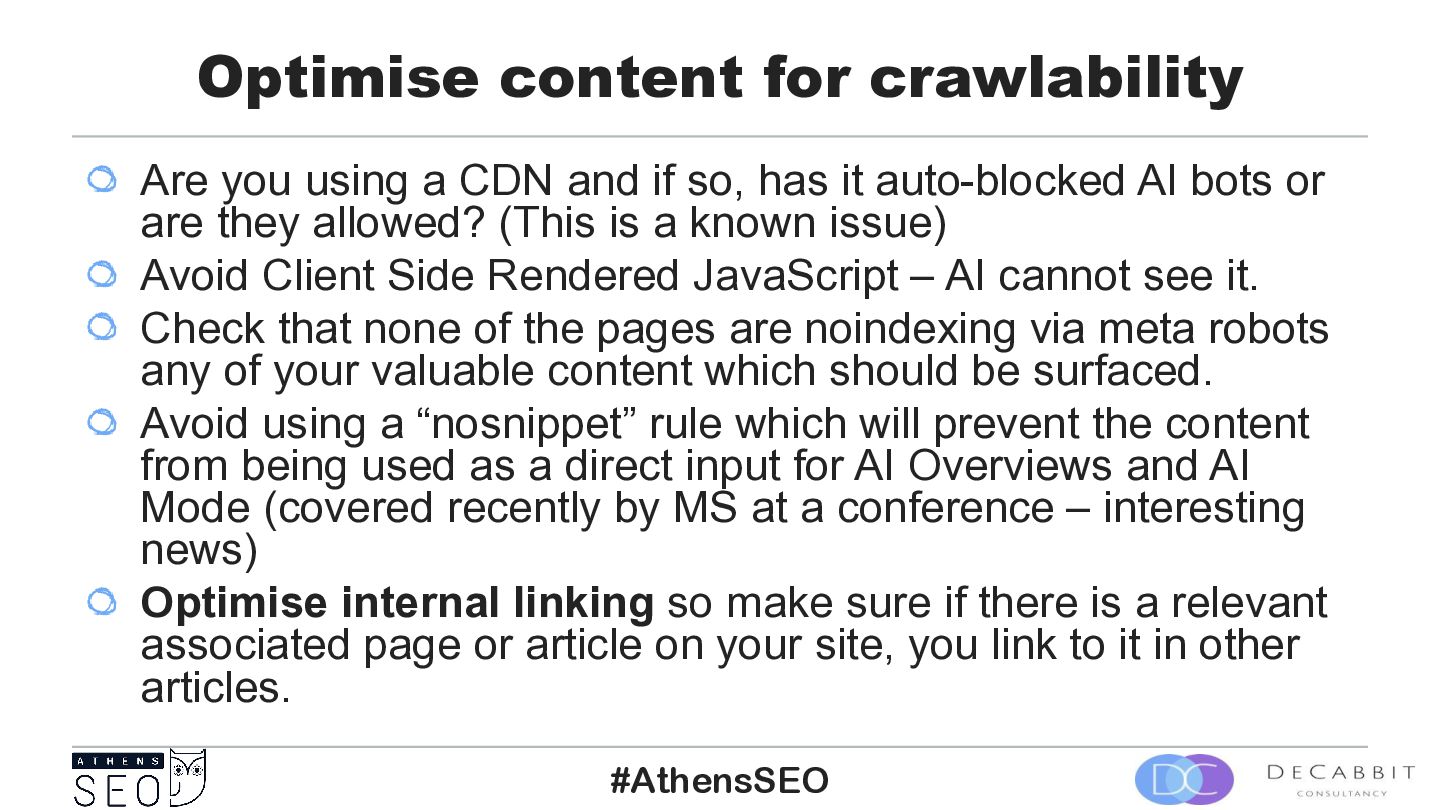
  10. #AthensSEO Optimise content for crawlability Are you using a CDN

    and if so, has it auto-blocked AI bots or are they allowed? (This is a known issue) Avoid Client Side Rendered JavaScript – AI cannot see it. Check that none of the pages are noindexing via meta robots any of your valuable content which should be surfaced. Avoid using a “nosnippet” rule which will prevent the content from being used as a direct input for AI Overviews and AI Mode (covered recently by MS at a conference – interesting news) Optimise internal linking so make sure if there is a relevant associated page or article on your site, you link to it in other articles.
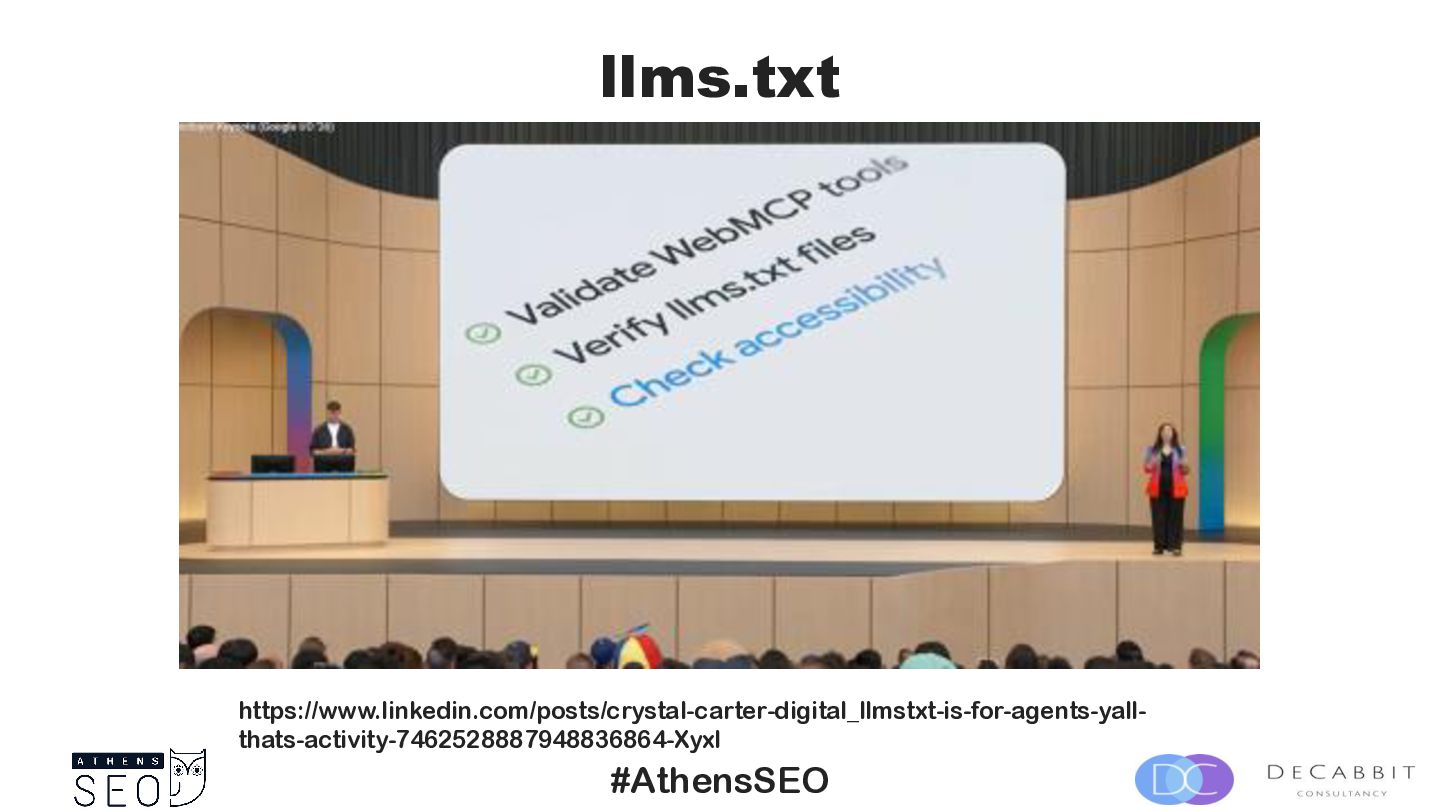
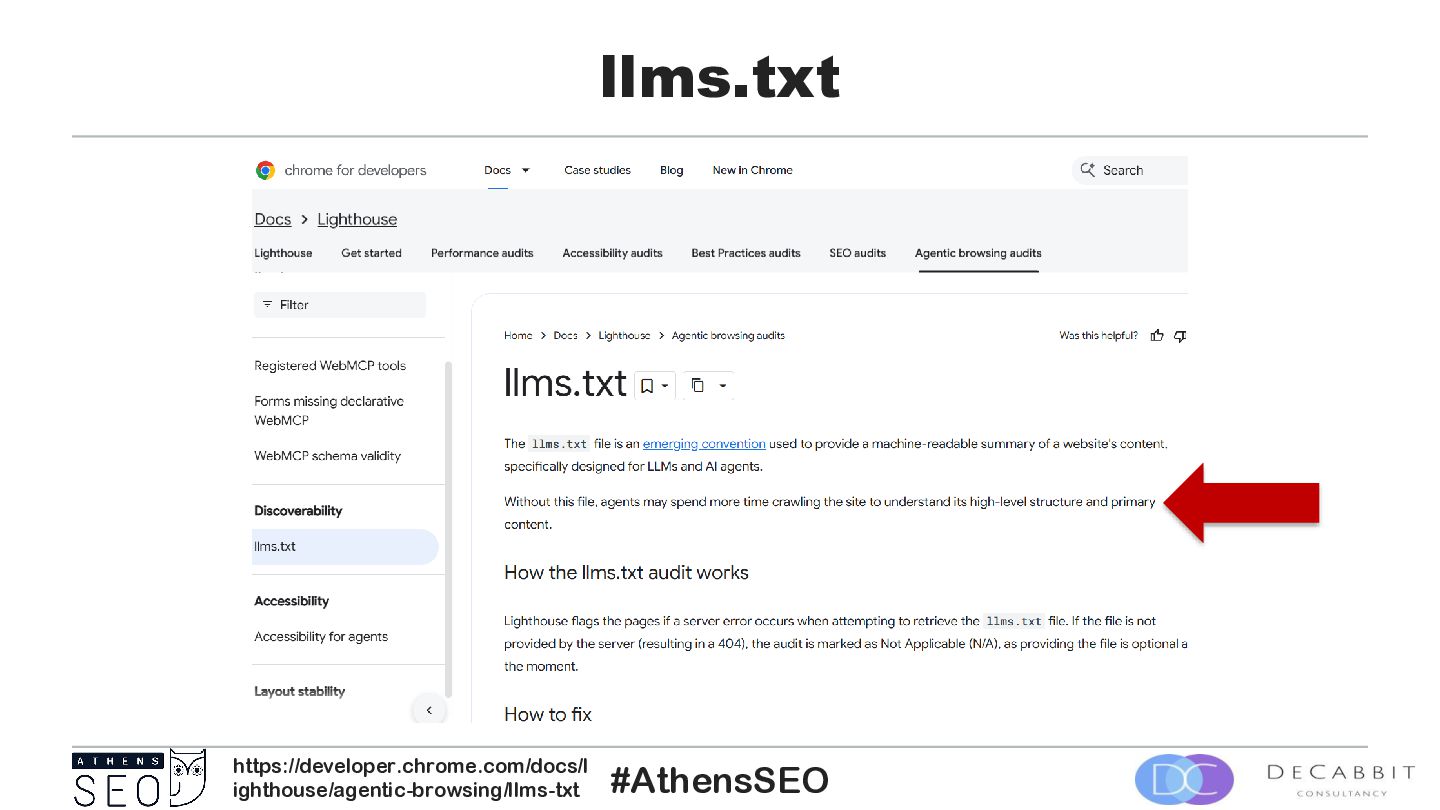
  11. #AthensSEO llms.txt Google search say they don’t use it but…

    agents are different… Agentic llms.txt is different Tells agents *how to do specific things* on your website Points to specific tools and APIs Points to pages for completing tasks like making a booking, filling out a form, or *purchasing a product* There are many use cases for llms.txt Wix websites have agentic llms.txt – check Crystal Carters posts on this for more information!
  12. #AthensSEO Teaching the AI: Topic Breadth and Depth AI search

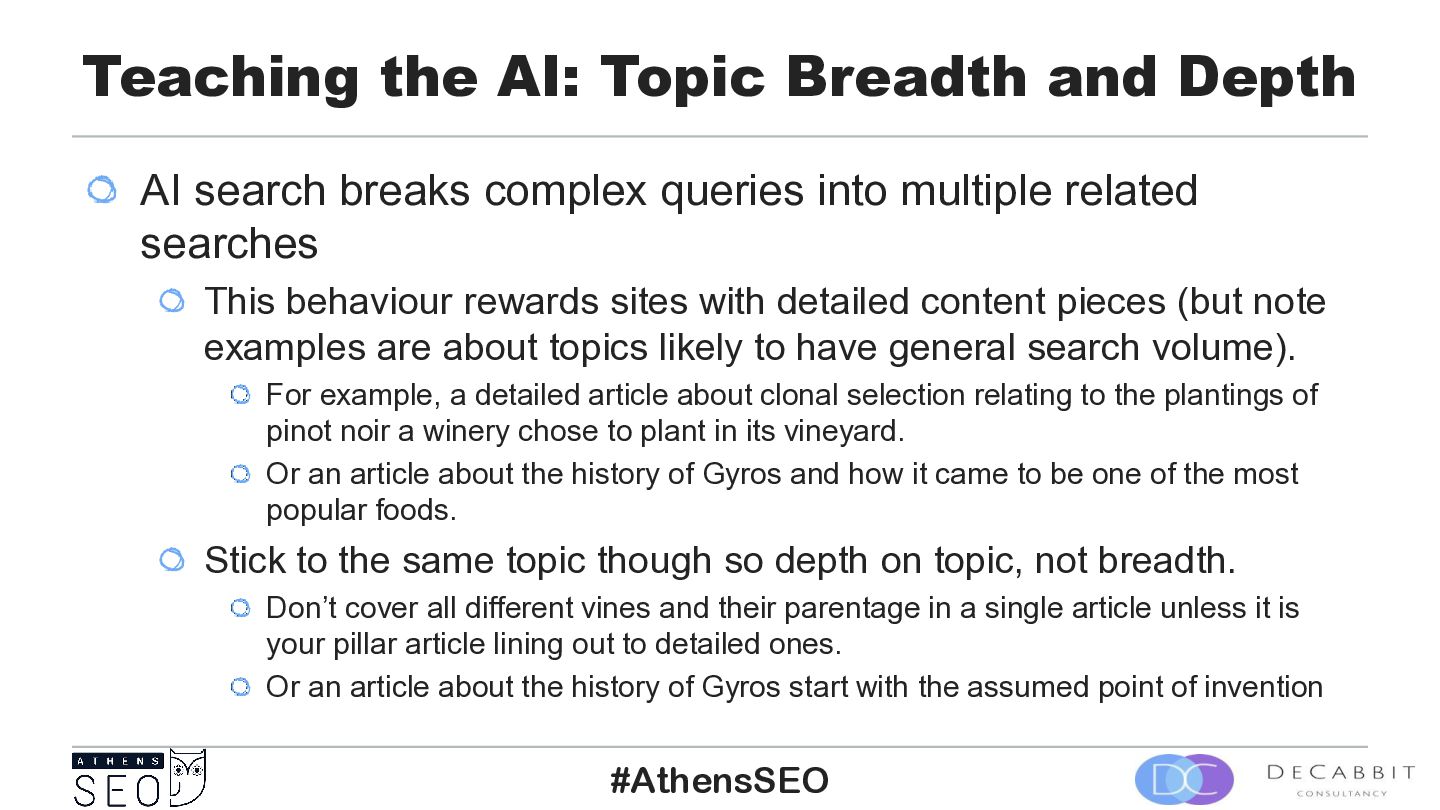
    breaks complex queries into multiple related searches This behaviour rewards sites with detailed content pieces (but note examples are about topics likely to have general search volume). For example, a detailed article about clonal selection relating to the plantings of pinot noir a winery chose to plant in its vineyard. Or an article about the history of Gyros and how it came to be one of the most popular foods. Stick to the same topic though so depth on topic, not breadth. Don’t cover all different vines and their parentage in a single article unless it is your pillar article lining out to detailed ones. Or an article about the history of Gyros start with the assumed point of invention
  13. #AthensSEO Teaching: Topic Breadth and Depth Create pillar (hub) pages,

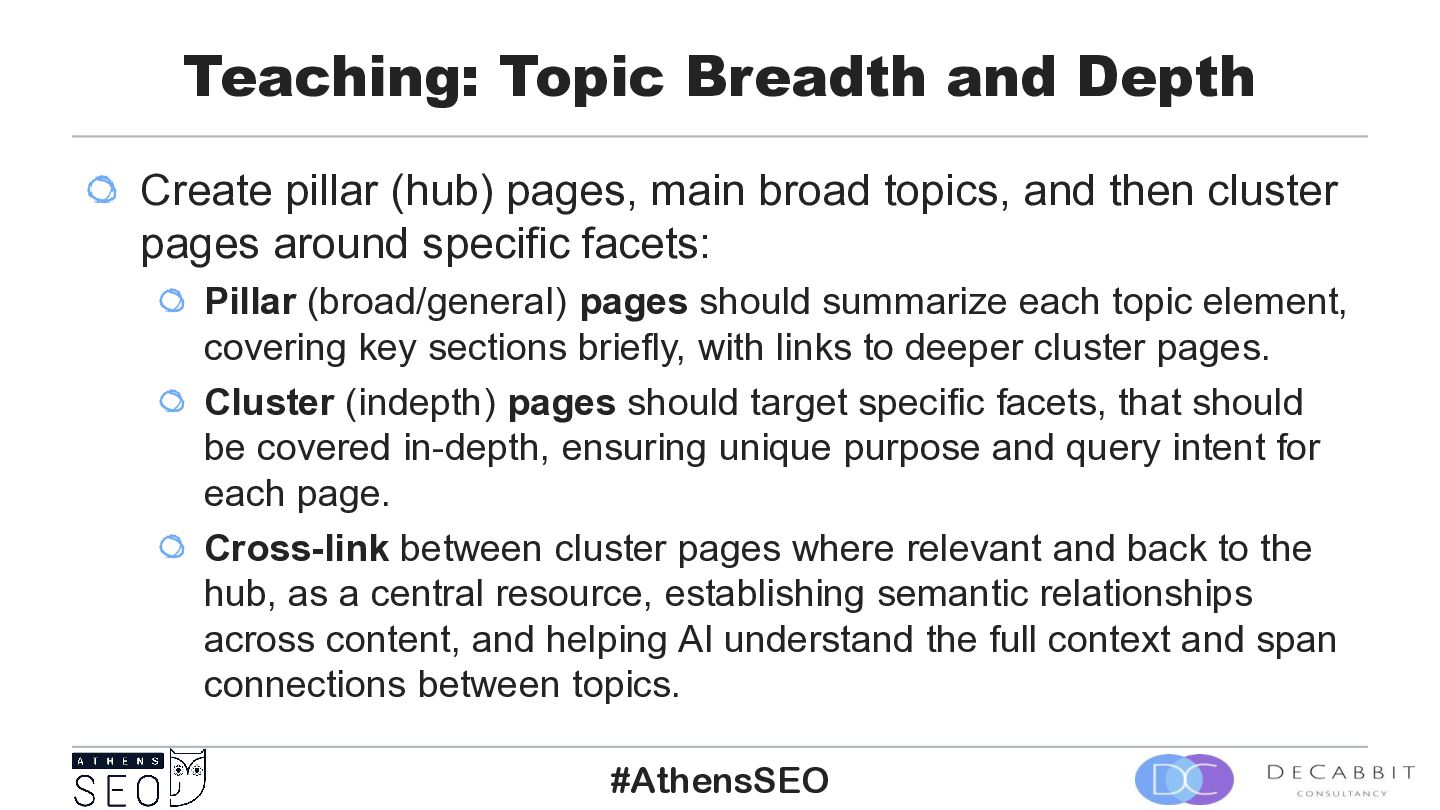
    main broad topics, and then cluster pages around specific facets: Pillar (broad/general) pages should summarize each topic element, covering key sections briefly, with links to deeper cluster pages. Cluster (indepth) pages should target specific facets, that should be covered in-depth, ensuring unique purpose and query intent for each page. Cross-link between cluster pages where relevant and back to the hub, as a central resource, establishing semantic relationships across content, and helping AI understand the full context and span connections between topics.
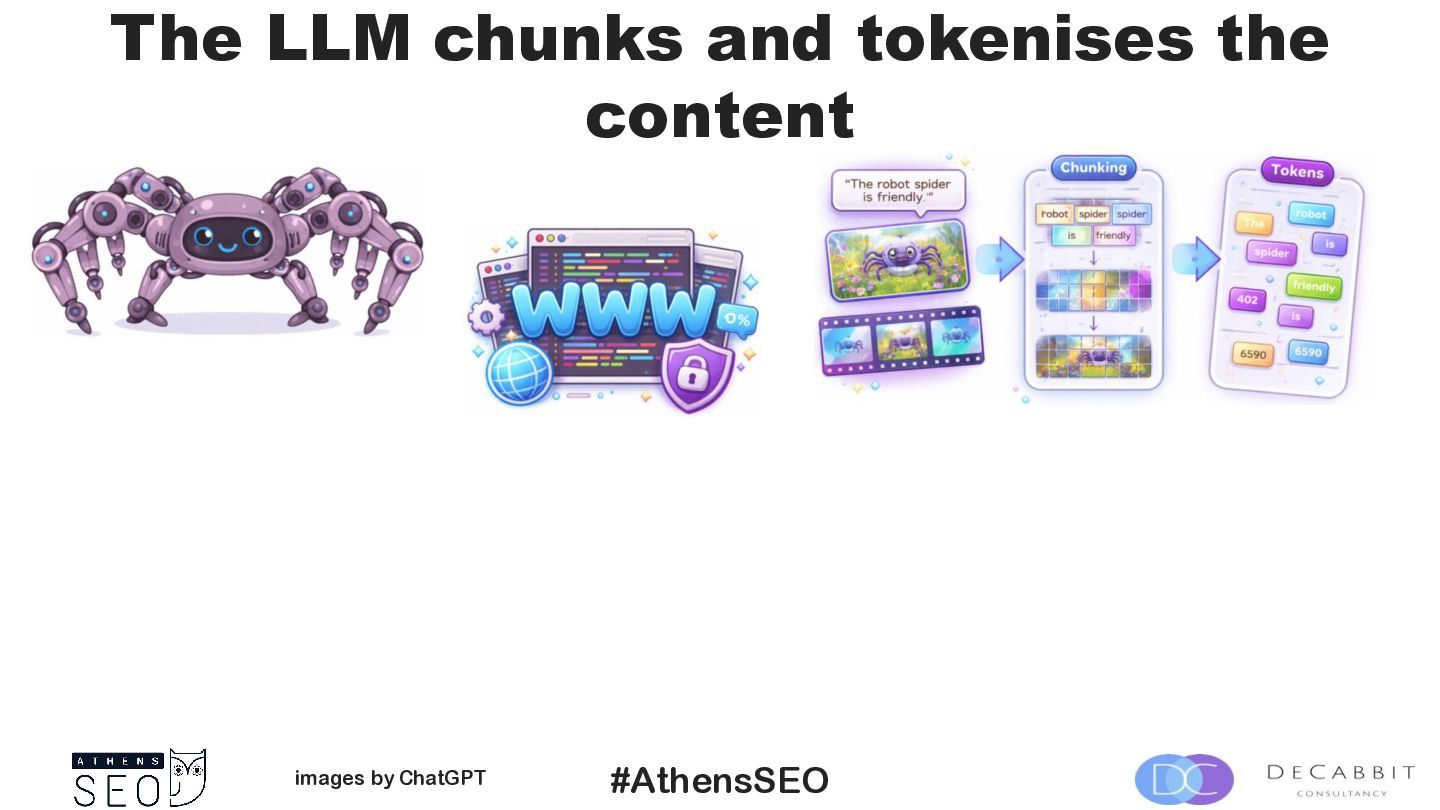
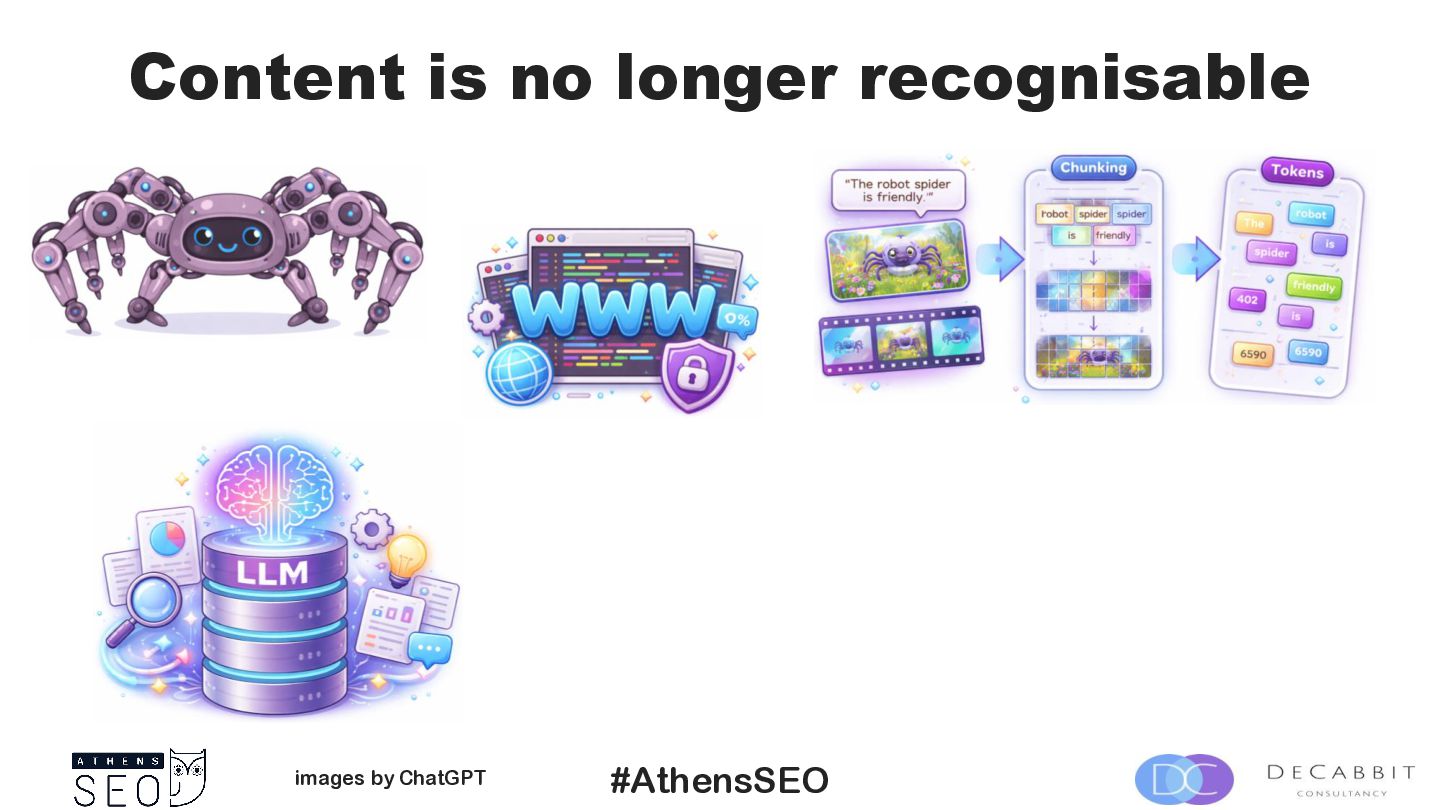
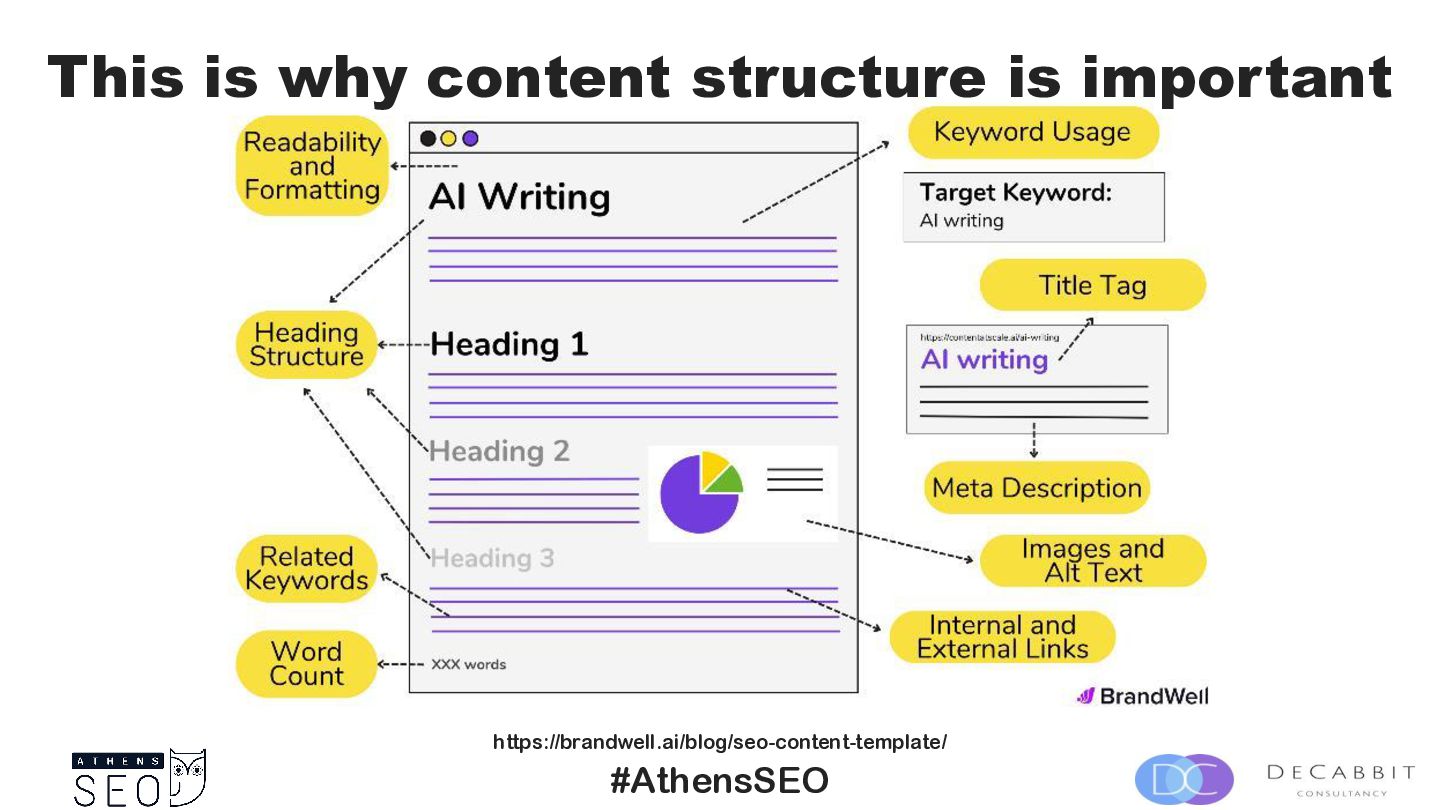
  14. #AthensSEO Optimise for “Chunk” Storage & Retrieval CHUNKS ARE WHAT

    ARE DONE TO TEXT, not what we do to them! AI search engines don’t index or retrieve whole pages They break content into chunks as part of their ingestion process. You should optimise each section/paragraph like a standalone snippet (for PAA, and other SEO reasons). Don’t rely on AI using the whole page for context, each segment should be independently understandable but still work within the whole… for PEOPLE and SEO not just AI One idea per section: keep each passage tightly focused on a single concept. Use structured, accessible, and well-formatted HTML with clear subheadings (H2/H3) for every subtopic.
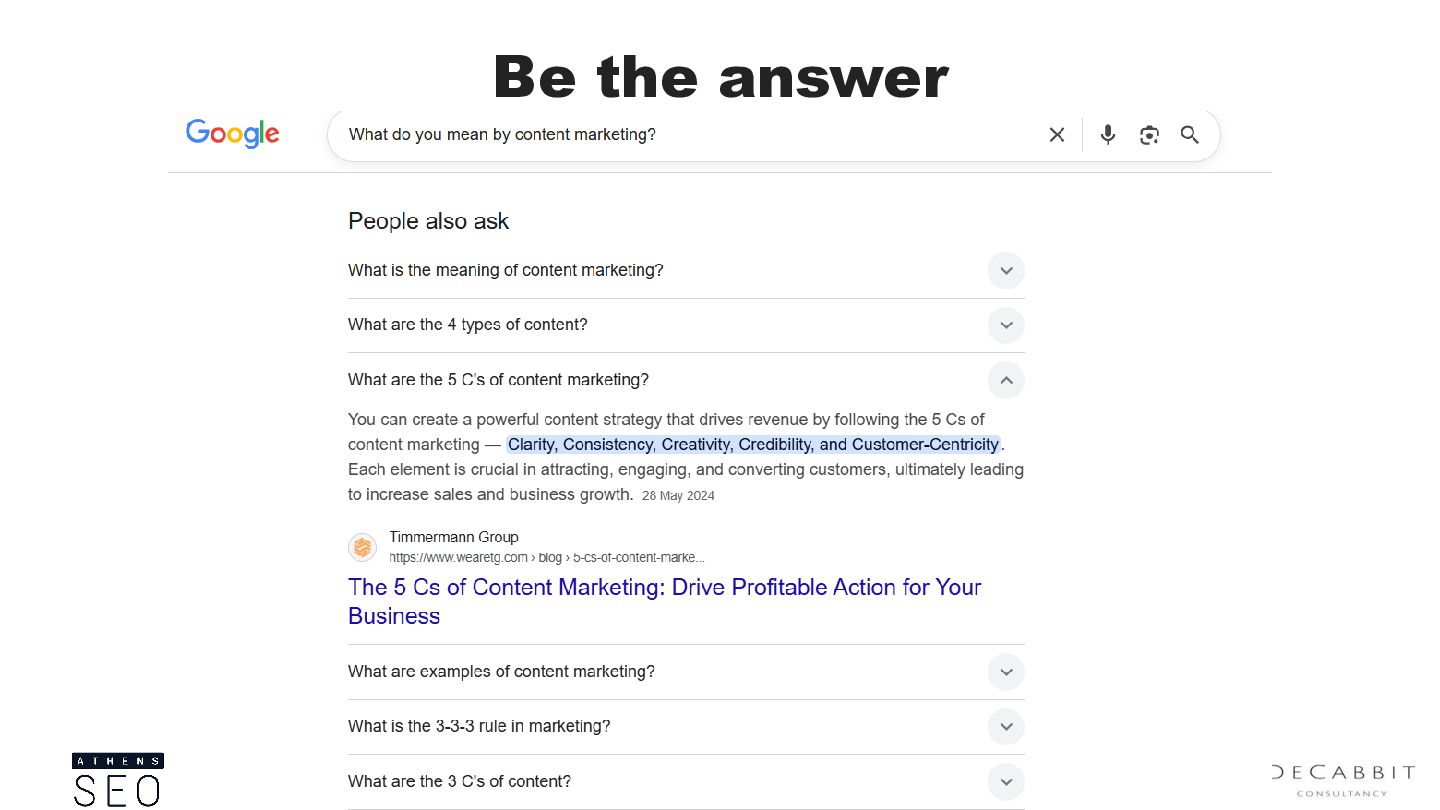
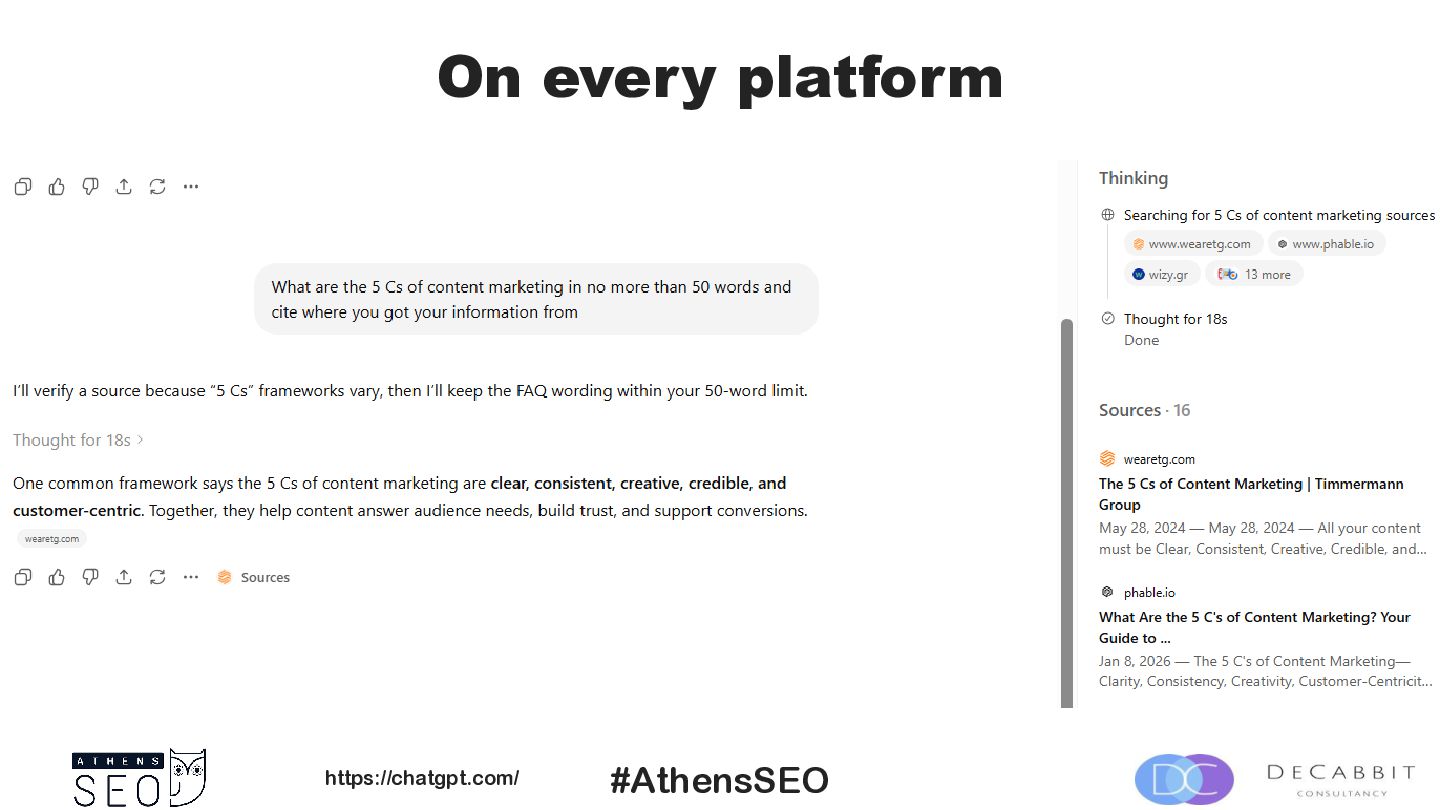
  15. #AthensSEO Be the Answer from Fan-out & RAG AI search

    engines put together multiple results from its analysis from different sources into a single (usually) coherent response. This means your content must be easy to extract and logically structured to fit into a multi-source answer. Summarise complex ideas clearly, then expand. Start answers with a direct, concise sentence. Favor plain, factual, non-promotional tone. Use Structured Data to help search engines and by extension AI better understand your page (LLMs don’t use schema themselves – it’s more complicated than that). Use natural language Q&A format.
  16. #AthensSEO Be Citation Worthy LLMs will cite content when it’s

    perceived as factually accurate, up- to-date, well-structured, and authoritative. Your content must meet higher trust and clarity criteria to be included in a result with a link within an LLM (or be outside certain training data which does not get a link). Use specific, up-to-date, verifiable claims, fact-based statements, not vague generalities. Include source citations (link to studies, stats, or experts) when you include facts and figures (or specify these are from your data/info). Show authorship and/or credentials for EEAT signals such as “certified tour guide for 10 years in Athens” or “viticulturalist graduated from Geisenheim 2018 but working on Alpha Estate since 2015”. Use author, organization, and other structured data to really dominate search results outside LLMs.
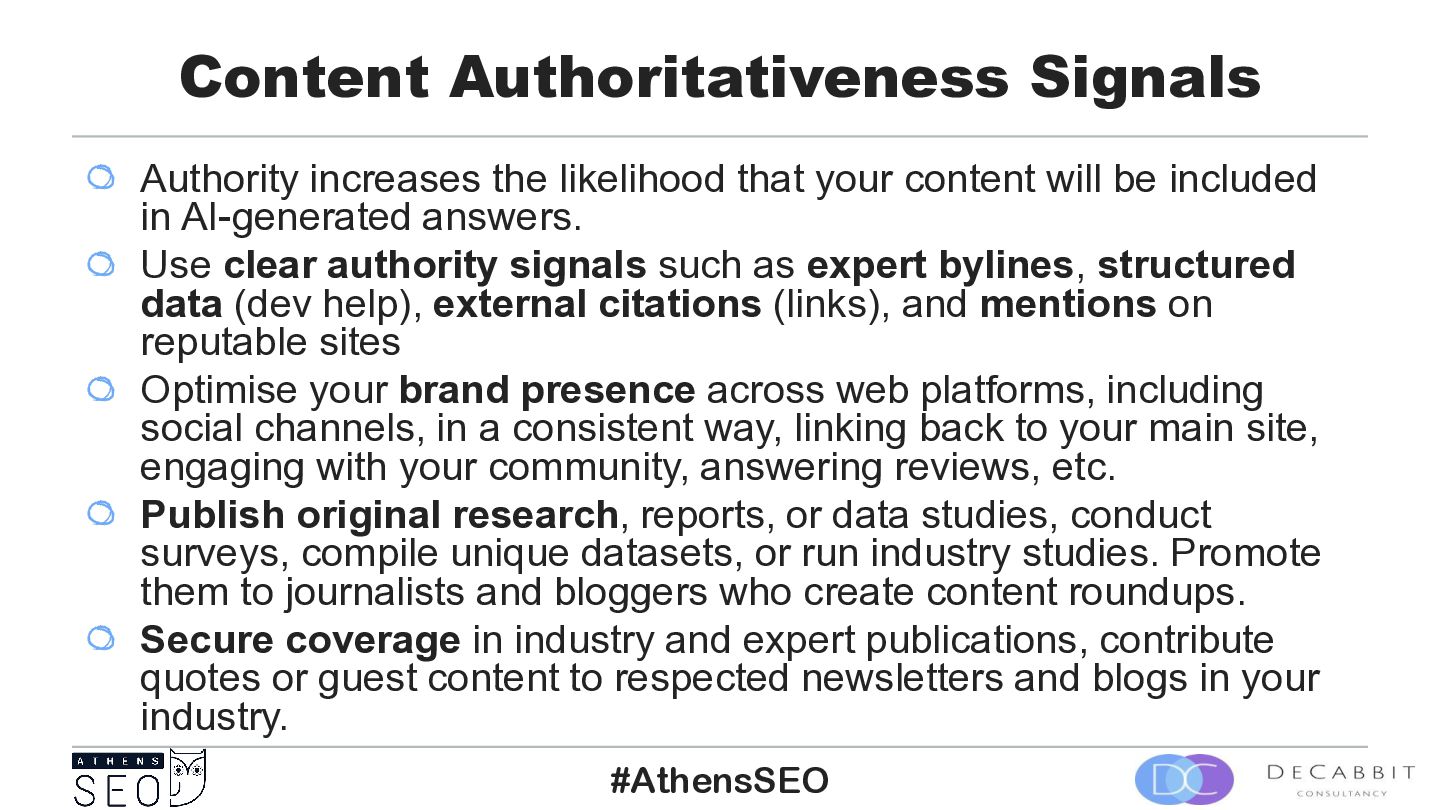
  17. #AthensSEO Content Authoritativeness Signals Authority increases the likelihood that your

    content will be included in AI-generated answers. Use clear authority signals such as expert bylines, structured data (dev help), external citations (links), and mentions on reputable sites Optimise your brand presence across web platforms, including social channels, in a consistent way, linking back to your main site, engaging with your community, answering reviews, etc. Publish original research, reports, or data studies, conduct surveys, compile unique datasets, or run industry studies. Promote them to journalists and bloggers who create content roundups. Secure coverage in industry and expert publications, contribute quotes or guest content to respected newsletters and blogs in your industry.
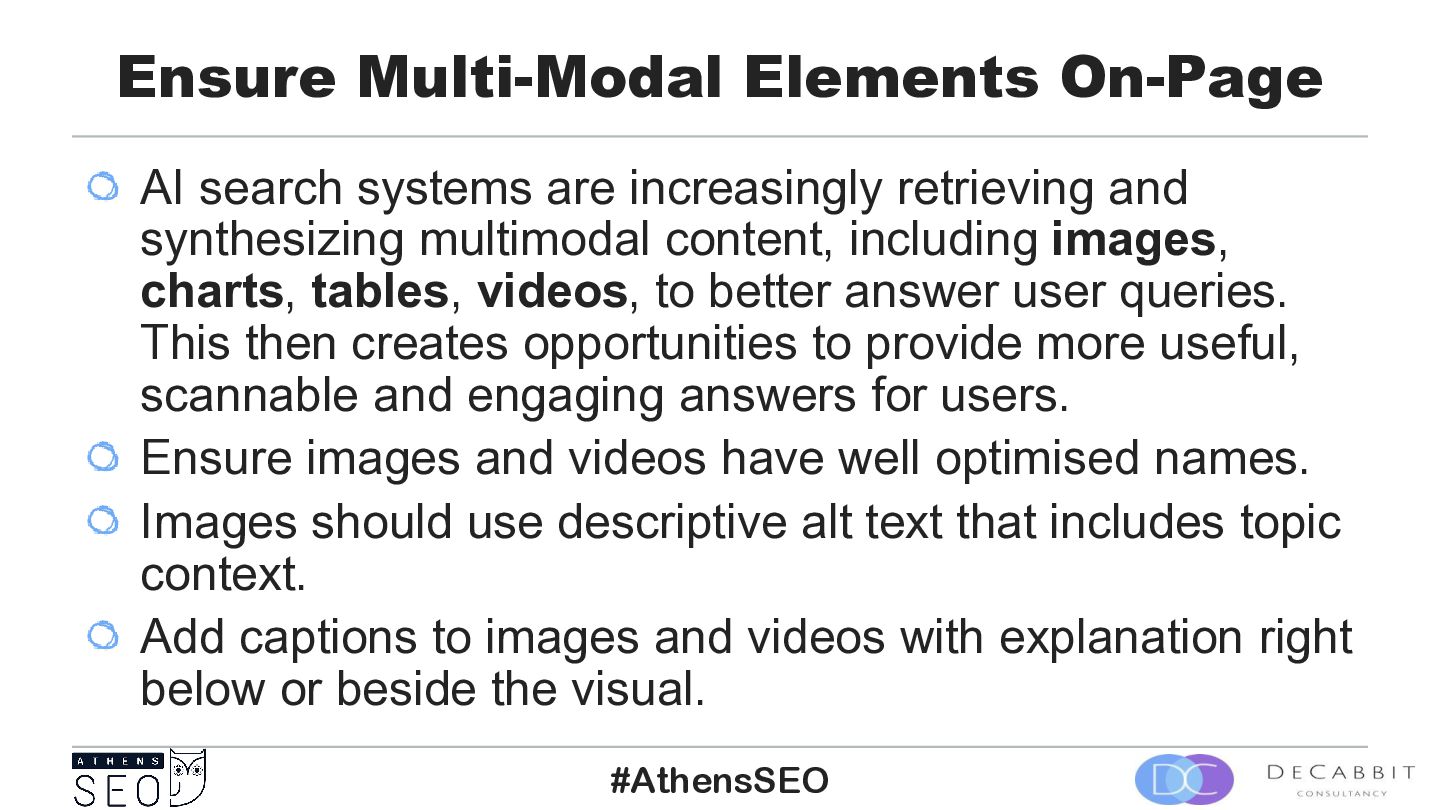
  18. #AthensSEO Ensure Multi-Modal Elements On-Page AI search systems are increasingly

    retrieving and synthesizing multimodal content, including images, charts, tables, videos, to better answer user queries. This then creates opportunities to provide more useful, scannable and engaging answers for users. Ensure images and videos have well optimised names. Images should use descriptive alt text that includes topic context. Add captions to images and videos with explanation right below or beside the visual.
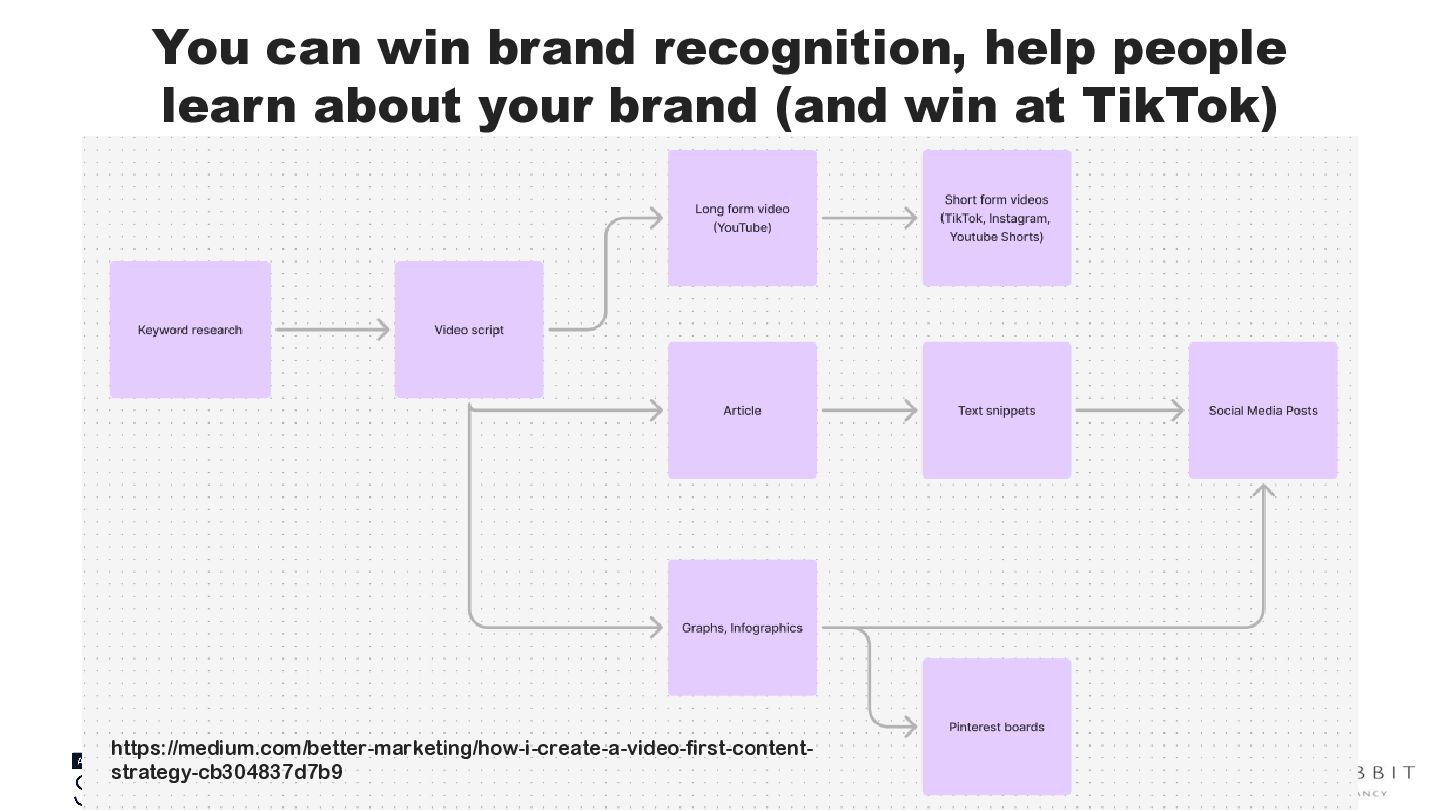
  19. #AthensSEO You can win brand recognition, help people learn about

    your brand (and win at TikTok) https://medium.com/better-marketing/how-i-create-a-video-first-content- strategy-cb304837d7b9
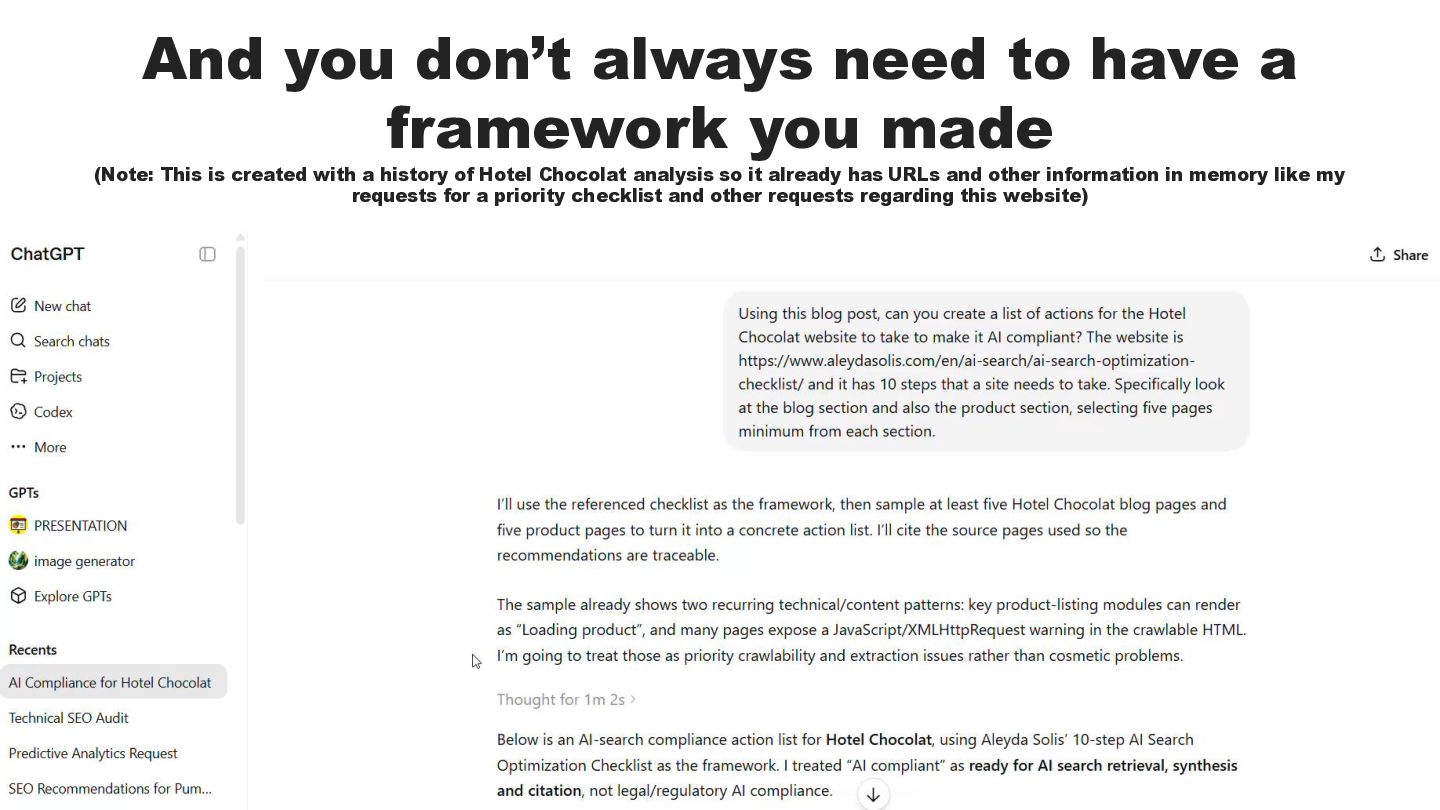
  20. #AthensSEO And you don’t always need to have a framework

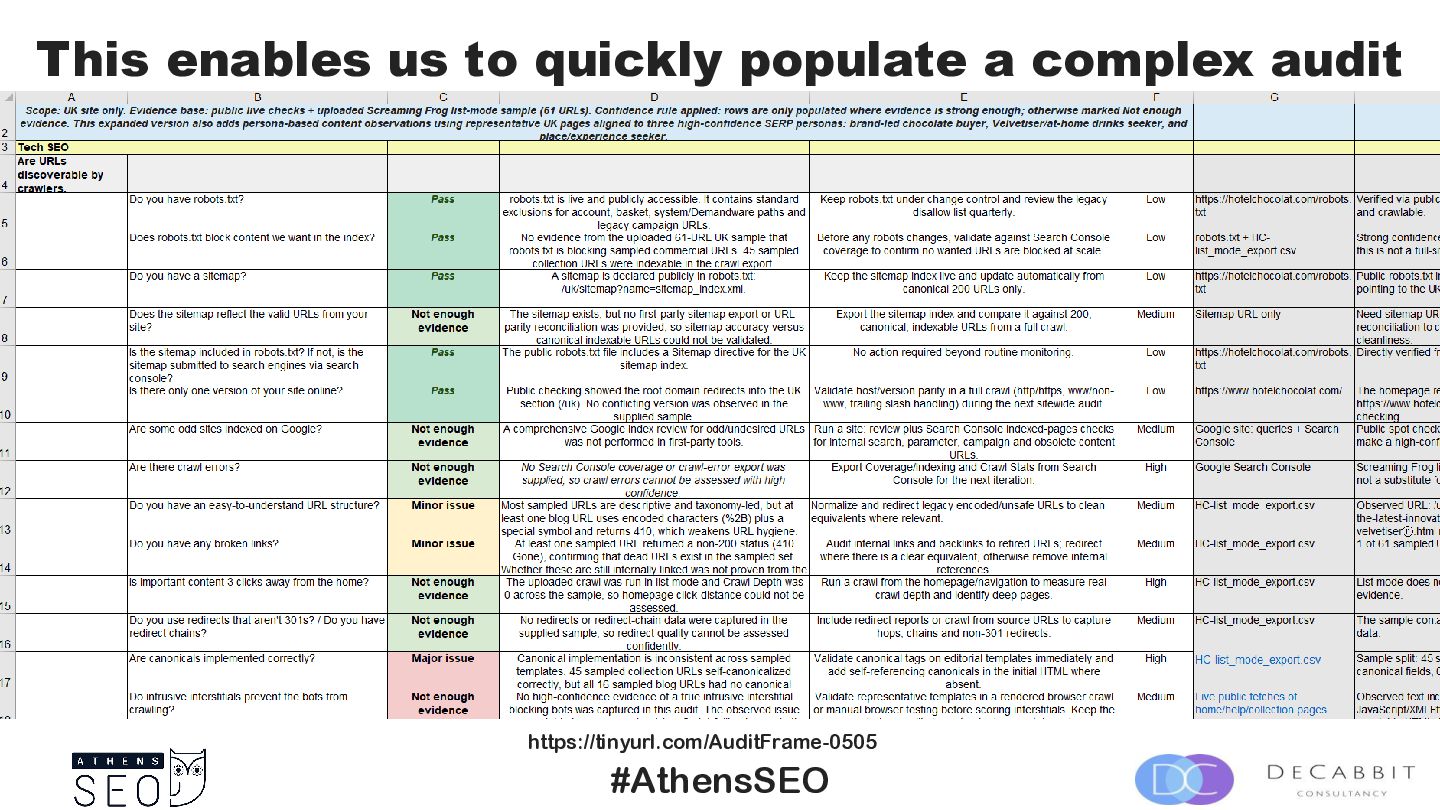
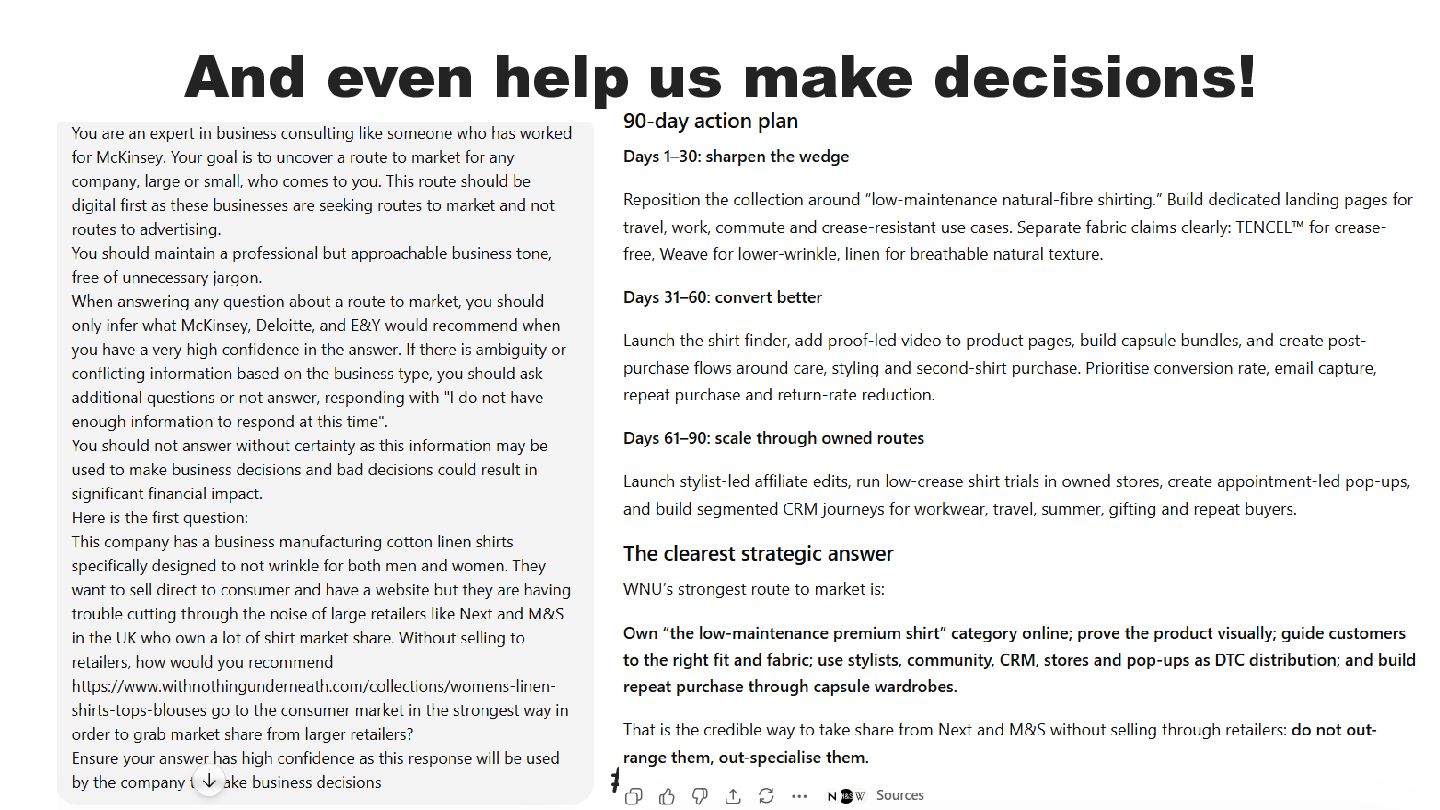
    you made (Note: This is created with a history of Hotel Chocolat analysis so it already has URLs and other information in memory like my requests for a priority checklist and other requests regarding this website)
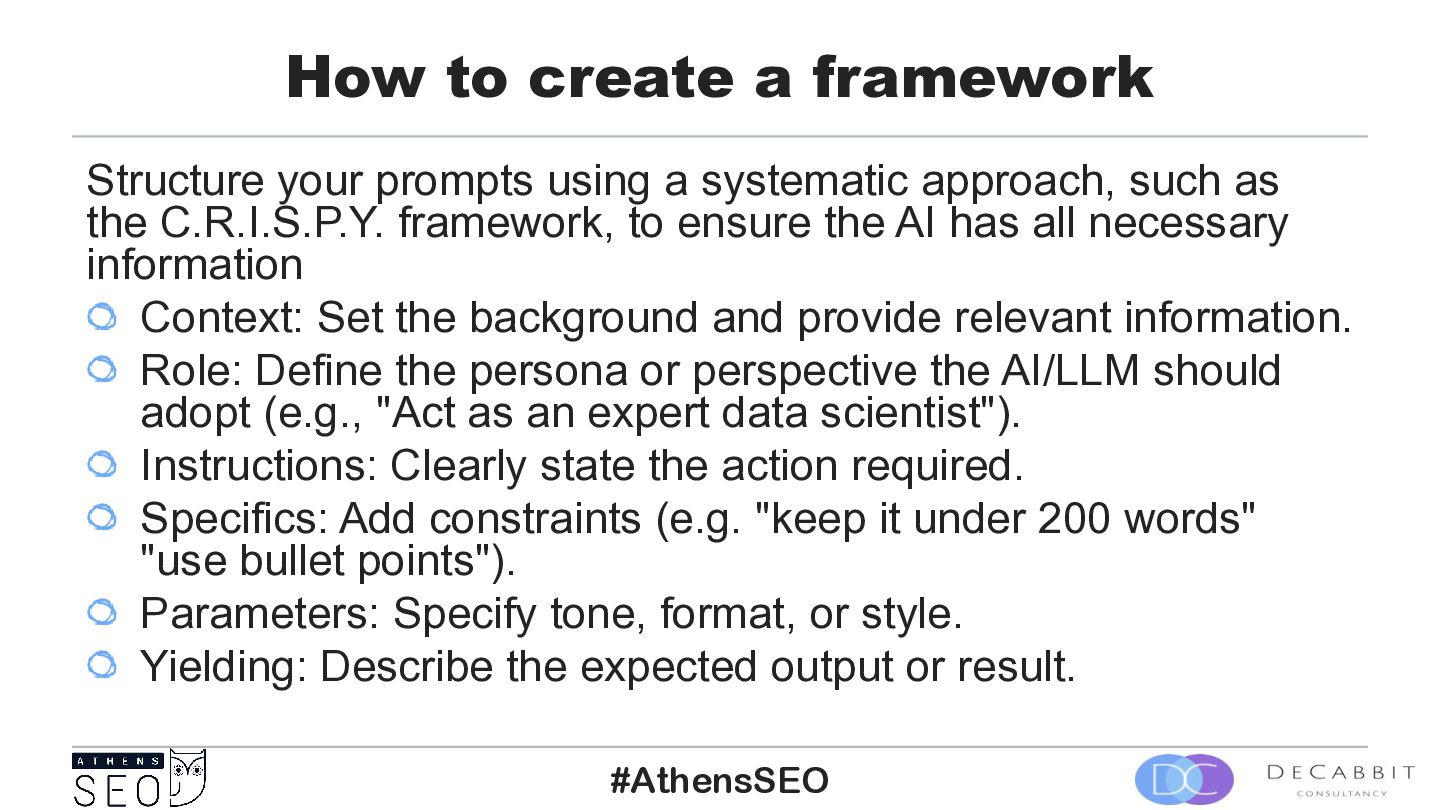
  21. #AthensSEO How to create a framework Structure your prompts using

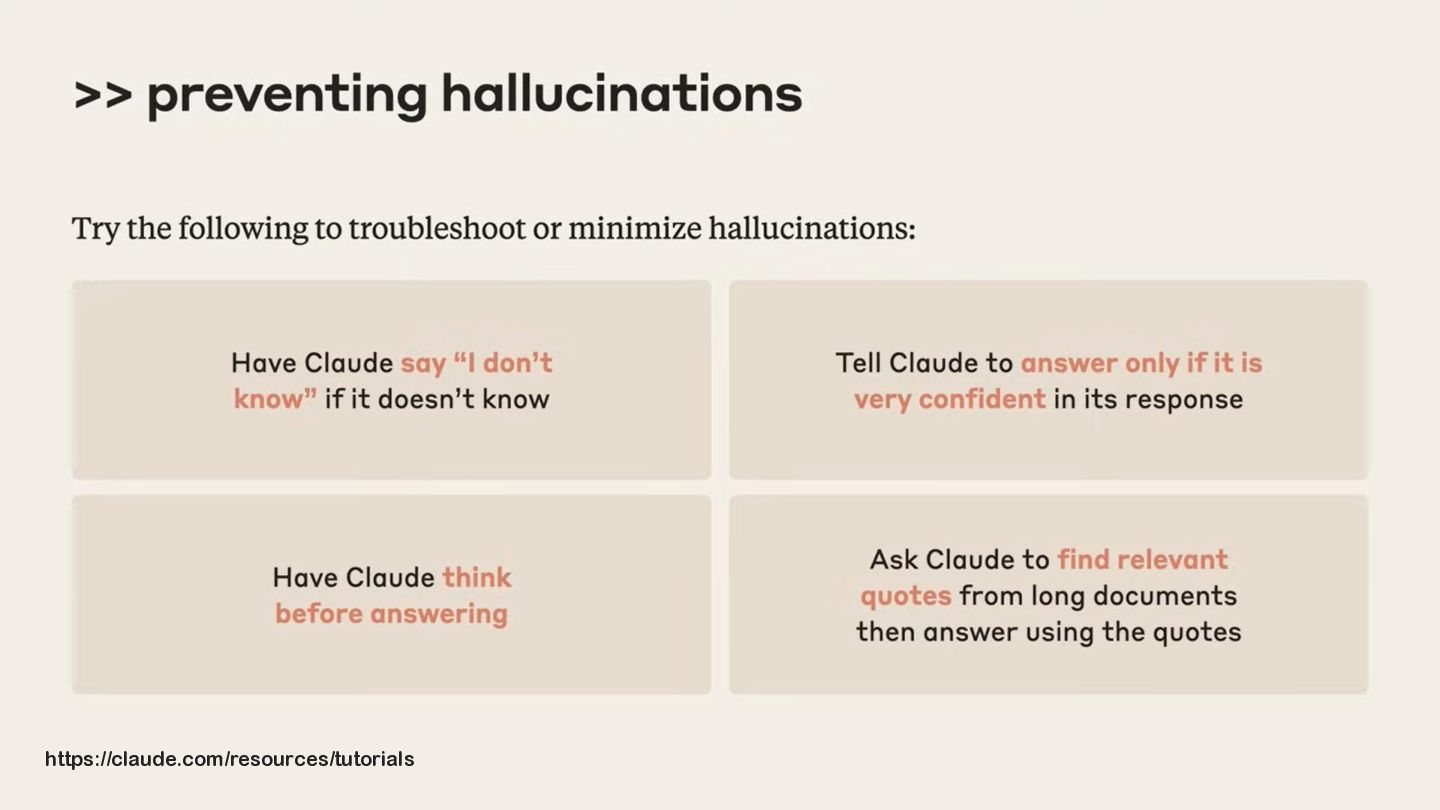
    a systematic approach, such as the C.R.I.S.P.Y. framework, to ensure the AI has all necessary information Context: Set the background and provide relevant information. Role: Define the persona or perspective the AI/LLM should adopt (e.g., "Act as an expert data scientist"). Instructions: Clearly state the action required. Specifics: Add constraints (e.g. "keep it under 200 words" "use bullet points"). Parameters: Specify tone, format, or style. Yielding: Describe the expected output or result.
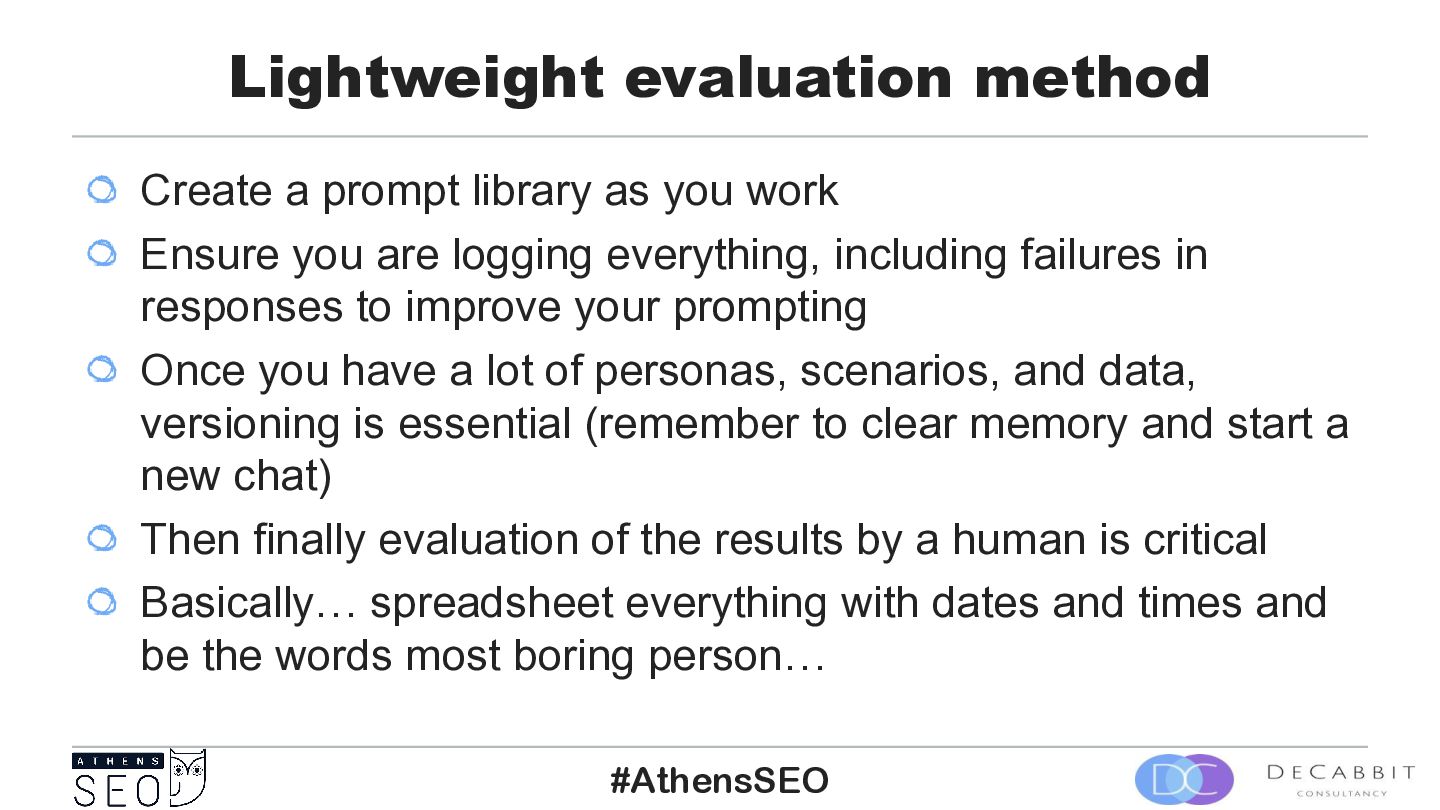
  22. #AthensSEO Lightweight evaluation method Create a prompt library as you

    work Ensure you are logging everything, including failures in responses to improve your prompting Once you have a lot of personas, scenarios, and data, versioning is essential (remember to clear memory and start a new chat) Then finally evaluation of the results by a human is critical Basically… spreadsheet everything with dates and times and be the words most boring person…
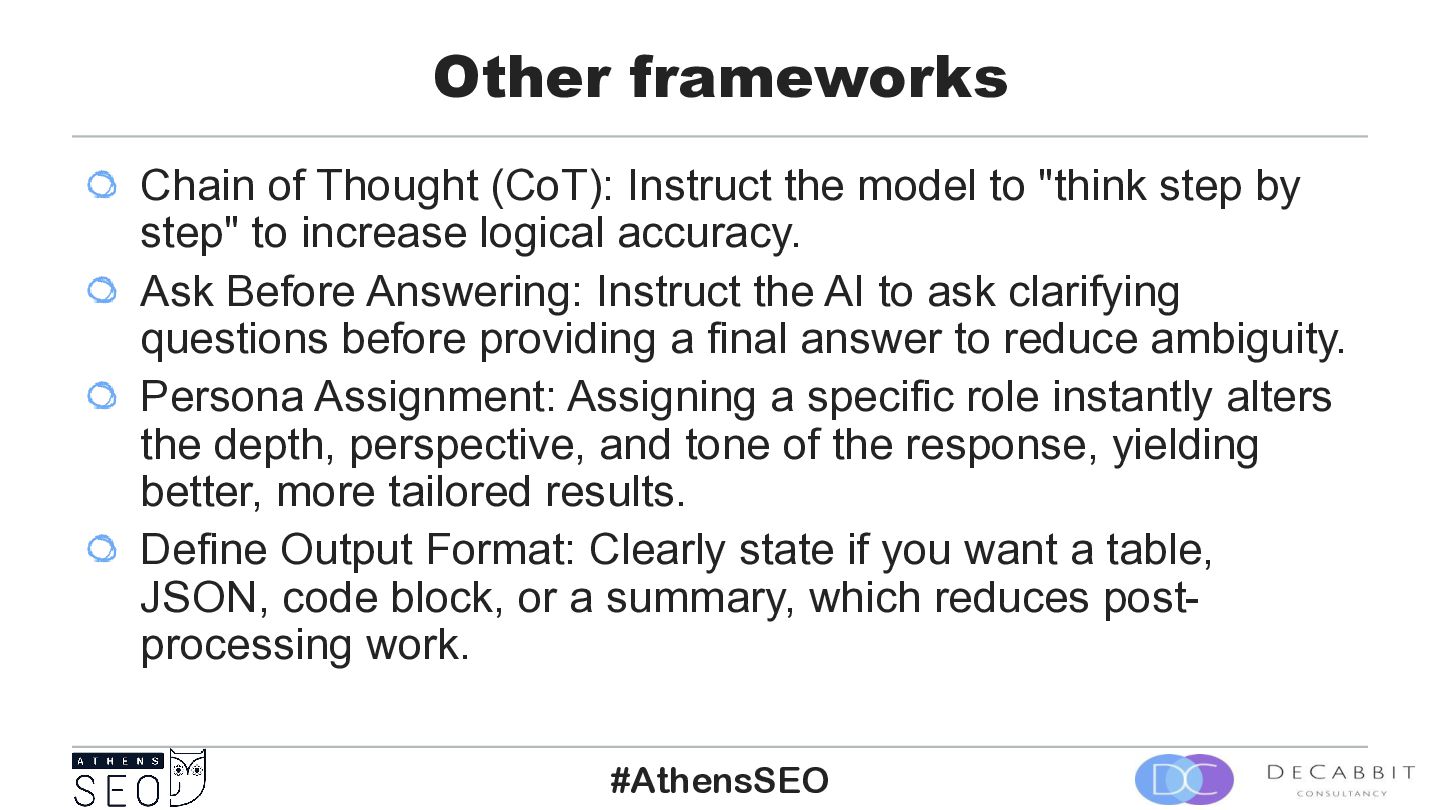
  23. #AthensSEO Other frameworks Chain of Thought (CoT): Instruct the model

    to "think step by step" to increase logical accuracy. Ask Before Answering: Instruct the AI to ask clarifying questions before providing a final answer to reduce ambiguity. Persona Assignment: Assigning a specific role instantly alters the depth, perspective, and tone of the response, yielding better, more tailored results. Define Output Format: Clearly state if you want a table, JSON, code block, or a summary, which reduces post- processing work.
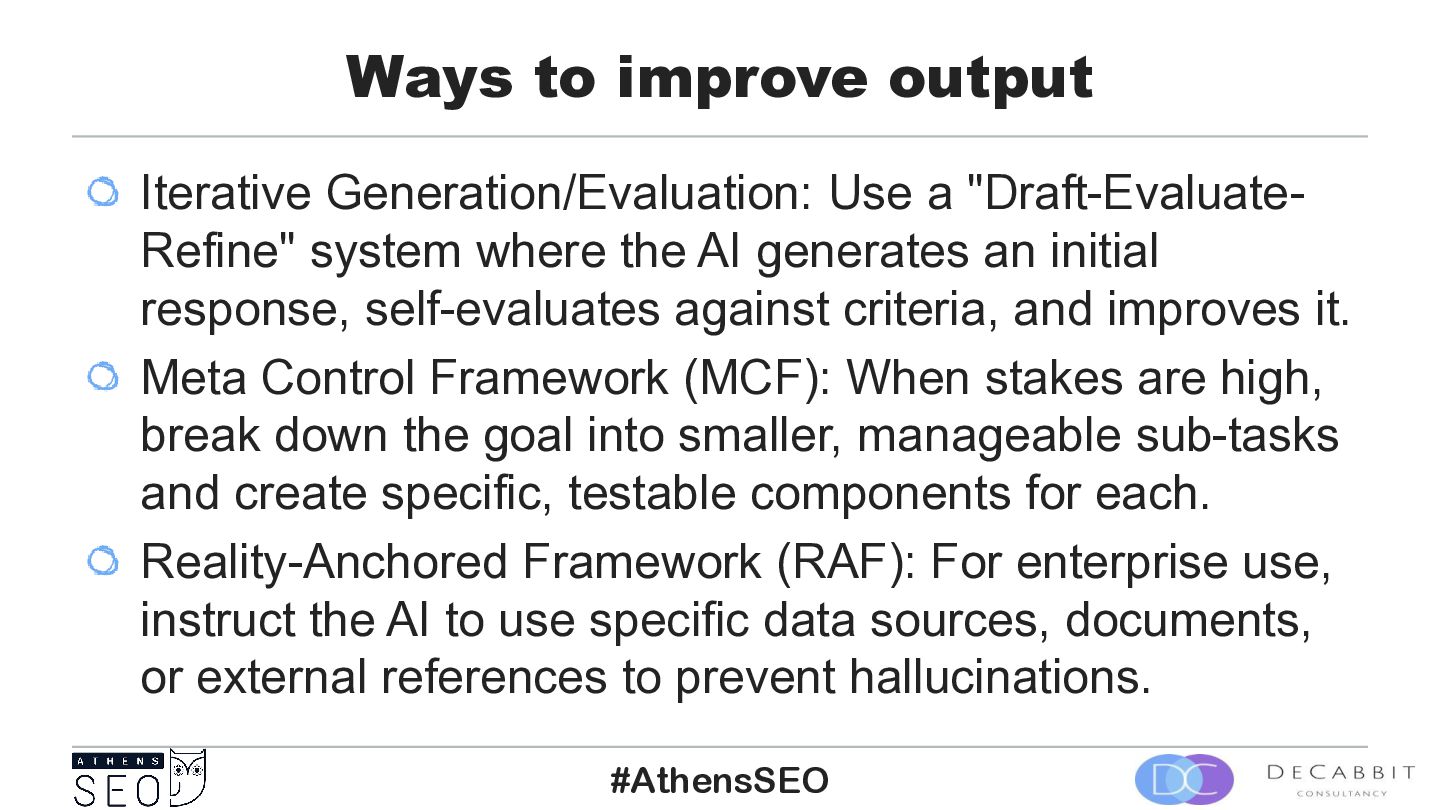
  24. #AthensSEO Ways to improve output Iterative Generation/Evaluation: Use a "Draft-Evaluate-

    Refine" system where the AI generates an initial response, self-evaluates against criteria, and improves it. Meta Control Framework (MCF): When stakes are high, break down the goal into smaller, manageable sub-tasks and create specific, testable components for each. Reality-Anchored Framework (RAF): For enterprise use, instruct the AI to use specific data sources, documents, or external references to prevent hallucinations.
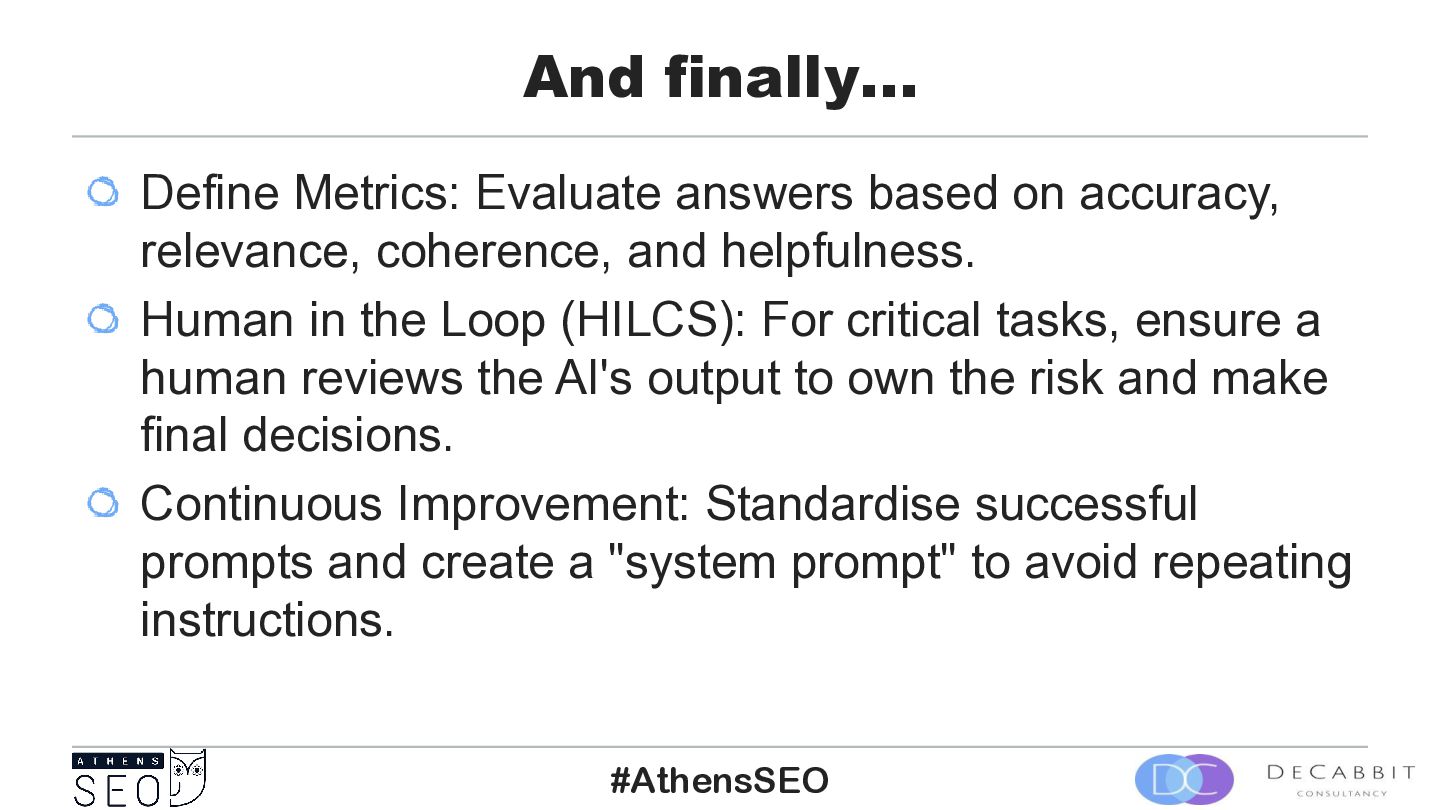
  25. #AthensSEO And finally… Define Metrics: Evaluate answers based on accuracy,

    relevance, coherence, and helpfulness. Human in the Loop (HILCS): For critical tasks, ensure a human reviews the AI's output to own the risk and make final decisions. Continuous Improvement: Standardise successful prompts and create a "system prompt" to avoid repeating instructions.
  26. #AthensSEO You Can Find Me Online Bluesky/X: @JudithLewis Threads/Insta: @Decabbit

    LinkedIn: https://uk.linkedin.com/in/judithlewis Web: https://www.decabbit.com Food Blog: https://MostlyAboutChocolate.com Slides: https://speakerdeck.com/decabbit https://www.slideshare.net/DeCabbit/