How to Defeat PMO
Sponsored
·
 Your Podcast. Everywhere. Effortlessly.
Share. Educate. Inspire. Entertain. You do you. We'll handle the rest.
→
Your Podcast. Everywhere. Effortlessly.
Share. Educate. Inspire. Entertain. You do you. We'll handle the rest.
→

Share
Embed
How to Defeat PMO

Dylan Devine
October 24, 2026
Transcript
34 slides
-
Defeating PMO with Everything: How You Can Become Virtuous A
Presentation Desktop or Laptop Recommended; Use Slideshow -
Introduction in Brief: Virtually every man, woman, and child in
these dark times has been reared up in a hyper-sexualized culture. Everyone who wants to live a chaste life has their own reasons for doing so. Some are religious, and others see benefit even in the secular case against PMO (pornography, masturbation, and orgasm). It’s not the case that orgasm itself is inherently harmful (when ordered towards procreative ends with one’s spouse), rather that masturbation—especially to orgasm—reinforces vice and sexual addiction. The world is not yet ready to acknowledge that PMO addiction is real and that it is detrimental to human flourishing. If you’re here, that means you have already taken the first step in acknowledging that this problem persists and that you want to take concrete action against it in your own life. Plenty of valuable No Fap content and resources are already available, but in this lecture we will be tackling the issue from multiple avenues that are rarely explored; we will not only discuss the psychology of addiction, but will use Applied Behavioral Analysis (behavioral therapy) in concert with classical philosophy and theology. There is something here for everyone; even if you aren’t religious, haven’t studied Aristotle, or haven’t heard of Applied Behavioral Therapy, you will develop a comprehensive, wholistic understanding of PMO and virtue by the end of this lecture. You have my word on that. -
What is Addiction? Addiction is a biological, psychological, and spiritual
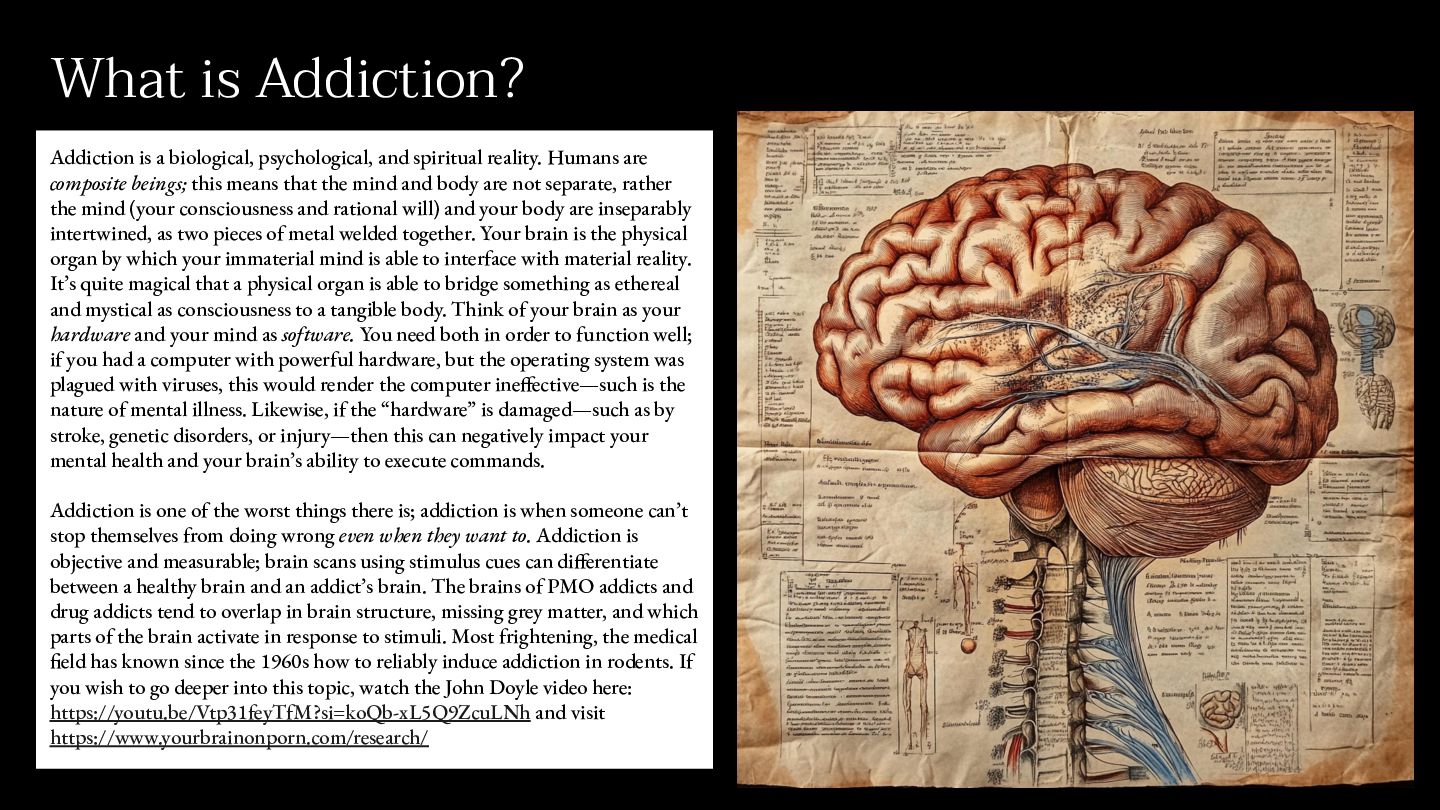
reality. Humans are composite beings; this means that the mind and body are not separate, rather the mind (your consciousness and rational will) and your body are inseparably intertwined, as two pieces of metal welded together. Your brain is the physical organ by which your immaterial mind is able to interface with material reality. It’s quite magical that a physical organ is able to bridge something as ethereal and mystical as consciousness to a tangible body. Think of your brain as your hardware and your mind as software. You need both in order to function well; if you had a computer with powerful hardware, but the operating system was plagued with viruses, this would render the computer ineffective—such is the nature of mental illness. Likewise, if the “hardware” is damaged—such as by stroke, genetic disorders, or injury—then this can negatively impact your mental health and your brain’s ability to execute commands. Addiction is one of the worst things there is; addiction is when someone can’t stop themselves from doing wrong even when they want to. Addiction is objective and measurable; brain scans using stimulus cues can differentiate between a healthy brain and an addict’s brain. The brains of PMO addicts and drug addicts tend to overlap in brain structure, missing grey matter, and which parts of the brain activate in response to stimuli. Most frightening, the medical field has known since the 1960s how to reliably induce addiction in rodents. If you wish to go deeper into this topic, watch the John Doyle video here: https://youtu.be/Vtp31feyTfM?si=koQb-xL5Q9ZcuLNh and visit https://www.yourbrainonporn.com/research/ -
The Four Moral Categories: There are four kinds of people
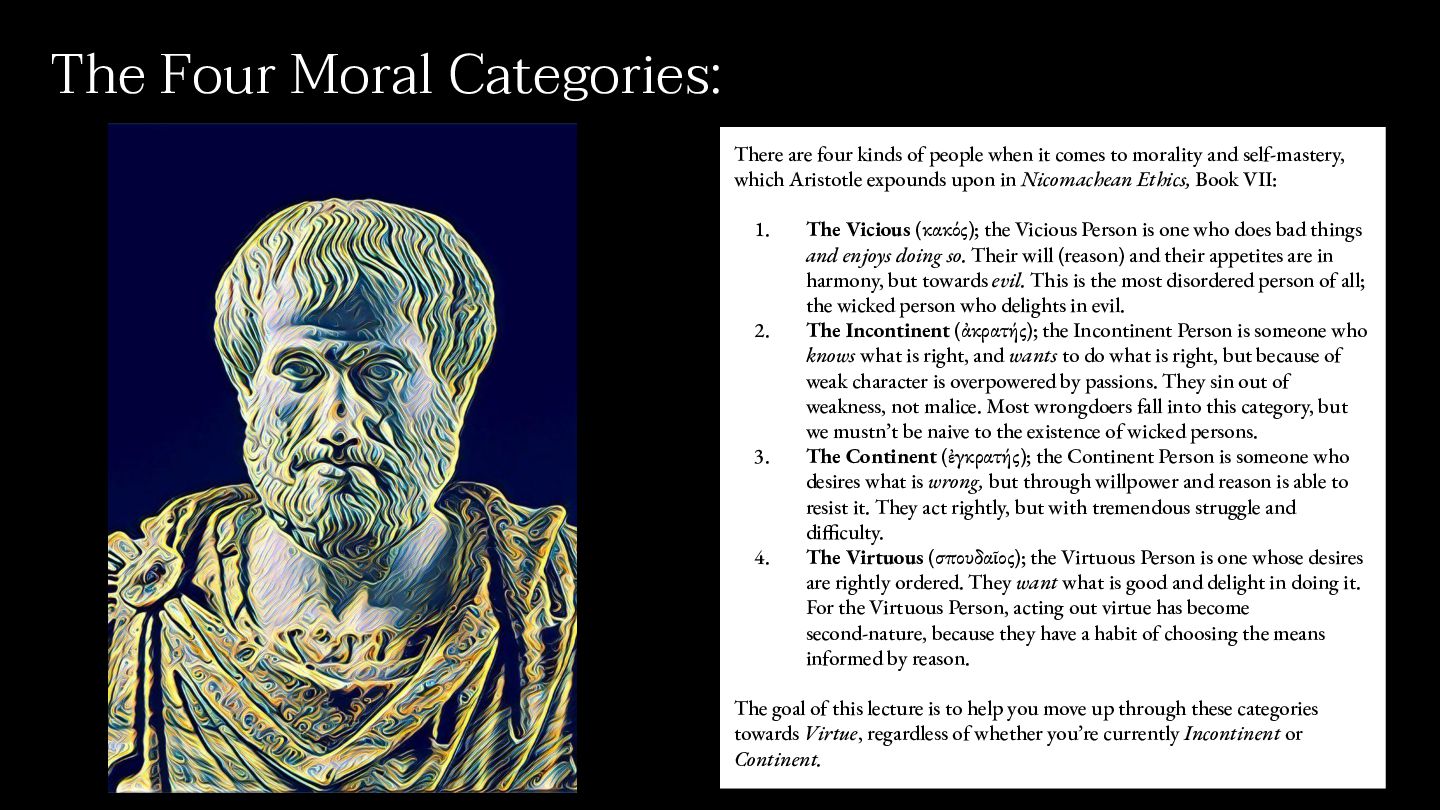
when it comes to morality and self-mastery, which Aristotle expounds upon in Nicomachean Ethics, Book VII: 1. 2. 3. 4. The Vicious (κακός); the Vicious Person is one who does bad things and enjoys doing so. Their will (reason) and their appetites are in harmony, but towards evil. This is the most disordered person of all; the wicked person who delights in evil. The Incontinent (ἀκρατής); the Incontinent Person is someone who knows what is right, and wants to do what is right, but because of weak character is overpowered by passions. They sin out of weakness, not malice. Most wrongdoers fall into this category, but we mustn’t be naive to the existence of wicked persons. The Continent (ἐγκρατής); the Continent Person is someone who desires what is wrong, but through willpower and reason is able to resist it. They act rightly, but with tremendous struggle and difficulty. The Virtuous (σπουδαῖος); the Virtuous Person is one whose desires are rightly ordered. They want what is good and delight in doing it. For the Virtuous Person, acting out virtue has become second-nature, because they have a habit of choosing the means informed by reason. The goal of this lecture is to help you move up through these categories towards Virtue, regardless of whether you’re currently Incontinent or Continent. -
The Markers of an Addict: Some of you may have
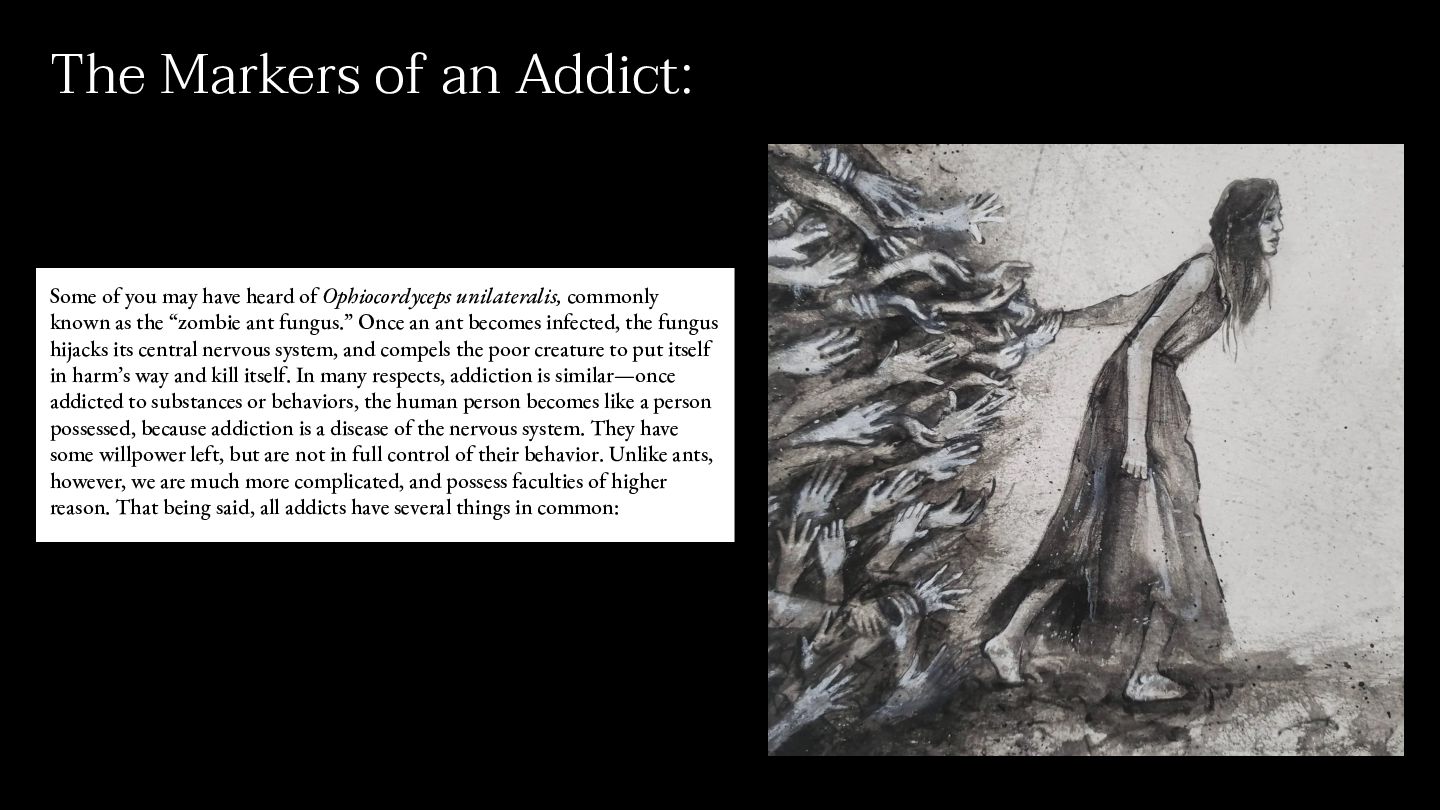
heard of Ophiocordyceps unilateralis, commonly known as the “zombie ant fungus.” Once an ant becomes infected, the fungus hijacks its central nervous system, and compels the poor creature to put itself in harm’s way and kill itself. In many respects, addiction is similar—once addicted to substances or behaviors, the human person becomes like a person possessed, because addiction is a disease of the nervous system. They have some willpower left, but are not in full control of their behavior. Unlike ants, however, we are much more complicated, and possess faculties of higher reason. That being said, all addicts have several things in common: -
The Markers of an Addict (cont.): 1. 2. 3. They
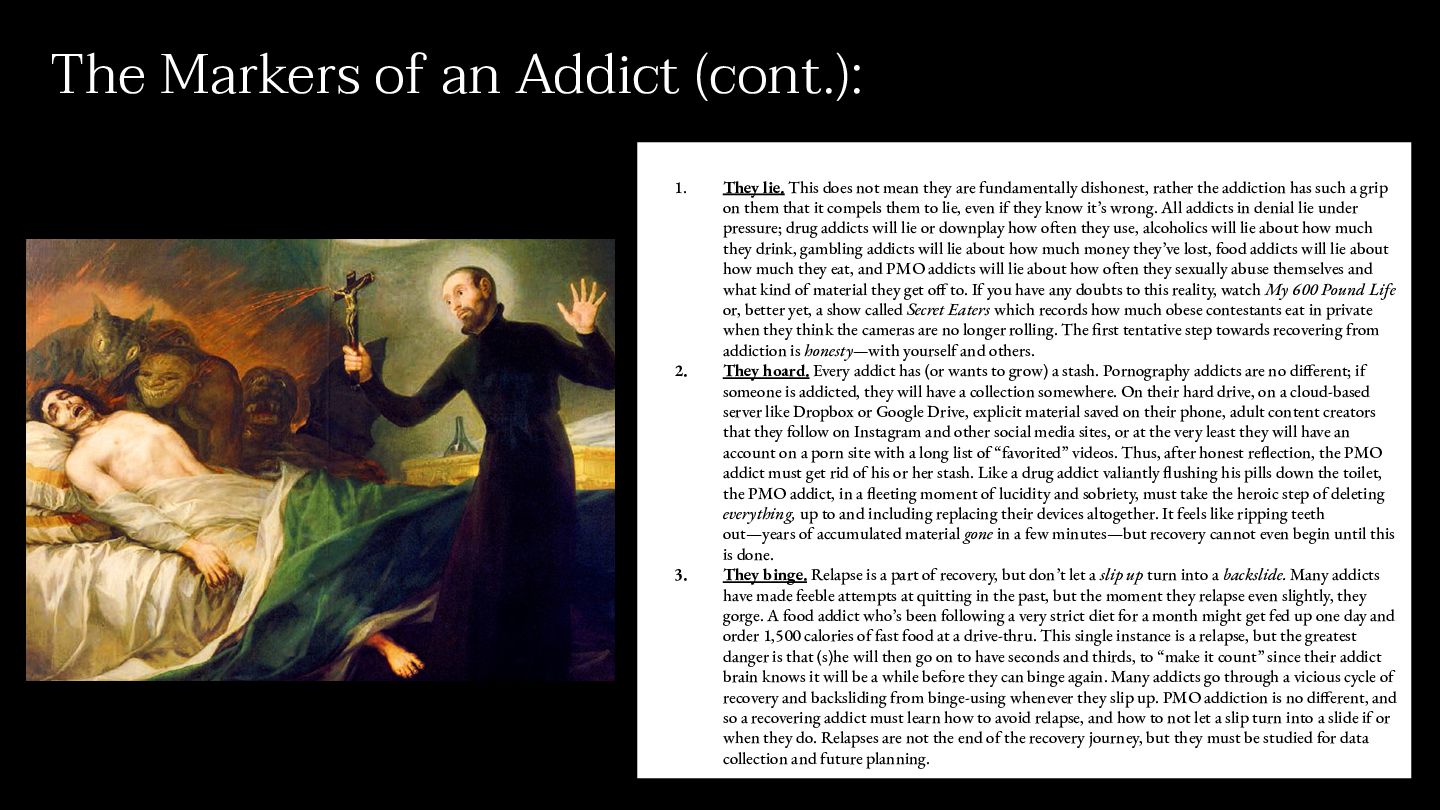
lie. This does not mean they are fundamentally dishonest, rather the addiction has such a grip on them that it compels them to lie, even if they know it’s wrong. All addicts in denial lie under pressure; drug addicts will lie or downplay how often they use, alcoholics will lie about how much they drink, gambling addicts will lie about how much money they’ve lost, food addicts will lie about how much they eat, and PMO addicts will lie about how often they sexually abuse themselves and what kind of material they get off to. If you have any doubts to this reality, watch My 600 Pound Life or, better yet, a show called Secret Eaters which records how much obese contestants eat in private when they think the cameras are no longer rolling. The first tentative step towards recovering from addiction is honesty—with yourself and others. They hoard. Every addict has (or wants to grow) a stash. Pornography addicts are no different; if someone is addicted, they will have a collection somewhere. On their hard drive, on a cloud-based server like Dropbox or Google Drive, explicit material saved on their phone, adult content creators that they follow on Instagram and other social media sites, or at the very least they will have an account on a porn site with a long list of “favorited” videos. Thus, after honest reflection, the PMO addict must get rid of his or her stash. Like a drug addict valiantly flushing his pills down the toilet, the PMO addict, in a fleeting moment of lucidity and sobriety, must take the heroic step of deleting everything, up to and including replacing their devices altogether. It feels like ripping teeth out—years of accumulated material gone in a few minutes—but recovery cannot even begin until this is done. They binge. Relapse is a part of recovery, but don’t let a slip up turn into a backslide. Many addicts have made feeble attempts at quitting in the past, but the moment they relapse even slightly, they gorge. A food addict who’s been following a very strict diet for a month might get fed up one day and order 1,500 calories of fast food at a drive-thru. This single instance is a relapse, but the greatest danger is that (s)he will then go on to have seconds and thirds, to “make it count” since their addict brain knows it will be a while before they can binge again. Many addicts go through a vicious cycle of recovery and backsliding from binge-using whenever they slip up. PMO addiction is no different, and so a recovering addict must learn how to avoid relapse, and how to not let a slip turn into a slide if or when they do. Relapses are not the end of the recovery journey, but they must be studied for data collection and future planning. -
How the Damaged Person Cries Out: Some people have no
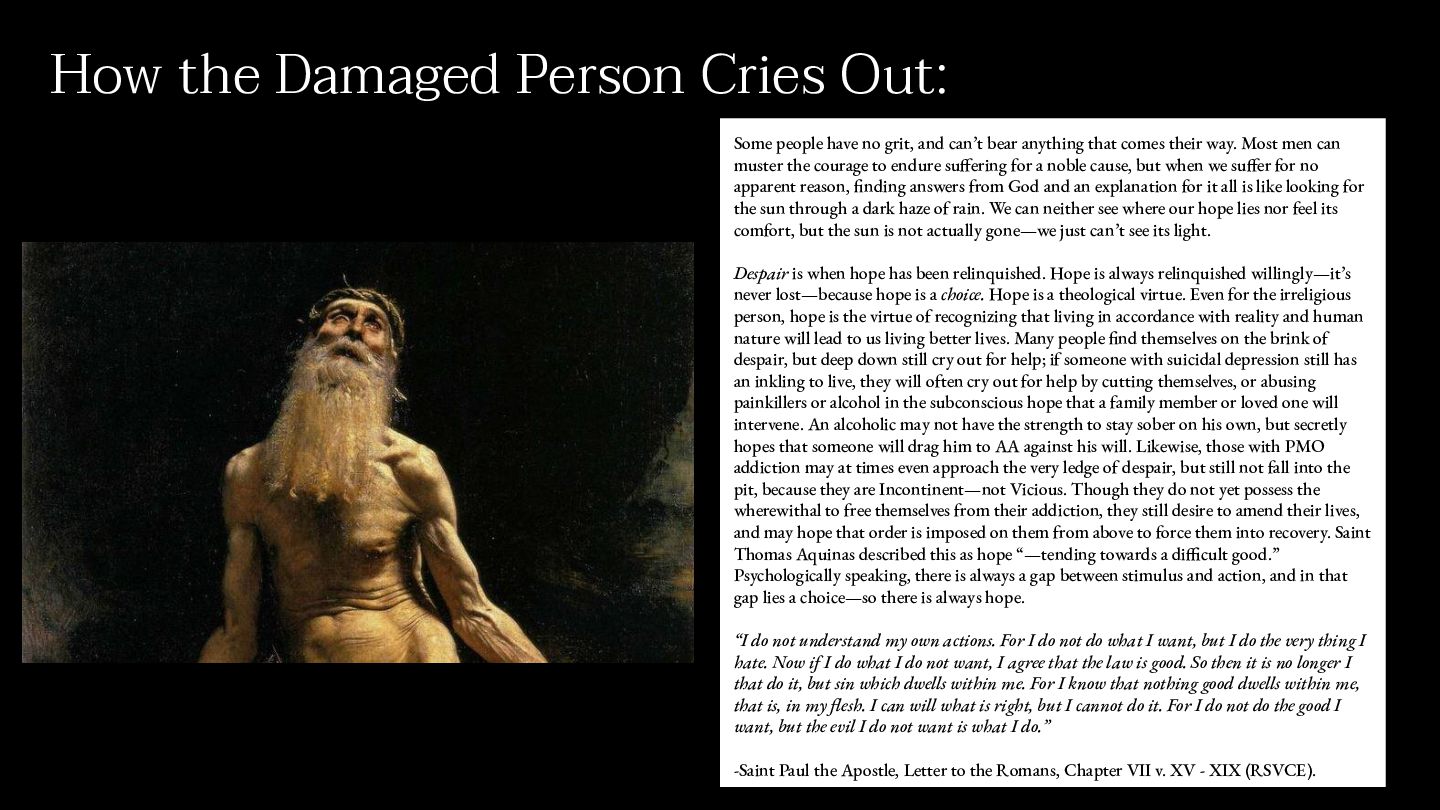
grit, and can’t bear anything that comes their way. Most men can muster the courage to endure suffering for a noble cause, but when we suffer for no apparent reason, finding answers from God and an explanation for it all is like looking for the sun through a dark haze of rain. We can neither see where our hope lies nor feel its comfort, but the sun is not actually gone—we just can’t see its light. Despair is when hope has been relinquished. Hope is always relinquished willingly—it’s never lost—because hope is a choice. Hope is a theological virtue. Even for the irreligious person, hope is the virtue of recognizing that living in accordance with reality and human nature will lead to us living better lives. Many people find themselves on the brink of despair, but deep down still cry out for help; if someone with suicidal depression still has an inkling to live, they will often cry out for help by cutting themselves, or abusing painkillers or alcohol in the subconscious hope that a family member or loved one will intervene. An alcoholic may not have the strength to stay sober on his own, but secretly hopes that someone will drag him to AA against his will. Likewise, those with PMO addiction may at times even approach the very ledge of despair, but still not fall into the pit, because they are Incontinent—not Vicious. Though they do not yet possess the wherewithal to free themselves from their addiction, they still desire to amend their lives, and may hope that order is imposed on them from above to force them into recovery. Saint Thomas Aquinas described this as hope “—tending towards a difficult good.” Psychologically speaking, there is always a gap between stimulus and action, and in that gap lies a choice—so there is always hope. “I do not understand my own actions. For I do not do what I want, but I do the very thing I hate. Now if I do what I do not want, I agree that the law is good. So then it is no longer I that do it, but sin which dwells within me. For I know that nothing good dwells within me, that is, in my flesh. I can will what is right, but I cannot do it. For I do not do the good I want, but the evil I do not want is what I do.” -Saint Paul the Apostle, Letter to the Romans, Chapter VII v. XV - XIX (RSVCE). -
The ABCs of Behavioral Therapy: Board Certified Behavioral Analysts (BCBAs)
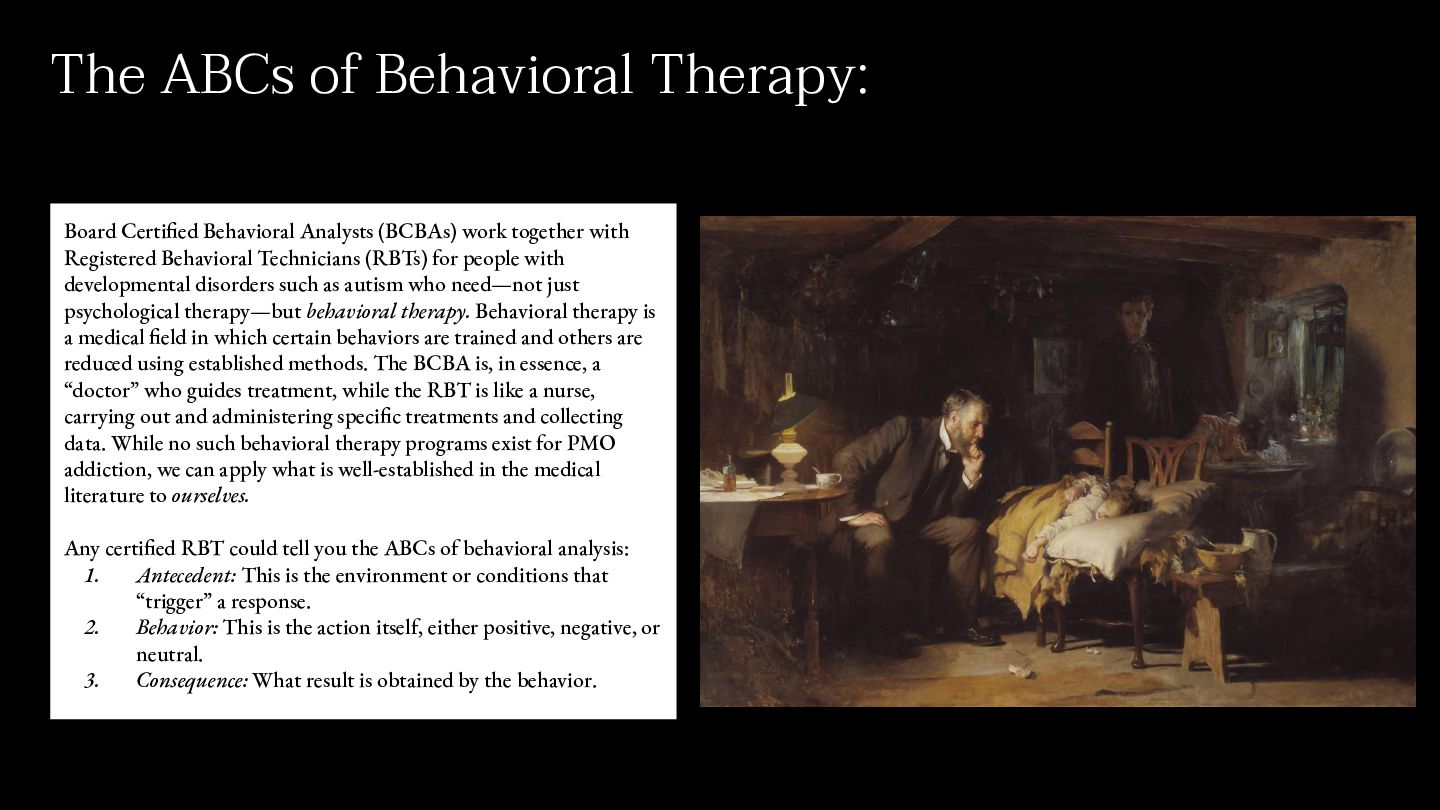
work together with Registered Behavioral Technicians (RBTs) for people with developmental disorders such as autism who need—not just psychological therapy—but behavioral therapy. Behavioral therapy is a medical field in which certain behaviors are trained and others are reduced using established methods. The BCBA is, in essence, a “doctor” who guides treatment, while the RBT is like a nurse, carrying out and administering specific treatments and collecting data. While no such behavioral therapy programs exist for PMO addiction, we can apply what is well-established in the medical literature to ourselves. Any certified RBT could tell you the ABCs of behavioral analysis: 1. Antecedent: This is the environment or conditions that “trigger” a response. 2. Behavior: This is the action itself, either positive, negative, or neutral. 3. Consequence: What result is obtained by the behavior. -
The ABCs of Behavioral Therapy (cont.): Let’s take a moment
to look deeper into each of these. In order to properly understand and implement the ABCs, we must understand what behavioral technicians call function. Function is the purpose of a behavior. There are four functions of behavior, which can be remembered as SEAT. 1. 2. 3. 4. Sensory: These are behaviors done purely for sensory pleasure or a pleasant tactile sensation. Fidgeting and self-soothing behaviors in children are a common example. Escape: These are behaviors done—not for the behavior itself—but in service of avoiding and delaying some other task or obligation. Attention: These are behaviors that accomplish one thing—they make others speak to us, acknowledge us, praise us, or punish us. Attention-seeking is not always positive; oftentimes, it matters little whether the attention is positive or negative. Tangible: This is when a behavior is only done in service of some other reward;:money, material goods, status, or access to something we want. This is why we must examine ourselves to find our hidden motivations. -
Examining Our Conscience: Because behavioral therapy in a clinical setting
concerns itself with individuals who cannot help themselves (usually special needs children), it requires that a certified behavioral technician examines and observes the patient to determine the function of their behavior; for instance, to the untrained eye, a young child who frequently gets out of his chair and leaves the classroom sounds like a case where the function of behavior is escape (to avoid having to do classwork). But that may not actually be the case; it could be attention-seeking behavior (to impress classmates and get the teacher’s attention), or if the child has Autism Spectrum Disorder, he could be leaving the class for sensory reasons—especially if the class is noisy, and he prefers the peace of the hallway. It can also be for tangible reasons—maybe his favorite toy is in another room, so he leaves the class to try to fetch it. The same is true with PMO use; a person reading this could easily assume that the function of their behavior is sensory only (for the physical pleasure), but that may not be its actual function. A person could use PMO because they crave intimacy, and pornography simulates intimacy in a disordered way; if someone has not yet fortified themselves to be able to regulate their emotions and self-soothe, they may turn to substance abuse (like overeating, drugs, or alcohol) or behavioral abuses like PMO for comfort. It can be craving attention from a lack of intimacy; the function could be escape if someone turns to pornography as a distraction from their obligations. Our work begins with examining ourselves and finding out the SEAT function of our behavior. Once accomplished, the harmful behavior (PMO) can be replaced with healthy Alternatives that fulfill the same function. If the need is comfort, we can replace the behavior with prayer, reading, meditation, and relaxation techniques. If it’s stimulation, we can replace it with cold showers, working out, or working on a mentally-demanding creative project. If the function is escape, we may need to replace it with positive behaviors that help us engage with our obligations while decompressing from pressure (praying the rosary or Litany of Trust can help, as does meditation). If the need is intimacy (attention), we need to strengthen the real human connections in our lives and use confession-based accountability. For those who do not practice confession with a priest, you may still benefit by finding an accountability partner and seeing a therapist about how you can overcome anxiety and improve social skills to strengthen these real-world connections. Behaviors can have multiple functions, so you have to find the combination that works for you through trial and error. SENSORY: Orgasm ESCAPE: Doomscrolling / pleasurable time-kill ATTENTION: Parasocial relationships with OnlyFans / cam site pornographers TANGIBLE: Access to novelty -
Antecedents and Near Occasion: Behavioral patterns do not spawn out
of nowhere; every habit follows Antecedent ──────▶ Behavior ──────▶ Consequence. The stage is set by the antecedent—the circumstances that “trigger” a compulsion to do a particular behavior. This is true for every behavior, not just addictions; let’s say every time someone feels anxious, they have a drink. The antecedent is feeling anxiety, the behavior is drinking, and the consequence is temporarily numbing their anxiety. If someone sees a sink full of dishes, they might start washing the dishes, or ignore them. If someone passes a coffee shop on their way to work, they could just drive past, or they could stop to grab a coffee. Thus, recovering from an addiction is not a matter of brute willpower, but minimizing triggers and changing our behavioral response to the ones we can’t avoid. For men who use pornography, that trigger could be being alone at night, sitting in a specific chair or laying in bed with your phone, browsing specific social media sites, having large blocks of unstructured free time with no clear task or schedule (boredom), feeling fatigued or stressed after a long work day, feeling lonely or isolated, or feeling guilt and shame from previous failures. Your brain will play tricks on you to get its fleeting dopaminergic reward; it will say, “You’ve worked hard, you deserve a break,” or “I’ll do better tomorrow,” or “It’s not as bad as what others do.” Armed with this information, let’s say a recovering alcoholic needed to book a room at a hotel for a work trip. If his room comes with a minifridge full of booze, he’s putting himself under unnecessary temptation and may very well relapse. But if he plans his life around avoiding the temptation altogether by requesting a room with no fridge (or an empty fridge), then he saves himself—not through willpower—but strategy. -
Antecedents and Near Occasion (cont.): In theology, this is called
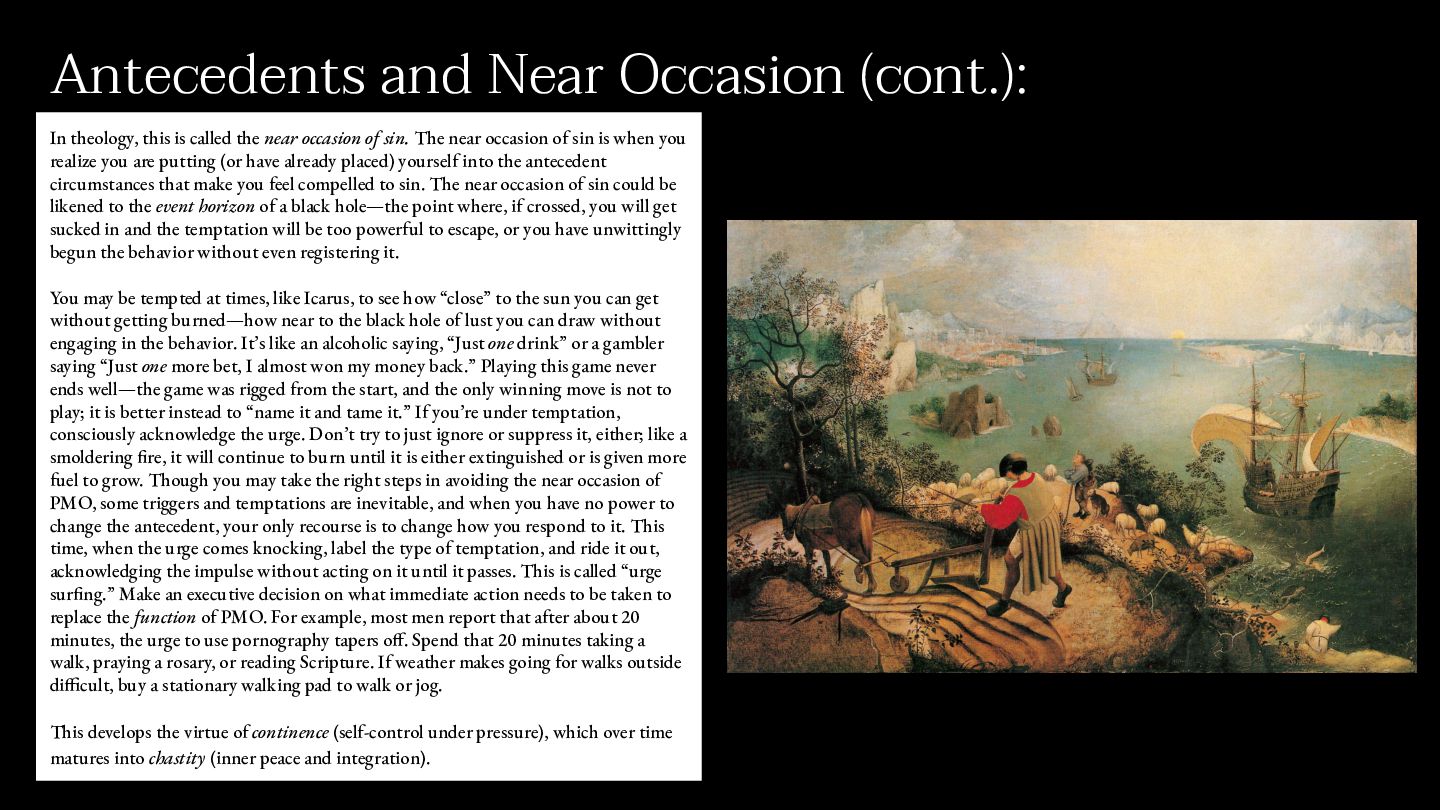
the near occasion of sin. The near occasion of sin is when you realize you are putting (or have already placed) yourself into the antecedent circumstances that make you feel compelled to sin. The near occasion of sin could be likened to the event horizon of a black hole—the point where, if crossed, you will get sucked in and the temptation will be too powerful to escape, or you have unwittingly begun the behavior without even registering it. You may be tempted at times, like Icarus, to see how “close” to the sun you can get without getting burned—how near to the black hole of lust you can draw without engaging in the behavior. It’s like an alcoholic saying, “Just one drink” or a gambler saying “Just one more bet, I almost won my money back.” Playing this game never ends well—the game was rigged from the start, and the only winning move is not to play; it is better instead to “name it and tame it.” If you’re under temptation, consciously acknowledge the urge. Don’t try to just ignore or suppress it, either; like a smoldering fire, it will continue to burn until it is either extinguished or is given more fuel to grow. Though you may take the right steps in avoiding the near occasion of PMO, some triggers and temptations are inevitable, and when you have no power to change the antecedent, your only recourse is to change how you respond to it. This time, when the urge comes knocking, label the type of temptation, and ride it out, acknowledging the impulse without acting on it until it passes. This is called “urge surfing.” Make an executive decision on what immediate action needs to be taken to replace the function of PMO. For example, most men report that after about 20 minutes, the urge to use pornography tapers off. Spend that 20 minutes taking a walk, praying a rosary, or reading Scripture. If weather makes going for walks outside difficult, buy a stationary walking pad to walk or jog. This develops the virtue of continence (self-control under pressure), which over time matures into chastity (inner peace and integration). -
Hope and Defeatism: Many of you have probably heard the
expression, Thoughts become words, words become actions, actions become habits, and habits become character. This is psychologically accurate, and is anchored in both classical philosophy and theology. Aristotle writes in Nicomachean Ethics: “We become just by doing just acts, temperate by doing temperate acts, brave by doing brave acts,” II.1 (1103b), and also, “Moral virtue comes about as a result of habit... it is by doing what we do in our transactions with other men that we become just or unjust” (1103a). This is deeply intertwined with the teachings of Scripture; according to Christ, “Out of the abundance of the heart the mouth speaks” (Matthew 12:34). Saint Paul the Apostle writes: “Do not be conformed to this world but be transformed by the renewal of your mind, that you may prove what is the will of God” (Romans 12:2). The term renewal of the mind refers to how our will can choose to interact with thoughts that arise in our mind; over the next few sections, we will delve deeper into how you can use behavioral therapy techniques to renew your mind, regardless of your religious beliefs. Saint John Cassian writes in the 5th century, “The beginning of every sin is in the thought… if we guard our hearts and reject evil thoughts as soon as they arise, we will not fall into sin through word or deed.” Cassian describes the eight stages of temptation as occurring in a specific order: suggestion → conversation → struggle → consent → captivity → passion. Saint Augustine concurs with this: “The mind commands the body and is instantly obeyed; the mind commands itself and meets resistance. The origin of sin is within.” Thus, disordered behaviors are outward manifestations of the disorder in our own mind. -
Hope and Defeatism (cont.): Saint Thomas Aquinas expands upon this
idea, by pointing out the following: not only do antecedents (circumstance and disposition) influence current behavior, but that behaviors which become habitual shape future antecedents. This is why the Incontinent person feels like they are trapped in a hamster-wheel of recovery and relapse. “From acts are formed habits, and from habits proceed acts.” (ST I-II, q.51, a.2) Thus, every action not only arises from prior dispositions but shapes future ones—the very essence of the saying “actions become habits.” Saint Francis de Sales echos this idea splendidly in his Introduction to the Devout Life: “A slight failing, when often repeated, becomes a habit, and a habit confirmed becomes a second nature.” The ancient mathematician Archimedes said something interesting in the 4th century which has come to shape how we ought to view moral formation: He said, “Give me a place to stand, and I will move the earth.” He was speaking literally, as he was talking about the invention of the lever, and how a small amount of force applied correctly can have disproportionate effect, because our physical efforts are multiplied. One temptation we often face is defeatism—even when we have the strength to do a small, correct action, we consider it futile, because we believe that making a small effort today would be wasted. Why take small steps today when I’m certain I will just fail tomorrow? The Incontinent person looks at the years and decades ahead, and thinks to themselves, “I can only go a week [or for some, a day] without using pornography, so what use is there in staying chaste for the next 20 minutes? What good is holding out for 20 minutes when the goal is to become sober for the rest of my life, which I have not the power to do?” There’s this common proverb which addresses this very issue. “Do you know how you eat an elephant? One bite at a time.” -
Renewal of the Mind: Things sound dire when we put
them that way, like a snowball of errors growing rapidly as our lives spiral out of control. Yet, many fail to conceive that the opposite is also true; small successes pile up, multiply, and even accumulate interest. These are excerpts from William James's 1890 classic, Principles of Psychology, Chapter IV, on "Habit": 1. 2. 3. 4. 5. The great thing, then, in all education, is to make our nervous system our ally instead of our enemy. It is to fund and capitalize our acquisitions, and live at ease upon the interest of the fund. For this we must make automatic and habitual, as early as possible, as many useful actions as we can, and guard against the growing into ways that are likely to be disadvantageous to us, as we should guard against the plague. The more of the details of our daily life we can hand over to the effortless custody of automatism, the more our higher powers of mind will be set free for their own proper work. Seize the very first possible opportunity to act on every resolution you make, and on every emotional prompting you may experience in the direction of the habits you aspire to gain. It is not in the moment of their forming, but in the moment of their producing motor effects, that resolves and aspirations communicate the new “set” to the brain. No matter how full a reservoir of maxims one may possess, and no matter how good one's sentiments may be, if one have not taken advantage of every concrete opportunity to act, one's character may remain entirely unaffected for the better. As a final practical maxim, relative to these habits of the will, we may, then, offer something like this: Keep the faculty of effort alive in you by a little gratuitous exercise every day. That is, be systematically ascetic or heroic in little unnecessary points, do every day or two something for no other reason than that you would rather not do it, so that when the hour of dire need draws nigh, it may find you not unnerved. -
Renewal of the Mind (cont.): In order to carry out
this commission of seizing upon every concrete opportunity to act, no matter how small, we must first win the battle in our mind. The battle of the mind is unique, in that it is won by believing you can win. No other battle works this way; your thoughts are the only place where your belief in the outcome always determines the outcome. If you believe that you can win, then you will triumph, and if you believe you can’t, then you won’t. It’s a self-fulfilling prophecy. We must therefore renew our minds by believing we can win, and acting out every little virtuous moment we can. According to Saint Francis de Sales: “Great works are composed of small acts faithfully done; do not despise the little virtues.” Like the lever, small actions of virtue—repeated with constancy—move vast moral weight. What’s more, is that we can learn from the 80/20 rule for Pareto efficiency. In statistics, the 80/20 rule reflects a mathematical pattern in nature that occurs everywhere. 20% of a farmer’s pea-pods produce 80% of the peas; 20% of customers account for 80% of the profits; the hardest-working 20% of employees do 80% of the work; 20% of your carpet gets 80% of the wear and tear from foot travel, et cetera. We can apply this to our own lives—the worst 20% of our weaknesses cause 80% of our problems. You may notice that 80% of your temptation occurs in the same few places. One thing which we ought to do is to focus our efforts on the 20% of our weaknesses which cause the largest share of our problems. When you wage war against temptation, leave no survivors. You must take every thought captive, and interrogate them to make them justify their existence. When a thought prompts you to lust, reject it instantly—do not negotiate or bargain. Don’t invite the thought to come in and chat over dinner. You slam the door in its face. You don’t negotiate with terrorists. Then, once you have rejected the thought, examine yourself and ask where that thought came from—what antecedent led to its formation—what function of behavior is behind the temptation—and what action can be taken immediately to fulfill the same function in a healthy way. All of our thoughts have a tone and are framed in a certain way; we can’t always control every thought and emotion, but we can choose how we think about them—how we frame them and respond to them in deed. If the thought is, “I’ll just give in and start over tomorrow,” reframe it as: “I can start over now by choosing differently in this moment.” If the thought is, “This will make me feel better,” respond, “This will numb me for a moment, but make me feel empty after, and worsen my addiction.” These tempting thoughts are used to getting their way without resistance, and when you start fighting back and challenging them, they retreat. “Submit yourselves therefore to God. Resist the devil and he will flee from you.” -James 4:7 -
Ego Depletion and Willpower: ~The following video is required viewing~
https://youtu.be/k2Wcu6aGyz8?si=fNK-YKxv_Iwgg_uw -
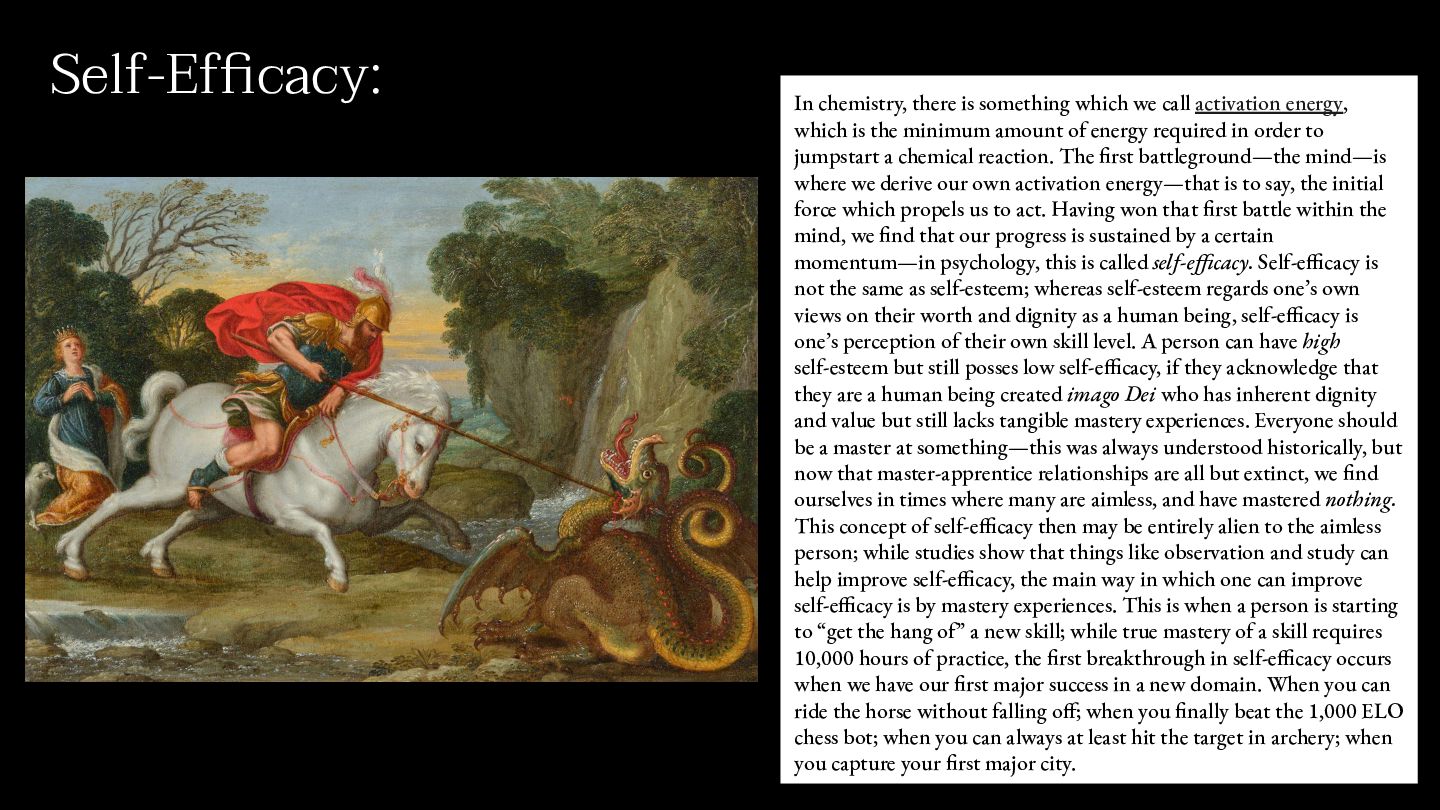
Self-Efficacy: In chemistry, there is something which we call activation
energy, which is the minimum amount of energy required in order to jumpstart a chemical reaction. The first battleground—the mind—is where we derive our own activation energy—that is to say, the initial force which propels us to act. Having won that first battle within the mind, we find that our progress is sustained by a certain momentum—in psychology, this is called self-efficacy. Self-efficacy is not the same as self-esteem; whereas self-esteem regards one’s own views on their worth and dignity as a human being, self-efficacy is one’s perception of their own skill level. A person can have high self-esteem but still posses low self-efficacy, if they acknowledge that they are a human being created imago Dei who has inherent dignity and value but still lacks tangible mastery experiences. Everyone should be a master at something—this was always understood historically, but now that master-apprentice relationships are all but extinct, we find ourselves in times where many are aimless, and have mastered nothing. This concept of self-efficacy then may be entirely alien to the aimless person; while studies show that things like observation and study can help improve self-efficacy, the main way in which one can improve self-efficacy is by mastery experiences. This is when a person is starting to “get the hang of” a new skill; while true mastery of a skill requires 10,000 hours of practice, the first breakthrough in self-efficacy occurs when we have our first major success in a new domain. When you can ride the horse without falling off; when you finally beat the 1,000 ELO chess bot; when you can always at least hit the target in archery; when you capture your first major city. -
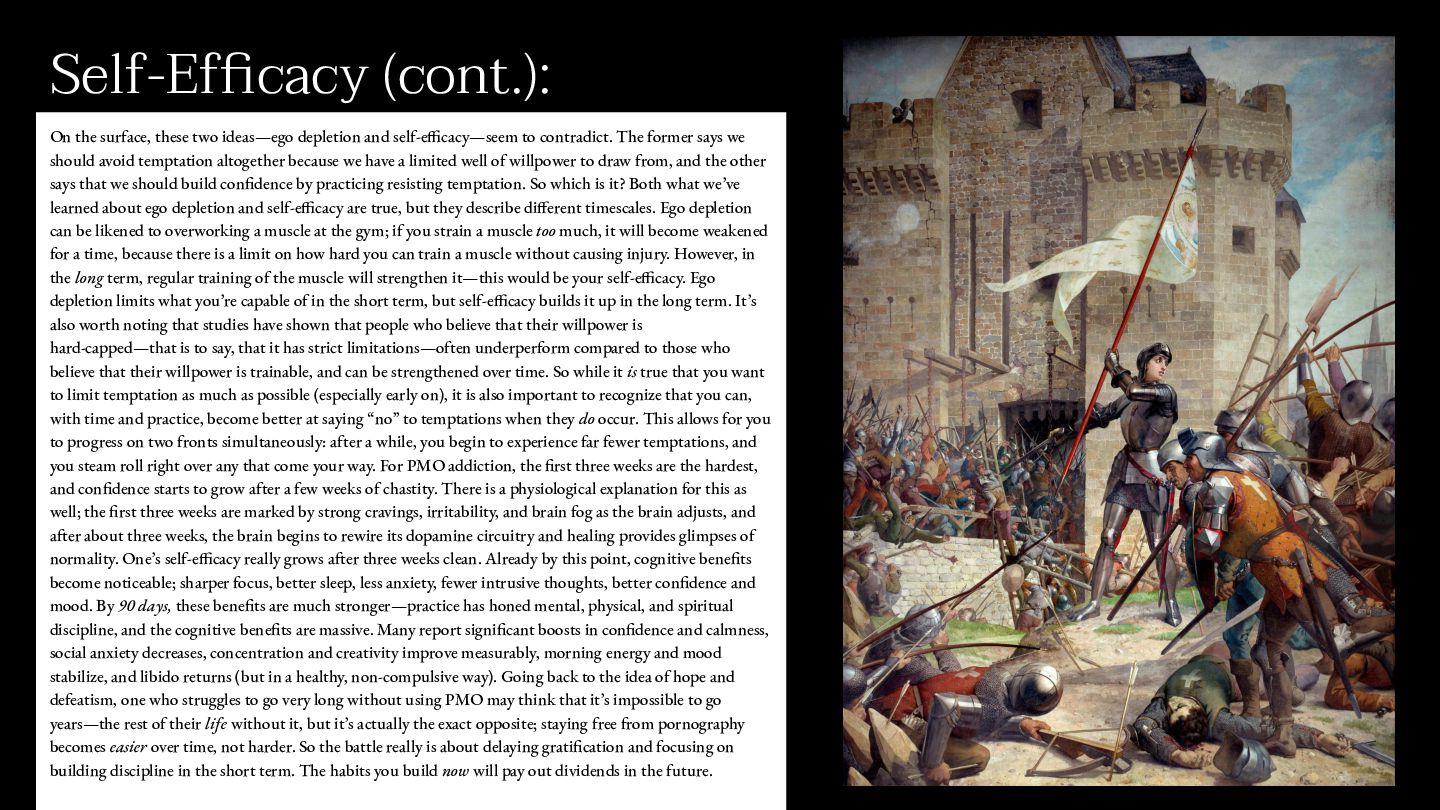
Self-Efficacy (cont.): On the surface, these two ideas—ego depletion and
self-efficacy—seem to contradict. The former says we should avoid temptation altogether because we have a limited well of willpower to draw from, and the other says that we should build confidence by practicing resisting temptation. So which is it? Both what we’ve learned about ego depletion and self-efficacy are true, but they describe different timescales. Ego depletion can be likened to overworking a muscle at the gym; if you strain a muscle too much, it will become weakened for a time, because there is a limit on how hard you can train a muscle without causing injury. However, in the long term, regular training of the muscle will strengthen it—this would be your self-efficacy. Ego depletion limits what you’re capable of in the short term, but self-efficacy builds it up in the long term. It’s also worth noting that studies have shown that people who believe that their willpower is hard-capped—that is to say, that it has strict limitations—often underperform compared to those who believe that their willpower is trainable, and can be strengthened over time. So while it is true that you want to limit temptation as much as possible (especially early on), it is also important to recognize that you can, with time and practice, become better at saying “no” to temptations when they do occur. This allows for you to progress on two fronts simultaneously: after a while, you begin to experience far fewer temptations, and you steam roll right over any that come your way. For PMO addiction, the first three weeks are the hardest, and confidence starts to grow after a few weeks of chastity. There is a physiological explanation for this as well; the first three weeks are marked by strong cravings, irritability, and brain fog as the brain adjusts, and after about three weeks, the brain begins to rewire its dopamine circuitry and healing provides glimpses of normality. One’s self-efficacy really grows after three weeks clean. Already by this point, cognitive benefits become noticeable; sharper focus, better sleep, less anxiety, fewer intrusive thoughts, better confidence and mood. By 90 days, these benefits are much stronger—practice has honed mental, physical, and spiritual discipline, and the cognitive benefits are massive. Many report significant boosts in confidence and calmness, social anxiety decreases, concentration and creativity improve measurably, morning energy and mood stabilize, and libido returns (but in a healthy, non-compulsive way). Going back to the idea of hope and defeatism, one who struggles to go very long without using PMO may think that it’s impossible to go years—the rest of their life without it, but it’s actually the exact opposite; staying free from pornography becomes easier over time, not harder. So the battle really is about delaying gratification and focusing on building discipline in the short term. The habits you build now will pay out dividends in the future. -
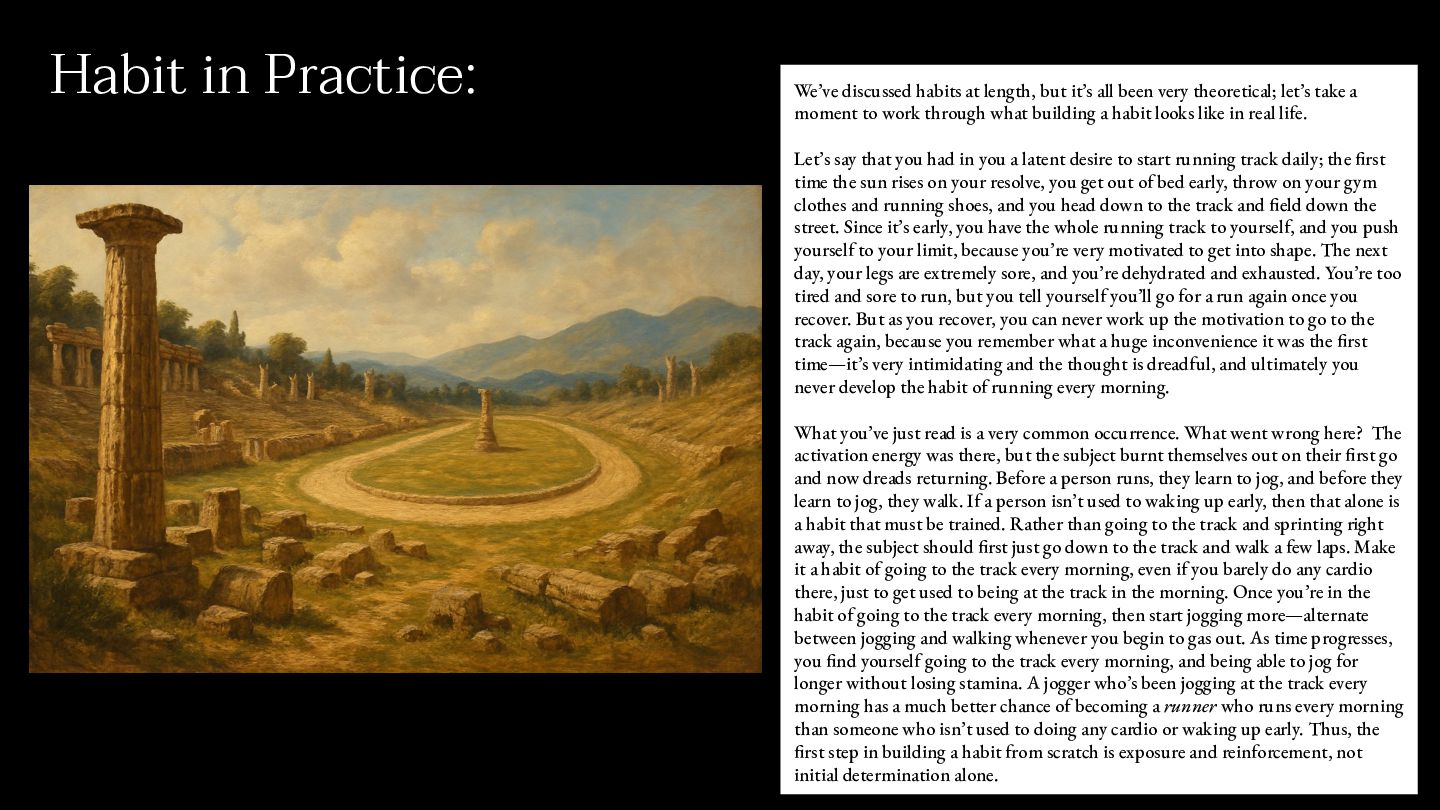
Habit in Practice: We’ve discussed habits at length, but it’s
all been very theoretical; let’s take a moment to work through what building a habit looks like in real life. Let’s say that you had in you a latent desire to start running track daily; the first time the sun rises on your resolve, you get out of bed early, throw on your gym clothes and running shoes, and you head down to the track and field down the street. Since it’s early, you have the whole running track to yourself, and you push yourself to your limit, because you’re very motivated to get into shape. The next day, your legs are extremely sore, and you’re dehydrated and exhausted. You’re too tired and sore to run, but you tell yourself you’ll go for a run again once you recover. But as you recover, you can never work up the motivation to go to the track again, because you remember what a huge inconvenience it was the first time—it’s very intimidating and the thought is dreadful, and ultimately you never develop the habit of running every morning. What you’ve just read is a very common occurrence. What went wrong here? The activation energy was there, but the subject burnt themselves out on their first go and now dreads returning. Before a person runs, they learn to jog, and before they learn to jog, they walk. If a person isn’t used to waking up early, then that alone is a habit that must be trained. Rather than going to the track and sprinting right away, the subject should first just go down to the track and walk a few laps. Make it a habit of going to the track every morning, even if you barely do any cardio there, just to get used to being at the track in the morning. Once you’re in the habit of going to the track every morning, then start jogging more—alternate between jogging and walking whenever you begin to gas out. As time progresses, you find yourself going to the track every morning, and being able to jog for longer without losing stamina. A jogger who’s been jogging at the track every morning has a much better chance of becoming a runner who runs every morning than someone who isn’t used to doing any cardio or waking up early. Thus, the first step in building a habit from scratch is exposure and reinforcement, not initial determination alone. -
Types of Reinforcement: In applied behavioral analysis, anything which produces
more of a behavior is called a “reinforcer.” If the behavior increases as a consequence of something, then that behavior has been reinforced. The two most important categories of reinforcement are unconditioned and conditioned, or “learned” and “inherited.” Unconditioned reinforcers are those things which all people find inherent pleasure or delight in. They don’t need to be learned, because we are already wired so as to find them desirable, and—in their most extreme forms—almost irresistible. These are things like food, water, sleep, sexual stimulation & orgasm, and basic bodily comforts, like shelter. Other reinforcers need to be learned or conditioned over time—these are things like social acceptance, money, praise, access to entertainment, grades, etc. For example, a baby does not need to learn to enjoy milk, because the child will find the milk satisfying in and of itself. However, young children need to be forced to take care of their hygiene and play nicely with other children, because—even though they don’t see the immediate importance of that—in the long term, social integration is vital to their flourishing. Something is called a super stimulant if it maximizes the amount of pleasure derived from an unconditioned reinforcement system. Fast food is an example of this: highly processed junk foods have been engineered by food chemists and psychologists to reach what they call the “bliss point,” which is where the ratio of salt, sugar, and fat is optimized in such a way so as to induce the maximum amount of pleasure from eating it. Drinks like sodas (sugars) are paired with fries and burgers (salt and fat) to strike this balance and reach the “bliss point,” making them highly addictive and cravable. Well, sexual stimulation & orgasm is not only an unconditioned reinforcer, but it’s the strongest unconditioned reinforcer—stronger even than food. And pornography is the super stimulant version of this—the “fast food” of sex. If you were exposed to the porn industry at a young age, then this reinforced behavior runs deep, and that’s why it’s tough to quit. This is also why many recovering addicts will quit one addiction only to pick up another—someone quitting cigarettes runs the risk of becoming an alcoholic, or someone quitting alcohol runs the risk of developing a food addiction and gaining weight. They’re trading one unconditioned reinforcer for another to cope. -
Delayed Gratification: One task for the recovering addict, then, is
to ensure they do not trade one addiction for another. The way to do this is to trade our unconditioned reinforcers for conditioned reinforcers. This means that instead of trading one bodily desire for another (sex for food, etc.), we must trade up—that is to say, trade our bodily desires for these more abstract, conditioned reinforcers. This is difficult at first—the reward for eating junk food is instant and tangible. The pleasure reward for PMO is likewise instant, tangible, and powerful, whereas conditioned reinforcers like social acceptance, good grades, and respect are rewards that we don’t get right away. They trickle in slowly and accumulate as our good habits develop over time. They’re also less tangible; there’s no concrete pleasure response in the brain when you’ve achieved social acceptance (whatever that means), but rather there’s a general satisfaction—a feeling of belonging, of community, of fulfillment. The goal is not merely to white-knuckle your way into abstinence, but to condition yourself to reinforce healthy desires. When someone uses PMO regularly, their prefrontal cortex weakens; the prefrontal cortex is the part of the brain which governs strategy, logic, and long-term decision making. And while prefrontal control weakens, other parts of the brain—like the amygdala and striatum centers—develop stronger connections. These are the parts of the brain responsible for emotional impulses and habits; while necessary to function, these parts of the brain become dangerous to us when they are overactive, as it makes PMO use compulsive and reflexive. The part of our brain that plans ahead and thinks about the consequences of our actions is atrophied, and overpowered by emotion and impulsivity. This extends beyond PMO use; PMO addicts report being more compulsive in general, making snap decisions to throw their long-term future under the bus for immediate gratifications, seeking short-term rewards over long-term ones. Thus, when we trade reinforcers, we need to trade up, not down. We don’t go to a feast for the food, we go for the camaraderie, the companionship, the celebration. When the cravings and impulses come knocking, you have to recognize that it’s only a bodily desire, and that you have higher ideals worth striving for. We are not animals, and you were made for greater things than short-term pleasure seeking. -
Two Addictions? Have you checked your screen time lately? You
should check it right now. Among Gen Z, it’s above 6 hours a day on average. I can speak from experience by saying that I had times where mine was well above 7 - 9 hours a day. If you aim for 8 hours of sleep per day, that means that the average zoomer is spending about 38% of their waking hours on their phone. That’s around 186 hours per month, and 2,190 hours per year. That’s over 91 days (!) straight of hours spent. Even among older generations (millennials, Gen X, Baby Boomers) the average is still well over 4 hours a day. I hate to beat the “those damn kids and their smartphones” drum, but it’s true—most of us are addicted to social media, texting, or even scrolling through dating apps as a crutch to replace pornography. These two addictions are not separate, rather pornography addiction is an extension of smartphone and social media addiction. But even if you don’t use your phone for this kind of stuff, and use a computer or other device instead, the result is still the same—the compulsive urge to constantly check notifications, replies, argue with people online, seek social validation, etc. Being chronically online is itself an antecedent to PMO use; social media is full of sexualized content everywhere, and even if you manage to avoid it sometimes, just being bored and scrolling on your phone can itself be a near occasion that prompts you to want to use porn. This is made worse by the invasive omnipresence of AI and short-form content, like TikToks, YouTube shorts, Facebook / Instagram reels, etc. Most of this short-form content is complete slop. It does not edify or nourish, it distracts for 10 - 30 seconds, maybe provides a chuckle, and then fries your attention span as you get used to cycling through clips. This almost makes it sound unfair—having to deal with two addictions simultaneously—but this is actually to your benefit. Remember the Pareto principle we discussed earlier? This simplifies things immensely; it means that 80% of the battle is just putting down the damn phone, it’s a portable portal to Hell, and we’re attached to them like Gollum to the One Ring. -
Two Addictions? (cont.): With PMO, quitting cold turkey is the
only effective method for most. But when it comes to dopamine detox, gradually de-escalating is recommended. Quitting both PMO and social media cold turkey simultaneously is a burnout and relapse waiting to happen. Some people complain that the term dopamine detox isn’t scientifically accurate (and they’re technically correct, because it’s not actually a detox from dopamine in the strictest sense), but the idea is sound—the detox is done by breaking short-term gratification seeking behaviors. Many phone-addicted people today (especially zoomers and the upcoming Gen Alpha, who have been raised on iPads) can’t even sit down to enjoy a movie without being on their phones; if you want to go nuclear and go straight to using a flip phone, you can, but for most people I would recommend gradually scaling down the media consumption ladder. The ideal replacement for doomscrolling would be reading classical literature and Scripture; however, if we’re being honest and realistic with ourselves, most people do not read recreationally, and if they do, it’s mostly going to be slop, not spiritually edifying and character-building works with great literary merit like The Brothers Karamazov and Ecclesiastes. Most of us are not going to be able to seamlessly transition straight from doomscrolling 6+ hours a day to reading Dostovesky for fun overnight—the transition is going to be gradual. You can start by using YouTube more and traditional “social media” less; YouTube, while flawed, is the only social media site to have a positive effect on mental health, whereas sites like Instagram and TikTok have profoundly negative effects. Next, another step can be listening to music more instead of scrolling; pop in some earbuds and listen to music while doing chores or tasks. Once a week or so, try to just sit down and watch a full 2-3 hour movie without checking your phone; turn it off and just lock in for the entire film. Watch some movies made by great directors, like Sergio Leone, Stanley Kubrick, Ridley Scott, Quintin Tarantino, or Martin Scorsese. Even playing video games is better than doomscrolling—at least video games provide you with fun mental stimulation and eye-hand coordination, whereas social media just turns you into a zombie. A typical detox will look something like replacing doom scrolling with YouTube and story-driven video games, then replacing those with artistic movies and music, then replacing those with literature and Scripture. -
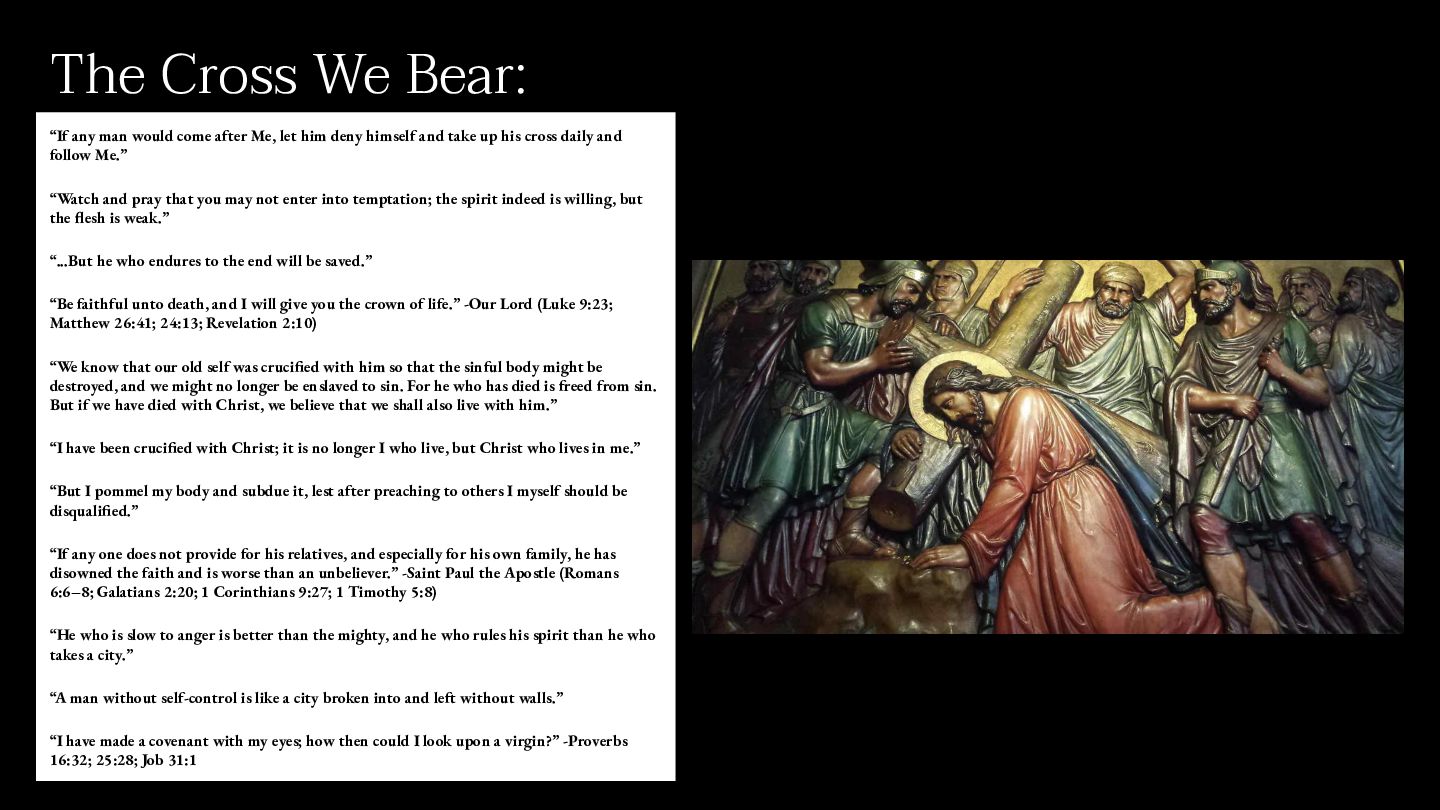
The Cross We Bear: “If any man would come after
Me, let him deny himself and take up his cross daily and follow Me.” “Watch and pray that you may not enter into temptation; the spirit indeed is willing, but the flesh is weak.” “...But he who endures to the end will be saved.” “Be faithful unto death, and I will give you the crown of life.” -Our Lord (Luke 9:23; Matthew 26:41; 24:13; Revelation 2:10) “We know that our old self was crucified with him so that the sinful body might be destroyed, and we might no longer be enslaved to sin. For he who has died is freed from sin. But if we have died with Christ, we believe that we shall also live with him.” “I have been crucified with Christ; it is no longer I who live, but Christ who lives in me.” “But I pommel my body and subdue it, lest after preaching to others I myself should be disqualified.” “If any one does not provide for his relatives, and especially for his own family, he has disowned the faith and is worse than an unbeliever.” -Saint Paul the Apostle (Romans 6:6–8; Galatians 2:20; 1 Corinthians 9:27; 1 Timothy 5:8) “He who is slow to anger is better than the mighty, and he who rules his spirit than he who takes a city.” “A man without self-control is like a city broken into and left without walls.” “I have made a covenant with my eyes; how then could I look upon a virgin?” -Proverbs 16:32; 25:28; Job 31:1 -
How Pornography Insults Our Lord and Lady: When Christ as
God saw fit to enter into His own creation as a man, He united His nature with mankind’s; at the Annunciation, Mary’s “Yes” consecrated human flesh itself and made it holy, because through her, the Word took on our nature: “The Word became flesh and dwelt among us” (John 1:14). This means that human embodiment—including sexuality—was elevated, made holy, and given a sacramental dignity. This is why Saint Paul the Apostle wrote, “Do you not know that your body is a temple of the Holy Spirit within you, which you have from God? You are not your own; you were bought with a price. So glorify God in your body.” Our Lord honored mankind by taking on human likeness through the Incarnation, and He purchased our liberation from sin with His own blood. This is also why Our Lord, after the Incarnation, forbid divorce and remarriage, and taught that lust was adultery of the heart—because we no longer belong to our base passions, we belong to Christ, who ransomed us. Pornography disgraces Our Lord by abusing the temple that belongs to Him, and it deeply offends Our Lady. As the mother of God-incarnate, Mary is the personification of maternal love, chastity, and obedience. As Saint Irenaeus wrote in 180 AD, “The knot of Eve’s disobedience was unbound by Mary’s obedience.” One of Our Lady’s ancient Latin titles is Virgo Purissima—the Most Pure Virgin. Every sin against chastity wounds our purity, but pornography is especially harmful, as it attacks our sight—the light of our eyes. The eyes, meant for contemplation of beauty as God made it, become tools of lust. The imagination, meant for meditation and prayer, becomes a stage for vice. Every woman bears, in some way, a reflection of the dignity of Mary, and this is why the Church has long considered feminism and the so-called “sexual liberation” of women to be a demonic perversion of what is good, true, and beautiful—it’s the anti-Mary. Thus, like the Blessed Virgin, our souls should magnify the Lord, and we should desire that His will be done according to His word. If it’s chastity you desire, a devotion to the rosary and to Saint Joseph will not fail. For non-Catholic Christians, a good lectio divina (prayerful reading of Scripture—especially the Psalms) would be wise, and for non-Christians, a contemplation on how objectification harms women and wounds your virtue is certainly in order. -
The Idolatry of Pornography: The word fetish comes from a
Portuguese word referring to anything created artificially by magic, and quickly came to refer to any object believed to hold supernatural power. In French and English-speaking countries, it came to refer to any pagan idol or object of irrational devotion. Fetish, quite literally, means “idol.” When someone speaks of having a “fetish,” they are—without even realizing it—using a word that means “idol of irrational worship.” In City of God (Book XIV, ch. 15—16), Saint Augustine writes that sin arises from “disordered love” (amor inordinatus), which is when the soul loves the lower more than the higher. For him, lust is “a turning of the soul from the Creator to the creature.” He directly parallels lustful fixation with the idolater’s fixation on an image: both confuse the sign with the reality and try to fill the void of God with matter. In the 4th century, Saint John Chrysostom taught in his homilies: “He who worships the body with unchaste eyes commits idolatry, for he makes an idol of flesh,” and also, “He who looks on a woman with unchaste eyes sets up an idol in his heart.” According to Saint Paul the Apostle in his letter to the Romans: “They exchanged the glory of the incorruptible God for an image made like corruptible man” (Romans 1:23). Desire for the person (who bears God’s image) becomes replaced by desire for the image itself. Modern neuroscience supports this theological insight, by revealing that pornography addiction creates a fixation with the image which comes to replace genuine human connection and intimacy. This is why many men who use pornography can’t “perform” for the woman they are with. As Psalm 115:8 teaches us, those who make idols become hollow like their idols, and those who make an idol out of the image of the human body become, themselves, hollowed out and emptied—incapable of genuine connection and communion. Even to the irreligious person, a fetish can be recognized as a disordered and unhealthy obsession that degrades human dignity, instrumentalizes the human person, and hinders self-actualization. -
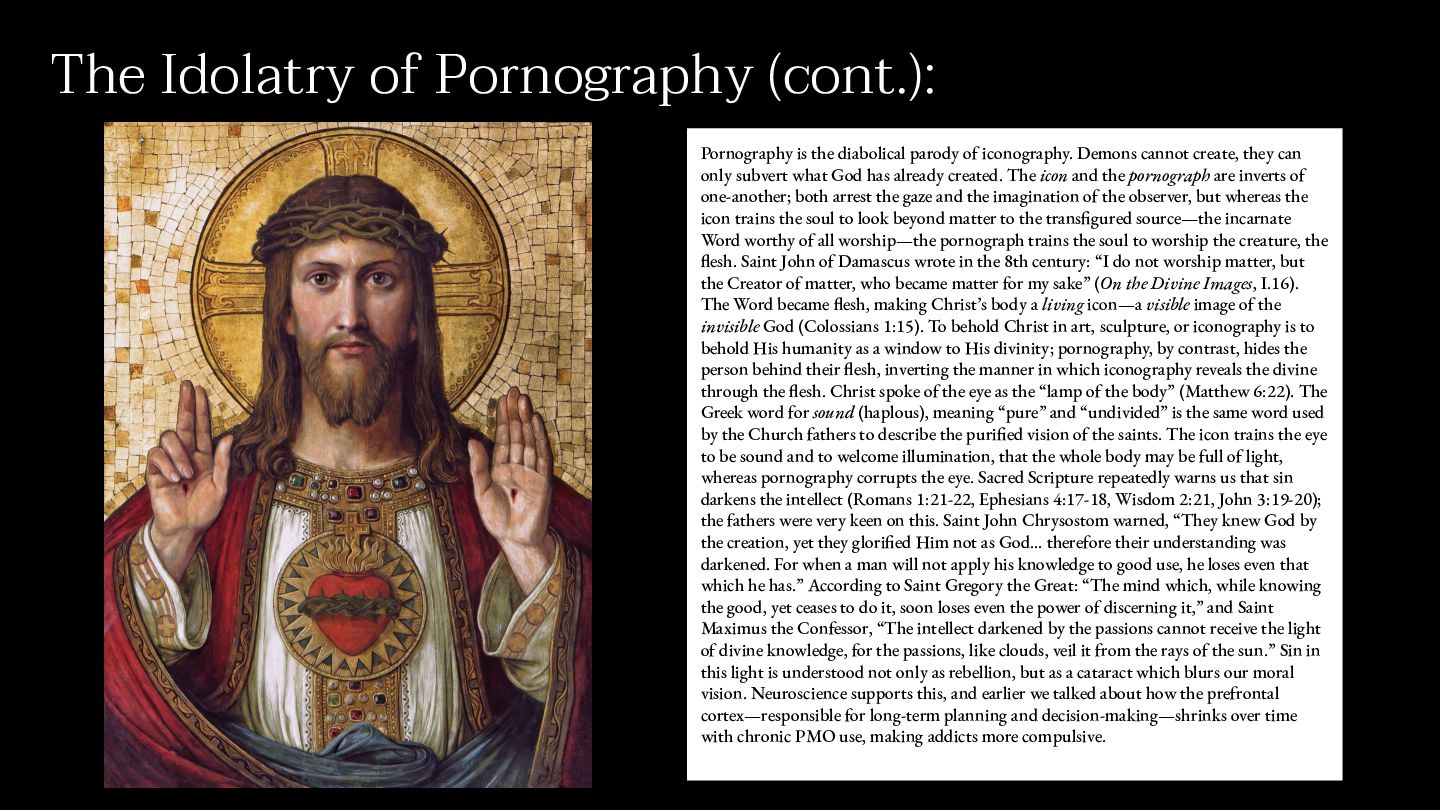
The Idolatry of Pornography (cont.): Pornography is the diabolical parody
of iconography. Demons cannot create, they can only subvert what God has already created. The icon and the pornograph are inverts of one-another; both arrest the gaze and the imagination of the observer, but whereas the icon trains the soul to look beyond matter to the transfigured source—the incarnate Word worthy of all worship—the pornograph trains the soul to worship the creature, the flesh. Saint John of Damascus wrote in the 8th century: “I do not worship matter, but the Creator of matter, who became matter for my sake” (On the Divine Images, I.16). The Word became flesh, making Christ’s body a living icon—a visible image of the invisible God (Colossians 1:15). To behold Christ in art, sculpture, or iconography is to behold His humanity as a window to His divinity; pornography, by contrast, hides the person behind their flesh, inverting the manner in which iconography reveals the divine through the flesh. Christ spoke of the eye as the “lamp of the body” (Matthew 6:22). The Greek word for sound (haplous), meaning “pure” and “undivided” is the same word used by the Church fathers to describe the purified vision of the saints. The icon trains the eye to be sound and to welcome illumination, that the whole body may be full of light, whereas pornography corrupts the eye. Sacred Scripture repeatedly warns us that sin darkens the intellect (Romans 1:21-22, Ephesians 4:17-18, Wisdom 2:21, John 3:19-20); the fathers were very keen on this. Saint John Chrysostom warned, “They knew God by the creation, yet they glorified Him not as God… therefore their understanding was darkened. For when a man will not apply his knowledge to good use, he loses even that which he has.” According to Saint Gregory the Great: “The mind which, while knowing the good, yet ceases to do it, soon loses even the power of discerning it,” and Saint Maximus the Confessor, “The intellect darkened by the passions cannot receive the light of divine knowledge, for the passions, like clouds, veil it from the rays of the sun.” Sin in this light is understood not only as rebellion, but as a cataract which blurs our moral vision. Neuroscience supports this, and earlier we talked about how the prefrontal cortex—responsible for long-term planning and decision-making—shrinks over time with chronic PMO use, making addicts more compulsive. -
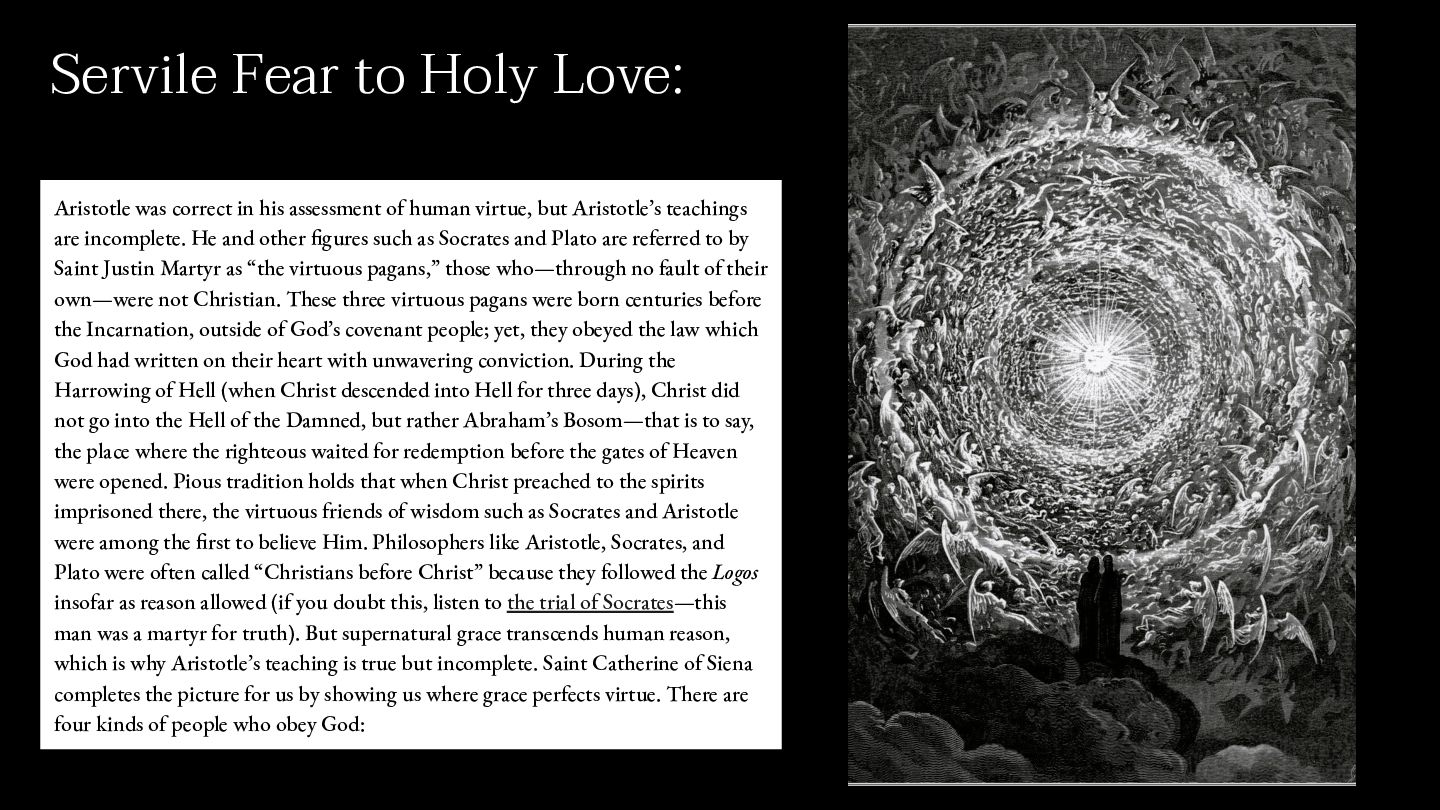
Servile Fear to Holy Love: Aristotle was correct in his
assessment of human virtue, but Aristotle’s teachings are incomplete. He and other figures such as Socrates and Plato are referred to by Saint Justin Martyr as “the virtuous pagans,” those who—through no fault of their own—were not Christian. These three virtuous pagans were born centuries before the Incarnation, outside of God’s covenant people; yet, they obeyed the law which God had written on their heart with unwavering conviction. During the Harrowing of Hell (when Christ descended into Hell for three days), Christ did not go into the Hell of the Damned, but rather Abraham’s Bosom—that is to say, the place where the righteous waited for redemption before the gates of Heaven were opened. Pious tradition holds that when Christ preached to the spirits imprisoned there, the virtuous friends of wisdom such as Socrates and Aristotle were among the first to believe Him. Philosophers like Aristotle, Socrates, and Plato were often called “Christians before Christ” because they followed the Logos insofar as reason allowed (if you doubt this, listen to the trial of Socrates—this man was a martyr for truth). But supernatural grace transcends human reason, which is why Aristotle’s teaching is true but incomplete. Saint Catherine of Siena completes the picture for us by showing us where grace perfects virtue. There are four kinds of people who obey God: -
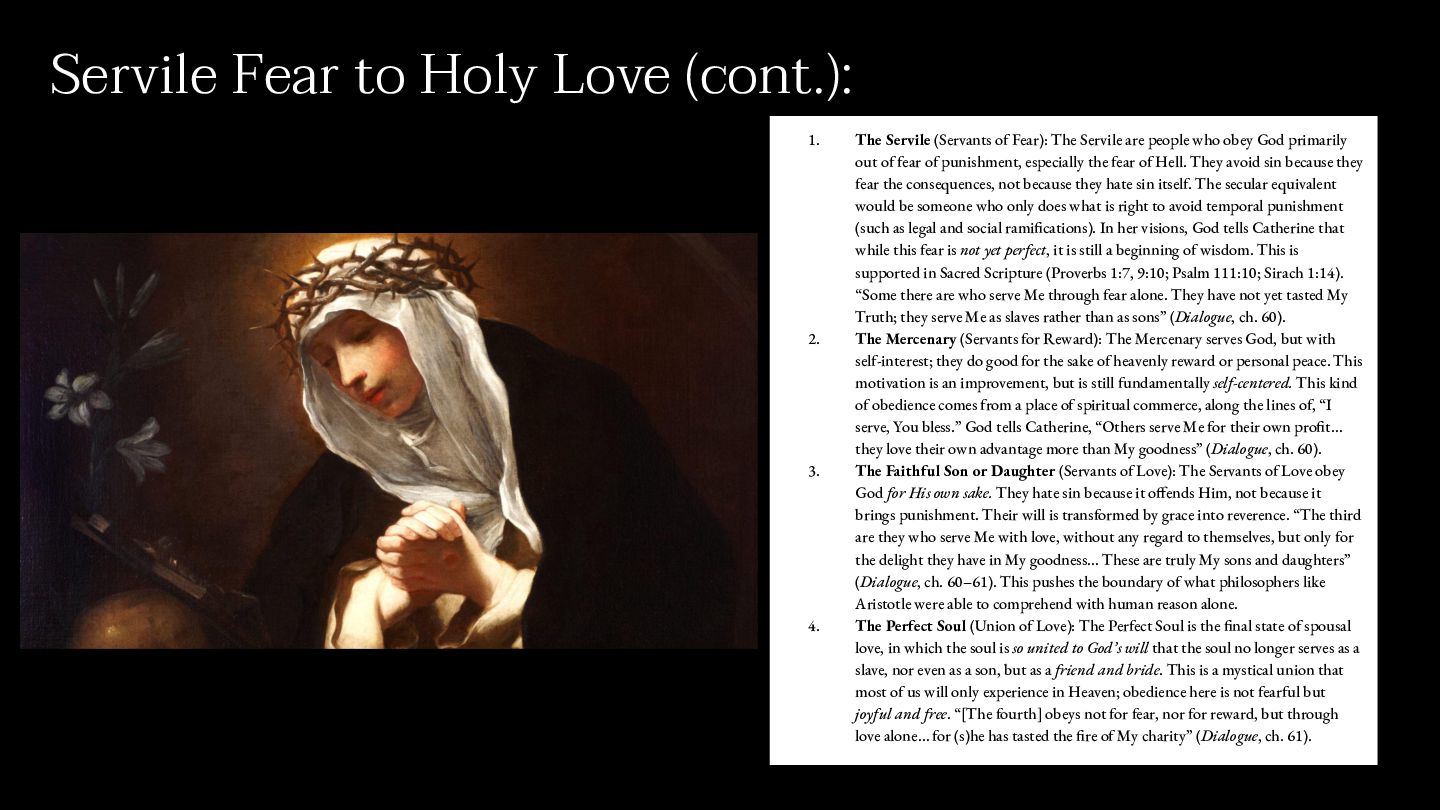
Servile Fear to Holy Love (cont.): 1. 2. 3. 4.
The Servile (Servants of Fear): The Servile are people who obey God primarily out of fear of punishment, especially the fear of Hell. They avoid sin because they fear the consequences, not because they hate sin itself. The secular equivalent would be someone who only does what is right to avoid temporal punishment (such as legal and social ramifications). In her visions, God tells Catherine that while this fear is not yet perfect, it is still a beginning of wisdom. This is supported in Sacred Scripture (Proverbs 1:7, 9:10; Psalm 111:10; Sirach 1:14). “Some there are who serve Me through fear alone. They have not yet tasted My Truth; they serve Me as slaves rather than as sons” (Dialogue, ch. 60). The Mercenary (Servants for Reward): The Mercenary serves God, but with self-interest; they do good for the sake of heavenly reward or personal peace. This motivation is an improvement, but is still fundamentally self-centered. This kind of obedience comes from a place of spiritual commerce, along the lines of, “I serve, You bless.” God tells Catherine, “Others serve Me for their own profit… they love their own advantage more than My goodness” (Dialogue, ch. 60). The Faithful Son or Daughter (Servants of Love): The Servants of Love obey God for His own sake. They hate sin because it offends Him, not because it brings punishment. Their will is transformed by grace into reverence. “The third are they who serve Me with love, without any regard to themselves, but only for the delight they have in My goodness… These are truly My sons and daughters” (Dialogue, ch. 60–61). This pushes the boundary of what philosophers like Aristotle were able to comprehend with human reason alone. The Perfect Soul (Union of Love): The Perfect Soul is the final state of spousal love, in which the soul is so united to God’s will that the soul no longer serves as a slave, nor even as a son, but as a friend and bride. This is a mystical union that most of us will only experience in Heaven; obedience here is not fearful but joyful and free. “[The fourth] obeys not for fear, nor for reward, but through love alone… for (s)he has tasted the fire of My charity” (Dialogue, ch. 61). -
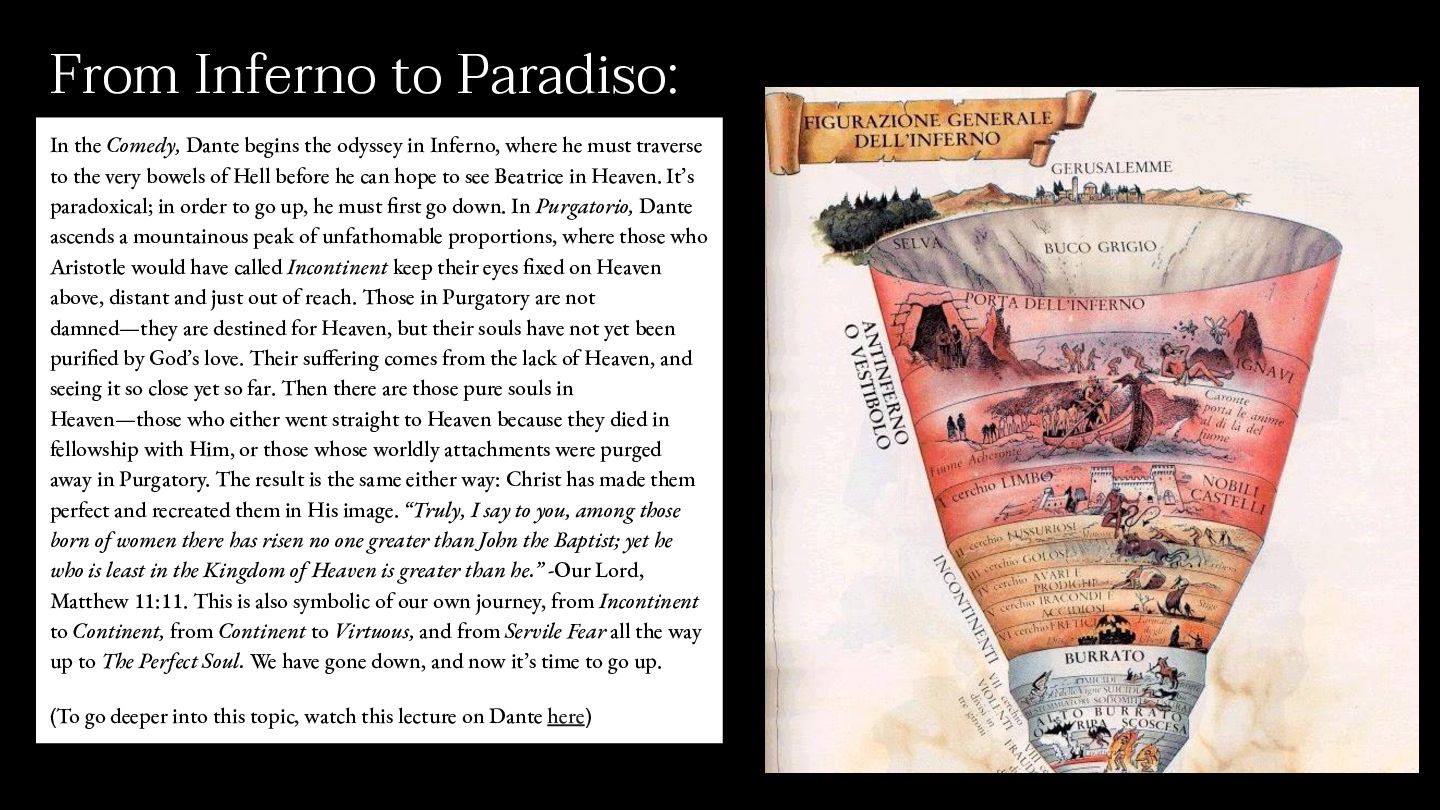
From Inferno to Paradiso: In the Comedy, Dante begins the
odyssey in Inferno, where he must traverse to the very bowels of Hell before he can hope to see Beatrice in Heaven. It’s paradoxical; in order to go up, he must first go down. In Purgatorio, Dante ascends a mountainous peak of unfathomable proportions, where those who Aristotle would have called Incontinent keep their eyes fixed on Heaven above, distant and just out of reach. Those in Purgatory are not damned—they are destined for Heaven, but their souls have not yet been purified by God’s love. Their suffering comes from the lack of Heaven, and seeing it so close yet so far. Then there are those pure souls in Heaven—those who either went straight to Heaven because they died in fellowship with Him, or those whose worldly attachments were purged away in Purgatory. The result is the same either way: Christ has made them perfect and recreated them in His image. “Truly, I say to you, among those born of women there has risen no one greater than John the Baptist; yet he who is least in the Kingdom of Heaven is greater than he.” -Our Lord, Matthew 11:11. This is also symbolic of our own journey, from Incontinent to Continent, from Continent to Virtuous, and from Servile Fear all the way up to The Perfect Soul. We have gone down, and now it’s time to go up. (To go deeper into this topic, watch this lecture on Dante here) -
~Fin~ I guess, all I’m trying to say, gentlemen… …is
that we’re all gonna make it. ~Further Reading~ ➟ -
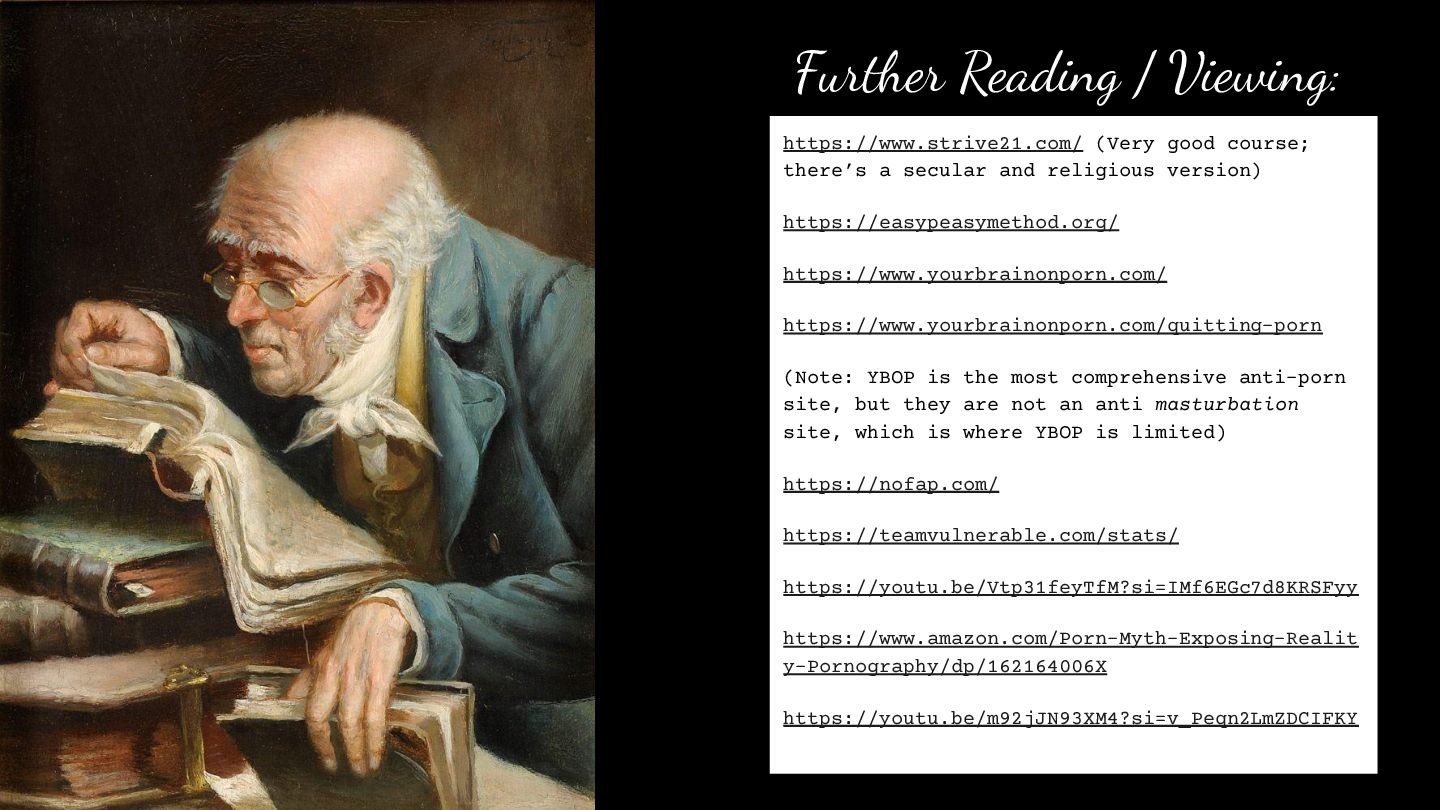
Further Reading / Viewing: https://www.strive21.com/ (Very good course; there’s a
secular and religious version) https://easypeasymethod.org/ https://www.yourbrainonporn.com/ https://www.yourbrainonporn.com/quitting-porn (Note: YBOP is the most comprehensive anti-porn site, but they are not an anti masturbation site, which is where YBOP is limited) https://nofap.com/ https://teamvulnerable.com/stats/ https://youtu.be/Vtp31feyTfM?si=IMf6EGc7d8KRSFyy https://www.amazon.com/Porn-Myth-Exposing-Realit y-Pornography/dp/162164006X https://youtu.be/m92jJN93XM4?si=v_Peqn2LmZDCIFKY
 awsjcpm
 punipuni_mint
 takasumasakazu
 harumaito
 2bo
 inoue2002
 aokiplayer
 sakopon
 coco_se
 salamanderezo
 chikuwait
 raygrieselhuber
 destraynor
 moore
 inesmontani
 ryanjones
 helenjbeal
 reverentgeek
 maggiecrowley
 shpigford
 keithpitt
 lara