Share
CHINOG 12 - Building Trustworthy Network Automation, From Principles to Practice CHINOG 12
Trust is essential for successful network automation adoption.
When automation platforms exhibit predictable behaviors and transparent processes, teams can confidently delegate critical network operations. Building trustworthy automation doesn't happen by itself, it needs to be baked into the design of every workflows. This technical session examines core principles that build trust, including idempotency, declarative workflows, and robust version control. Using practical examples from production environments, we'll analyze how specific technical decisions affect automation reliability and team confidence. The presentation covers key implementation patterns like state verification, diff-based changes, and failure handling. Attendees will learn concrete approaches for building automation platforms that network teams can trust and rely on daily.
Damien Garros
Transcript
45 slides
-
Damien Garros - CHINOG 12 - May 2025 Building Trustworthy
Network Automation, From Principles to Practice -
Damien Garros - CHINOG 12 - May 2025 About me
: Damien Garros Co-Founder and CEO of OpsMill Creator of Infrahub, a next generation Infrastructure data management platform (Source of Truth) Focused on Infrastructure as Code, Automation & Observability for 12+ years Previously leading Technical Architecture at Network to Code @dgarros damiengarros -
Damien Garros - CHINOG 12 - May 2025 Trust is
essential for successful network automation adoption. -
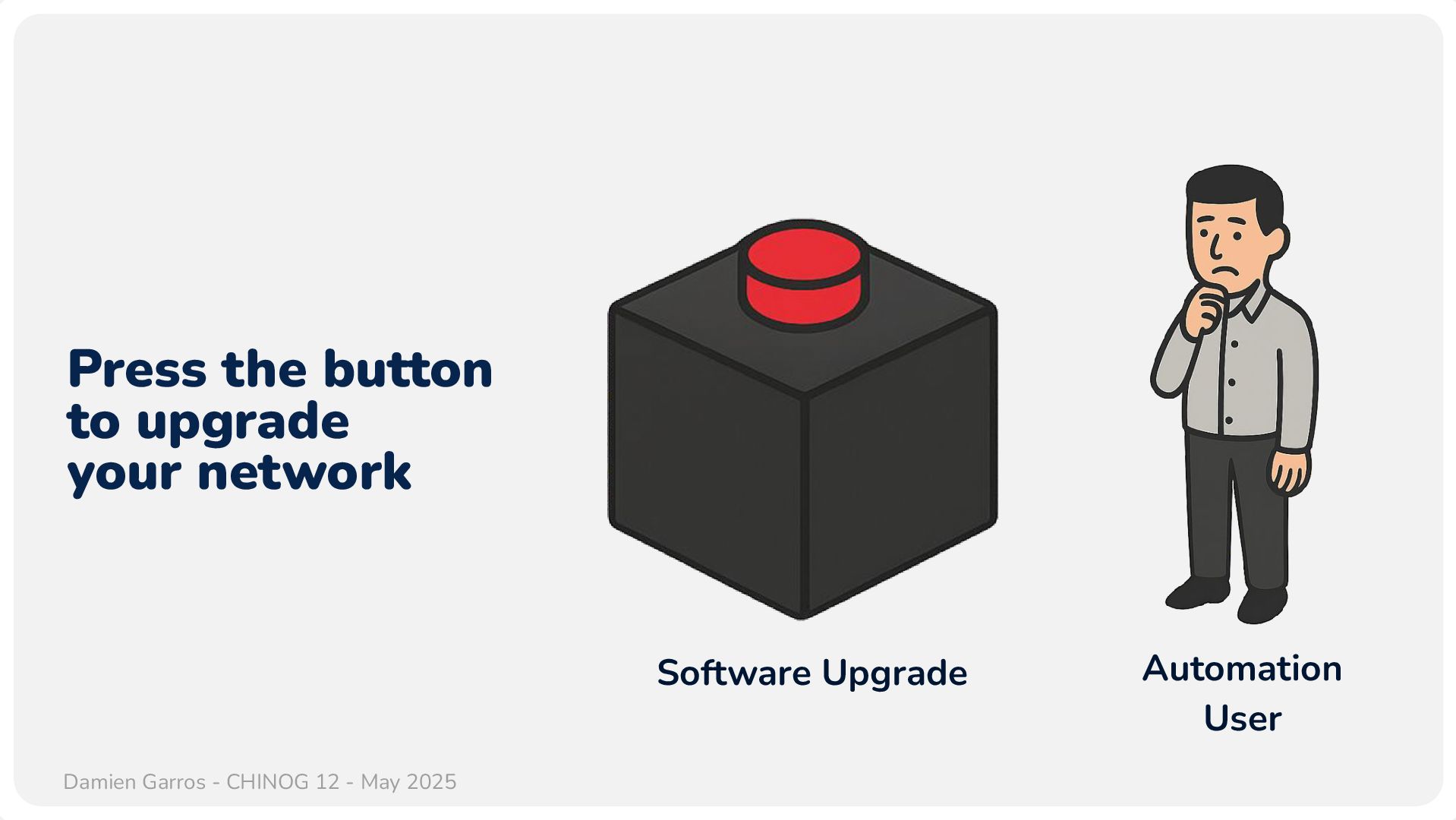
Damien Garros - CHINOG 12 - May 2025 Press the
button to upgrade your network Software Upgrade Automation User -
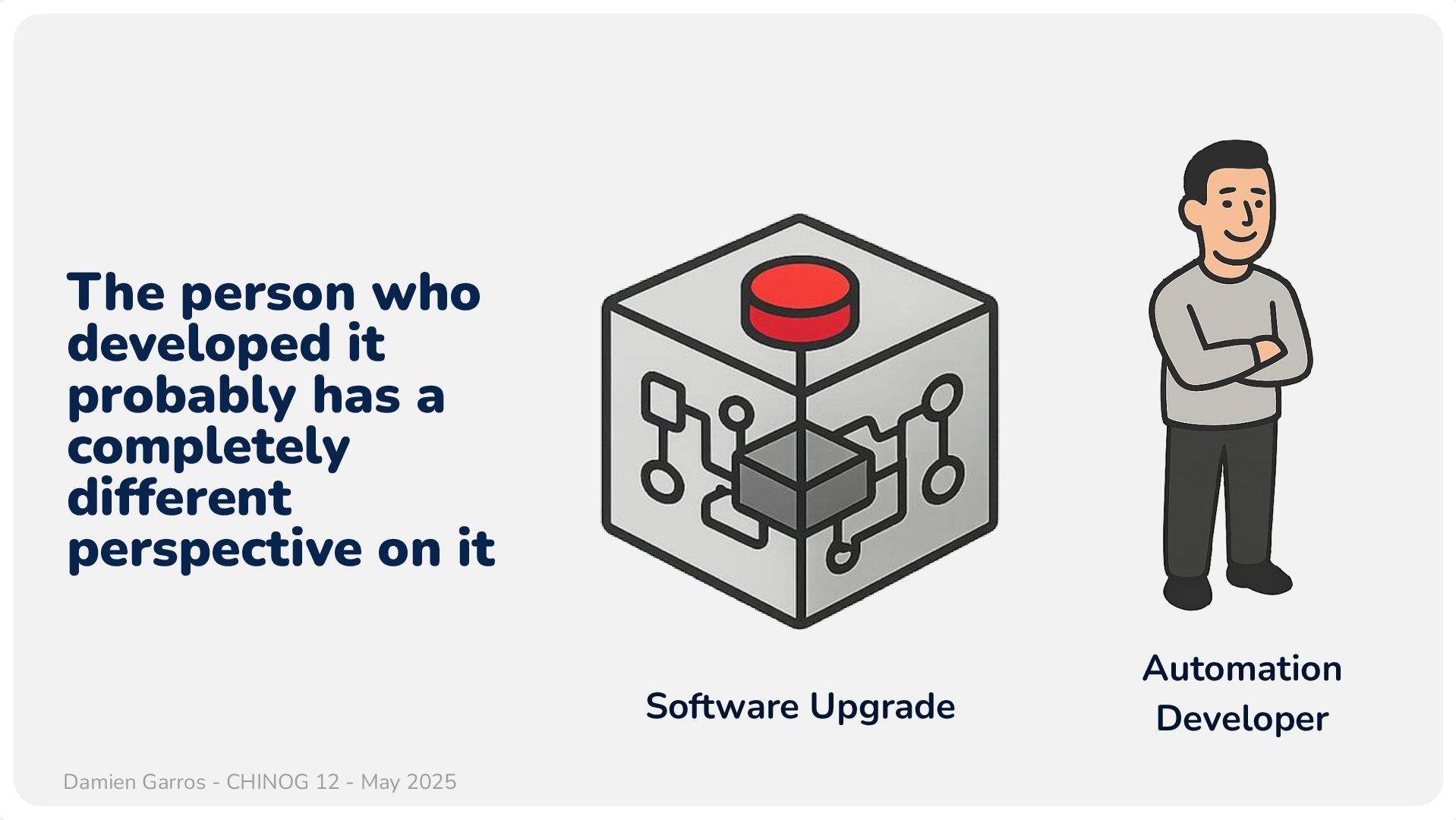
Damien Garros - CHINOG 12 - May 2025 Software Upgrade
The person who developed it probably has a completely different perspective on it Automation Developer -
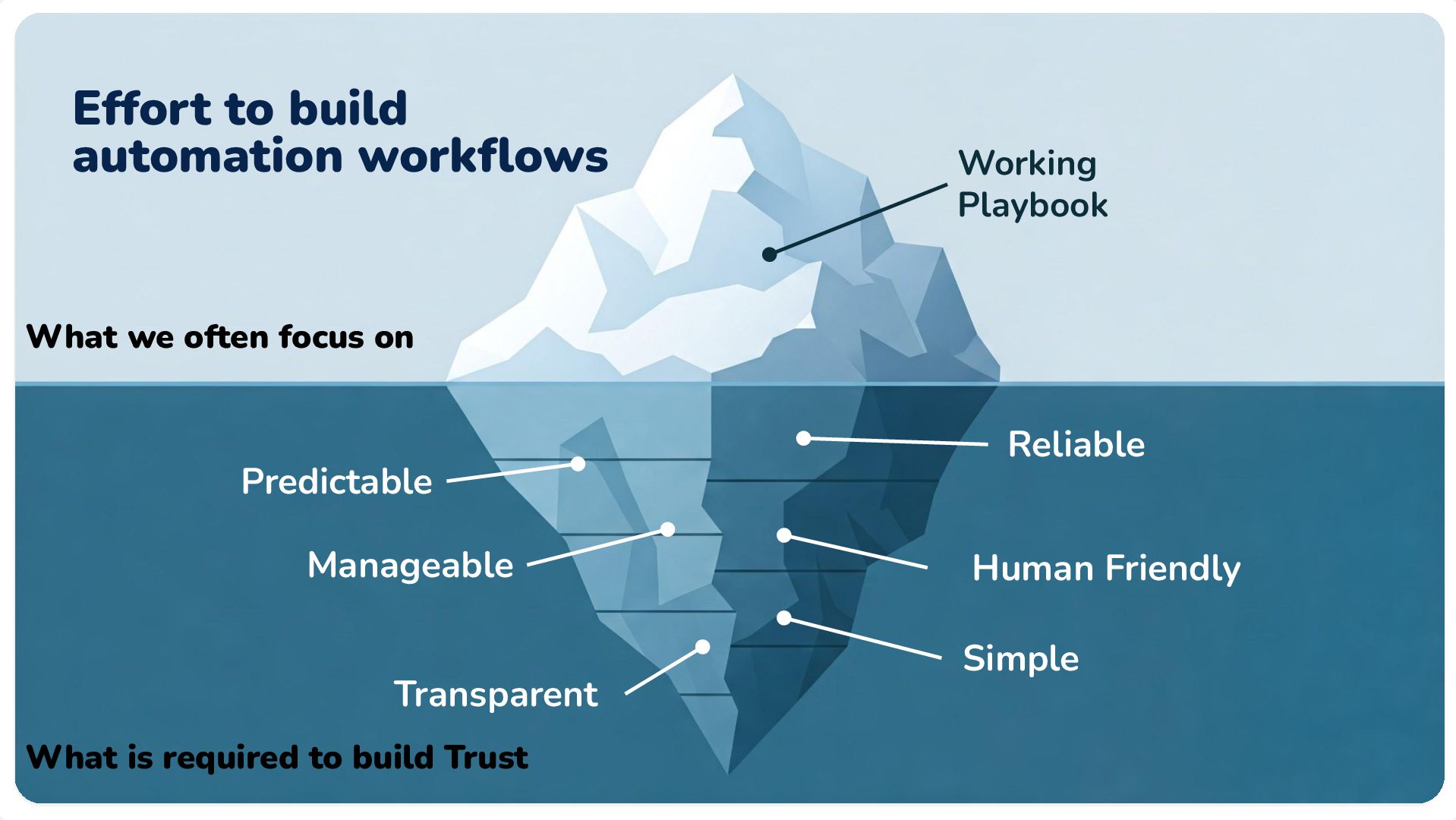
Damien Garros - CHINOG 12 - May 2025 Effort to
build automation workflows Predictable Manageable Transparent Reliable Human Friendly Working Playbook Simple What we often focus on What is required to build Trust -
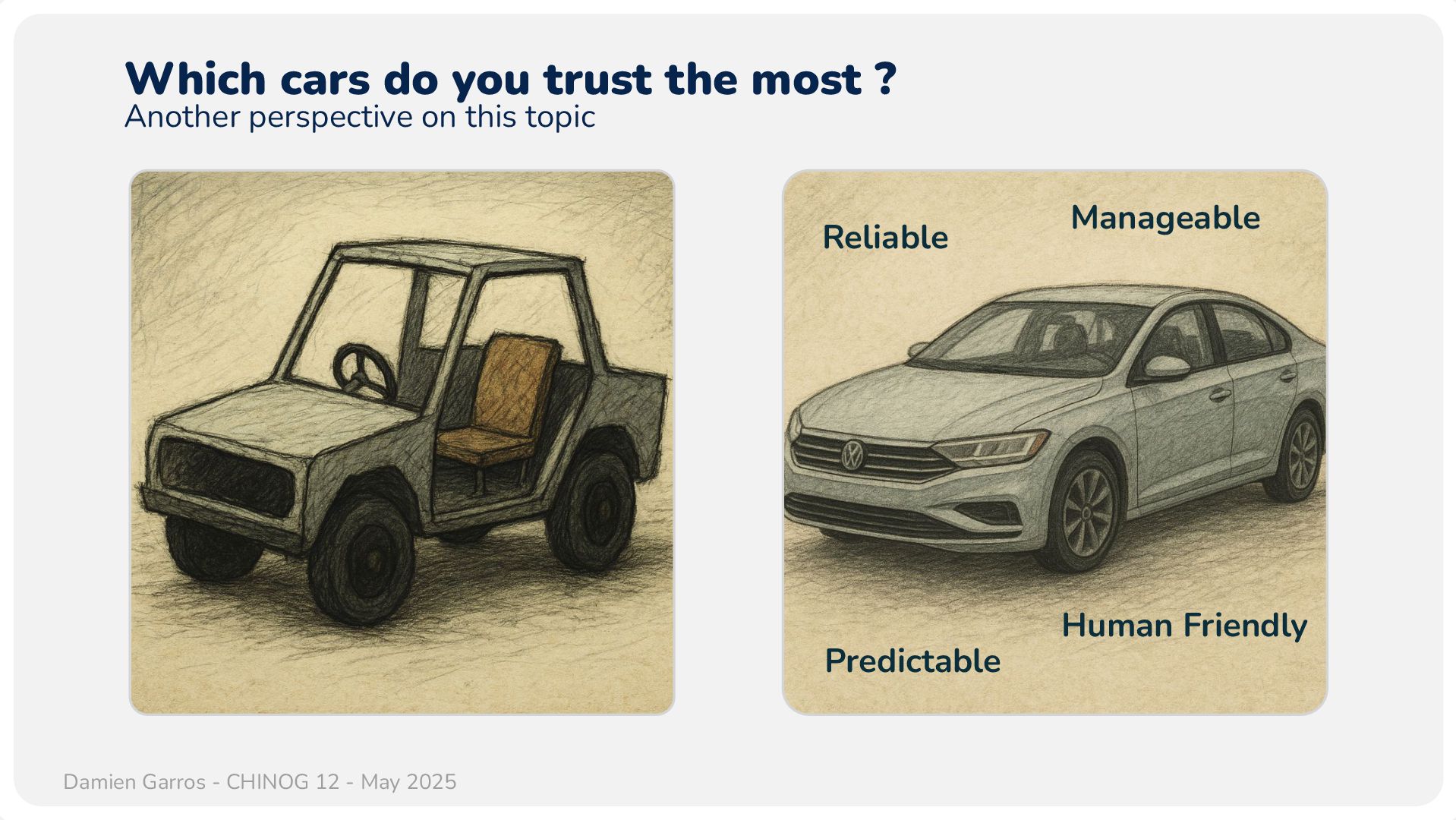
Damien Garros - CHINOG 12 - May 2025 Which cars
do you trust the most ? Another perspective on this topic Predictable Manageable Reliable Human Friendly -
Damien Garros - CHINOG 12 - May 2025 Main Principles
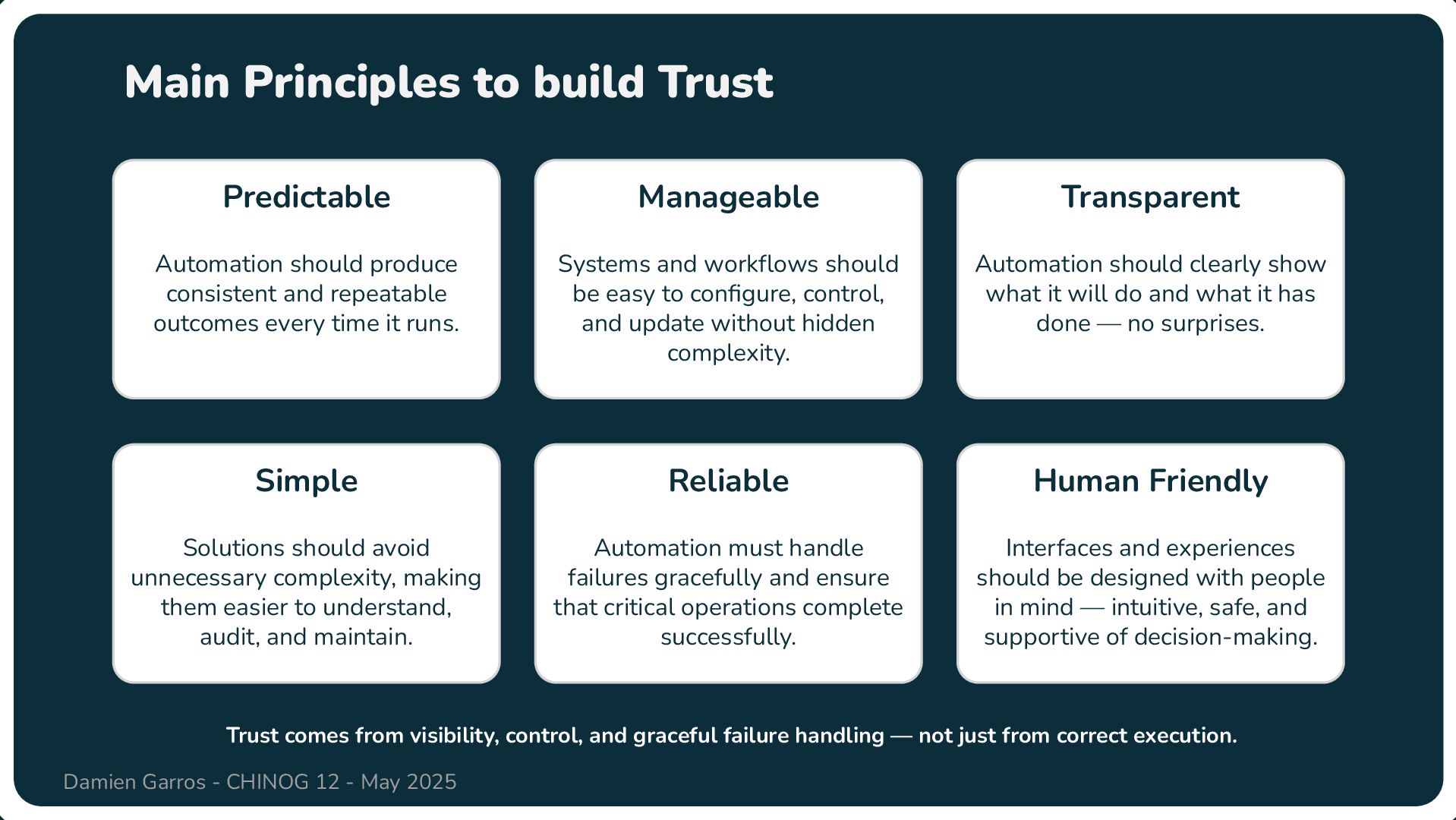
to build Trust Predictable Automation should produce consistent and repeatable outcomes every time it runs. Manageable Systems and workflows should be easy to configure, control, and update without hidden complexity. Transparent Automation should clearly show what it will do and what it has done — no surprises. Simple Solutions should avoid unnecessary complexity, making them easier to understand, audit, and maintain. Reliable Automation must handle failures gracefully and ensure that critical operations complete successfully. Human Friendly Interfaces and experiences should be designed with people in mind — intuitive, safe, and supportive of decision-making. Trust comes from visibility, control, and graceful failure handling — not just from correct execution. -
Damien Garros - CHINOG 12 - May 2025 Built on
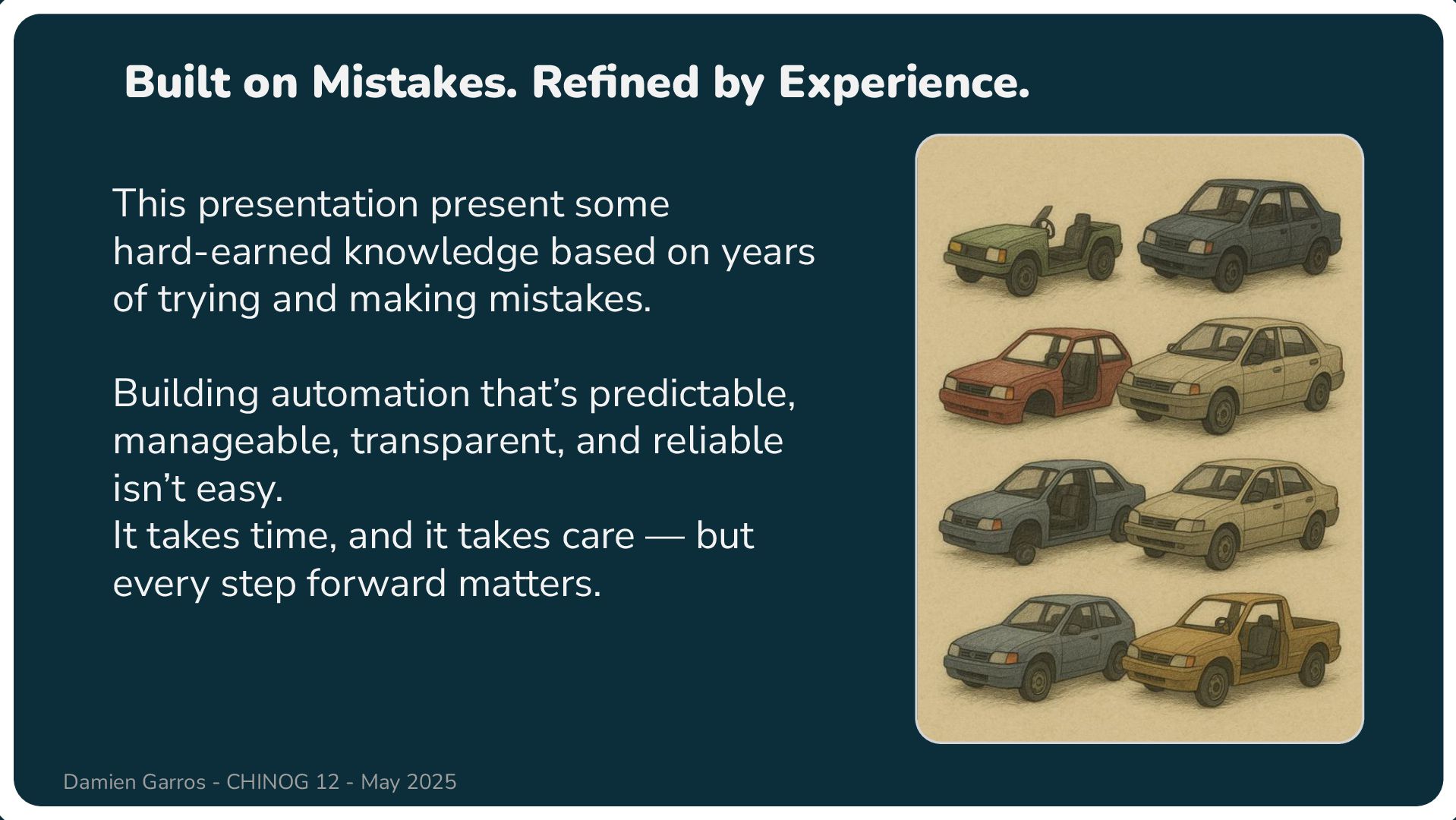
Mistakes. Refined by Experience. This presentation present some hard-earned knowledge based on years of trying and making mistakes. Building automation that’s predictable, manageable, transparent, and reliable isn’t easy. It takes time, and it takes care — but every step forward matters. -
Damien Garros - CHINOG 12 - May 2025 Design Principles
of Trustworthy Automation -
Damien Garros - CHINOG 12 - May 2025 Idempotency is
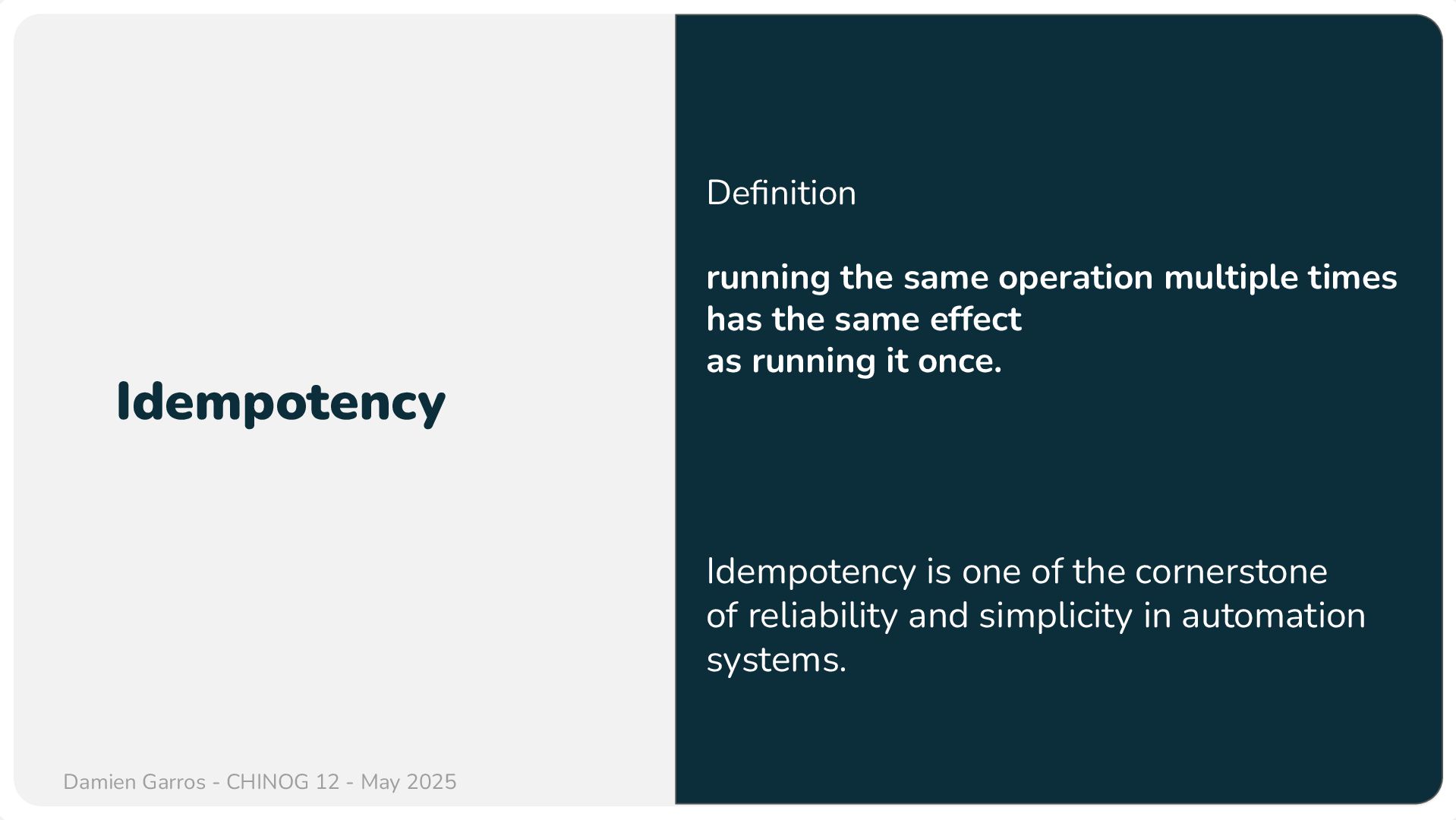
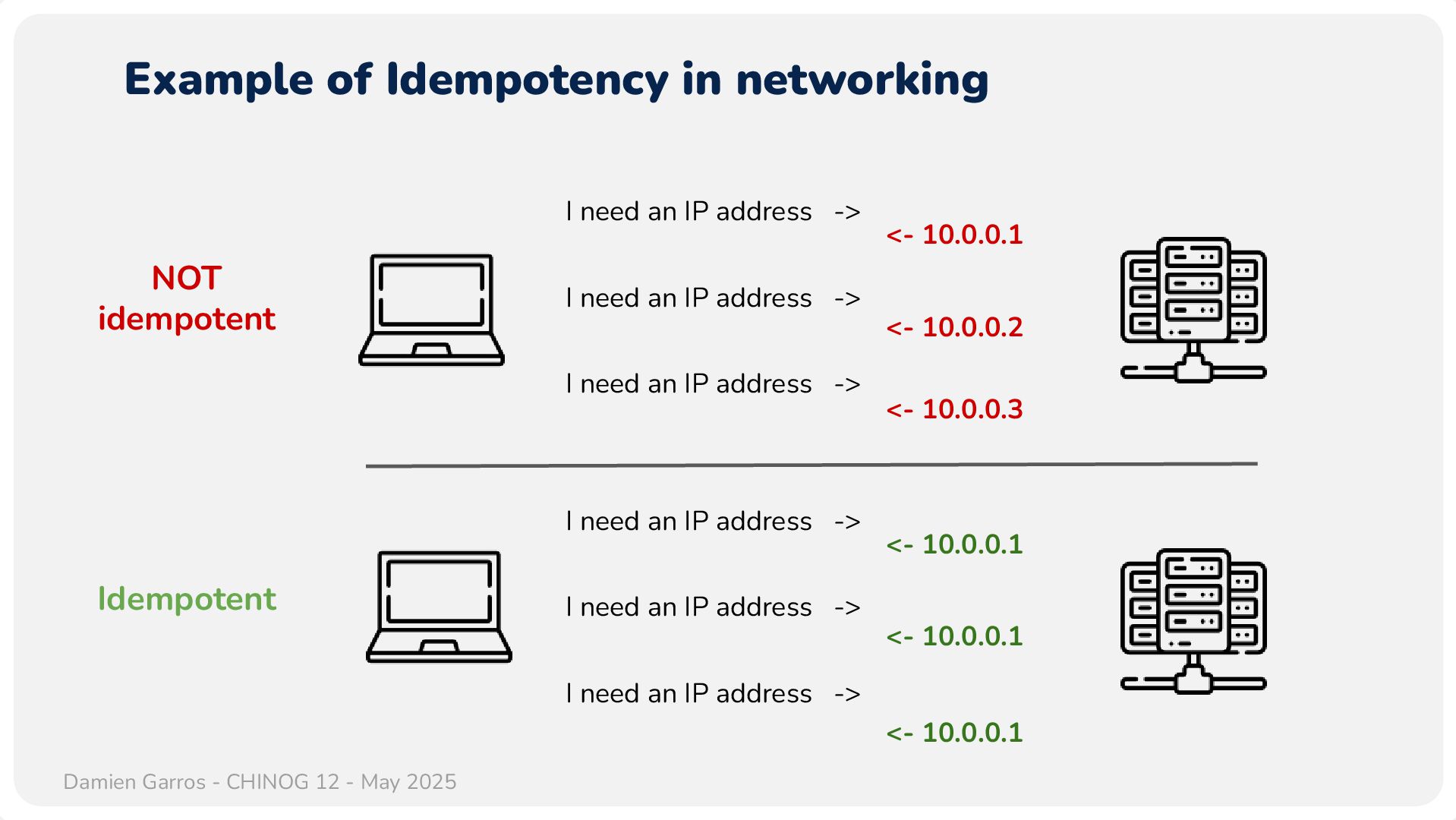
one of the cornerstone of reliability and simplicity in automation systems. Definition running the same operation multiple times has the same effect as running it once. Idempotency -
Damien Garros - CHINOG 12 - May 2025 Example of
Idempotency in networking I need an IP address -> I need an IP address -> I need an IP address -> <- 10.0.0.1 <- 10.0.0.2 <- 10.0.0.3 NOT idempotent I need an IP address -> I need an IP address -> I need an IP address -> <- 10.0.0.1 <- 10.0.0.1 Idempotent <- 10.0.0.1 -
Damien Garros - CHINOG 12 - May 2025 Example of
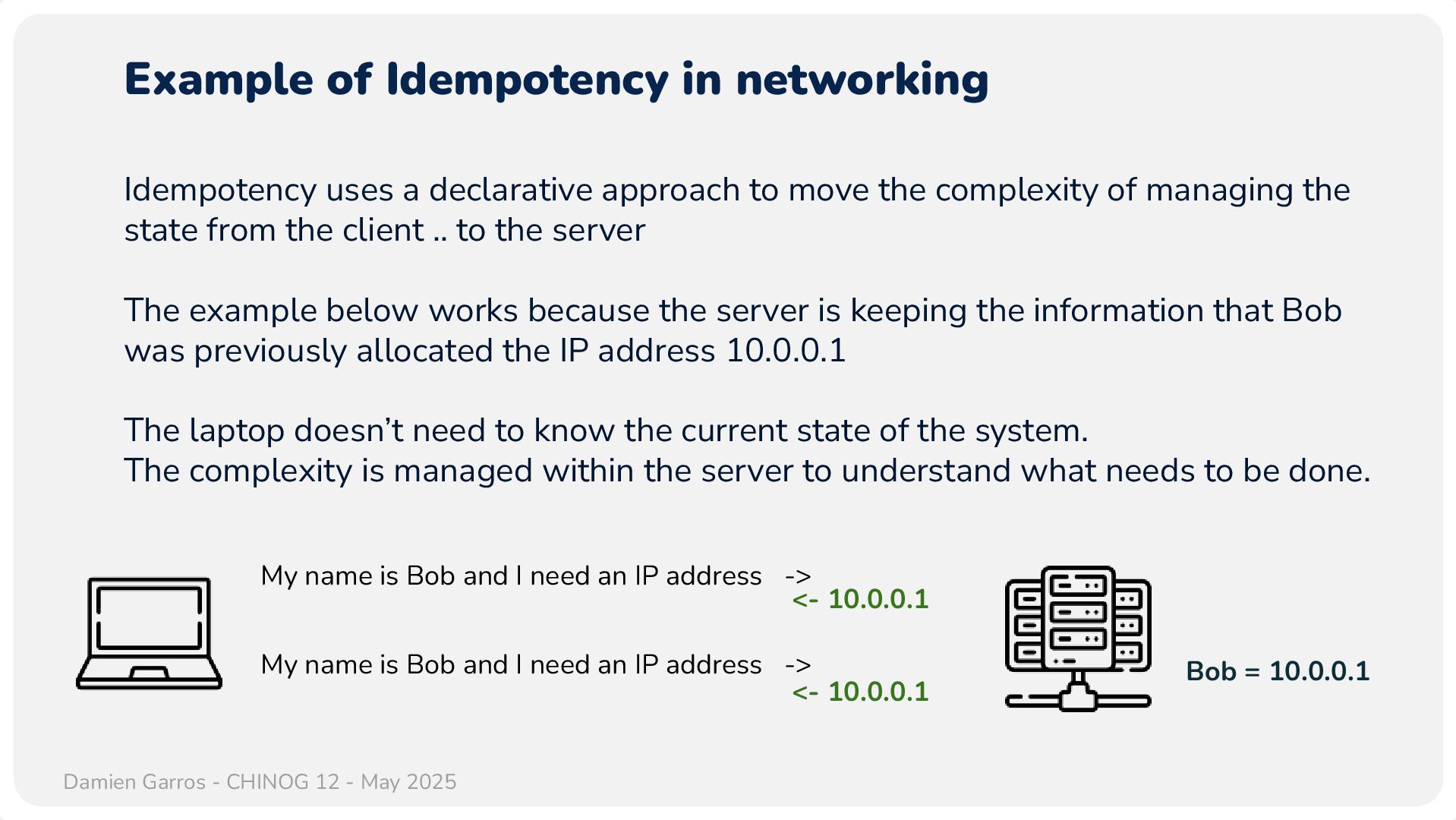
Idempotency in networking My name is Bob and I need an IP address -> <- 10.0.0.1 <- 10.0.0.1 Idempotency uses a declarative approach to move the complexity of managing the state from the client .. to the server The example below works because the server is keeping the information that Bob was previously allocated the IP address 10.0.0.1 The laptop doesn’t need to know the current state of the system. The complexity is managed within the server to understand what needs to be done. My name is Bob and I need an IP address -> Bob = 10.0.0.1 -
Damien Garros - CHINOG 12 - May 2025 Dry Runs
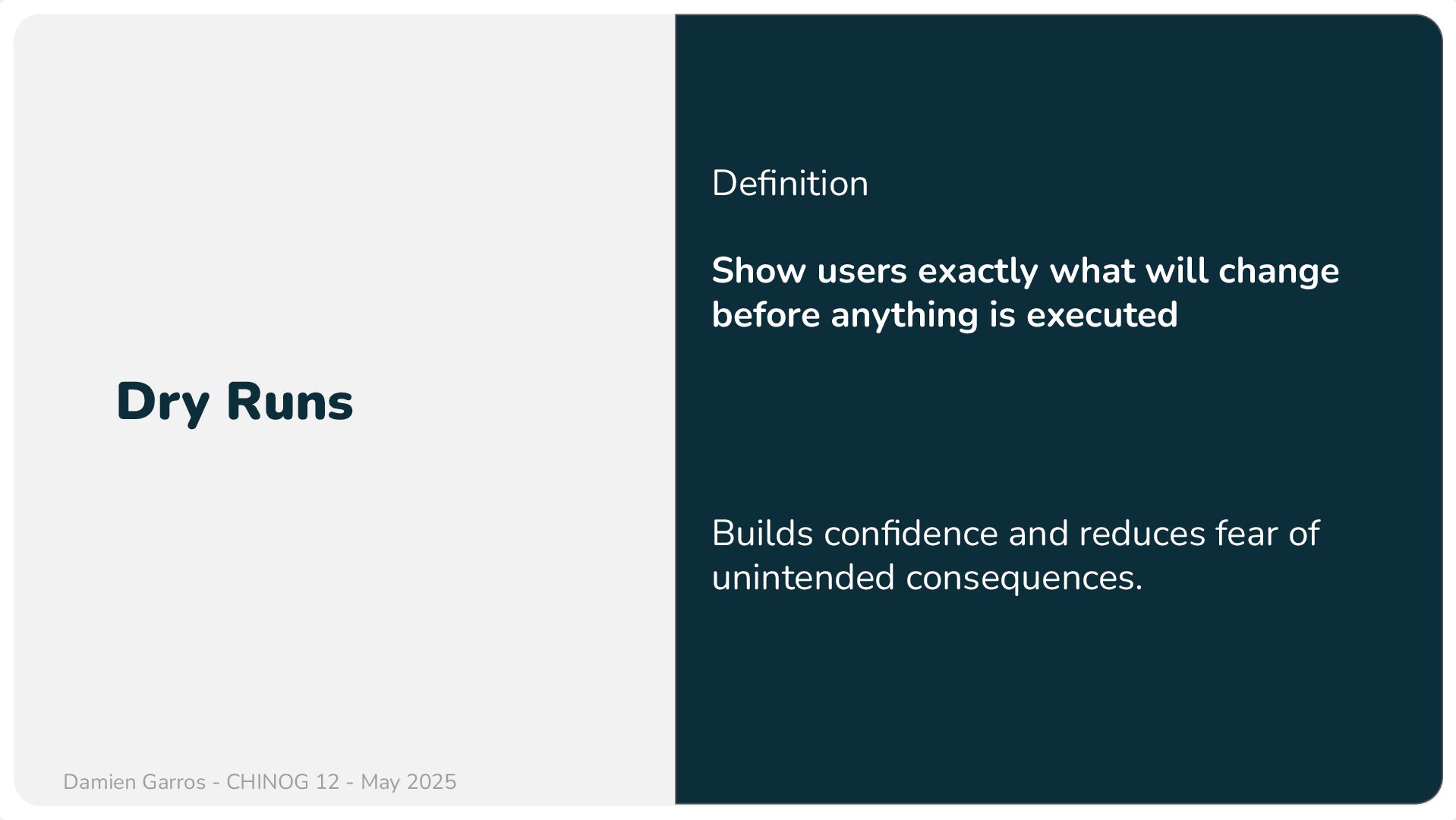
Definition Show users exactly what will change before anything is executed Builds confidence and reduces fear of unintended consequences. -
Damien Garros - CHINOG 12 - May 2025 Dry Run
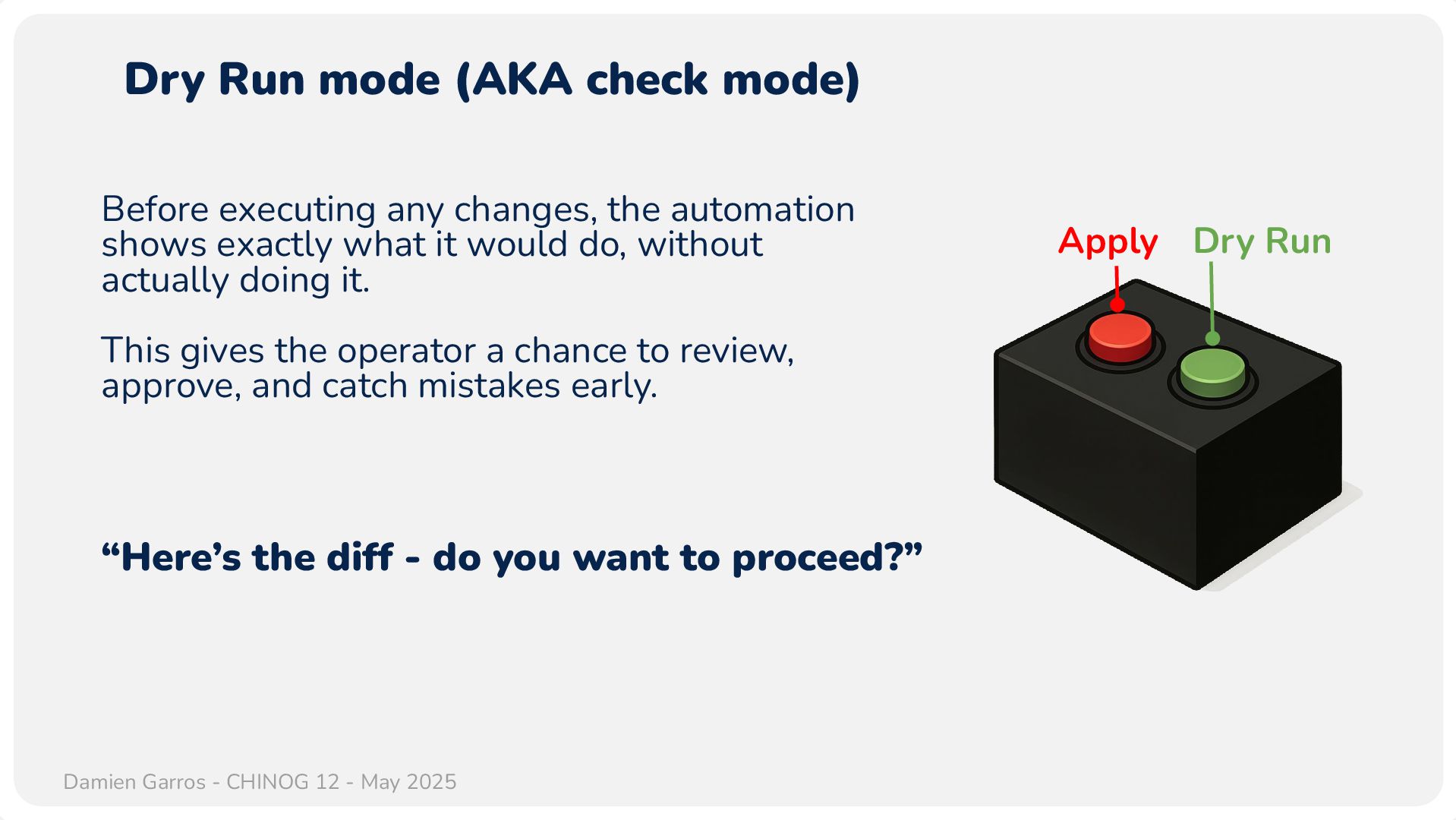
mode (AKA check mode) Before executing any changes, the automation shows exactly what it would do, without actually doing it. This gives the operator a chance to review, approve, and catch mistakes early. “Here’s the diff - do you want to proceed?” Apply Dry Run -
Damien Garros - CHINOG 12 - May 2025 Dry Run
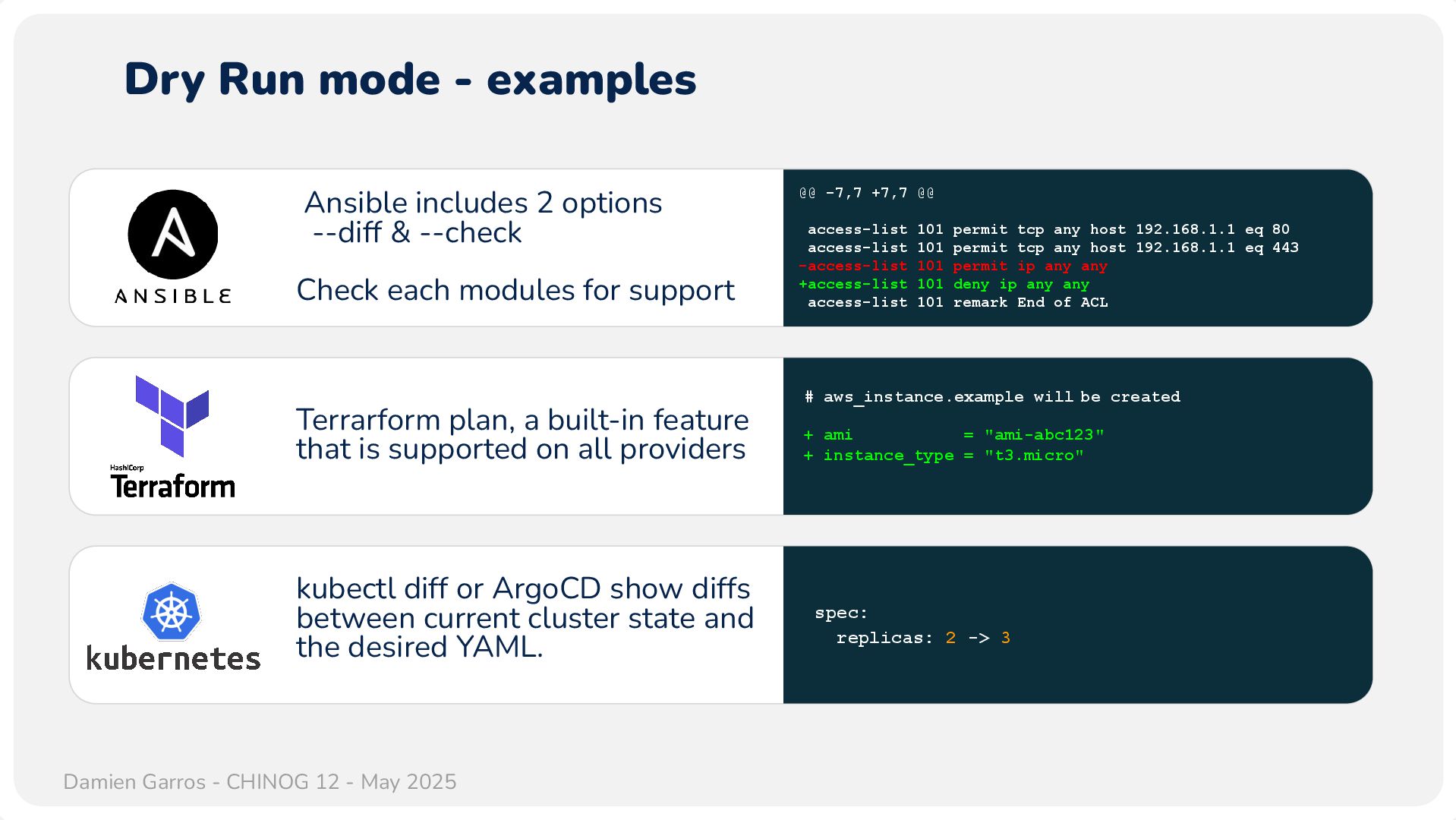
mode - examples Ansible includes 2 options --diff & --check Check each modules for support @@ -7,7 +7,7 @@ access-list 101 permit tcp any host 192.168.1.1 eq 80 access-list 101 permit tcp any host 192.168.1.1 eq 443 -access-list 101 permit ip any any +access-list 101 deny ip any any access-list 101 remark End of ACL # aws_instance.example will be created + ami = "ami-abc123" + instance_type = "t3.micro" Terrarform plan, a built-in feature that is supported on all providers kubectl diff or ArgoCD show diffs between current cluster state and the desired YAML. spec: replicas: 2 -> 3 -
Damien Garros - CHINOG 12 - May 2025 Transactional Definition
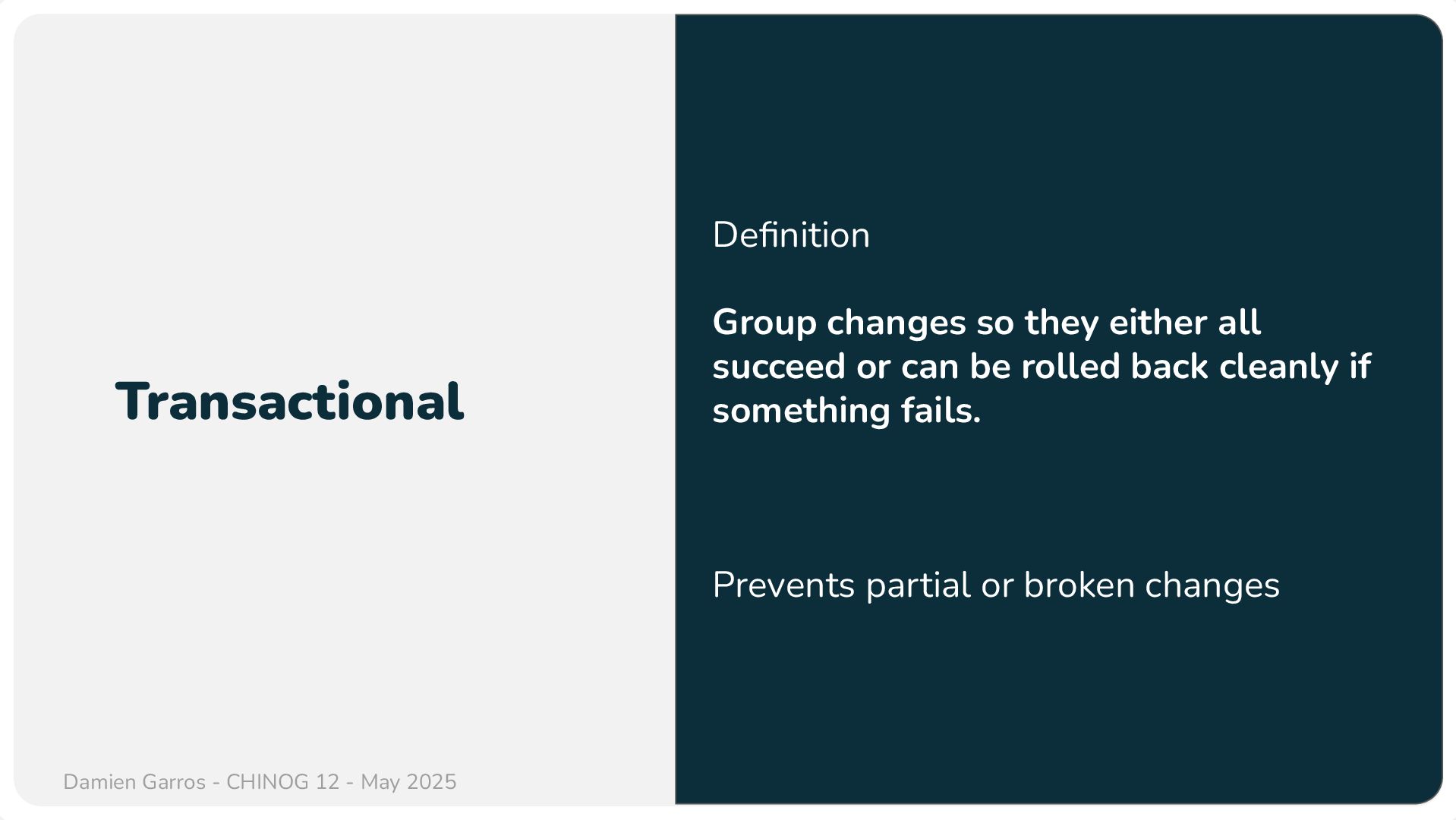
Group changes so they either all succeed or can be rolled back cleanly if something fails. Prevents partial or broken changes -
Damien Garros - CHINOG 12 - May 2025 Transactional Transactional
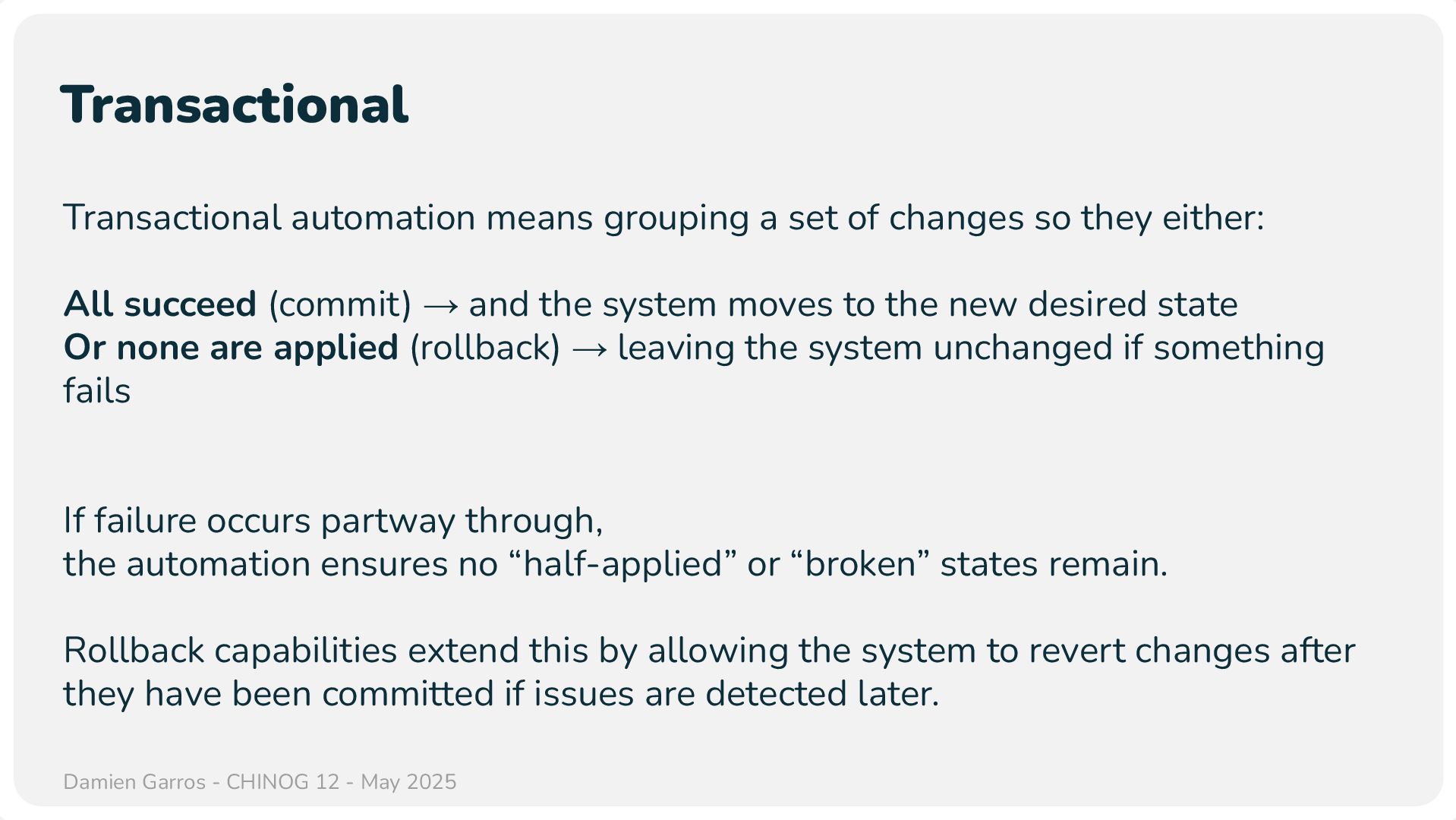
automation means grouping a set of changes so they either: All succeed (commit) → and the system moves to the new desired state Or none are applied (rollback) → leaving the system unchanged if something fails If failure occurs partway through, the automation ensures no “half-applied” or “broken” states remain. Rollback capabilities extend this by allowing the system to revert changes after they have been committed if issues are detected later. -
Damien Garros - CHINOG 12 - May 2025 Design Principles
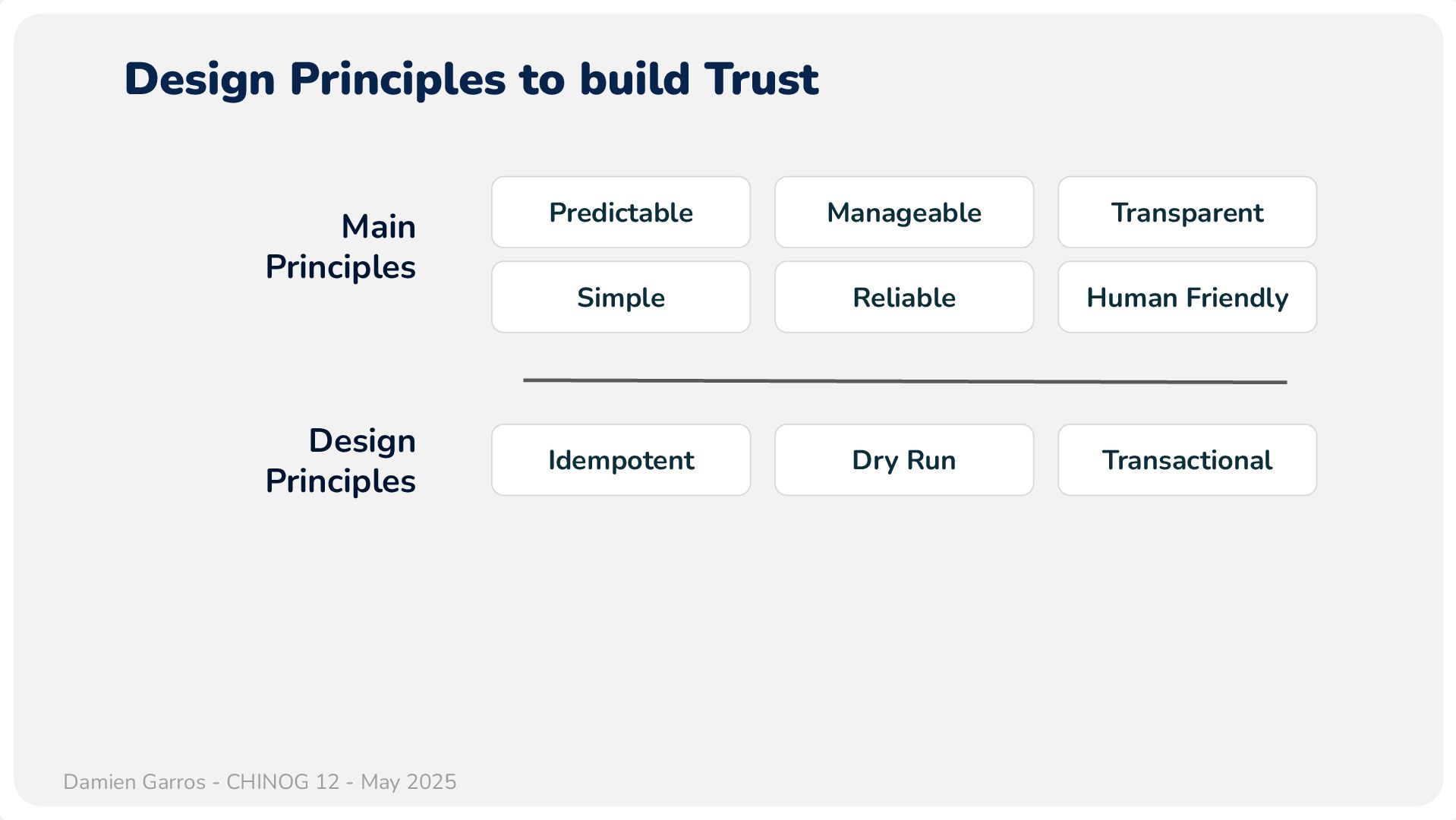
to build Trust Predictable Idempotent Manageable Transparent Simple Reliable Human Friendly Dry Run Main Principles Design Principles Transactional -
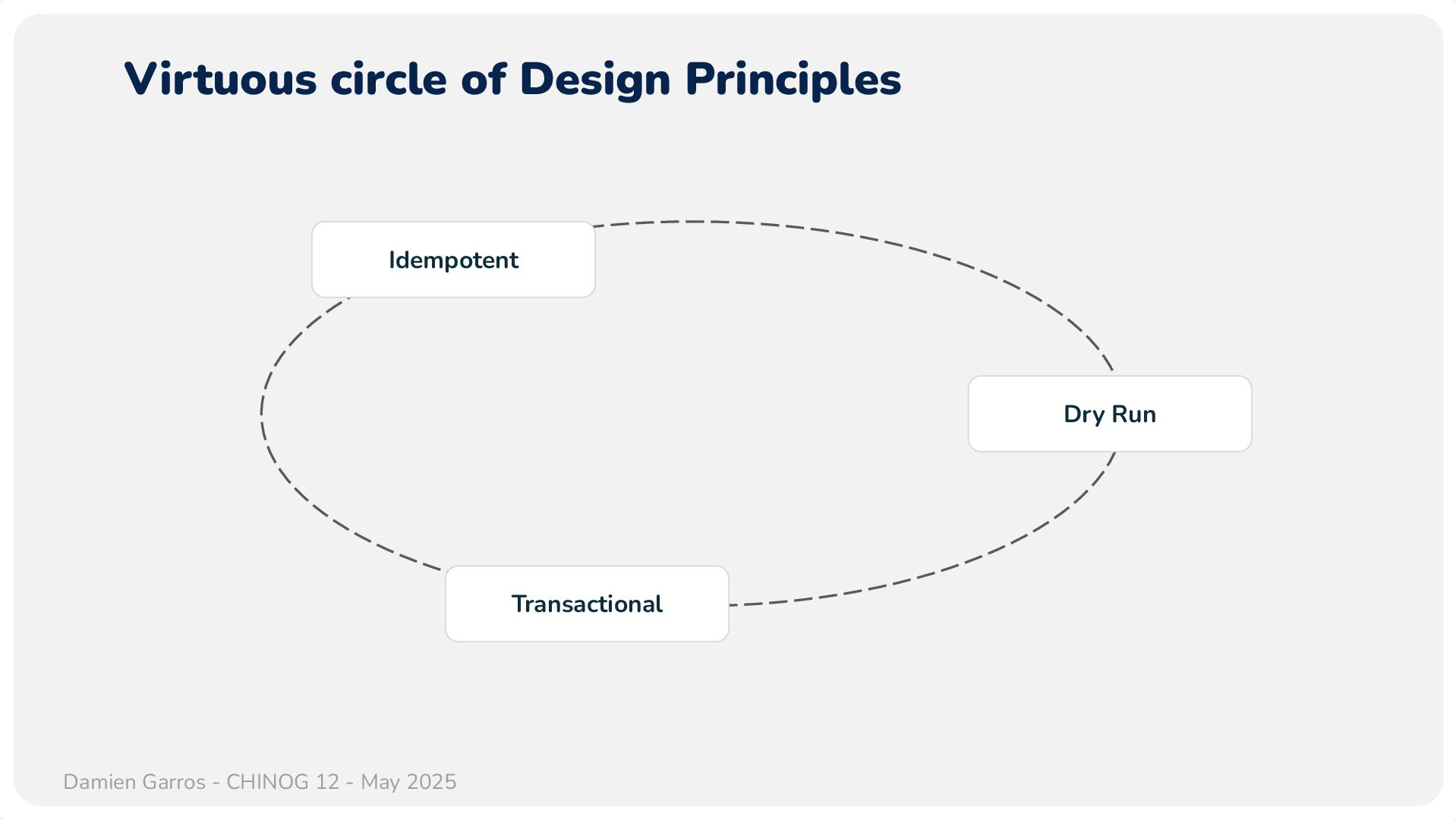
Damien Garros - CHINOG 12 - May 2025 Virtuous circle
of Design Principles Idempotent Dry Run Transactional -
Damien Garros - CHINOG 12 - May 2025 Tools and
Technologies that enable Trustworthy Automation -
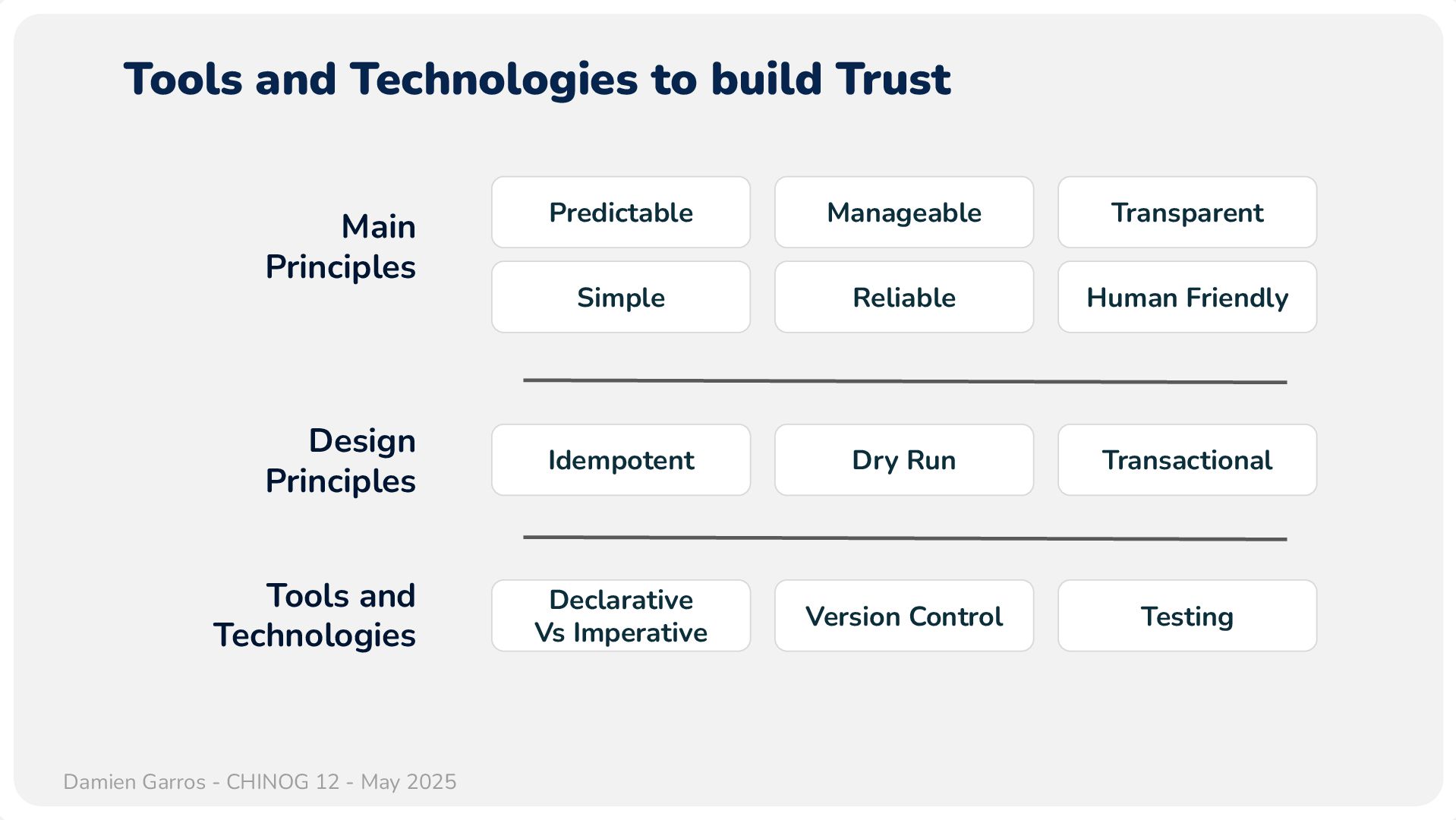
Damien Garros - CHINOG 12 - May 2025 Tools and
Technologies to build Trust Predictable Idempotent Manageable Transparent Simple Reliable Human Friendly Dry Run Testing Main Principles Design Principles Version Control Declarative Vs Imperative Tools and Technologies Transactional -
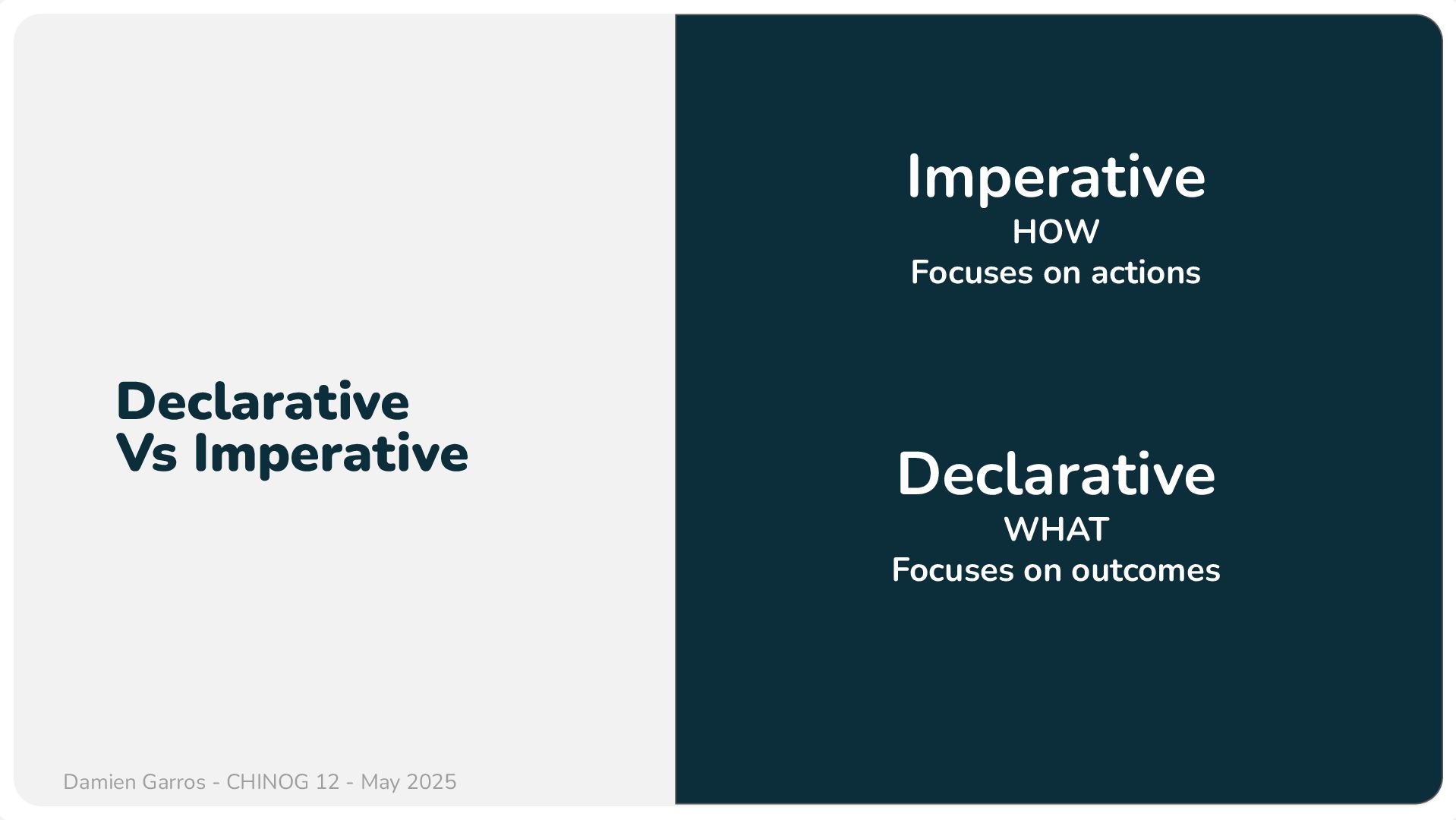
Damien Garros - CHINOG 12 - May 2025 Declarative Vs
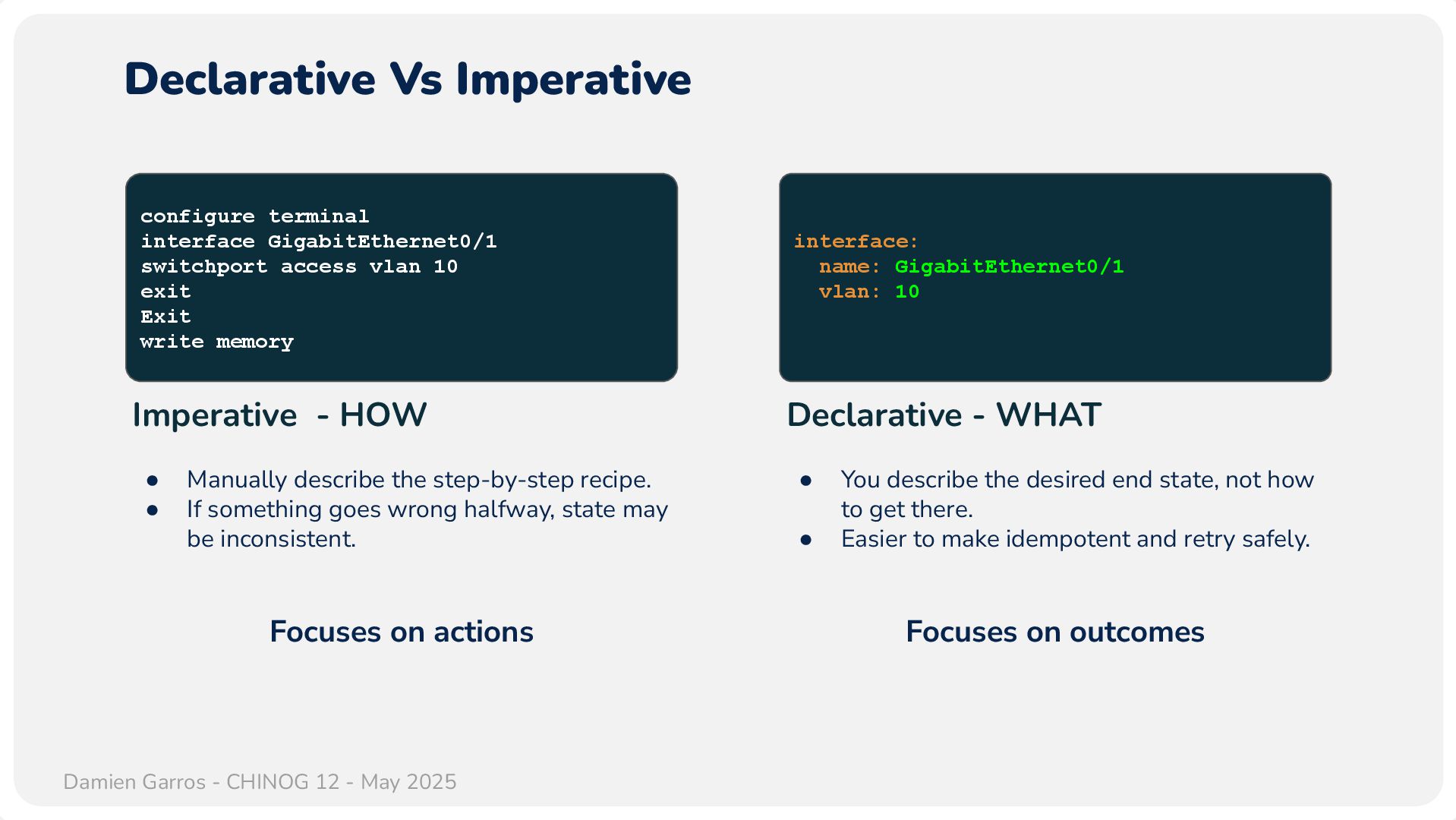
Imperative Imperative HOW Focuses on actions Declarative - WHAT Declarative WHAT Focuses on outcomes -
Damien Garros - CHINOG 12 - May 2025 Declarative Vs
Imperative Imperative - HOW • Manually describe the step-by-step recipe. • If something goes wrong halfway, state may be inconsistent. Focuses on actions Declarative - WHAT • You describe the desired end state, not how to get there. • Easier to make idempotent and retry safely. Focuses on outcomes configure terminal interface GigabitEthernet0/1 switchport access vlan 10 exit Exit write memory interface: name: GigabitEthernet0/1 vlan: 10 -
Damien Garros - CHINOG 12 - May 2025 Declarative Vs
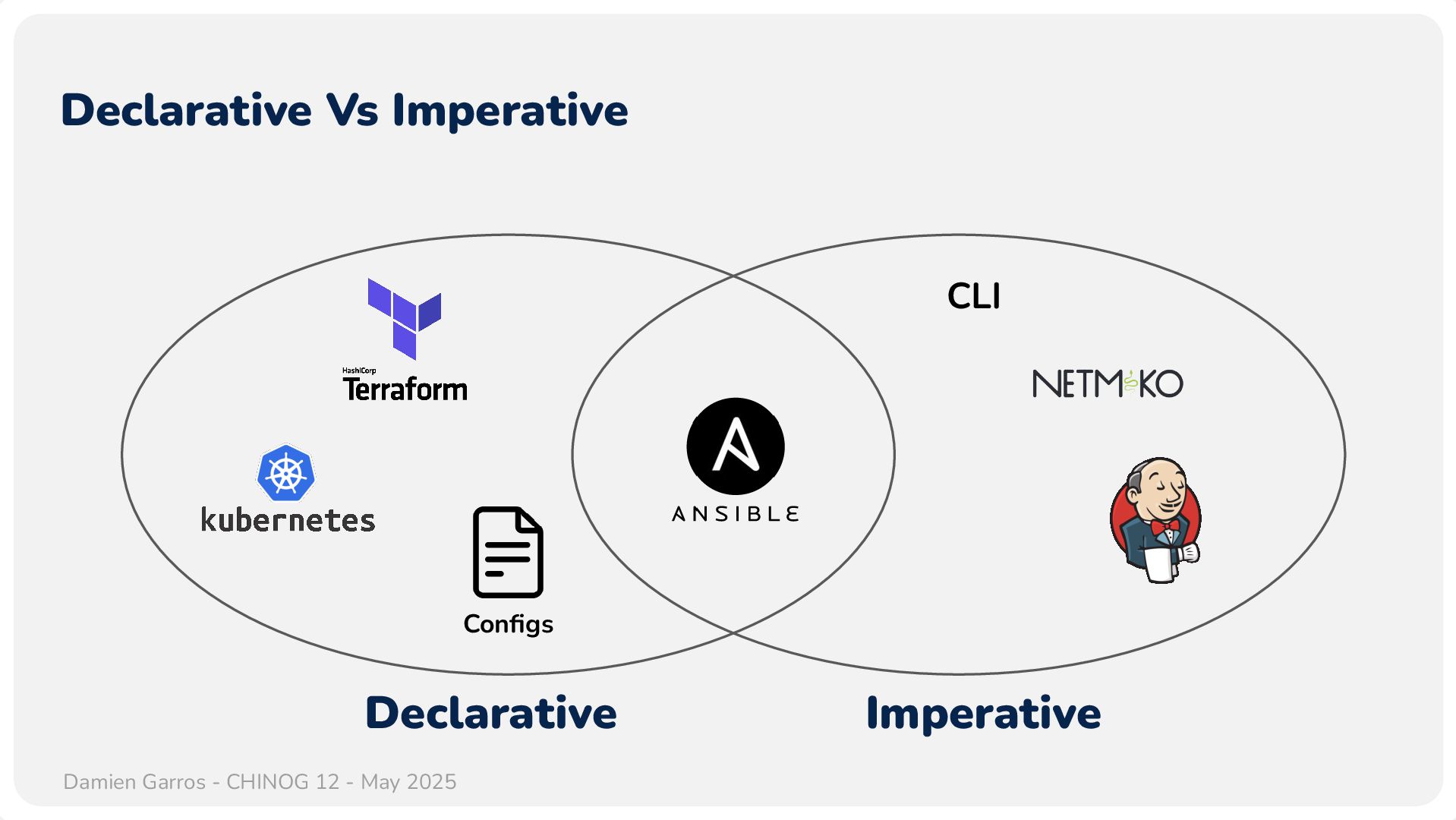
Imperative Declarative Imperative Configs CLI -
Damien Garros - CHINOG 12 - May 2025 Imperative Method
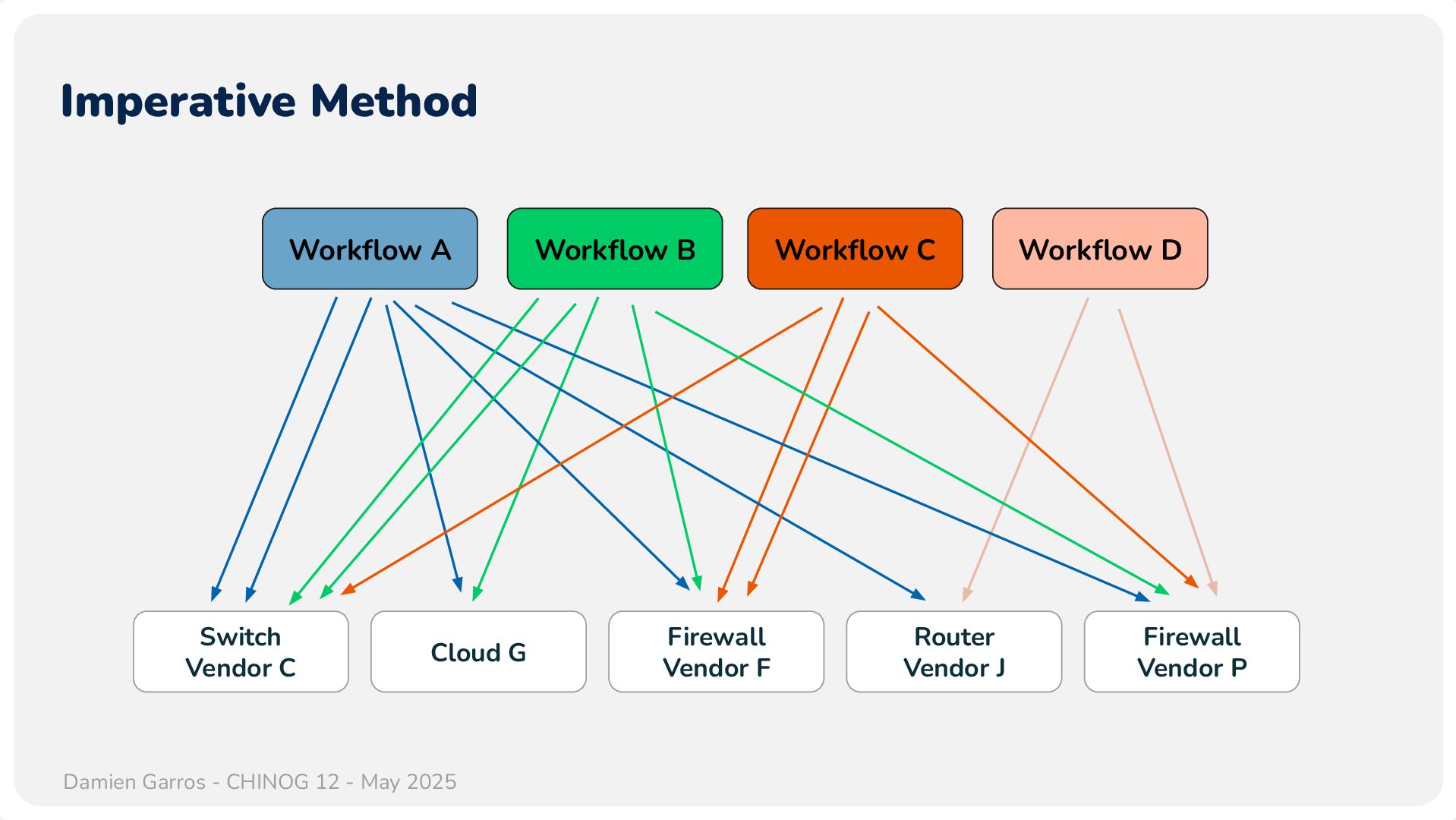
Switch Vendor C Cloud G Firewall Vendor F Router Vendor J Firewall Vendor P Workflow A Workflow B Workflow C Workflow D -
Damien Garros - CHINOG 12 - May 2025 Declarative Vs
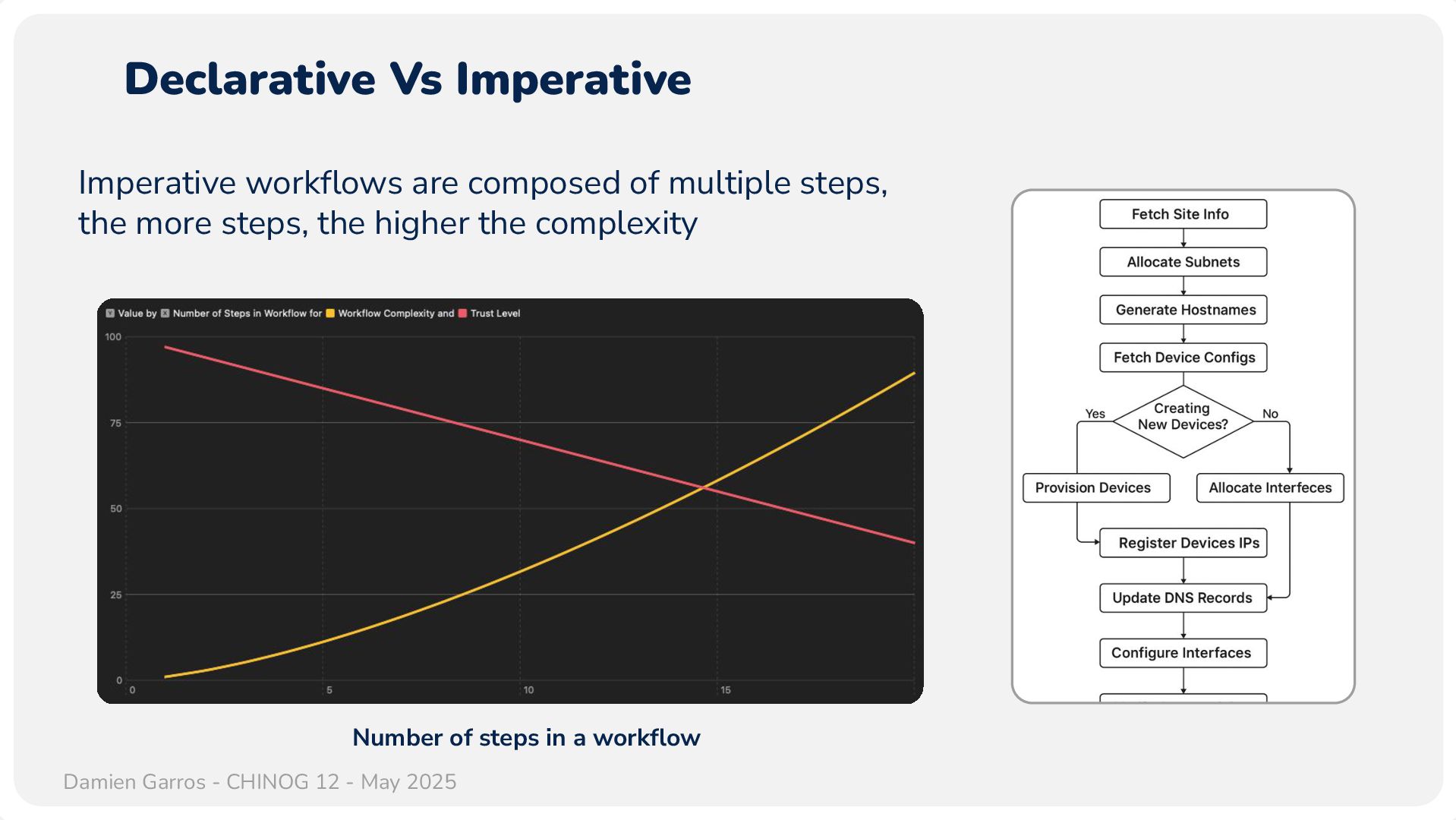
Imperative Imperative workflows are composed of multiple steps, the more steps, the higher the complexity Number of steps in a workflow -
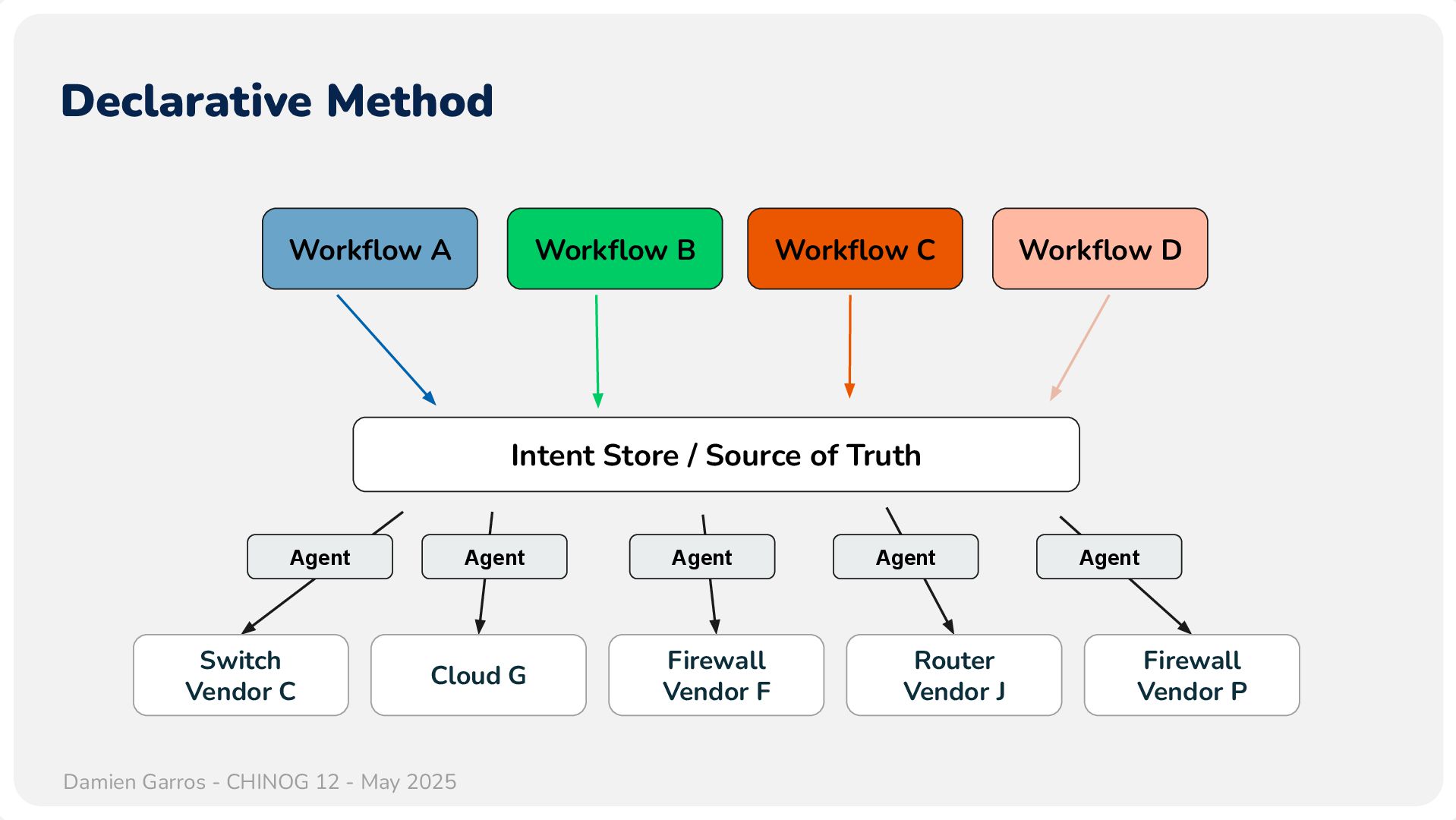
Damien Garros - CHINOG 12 - May 2025 Declarative Method
Intent Store / Source of Truth Switch Vendor C Cloud G Firewall Vendor F Router Vendor J Firewall Vendor P Agent Agent Agent Agent Agent Workflow A Workflow B Workflow C Workflow D -
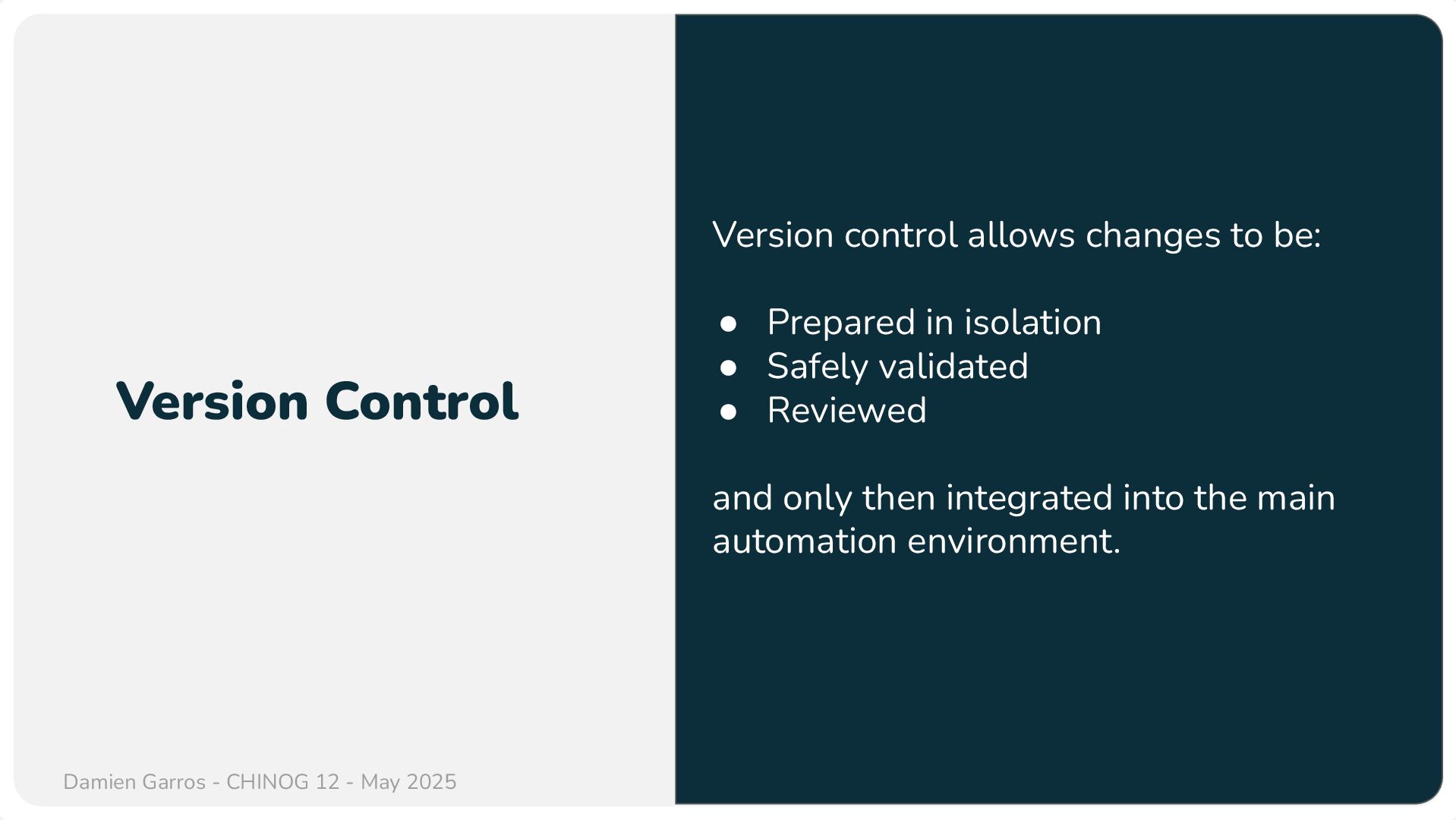
Damien Garros - CHINOG 12 - May 2025 Version Control
Version control allows changes to be: • Prepared in isolation • Safely validated • Reviewed and only then integrated into the main automation environment. -
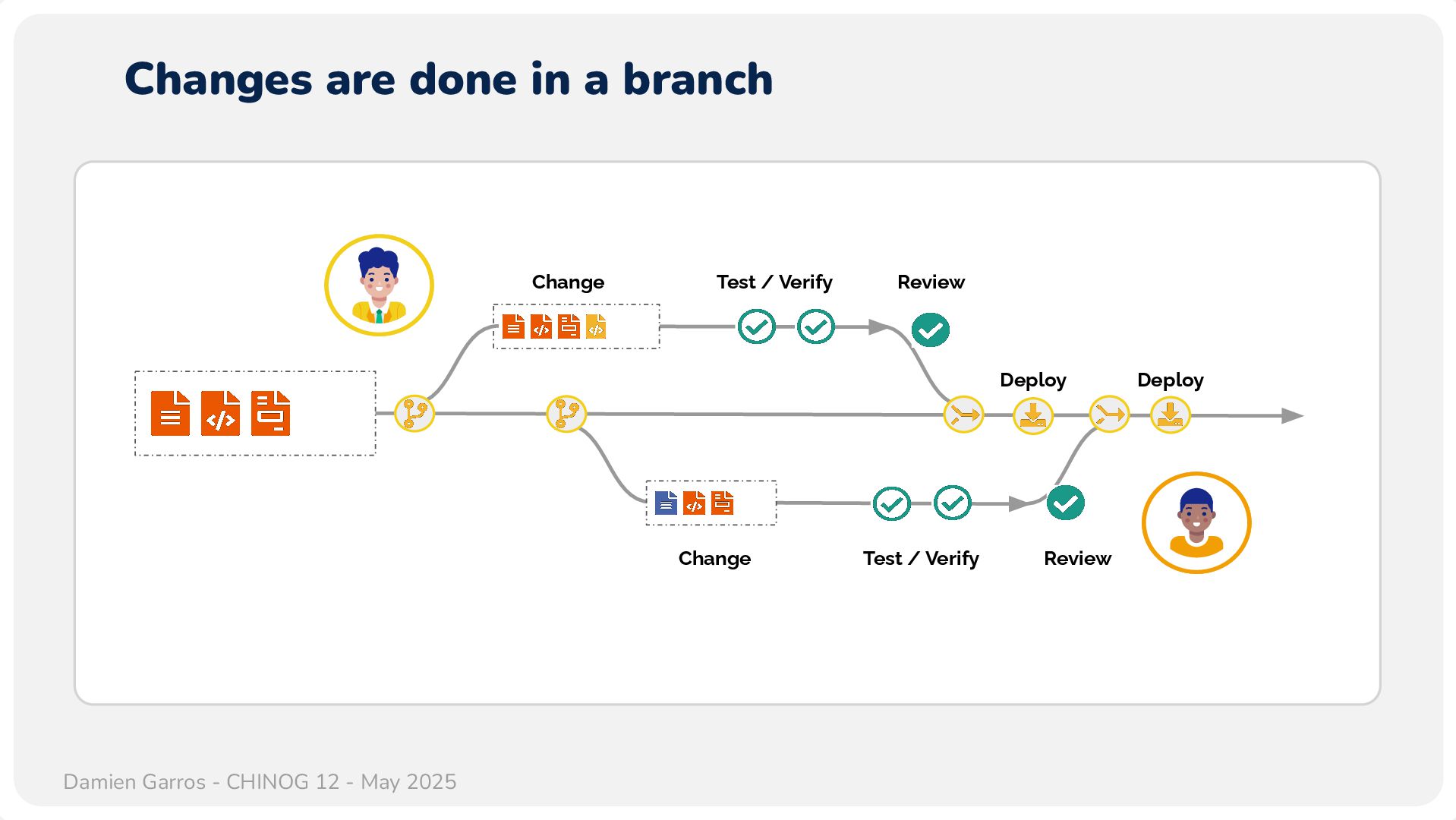
Damien Garros - CHINOG 12 - May 2025 Changes are
done in a branch Change Test / Verify Review Change Test / Verify Review Deploy Deploy -
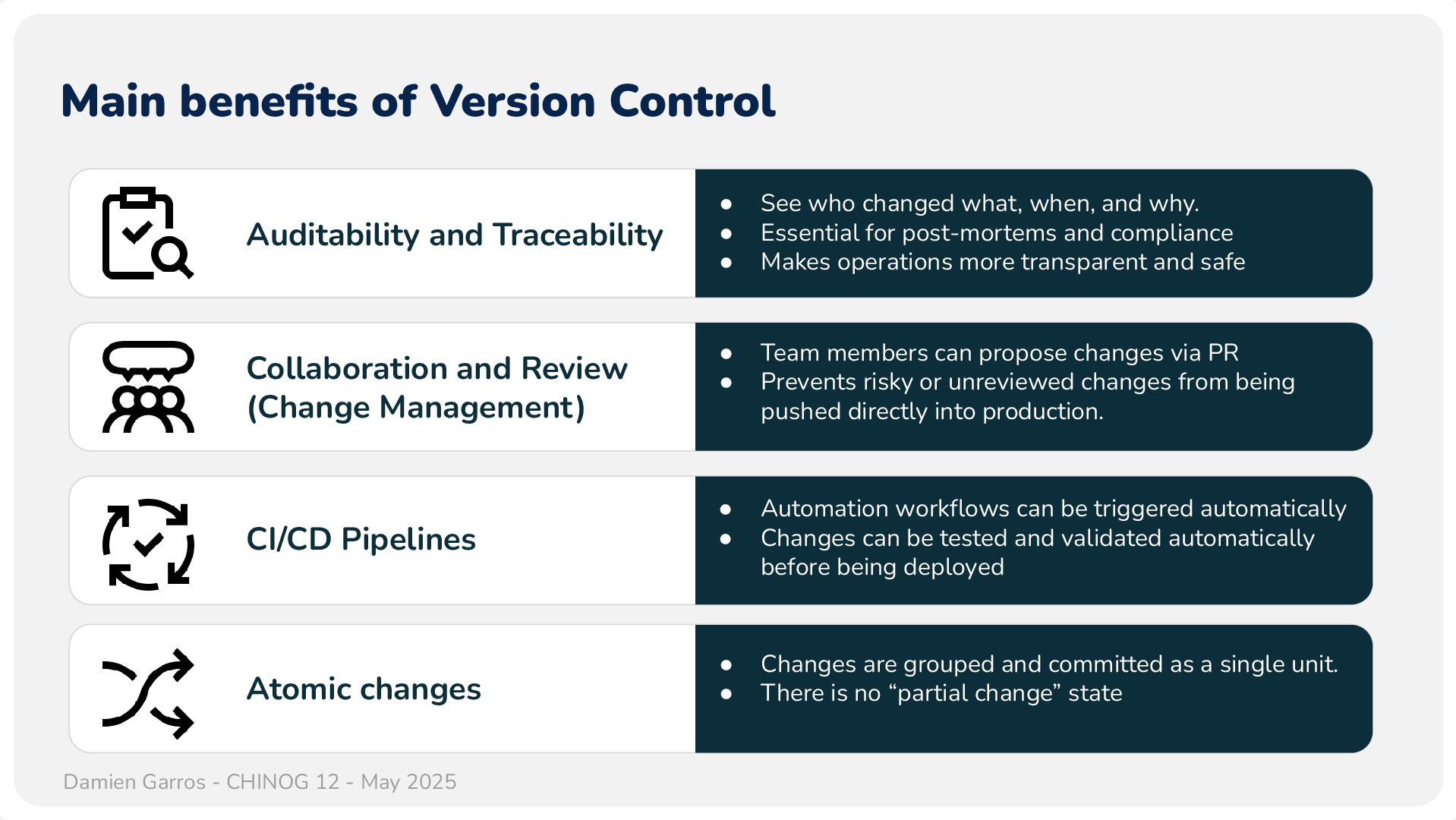
Damien Garros - CHINOG 12 - May 2025 Main benefits
of Version Control Auditability and Traceability • See who changed what, when, and why. • Essential for post-mortems and compliance • Makes operations more transparent and safe Collaboration and Review (Change Management) CI/CD Pipelines Atomic changes • Team members can propose changes via PR • Prevents risky or unreviewed changes from being pushed directly into production. • Automation workflows can be triggered automatically • Changes can be tested and validated automatically before being deployed • Changes are grouped and committed as a single unit. • There is no “partial change” state -
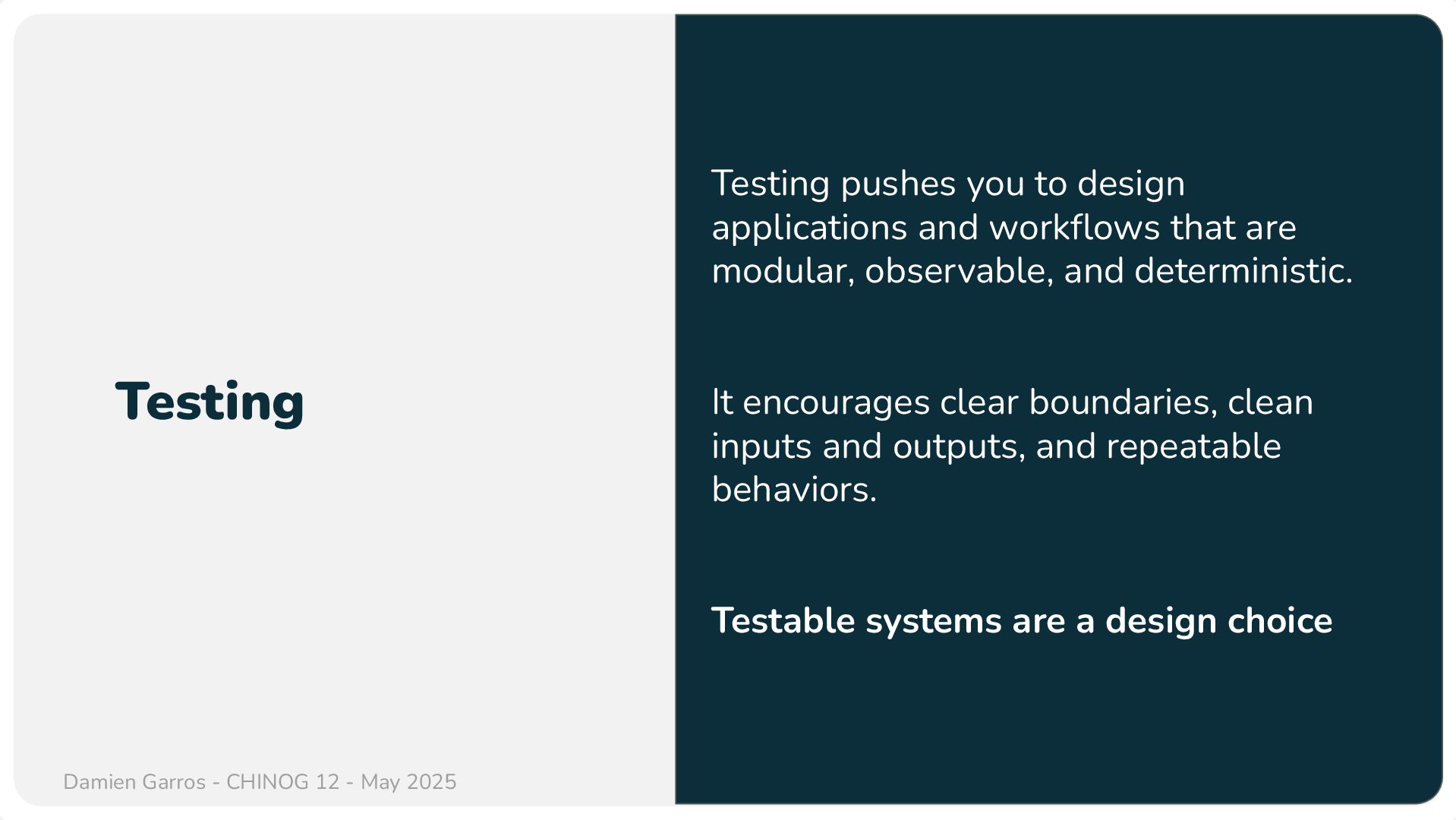
Damien Garros - CHINOG 12 - May 2025 Testing Testing
pushes you to design applications and workflows that are modular, observable, and deterministic. It encourages clear boundaries, clean inputs and outputs, and repeatable behaviors. Testable systems are a design choice -
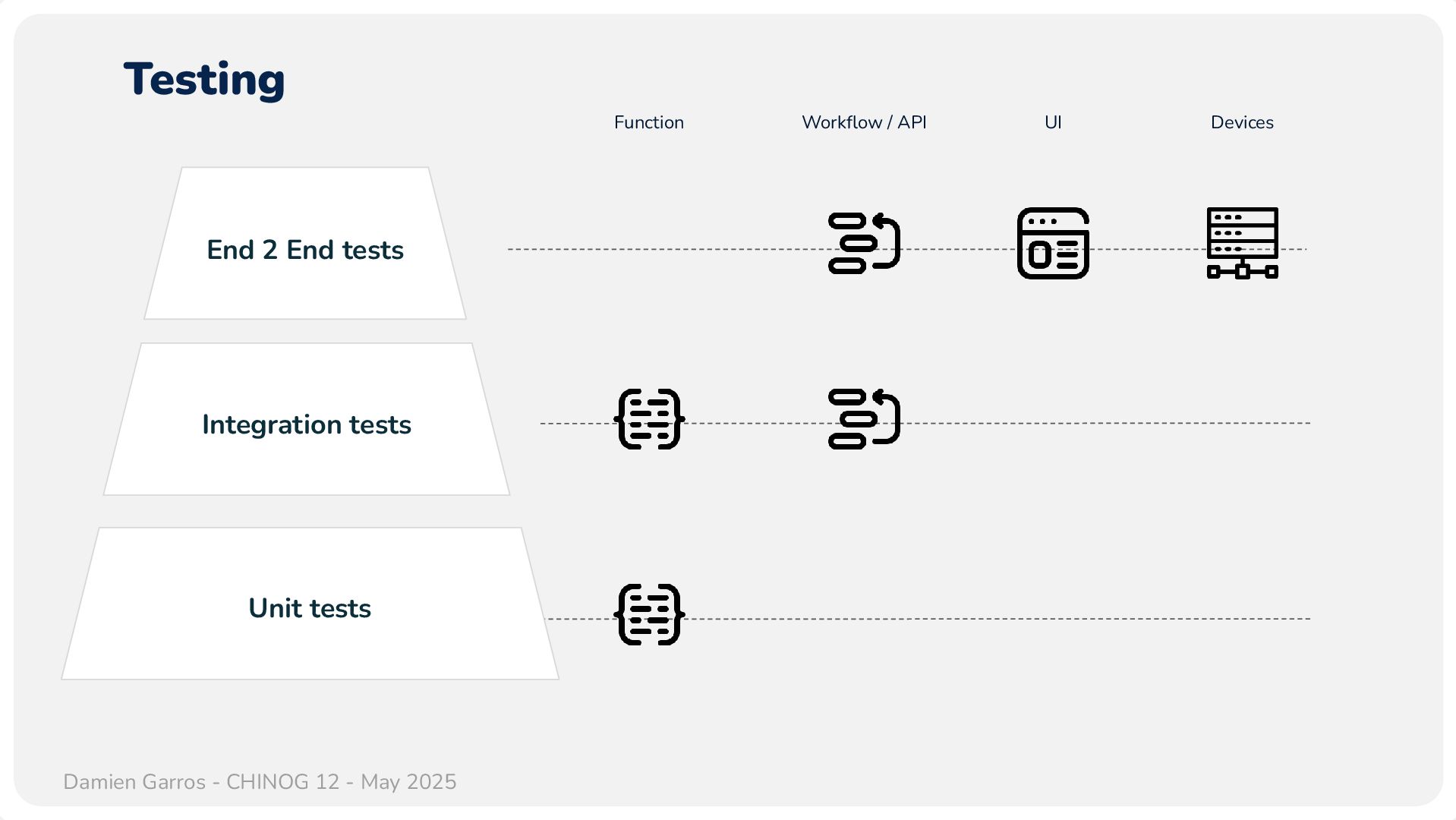
Damien Garros - CHINOG 12 - May 2025 Testing Unit
tests Integration tests End 2 End tests Function Workflow / API UI Devices -
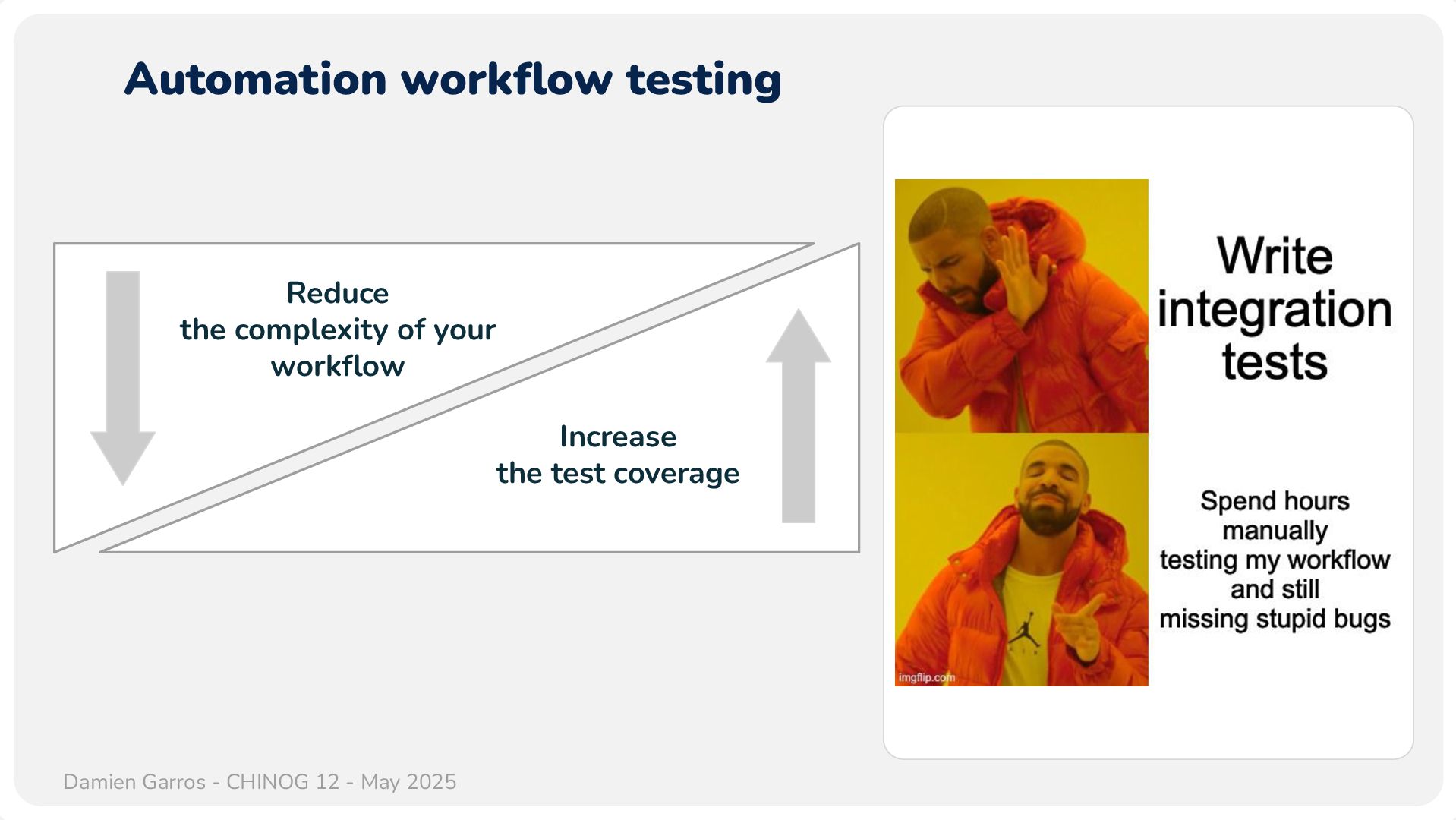
Damien Garros - CHINOG 12 - May 2025 Automation workflow
testing Reduce the complexity of your workflow Increase the test coverage -
Damien Garros - CHINOG 12 - May 2025 Practical Patterns
for Building Trust -
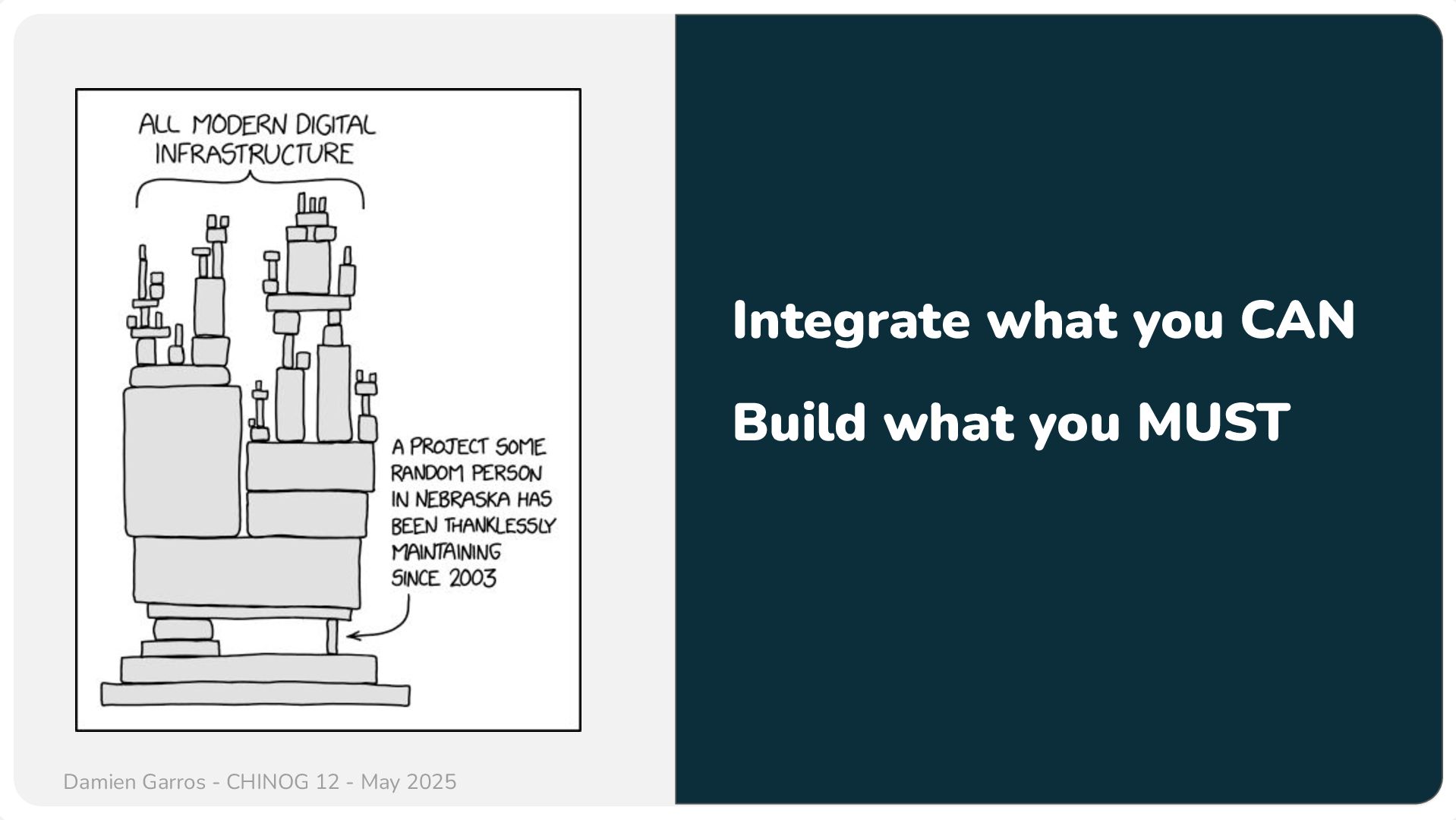
Damien Garros - CHINOG 12 - May 2025 Integrate what
you CAN Build what you MUST -
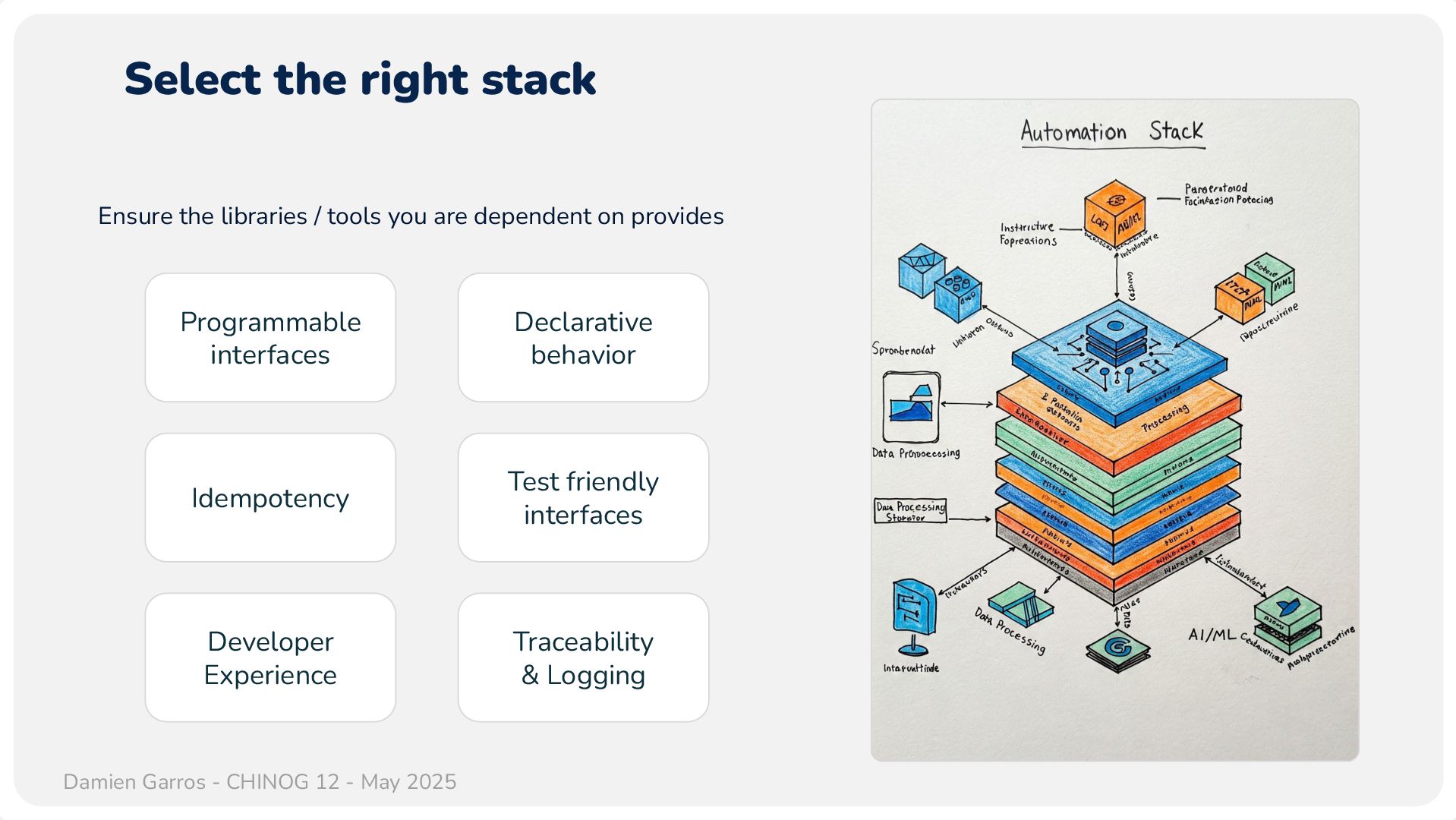
Damien Garros - CHINOG 12 - May 2025 Select the
right stack Ensure the libraries / tools you are dependent on provides Programmable interfaces Declarative behavior Developer Experience Idempotency Test friendly interfaces Traceability & Logging -
Damien Garros - CHINOG 12 - May 2025 The 3
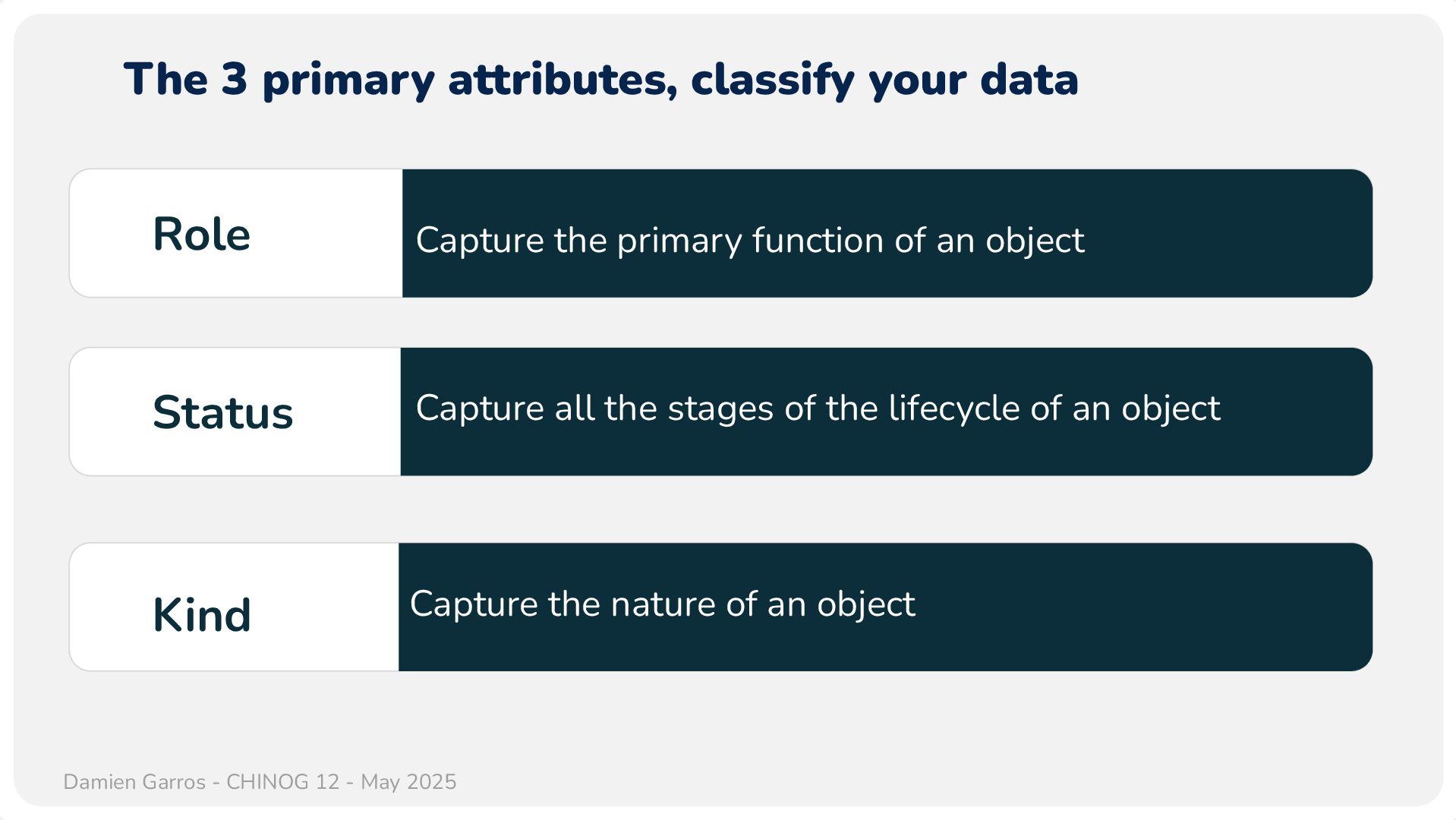
primary attributes, classify your data Role Capture the primary function of an object Status Kind Capture all the stages of the lifecycle of an object Capture the nature of an object -
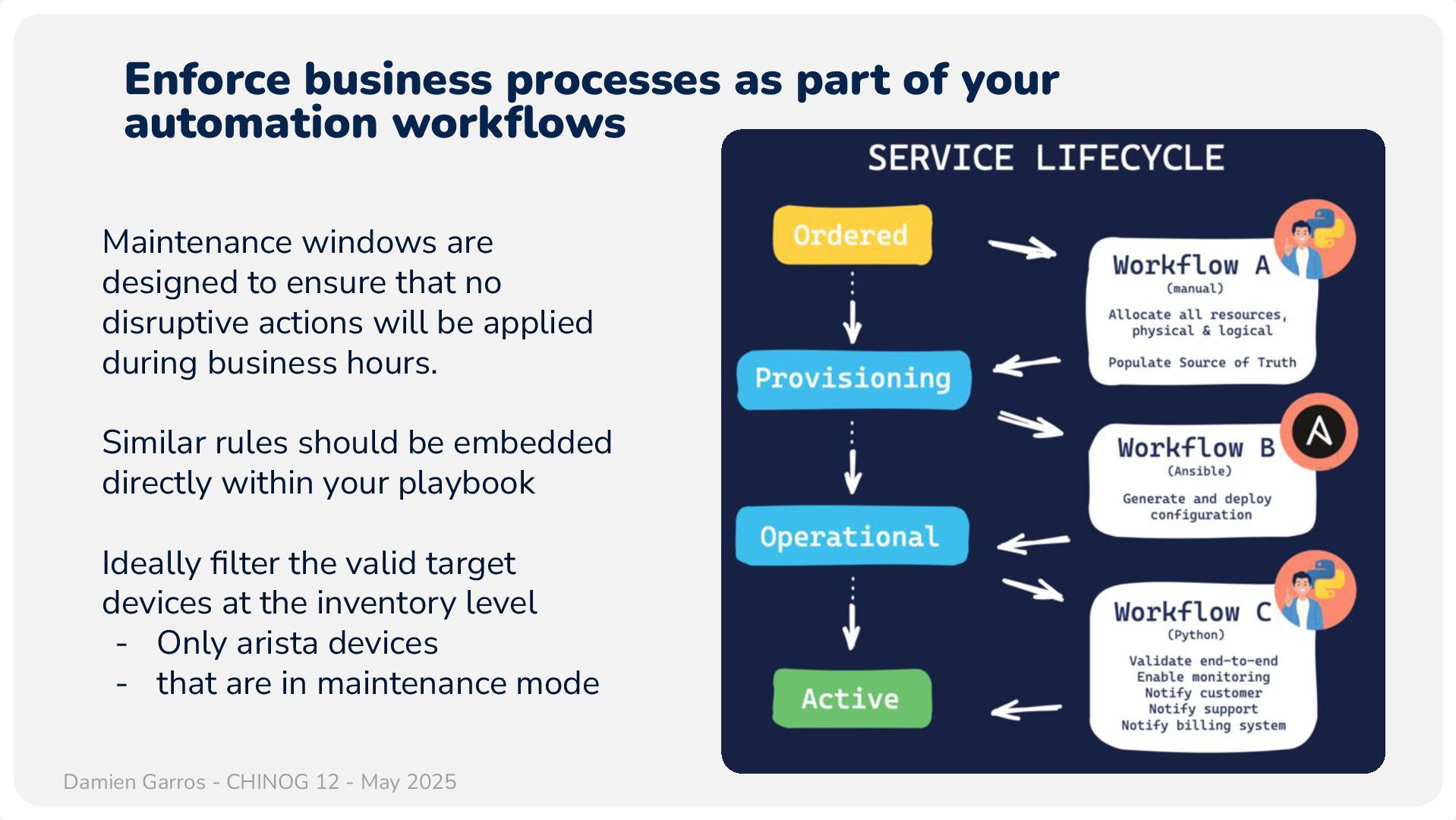
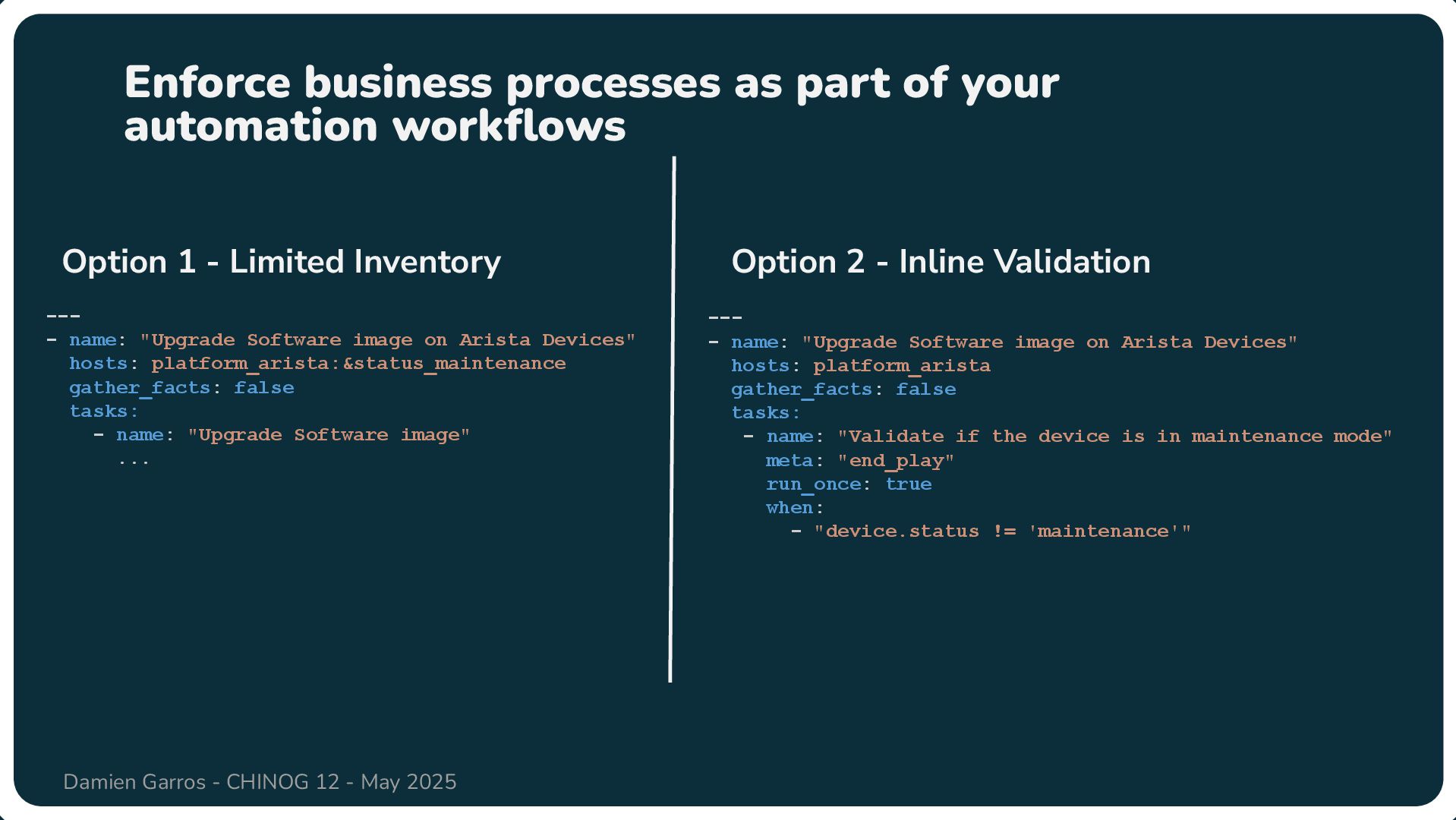
Damien Garros - CHINOG 12 - May 2025 Enforce business
processes as part of your automation workflows Maintenance windows are designed to ensure that no disruptive actions will be applied during business hours. Similar rules should be embedded directly within your playbook Ideally filter the valid target devices at the inventory level - Only arista devices - that are in maintenance mode -
Damien Garros - CHINOG 12 - May 2025 Enforce business
processes as part of your automation workflows --- - name: "Upgrade Software image on Arista Devices" hosts: platform_arista gather_facts: false tasks: - name: "Validate if the device is in maintenance mode" meta: "end_play" run_once: true when: - "device.status != 'maintenance'" --- - name: "Upgrade Software image on Arista Devices" hosts: platform_arista:&status_maintenance gather_facts: false tasks: - name: "Upgrade Software image" ... Option 2 - Inline Validation Option 1 - Limited Inventory -
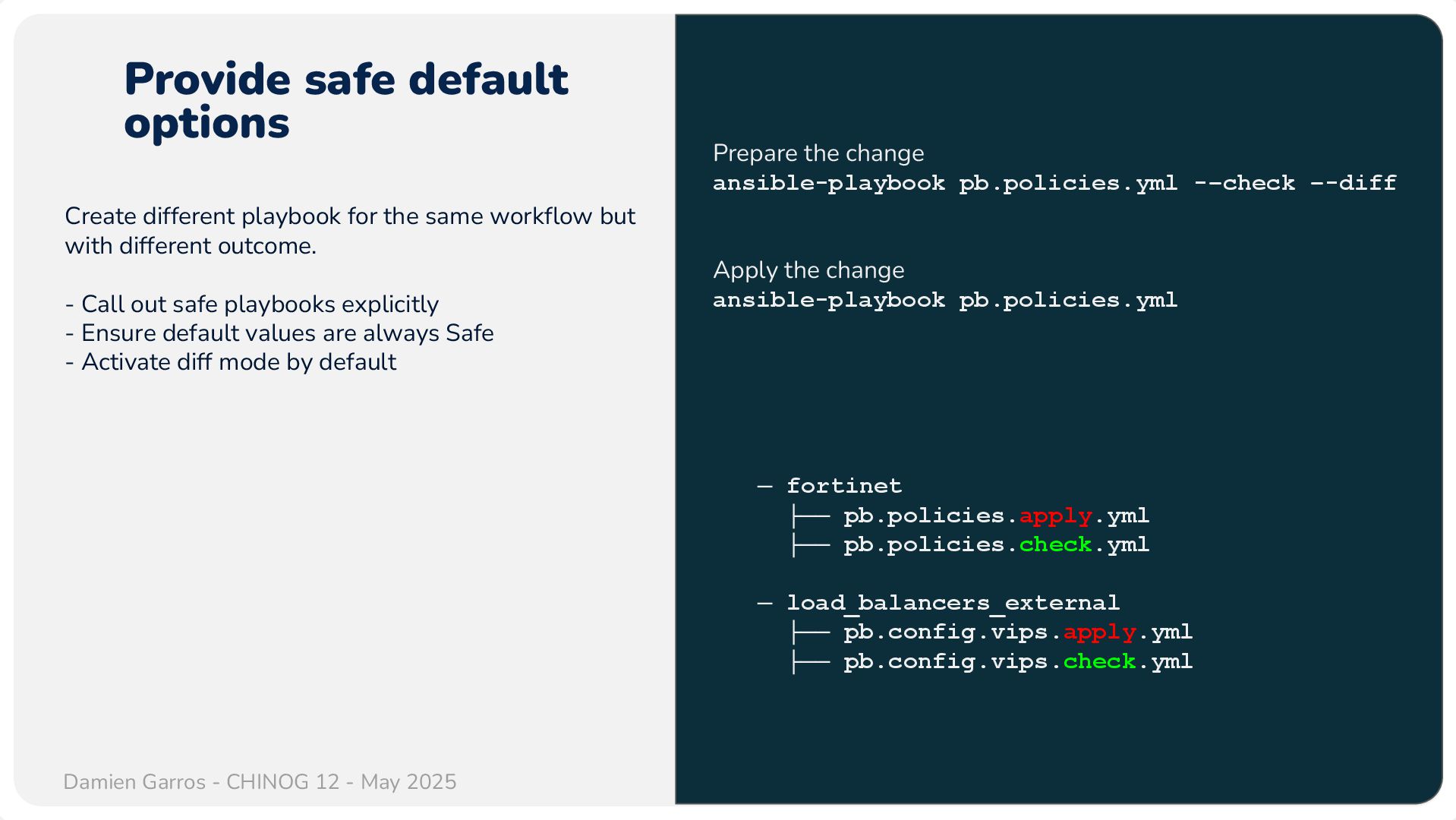
Damien Garros - CHINOG 12 - May 2025 Provide safe
default options ─ fortinet ├── pb.policies.apply.yml ├── pb.policies.check.yml ─ load_balancers_external ├── pb.config.vips.apply.yml ├── pb.config.vips.check.yml Create different playbook for the same workflow but with different outcome. - Call out safe playbooks explicitly - Ensure default values are always Safe - Activate diff mode by default Prepare the change ansible-playbook pb.policies.yml -–check –-diff Apply the change ansible-playbook pb.policies.yml -
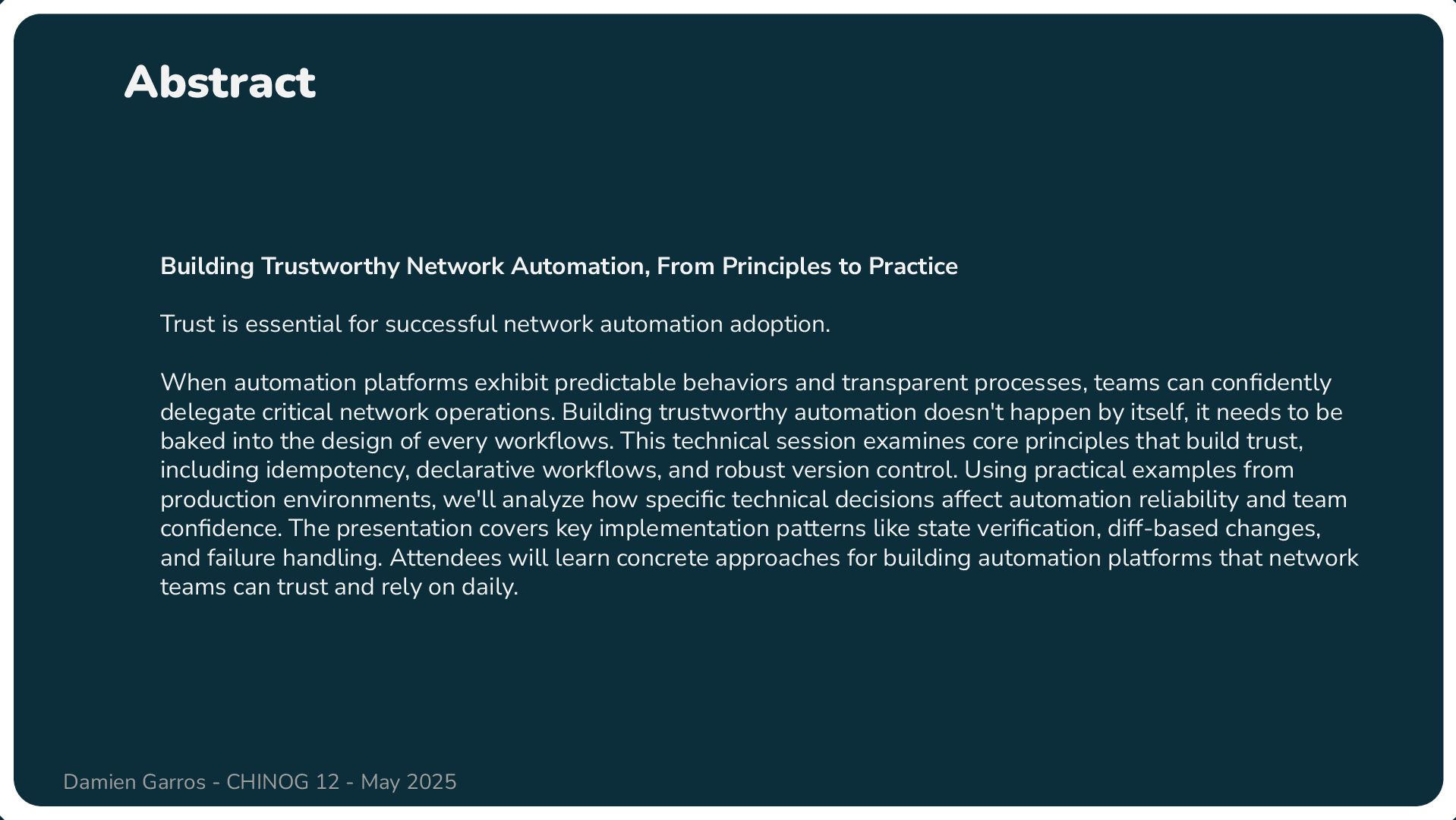
Damien Garros - CHINOG 12 - May 2025 Abstract Building
Trustworthy Network Automation, From Principles to Practice Trust is essential for successful network automation adoption. When automation platforms exhibit predictable behaviors and transparent processes, teams can confidently delegate critical network operations. Building trustworthy automation doesn't happen by itself, it needs to be baked into the design of every workflows. This technical session examines core principles that build trust, including idempotency, declarative workflows, and robust version control. Using practical examples from production environments, we'll analyze how specific technical decisions affect automation reliability and team confidence. The presentation covers key implementation patterns like state verification, diff-based changes, and failure handling. Attendees will learn concrete approaches for building automation platforms that network teams can trust and rely on daily.