Upgrade to Pro — share decks privately, control downloads, hide ads and more …

Cosmos DB at VLDB 2019

Avatar for Dharma Shukla Dharma Shukla
September 25, 2021

Cosmos DB at VLDB 2019

Avatar for Dharma Shukla

Dharma Shukla

September 25, 2021

Other Decks in Technology

Transcript

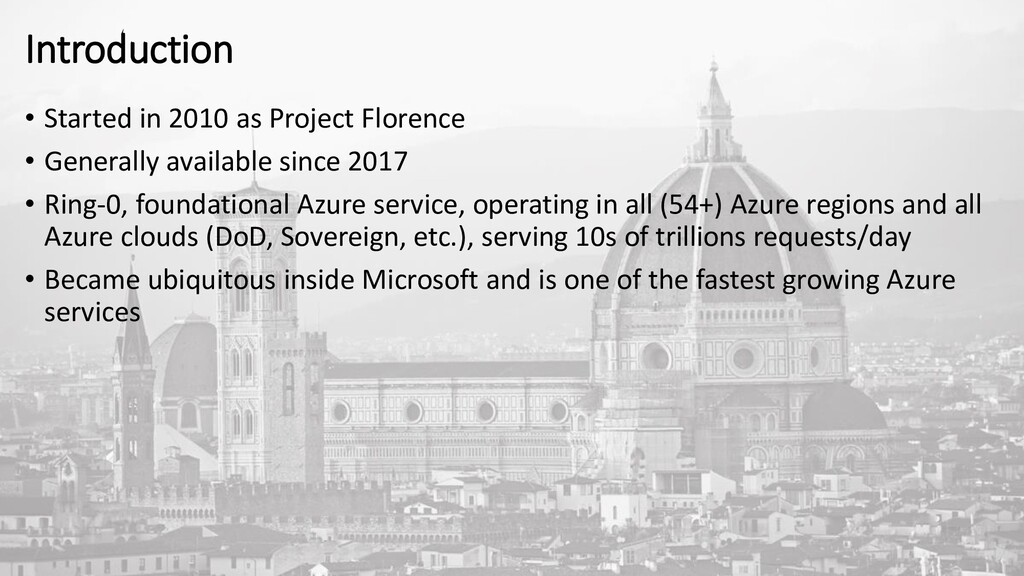
  1. Introduction • Started in 2010 as Project Florence • Generally

    available since 2017 • Ring-0, foundational Azure service, operating in all (54+) Azure regions and all Azure clouds (DoD, Sovereign, etc.), serving 10s of trillions requests/day • Became ubiquitous inside Microsoft and is one of the fastest growing Azure services
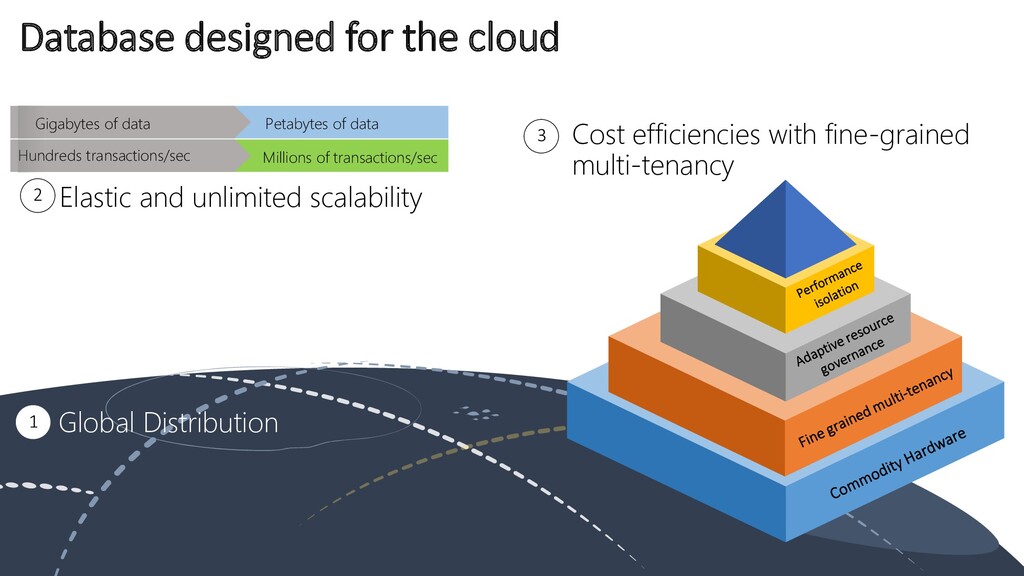
  2. Database designed for the cloud Global Distribution 1 Elastic and

    unlimited scalability Millions of transactions/sec Petabytes of data Hundreds transactions/sec Gigabytes of data 2 Cost efficiencies with fine-grained multi-tenancy 3
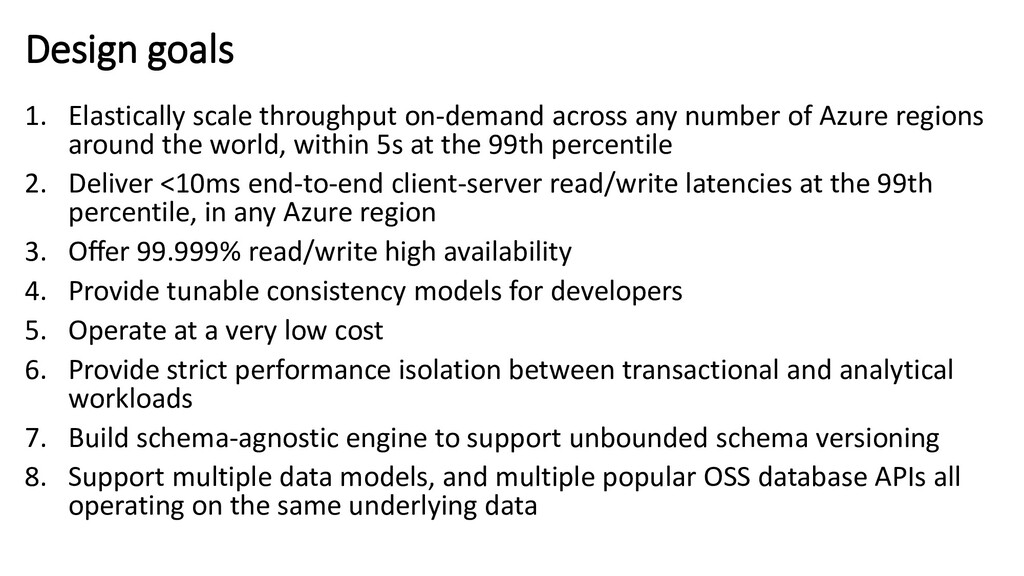
  3. Design goals 1. Elastically scale throughput on-demand across any number

    of Azure regions around the world, within 5s at the 99th percentile 2. Deliver <10ms end-to-end client-server read/write latencies at the 99th percentile, in any Azure region 3. Offer 99.999% read/write high availability 4. Provide tunable consistency models for developers 5. Operate at a very low cost 6. Provide strict performance isolation between transactional and analytical workloads 7. Build schema-agnostic engine to support unbounded schema versioning 8. Support multiple data models, and multiple popular OSS database APIs all operating on the same underlying data
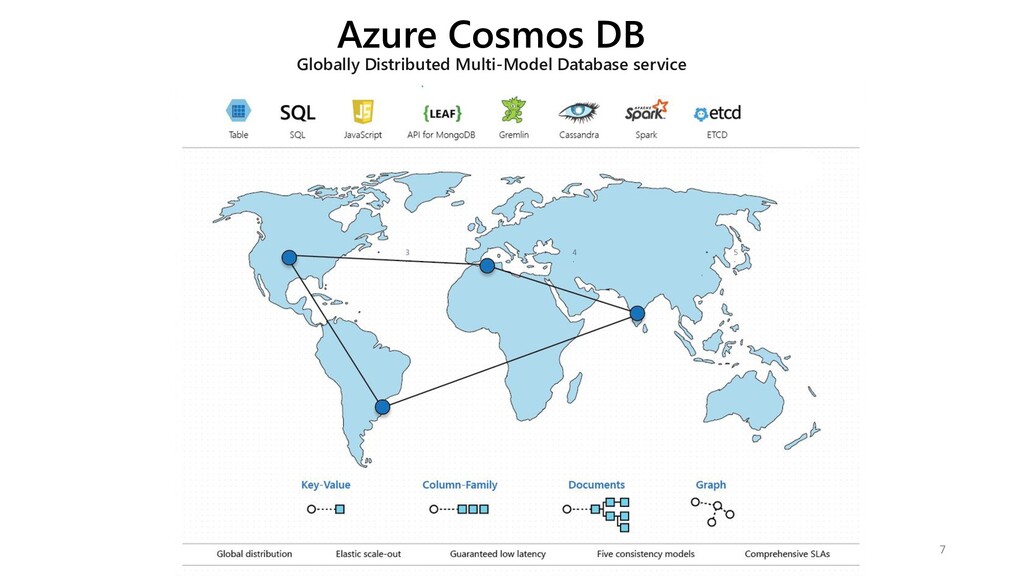
  4. • 3 . • 4 . • 5 . 6

    . Globally Distributed Multi-Model Database service 7 Azure Cosmos DB
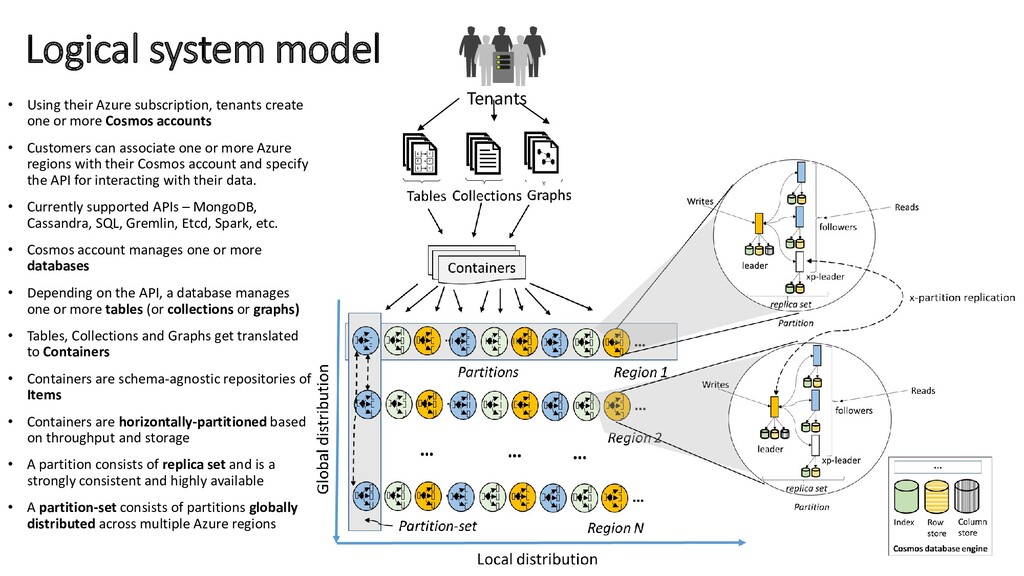
  5. Logical system model • Using their Azure subscription, tenants create

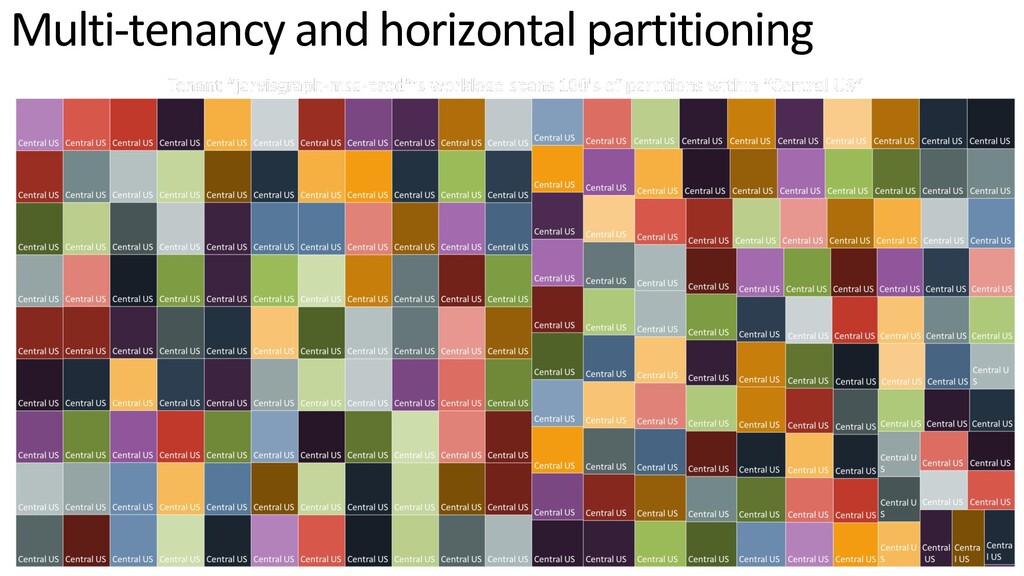
    one or more Cosmos accounts • Customers can associate one or more Azure regions with their Cosmos account and specify the API for interacting with their data. • Currently supported APIs – MongoDB, Cassandra, SQL, Gremlin, Etcd, Spark, etc. • Cosmos account manages one or more databases • Depending on the API, a database manages one or more tables (or collections or graphs) • Tables, Collections and Graphs get translated to Containers • Containers are schema-agnostic repositories of Items • Containers are horizontally-partitioned based on throughput and storage • A partition consists of replica set and is a strongly consistent and highly available • A partition-set consists of partitions globally distributed across multiple Azure regions Tenants
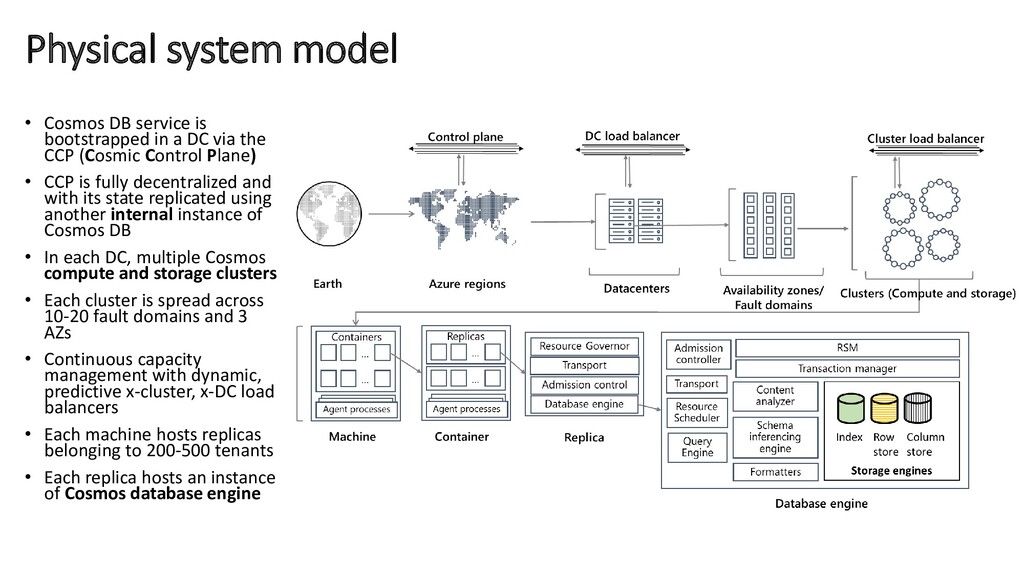
  6. Physical system model • Cosmos DB service is bootstrapped in

    a DC via the CCP (Cosmic Control Plane) • CCP is fully decentralized and with its state replicated using another internal instance of Cosmos DB • In each DC, multiple Cosmos compute and storage clusters • Each cluster is spread across 10-20 fault domains and 3 AZs • Continuous capacity management with dynamic, predictive x-cluster, x-DC load balancers • Each machine hosts replicas belonging to 200-500 tenants • Each replica hosts an instance of Cosmos database engine
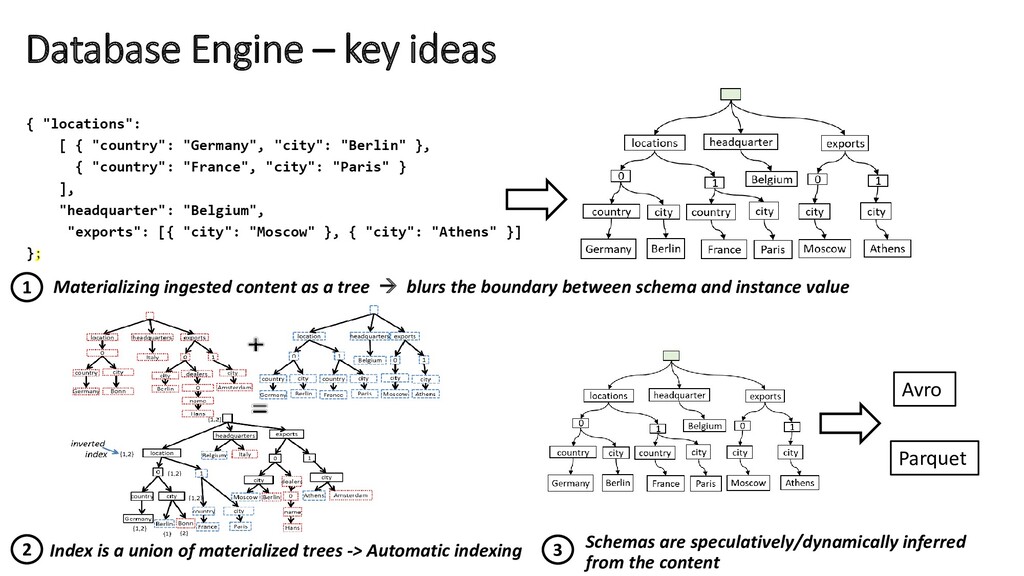
  7. Database Engine – key ideas Index is a union of

    materialized trees -> Automatic indexing Materializing ingested content as a tree → blurs the boundary between schema and instance value Schemas are speculatively/dynamically inferred from the content 1 2 3 Avro Parquet
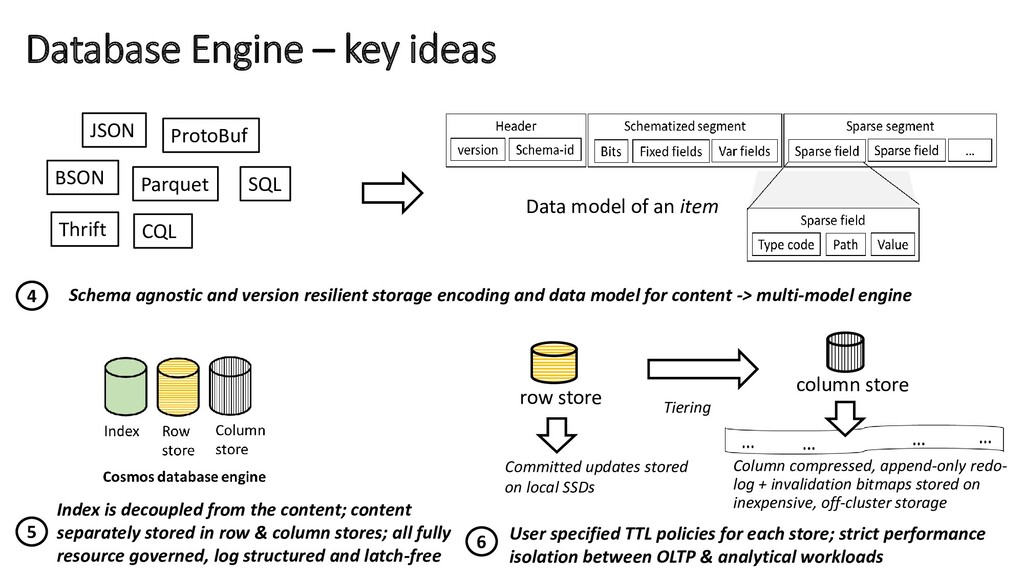
  8. Database Engine – key ideas Index is decoupled from the

    content; content separately stored in row & column stores; all fully resource governed, log structured and latch-free Schema agnostic and version resilient storage encoding and data model for content -> multi-model engine User specified TTL policies for each store; strict performance isolation between OLTP & analytical workloads 4 5 6 JSON BSON Parquet CQL SQL ProtoBuf Data model of an item Thrift Column compressed, append-only redo- log + invalidation bitmaps stored on inexpensive, off-cluster storage row store column store Committed updates stored on local SSDs Tiering
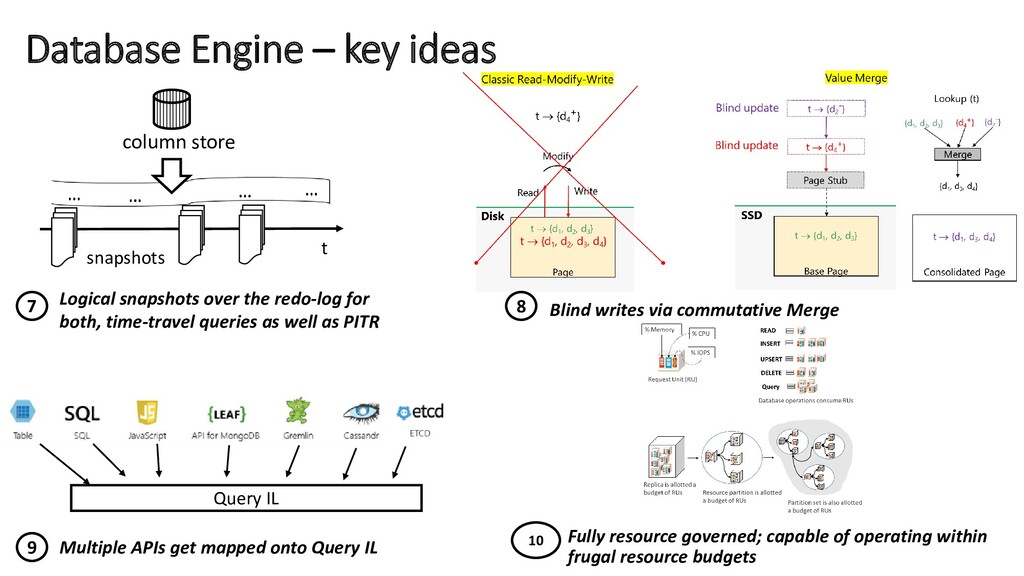
  9. Database Engine – key ideas Multiple APIs get mapped onto

    Query IL Logical snapshots over the redo-log for both, time-travel queries as well as PITR Fully resource governed; capable of operating within frugal resource budgets 7 9 10 column store Blind writes via commutative Merge 8 Query IL t snapshots
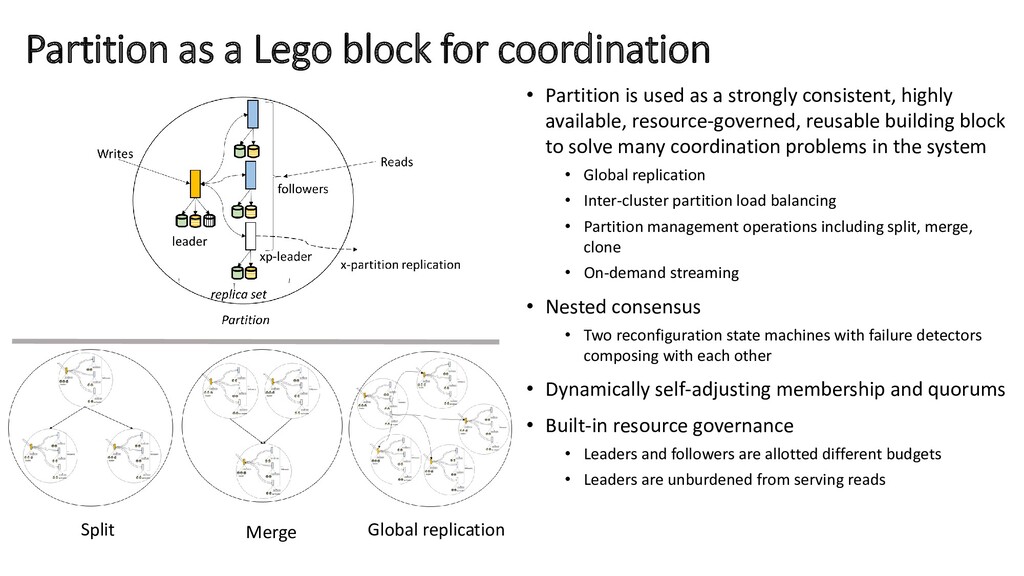
  10. Partition as a Lego block for coordination • Partition is

    used as a strongly consistent, highly available, resource-governed, reusable building block to solve many coordination problems in the system • Global replication • Inter-cluster partition load balancing • Partition management operations including split, merge, clone • On-demand streaming • Nested consensus • Two reconfiguration state machines with failure detectors composing with each other • Dynamically self-adjusting membership and quorums • Built-in resource governance • Leaders and followers are allotted different budgets • Leaders are unburdened from serving reads Split Merge Global replication
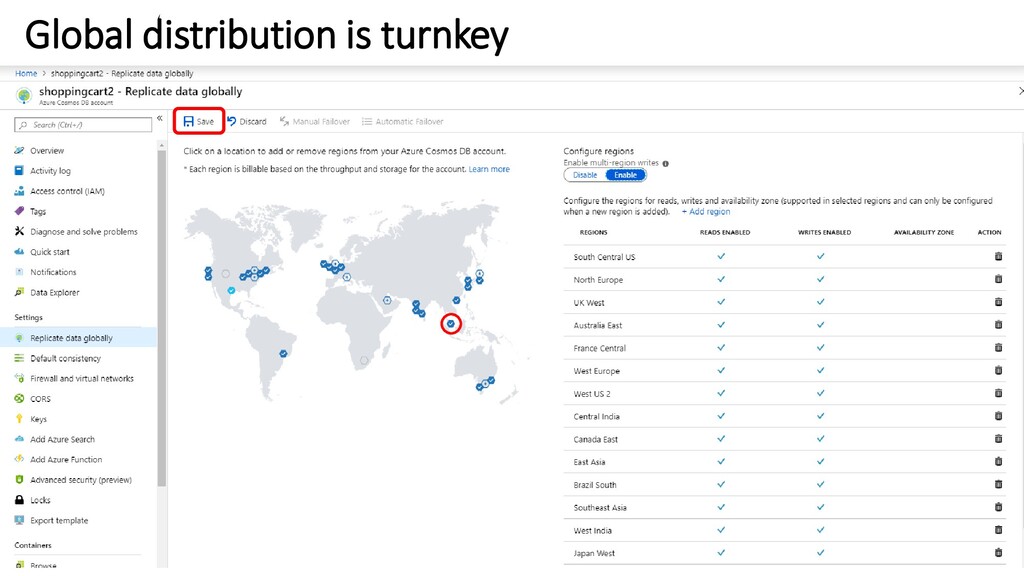
  11. Global distribution • The distribution protocol propagates writes within a

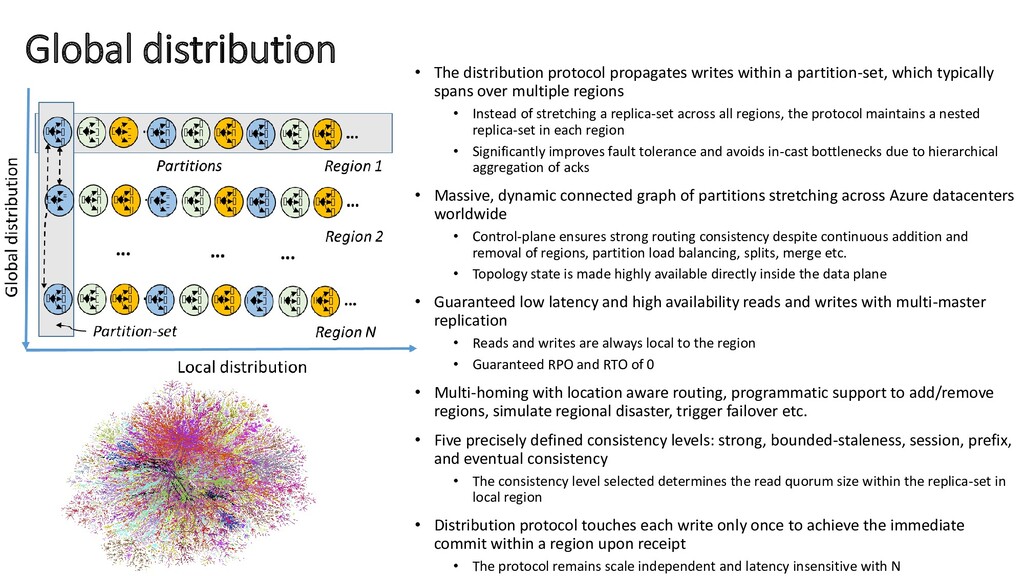
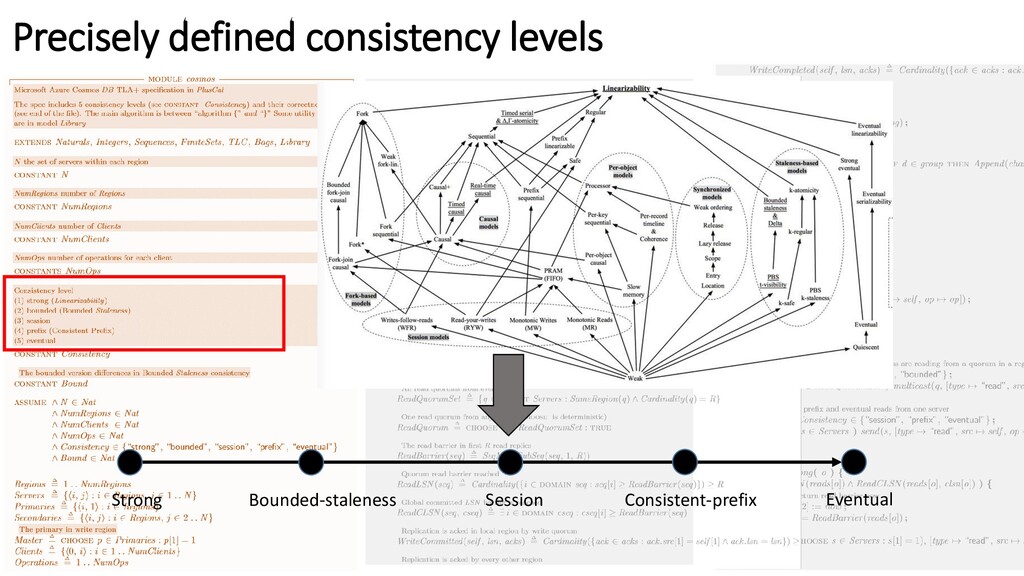
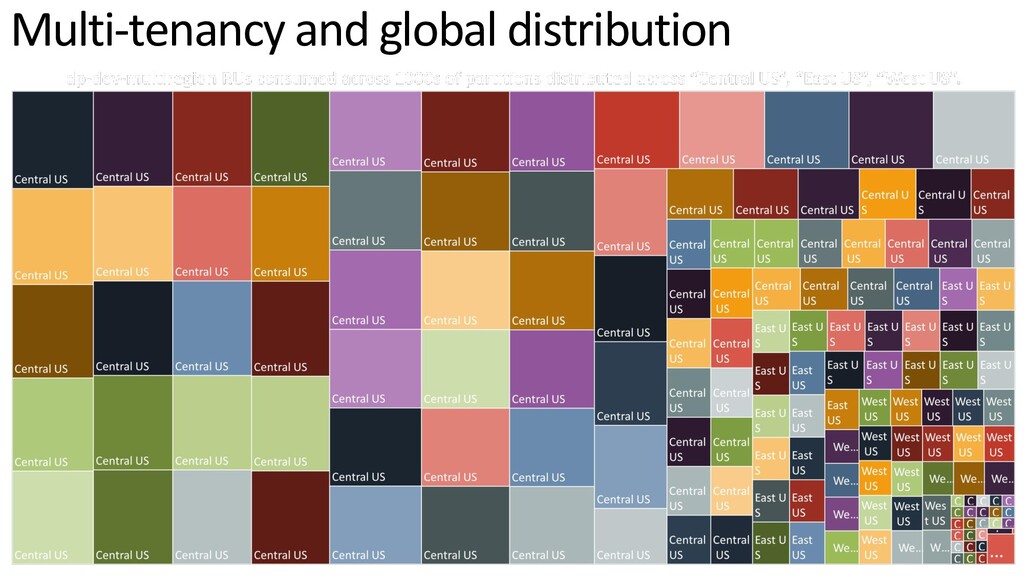
    partition-set, which typically spans over multiple regions • Instead of stretching a replica-set across all regions, the protocol maintains a nested replica-set in each region • Significantly improves fault tolerance and avoids in-cast bottlenecks due to hierarchical aggregation of acks • Massive, dynamic connected graph of partitions stretching across Azure datacenters worldwide • Control-plane ensures strong routing consistency despite continuous addition and removal of regions, partition load balancing, splits, merge etc. • Topology state is made highly available directly inside the data plane • Guaranteed low latency and high availability reads and writes with multi-master replication • Reads and writes are always local to the region • Guaranteed RPO and RTO of 0 • Multi-homing with location aware routing, programmatic support to add/remove regions, simulate regional disaster, trigger failover etc. • Five precisely defined consistency levels: strong, bounded-staleness, session, prefix, and eventual consistency • The consistency level selected determines the read quorum size within the replica-set in local region • Distribution protocol touches each write only once to achieve the immediate commit within a region upon receipt • The protocol remains scale independent and latency insensitive with N
  12. Consensus within a replica set 1 2 3 4 5

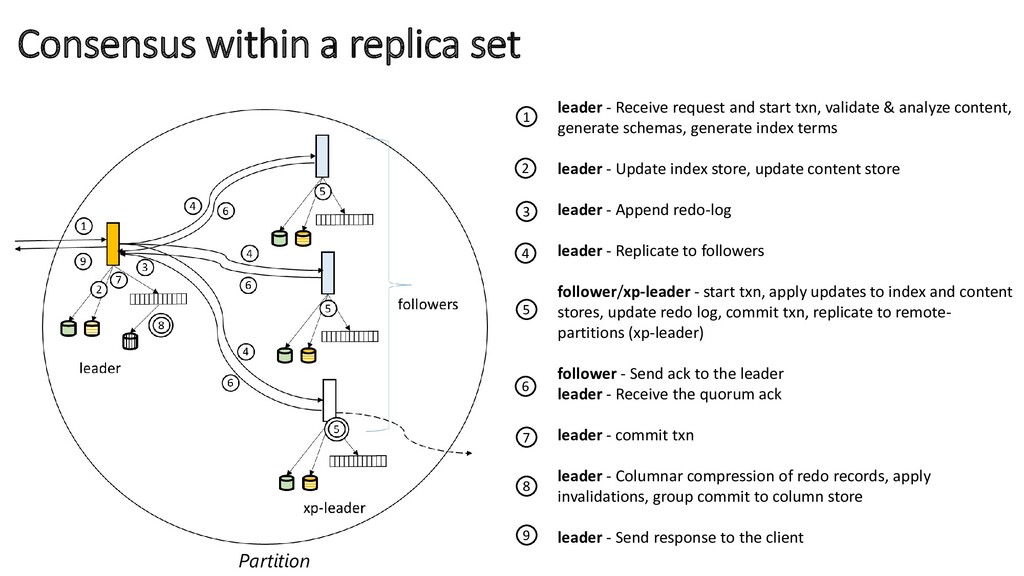
    6 7 8 leader - Receive request and start txn, validate & analyze content, generate schemas, generate index terms leader - Update index store, update content store leader - Append redo-log leader - Replicate to followers follower/xp-leader - start txn, apply updates to index and content stores, update redo log, commit txn, replicate to remote- partitions (xp-leader) follower - Send ack to the leader leader - Receive the quorum ack leader - commit txn leader - Columnar compression of redo records, apply invalidations, group commit to column store leader - Send response to the client 9 Partition
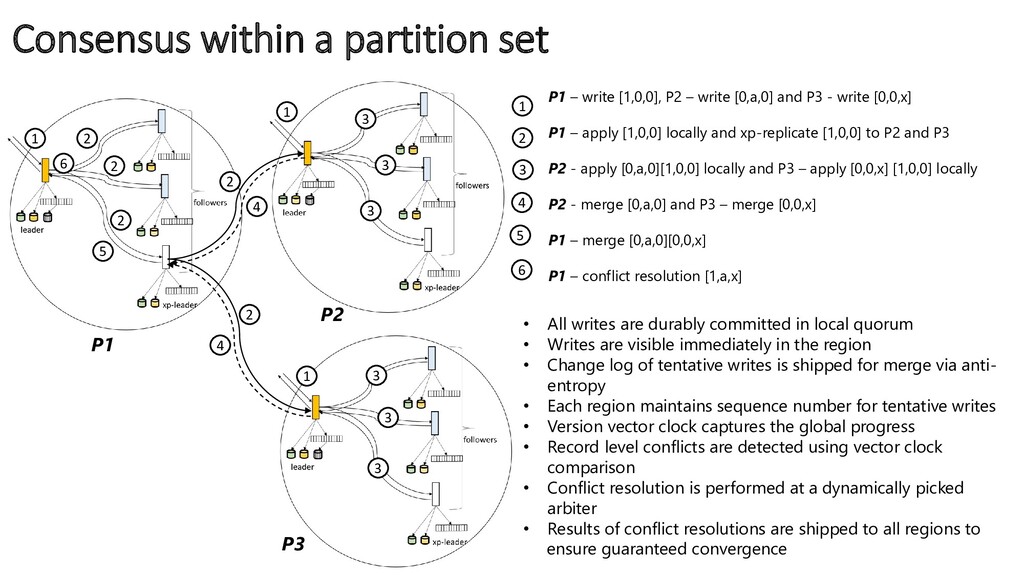
  13. Consensus within a partition set 1 2 2 1 4

    4 1 1 • All writes are durably committed in local quorum • Writes are visible immediately in the region • Change log of tentative writes is shipped for merge via anti- entropy • Each region maintains sequence number for tentative writes • Version vector clock captures the global progress • Record level conflicts are detected using vector clock comparison • Conflict resolution is performed at a dynamically picked arbiter • Results of conflict resolutions are shipped to all regions to ensure guaranteed convergence P1 – write [1,0,0], P2 – write [0,a,0] and P3 - write [0,0,x] P1 – apply [1,0,0] locally and xp-replicate [1,0,0] to P2 and P3 P2 - apply [0,a,0][1,0,0] locally and P3 – apply [0,0,x] [1,0,0] locally P2 - merge [0,a,0] and P3 – merge [0,0,x] P1 – merge [0,a,0][0,0,x] P1 – conflict resolution [1,a,x] 2 2 2 2 3 3 3 3 3 3 3 5 4 5 6 6 P1 P2 P3
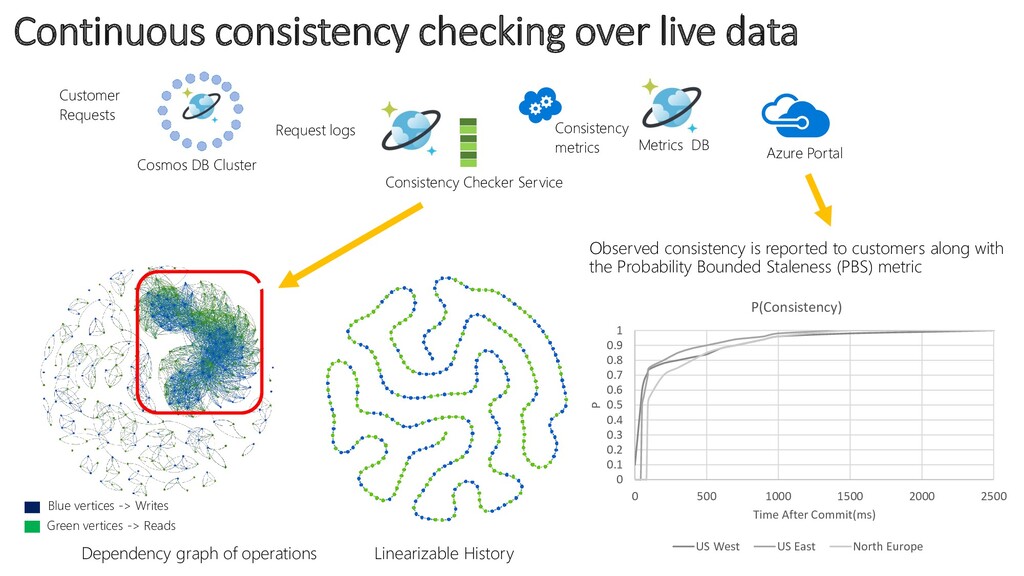
  14. Continuous consistency checking over live data Cosmos DB Cluster Consistency

    Checker Service Request logs Metrics DB Azure Portal Consistency metrics Blue vertices -> Writes Green vertices -> Reads Linearizable History Dependency graph of operations Customer Requests Observed consistency is reported to customers along with the Probability Bounded Staleness (PBS) metric 0 0.1 0.2 0.3 0.4 0.5 0.6 0.7 0.8 0.9 1 0 500 1000 1500 2000 2500 P Time After Commit(ms) P(Consistency) US West US East North Europe
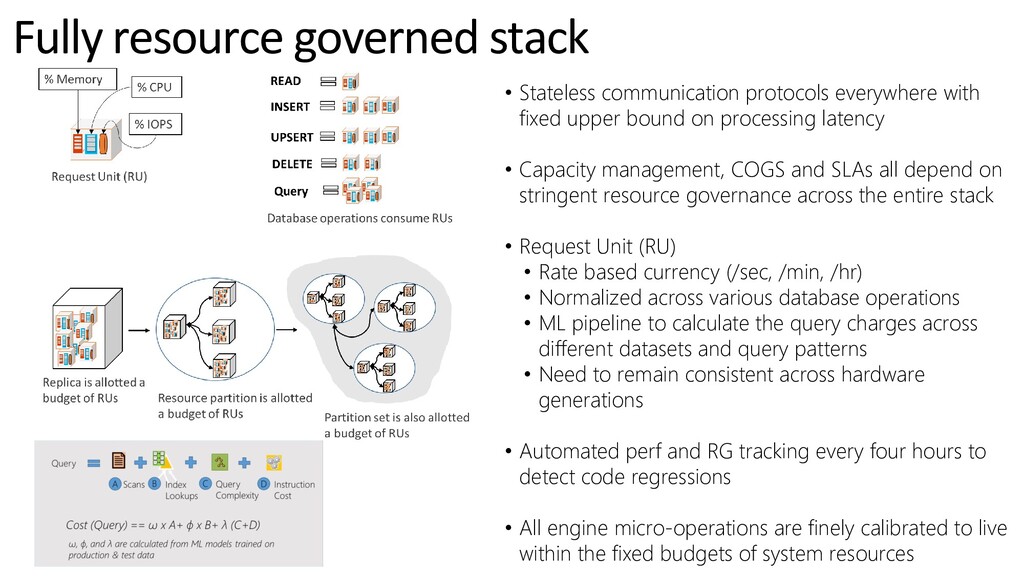
  15. Fully resource governed stack • Stateless communication protocols everywhere with

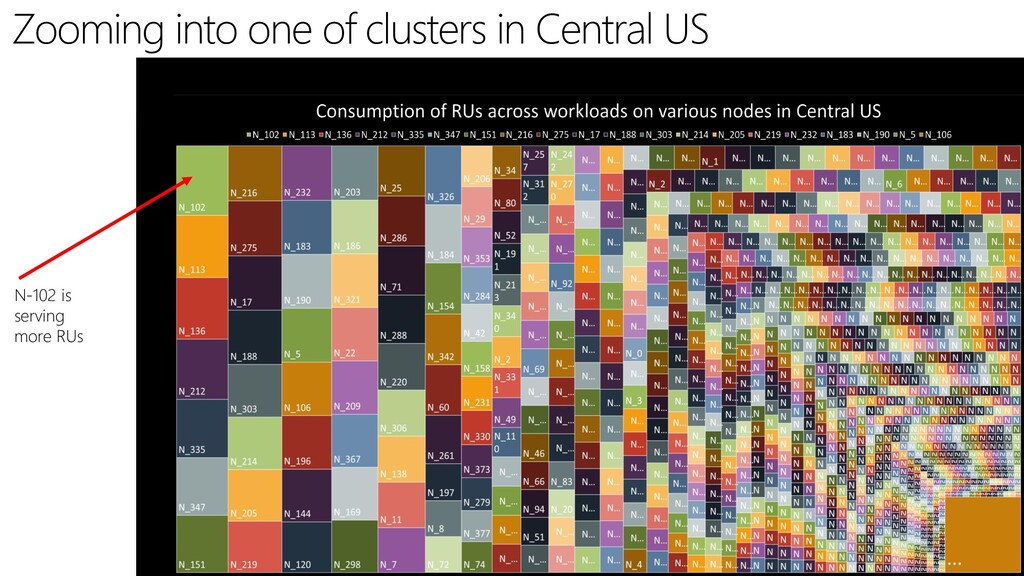
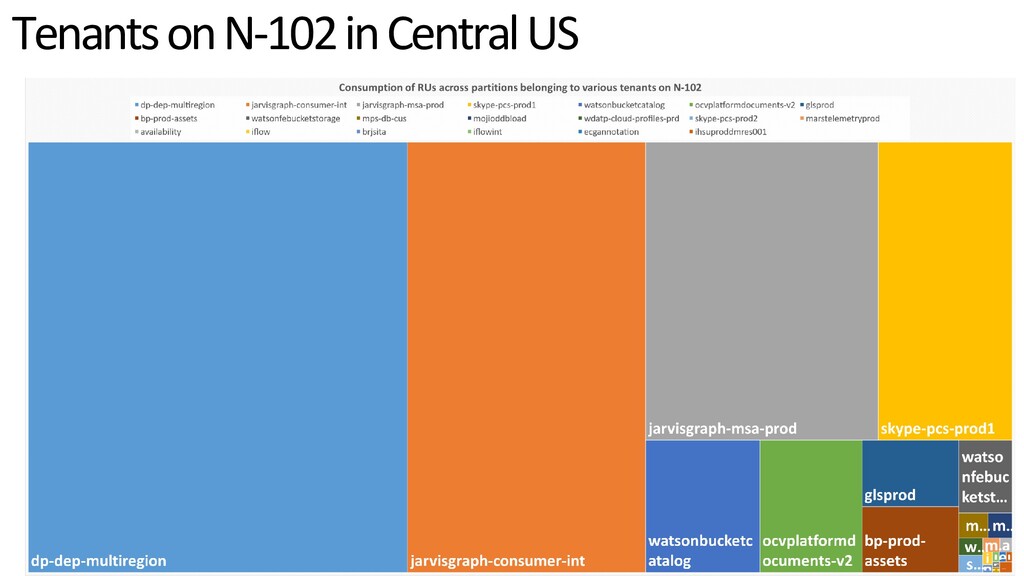
    fixed upper bound on processing latency • Capacity management, COGS and SLAs all depend on stringent resource governance across the entire stack • Request Unit (RU) • Rate based currency (/sec, /min, /hr) • Normalized across various database operations • ML pipeline to calculate the query charges across different datasets and query patterns • Need to remain consistent across hardware generations • Automated perf and RG tracking every four hours to detect code regressions • All engine micro-operations are finely calibrated to live within the fixed budgets of system resources
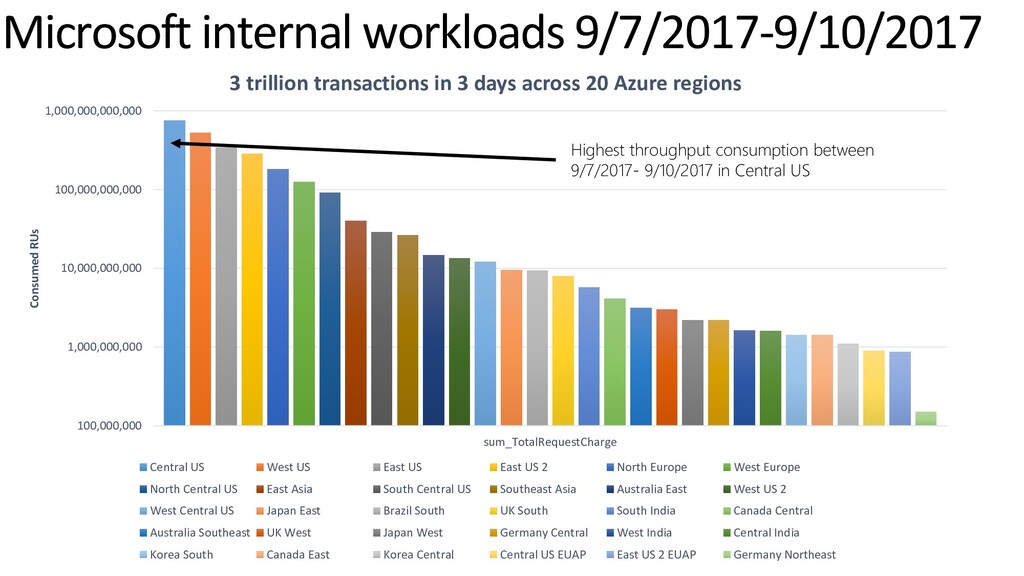
  16. 100,000,000 1,000,000,000 10,000,000,000 100,000,000,000 1,000,000,000,000 sum_TotalRequestCharge Consumed RUs 3 trillion

    transactions in 3 days across 20 Azure regions Central US West US East US East US 2 North Europe West Europe North Central US East Asia South Central US Southeast Asia Australia East West US 2 West Central US Japan East Brazil South UK South South India Canada Central Australia Southeast UK West Japan West Germany Central West India Central India Korea South Canada East Korea Central Central US EUAP East US 2 EUAP Germany Northeast Microsoft internal workloads 9/7/2017-9/10/2017 Highest throughput consumption between 9/7/2017- 9/10/2017 in Central US
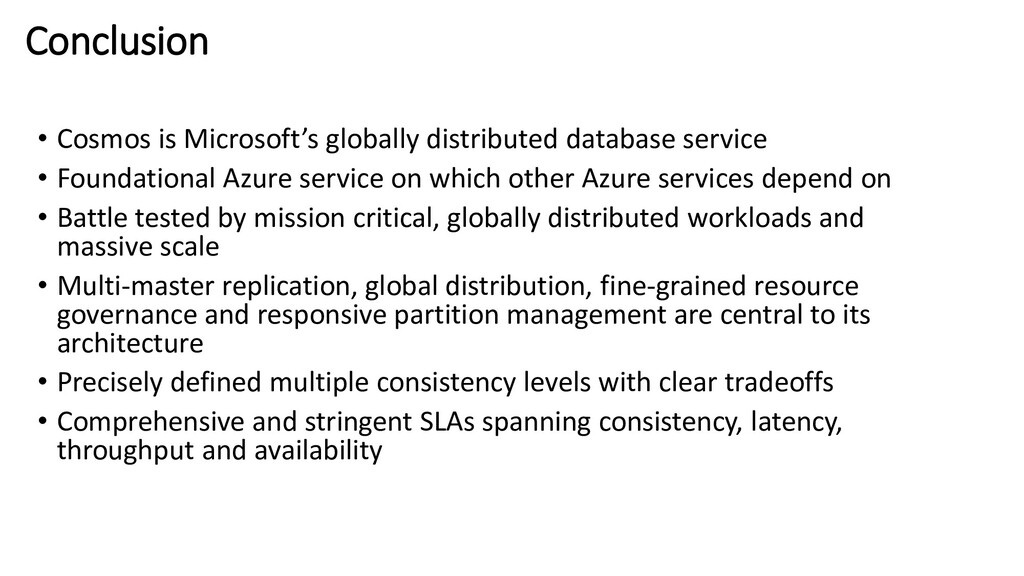
  17. Conclusion • Cosmos is Microsoft’s globally distributed database service •

    Foundational Azure service on which other Azure services depend on • Battle tested by mission critical, globally distributed workloads and massive scale • Multi-master replication, global distribution, fine-grained resource governance and responsive partition management are central to its architecture • Precisely defined multiple consistency levels with clear tradeoffs • Comprehensive and stringent SLAs spanning consistency, latency, throughput and availability
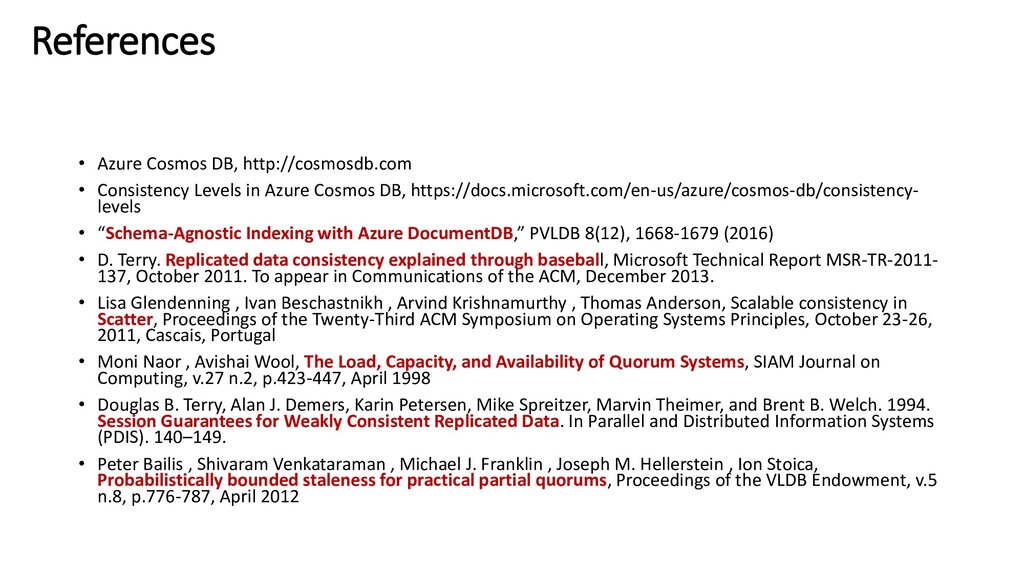
  18. References • Azure Cosmos DB, http://cosmosdb.com • Consistency Levels in

    Azure Cosmos DB, https://docs.microsoft.com/en-us/azure/cosmos-db/consistency- levels • “Schema-Agnostic Indexing with Azure DocumentDB,” PVLDB 8(12), 1668-1679 (2016) • D. Terry. Replicated data consistency explained through baseball, Microsoft Technical Report MSR-TR-2011- 137, October 2011. To appear in Communications of the ACM, December 2013. • Lisa Glendenning , Ivan Beschastnikh , Arvind Krishnamurthy , Thomas Anderson, Scalable consistency in Scatter, Proceedings of the Twenty-Third ACM Symposium on Operating Systems Principles, October 23-26, 2011, Cascais, Portugal • Moni Naor , Avishai Wool, The Load, Capacity, and Availability of Quorum Systems, SIAM Journal on Computing, v.27 n.2, p.423-447, April 1998 • Douglas B. Terry, Alan J. Demers, Karin Petersen, Mike Spreitzer, Marvin Theimer, and Brent B. Welch. 1994. Session Guarantees for Weakly Consistent Replicated Data. In Parallel and Distributed Information Systems (PDIS). 140–149. • Peter Bailis , Shivaram Venkataraman , Michael J. Franklin , Joseph M. Hellerstein , Ion Stoica, Probabilistically bounded staleness for practical partial quorums, Proceedings of the VLDB Endowment, v.5 n.8, p.776-787, April 2012