The 3 Types of AP Leaders — and Why Only One Powers Growth
Discover the 3 types of Accounts Payable (AP) leaders—Traditionalist, Optimizer, and AI-Driven Strategist—and learn why only one can truly drive business growth through proactive insights and AI integration.
(AP) leaders and understand why only one truly drives business growth. Importance: In a rapidly evolving business landscape, the role of AP leaders is pivotal in shaping financial operations.
and keeps processes moving. • Focuses on execution without anticipating future challenges. • Limitations: • Reacting to errors and fraud risks rather than proactively addressing them. • Lacks integration of AI and data insights. • Outcome: While dependable, this approach is becoming outdated in the modern business environment.
and embraces automation tools. • Implements technologies like Optical Character Recognition (OCR) for invoice capture. • Utilizes dashboards for tracking early payment savings and processing cycle times. • Limitations: • Primarily focuses on historical data. • Optimizes existing processes without driving strategic change. • Outcome: Improves efficiency but may miss opportunities for strategic growth.
Integrates Artificial Intelligence (AI) into AP systems. • AI capabilities include: • Flagging duplicate invoices before payment. • Predicting potential vendor delays based on payment patterns. • Recommending optimal payment timings to enhance cash flow and supplier relationships. • Aligns AP insights directly with business goals. • Outcome: Not only saves money but also safeguards and drives business growth.
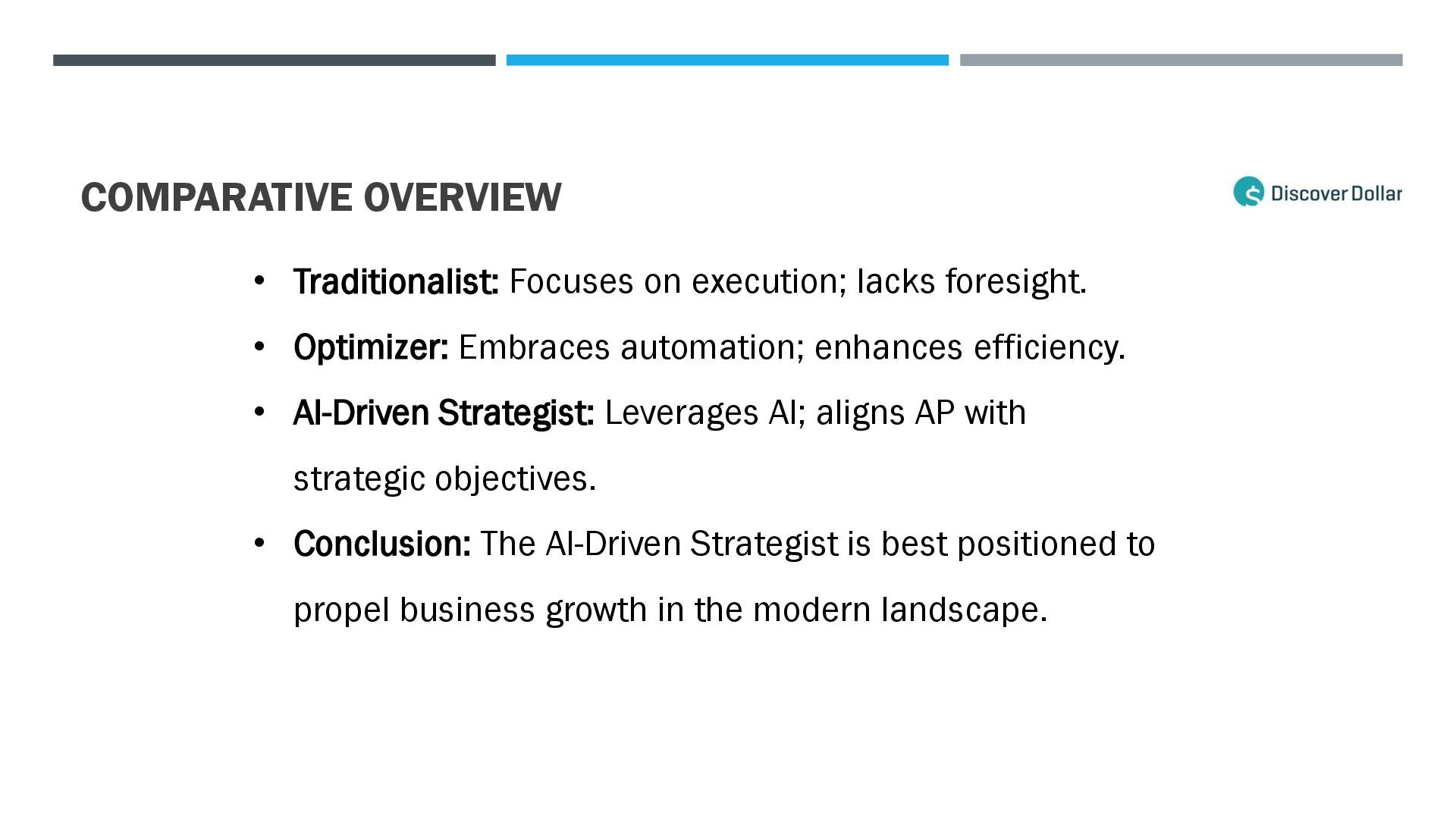
Optimizer: Embraces automation; enhances efficiency. • AI-Driven Strategist: Leverages AI; aligns AP with strategic objectives. • Conclusion: The AI-Driven Strategist is best positioned to propel business growth in the modern landscape.
Anticipates challenges before they arise. • Strategic Alignment: Aligns financial operations with broader business objectives. • Competitive Edge: In a world where every dollar and delay matters, AI isn't optional—it's a competitive edge.
to not only optimize processes but also to drive strategic business outcomes. • Embrace AI-driven strategies to stay ahead in the competitive business environment.


 discoverdollar
 thomaspeham
 shunsuke_takeuchi
 gatechnologies
 stanby_inc
 auditech2022
 ikmwatanabe
 mwktp
mwktp
 kuraryu0128
 fullerene_inc
 kazumakitao
 c0rp_mdm
 kazuyama88
 shpigford
 tammyeverts
 katiecoart
 orderedlist
 aleyda
 holman
 jct
jct
 codingconduct
 tessaabrams
 cassininazir
 portentint