Upgrade to PRO for Only $50/Year—Limited-Time Offer! 🔥

OP Education Test

Avatar for e4health e4health PRO
August 03, 2023
110

OP Education Test

Avatar for e4health

e4health PRO

August 03, 2023

Transcript

  1. Medication Noncompliance Should we use medication noncompliance Z-codes or Underdosing

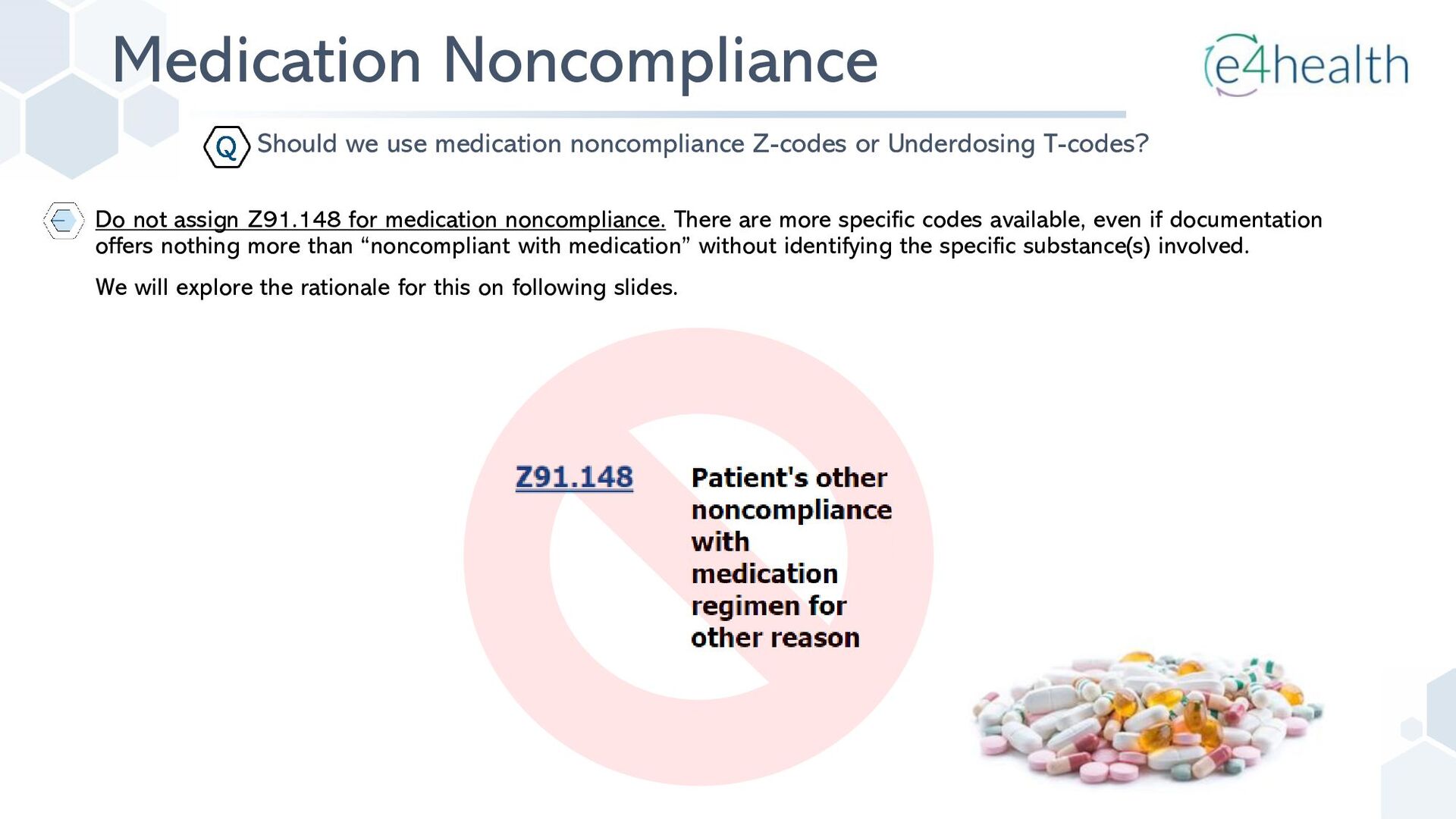
    T-codes? Do not assign Z91.148 for medication noncompliance. There are more specific codes available, even if documentation offers nothing more than “noncompliant with medication” without identifying the specific substance(s) involved. We will explore the rationale for this on following slides.
  2. Medication Noncompliance Should we use medication noncompliance Z-codes or Underdosing

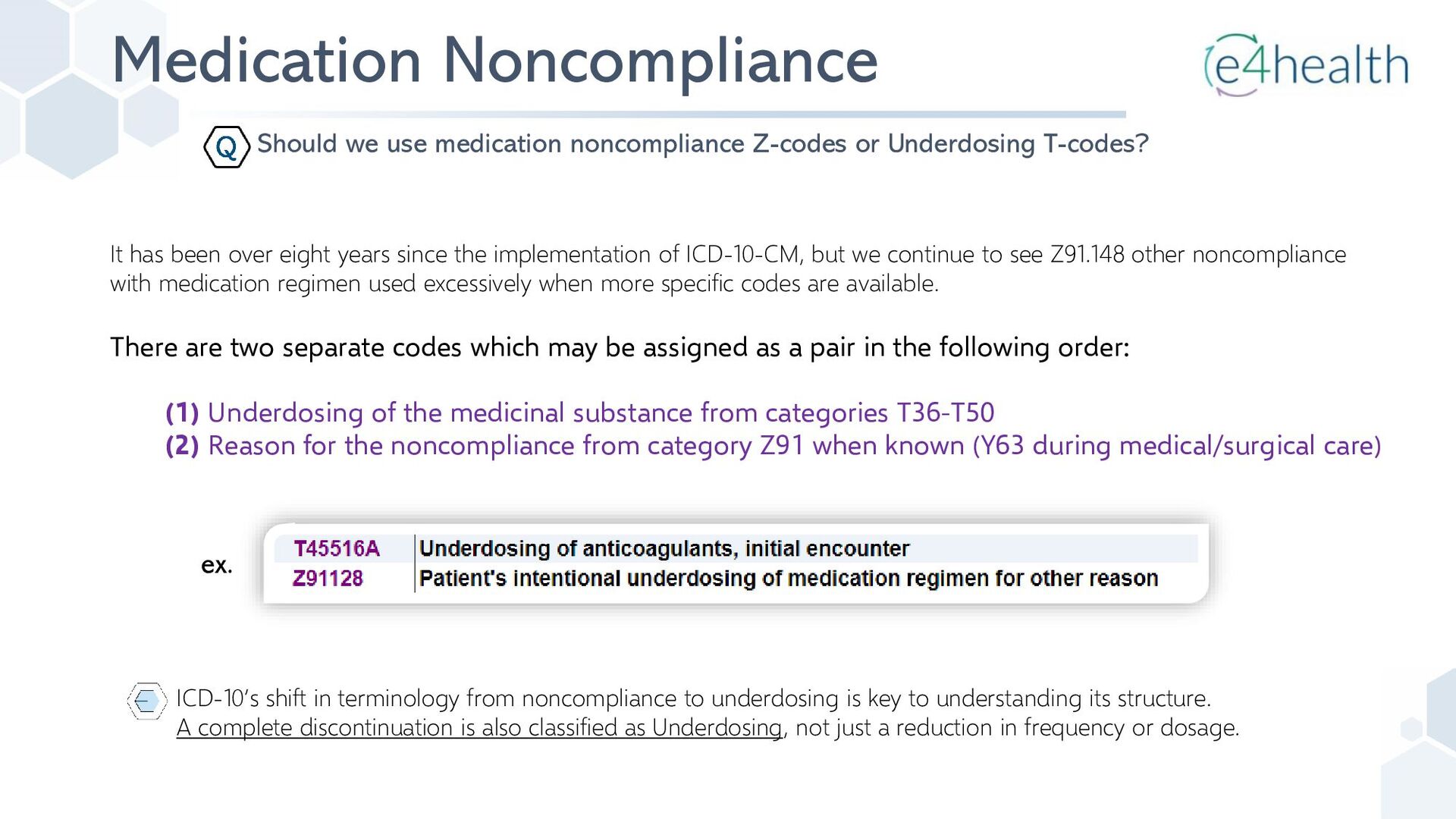
    T-codes? It has been over eight years since the implementation of ICD-10-CM, but we continue to see Z91.148 other noncompliance with medication regimen used excessively when more specific codes are available. There are two separate codes which may be assigned as a pair in the following order: (1) Underdosing of the medicinal substance from categories T36-T50 (2) Reason for the noncompliance from category Z91 when known (Y63 during medical/surgical care) ICD-10’s shift in terminology from noncompliance to underdosing is key to understanding its structure. A complete discontinuation is also classified as Underdosing, not just a reduction in frequency or dosage. ex.
  3. Should we use medication noncompliance Z-codes or Underdosing T-codes? Underdosing

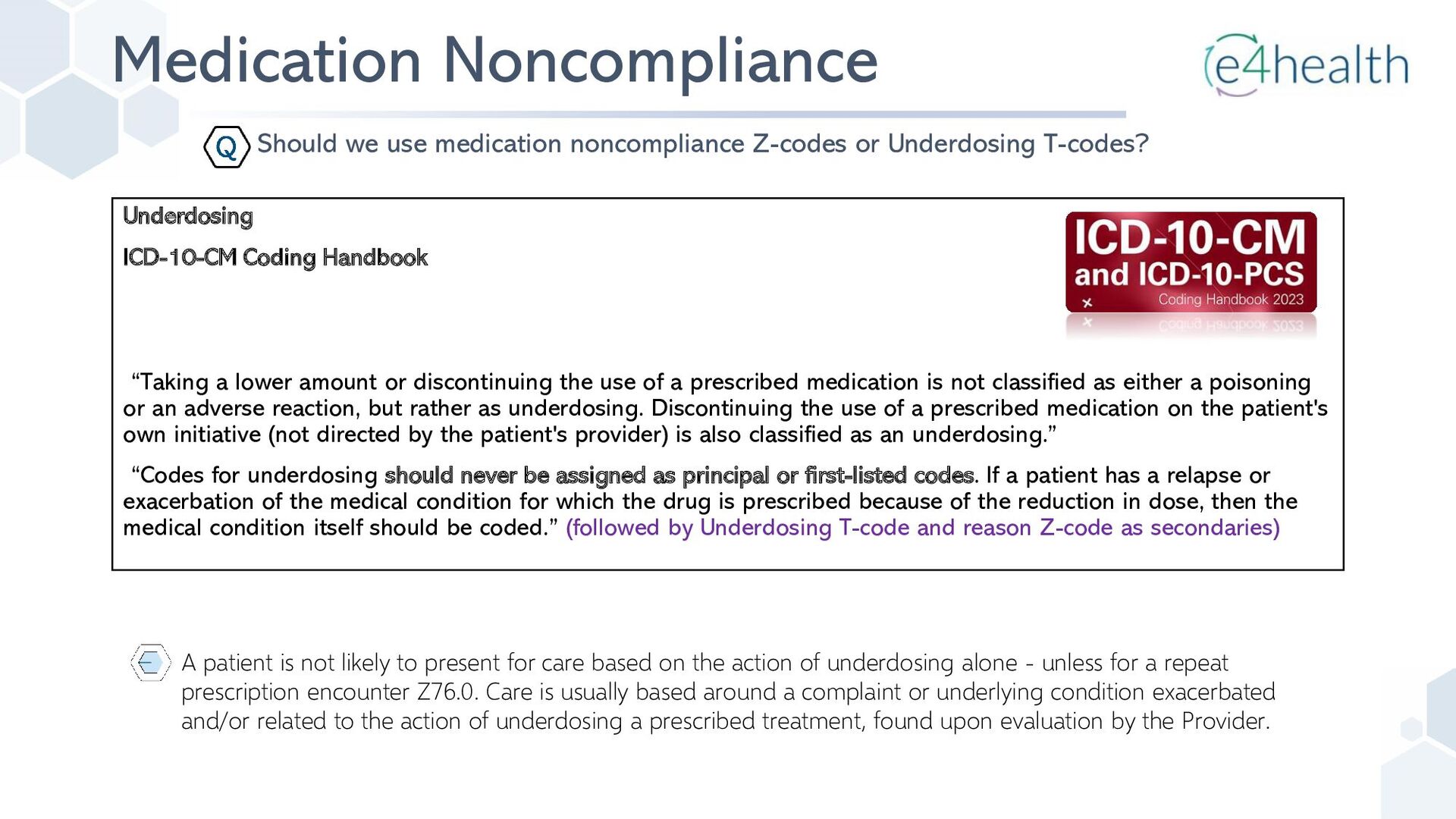
    ICD-10-CM Coding Handbook “Taking a lower amount or discontinuing the use of a prescribed medication is not classified as either a poisoning or an adverse reaction, but rather as underdosing. Discontinuing the use of a prescribed medication on the patient's own initiative (not directed by the patient's provider) is also classified as an underdosing.” “Codes for underdosing should never be assigned as principal or first-listed codes. If a patient has a relapse or exacerbation of the medical condition for which the drug is prescribed because of the reduction in dose, then the medical condition itself should be coded.” (followed by Underdosing T-code and reason Z-code as secondaries) Medication Noncompliance A patient is not likely to present for care based on the action of underdosing alone - unless for a repeat prescription encounter Z76.0. Care is usually based around a complaint or underlying condition exacerbated and/or related to the action of underdosing a prescribed treatment, found upon evaluation by the Provider.
  4. Should we use medication noncompliance Z-codes or Underdosing T-codes? ICD-10-CM

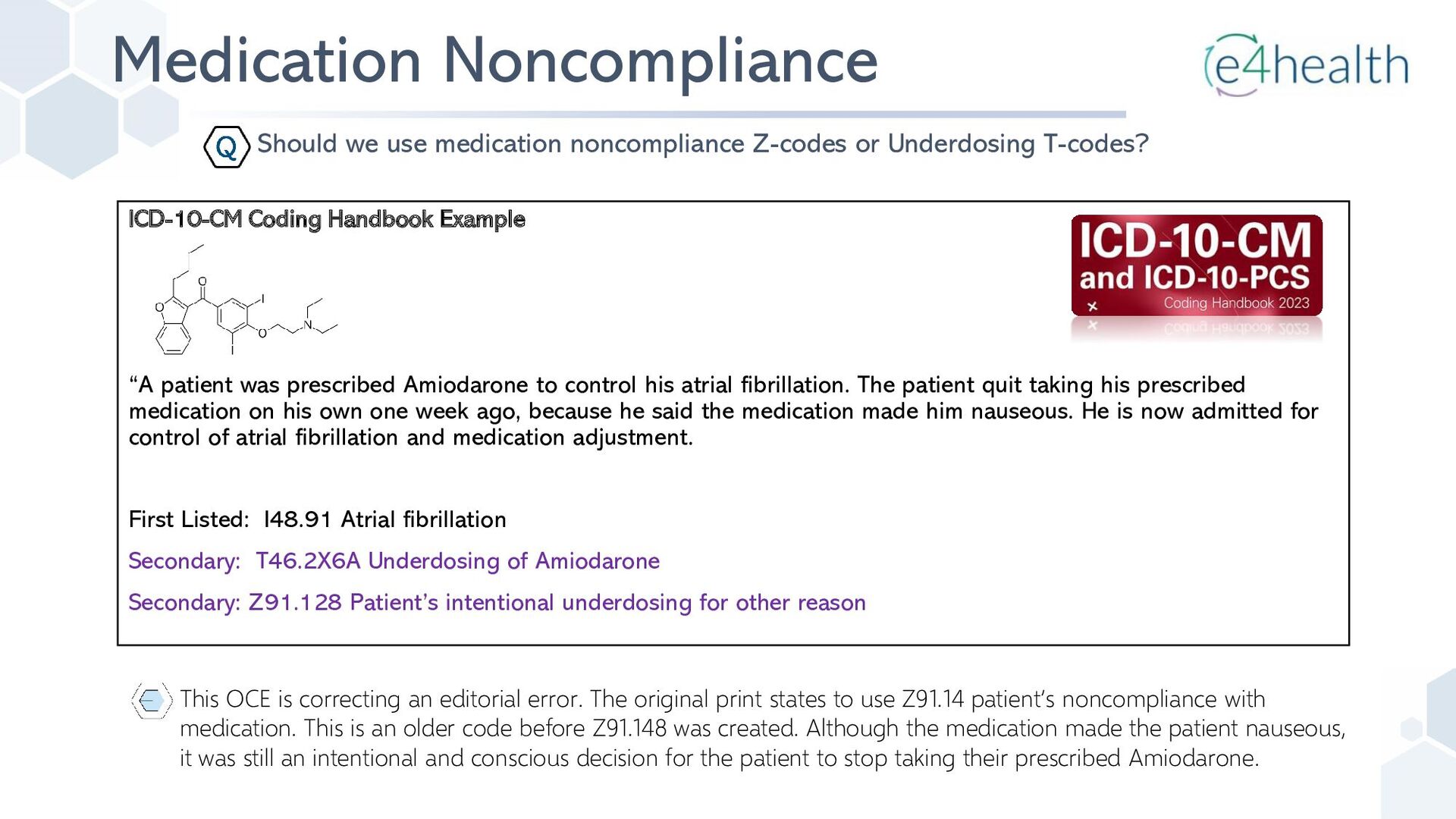
    Coding Handbook Example “A patient was prescribed Amiodarone to control his atrial fibrillation. The patient quit taking his prescribed medication on his own one week ago, because he said the medication made him nauseous. He is now admitted for control of atrial fibrillation and medication adjustment. First Listed: I48.91 Atrial fibrillation Secondary: T46.2X6A Underdosing of Amiodarone Secondary: Z91.128 Patient’s intentional underdosing for other reason Medication Noncompliance This OCE is correcting an editorial error. The original print states to use Z91.14 patient’s noncompliance with medication. This is an older code before Z91.148 was created. Although the medication made the patient nauseous, it was still an intentional and conscious decision for the patient to stop taking their prescribed Amiodarone.
  5. Medication Noncompliance Should we use medication noncompliance Z-codes or Underdosing

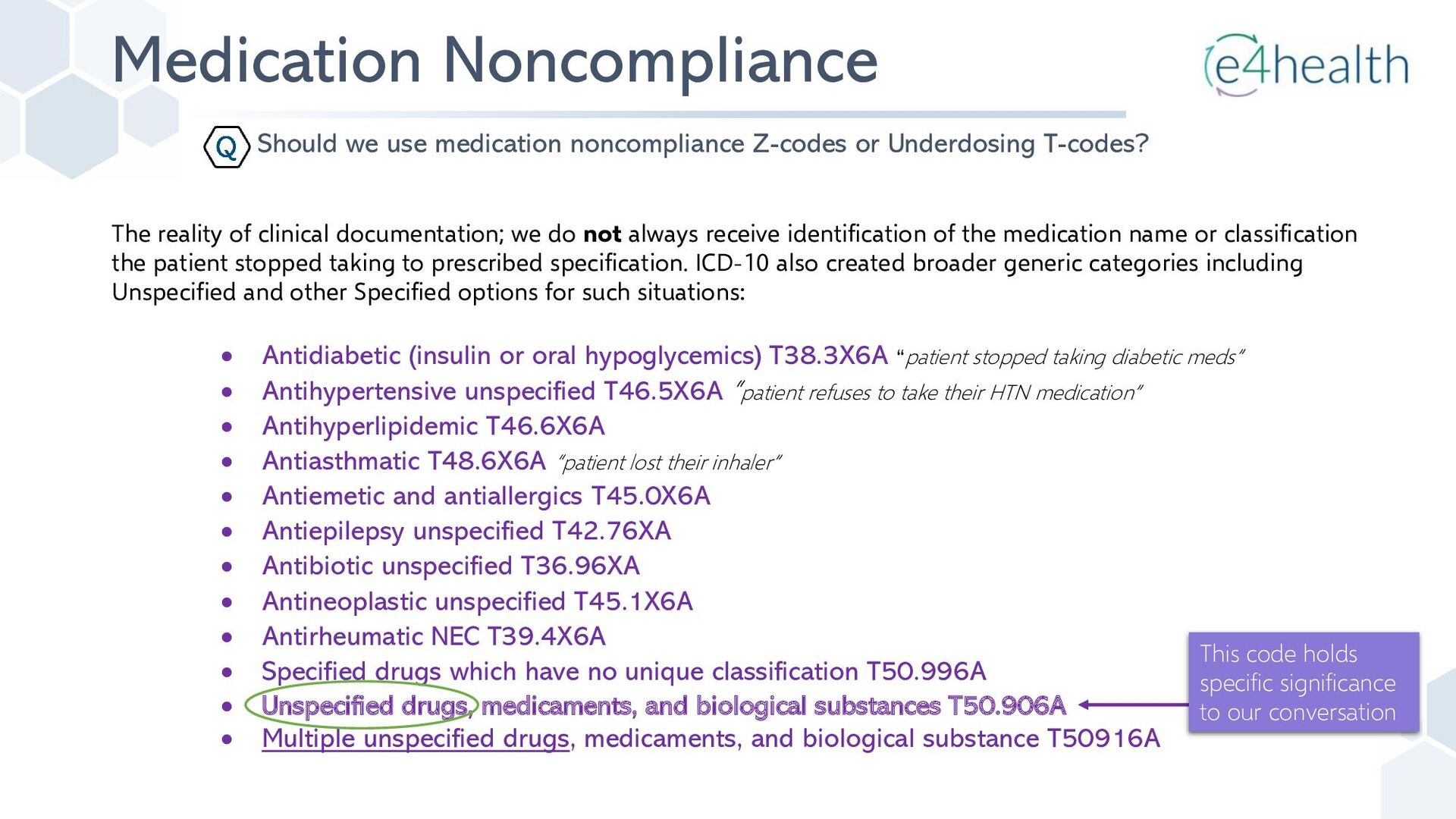
    T-codes? The reality of clinical documentation; we do not always receive identification of the medication name or classification the patient stopped taking to prescribed specification. ICD-10 also created broader generic categories including Unspecified and other Specified options for such situations: • Antidiabetic (insulin or oral hypoglycemics) T38.3X6A “patient stopped taking diabetic meds” • Antihypertensive unspecified T46.5X6A “patient refuses to take their HTN medication” • Antihyperlipidemic T46.6X6A • Antiasthmatic T48.6X6A “patient lost their inhaler” • Antiemetic and antiallergics T45.0X6A • Antiepilepsy unspecified T42.76XA • Antibiotic unspecified T36.96XA • Antineoplastic unspecified T45.1X6A • Antirheumatic NEC T39.4X6A • Specified drugs which have no unique classification T50.996A • Unspecified drugs, medicaments, and biological substances T50.906A • Multiple unspecified drugs, medicaments, and biological substance T50916A This code holds specific significance to our conversation
  6. Medication Noncompliance Should we use medication noncompliance Z-codes or Underdosing

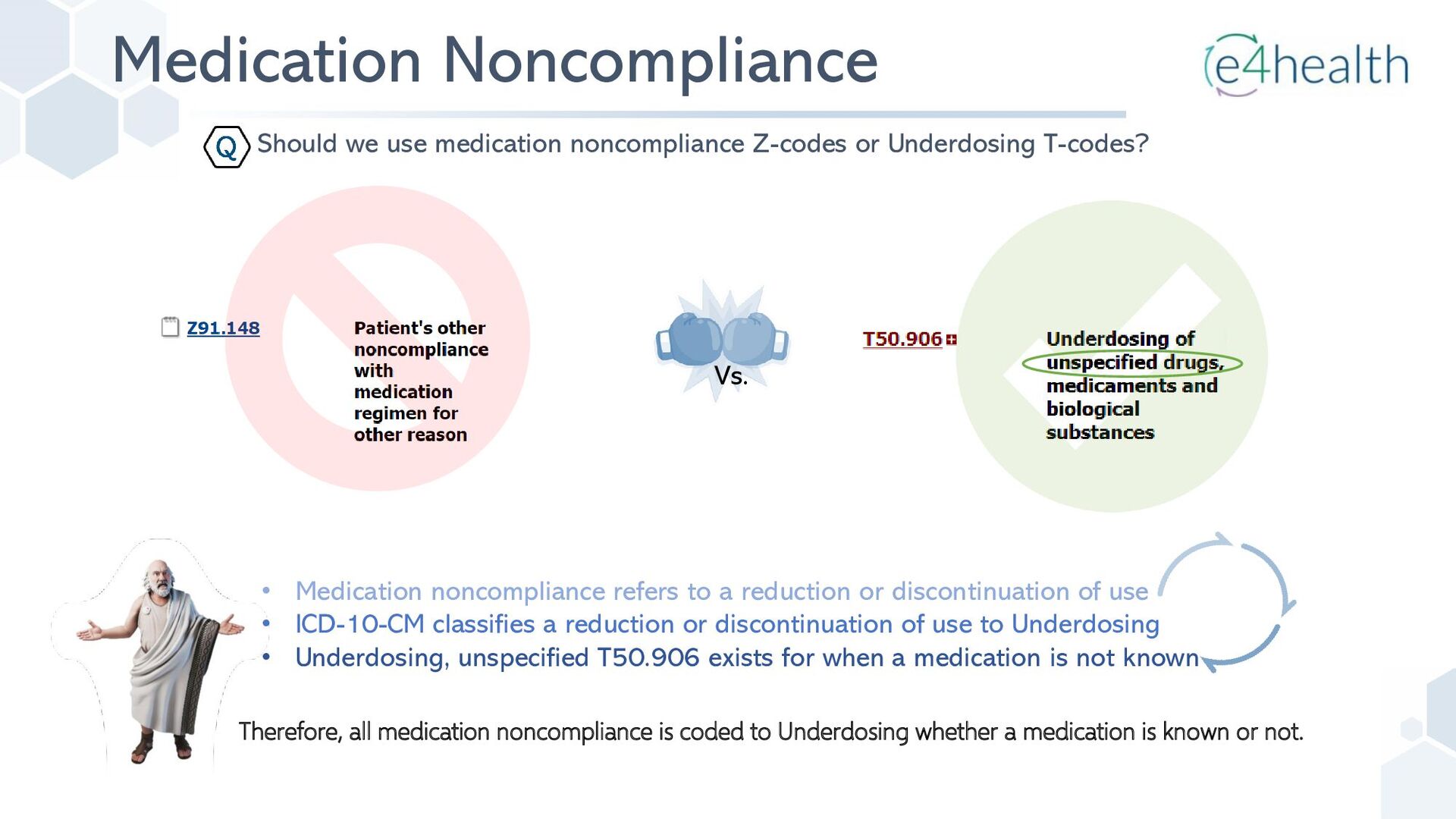
    T-codes? Vs. • Medication noncompliance refers to a reduction or discontinuation of use • ICD-10-CM classifies a reduction or discontinuation of use to Underdosing • Underdosing, unspecified T50.906 exists for when a medication is not known Therefore, all medication noncompliance is coded to Underdosing whether a medication is known or not.
  7. Medication Noncompliance Should we use medication noncompliance Z-codes or Underdosing

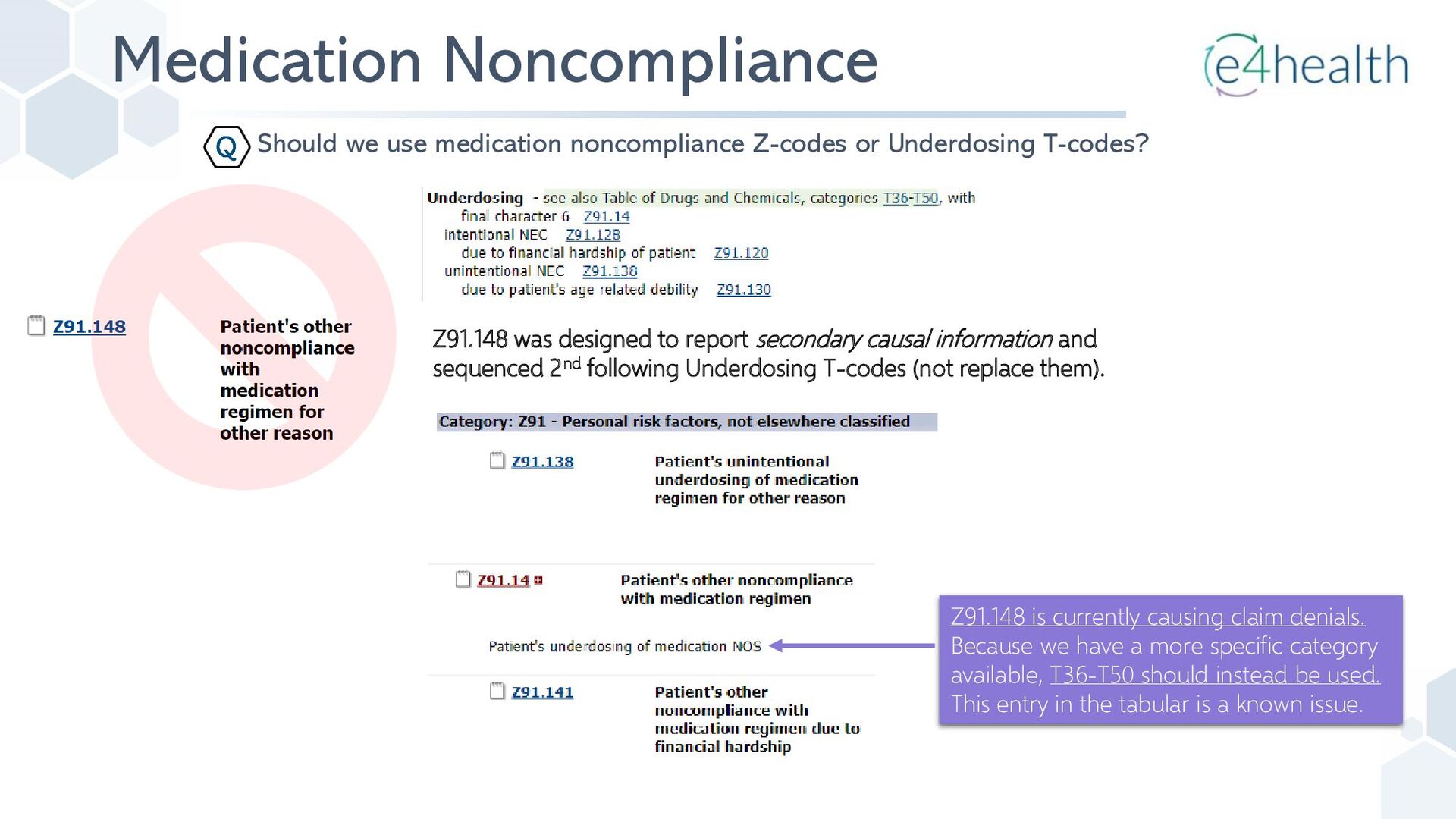
    T-codes? Z91.148 was designed to report secondary causal information and sequenced 2nd following Underdosing T-codes (not replace them). Z91.148 is currently causing claim denials. Because we have a more specific category available, T36-T50 should instead be used. This entry in the tabular is a known issue.
  8. Intentional vs. Unintentional If Z91.148 is a suggested no-code, which

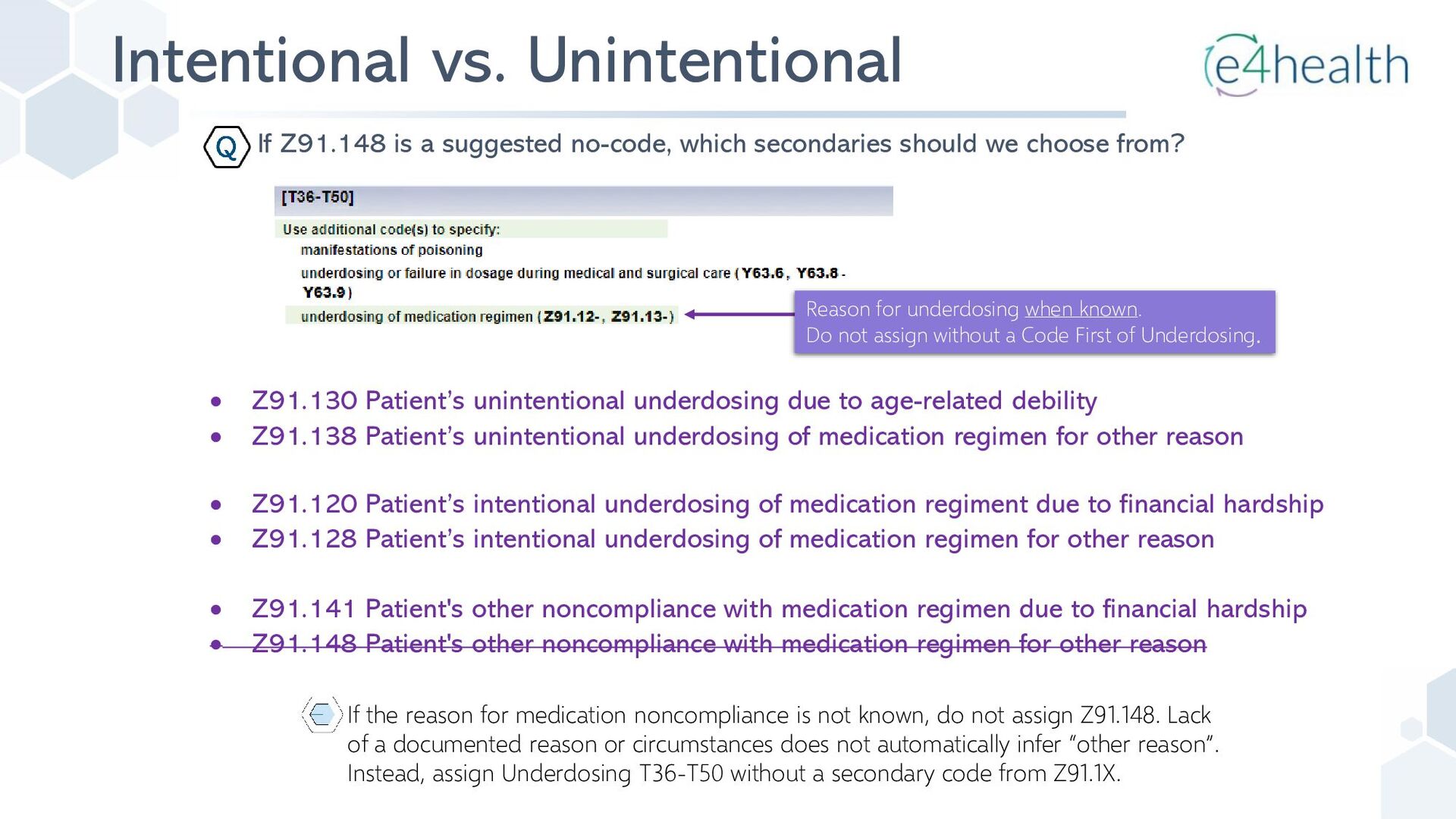
    secondaries should we choose from? • Z91.130 Patient’s unintentional underdosing due to age-related debility • Z91.138 Patient’s unintentional underdosing of medication regimen for other reason • Z91.120 Patient’s intentional underdosing of medication regiment due to financial hardship • Z91.128 Patient’s intentional underdosing of medication regimen for other reason • Z91.141 Patient's other noncompliance with medication regimen due to financial hardship • Z91.148 Patient's other noncompliance with medication regimen for other reason Reason for underdosing when known. Do not assign without a Code First of Underdosing. If the reason for medication noncompliance is not known, do not assign Z91.148. Lack of a documented reason or circumstances does not automatically infer “other reason”. Instead, assign Underdosing T36-T50 without a secondary code from Z91.1X.
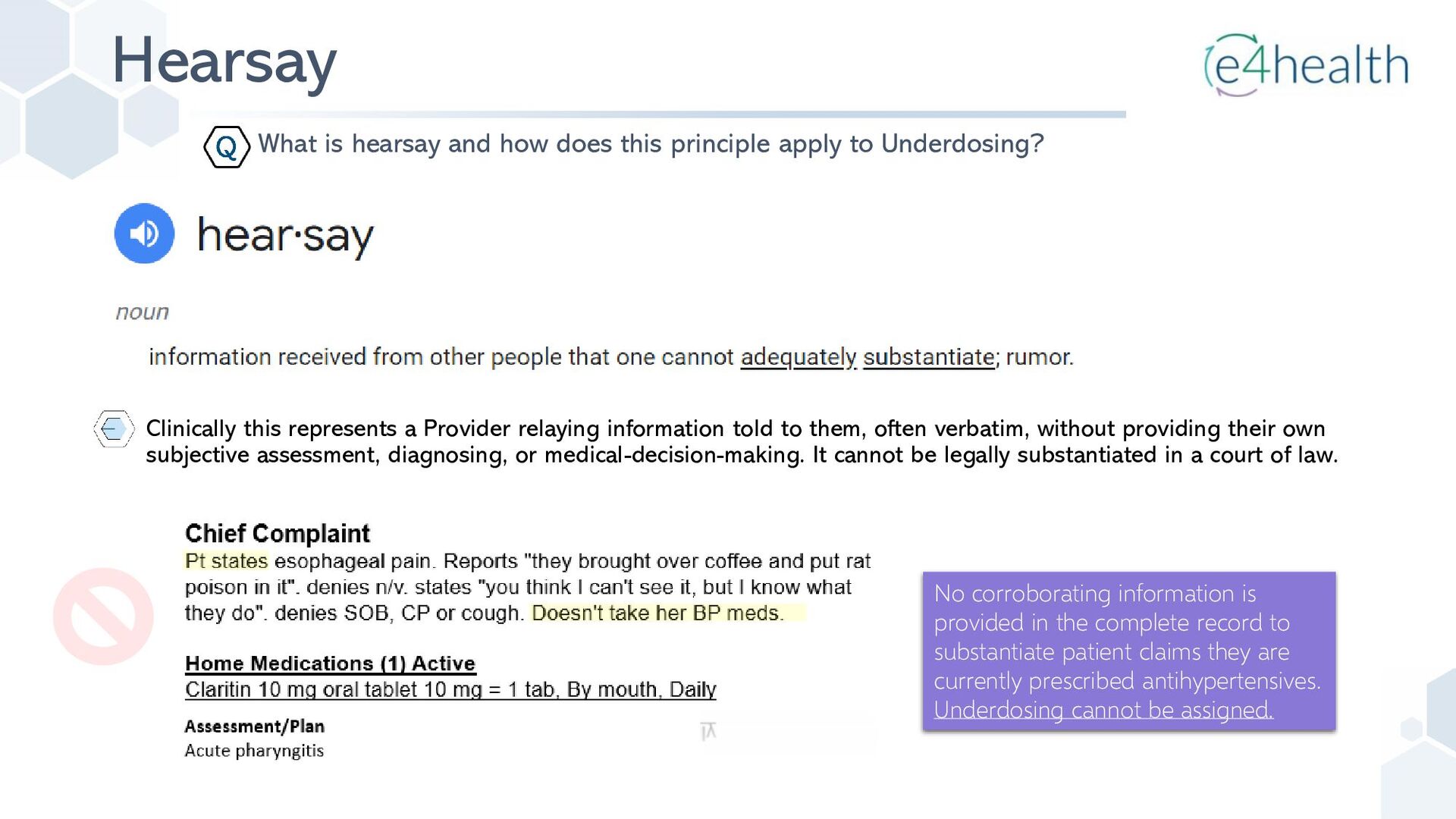
  9. Hearsay What is hearsay and how does this principle apply

    to Underdosing? Clinically this represents a Provider relaying information told to them, often verbatim, without providing their own subjective assessment, diagnosing, or medical-decision-making. It cannot be legally substantiated in a court of law. No corroborating information is provided in the complete record to substantiate patient claims they are currently prescribed antihypertensives. Underdosing cannot be assigned.
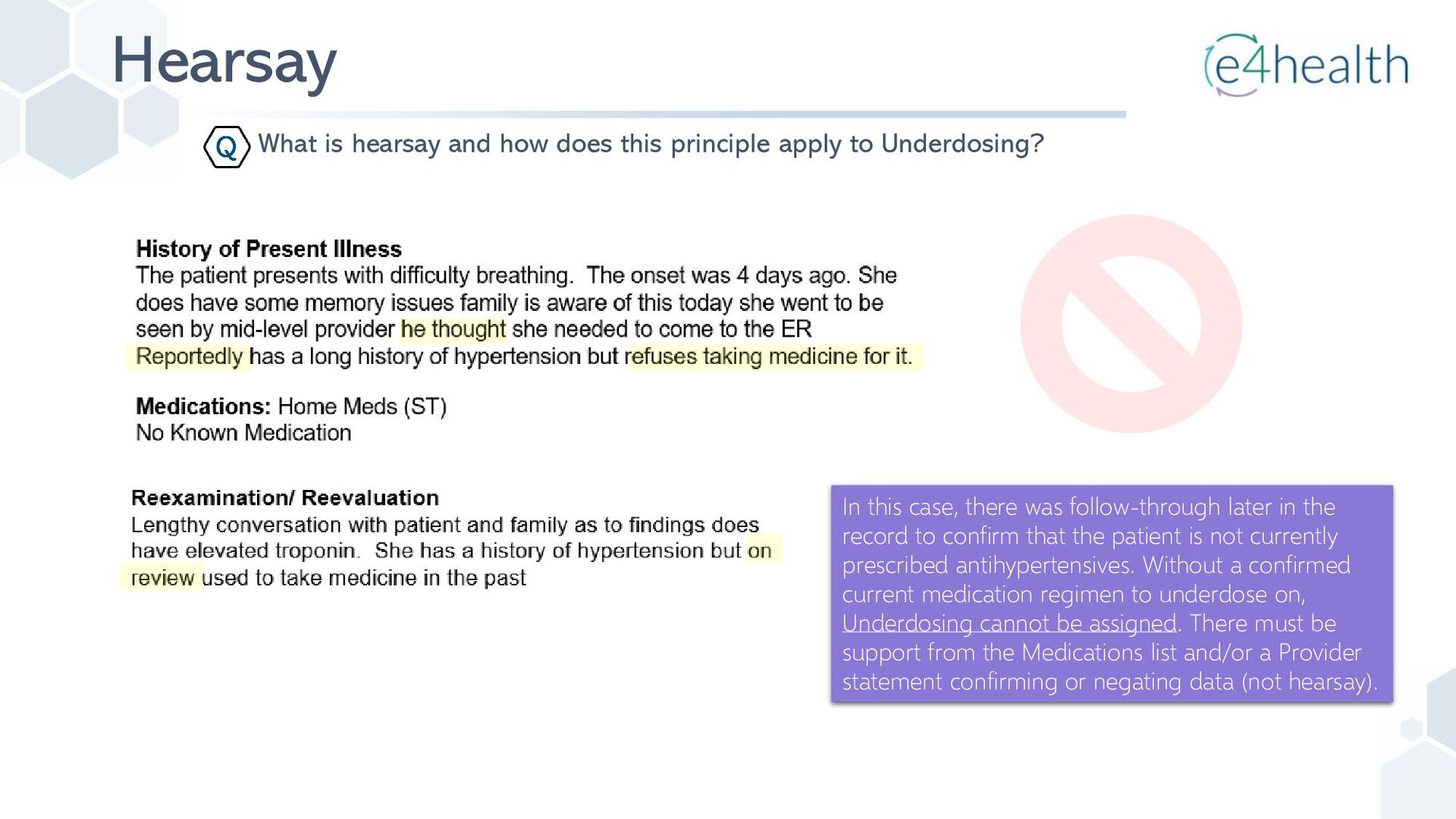
  10. Hearsay What is hearsay and how does this principle apply

    to Underdosing? In this case, there was follow-through later in the record to confirm that the patient is not currently prescribed antihypertensives. Without a confirmed current medication regimen to underdose on, Underdosing cannot be assigned. There must be support from the Medications list and/or a Provider statement confirming or negating data (not hearsay).
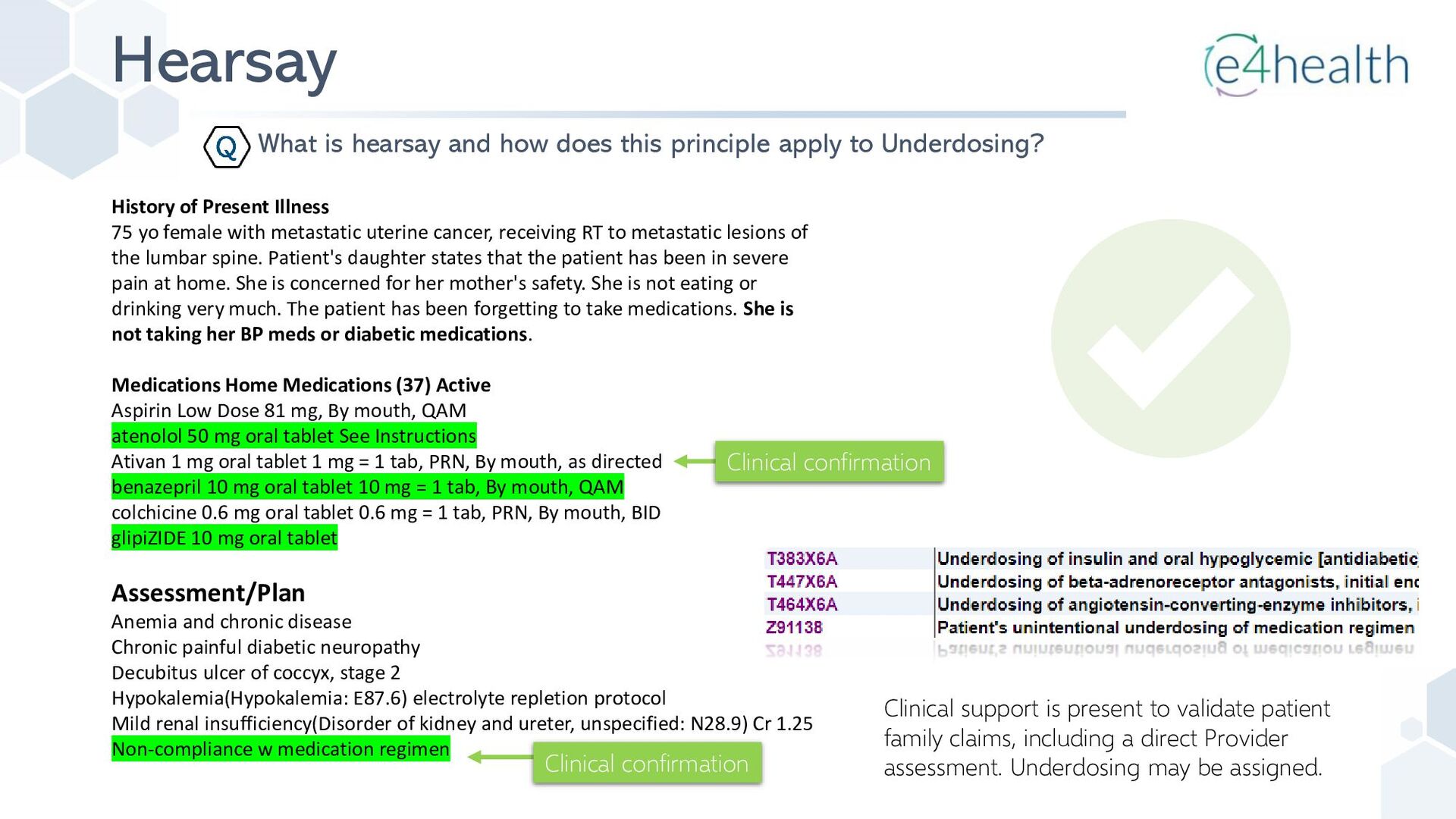
  11. Hearsay What is hearsay and how does this principle apply

    to Underdosing? History of Present Illness 75 yo female with metastatic uterine cancer, receiving RT to metastatic lesions of the lumbar spine. Patient's daughter states that the patient has been in severe pain at home. She is concerned for her mother's safety. She is not eating or drinking very much. The patient has been forgetting to take medications. She is not taking her BP meds or diabetic medications. Medications Home Medications (37) Active Aspirin Low Dose 81 mg, By mouth, QAM atenolol 50 mg oral tablet See Instructions Ativan 1 mg oral tablet 1 mg = 1 tab, PRN, By mouth, as directed benazepril 10 mg oral tablet 10 mg = 1 tab, By mouth, QAM colchicine 0.6 mg oral tablet 0.6 mg = 1 tab, PRN, By mouth, BID glipiZIDE 10 mg oral tablet Assessment/Plan Anemia and chronic disease Chronic painful diabetic neuropathy Decubitus ulcer of coccyx, stage 2 Hypokalemia(Hypokalemia: E87.6) electrolyte repletion protocol Mild renal insufficiency(Disorder of kidney and ureter, unspecified: N28.9) Cr 1.25 Non-compliance w medication regimen Clinical confirmation Clinical confirmation Clinical support is present to validate patient family claims, including a direct Provider assessment. Underdosing may be assigned.
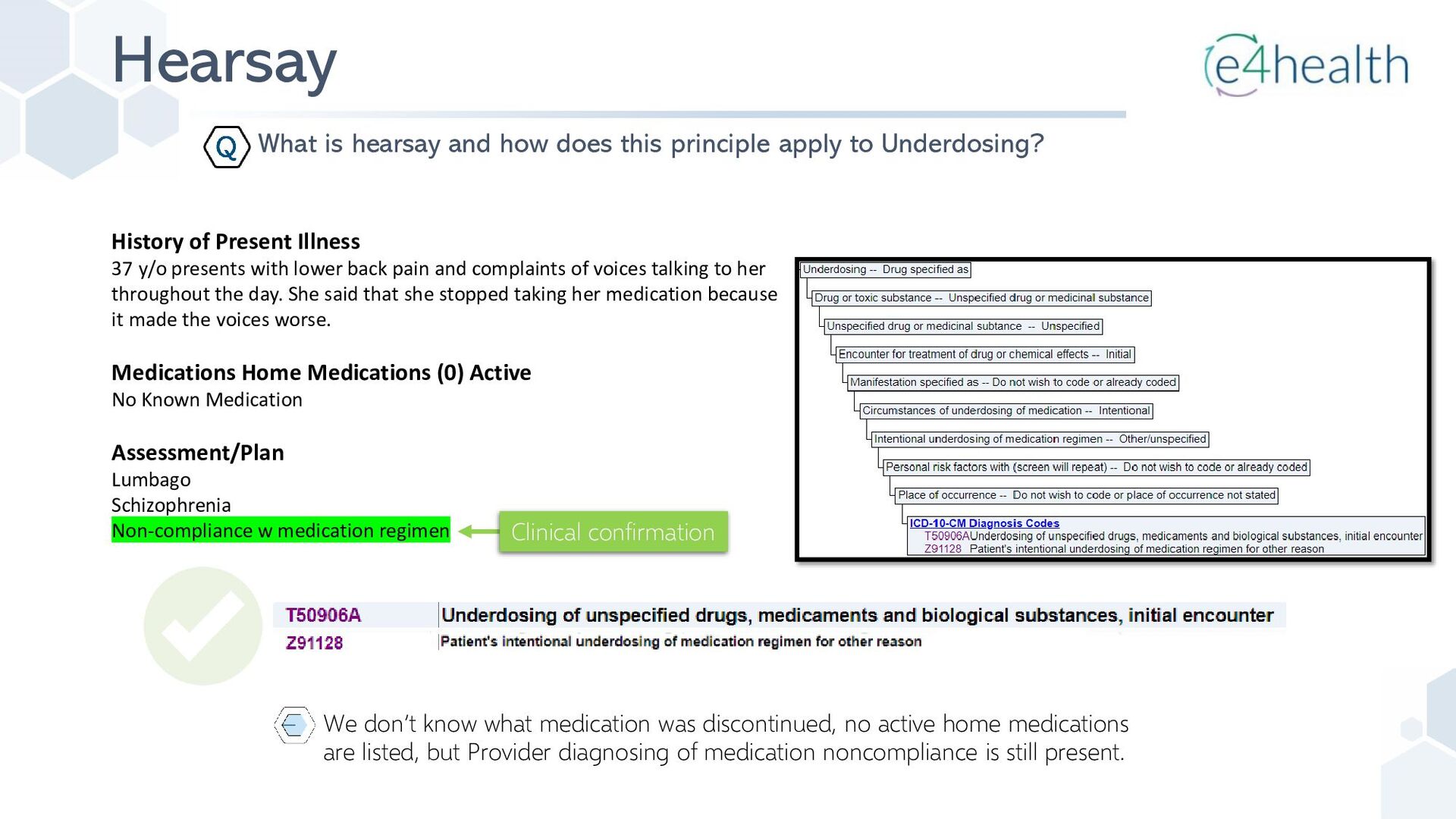
  12. Hearsay What is hearsay and how does this principle apply

    to Underdosing? History of Present Illness 37 y/o presents with lower back pain and complaints of voices talking to her throughout the day. She said that she stopped taking her medication because it made the voices worse. Medications Home Medications (0) Active No Known Medication Assessment/Plan Lumbago Schizophrenia Non-compliance w medication regimen Clinical confirmation We don’t know what medication was discontinued, no active home medications are listed, but Provider diagnosing of medication noncompliance is still present.