Interop New York - Building Your Network for th...
 Your Podcast. Everywhere. Effortlessly.
Share. Educate. Inspire. Entertain. You do you. We'll handle the rest.
→

Share
Interop New York - Building Your Network for the Next 10 Years
Networking is cool again! After a decade of relative technology stagnation, data center networking has been seen dozens of new technologies emerge to offer new business services. This means more networking, more technology and more things to do.
This workshop is well suited to network architects & engineers who want insights into the technology foundation of the data center network for the next 10 years. This session will particularly focus on the design principles for Private and Public Cloud networking and help understand the difference between "virtual networking" of today and "cloud networking" of tomorrow. This session will attempt to define Software Define Networking so that you can laugh at "software defined” vendors.
This workshop will explore the following:
Data Center Fabrics
L2 Fabrics - MLAG, TRILL / FabricPath / VCS
L3 Fabrics - Leaf/Spine, Juniper QFabric, Cisco Dynamic Fabric Automation
Virtual Networking (Legacy)
Introduction to Software Defined Networking
Controllers
OpenFlow, Cisco onePK, SLAX, NetConf
Overlay Networking
What is Overlay Networking and Why You Want It
Tunnel protocols VXLAN, NVGRE, MPLSoGRE,
Tunnel Fabrics, Network Agents,
Enterprise Security Overhaul
Cloud Networking
Networking for Virtual/Software Defined Data Centers
Programmable Infrastructure
Comparing Software-Only and Integrated Overlays

EtherealMind
Transcript
157 slides
-
About Me ‣ Host of Packet Pushers Podcast ‣ Freelance
Network Architect/Engineer ‣ Blog - EtherealMind.com ‣ NetworkComputing.com (http://networkcomputing.com/blogs/author/Greg-Ferro) ‣ Slides: speakerdeck.com/etherealmind 2 2 Tuesday, 1 October 13 -
Needs ‣ Understand your needs ‣ Write them down ‣
All cars are the almost the same. ‣ There isn’t much difference between them ‣ They all use the same fuel ‣ They all get you where you want to go 3 3 Tuesday, 1 October 13 -
Scheduling ‣ Phones ‣ Questions ‣ Toilets ‣ Break at
10:30am ‣ Four Parts 4 4 Tuesday, 1 October 13 -
Agenda - Part 0 Part 0 - Networking Renaissance Part
1 - Data Centre Fabrics & Designs Part 2 - Switch Internals Part 3 - SDN, Operations and Overlays 5 5 Tuesday, 1 October 13 -
The Renaissance •Scaling •Reliability •Multi-tenancy / Secure Zones •Host Mobility
•Virtualization 6 6 Tuesday, 1 October 13 -
Scaling ‣ Device density increasing ‣ 1 Physical > 50
Virtual (1000 MAC -> 50000MAC) ‣ 10GbE needed for 20-100 servers per physical servers ‣ 10GbE server means 40GbE uplinks 7 7 Tuesday, 1 October 13 -
Reliability ‣ Networks not reliable ‣ Brittle failure modes in
Data Centre ‣ Unreliable operations due to hand cranking ‣ sending humans to do a robots job ‣ who thinks configuring VLANs or firewall rules is “skill” ‣ Current change not reliable 8 8 Tuesday, 1 October 13 -
Multitenancy ‣ Multitenancy is about security ‣ Public Cloud obvious
‣ Enterprises need new Security models ‣ operational security needs more zones ‣ existing tools work but aren’t good enough ‣ Software Defined Data Centers 9 9 Tuesday, 1 October 13 -
Mobility ‣ Server mobility ‣ Application mobility ‣ Automated server
and application provisioning ‣ Faster Service Delivery through automation & orchestration 10 10 Tuesday, 1 October 13 -
Virtualization ‣ Virtualization need new networking ‣ The edge of
the network moved into the hypervisor ‣ Loss of network control & visibility ‣ Enables Cloud Systems for tight integration between servers, storage & network 11 11 Tuesday, 1 October 13 -
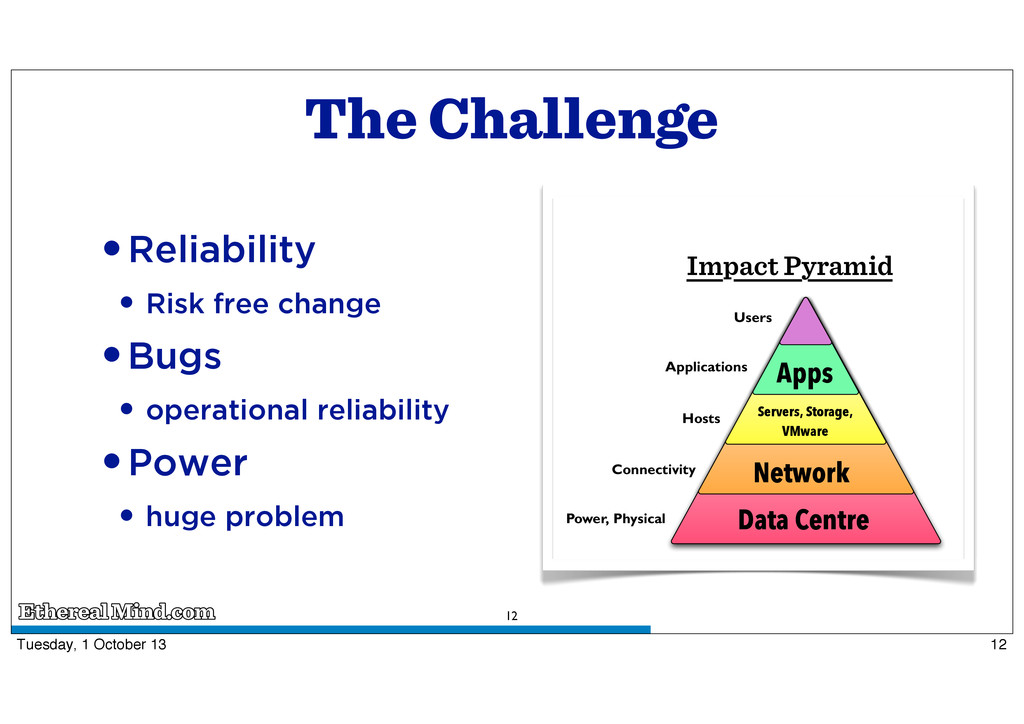
The Challenge •Reliability • Risk free change •Bugs • operational
reliability •Power • huge problem Power, Physical Hosts Users Connectivity Applications Data Centre Network Servers, Storage, VMware Apps Impact Pyramid 12 12 Tuesday, 1 October 13 -
CapEx •Spend first, ROI later •Buy a large core, planning
for growth •Servers start small, scale linear •“Blind” CapEx vs “Step” CapEx / OpEx Time Capital Expenditure Network Install Port Capacity Network Upgrade Server Upgrades Server Upgrades Server Upgrades CapEx Waste 13 13 Tuesday, 1 October 13 -
Failure •Single points of Complex failure •Why have only one
pair of firewalls ‣ routing, cost, power users ‣ Only one or two critical services need HA •HA systems are inherently risky & shared fate systems. ‣ Active/Standby firewall •HA in vertical scale system = $$$$$’s SVR WAN RTR Internet RTR FWL FWL SVR SVR SVR SVR SVR SVR Stateful HA Active/Standby WAN Internet LoadBal LoadBal Stateful HA 14 14 Tuesday, 1 October 13 -
Configuration Failure ‣ Manual Configuration ‣ All devices are configured
using “power tools” ‣ Every engineer is a “power user” ‣ Why have an API ? Substandard & lack vendor commitment ‣ Restricts number of devices (requires power users) ‣ “Don’t send a human to do a robots job” 15 15 Tuesday, 1 October 13 -
Fourth Wave of Virtualization ‣ 1998 - virtual lans, 2002
- virtual routing, 2007- virtual devices ‣ The secret is in the name ‣ another virtualization phase is no big deal ‣ networking will be integrated with servers and storage by 2015 16 16 Tuesday, 1 October 13 -
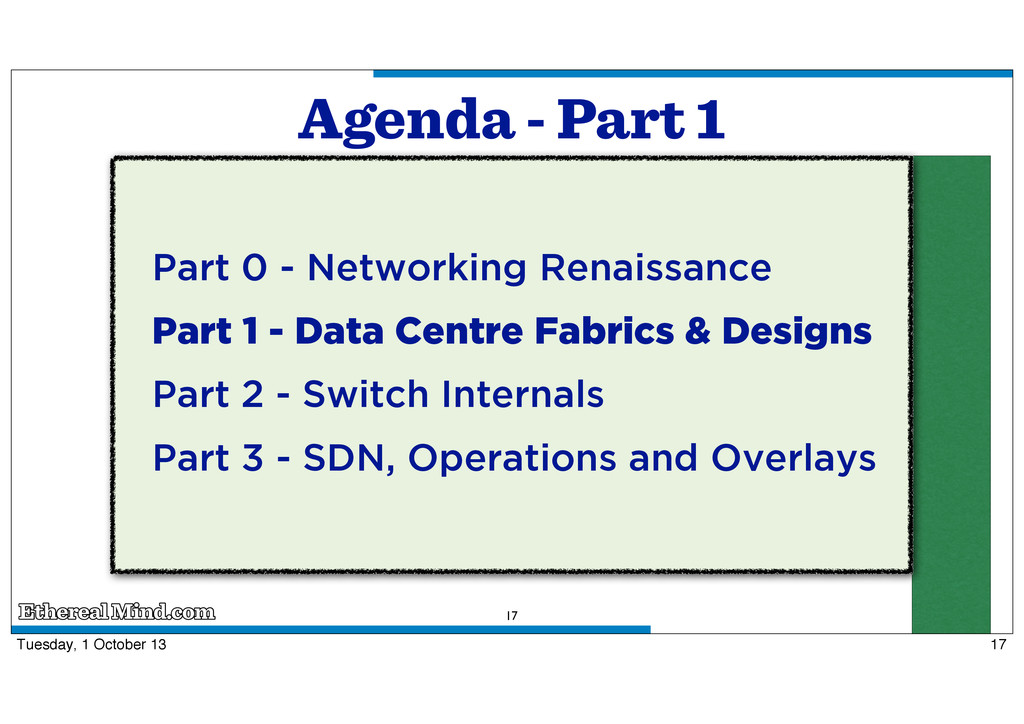
Agenda - Part 1 Part 0 - Networking Renaissance Part
1 - Data Centre Fabrics & Designs Part 2 - Switch Internals Part 3 - SDN, Operations and Overlays 17 17 Tuesday, 1 October 13 -
Disclaimer ‣ Focus on technology & features ‣ Understanding of
why you buy not what you buy ‣ I don’t endorse vendors, you need to make your own choices ‣ The future is uncertain 18 18 Tuesday, 1 October 13 -
Classes of Data Centre Networks Today ‣ Tree ‣ Spanning
Tree ‣ LAG ‣ MLAG Tomorrow ‣ Fabrics ‣ L2 ECMP ‣ L3 ECMP 19 Wisdom: Everything works for someone Some things work better than others 19 Tuesday, 1 October 13 -
Tree Networking Core Core Dist'n Dist'n Dist'n Dist'n Access Access
Access Access Access Access Access Access 20 20 Tuesday, 1 October 13 -
STP Review - Negative ‣ Ethernet networks cannot have loops
‣ Ethernet is a dumb (but cheap) protocol ‣ STP prevents loops ‣ STP protocol has been enhanced (RSTP/ MSTP) ‣ inherently unreliable during changes ‣ Brittle failure mode ‣ One mistake and an entire data centre goes down 21 21 Tuesday, 1 October 13 -
STP Features TYPES ‣ Classic ‣ PVST / PVST+ ‣
Cisco proprietary ‣ Rapid STP ‣ Multiple Instance Features ‣ Loop Guard ‣ Root Guard ‣ BPDU Guard ‣ UDLD ‣ Portfast ‣ Root Placement 22 22 Tuesday, 1 October 13 -
STP Review - Positive ‣ Cheap - standard feature, no
licensing ‣ Knowledge, Skills and Resources everywhere ‣ STP will be around until I retire 23 23 Tuesday, 1 October 13 -
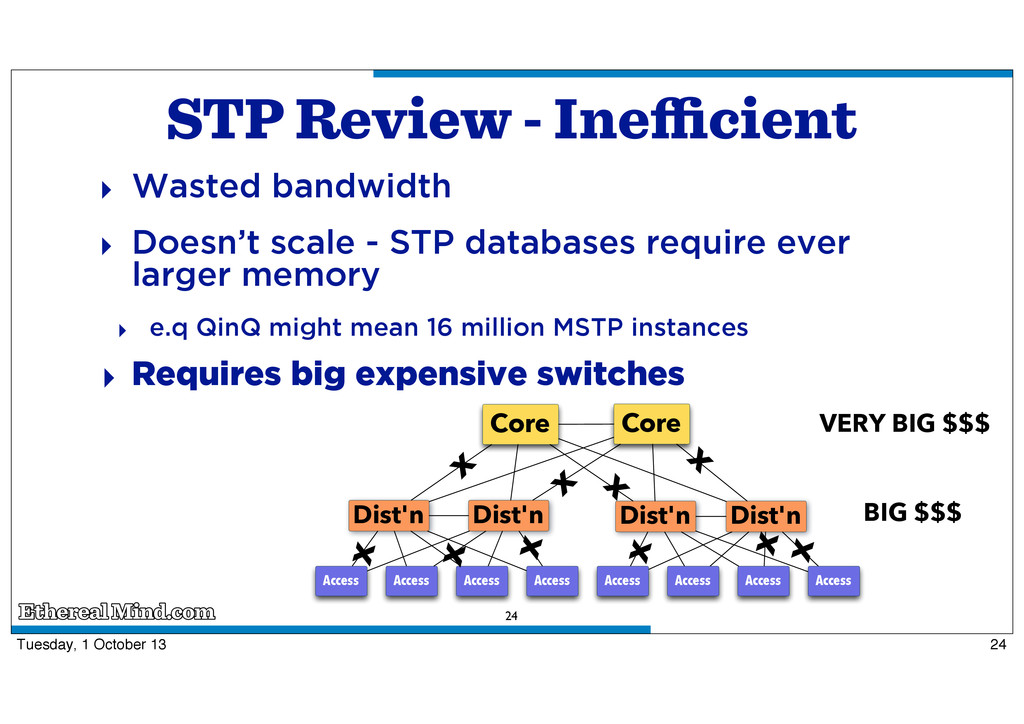
STP Review - Inefficient ‣ Wasted bandwidth ‣ Doesn’t scale
- STP databases require ever larger memory ‣ e.q QinQ might mean 16 million MSTP instances ‣ Requires big expensive switches Core Core Dist'n Dist'n Dist'n Dist'n Access Access Access Access Access Access Access Access x x x x x x x x x x VERY BIG $$$ BIG $$$ 24 24 Tuesday, 1 October 13 -
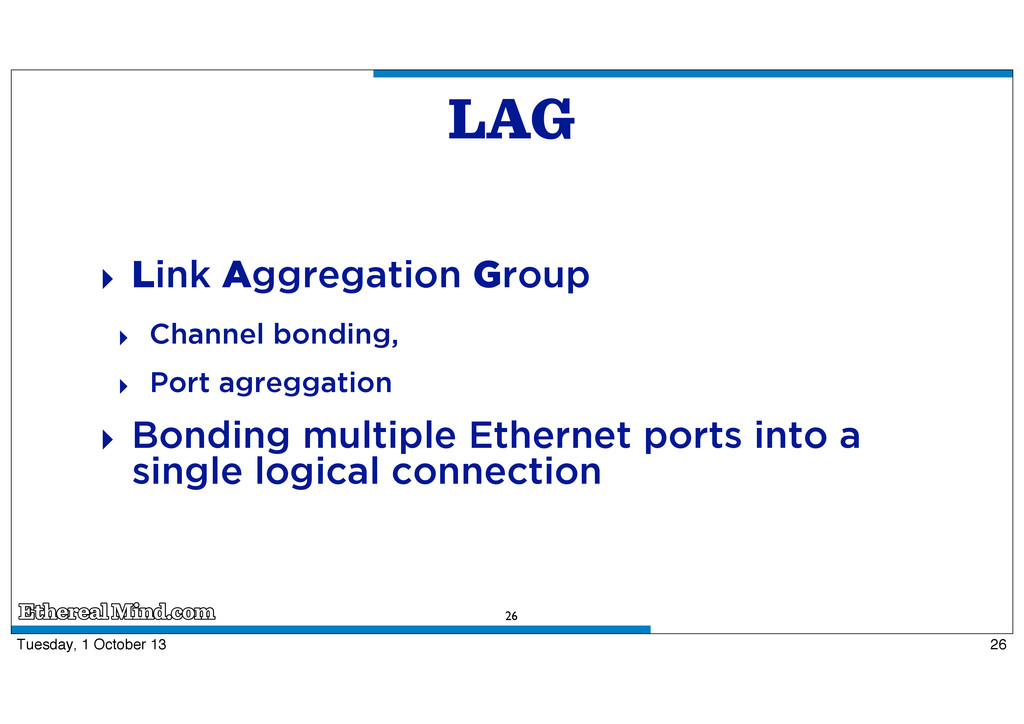
LAG ‣ Link Aggregation Group ‣ Channel bonding, ‣ Port
agreggation ‣ Bonding multiple Ethernet ports into a single logical connection 26 26 Tuesday, 1 October 13 -
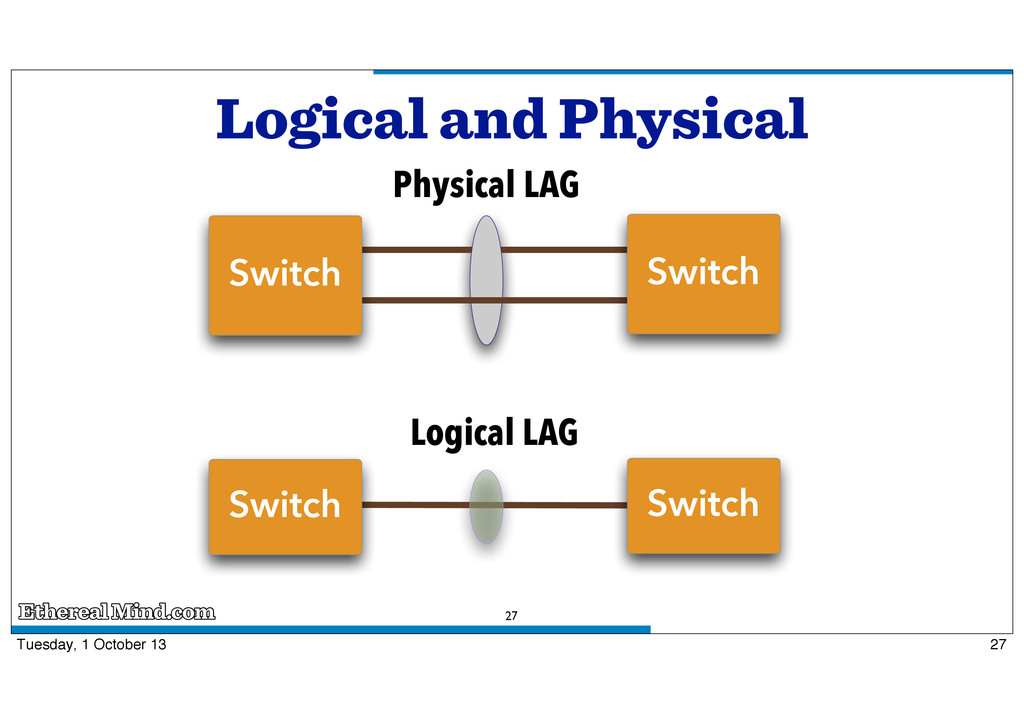
Logical and Physical Physical LAG Switch Switch Logical LAG Switch
Switch 27 27 Tuesday, 1 October 13 -
Switch Switch LAG Load Balancing ‣ Flow balancing ‣ Megaflow
impacts 28 28 Tuesday, 1 October 13 -
‣ 4 x 10GbE ports ‣ 40G Bandwidth but 10GbE
Speed ‣ Doesn’t solve latency Switch Switch LAG Bandwidth and Speed 29 29 Tuesday, 1 October 13 -
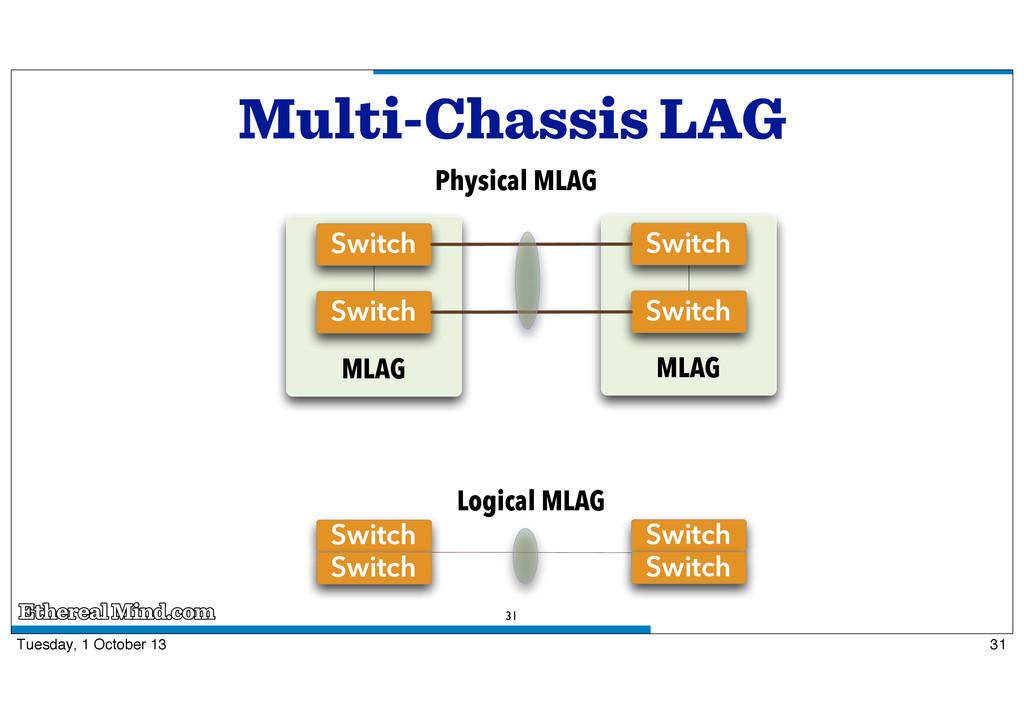
Multi-Chassis LAG MLAG MLAG Switch Switch Switch Switch Physical MLAG
Logical MLAG Switch Switch Switch Switch 31 31 Tuesday, 1 October 13 -
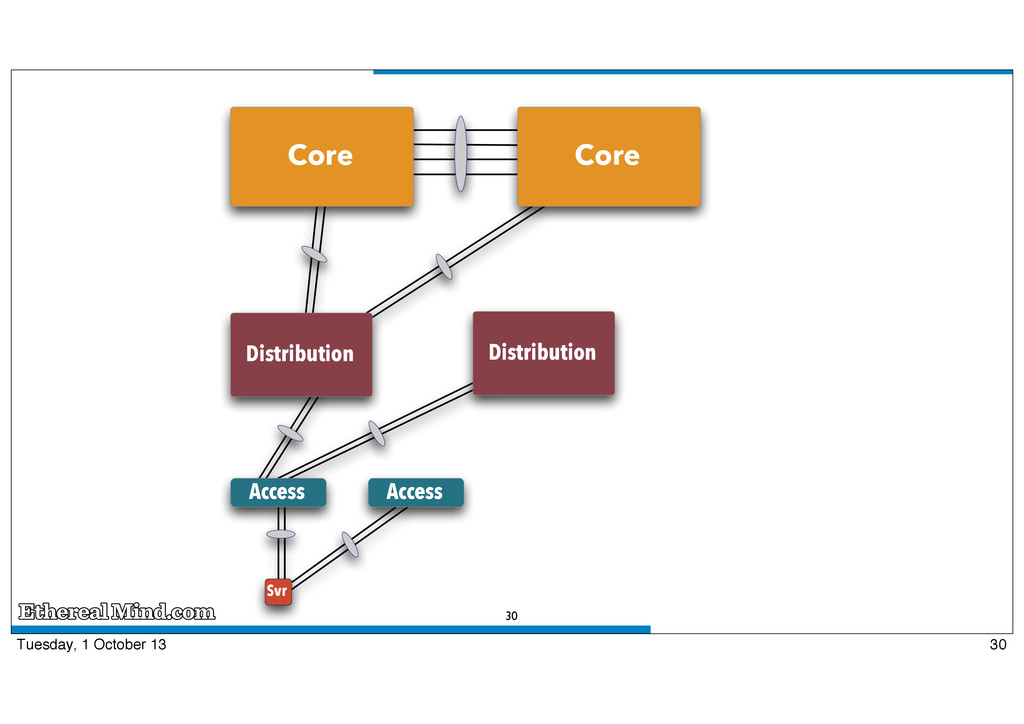
Core Core Distribution Distribution Svr Access Access Core Core Distribution
Distribution Svr Access Access 32 32 Tuesday, 1 October 13 -
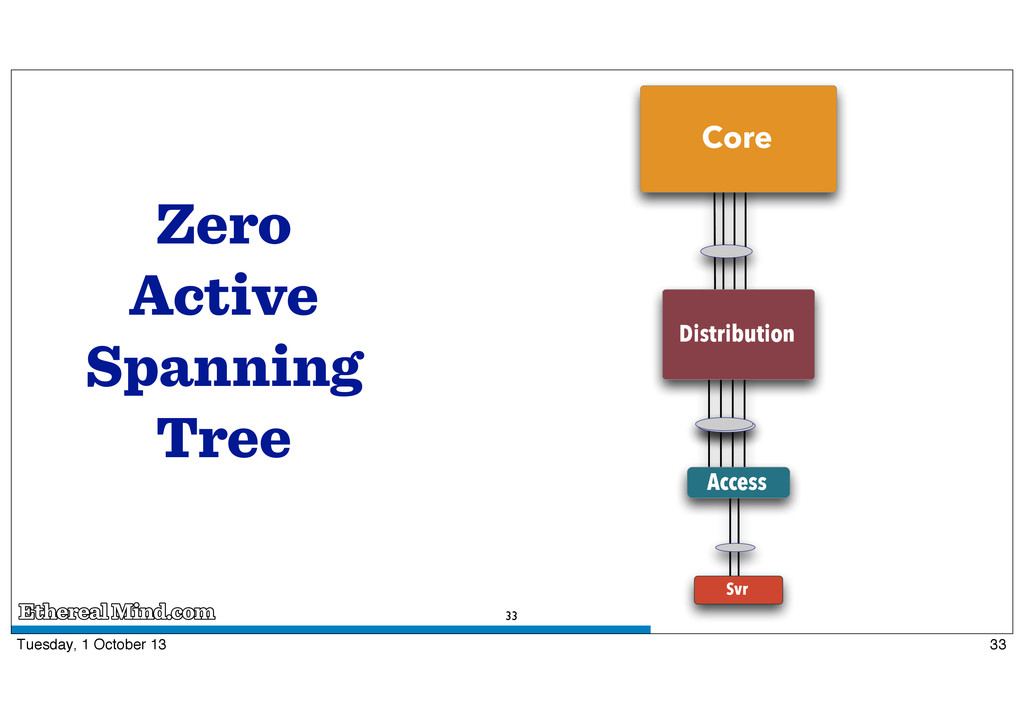
Svr Access Core Distribution Zero Active Spanning Tree 33 33
Tuesday, 1 October 13 -
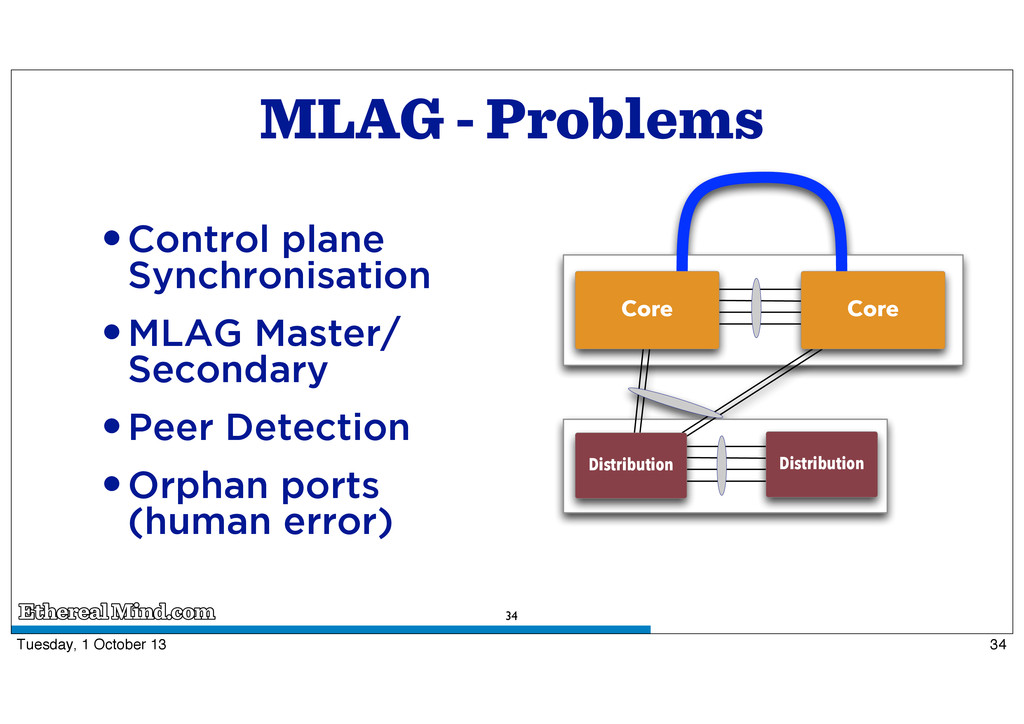
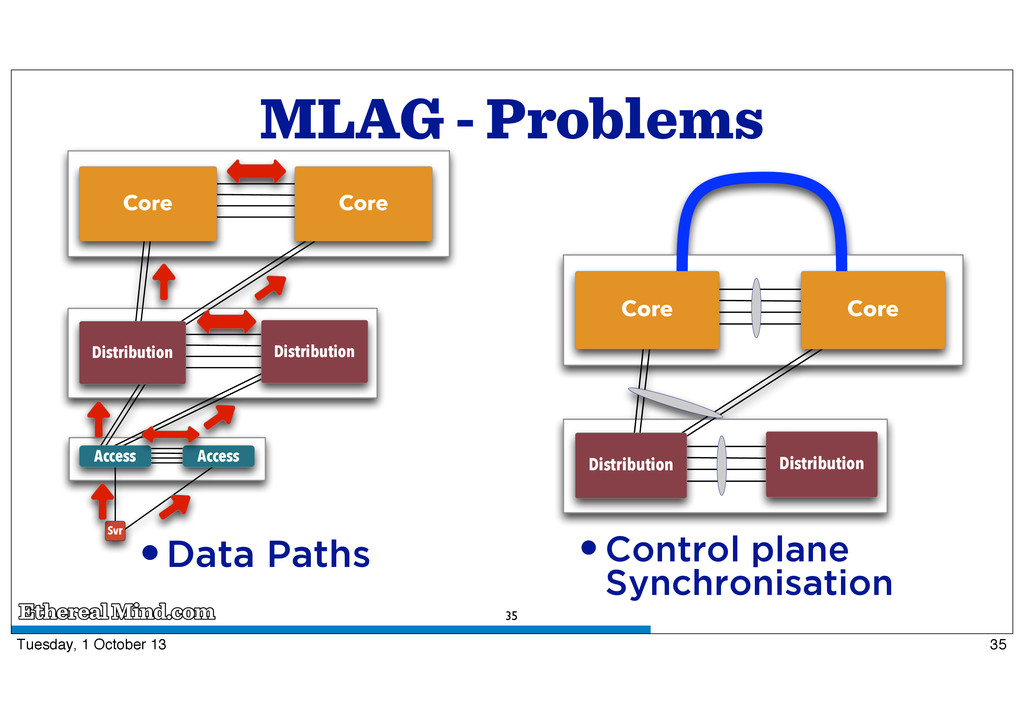
MLAG - Problems •Control plane Synchronisation •MLAG Master/ Secondary •Peer
Detection •Orphan ports (human error) Core Core Distribution Distribution 34 34 Tuesday, 1 October 13 -
MLAG - Problems •Control plane Synchronisation Core Core Distribution Distribution
Core Core Distribution Distribution Svr Access Access •Data Paths 35 35 Tuesday, 1 October 13 -
LAG & MLAG Designs ‣ Spanning Tree Avoidance is big
business ‣ Link Aggregation works well for many ‣ MLAG is a tricky thing ‣ complex, hard to configure reliably ‣ tends to buggy and over-featuring ‣ Popular for virtualization cores ‣ Doesn’t scale - only 2 switches per MLAG 36 36 Tuesday, 1 October 13 -
Propietary MLAG ‣ Cisco VSS, vPC ‣ HP IRF ‣
Juniper Virtual Chassis 37 37 Tuesday, 1 October 13 -
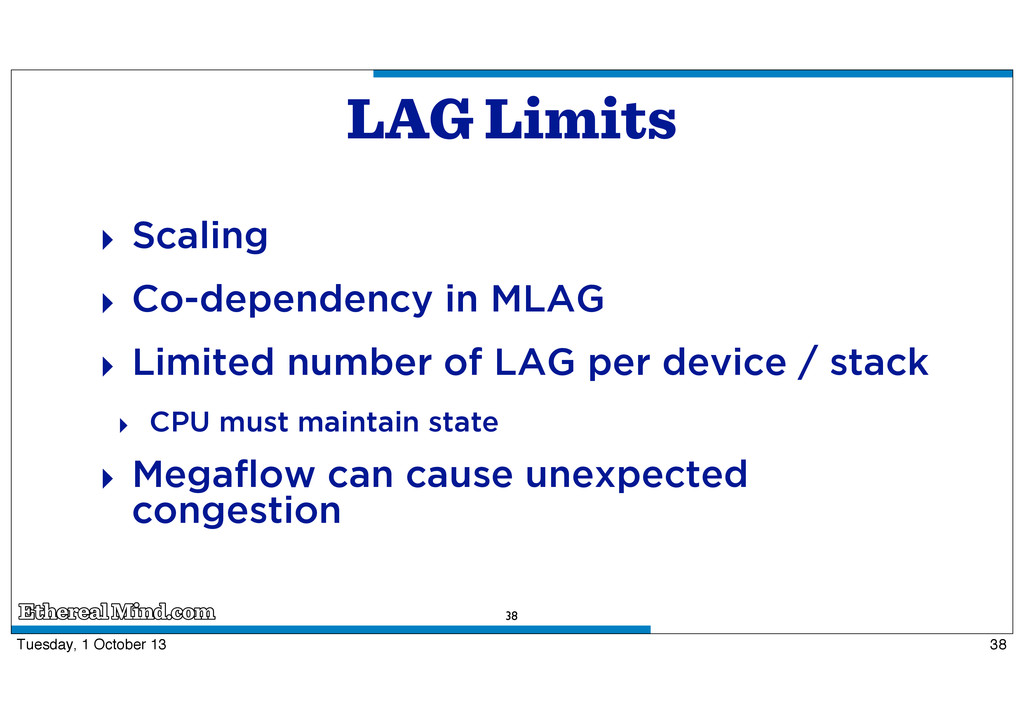
LAG Limits ‣ Scaling ‣ Co-dependency in MLAG ‣ Limited
number of LAG per device / stack ‣ CPU must maintain state ‣ Megaflow can cause unexpected congestion 38 38 Tuesday, 1 October 13 -
Latency ‣ New ‘old’ requirement ‣ Distributed storage eg vSAN
‣ Distributed database eg CEPH, Lustre, ‣ Impacts everything ‣ Cheap products have high latency ‣ Consistent latency can be important 40 40 Tuesday, 1 October 13 -
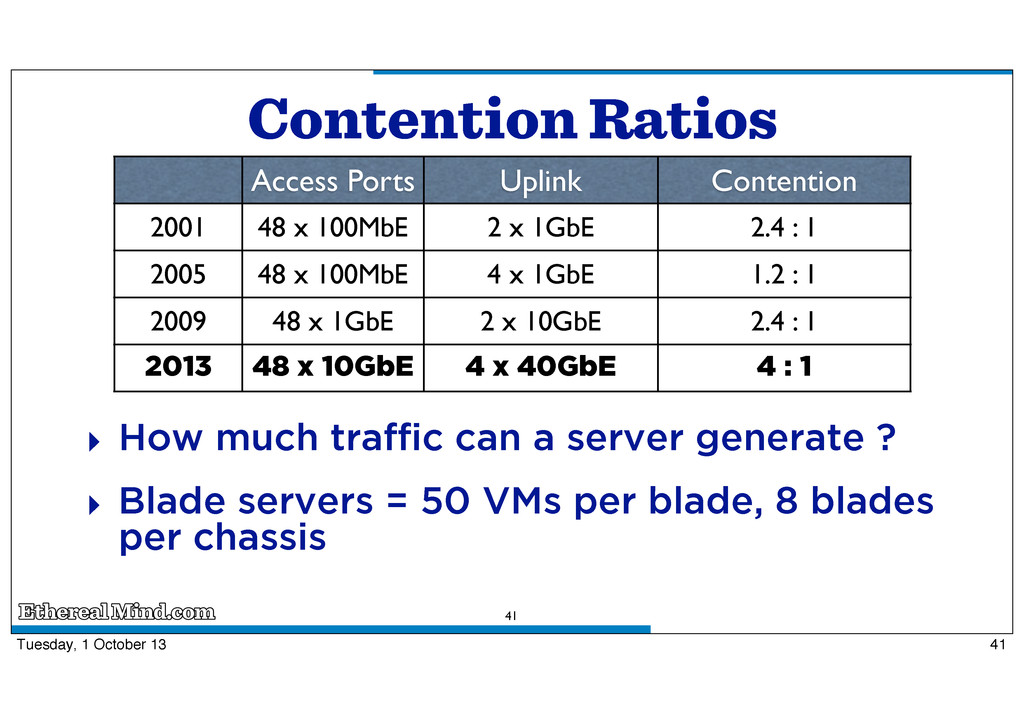
Contention Ratios Access Ports Uplink Contention 2001 48 x 100MbE
2 x 1GbE 2.4 : 1 2005 48 x 100MbE 4 x 1GbE 1.2 : 1 2009 48 x 1GbE 2 x 10GbE 2.4 : 1 2013 48 x 10GbE 4 x 40GbE 4 : 1 ‣ How much traffic can a server generate ? ‣ Blade servers = 50 VMs per blade, 8 blades per chassis 41 41 Tuesday, 1 October 13 -
Distribution Distribution Distribution Distribution Access Access Access Access Access Access
Access Access X X X X X X X X X X X X Svr Svr Svr Svr Svr Svr Svr Svr Svr Svr Svr Svr Svr Svr Svr Svr Svr Svr Svr Svr Svr Svr Svr Svr Svr Svr Svr Svr Svr Svr Svr Svr 1 2 3 Core Core 42 42 Tuesday, 1 October 13 -
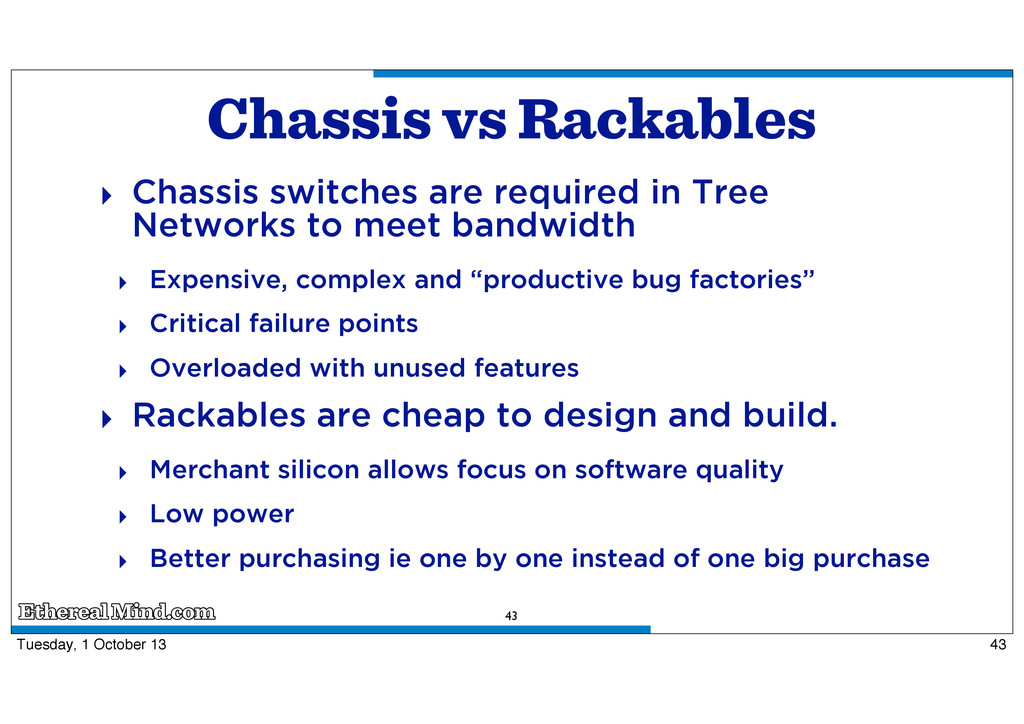
Chassis vs Rackables ‣ Chassis switches are required in Tree
Networks to meet bandwidth ‣ Expensive, complex and “productive bug factories” ‣ Critical failure points ‣ Overloaded with unused features ‣ Rackables are cheap to design and build. ‣ Merchant silicon allows focus on software quality ‣ Low power ‣ Better purchasing ie one by one instead of one big purchase 43 43 Tuesday, 1 October 13 -
Power ‣ Rules of thumb ‣ Less switches = less
power ‣ TOR Switches efficiency better than Chassis 44 44 Tuesday, 1 October 13 -
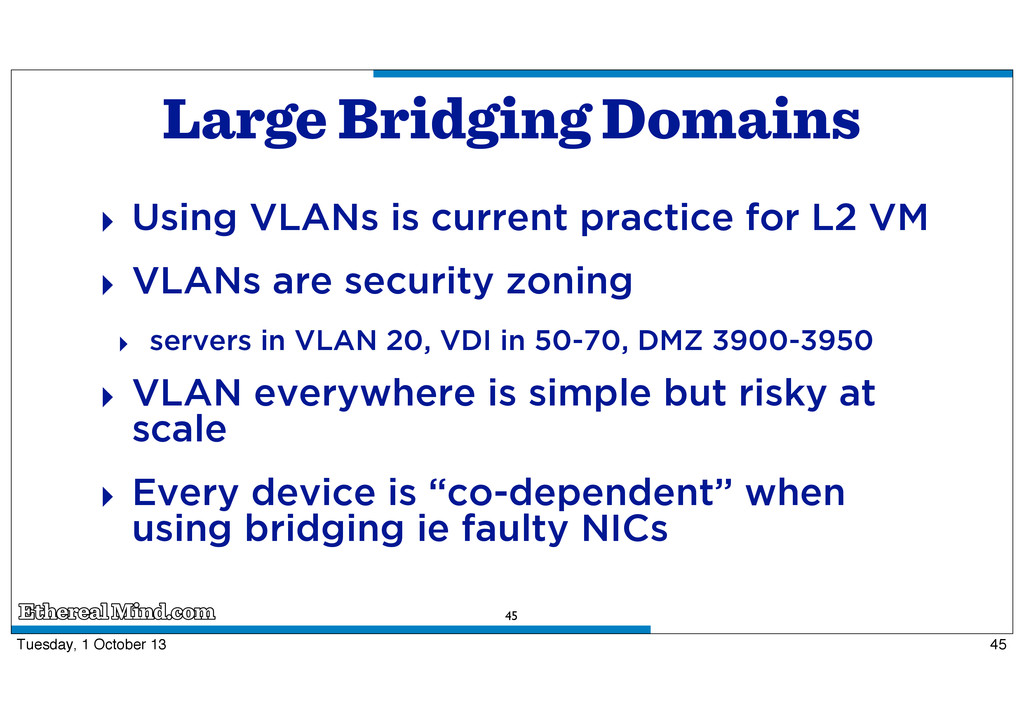
Large Bridging Domains ‣ Using VLANs is current practice for
L2 VM ‣ VLANs are security zoning ‣ servers in VLAN 20, VDI in 50-70, DMZ 3900-3950 ‣ VLAN everywhere is simple but risky at scale ‣ Every device is “co-dependent” when using bridging ie faulty NICs 45 45 Tuesday, 1 October 13 -
DCBX 46 Switch Switch Switch Switch PAUSE Capability Exchange PAUSE
PAUSE Storage Server Capability Exchange Capability Exchange PAUSE PAUSE Capability Exchange Capability Exchange ‣ IEEE DCBX Working Group ‣ PFC(802.1Qbb), ETS/DCXB(802.1Qaz), QCN ‣ much more complicated that this ‣ hard to make work, complex to maintain ‣ proprietary solution for Cisco, Brocade, Juniper 46 Tuesday, 1 October 13 -
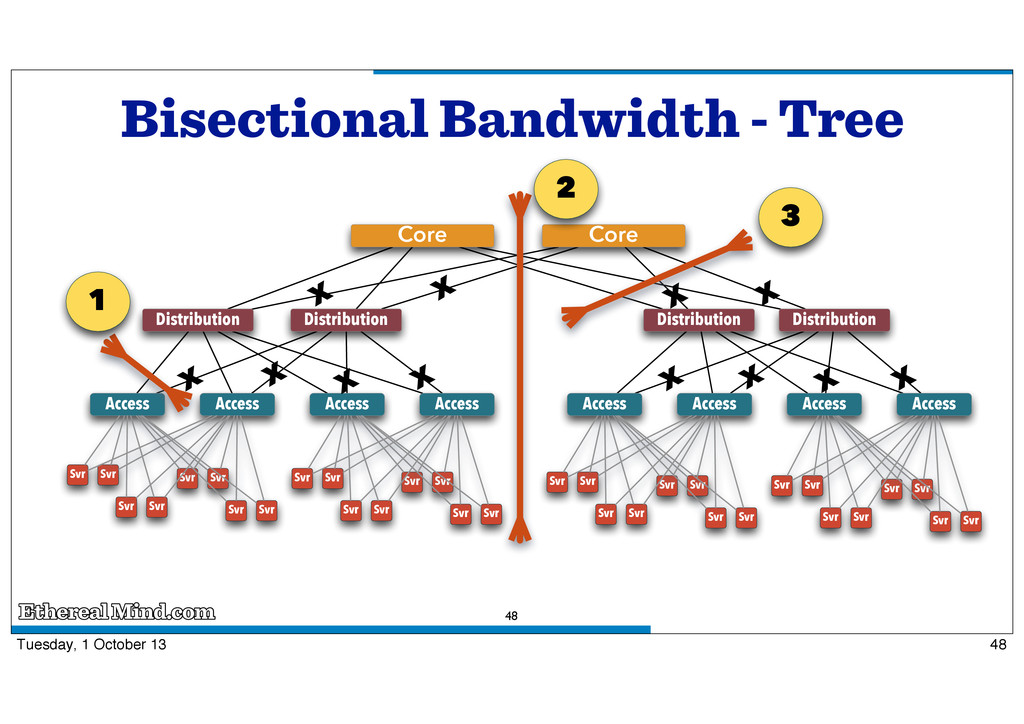
Bisectional Bandwidth - Tree Distribution Distribution Distribution Distribution Access Access
Access Access Access Access Access Access Core Core X X X X X X X X X X X X Svr Svr Svr Svr Svr Svr Svr Svr Svr Svr Svr Svr Svr Svr Svr Svr Svr Svr Svr Svr Svr Svr Svr Svr Svr Svr Svr Svr Svr Svr Svr Svr 1 2 3 48 48 Tuesday, 1 October 13 -
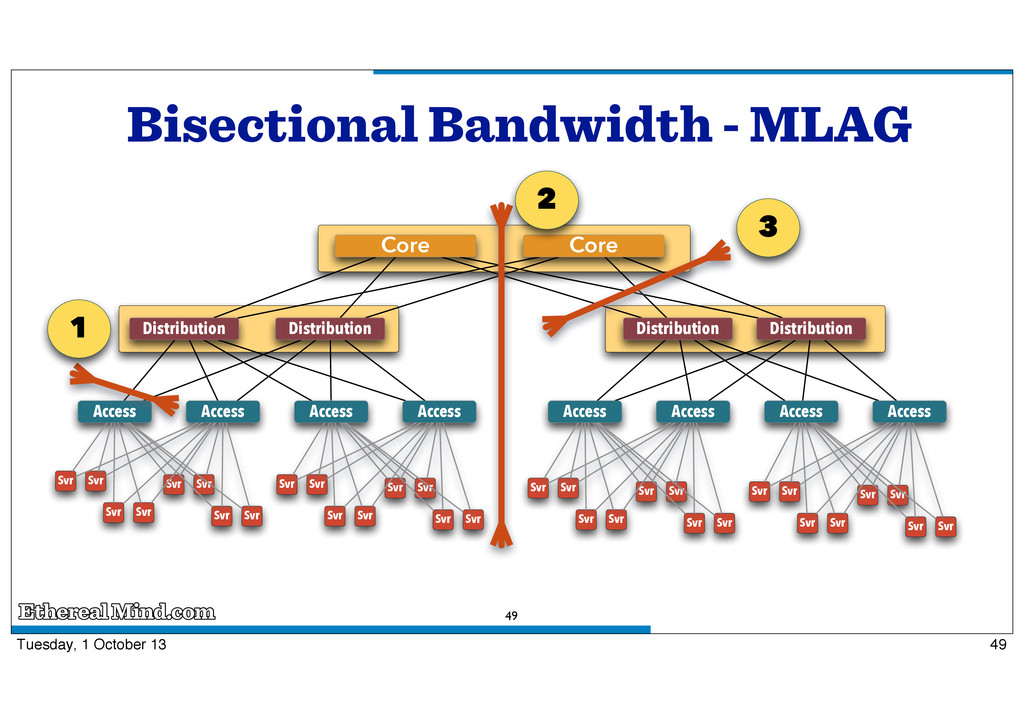
Bisectional Bandwidth - MLAG Distribution Distribution Distribution Distribution Access Access
Access Access Access Access Access Access Core Core Svr Svr Svr Svr Svr Svr Svr Svr Svr Svr Svr Svr Svr Svr Svr Svr Svr Svr Svr Svr Svr Svr Svr Svr Svr Svr Svr Svr Svr Svr Svr Svr 1 2 3 49 49 Tuesday, 1 October 13 -
Why Fabrics ? ‣ STP and LAG Networks are high
contention ‣ 8:1 and 4:1 are common ‣ Need modular build-out methods ‣ better purchasing models (less capital) ‣ In virtualization and cloud deployments, East/West > North/South Goal: Build a Lossless Network 51 51 Tuesday, 1 October 13 -
Purchasing Time Capital Expenditure Network Install Port Capacity Network Upgrade
Server Upgrades Server Upgrades Wasted CapEx Port Capacity New Server New Server New Servers •Spend big, ROI later •Network Assets rot for years & years 52 52 Tuesday, 1 October 13 -
North South East West Distribution Distribution Distribution Distribution Access Access
Access Access Access Access Access Access Core Core Svr Svr Svr Svr Svr Svr Svr Svr Svr Svr Svr Svr Svr Svr Svr Svr Svr Svr Svr Svr Svr Svr Svr Svr Svr Svr Svr Svr Svr Svr Svr Svr WAN EAST- WEST NO RTH - SO UTH N O RTH - SO U TH WAN Rtr WAN Rtr 53 53 Tuesday, 1 October 13 -
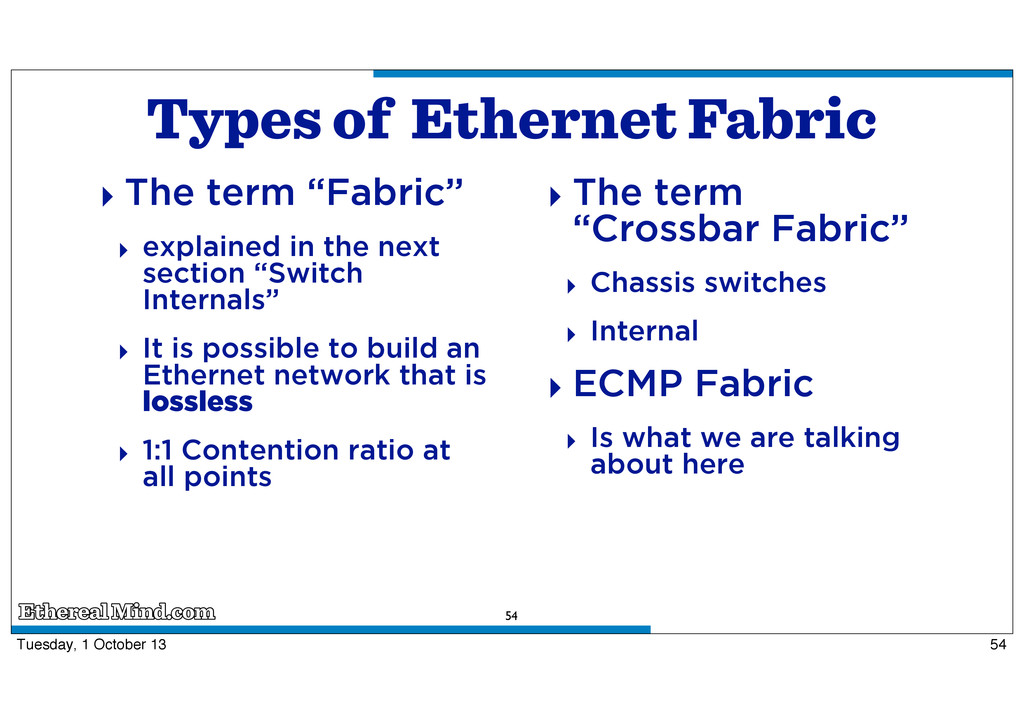
Types of Ethernet Fabric ‣ The term “Fabric” ‣ explained
in the next section “Switch Internals” ‣ It is possible to build an Ethernet network that is lossless ‣ 1:1 Contention ratio at all points ‣ The term “Crossbar Fabric” ‣ Chassis switches ‣ Internal ‣ ECMP Fabric ‣ Is what we are talking about here 54 54 Tuesday, 1 October 13 -
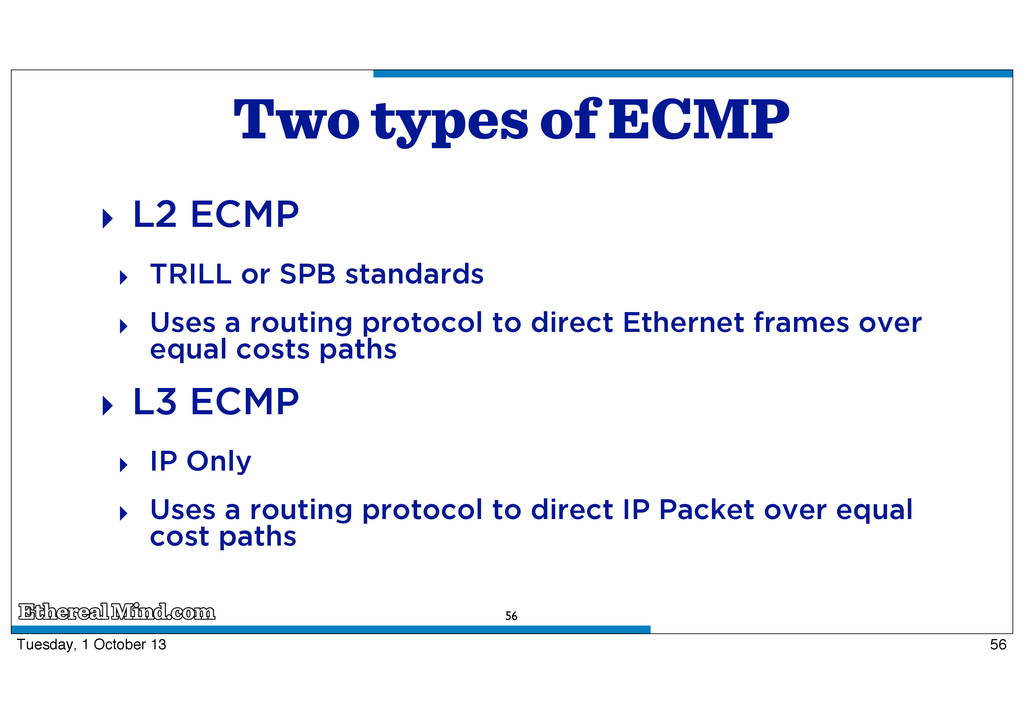
Two types of ECMP ‣ L2 ECMP ‣ TRILL or
SPB standards ‣ Uses a routing protocol to direct Ethernet frames over equal costs paths ‣ L3 ECMP ‣ IP Only ‣ Uses a routing protocol to direct IP Packet over equal cost paths 56 56 Tuesday, 1 October 13 -
Spine Spine Edge Edge Edge Edge Edge Edge Spine Spine
Storage Server Server Server Server Server Server Server Server Storage Spine Leaf 57 57 Tuesday, 1 October 13 -
Equal Cost Multipath 1 Spine Spine Edge Edge Edge Edge
Edge Edge Spine Spine Server Server 2 3 4 1 2 3 4 58 58 Tuesday, 1 October 13 -
ECMP Width determined by Vendor Implementation Spine Spine Edge Edge
Edge Edge Edge Edge Spine Spine Server Server Spine Spine Spine Spine Spine Spine Spine Spine Edge Edge Edge Edge Edge Edge Uplink ports on Leaf Nodes 59 59 Tuesday, 1 October 13 -
SPINE SPINE LEAF LEAF LEAF LEAF SPINE SPINE LEAF LEAF
LEAF S S 1 2 3 1 2 3 Spine - Unequal Paths 60 60 Tuesday, 1 October 13 -
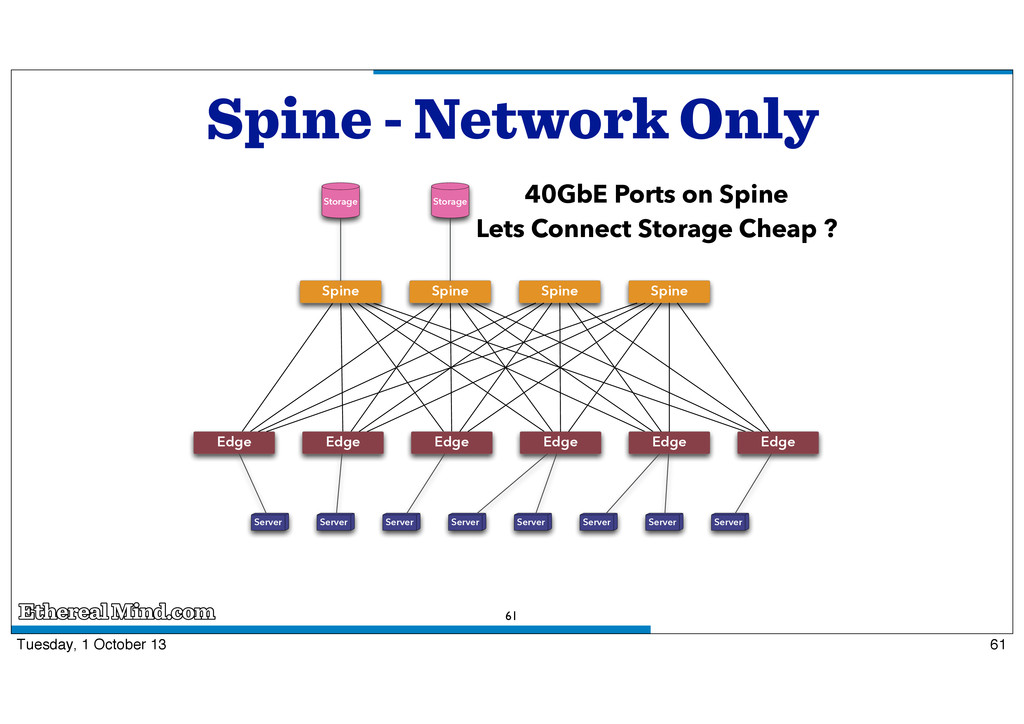
Spine - Network Only Spine Spine Edge Edge Edge Edge
Edge Edge Spine Spine Storage Server Server Server Server Server Server Server Server Storage 40GbE Ports on Spine Lets Connect Storage Cheap ? 61 61 Tuesday, 1 October 13 -
Spine - Network Only MegaFlows Cause Unequal Load Factors Spine
Spine Edge Edge Edge Edge Edge Edge Spine Spine Server Server Storage Storage 62 62 Tuesday, 1 October 13 -
East West Spine Spine Edge Edge Edge Edge Edge Edge
Spine Spine Server Server Storage Storage East West Bandwith is Excellent 63 63 Tuesday, 1 October 13 -
Bisectional - ECMP 64 Core Core Edge Edge Edge Edge
Edge Edge Core Core 2 1 64 Tuesday, 1 October 13 -
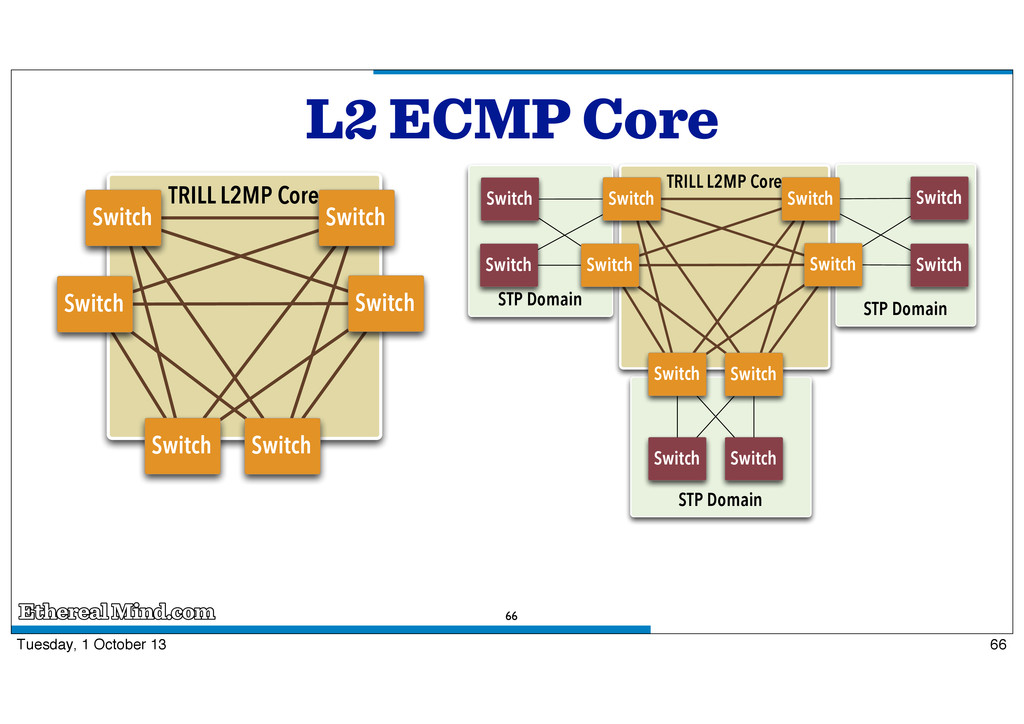
L2 ECMP SPINE SPINE LEAF LEAF LEAF LEAF SPINE SPINE
LEAF LEAF LEAF S S SPINE SPINE LEAF LEAF LEAF LEAF SPINE SPINE LEAF LEAF LEAF S S VLAN 1 65 65 Tuesday, 1 October 13 -
L2 ECMP Core TRILL L2MP Core Switch Switch Switch Switch
Switch Switch STP Domain STP Domain TRILL L2MP Core STP Domain Switch Switch Switch Switch Switch Switch Switch Switch Switch Switch Switch Switch 66 66 Tuesday, 1 October 13 -
TRILL/SPB 67 STP Domain STP Domain Switch Switch Switch Switch
RBridge RBridge RBridge RBridge IS-IS protocol "MAC Address:RBridgeID" Encapsulsation RBridge RBridge Switch Switch RBridge RBridge Ethernet Frame RBridge TRILL ENCAP RBridge Lookup MAC Lookup MAC Lookup RBridge Lookup RBridge Lookup TRILL ENCAP Ethernet Frame "Routing by MAC Address" 67 Tuesday, 1 October 13 -
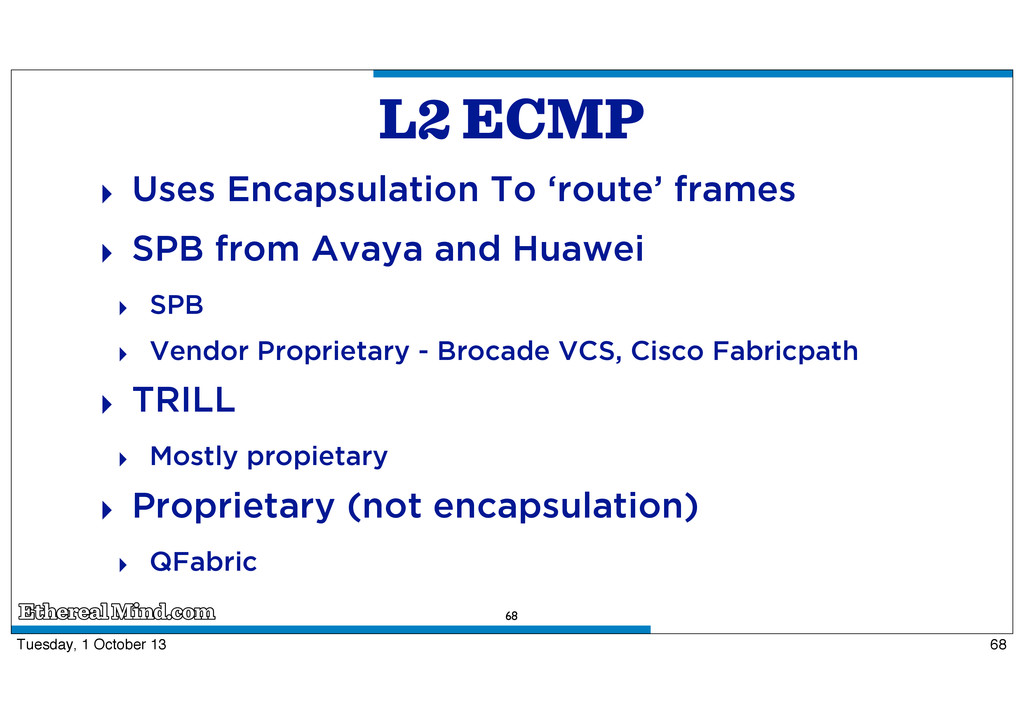
L2 ECMP ‣ Uses Encapsulation To ‘route’ frames ‣ SPB
from Avaya and Huawei ‣ SPB ‣ Vendor Proprietary - Brocade VCS, Cisco Fabricpath ‣ TRILL ‣ Mostly propietary ‣ Proprietary (not encapsulation) ‣ QFabric 68 68 Tuesday, 1 October 13 -
L3 ECMP ‣ No connections between spines ‣ upgradeable without
outage ‣ Semi-independent control planes ‣ Grows piece by piece ‣ Use low cost 1RU switches ‣ Dell S6000, Mellanox S1032, Nexus 5500, ‣ Simplicity means reliable 69 69 Tuesday, 1 October 13 -
70 Spine Spine Edge Edge Edge Edge Edge Edge Spine
Spine Server "Old" vMotion Doesn't WORK Server Server Server Server Server Server Server Server Server Server Server 70 Tuesday, 1 October 13 -
71 L2 / L3 ECMP Spine Spine Edge Edge Edge
Edge Edge Edge Spine Spine Server Server L3 L2 71 Tuesday, 1 October 13 -
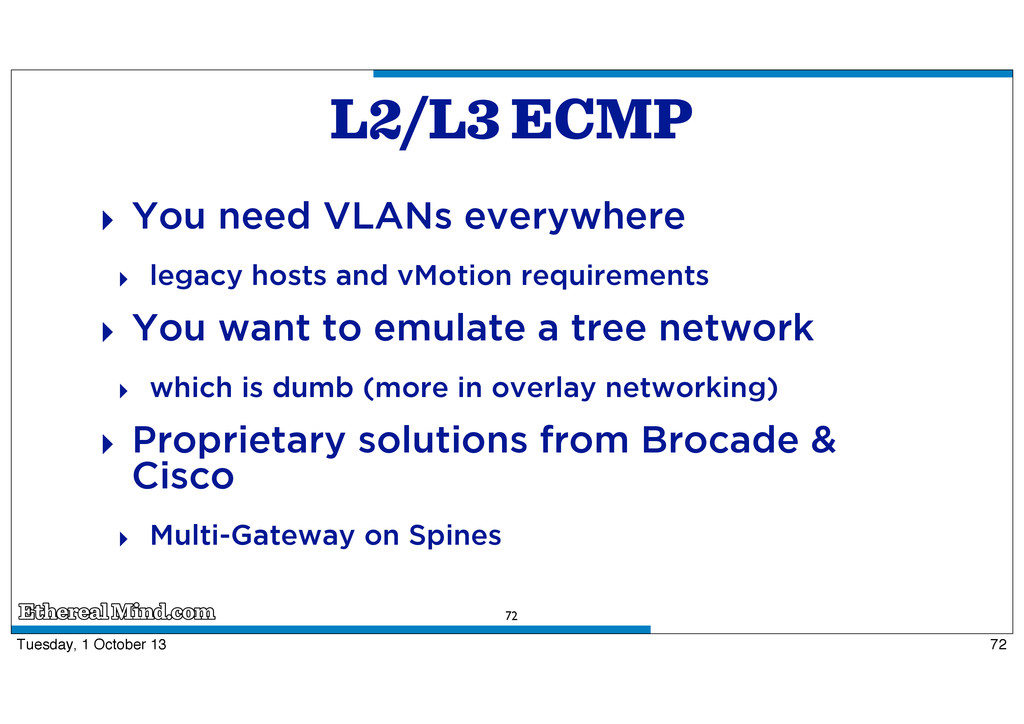
72 L2/L3 ECMP ‣ You need VLANs everywhere ‣ legacy
hosts and vMotion requirements ‣ You want to emulate a tree network ‣ which is dumb (more in overlay networking) ‣ Proprietary solutions from Brocade & Cisco ‣ Multi-Gateway on Spines 72 Tuesday, 1 October 13 -
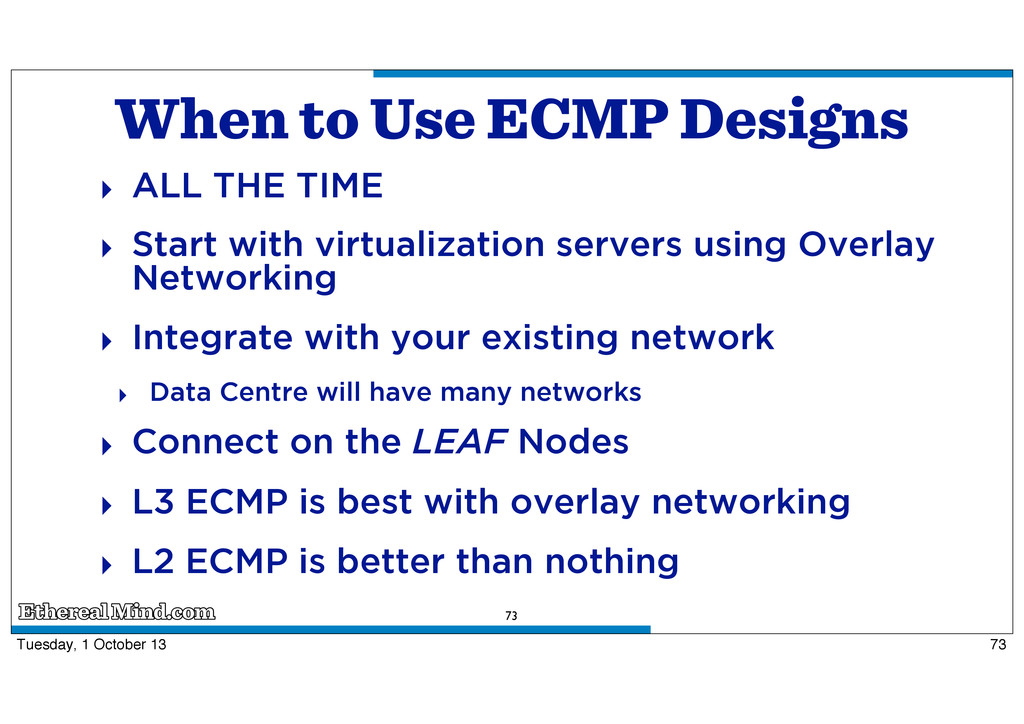
When to Use ECMP Designs ‣ ALL THE TIME ‣
Start with virtualization servers using Overlay Networking ‣ Integrate with your existing network ‣ Data Centre will have many networks ‣ Connect on the LEAF Nodes ‣ L3 ECMP is best with overlay networking ‣ L2 ECMP is better than nothing 73 73 Tuesday, 1 October 13 -
Sizing ECMP ‣ Most ECMP solutions are minimum of 500
GbE ports ‣ Different vendors can offer 750 and, in some cases, up to 1500 10GbE ports in a single ECMP network ‣ thats a lot of ports 74 74 Tuesday, 1 October 13 -
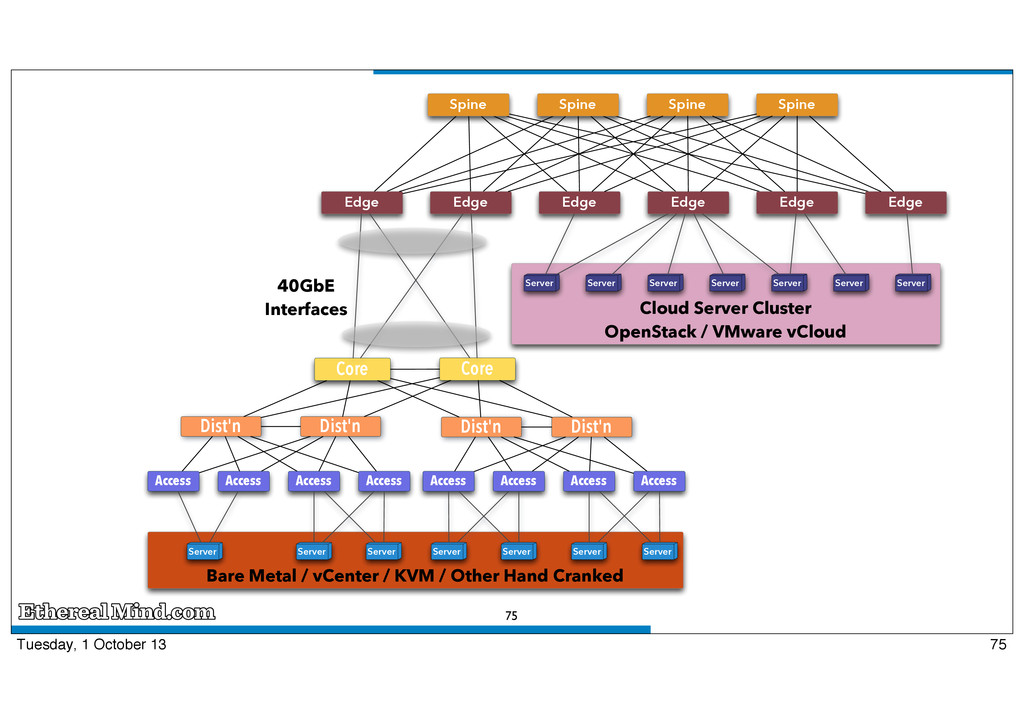
75 Cloud Server Cluster OpenStack / VMware vCloud Spine Spine
Edge Edge Edge Edge Edge Edge Spine Spine Core Core Dist'n Dist'n Dist'n Dist'n Access Access Access Access Access Access Access Access Server Server Server Server Server Server Server 40GbE Interfaces Bare Metal / vCenter / KVM / Other Hand Cranked Server Server Server Server Server Server Server 75 Tuesday, 1 October 13 -
76 Cloud Server Cluster OpenStack / VMware vCloud Spine Spine
Edge Edge Edge Edge Grow Over Time Core Core Dist'n Dist'n Dist'n Dist'n Access Access Access Access Access Access Access Access Server Server Server Server Server 10GbE Interfaces Bare Metal / vCenter / KVM / Other Hand Cranked Server Server Server Server Server Server Server 76 Tuesday, 1 October 13 -
MultiGateway Routing ‣ For L2 ECMP designs, where and how
are default gateways handled ‣ For L2/L3 ECMP where & how IP routing in handled 78 78 Tuesday, 1 October 13 -
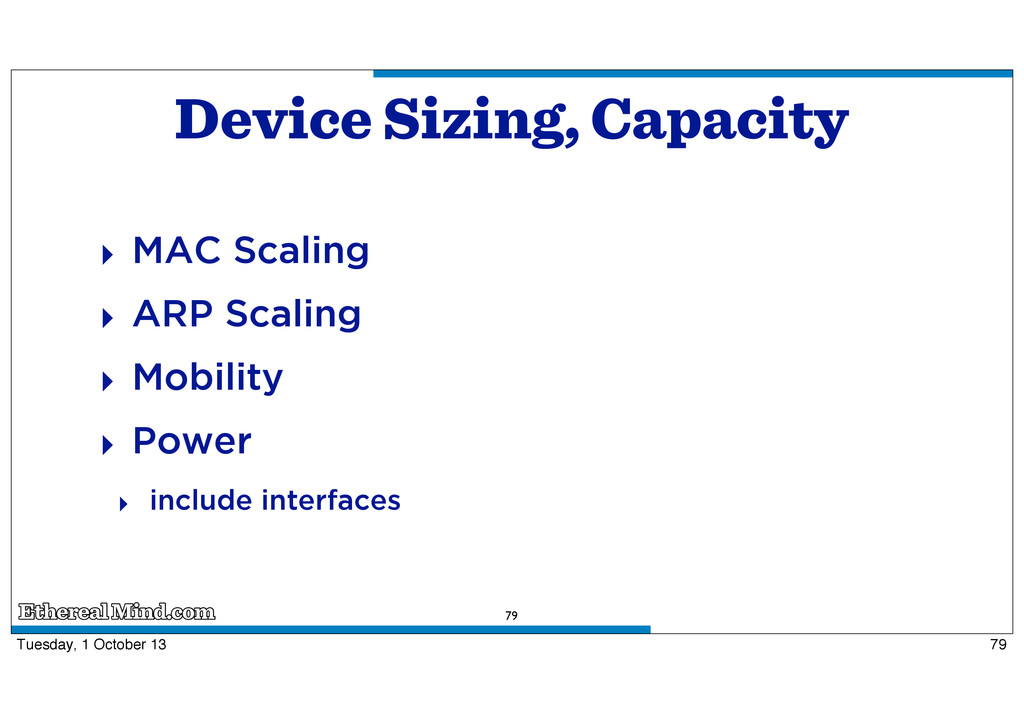
Device Sizing, Capacity ‣ MAC Scaling ‣ ARP Scaling ‣
Mobility ‣ Power ‣ include interfaces 79 79 Tuesday, 1 October 13 -
Industry Changes ‣ Asset rotation to move to 3 -
5 years (instead of 5-10 today) ‣ CapEx will drop accordingly ‣ Simpler devices ‣ SDN platforms add new costs based on consumption ie per use licensing ‣ Budget remain static 80 80 Tuesday, 1 October 13 -
Agenda - Part 2 Part 0 - Networking Renaissance Part
1 - Data Centre Fabrics & Designs Part 2 - Switch Internals Part 3 - SDN, Operations and Overlays 82 82 Tuesday, 1 October 13 -
Inside Your Switch ‣ Have you though about what happens
inside your switch 83 83 Tuesday, 1 October 13 -
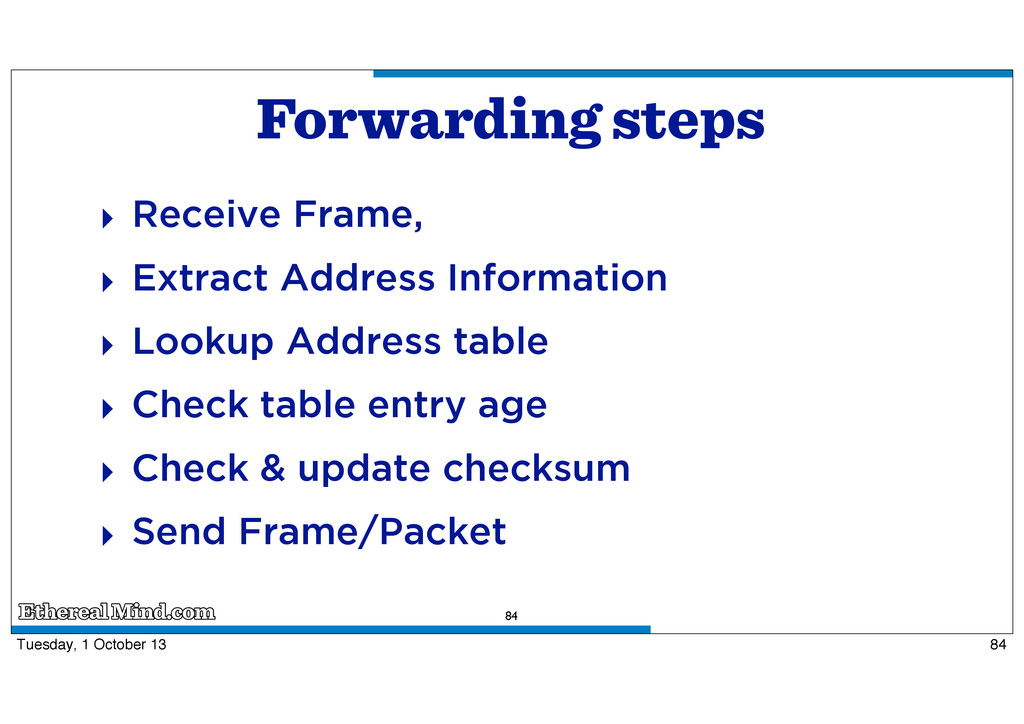
Forwarding steps ‣ Receive Frame, ‣ Extract Address Information ‣
Lookup Address table ‣ Check table entry age ‣ Check & update checksum ‣ Send Frame/Packet 84 84 Tuesday, 1 October 13 -
Packet Pathway Packet Parser VLAN Processor MST Storage L2 Match/
Learning L2 CAM L3 Match/ Learning ACL Processing L3 CAM TCAM Input Counters Ingress Egress Output Counters Packet Rewrite QoS Policing/ Shaping PHY Crossbar PHY 85 85 Tuesday, 1 October 13 -
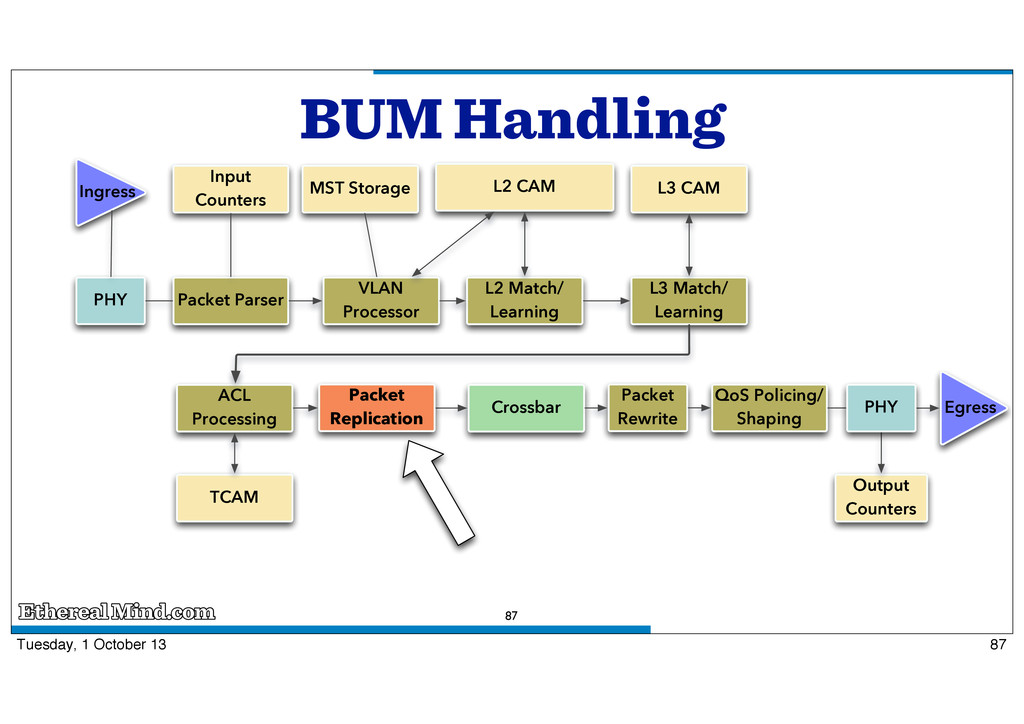
Ethernet BUM Traffic ‣ Broadcast ‣ IP ARP ‣ FF:FF:FF:FF:FF:FF
‣ Multicast ‣ IP Multicast, VRRP, ‣ 01:xx:xx:xx:xx:xx ‣ Unknown Unicast ‣ Flooding for Mac Address learning ‣ Switch must replicate frame and send out every port 86 86 Tuesday, 1 October 13 -
BUM Handling Packet Parser VLAN Processor MST Storage L2 Match/
Learning L2 CAM L3 Match/ Learning ACL Processing L3 CAM TCAM Input Counters Ingress Egress Output Counters Packet Rewrite QoS Policing/ Shaping PHY Crossbar PHY Packet Replication 87 87 Tuesday, 1 October 13 -
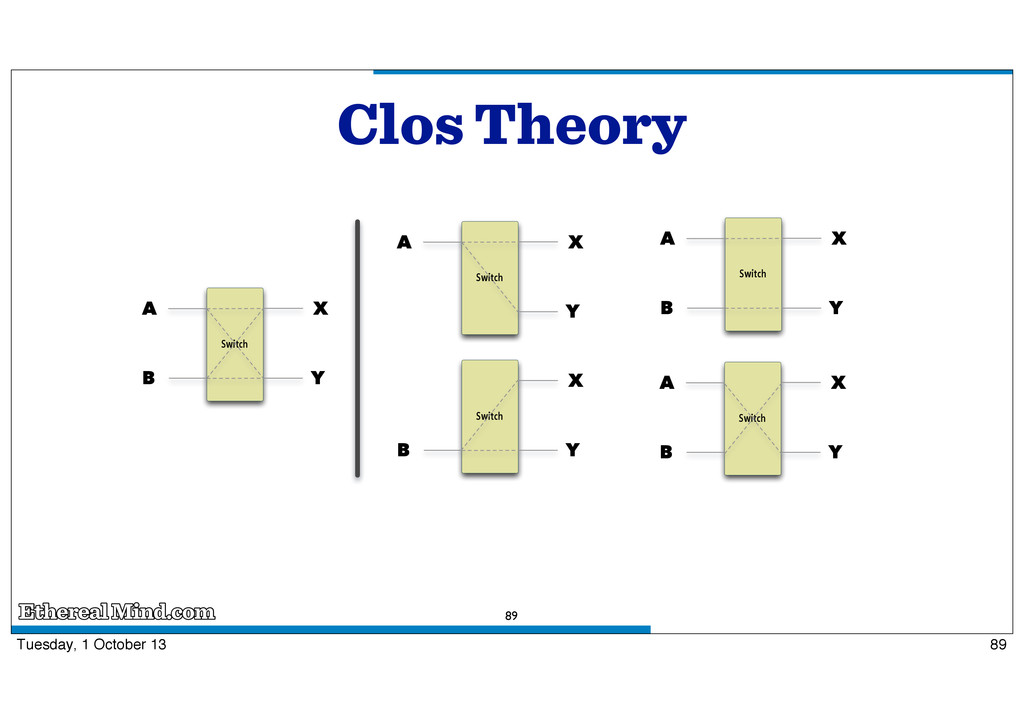
Clos Theory Switch A B X Y Switch A X
Y Switch B X Y Switch A B X Y Switch A B X Y 89 89 Tuesday, 1 October 13 -
Crossbar 1 90 1 2 3 4 5 Any input
to any output 1 2 3 4 5 Any input to any output 1 2 3 4 5 1 2 3 4 5 90 Tuesday, 1 October 13 -
Crossbar 2 91 1 2 3 4 5 1 2
3 4 5 1 2 3 4 5 1 2 3 4 5 X 91 Tuesday, 1 October 13 -
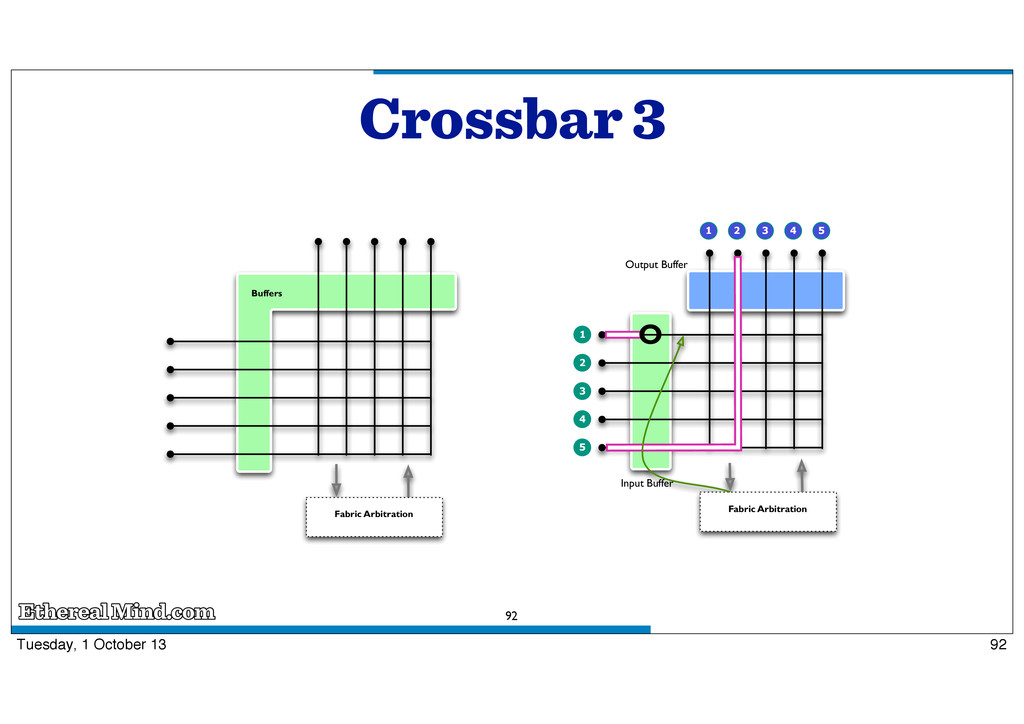
Crossbar 3 92 Buffers Fabric Arbitration 1 2 3 4
5 1 2 3 4 5 O Fabric Arbitration Input Buffer Output Buffer 92 Tuesday, 1 October 13 -
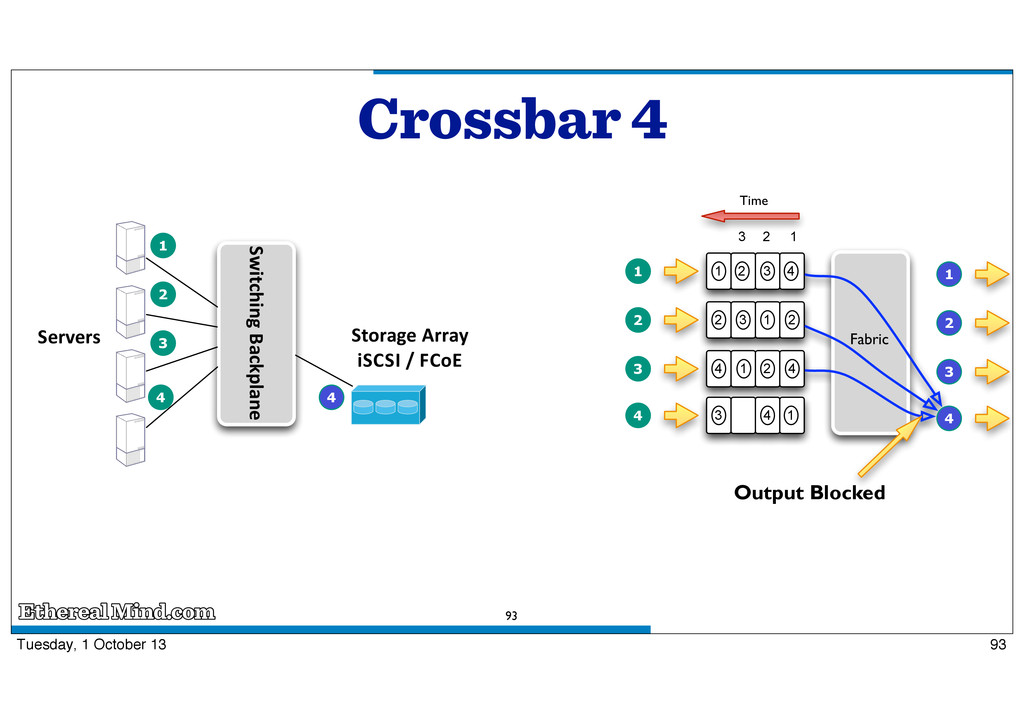
Crossbar 4 93 Fabric 1 2 3 4 1 2
3 4 2 3 3 2 4 4 1 2 4 1 1 1 2 3 4 Switching)Backplane 4 1 2 3 Time 1 2 3 Output Blocked Servers Storage)Array iSCSI)/)FCoE 4 93 Tuesday, 1 October 13 -
Crossbar 5 94 Input Queue Fabric 1 2 3 4
1 2 3 4 2 3 3 2 4 4 1 2 4 1 1 1 2 3 4 Q Packets Queued at Input Time 1 2 3 Q 94 Tuesday, 1 October 13 -
Crossbar 6 95 Output Queue Input Queue Fabric 1 2
3 4 1 2 3 4 2 3 3 2 4 4 1 2 4 1 1 1 2 3 4 Q Q Q Packet is Queued at Output Time 1 2 3 95 Tuesday, 1 October 13 -
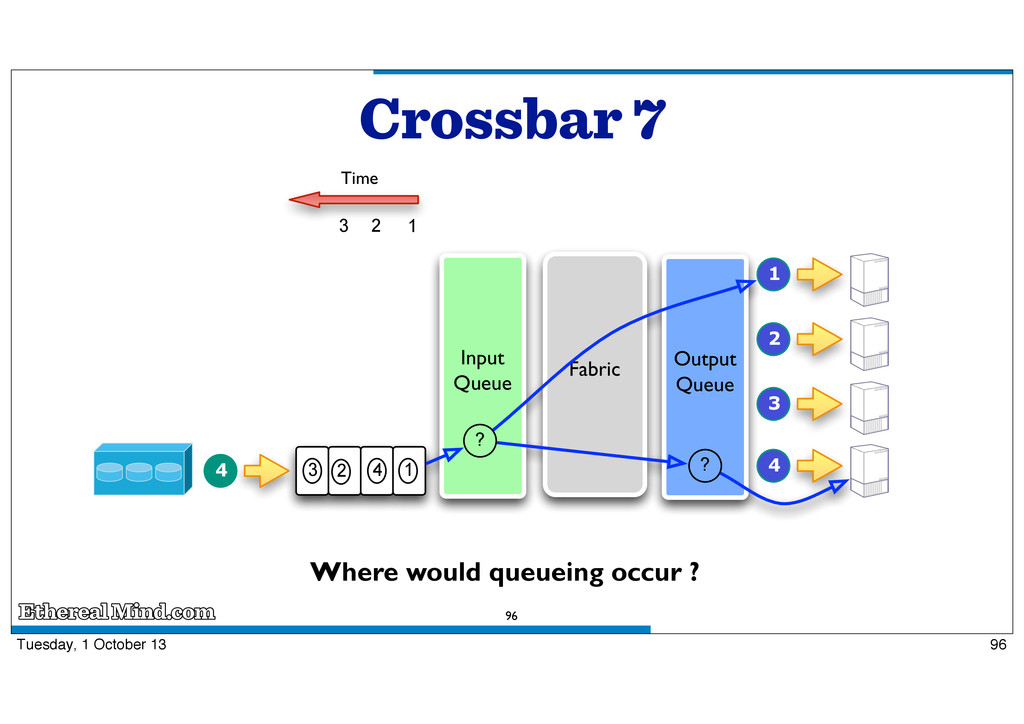
Crossbar 7 96 Output Queue Input Queue Fabric 4 3
1 2 4 1 2 3 4 ? ? Where would queueing occur ? Time 1 2 3 96 Tuesday, 1 October 13 -
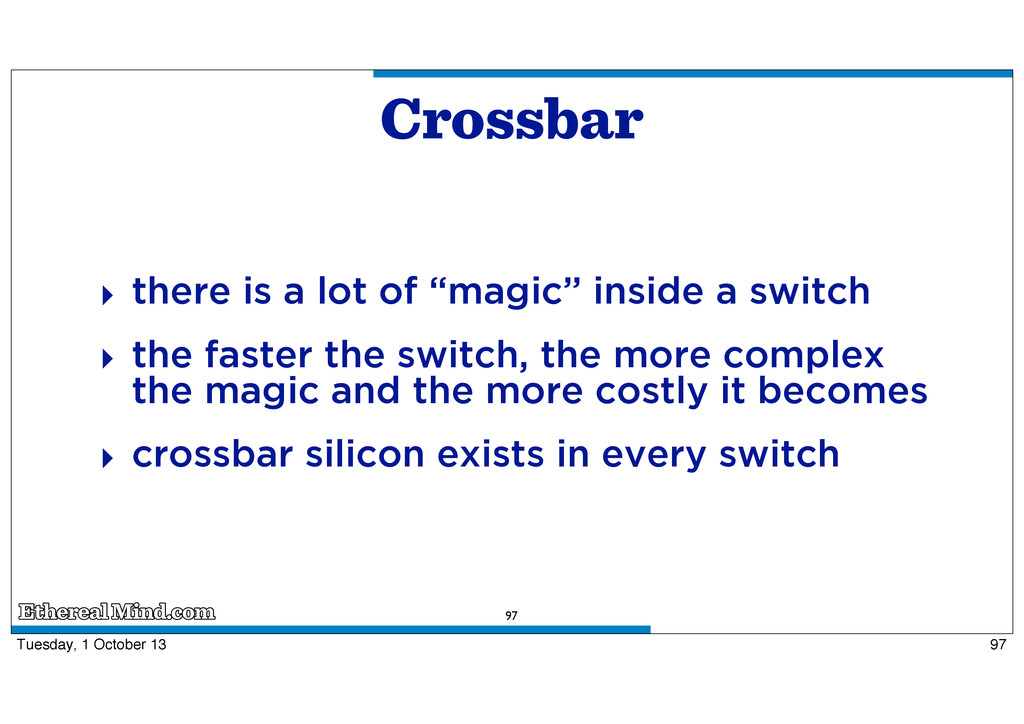
Crossbar 97 ‣ there is a lot of “magic” inside
a switch ‣ the faster the switch, the more complex the magic and the more costly it becomes ‣ crossbar silicon exists in every switch 97 Tuesday, 1 October 13 -
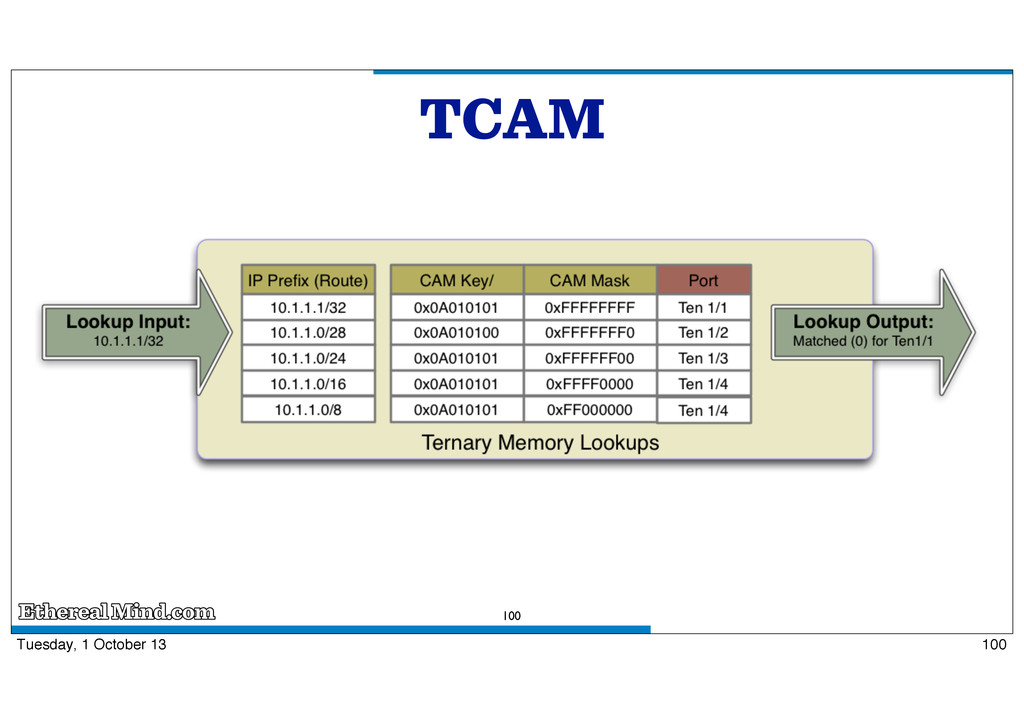
Content Addressable Memory ‣ High Speed SRAM memory ‣ Performs
a database lookup in a single clock cycle ‣ Expensive, fast, ‣ Different types ‣ BCAM - exact match ‣ TCAM - partial match 98 98 Tuesday, 1 October 13 -
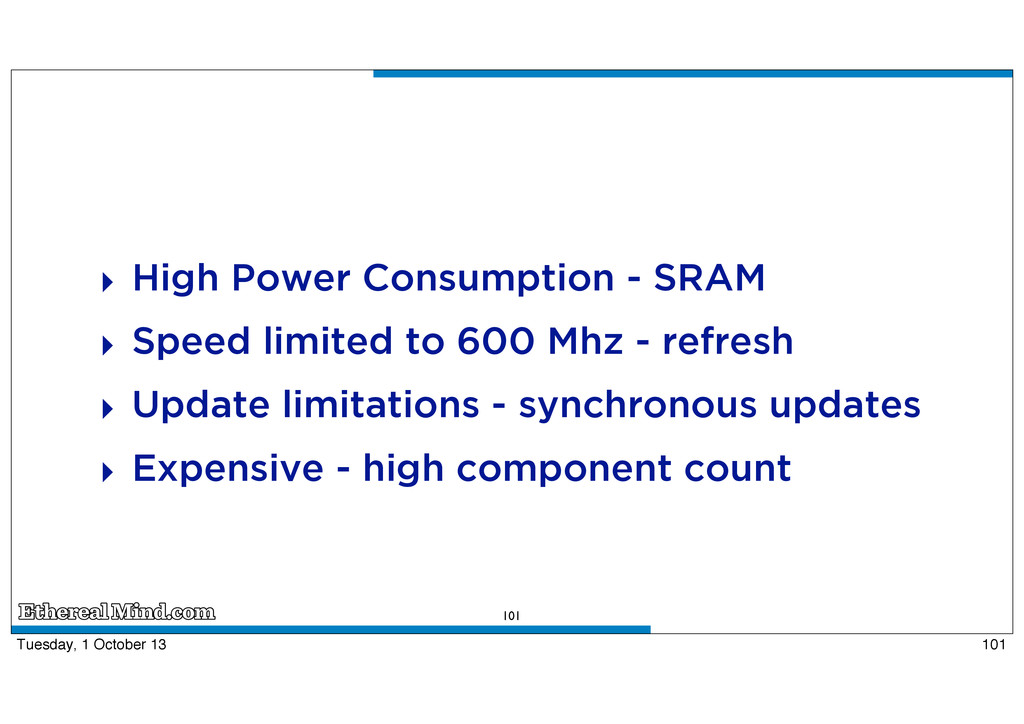
101 ‣ High Power Consumption - SRAM ‣ Speed limited
to 600 Mhz - refresh ‣ Update limitations - synchronous updates ‣ Expensive - high component count 101 Tuesday, 1 October 13 -
Rack vs Chassis - 1 ‣ Rackable switch use “System
on Chip” ‣ Low cost but performance limited ‣ ECMP allows small switches to do big things ‣ low cost rackable devices allow for rotation in 3 years (server replacement times) ‣ new features, 40GbE / 100GbE ‣ react to changes in networking ‣ switching on motherboard 102 102 Tuesday, 1 October 13 -
Rack vs Chassis - 2 ‣ chassis switches are way
more expensive and unreliable because of complexity ‣ chassis switches are poor choices for network services e.g. ‣ chassis switch mandatory for tree network & optional for ECMP designs 103 103 Tuesday, 1 October 13 -
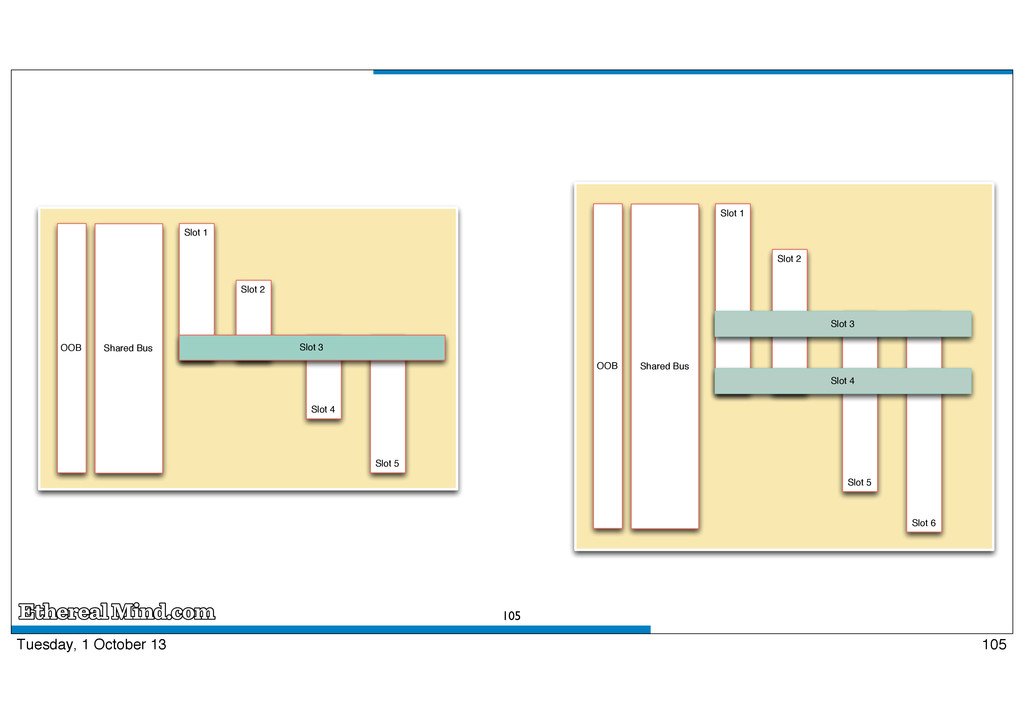
Chassis Switching & Backplanes ‣ length ‣ speed ‣ clocking
104 104 Tuesday, 1 October 13 -
105 Slot 1 Slot 2 Slot 4 Slot 5 OOB
Shared Bus Slot 3 Slot 1 Slot 2 Slot 5 Slot 6 OOB Shared Bus Slot 3 Slot 4 105 Tuesday, 1 October 13 -
Chassis Architecture 106 FABRIC MODULES Fabric ASIC Packet Processor Port
ASIC Port ASIC Packet Processor Port ASIC Port ASIC Packet Processor Port ASIC Port ASIC Packet Processor Port ASIC Port ASIC CHASSIS BACKPLANE Packet Processor Port ASIC Port ASIC Packet Processor Port ASIC Port ASIC Packet Processor Port ASIC Port ASIC Packet Processor Port ASIC Port ASIC Fabric ASIC Fabric ASIC Fabric ASIC LINE CARD LINE CARD 106 Tuesday, 1 October 13 -
Dual Active Fabrics ‣ Dual Active Fabric ‣ Legacy Switches
‣ Chassis Switches Only ‣ Complex ‣ Complexity = Software Risk & Hard to Maintain 107 107 Tuesday, 1 October 13 -
Ethernet Bandwidth in 25 Years 1990 1992 1994 1996 1998
2000 2002 2004 2006 2008 2010 2012 2014 1.1 × 10¹² 0 1 × 10¹¹ 2 × 10¹¹ 3 × 10¹¹ 4 × 10¹¹ 5 × 10¹¹ 6 × 10¹¹ 7 × 10¹¹ 8 × 10¹¹ 9 × 10¹¹ 1 × 10¹² 10 Mbps 100 Mbps 1 Gbps 10 Gbps 40 Gbps 100 Gbps 1 Tbps 400 Gbps 109 109 Tuesday, 1 October 13 -
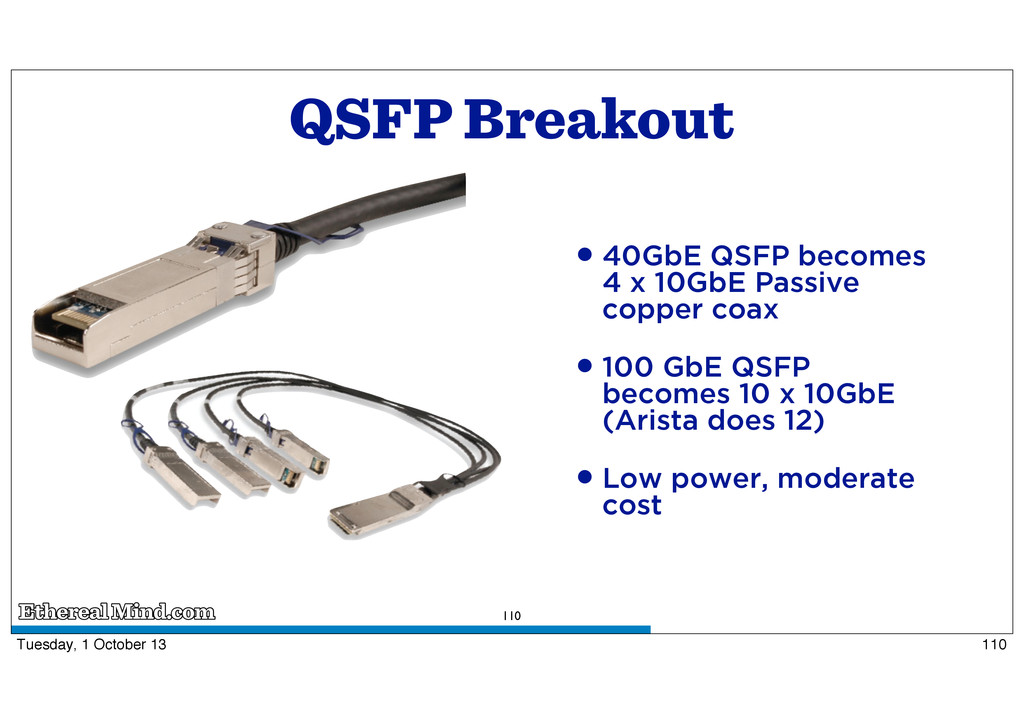
QSFP Breakout •40GbE QSFP becomes 4 x 10GbE Passive copper
coax •100 GbE QSFP becomes 10 x 10GbE (Arista does 12) •Low power, moderate cost 110 110 Tuesday, 1 October 13 -
Merchant Silicon ‣ Broadcom Trident2 ‣ Fully-featured , high-density 1RU
data center switch ‣ 2.56Tbps throughput DCB-enabled, VLT ‣ 32x40GbE and 8x40GbE ( 96x10GbE in breakout mode) ‣ Look for other features ‣ Speeds and feeds no longer important ‣ Dell S6000 operates room temperature ‣ VTEP capabilties ‣ software quality 111 111 Tuesday, 1 October 13 -
40GbE & 100GbE Physical ‣ 10GbE lanes (4 x 10,
10 x 10) ‣ Multimode - 40 GbE fibre=4 pair, 100 GbE = 10 pair ‣ UTP highly unlikely > 98% certain ‣ New fibre types used for distance ‣ Use new cabling methods ‣ abandon flood cabling 112 112 Tuesday, 1 October 13 -
How Much 10GbE Do You Need ? ‣ A typical
Broadcom Trident2 switch has 32 x 40GbE ports ‣ Lets Say Blade Chassis uses 1 x 40GbE to a pair of switches ‣ Each 40GbE can be 4 x 10GbE (whichever cheaper) ‣ 1 Blade Chassis = 8 Physical Servers ‣ 8 Physical = 20 Virtual ‣ 32 x 20 x 8 = 5120 Virtual Servers 113 113 Tuesday, 1 October 13 -
QoS in the Data Centre ‣ No. ‣ If you
do, it will break things ‣ Buy bigger switches ‣ Its cheaper & more reliable ‣ QoS heavily depends on the physical devices. ‣ consistent end-to-end QoS deeply impractical with current systems. No known solutions. ‣ With sufficient thrust, pigs fly just fine. However, this is not necessarily a good idea. It is hard to be sure where they are going to land, and it could be dangerous sitting under them as they fly overhead - RFC1925 Rule 3. 114 114 Tuesday, 1 October 13 -
Please Rate Me ‣ If its good they might invite
me back and I’ll know the effort is worthwhile ‣ I might get champagne with gold flakes in it. ‣ If it’s not good, then I will be prevented from inflicting this on anyone else. 116 116 Tuesday, 1 October 13 -
Agenda - Part 3 Part 0 - Networking Renaissance Part
1 - Data Centre Fabrics & Designs Part 2 - Switch Internals Part 3 - SDN, Operations and Overlays 117 117 Tuesday, 1 October 13 -
SDN 118 ‣ Software Defined Networking ‣ is about new
ways of operating your network ‣ instead of manual configuration for boring stuff, use software / applications ‣ enable Cloud by integrating network with virtualization & storage 118 Tuesday, 1 October 13 -
Can’t predict 10 years of SDN ‣ But I can
tell you what the next three years will look like ‣ OpenFlow changed and will change everything ‣ drastic change will take time to arrive ‣ OpenFlow probably dominant in hardware in 5 years 119 119 Tuesday, 1 October 13 -
Controller Networks 120 East West LAN Switches Network SDN Controller
OpenFlow 120 Tuesday, 1 October 13 -
Controller Networking 121 East West LAN Switches Network SDN Controller
OpenFlow Quantum/OpenStack Configuration Controller Orchestration Controller Northbound SDN Northbound SDN Southbound SDN North/South LAN 121 Tuesday, 1 October 13 -
Overlay Networking 122 ‣ Changing the physical network will take
years ‣ OpenFlow needs new hardware ‣ Competitive pressure means we need new networking today ‣ Overlay Networking 122 Tuesday, 1 October 13 -
123 Physical Server Hypervisor vSwitch VM VM OS App vNIC
OS App vNIC Driver Driver Physical Server Hypervisor vSwitch VM VM OS App vNIC OS App vNIC Driver Driver Physical Server Hypervisor vSwitch VM VM OS App vNIC OS App vNIC Driver Driver Physical Server Hypervisor vSwitch VM VM OS App vNIC OS App vNIC Driver Driver ToR NIC NIC NIC NIC NIC NIC NIC NIC ToR 123 Tuesday, 1 October 13 -
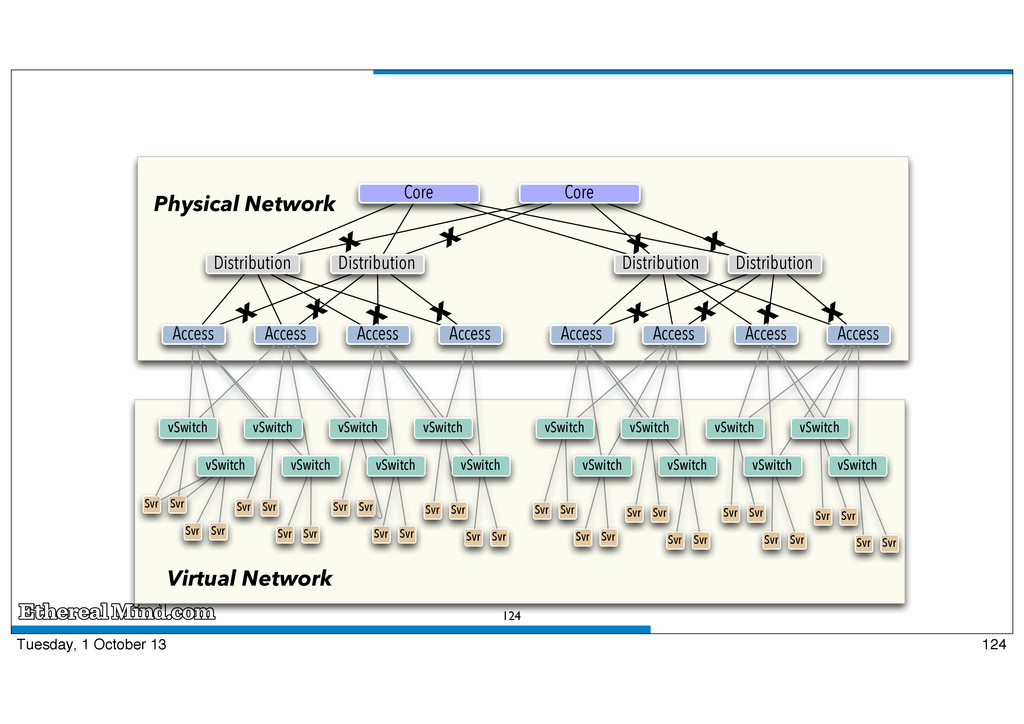
124 Distribution Distribution Distribution Distribution Access Access Access Access Access
Access Access Access Core Core X X X X X X X X X X X X Svr Svr Svr Svr Svr Svr Svr Svr Svr Svr Svr Svr Svr Svr Svr Svr Svr Svr Svr Svr Svr Svr Svr Svr Svr Svr Svr Svr Svr Svr Svr Svr vSwitch vSwitch vSwitch vSwitch vSwitch vSwitch vSwitch vSwitch vSwitch vSwitch vSwitch vSwitch vSwitch vSwitch vSwitch vSwitch Physical Network Virtual Network 124 Tuesday, 1 October 13 -
Overlay Networking 127 •Full Mesh of Tunnels •Using existing assets
•No impact to physical network - NO CHANGE CONTROL 127 Tuesday, 1 October 13 -
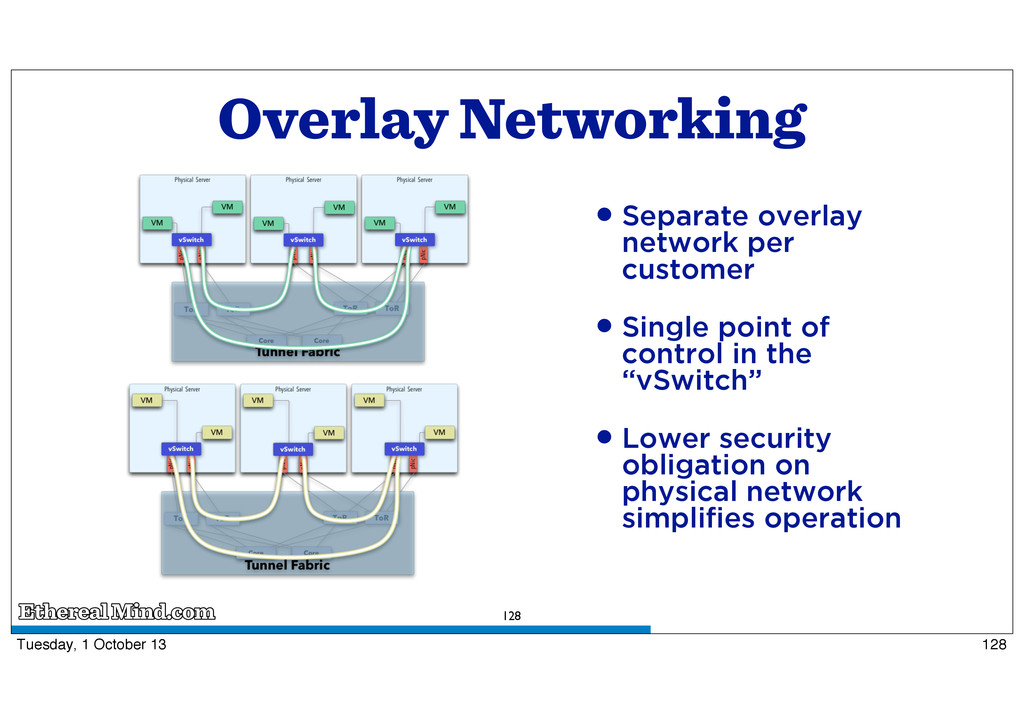
Overlay Networking 128 •Separate overlay network per customer •Single point
of control in the “vSwitch” •Lower security obligation on physical network simplifies operation 128 Tuesday, 1 October 13 -
Overlay Networking 129 •Today, vSwitch is a “robot patch panel”
•Tomorrow, a network device performing routing, load balancing, filtering/firewall at network edge 129 Tuesday, 1 October 13 -
Network performance of x86 •Intel confirms 40Gbps forwarding on a
single CPU core •Expect to see Fulcrum switch silicon on motherboard in 2015 & CPU die by 2017 (maybe) 130 130 Tuesday, 1 October 13 -
Network Agent as Router •Network agent can •filter at the
edge, •load balance across available path •policy route (SRC/DST into tunnel interfaces 131 131 Tuesday, 1 October 13 -
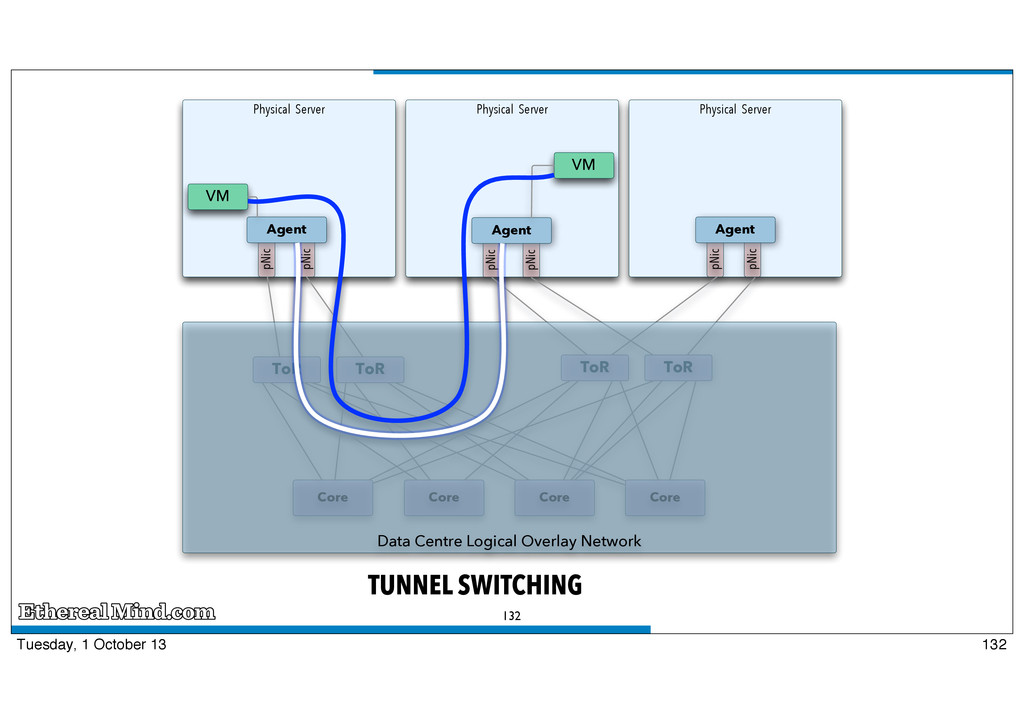
132 Physical Server Physical Server Physical Server pNic pNic VM
Core Core Core Core Agent ToR ToR pNic pNic VM Agent ToR ToR pNic pNic Agent Data Centre Logical Overlay Network TUNNEL SWITCHING 132 Tuesday, 1 October 13 -
133 Physical Server Physical Server Physical Server pNic pNic VM
Core Core Core Core Agent ToR ToR pNic pNic Agent ToR ToR pNic pNic VM Agent TUNNEL ROUTING 133 Tuesday, 1 October 13 -
134 Physical Server Physical Server Physical Server VM VM VM
VM VM VM Core Core Core Core vSwitch ToR ToR VM VM VM VM VM VM vSwitch ToR ToR VM VM VM VM VM VM vSwitch Hypervisor Manager Network Controller API Enabled Network Devices API Enabled Software Network Agents 134 Tuesday, 1 October 13 -
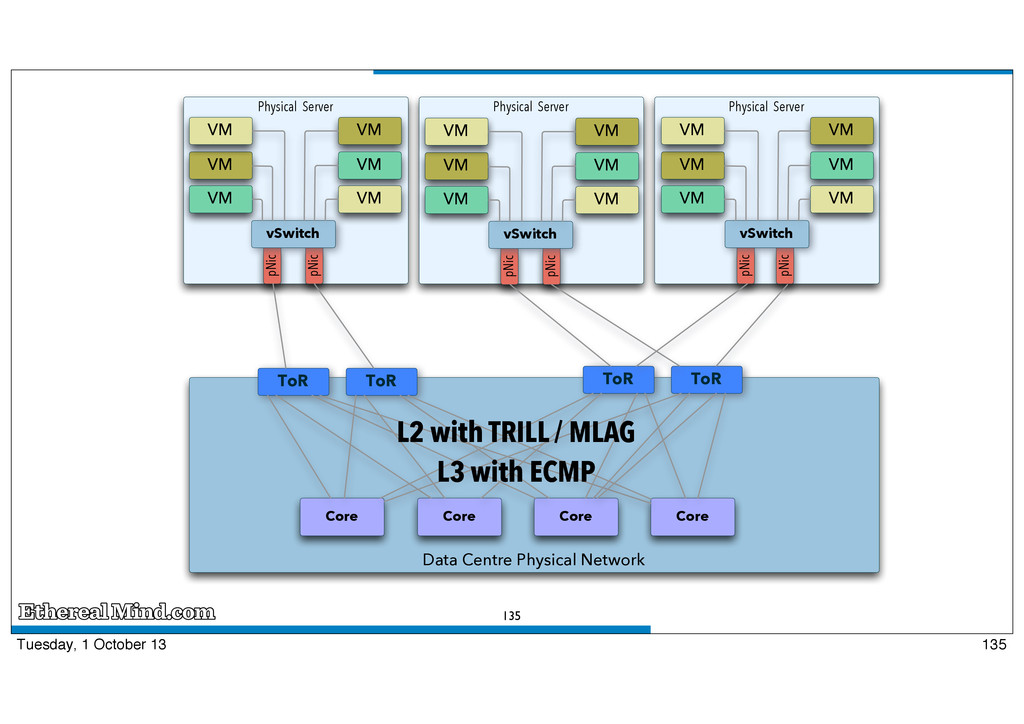
135 Data Centre Physical Network Physical Server Physical Server Physical
Server pNic pNic VM VM VM VM VM VM Core Core Core Core vSwitch ToR ToR pNic pNic VM VM VM VM VM VM vSwitch ToR ToR pNic pNic VM VM VM VM VM VM vSwitch L2 with TRILL / MLAG L3 with ECMP 135 Tuesday, 1 October 13 -
136 VTEP ‣ VXLAN Tunnel End Point (VTEP) ‣ Connects
Overlay to Underlay ‣ At high bandwidth & Low latency ‣ VXLAN to VLAN ‣ Not first option, use software appliances ‣ USE LOTS of Software Appliances - 1 per VXLAN/ VLAN if you can. Still cheaper than hardware device and cheaper to own 136 Tuesday, 1 October 13 -
137 FWL Physical Server pNic pNic VM VM VM VM
VM VM Core Core Core Core ToR ToR ToR ToR VXLAN, NVGRE, NVO3 or MPLSoGRE FWL RTR RTR Internal VTEP VTEP vSwitch Internet SW SW Direct Hosts Server Server Legacy Hosts 137 Tuesday, 1 October 13 -
138 FWL Physical Server Physical Server Physical Server pNic pNic
VM VM VM VM VM VM Core Core Core Core ToR ToR pNic pNic VM VM VM VM VM VM ToR ToR pNic pNic VM VM VM VM VM VM VXLAN, NVGRE, NVO3 or MPLSoGRE FWL RTR RTR Internal OVSDB VTEP VTEP vSwitch vSwitch vSwitch Network Controller OVSDB Internet SW SW Direct Hosts Server Server Legacy Hosts •Network Controller make this easy to operate •Easier than MPLS, VRF- Lite, Virtual Device Contexts •Mapping Underlay to Overlay is painful because orchestration fails 138 Tuesday, 1 October 13 -
Software Defined Data Centres 139 ‣ Overlay Networking means that
the network has a new range of services ‣ Full service separation for security and multi-tenancy applications 139 Tuesday, 1 October 13 -
Today 140 UCS2100 UCS2100 UCS 5100 B2xx B2xx B2xx B2xx
B2xx B2xx B2xx B2xx UCS2100 UCS2100 UCS 5100 B2xx B2xx B2xx B2xx B2xx B2xx B2xx B2xx Ethernet Core Ethernet Core NX7K Core Context NX7K Core Context LoadBal UCS6200 UCS6200 LoadBal NX7K Aggr Context NX7K Aggr Context ASA Firewall ASA Context ASA Context ASA Firewall ASA Context ASA Context MPLS/WAN Internet VMDC Design Template v2.1 - Cisco CVD NX5K NX5K NX5K NX5K DMZ Svr DMZ Svr DMZ Svr DMZ Svr DMZ Svr •Ethernet Core with VDC, MPLS, VRF-Lite or E-VPN •Device contexts •Aieeeeeeeeeeee, change control 140 Tuesday, 1 October 13 -
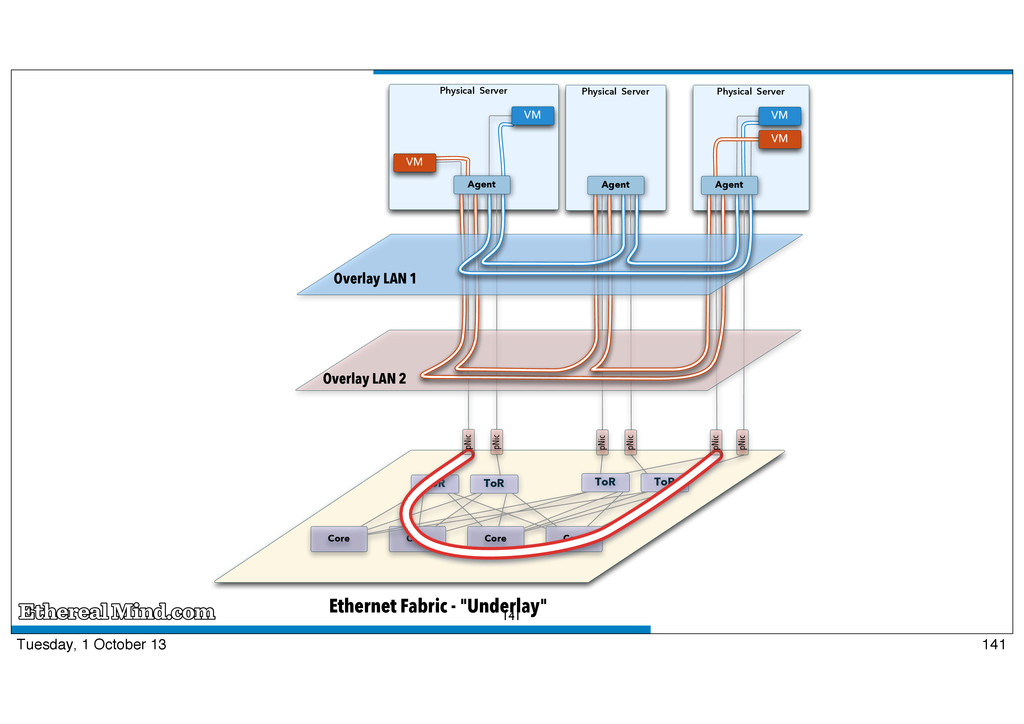
141 Physical Server Physical Server Physical Server Core Core Core
Core ToR ToR ToR ToR Ethernet Fabric - "Underlay" Overlay LAN 1 Overlay LAN 2 pNic pNic pNic pNic pNic pNic Agent Agent VM Agent VM VM VM 141 Tuesday, 1 October 13 -
142 Physical Server Physical Server Physical Server Virtual Data Center
1 Virtual Data Center 2 Agent Agent VM Agent VM VM Network Controller VM VM VM VM 142 Tuesday, 1 October 13 -
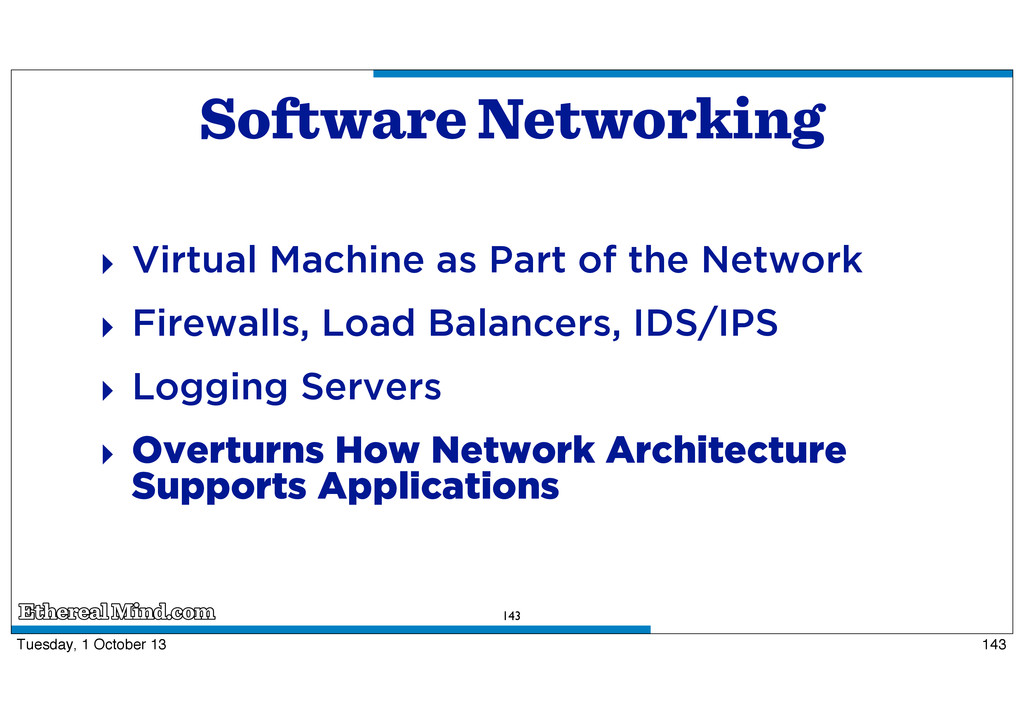
143 Software Networking ‣ Virtual Machine as Part of the
Network ‣ Firewalls, Load Balancers, IDS/IPS ‣ Logging Servers ‣ Overturns How Network Architecture Supports Applications 143 Tuesday, 1 October 13 -
144 RTR RTR FWL FWL Core Core Access Access SV
R SV R SV R SV R SV R SV R Access Access SV R SV R SV R SV R SV R SV R Access SV R SV R SV R Application Shared Resources Internal Service Application RTR RTR FWL FWL Core Core SVR SVR SVR SVR SVR SVR SVR SVR SVR SVR SVR SVR DMZ SVR SVR SVR 144 Tuesday, 1 October 13 -
145 Application Shared Resources Internal Service Application SVR SVR SVR
SVR SVR SVR SVR SVR SVR SVR SVR SVR DMZ SVR SVR SVR RTR RTR FWL FWL RTR FWL RTR FWL FWL FWL Application Shared Resources Internal Service Application SVR SVR SVR SVR SVR SVR SVR SVR SVR SVR SVR SVR DMZ SVR SVR SVR RTR RTR FWL FWL RTR FWL RTR FWL FWL FWL 145 Tuesday, 1 October 13 -
146 Virtual Data Centers ‣ Network separation by overlay and
controller ‣ Server <-> Network integration at controller 146 Tuesday, 1 October 13 -
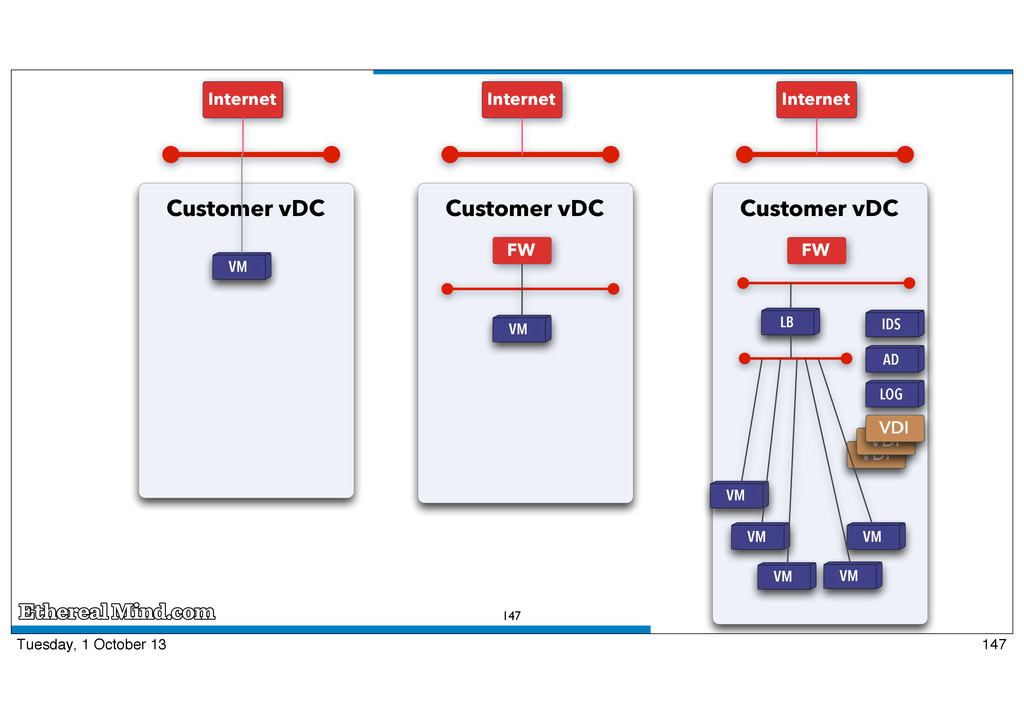
147 Internet Customer vDC VM Internet FW Customer vDC VM
Internet FW Customer vDC LB VDI IDS AD LOG VDI VDI VM VM VM VM VM 147 Tuesday, 1 October 13 -
148 Internet Customer vDC vApp Template FW SVR VDI VDI
SVR App Catalog vApp Template FW SVR VDI VDI SVR 148 Tuesday, 1 October 13 -
149 Internet Customer vDC vApp Template FW SVR VDI VDI
SVR App Catalog vApp Template FW SVR VDI VDI SVR RTR SVR Zone 3 vDC SVR SVR SVR 149 Tuesday, 1 October 13 -
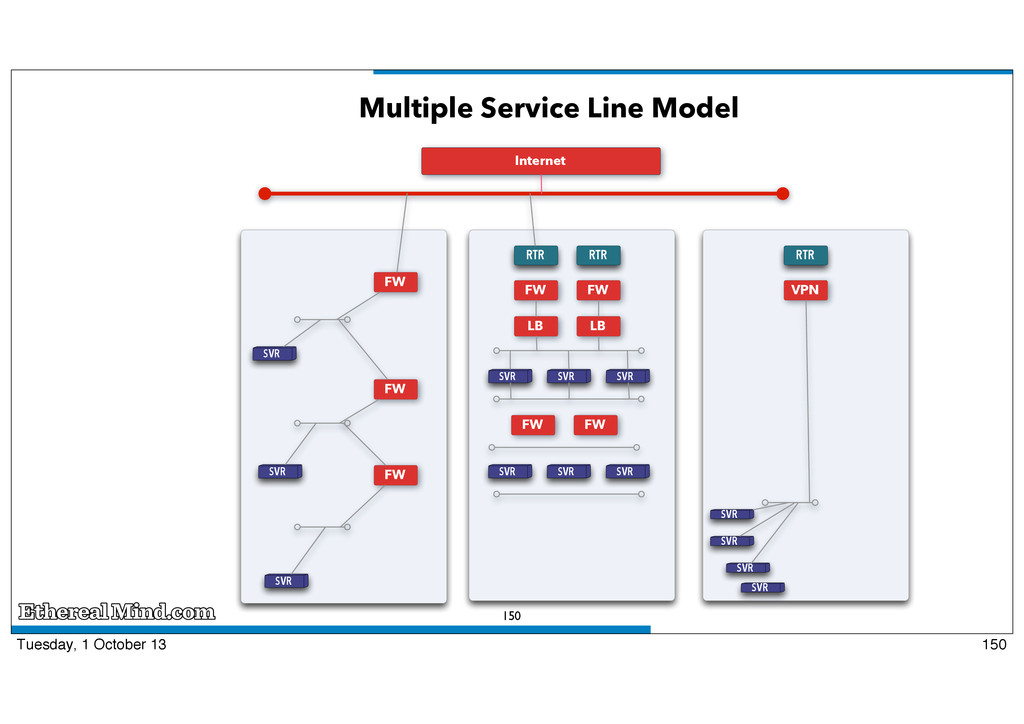
150 SVR SVR SVR SVR SVR SVR SVR Multiple Service
Line Model RTR RTR FW FW FW FW LB SVR RTR FW LB SVR SVR FW FW SVR SVR SVR VPN Internet 150 Tuesday, 1 October 13 -
151 SVR SVR SVR Resources Services vDC SVR SVR RTR
Active Directory Patching SVR AntiVirus vCNS SVR vCNS SVR SVR SVR Service Lines with Shared Resources RTR RTR FW FW FW FW LB SVR RTR FW LB SVR SVR FW FW SVR SVR SVR VPN Internet 151 Tuesday, 1 October 13 -
152 RTR VPN IAM NAC Juniper MAG ? RSA IAM
Juniper SA Security vDC RTR SVR Zone 1 vDC vCNS RTR DLP FW PXY SAML Internet SVR SVR Resources Services vDC SVR SVR SVR RTR Active Directory Patching SVR AntiVirus PXY Remote Access/BYOD Outbound Web Services LOG LOG RTR FW Inbound Web Services IDS IDS RTR SVR Zone 2 vDC vCNS SVR SVR SVR RTR SVR Zone 3 vDC vCNS SVR SVR SVR . . . . . . . Templates Virtual Data Centre Inter-Org Links LOG 152 Tuesday, 1 October 13 -
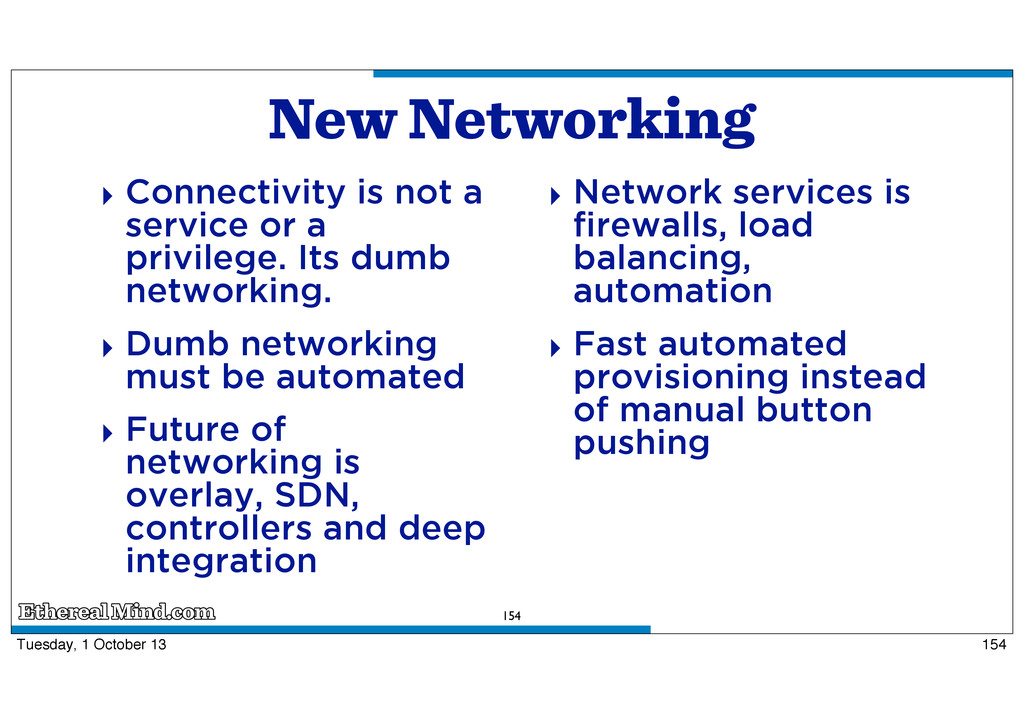
New Networking 154 ‣ Connectivity is not a service or
a privilege. Its dumb networking. ‣ Dumb networking must be automated ‣ Future of networking is overlay, SDN, controllers and deep integration ‣ Network services is firewalls, load balancing, automation ‣ Fast automated provisioning instead of manual button pushing 154 Tuesday, 1 October 13 -
Network Fabrics ‣ Expect to deploy multiple switch fabrics in
the data centre ‣ Reconsider chassis purchases, build ECMP fabrics ‣ expect to upgrade to 40GbE/100GbE within 3 years ‣ don’t pre-cable new racks, use cabling system ‣ 155 155 Tuesday, 1 October 13 -
Please Rate Me ‣ If its good they might invite
me back and I’ll know the effort is worthwhile ‣ I might get champagne with gold flakes in it. ‣ If it’s not good, then I will be prevented from inflicting this on anyone else. 156 156 Tuesday, 1 October 13 -
Thankyou Question Time ‣ Host of Packet Pushers Podcast ‣
Freelance Network Architect/Engineer ‣ Blog - EtherealMind.com ‣ NetworkComputing.com (http://networkcomputing.com/blogs/author/Greg-Ferro) ‣ Slides: speakerdeck.com/etherealmind 157 157 Tuesday, 1 October 13
 etherealmind
 inariku
 azukiazusa1
 staka121
 junya_okura
 kmiya84377
 sat
 ivry_presentationmaterials
 takaha4k
 junjikoide
 oidfj
 hatahata021
 miu_crescent
 marktimemedia
 mkilby
 tammyeverts
 bkeepers
 danielanewman
 nwiizo
 hatefulcrawdad
 mlcsv
 nmsamuel
 ipullrank