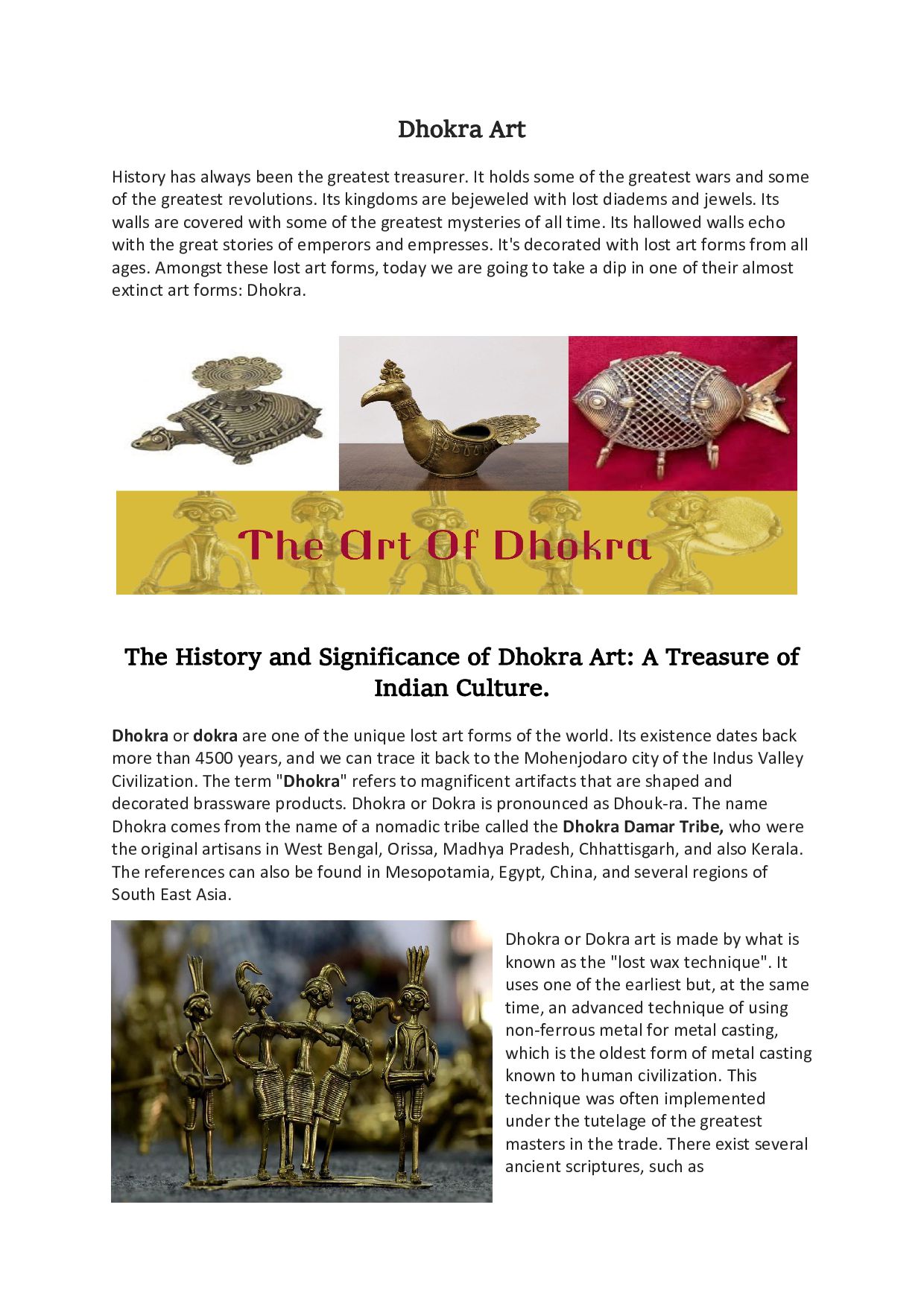
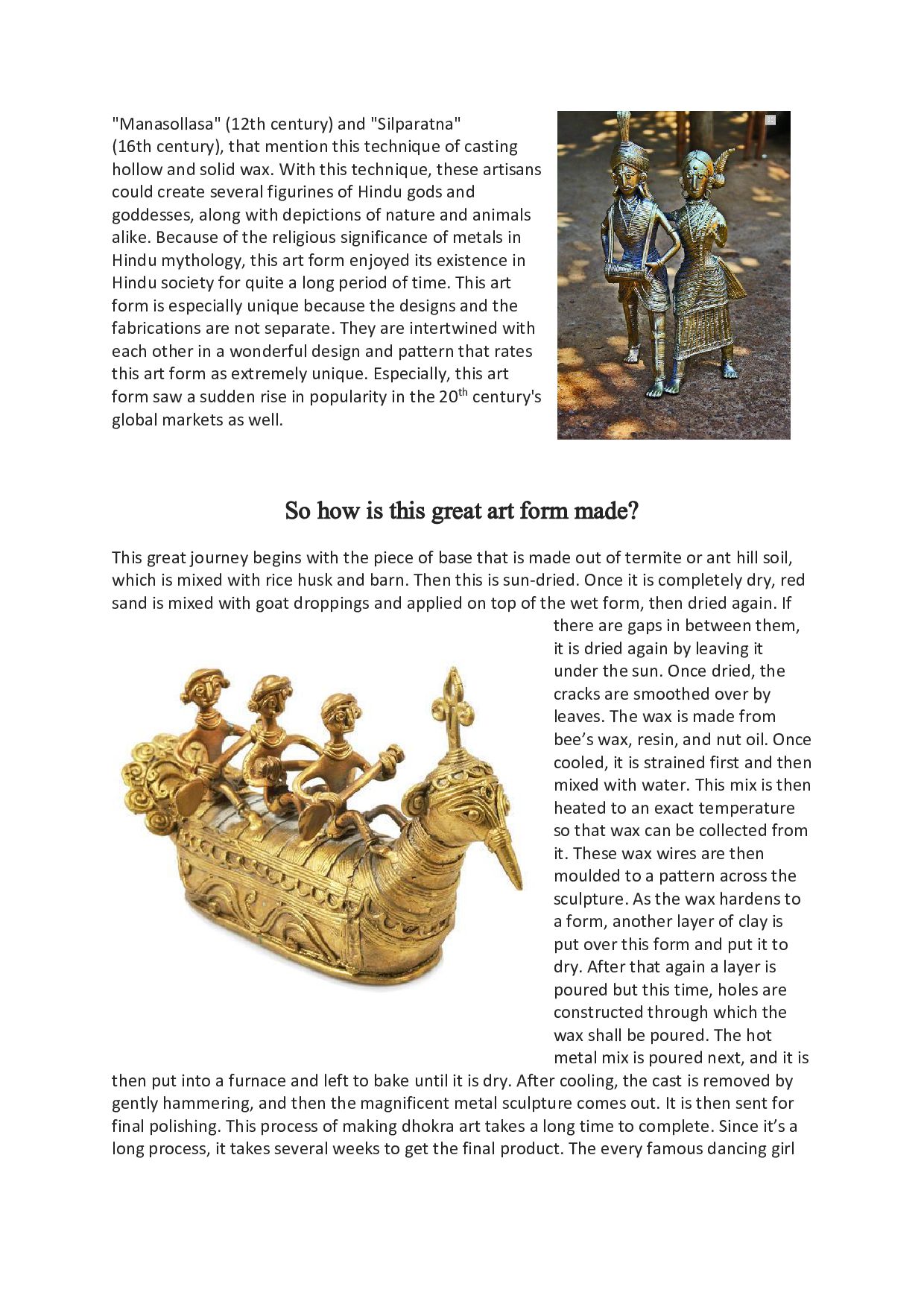
holds some of the greatest wars and some of the greatest revolutions. Its kingdoms are bejeweled with lost diadems and jewels. Its walls are covered with some of the greatest mysteries of all time. Its hallowed walls echo with the great stories of emperors and empresses. It's decorated with lost art forms from all ages. Amongst these lost art forms, today we are going to take a dip in one of their almost extinct art forms: Dhokra. The History and Significance of Dhokra Art: A Treasure of Indian Culture. Dhokra or dokra are one of the unique lost art forms of the world. Its existence dates back more than 4500 years, and we can trace it back to the Mohenjodaro city of the Indus Valley Civilization. The term "Dhokra" refers to magnificent artifacts that are shaped and decorated brassware products. Dhokra or Dokra is pronounced as Dhouk-ra. The name Dhokra comes from the name of a nomadic tribe called the Dhokra Damar Tribe, who were the original artisans in West Bengal, Orissa, Madhya Pradesh, Chhattisgarh, and also Kerala. The references can also be found in Mesopotamia, Egypt, China, and several regions of South East Asia. Dhokra or Dokra art is made by what is known as the "lost wax technique". It uses one of the earliest but, at the same time, an advanced technique of using non-ferrous metal for metal casting, which is the oldest form of metal casting known to human civilization. This technique was often implemented under the tutelage of the greatest masters in the trade. There exist several ancient scriptures, such as
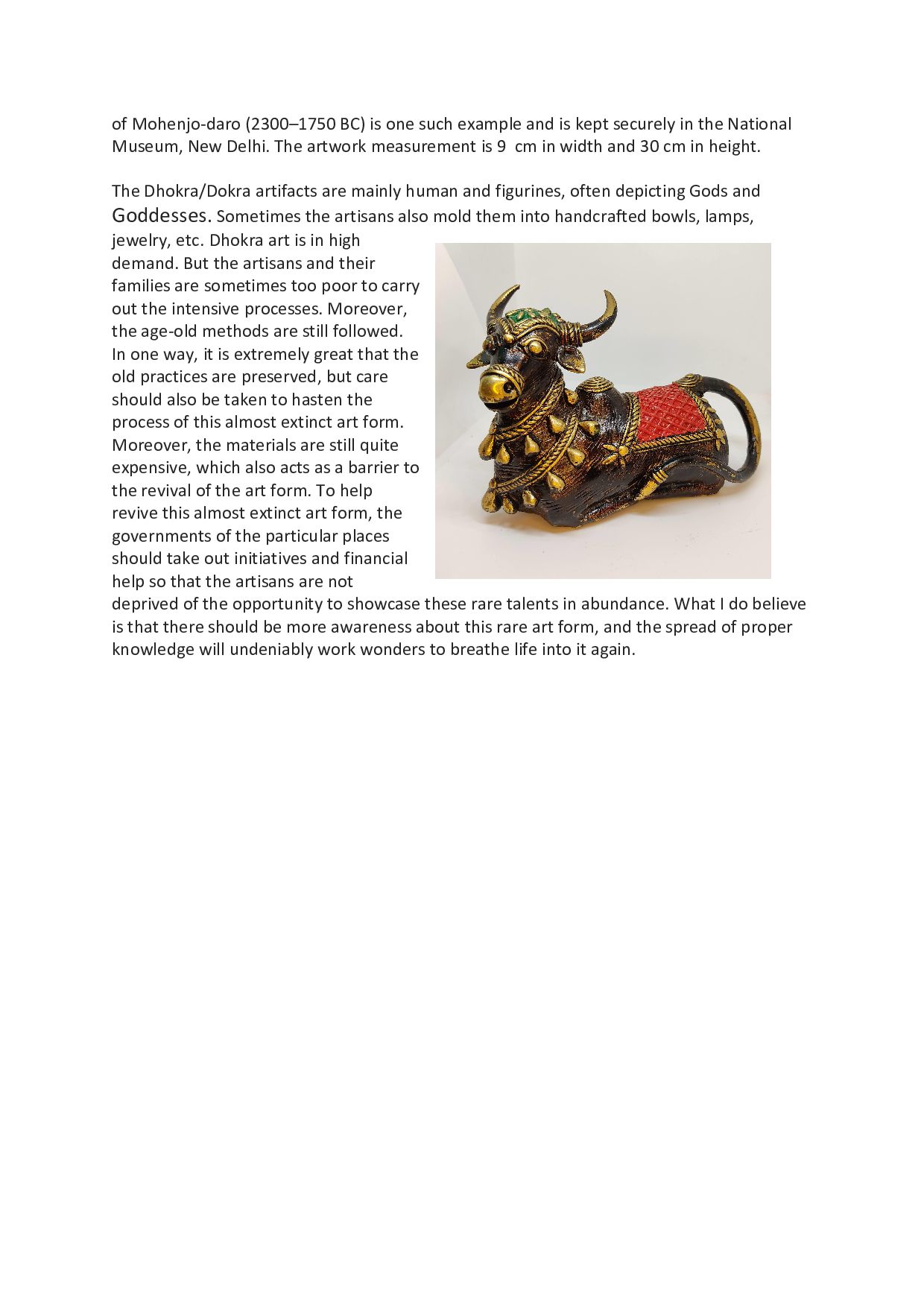
technique of casting hollow and solid wax. With this technique, these artisans could create several figurines of Hindu gods and goddesses, along with depictions of nature and animals alike. Because of the religious significance of metals in Hindu mythology, this art form enjoyed its existence in Hindu society for quite a long period of time. This art form is especially unique because the designs and the fabrications are not separate. They are intertwined with each other in a wonderful design and pattern that rates this art form as extremely unique. Especially, this art form saw a sudden rise in popularity in the 20th century's global markets as well. So how is this great art form made? This great journey begins with the piece of base that is made out of termite or ant hill soil, which is mixed with rice husk and barn. Then this is sun-dried. Once it is completely dry, red sand is mixed with goat droppings and applied on top of the wet form, then dried again. If there are gaps in between them, it is dried again by leaving it under the sun. Once dried, the cracks are smoothed over by leaves. The wax is made from bee’s wax, resin, and nut oil. Once cooled, it is strained first and then mixed with water. This mix is then heated to an exact temperature so that wax can be collected from it. These wax wires are then moulded to a pattern across the sculpture. As the wax hardens to a form, another layer of clay is put over this form and put it to dry. After that again a layer is poured but this time, holes are constructed through which the wax shall be poured. The hot metal mix is poured next, and it is then put into a furnace and left to bake until it is dry. After cooling, the cast is removed by gently hammering, and then the magnificent metal sculpture comes out. It is then sent for final polishing. This process of making dhokra art takes a long time to complete. Since it’s a long process, it takes several weeks to get the final product. The every famous dancing girl
kept securely in the National Museum, New Delhi. The artwork measurement is 9 cm in width and 30 cm in height. The Dhokra/Dokra artifacts are mainly human and figurines, often depicting Gods and Goddesses. Sometimes the artisans also mold them into handcrafted bowls, lamps, jewelry, etc. Dhokra art is in high demand. But the artisans and their families are sometimes too poor to carry out the intensive processes. Moreover, the age-old methods are still followed. In one way, it is extremely great that the old practices are preserved, but care should also be taken to hasten the process of this almost extinct art form. Moreover, the materials are still quite expensive, which also acts as a barrier to the revival of the art form. To help revive this almost extinct art form, the governments of the particular places should take out initiatives and financial help so that the artisans are not deprived of the opportunity to showcase these rare talents in abundance. What I do believe is that there should be more awareness about this rare art form, and the spread of proper knowledge will undeniably work wonders to breathe life into it again.


 tbpgr
 attelu
 makaibito
 kuradashi
 kinsofficial
 superstudio
 ggfs
 kintotechdev
 ikuodanaka
 iwashi86
 malna
 nessu_inc
 cassininazir
 mlcsv
 tammyeverts
 aleyda
 tmiket
 reverentgeek
 michielstock
 brad_frost
 eitanlees
 lindahogenes
 morganepeng
 ipullrank