Upgrade to Pro — share decks privately, control downloads, hide ads and more …

Testing the parts you don’t see: Pseudo-tested ...

Testing the parts you don’t see: Pseudo-tested native code in Python libraries

Python test suites can look strong while still missing important problems. A package may have high coverage, passing tests, and a clean public API, yet some of its most important behavior may not be checked in a way that would catch real mistakes. This is especially important for Python libraries that rely on native extensions written in C, C++, or Rust, such as NumPy, scikit-learn, and Polars. In these projects, Python-level tests may exercise the public API while still missing mistakes in the performance-critical native implementation underneath.

In this talk, we will show how mutation testing can make that gap visible. Mutation testing works by making small, meaningful changes to code and checking whether the test suite catches them; when a change survives, it suggests that “covered” does not always mean “well tested.” Using concrete examples, we will explain how this idea applies to Python packages with native internals and discuss practical challenges such as choosing mutation targets, rebuilding native extensions, and interpreting surviving mutations. Attendees will leave with a clearer understanding of the limits of coverage in extension-backed Python libraries, along with practical ideas for improving tests around native-backed APIs.

Avatar for Gregory Kapfhammer

Gregory Kapfhammer

July 24, 2026

More Decks by Gregory Kapfhammer

Other Decks in Programming

Transcript

  1. PYOHIO 2026 · JULY 26 Testing the Parts You Don't

    See Pseudo-Tested Native Code in Python Libraries “look inside” Issei Hasegawa Gregory M. Kapfhammer Department of Computer and Information Science Allegheny College 1
  2. 2

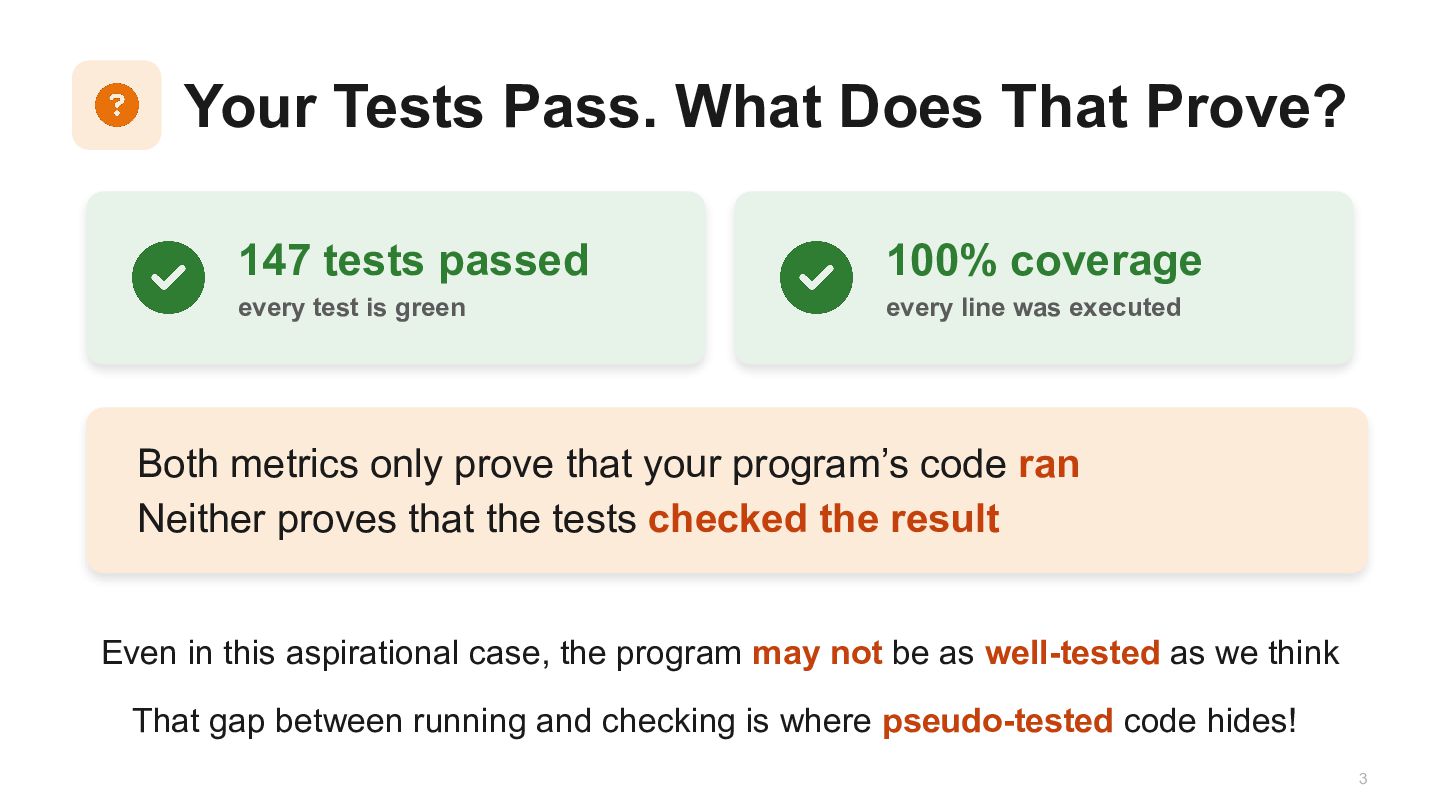
  3. Your Tests Pass. What Does That Prove? 147 tests passed

    100% coverage every test is green every line was executed Both metrics only prove that your program’s code ran Neither proves that the tests checked the result Even in this aspirational case, the program may not be as well-tested as we think That gap between running and checking is where pseudo-tested code hides! 3
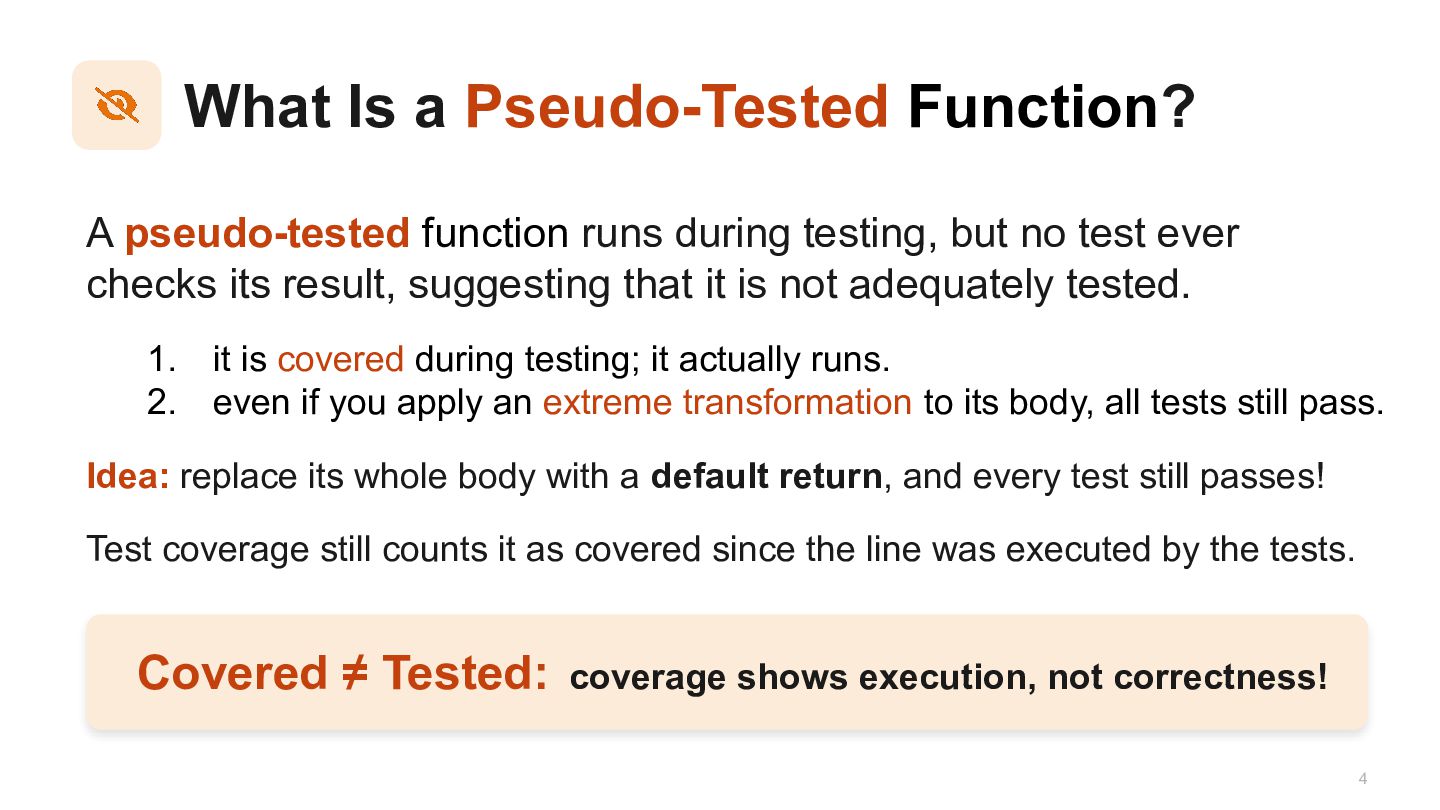
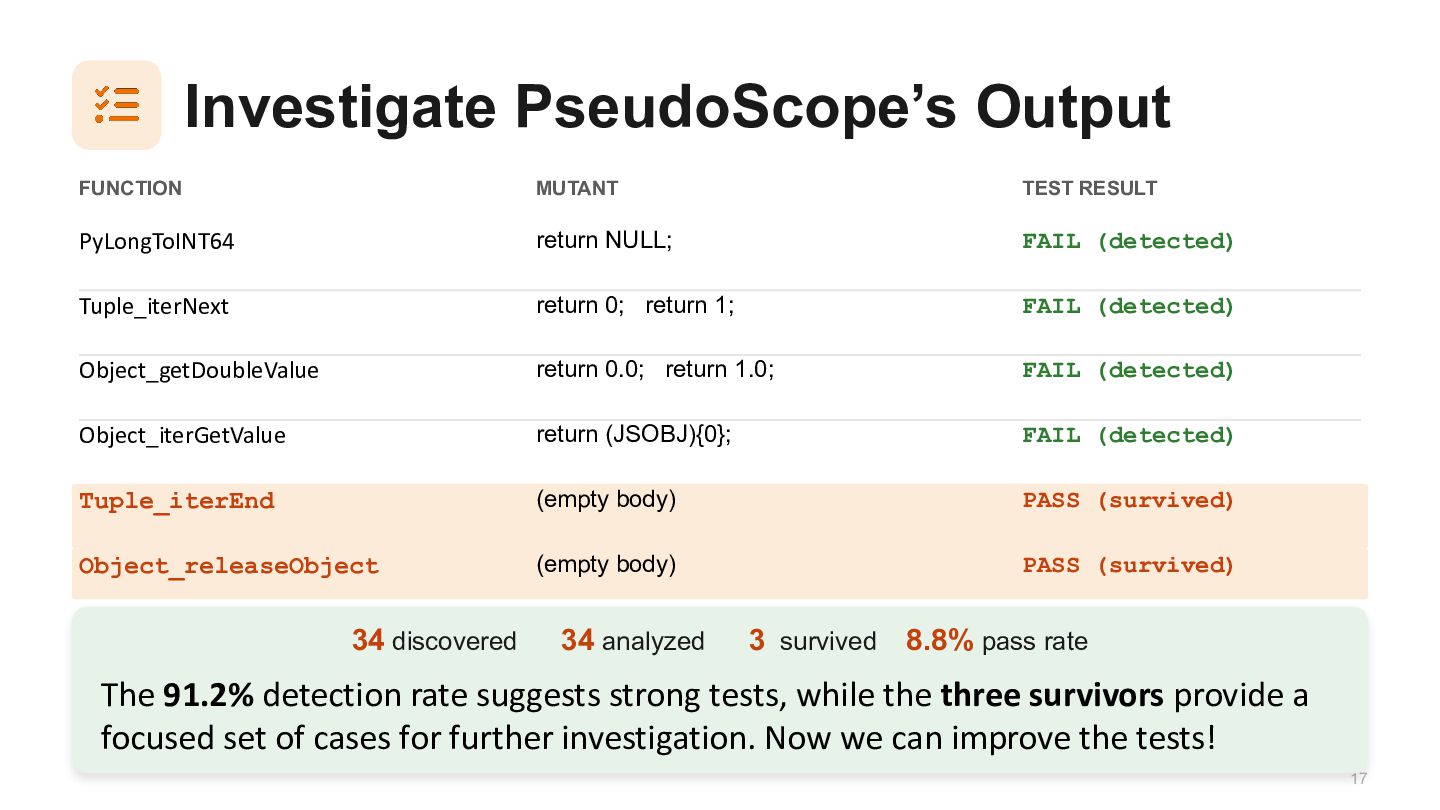
  4. What Is a Pseudo-Tested Function? A pseudo-tested function runs during

    testing, but no test ever checks its result, suggesting that it is not adequately tested. 1. 2. it is covered during testing; it actually runs. even if you apply an extreme transformation to its body, all tests still pass. Idea: replace its whole body with a default return, and every test still passes! Test coverage still counts it as covered since the line was executed by the tests. Covered ≠ Tested: coverage shows execution, not correctness! 4
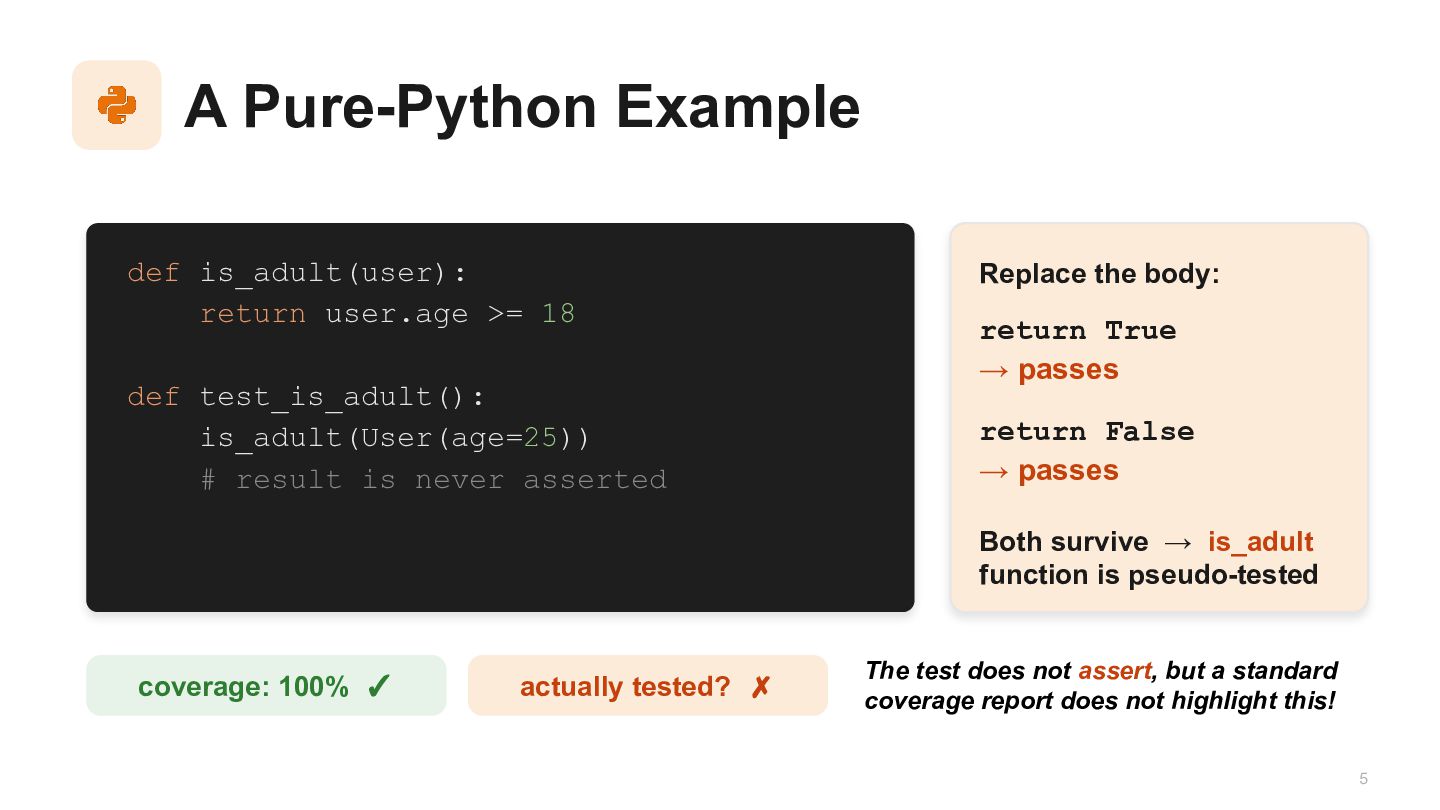
  5. A Pure-Python Example def is_adult(user): return user.age >= 18 def

    test_is_adult(): is_adult(User(age=25)) # result is never asserted Replace the body: return True → passes return False → passes Both survive → is_adult function is pseudo-tested coverage: 100% ✓ actually tested? ✗ The test does not assert, but a standard coverage report does not highlight this! 5
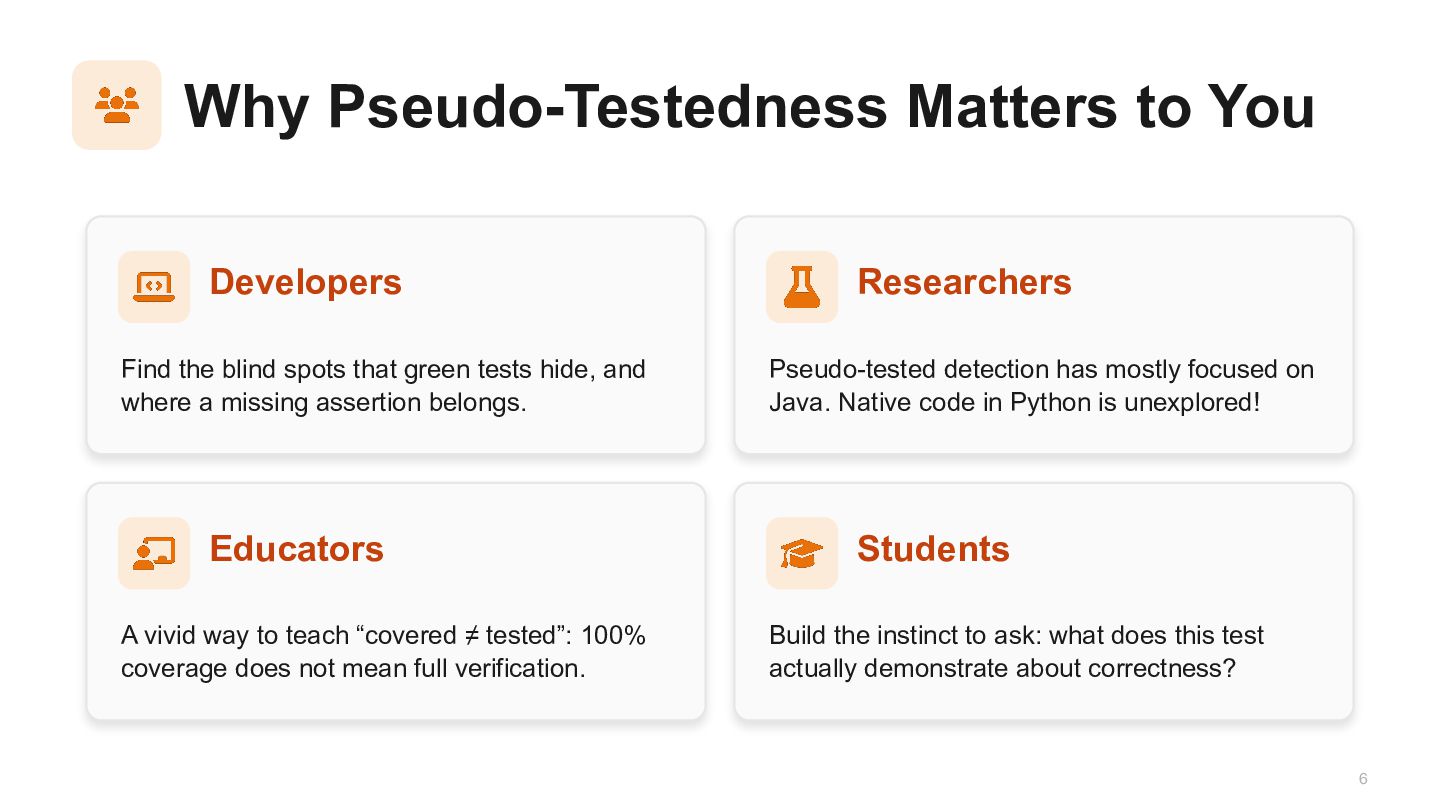
  6. Why Pseudo-Testedness Matters to You Developers Find the blind spots

    that green tests hide, and where a missing assertion belongs. Educators A vivid way to teach “covered ≠ tested”: 100% coverage does not mean full verification. Researchers Pseudo-tested detection has mostly focused on Java. Native code in Python is unexplored! Students Build the instinct to ask: what does this test actually demonstrate about correctness? 6
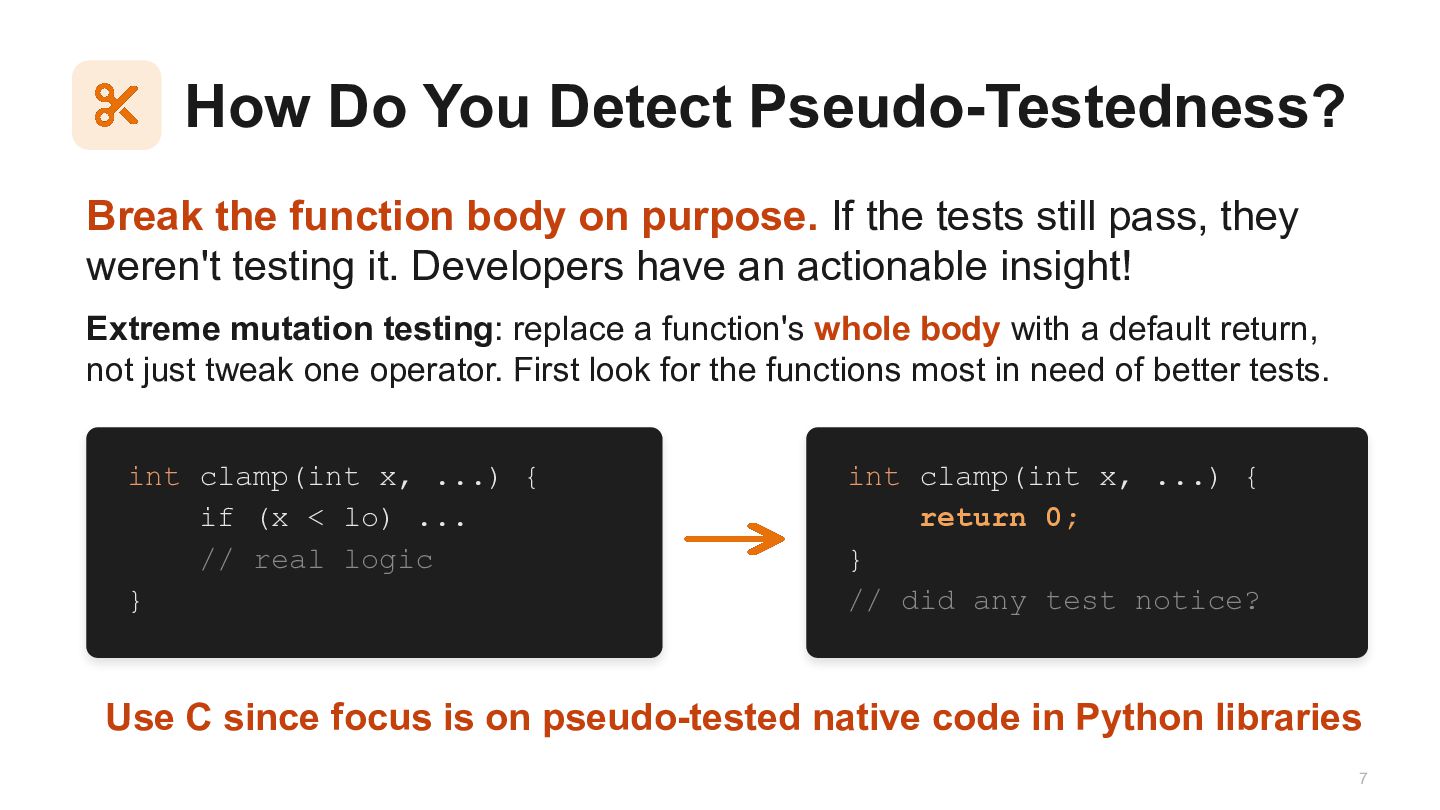
  7. How Do You Detect Pseudo-Testedness? Break the function body on

    purpose. If the tests still pass, they weren't testing it. Developers have an actionable insight! Extreme mutation testing: replace a function's whole body with a default return, not just tweak one operator. First look for the functions most in need of better tests. int clamp(int x, ...) { if (x < lo) ... // real logic } int clamp(int x, ...) { return 0; } // did any test notice? Use C since focus is on pseudo-tested native code in Python libraries 7
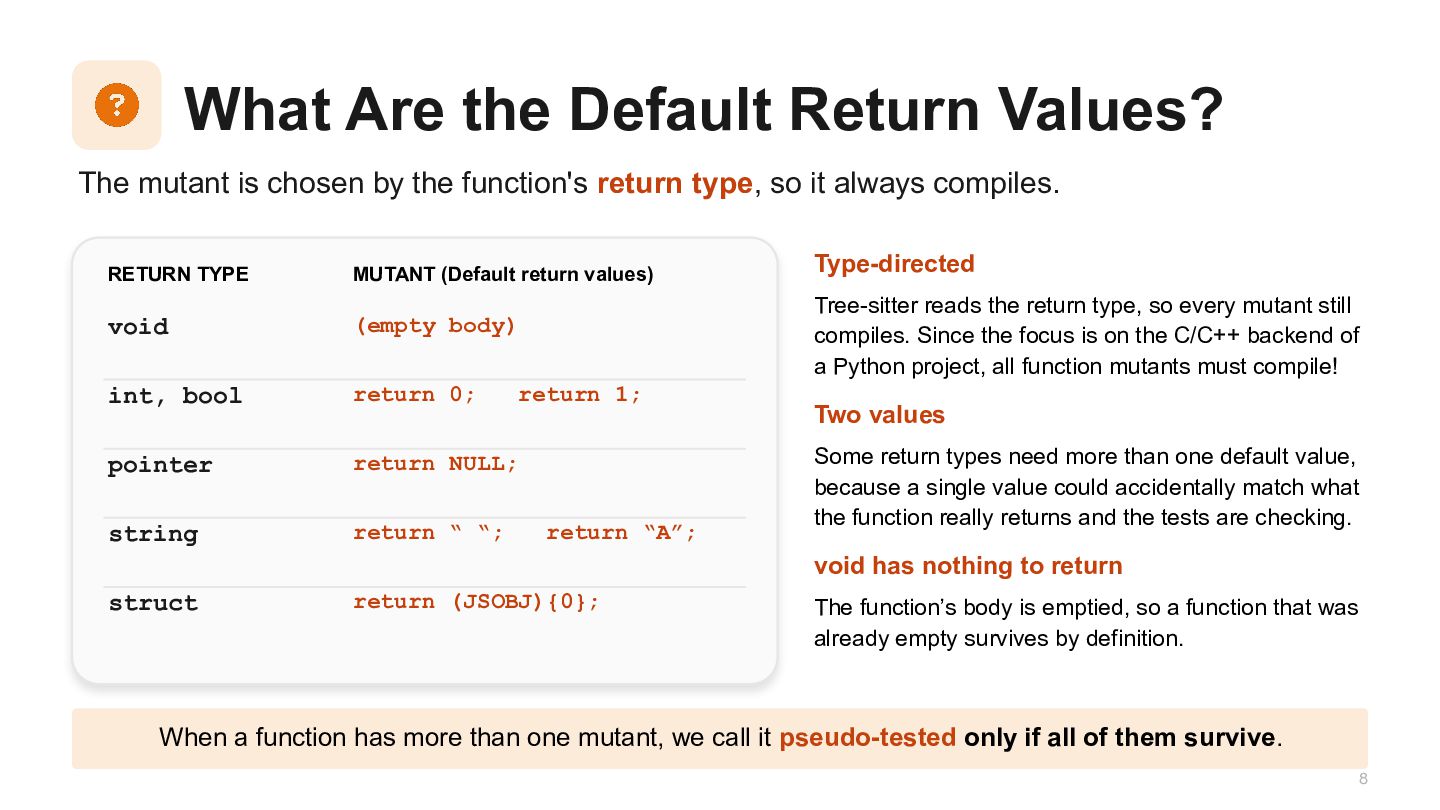
  8. What Are the Default Return Values? The mutant is chosen

    by the function's return type, so it always compiles. RETURN TYPE MUTANT (Default return values) void (empty body) int, bool return 0; pointer return NULL; string return “ “; Type-directed Tree-sitter reads the return type, so every mutant still compiles. Since the focus is on the C/C++ backend of a Python project, all function mutants must compile! return 1; return “A”; Two values Some return types need more than one default value, because a single value could accidentally match what the function really returns and the tests are checking. void has nothing to return struct return (JSOBJ){0}; The function’s body is emptied, so a function that was already empty survives by definition. When a function has more than one mutant, we call it pseudo-tested only if all of them survive. 8
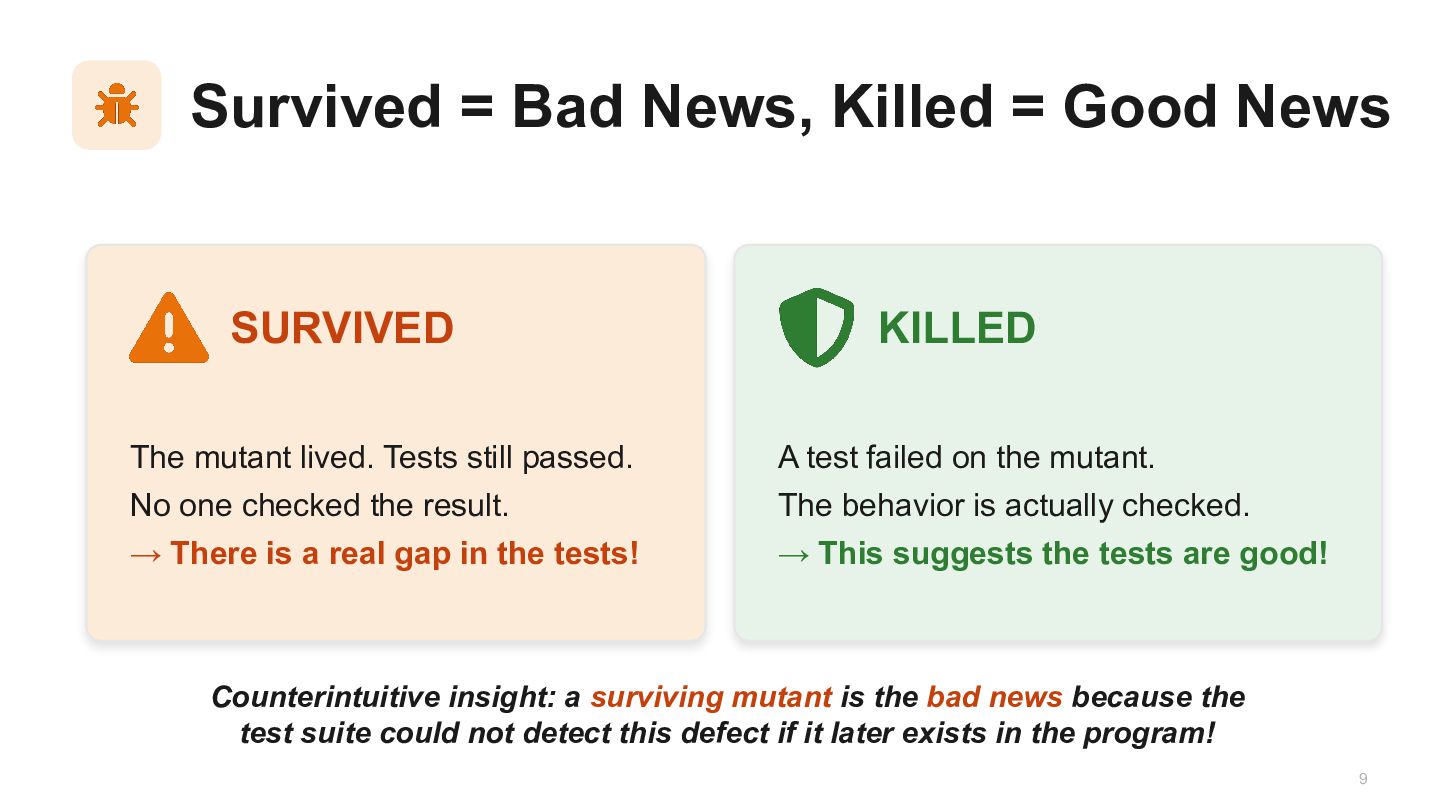
  9. Survived = Bad News, Killed = Good News SURVIVED KILLED

    The mutant lived. Tests still passed. A test failed on the mutant. No one checked the result. → There is a real gap in the tests! The behavior is actually checked. → This suggests the tests are good! Counterintuitive insight: a surviving mutant is the bad news because the test suite could not detect this defect if it later exists in the program! 9
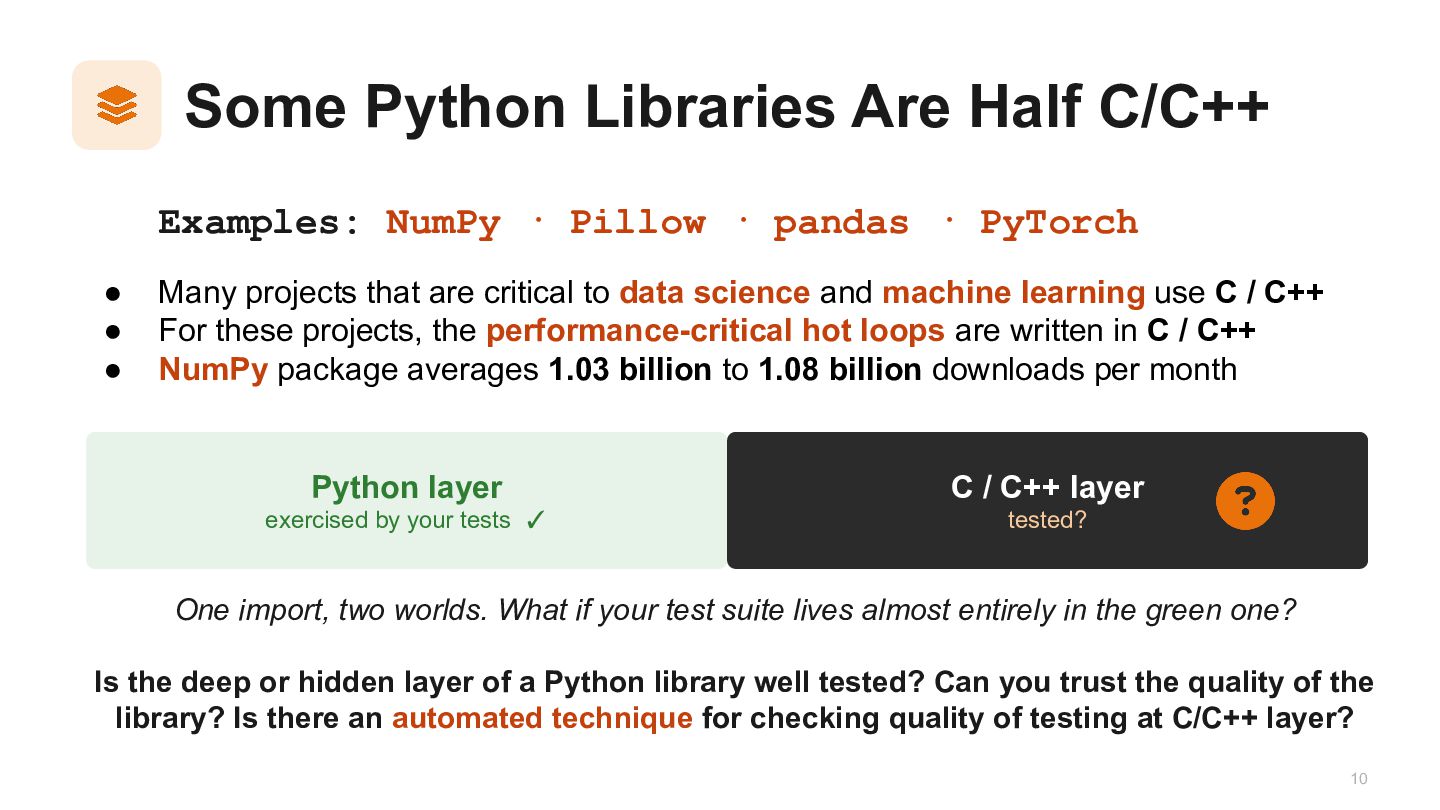
  10. Some Python Libraries Are Half C/C++ Examples: NumPy · Pillow

    · pandas · PyTorch • • • Many projects that are critical to data science and machine learning use C / C++ For these projects, the performance-critical hot loops are written in C / C++ NumPy package averages 1.03 billion to 1.08 billion downloads per month Python layer C / C++ layer exercised by your tests ✓ tested? One import, two worlds. What if your test suite lives almost entirely in the green one? Is the deep or hidden layer of a Python library well tested? Can you trust the quality of the library? Is there an automated technique for checking quality of testing at C/C++ layer? 10
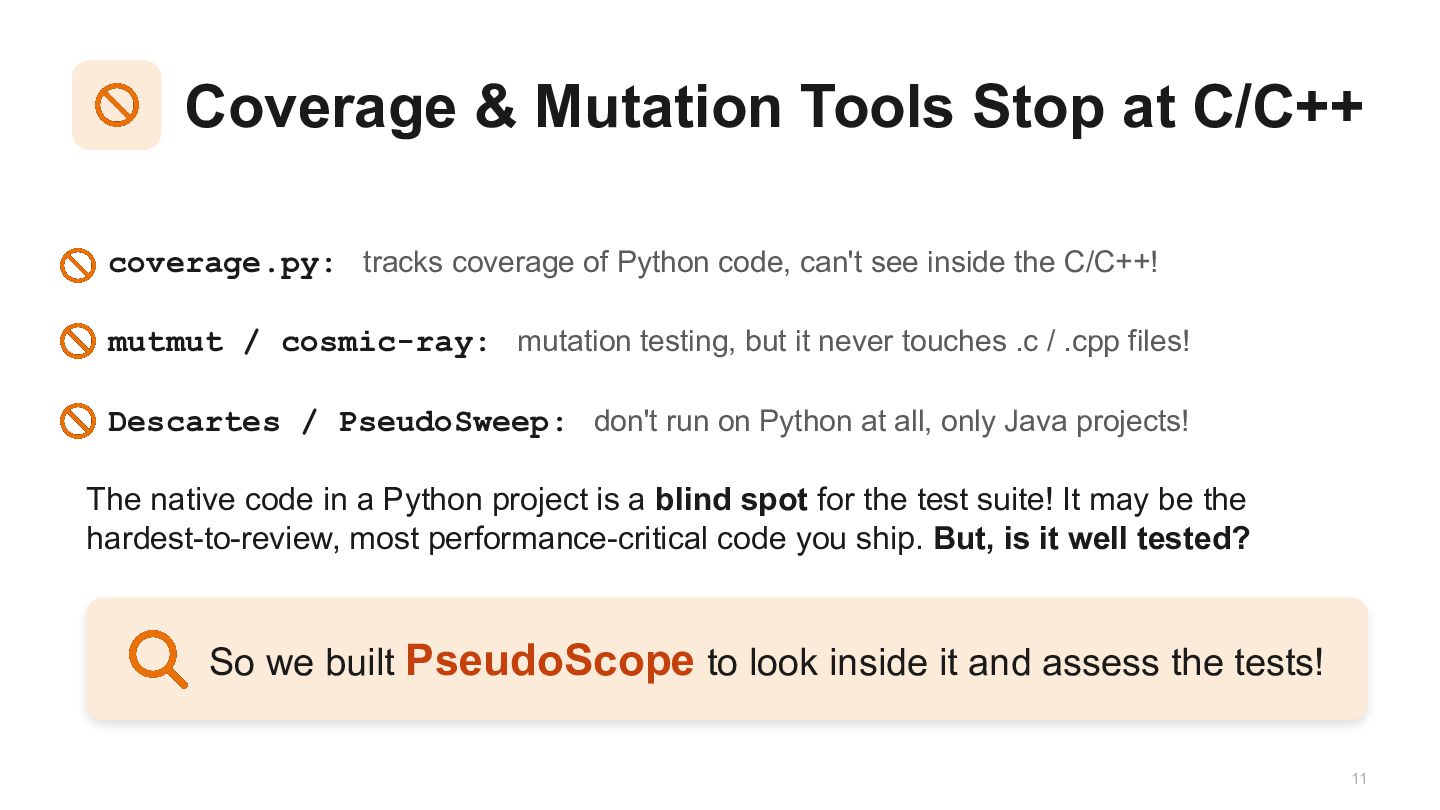
  11. Coverage & Mutation Tools Stop at C/C++ coverage.py: tracks coverage

    of Python code, can't see inside the C/C++! mutmut / cosmic-ray: mutation testing, but it never touches .c / .cpp files! Descartes / PseudoSweep: don't run on Python at all, only Java projects! The native code in a Python project is a blind spot for the test suite! It may be the hardest-to-review, most performance-critical code you ship. But, is it well tested? So we built PseudoScope to look inside it and assess the tests! 11
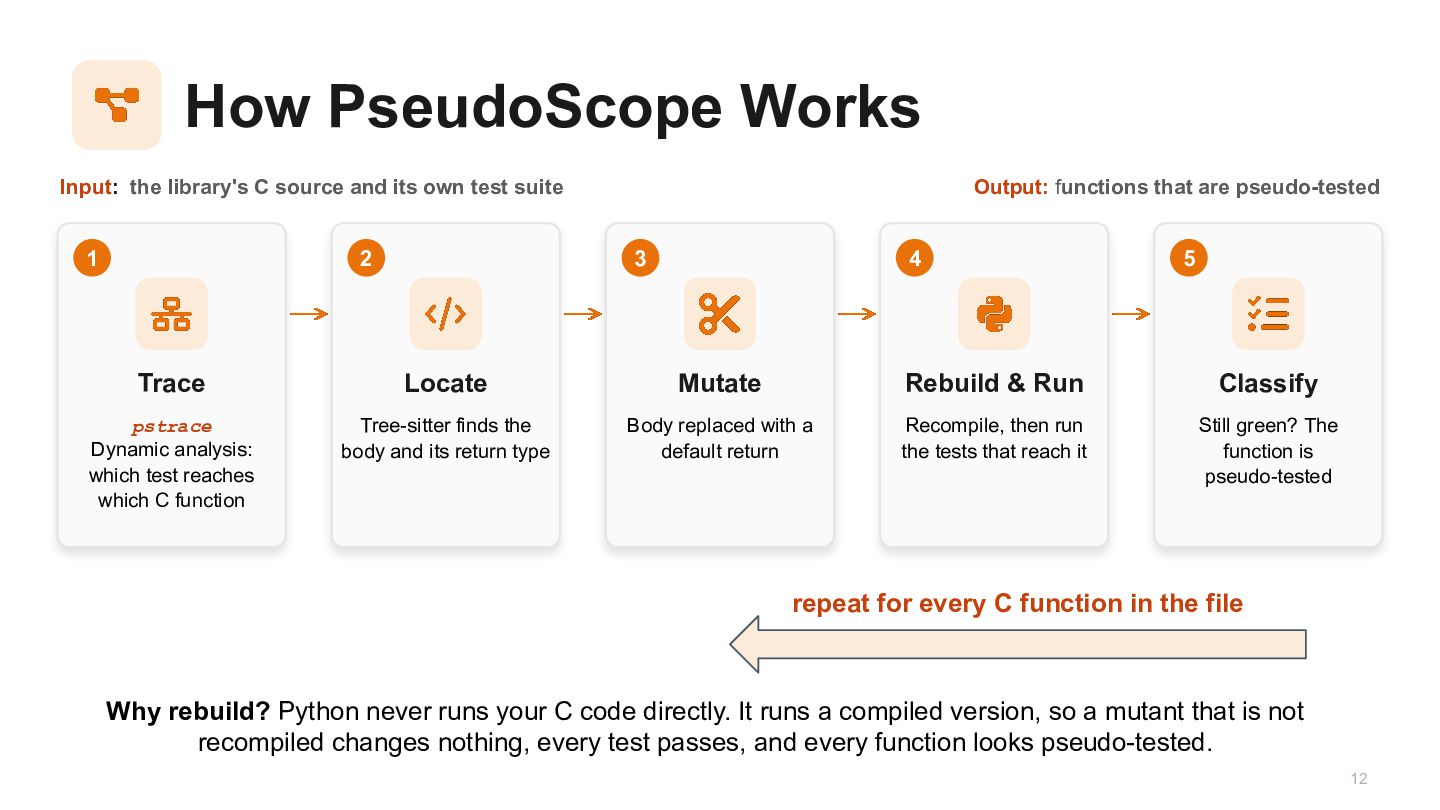
  12. How PseudoScope Works Input: the library's C source and its

    own test suite 2 1 Output: functions that are pseudo-tested 3 4 5 Trace Locate Mutate Rebuild & Run Classify pstrace Tree-sitter finds the body and its return type Body replaced with a default return Recompile, then run the tests that reach it Still green? The function is pseudo-tested Dynamic analysis: which test reaches which C function repeat for every C function in the file Why rebuild? Python never runs your C code directly. It runs a compiled version, so a mutant that is not recompiled changes nothing, every test passes, and every function looks pseudo-tested. 12
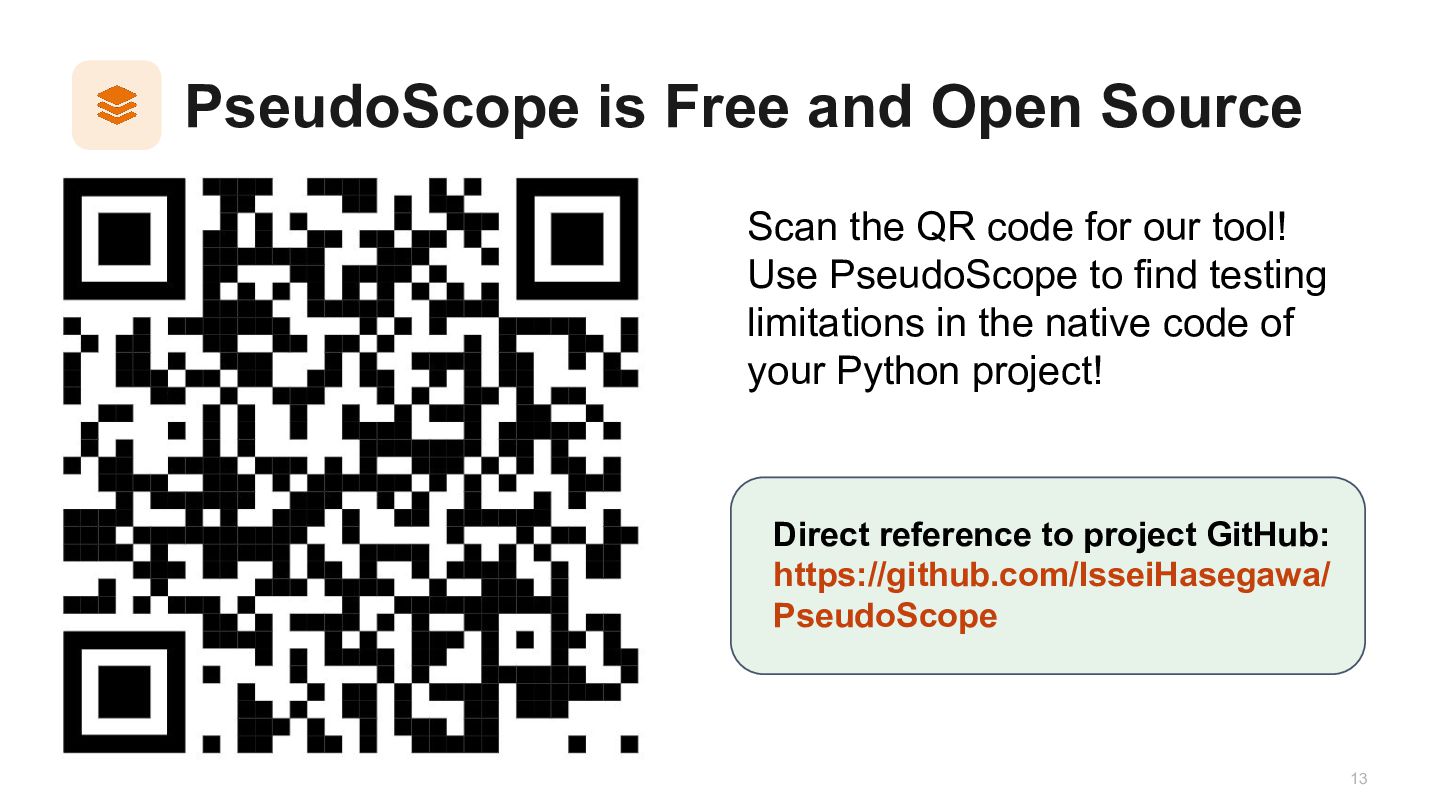
  13. PseudoScope is Free and Open Source Scan the QR code

    for our tool! Use PseudoScope to find testing limitations in the native code of your Python project! Direct reference to project GitHub: https://github.com/IsseiHasegawa/ PseudoScope 13
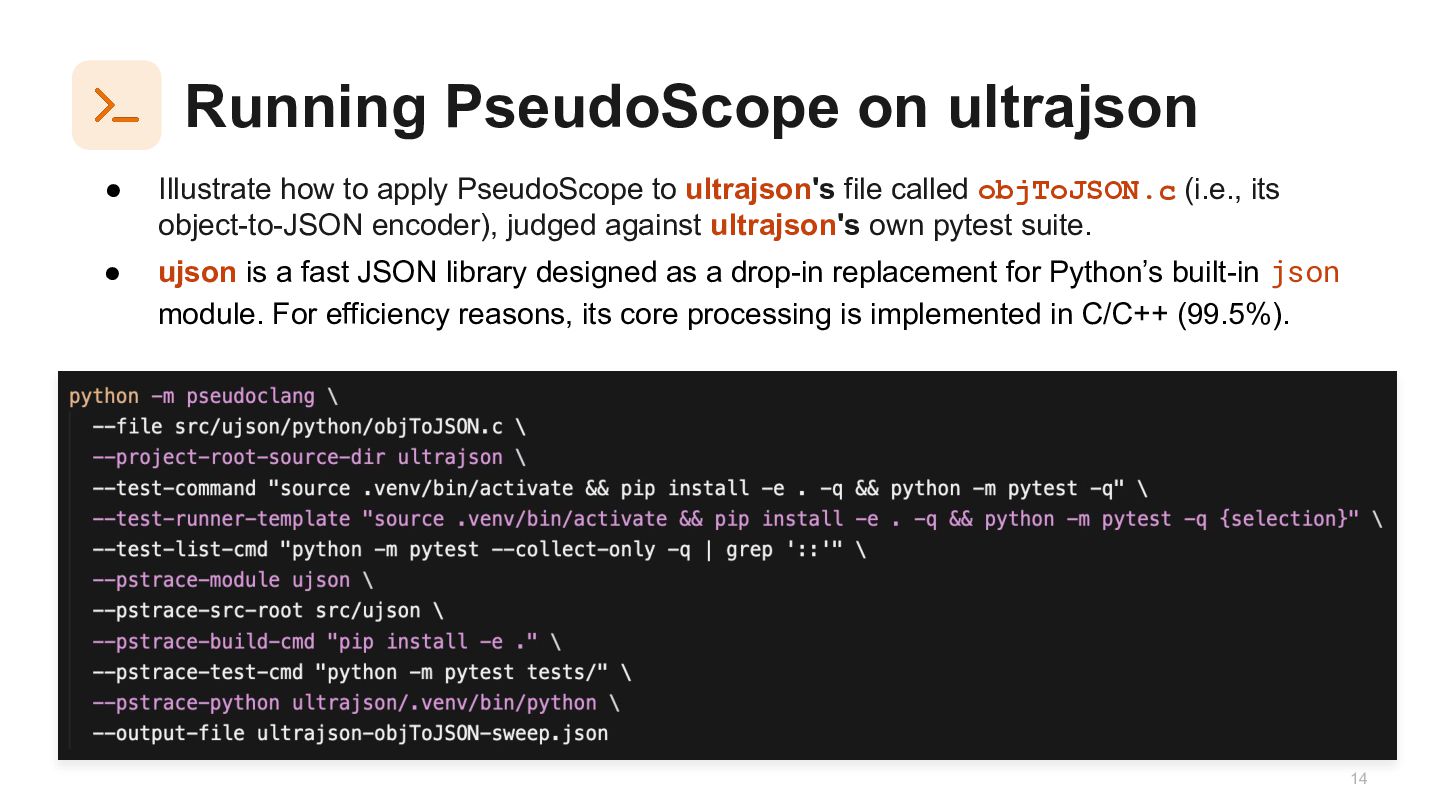
  14. Running PseudoScope on ultrajson • Illustrate how to apply PseudoScope

    to ultrajson's file called objToJSON.c (i.e., its object-to-JSON encoder), judged against ultrajson's own pytest suite. • ujson is a fast JSON library designed as a drop-in replacement for Python’s built-in json module. For efficiency reasons, its core processing is implemented in C/C++ (99.5%). 14
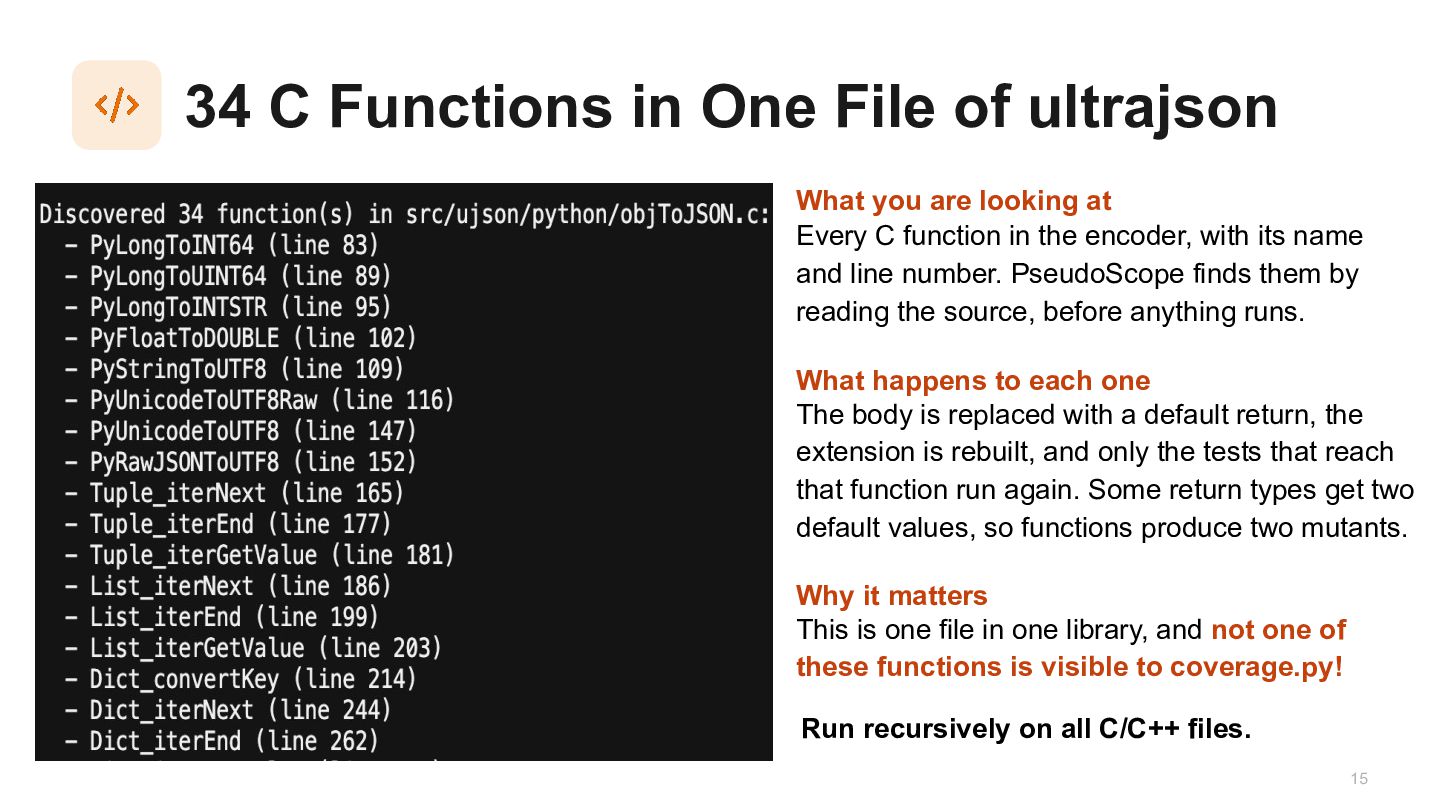
  15. 34 C Functions in One File of ultrajson What you

    are looking at Every C function in the encoder, with its name and line number. PseudoScope finds them by reading the source, before anything runs. What happens to each one The body is replaced with a default return, the extension is rebuilt, and only the tests that reach that function run again. Some return types get two default values, so functions produce two mutants. Why it matters This is one file in one library, and not one of these functions is visible to coverage.py! Run recursively on all C/C++ files. 15
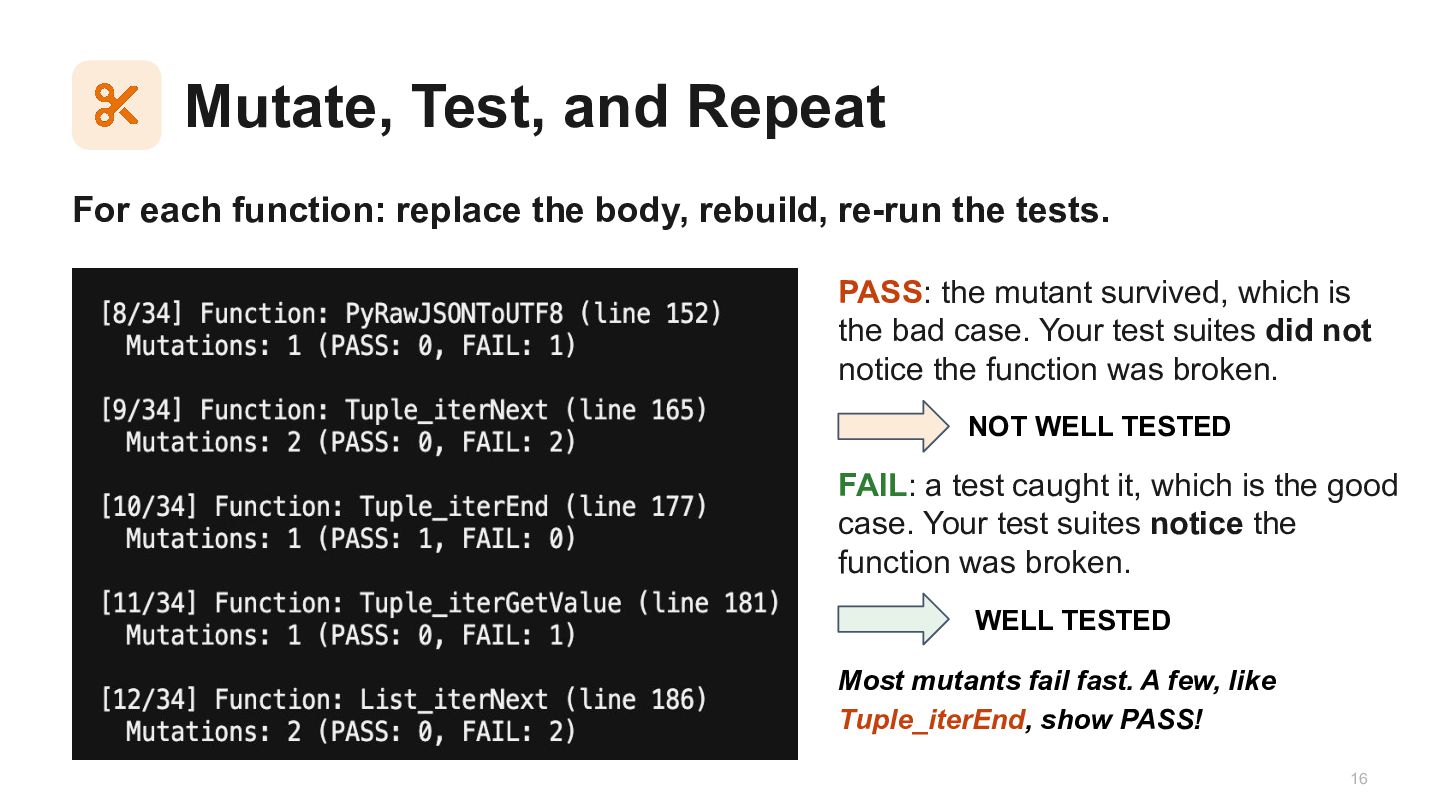
  16. Mutate, Test, and Repeat For each function: replace the body,

    rebuild, re-run the tests. PASS: the mutant survived, which is the bad case. Your test suites did not notice the function was broken. NOT WELL TESTED FAIL: a test caught it, which is the good case. Your test suites notice the function was broken. WELL TESTED Most mutants fail fast. A few, like Tuple_iterEnd, show PASS! 16
  17. Investigate PseudoScope’s Output FUNCTION MUTANT TEST RESULT PyLongToINT64 return NULL;

    FAIL (detected) Tuple_iterNext return 0; return 1; FAIL (detected) Object_getDoubleValue return 0.0; return 1.0; FAIL (detected) Object_iterGetValue return (JSOBJ){0}; FAIL (detected) Tuple_iterEnd (empty body) PASS (survived) Object_releaseObject (empty body) PASS (survived) 34 discovered 34 analyzed 3 survived 8.8% pass rate The 91.2% detection rate suggests strong tests, while the three survivors provide a focused set of cases for further investigation. Now we can improve the tests! 17
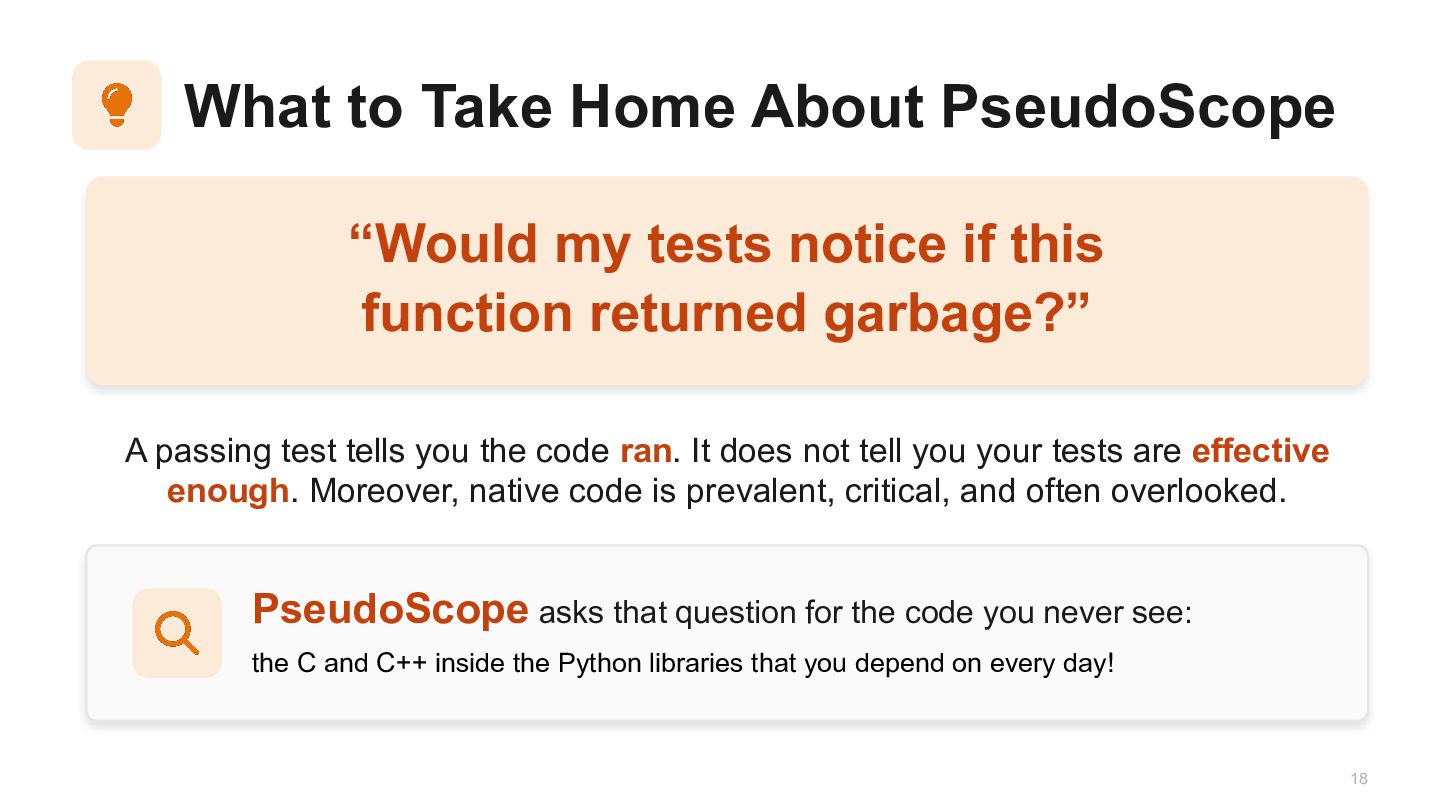
  18. What to Take Home About PseudoScope “Would my tests notice

    if this function returned garbage?” A passing test tells you the code ran. It does not tell you your tests are effective enough. Moreover, native code is prevalent, critical, and often overlooked. PseudoScope asks that question for the code you never see: the C and C++ inside the Python libraries that you depend on every day! 18
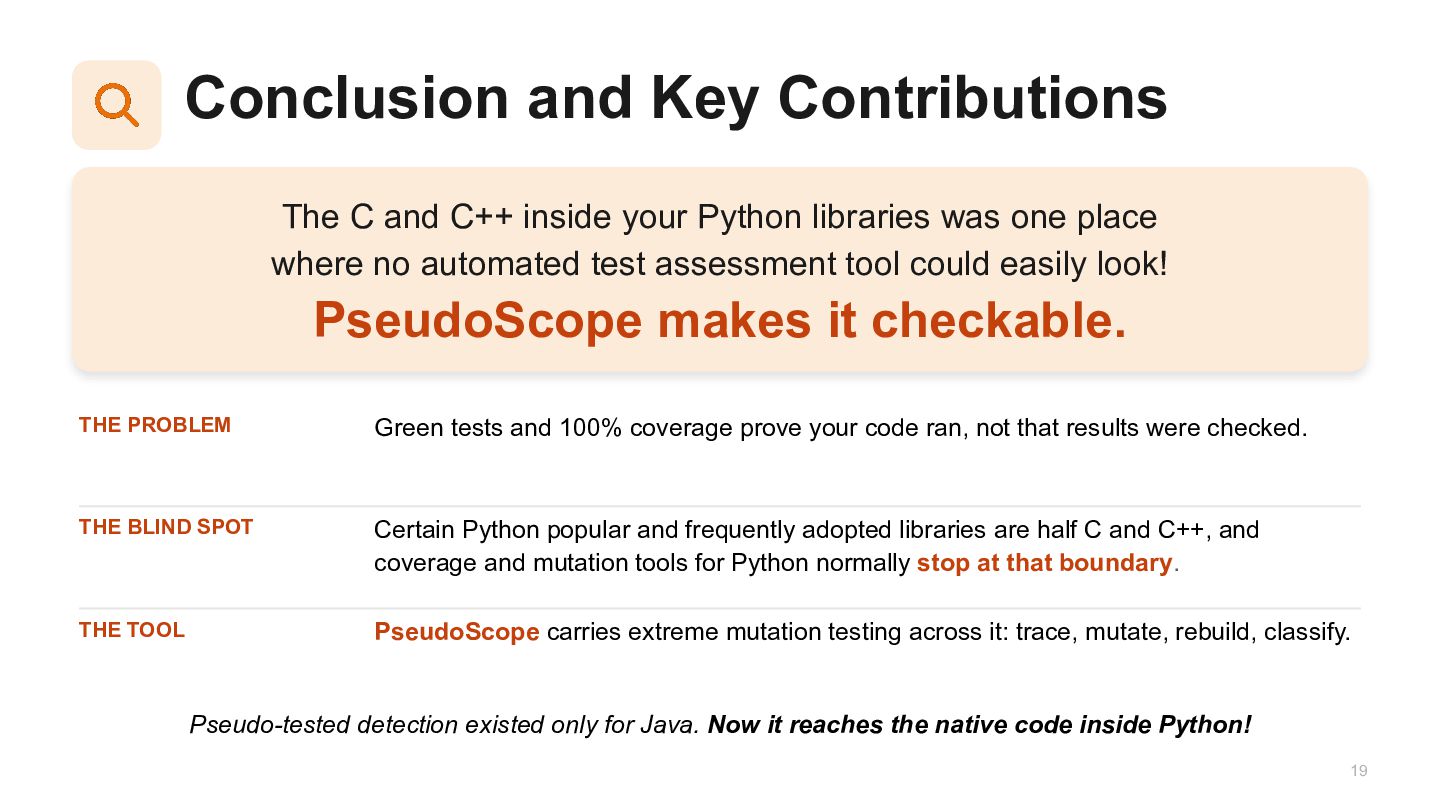
  19. Conclusion and Key Contributions The C and C++ inside your

    Python libraries was one place where no automated test assessment tool could easily look! PseudoScope makes it checkable. THE PROBLEM Green tests and 100% coverage prove your code ran, not that results were checked. THE BLIND SPOT Certain Python popular and frequently adopted libraries are half C and C++, and coverage and mutation tools for Python normally stop at that boundary. THE TOOL PseudoScope carries extreme mutation testing across it: trace, mutate, rebuild, classify. Pseudo-tested detection existed only for Java. Now it reaches the native code inside Python! 19
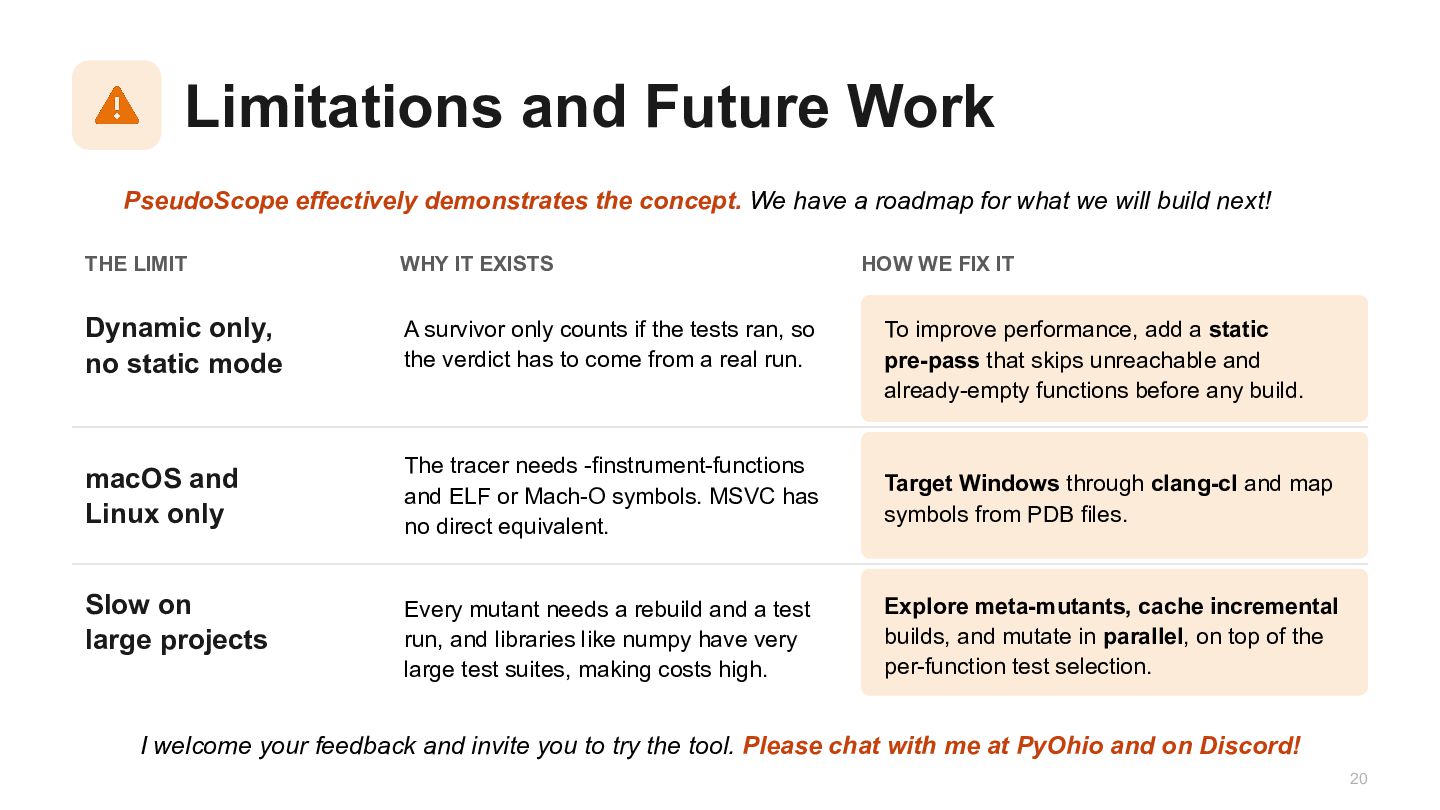
  20. Limitations and Future Work PseudoScope effectively demonstrates the concept. We

    have a roadmap for what we will build next! THE LIMIT WHY IT EXISTS Dynamic only, no static mode A survivor only counts if the tests ran, so the verdict has to come from a real run. macOS and Linux only The tracer needs -finstrument-functions and ELF or Mach-O symbols. MSVC has no direct equivalent. Target Windows through clang-cl and map symbols from PDB files. Slow on large projects Every mutant needs a rebuild and a test run, and libraries like numpy have very large test suites, making costs high. Explore meta-mutants, cache incremental builds, and mutate in parallel, on top of the per-function test selection. HOW WE FIX IT To improve performance, add a static pre-pass that skips unreachable and already-empty functions before any build. I welcome your feedback and invite you to try the tool. Please chat with me at PyOhio and on Discord! 20