Upgrade to Pro — share decks privately, control downloads, hide ads and more …

Don't blame the type checker: Finding who Is ri...

Don't blame the type checker: Finding who Is right when Python type checkers disagree

Type checkers help Python developers catch bugs, but what happens when they disagree on the same code? One type checker says your code is fine, another flags an error. Which one is right? Pytifex is an open-source tool that solves this problem. It automatically generates code examples that lead to disagreements between type checkers by mining closed bug reports from type checker repositories, further mutating them with an LLM to generate novel edge cases, and running four checkers — mypy, pyrefly, zuban, and ty — on each example. Correctness is then evaluated through progressively harder phases, from runtime crash detection to hypothesis-based property testing. Pytifex has already uncovered confirmed defects across multiple type checkers, demonstrating that even mature tools have blind spots on code derived from bugs they have already fixed.

Attendees will leave understanding why type checker disagreements happen, why they matter for Python developers, how Pytifex mines and mutates real bug reports to generate novel test cases, and why framing type checker correctness in terms of false positives and false negatives misses the point. They will also see how the multi-phase evaluation pipeline distinguishes objective phases (where a clear ground truth exists) from subjective ones that rely on interpretation, and why that distinction matters for trusting the results. We will walk through real examples where the outlying checker turned out to be right and the majority was wrong and leave knowing how to set up and run Pytifex themselves.

Avatar for Gregory Kapfhammer

Gregory Kapfhammer

July 24, 2026

More Decks by Gregory Kapfhammer

Other Decks in Research

Transcript

  1. PYTIFEX · A MUTATION-BASED DIFFERENTIAL TESTING TOOL FOR PYTHON TYPE

    CHECKERS Don't Blame the Type Checker: Automatically Finding Who Is Right When Python Type Checkers Disagree PYOHIO 2026 Benedek Kaibas Gregory M. Kapfhammer Department of Computer and Information Science Allegheny College https://github.com/benedekaibas/pytifex
  2. Who is the creator of Pytifex? Name: Benedek Kaibas Affiliation:

    Currently entering Masters Studies in Computer Science Currently working on the Clang Static Analyzer as a Google Summer of Code student @ LLVM Interests: • Static Analysis • Compilers • Functional programming • Research and engineering In case you want to talk with me, feel free to contact me at [email protected]. I am glad to chat on Discord!
  3. Type annotations and type checkers for Python An annotation declares

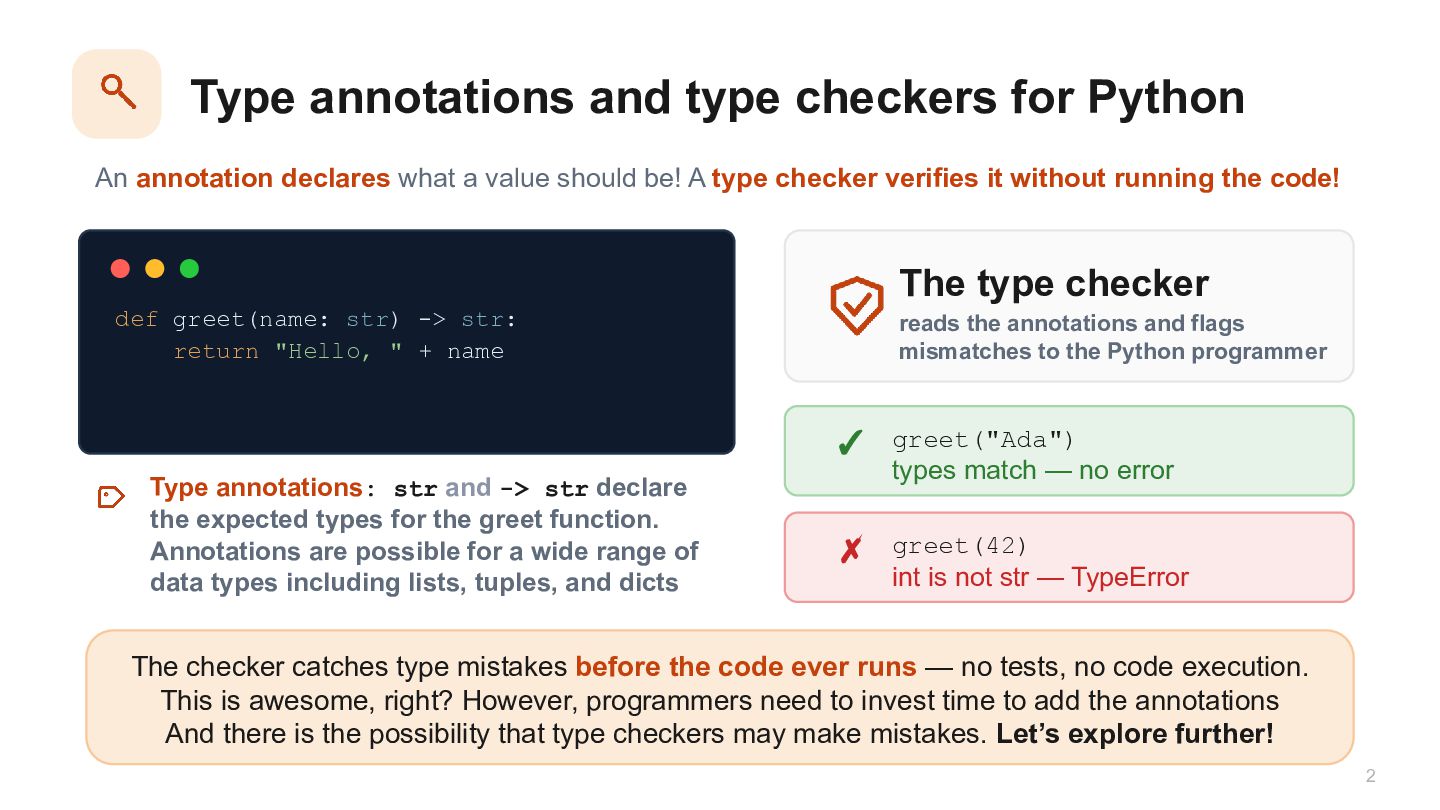
    what a value should be! A type checker verifies it without running the code! The type checker def greet(name: str) -> str: return "Hello, " + name reads the annotations and flags mismatches to the Python programmer ✓ greet("Ada") Type annotations: str and -> str declare the expected types for the greet function. Annotations are possible for a wide range of data types including lists, tuples, and dicts types match — no error ✗ greet(42) int is not str — TypeError The checker catches type mistakes before the code ever runs — no tests, no code execution. This is awesome, right? However, programmers need to invest time to add the annotations And there is the possibility that type checkers may make mistakes. Let’s explore further! 2
  4. Do Python codebases need type annotations? Why would annotating your

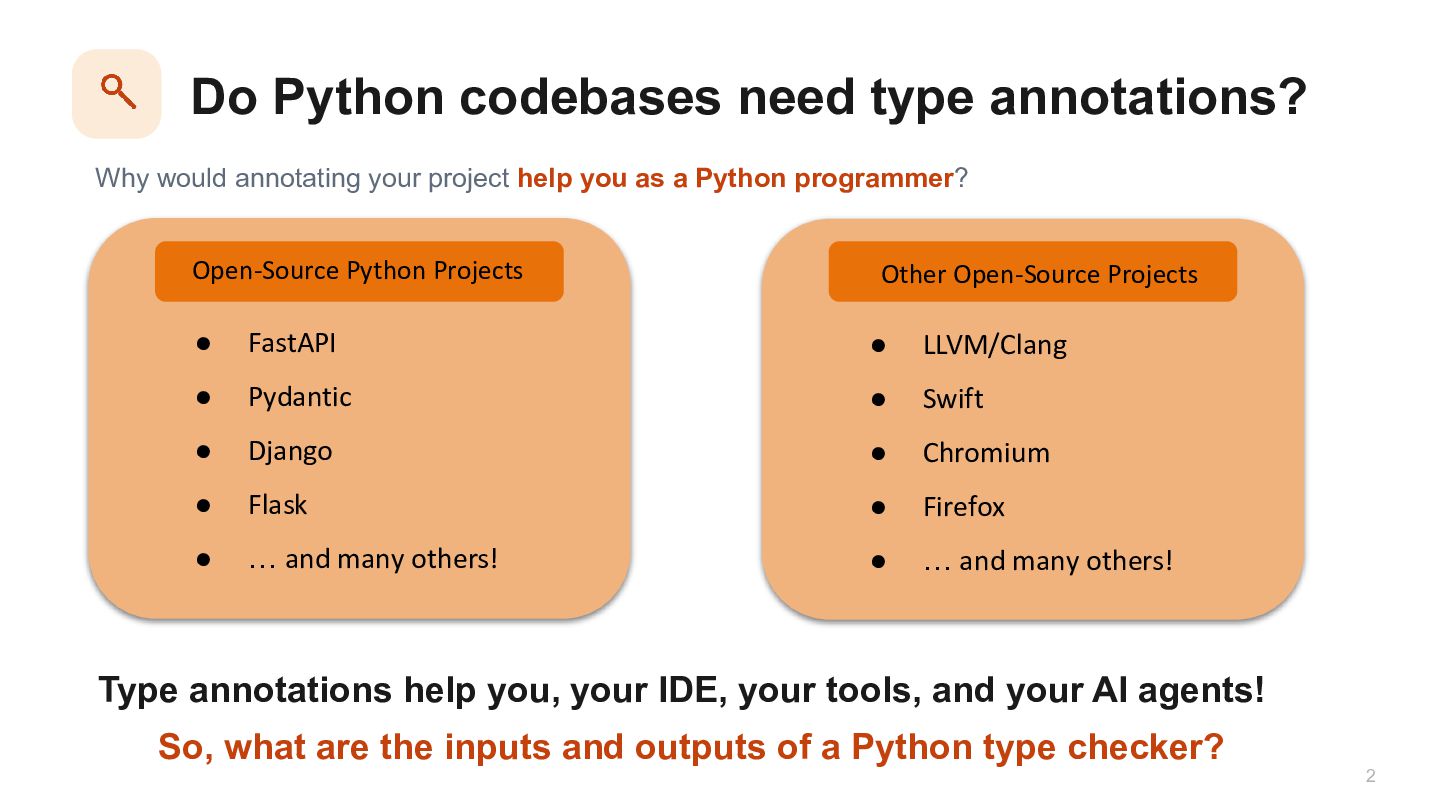
    project help you as a Python programmer? Open-Source Python Projects Other Open-Source Projects • FastAPI • LLVM/Clang • Pydantic • Swift • Django • Chromium • Flask • Firefox • … and many others! • … and many others! Type annotations help you, your IDE, your tools, and your AI agents! So, what are the inputs and outputs of a Python type checker? 2
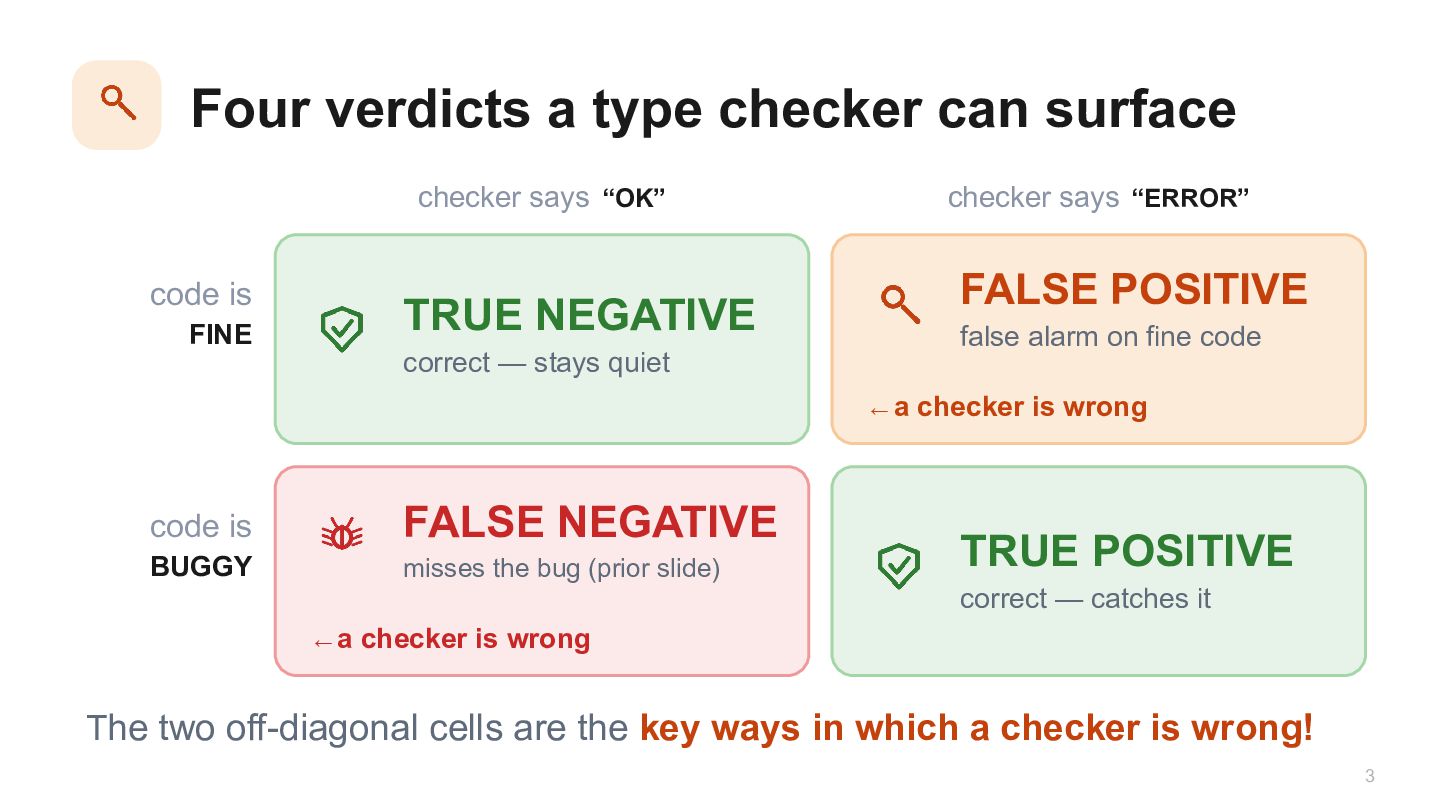
  5. Four verdicts a type checker can surface checker says “OK”

    code is FINE TRUE NEGATIVE correct — stays quiet checker says “ERROR” FALSE POSITIVE false alarm on fine code ← a checker is wrong code is FALSE NEGATIVE BUGGY misses the bug (prior slide) TRUE POSITIVE correct — catches it ← a checker is wrong The two off-diagonal cells are the key ways in which a checker is wrong! 3
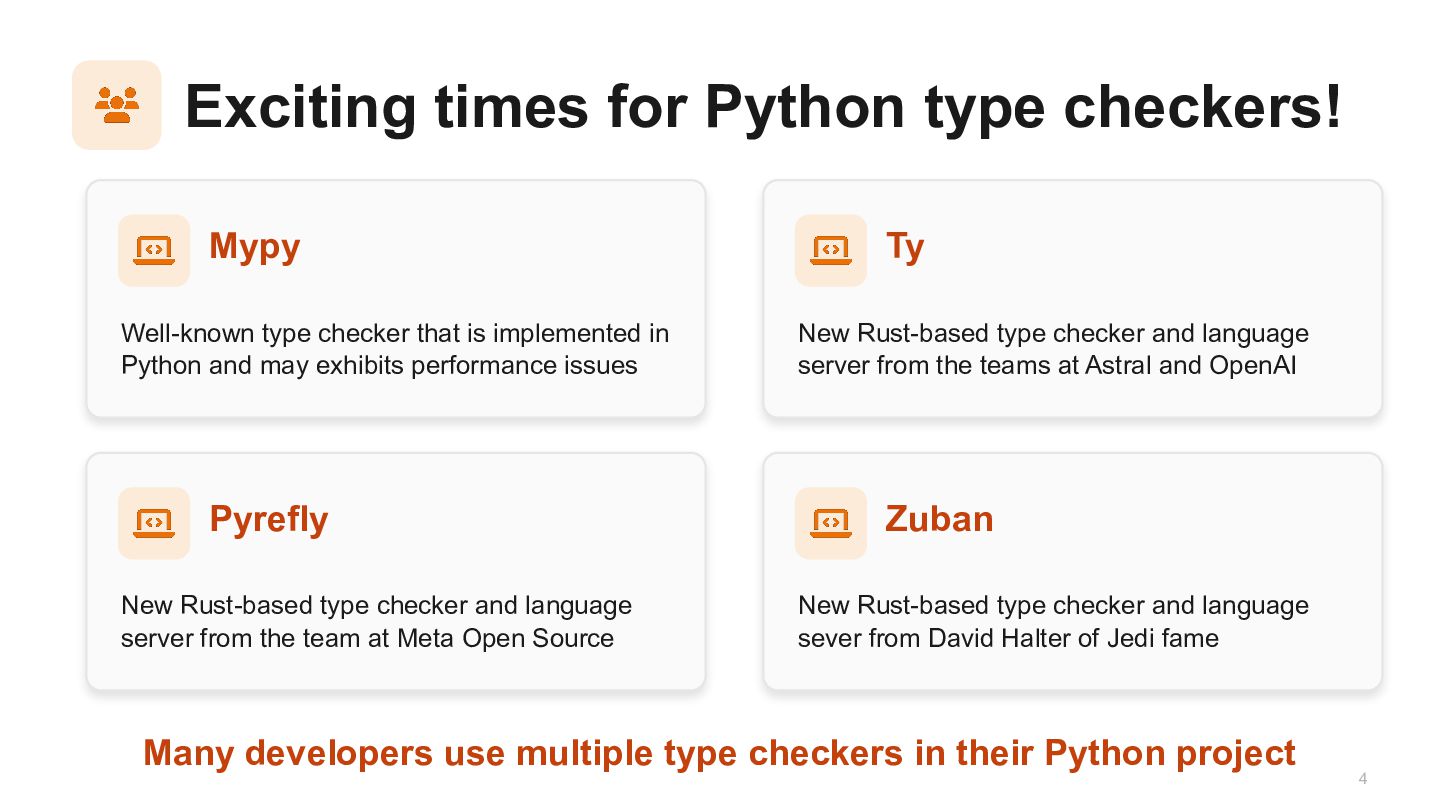
  6. Exciting times for Python type checkers! Mypy Well-known type checker

    that is implemented in Python and may exhibits performance issues Pyrefly New Rust-based type checker and language server from the team at Meta Open Source Ty New Rust-based type checker and language server from the teams at Astral and OpenAI Zuban New Rust-based type checker and language sever from David Halter of Jedi fame Many developers use multiple type checkers in their Python project 4
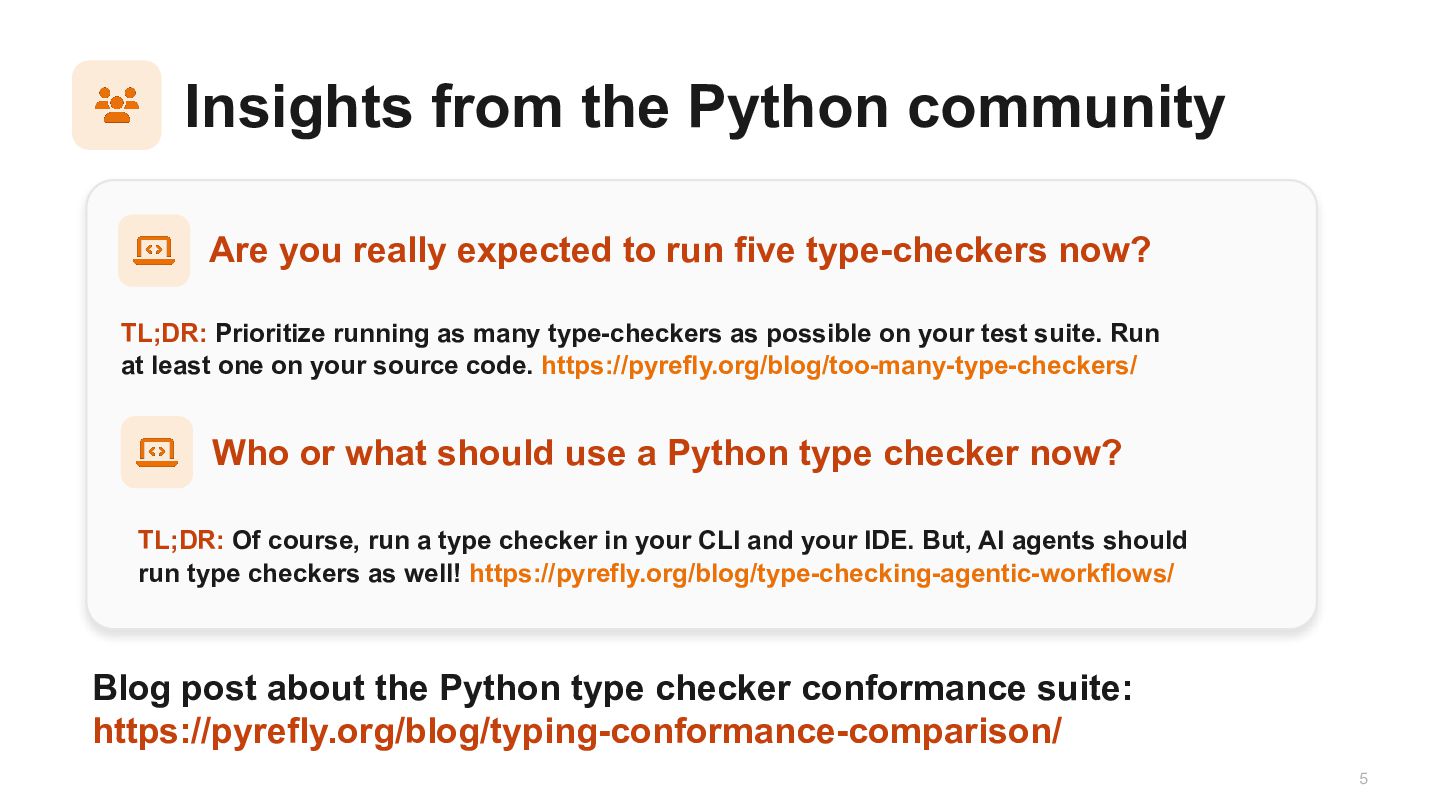
  7. Insights from the Python community Are you really expected to

    run five type-checkers now? TL;DR: Prioritize running as many type-checkers as possible on your test suite. Run at least one on your source code. https://pyrefly.org/blog/too-many-type-checkers/ Who or what should use a Python type checker now? TL;DR: Of course, run a type checker in your CLI and your IDE. But, AI agents should run type checkers as well! https://pyrefly.org/blog/type-checking-agentic-workflows/ Blog post about the Python type checker conformance suite: https://pyrefly.org/blog/typing-conformance-comparison/ 5
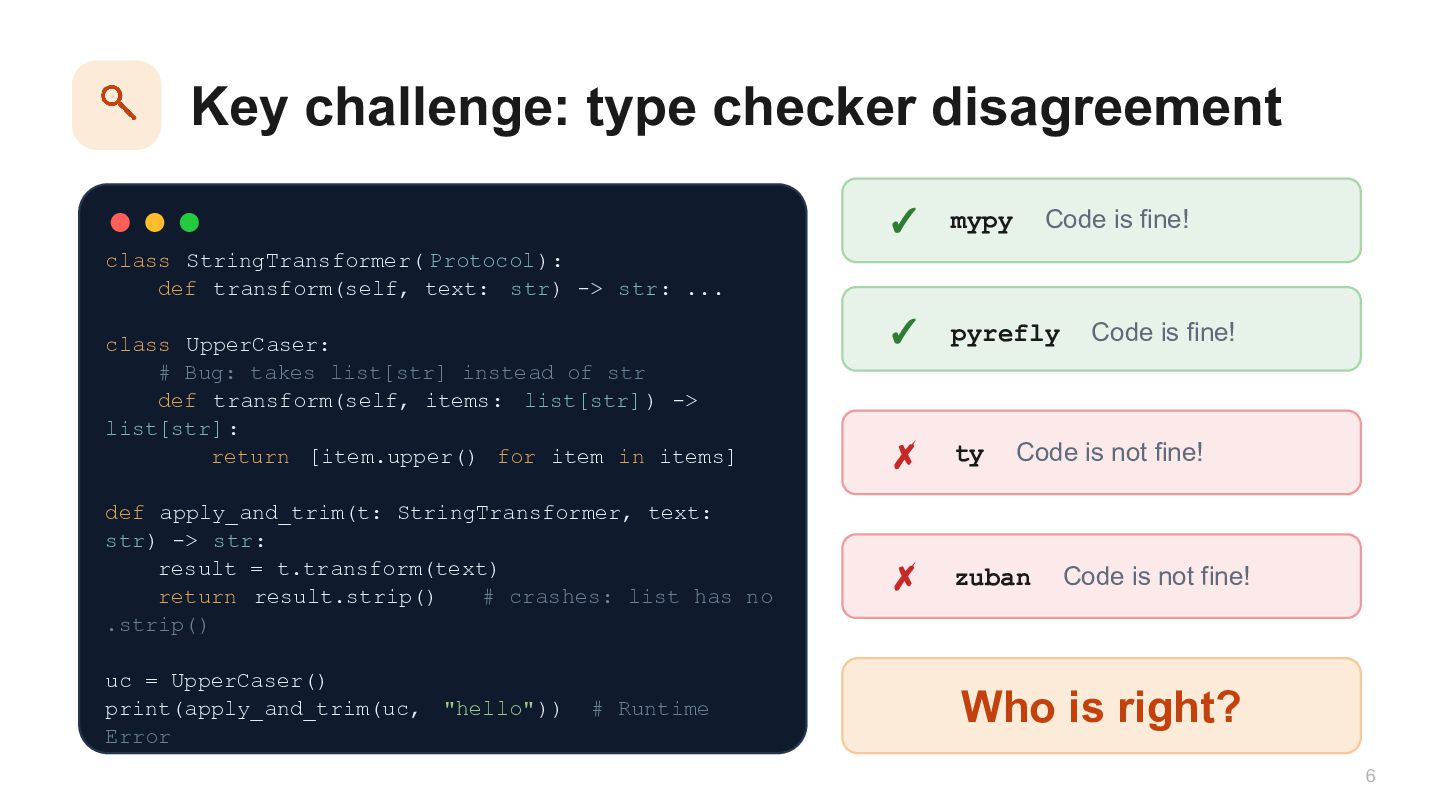
  8. Key challenge: type checker disagreement ✓ mypy Code is fine!

    class StringTransformer( Protocol ): def transform(self, text: str) -> str: ... class UpperCaser: # Bug: takes list[str] instead of str def transform(self, items: list[str] ) -> list[str] : return [item.upper() for item in items] def apply_and_trim(t: StringTransformer, text: str) -> str: result = t.transform(text) return result.strip() # crashes: list has no .strip() uc = UpperCaser() print(apply_and_trim(uc, "hello")) Error # Runtime ✓ pyrefly Code is fine! ✗ ty ✗ zuban Code is not fine! Code is not fine! Who is right? 6
  9. Why type checker bugs matters to you Even if you

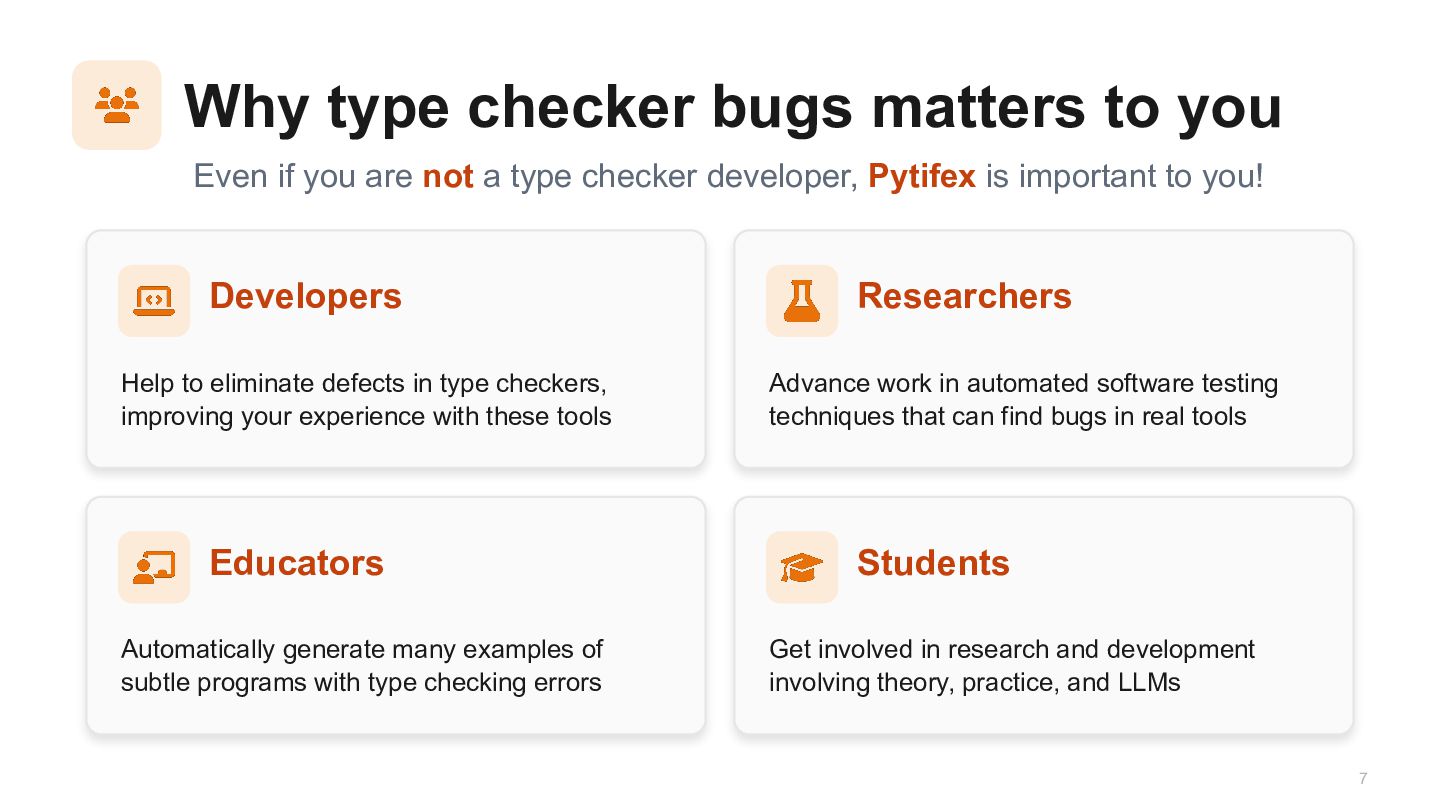
    are not a type checker developer, Pytifex is important to you! Developers Help to eliminate defects in type checkers, improving your experience with these tools Educators Automatically generate many examples of subtle programs with type checking errors Researchers Advance work in automated software testing techniques that can find bugs in real tools Students Get involved in research and development involving theory, practice, and LLMs 7
  10. Why generate new Python code at all? You can't wait

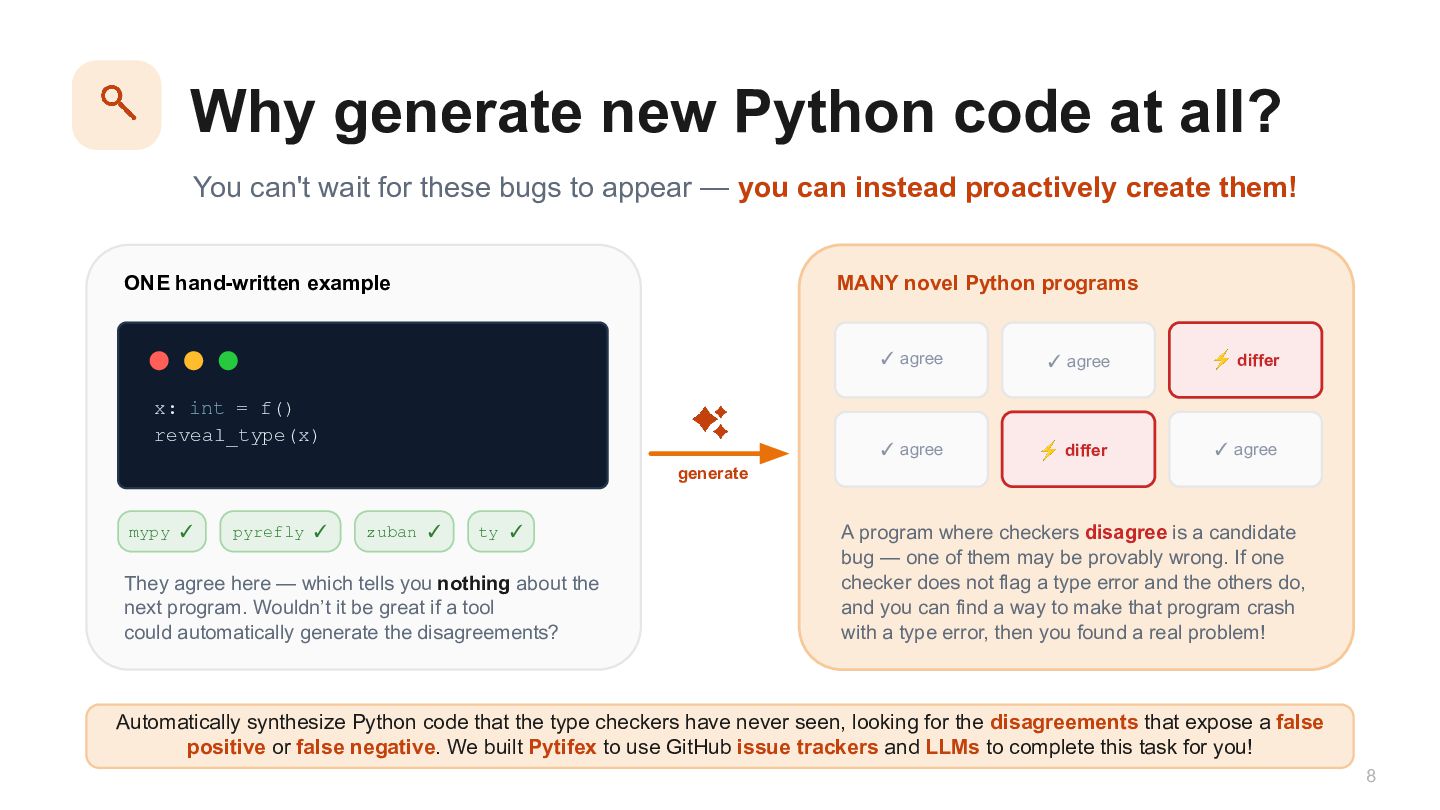
    for these bugs to appear — you can instead proactively create them! ONE hand-written example MANY novel Python programs x: int = f() reveal_type(x) ✓ agree ✓ agree ⚡ differ ✓ agree ⚡ differ ✓ agree generate mypy ✓ pyrefly ✓ zuban ✓ ty ✓ They agree here — which tells you nothing about the next program. Wouldn’t it be great if a tool could automatically generate the disagreements? A program where checkers disagree is a candidate bug — one of them may be provably wrong. If one checker does not flag a type error and the others do, and you can find a way to make that program crash with a type error, then you found a real problem! Automatically synthesize Python code that the type checkers have never seen, looking for the disagreements that expose a false positive or false negative. We built Pytifex to use GitHub issue trackers and LLMs to complete this task for you! 8
  11. Automatically pressure testing type checkers Generate unseen code · run

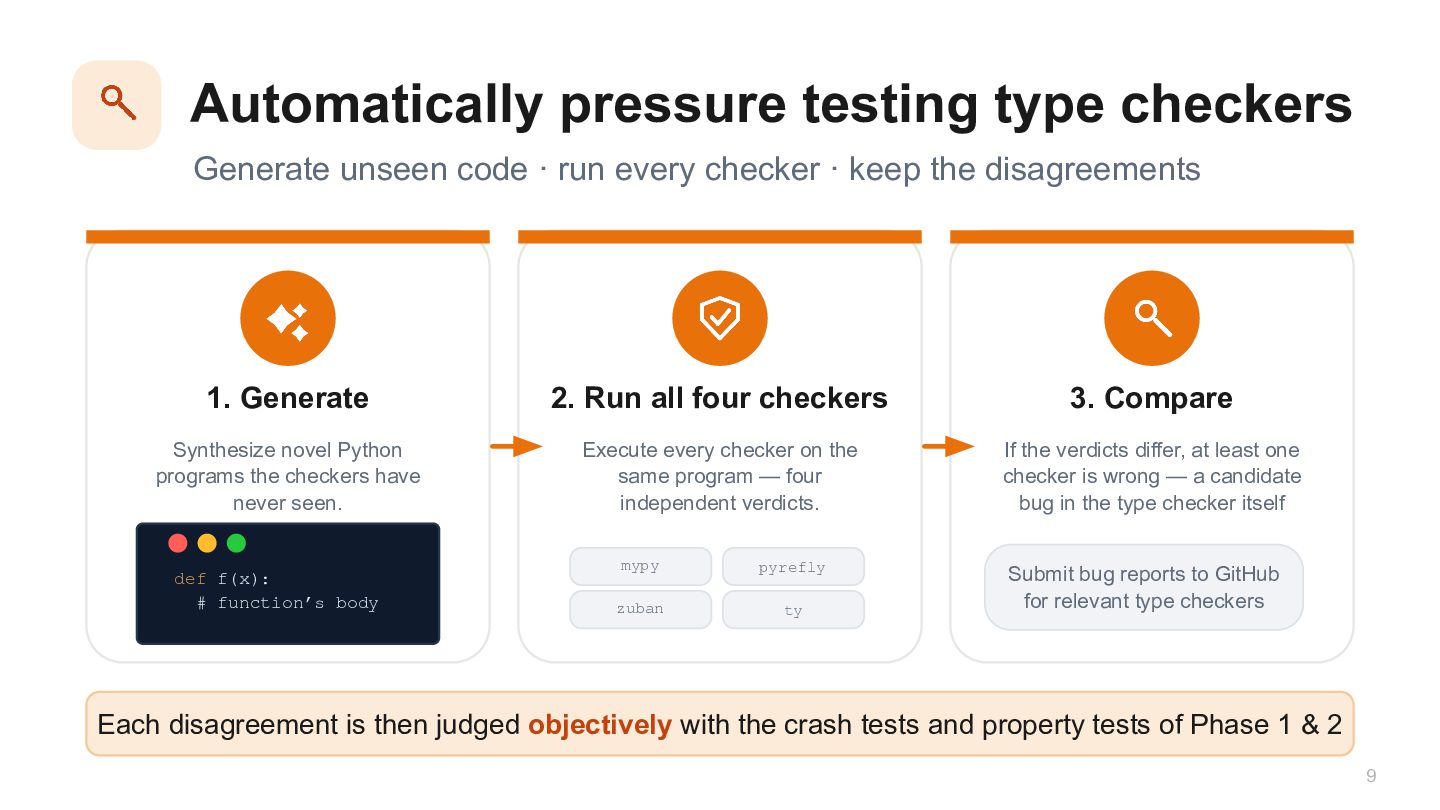
    every checker · keep the disagreements 1. Generate 2. Run all four checkers 3. Compare Synthesize novel Python programs the checkers have never seen. Execute every checker on the same program — four independent verdicts. If the verdicts differ, at least one checker is wrong — a candidate bug in the type checker itself def f(x): # function’s body mypy pyrefly zuban ty Submit bug reports to GitHub for relevant type checkers Each disagreement is then judged objectively with the crash tests and property tests of Phase 1 & 2 9
  12. How to evaluate the Python type checkers? Pytifex follows three

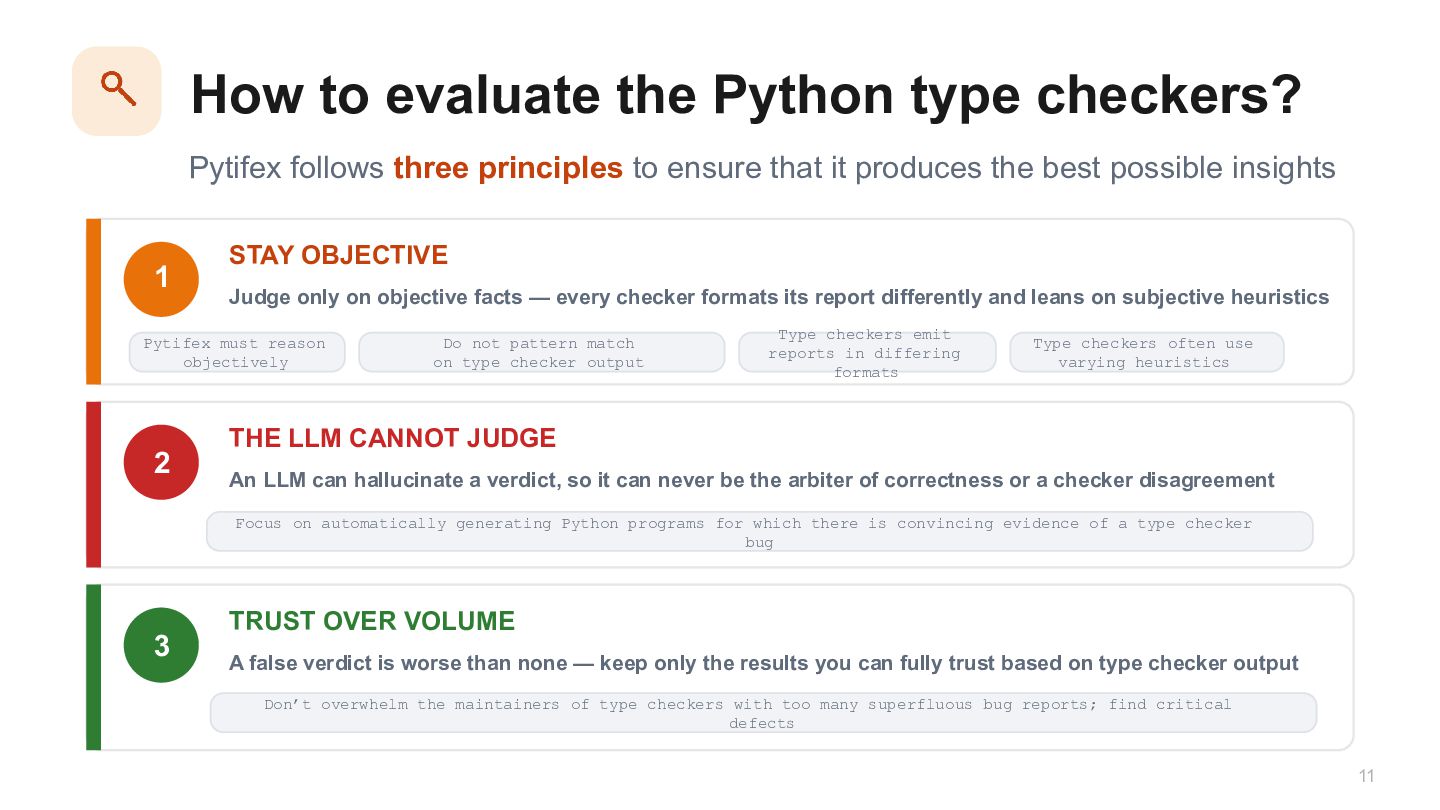
    principles to ensure that it produces the best possible insights 1 STAY OBJECTIVE Judge only on objective facts — every checker formats its report differently and leans on subjective heuristics Pytifex must reason objectively 2 Do not pattern match on type checker output Type checkers emit reports in differing formats Type checkers often use varying heuristics THE LLM CANNOT JUDGE An LLM can hallucinate a verdict, so it can never be the arbiter of correctness or a checker disagreement Focus on automatically generating Python programs for which there is convincing evidence of a type checker bug 3 TRUST OVER VOLUME A false verdict is worse than none — keep only the results you can fully trust based on type checker output Don’t overwhelm the maintainers of type checkers with too many superfluous bug reports; find critical defects 11
  13. Mine bug reports and generate new code Generate unseen code

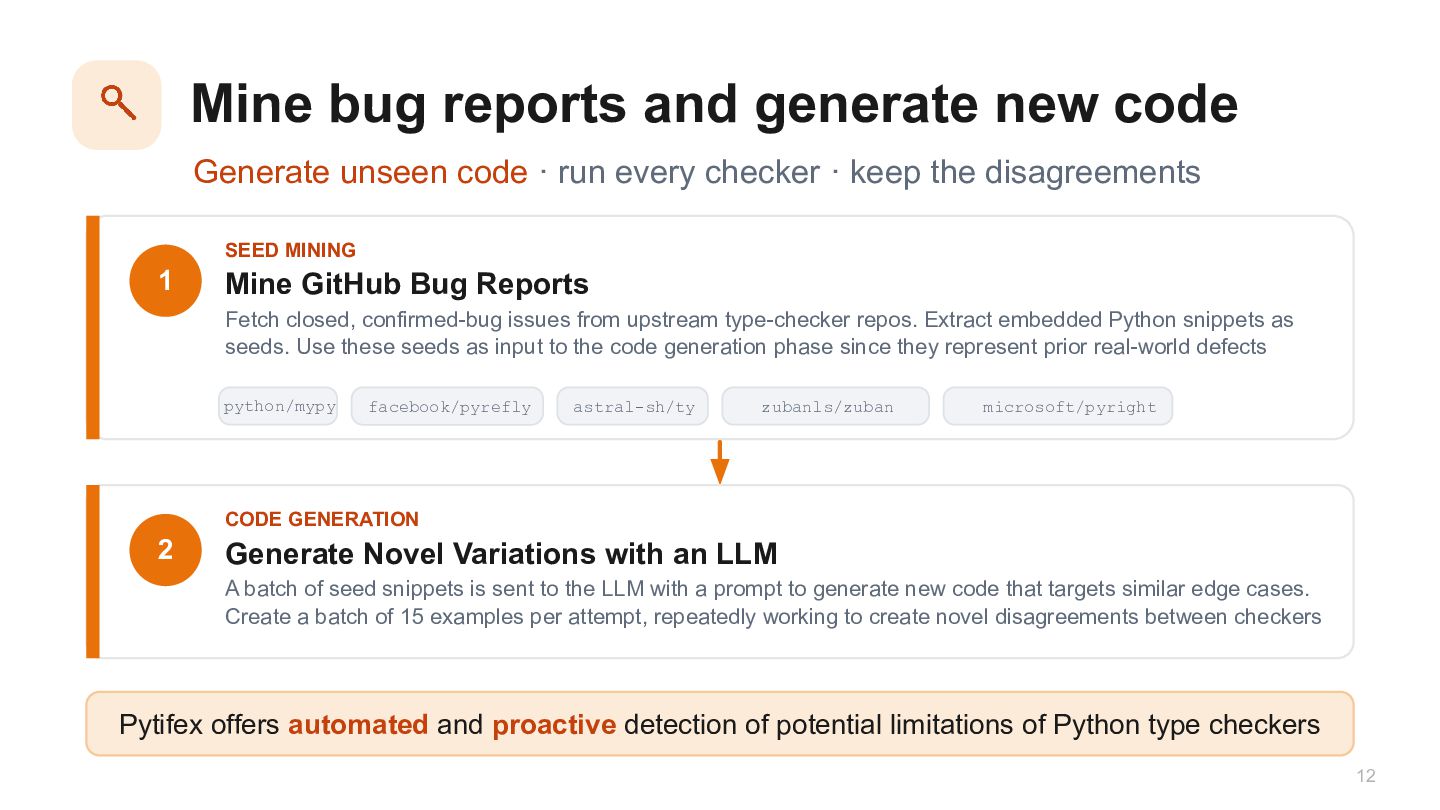
    · run every checker · keep the disagreements SEED MINING 1 Mine GitHub Bug Reports Fetch closed, confirmed-bug issues from upstream type-checker repos. Extract embedded Python snippets as seeds. Use these seeds as input to the code generation phase since they represent prior real-world defects python/mypy facebook/pyrefly astral-sh/ty zubanls/zuban microsoft/pyright CODE GENERATION 2 Generate Novel Variations with an LLM A batch of seed snippets is sent to the LLM with a prompt to generate new code that targets similar edge cases. Create a batch of 15 examples per attempt, repeatedly working to create novel disagreements between checkers Pytifex offers automated and proactive detection of potential limitations of Python type checkers 12
  14. Mine bug reports and generate new code Generate unseen code

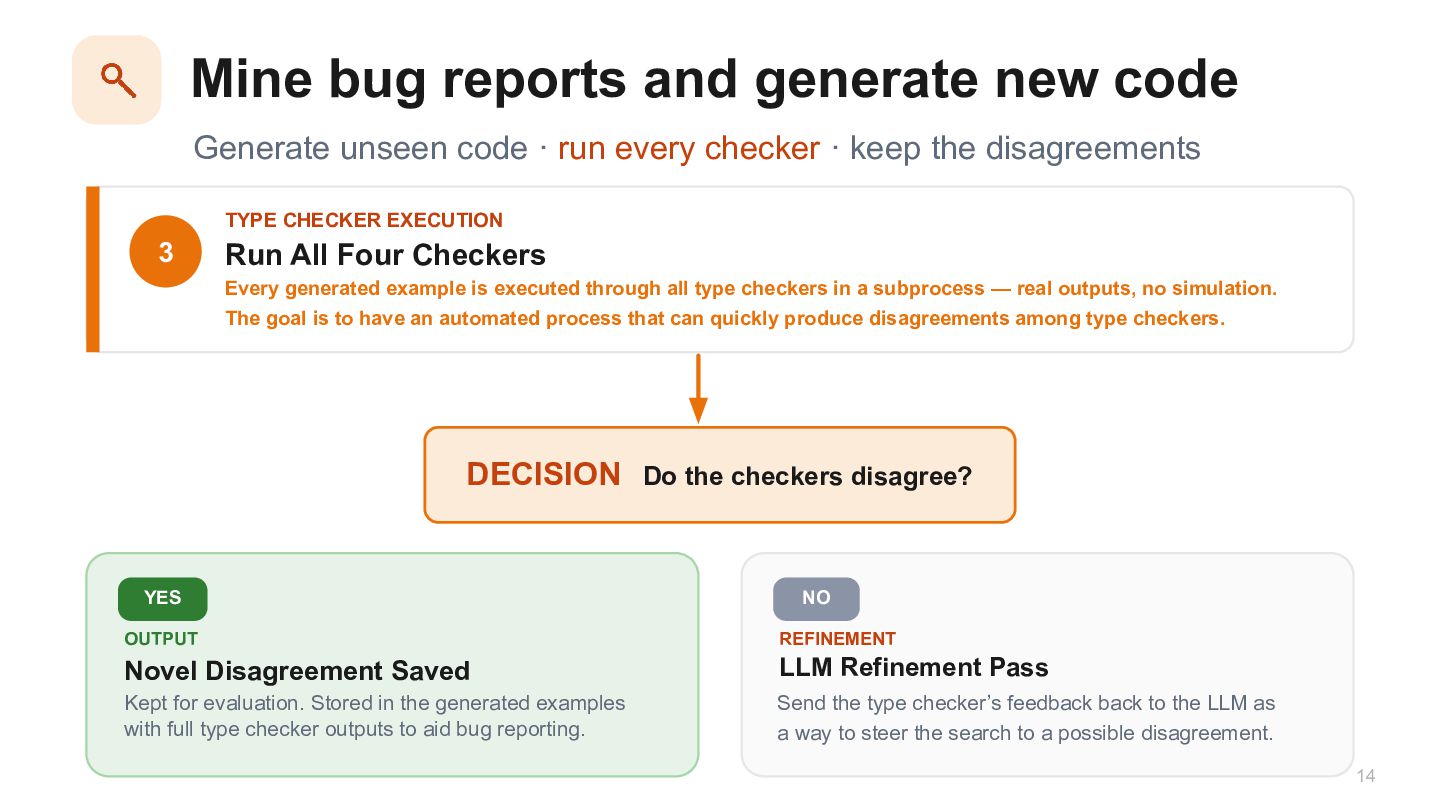
    · run every checker · keep the disagreements TYPE CHECKER EXECUTION 3 Run All Four Checkers Every generated example is executed through all type checkers in a subprocess — real outputs, no simulation. The goal is to have an automated process that can quickly produce disagreements among type checkers. DECISION Do the checkers disagree? YES NO OUTPUT REFINEMENT Novel Disagreement Saved LLM Refinement Pass Kept for evaluation. Stored in the generated examples with full type checker outputs to aid bug reporting. Send the type checker’s feedback back to the LLM as a way to steer the search to a possible disagreement. 14
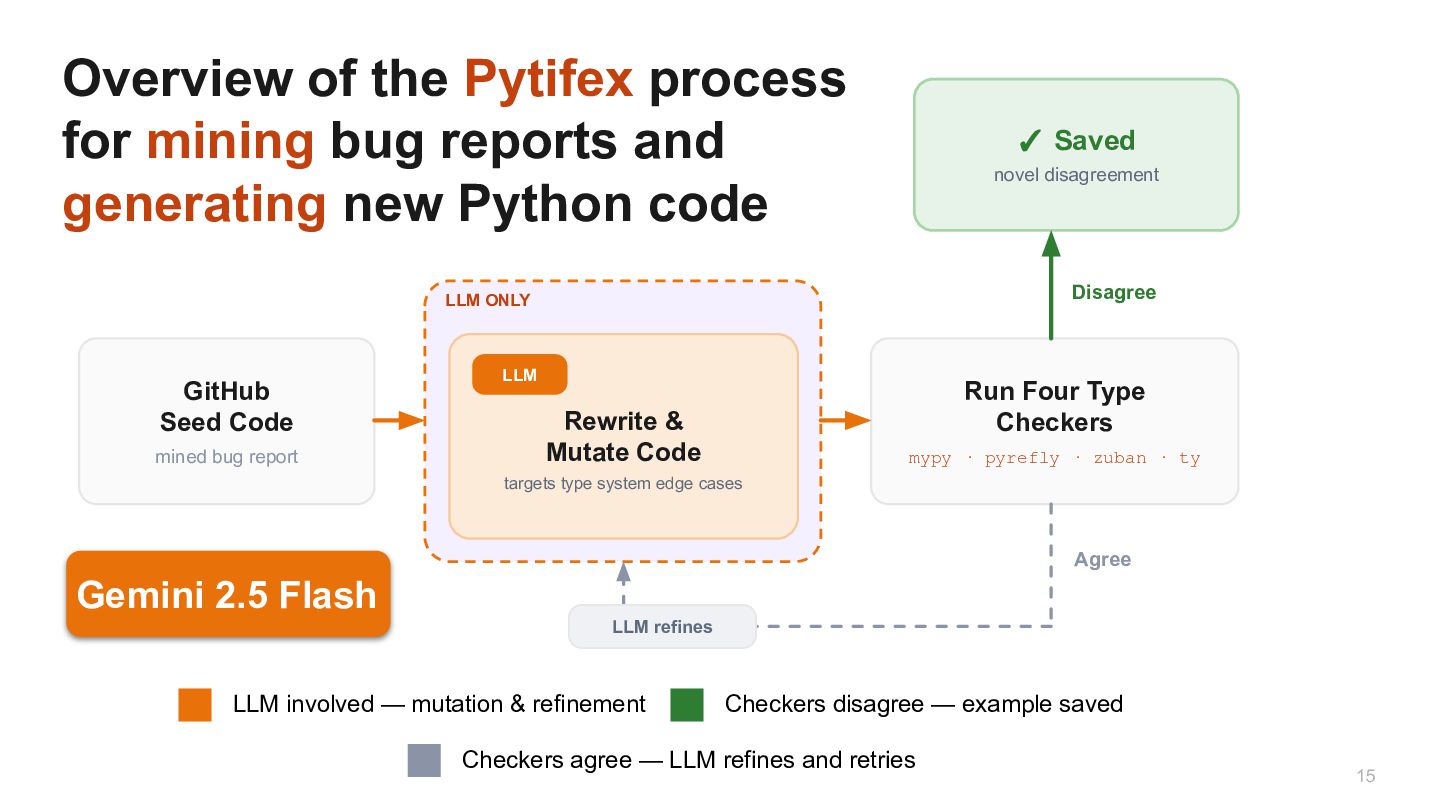
  15. Overview of the Pytifex process for mining bug reports and

    generating new Python code ✓ Saved novel disagreement Disagree LLM ONLY GitHub Seed Code mined bug report LLM Run Four Type Checkers Rewrite & Mutate Code mypy · pyrefly · zuban · ty targets type system edge cases Agree Gemini 2.5 Flash LLM refines LLM involved — mutation & refinement Checkers disagree — example saved Checkers agree — LLM refines and retries 15
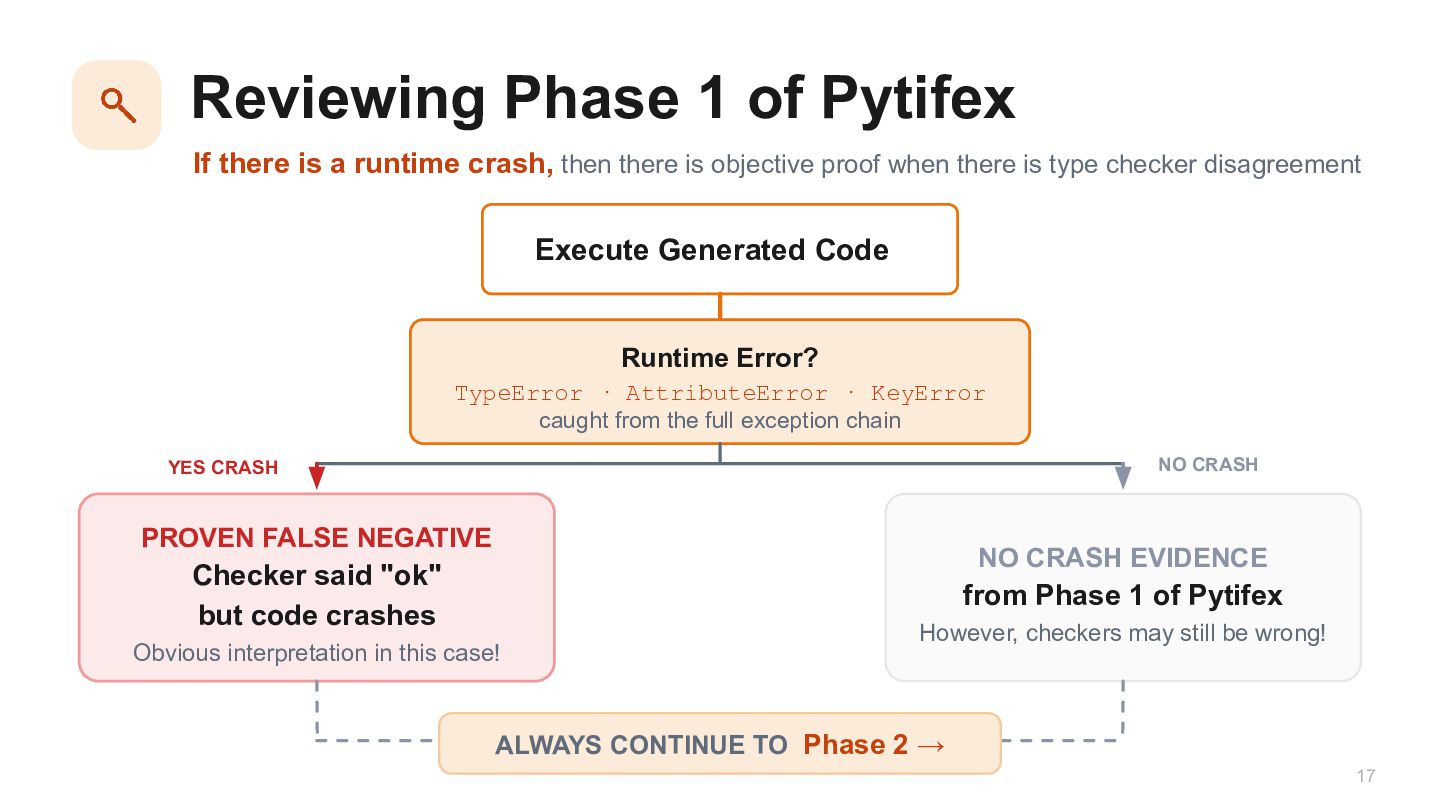
  16. Reviewing Phase 1 of Pytifex If there is a runtime

    crash, then there is objective proof when there is type checker disagreement Execute Generated Code Runtime Error? TypeError · AttributeError · KeyError caught from the full exception chain NO CRASH YES CRASH PROVEN FALSE NEGATIVE NO CRASH EVIDENCE Checker said "ok" but code crashes from Phase 1 of Pytifex Obvious interpretation in this case! However, checkers may still be wrong! ALWAYS CONTINUE TO Phase 2 → 17
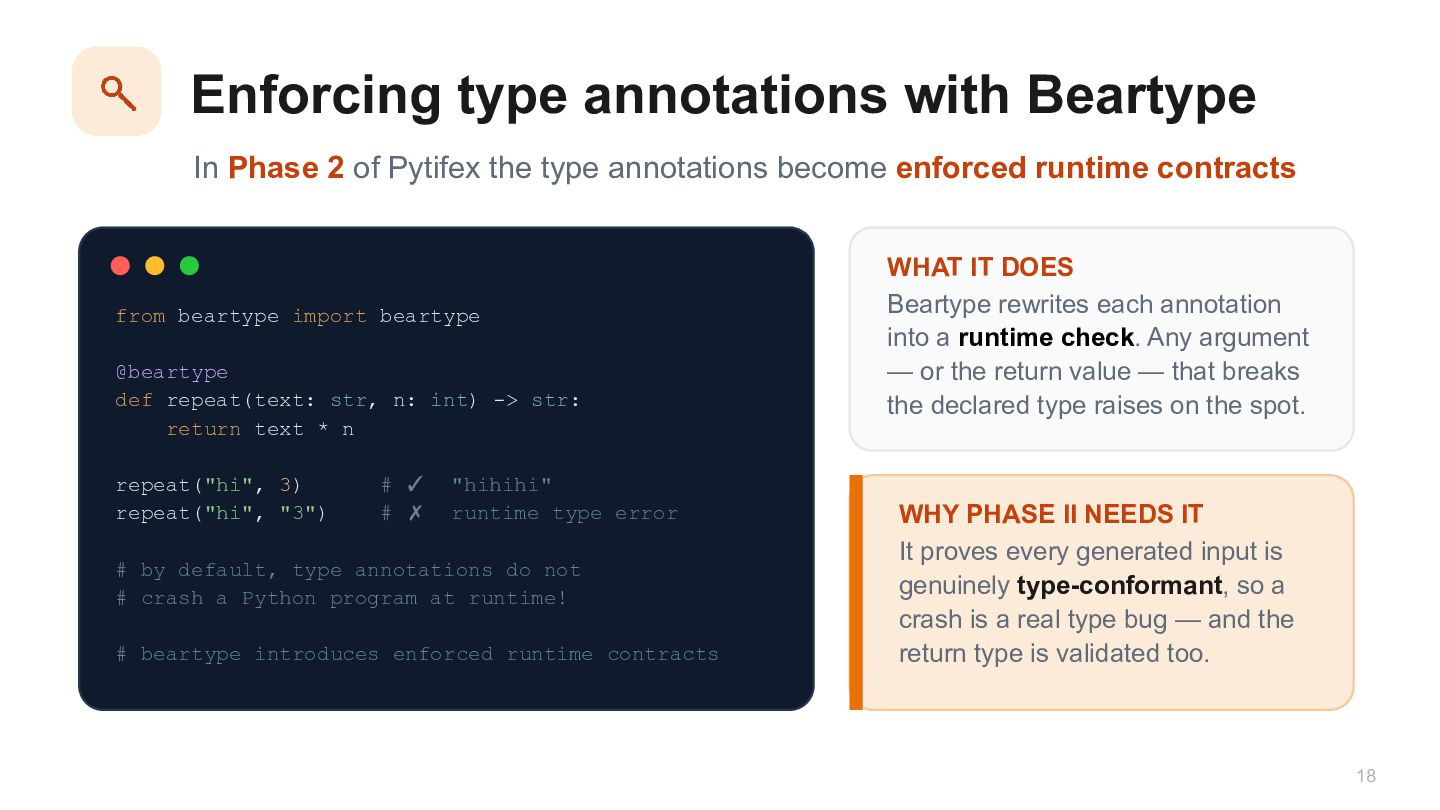
  17. Enforcing type annotations with Beartype In Phase 2 of Pytifex

    the type annotations become enforced runtime contracts from beartype import beartype @beartype def repeat(text: str, n: int) -> str: return text * n repeat("hi", 3) repeat("hi", "3") # ✓ # ✗ "hihihi" runtime type error # by default, type annotations do not # crash a Python program at runtime! # beartype introduces enforced runtime contracts WHAT IT DOES Beartype rewrites each annotation into a runtime check. Any argument — or the return value — that breaks the declared type raises on the spot. WHY PHASE II NEEDS IT It proves every generated input is genuinely type-conformant, so a crash is a real type bug — and the return type is validated too. 18
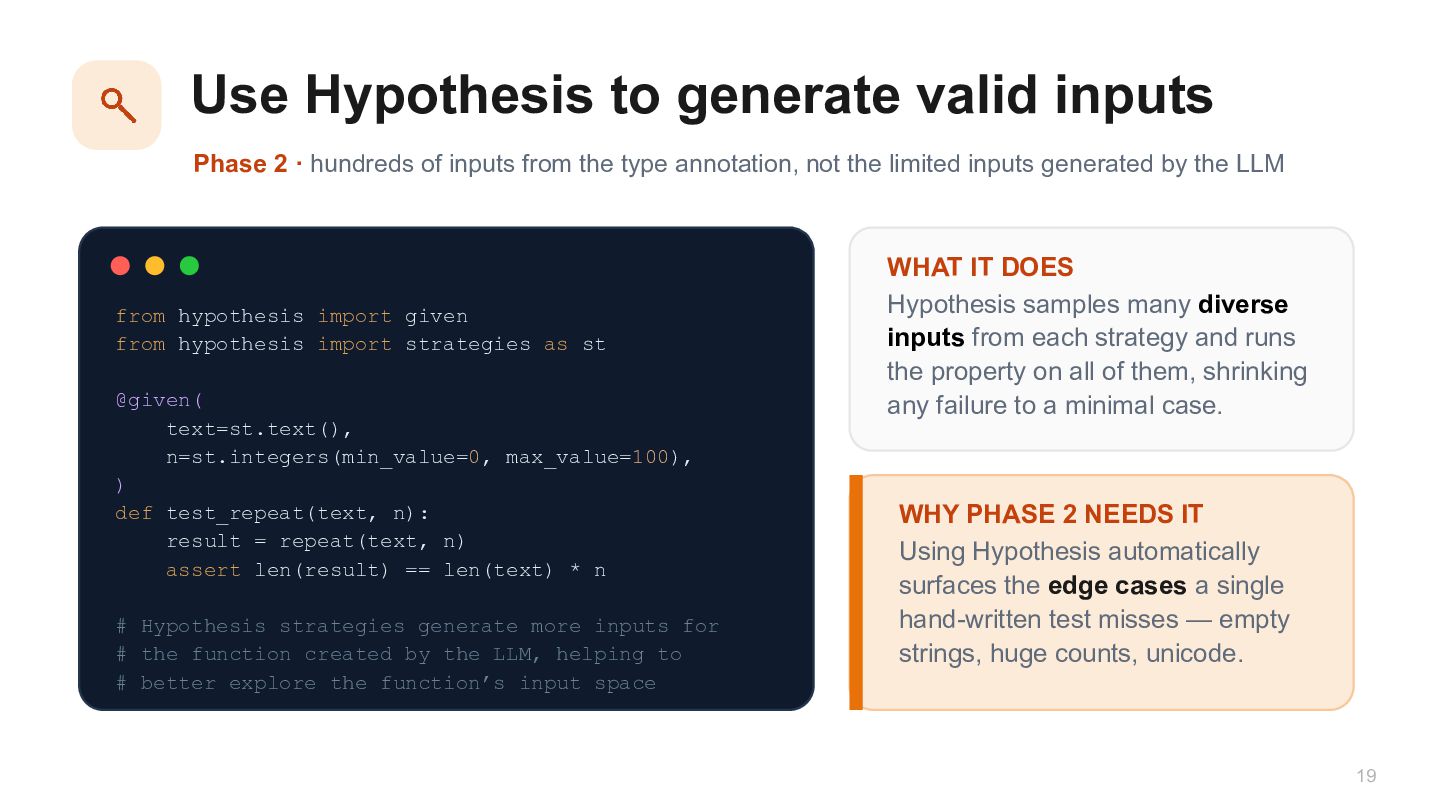
  18. Use Hypothesis to generate valid inputs Phase 2 · hundreds

    of inputs from the type annotation, not the limited inputs generated by the LLM from hypothesis import given from hypothesis import strategies as st @given( text=st.text(), n=st.integers(min_value=0, max_value=100), ) def test_repeat(text, n): result = repeat(text, n) assert len(result) == len(text) * n # Hypothesis strategies generate more inputs for # the function created by the LLM, helping to # better explore the function’s input space WHAT IT DOES Hypothesis samples many diverse inputs from each strategy and runs the property on all of them, shrinking any failure to a minimal case. WHY PHASE 2 NEEDS IT Using Hypothesis automatically surfaces the edge cases a single hand-written test misses — empty strings, huge counts, unicode. 19
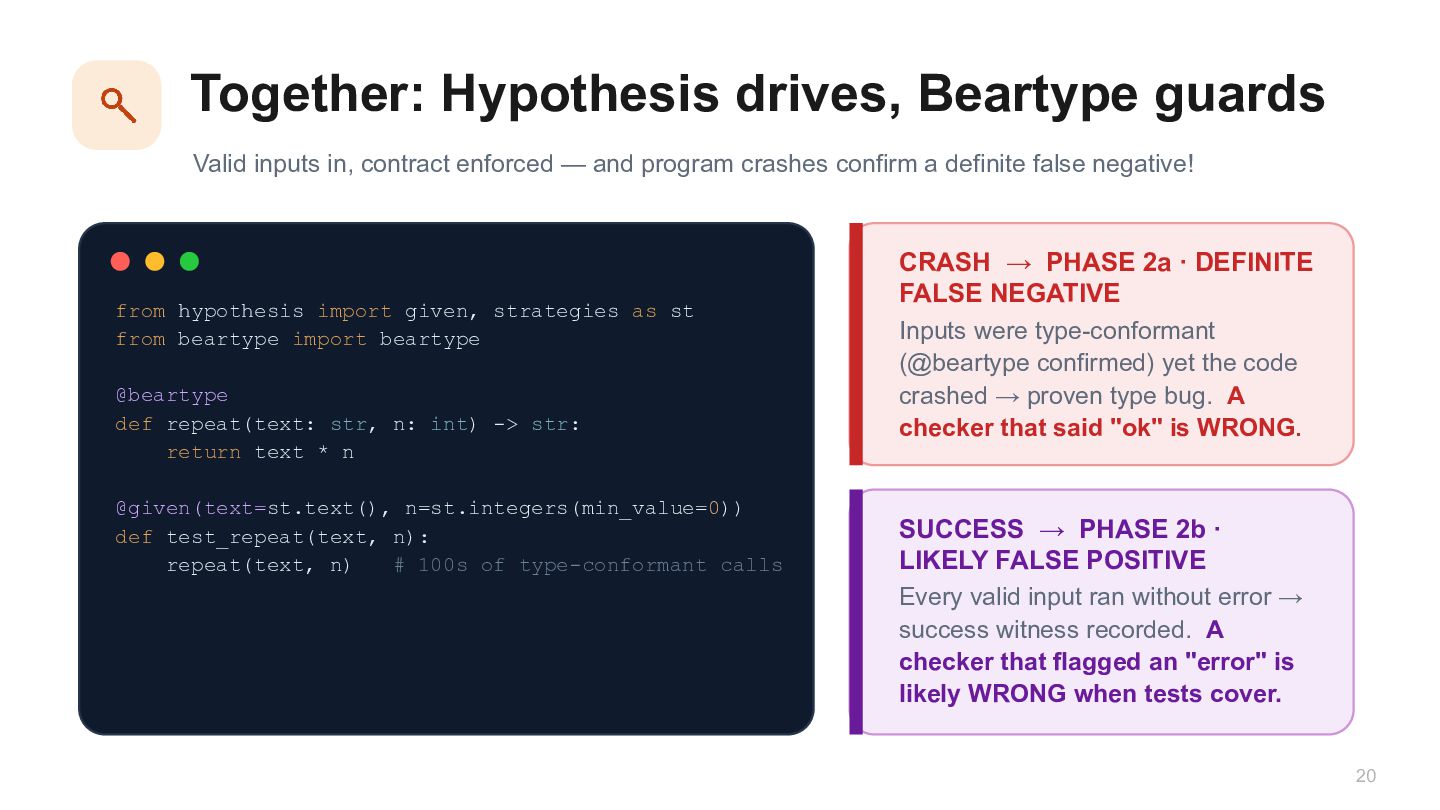
  19. Together: Hypothesis drives, Beartype guards Valid inputs in, contract enforced

    — and program crashes confirm a definite false negative! from hypothesis import given, strategies as st from beartype import beartype @beartype def repeat(text: str, n: int) -> str: return text * n @given(text=st.text(), n=st.integers(min_value=0)) def test_repeat(text, n): repeat(text, n) # 100s of type-conformant calls CRASH → PHASE 2a · DEFINITE FALSE NEGATIVE Inputs were type-conformant (@beartype confirmed) yet the code crashed → proven type bug. A checker that said "ok" is WRONG. SUCCESS → PHASE 2b · LIKELY FALSE POSITIVE Every valid input ran without error → success witness recorded. A checker that flagged an "error" is likely WRONG when tests cover. 20
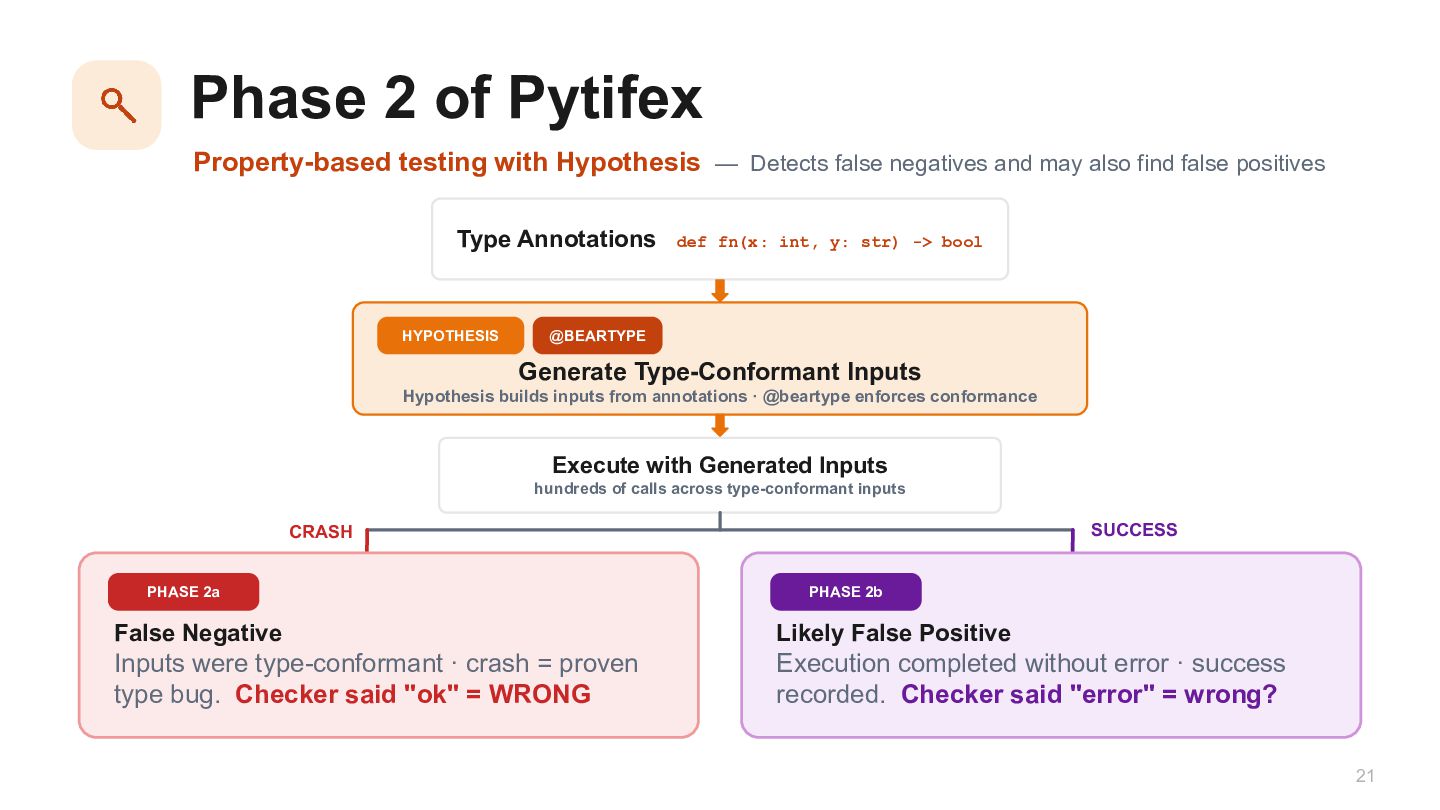
  20. Phase 2 of Pytifex Property-based testing with Hypothesis — Detects

    false negatives and may also find false positives Type Annotations HYPOTHESIS def fn(x: int, y: str) -> bool @BEARTYPE Generate Type-Conformant Inputs Hypothesis builds inputs from annotations · @beartype enforces conformance Execute with Generated Inputs hundreds of calls across type-conformant inputs SUCCESS CRASH PHASE 2a PHASE 2b False Negative Likely False Positive Inputs were type-conformant · crash = proven type bug. Checker said "ok" = WRONG Execution completed without error · success recorded. Checker said "error" = wrong? 21
  21. A disagreement Pytifex automatically found Assign a str to a

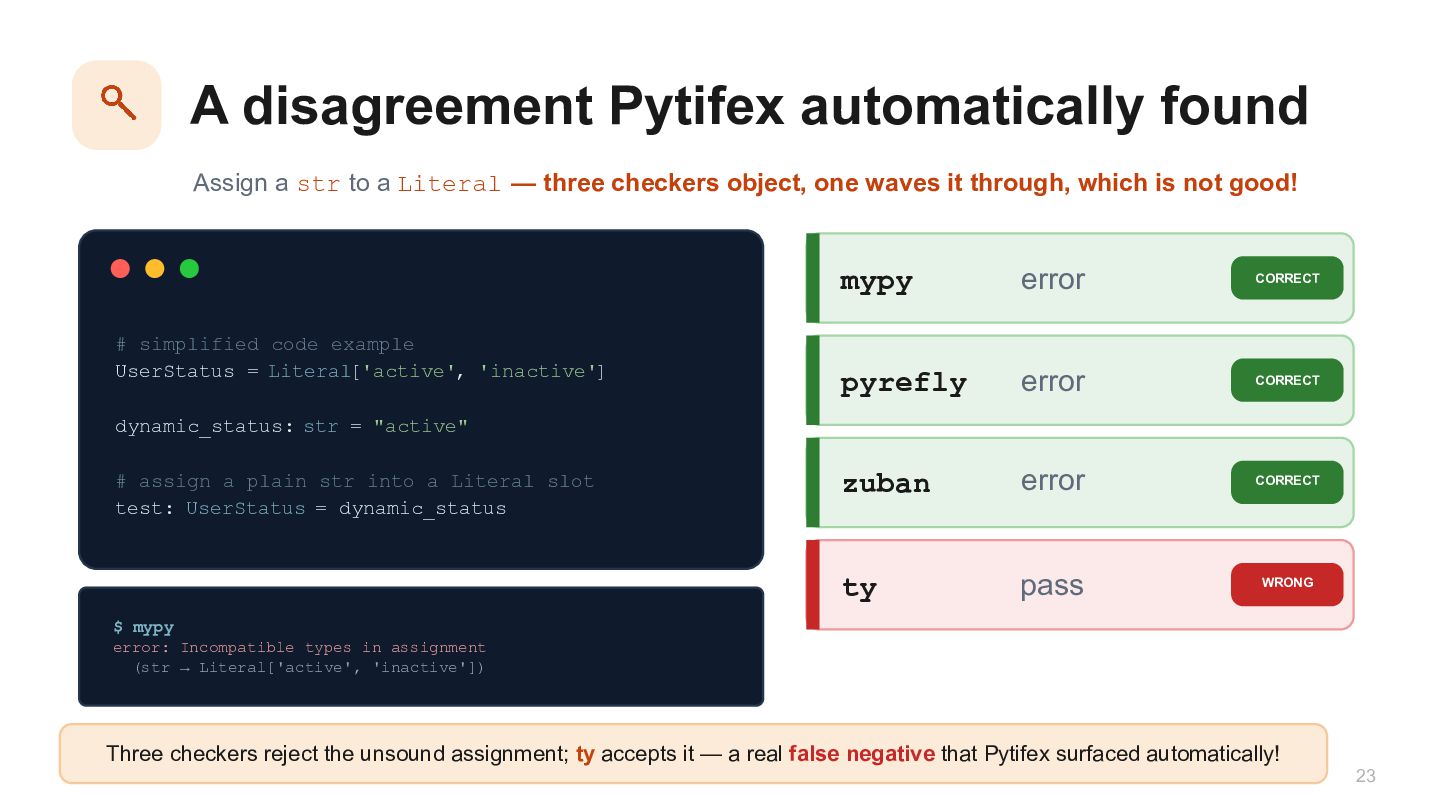
    Literal — three checkers object, one waves it through, which is not good! # simplified code example UserStatus = Literal['active', 'inactive'] mypy error CORRECT pyrefly error CORRECT zuban error CORRECT ty pass WRONG dynamic_status: str = "active" # assign a plain str into a Literal slot test: UserStatus = dynamic_status $ mypy error: Incompatible types in assignment (str → Literal['active', 'inactive']) Three checkers reject the unsound assignment; ty accepts it — a real false negative that Pytifex surfaced automatically! 23
  22. Is a new release of a type checker always better?

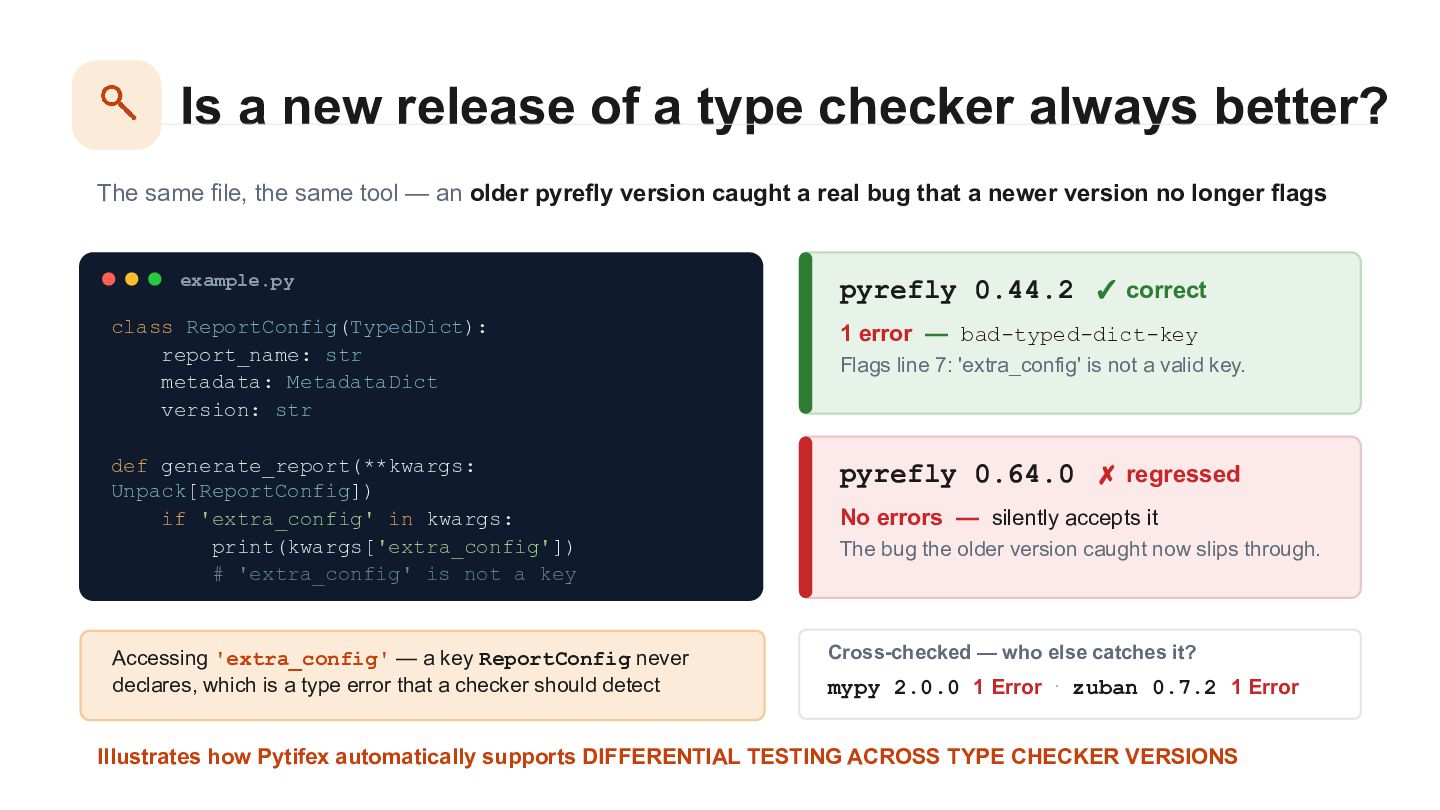
    The same file, the same tool — an older pyrefly version caught a real bug that a newer version no longer flags example.py pyrefly 0.44.2 ✓ correct class ReportConfig(TypedDict): report_name: str metadata: MetadataDict version: str 1 error — bad-typed-dict-key def generate_report(**kwargs: Unpack[ReportConfig]) if 'extra_config' in kwargs: print(kwargs['extra_config']) # 'extra_config' is not a key pyrefly 0.64.0 ✗ regressed Accessing 'extra_config' — a key ReportConfig never declares, which is a type error that a checker should detect Cross-checked — who else catches it? Flags line 7: 'extra_config' is not a valid key. No errors — silently accepts it The bug the older version caught now slips through. mypy 2.0.0 1 Error · zuban 0.7.2 1 Error Illustrates how Pytifex automatically supports DIFFERENTIAL TESTING ACROSS TYPE CHECKER VERSIONS
  23. What to take home about the Pytifex tool? Is it

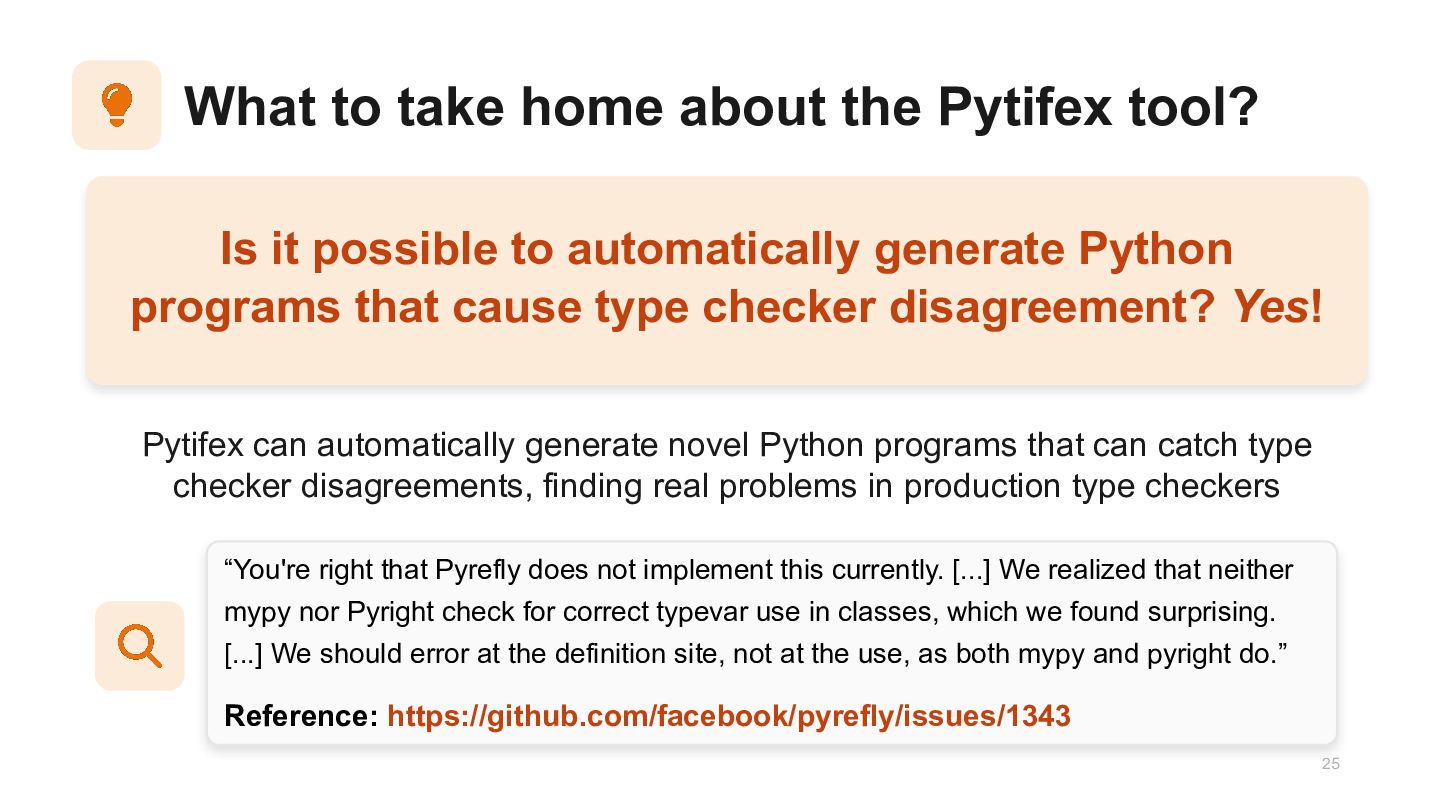
    possible to automatically generate Python programs that cause type checker disagreement? Yes! Pytifex can automatically generate novel Python programs that can catch type checker disagreements, finding real problems in production type checkers “You're right that Pyrefly does not implement this currently. [...] We realized that neither mypy nor Pyright check for correct typevar use in classes, which we found surprising. [...] We should error at the definition site, not at the use, as both mypy and pyright do.” Reference: https://github.com/facebook/pyrefly/issues/1343 25
  24. Advertisement for an upcoming PyOhio 2026 talk! Testing the Parts

    You Don't See Pseudo-Tested Native Code in Python Libraries “look inside” Please attend this presentation by Issei Hasegawa in Ballroom D on Sunday, July 26 at 2:45 PM. See you there!
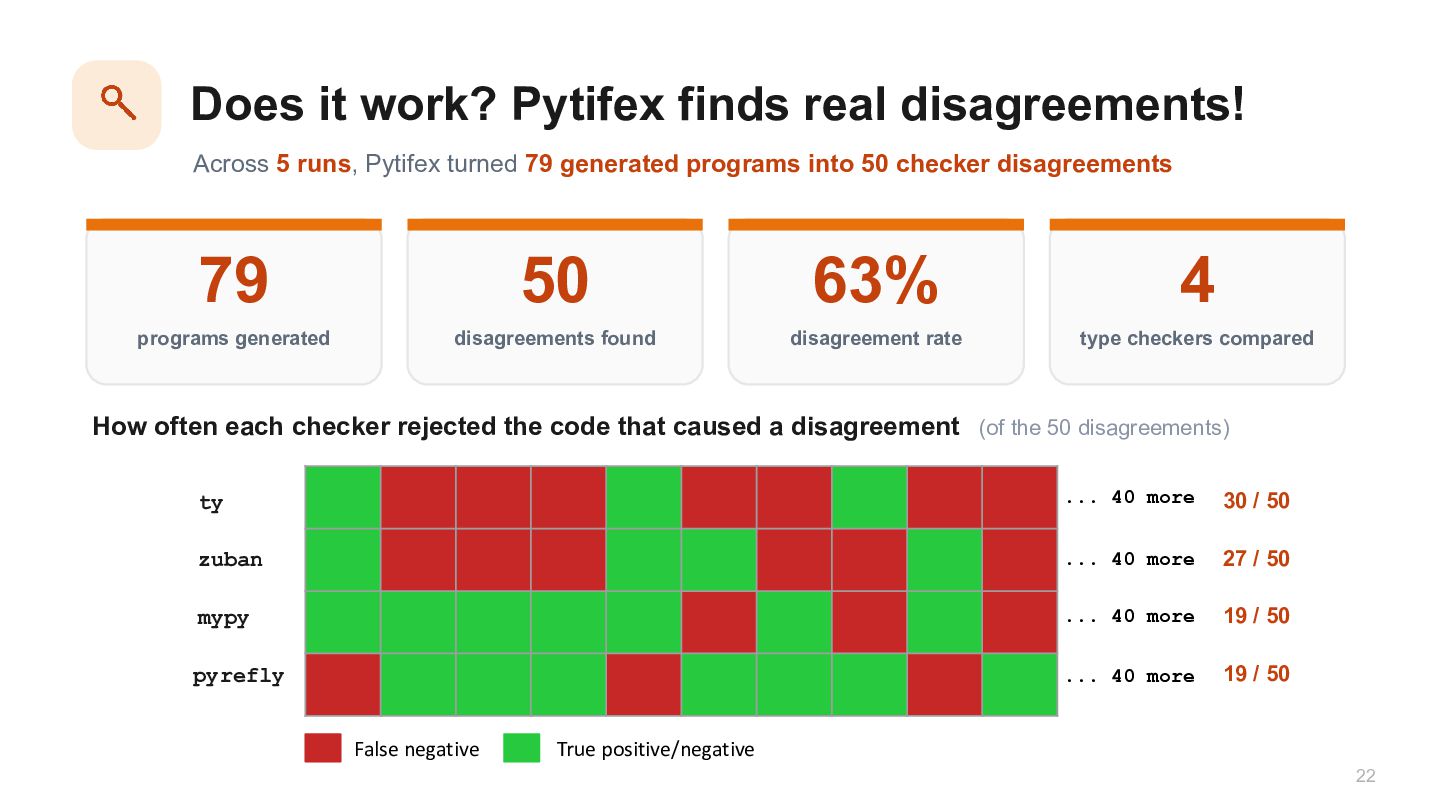
  25. Does it work? Pytifex finds real disagreements! Across 5 runs,

    Pytifex turned 79 generated programs into 50 checker disagreements 79 50 63% 4 programs generated disagreements found disagreement rate type checkers compared How often each checker rejected the code that caused a disagreement (of the 50 disagreements) ty ... 40 more 30 / 50 zuban ... 40 more 27 / 50 mypy ... 40 more 19 / 50 pyrefly ... 40 more 19 / 50 False negative True positive/negative 22