Upgrade to Pro — share decks privately, control downloads, hide ads and more …

How to Tell If Your Home Needs a Hybrid Inverter

How to Tell If Your Home Needs a Hybrid Inverter

Wondering whether your home really needs a hybrid inverter? This practical guide explains how hybrid inverters work, when they make sense for a residential solar system, and what to consider before choosing one. It covers battery compatibility, energy storage, inverter capacity, existing solar systems, and future expansion. The guide also includes a real-world example of an 8kW hybrid inverter to help homeowners understand what to look for when comparing options.

Avatar for Harry Parker

Harry Parker

September 29, 2026

Other Decks in Marketing & SEO

Transcript

  1. How to Tell If Your Home Needs a Hybrid Inverter

    A practical guide to solar, battery storage, system sizing and future expansion SOLAR RAINS SOLAR RAINS • HYBRID INVERTER GUIDE 1
  2. 01 START HERE Why the inverter matters When I first

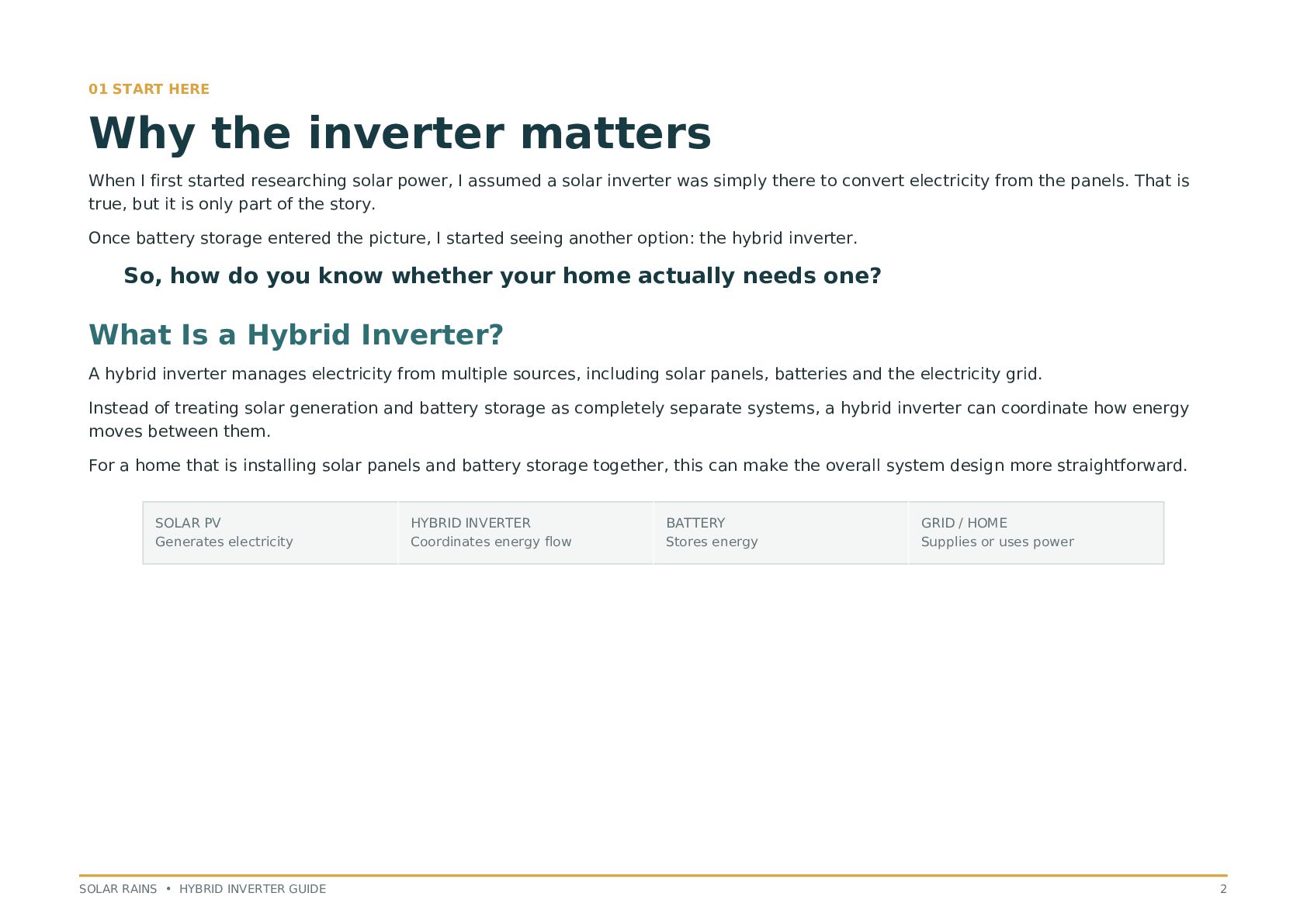
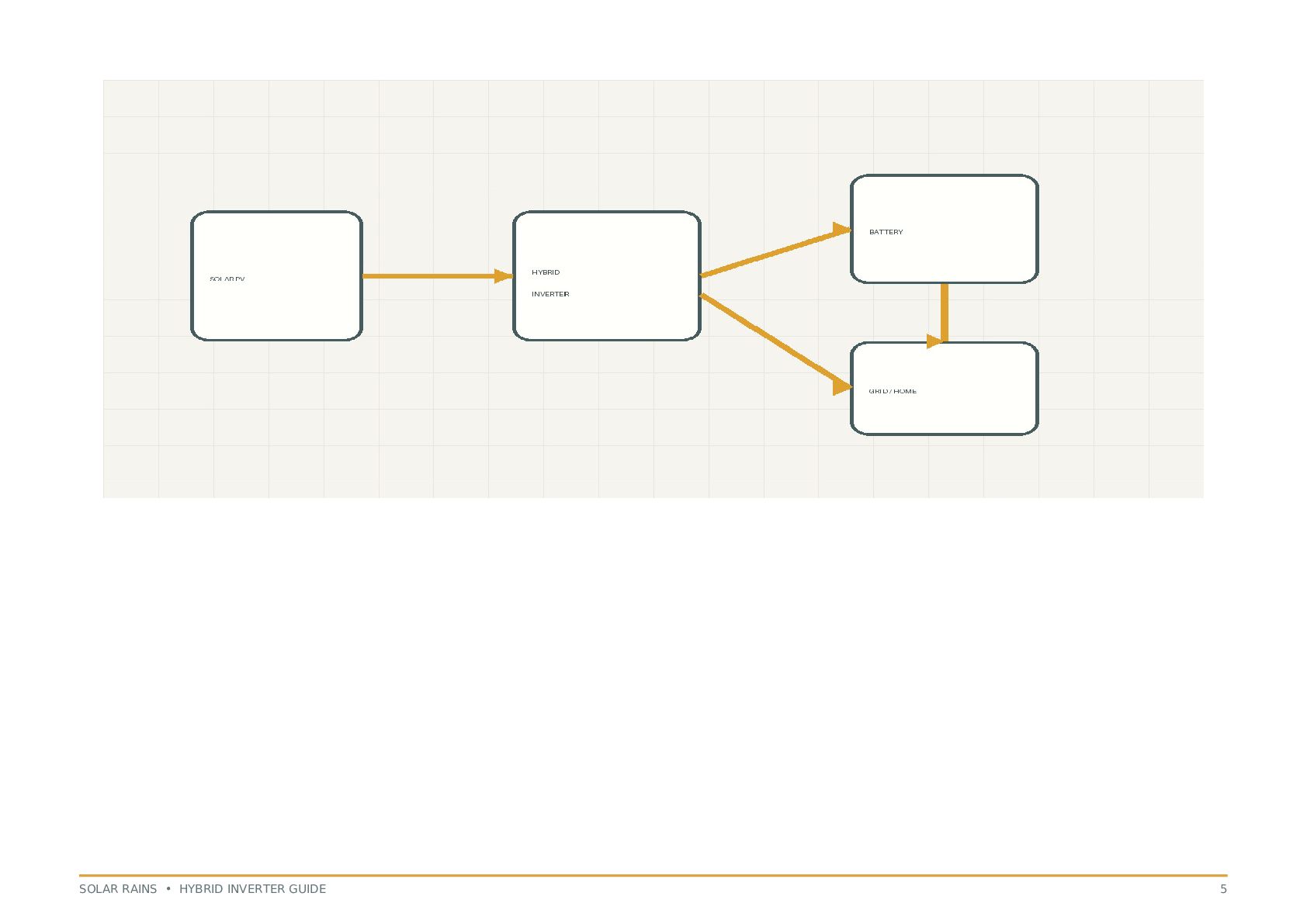
    started researching solar power, I assumed a solar inverter was simply there to convert electricity from the panels. That is true, but it is only part of the story. Once battery storage entered the picture, I started seeing another option: the hybrid inverter. So, how do you know whether your home actually needs one? What Is a Hybrid Inverter? A hybrid inverter manages electricity from multiple sources, including solar panels, batteries and the electricity grid. Instead of treating solar generation and battery storage as completely separate systems, a hybrid inverter can coordinate how energy moves between them. For a home that is installing solar panels and battery storage together, this can make the overall system design more straightforward. SOLAR PV Generates electricity SOLAR RAINS • HYBRID INVERTER GUIDE HYBRID INVERTER Coordinates energy flow BATTERY Stores energy GRID / HOME Supplies or uses power 2
  3. 02 WHEN IT MAKES SENSE When Does a Hybrid Inverter

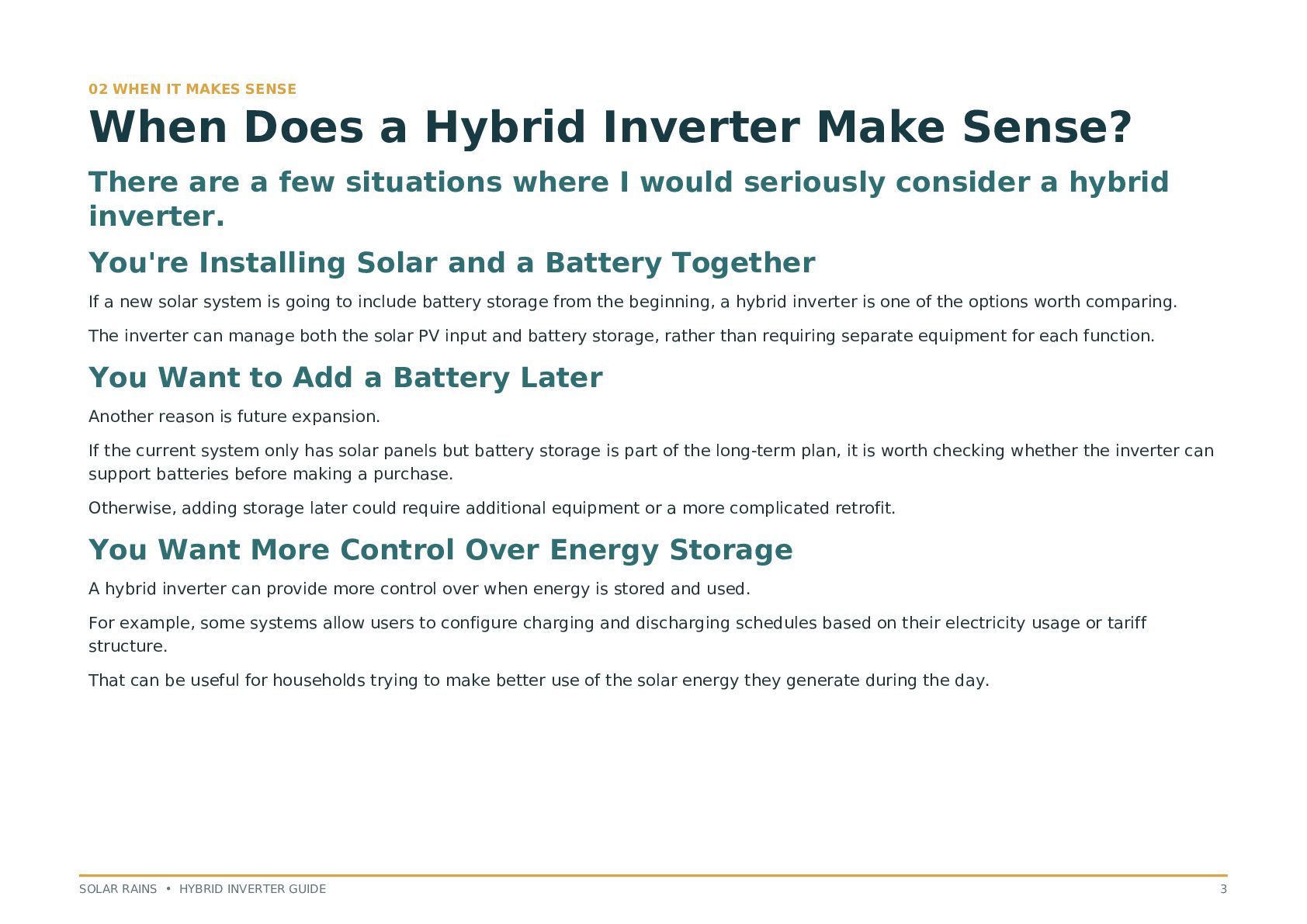
    Make Sense? There are a few situations where I would seriously consider a hybrid inverter. You're Installing Solar and a Battery Together If a new solar system is going to include battery storage from the beginning, a hybrid inverter is one of the options worth comparing. The inverter can manage both the solar PV input and battery storage, rather than requiring separate equipment for each function. You Want to Add a Battery Later Another reason is future expansion. If the current system only has solar panels but battery storage is part of the long-term plan, it is worth checking whether the inverter can support batteries before making a purchase. Otherwise, adding storage later could require additional equipment or a more complicated retrofit. You Want More Control Over Energy Storage A hybrid inverter can provide more control over when energy is stored and used. For example, some systems allow users to configure charging and discharging schedules based on their electricity usage or tariff structure. That can be useful for households trying to make better use of the solar energy they generate during the day. SOLAR RAINS • HYBRID INVERTER GUIDE 3
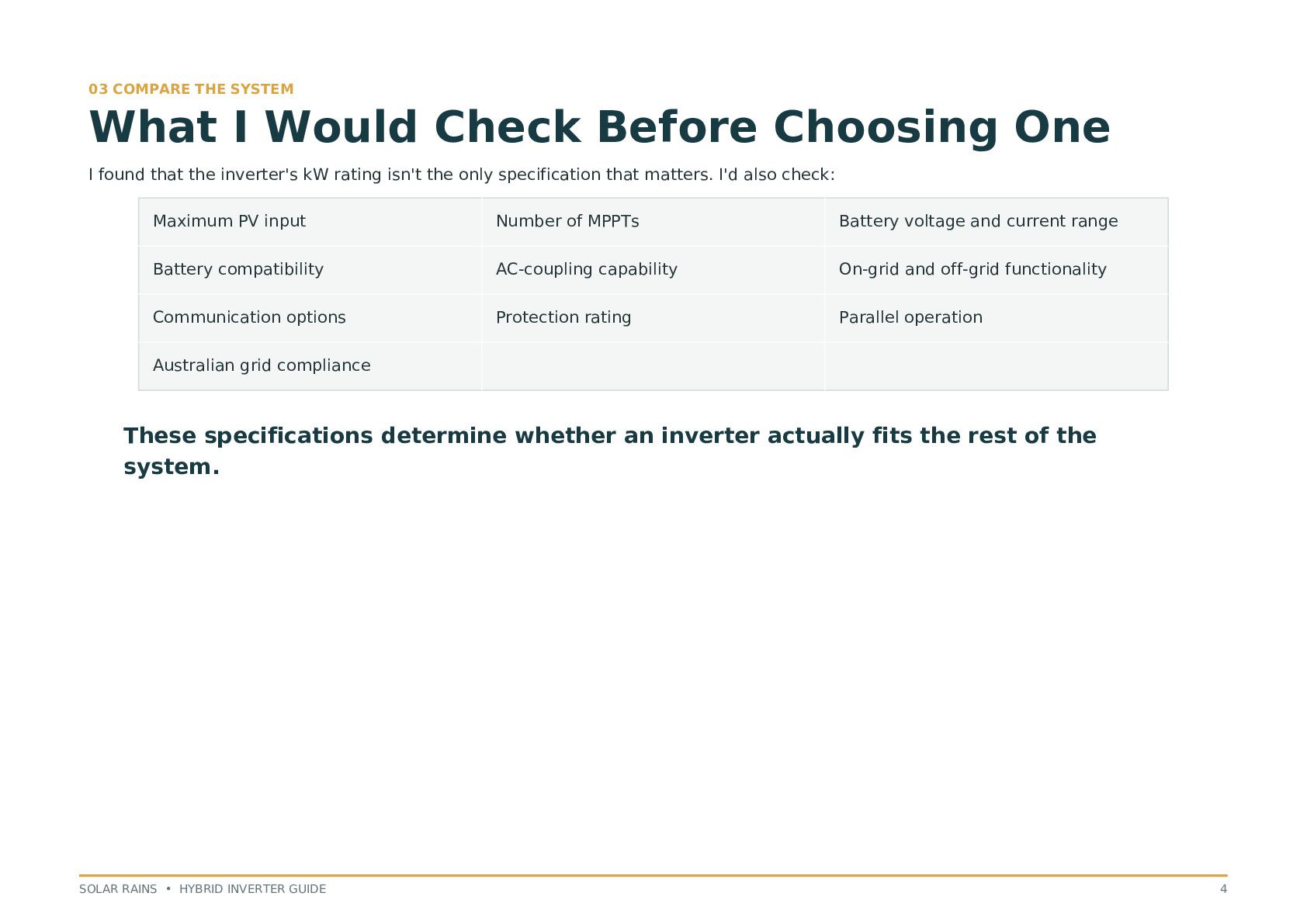
  4. 03 COMPARE THE SYSTEM What I Would Check Before Choosing

    One I found that the inverter's kW rating isn't the only specification that matters. I'd also check: Maximum PV input Number of MPPTs Battery voltage and current range Battery compatibility AC-coupling capability On-grid and off-grid functionality Communication options Protection rating Parallel operation Australian grid compliance These specifications determine whether an inverter actually fits the rest of the system. SOLAR RAINS • HYBRID INVERTER GUIDE 4
  5. 04 A REAL-WORLD EXAMPLE An Example I Came Across While

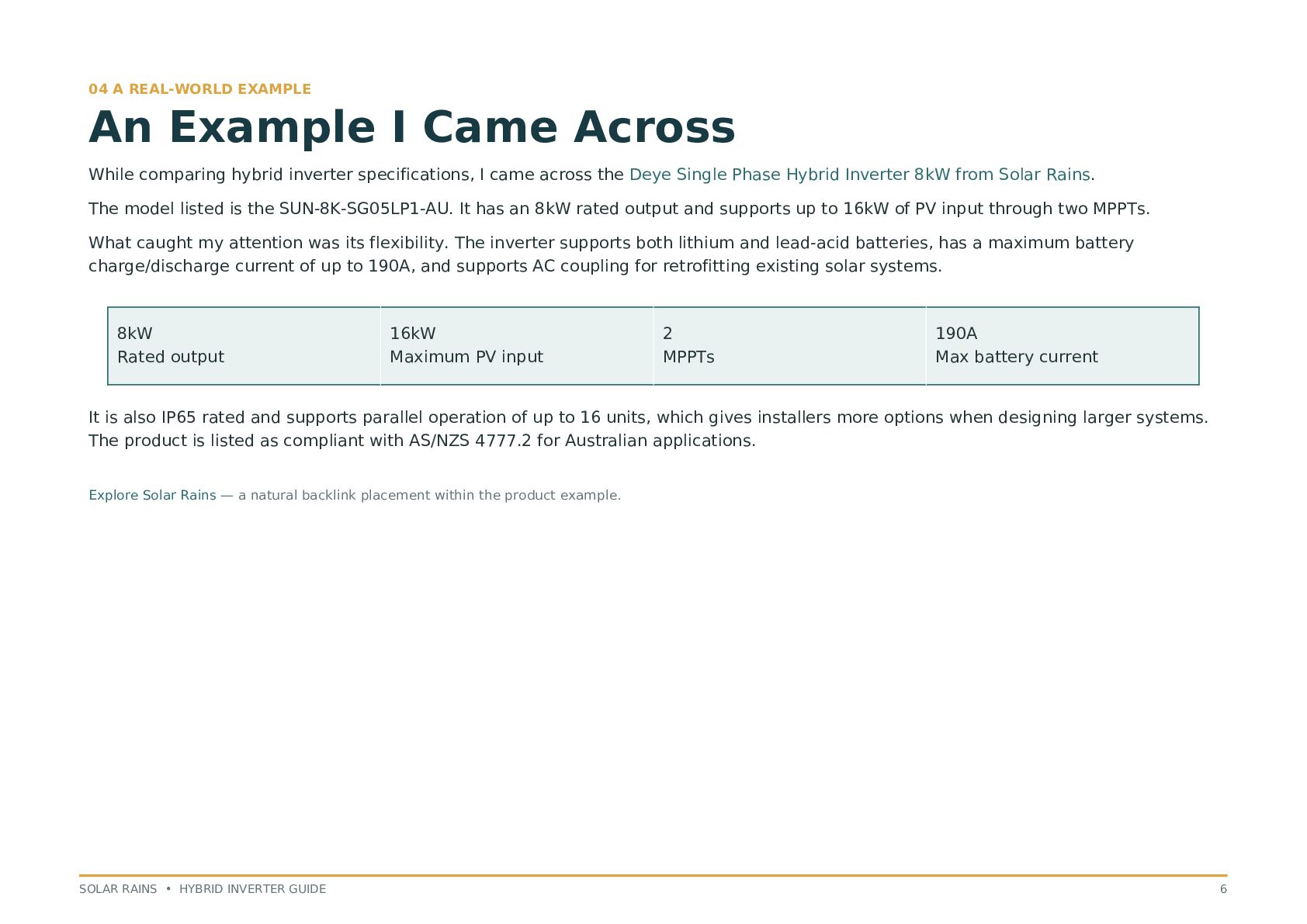
    comparing hybrid inverter specifications, I came across the Deye Single Phase Hybrid Inverter 8kW from Solar Rains. The model listed is the SUN-8K-SG05LP1-AU. It has an 8kW rated output and supports up to 16kW of PV input through two MPPTs. What caught my attention was its flexibility. The inverter supports both lithium and lead-acid batteries, has a maximum battery charge/discharge current of up to 190A, and supports AC coupling for retrofitting existing solar systems. 8kW Rated output 16kW Maximum PV input 2 MPPTs 190A Max battery current It is also IP65 rated and supports parallel operation of up to 16 units, which gives installers more options when designing larger systems. The product is listed as compliant with AS/NZS 4777.2 for Australian applications. Explore Solar Rains — a natural backlink placement within the product example. SOLAR RAINS • HYBRID INVERTER GUIDE 6
  6. 05 SIZE IT FOR THE HOME Do I Actually Need

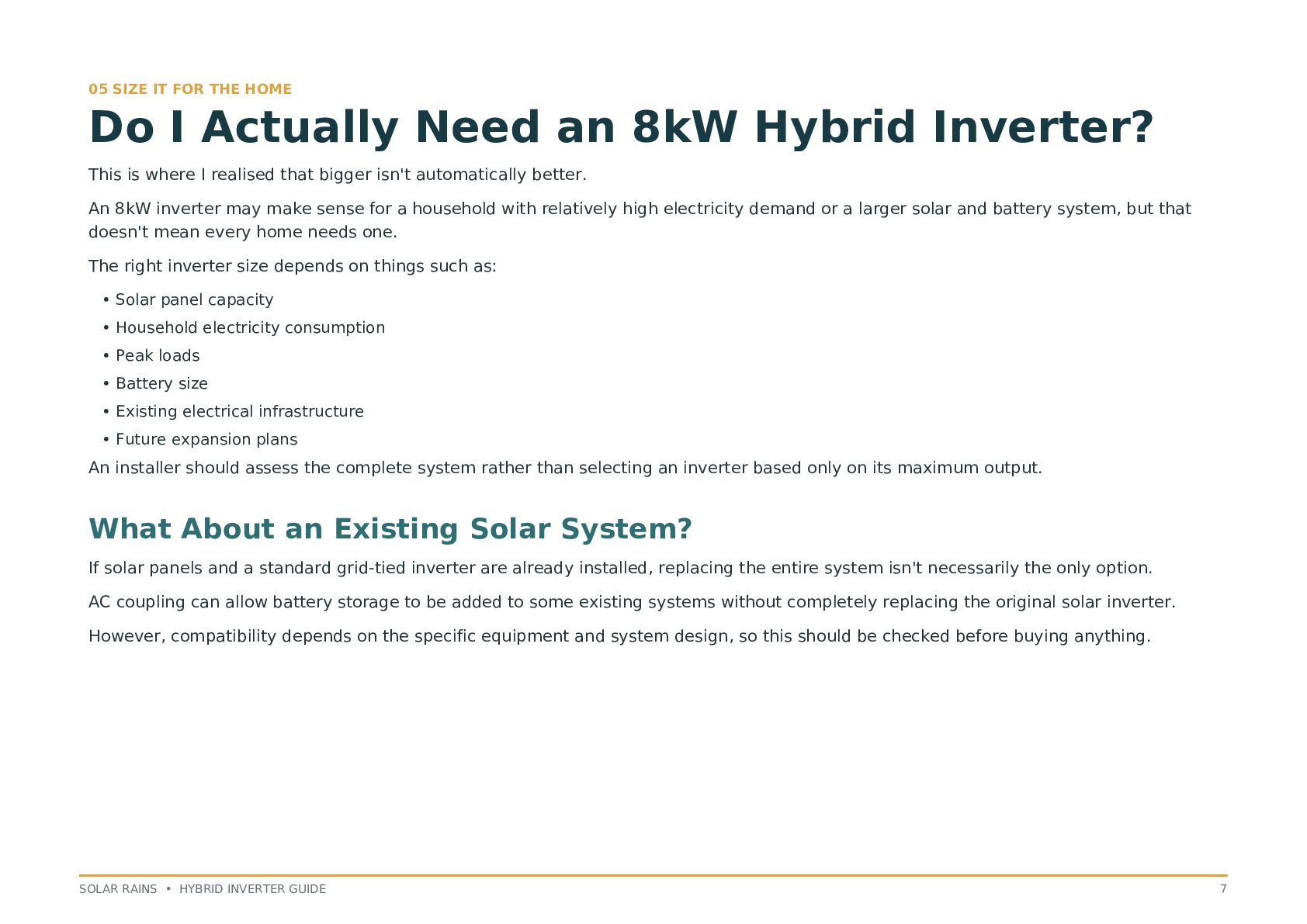
    an 8kW Hybrid Inverter? This is where I realised that bigger isn't automatically better. An 8kW inverter may make sense for a household with relatively high electricity demand or a larger solar and battery system, but that doesn't mean every home needs one. The right inverter size depends on things such as: • Solar panel capacity • Household electricity consumption • Peak loads • Battery size • Existing electrical infrastructure • Future expansion plans An installer should assess the complete system rather than selecting an inverter based only on its maximum output. What About an Existing Solar System? If solar panels and a standard grid-tied inverter are already installed, replacing the entire system isn't necessarily the only option. AC coupling can allow battery storage to be added to some existing systems without completely replacing the original solar inverter. However, compatibility depends on the specific equipment and system design, so this should be checked before buying anything. SOLAR RAINS • HYBRID INVERTER GUIDE 7
  7. 06 THE CHECKLIST My Hybrid Inverter Checklist If I were

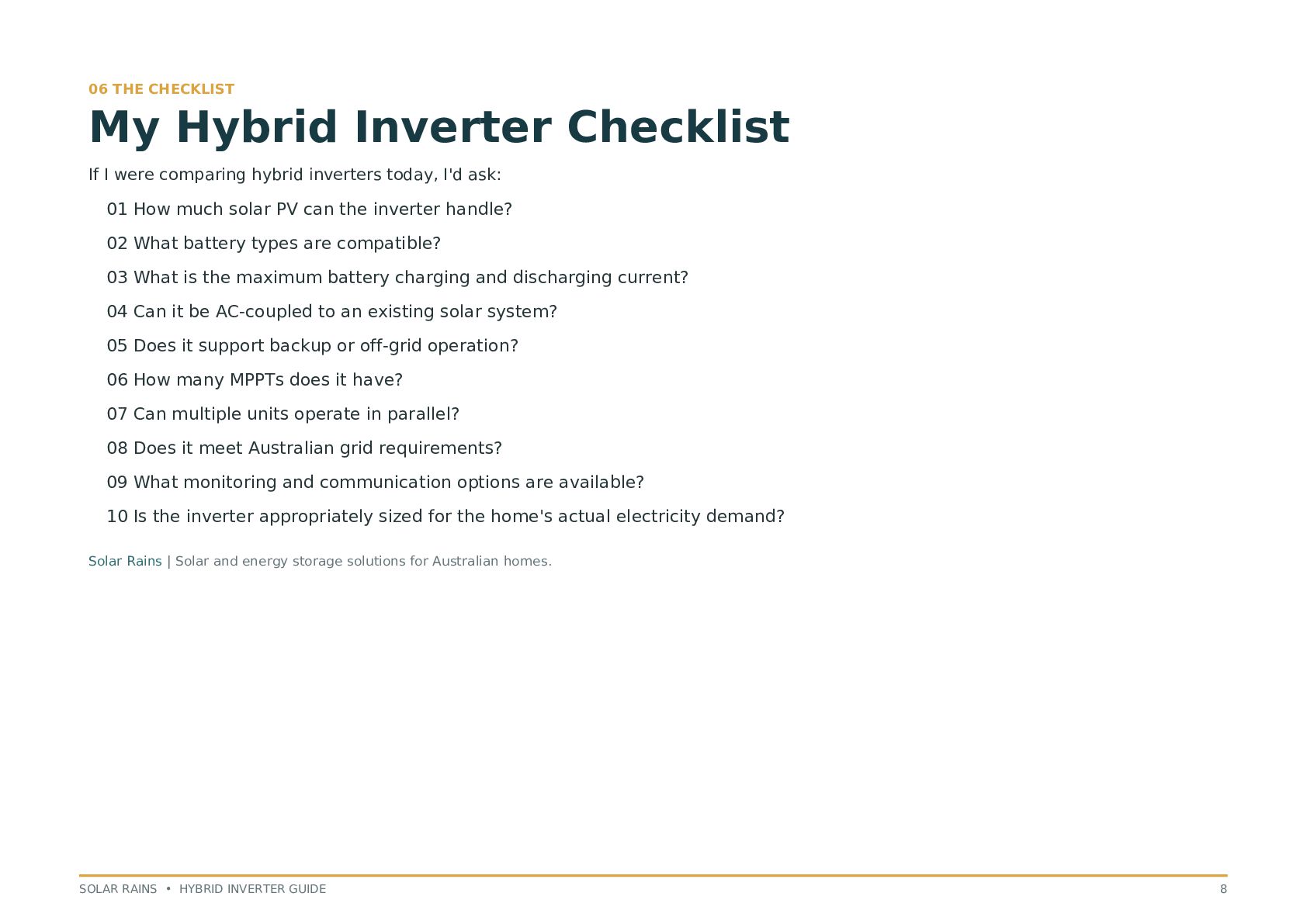
    comparing hybrid inverters today, I'd ask: 01 How much solar PV can the inverter handle? 02 What battery types are compatible? 03 What is the maximum battery charging and discharging current? 04 Can it be AC-coupled to an existing solar system? 05 Does it support backup or off-grid operation? 06 How many MPPTs does it have? 07 Can multiple units operate in parallel? 08 Does it meet Australian grid requirements? 09 What monitoring and communication options are available? 10 Is the inverter appropriately sized for the home's actual electricity demand? Solar Rains | Solar and energy storage solutions for Australian homes. SOLAR RAINS • HYBRID INVERTER GUIDE 8
  8. 07 FINAL THOUGHTS Match the inverter to the whole system

    A hybrid inverter isn't automatically necessary for every solar installation. For me, the biggest lesson was that the inverter should be considered as part of the whole solar and battery system, rather than as a standalone product. If battery storage, future expansion or energy management is important, a hybrid inverter is definitely worth researching. The key is matching its specifications to the home's solar generation, electricity consumption and battery requirements rather than simply choosing the highest-rated model. Want to explore hybrid inverter options? Visit Solar Rains for Australian solar and energy storage products. VISIT SOLAR RAINS → Source content preserved from the supplied 4-page article. Visuals in this redesigned PDF are original illustrative graphics. SOLAR RAINS • HYBRID INVERTER GUIDE 9