Upgrade to Pro — share decks privately, control downloads, hide ads and more …

RTCA Katharine Blythe & Dan Whitten - Introduci...

Sponsored · Your Podcast. Everywhere. Effortlessly. Share. Educate. Inspire. Entertain. You do you. We'll handle the rest. →
Avatar for IES Events IES Events
October 26, 2026
37

RTCA Katharine Blythe & Dan Whitten - Introducing STAIR: A new screening tool for air quality impacts from roads

Avatar for IES Events

IES Events

October 26, 2026

More Decks by IES Events

Transcript

  1. Introducing STAIR: A New Screening Tool for Air Quality Impacts

    from Roads Katharine Blythe – Natural England Dan Whitten – AECOM IAQM – Routes to Clean Air - 21 October 2026 www.gov.uk/natural-england 1
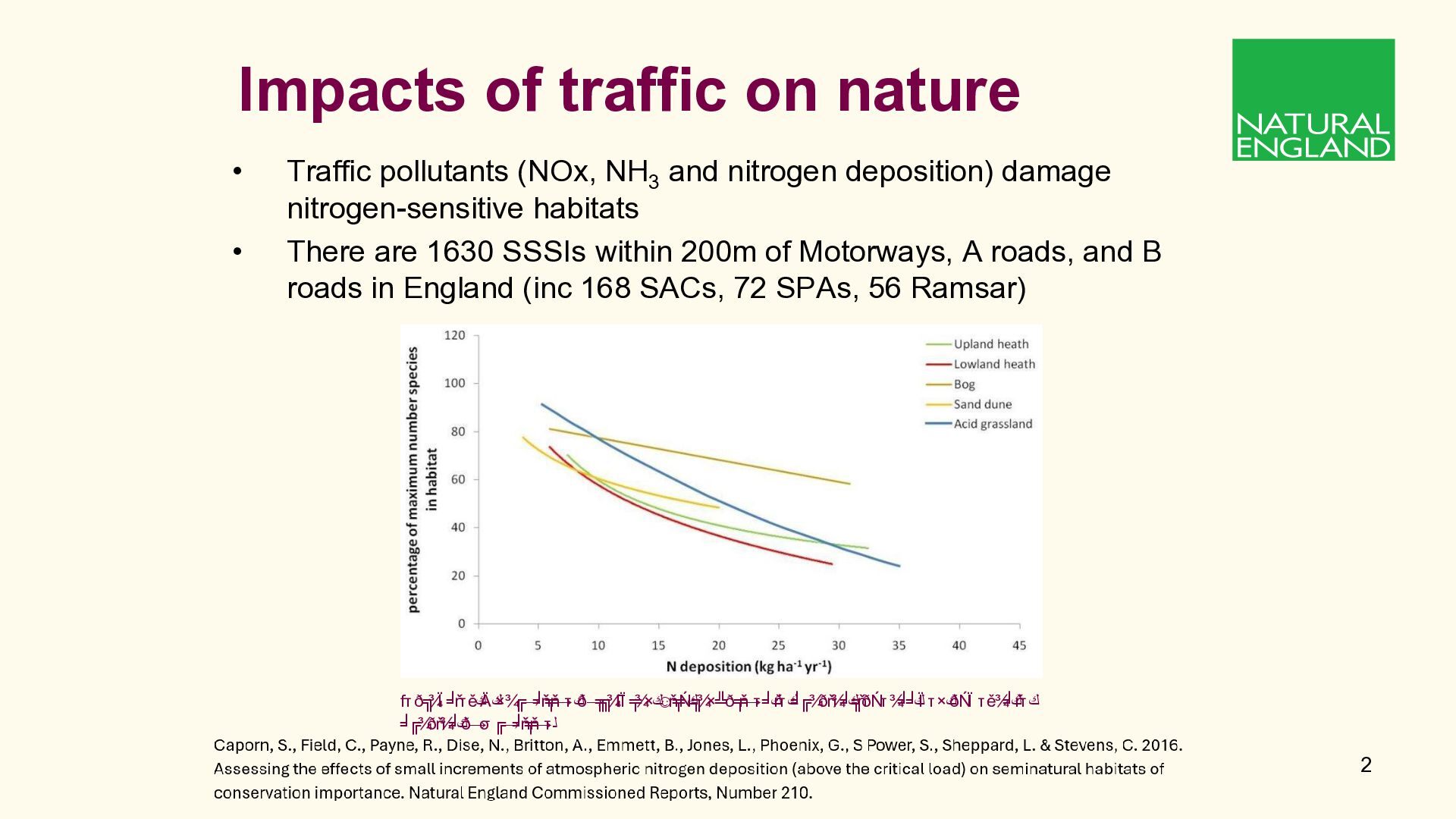
  2. Impacts of traffic on nature • • Traffic pollutants (NOx,

    NH3 and nitrogen deposition) damage nitrogen-sensitive habitats There are 1630 SSSIs within 200m of Motorways, A roads, and B roads in England (inc 168 SACs, 72 SPAs, 56 Ramsar) CAPORN, S., FIELD, C., PAYNE, R., DISE, N., BRITTON, A., EMMETT, B., JONES, L., PHOENIX, G., S POWER, S., SHEPPARD, L. & STEVENS, C. 2016. Assessing the effects of small increments of atmospheric nitrogen deposition (above the critical load) on seminatural habitats of conservation importance. Natural England Commissioned Reports, Number 210. 2
  3. Why is screening important? • • • Traffic is a

    critical part of development impact • construction and operation • NSIPs, industry, Local Plans, New Towns… Effective screening ensures effort is focused where risks are greatest • use of 1% of the critical level or load – in-combination For traffic, historic practice relied on 1,000 AADT threshold. • developed as a road scheme model threshold • coincided with an approx. 1% change in NOx concentrations • treated as a proxy screening tool for NOx • never specifically designed or validated for wider consideration of nitrogen deposition or ammonia impacts on sensitive habitats 3
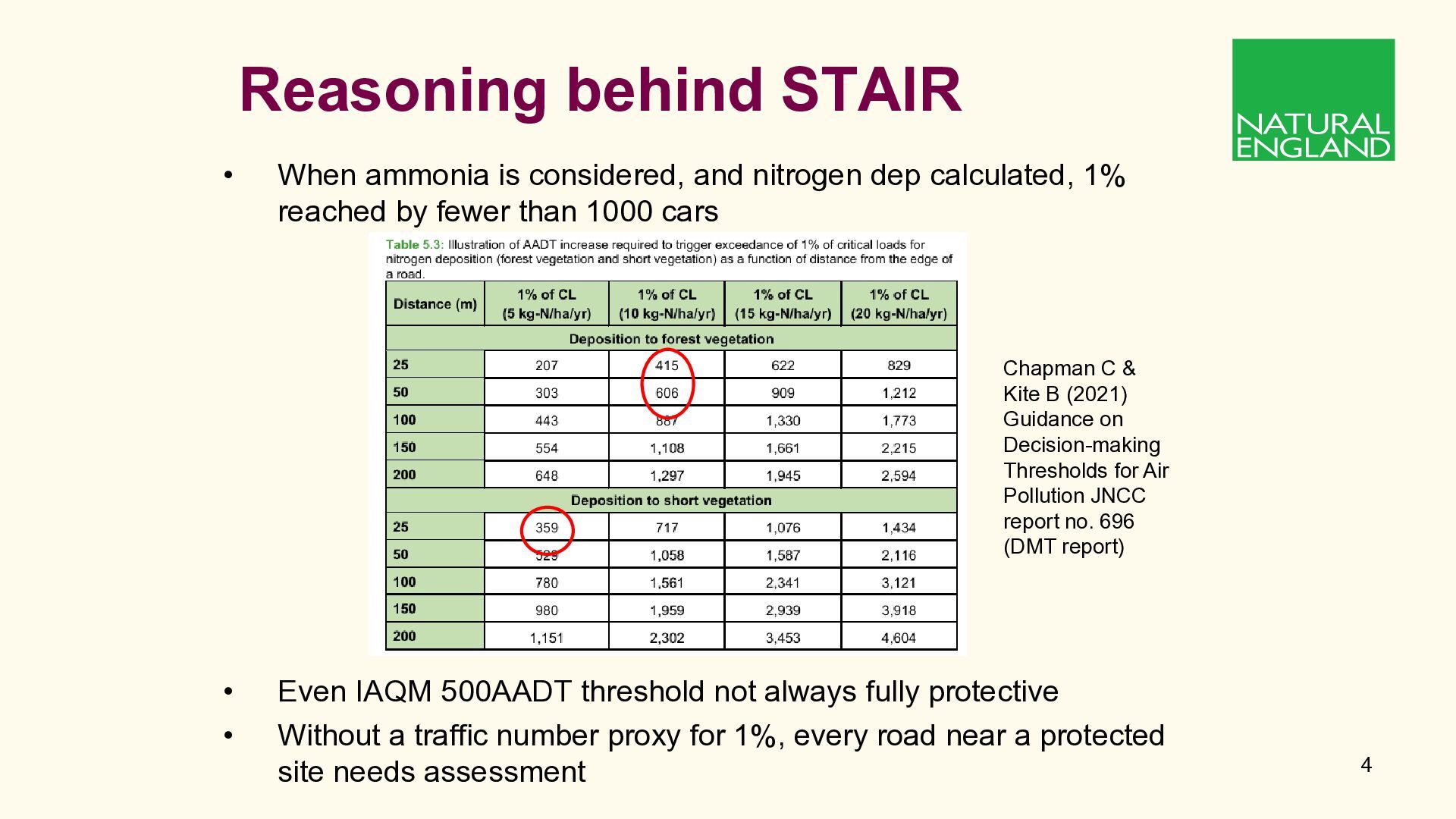
  4. Reasoning behind STAIR • When ammonia is considered, and nitrogen

    dep calculated, 1% reached by fewer than 1000 cars Chapman C & Kite B (2021) Guidance on Decision-making Thresholds for Air Pollution JNCC report no. 696 (DMT report) • • Even IAQM 500AADT threshold not always fully protective Without a traffic number proxy for 1%, every road near a protected site needs assessment 4
  5. Development of STAIR • • • • • Work undertaken

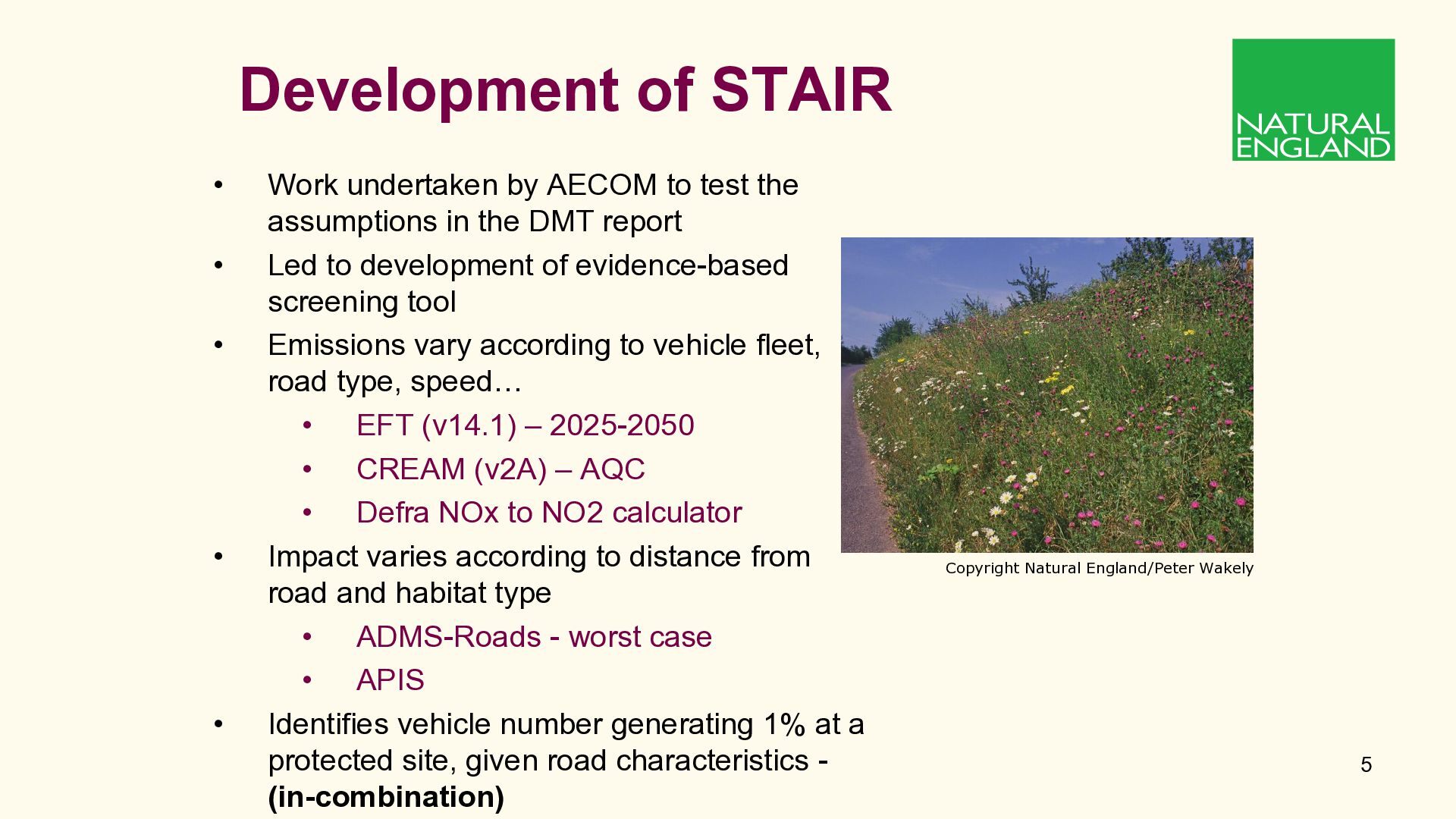
    by AECOM to test the assumptions in the DMT report Led to development of evidence-based screening tool Emissions vary according to vehicle fleet, road type, speed… • EFT (v14.1) – 2025-2050 • CREAM (v2A) – AQC • Defra NOx to NO2 calculator Impact varies according to distance from road and habitat type • ADMS-Roads - worst case • APIS Identifies vehicle number generating 1% at a protected site, given road characteristics (in-combination) Copyright Natural England/Peter Wakely 5
  6. Benefits of STAIR • • • For the environment •

    Avoids potential of screening out sites with a risk of traffic impact (LSE) • Scientifically robust and ecologically relevant screening For developers • Focuses resources where they matter most - where detailed assessment is genuinely needed • Reduced uncertainty that all relevant sites are assessed • Supports e icient in rastructure delivery​ For decision-makers • More robust and de ensible evidence base​ • Consistent and transparent assessments​ • Greater con idence in screening decisions​ • Supports proportionate decision-making​ 7
  7. Key points and next steps • • • • •

    STAIR does not change environmental standards or legal requirements Improves how existing evidence is applied Not the only way this information can be calculated – but can help identify when further assessment needed Only a screening tool – not replacing detailed assessment Better screening supports healthier ecosystems, environmental resilience and better-informed decisions Copyright Natural England/Robin Chittenden NEXT STEPS • Updates in line with changes to models • Publish on Access to Evidence (in due course) • Any roadside monitoring –esp ammonia – to improve tool? 8
  8. 9