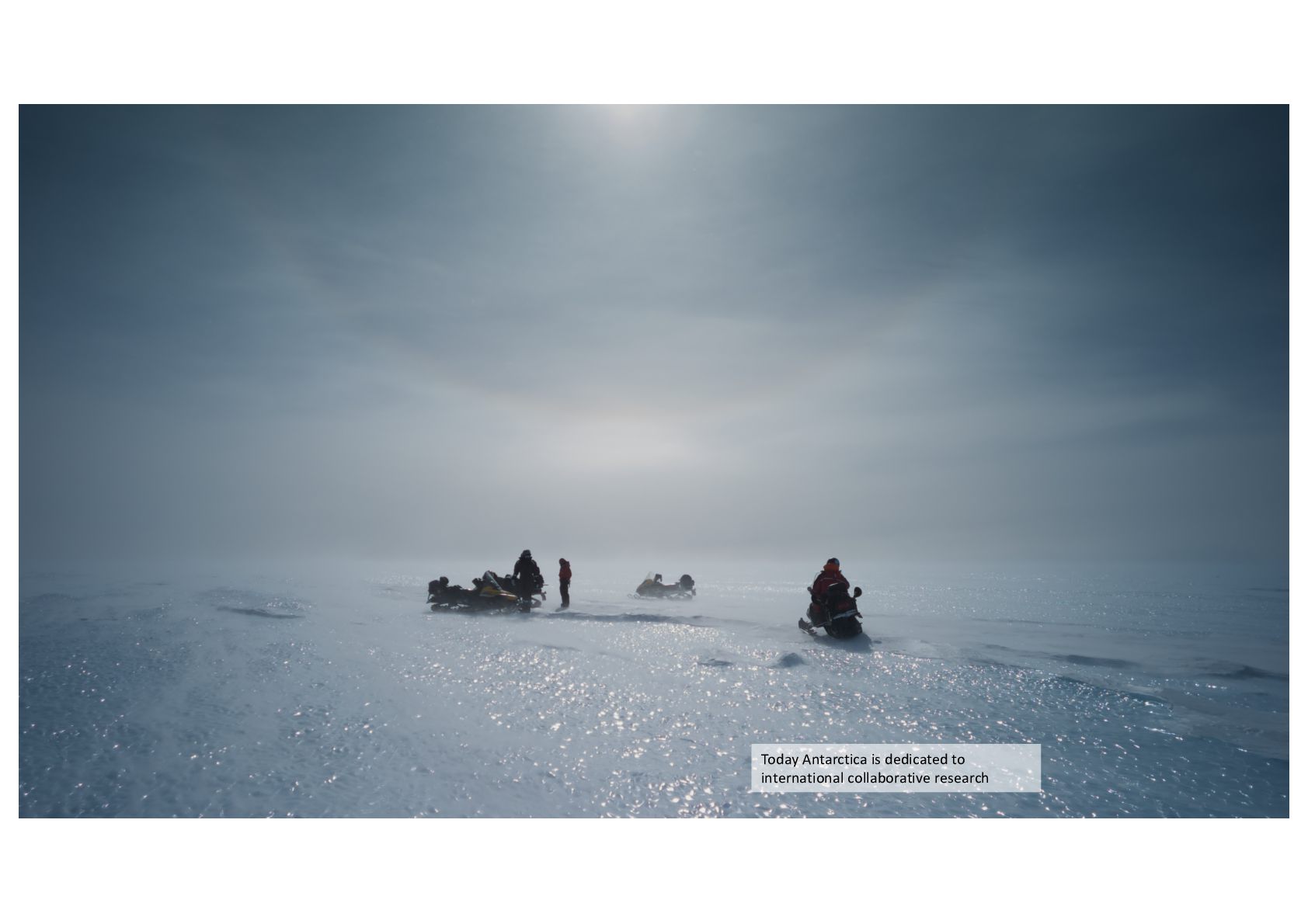
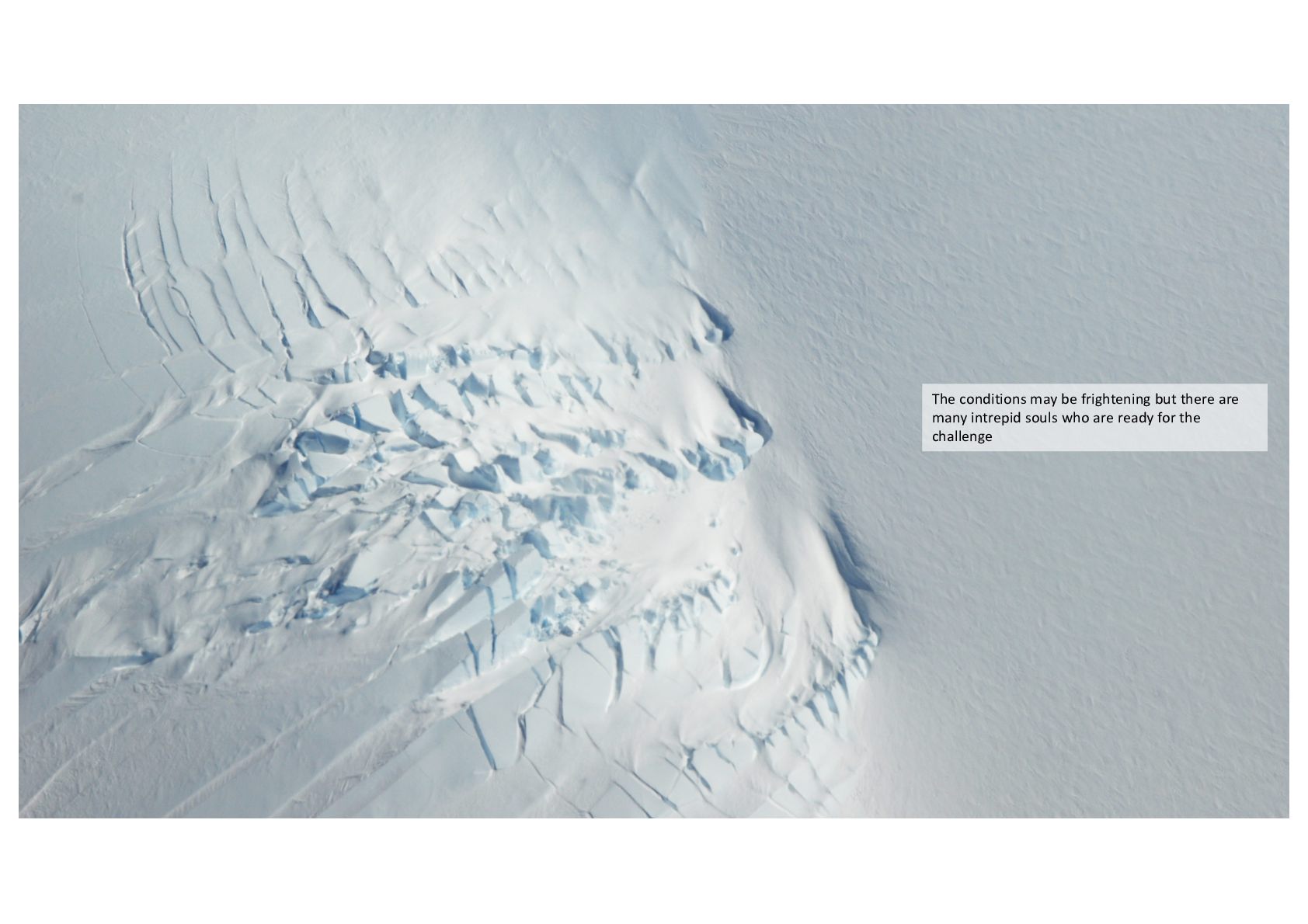
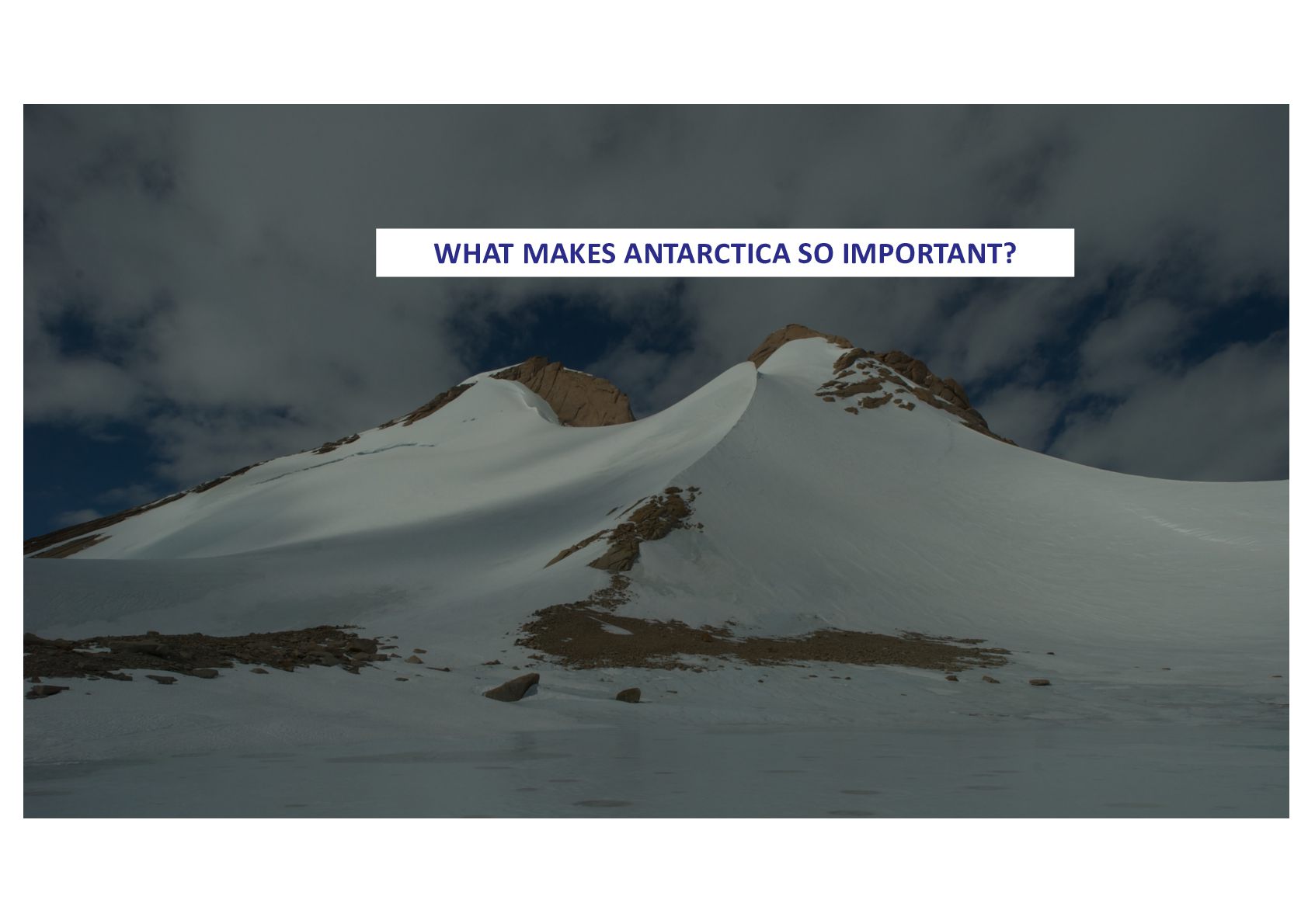
of extremes. It is the coldest, highest, driest, windiest, remotest, most desolate place on the planet.” Christopher C. Joyner, Governing the Frozen Commons – The Antarctic Regime and Environmental Protection, University of South Carolina Press, 1998. Even the language used to describe the surrounding oceans is extreme: The roaring 40s, the Fearsome 50s, the Screaming 60s. It speaks of the indomitable, unconquerable heart of this continent, formed by the collision of tectonic plates to create Gondwana then split up and drifted into its current position. The geological history indicates possible riches in the collision zones which produced the conditions for exposing minerals from the deep mantle. The land mass is surrounded by an ocean that is rich in biodiversity due to the upwelling of nutrients driven by deep ocean currents. This bounty brought whalers and fishermen to the south seeking these riches from the depths. It is a land of dreams and nightmares……… FINDING ANTARCTICA ANTARCTIC FUTURES SYMPOSIUM
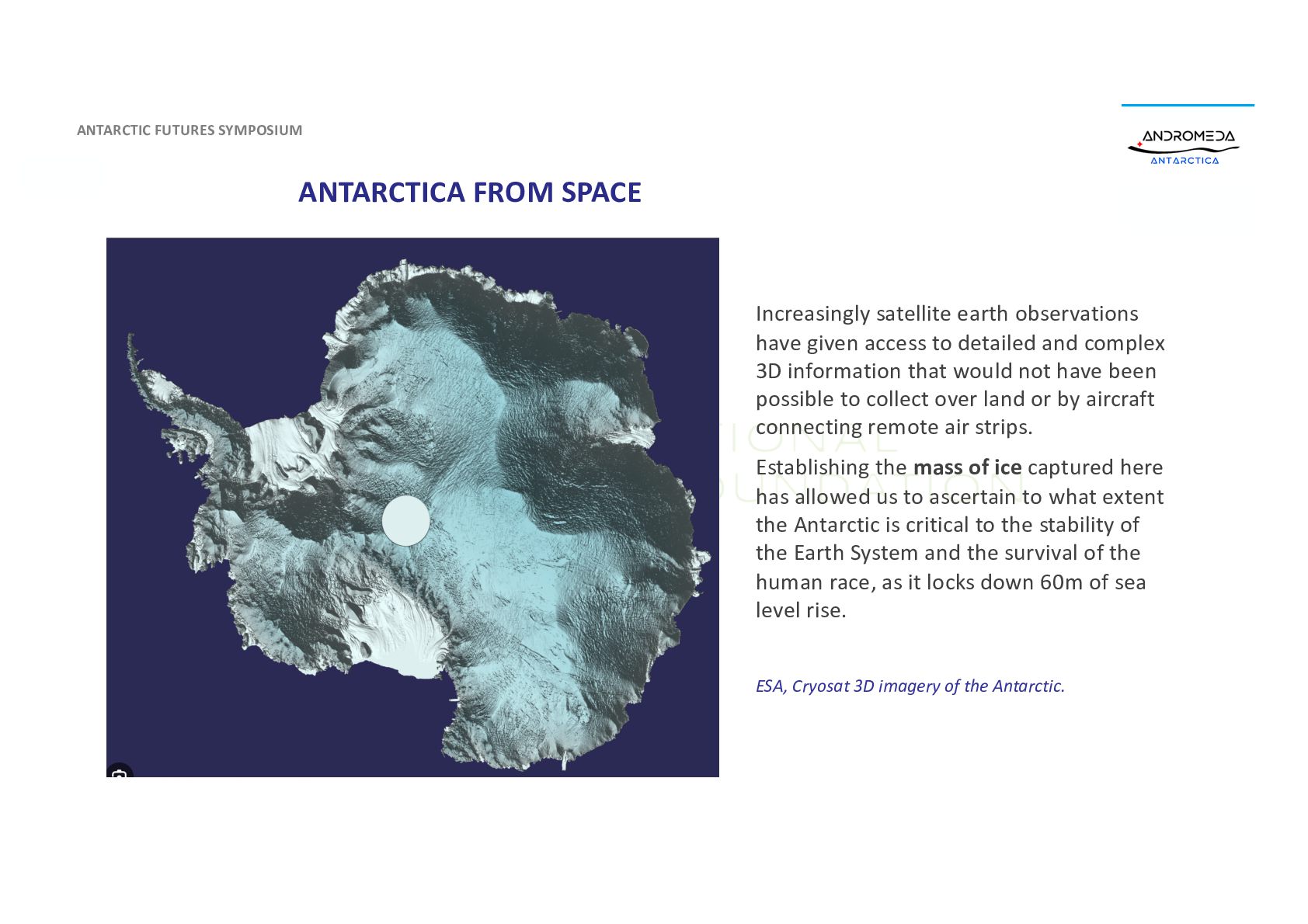
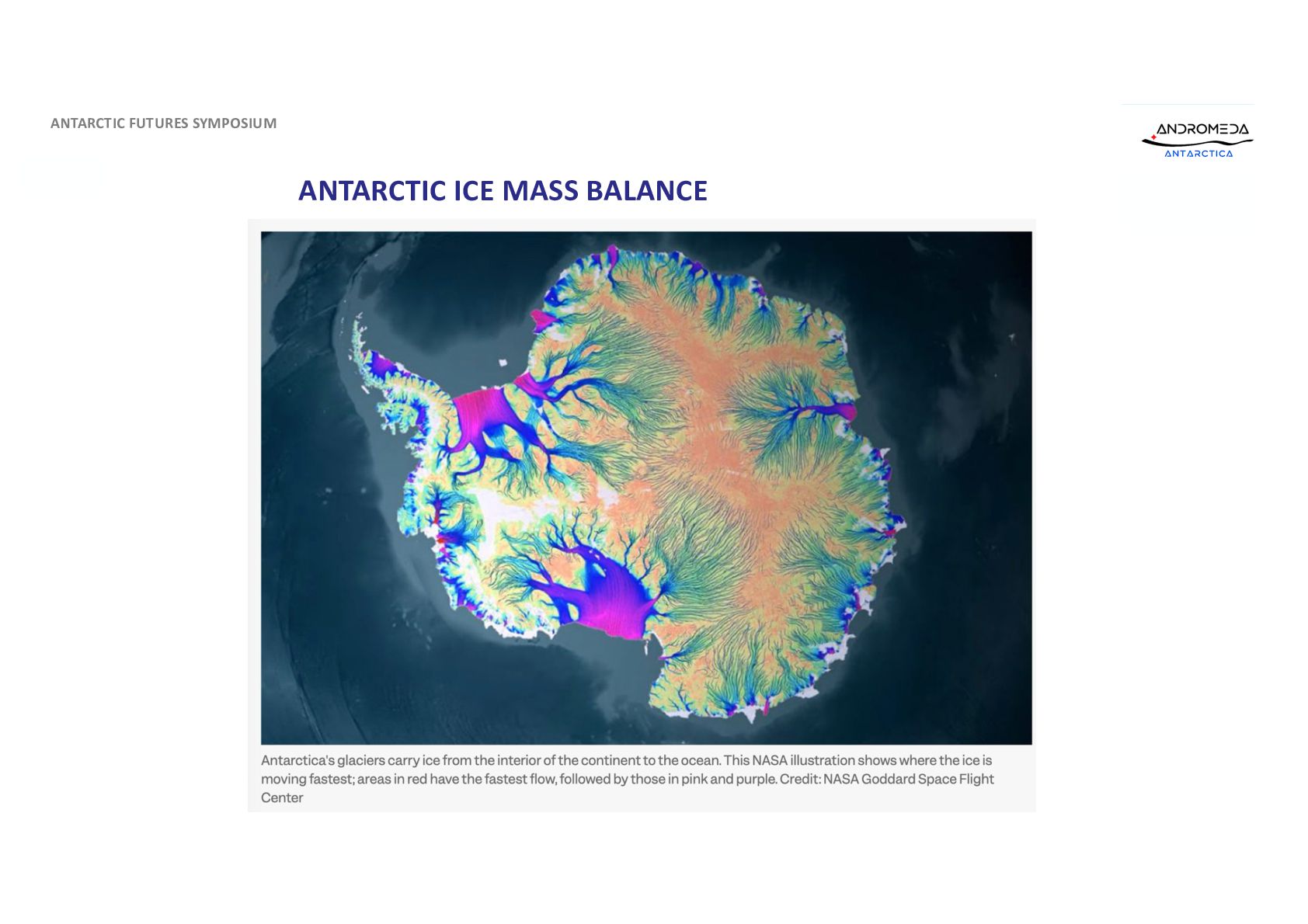
to detailed and complex 3D information that would not have been possible to collect over land or by aircraft connecting remote air strips. Establishing the mass of ice captured here has allowed us to ascertain to what extent the Antarctic is critical to the stability of the Earth System and the survival of the human race, as it locks down 60m of sea level rise. ESA, Cryosat 3D imagery of the Antarctic. ANTARCTIC FUTURES SYMPOSIUM
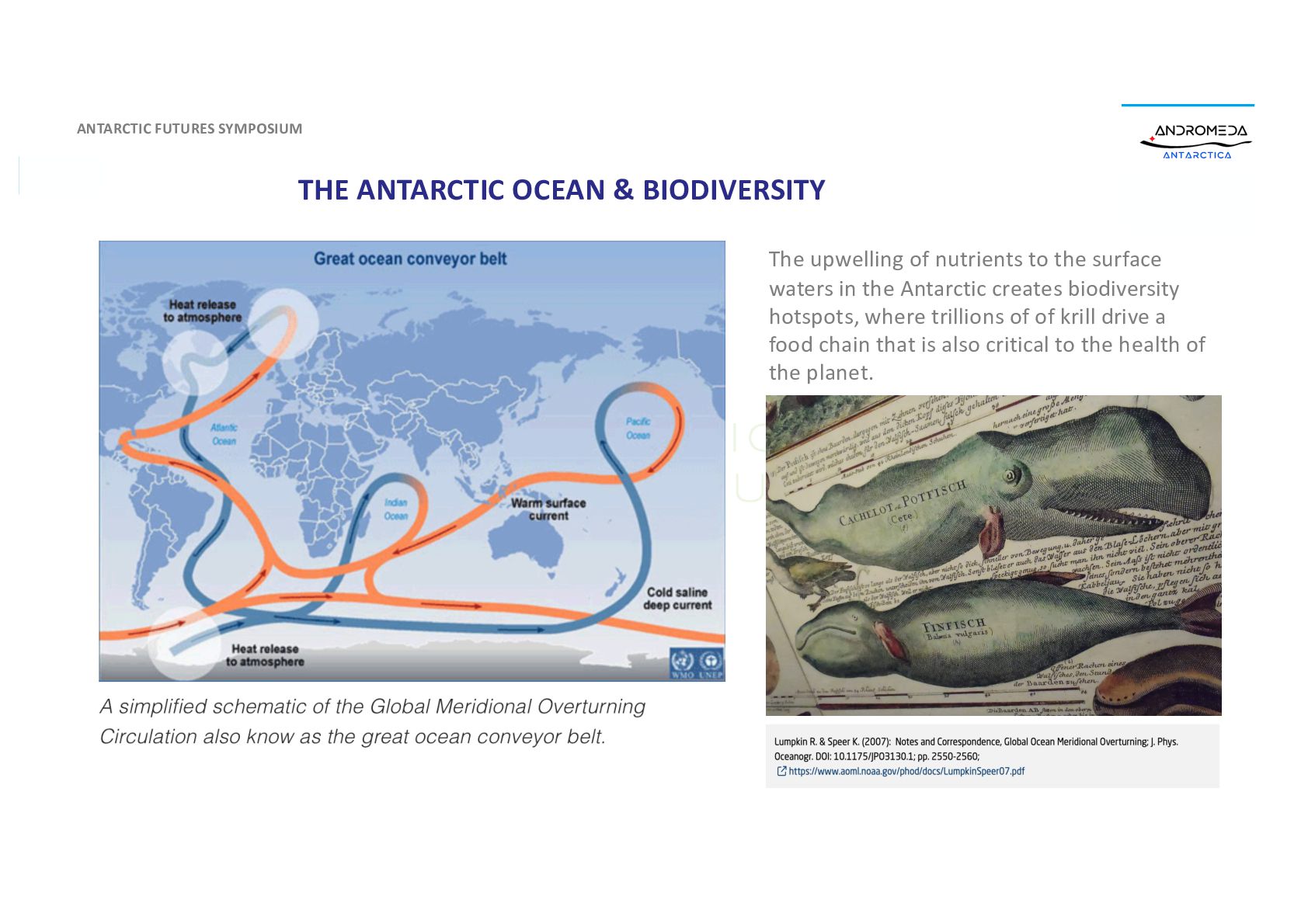
of nutrients to the surface waters in the Antarctic creates biodiversity hotspots, where trillions of of krill drive a food chain that is also critical to the health of the planet.
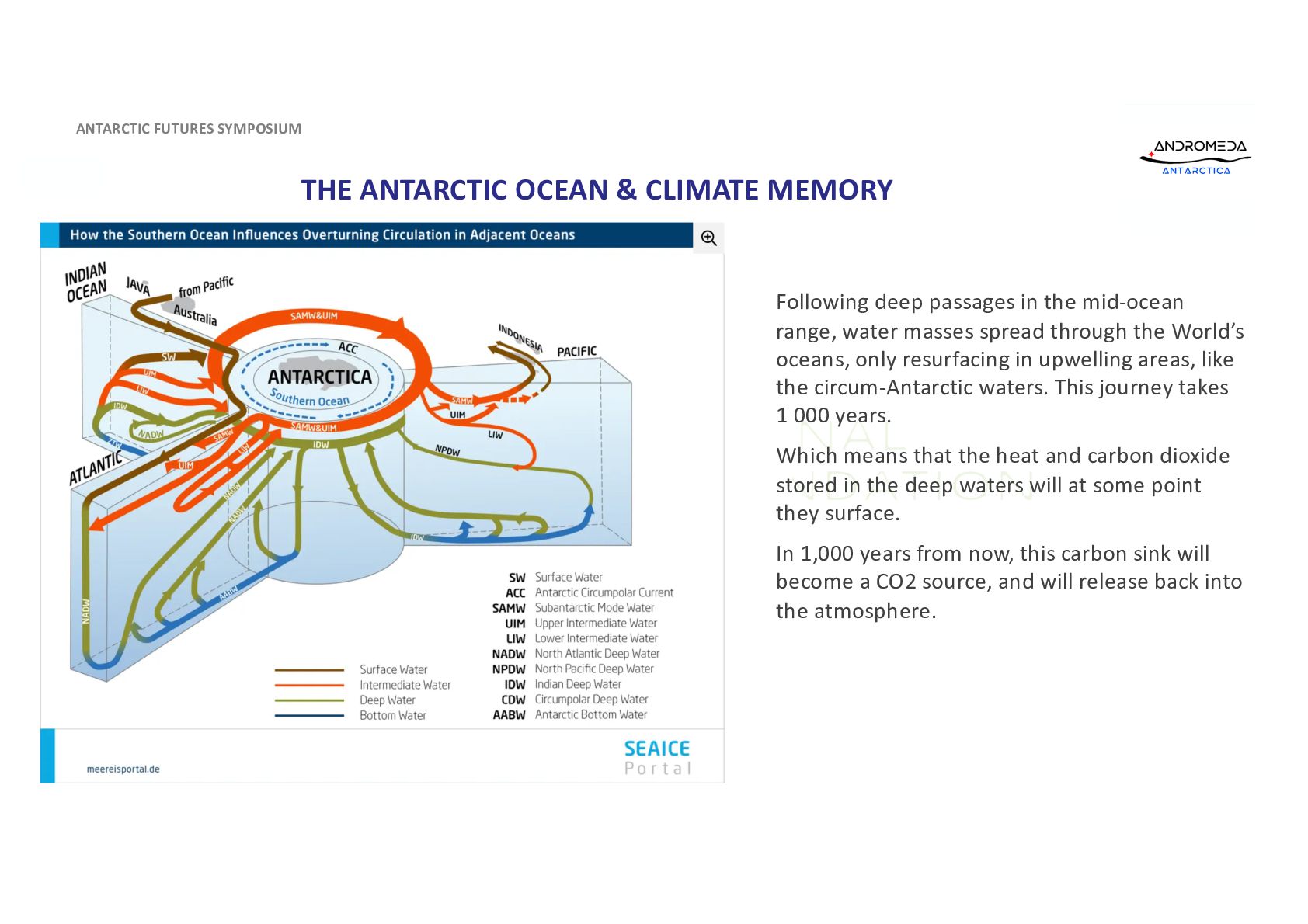
deep passages in the mid-ocean range, water masses spread through the World’s oceans, only resurfacing in upwelling areas, like the circum-Antarctic waters. This journey takes 1 000 years. Which means that the heat and carbon dioxide stored in the deep waters will at some point they surface. In 1,000 years from now, this carbon sink will become a CO2 source, and will release back into the atmosphere.
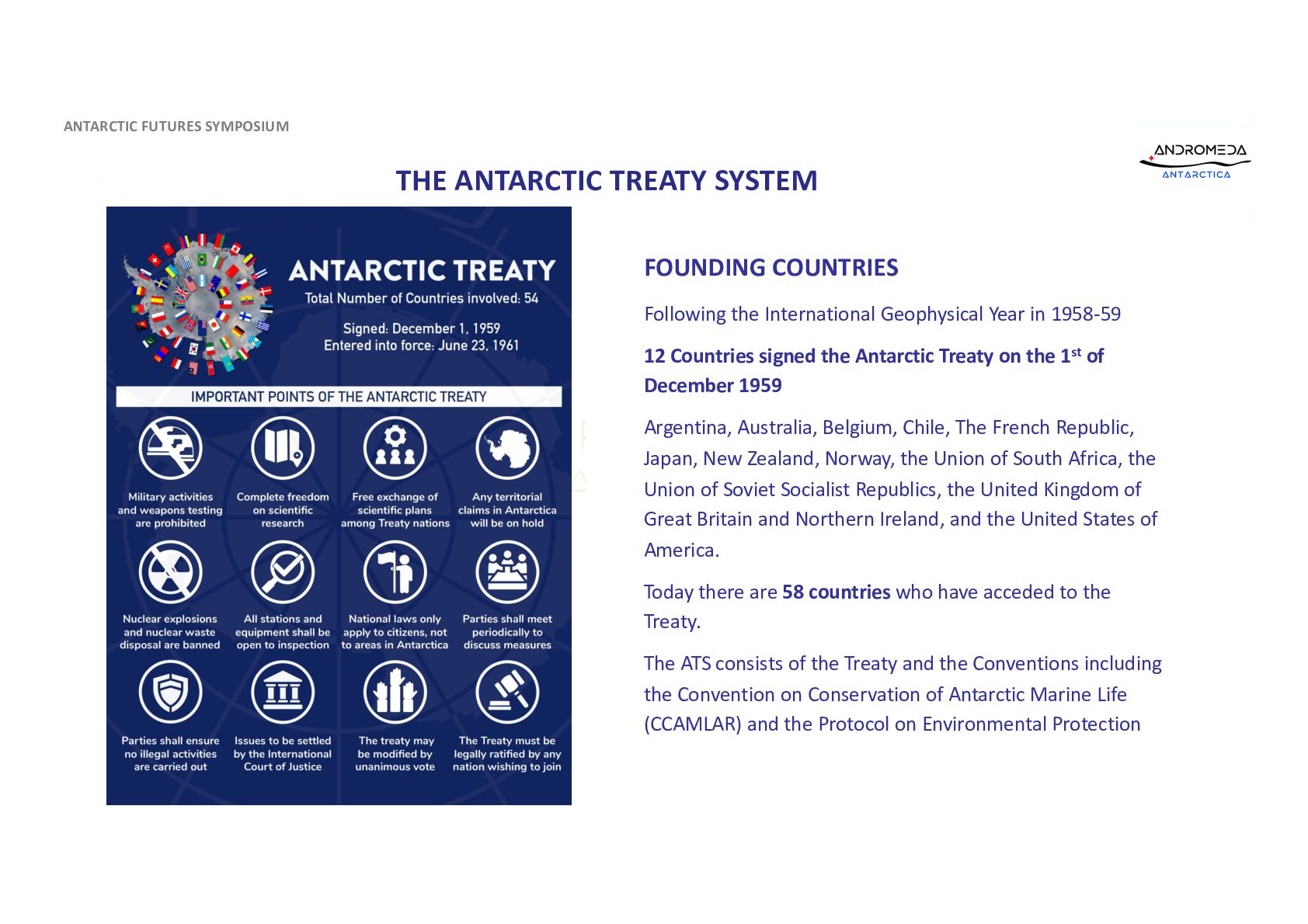
Countries signed the Antarctic Treaty on the 1st of December 1959 Argentina, Australia, Belgium, Chile, The French Republic, Japan, New Zealand, Norway, the Union of South Africa, the Union of Soviet Socialist Republics, the United Kingdom of Great Britain and Northern Ireland, and the United States of America. Today there are 58 countries who have acceded to the Treaty. The ATS consists of the Treaty and the Conventions including the Convention on Conservation of Antarctic Marine Life (CCAMLAR) and the Protocol on Environmental Protection ANTARCTIC FUTURES SYMPOSIUM THE ANTARCTIC TREATY SYSTEM
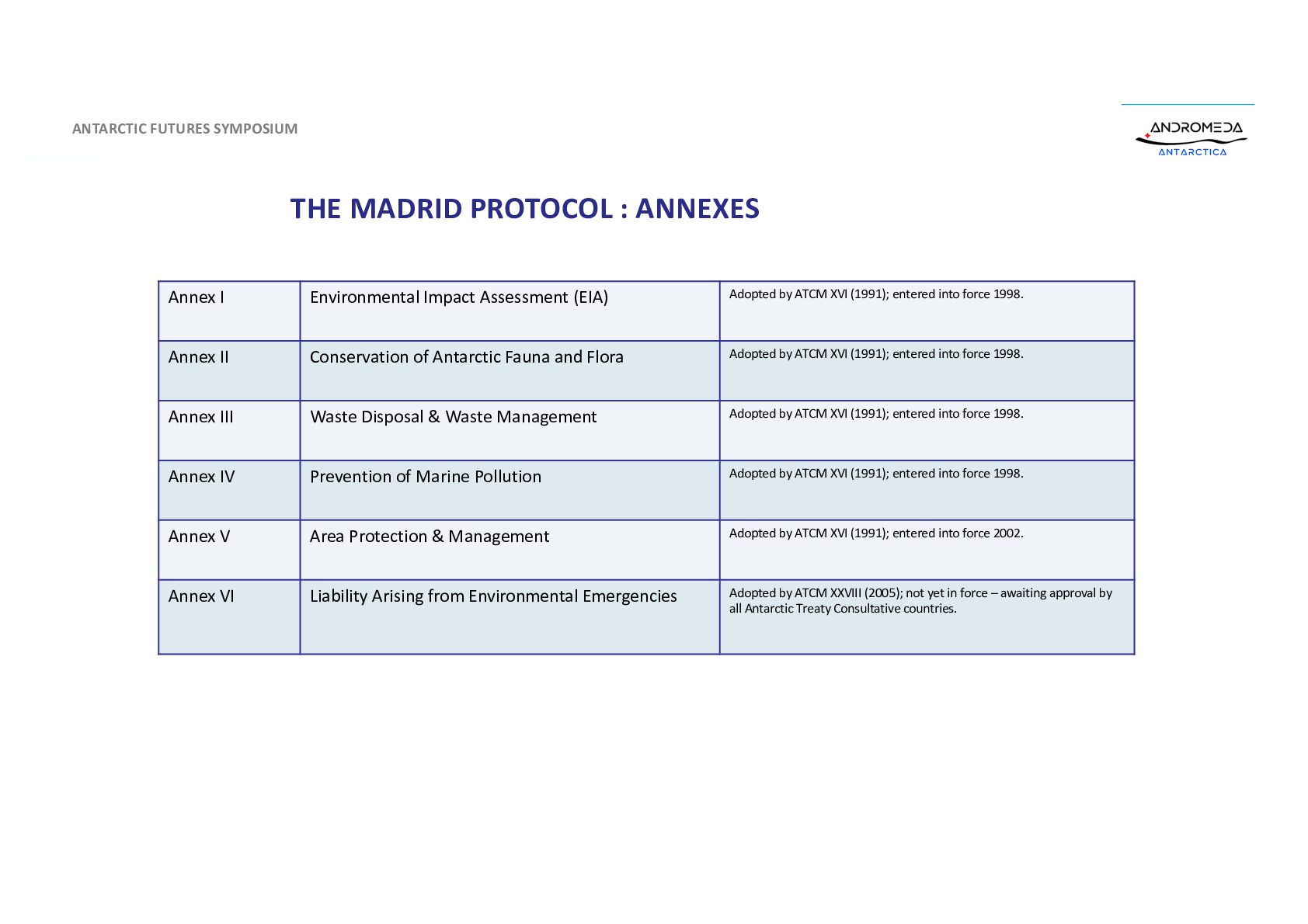
(1991); entered into force 1998. Annex II Conservation of Antarctic Fauna and Flora Adopted by ATCM XVI (1991); entered into force 1998. Annex III Waste Disposal & Waste Management Adopted by ATCM XVI (1991); entered into force 1998. Annex IV Prevention of Marine Pollution Adopted by ATCM XVI (1991); entered into force 1998. Annex V Area Protection & Management Adopted by ATCM XVI (1991); entered into force 2002. Annex VI Liability Arising from Environmental Emergencies Adopted by ATCM XXVIII (2005); not yet in force – awaiting approval by all Antarctic Treaty Consultative countries. ANTARCTIC FUTURES SYMPOSIUM THE MADRID PROTOCOL : ANNEXES
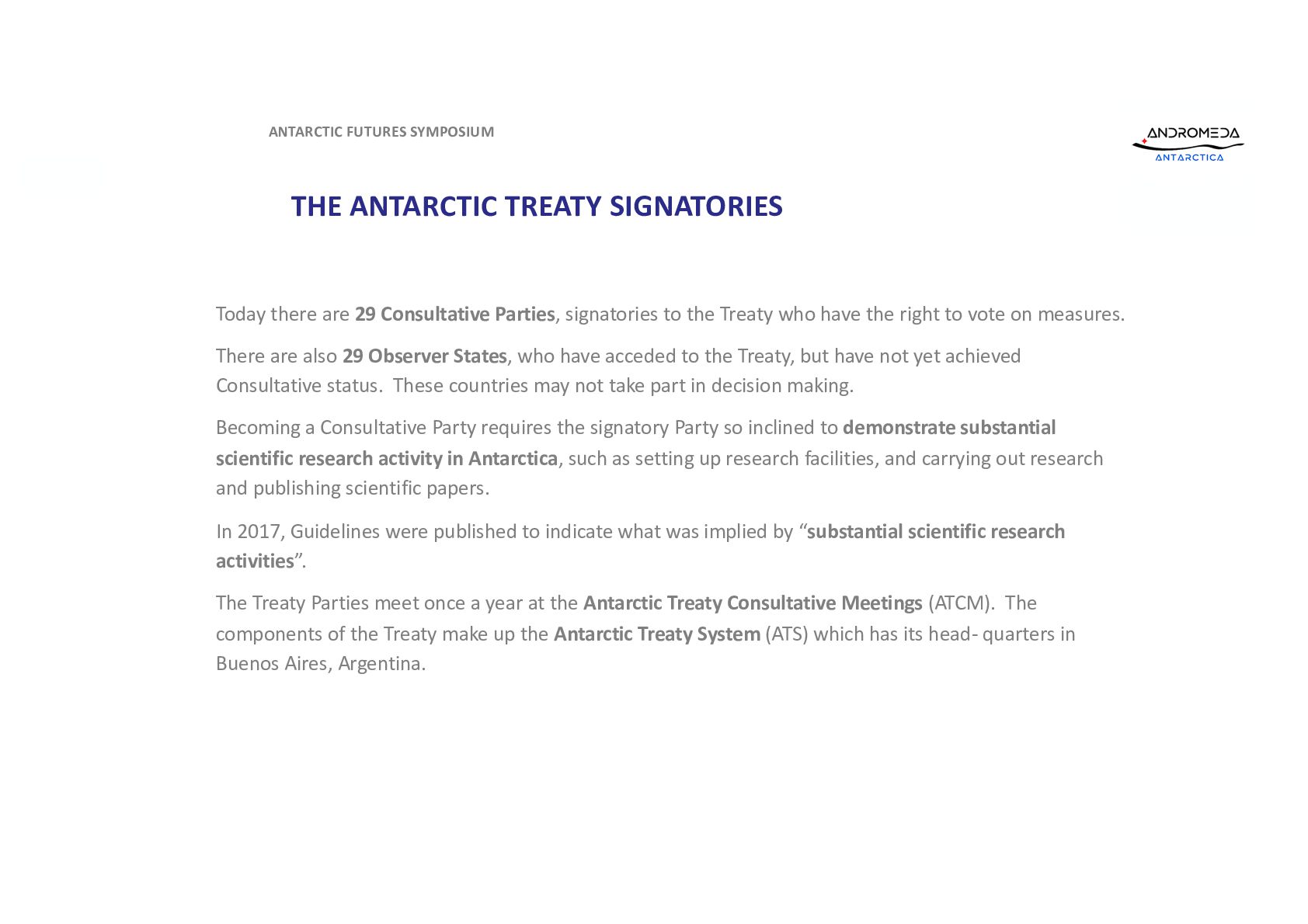
signatories to the Treaty who have the right to vote on measures. There are also 29 Observer States, who have acceded to the Treaty, but have not yet achieved Consultative status. These countries may not take part in decision making. Becoming a Consultative Party requires the signatory Party so inclined to demonstrate substantial scientific research activity in Antarctica, such as setting up research facilities, and carrying out research and publishing scientific papers. In 2017, Guidelines were published to indicate what was implied by “substantial scientific research activities”. The Treaty Parties meet once a year at the Antarctic Treaty Consultative Meetings (ATCM). The components of the Treaty make up the Antarctic Treaty System (ATS) which has its head- quarters in Buenos Aires, Argentina. ANTARCTIC FUTURES SYMPOSIUM
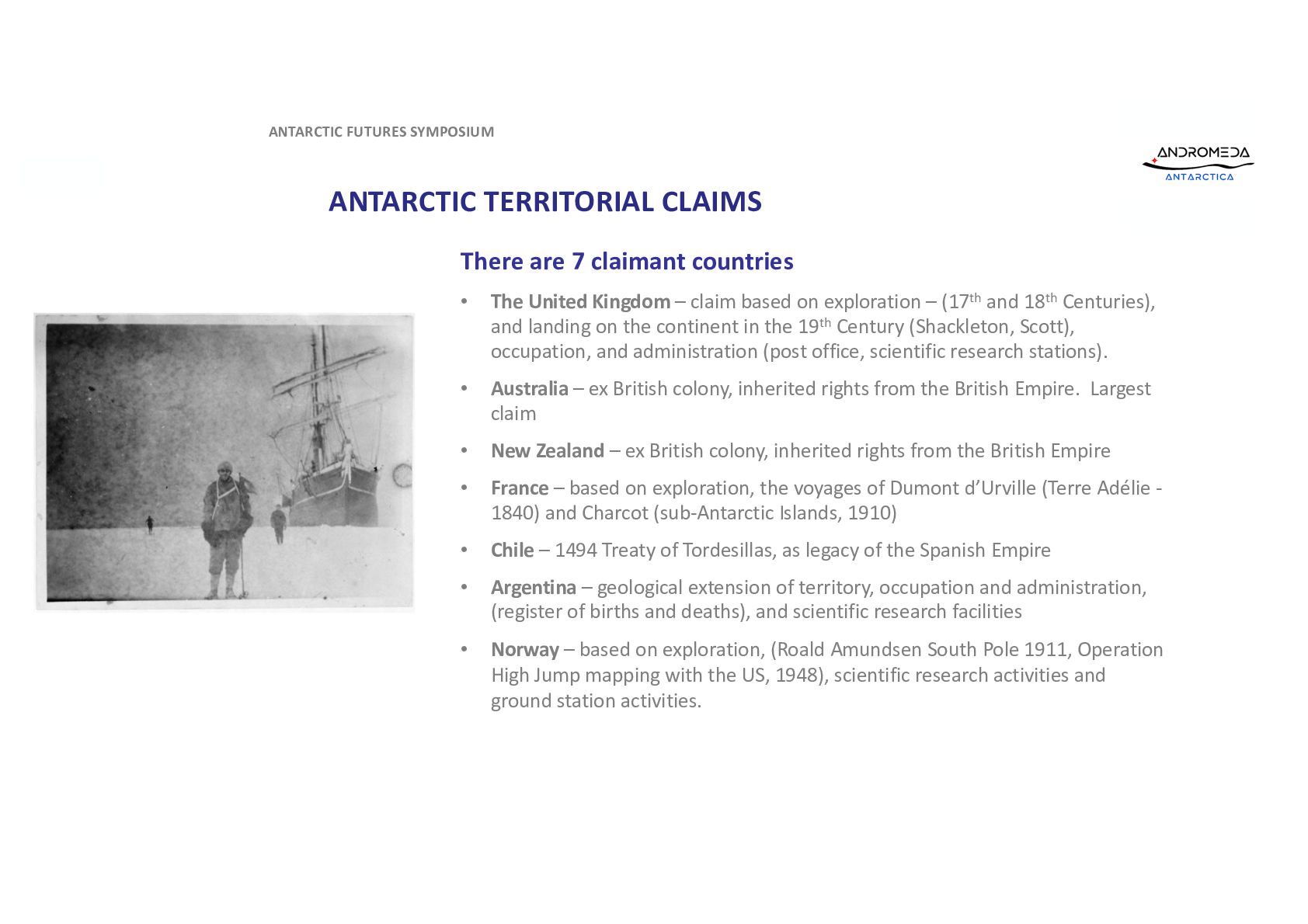
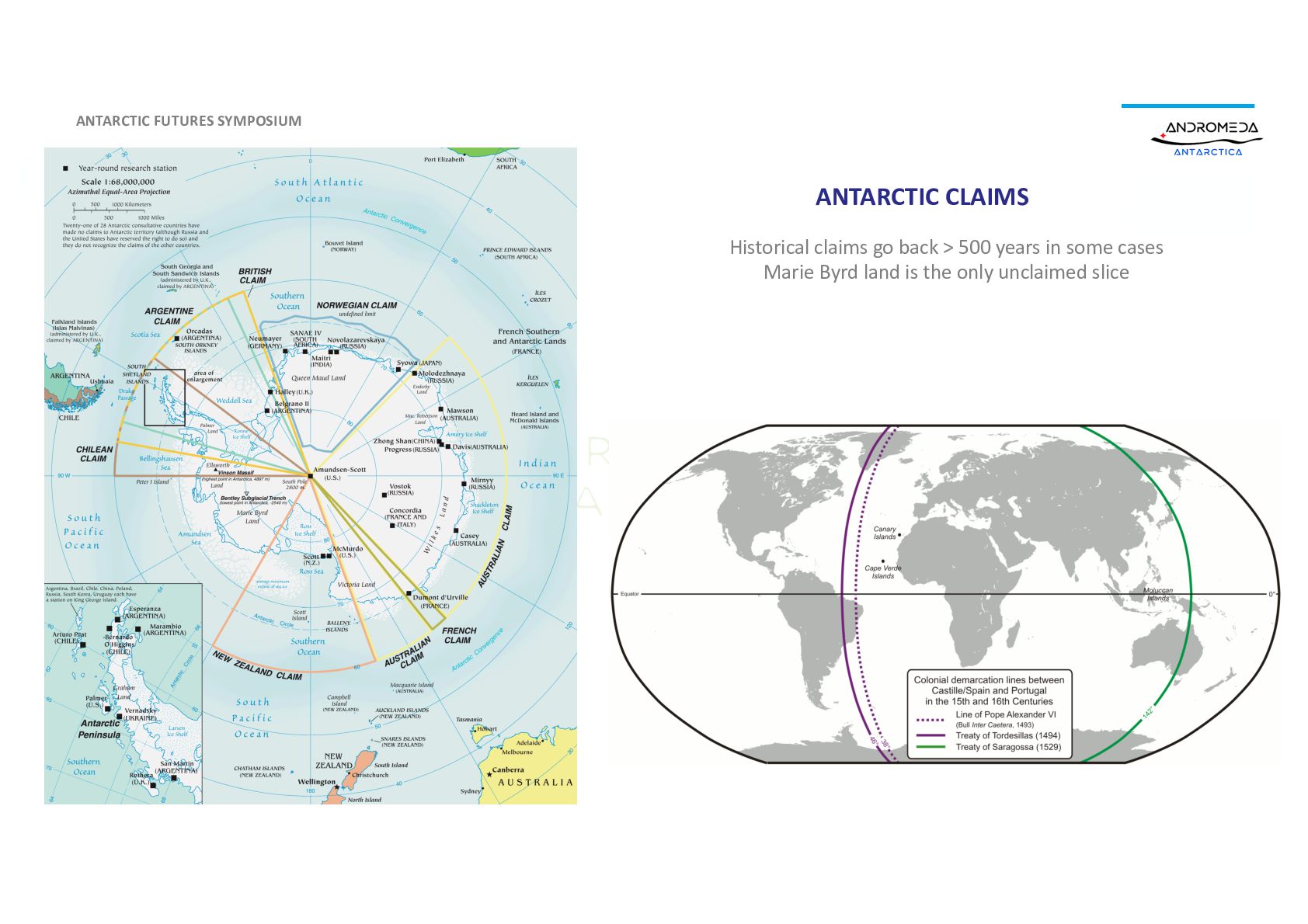
claim based on exploration – (17th and 18th Centuries), and landing on the continent in the 19th Century (Shackleton, Scott), occupation, and administration (post office, scientific research stations). • Australia – ex British colony, inherited rights from the British Empire. Largest claim • New Zealand – ex British colony, inherited rights from the British Empire • France – based on exploration, the voyages of Dumont d’Urville (Terre Adélie - 1840) and Charcot (sub-Antarctic Islands, 1910) • Chile – 1494 Treaty of Tordesillas, as legacy of the Spanish Empire • Argentina – geological extension of territory, occupation and administration, (register of births and deaths), and scientific research facilities • Norway – based on exploration, (Roald Amundsen South Pole 1911, Operation High Jump mapping with the US, 1948), scientific research activities and ground station activities. ANTARCTIC FUTURES SYMPOSIUM ANTARCTIC TERRITORIAL CLAIMS
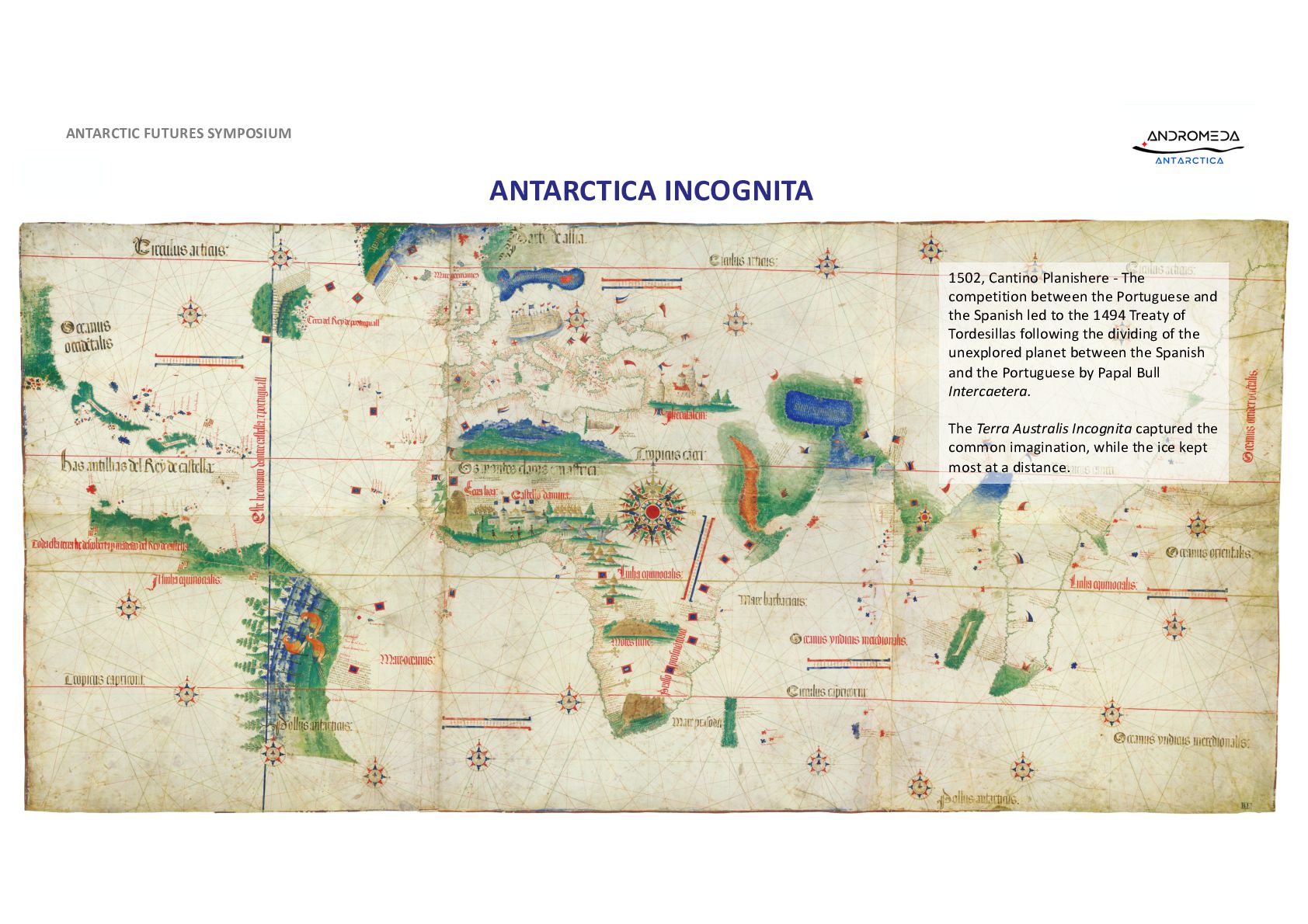
competition between the Portuguese and the Spanish led to the 1494 Treaty of Tordesillas following the dividing of the unexplored planet between the Spanish and the Portuguese by Papal Bull Intercaetera. The Terra Australis Incognita captured the common imagination, while the ice kept most at a distance.
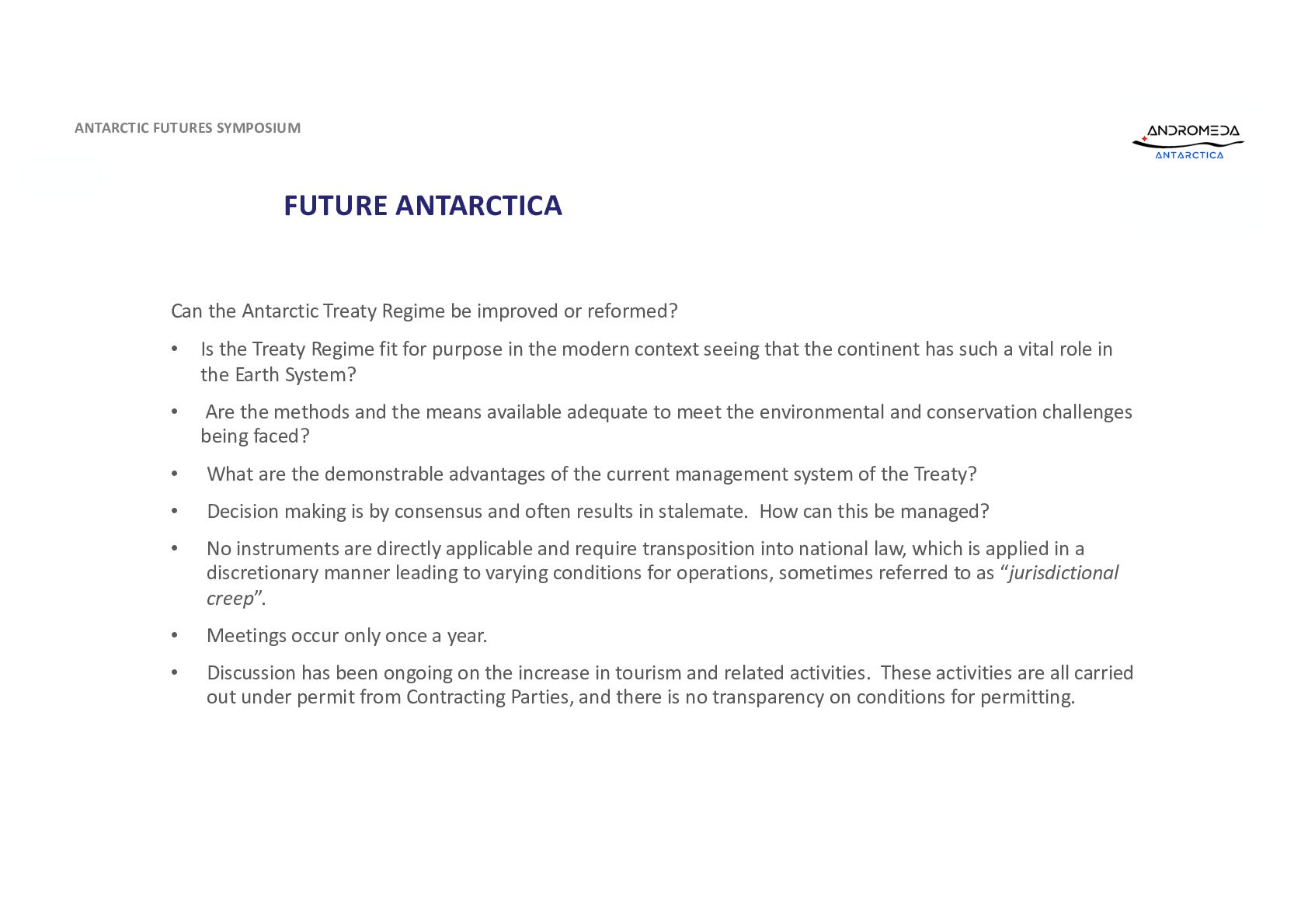
Is the Treaty Regime fit for purpose in the modern context seeing that the continent has such a vital role in the Earth System? • Are the methods and the means available adequate to meet the environmental and conservation challenges being faced? • What are the demonstrable advantages of the current management system of the Treaty? • Decision making is by consensus and often results in stalemate. How can this be managed? • No instruments are directly applicable and require transposition into national law, which is applied in a discretionary manner leading to varying conditions for operations, sometimes referred to as “jurisdictional creep”. • Meetings occur only once a year. • Discussion has been ongoing on the increase in tourism and related activities. These activities are all carried out under permit from Contracting Parties, and there is no transparency on conditions for permitting. ANTARCTIC FUTURES SYMPOSIUM FUTURE ANTARCTICA
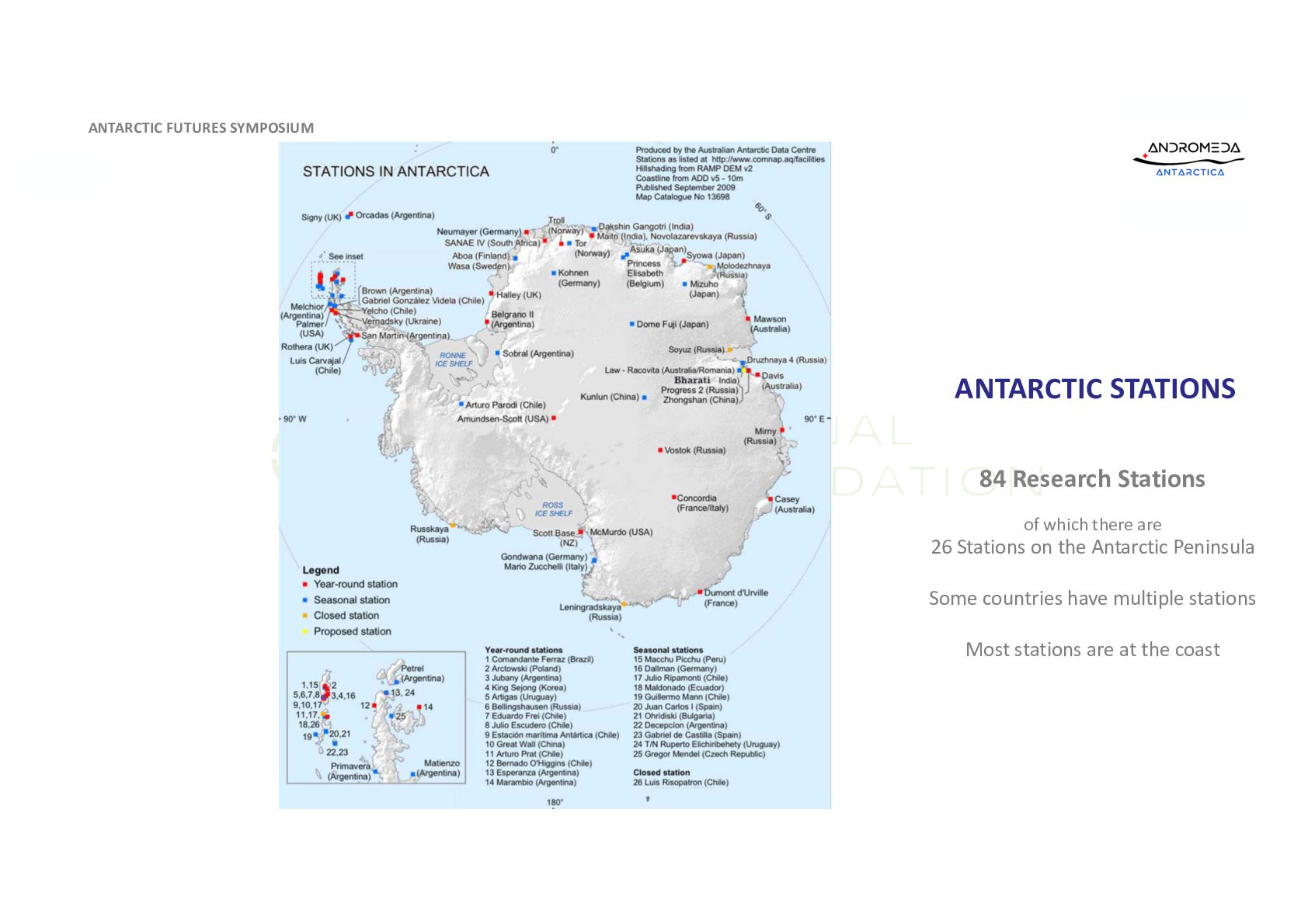
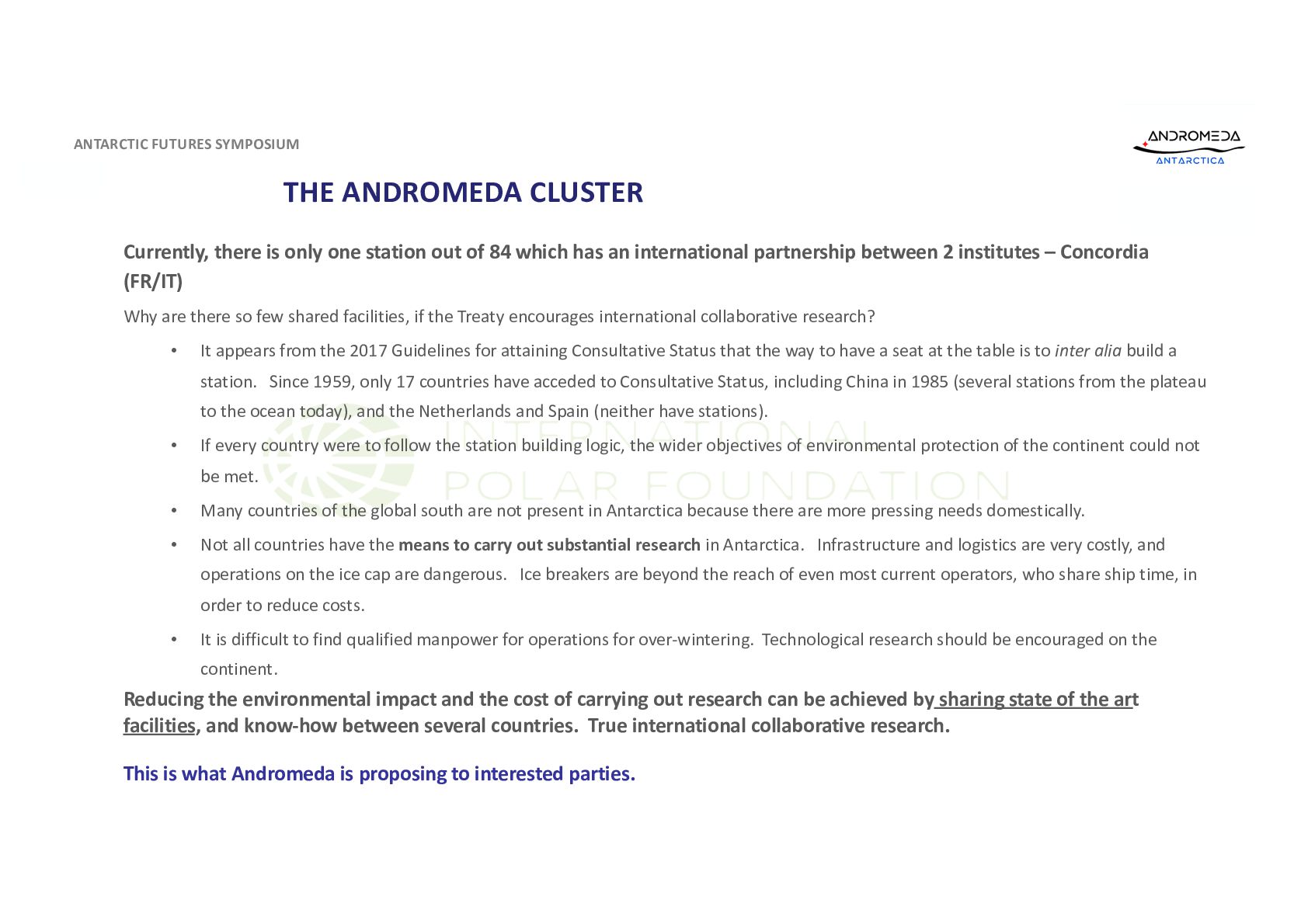
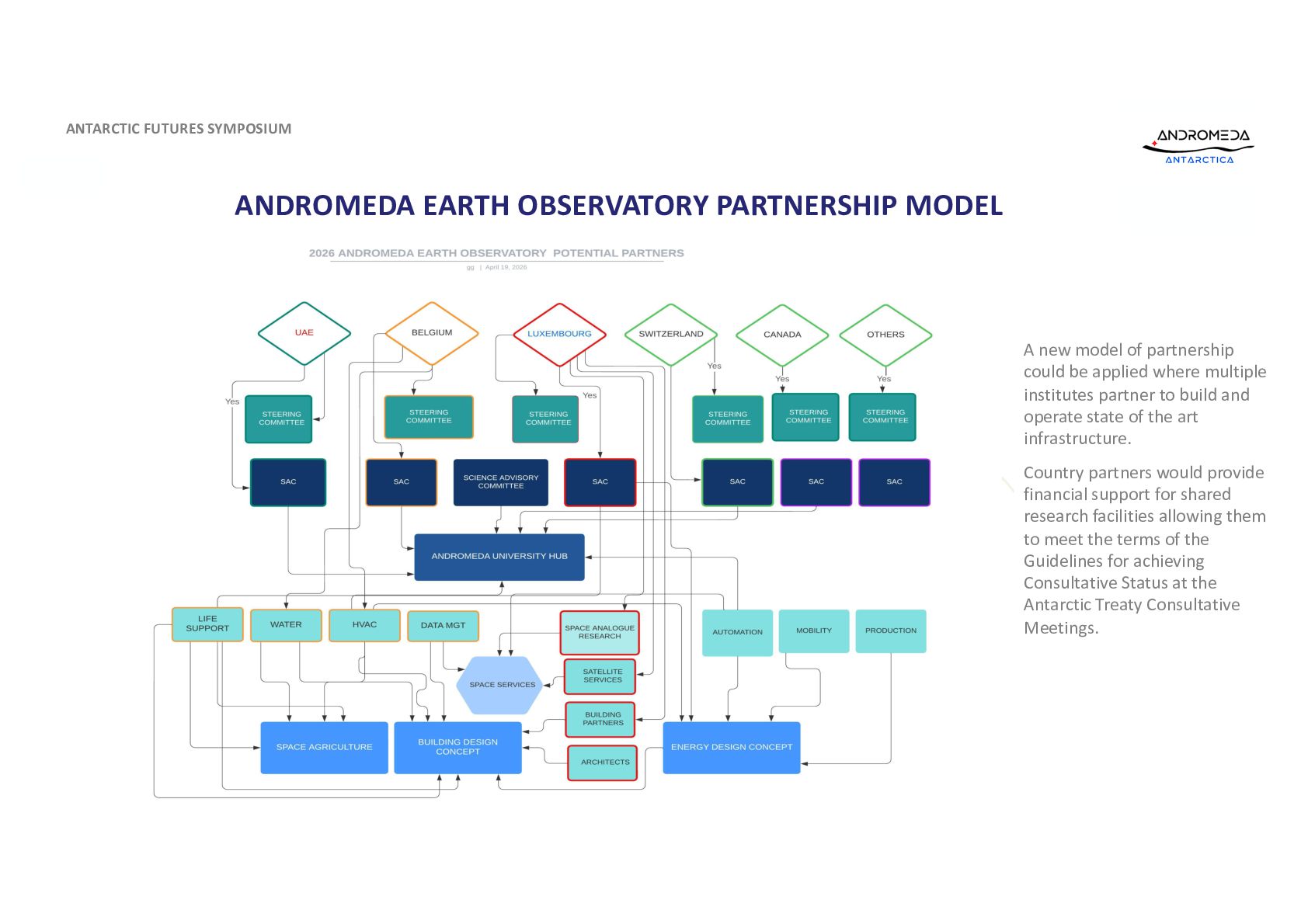
has an international partnership between 2 institutes – Concordia (FR/IT) Why are there so few shared facilities, if the Treaty encourages international collaborative research? • It appears from the 2017 Guidelines for attaining Consultative Status that the way to have a seat at the table is to inter alia build a station. Since 1959, only 17 countries have acceded to Consultative Status, including China in 1985 (several stations from the plateau to the ocean today), and the Netherlands and Spain (neither have stations). • If every country were to follow the station building logic, the wider objectives of environmental protection of the continent could not be met. • Many countries of the global south are not present in Antarctica because there are more pressing needs domestically. • Not all countries have the means to carry out substantial research in Antarctica. Infrastructure and logistics are very costly, and operations on the ice cap are dangerous. Ice breakers are beyond the reach of even most current operators, who share ship time, in order to reduce costs. • It is difficult to find qualified manpower for operations for over-wintering. Technological research should be encouraged on the continent. Reducing the environmental impact and the cost of carrying out research can be achieved by sharing state of the art facilities, and know-how between several countries. True international collaborative research. This is what Andromeda is proposing to interested parties. ANTARCTIC FUTURES SYMPOSIUM THE ANDROMEDA CLUSTER
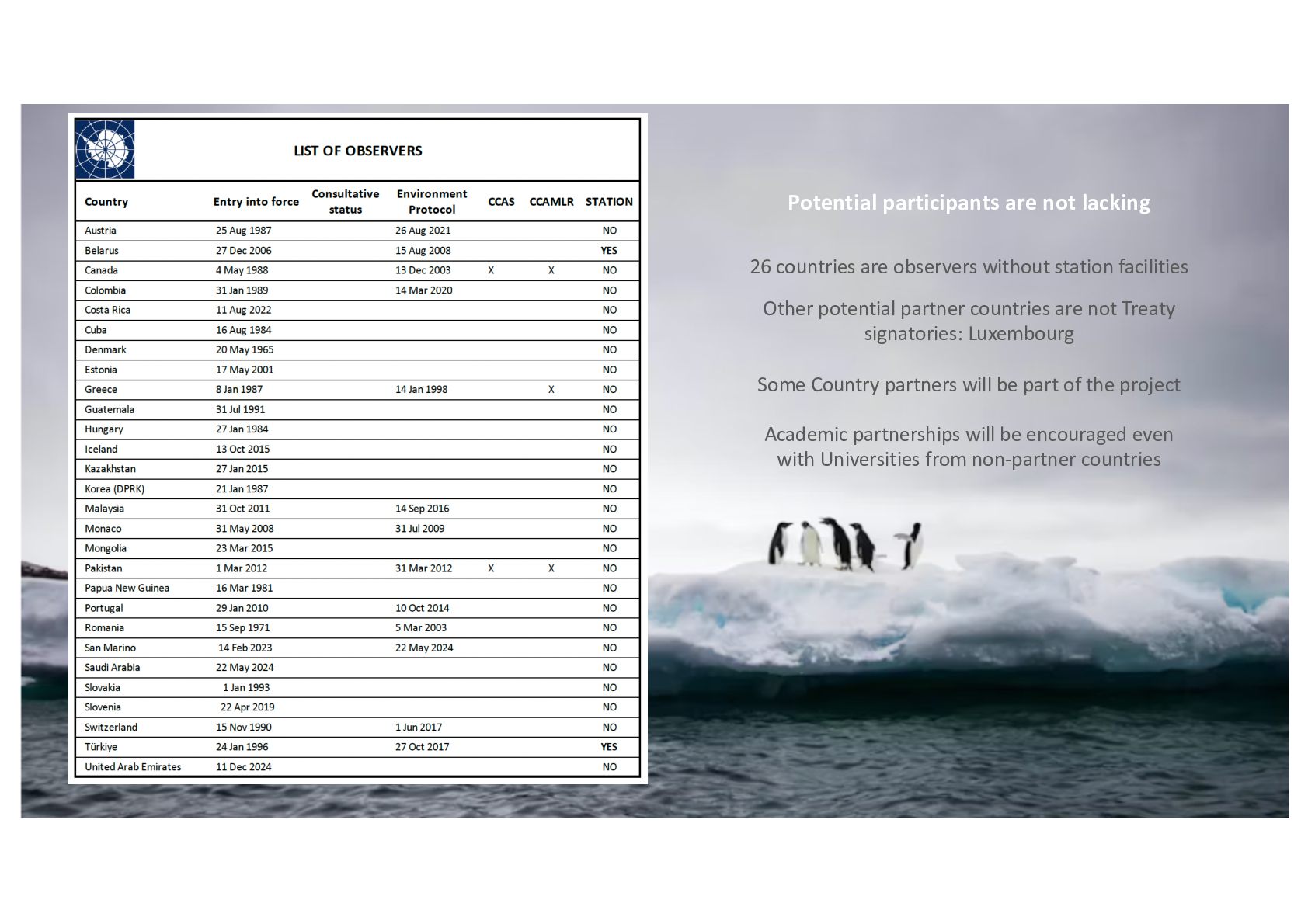
are observers without station facilities Other potential partner countries are not Treaty signatories: Luxembourg Some Country partners will be part of the project Academic partnerships will be encouraged even with Universities from non-partner countries
institutes partner to build and operate state of the art infrastructure. Country partners would provide financial support for shared research facilities allowing them to meet the terms of the Guidelines for achieving Consultative Status at the Antarctic Treaty Consultative Meetings. ANTARCTIC FUTURES SYMPOSIUM ANDROMEDA EARTH OBSERVATORY PARTNERSHIP MODEL
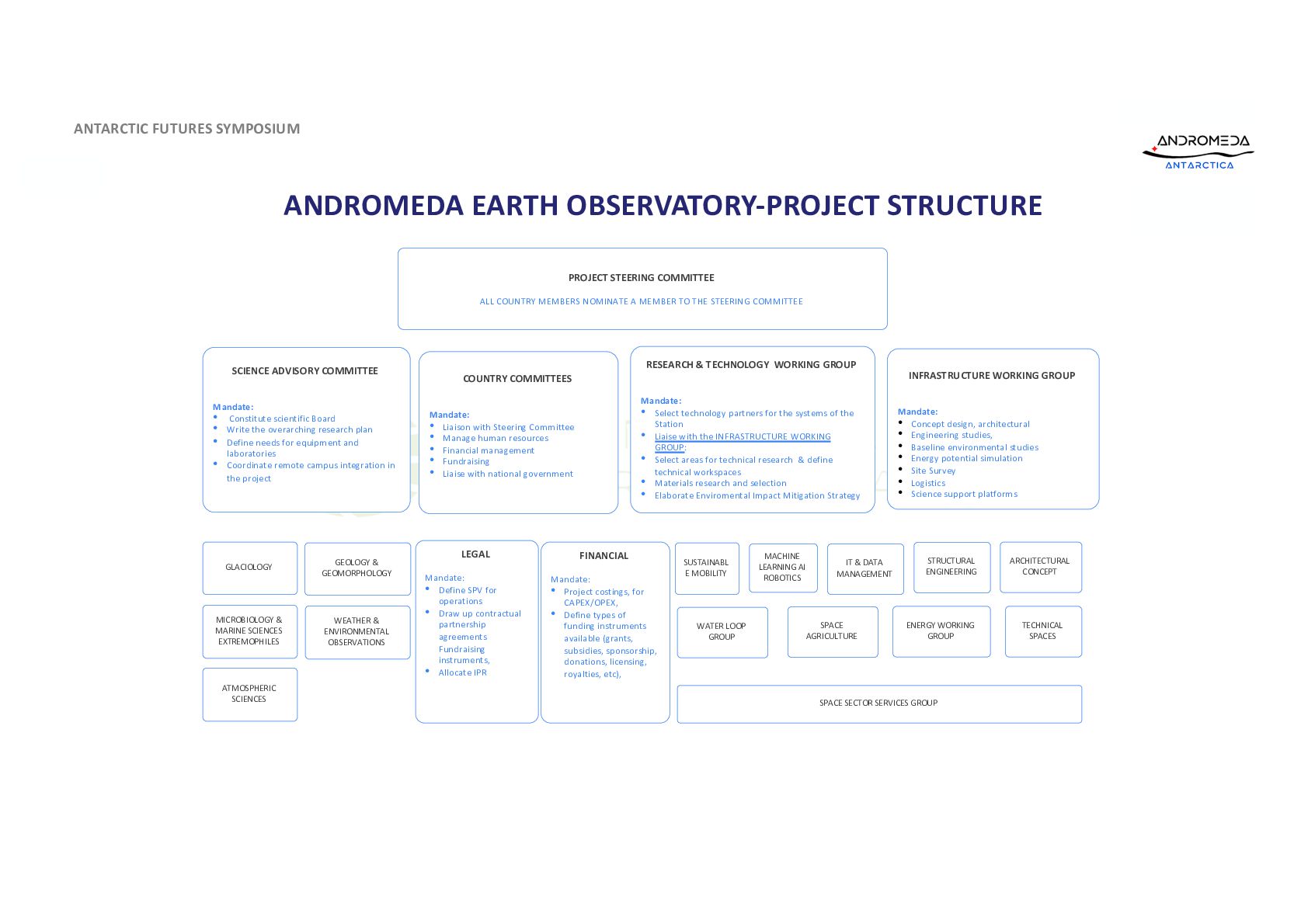
A MEMBER TO THE STEERING COMMITTEE SCIENCE ADVISORY COMMITTEE Mandate: • Constitute scientific Board • Write the overarching research plan • Define needs for equipment and laboratories • Coordinate remote campus integration in the project ENERGY WORKING GROUP INFRASTRUCTURE WORKING GROUP Mandate: • Concept design, architectural • Engineering studies, • Baseline environmental studies • Energy potential simulation • Site Survey • Logistics • Science support platforms LEGAL Mandate: • Define SPV for operations • Draw up contractual partnership agreements Fundraising instruments, • Allocate IPR FINANCIAL Mandate: • Project costings, for CAPEX/OPEX, • Define types of funding instruments available (grants, subsidies, sponsorship, donations, licensing, royalties, etc), ARCHITECTURAL CONCEPT STRUCTURAL ENGINEERING SPACE SECTOR SERVICES GROUP GLACIOLOGY WEATHER & ENVIRONMENTAL OBSERVATIONS GEOLOGY & GEOMORPHOLOGY SUSTAINABL E MOBILITY COUNTRY COMMITTEES Mandate: • Liaison with Steering Committee • Manage human resources • Financial management • Fundraising • Liaise with national government RESEARCH & TECHNOLOGY WORKING GROUP Mandate: • Select technology partners for the systems of the Station • Liaise with the INFRASTRUCTURE WORKING GROUP: • Select areas for technical research & define technical workspaces • Materials research and selection • Elaborate Enviromental Impact Mitigation Strategy MICROBIOLOGY & MARINE SCIENCES EXTREMOPHILES MACHINE LEARNING AI ROBOTICS IT & DATA MANAGEMENT WATER LOOP GROUP TECHNICAL SPACES SPACE AGRICULTURE ATMOSPHERIC SCIENCES ANDROMEDA EARTH OBSERVATORY-PROJECT STRUCTURE


 ipfevents
 michielstock
 x_ttyszk
 syuchimu
 hayashiyus884
 trycycle
%20square.jpg) baggiponte
baggiponte
 mickey_kubo
 nozakijcom
 voginip
 miyayou
 charlesmeaden
 tmiket
 eileencodes
 tomoyanonymous
 aleyda
 bethany
 lauravandoore
 iamctodd
 csswizardry
 frankvandijk
 pedronauck
 ryanjones