Upgrade to Pro — share decks privately, control downloads, hide ads and more …

The Master (SEO) Guide in 2026 - Jan Muhammad S...

Sponsored · Your Podcast. Everywhere. Effortlessly. Share. Educate. Inspire. Entertain. You do you. We'll handle the rest. →

The Master (SEO) Guide in 2026 - Jan Muhammad SEO Consultant

The Complete SEO Guide for 2026: Search Engine Optimization Simplified. Many find SEO complex, but the fundamentals are straightforward. This ultimate playbook by Jan Muhammad, search engine optimization (SEO) consultant, breaks down every concept using practical examples and clear explanations. Learn everything you need to rank higher and drive real traffic.
Author: Jan Muhammad SEO Consultant

Avatar for Jan Muhammad

Jan Muhammad

November 27, 2025

Other Decks in Marketing & SEO

Transcript

  1. The Master Search Engine Optimization (SEO) Guide in 2026 Master

    Search Engine Optimization in 2026 - Your Complete SEO Roadmap. SEO seems complicated until someone explains it properly. This comprehensive guide from SEO Consultant Jan Muhammad cuts through the confusion with practical strategies and actionable tactics. Get the complete SEO knowledge you need to succeed. Author: Jan Muhammad SEO Consultant
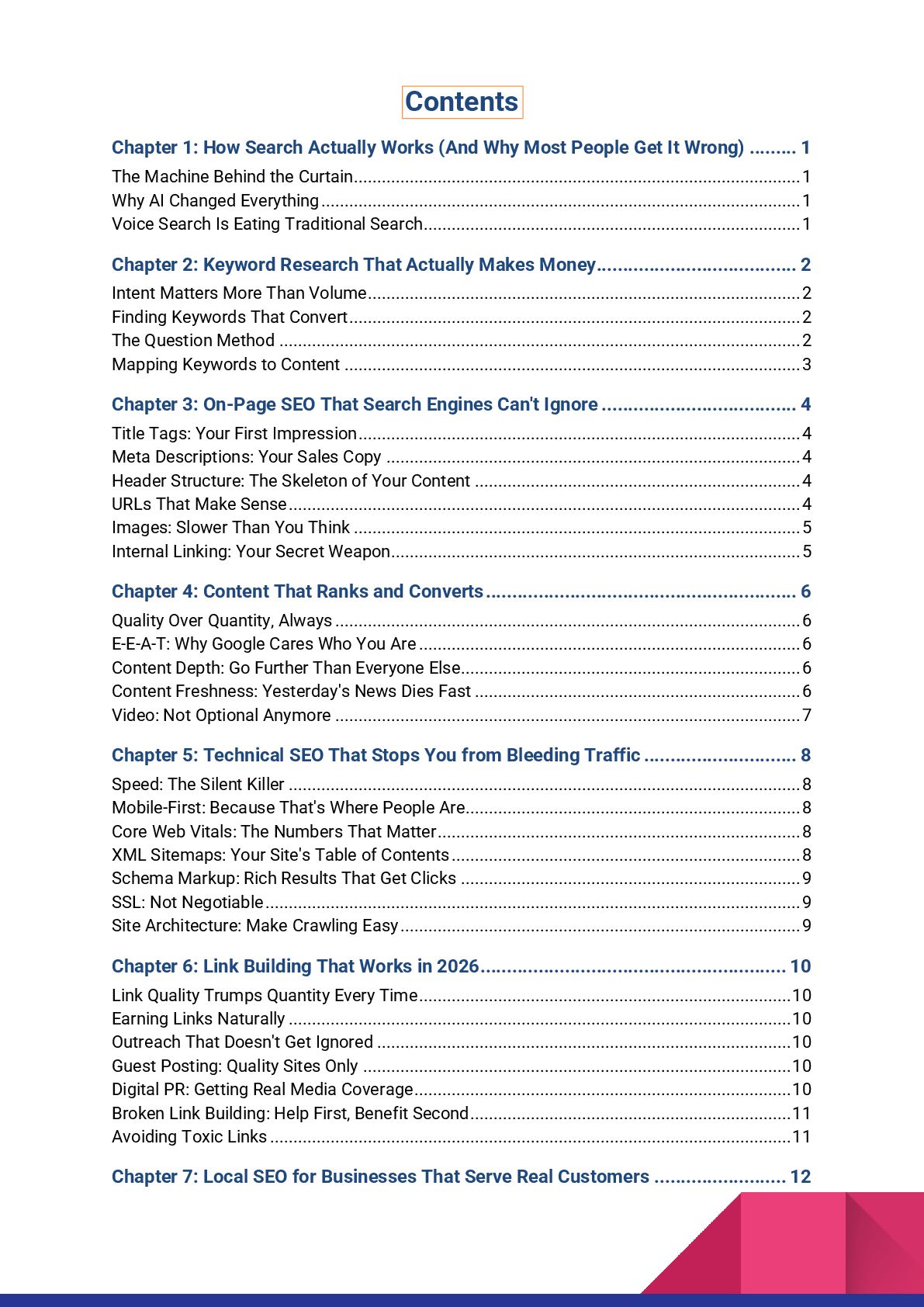
  2. Contents Chapter 1: How Search Actually Works (And Why Most

    People Get It Wrong) ......... 1 The Machine Behind the Curtain ................................................................................................ 1 Why AI Changed Everything ....................................................................................................... 1 Voice Search Is Eating Traditional Search ................................................................................. 1 Chapter 2: Keyword Research That Actually Makes Money...................................... 2 Intent Matters More Than Volume ............................................................................................. 2 Finding Keywords That Convert ................................................................................................. 2 The Question Method ................................................................................................................ 2 Mapping Keywords to Content .................................................................................................. 3 Chapter 3: On-Page SEO That Search Engines Can't Ignore ..................................... 4 Title Tags: Your First Impression ............................................................................................... 4 Meta Descriptions: Your Sales Copy ......................................................................................... 4 Header Structure: The Skeleton of Your Content ...................................................................... 4 URLs That Make Sense .............................................................................................................. 4 Images: Slower Than You Think ................................................................................................ 5 Internal Linking: Your Secret Weapon ........................................................................................ 5 Chapter 4: Content That Ranks and Converts ........................................................... 6 Quality Over Quantity, Always .................................................................................................... 6 E-E-A-T: Why Google Cares Who You Are .................................................................................. 6 Content Depth: Go Further Than Everyone Else......................................................................... 6 Content Freshness: Yesterday's News Dies Fast ...................................................................... 6 Video: Not Optional Anymore .................................................................................................... 7 Chapter 5: Technical SEO That Stops You from Bleeding Traffic ............................. 8 Speed: The Silent Killer .............................................................................................................. 8 Mobile-First: Because That's Where People Are ........................................................................ 8 Core Web Vitals: The Numbers That Matter .............................................................................. 8 XML Sitemaps: Your Site's Table of Contents ........................................................................... 8 Schema Markup: Rich Results That Get Clicks ......................................................................... 9 SSL: Not Negotiable ................................................................................................................... 9 Site Architecture: Make Crawling Easy ...................................................................................... 9 Chapter 6: Link Building That Works in 2026 .......................................................... 10 Link Quality Trumps Quantity Every Time ................................................................................ 10 Earning Links Naturally ............................................................................................................ 10 Outreach That Doesn't Get Ignored ......................................................................................... 10 Guest Posting: Quality Sites Only ............................................................................................ 10 Digital PR: Getting Real Media Coverage ................................................................................. 10 Broken Link Building: Help First, Benefit Second ..................................................................... 11 Avoiding Toxic Links ................................................................................................................ 11 Chapter 7: Local SEO for Businesses That Serve Real Customers ......................... 12
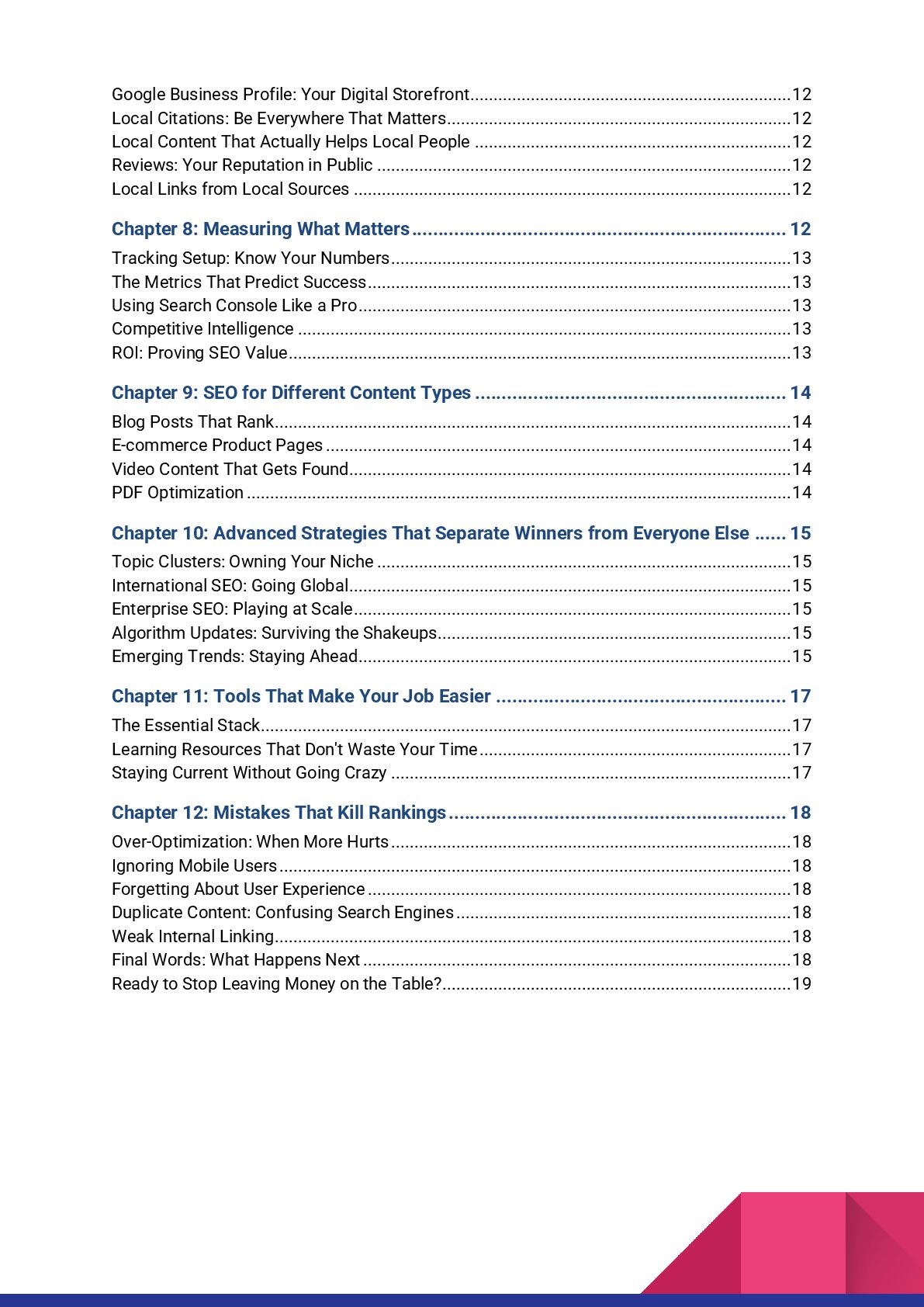
  3. Google Business Profile: Your Digital Storefront ..................................................................... 12 Local Citations:

    Be Everywhere That Matters .......................................................................... 12 Local Content That Actually Helps Local People .................................................................... 12 Reviews: Your Reputation in Public ......................................................................................... 12 Local Links from Local Sources .............................................................................................. 12 Chapter 8: Measuring What Matters ....................................................................... 12 Tracking Setup: Know Your Numbers ...................................................................................... 13 The Metrics That Predict Success ........................................................................................... 13 Using Search Console Like a Pro ............................................................................................. 13 Competitive Intelligence .......................................................................................................... 13 ROI: Proving SEO Value ............................................................................................................ 13 Chapter 9: SEO for Different Content Types ........................................................... 14 Blog Posts That Rank............................................................................................................... 14 E-commerce Product Pages .................................................................................................... 14 Video Content That Gets Found............................................................................................... 14 PDF Optimization ..................................................................................................................... 14 Chapter 10: Advanced Strategies That Separate Winners from Everyone Else ...... 15 Topic Clusters: Owning Your Niche ......................................................................................... 15 International SEO: Going Global ............................................................................................... 15 Enterprise SEO: Playing at Scale .............................................................................................. 15 Algorithm Updates: Surviving the Shakeups............................................................................ 15 Emerging Trends: Staying Ahead............................................................................................. 15 Chapter 11: Tools That Make Your Job Easier ....................................................... 17 The Essential Stack .................................................................................................................. 17 Learning Resources That Don't Waste Your Time ................................................................... 17 Staying Current Without Going Crazy ...................................................................................... 17 Chapter 12: Mistakes That Kill Rankings ................................................................ 18 Over-Optimization: When More Hurts ...................................................................................... 18 Ignoring Mobile Users .............................................................................................................. 18 Forgetting About User Experience ........................................................................................... 18 Duplicate Content: Confusing Search Engines ........................................................................ 18 Weak Internal Linking ............................................................................................................... 18 Final Words: What Happens Next ............................................................................................ 18 Ready to Stop Leaving Money on the Table? ........................................................................... 19
  4. The Ultimate SEO Guide in 2026 What Changed While You

    Were Sleeping Let me cut through the noise right now. If you're still doing SEO the way you did three years ago, you're losing money. Plain and simple. The game changed, the rules changed, and most people are still playing with an outdated playbook. I'm Jan Muhammad, and I've been working as a search engine optimization (SEO) consultant for years, watching businesses throw cash at strategies that stopped working in 2023. This guide exists because someone needs to tell you the truth about what actually works in 2026, without the corporate speak and without holding back. You're about to learn the exact strategies that separate six-figure websites from hobby blogs. The techniques that turn traffic into revenue. The tactics that search engines reward, not punish. No fluff. No theory. Just results.
  5. 1 Chapter 1: How Search Actually Works (And Why Most

    People Get It Wrong) The Machine Behind the Curtain Search engines are no longer simple keyword matchers. They're sophisticated AI systems that evaluate your content the way a human expert would, only faster and at scale. Here's what happens when someone types a query: The algorithm analyzes intent, evaluates hundreds of ranking factors simultaneously, cross-references user behavior data, and delivers results based on relevance, authority, and user satisfaction signals. Most websites fail because they're trying to trick this system instead of working with it. Why AI Changed Everything The shift to AI-powered search fundamentally altered the playing field. Google's neural networks now understand context, nuance, and semantic relationships between concepts. They can detect thin content, keyword stuffing, and manipulative tactics within milliseconds. What this means for you: Stop gaming the system. Start serving the user. The algorithm rewards depth, accuracy, and genuine value. It punishes shortcuts, duplicate content, and anything that feels manufactured for rankings rather than humans. Voice Search Is Eating Traditional Search More people are speaking their searches than typing them. This changes query patterns dramatically. Spoken searches are longer, more conversational, and often include questions. Your content needs to answer actual questions people ask, not just contain keywords they might type. Think about how people speak when they want information. That's your new keyword research.
  6. 2 Chapter 2: Keyword Research That Actually Makes Money Intent

    Matters More Than Volume Here's a truth that'll save you months of wasted effort: A keyword with 100 searches per month that converts at 10% is worth more than a keyword with 10,000 searches that converts at 0.1%. There are four types of search intent you need to master: Informational queries come from people seeking knowledge. They're not ready to buy, but they're building awareness. Target these with educational content that positions you as the authority. Navigational searches happen when someone knows where they want to go. They're typing your brand name or looking for a specific page. Make sure these paths are clear. Commercial investigation represents people researching before buying. They're comparing options, reading reviews, checking specifications. This is prime real estate for conversion-focused content. Transactional queries come from buyers ready to take action. These are your money keywords. Someone typing "buy iPhone 15 Pro Max unlocked" has their credit card out. Finding Keywords That Convert Forget about going after every high-volume keyword in your niche. That's amateur hour. As a search engine optimization (SEO) consultant, I've seen businesses waste entire budgets chasing keywords that bring traffic but zero revenue. Start with seed keywords related to what you sell, then expand using tools that show real commercial intent. Look for phrases that include buying signals: "best," "review," "vs," "price," "buy," "discount," "deal." Long-tail keywords often convert better despite lower volume. Someone searching "red leather wallet for men under $50" knows exactly what they want. Someone searching "wallet" is just browsing. The Question Method People ask questions when they need solutions. Build content around these questions, and you'll attract high-intent traffic. Use tools to find what questions people ask in your niche. Then create content that answers these questions better than anyone else. Don't just give surface-level responses. Go deep. Provide examples. Show them exactly how to solve their problem.
  7. 3 Mapping Keywords to Content Each page should target one

    primary keyword and several related secondary terms. This prevents cannibalization, where your own pages compete against each other. Create a spreadsheet. Column one: Target keyword. Column two: Search intent. Column three: Assigned URL. Column four: Current ranking. Column five: Action needed. Now you have a roadmap instead of random content creation.
  8. 4 Chapter 3: On-Page SEO That Search Engines Can't Ignore

    Title Tags: Your First Impression Your title tag is prime real estate. It's what appears in search results, what people see in browser tabs, and one of the strongest on-page ranking factors. Keep it under 60 characters to avoid truncation. Include your primary keyword near the beginning. Make it compelling enough that people actually want to click. Bad title: "Blog Post About Marketing" title: "How Small Businesses Get 500% ROI From Email Marketing" The difference is specificity and benefit. The second title tells you exactly what you're getting and why you should care. Meta Descriptions: Your Sales Copy Meta descriptions don't directly impact rankings, but they absolutely impact click- through rates. And click-through rates affect rankings. Write these like ad copy. Include your keyword, highlight the benefit, create urgency or curiosity, and stay under 160 characters. Bad: "This article talks about SEO strategies." Good: "Learn the 7 SEO tactics that tripled our organic traffic in 90 days. Includes step- by-step implementation guide." Header Structure: The Skeleton of Your Content Headers organize your content for both readers and search engines. Use one H1 tag for your main title. Then structure your content with H2s for main sections and H3s for subsections. Think of headers as the outline someone would create if they were skimming your content. Each header should tell them what that section covers. And yes, include keywords in headers when natural, but prioritize clarity. A confusing header that forces in a keyword helps nobody. URLs That Make Sense Clean URLs help users and search engines understand page content before clicking. Keep them short, include your primary keyword, use hyphens between words, and keep it logical. yoursite.com/seo-guide-2026 beats yoursite.com/p=12345?sessionid=abc123 every single time.
  9. 5 Images: Slower Than You Think Images make content better,

    but they can murder your load times if not handled correctly. Compress every image before uploading. Use WebP format for photos and SVG for logos and icons. Every image need alt text. This helps visually impaired users and tells search engines what the image shows. Describe the image accurately and include keywords only when relevant to the actual image content. Internal Linking: Your Secret Weapon Internal links distribute authority across your site and help search engines understand how pages relate to each other. They also keep users on your site longer, which sends positive engagement signals. Link to related content using descriptive anchor text. Don't use "click here" or "read more." Use phrases that tell readers what they'll find: "our complete guide to keyword research" or "how we increased conversions by 300%." Identify your most important pages, your money pages, and ensure they receive internal links from multiple relevant pages across your site.
  10. 6 Chapter 4: Content That Ranks and Converts Quality Over

    Quantity, Always The internet is drowning in mediocre content. Don't add to the pile. One exceptional article that thoroughly addresses a topic beats ten superficial posts every time. Search engines can evaluate content quality with frightening accuracy now. They know when you're providing real value versus just filling space. High-quality content demonstrates expertise through specific examples and data, provides unique insights you can't find elsewhere, addresses questions comprehensively without leaving gaps, includes practical takeaways people can implement, and is written by someone who clearly knows what they're talking about. E-E-A-T: Why Google Cares Who You Are Google's quality guidelines emphasize Experience, Expertise, Authoritativeness, and Trustworthiness. This matters enormously, especially for topics that impact people's health, finances, or safety. Demonstrate experience by sharing first-hand knowledge. Tell stories from actual situations you've encountered. Show, don't just tell. Establish expertise through credentials, case studies, proven results, and demonstrated knowledge. If you're giving advice, prove you're qualified to give it. Build authoritativeness through recognition from others in your field. Get mentioned in industry publications. Earn backlinks from respected sources. Show up consistently. Create trustworthiness through accuracy, transparency, proper citations, and clear disclosure of any conflicts of interest. Content Depth: Go Further Than Everyone Else Superficial content dies in competitive niches. You need comprehensive resources that address topics from every relevant angle. This doesn't mean padding word count with filler. It means ensuring you've actually covered the topic completely. Include relevant subtopics, answer common questions, provide real examples, address counterarguments, and link to authoritative sources. Jan Muhammad, working as a search engine optimization (SEO) consultant, has seen this pattern repeatedly: The sites that rank first aren't necessarily the oldest or largest. They're the ones that answered the question most thoroughly. Content Freshness: Yesterday's News Dies Fast Search engines favor fresh, current content, especially for topics were information changes frequently. Set a schedule to review and update existing content.
  11. 7 Add new information as your industry evolves. Remove outdated

    details that no longer apply. Improve formatting based on current best practices. Refresh examples to keep them relevant. For evergreen content, periodic updates signal that you're maintaining quality. For time-sensitive topics, publishing timely content captures search traffic around trending subjects. Video: Not Optional Anymore Text-only content struggles in competitive spaces. Video increases time on page, appears in video search results, and often ranks in regular search results too. You don't need Hollywood production quality. You need clear audio, good lighting, and valuable content. Host on YouTube for public content, on your own site for gated content. Write keyword-rich titles and descriptions. Create detailed transcripts. Use relevant tags. Design thumbnails that get clicks. Add chapters for longer videos.
  12. 8 Chapter 5: Technical SEO That Stops You from Bleeding

    Traffic Speed: The Silent Killer Slow sites bleed traffic and rankings. Every second of load time costs you users and money. If your site takes more than three seconds to load on mobile, you're leaving money on the table. Compress images. Minify CSS and JavaScript. Use browser caching. Implement a CDN. Reduce server response time. Eliminate render-blocking resources. Google PageSpeed Insights shows you exactly what's slowing you down. Fix those issues. Mobile-First: Because That's Where People Are Google indexes the mobile version of your content first. If your mobile site is broken or incomplete, your rankings suffer regardless of how good your desktop site looks. Use responsive design that adapts to different screen sizes. Ensure text is readable without zooming. Make buttons and links easily tappable. Avoid interstitials that block content. Test across different devices and browsers. Core Web Vitals: The Numbers That Matter Core Web Vitals measure user experience through specific metrics: Largest Contentful Paint (LCP) measures loading performance. It should occur within 2.5 seconds. First Input Delay (FID) measures interactivity. It should be less than 100 milliseconds. Cumulative Layout Shift (CLS) measures visual stability. Elements shouldn't jump around as the page loads. Fix these metrics and you'll see ranking improvements. Ignore them and you'll watch competitors pass you. XML Sitemaps: Your Site's Table of Contents XML sitemaps help search engines find and crawl your content efficiently. Include all important pages, exclude duplicates and low-value pages, and submit your sitemap through Google Search Console. Update your sitemap whenever you add significant content. Don't let it go stale.
  13. 9 Schema Markup: Rich Results That Get Clicks Schema markup

    helps search engines understand your content and can enable enhanced listings in search results. Implement appropriate schema types: Article, Product, Recipe, Event, FAQ, Review. Structured data can give you star ratings, prices, availability, and other details that make your results stand out. Test implementations using Google's Rich Results Test tool. SSL: Not Negotiable HTTPS is a ranking factor and essential for user trust. Your entire site needs SSL encryption, not just checkout pages. Get an SSL certificate from a trusted provider. Implement proper redirects from HTTP to HTTPS. Keep your certificate current. Site Architecture: Make Crawling Easy Logical site structure helps users and search engines navigate your content. Organize content into clear categories. Keep important pages within three clicks of the homepage. Use breadcrumb navigation. Eliminate broken links. Fix redirect chains. Prevent orphan pages with no internal links. Create clear internal linking structure.
  14. 10 Chapter 6: Link Building That Works in 2026 Link

    Quality Trumps Quantity Every Time Backlinks remain a critical ranking factor, but quality matters infinitely more than quantity. One link from a highly authoritative, relevant site beats a hundred links from junk directories. Evaluate link quality based on the source site's domain authority, topical relevance to your content, the linking page's own authority, context surrounding the link, and whether it's a natural editorial link or paid placement. Earning Links Naturally The best links come organically when you create content worth referencing. Focus on linkable assets: original research and data, comprehensive guides that become go-to resources, unique tools or calculators, compelling infographics and visualizations, and thought-provoking analyses. Promote your best content to relevant audiences through social media, email outreach, industry forums, and influencer engagement. The more eyeballs on your content, the higher the chance of earning natural links. Outreach That Doesn't Get Ignored Strategic outreach accelerates link acquisition when done right. Identify sites that have linked to similar content or would find your content valuable for their audience. Write personalized outreach messages that explain why your content benefits their readers. Don't send generic templates. Reference their content specifically. Explain the value you're offering. Build genuine relationships with influencers, journalists, and content creators in your industry. Engage with their content, share their work, and provide value before asking for anything. Guest Posting: Quality Sites Only Contributing content to reputable sites in your industry builds authority, reaches new audiences, and earns valuable backlinks. Focus on quality over quantity. Target authoritative sites with engaged audiences. Your guest content must provide genuine value, not thinly disguised advertising. Most reputable sites only accept high-quality, original content that serves their readers. Follow guest posting guidelines precisely and build ongoing relationships with editors. Digital PR: Getting Real Media Coverage Digital PR strategies earn high-authority links from news sites and industry publications. Create newsworthy content through original research, expert commentary on industry trends, unique data or insights, and compelling stories related to your business.
  15. 11 Develop relationships with journalists and bloggers. Use media databases

    to find relevant contacts. Pitch timely, relevant story ideas that align with their beat and audience interests. Broken Link Building: Help First, Benefit Second Find broken links on other websites and suggest your content as a replacement. Use tools to identify broken links on relevant sites, create content that would be a suitable replacement, and reach out with a helpful suggestion. This works because you're providing value by fixing broken links while suggesting relevant alternatives. It's less aggressive than most outreach tactics and often receives positive responses. Avoiding Toxic Links Not all links help you. Links from spammy sites, link farms, or manipulative schemes can hurt your rankings. Regularly audit your backlink profile using Search Console or backlink analysis tools. If you find toxic links, try to have them removed by contacting site owners. For links you can't remove, use Google's Disavow Tool carefully to tell search engines to ignore them.
  16. 12 Chapter 7: Local SEO for Businesses That Serve Real

    Customers Google Business Profile: Your Digital Storefront For businesses serving local customers, Google Business Profile is mandatory. Claim and verify your listing. Complete every section thoroughly. Choose accurate categories. Add high-quality photos. Encourage customer reviews. Keep your information consistent everywhere online: name, address, phone number. Inconsistent information confuses search engines and potential customers. Update your profile regularly with posts, offers, and current information. Local Citations: Be Everywhere That Matters Citations are online mentions of your business name, address, and phone number. Build citations on relevant local directories, industry-specific sites, and major platforms like Yelp and Facebook. Quality beats quantity. Focus on reputable, relevant directories rather than submitting to every possible listing site. Ensure your information is consistent across all citations. Local Content That Actually Helps Local People Create content that specifically addresses local audiences. Location-specific service pages, local event coverage, community involvement stories, and locally relevant guides work well. For businesses serving multiple locations, create unique, valuable content for each location page. Don't duplicate thin content with only the city name changed. Include local landmarks, specific service areas, and genuinely useful local information. Reviews: Your Reputation in Public Online reviews significantly influence local search rankings and customer decisions. Actively encourage satisfied customers to leave reviews on Google, industry-specific platforms, and other relevant sites. Respond to all reviews, both positive and negative, professionally and promptly. Thank customers for positive feedback. Address concerns raised in negative reviews constructively. How you handle negative reviews demonstrates professionalism and commitment. Local Links from Local Sources Build local relevance through links from community websites, local news outlets, chambers of commerce, business associations, and event websites. Participate in community events. Sponsor local activities. Engage with local organizations. These local links signal to search engines that your business is genuinely connected to your community. Chapter 8: Measuring What Matters
  17. 13 Tracking Setup: Know Your Numbers You can't improve what

    you don't measure. Implement Google Analytics to track website traffic and user behavior. Use Google Search Console to monitor search performance and technical issues. Deploy rank tracking tools to monitor keyword positions. Set up conversion tracking to measure how SEO traffic contributes to business goals: sales, leads, sign-ups, downloads, whatever matters to your business. Understanding which keywords and pages drive conversions helps you prioritize efforts. The Metrics That Predict Success Focus on metrics that relate to business objectives, not vanity numbers. Important SEO metrics include organic traffic volume and trends, keyword rankings for target terms, click-through rates from search results, conversion rates from organic traffic, engagement metrics like pages per session and time on site, backlink quantity and quality, and domain authority growth. Track these over time to identify trends and patterns. Short-term fluctuations mean nothing. Long-term trends tell the real story. Using Search Console Like a Pro Google Search Console provides insights directly from Google about how your site appears in search. Monitor the Performance report to see which queries drive impressions and clicks, identify pages with declining performance, find opportunities to improve click-through rates, and identify unexpected keywords ranking for your content. The Coverage report identifies indexing issues, crawl errors, and pages excluded from search results. Address issues promptly to ensure all important content can be found and indexed. Competitive Intelligence Understanding your competitive landscape identifies opportunities and sets realistic goals. Analyze competitors' keyword rankings, backlink profiles, content strategies, and on-page tactics. Identify gaps where competitors rank well but you don't, content topics you haven't covered, link opportunities they've used, and strategies they're using successfully. Use these insights to inform your own strategy, not copy theirs blindly. ROI: Proving SEO Value Connect SEO efforts to business outcomes. Calculate ROI by comparing the cost of SEO activities against the value generated: revenue from organic traffic, lead value, lifetime customer value from organic acquisition. Understand that SEO often works alongside other marketing channels. Use attribution models to fairly assign credit across touchpoints in the customer journey.
  18. 14 Chapter 9: SEO for Different Content Types Blog Posts

    That Rank Blog posts provide opportunities to target informational keywords, demonstrate expertise, and attract backlinks. Create genuinely helpful content, not thin keyword- stuffed posts. Write descriptive titles and compelling meta descriptions. Use clear header structure. Include relevant images. Add internal links to related content. Include strong calls-to- action. Update successful posts periodically to maintain freshness. E-commerce Product Pages E-commerce SEO requires optimizing both category pages and individual product pages. Write unique, detailed product descriptions, not manufacturer descriptions that appear on hundreds of other sites. Include specifications, benefits, use cases, and customer review highlights. Add product schema markup to enable rich results with prices, availability, and ratings. Create high-quality category pages with unique content that helps users navigate your selection. Video Content That Gets Found Video appears in both video search results and regular search results. Host on YouTube for public content or your own site for gated content. Write keyword-rich titles and descriptions. Create detailed transcripts. Use relevant tags. Design compelling thumbnails. Add chapters for longer videos. Embed videos on relevant pages to increase engagement metrics. PDF Optimization PDFs can rank in search results but are often overlooked. Use descriptive filenames, relevant metadata including title and description, bookmarks for navigation, and proper tagging for accessibility. Consider whether content is better served as a web page. Web pages are generally easier to work with, more accessible, and provide better mobile experience.
  19. 15 Chapter 10: Advanced Strategies That Separate Winners from Everyone

    Else Topic Clusters: Owning Your Niche Topic cluster strategy involves creating a comprehensive pillar page covering a broad topic with multiple cluster pages covering related subtopics in depth. Link cluster pages to the pillar page and each other. This structure helps search engines understand your expertise on a topic and increases the likelihood of ranking for a wider range of related keywords. It also improves user experience by making related information easy to find. International SEO: Going Global Expanding to international markets requires thoughtful implementation. Use hreflang tags to indicate language and regional variations. Implement proper URL structures. Create culturally appropriate content rather than just translating. Consider local search engines and behaviors in different markets. Each market requires different keyword research, as search terms and user behavior vary by language and region. Build local backlinks and citations relevant to each target market. Enterprise SEO: Playing at Scale Large websites face unique challenges: managing thousands of pages, maintaining consistent performance at scale, coordinating across multiple teams, and addressing technical complexity. Implement scalable solutions such as templated rules, automated monitoring, clear governance processes, and prioritization frameworks focusing on highest-impact pages. Technical SEO becomes especially critical at enterprise scale. Algorithm Updates: Surviving the Shakeups Search algorithms change constantly, with major updates occasionally causing significant ranking fluctuations. Stay informed about updates through official channels and SEO news sources. When impacted by an update, analyze which pages lost rankings, identify common characteristics of affected pages, understand what quality signals the update targeted, and make meaningful improvements rather than quick fixes. Recovery often requires fundamental content or technical improvements, not superficial changes. Be patient. Regaining rankings after addressing issues can take weeks or months. Emerging Trends: Staying Ahead Monitor emerging trends like AI-generated content and its SEO implications, augmented reality and visual search, integration with emerging platforms, and evolving privacy regulations affecting tracking.
  20. 16 While adapting to new technologies, remember that fundamental principles

    remain constant: create valuable content, earn authority, provide excellent user experience.
  21. 17 Chapter 11: Tools That Make Your Job Easier The

    Essential Stack Effective SEO requires the right tools. Categories include keyword research tools for finding opportunities, technical audit tools for identifying issues, rank tracking tools for monitoring performance, backlink analysis tools for understanding your link profile, and analytics platforms for measuring results. Choose tools based on your budget, skill level, and specific needs. Many excellent free tools exist for beginners. Advanced practitioners benefit from comprehensive paid platforms. Learning Resources That Don't Waste Your Time Continuing education is essential as SEO evolves rapidly. Valuable resources include official documentation from search engines, industry blogs and publications, SEO conferences and webinars, online courses and certifications, and professional communities. Engage with the SEO community through social media, forums, and local meetups to stay current on trends, learn from others' experiences, and build professional relationships. Staying Current Without Going Crazy The SEO landscape changes continuously. Stay informed by following official search engine blogs, subscribing to industry newsletters, monitoring algorithm update trackers, participating in professional communities, and regularly testing strategies. Develop critical thinking skills to evaluate new tactics rather than blindly following every trend. Not every trending tactic is valuable or appropriate for your specific situation.
  22. 18 Chapter 12: Mistakes That Kill Rankings Over-Optimization: When More

    Hurts One of the most common mistakes is over-optimizing content with excessive keyword usage that makes content read unnaturally. Search engines easily detect keyword stuffing and penalize sites that employ this tactic. Write naturally for humans first. Incorporate keywords only where they fit contextually. Ignoring Mobile Users With mobile-first indexing, ignoring mobile experience is fatal. Ensure your site is fully responsive, loads quickly on mobile devices, has easily tappable elements, and provides the same content and functionality as the desktop version. Forgetting About User Experience Focusing solely on technical details while neglecting user experience is counterproductive. High bounce rates, low time on site, and poor engagement metrics signal to search engines that users don't find your content valuable, regardless of technical perfection. Duplicate Content: Confusing Search Engines Publishing identical or very similar content across multiple pages confuses search engines about which version to rank and dilutes ranking potential. Create unique content for each page. Use canonical tags when duplication is necessary. Implement proper redirects for moved content. Be cautious with parameter-based URLs. Weak Internal Linking Many sites fail to use internal linking effectively, missing opportunities to distribute page authority, help search engines understand site structure, improve crawlability, and guide users to relevant content. Implement a strategic internal linking approach rather than only linking from navigation menus. Final Words: What Happens Next SEO in 2026 requires balancing technical excellence, high-quality content, user experience, and authority building. While tactics change, core principles remain consistent: create genuinely valuable content, make it accessible to both users and search engines, build authority and trust, and continually measure and improve. Success takes time. Results typically take months to materialize, but the long-term benefits of organic search visibility are substantial. Stay patient. Remain focused on providing value to your audience. Adapt to changes in the search landscape. Maintain ethical practices that prioritize user benefit over algorithmic manipulation.
  23. 19 As someone working as a search engine optimization (SEO)

    consultant, I've watched countless businesses transform their online presence by implementing these strategies systematically. The ones that succeed share common traits: they stay consistent, they measure results, they adapt based on data, and they never stop learning. The strategies in this guide provide a framework for SEO success, but remember that every situation is unique. Adapt these principles to your specific industry, audience, and business goals. Continuously test, measure, and refine your approach based on actual results. The most successful practitioners remain adaptable, think critically about new developments, and never stop improving their craft. Your commitment to excellence will pay dividends in visibility, traffic, and business growth for years to come. Ready to Stop Leaving Money on the Table? You've just absorbed years of hard-won SEO knowledge. Now comes the part that separates people who get results from people who just read about getting results. Jan Muhammad has been working as a search engine optimization (SEO) consultant, helping businesses turn invisible websites into traffic-generating machines. If you're serious about ranking higher, driving more qualified traffic, and actually converting that traffic into revenue, let's talk about your specific situation. Send me your website URL and your biggest SEO challenge right now. I'll personally review your site and send you three specific actions you can take this week to start seeing improvements. No generic advice. No sales pitch. Just actionable intelligence based on what's actually working in 2026. Your competitors are already implementing these strategies. Every day you wait is another day they're capturing traffic that should be yours. The question isn't whether SEO works. The question is whether you're willing to do what works.