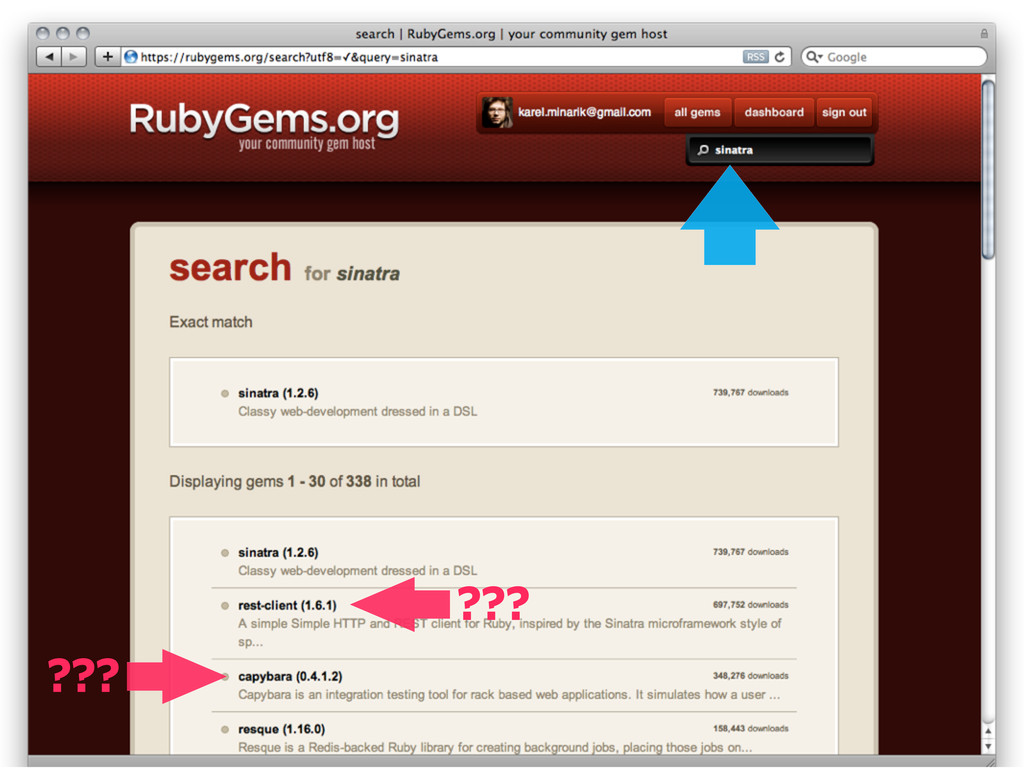
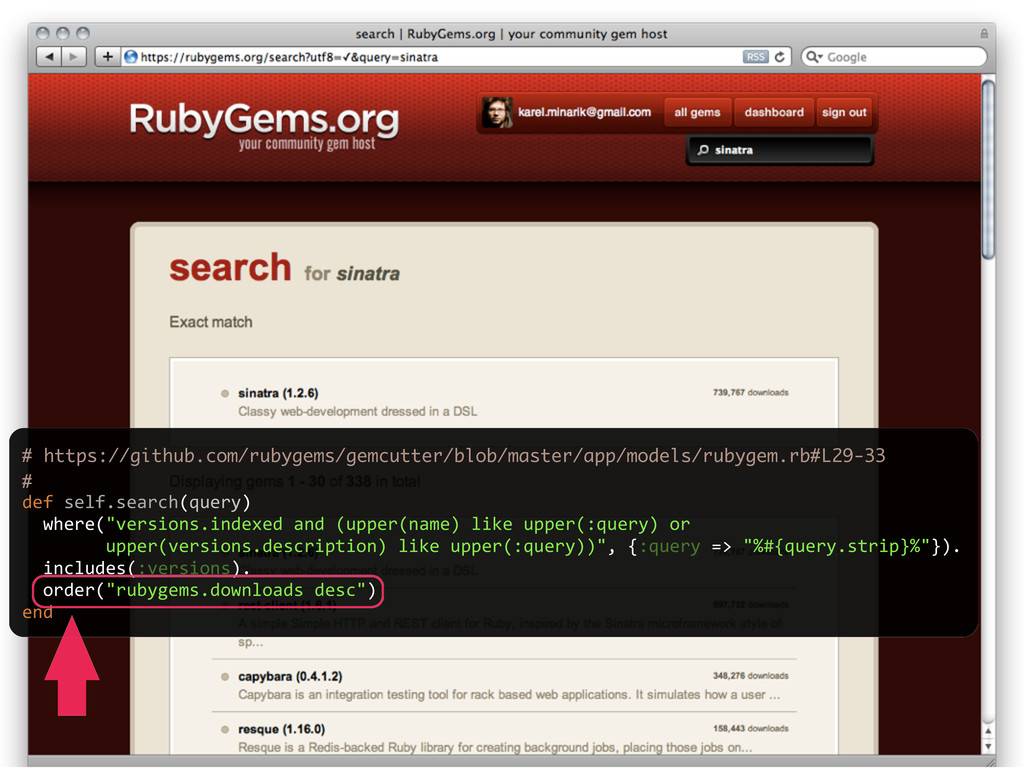
upper(:query) or upper(versions.description) like upper(:query))", {:query => "%#{query.strip}%"}). includes(:versions). order("rubygems.downloads desc") end
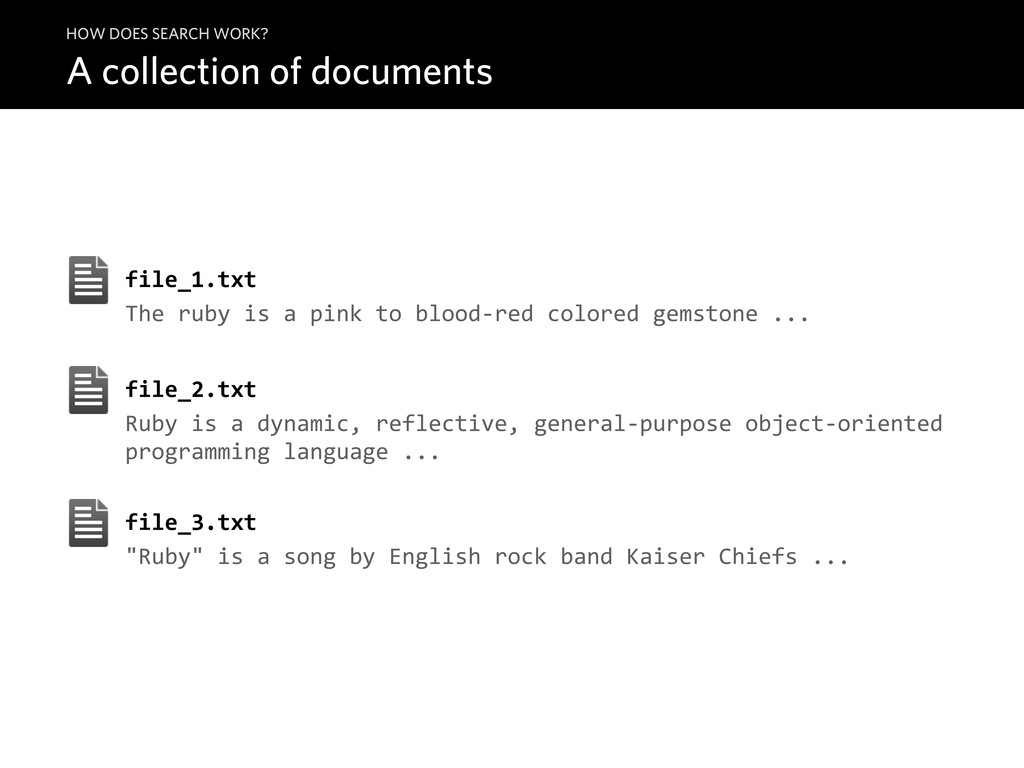
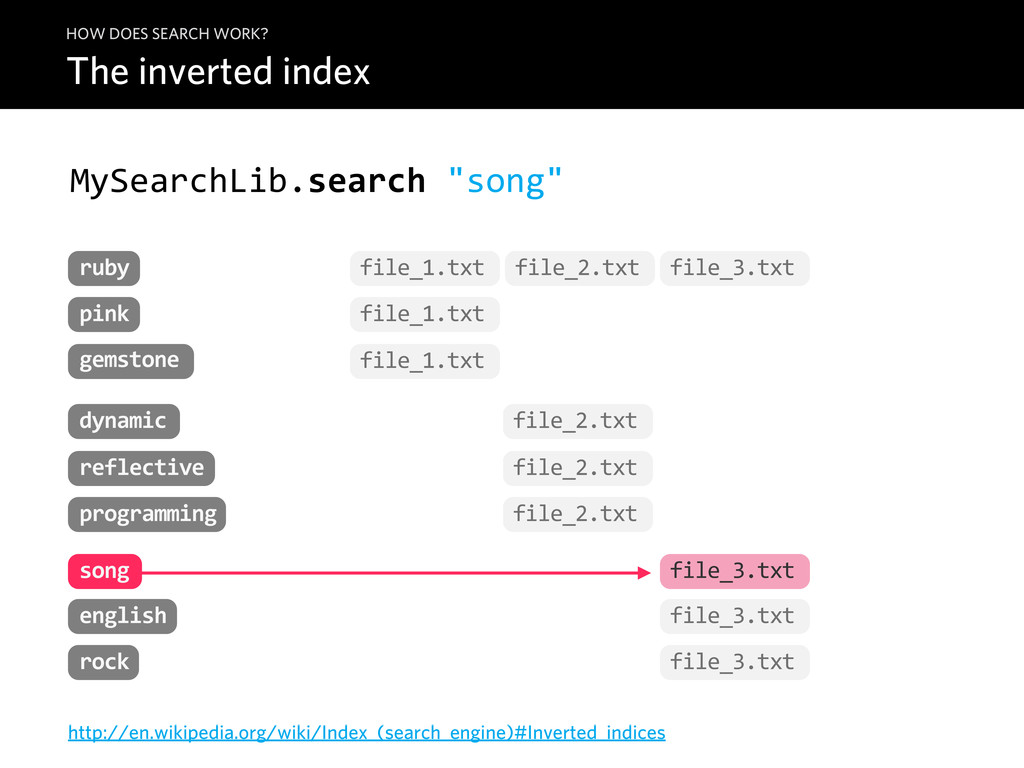
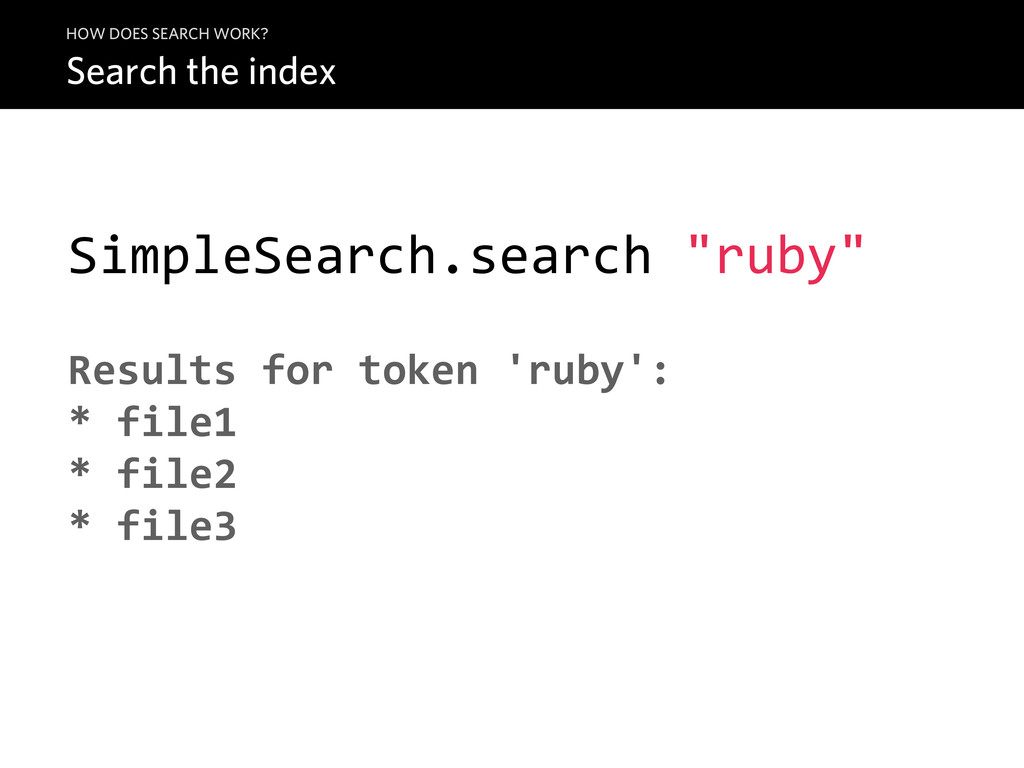
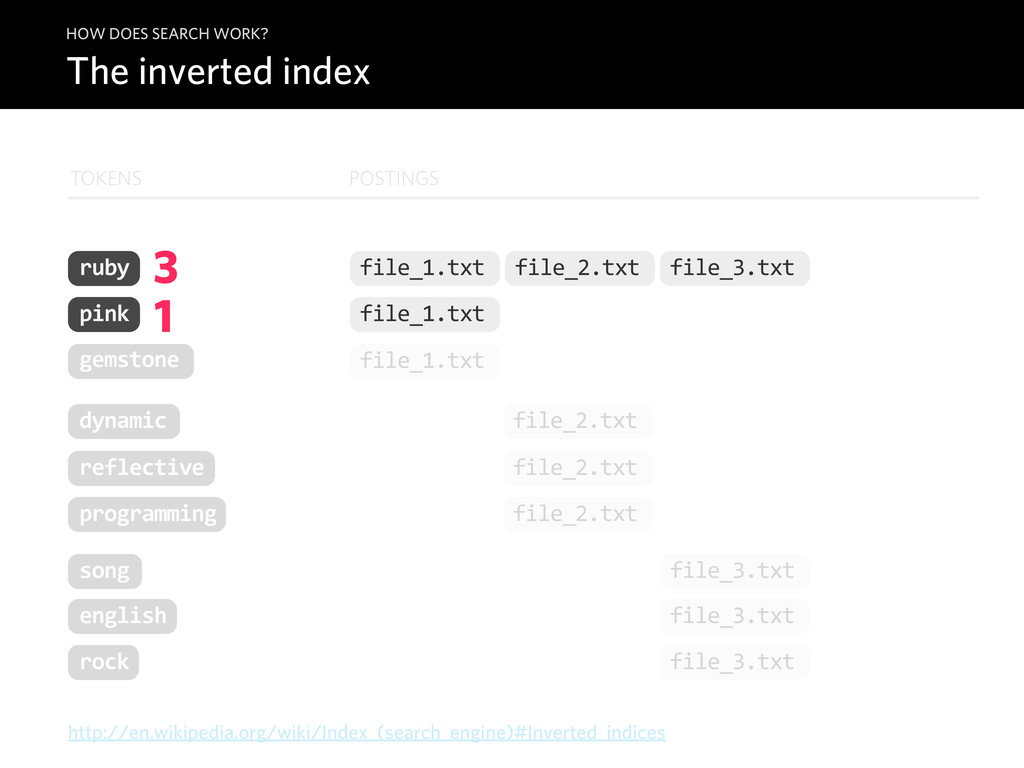
ruby is a pink to blood-‐red colored gemstone ... file_2.txt Ruby is a dynamic, reflective, general-‐purpose object-‐oriented programming language ... file_3.txt "Ruby" is a song by English rock band Kaiser Chiefs ...
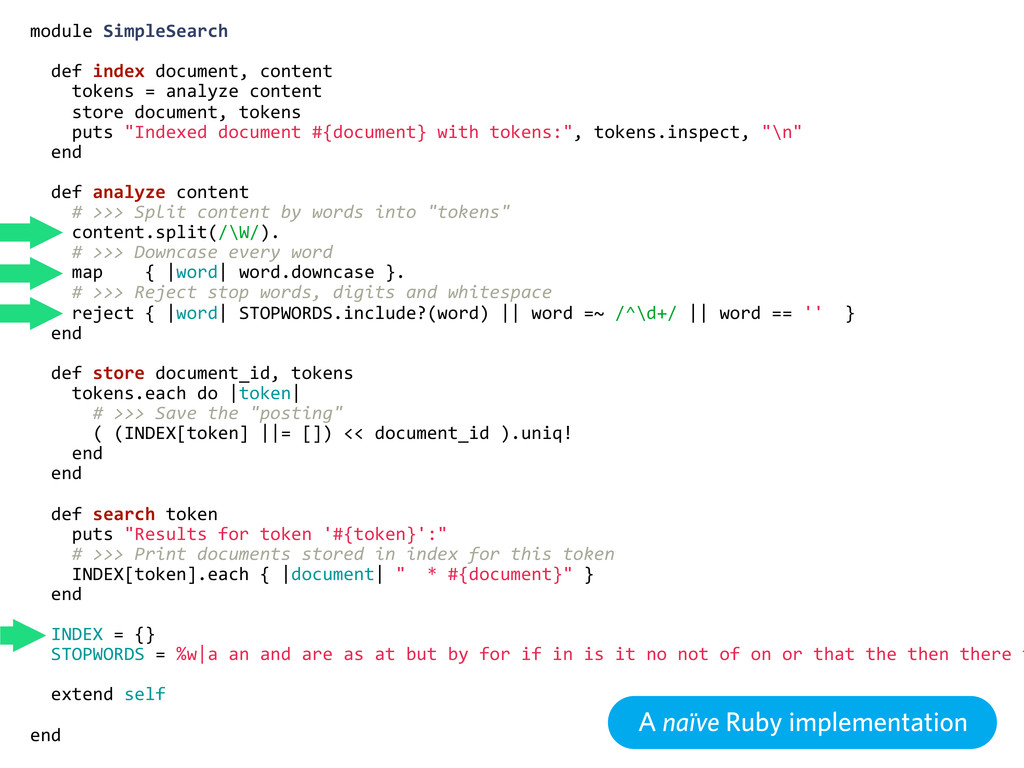
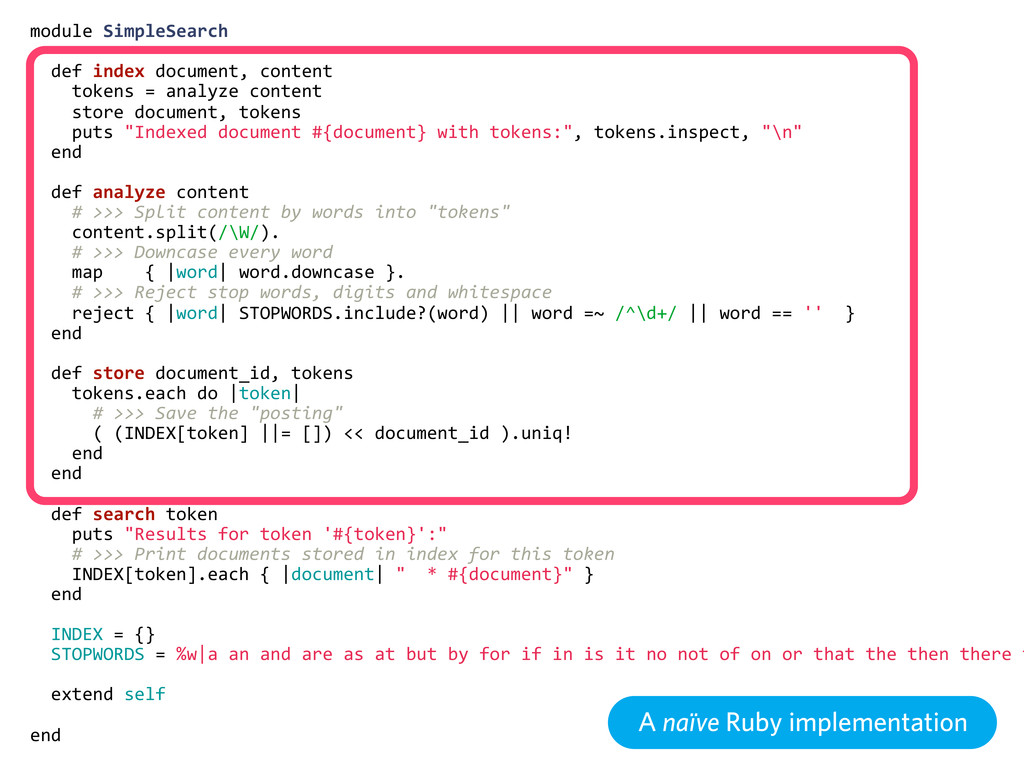
tokens = analyze content store document, tokens puts "Indexed document #{document} with tokens:", tokens.inspect, "\n" end def analyze content # >>> Split content by words into "tokens" content.split(/\W/). # >>> Downcase every word map { |word| word.downcase }. # >>> Reject stop words, digits and whitespace reject { |word| STOPWORDS.include?(word) || word =~ /^\d+/ || word == '' } end def store document_id, tokens tokens.each do |token| # >>> Save the "posting" ( (INDEX[token] ||= []) << document_id ).uniq! end end def search token puts "Results for token '#{token}':" # >>> Print documents stored in index for this token INDEX[token].each { |document| " * #{document}" } end INDEX = {} STOPWORDS = %w|a an and are as at but by for if in is it no not of on or that the then there t extend self end A naïve Ruby implementation
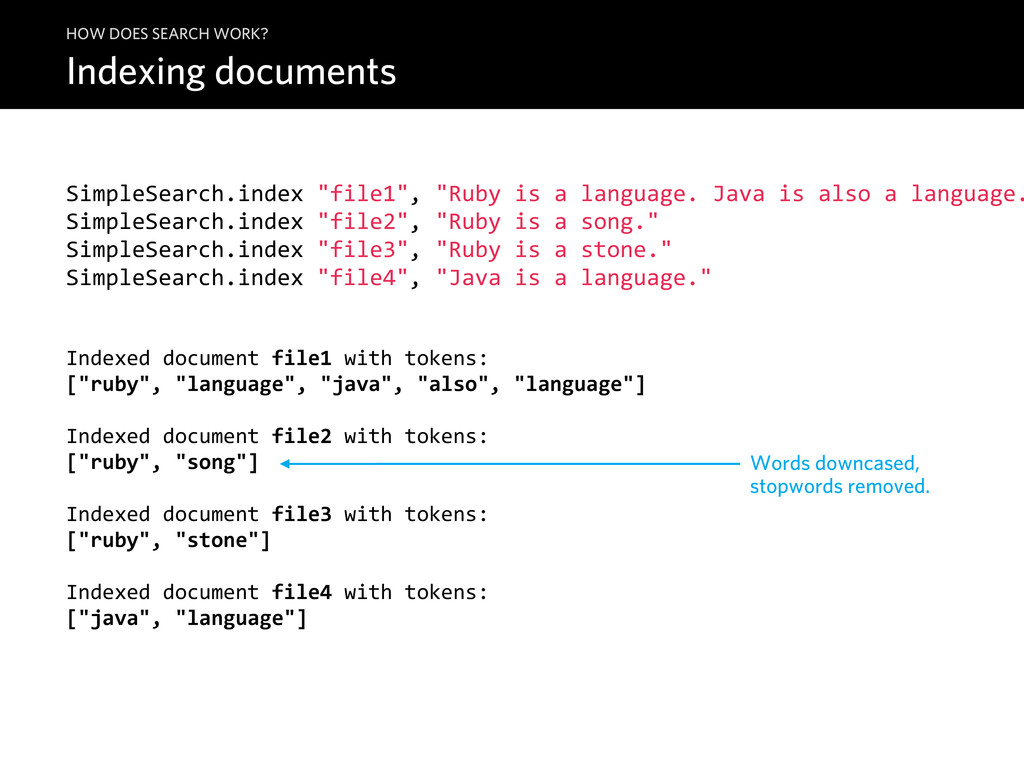
language. SimpleSearch.index "file2", "Ruby is a song." SimpleSearch.index "file3", "Ruby is a stone." SimpleSearch.index "file4", "Java is a language." Indexed document file1 with tokens: ["ruby", "language", "java", "also", "language"] Indexed document file2 with tokens: ["ruby", "song"] Indexed document file3 with tokens: ["ruby", "stone"] Indexed document file4 with tokens: ["java", "language"] Indexing documents HOW DOES SEARCH WORK? Words downcased, stopwords removed.
tokens = analyze content store document, tokens puts "Indexed document #{document} with tokens:", tokens.inspect, "\n" end def analyze content # >>> Split content by words into "tokens" content.split(/\W/). # >>> Downcase every word map { |word| word.downcase }. # >>> Reject stop words, digits and whitespace reject { |word| STOPWORDS.include?(word) || word =~ /^\d+/ || word == '' } end def store document_id, tokens tokens.each do |token| # >>> Save the "posting" ( (INDEX[token] ||= []) << document_id ).uniq! end end def search token puts "Results for token '#{token}':" # >>> Print documents stored in index for this token INDEX[token].each { |document| " * #{document}" } end INDEX = {} STOPWORDS = %w|a an and are as at but by for if in is it no not of on or that the then there t extend self end A naïve Ruby implementation
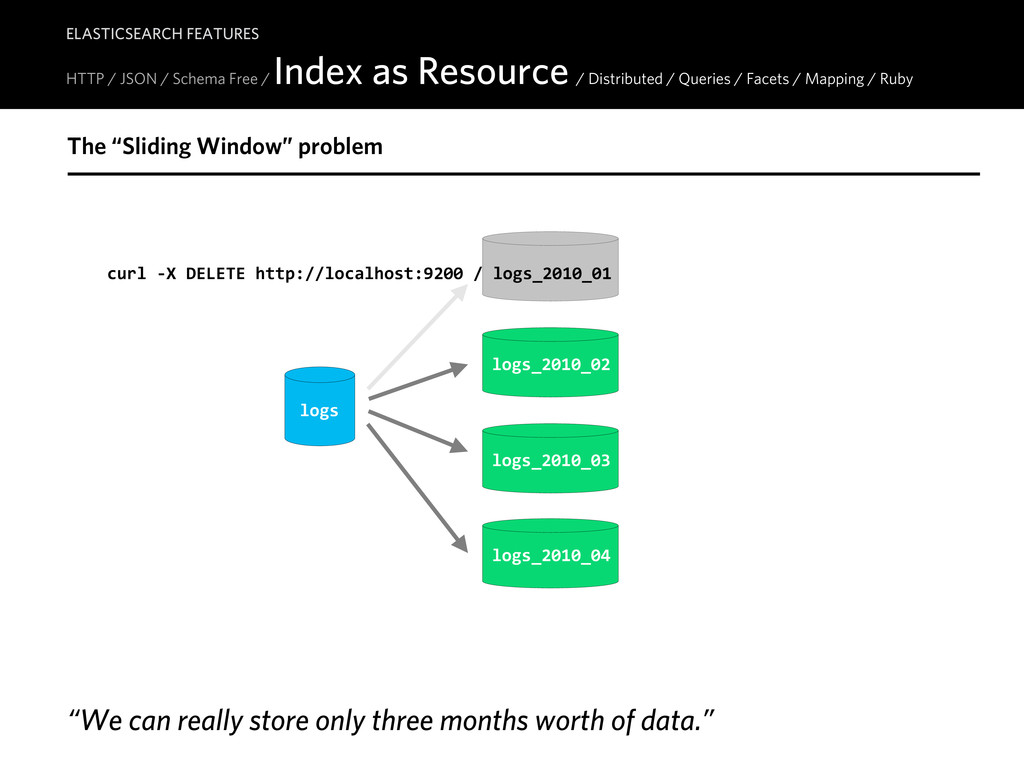
/ Distributed / Queries / Facets / Mapping / Ruby ELASTICSEARCH FEATURES logs The “Sliding Window” problem logs_2010_02 logs_2010_03 logs_2010_04 curl -‐X DELETE http://localhost:9200 / logs_2010_01 “We can really store only three months worth of data.”
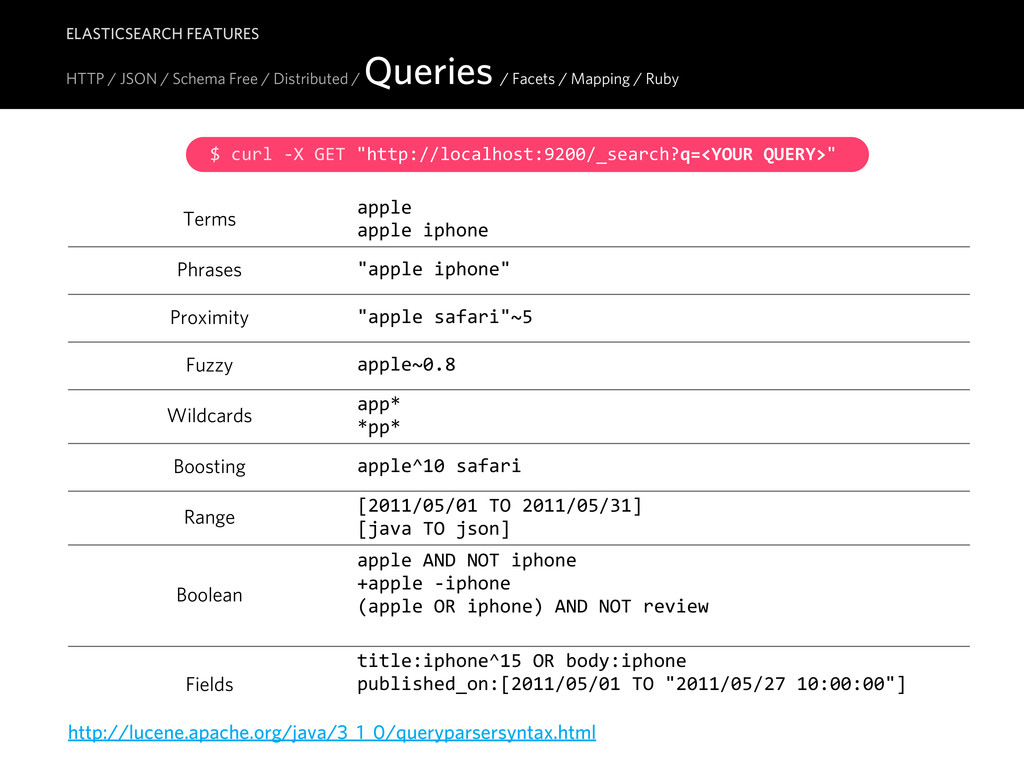
/ Facets / Mapping / Ruby ELASTICSEARCH FEATURES Terms apple apple iphone Phrases "apple iphone" Proximity "apple safari"~5 Fuzzy apple~0.8 Wildcards app* *pp* Boosting apple^10 safari Range [2011/05/01 TO 2011/05/31] [java TO json] Boolean apple AND NOT iphone +apple -‐iphone (apple OR iphone) AND NOT review Fields title:iphone^15 OR body:iphone published_on:[2011/05/01 TO "2011/05/27 10:00:00"] http://lucene.apache.org/java/3_1_0/queryparsersyntax.html $ curl -‐X GET "http://localhost:9200/_search?q=<YOUR QUERY>"
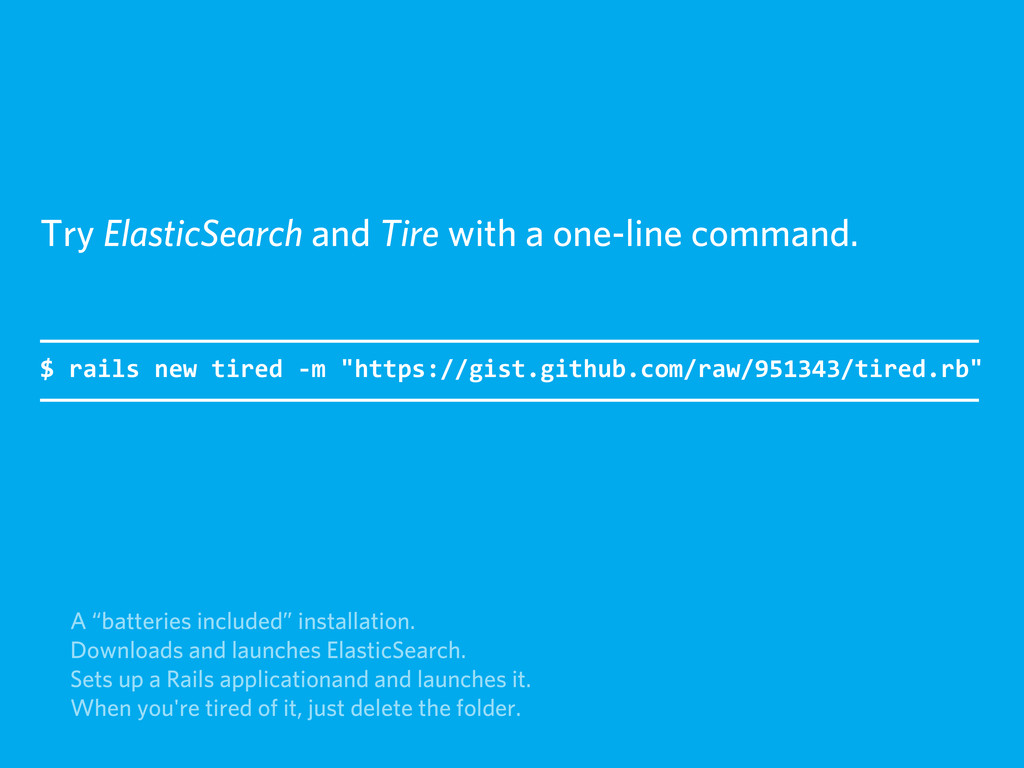
Downloads and launches ElasticSearch. Sets up a Rails applicationand and launches it. When you're tired of it, just delete the folder. Try ElasticSearch and Tire with a one-line command.


 karmi
karmi
 iwatatomoya
 masahirokawahara
 pauli
pauli
 naruoga
 oracle4engineer
 kakakakakku
 kawametho
 mochizuki875
 junkifurukawa
 toshimaru
 miidas
 jacobtomlinson
 watany
 destraynor
 frankvandijk
 palkan
 dougneiner
 wjessup
 aki_iinuma
 addyosmani
 techseoconnect
 nonsquared
 soudai





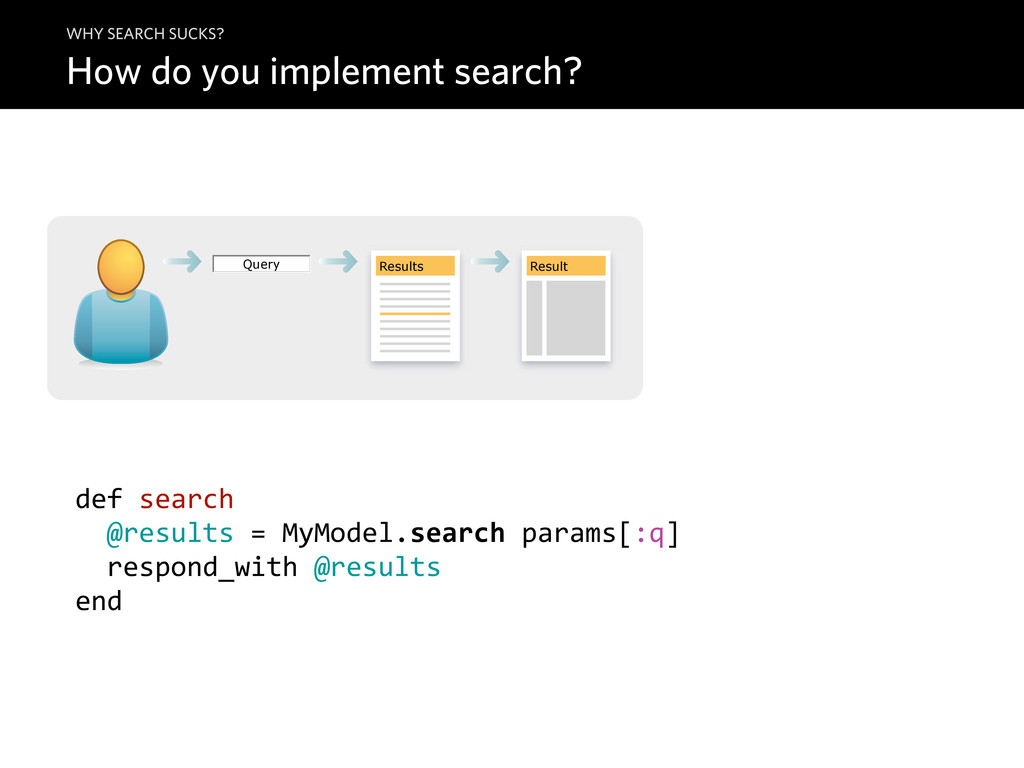
![def search @results = MyModel.search params[:q] respond_with @results](https://files.speakerdeck.com/presentations/4e810177d4209c0060001f48/slide_19.jpg)
![def search @results = MyModel.search params[:q] respond_with @results](https://files.speakerdeck.com/presentations/4e810177d4209c0060001f48/slide_20.jpg)
![MyModel.search "(this OR that) AND NOT whatever" Arel::Table.new(:articles). where(articles[:title].eq('On](https://files.speakerdeck.com/presentations/4e810177d4209c0060001f48/slide_22.jpg)