Upgrade to Pro — share decks privately, control downloads, hide ads and more …

Step-by-Step Taylor Soft Serve Machine Troubles...

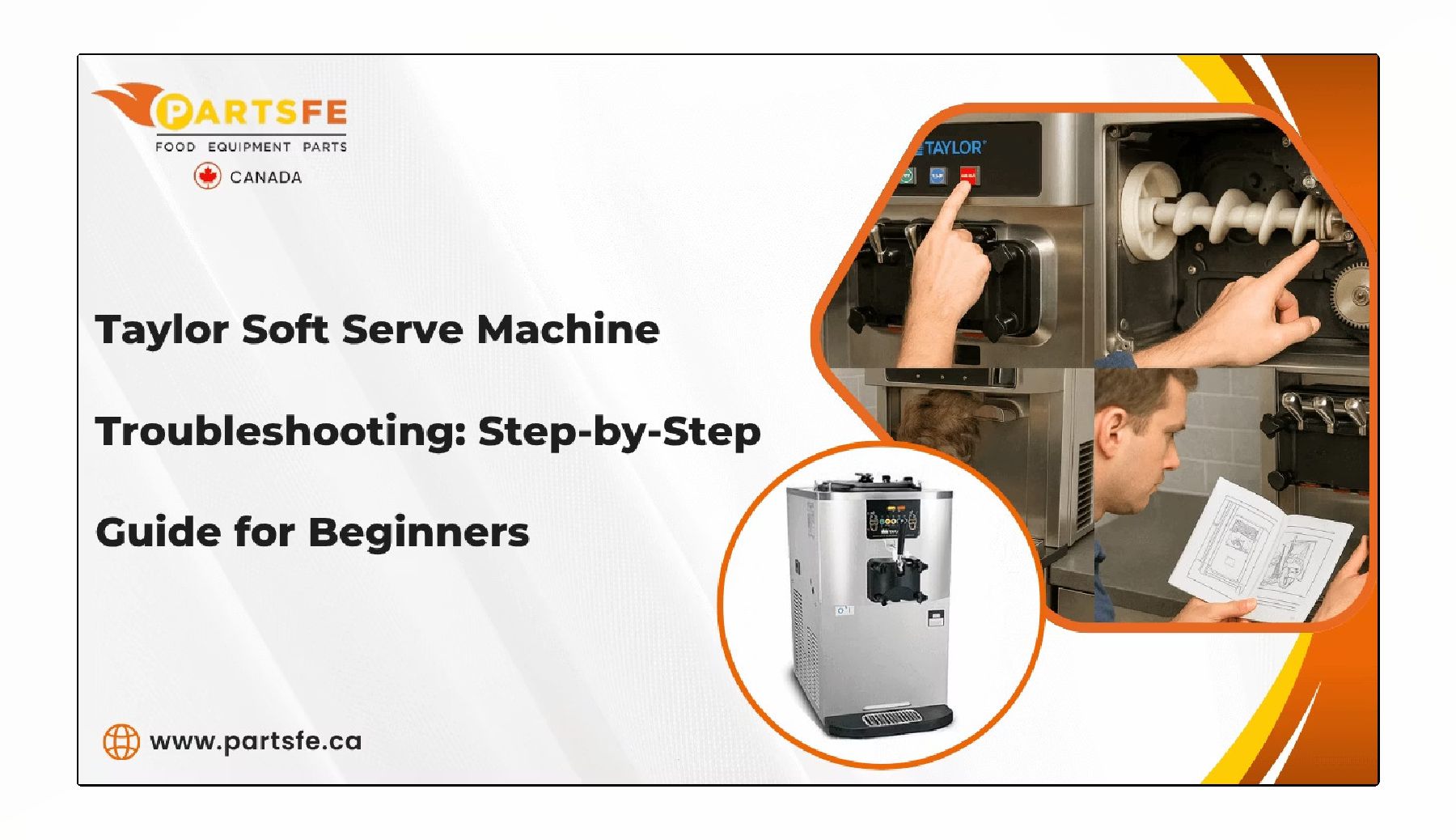
Step-by-Step Taylor Soft Serve Machine Troubleshooting for New Beginners

Troubleshooting a Taylor soft serve machine doesn’t have to be overwhelming, especially for beginners. This step-by-step guide walks you through identifying and resolving common issues such as inconsistent texture, error codes, over-freezing, or poor dispensing performance. By understanding basic components, cleaning requirements, and reset procedures, operators can quickly restore smooth operation and prevent costly downtime. Whether you’re managing a café or restaurant, proper maintenance ensures product quality and customer satisfaction. Designed for entry-level users, this guide simplifies troubleshooting for machines manufactured by Taylor Company, helping you maintain efficiency and extend equipment lifespan.

Visit the website: https://partsfe.ca/blog/post/taylor-soft-serve-machine-troubleshooting-guide

Avatar for leoeliferenko

leoeliferenko

April 21, 2026

More Decks by leoeliferenko

Other Decks in Business

Transcript

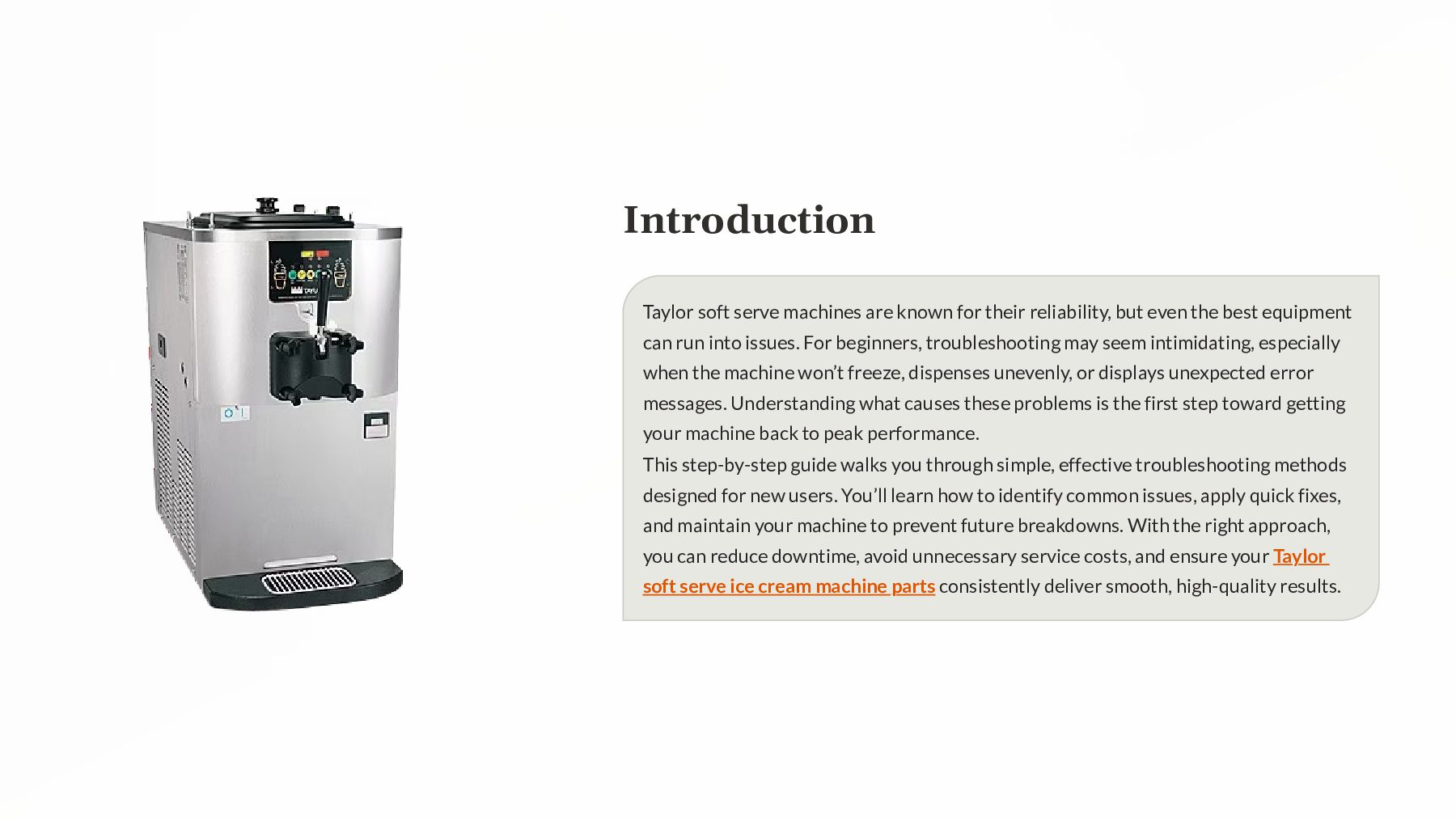
  1. Introduction Taylor soft serve machines are known for their reliability,

    but even the best equipment can run into issues. For beginners, troubleshooting may seem intimidating, especially when the machine won9t freeze, dispenses unevenly, or displays unexpected error messages. Understanding what causes these problems is the first step toward getting your machine back to peak performance. This step-by-step guide walks you through simple, effective troubleshooting methods designed for new users. You9ll learn how to identify common issues, apply quick fixes, and maintain your machine to prevent future breakdowns. With the right approach, you can reduce downtime, avoid unnecessary service costs, and ensure your Taylor soft serve ice cream machine parts consistently deliver smooth, high-quality results.
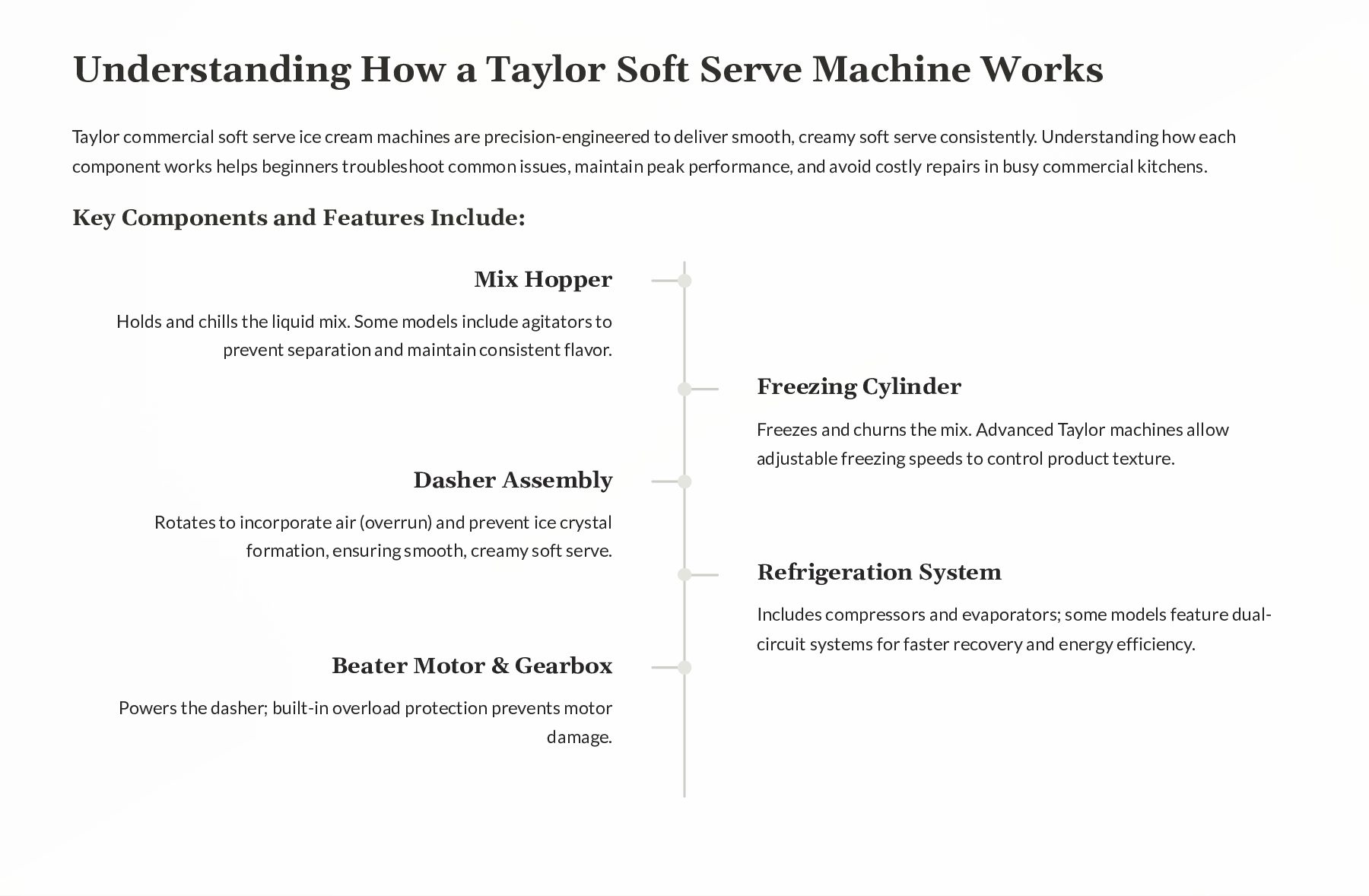
  2. Understanding How a Taylor Soft Serve Machine Works Taylor commercial

    soft serve ice cream machines are precision-engineered to deliver smooth, creamy soft serve consistently. Understanding how each component works helps beginners troubleshoot common issues, maintain peak performance, and avoid costly repairs in busy commercial kitchens. Key Components and Features Include: Mix Hopper Holds and chills the liquid mix. Some models include agitators to prevent separation and maintain consistent flavor. Freezing Cylinder Freezes and churns the mix. Advanced Taylor machines allow adjustable freezing speeds to control product texture. Dasher Assembly Rotates to incorporate air (overrun) and prevent ice crystal formation, ensuring smooth, creamy soft serve. Refrigeration System Includes compressors and evaporators; some models feature dual- circuit systems for faster recovery and energy efficiency. Beater Motor & Gearbox Powers the dasher; built-in overload protection prevents motor damage.
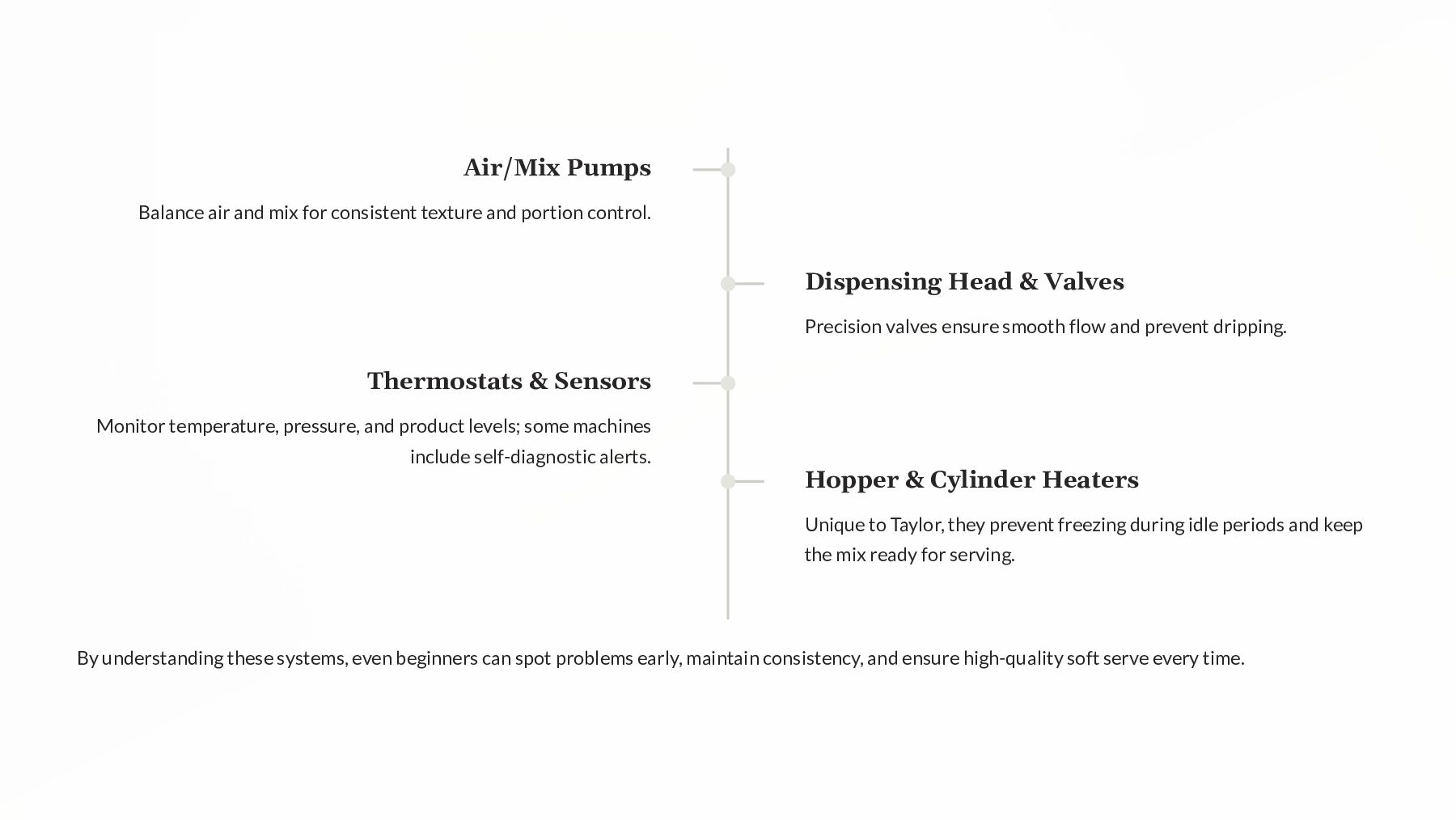
  3. Air/Mix Pumps Balance air and mix for consistent texture and

    portion control. Dispensing Head & Valves Precision valves ensure smooth flow and prevent dripping. Thermostats & Sensors Monitor temperature, pressure, and product levels; some machines include self-diagnostic alerts. Hopper & Cylinder Heaters Unique to Taylor, they prevent freezing during idle periods and keep the mix ready for serving. By understanding these systems, even beginners can spot problems early, maintain consistency, and ensure high-quality soft serve every time.
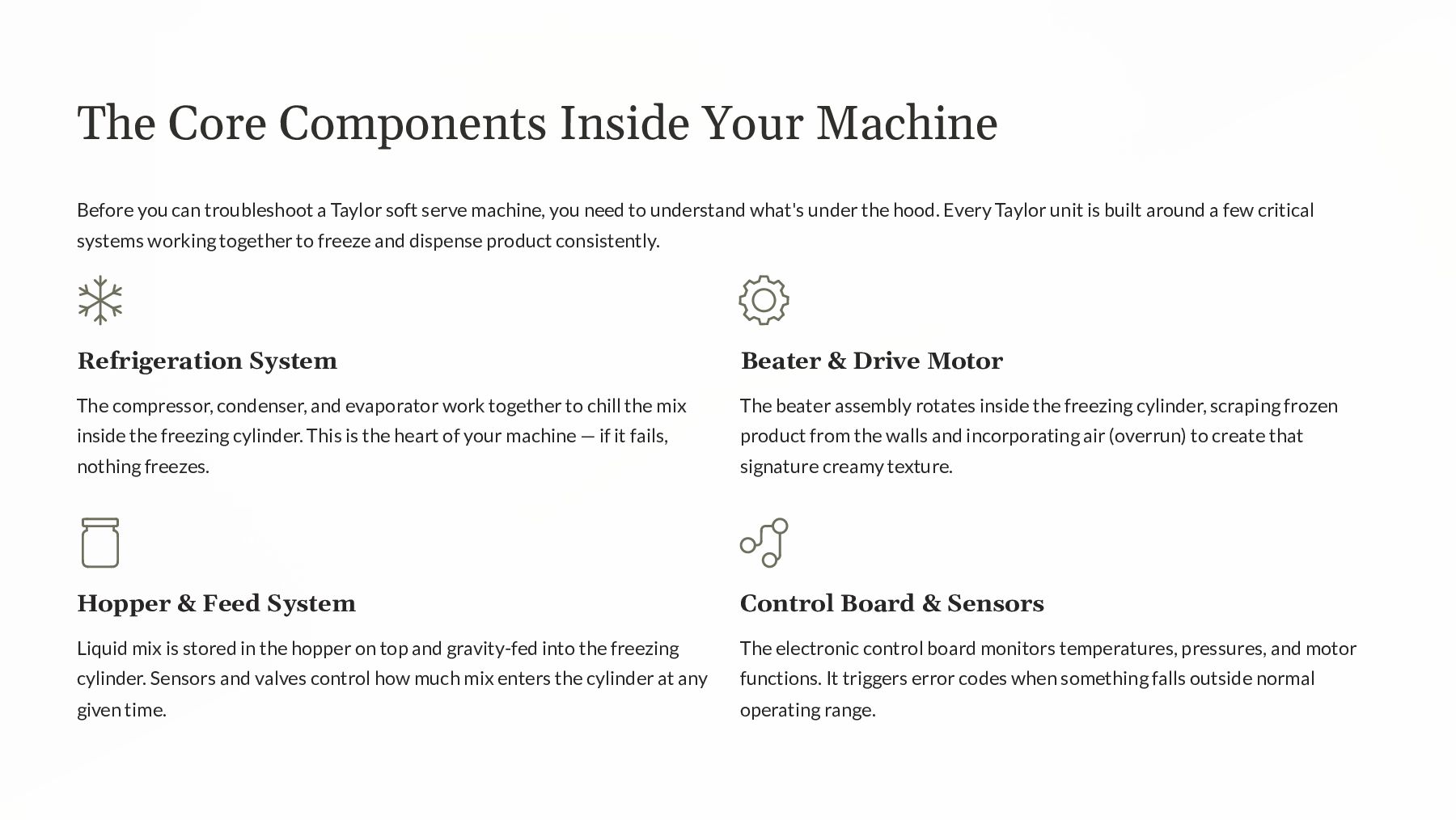
  4. The Core Components Inside Your Machine Before you can troubleshoot

    a Taylor soft serve machine, you need to understand what's under the hood. Every Taylor unit is built around a few critical systems working together to freeze and dispense product consistently. Refrigeration System The compressor, condenser, and evaporator work together to chill the mix inside the freezing cylinder. This is the heart of your machine — if it fails, nothing freezes. Beater & Drive Motor The beater assembly rotates inside the freezing cylinder, scraping frozen product from the walls and incorporating air (overrun) to create that signature creamy texture. Hopper & Feed System Liquid mix is stored in the hopper on top and gravity-fed into the freezing cylinder. Sensors and valves control how much mix enters the cylinder at any given time. Control Board & Sensors The electronic control board monitors temperatures, pressures, and motor functions. It triggers error codes when something falls outside normal operating range.
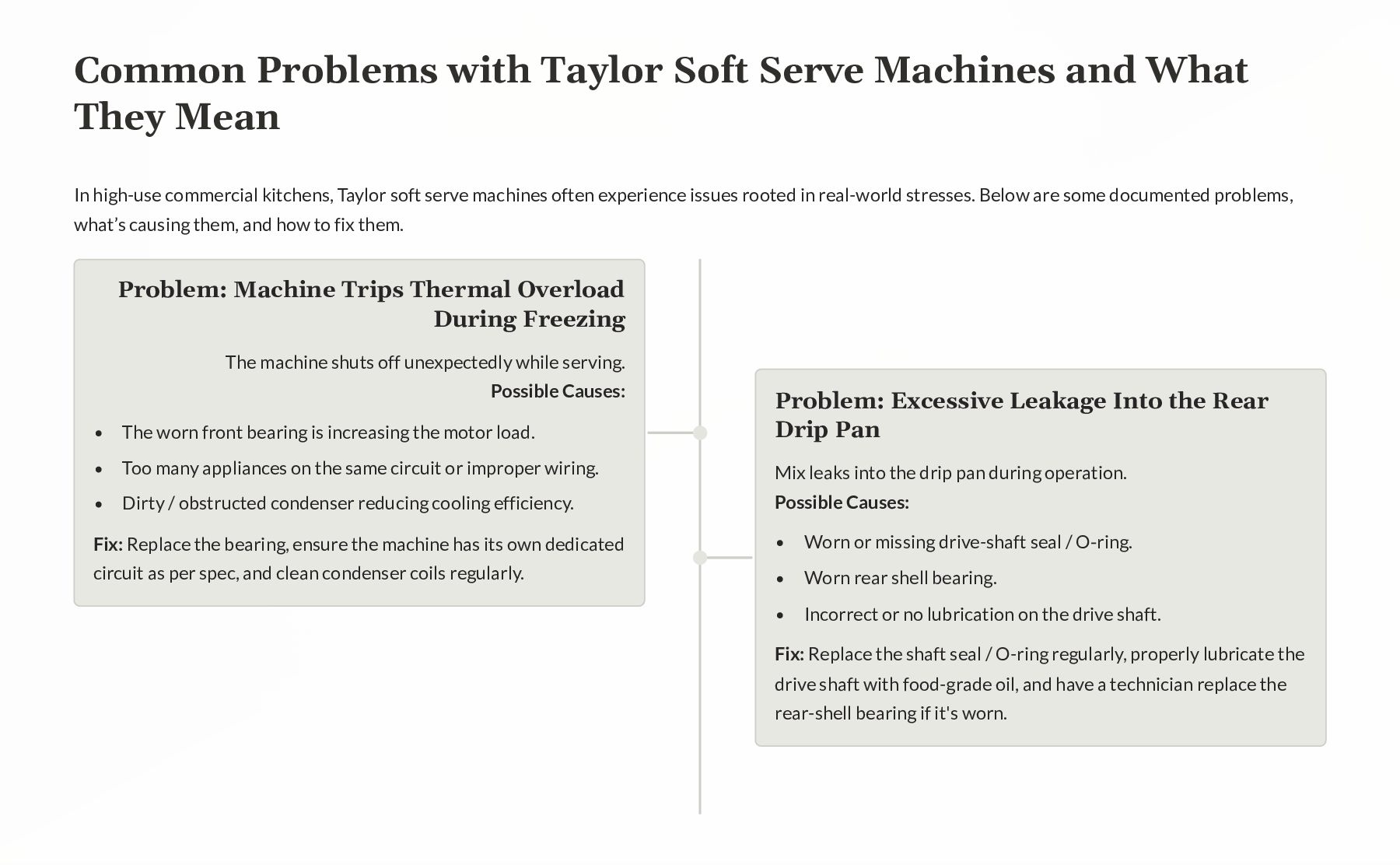
  5. Common Problems with Taylor Soft Serve Machines and What They

    Mean In high-use commercial kitchens, Taylor soft serve machines often experience issues rooted in real-world stresses. Below are some documented problems, what’s causing them, and how to fix them. Problem: Machine Trips Thermal Overload During Freezing The machine shuts off unexpectedly while serving. Possible Causes: The worn front bearing is increasing the motor load. Too many appliances on the same circuit or improper wiring. Dirty / obstructed condenser reducing cooling efficiency. Fix: Replace the bearing, ensure the machine has its own dedicated circuit as per spec, and clean condenser coils regularly. Problem: Excessive Leakage Into the Rear Drip Pan Mix leaks into the drip pan during operation. Possible Causes: Worn or missing drive-shaft seal / O- ring. Worn rear shell bearing. Incorrect or no lubrication on the drive shaft. Fix: Replace the shaft seal / O-ring regularly, properly lubricate the drive shaft with food-grade oil, and have a technician replace the rear-shell bearing if it's worn.
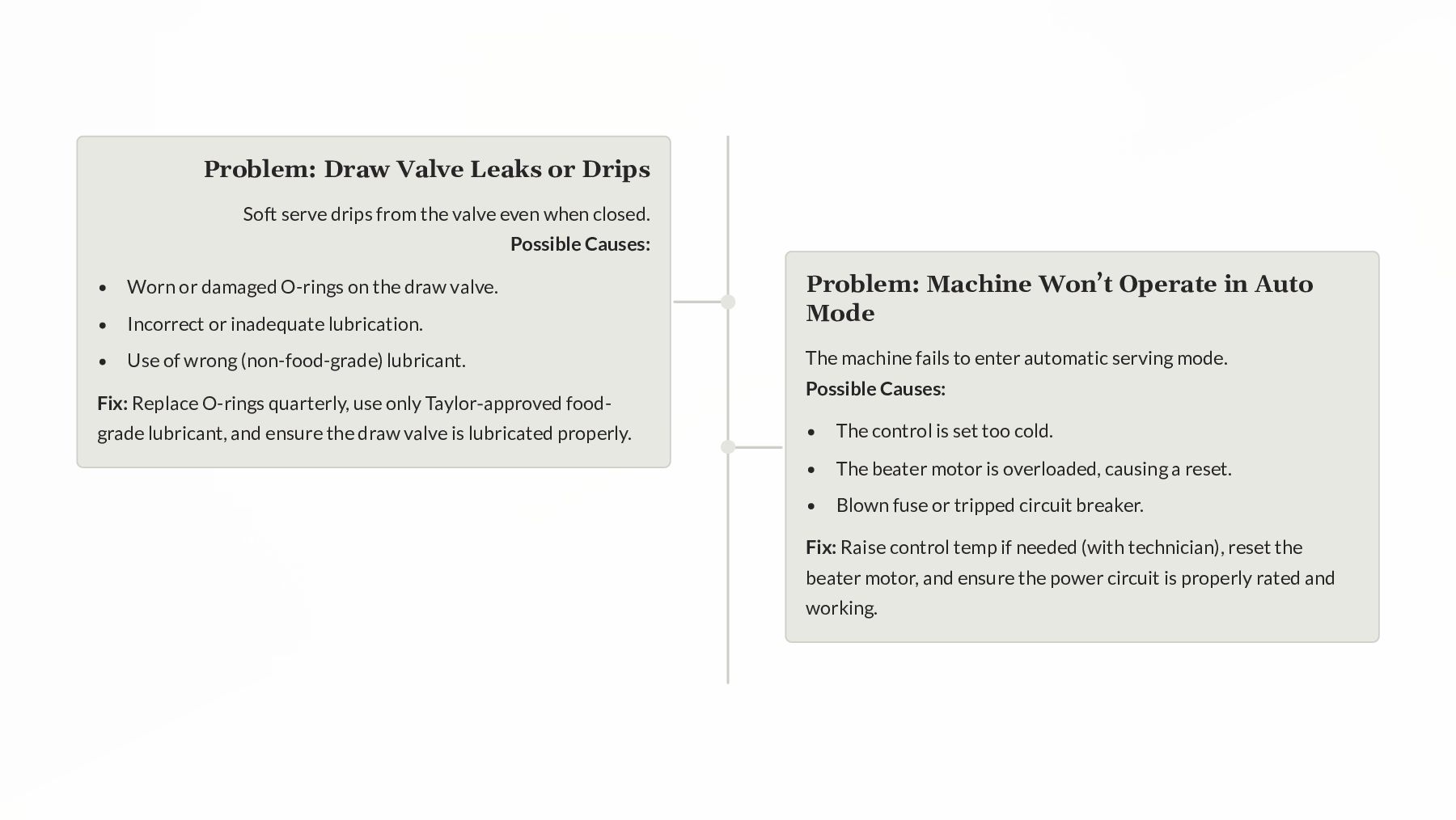
  6. Problem: Draw Valve Leaks or Drips Soft serve drips from

    the valve even when closed. Possible Causes: Worn or damaged O-rings on the draw valve. Incorrect or inadequate lubrication. Use of wrong (non-food-grade) lubricant. Fix: Replace O-rings quarterly, use only Taylor- approved food- grade lubricant, and ensure the draw valve is lubricated properly. Problem: Machine Won’t Operate in Auto Mode The machine fails to enter automatic serving mode. Possible Causes: The control is set too cold. The beater motor is overloaded, causing a reset. Blown fuse or tripped circuit breaker. Fix: Raise control temp if needed (with technician), reset the beater motor, and ensure the power circuit is properly rated and working.
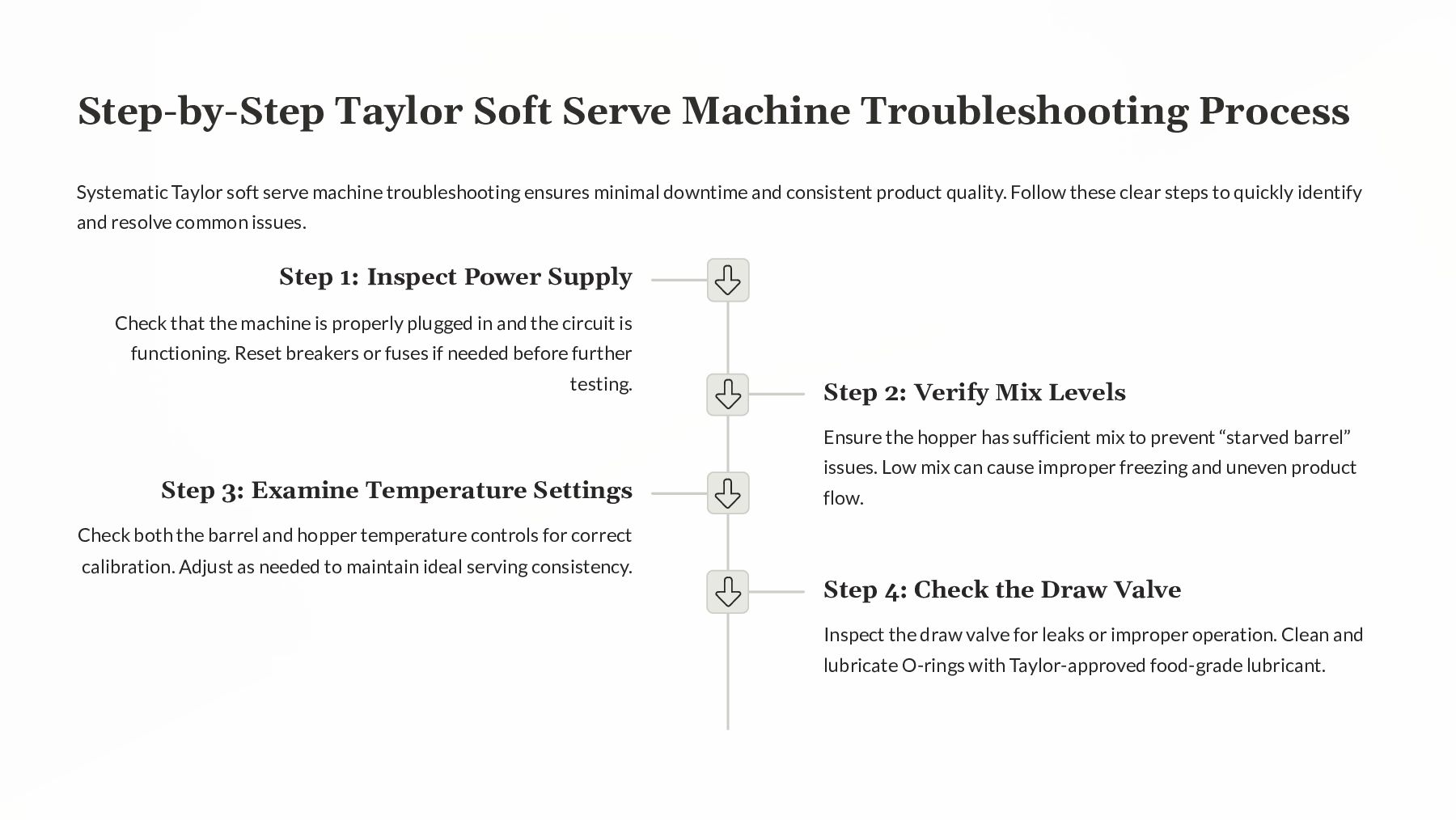
  7. Step-by-Step Taylor Soft Serve Machine Troubleshooting Process Systematic Taylor soft

    serve machine troubleshooting ensures minimal downtime and consistent product quality. Follow these clear steps to quickly identify and resolve common issues. Step 1: Inspect Power Supply Check that the machine is properly plugged in and the circuit is functioning. Reset breakers or fuses if needed before further testing. Step 2: Verify Mix Levels Ensure the hopper has sufficient mix to prevent <starved barrel= issues. Low mix can cause improper freezing and uneven product flow. Step 3: Examine Temperature Settings Check both the barrel and hopper temperature controls for correct calibration. Adjust as needed to maintain ideal serving consistency. Step 4: Check the Draw Valve Inspect the draw valve for leaks or improper operation. Clean and lubricate O-rings with Taylor-approved food-grade lubricant.
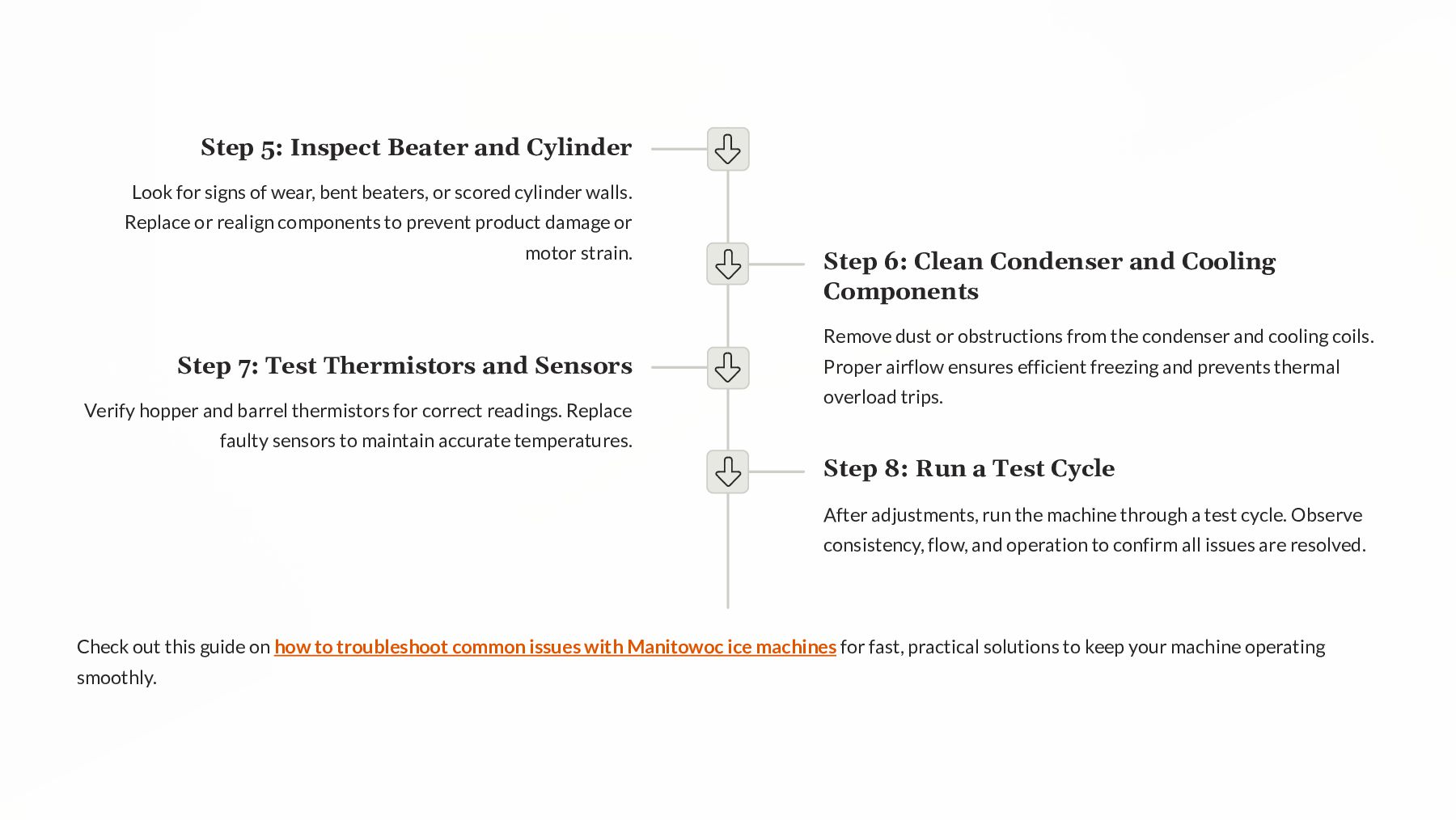
  8. Step 5: Inspect Beater and Cylinder Look for signs of

    wear, bent beaters, or scored cylinder walls. Replace or realign components to prevent product damage or motor strain. Step 6: Clean Condenser and Cooling Components Remove dust or obstructions from the condenser and cooling coils. Proper airflow ensures efficient freezing and prevents thermal overload trips. Step 7: Test Thermistors and Sensors Verify hopper and barrel thermistors for correct readings. Replace faulty sensors to maintain accurate temperatures. Step 8: Run a Test Cycle After adjustments, run the machine through a test cycle. Observe consistency, flow, and operation to confirm all issues are resolved. Check out this guide on how to troubleshoot common issues with Manitowoc ice machines for fast, practical solutions to keep your machine operating smoothly.
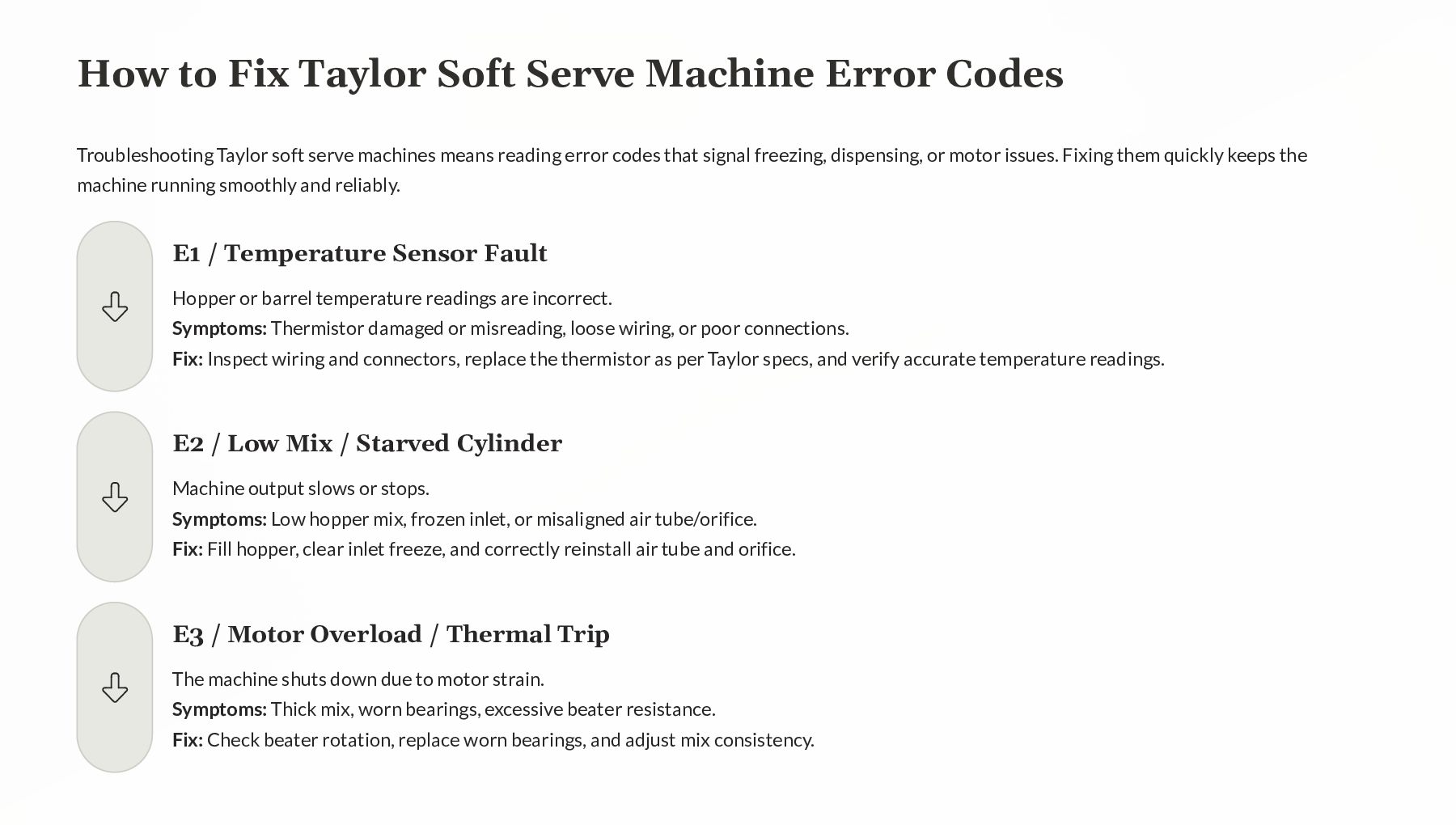
  9. How to Fix Taylor Soft Serve Machine Error Codes Troubleshooting

    Taylor soft serve machines means reading error codes that signal freezing, dispensing, or motor issues. Fixing them quickly keeps the machine running smoothly and reliably. E1 / Temperature Sensor Fault Hopper or barrel temperature readings are incorrect. Symptoms: Thermistor damaged or misreading, loose wiring, or poor connections. Fix: Inspect wiring and connectors, replace the thermistor as per Taylor specs, and verify accurate temperature readings. E2 / Low Mix / Starved Cylinder Machine output slows or stops. Symptoms: Low hopper mix, frozen inlet, or misaligned air tube/orifice. Fix: Fill hopper, clear inlet freeze, and correctly reinstall air tube and orifice. E3 / Motor Overload / Thermal Trip The machine shuts down due to motor strain. Symptoms: Thick mix, worn bearings, excessive beater resistance. Fix: Check beater rotation, replace worn bearings, and adjust mix consistency.
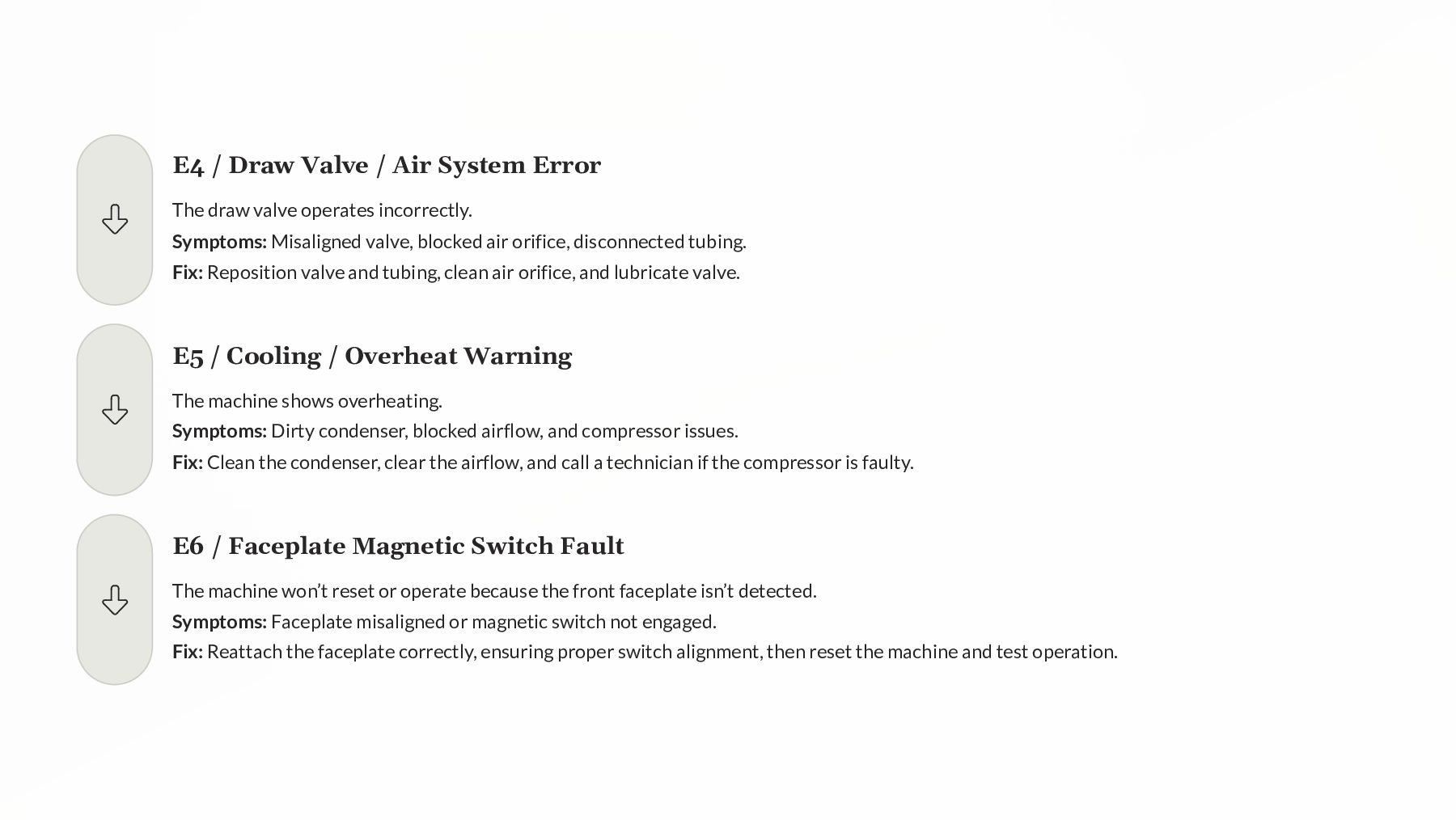
  10. E4 / Draw Valve / Air System Error The draw

    valve operates incorrectly. Symptoms: Misaligned valve, blocked air orifice, disconnected tubing. Fix: Reposition valve and tubing, clean air orifice, and lubricate valve. E5 / Cooling / Overheat Warning The machine shows overheating. Symptoms: Dirty condenser, blocked airflow, and compressor issues. Fix: Clean the condenser, clear the airflow, and call a technician if the compressor is faulty. E6 / Faceplate Magnetic Switch Fault The machine won’t reset or operate because the front faceplate isn’t detected. Symptoms: Faceplate misaligned or magnetic switch not engaged. Fix: Reattach the faceplate correctly, ensuring proper switch alignment, then reset the machine and test operation.
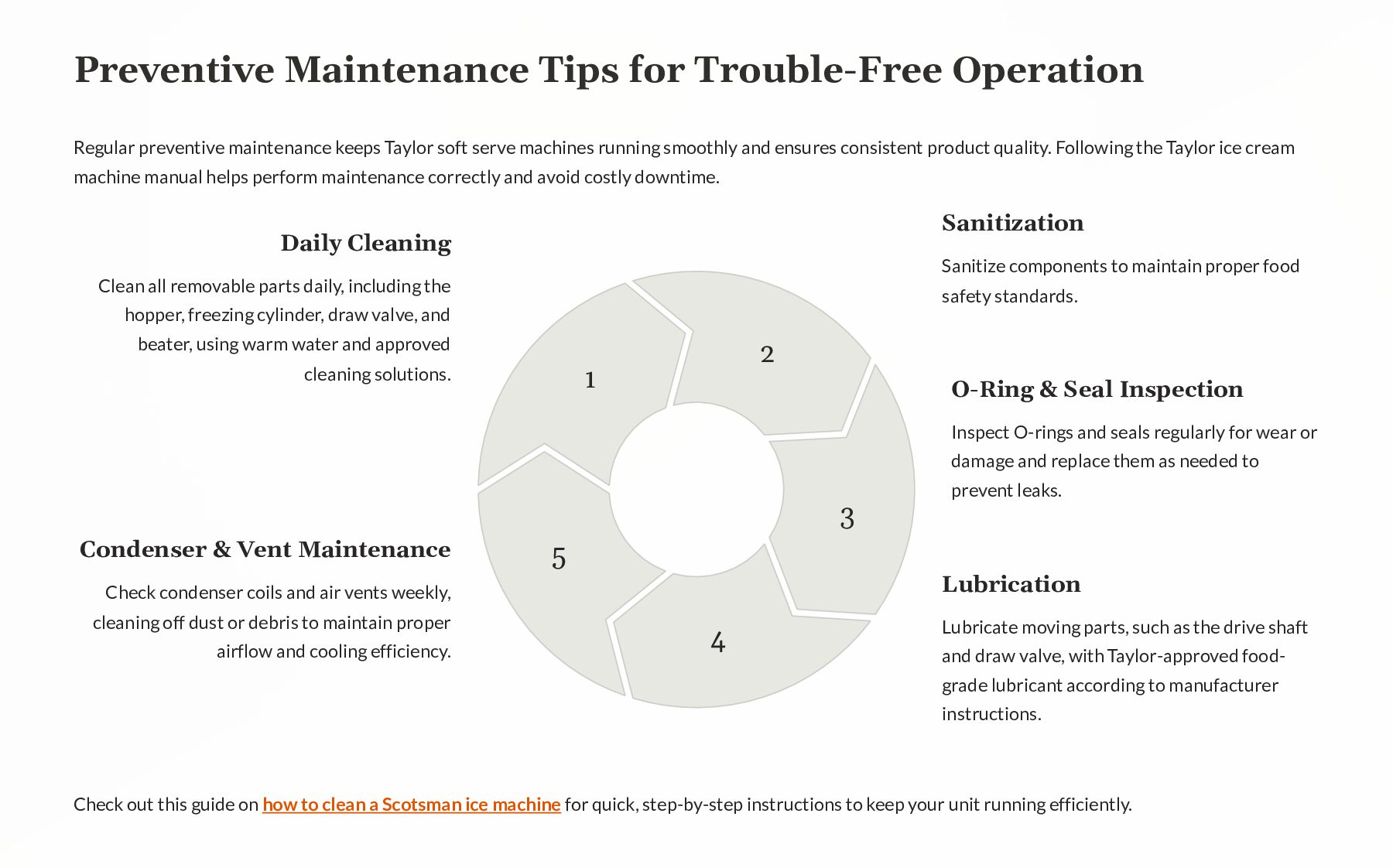
  11. Preventive Maintenance Tips for Trouble-Free Operation Regular preventive maintenance keeps

    Taylor soft serve machines running smoothly and ensures consistent product quality. Following the Taylor ice cream machine manual helps perform maintenance correctly and avoid costly downtime. 1 2 3 4 5 Check out this guide on how to clean a Scotsman ice machine for quick, step-by-step instructions to keep your unit running efficiently. Daily Cleaning Clean all removable parts daily, including the hopper, freezing cylinder, draw valve, and beater, using warm water and approved cleaning solutions. Sanitization Sanitize components to maintain proper food safety standards. O-Ring & Seal Inspection Inspect O-rings and seals regularly for wear or damage and replace them as needed to prevent leaks. Lubrication Lubricate moving parts, such as the drive shaft and draw valve, with Taylor-approved food- grade lubricant according to manufacturer instructions. Condenser & Vent Maintenance Check condenser coils and air vents weekly, cleaning off dust or debris to maintain proper airflow and cooling efficiency.
  12. Conclusion Proper troubleshooting and regular maintenance are essential to ensure

    your Taylor soft serve machine operates efficiently and delivers consistent, high-quality soft serve. By understanding common problems, error codes, and preventive care, you can minimize downtime and extend the life of your equipment. Following these steps also helps reduce repair costs and keeps your commercial kitchen running smoothly. Key Takeaways: Train staff to recognize early signs of mechanical strain or unusual noises. Keep spare O-rings, seals, and bearings on hand for quick replacements. Log machine performance and issues to track recurring problems. Avoid abrupt power-offs to protect motors and electronics. Ensure proper ambient kitchen conditions—extreme heat or humidity can affect machine performance. By implementing these tips along with standard maintenance, your Taylor soft serve machine can remain reliable and efficient. Documenting issues, preparing spare parts, and maintaining optimal kitchen conditions ensure smoother operation and longer equipment life. Looking to upgrade or fix your ice cream soft serve machine? PartsFe CA has you covered with high-quality replacement parts like the mix hopper, freezing cylinder, beater, and dasher assembly from leading brands including Taylor, Allpoints, Hamilton Beach, Franke, and Schaefer, offering fast shipping and reliable support to keep your commercial kitchen running smoothly.
  13. FAQs 1 Why is my Taylor ice cream machine not

    working? The machine may not be receiving power, or a fuse/circuit breaker may have tripped. Check the power supply, reset breakers, and inspect for any mechanical or electrical faults. 2 Why does my Taylor ice cream machine keep freezing up? Freezing issues can occur due to low mix levels, incorrect temperature settings, or clogged inlets. Ensure proper mix quantity, adjust barrel/hopper temperatures, and clear any obstructions. 3 How do you reset a Taylor ice cream machine? Turn the machine off and unplug it for a few minutes. Reattach all components properly, plug it back in, and power it on to reset the system.