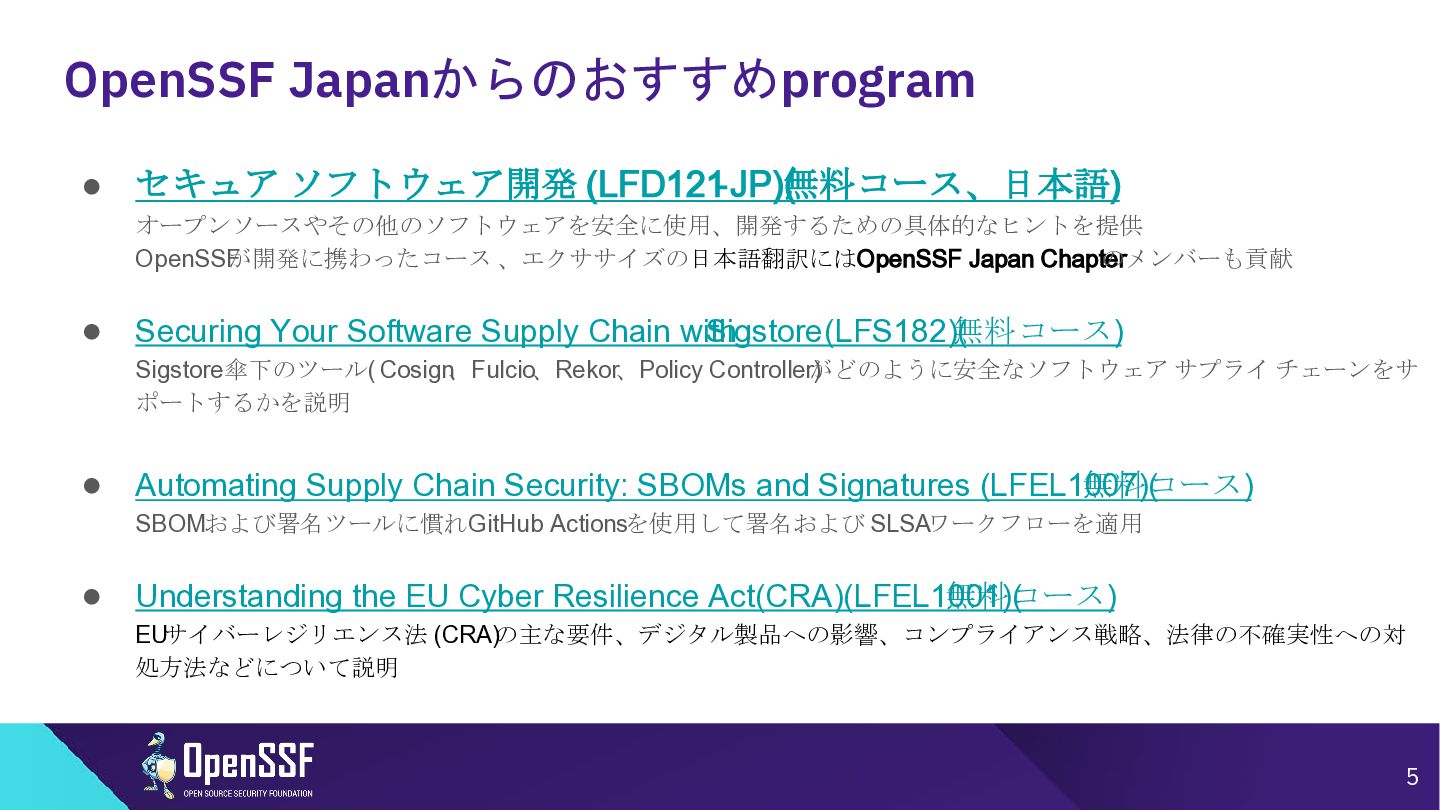
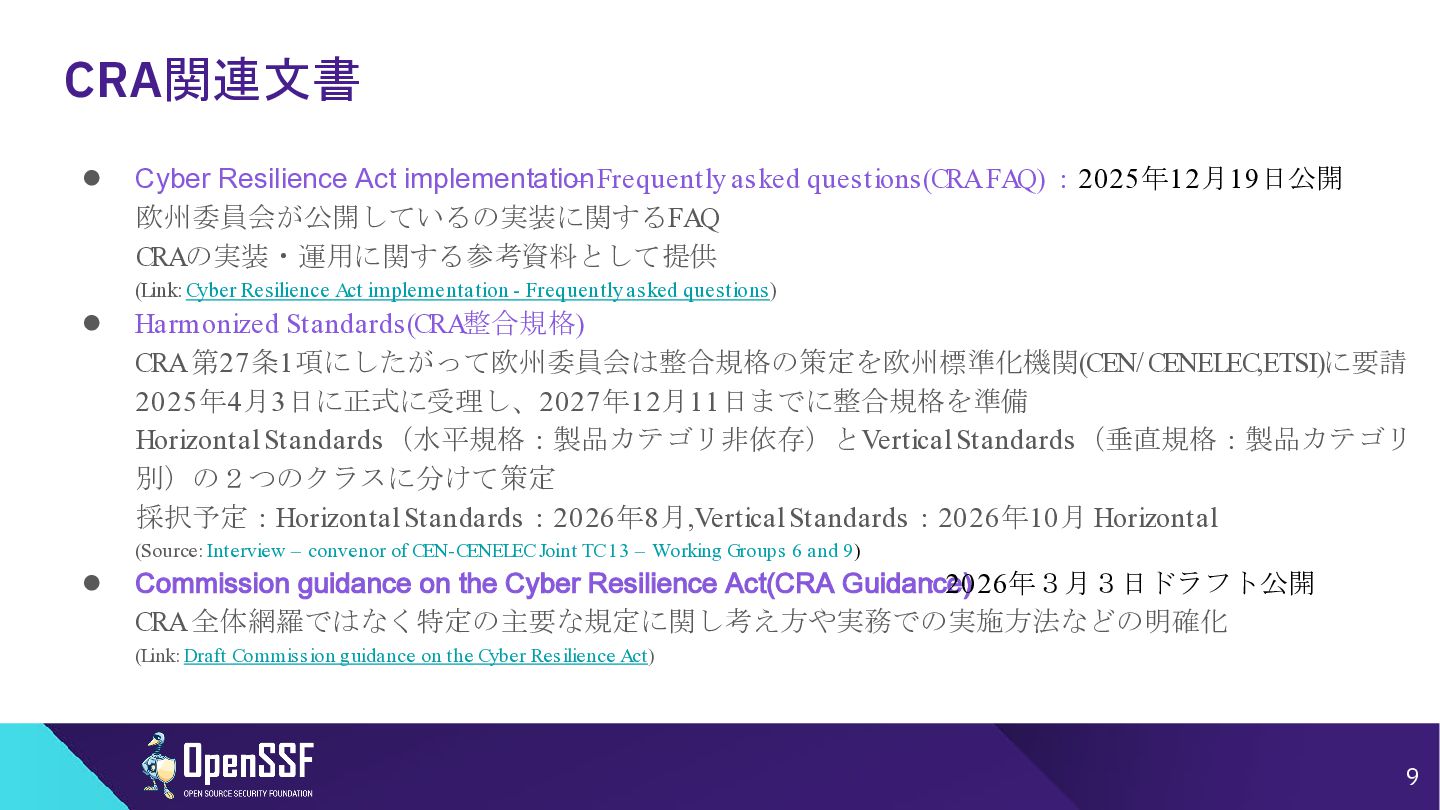
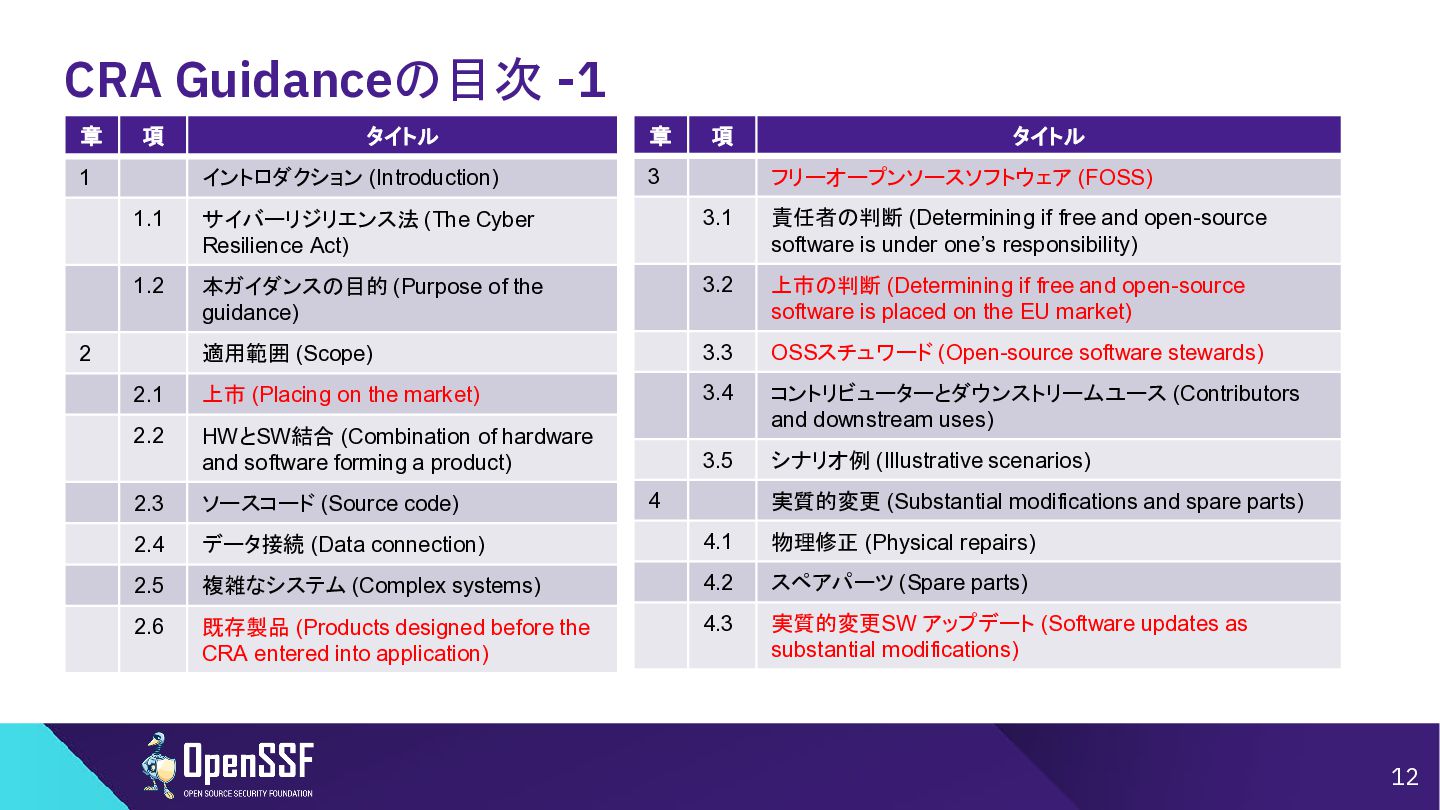
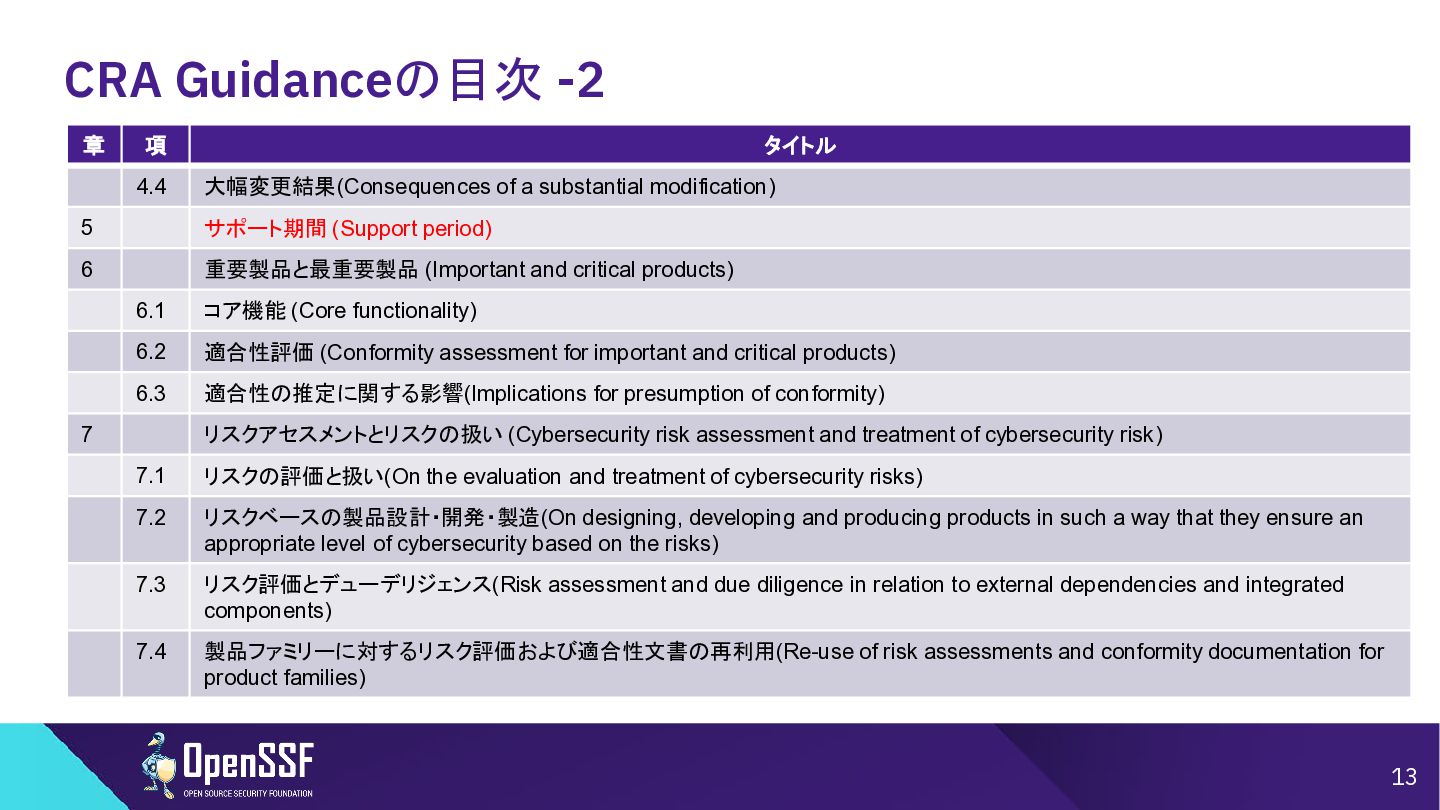
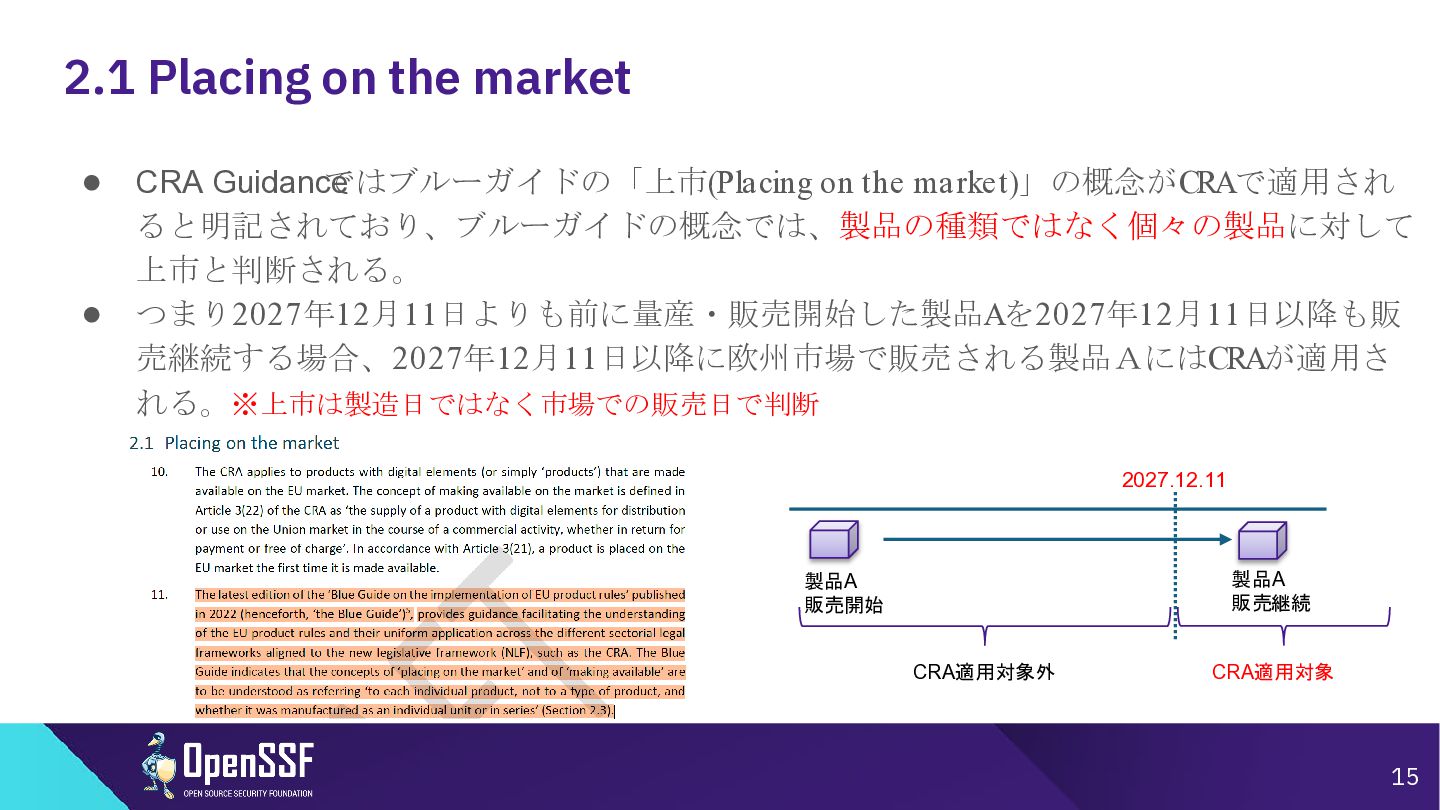
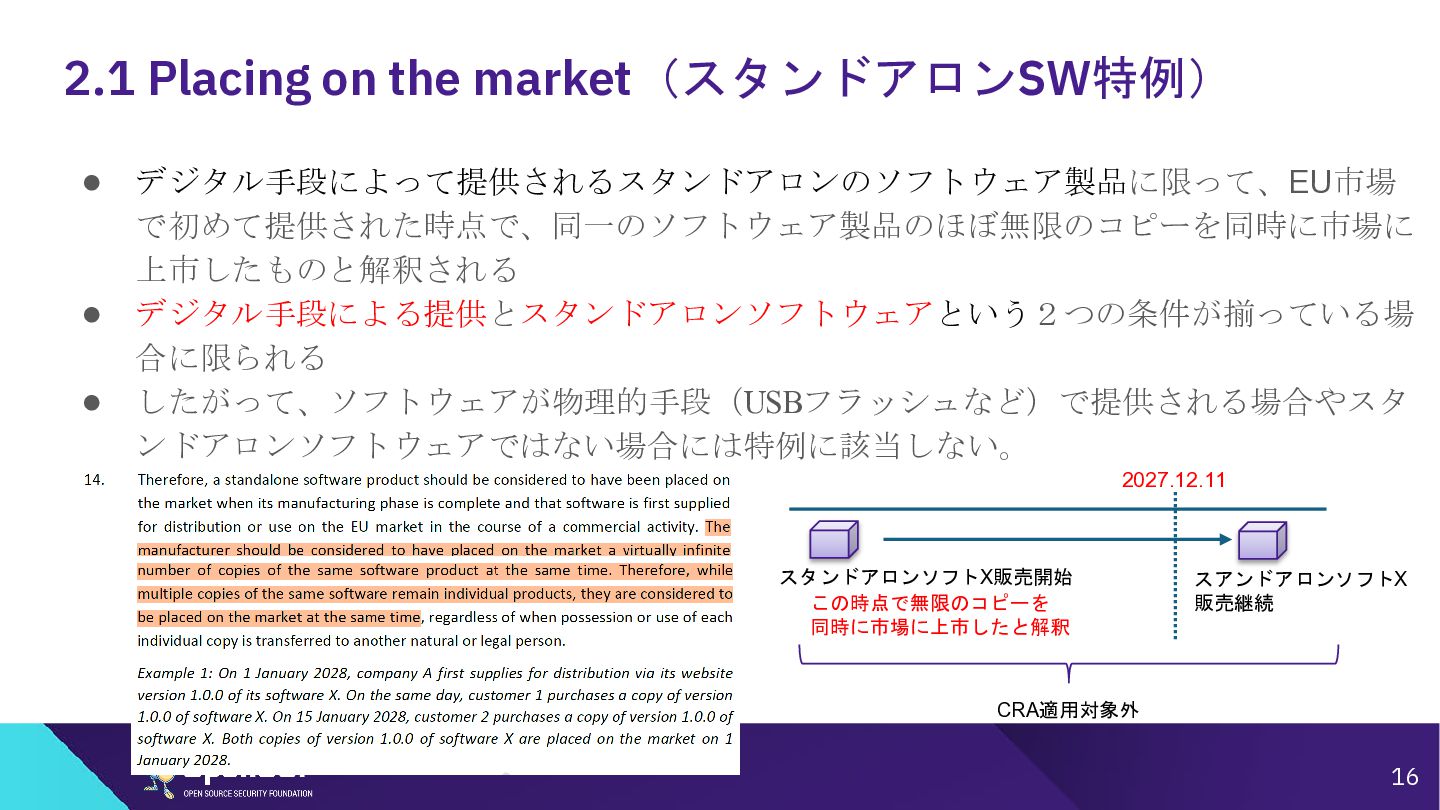
1.1 サイバーリジリエンス法 (The Cyber Resilience Act) 1.2 本ガイダンスの目的 (Purpose of the guidance) 2 適用範囲 (Scope) 2.1 上市 (Placing on the market) 2.2 HWとSW結合 (Combination of hardware and software forming a product) 2.3 ソースコード (Source code) 2.4 データ接続 (Data connection) 2.5 複雑なシステム (Complex systems) 2.6 既存製品 (Products designed before the CRA entered into application) 章 項 タイトル 3 フリーオープンソースソフトウェア (FOSS) 3.1 責任者の判断 (Determining if free and open-source software is under one’s responsibility) 3.2 上市の判断 (Determining if free and open-source software is placed on the EU market) 3.3 OSSスチュワード (Open-source software stewards) 3.4 コントリビューターとダウンストリームユース (Contributors and downstream uses) 3.5 シナリオ例 (Illustrative scenarios) 4 実質的変更 (Substantial modifications and spare parts) 4.1 物理修正 (Physical repairs) 4.2 スペアパーツ (Spare parts) 4.3 実質的変更SW アップデート (Software updates as substantial modifications)
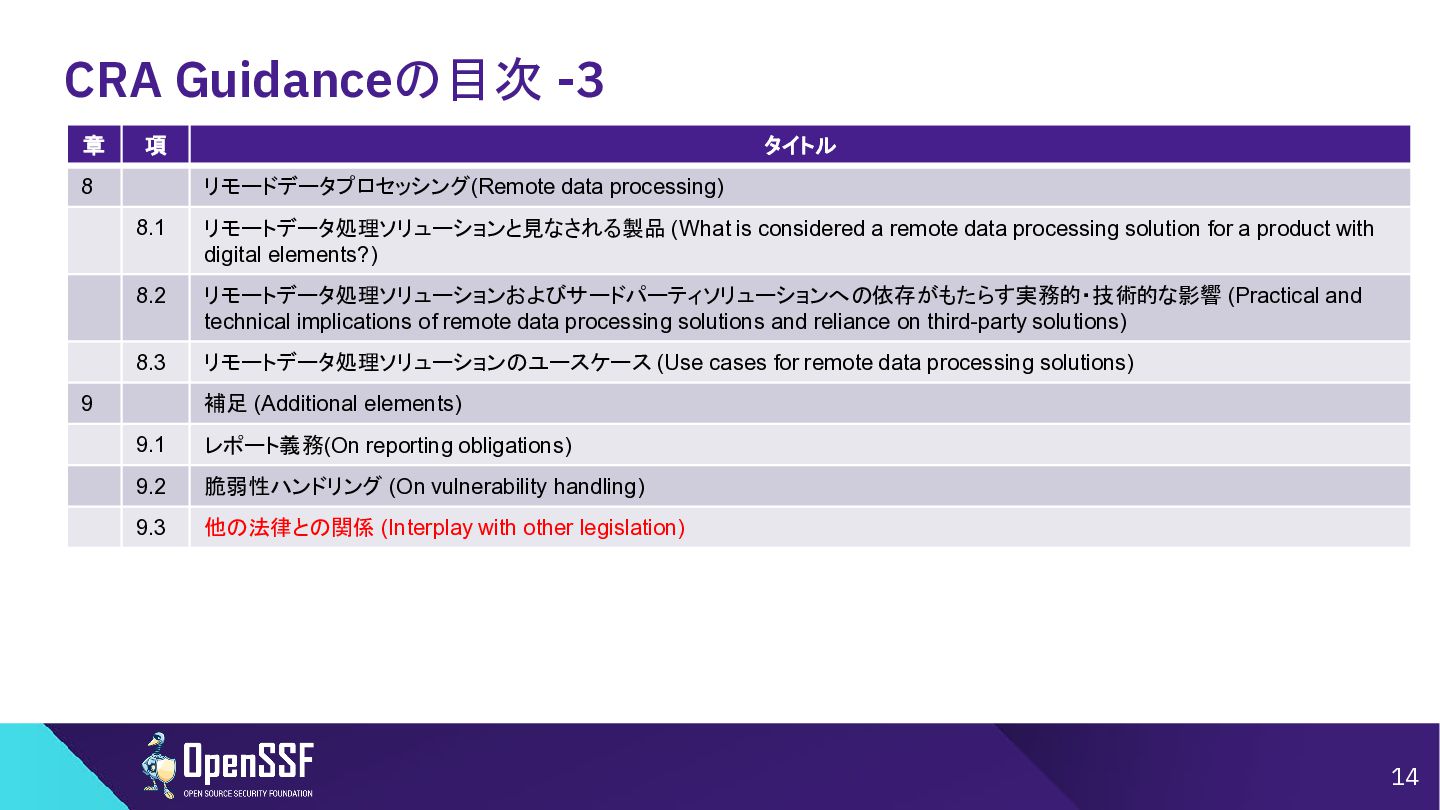
a substantial modification) 5 サポート期間 (Support period) 6 重要製品と最重要製品 (Important and critical products) 6.1 コア機能 (Core functionality) 6.2 適合性評価 (Conformity assessment for important and critical products) 6.3 適合性の推定に関する影響(Implications for presumption of conformity) 7 リスクアセスメントとリスクの扱い (Cybersecurity risk assessment and treatment of cybersecurity risk) 7.1 リスクの評価と扱い(On the evaluation and treatment of cybersecurity risks) 7.2 リスクベースの製品設計・開発・製造(On designing, developing and producing products in such a way that they ensure an appropriate level of cybersecurity based on the risks) 7.3 リスク評価とデューデリジェンス(Risk assessment and due diligence in relation to external dependencies and integrated components) 7.4 製品ファミリーに対するリスク評価および適合性文書の再利用(Re-use of risk assessments and conformity documentation for product families)
processing) 8.1 リモートデータ処理ソリューションと見なされる製品 (What is considered a remote data processing solution for a product with digital elements?) 8.2 リモートデータ処理ソリューションおよびサードパーティソリューションへの依存がもたらす実務的・技術的な影響 (Practical and technical implications of remote data processing solutions and reliance on third-party solutions) 8.3 リモートデータ処理ソリューションのユースケース (Use cases for remote data processing solutions) 9 補足 (Additional elements) 9.1 レポート義務(On reporting obligations) 9.2 脆弱性ハンドリング (On vulnerability handling) 9.3 他の法律との関係 (Interplay with other legislation)
Foundation®, & their contributors. The Linux Foundation has registered trademarks and uses trademarks. All other trademarks are those of their respective owners. Per the OpenSSF Charter, this presentation is released under the Creative Commons Attribution 4.0 International License (CC-BY-4.0), available at <https://creativecommons.org/licenses/by/4.0/>. You are free to: • Share — copy and redistribute the material in any medium or format for any purpose, even commercially. • Adapt — remix, transform, and build upon the material for any purpose, even commercially. The licensor cannot revoke these freedoms as long as you follow the license terms: • Attribution — You must give appropriate credit , provide a link to the license, and indicate if changes were made . You may do so in any reasonable manner, but not in any way that suggests the licensor endorses you or your use. • No additional restrictions — You may not apply legal terms or technological measures that legally restrict others from doing anything the license permits. 20


 lfj
lfj
 ymrl
ymrl
 ishiirikie
 tatamiya
 shumei_ito
 ykagano
 chack411
 iotengineer22
 kameitomohiro
 recruitengineers
.png) codatum
codatum
 toshimaru
 hironobuiga
 rasmusluckow
 destraynor
 ryanjones
 rabernat
 frankvandijk
 lemiorhan
 honzajavorek
 madoxten
 keavy
keavy
 retrage
 aarron
 axbom
axbom