Upgrade to Pro — share decks privately, control downloads, hide ads and more …

Verifying Cedar Policy’s correctness with prope...

Verifying Cedar Policy’s correctness with property-based and differential response testing

Presented at Bug Bash 2026: https://antithesis.com/bugbash/conference2026/agenda/
Recording: TBA
Location: 1201 K St NW, Washington, DC 20005

Avatar for Lucas Käldström

Lucas Käldström

April 24, 2026

More Decks by Lucas Käldström

Other Decks in Technology

Transcript

  1. Verifying Cedar Policy’s correctness with property-based and differential response testing
    Lucas Käldström Kubernetes Contributor & Cedar Maintainer Staff Software Engineer, @luxas.dev Bug Bash, Washington DC, April 23, 2026
  2. $ whoami - Kubernetes contributor, first around SIG Cluster Lifecycle,

    now SIG Auth - Staff Software Engineer at Upbound, working on access control - Explored making Kubernetes access control more granular, found Cedar ⇒ Kubernetes Enhancement: Conditional Authorization (KEP-5681) ⇒ Prototype for implementing Kubernetes ACLs using Cedar - Newly-accepted Cedar maintainer, lots of new stuff to learn @luxas.dev
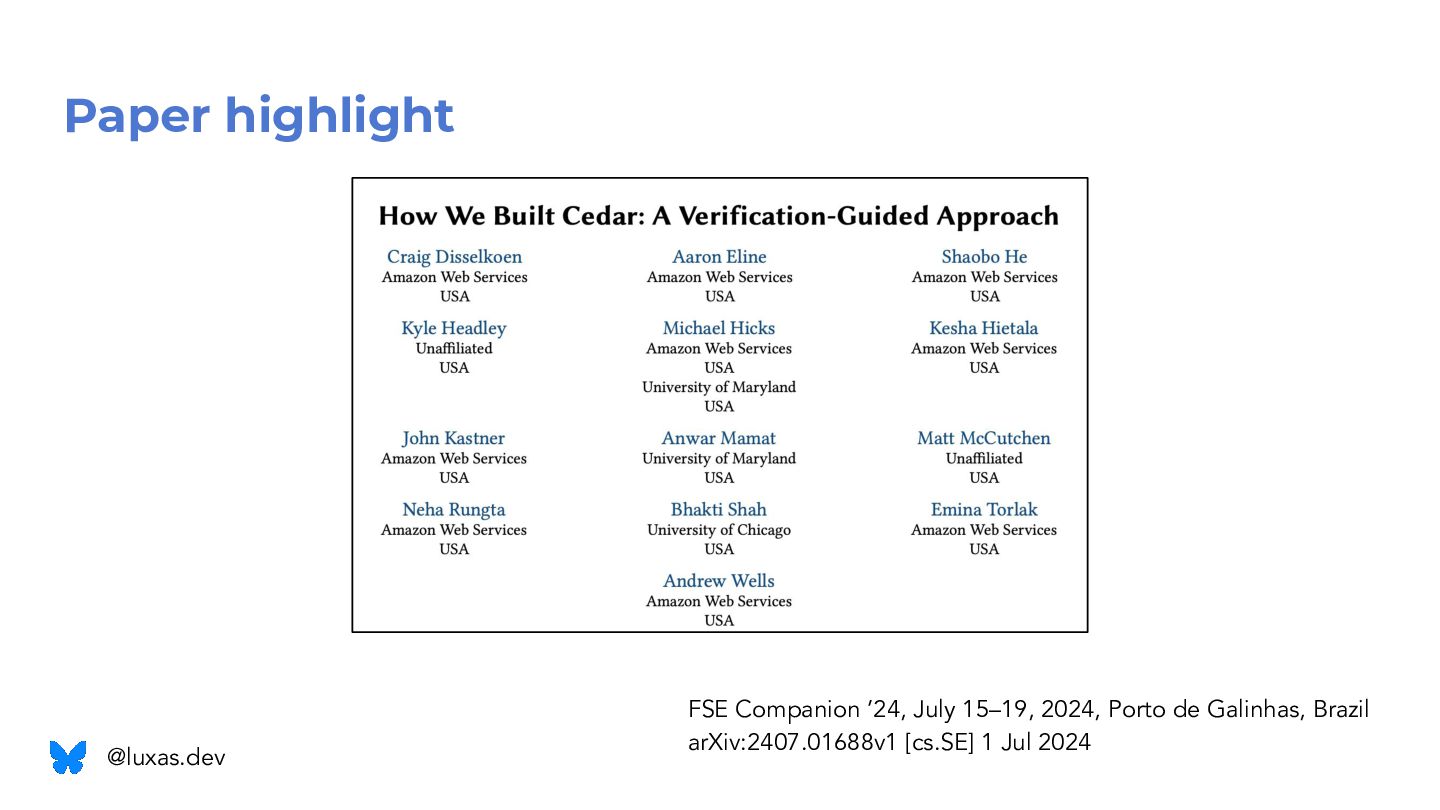
  3. Paper highlight FSE Companion ’24, July 15–19, 2024, Porto de

    Galinhas, Brazil arXiv:2407.01688v1 [cs.SE] 1 Jul 2024 @luxas.dev
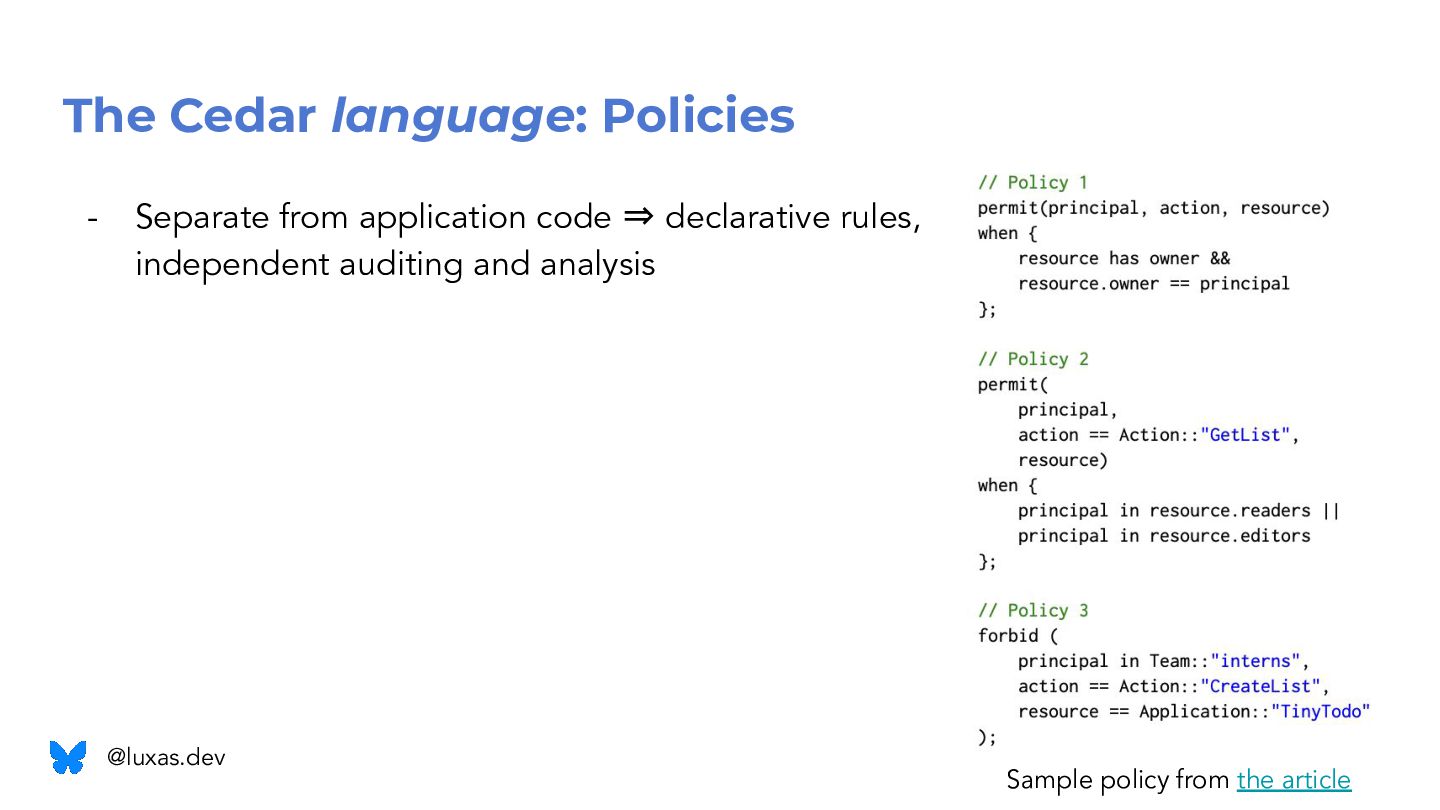
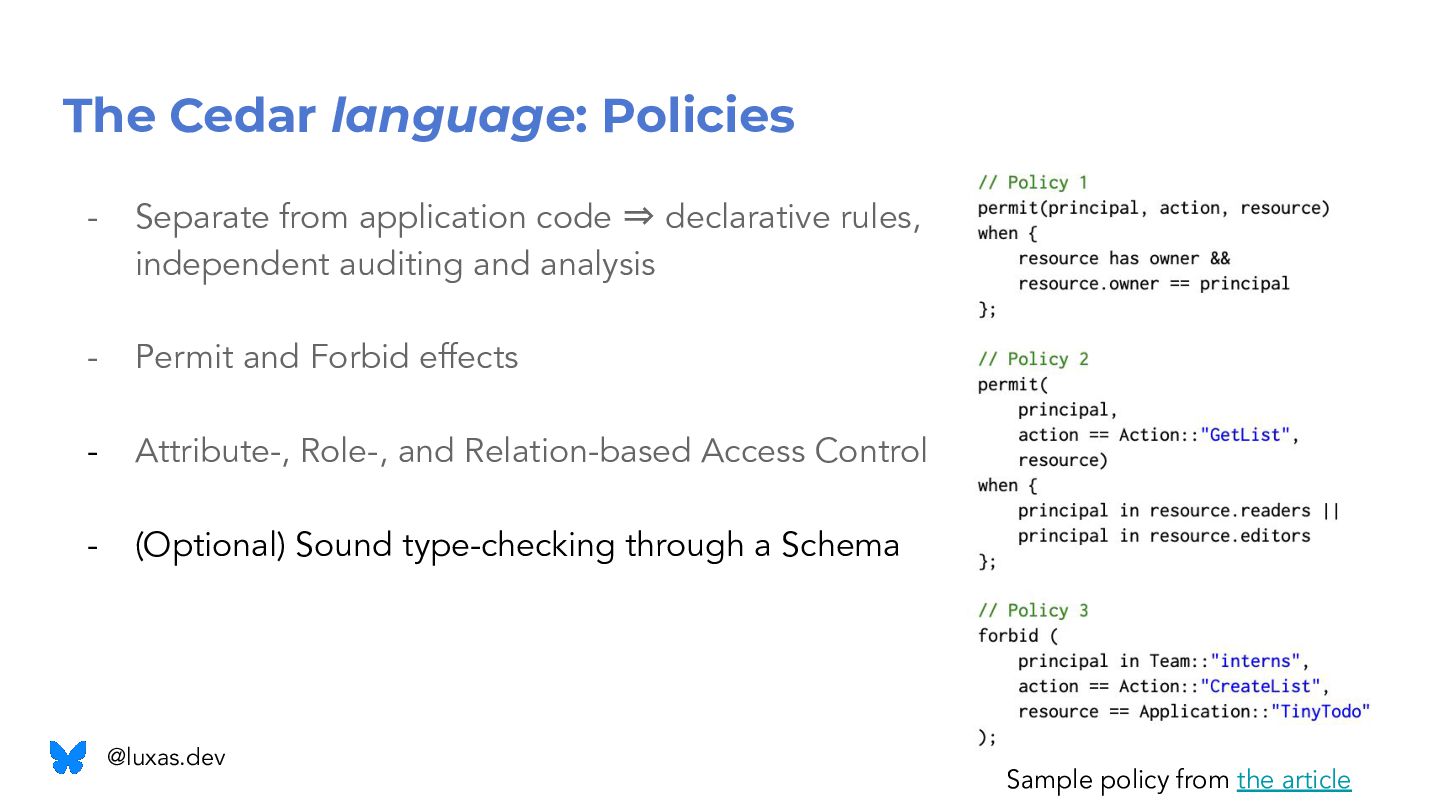
  4. The Cedar language: Policies - Separate from application code ⇒

    declarative rules, independent auditing and analysis @luxas.dev Sample policy from the article
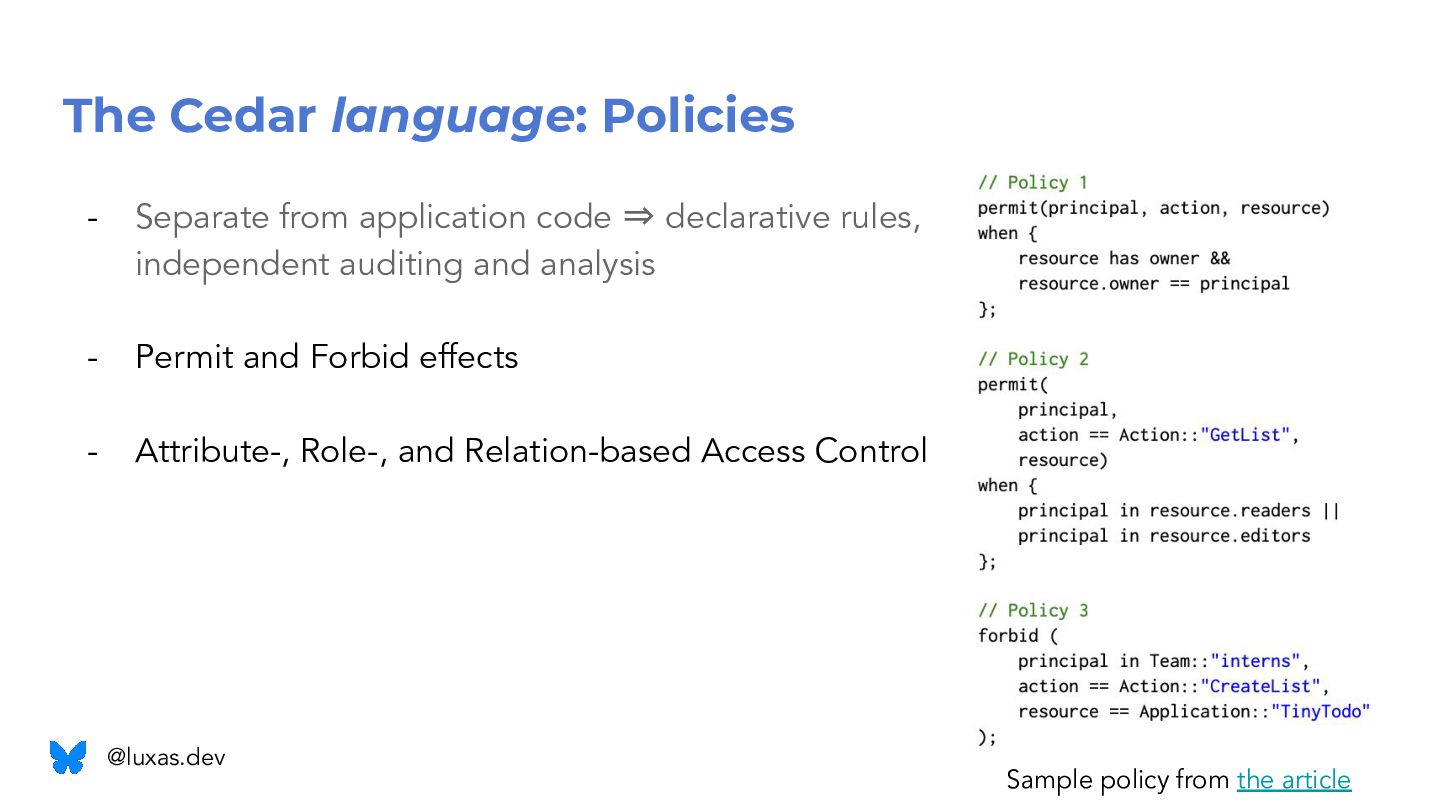
  5. The Cedar language: Policies - Separate from application code ⇒

    declarative rules, independent auditing and analysis - Permit and Forbid effects - Attribute-, Role-, and Relation-based Access Control @luxas.dev Sample policy from the article
  6. The Cedar language: Policies - Separate from application code ⇒

    declarative rules, independent auditing and analysis - Permit and Forbid effects - Attribute-, Role-, and Relation-based Access Control - (Optional) Sound type-checking through a Schema @luxas.dev Sample policy from the article
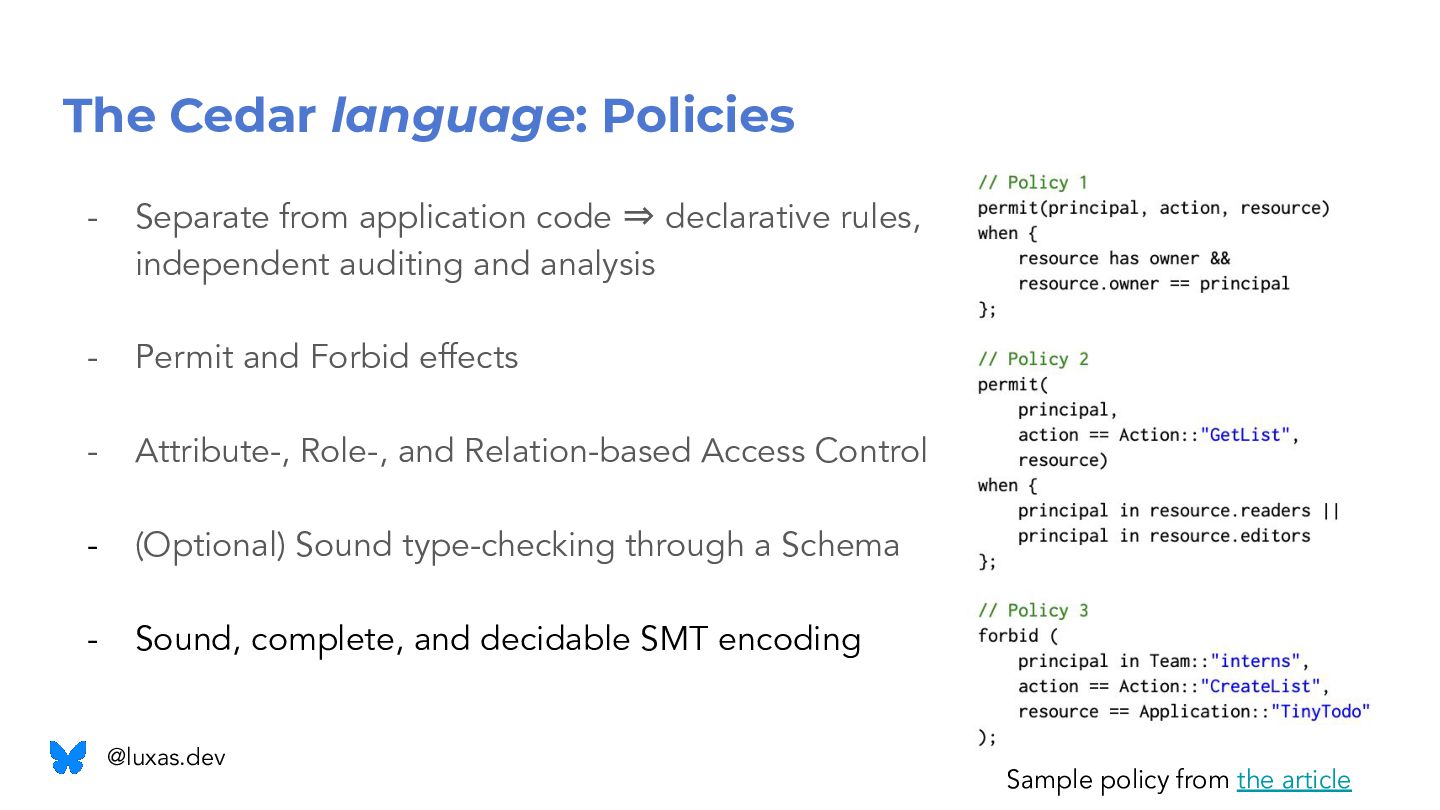
  7. The Cedar language: Policies - Separate from application code ⇒

    declarative rules, independent auditing and analysis - Permit and Forbid effects - Attribute-, Role-, and Relation-based Access Control - (Optional) Sound type-checking through a Schema - Sound, complete, and decidable SMT encoding @luxas.dev Sample policy from the article
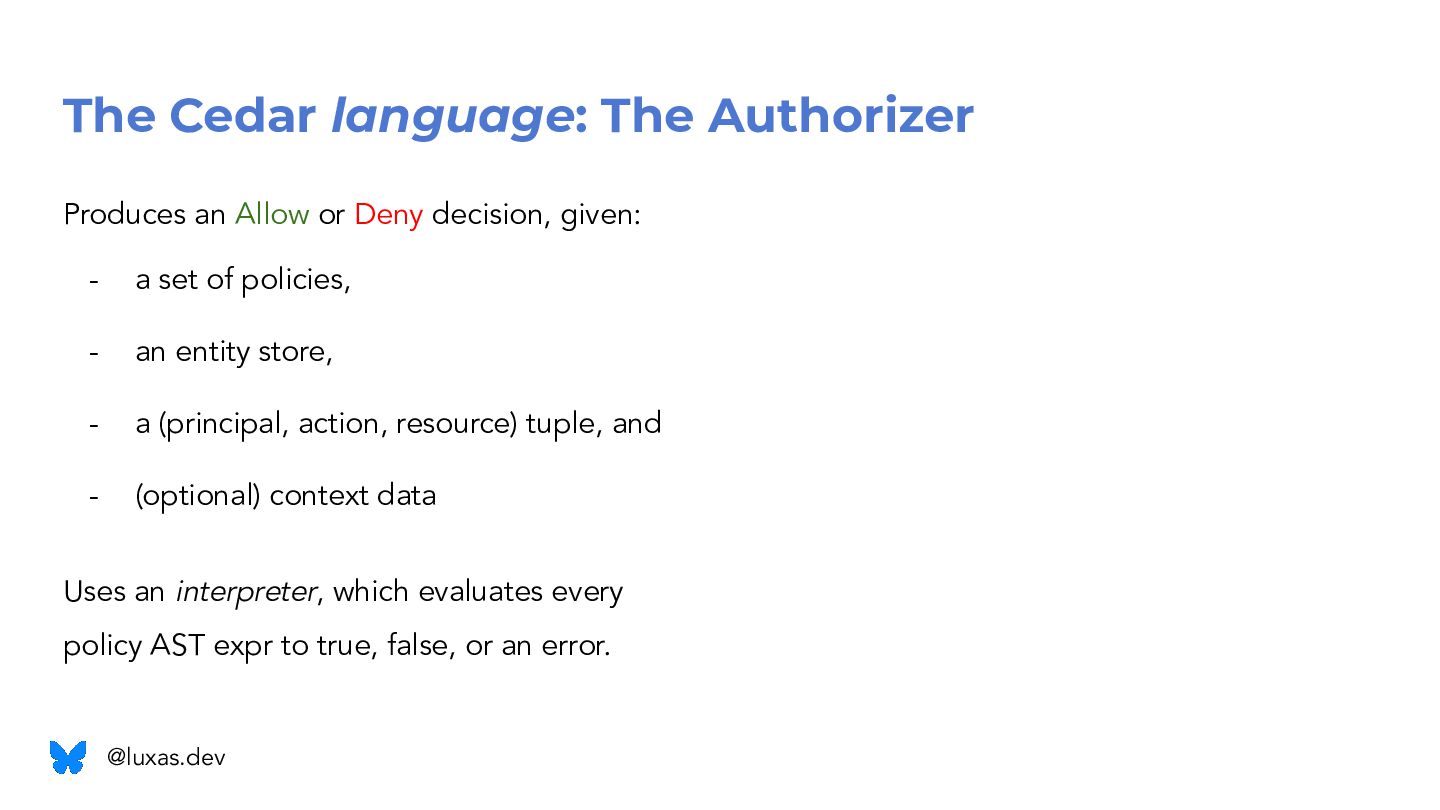
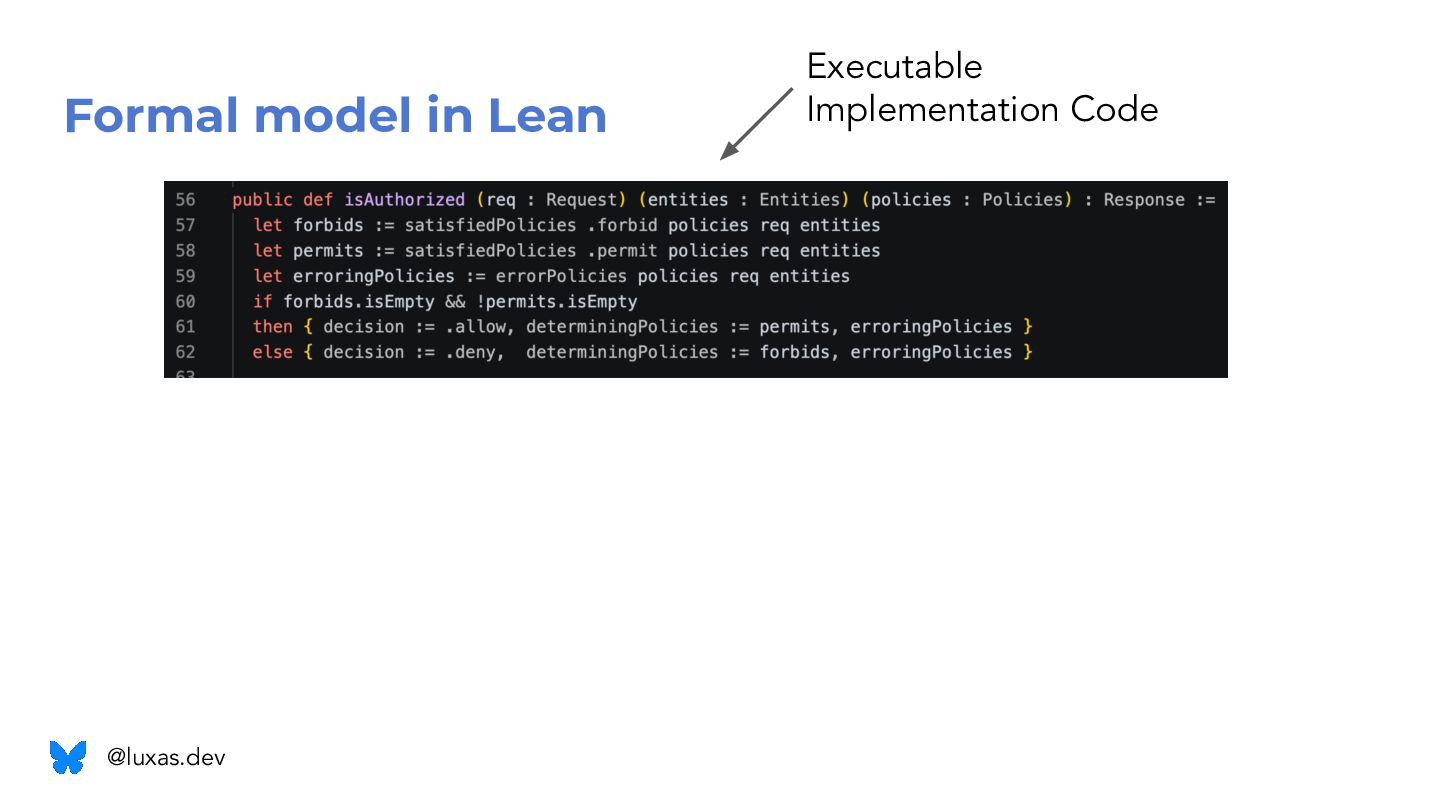
  8. The Cedar language: The Authorizer Produces an Allow or Deny

    decision, given: - a set of policies, - an entity store, - a (principal, action, resource) tuple, and - (optional) context data Uses an interpreter, which evaluates every policy AST expr to true, false, or an error. @luxas.dev
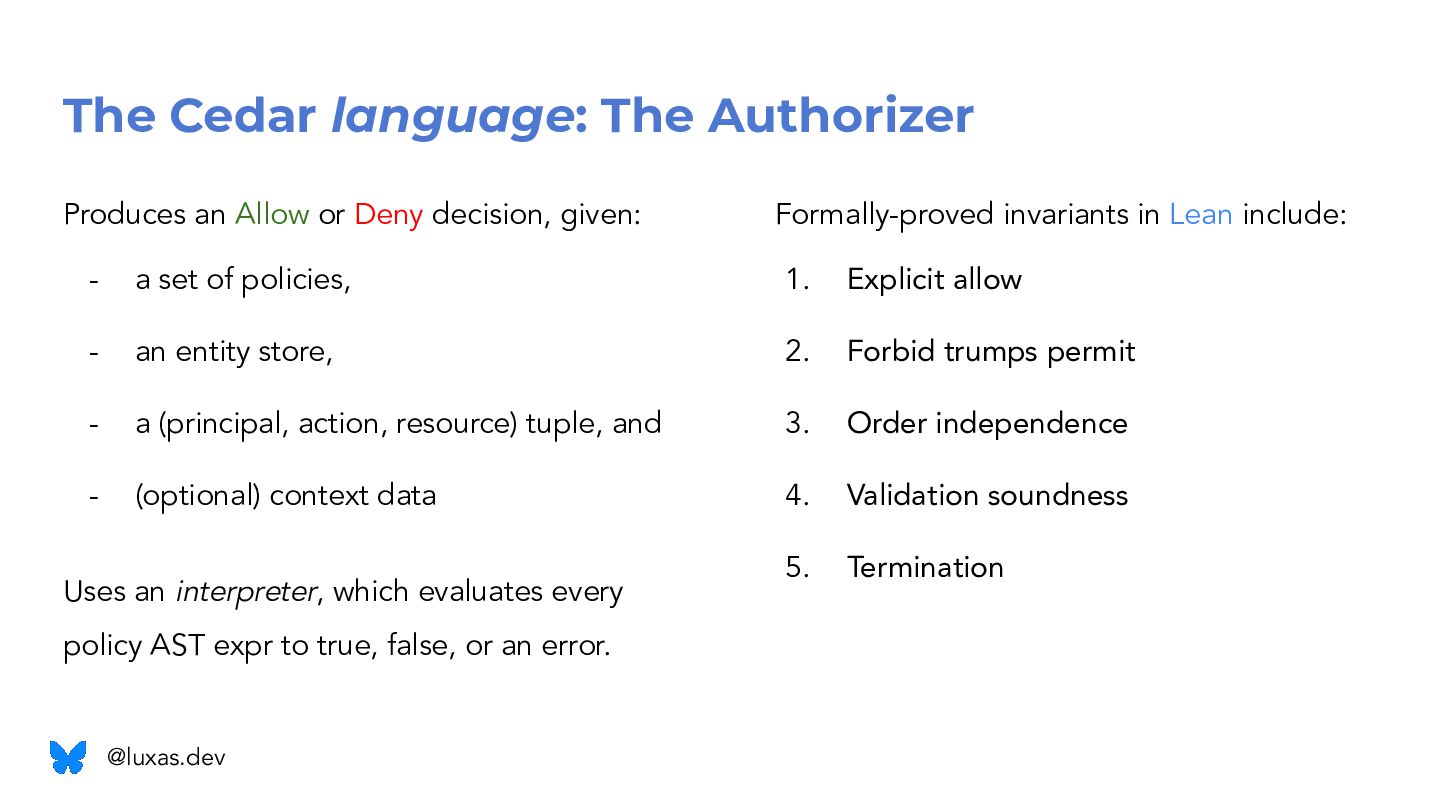
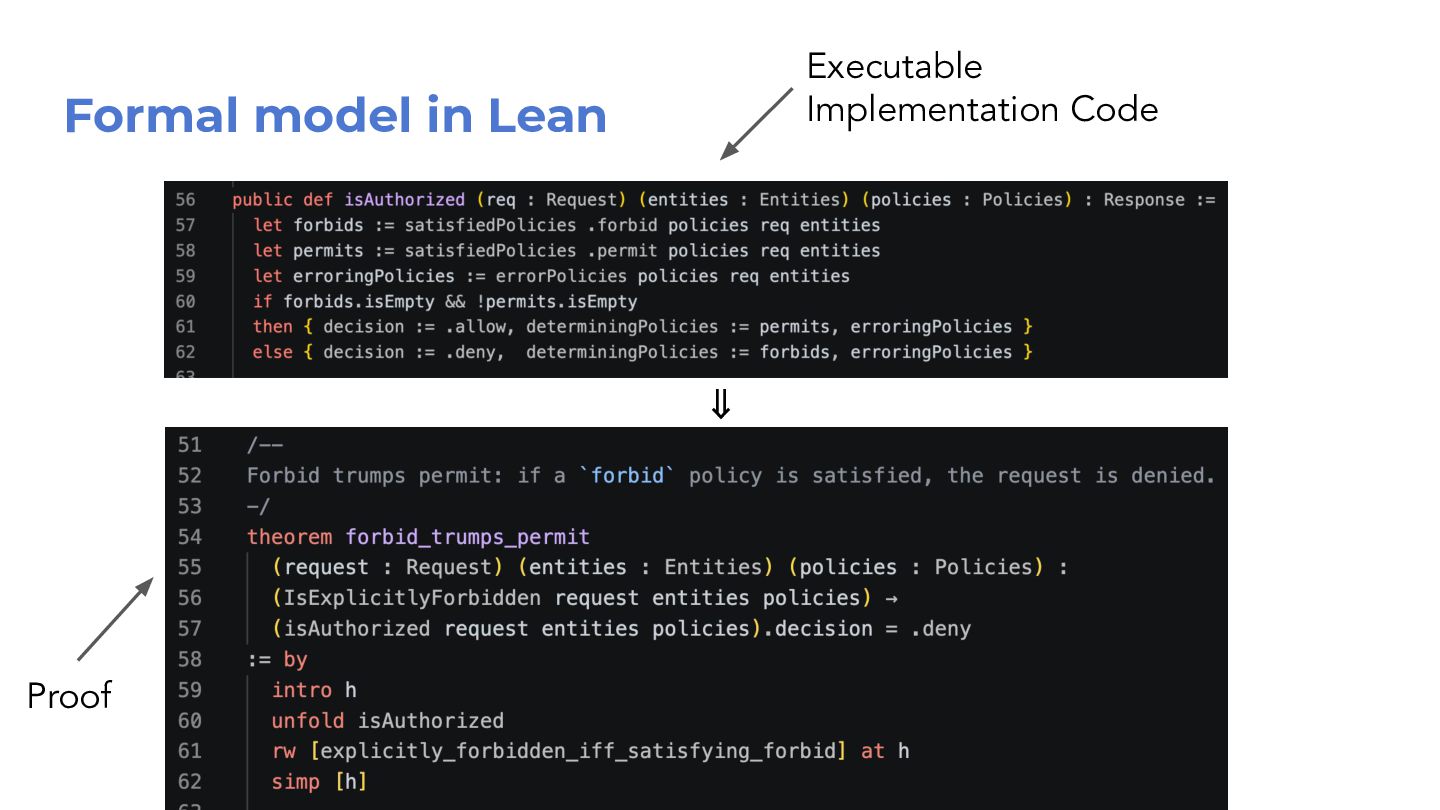
  9. The Cedar language: The Authorizer Produces an Allow or Deny

    decision, given: - a set of policies, - an entity store, - a (principal, action, resource) tuple, and - (optional) context data Uses an interpreter, which evaluates every policy AST expr to true, false, or an error. Formally-proved invariants in Lean include: 1. Explicit allow 2. Forbid trumps permit 3. Order independence 4. Validation soundness 5. Termination @luxas.dev
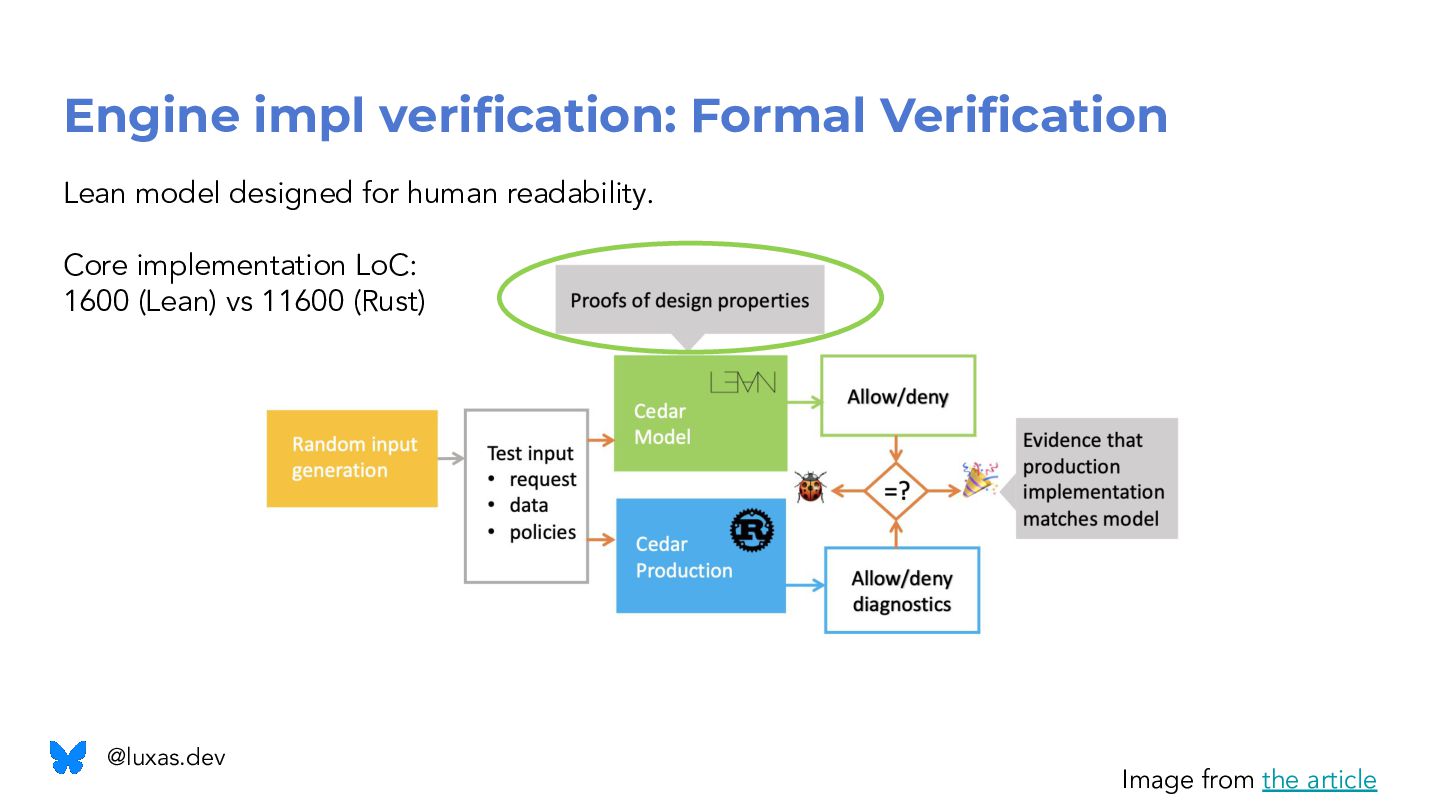
  10. Engine impl verification: Formal Verification Lean model designed for human

    readability. Core implementation LoC: 1600 (Lean) vs 11600 (Rust) @luxas.dev Image from the article
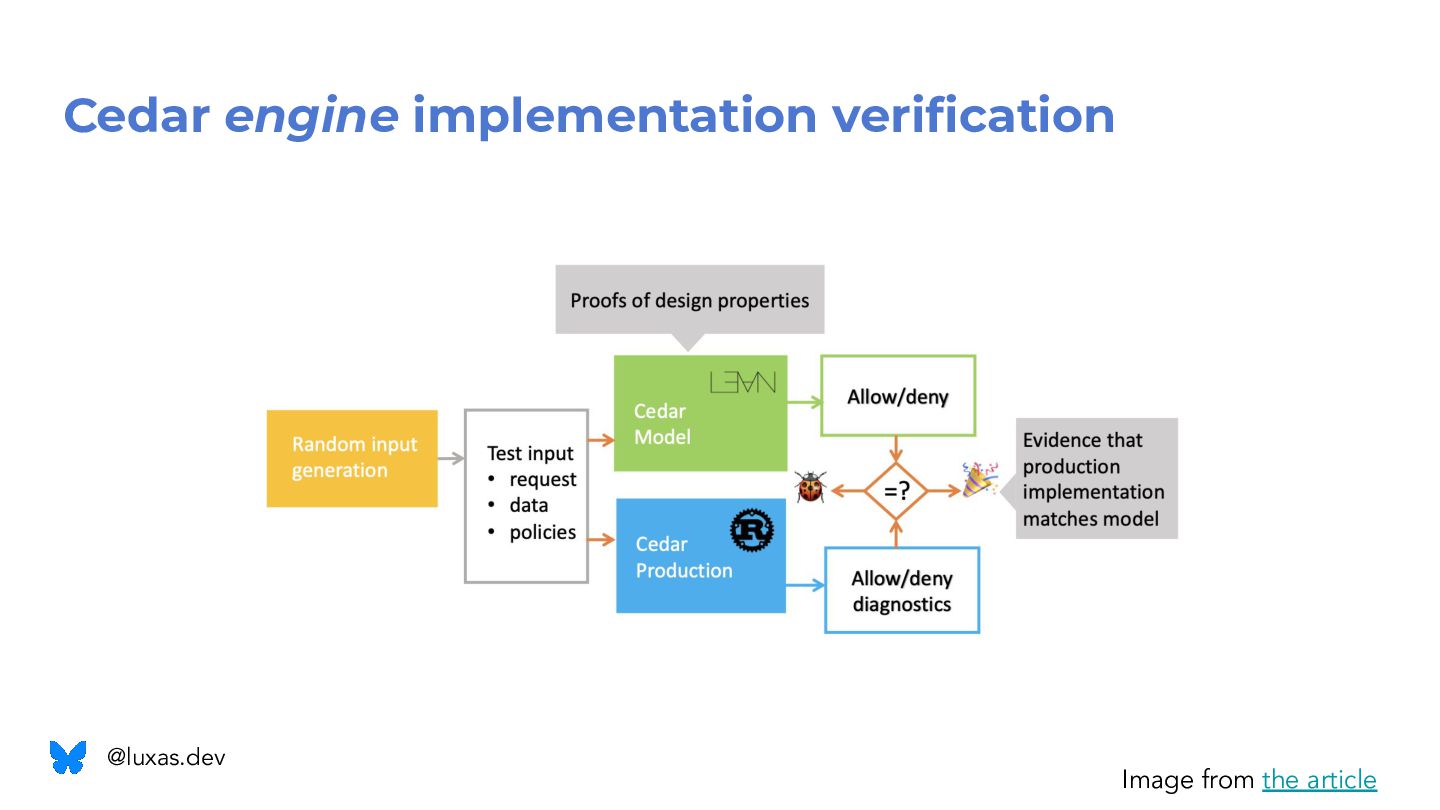
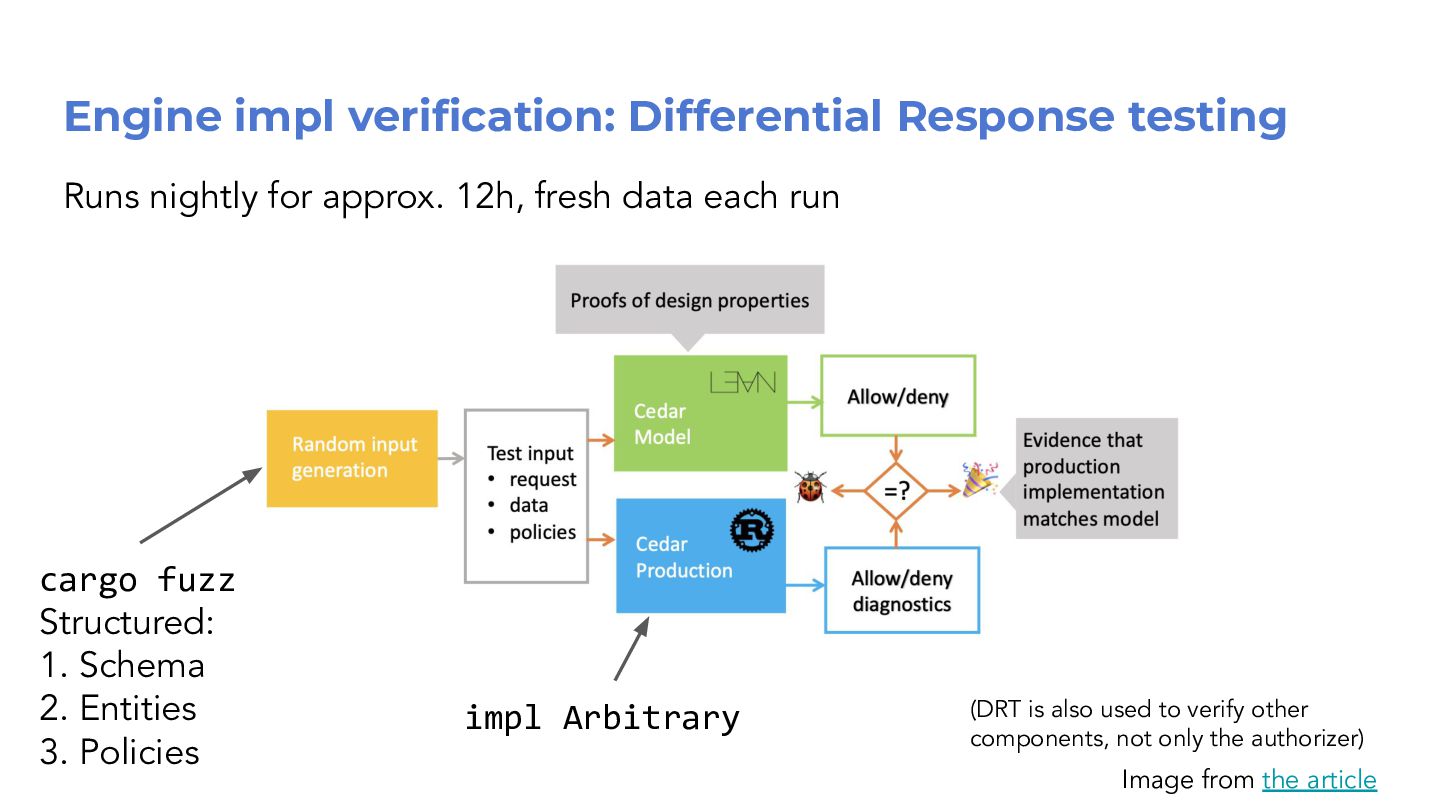
  11. Engine impl verification: Differential Response testing cargo fuzz Structured: 1.

    Schema 2. Entities 3. Policies impl Arbitrary Runs nightly for approx. 12h, fresh data each run (DRT is also used to verify other components, not only the authorizer) Image from the article
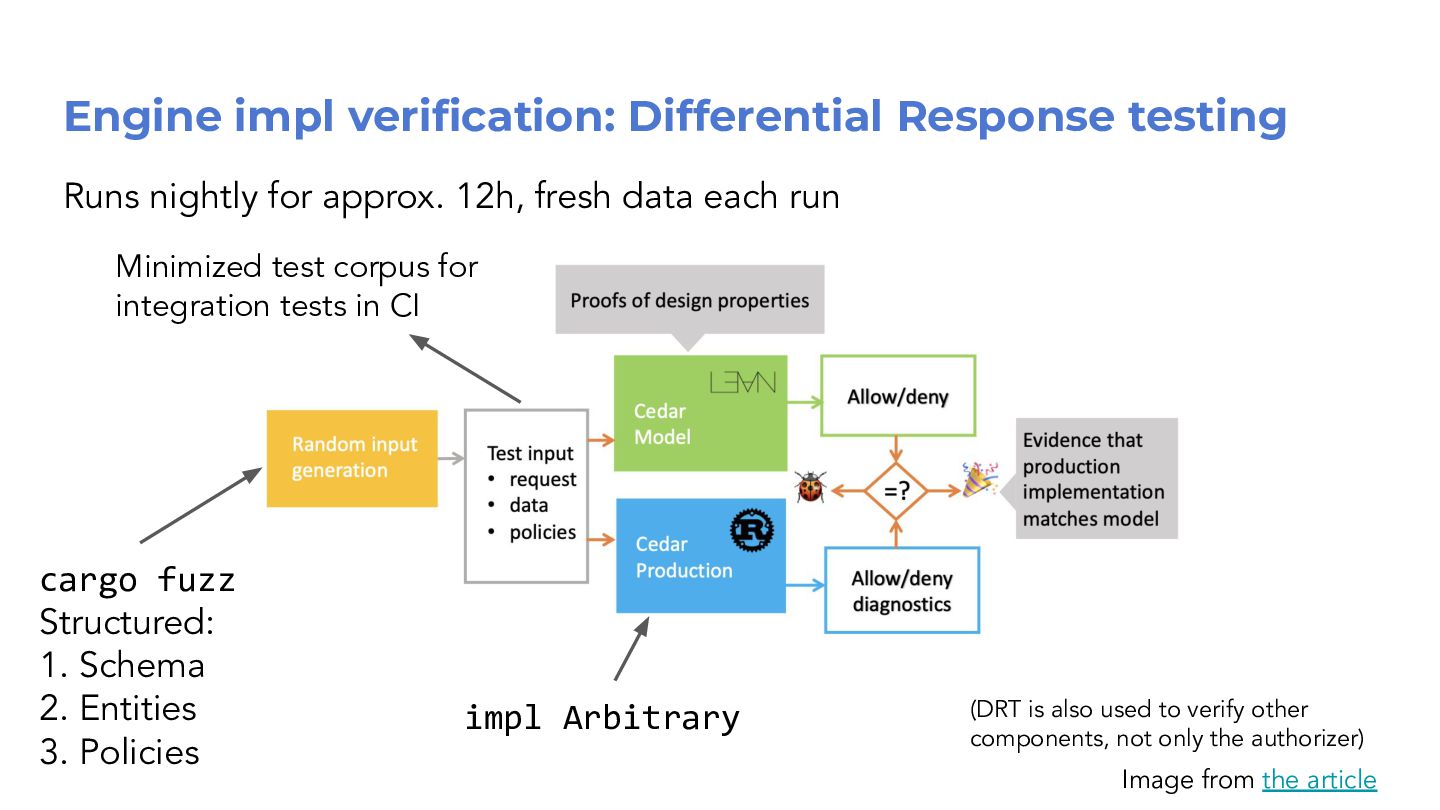
  12. Engine impl verification: Differential Response testing cargo fuzz Structured: 1.

    Schema 2. Entities 3. Policies impl Arbitrary Minimized test corpus for integration tests in CI Runs nightly for approx. 12h, fresh data each run (DRT is also used to verify other components, not only the authorizer) Image from the article
  13. Engine impl verification: Differential Response testing The integration test corpus,

    with millions of test cases, has led to it being feasible to fully re-implement the authorizer engine also in Go: @luxas.dev
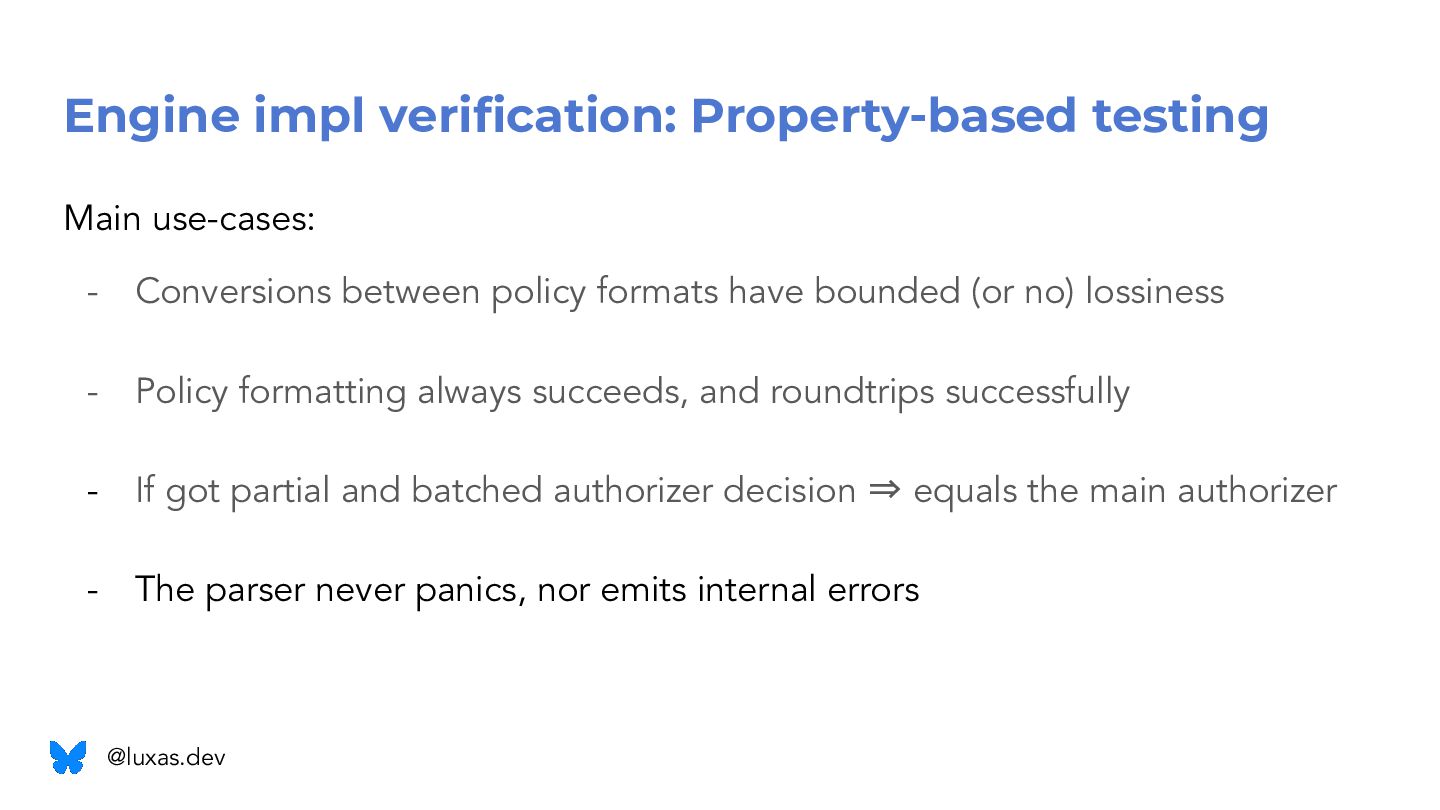
  14. Engine impl verification: Property-based testing Main use-cases: - Conversions between

    policy formats have bounded (or no) lossiness @luxas.dev
  15. Engine impl verification: Property-based testing Main use-cases: - Conversions between

    policy formats have bounded (or no) lossiness - Policy formatting always succeeds, and roundtrips successfully @luxas.dev
  16. Engine impl verification: Property-based testing Main use-cases: - Conversions between

    policy formats have bounded (or no) lossiness - Policy formatting always succeeds, and roundtrips successfully - If got partial and batched authorizer decision ⇒ equals the main authorizer @luxas.dev
  17. Engine impl verification: Property-based testing Main use-cases: - Conversions between

    policy formats have bounded (or no) lossiness - Policy formatting always succeeds, and roundtrips successfully - If got partial and batched authorizer decision ⇒ equals the main authorizer - The parser never panics, nor emits internal errors @luxas.dev
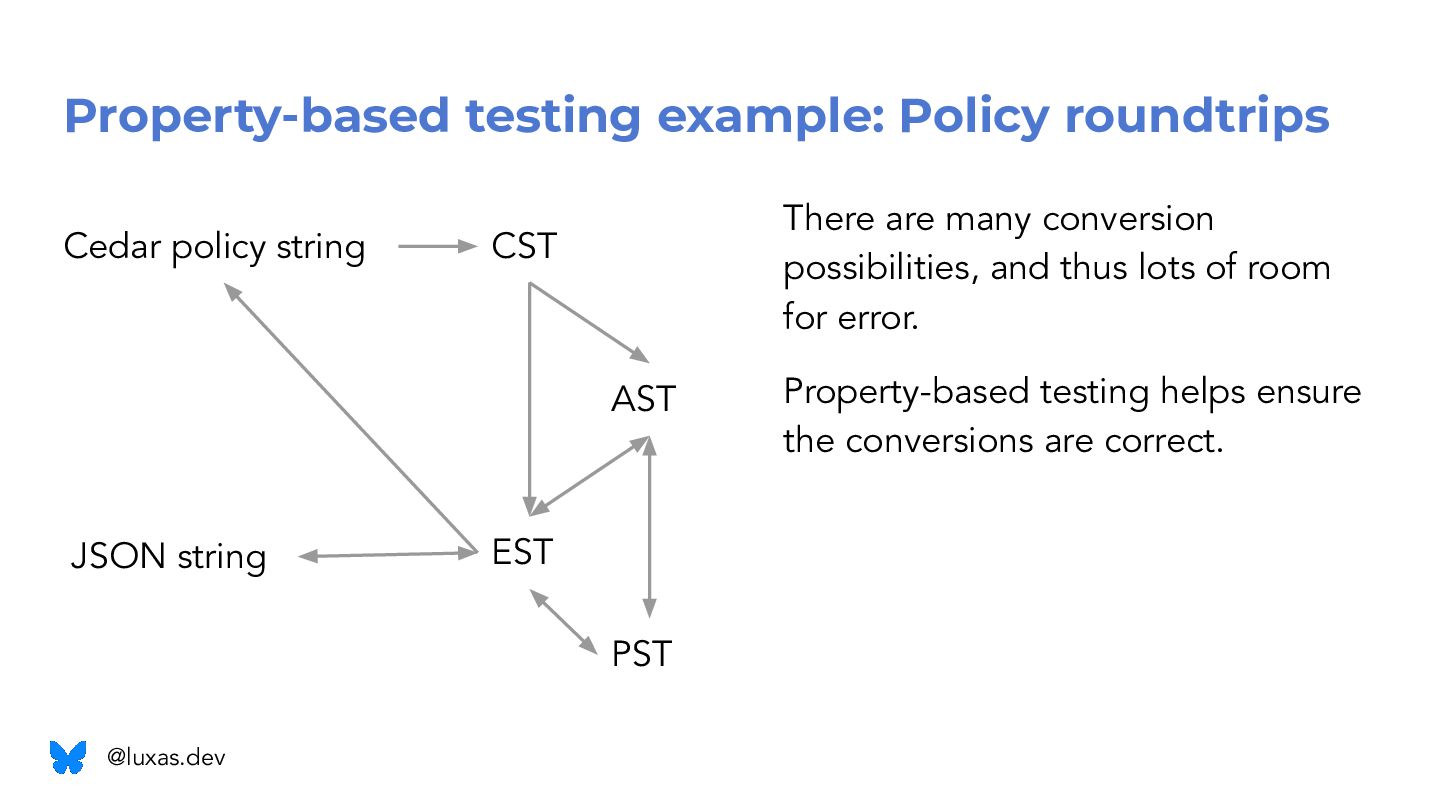
  18. Property-based testing example: Policy roundtrips There are many conversion possibilities,

    and thus lots of room for error. Property-based testing helps ensure the conversions are correct. Cedar policy string CST AST EST JSON string PST @luxas.dev
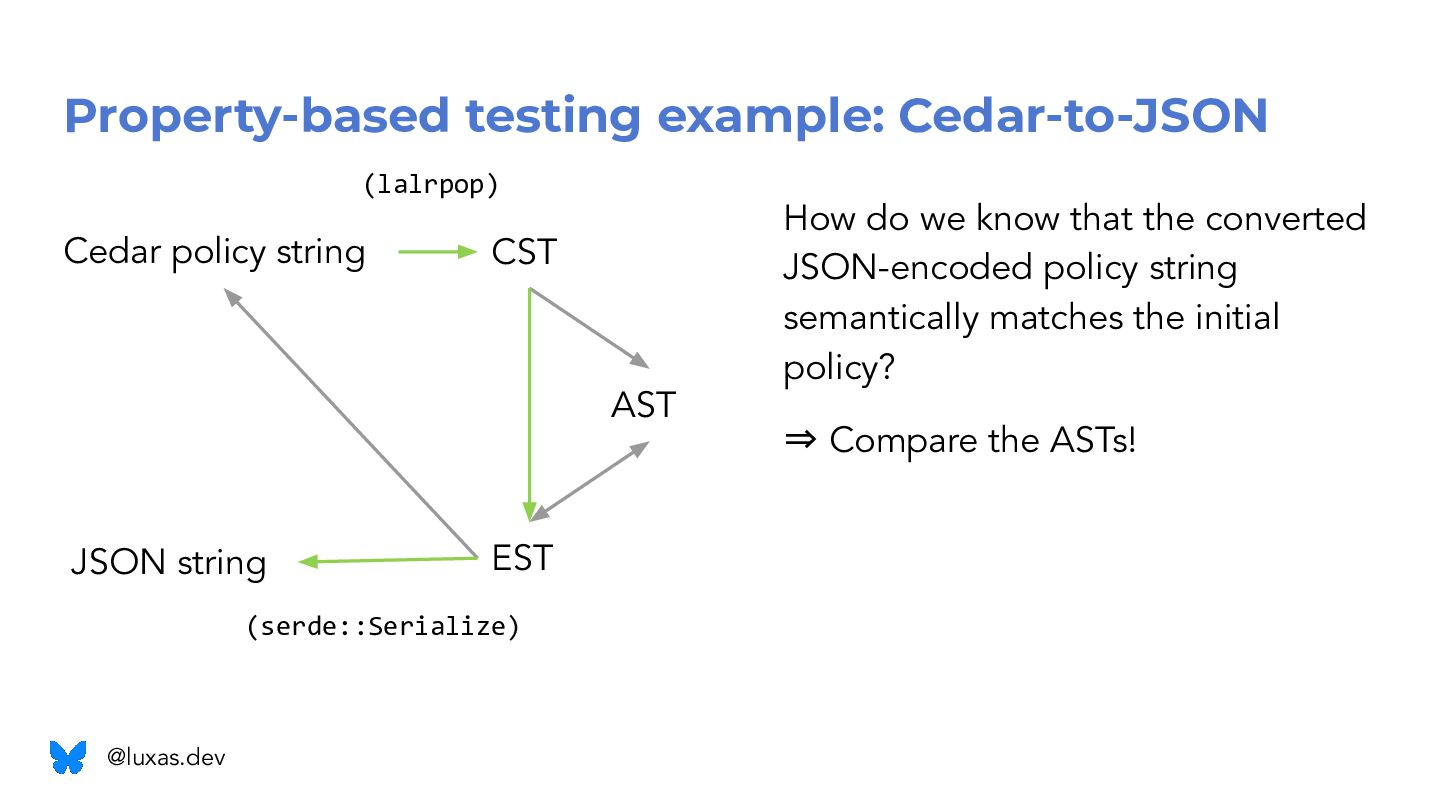
  19. Property-based testing example: Cedar-to-JSON How do we know that the

    converted JSON-encoded policy string semantically matches the initial policy? ⇒ Compare the ASTs! Cedar policy string CST AST EST JSON string (serde::Serialize) (lalrpop) @luxas.dev
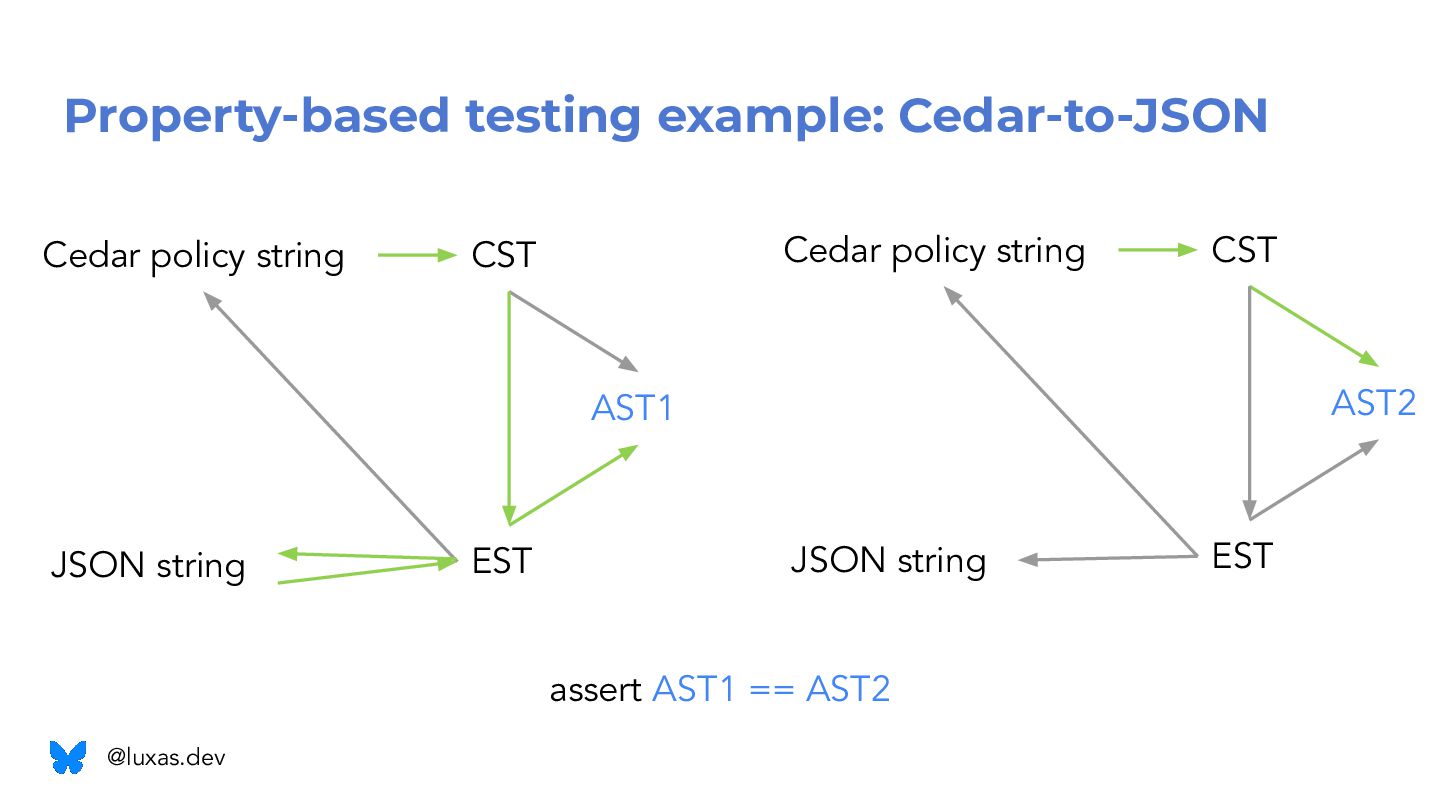
  20. Property-based testing example: Cedar-to-JSON Cedar policy string CST AST1 EST

    JSON string Cedar policy string CST AST2 EST JSON string assert AST1 == AST2 @luxas.dev
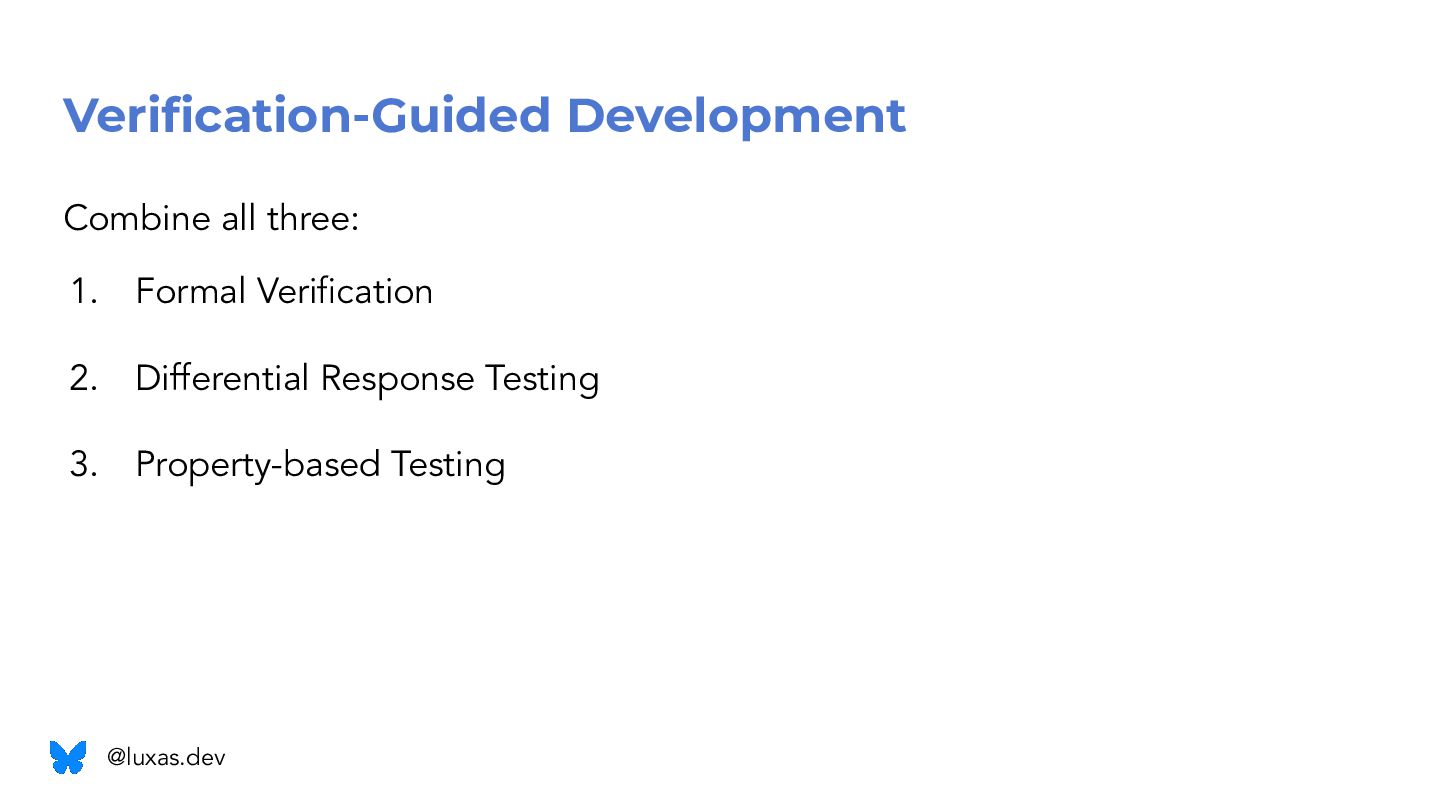
  21. Conclusion: Verification-Guided Development At least 21 bugs were found using

    these methods, but also 9 were not detected. @luxas.dev
  22. Conclusion: Verification-Guided Development At least 21 bugs were found using

    these methods, but also 9 were not detected. The project does not release unless DRT+PBT is passing. @luxas.dev
  23. Conclusion: Verification-Guided Development At least 21 bugs were found using

    these methods, but also 9 were not detected. The project does not release unless DRT+PBT is passing. Lean+DRT+PBT needed to graduate a feature from experimental. Code changes might need to be reflected in the Lean model. @luxas.dev
  24. Conclusion: Verification-Guided Development At least 21 bugs were found using

    these methods, but also 9 were not detected. The project does not release unless DRT+PBT is passing. Lean+DRT+PBT needed to graduate a feature from experimental. Code changes might need to be reflected in the Lean model. Overall, the method has yielded high quality and assurance! @luxas.dev
  25. Thank you! Special thanks to Katherine Hough and John Kastner

    who answering questions as I built the presentation, and to the Cedar maintainers that actually built all of this 😁 Try out Cedar at github.com/cedar-policy/cedar Cedar’s specification is available at github.com/cedar-policy/cedar-spec Join the community, use it and contribute if you like 😎 @luxas.dev