Conclusion Free All The Things • well known: free monads • maybe known: free applicatives • free monoids • free <you name it> Markus Hauck Free All The Things 1
Conclusion Goal Of This Talk • how many of you wrote a Free X • how many of you used Free… • Monad • Applicative • Functor • other? • Goal: explain the technique behind “Free X” Markus Hauck Free All The Things 2
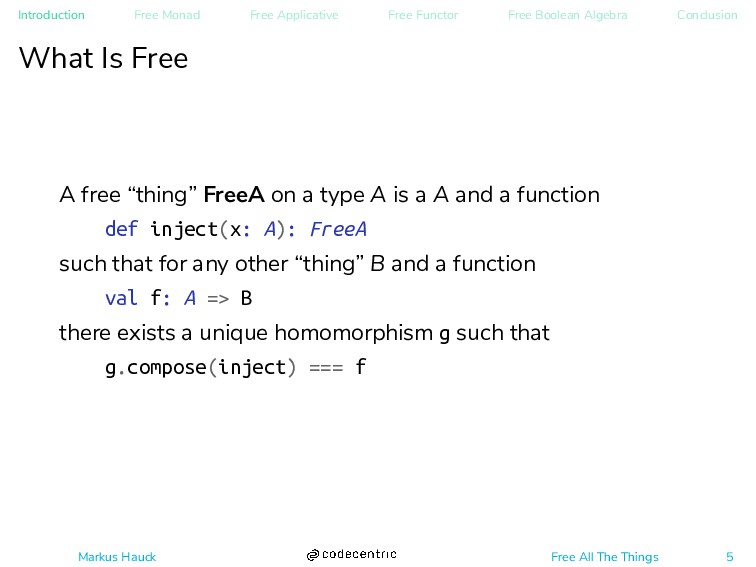
Conclusion What Is Free A free “thing” FreeA on a type A is a A and a function def inject(x: A): FreeA such that for any other “thing” B and a function val f: A => B there exists a unique homomorphism g such that g.compose(inject) === f Markus Hauck Free All The Things 5
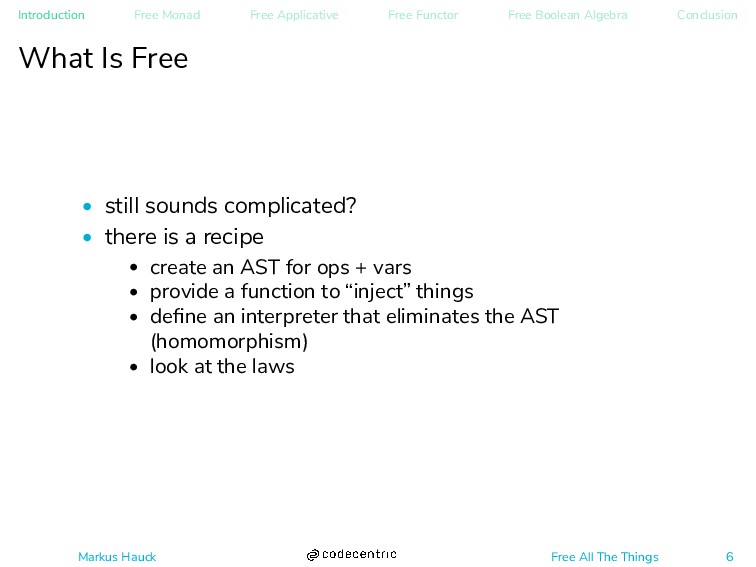
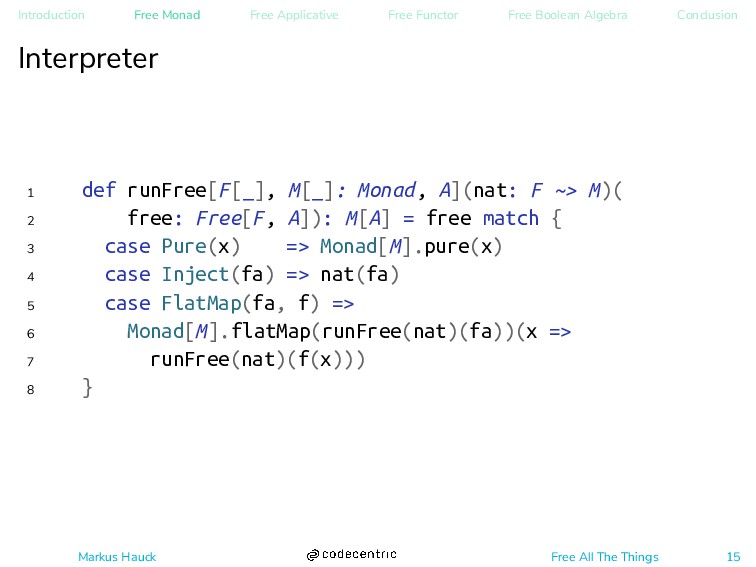
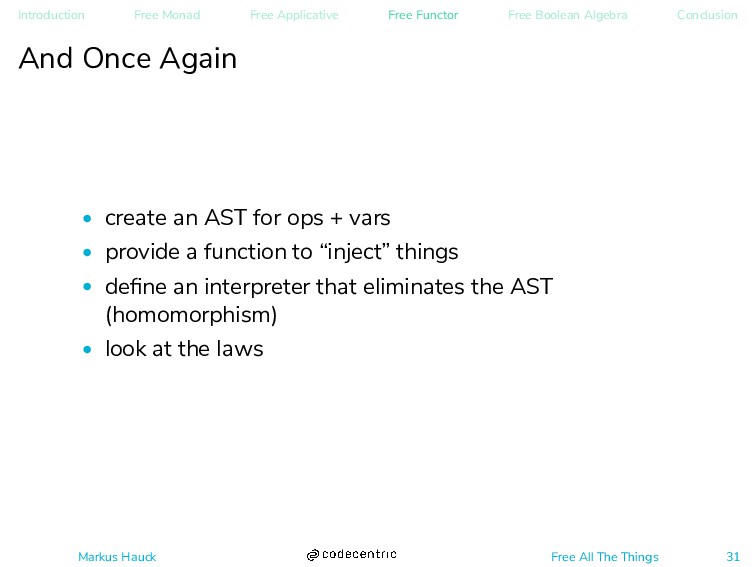
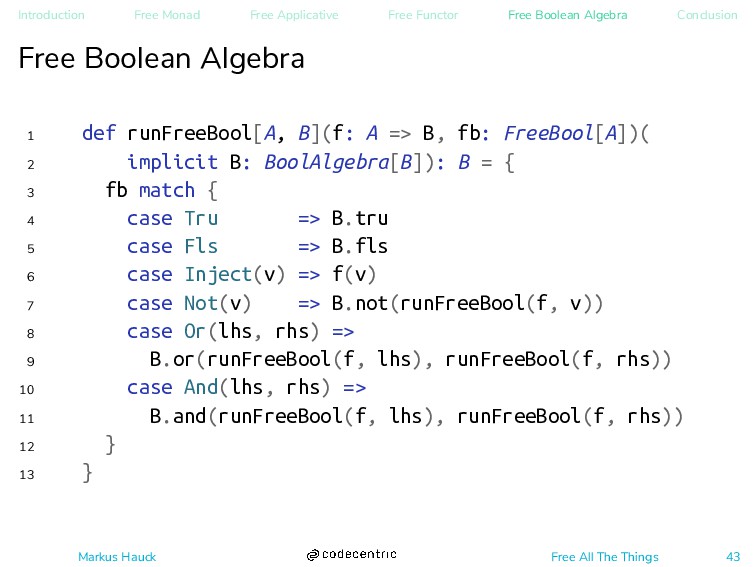
Conclusion What Is Free • still sounds complicated? • there is a recipe • create an AST for ops + vars • provide a function to “inject” things • define an interpreter that eliminates the AST (homomorphism) • look at the laws Markus Hauck Free All The Things 6
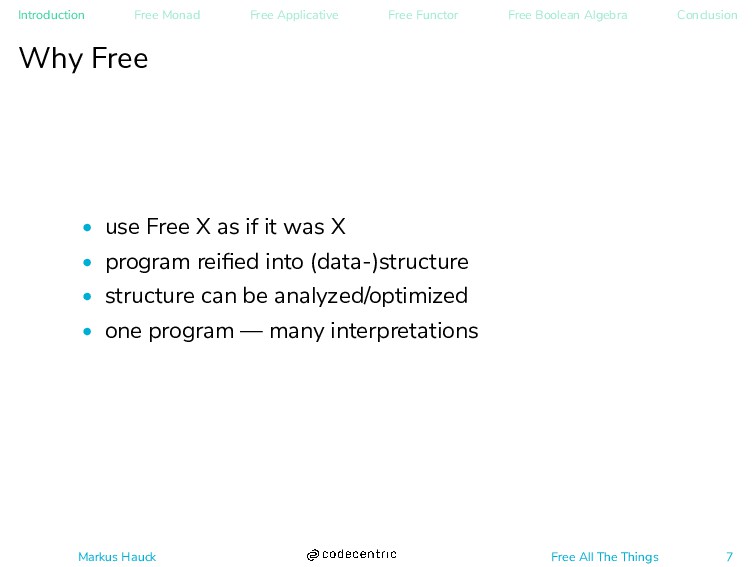
Conclusion Why Free • use Free X as if it was X • program reified into (data-)structure • structure can be analyzed/optimized • one program — many interpretations Markus Hauck Free All The Things 7
Conclusion Disclaimer Before We Start • this talk: deep embeddings / initial encoding / data structure representation • alternative: finally tagless • not this talk: optimization of free structures Markus Hauck Free All The Things 8
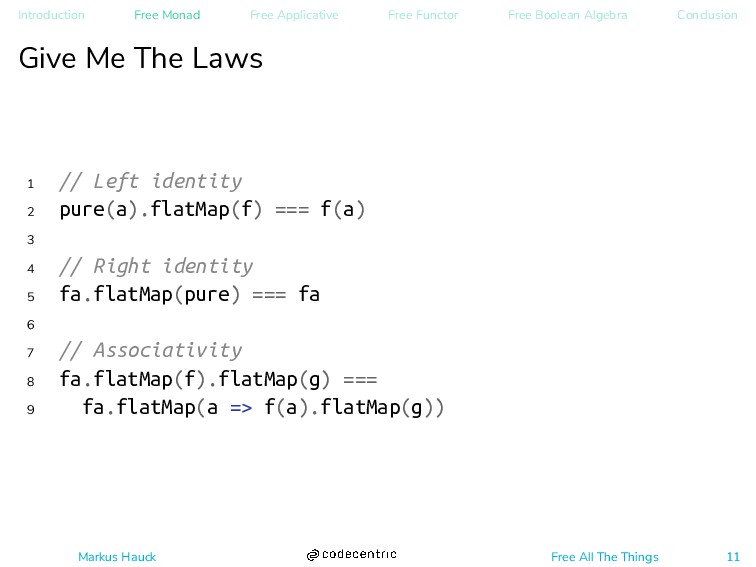
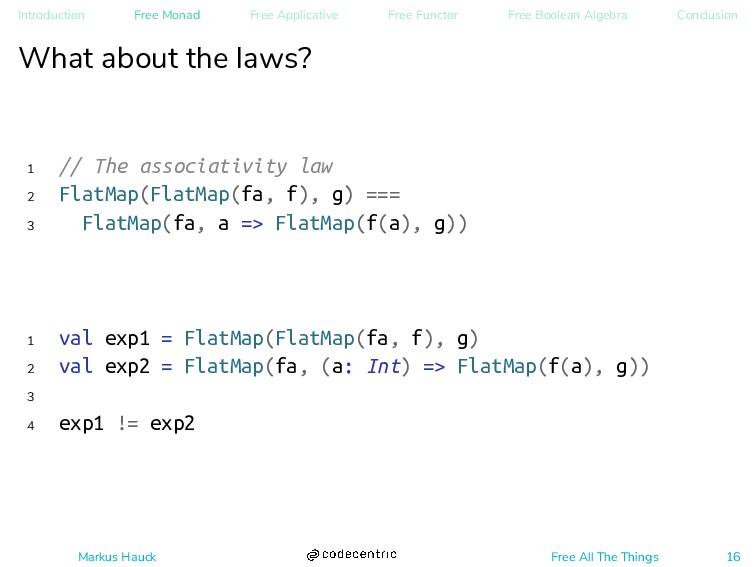
Conclusion Give Me The Laws 1 // Left identity 2 pure(a).flatMap(f) === f(a) 3 4 // Right identity 5 fa.flatMap(pure) === fa 6 7 // Associativity 8 fa.flatMap(f).flatMap(g) === 9 fa.flatMap(a => f(a).flatMap(g)) Markus Hauck Free All The Things 11
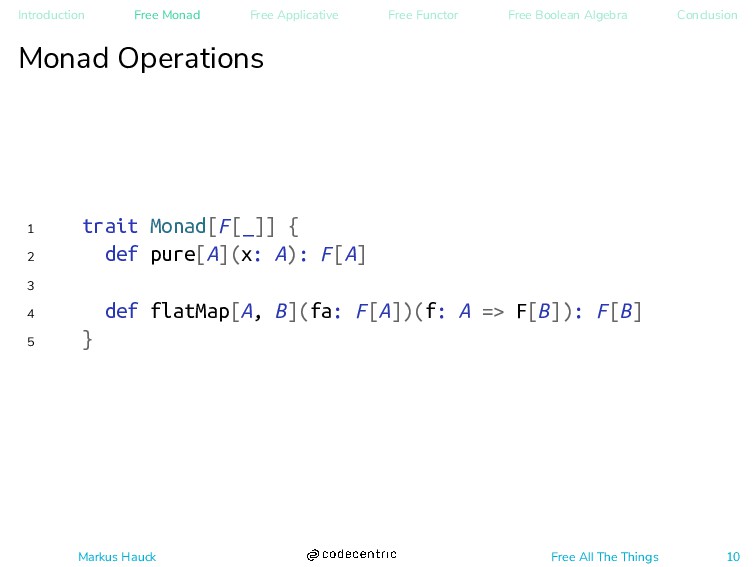
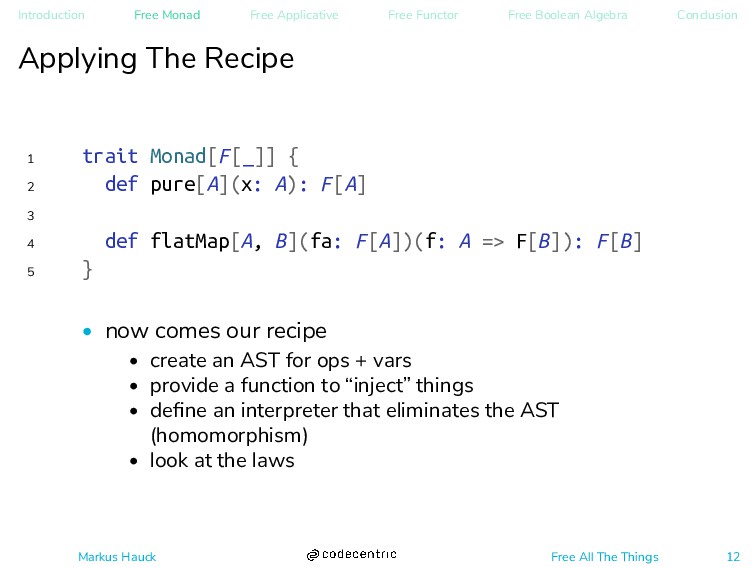
Conclusion Applying The Recipe 1 trait Monad[F[_]] { 2 def pure[A](x: A): F[A] 3 4 def flatMap[A, B](fa: F[A])(f: A => F[B]): F[B] 5 } • now comes our recipe • create an AST for ops + vars • provide a function to “inject” things • define an interpreter that eliminates the AST (homomorphism) • look at the laws Markus Hauck Free All The Things 12
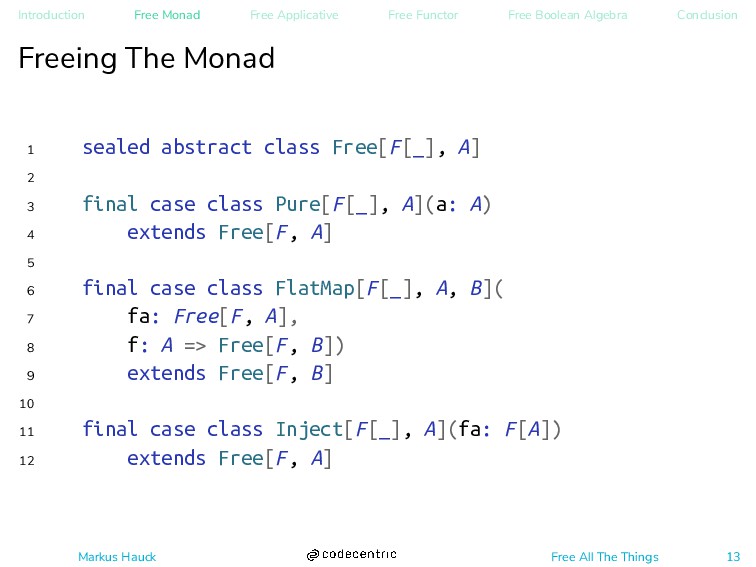
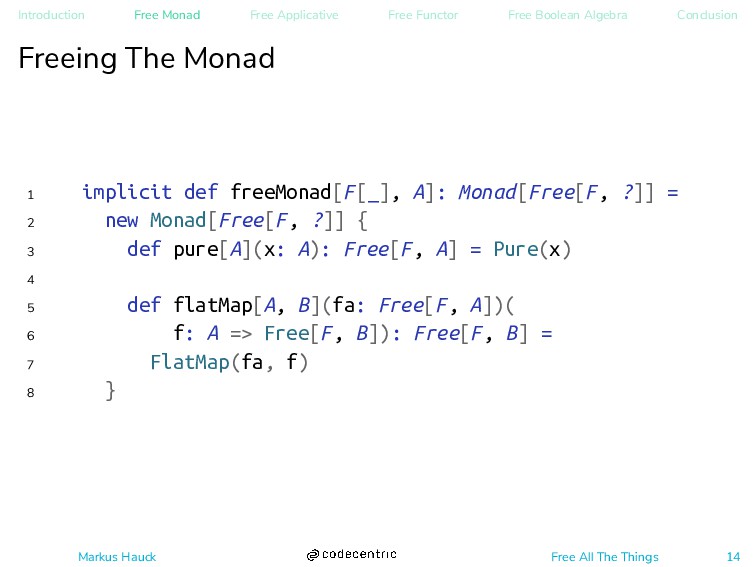
Conclusion Freeing The Monad 1 sealed abstract class Free[F[_], A] 2 3 final case class Pure[F[_], A](a: A) 4 extends Free[F, A] 5 6 final case class FlatMap[F[_], A, B]( 7 fa: Free[F, A], 8 f: A => Free[F, B]) 9 extends Free[F, B] 10 11 final case class Inject[F[_], A](fa: F[A]) 12 extends Free[F, A] Markus Hauck Free All The Things 13
Conclusion What about the laws? 1 // The associativity law 2 FlatMap(FlatMap(fa, f), g) === 3 FlatMap(fa, a => FlatMap(f(a), g)) 1 val exp1 = FlatMap(FlatMap(fa, f), g) 2 val exp2 = FlatMap(fa, (a: Int) => FlatMap(f(a), g)) 3 4 exp1 != exp2 Markus Hauck Free All The Things 16
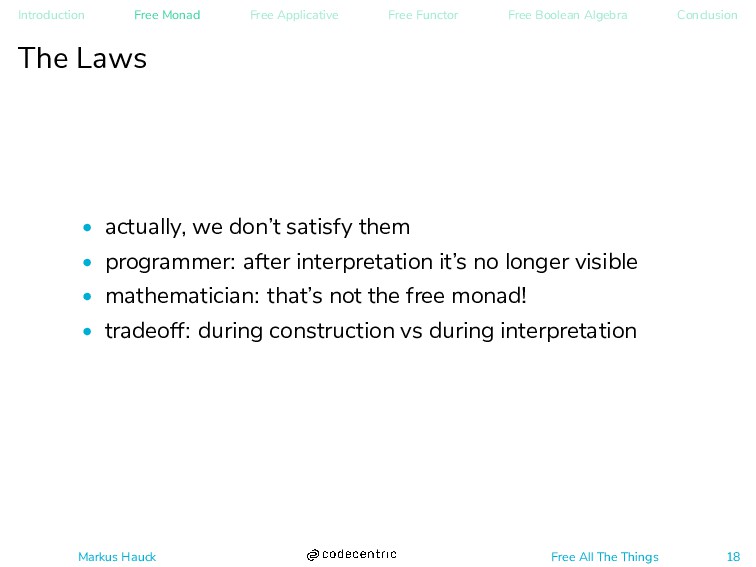
Conclusion The Laws • actually, we don’t satisfy them • programmer: after interpretation it’s no longer visible • mathematician: that’s not the free monad! • tradeoff: during construction vs during interpretation Markus Hauck Free All The Things 18
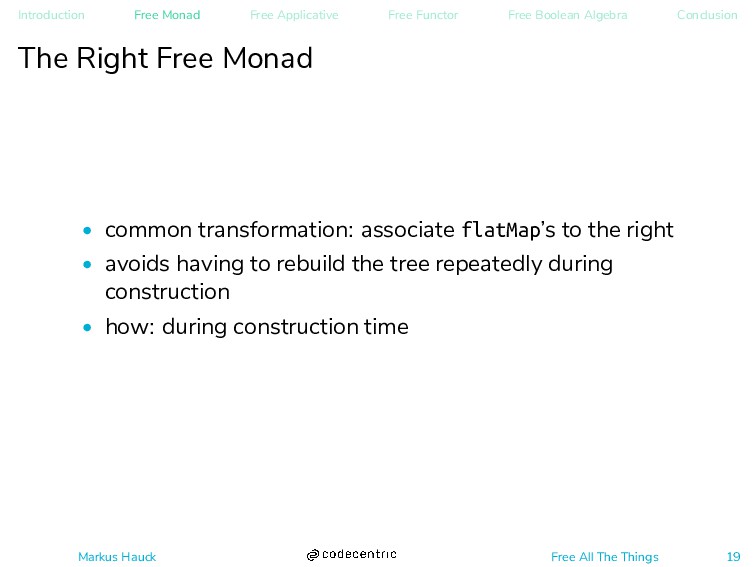
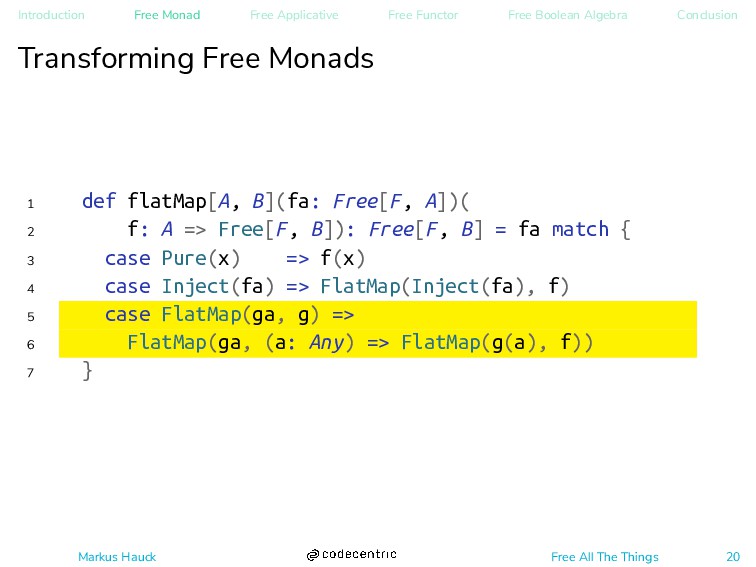
Conclusion The Right Free Monad • common transformation: associate flatMap’s to the right • avoids having to rebuild the tree repeatedly during construction • how: during construction time Markus Hauck Free All The Things 19
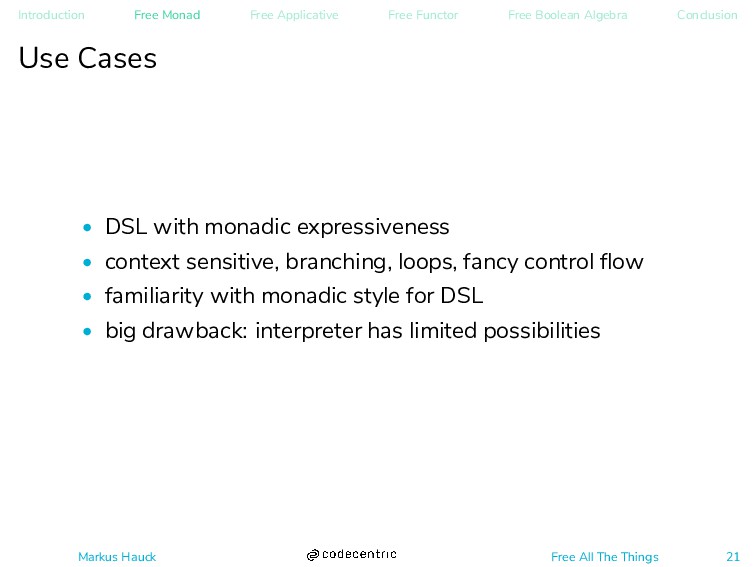
Conclusion Use Cases • DSL with monadic expressiveness • context sensitive, branching, loops, fancy control flow • familiarity with monadic style for DSL • big drawback: interpreter has limited possibilities Markus Hauck Free All The Things 21
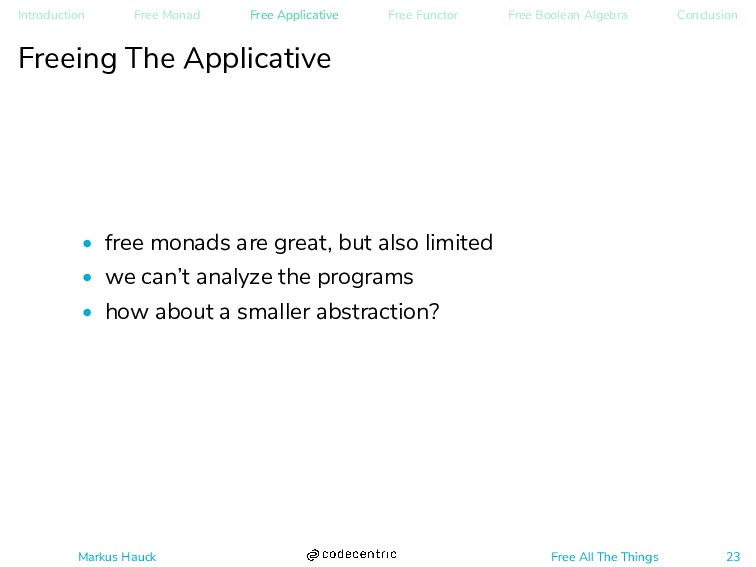
Conclusion Freeing The Applicative • free monads are great, but also limited • we can’t analyze the programs • how about a smaller abstraction? Markus Hauck Free All The Things 23
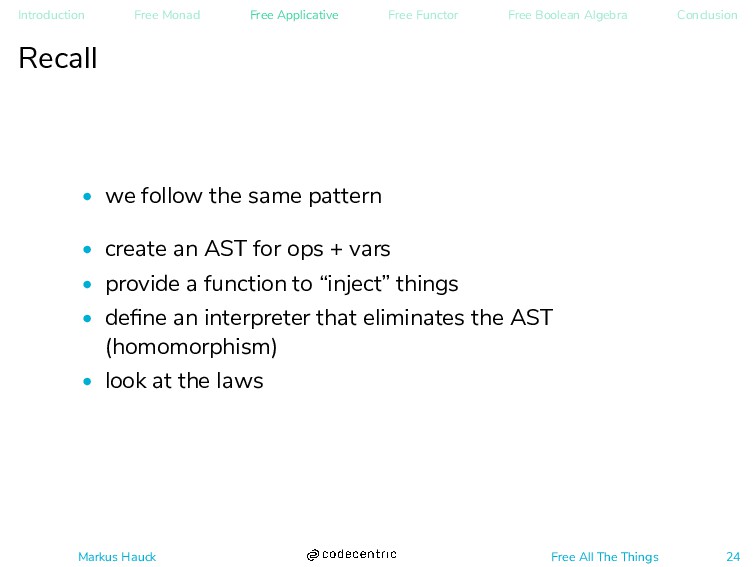
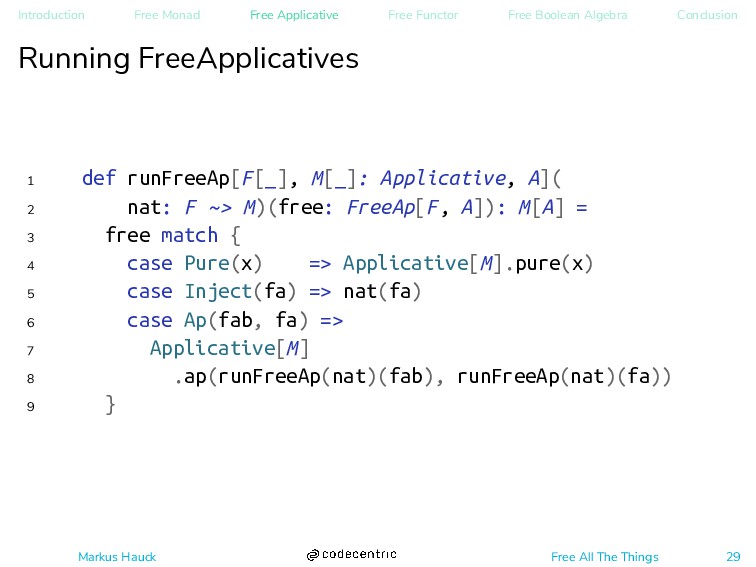
Conclusion Recall • we follow the same pattern • create an AST for ops + vars • provide a function to “inject” things • define an interpreter that eliminates the AST (homomorphism) • look at the laws Markus Hauck Free All The Things 24
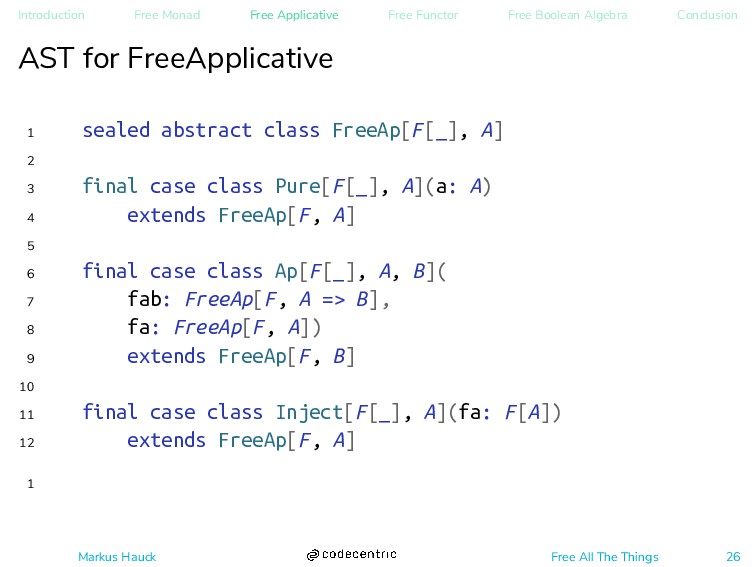
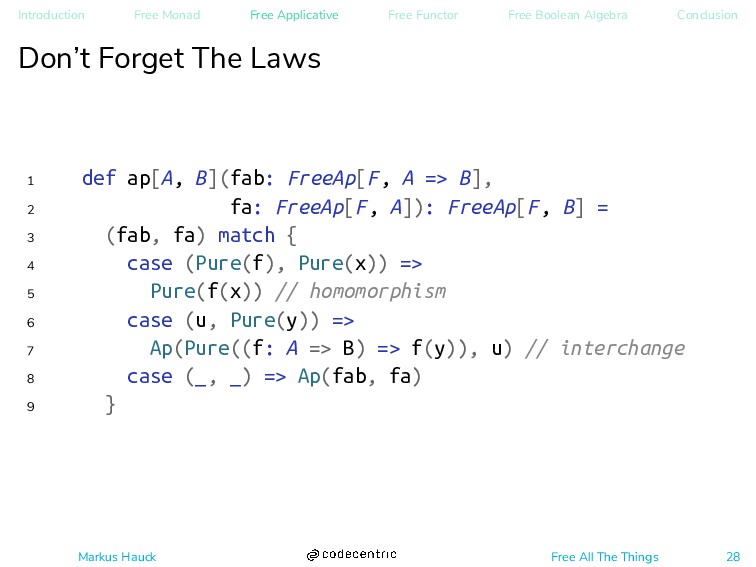
Conclusion AST for FreeApplicative 1 sealed abstract class FreeAp[F[_], A] 2 3 final case class Pure[F[_], A](a: A) 4 extends FreeAp[F, A] 5 6 final case class Ap[F[_], A, B]( 7 fab: FreeAp[F, A => B], 8 fa: FreeAp[F, A]) 9 extends FreeAp[F, B] 10 11 final case class Inject[F[_], A](fa: F[A]) 12 extends FreeAp[F, A] 1 Markus Hauck Free All The Things 26
Conclusion And Once Again • create an AST for ops + vars • provide a function to “inject” things • define an interpreter that eliminates the AST (homomorphism) • look at the laws Markus Hauck Free All The Things 31
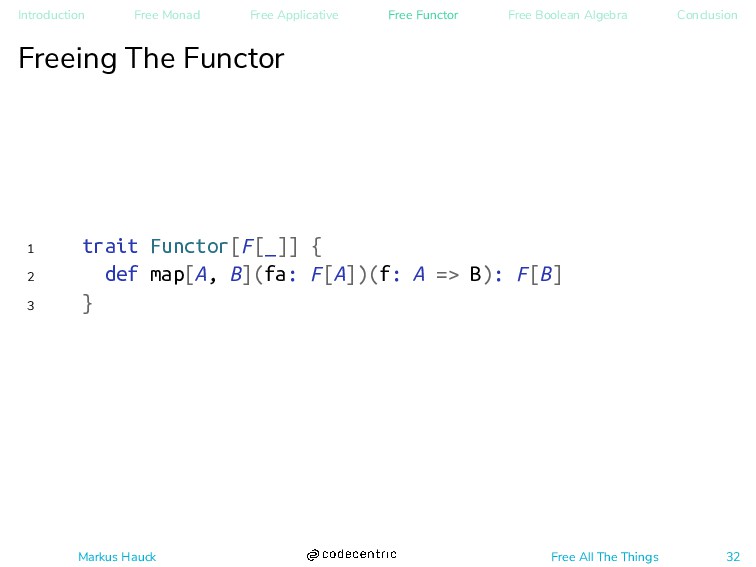
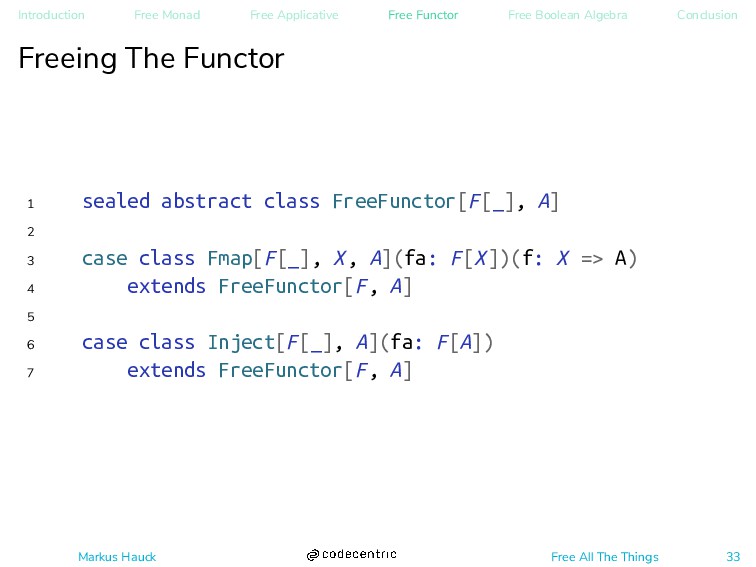
Conclusion Freeing The Functor 1 sealed abstract class FreeFunctor[F[_], A] 2 3 case class Fmap[F[_], X, A](fa: F[X])(f: X => A) 4 extends FreeFunctor[F, A] 5 6 case class Inject[F[_], A](fa: F[A]) 7 extends FreeFunctor[F, A] Markus Hauck Free All The Things 33
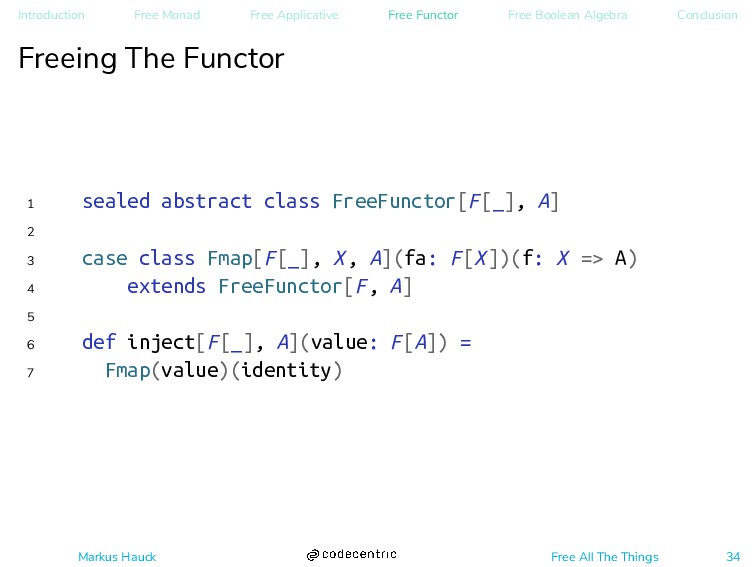
Conclusion Freeing The Functor 1 sealed abstract class FreeFunctor[F[_], A] 2 3 case class Fmap[F[_], X, A](fa: F[X])(f: X => A) 4 extends FreeFunctor[F, A] 5 6 def inject[F[_], A](value: F[A]) = 7 Fmap(value)(identity) Markus Hauck Free All The Things 34
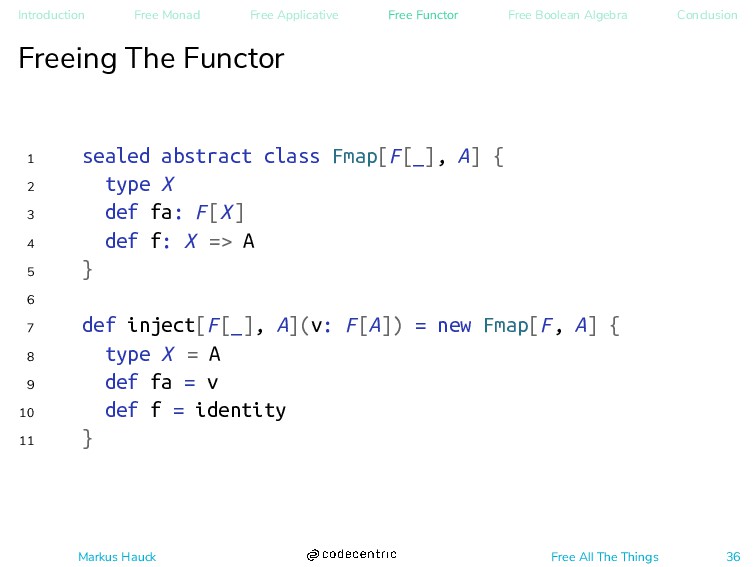
Conclusion Freeing The Functor 1 sealed abstract class Fmap[F[_], A] { 2 type X 3 def fa: F[X] 4 def f: X => A 5 } 6 7 def inject[F[_], A](v: F[A]) = new Fmap[F, A] { 8 type X = A 9 def fa = v 10 def f = identity 11 } Markus Hauck Free All The Things 36
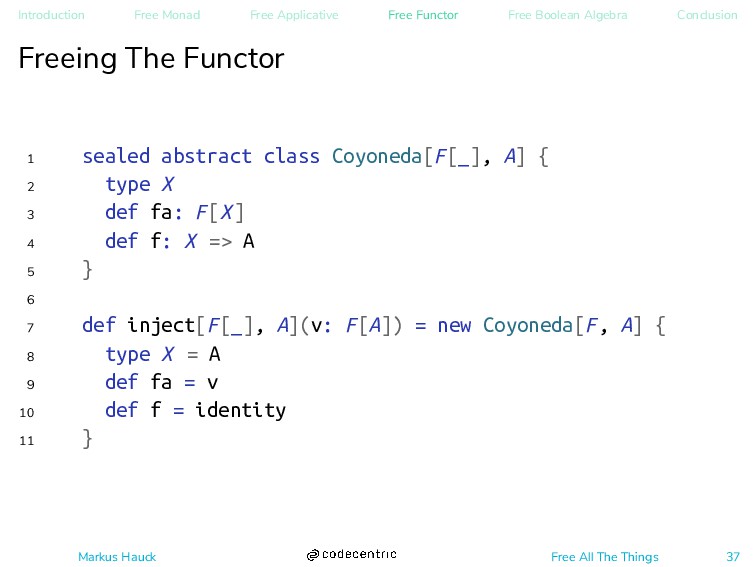
Conclusion Freeing The Functor 1 sealed abstract class Coyoneda[F[_], A] { 2 type X 3 def fa: F[X] 4 def f: X => A 5 } 6 7 def inject[F[_], A](v: F[A]) = new Coyoneda[F, A] { 8 type X = A 9 def fa = v 10 def f = identity 11 } Markus Hauck Free All The Things 37
Conclusion Disclaimer • Once upon a time: https://engineering.wingify.com/posts/Free-objects/ • use free boolean algebra to define DSL for event predicates • credits to Chris Stucchio (@stucchio) Markus Hauck Free All The Things 39
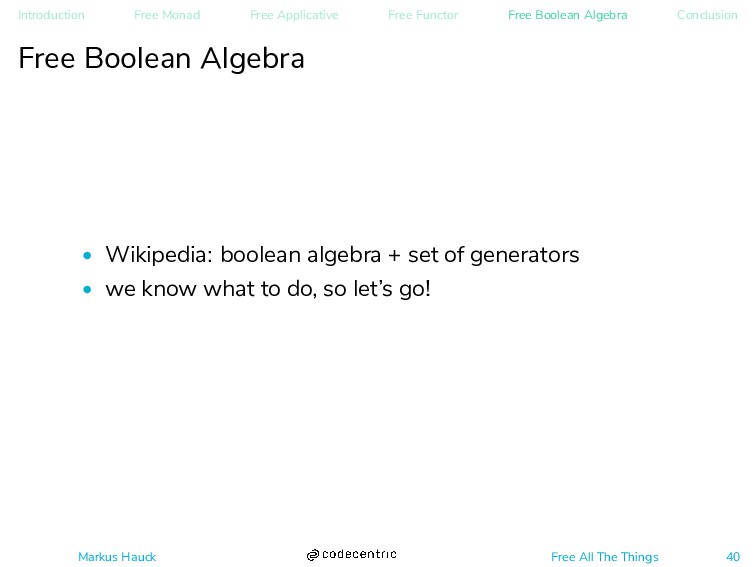
Conclusion Free Boolean Algebra • Wikipedia: boolean algebra + set of generators • we know what to do, so let’s go! Markus Hauck Free All The Things 40
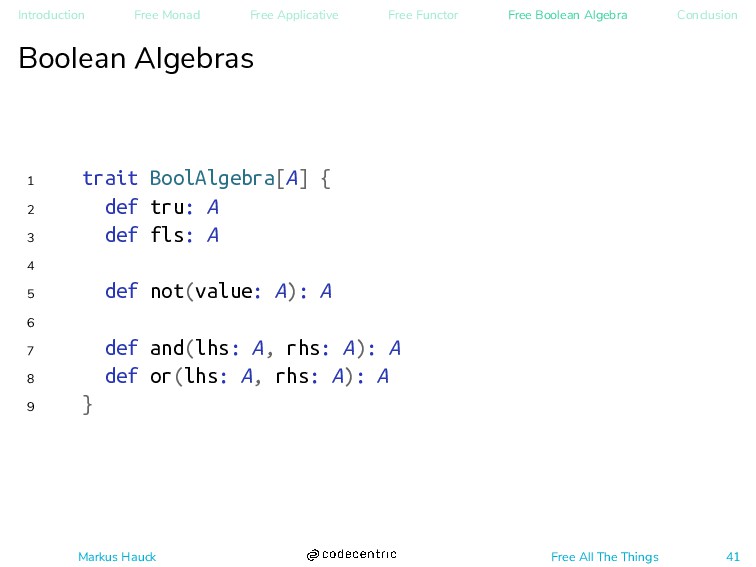
Conclusion Boolean Algebras 1 trait BoolAlgebra[A] { 2 def tru: A 3 def fls: A 4 5 def not(value: A): A 6 7 def and(lhs: A, rhs: A): A 8 def or(lhs: A, rhs: A): A 9 } Markus Hauck Free All The Things 41
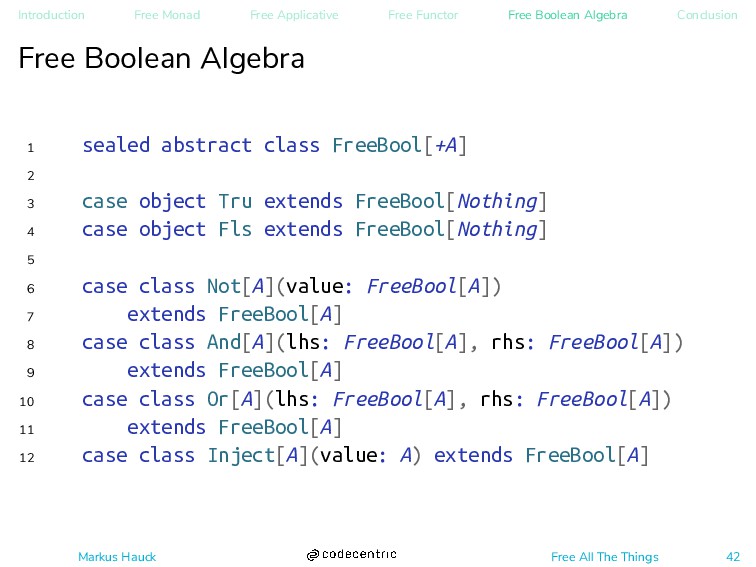
Conclusion Free Boolean Algebra 1 sealed abstract class FreeBool[+A] 2 3 case object Tru extends FreeBool[Nothing] 4 case object Fls extends FreeBool[Nothing] 5 6 case class Not[A](value: FreeBool[A]) 7 extends FreeBool[A] 8 case class And[A](lhs: FreeBool[A], rhs: FreeBool[A]) 9 extends FreeBool[A] 10 case class Or[A](lhs: FreeBool[A], rhs: FreeBool[A]) 11 extends FreeBool[A] 12 case class Inject[A](value: A) extends FreeBool[A] Markus Hauck Free All The Things 42
Conclusion Using Free Bool • that was easy • what can we do with our new discovered structure • DSL: boolean operators • true, false • and, or • xor, implies, nand, nor, nxor Markus Hauck Free All The Things 44
Conclusion Partial Evaluation • what if you don’t have all the information? • partially evaluate predicates • if evaluates successfully, done • else, send it on Markus Hauck Free All The Things 47
Conclusion Free Boolean Algebra • good example of underused free structure • partial evaluation • serialize the AST (JSON, Protobuf, Avro, …) • exercise: minimize AST representation Markus Hauck Free All The Things 49

 SiteGround - Reliable hosting with speed, security, and support you can count on.


 markus1189
 sorah
sorah
 gam0022
 morizo_1984
 findyinc
 rkaga
rkaga
 mixplace
 elmetal
 neuecc
 yukiny
 prota
prota
 steliosf
 panda728
 codingconduct
 427marketing
 akademiya2063
 mza
mza
 davidcarrasco
 inesmontani
 ryanjones
 frankvandijk
 garrettdimon
 charlesmeaden