Upgrade to Pro — share decks privately, control downloads, hide ads and more …

mbicerist Lucid English

Sponsored · Your Podcast. Everywhere. Effortlessly. Share. Educate. Inspire. Entertain. You do you. We'll handle the rest. →
Avatar for mehmet mehmet
November 17, 2019

mbicerist Lucid English

I present my way of teaching English for academic exams. This program is unique because the flow of topics is learner oriented. Learners don't have to wonder where to begin as long as they follow the order. This is not the fullest version as it lacks some basic topics such as IF Conditionals and Reported Speech. I keep the Awareness Studies to myself for classroom use.

Avatar for mehmet

mehmet

November 17, 2019

More Decks by mehmet

Other Decks in Education

Transcript

  1. hello! I am Mehmet BICER I am here because I

    love to teach English. You can find me at [email protected] 1
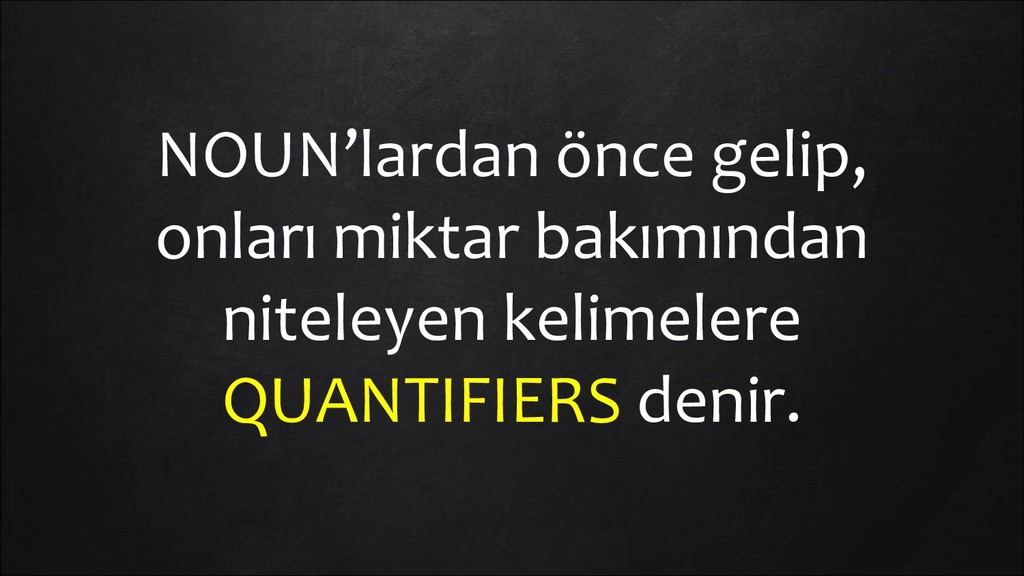
  2. NOU

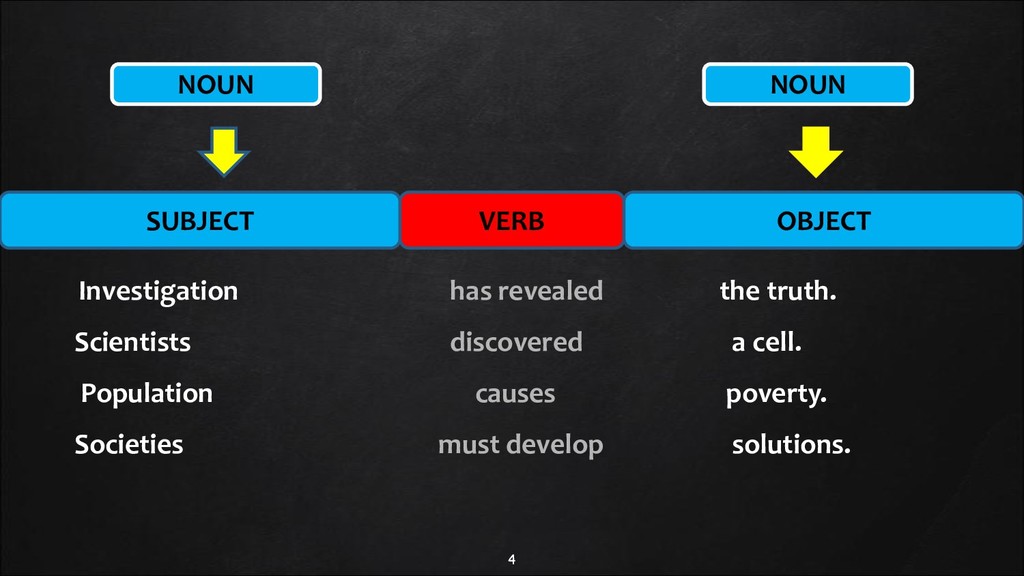
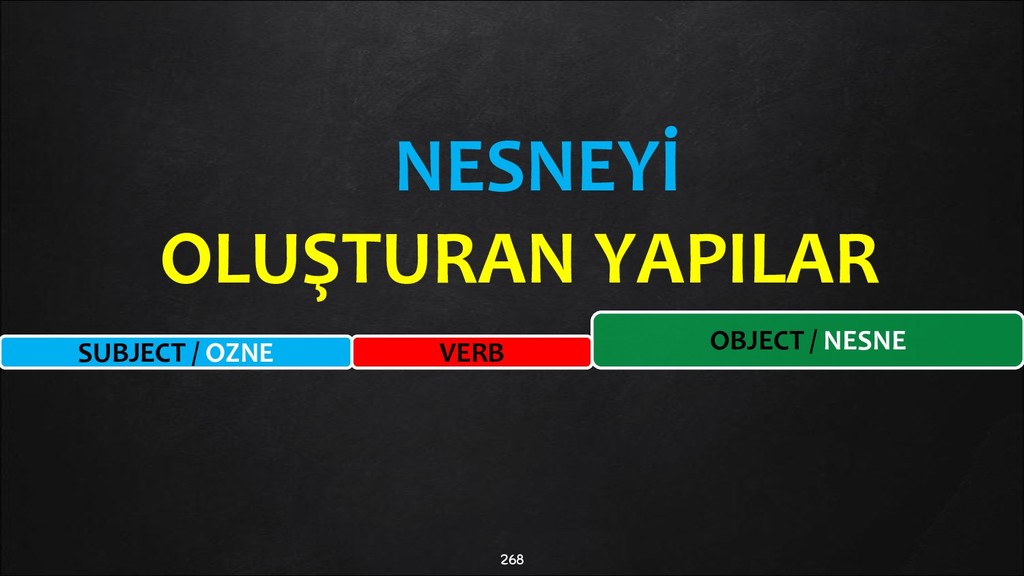
  3. 4 SUBJECT VERB OBJECT NOUN NOUN Investigation has revealed the

    truth. Scientists discovered a cell. Population causes poverty. Societies must develop solutions.
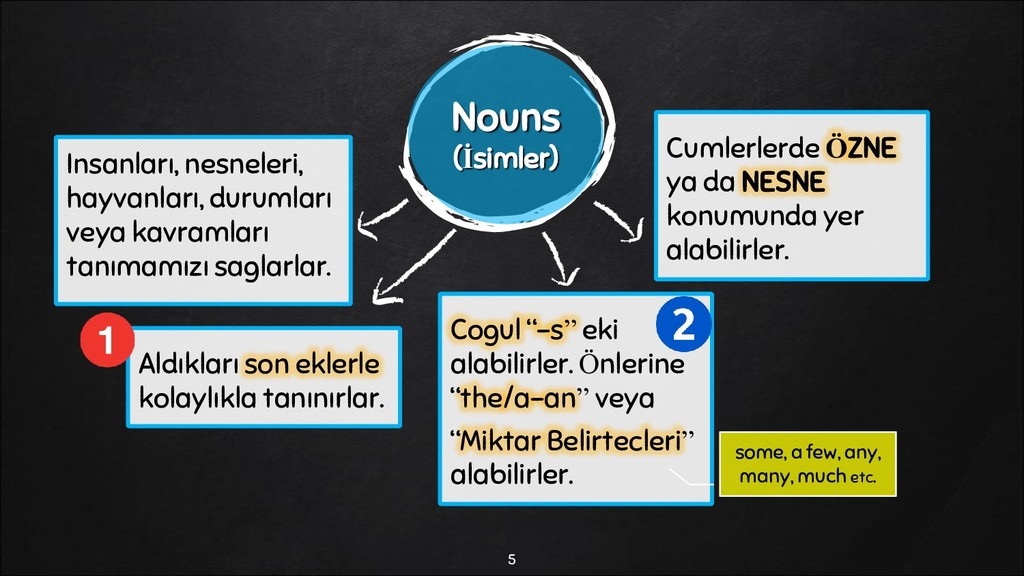
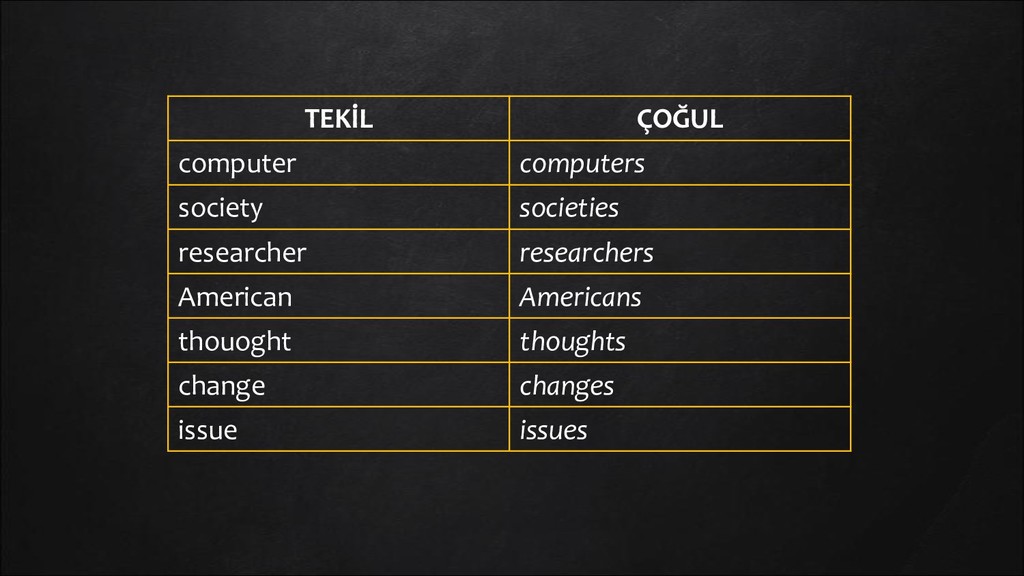
  4. 5 Nouns (İsimler) Insanları, nesneleri, hayvanları, durumları veya kavramları tanımamızı

    saglarlar. Cogul “-s” eki alabilirler. Önlerine “the/a-an” veya “Miktar Belirtecleri” alabilirler. Aldıkları son eklerle kolaylıkla tanınırlar. Cumlerlerde ÖZNE ya da NESNE konumunda yer alabilirler. some, a few, any, many, much etc.
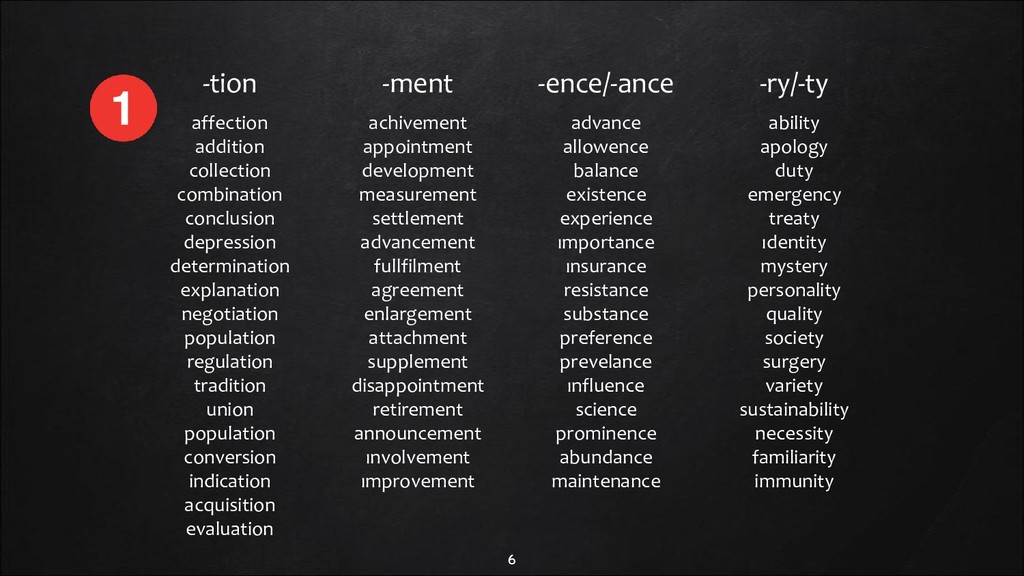
  5. 6 -tion -ment -ence/-ance -ry/-ty affection addition collection combination conclusion

    depression determination explanation negotiation population regulation tradition union population conversion indication acquisition evaluation achivement appointment development measurement settlement advancement fullfilment agreement enlargement attachment supplement disappointment retirement announcement ınvolvement ımprovement advance allowence balance existence experience ımportance ınsurance resistance substance preference prevelance ınfluence science prominence abundance maintenance ability apology duty emergency treaty ıdentity mystery personality quality society surgery variety sustainability necessity familiarity immunity
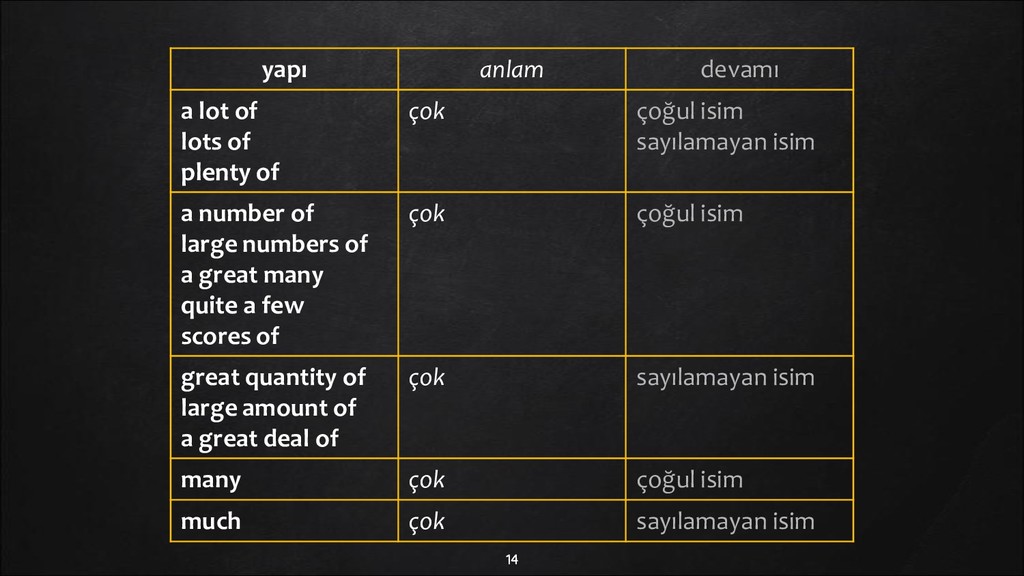
  6. 14 yapı anlam devamı a lot of lots of plenty

    of çok çoğul isim sayılamayan isim a number of large numbers of a great many quite a few scores of çok çoğul isim great quantity of large amount of a great deal of çok sayılamayan isim many çok çoğul isim much çok sayılamayan isim
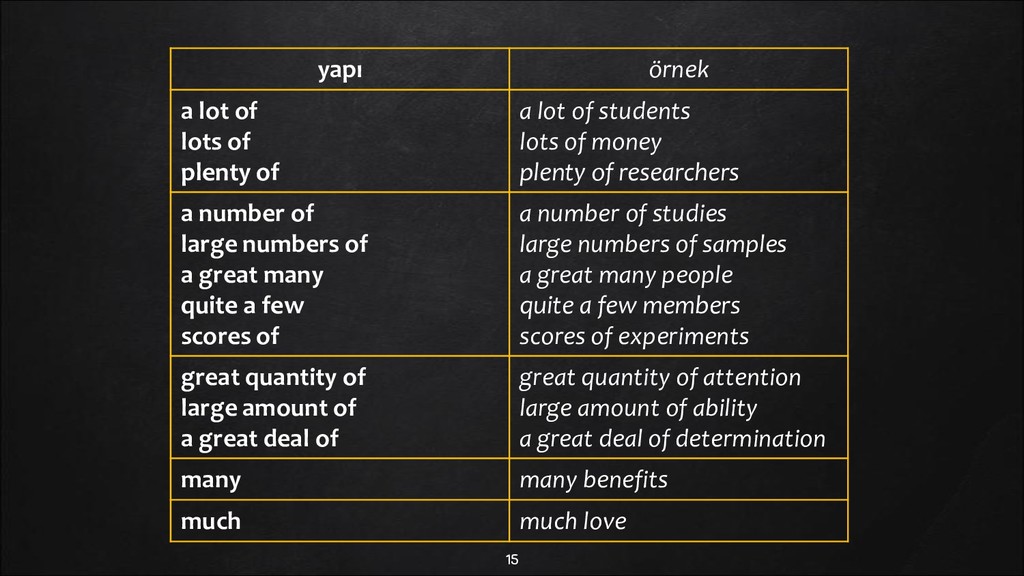
  7. 15 yapı örnek a lot of lots of plenty of

    a lot of students lots of money plenty of researchers a number of large numbers of a great many quite a few scores of a number of studies large numbers of samples a great many people quite a few members scores of experiments great quantity of large amount of a great deal of great quantity of attention large amount of ability a great deal of determination many many benefits much much love
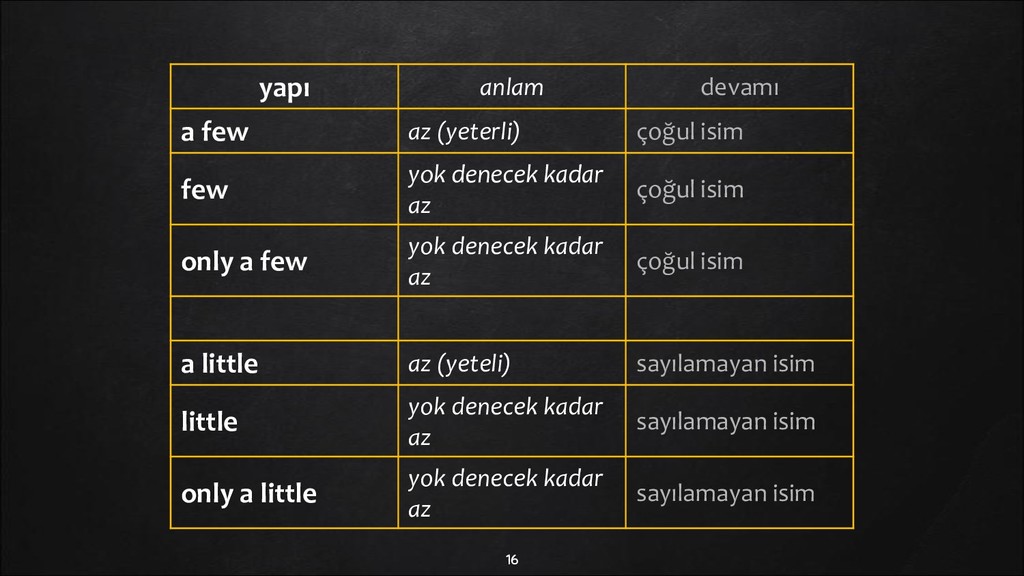
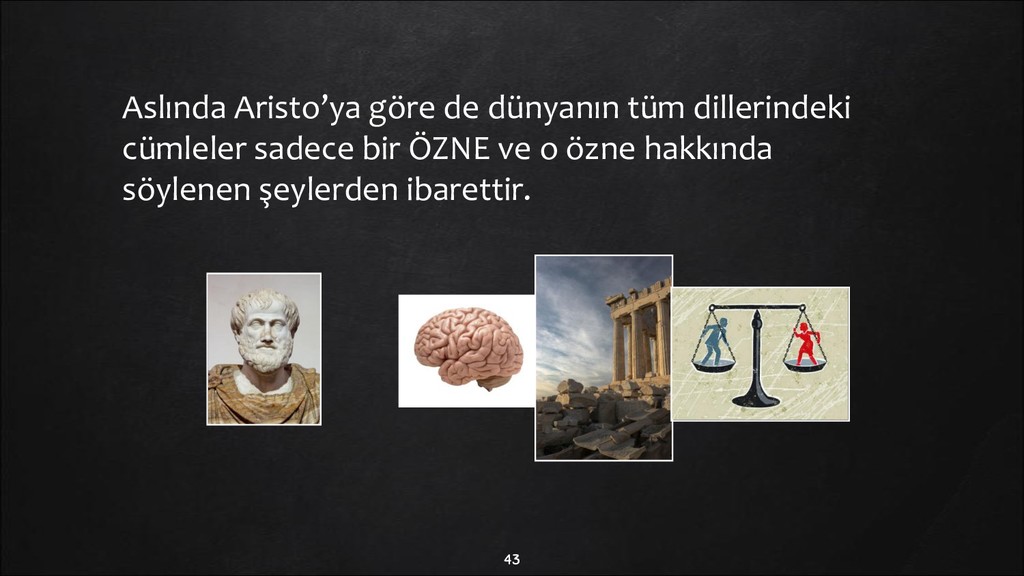
  8. 16 yapı anlam devamı a few az (yeterli) çoğul isim

    few yok denecek kadar az çoğul isim only a few yok denecek kadar az çoğul isim a little az (yeteli) sayılamayan isim little yok denecek kadar az sayılamayan isim only a little yok denecek kadar az sayılamayan isim
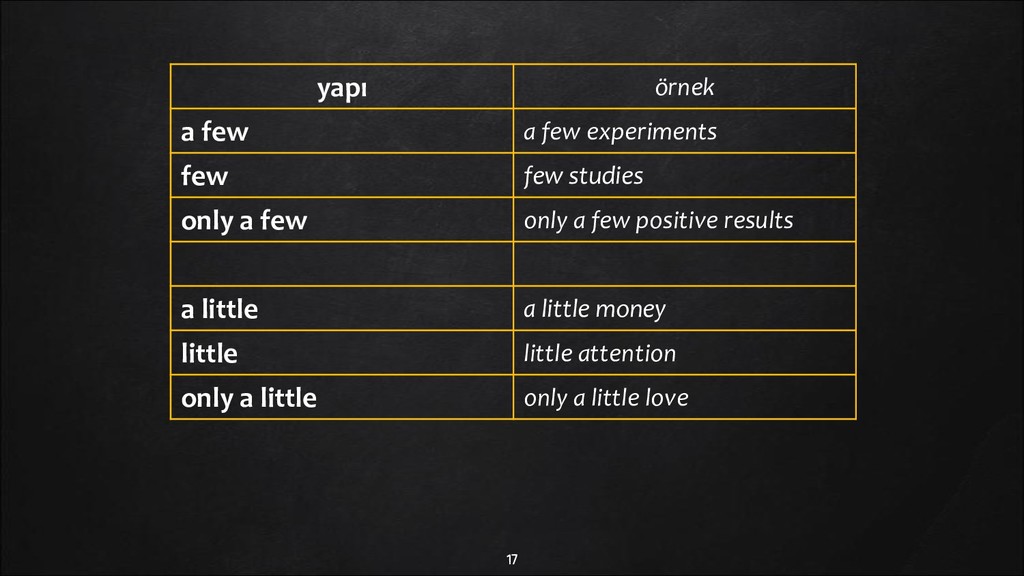
  9. 17 yapı örnek a few a few experiments few few

    studies only a few only a few positive results a little a little money little little attention only a little only a little love
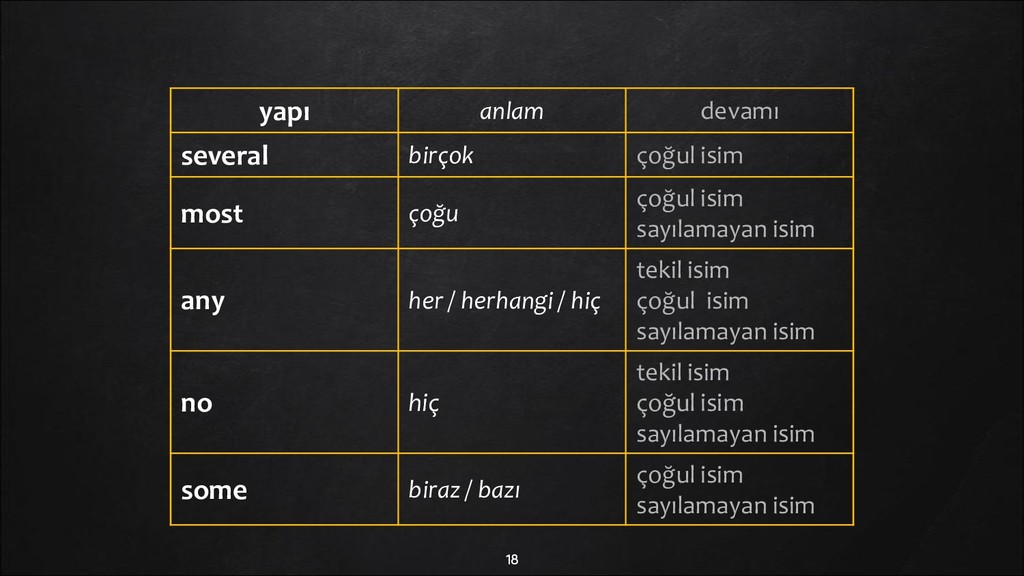
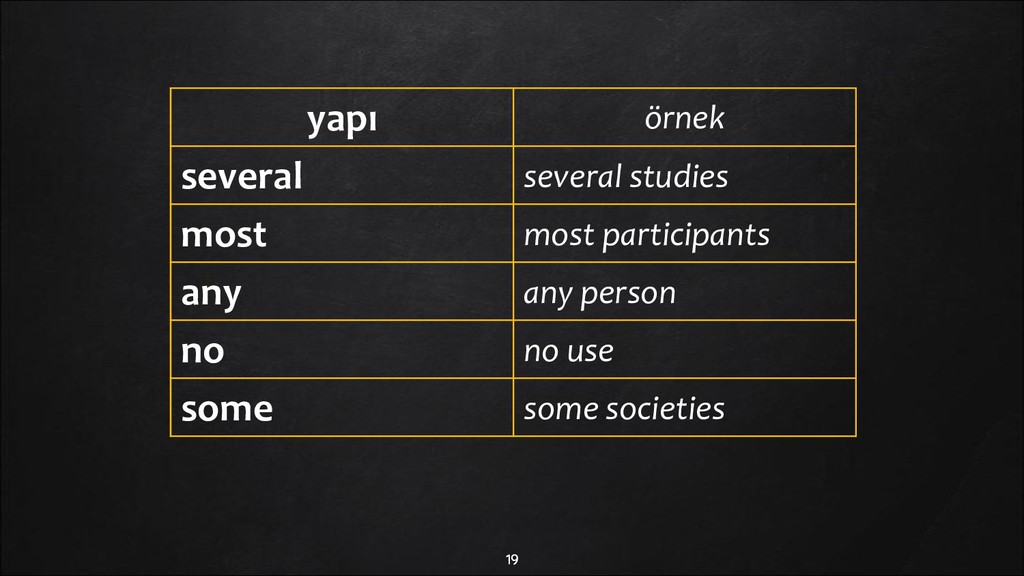
  10. 18 yapı anlam devamı several birçok çoğul isim most çoğu

    çoğul isim sayılamayan isim any her / herhangi / hiç tekil isim çoğul isim sayılamayan isim no hiç tekil isim çoğul isim sayılamayan isim some biraz / bazı çoğul isim sayılamayan isim
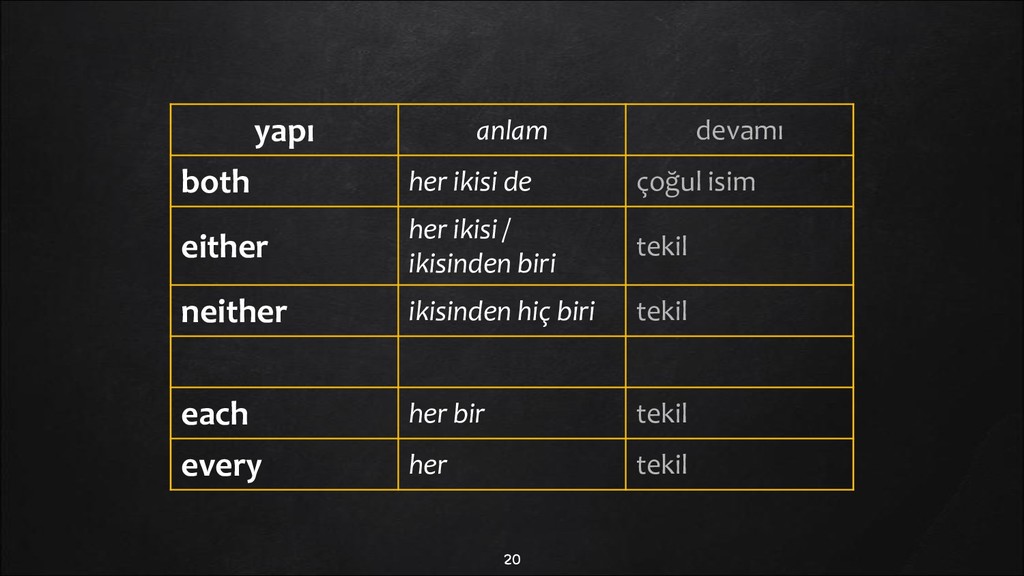
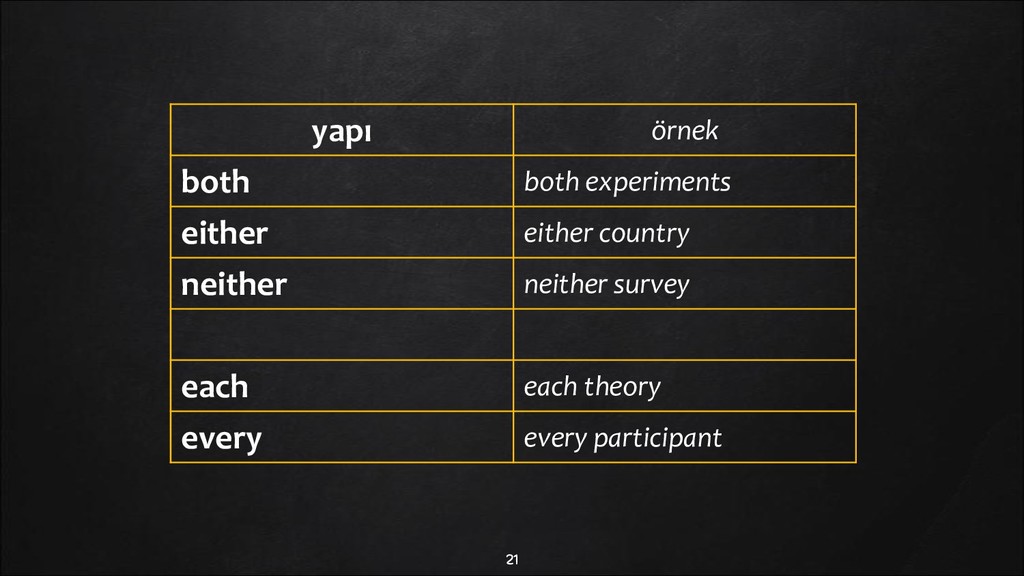
  11. 20 yapı anlam devamı both her ikisi de çoğul isim

    either her ikisi / ikisinden biri tekil neither ikisinden hiç biri tekil each her bir tekil every her tekil
  12. 21 yapı örnek both both experiments either either country neither

    neither survey each each theory every every participant
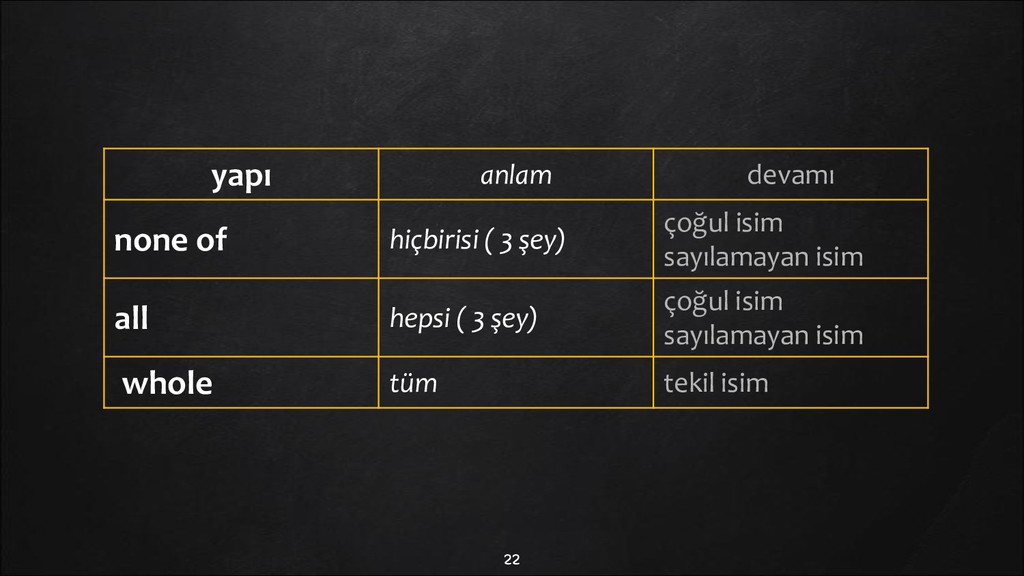
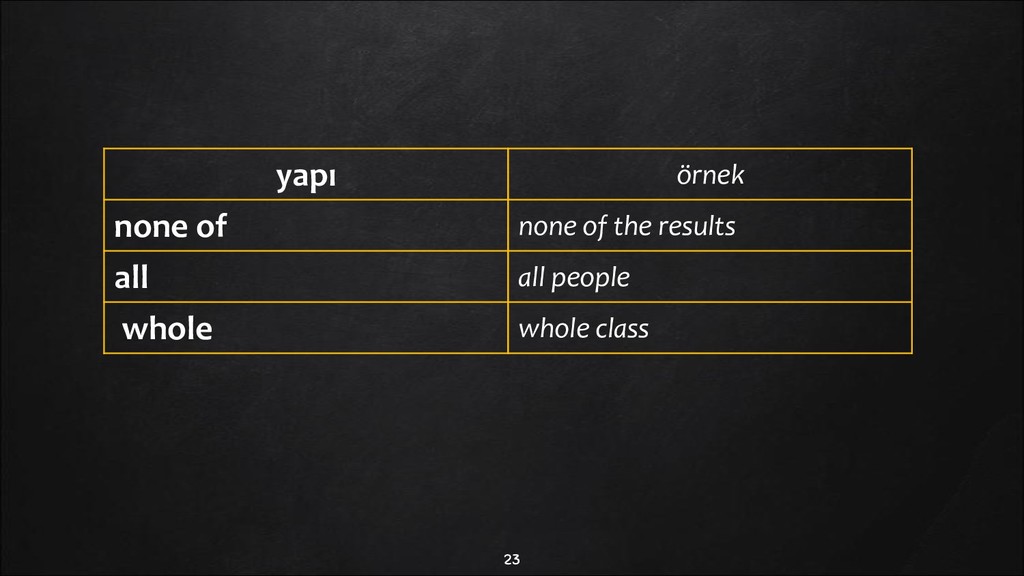
  13. 22 yapı anlam devamı none of hiçbirisi ( 3 şey)

    çoğul isim sayılamayan isim all hepsi ( 3 şey) çoğul isim sayılamayan isim whole tüm tekil isim
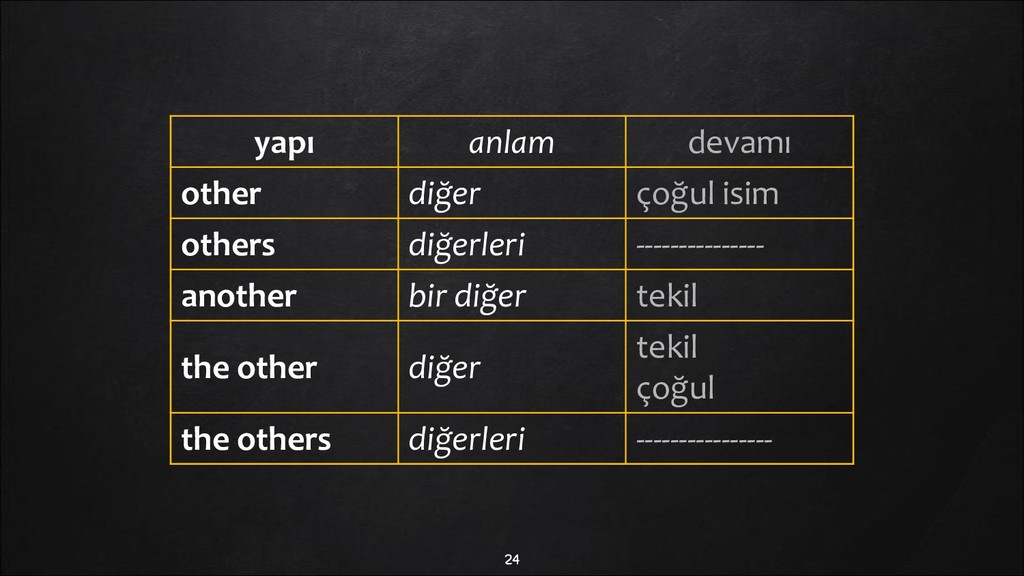
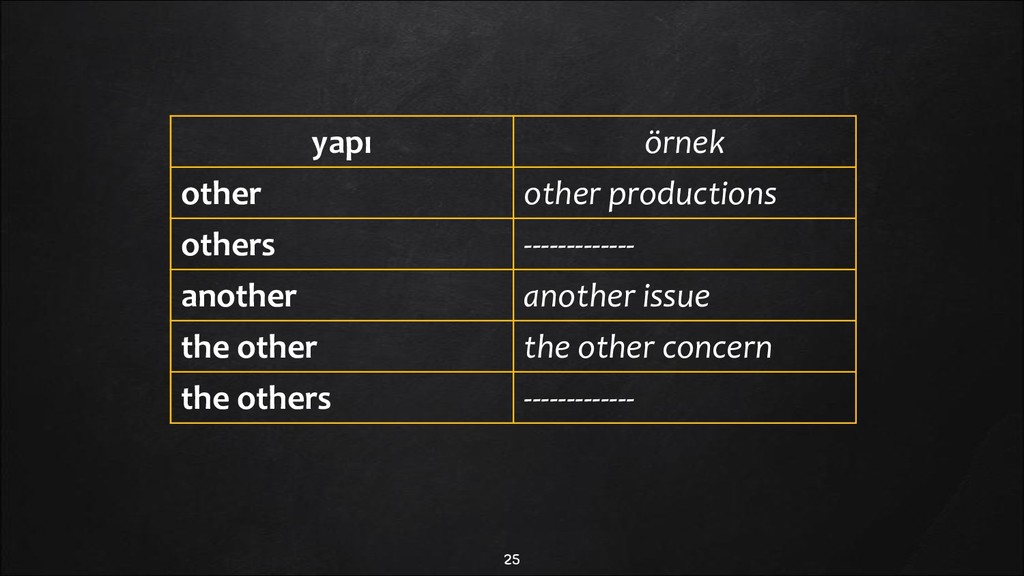
  14. 24 yapı anlam devamı other diğer çoğul isim others diğerleri

    --------------- another bir diğer tekil the other diğer tekil çoğul the others diğerleri ----------------
  15. 25 yapı örnek other other productions others ------------- another another

    issue the other the other concern the others -------------
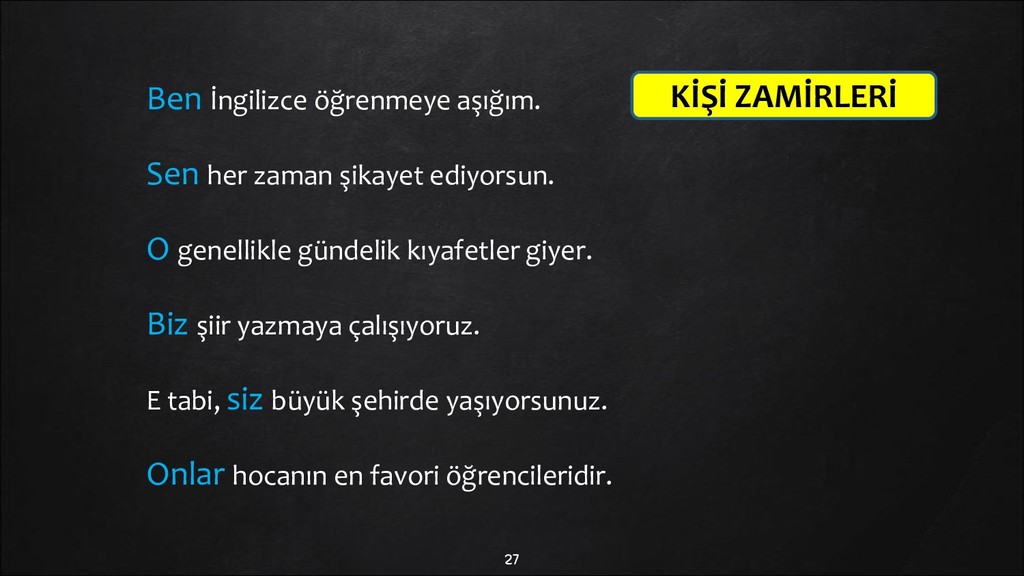
  16. 27 Ben İngilizce öğrenmeye aşığım. Sen her zaman şikayet ediyorsun.

    O genellikle gündelik kıyafetler giyer. Biz şiir yazmaya çalışıyoruz. E tabi, siz büyük şehirde yaşıyorsunuz. Onlar hocanın en favori öğrencileridir. KİŞİ ZAMİRLERİ
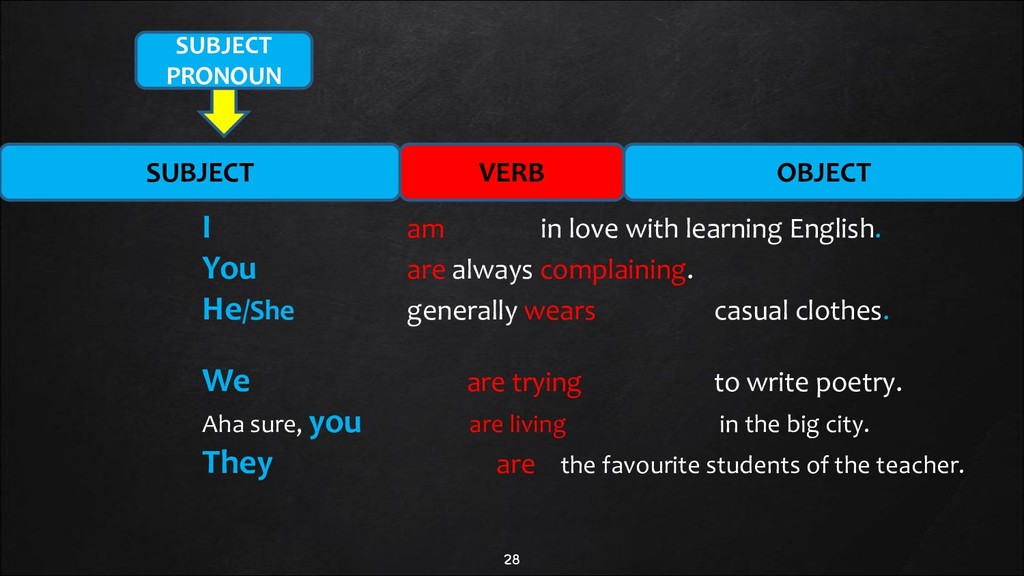
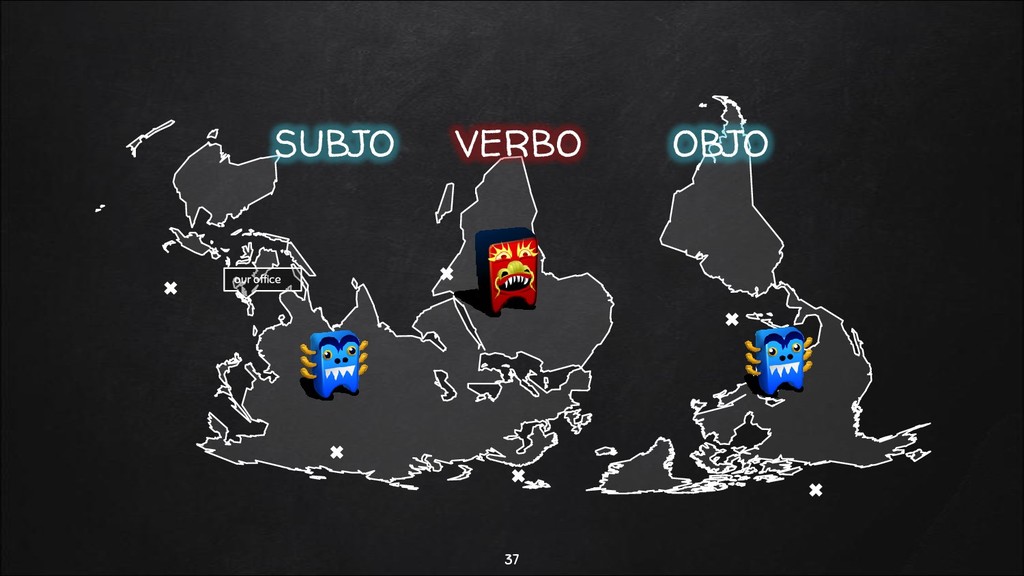
  17. 28 SUBJECT VERB OBJECT SUBJECT PRONOUN I am in love

    with learning English. You are always complaining. He/She generally wears casual clothes. We are trying to write poetry. Aha sure, you are living in the big city. They are the favourite students of the teacher.
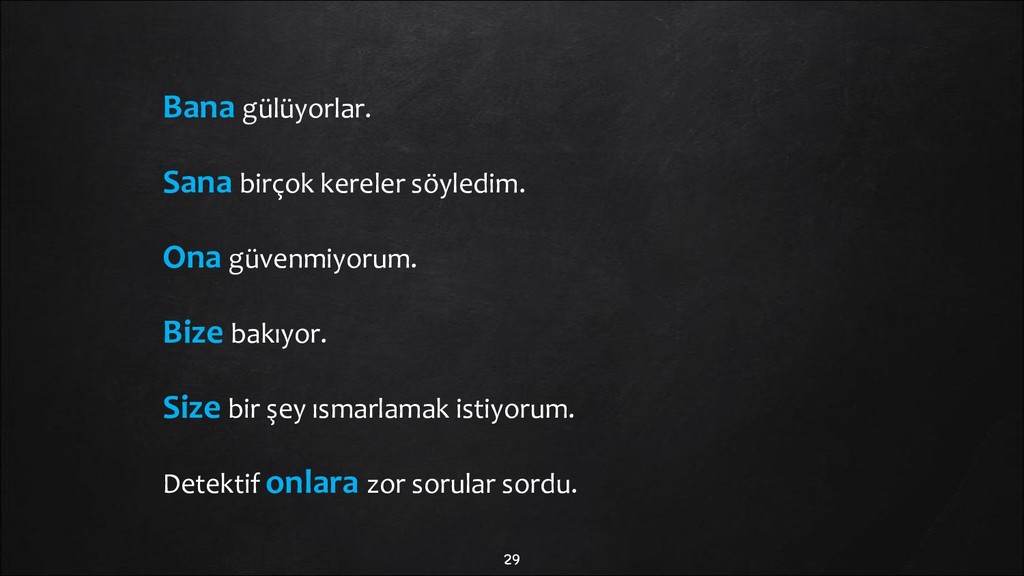
  18. 29 Bana gülüyorlar. Sana birçok kereler söyledim. Ona güvenmiyorum. Bize

    bakıyor. Size bir şey ısmarlamak istiyorum. Detektif onlara zor sorular sordu.
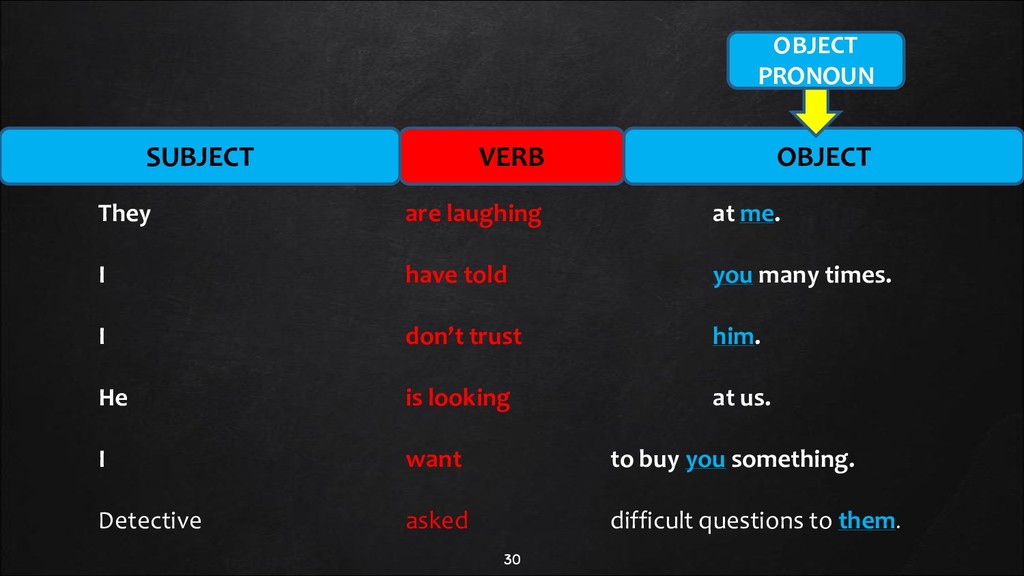
  19. 30 SUBJECT VERB OBJECT OBJECT PRONOUN They are laughing at

    me. I have told you many times. I don’t trust him. He is looking at us. I want to buy you something. Detective asked difficult questions to them.
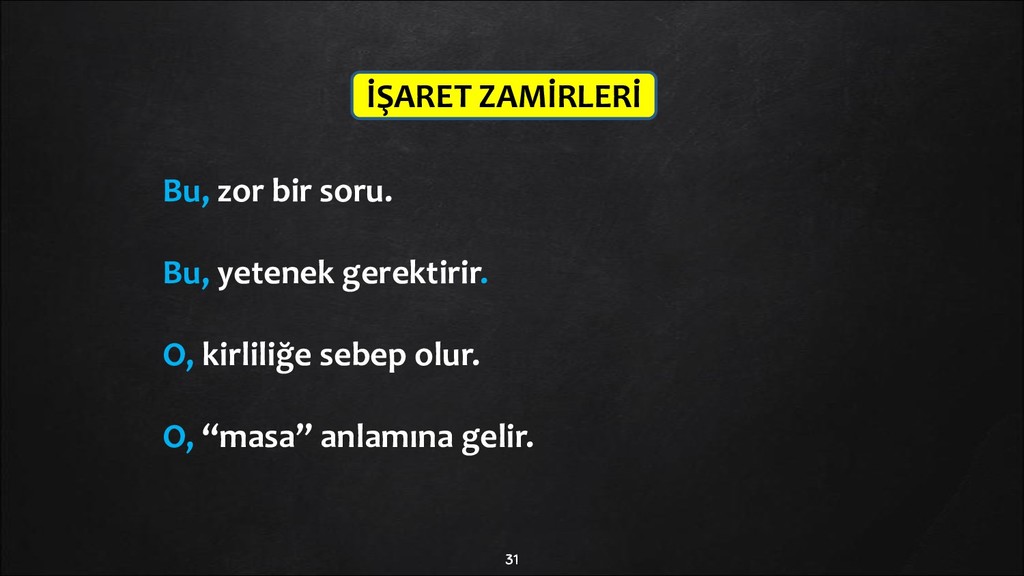
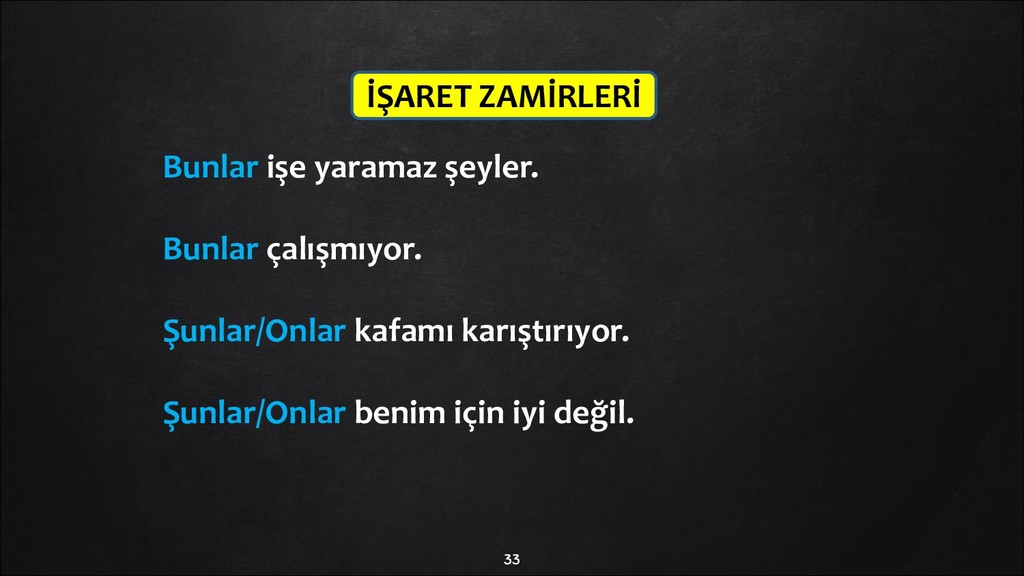
  20. 31 Bu, zor bir soru. Bu, yetenek gerektirir. O, kirliliğe

    sebep olur. O, “masa” anlamına gelir. İŞARET ZAMİRLERİ
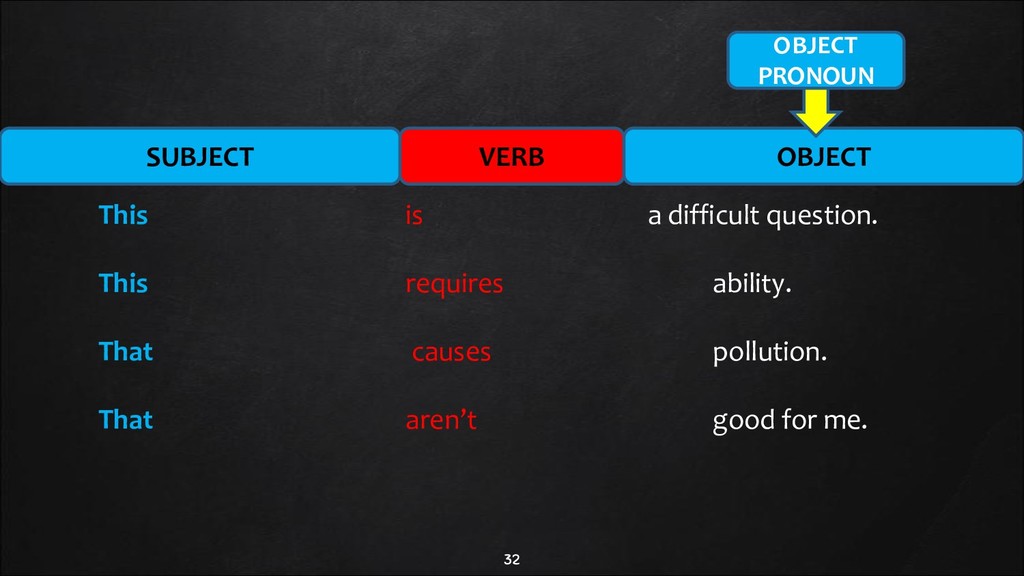
  21. 32 SUBJECT VERB OBJECT OBJECT PRONOUN This is a difficult

    question. This requires ability. That causes pollution. That aren’t good for me.
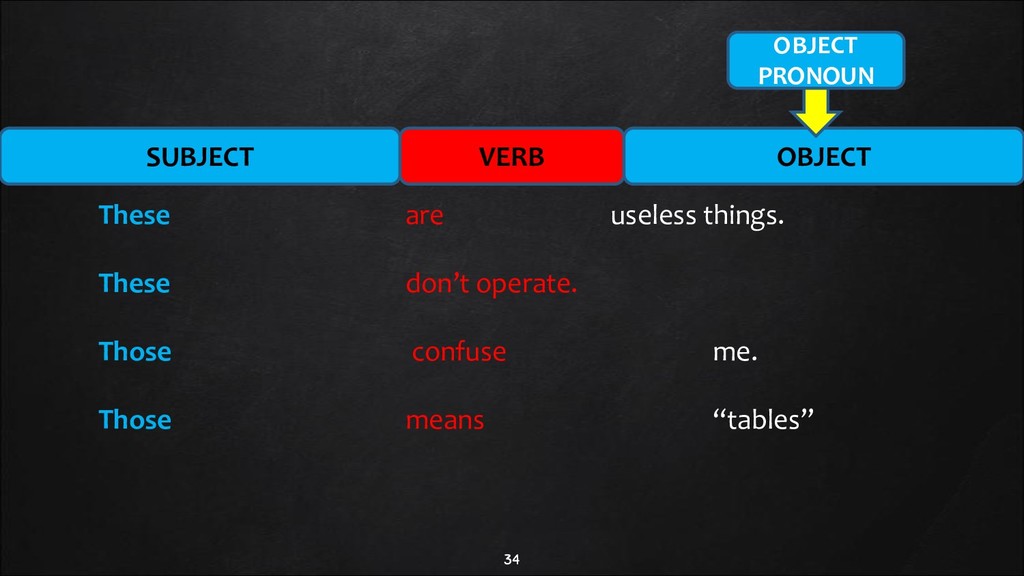
  22. 34 SUBJECT VERB OBJECT OBJECT PRONOUN These are useless things.

    These don’t operate. Those confuse me. Those means “tables”
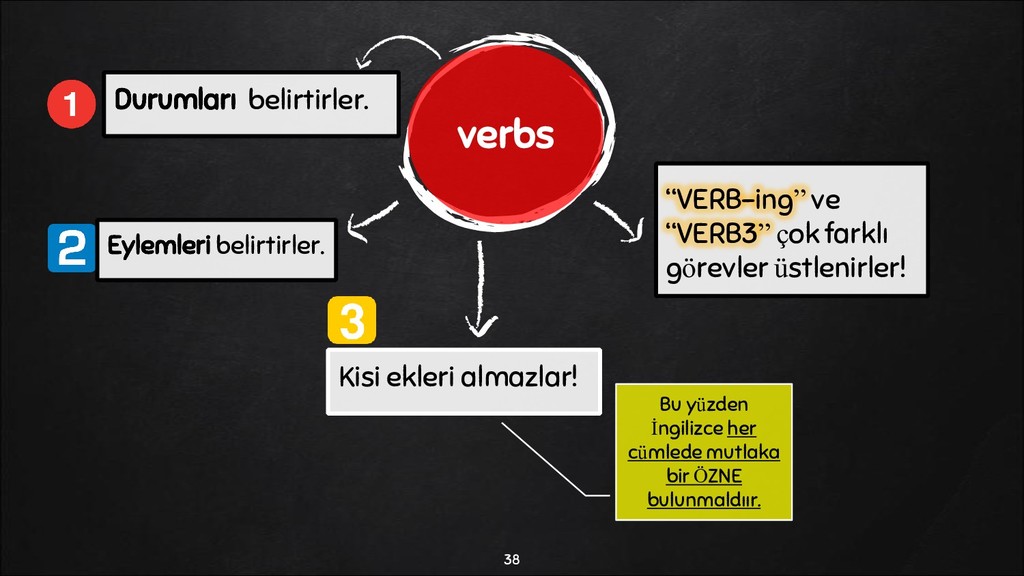
  23. 38 verbs Durumları belirtirler. Kisi ekleri almazlar! “VERB-ing” ve “VERB3”

    çok farklı görevler üstlenirler! Bu yüzden İngilizce her cümlede mutlaka bir ÖZNE bulunmaldıır. Eylemleri belirtirler.
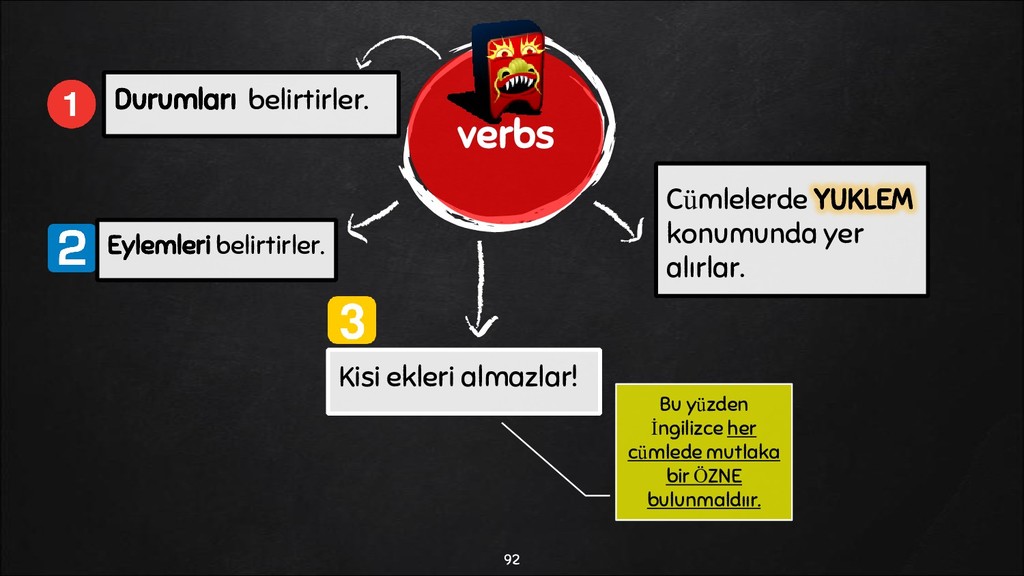
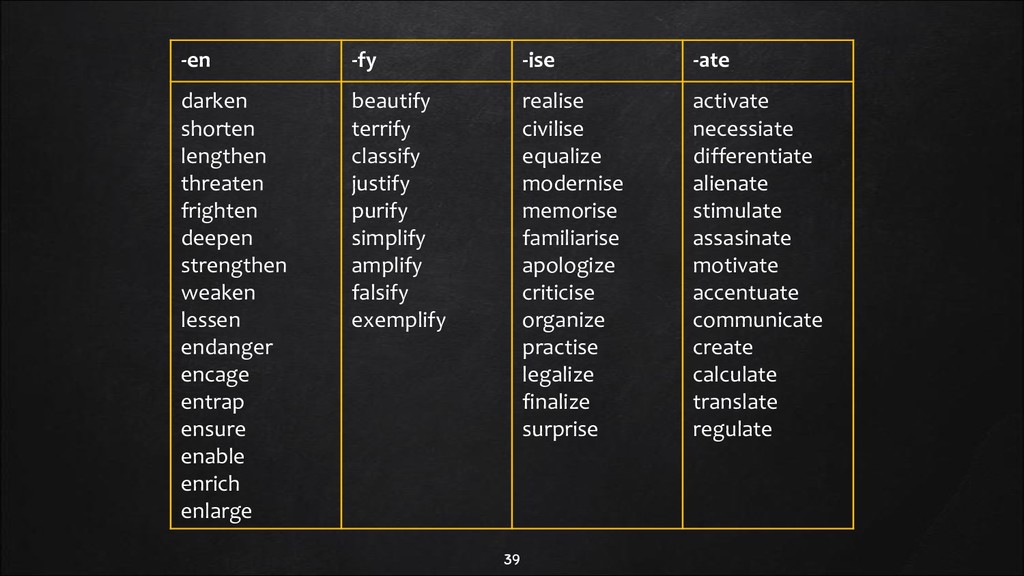
  24. 39 -en -fy -ise -ate darken shorten lengthen threaten frighten

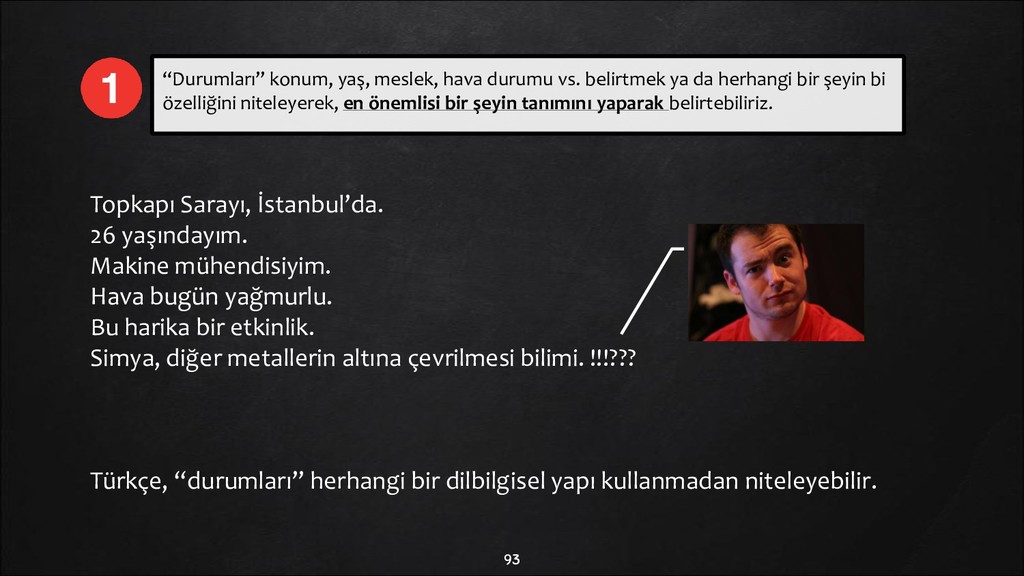
    deepen strengthen weaken lessen endanger encage entrap ensure enable enrich enlarge beautify terrify classify justify purify simplify amplify falsify exemplify realise civilise equalize modernise memorise familiarise apologize criticise organize practise legalize finalize surprise activate necessiate differentiate alienate stimulate assasinate motivate accentuate communicate create calculate translate regulate
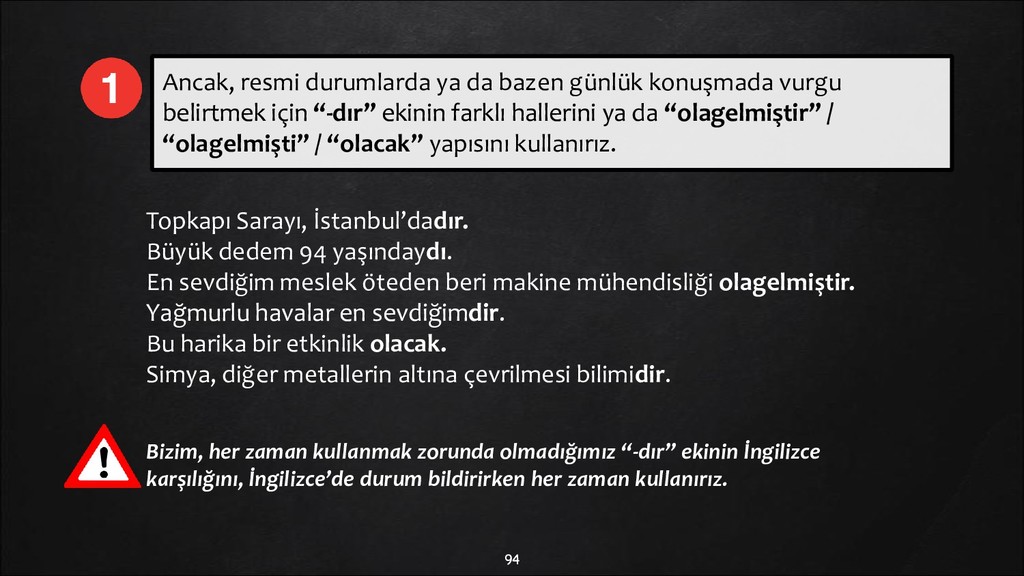
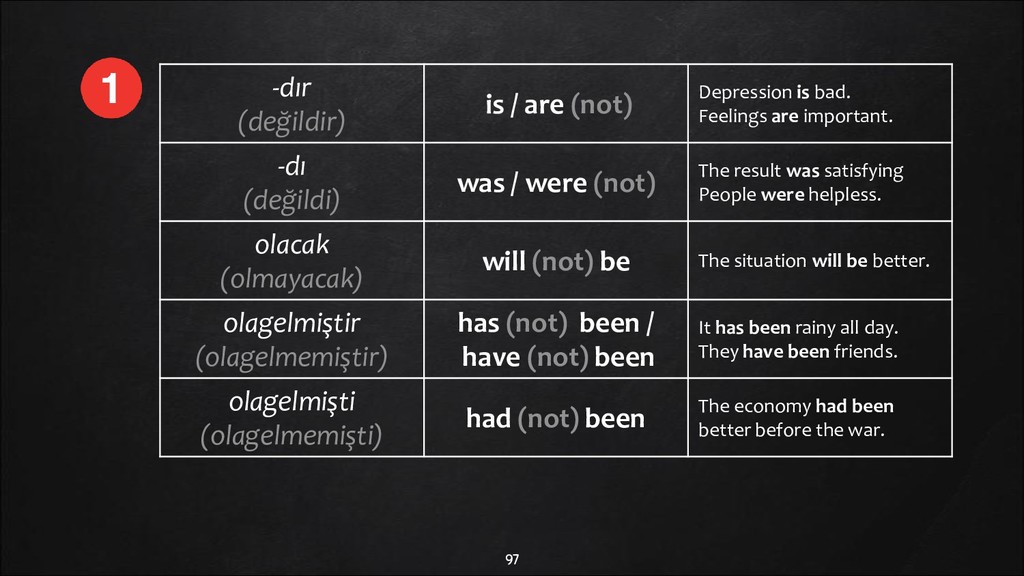
  25. 41 Türkçe’de FİİL’ler kişi eki alabilirler. Bu yüzden Türkçe’de tek

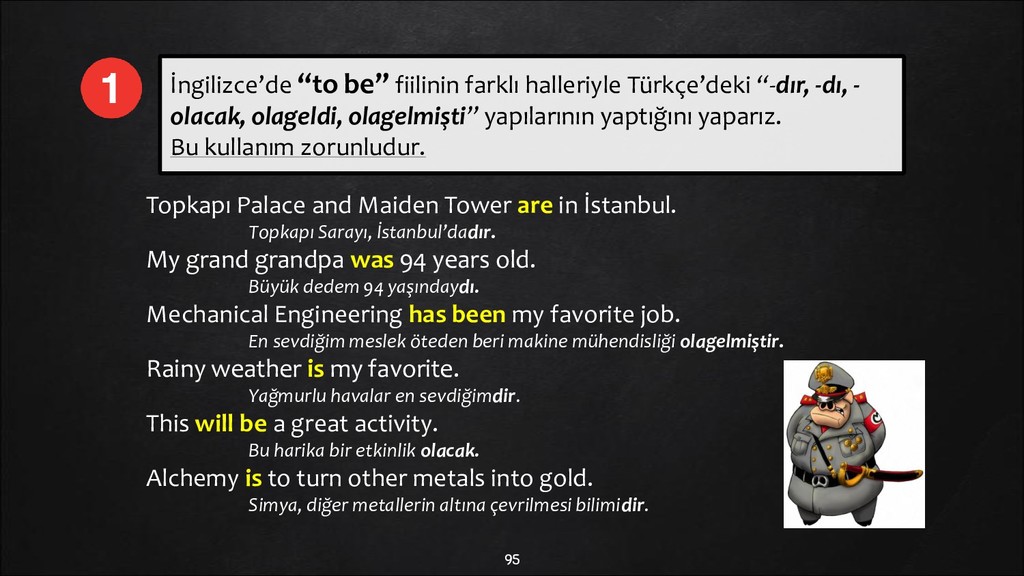
    kelimelik cümleler kurulabilir. Bitirdiler. İngilizce’de FİİL’ler sahış ekleri alamazlar! They finished. Görüldüğü gibi “they” olmasa “finish” eylemini kimin yaptığını anlayamıyor olacağız.
  26. 43 Aslında Aristo’ya göre de dünyanın tüm dillerindeki cümleler sadece

    bir ÖZNE ve o özne hakkında söylenen şeylerden ibarettir.
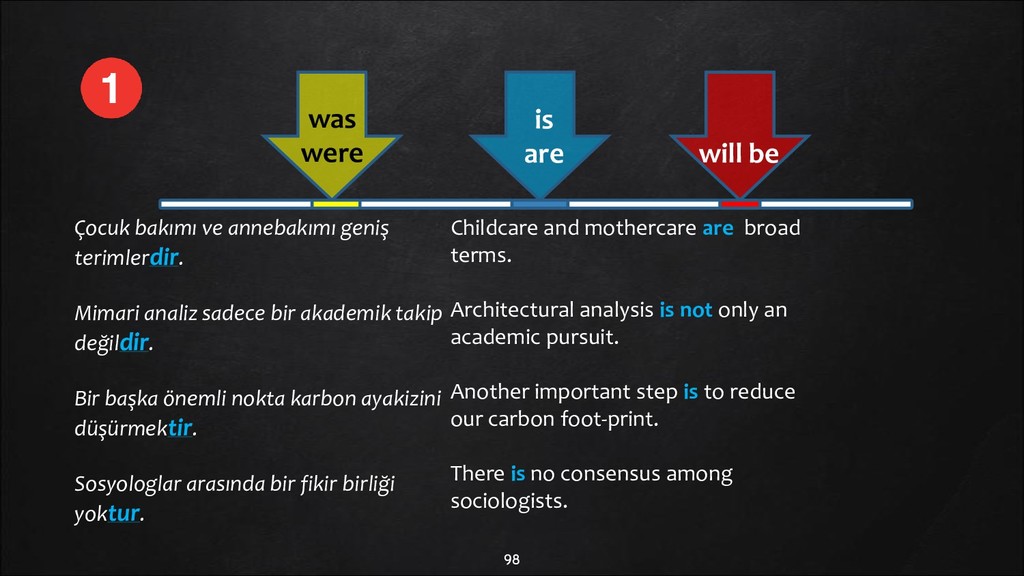
  27. 44 Şair, insanlığın bütünü içinde yer aldığı hissine sahip değilse,

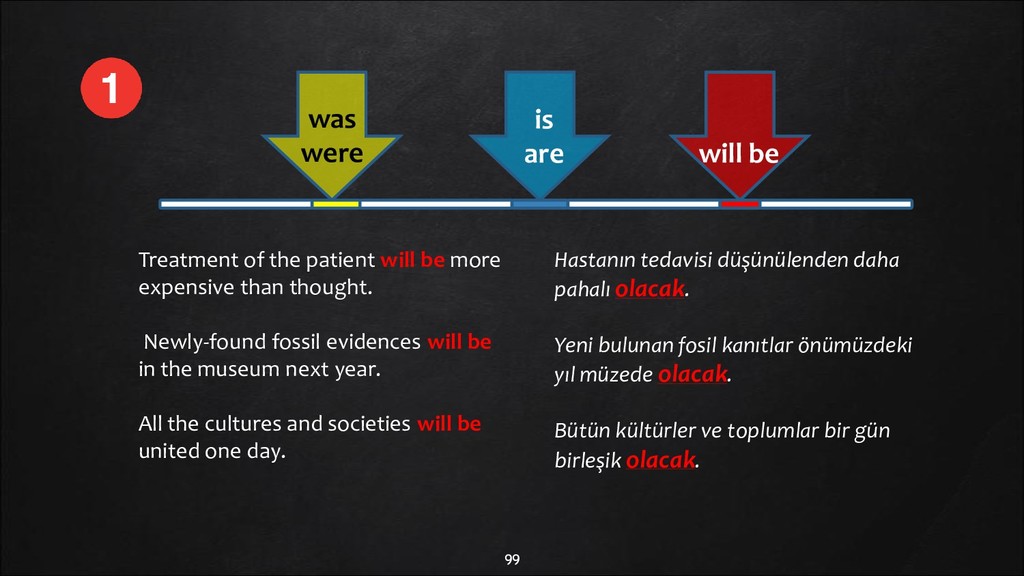
    bu duyguyla yazmıyorsa, edebiyatta yer edinemez. En karmaşık cümleler bile bu şekilde iki yapılı dizilimlere dönüştürülebilir.
  28. 45 İlerleyen konularda karmaşık yapılı cümleler öğrenecek olsak da şu

    sözümüz hep aklımızda kalsın! “Yeterince basit değilse, gereksiz karmaşıktır.”
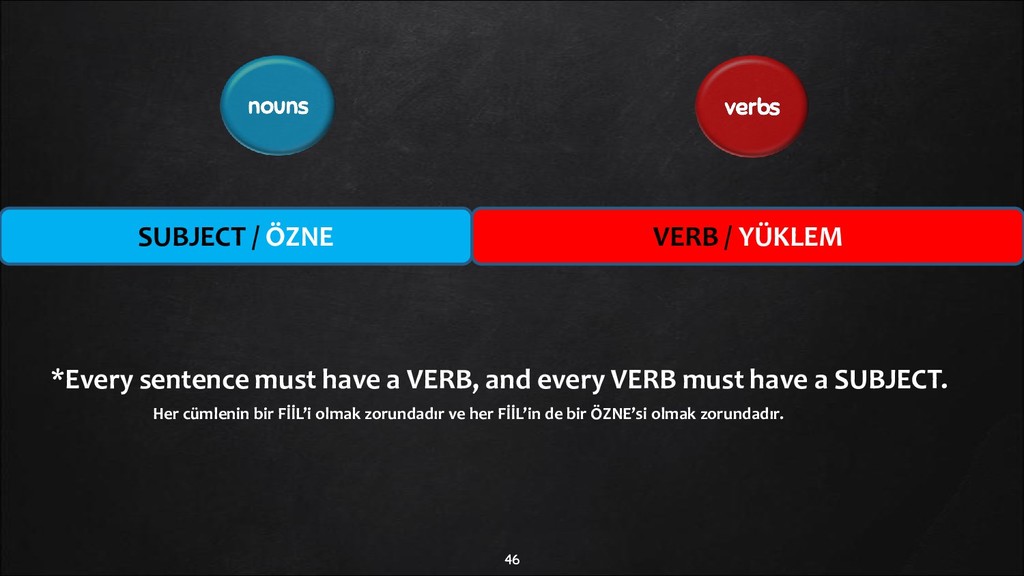
  29. 46 SUBJECT / ÖZNE VERB / YÜKLEM *Every sentence must

    have a VERB, and every VERB must have a SUBJECT. Her cümlenin bir FİİL’i olmak zorundadır ve her FİİL’in de bir ÖZNE’si olmak zorundadır. verbs nouns
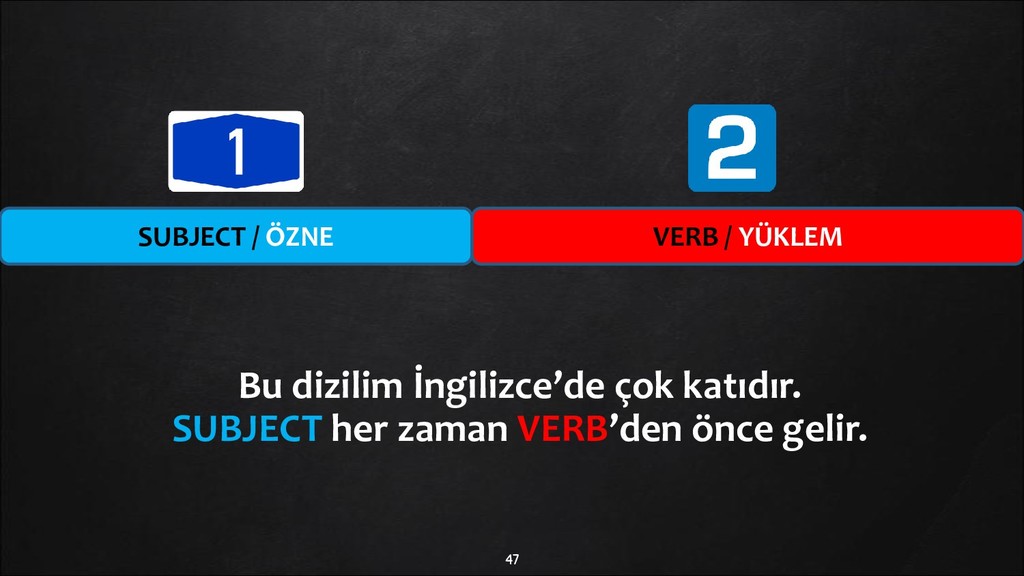
  30. 47 SUBJECT / ÖZNE VERB / YÜKLEM Bu dizilim İngilizce’de

    çok katıdır. SUBJECT her zaman VERB’den önce gelir.
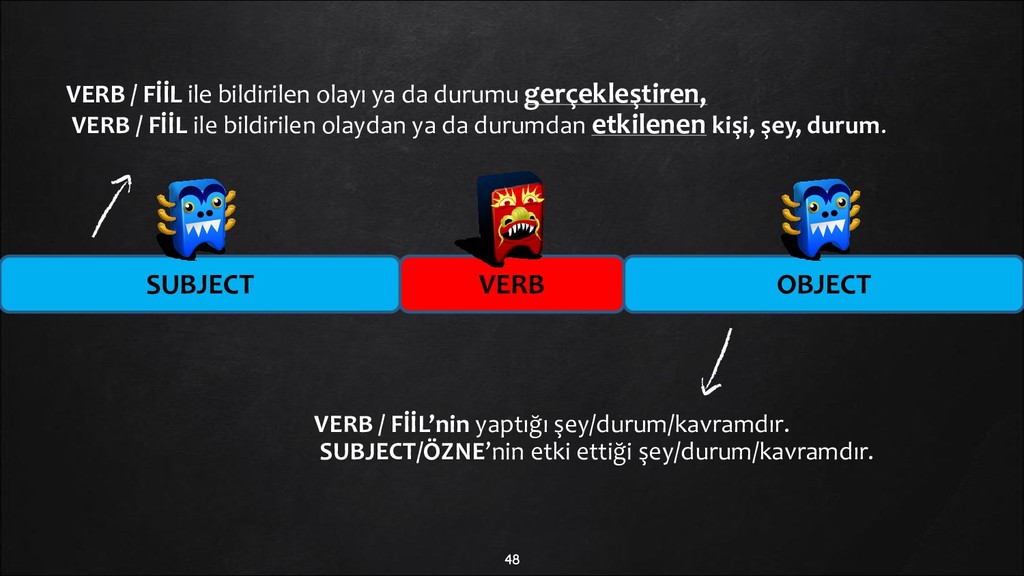
  31. 48 SUBJECT VERB OBJECT VERB / FİİL’nin yaptığı şey/durum/kavramdır. SUBJECT/ÖZNE’nin

    etki ettiği şey/durum/kavramdır. VERB / FİİL ile bildirilen olayı ya da durumu gerçekleştiren, VERB / FİİL ile bildirilen olaydan ya da durumdan etkilenen kişi, şey, durum.
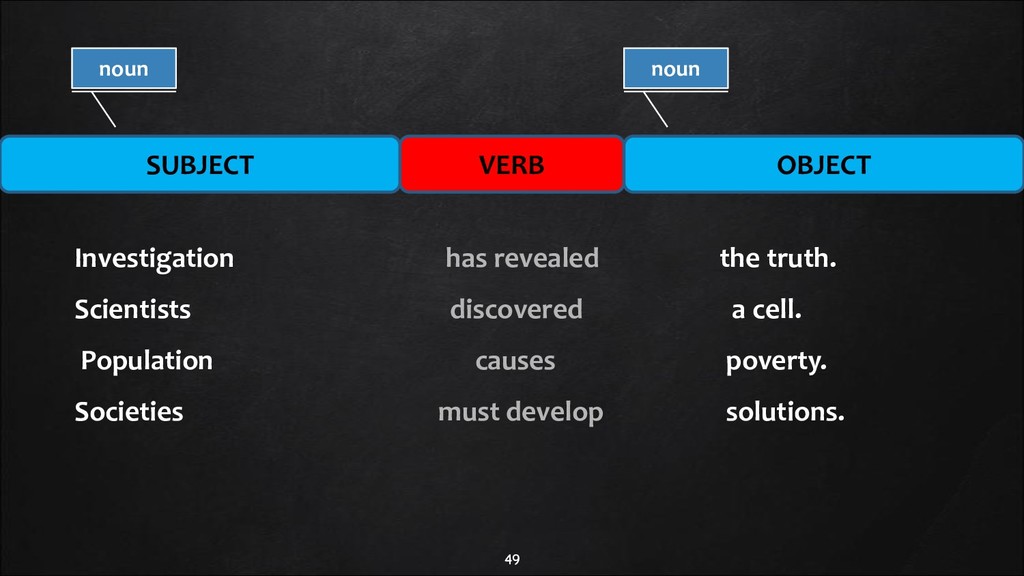
  32. 49 SUBJECT VERB OBJECT noun noun Investigation has revealed the

    truth. Scientists discovered a cell. Population causes poverty. Societies must develop solutions.
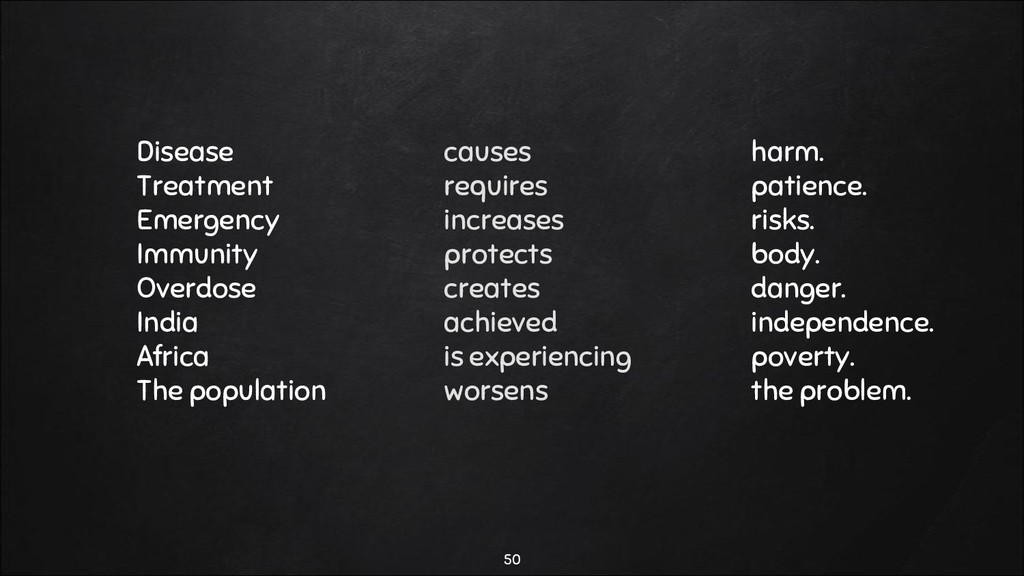
  33. 50 Disease causes harm. Treatment requires patience. Emergency increases risks.

    Immunity protects body. Overdose creates danger. India achieved independence. Africa is experiencing poverty. The population worsens the problem.
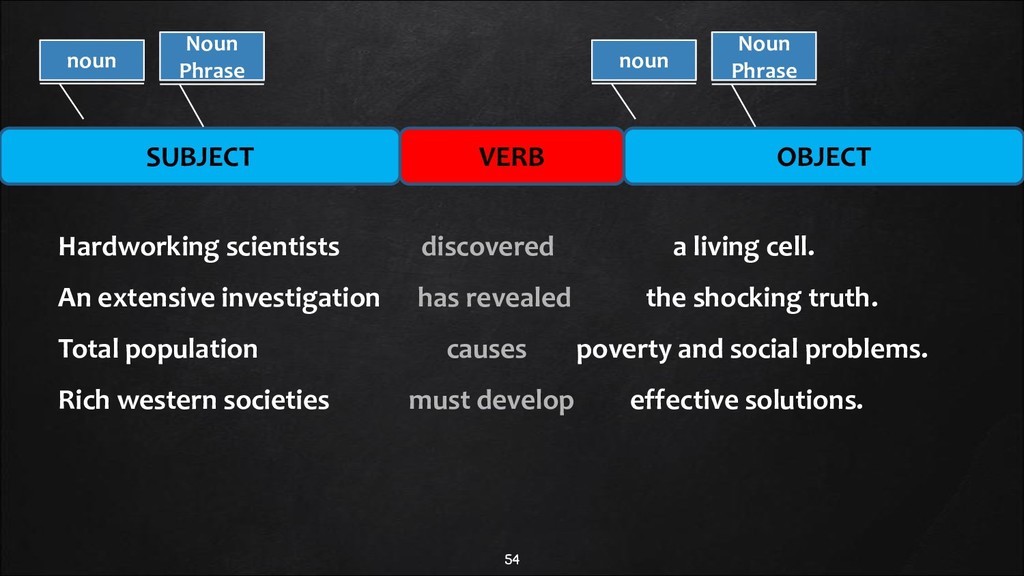
  34. 54 SUBJECT VERB OBJECT noun noun Noun Phrase Noun Phrase

    Hardworking scientists discovered a living cell. An extensive investigation has revealed the shocking truth. Total population causes poverty and social problems. Rich western societies must develop effective solutions.
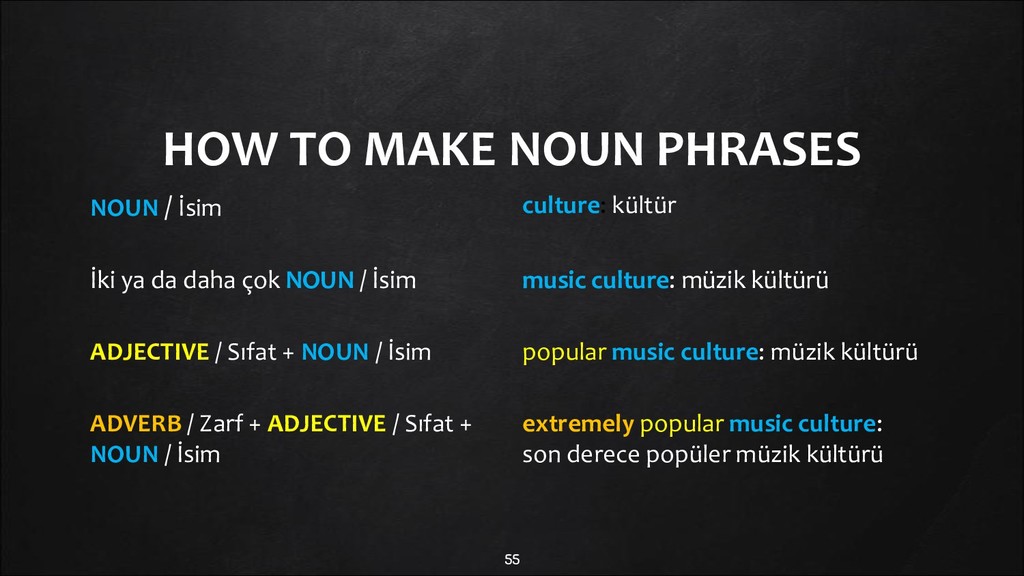
  35. 55 HOW TO MAKE NOUN PHRASES NOUN / İsim culture:

    kültür İki ya da daha çok NOUN / İsim music culture: müzik kültürü ADJECTIVE / Sıfat + NOUN / İsim popular music culture: müzik kültürü ADVERB / Zarf + ADJECTIVE / Sıfat + NOUN / İsim extremely popular music culture: son derece popüler müzik kültürü
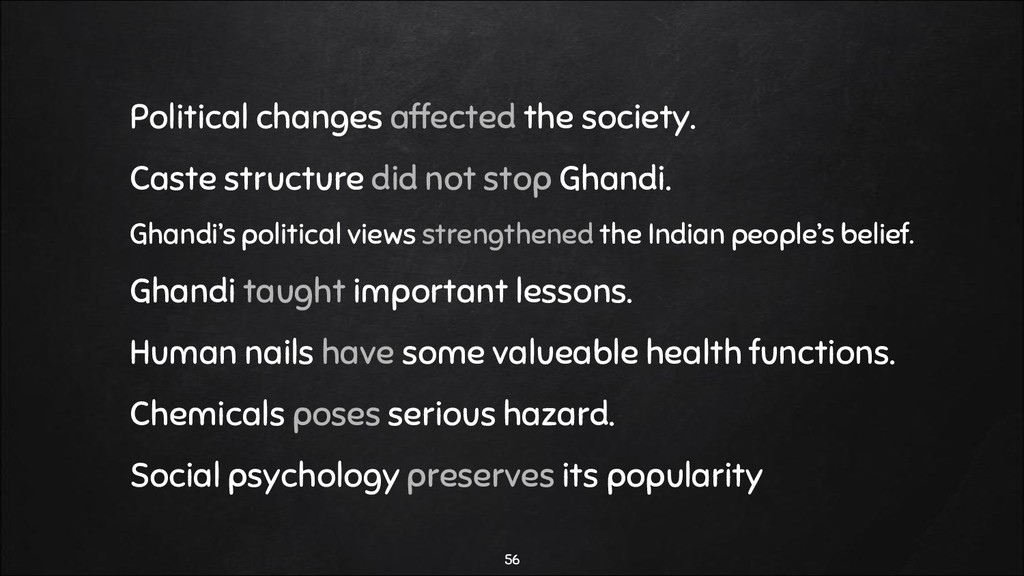
  36. Political changes affected the society. Caste structure did not stop

    Ghandi. Ghandi’s political views strengthened the Indian people’s belief. Ghandi taught important lessons. Human nails have some valueable health functions. Chemicals poses serious hazard. Social psychology preserves its popularity 56
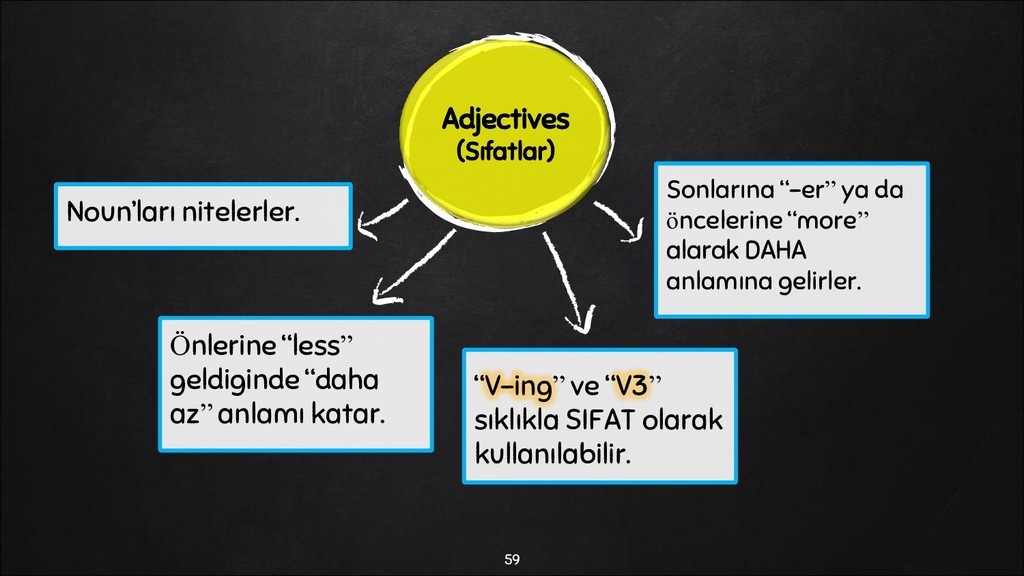
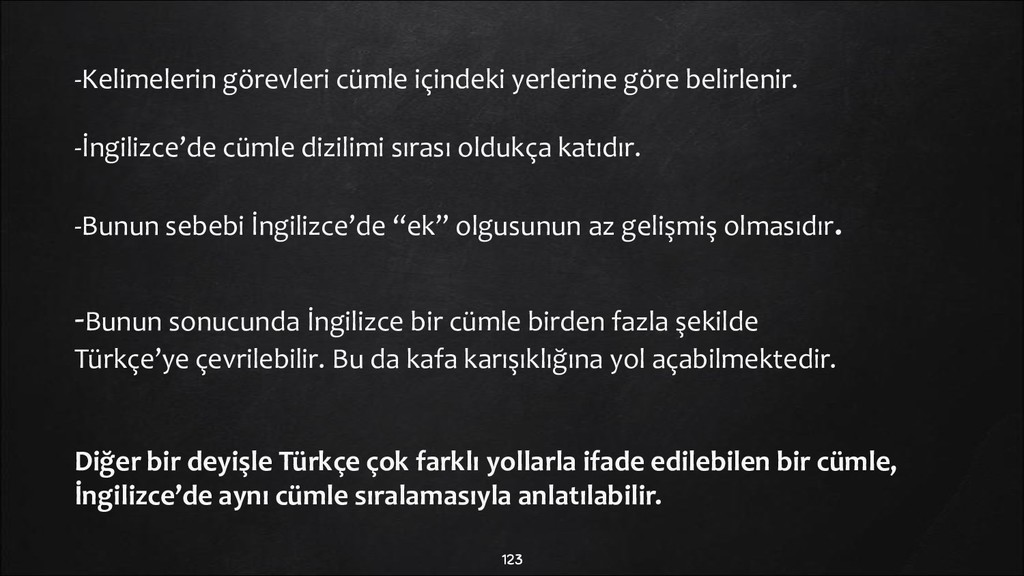
  37. 59 Adjectives (Sıfatlar) Noun’ları nitelerler. Önlerine “less” geldiginde “daha az”

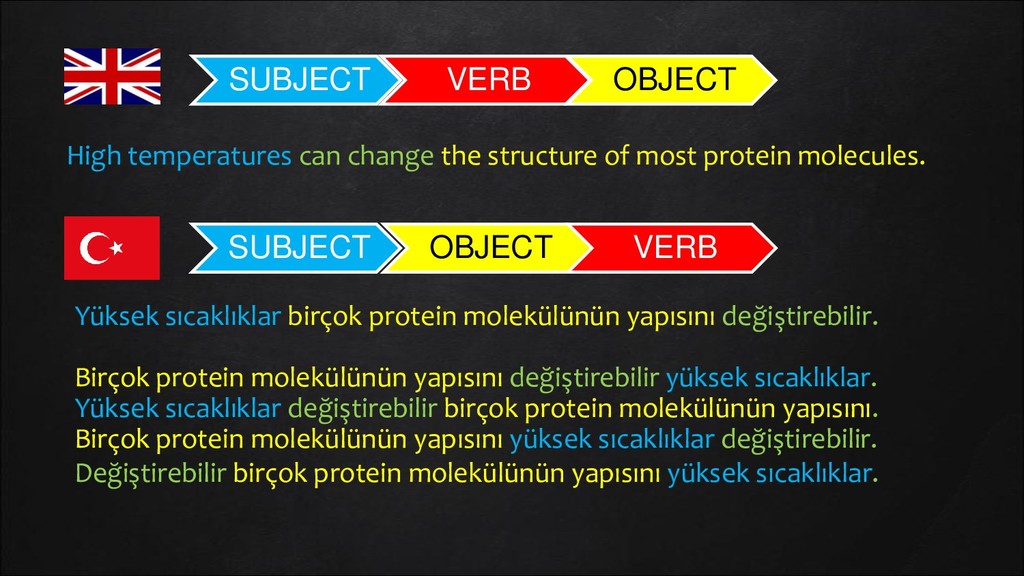
    anlamı katar. “V-ing” ve “V3” sıklıkla SIFAT olarak kullanılabilir. Sonlarına “-er” ya da öncelerine “more” alarak DAHA anlamına gelirler.
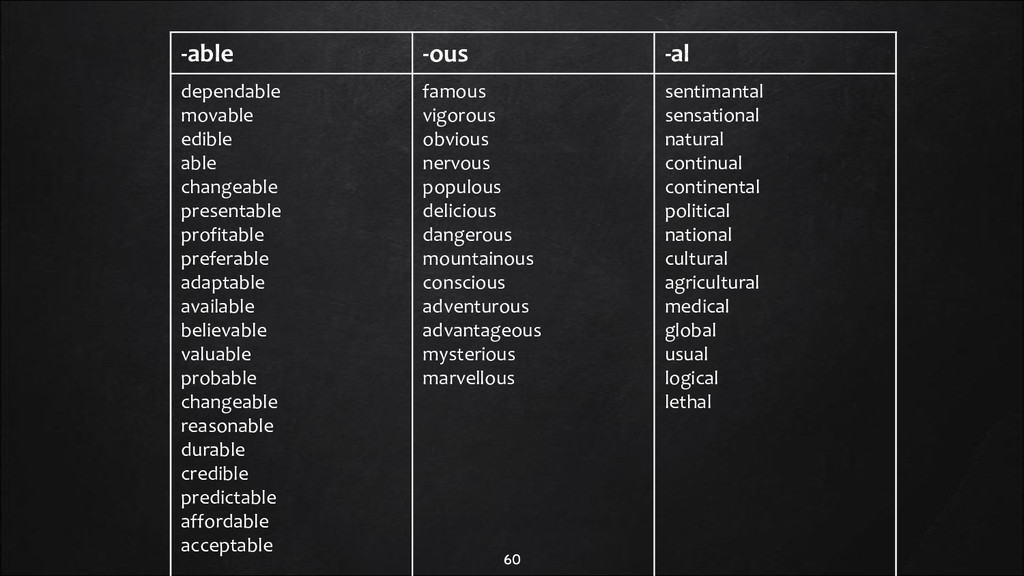
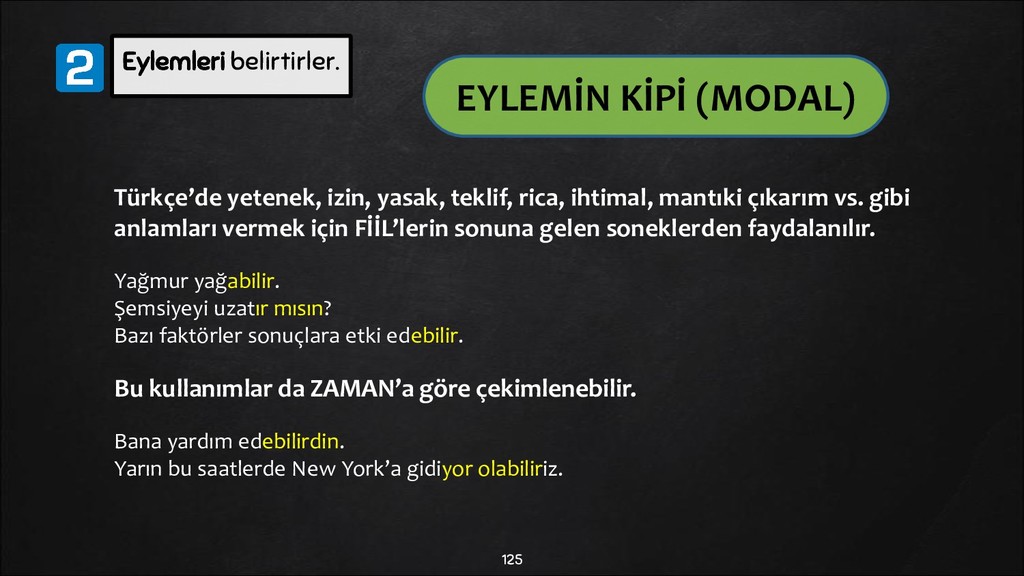
  38. 60 -able -ous -al dependable movable edible able changeable presentable

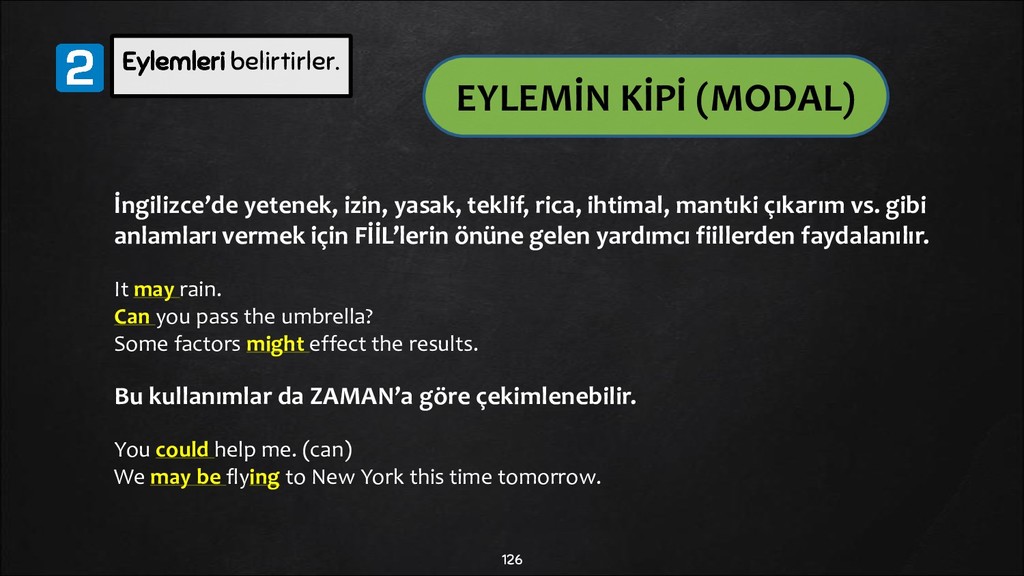
    profitable preferable adaptable available believable valuable probable changeable reasonable durable credible predictable affordable acceptable famous vigorous obvious nervous populous delicious dangerous mountainous conscious adventurous advantageous mysterious marvellous sentimantal sensational natural continual continental political national cultural agricultural medical global usual logical lethal
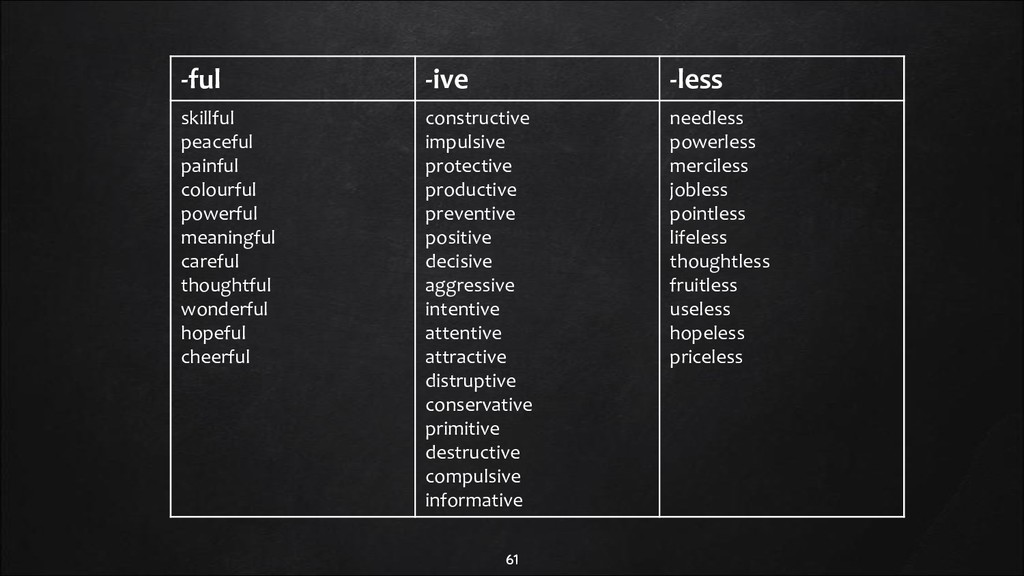
  39. 61 -ful -ive -less skillful peaceful painful colourful powerful meaningful

    careful thoughtful wonderful hopeful cheerful constructive impulsive protective productive preventive positive decisive aggressive intentive attentive attractive distruptive conservative primitive destructive compulsive informative needless powerless merciless jobless pointless lifeless thoughtless fruitless useless hopeless priceless
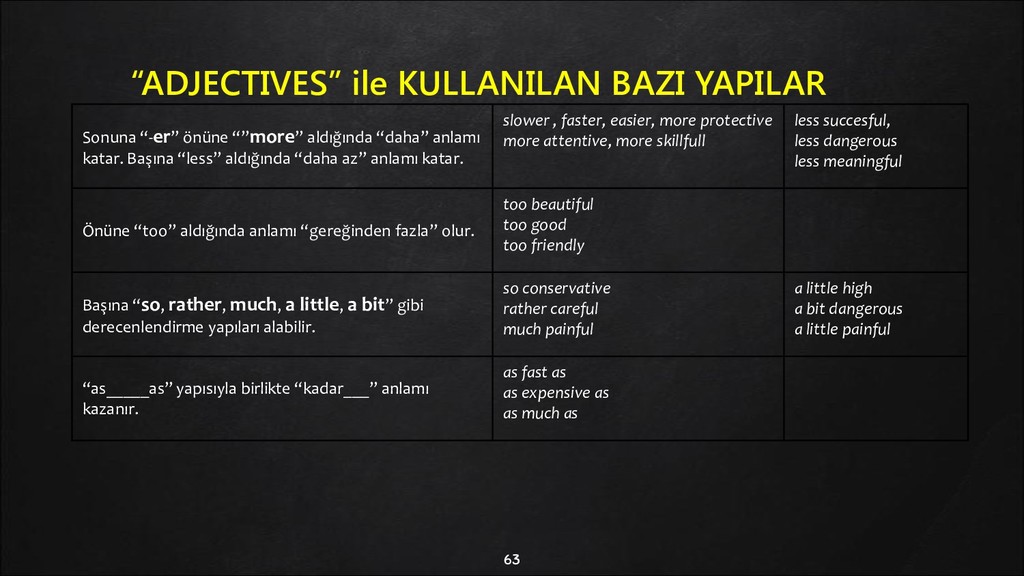
  40. 63 “ADJECTIVES” ile KULLANILAN BAZI YAPILAR Sonuna “-er” önüne “”more”

    aldığında “daha” anlamı katar. Başına “less” aldığında “daha az” anlamı katar. slower , faster, easier, more protective more attentive, more skillfull less succesful, less dangerous less meaningful Önüne “too” aldığında anlamı “gereğinden fazla” olur. too beautiful too good too friendly Başına “so, rather, much, a little, a bit” gibi derecenlendirme yapıları alabilir. so conservative rather careful much painful a little high a bit dangerous a little painful “as_____as” yapısıyla birlikte “kadar___” anlamı kazanır. as fast as as expensive as as much as
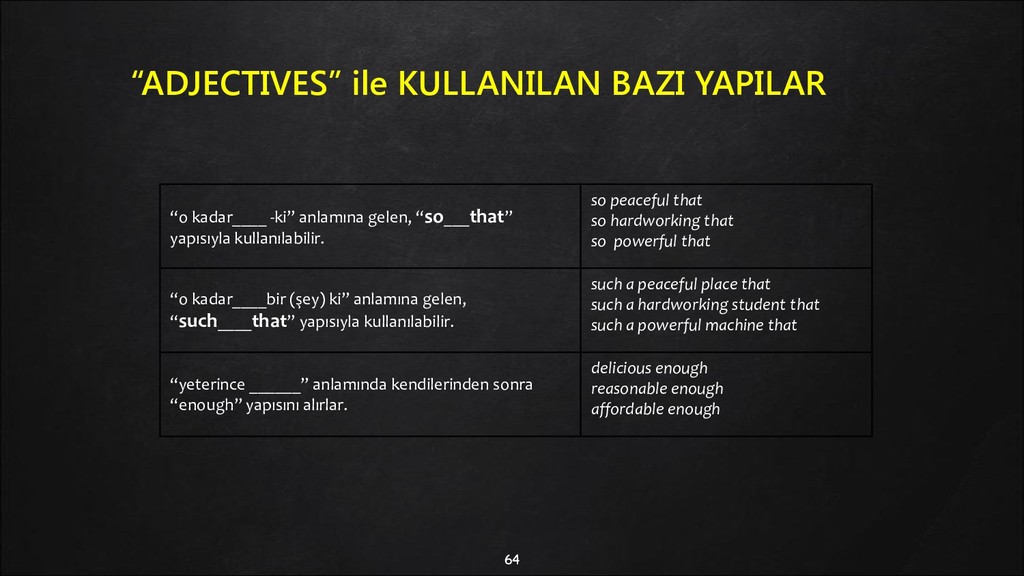
  41. 64 “o kadar____ -ki” anlamına gelen, “so___that” yapısıyla kullanılabilir. so

    peaceful that so hardworking that so powerful that “o kadar____bir (şey) ki” anlamına gelen, “such____that” yapısıyla kullanılabilir. such a peaceful place that such a hardworking student that such a powerful machine that “yeterince ______” anlamında kendilerinden sonra “enough” yapısını alırlar. delicious enough reasonable enough affordable enough “ADJECTIVES” ile KULLANILAN BAZI YAPILAR
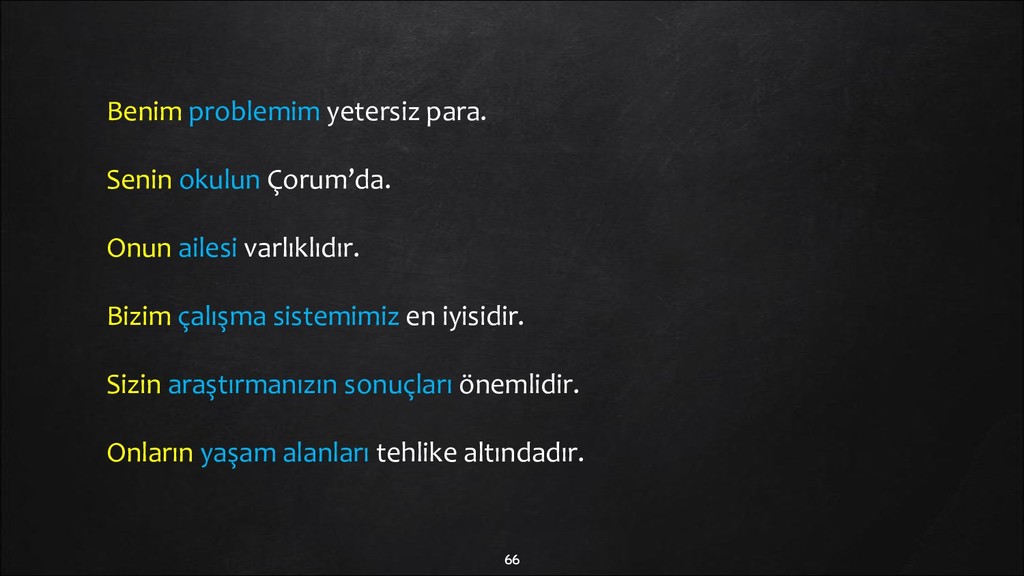
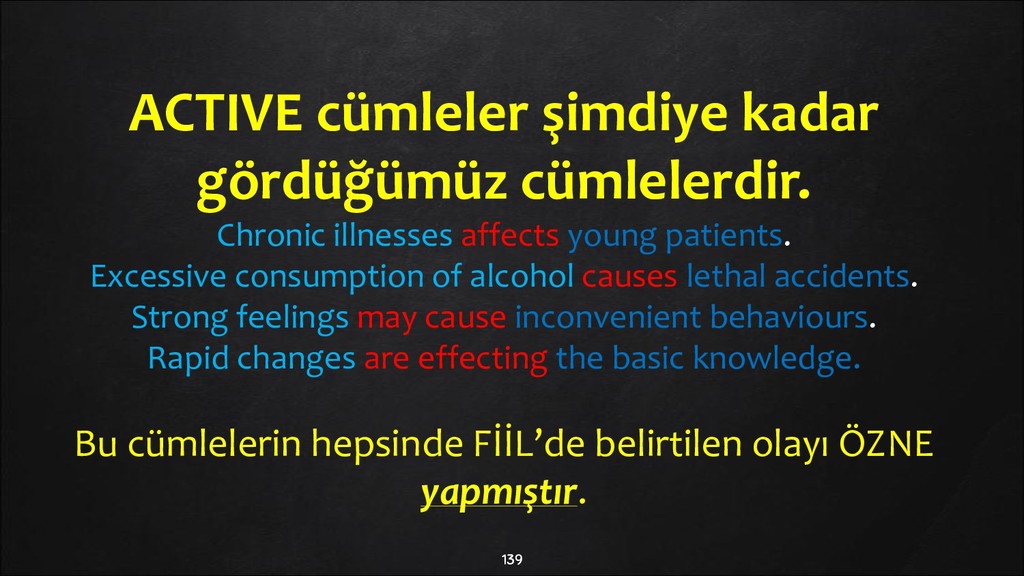
  42. 66 Benim problemim yetersiz para. Senin okulun Çorum’da. Onun ailesi

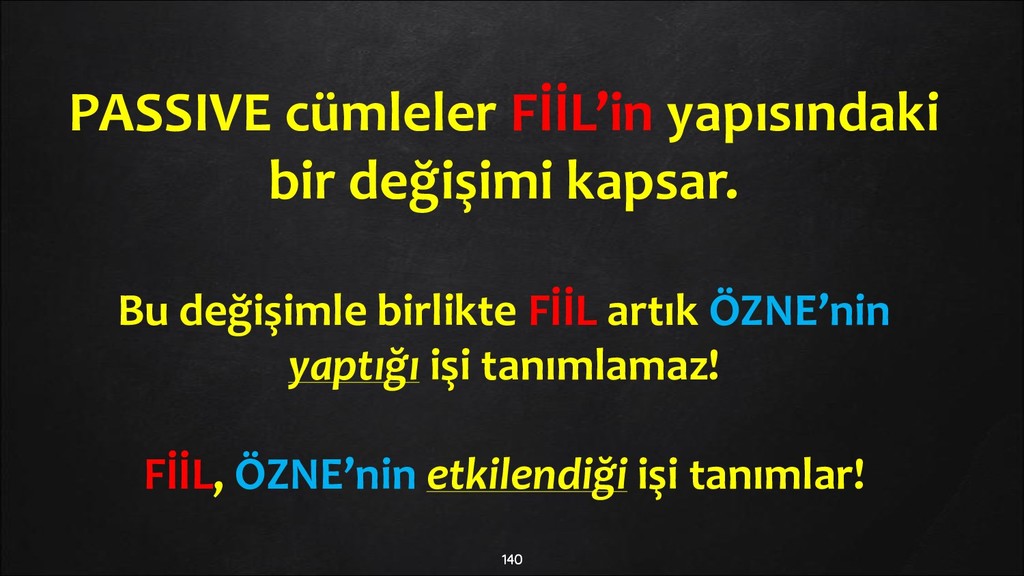
    varlıklıdır. Bizim çalışma sistemimiz en iyisidir. Sizin araştırmanızın sonuçları önemlidir. Onların yaşam alanları tehlike altındadır.
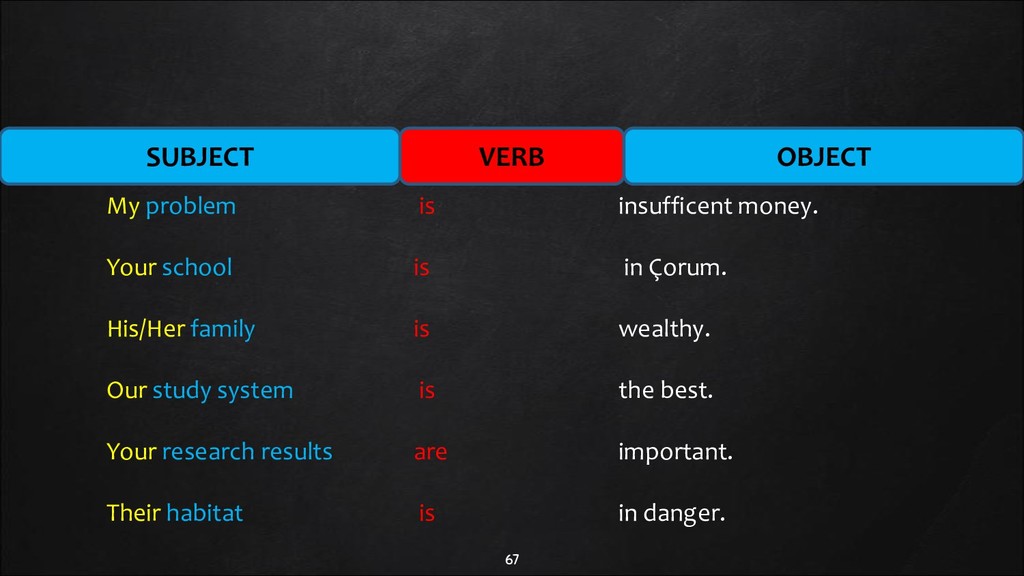
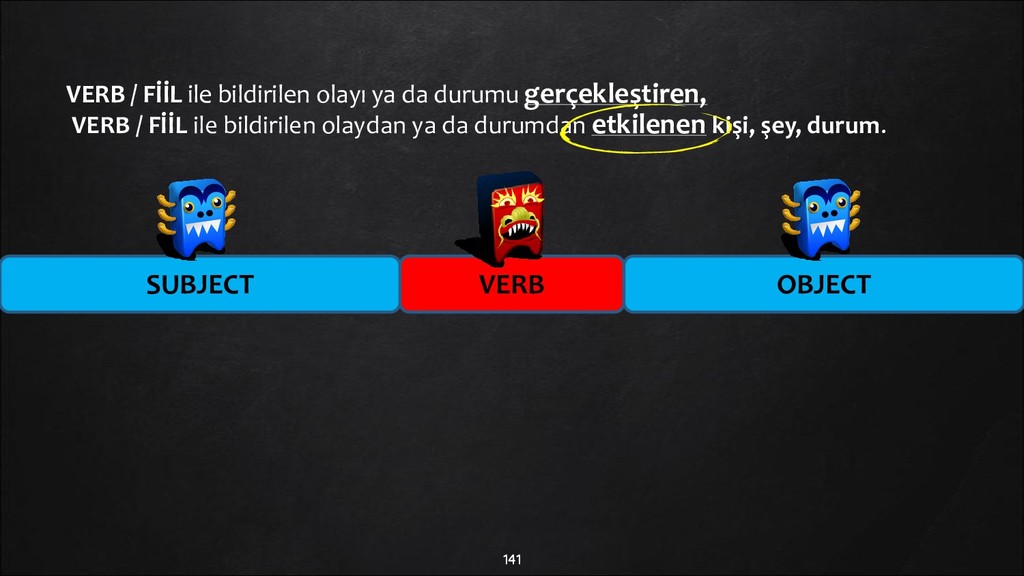
  43. 67 My problem is insufficent money. Your school is in

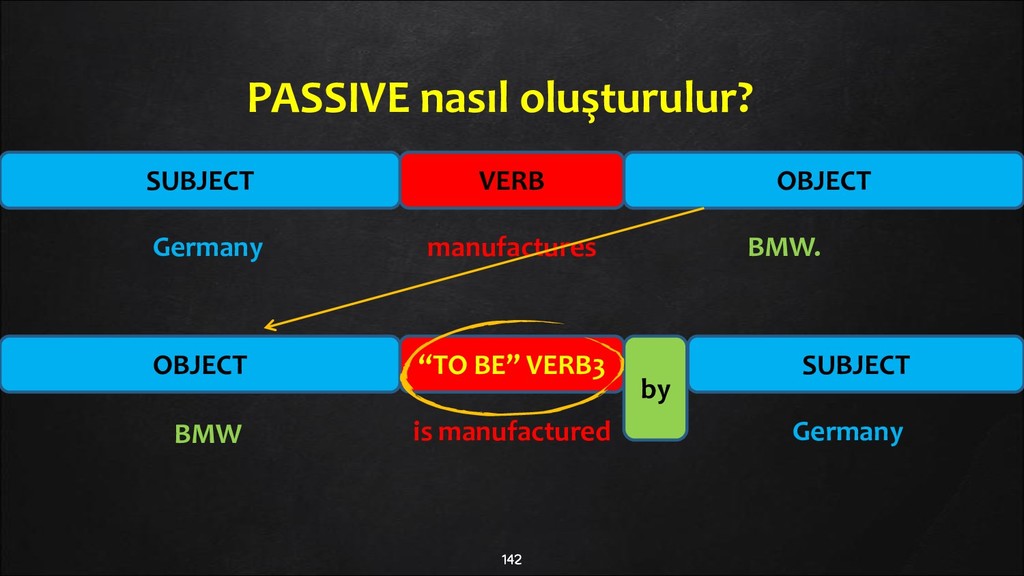
    Çorum. His/Her family is wealthy. Our study system is the best. Your research results are important. Their habitat is in danger. SUBJECT VERB OBJECT
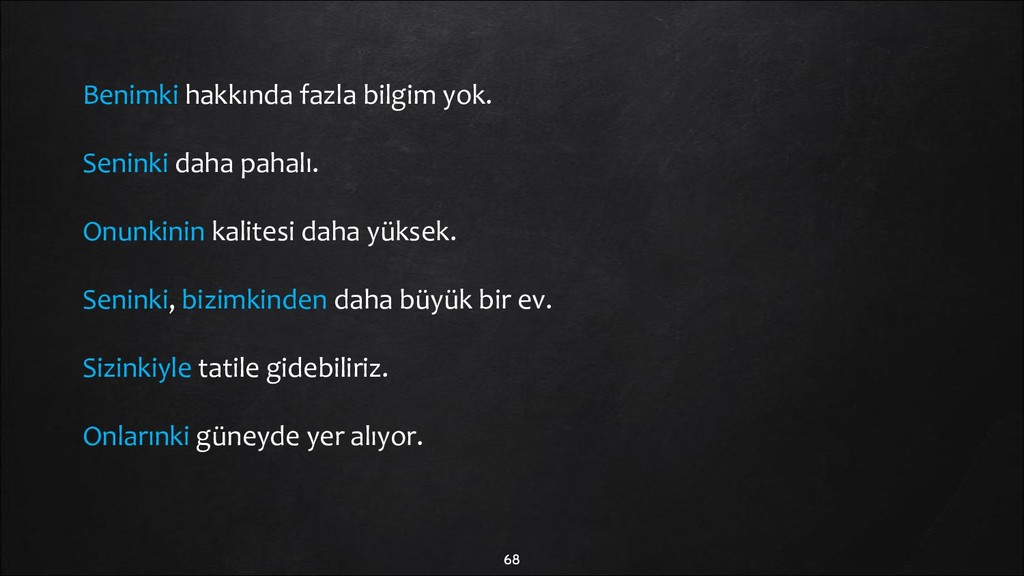
  44. 68 Benimki hakkında fazla bilgim yok. Seninki daha pahalı. Onunkinin

    kalitesi daha yüksek. Seninki, bizimkinden daha büyük bir ev. Sizinkiyle tatile gidebiliriz. Onlarınki güneyde yer alıyor.
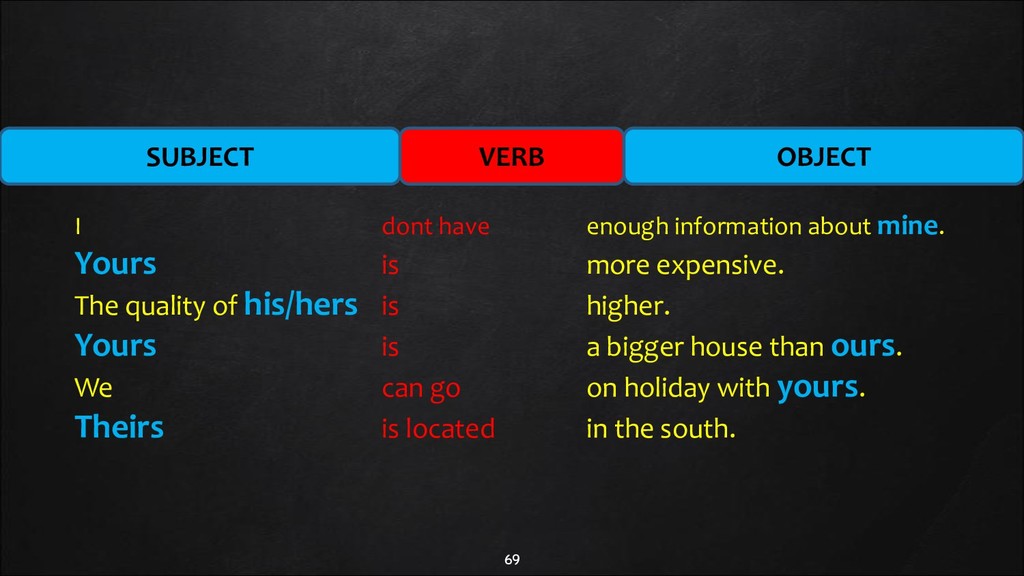
  45. 69 I dont have enough information about mine. Yours is

    more expensive. The quality of his/hers is higher. Yours is a bigger house than ours. We can go on holiday with yours. Theirs is located in the south. SUBJECT VERB OBJECT
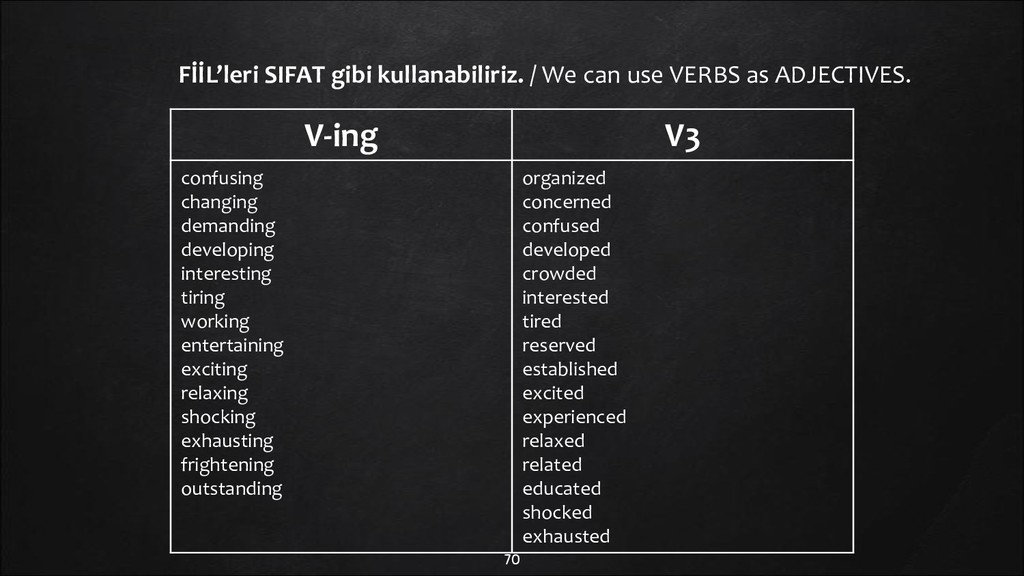
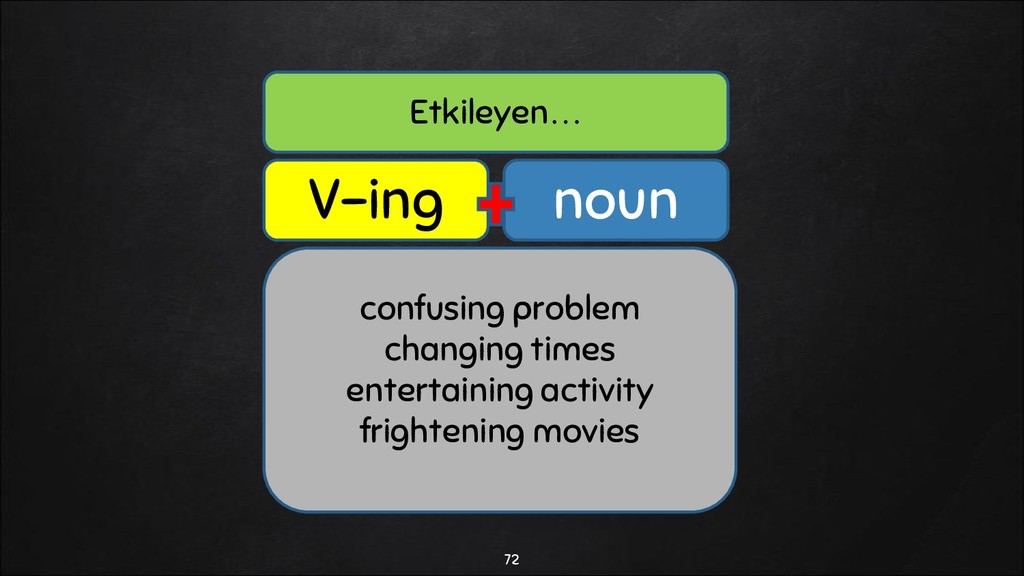
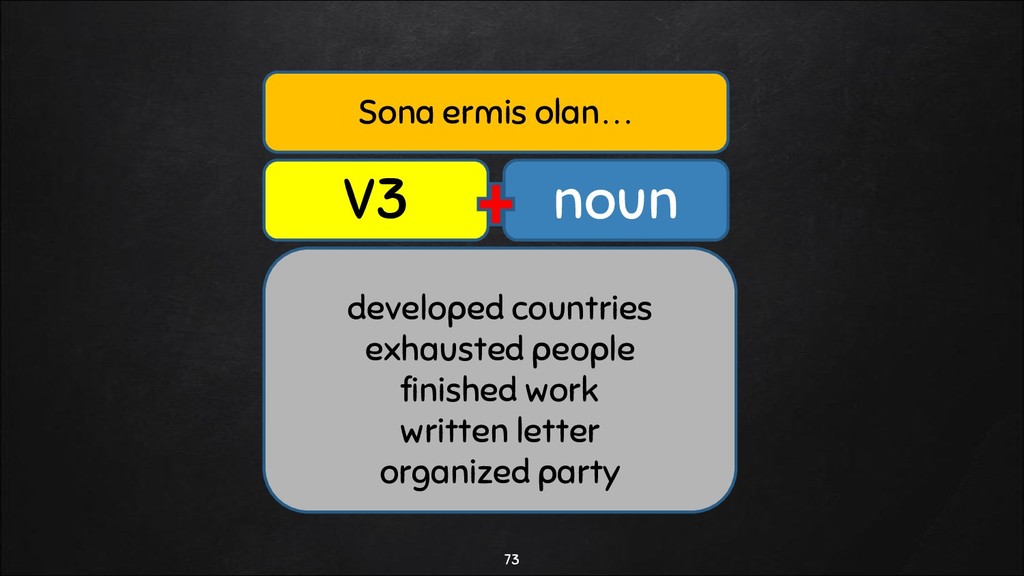
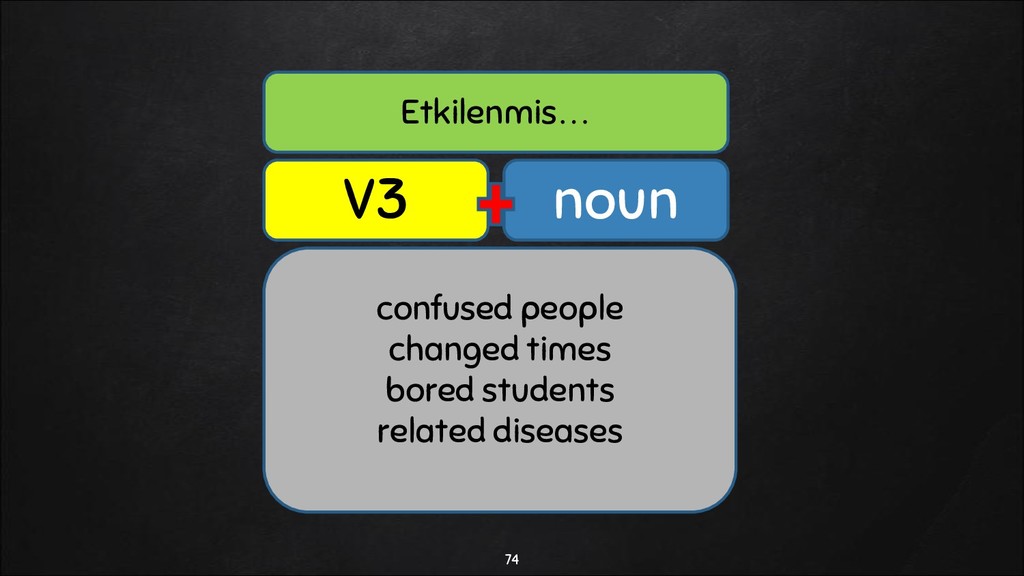
  46. 70 V-ing V3 confusing changing demanding developing interesting tiring working

    entertaining exciting relaxing shocking exhausting frightening outstanding organized concerned confused developed crowded interested tired reserved established excited experienced relaxed related educated shocked exhausted FİİL’leri SIFAT gibi kullanabiliriz. / We can use VERBS as ADJECTIVES.
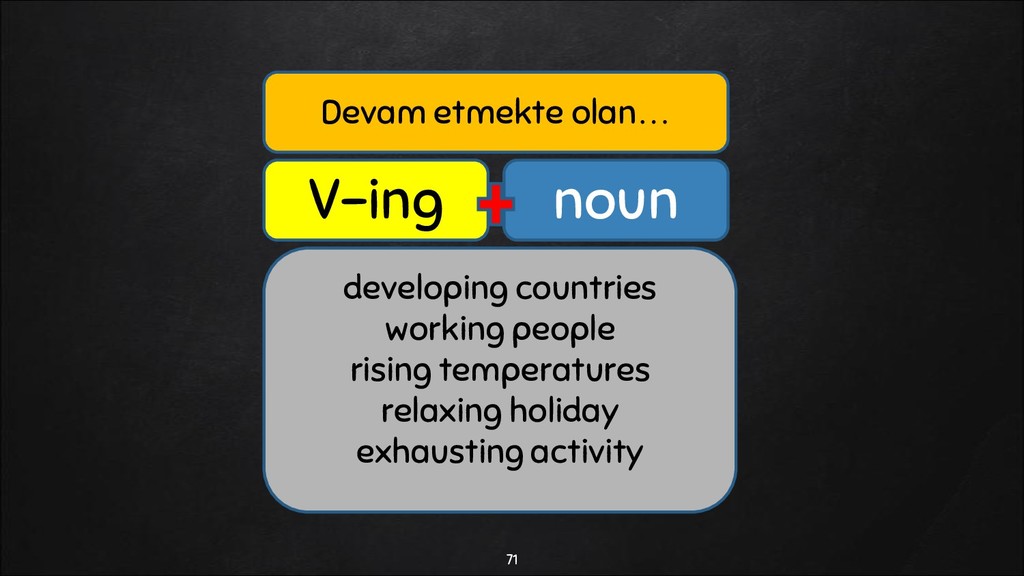
  47. 71 noun V-ing developing countries working people rising temperatures relaxing

    holiday exhausting activity Devam etmekte olan…
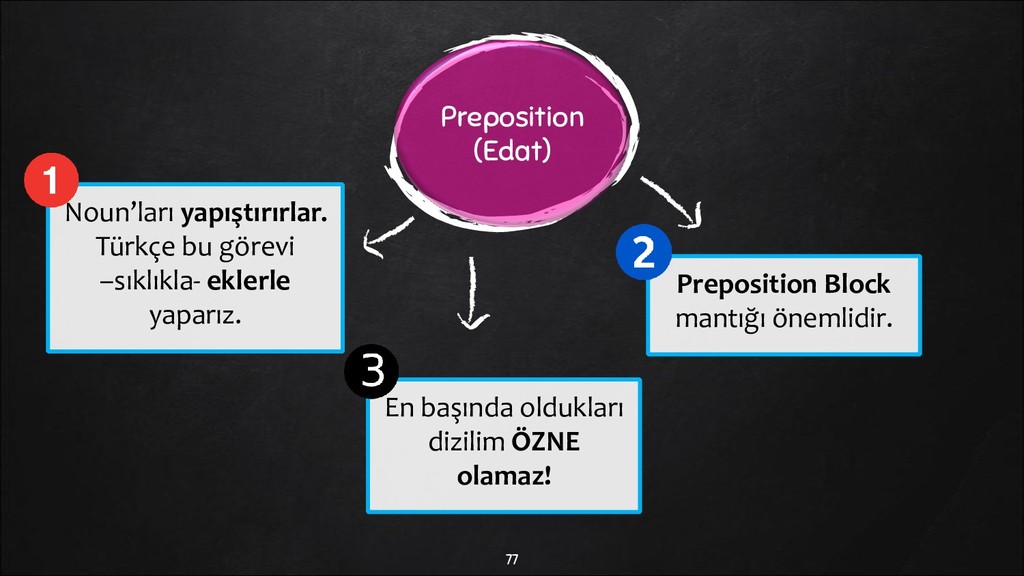
  48. 77 Noun’ları yapıştırırlar. Türkçe bu görevi –sıklıkla- eklerle yaparız. En

    başında oldukları dizilim ÖZNE olamaz! Preposition Block mantığı önemlidir. Preposition (Edat)
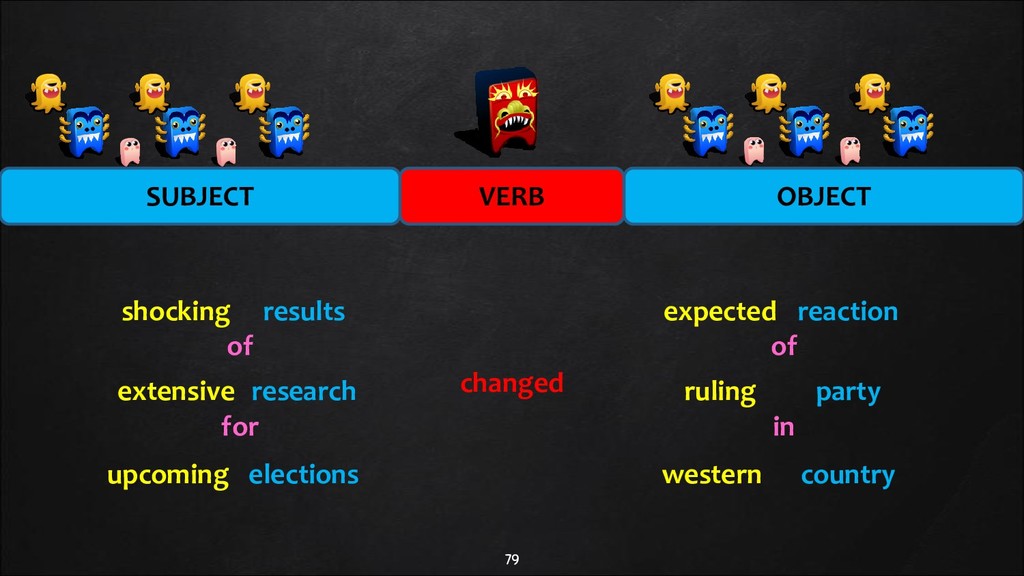
  49. 79 OBJECT SUBJECT VERB results research elections shocking extensive upcoming

    of for changed reaction party country expected ruling western of in
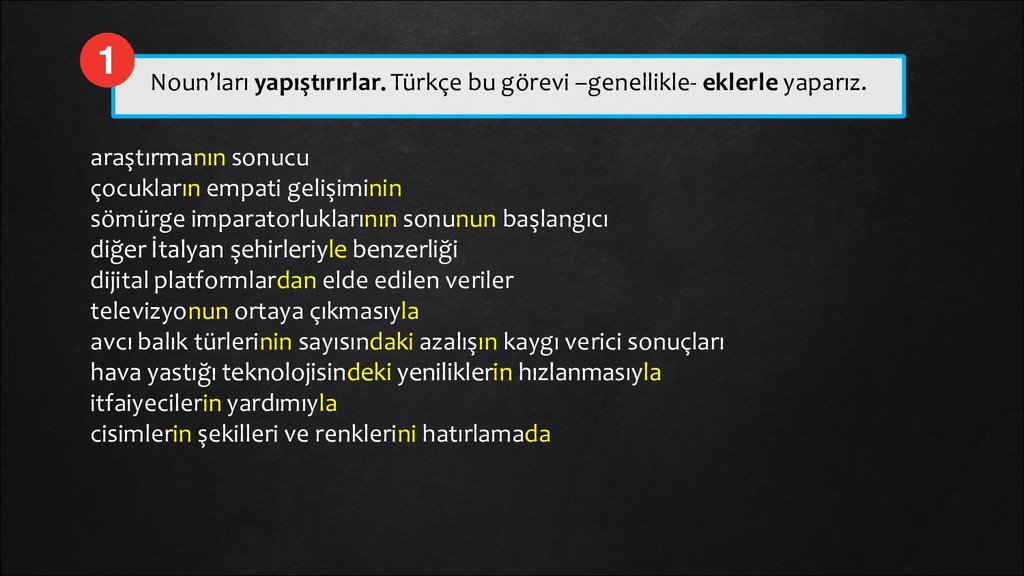
  50. Noun’ları yapıştırırlar. Türkçe bu görevi –genellikle- eklerle yaparız. araştırmanın sonucu

    çocukların empati gelişiminin sömürge imparatorluklarının sonunun başlangıcı diğer İtalyan şehirleriyle benzerliği dijital platformlardan elde edilen veriler televizyonun ortaya çıkmasıyla avcı balık türlerinin sayısındaki azalışın kaygı verici sonuçları hava yastığı teknolojisindeki yeniliklerin hızlanmasıyla itfaiyecilerin yardımıyla cisimlerin şekilleri ve renklerini hatırlamada
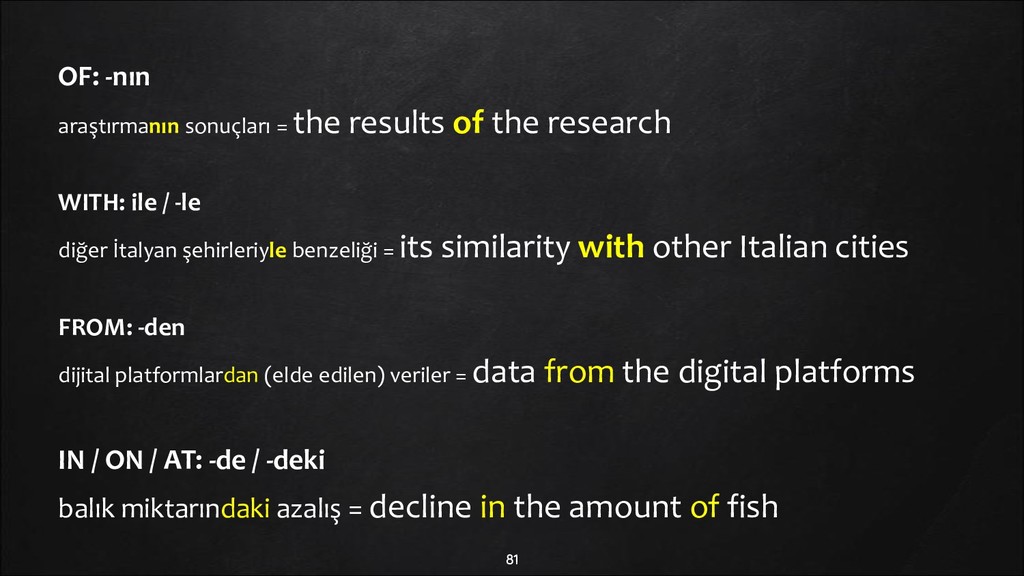
  51. 81 OF: -nın araştırmanın sonuçları = the results of the

    research WITH: ile / -le diğer İtalyan şehirleriyle benzeliği = its similarity with other Italian cities FROM: -den dijital platformlardan (elde edilen) veriler = data from the digital platforms IN / ON / AT: -de / -deki balık miktarındaki azalış = decline in the amount of fish
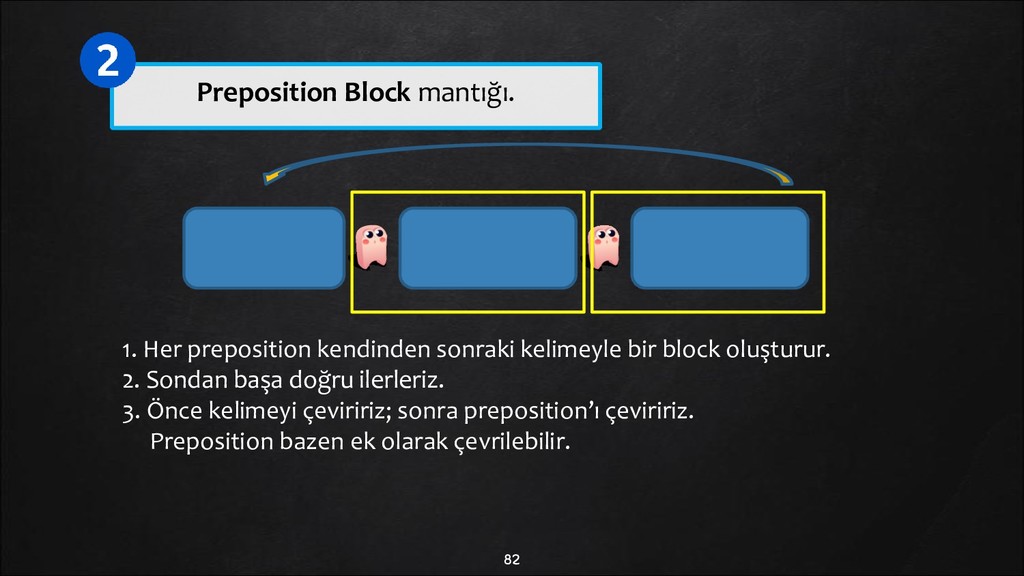
  52. 82 Preposition Block mantığı. 1. Her preposition kendinden sonraki kelimeyle

    bir block oluşturur. 2. Sondan başa doğru ilerleriz. 3. Önce kelimeyi çeviririz; sonra preposition’ı çeviririz. Preposition bazen ek olarak çevrilebilir.
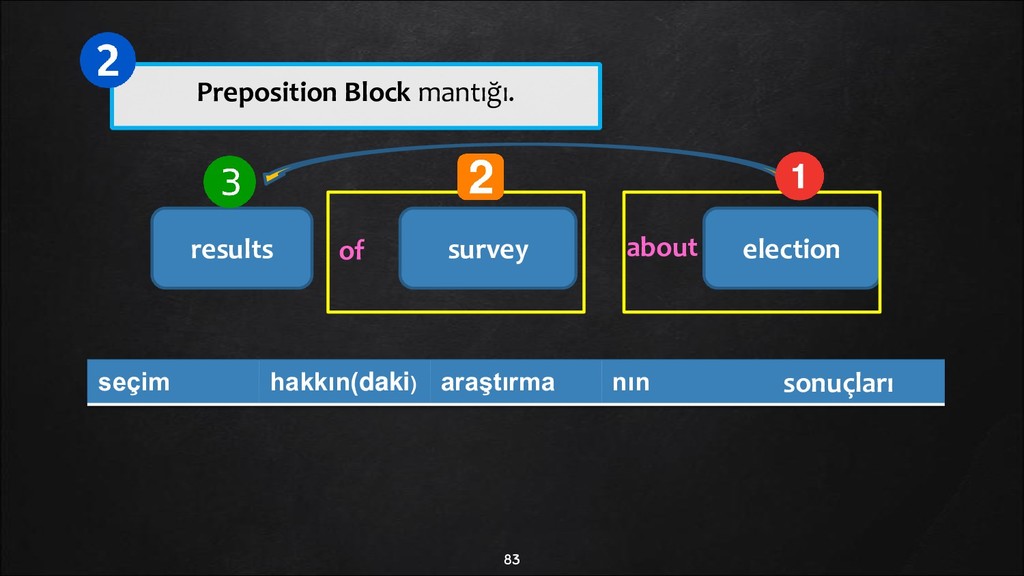
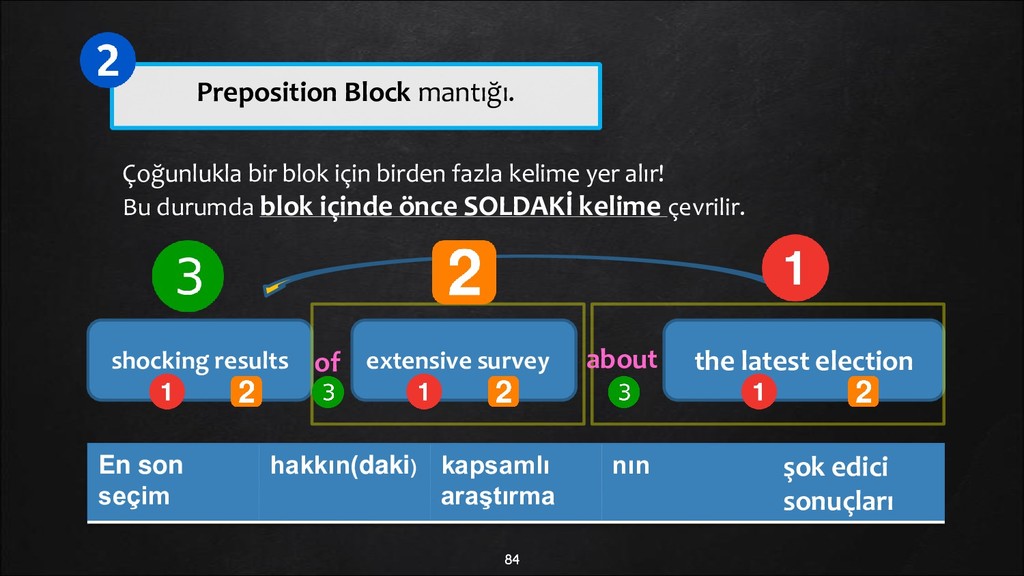
  53. 84 Preposition Block mantığı. shocking results extensive survey the latest

    election of about En son seçim hakkın(daki) kapsamlı araştırma nın şok edici sonuçları Çoğunlukla bir blok için birden fazla kelime yer alır! Bu durumda blok içinde önce SOLDAKİ kelime çevrilir.
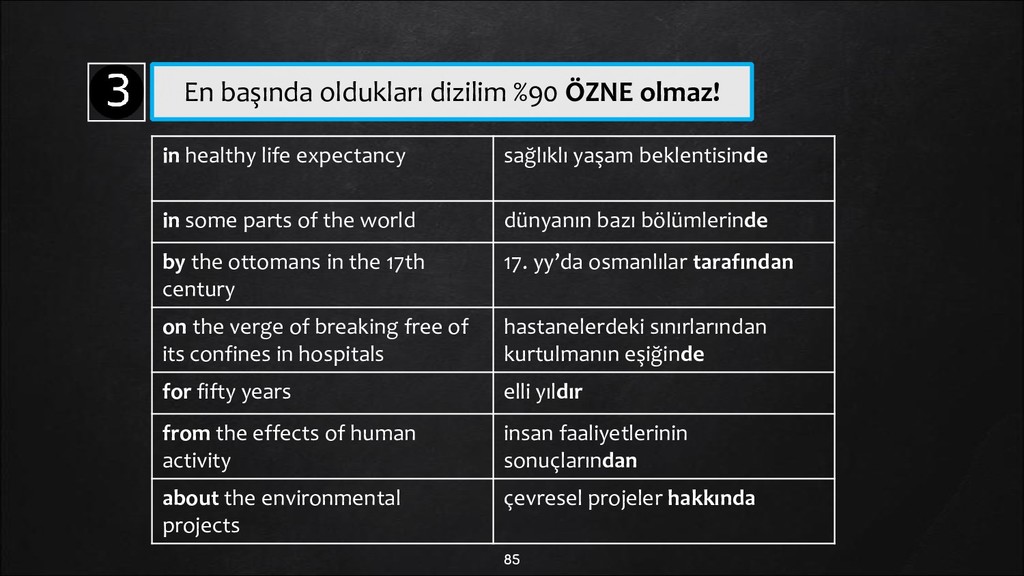
  54. 85 En başında oldukları dizilim %90 ÖZNE olmaz! in healthy
    life expectancy sağlıklı yaşam beklentisinde in some parts of the world dünyanın bazı bölümlerinde by the ottomans in the 17th century 17. yy’da osmanlılar tarafından on the verge of breaking free of its confines in hospitals hastanelerdeki sınırlarından kurtulmanın eşiğinde for fifty years elli yıldır from the effects of human activity insan faaliyetlerinin sonuçlarından about the environmental projects çevresel projeler hakkında
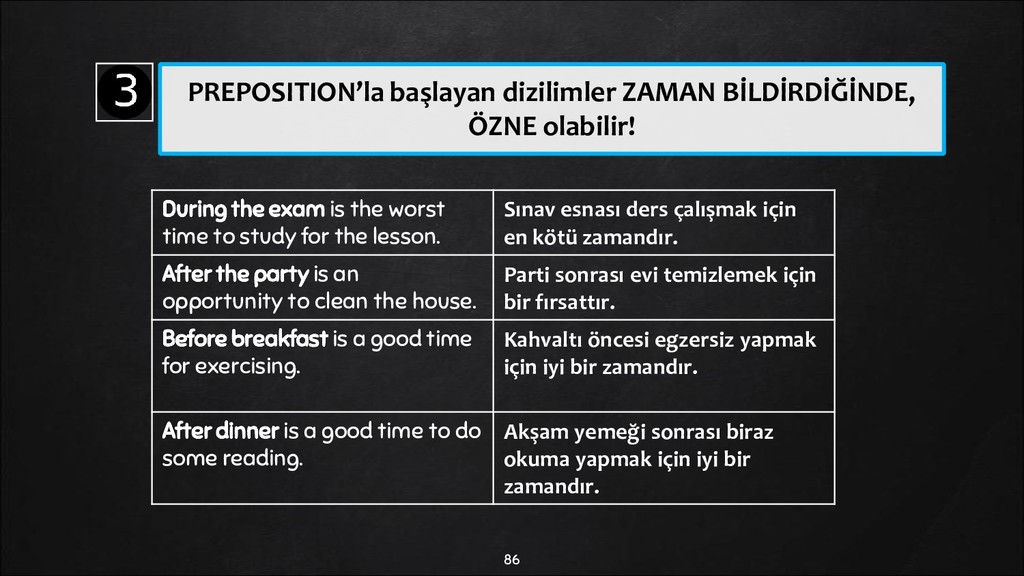
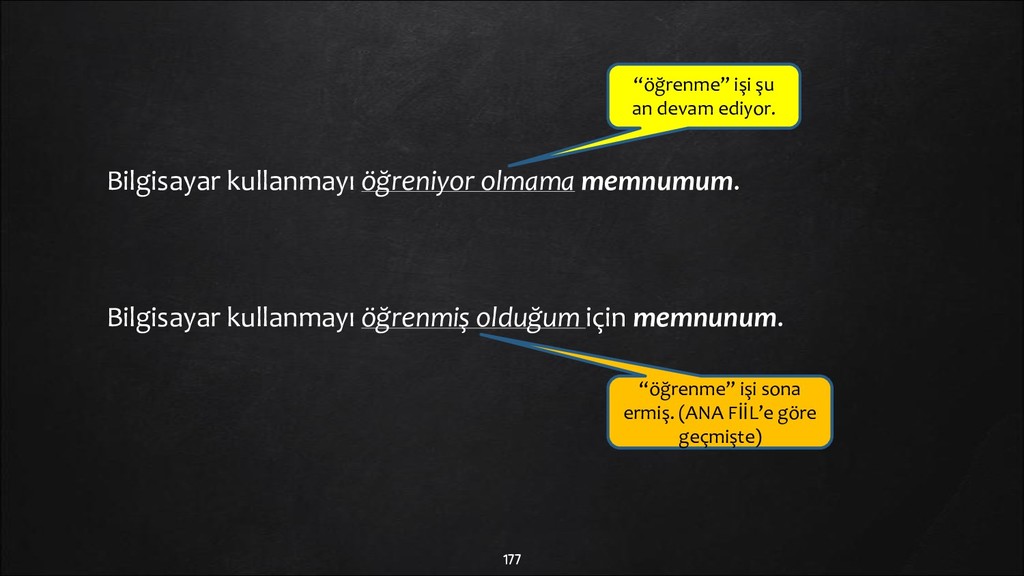
  55. 86 PREPOSITION’la başlayan dizilimler ZAMAN BİLDİRDİĞİNDE, ÖZNE olabilir! During the

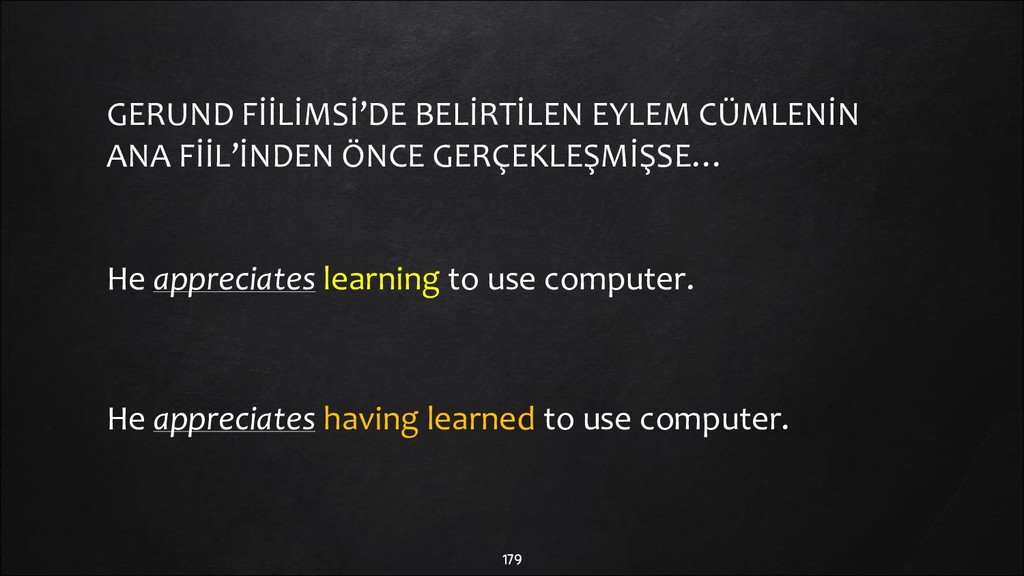
    exam is the worst time to study for the lesson. Sınav esnası ders çalışmak için en kötü zamandır. After the party is an opportunity to clean the house. Parti sonrası evi temizlemek için bir fırsattır. Before breakfast is a good time for exercising. Kahvaltı öncesi egzersiz yapmak için iyi bir zamandır. After dinner is a good time to do some reading. Akşam yemeği sonrası biraz okuma yapmak için iyi bir zamandır.
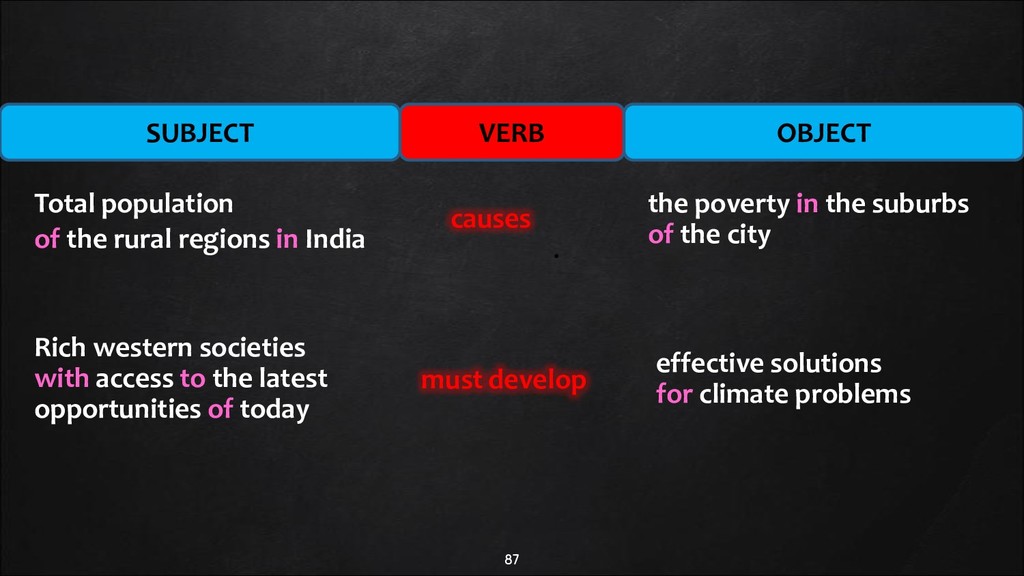
  56. 87 Total population of the rural regions in India causes

    . the poverty in the suburbs of the city Rich western societies with access to the latest opportunities of today must develop effective solutions for climate problems SUBJECT VERB OBJECT
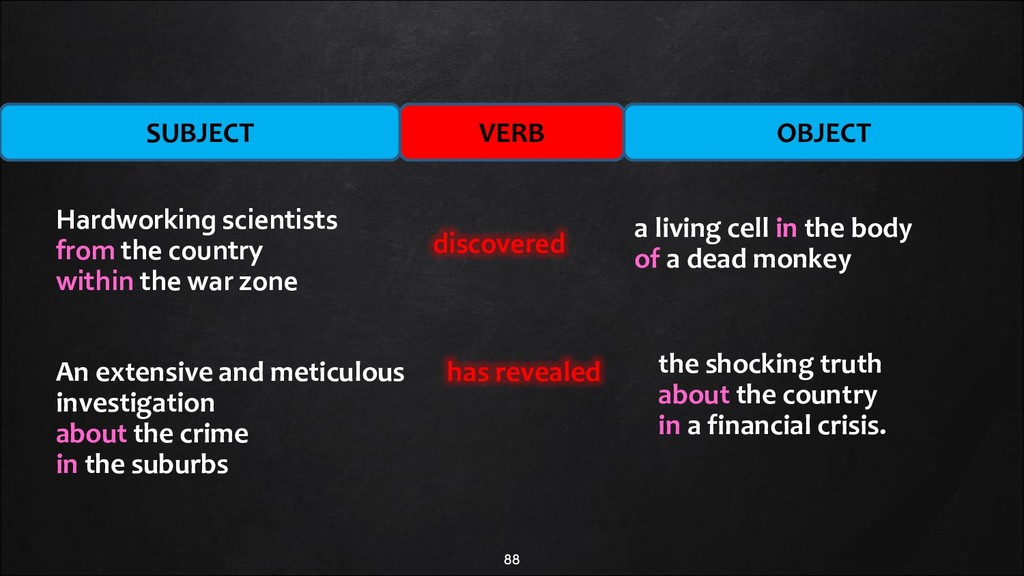
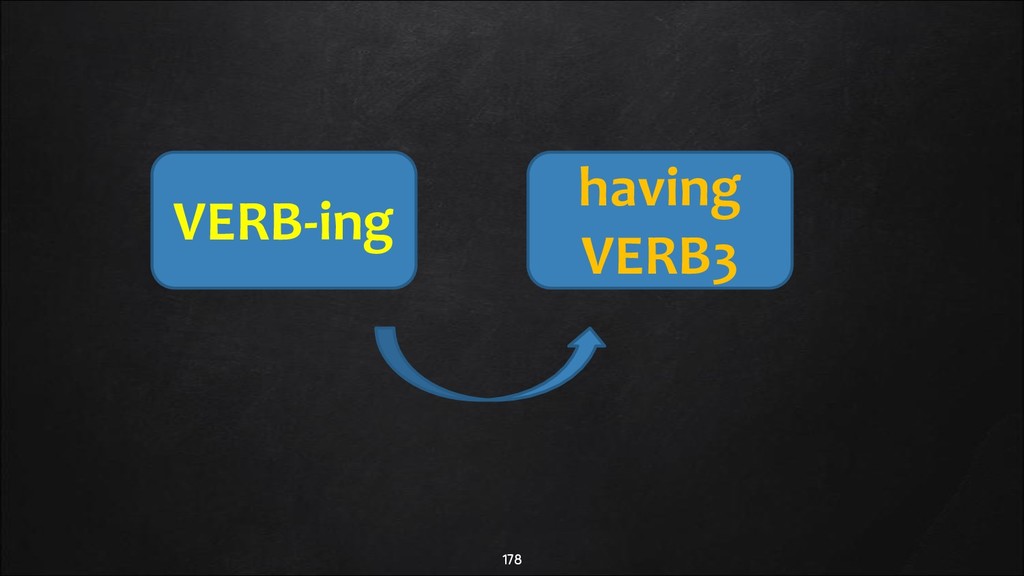
  57. 88 SUBJECT VERB OBJECT Hardworking scientists from the country within

    the war zone discovered a living cell in the body of a dead monkey An extensive and meticulous investigation about the crime in the suburbs has revealed the shocking truth about the country in a financial crisis.
  58. 92 verbs Durumları belirtirler. Kisi ekleri almazlar! Cümlelerde YUKLEM konumunda

    yer alırlar. Bu yüzden İngilizce her cümlede mutlaka bir ÖZNE bulunmaldıır. Eylemleri belirtirler.
  59. 93 Topkapı Sarayı, İstanbul’da. 26 yaşındayım. Makine mühendisiyim. Hava bugün

    yağmurlu. Bu harika bir etkinlik. Simya, diğer metallerin altına çevrilmesi bilimi. !!!??? Türkçe, “durumları” herhangi bir dilbilgisel yapı kullanmadan niteleyebilir. “Durumları” konum, yaş, meslek, hava durumu vs. belirtmek ya da herhangi bir şeyin bi özelliğini niteleyerek, en önemlisi bir şeyin tanımını yaparak belirtebiliriz.
  60. 94 Topkapı Sarayı, İstanbul’dadır. Büyük dedem 94 yaşındaydı. En sevdiğim

    meslek öteden beri makine mühendisliği olagelmiştir. Yağmurlu havalar en sevdiğimdir. Bu harika bir etkinlik olacak. Simya, diğer metallerin altına çevrilmesi bilimidir. Bizim, her zaman kullanmak zorunda olmadığımız “-dır” ekinin İngilizce karşılığını, İngilizce’de durum bildirirken her zaman kullanırız. Ancak, resmi durumlarda ya da bazen günlük konuşmada vurgu belirtmek için “-dır” ekinin farklı hallerini ya da “olagelmiştir” / “olagelmişti” / “olacak” yapısını kullanırız.
  61. 95 Topkapı Palace and Maiden Tower are in İstanbul. Topkapı

    Sarayı, İstanbul’dadır. My grand grandpa was 94 years old. Büyük dedem 94 yaşındaydı. Mechanical Engineering has been my favorite job. En sevdiğim meslek öteden beri makine mühendisliği olagelmiştir. Rainy weather is my favorite. Yağmurlu havalar en sevdiğimdir. This will be a great activity. Bu harika bir etkinlik olacak. Alchemy is to turn other metals into gold. Simya, diğer metallerin altına çevrilmesi bilimidir. İngilizce’de “to be” fiilinin farklı halleriyle Türkçe’deki “-dır, -dı, - olacak, olageldi, olagelmişti” yapılarının yaptığını yaparız. Bu kullanım zorunludur.
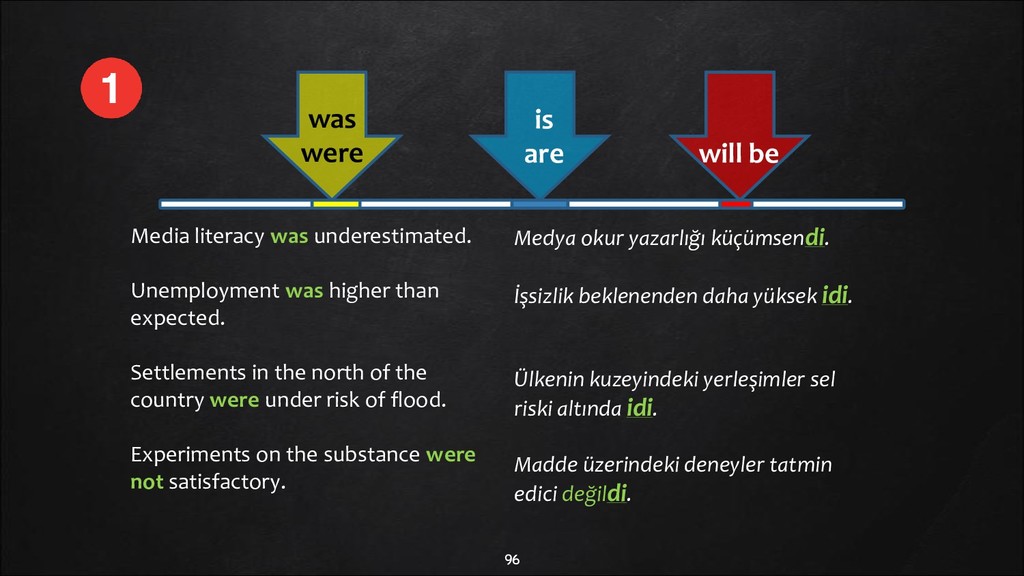
  62. 96 was were is are will be Media literacy was

    underestimated. Unemployment was higher than expected. Settlements in the north of the country were under risk of flood. Experiments on the substance were not satisfactory. Medya okur yazarlığı küçümsendi. İşsizlik beklenenden daha yüksek idi. Ülkenin kuzeyindeki yerleşimler sel riski altında idi. Madde üzerindeki deneyler tatmin edici değildi.
  63. 97 -dır (değildir) is / are (not) Depression is bad.

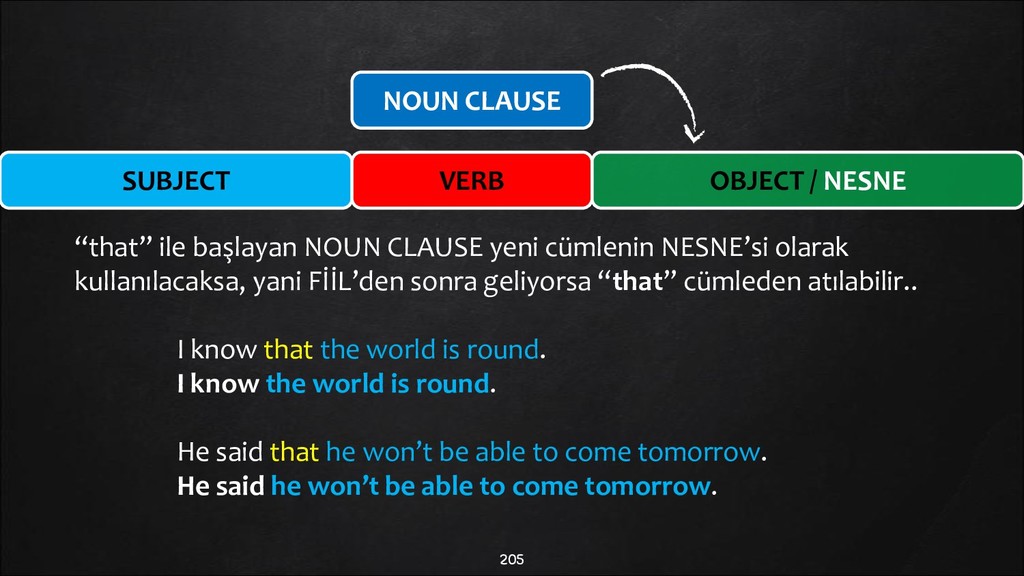
    Feelings are important. -dı (değildi) was / were (not) The result was satisfying People were helpless. olacak (olmayacak) will (not) be The situation will be better. olagelmiştir (olagelmemiştir) has (not) been / have (not) been It has been rainy all day. They have been friends. olagelmişti (olagelmemişti) had (not) been The economy had been better before the war.
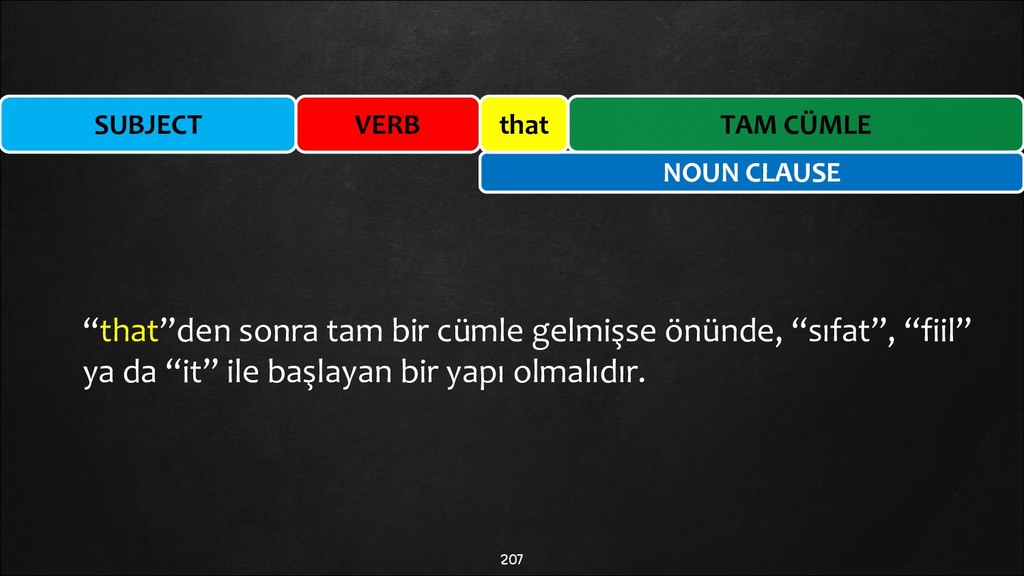
  64. 98 was were is are will be Childcare and mothercare

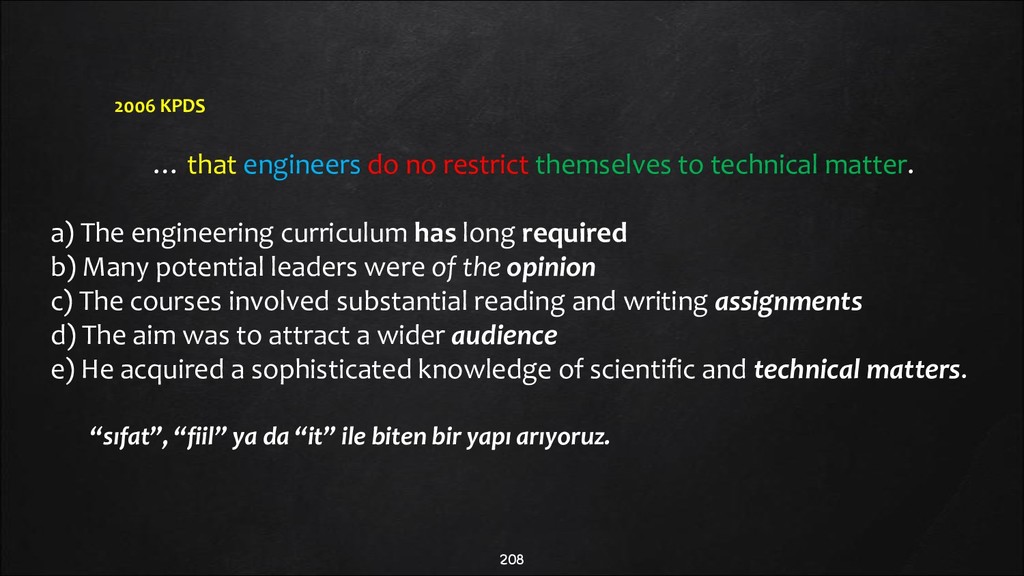
    are broad terms. Architectural analysis is not only an academic pursuit. Another important step is to reduce our carbon foot-print. There is no consensus among sociologists. Çocuk bakımı ve annebakımı geniş terimlerdir. Mimari analiz sadece bir akademik takip değildir. Bir başka önemli nokta karbon ayakizini düşürmektir. Sosyologlar arasında bir fikir birliği yoktur.
  65. 99 was were is are will be Hastanın tedavisi düşünülenden

    daha pahalı olacak. Yeni bulunan fosil kanıtlar önümüzdeki yıl müzede olacak. Bütün kültürler ve toplumlar bir gün birleşik olacak. Treatment of the patient will be more expensive than thought. Newly-found fossil evidences will be in the museum next year. All the cultures and societies will be united one day.
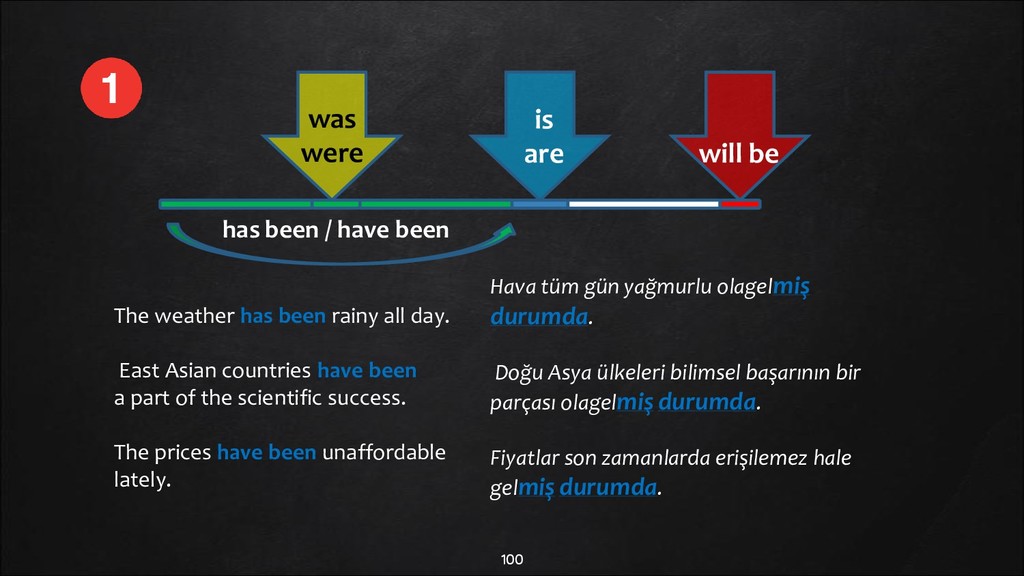
  66. 100 was were is are will be The weather has

    been rainy all day. East Asian countries have been a part of the scientific success. The prices have been unaffordable lately. has been / have been Hava tüm gün yağmurlu olagelmiş durumda. Doğu Asya ülkeleri bilimsel başarının bir parçası olagelmiş durumda. Fiyatlar son zamanlarda erişilemez hale gelmiş durumda.
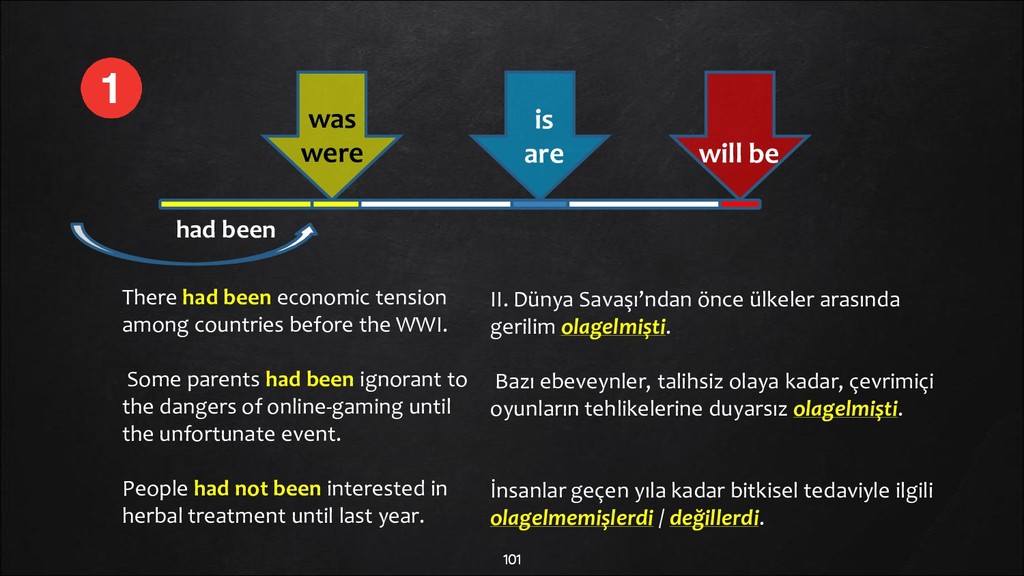
  67. 101 was were is are will be There had been

    economic tension among countries before the WWI. Some parents had been ignorant to the dangers of online-gaming until the unfortunate event. People had not been interested in herbal treatment until last year. had been II. Dünya Savaşı’ndan önce ülkeler arasında gerilim olagelmişti. Bazı ebeveynler, talihsiz olaya kadar, çevrimiçi oyunların tehlikelerine duyarsız olagelmişti. İnsanlar geçen yıla kadar bitkisel tedaviyle ilgili olagelmemişlerdi / değillerdi.
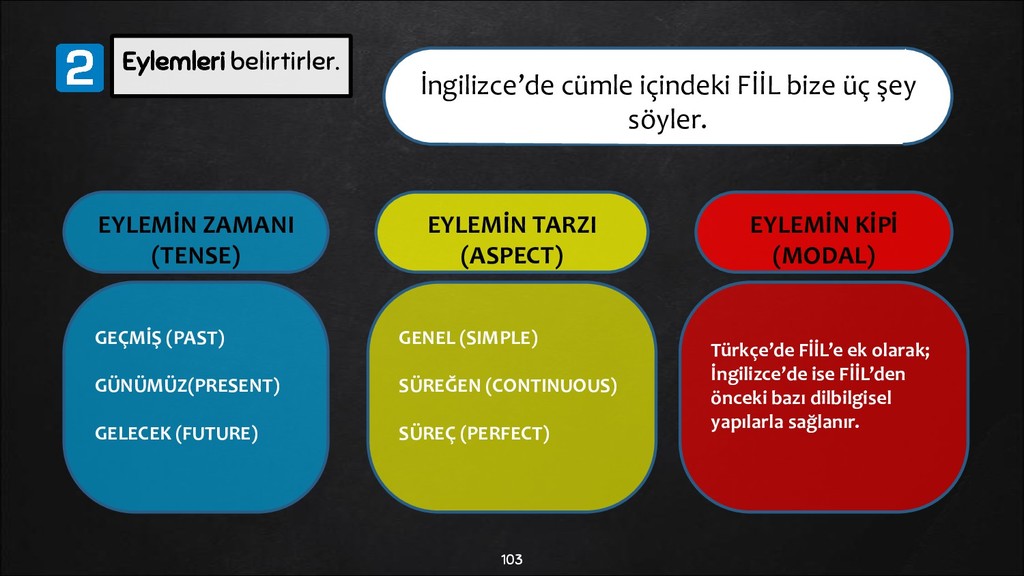
  68. 103 Eylemleri belirtirler. İngilizce’de cümle içindeki FİİL bize üç şey

    söyler. EYLEMİN ZAMANI (TENSE) EYLEMİN TARZI (ASPECT) EYLEMİN KİPİ (MODAL) GEÇMİŞ (PAST) GÜNÜMÜZ(PRESENT) GELECEK (FUTURE) GENEL (SIMPLE) SÜREĞEN (CONTINUOUS) SÜREÇ (PERFECT) Türkçe’de FİİL’e ek olarak; İngilizce’de ise FİİL’den önceki bazı dilbilgisel yapılarla sağlanır.
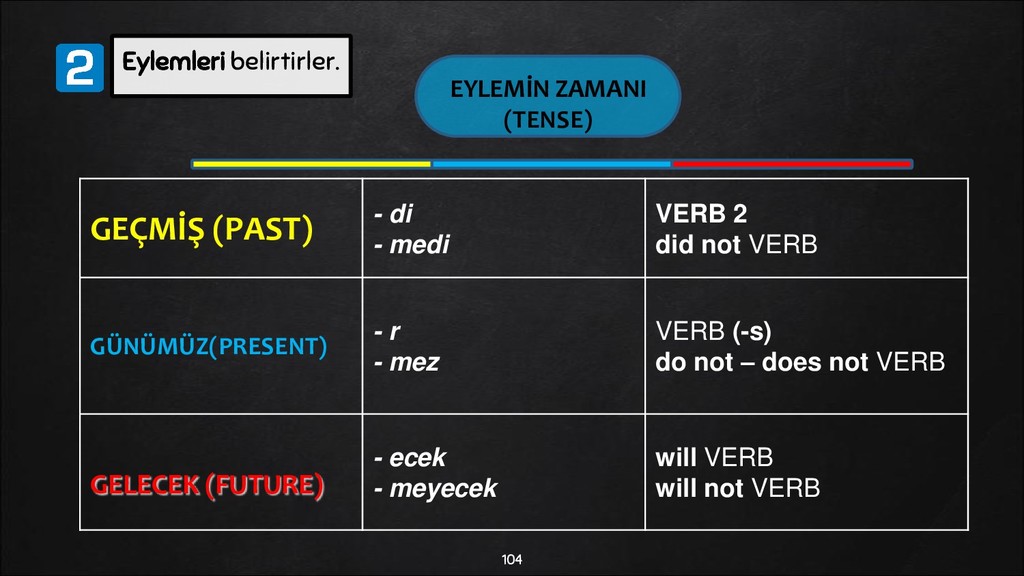
  69. 104 Eylemleri belirtirler. EYLEMİN ZAMANI (TENSE) GEÇMİŞ (PAST) - di

    - medi VERB 2 did not VERB GÜNÜMÜZ(PRESENT) - r - mez VERB (-s) do not – does not VERB GELECEK (FUTURE) - ecek - meyecek will VERB will not VERB
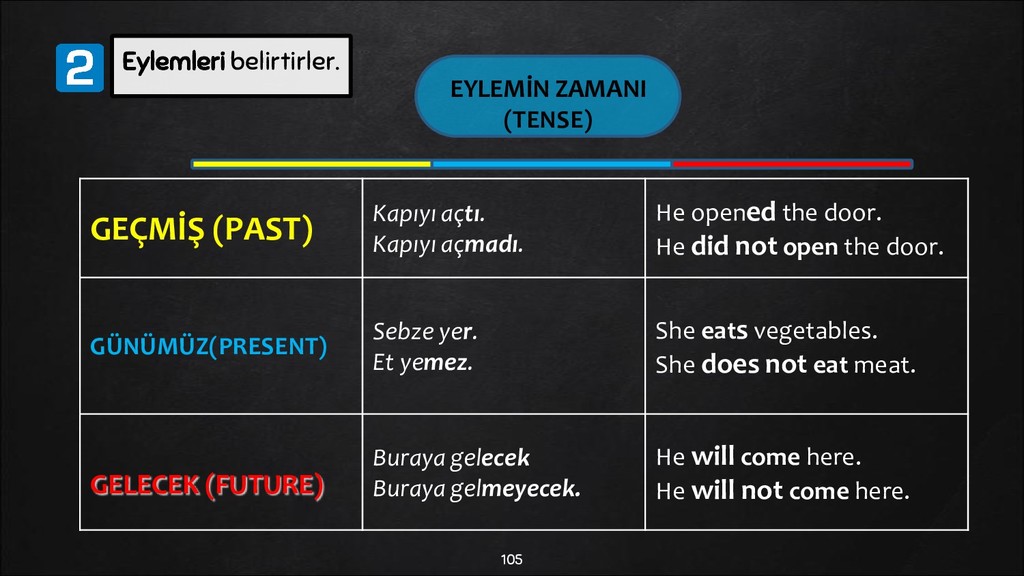
  70. 105 Eylemleri belirtirler. EYLEMİN ZAMANI (TENSE) GEÇMİŞ (PAST) Kapıyı açtı.

    Kapıyı açmadı. He opened the door. He did not open the door. GÜNÜMÜZ(PRESENT) Sebze yer. Et yemez. She eats vegetables. She does not eat meat. GELECEK (FUTURE) Buraya gelecek Buraya gelmeyecek. He will come here. He will not come here.
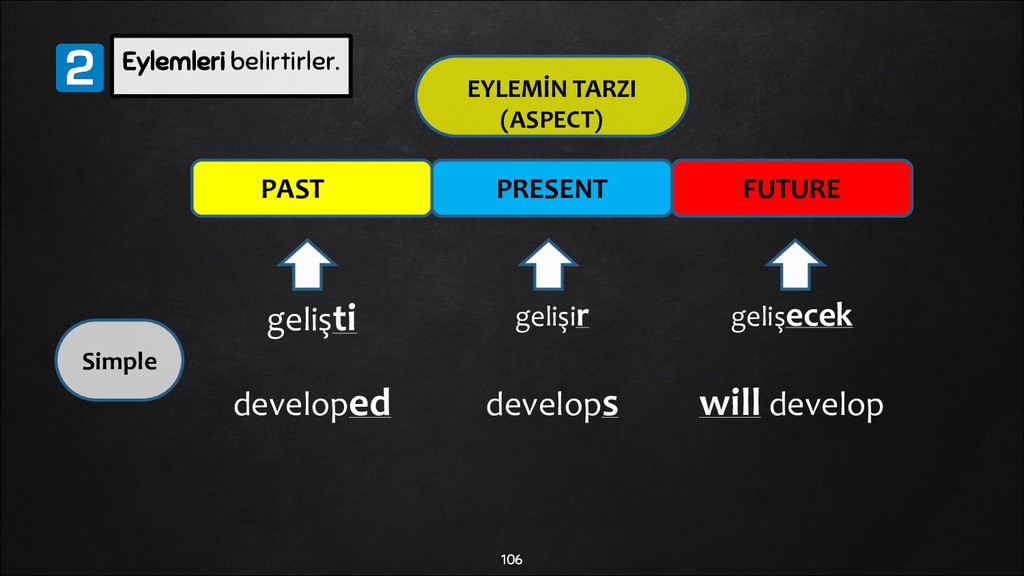
  71. 106 Eylemleri belirtirler. PRESENT FUTURE PAST EYLEMİN TARZI (ASPECT) gelişti

    gelişir gelişecek developed develops will develop Simple
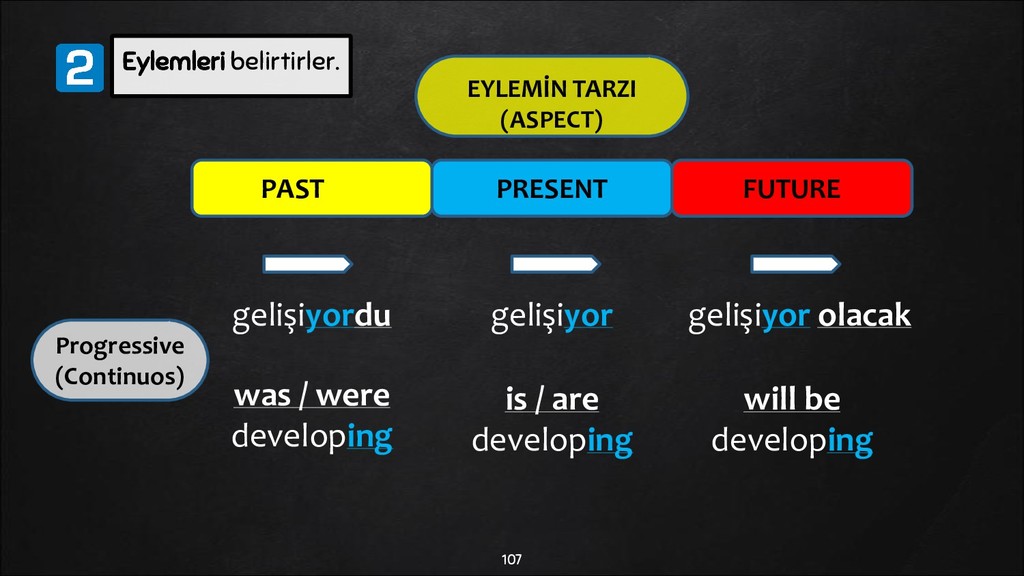
  72. 107 Eylemleri belirtirler. PRESENT FUTURE PAST EYLEMİN TARZI (ASPECT) gelişiyordu

    gelişiyor gelişiyor olacak was / were developing is / are developing will be developing Progressive (Continuos)
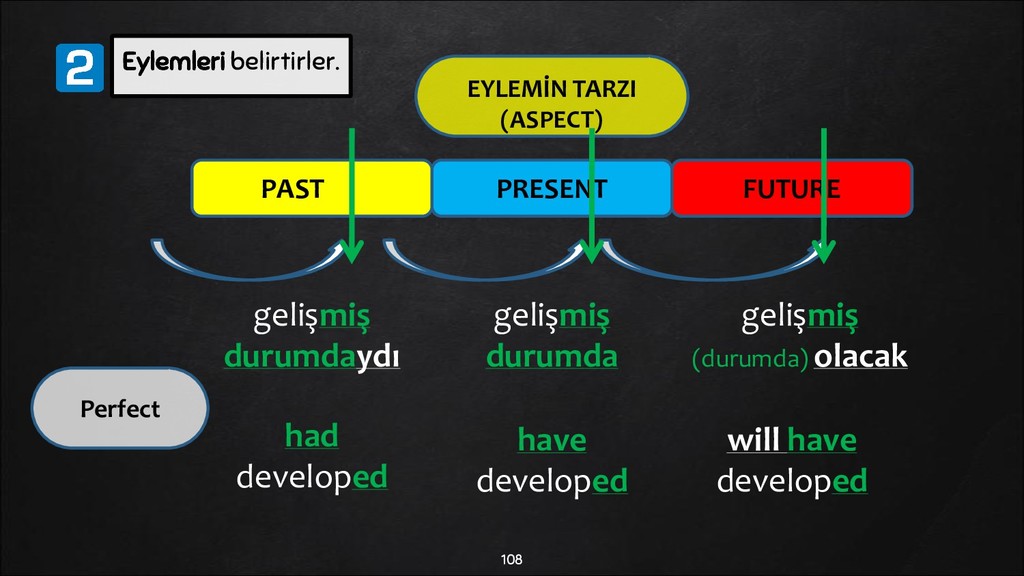
  73. 108 Eylemleri belirtirler. PRESENT FUTURE PAST EYLEMİN TARZI (ASPECT) gelişmiş

    durumdaydı gelişmiş durumda gelişmiş (durumda) olacak had developed have developed will have developed Perfect
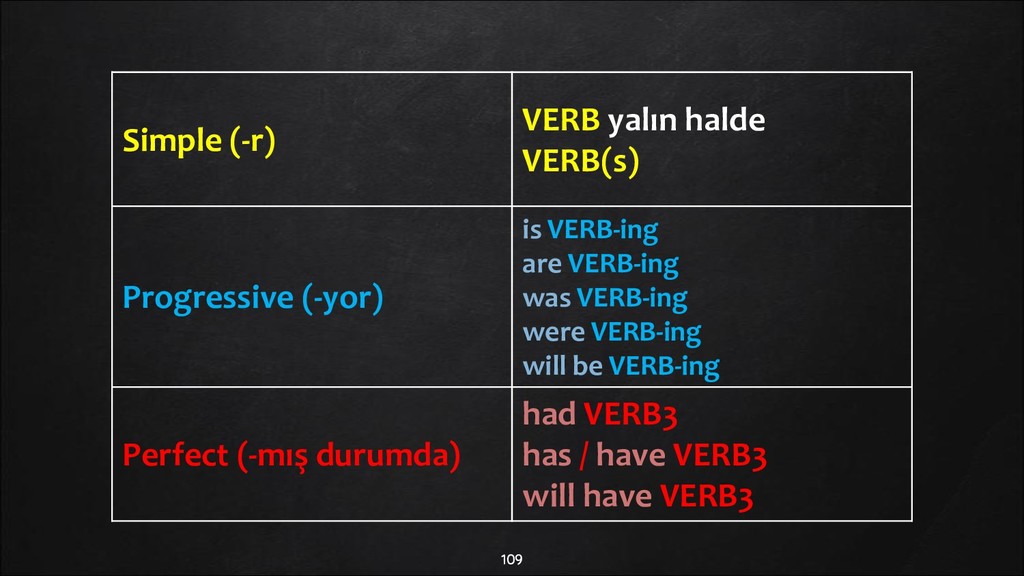
  74. 109 Simple (-r) VERB yalın halde VERB(s) Progressive (-yor) is

    VERB-ing are VERB-ing was VERB-ing were VERB-ing will be VERB-ing Perfect (-mış durumda) had VERB3 has / have VERB3 will have VERB3
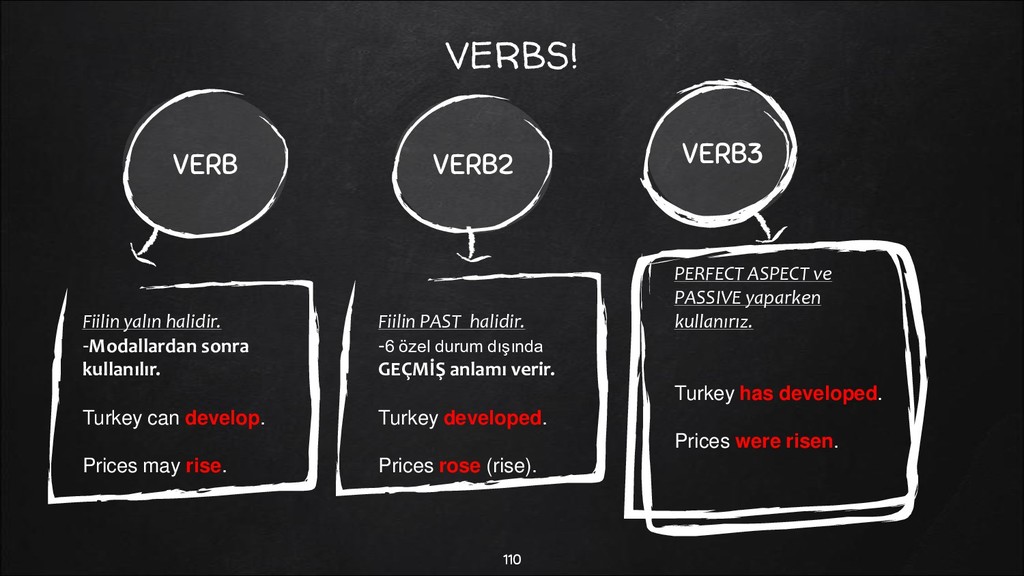
  75. VERBS! VERB2 VERB VERB3 110 Fiilin yalın halidir. -Modallardan sonra

    kullanılır. Turkey can develop. Prices may rise. Fiilin PAST halidir. -6 özel durum dışında GEÇMİŞ anlamı verir. Turkey developed. Prices rose (rise). PERFECT ASPECT ve PASSIVE yaparken kullanırız. Turkey has developed. Prices were risen.
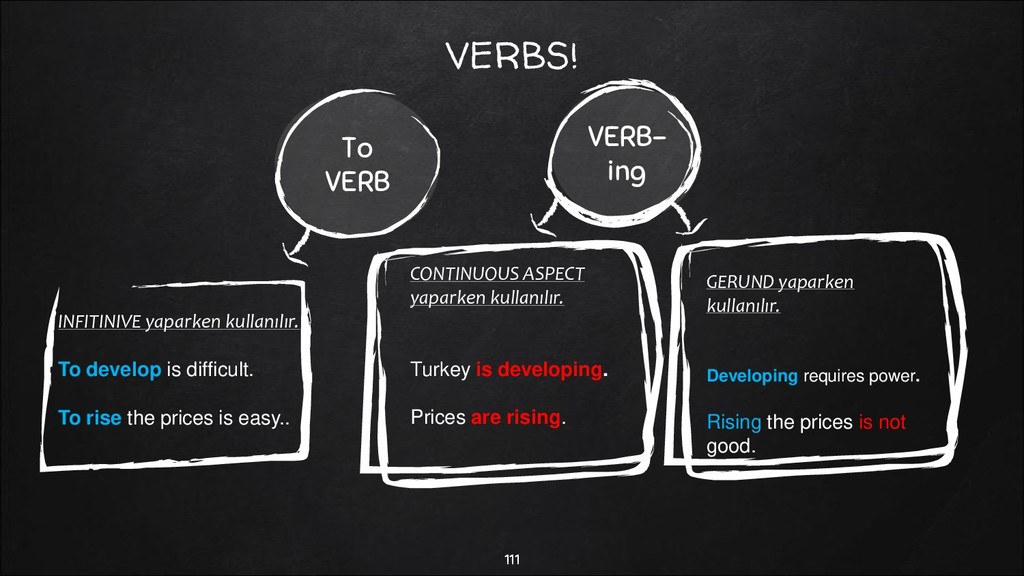
  76. VERBS! To VERB VERB- ing 111 INFITINIVE yaparken kullanılır. To

    develop is difficult. To rise the prices is easy.. CONTINUOUS ASPECT yaparken kullanılır. Turkey is developing. Prices are rising. GERUND yaparken kullanılır. Developing requires power. Rising the prices is not good.
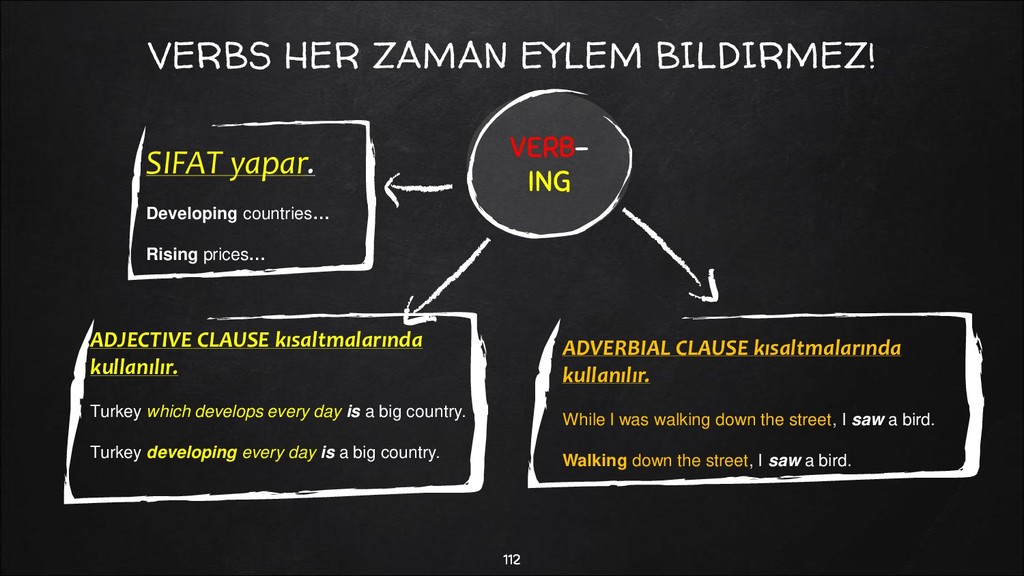
  77. VERBS HER ZAMAN EYLEM BILDIRMEZ! VERB- ING 112 SIFAT yapar.

    Developing countries… Rising prices… ADJECTIVE CLAUSE kısaltmalarında kullanılır. Turkey which develops every day is a big country. Turkey developing every day is a big country. ADVERBIAL CLAUSE kısaltmalarında kullanılır. While I was walking down the street, I saw a bird. Walking down the street, I saw a bird.
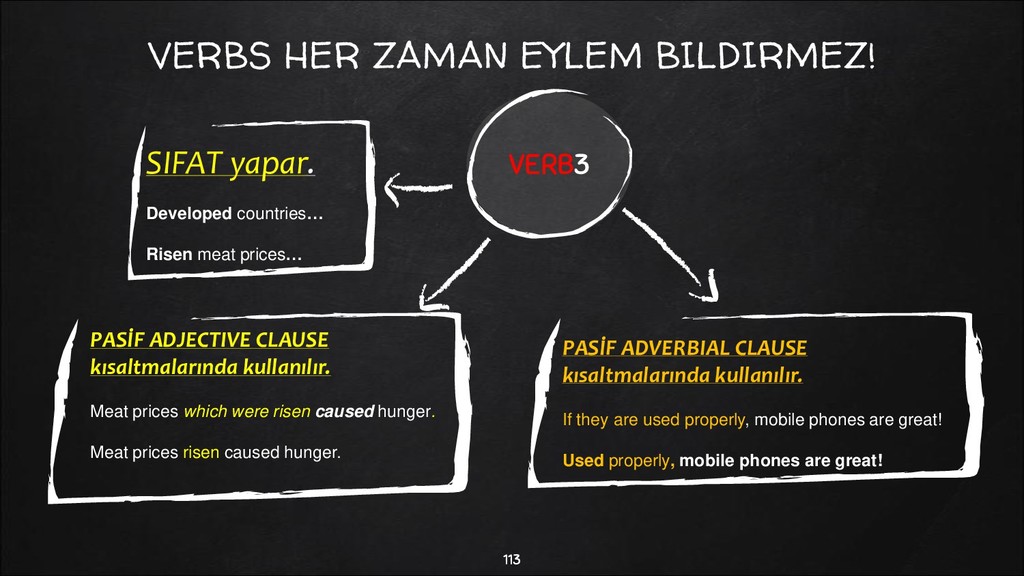
  78. VERBS HER ZAMAN EYLEM BILDIRMEZ! VERB3 113 SIFAT yapar. Developed

    countries… Risen meat prices… PASİF ADJECTIVE CLAUSE kısaltmalarında kullanılır. Meat prices which were risen caused hunger. Meat prices risen caused hunger. PASİF ADVERBIAL CLAUSE kısaltmalarında kullanılır. If they are used properly, mobile phones are great! Used properly, mobile phones are great!
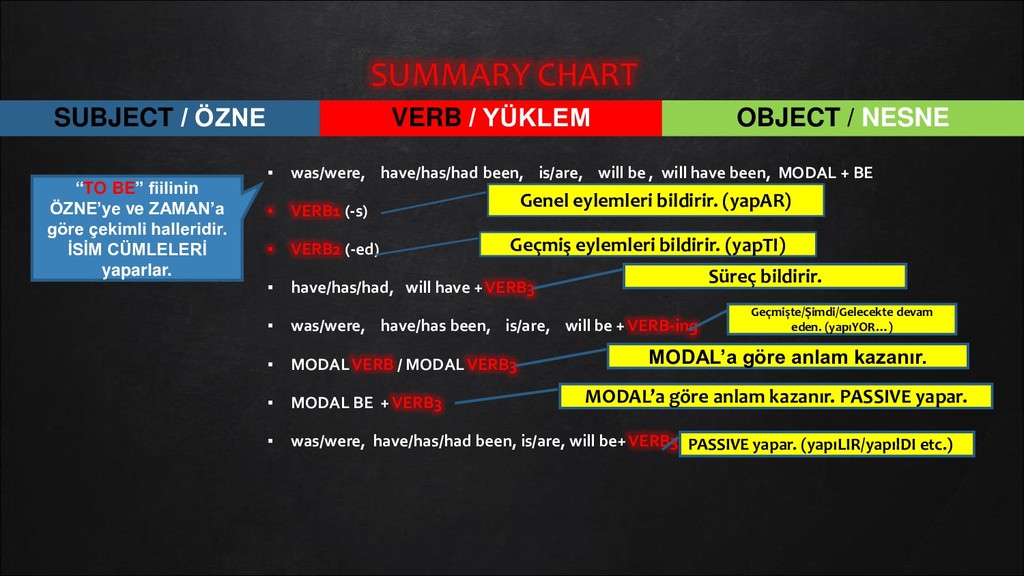
  79. SUBJECT / ÖZNE VERB / YÜKLEM OBJECT / NESNE ▪

    was/were, have/has/had been, is/are, will be , will have been, MODAL + BE ▪ VERB1 (-s) ▪ VERB2 (-ed) ▪ have/has/had, will have + VERB3 ▪ was/were, have/has been, is/are, will be + VERB-ing ▪ MODAL VERB / MODAL VERB3 ▪ MODAL BE + VERB3 ▪ was/were, have/has/had been, is/are, will be+ VERB3 “TO BE” fiilinin ÖZNE’ye ve ZAMAN’a göre çekimli halleridir. İSİM CÜMLELERİ yaparlar. Genel eylemleri bildirir. (yapAR) Geçmiş eylemleri bildirir. (yapTI) Süreç bildirir. Geçmişte/Şimdi/Gelecekte devam eden. (yapıYOR…) MODAL’a göre anlam kazanır. MODAL’a göre anlam kazanır. PASSIVE yapar. PASSIVE yapar. (yapıLIR/yapılDI etc.) SUMMARY CHART
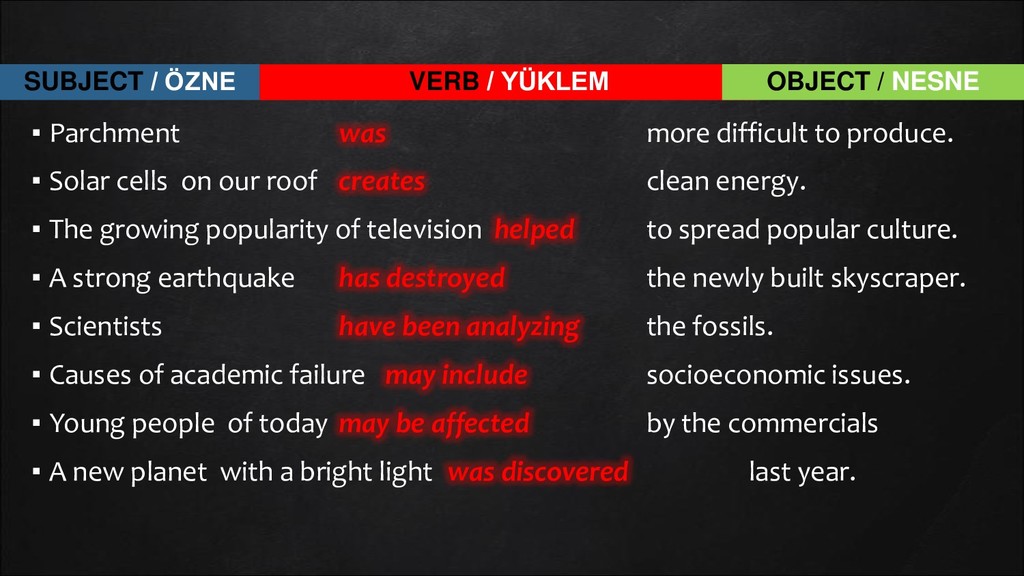
  80. SUBJECT / ÖZNE VERB / YÜKLEM OBJECT / NESNE ▪

    Parchment was more difficult to produce. ▪ Solar cells on our roof creates clean energy. ▪ The growing popularity of television helped to spread popular culture. ▪ A strong earthquake has destroyed the newly built skyscraper. ▪ Scientists have been analyzing the fossils. ▪ Causes of academic failure may include socioeconomic issues. ▪ Young people of today may be affected by the commercials ▪ A new planet with a bright light was discovered last year.
  81. 119 •Söylediklerini tam olarak anlıyorum. •Çalışmalar uzun zamandan sonra nihayet

    sonuç verdi. •Yağmur ince ince yağıyordu. •İnsan dili ortaya aniden çıkıvermedi. •Gelişmiş ülkeler yardım kampanyasına kısmen destek verdi. •Kuşların bu bölgede uçtukları nadiren görülür. •Hükümetler ve sosyal kuruluşlar giderek artan bir şekilde kaygılanıyorlar. •Sosyal psikoloji özellikle toplumsal ilişkilerle ilgilenir. •Kilo vermede diyetin rolü genel olarak önemlidir.
  82. 120 Daha önceki derslerimizde NOUN’ları SIFAT’larla niteleyebileceğimizi öğrenmiştik. Şimdi benzer

    şekilde VERB’leri nitelemek üzere kullandığımız ADVERB’leri inceleyelim.
  83. 121 • İngilizce’de genellikle “-ly” son ekli ile biten ADVERB’ler

    ile FİİL’leri birçok yönden niteleyebiliriz. • Cümlede farklı yerlerde bulunabilirler. He plays the flute beautifully. He greedily ate the chocolate cake. Slowly she picked up the knife.
  84. 123 -Kelimelerin görevleri cümle içindeki yerlerine göre belirlenir. -İngilizce’de cümle

    dizilimi sırası oldukça katıdır. -Bunun sebebi İngilizce’de “ek” olgusunun az gelişmiş olmasıdır. -Bunun sonucunda İngilizce bir cümle birden fazla şekilde Türkçe’ye çevrilebilir. Bu da kafa karışıklığına yol açabilmektedir. Diğer bir deyişle Türkçe çok farklı yollarla ifade edilebilen bir cümle, İngilizce’de aynı cümle sıralamasıyla anlatılabilir.
  85. SUBJECT VERB OBJECT SUBJECT VERB OBJECT High temperatures can change

    the structure of most protein molecules. Yüksek sıcaklıklar birçok protein molekülünün yapısını değiştirebilir. Birçok protein molekülünün yapısını değiştirebilir yüksek sıcaklıklar. Yüksek sıcaklıklar değiştirebilir birçok protein molekülünün yapısını. Birçok protein molekülünün yapısını yüksek sıcaklıklar değiştirebilir. Değiştirebilir birçok protein molekülünün yapısını yüksek sıcaklıklar.
  86. 125 Eylemleri belirtirler. EYLEMİN KİPİ (MODAL) Türkçe’de yetenek, izin, yasak,

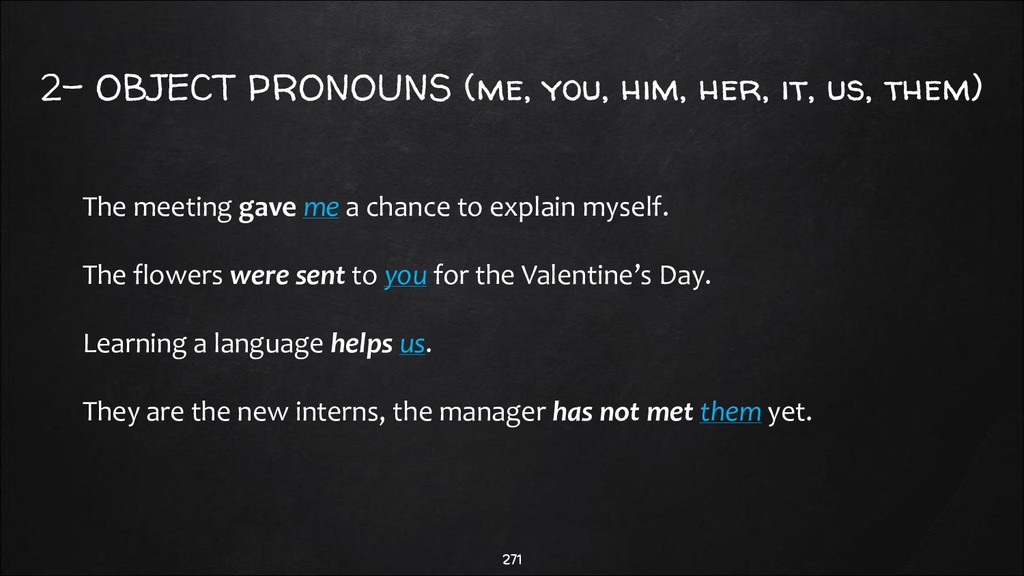
    teklif, rica, ihtimal, mantıki çıkarım vs. gibi anlamları vermek için FİİL’lerin sonuna gelen soneklerden faydalanılır. Yağmur yağabilir. Şemsiyeyi uzatır mısın? Bazı faktörler sonuçlara etki edebilir. Bu kullanımlar da ZAMAN’a göre çekimlenebilir. Bana yardım edebilirdin. Yarın bu saatlerde New York’a gidiyor olabiliriz.
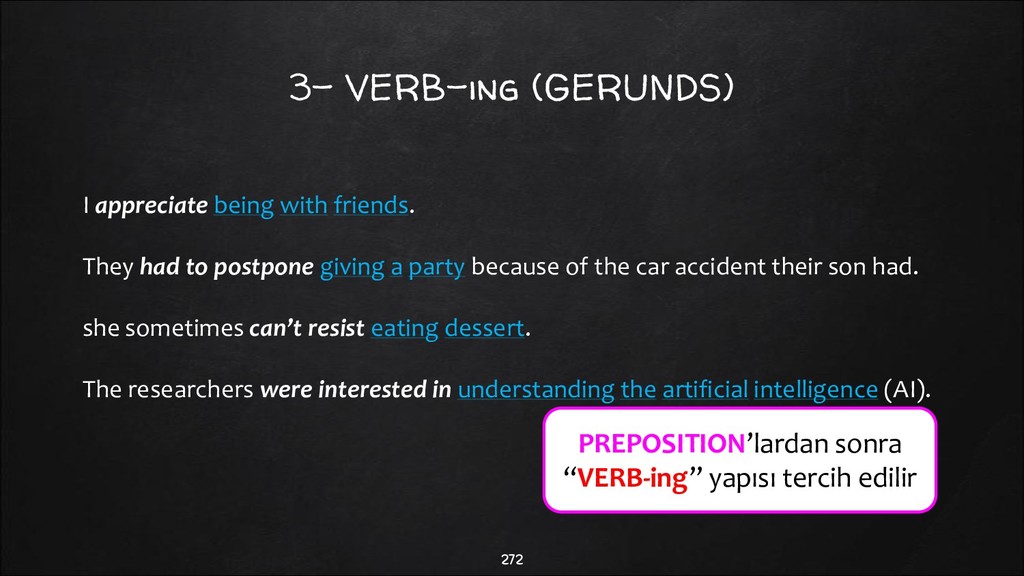
  87. 126 Eylemleri belirtirler. EYLEMİN KİPİ (MODAL) İngilizce’de yetenek, izin, yasak,

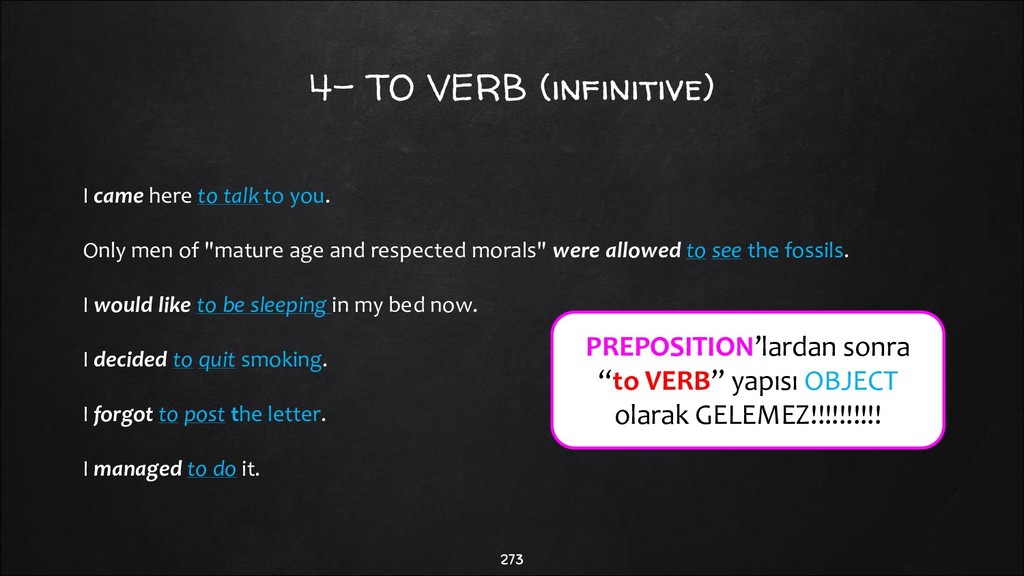
    teklif, rica, ihtimal, mantıki çıkarım vs. gibi anlamları vermek için FİİL’lerin önüne gelen yardımcı fiillerden faydalanılır. It may rain. Can you pass the umbrella? Some factors might effect the results. Bu kullanımlar da ZAMAN’a göre çekimlenebilir. You could help me. (can) We may be flying to New York this time tomorrow.
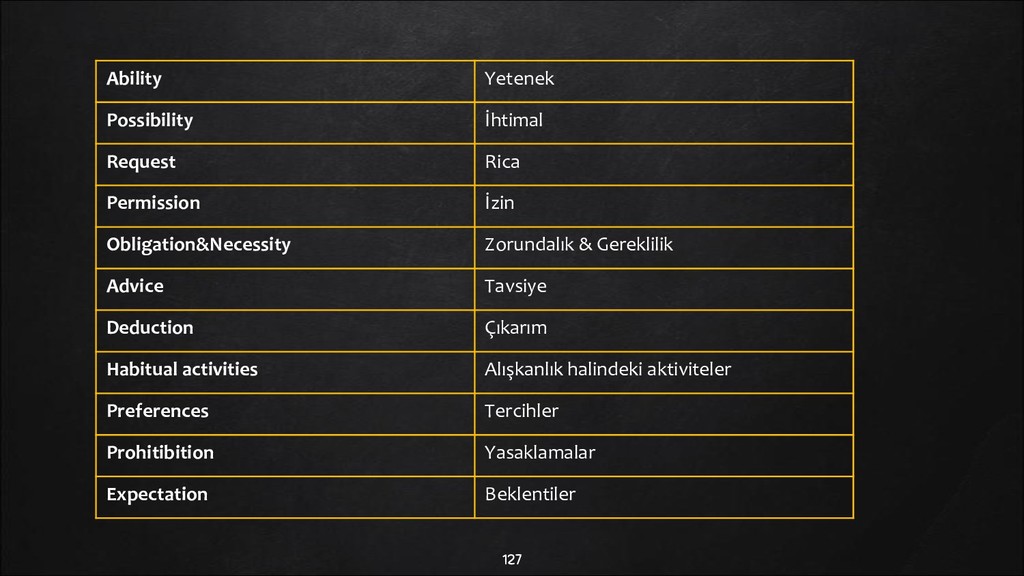
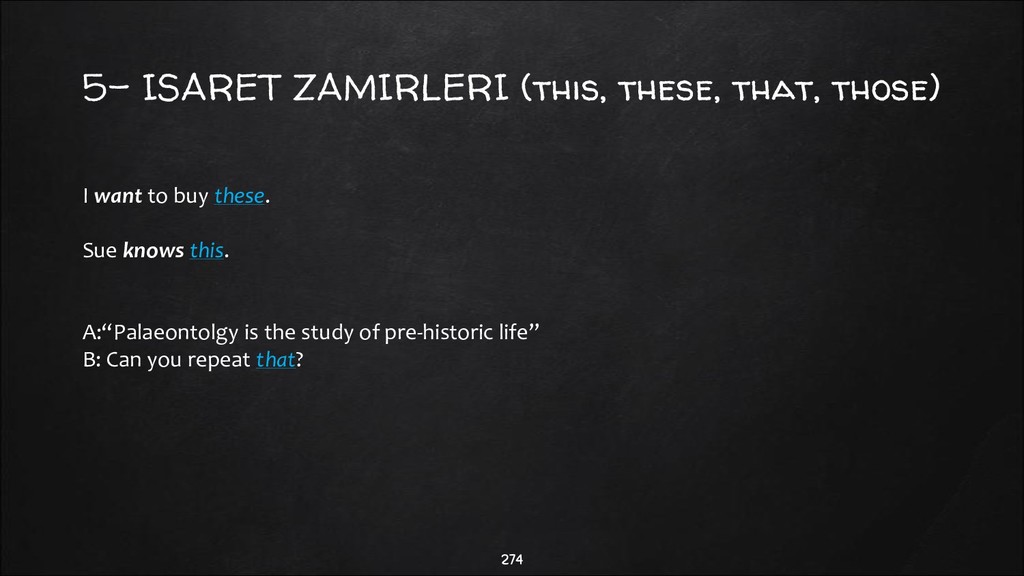
  88. 127 Ability Yetenek Possibility İhtimal Request Rica Permission İzin Obligation&Necessity

    Zorundalık & Gereklilik Advice Tavsiye Deduction Çıkarım Habitual activities Alışkanlık halindeki aktiviteler Preferences Tercihler Prohitibition Yasaklamalar Expectation Beklentiler
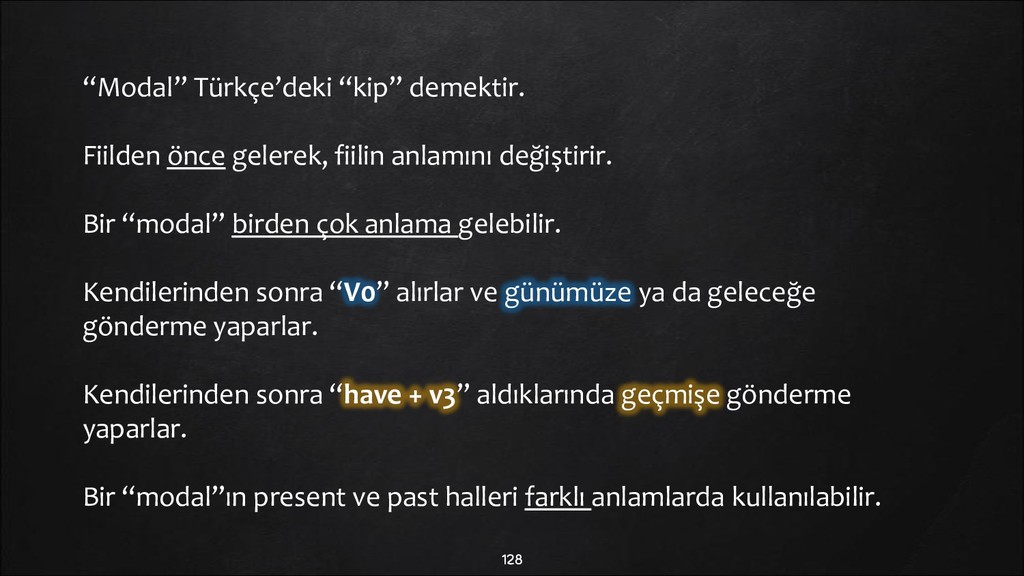
  89. 128 “Modal” Türkçe’deki “kip” demektir. Fiilden önce gelerek, fiilin anlamını

    değiştirir. Bir “modal” birden çok anlama gelebilir. Kendilerinden sonra “V0” alırlar ve günümüze ya da geleceğe gönderme yaparlar. Kendilerinden sonra “have + v3” aldıklarında geçmişe gönderme yaparlar. Bir “modal”ın present ve past halleri farklı anlamlarda kullanılabilir.
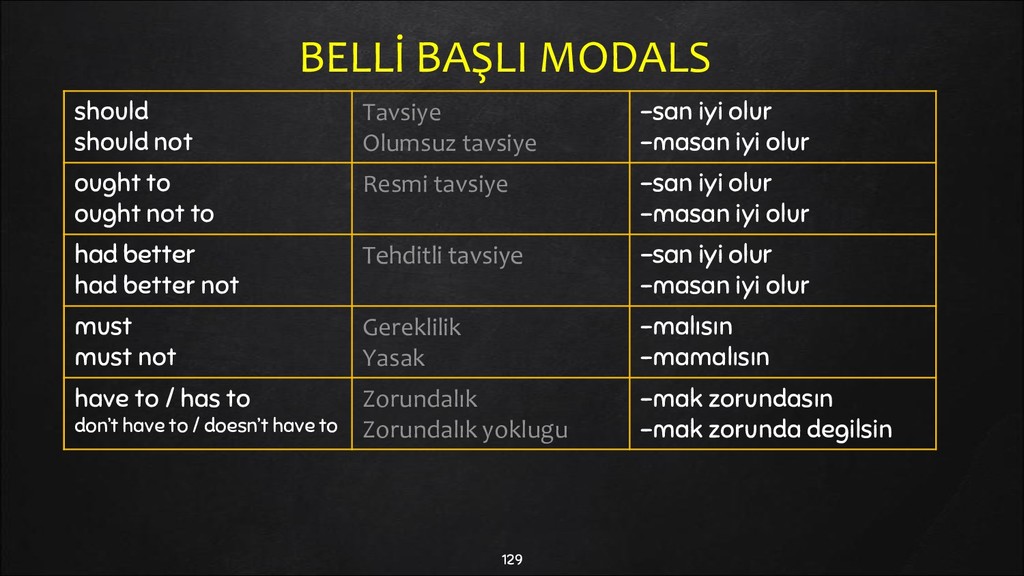
  90. should should not Tavsiye Olumsuz tavsiye -san iyi olur -masan

    iyi olur ought to ought not to Resmi tavsiye -san iyi olur -masan iyi olur had better had better not Tehditli tavsiye -san iyi olur -masan iyi olur must must not Gereklilik Yasak -malısın -mamalısın have to / has to don’t have to / doesn’t have to Zorundalık Zorundalık yoklugu -mak zorundasın -mak zorunda degilsin 129 BELLİ BAŞLI MODALS
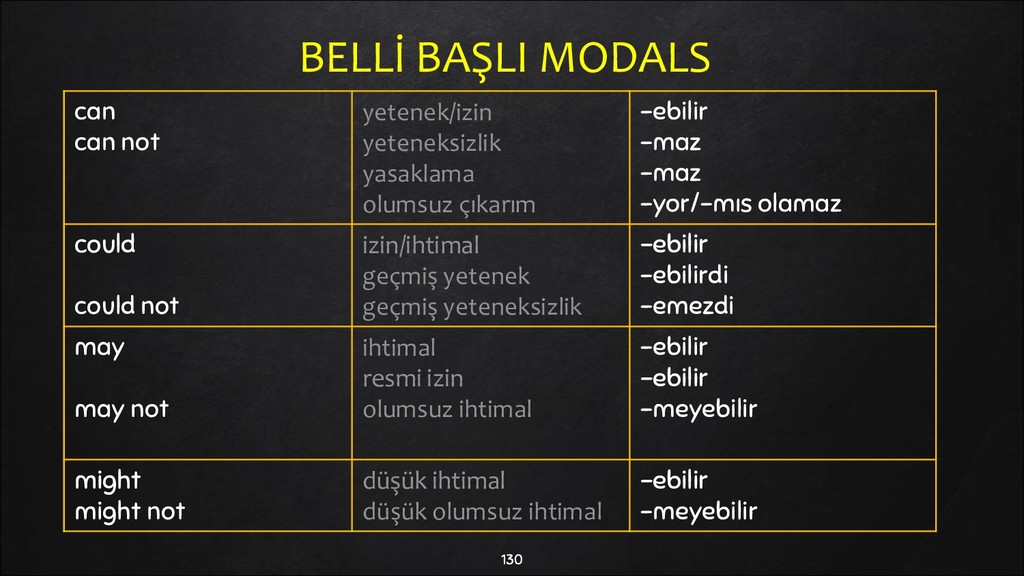
  91. can can not yetenek/izin yeteneksizlik yasaklama olumsuz çıkarım -ebilir -maz

    -maz -yor/-mıs olamaz could could not izin/ihtimal geçmiş yetenek geçmiş yeteneksizlik -ebilir -ebilirdi -emezdi may may not ihtimal resmi izin olumsuz ihtimal -ebilir -ebilir -meyebilir might might not düşük ihtimal düşük olumsuz ihtimal -ebilir -meyebilir 130 BELLİ BAŞLI MODALS
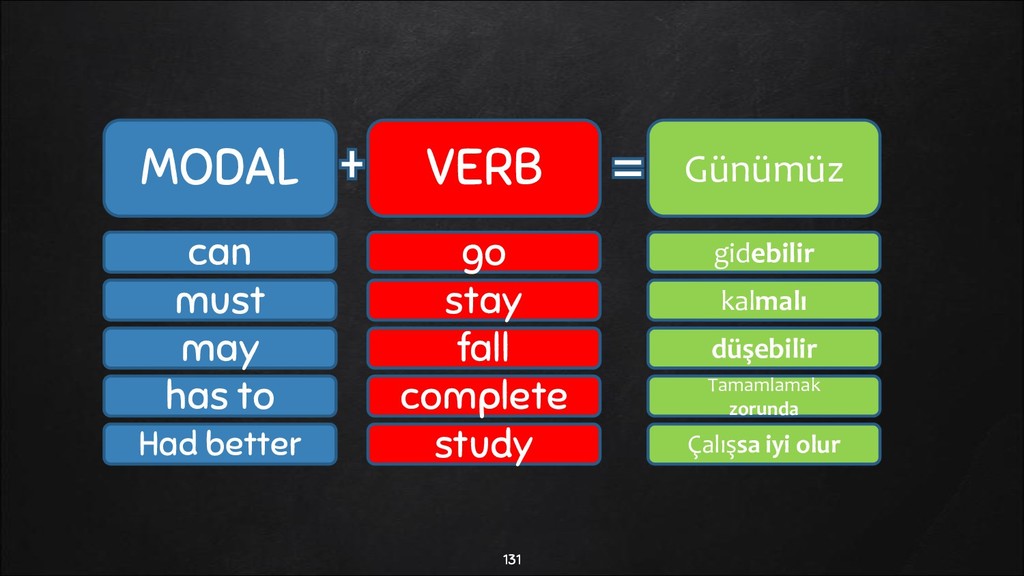
  92. 131 MODAL VERB Günümüz can go gidebilir must stay kalmalı

    may fall düşebilir has to complete Tamamlamak zorunda Had better study Çalışsa iyi olur
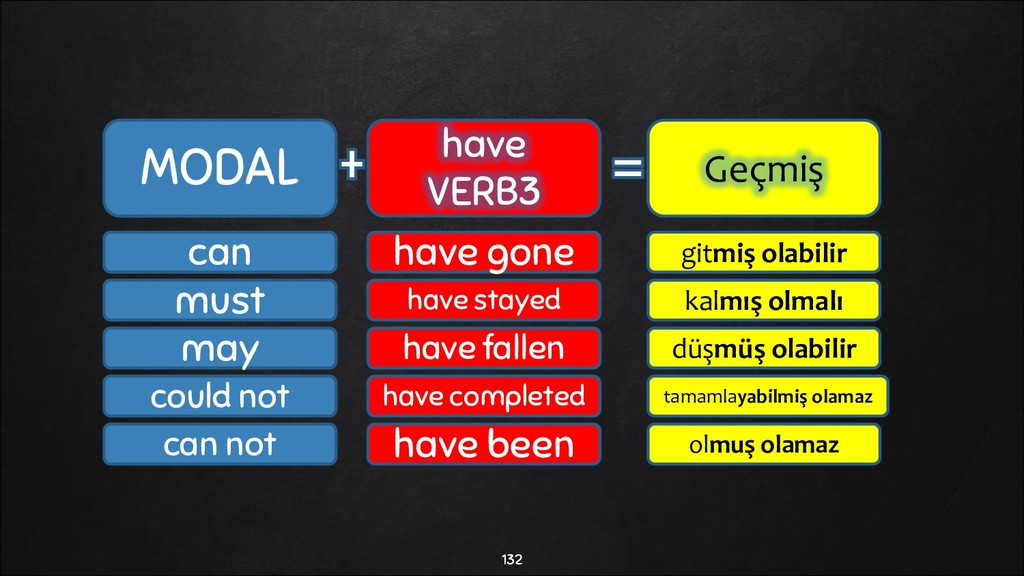
  93. 132 MODAL have VERB3 Geçmiş can have gone gitmiş olabilir

    must have stayed kalmış olmalı may have fallen düşmüş olabilir could not have completed tamamlayabilmiş olamaz can not have been olmuş olamaz
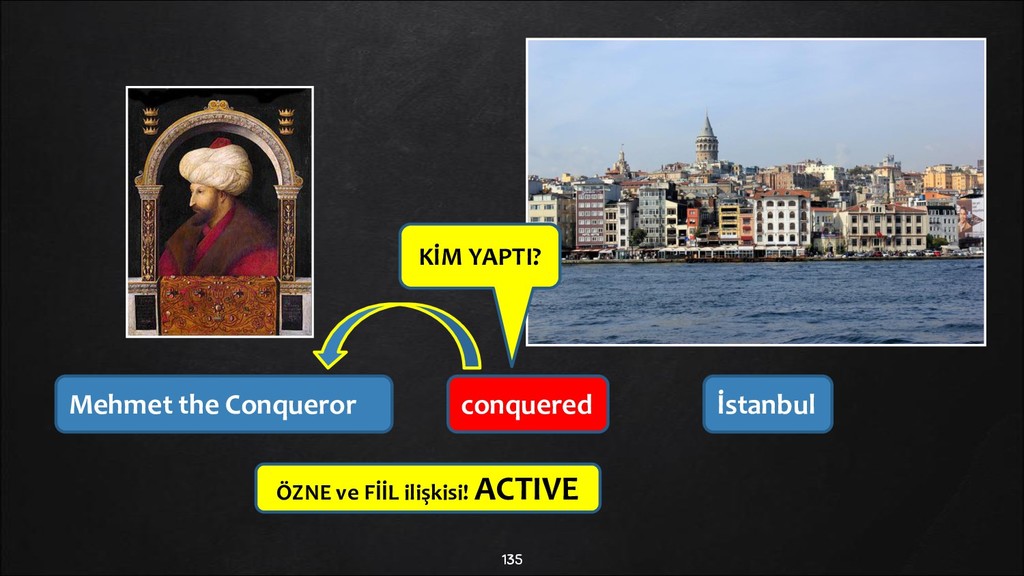
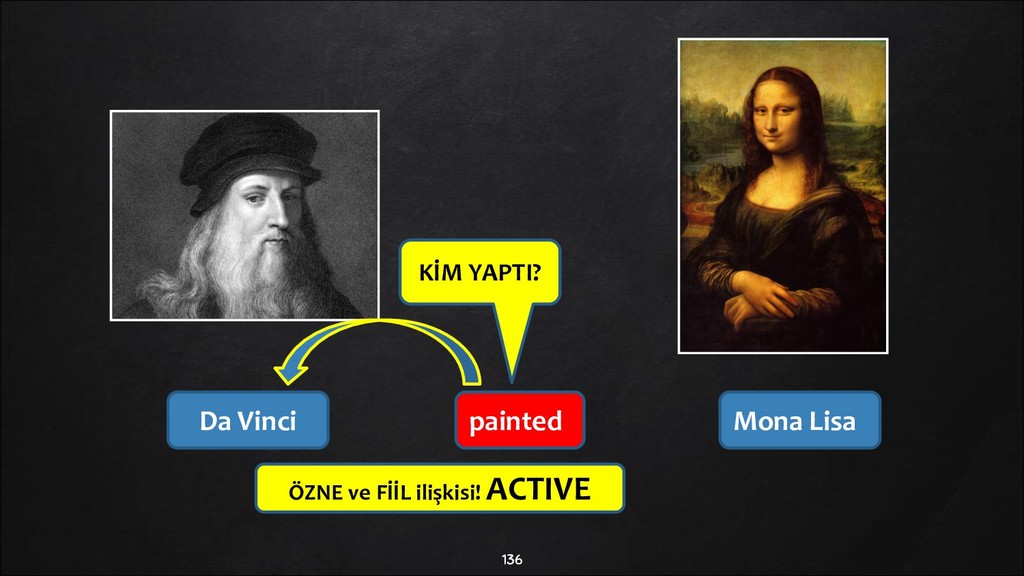
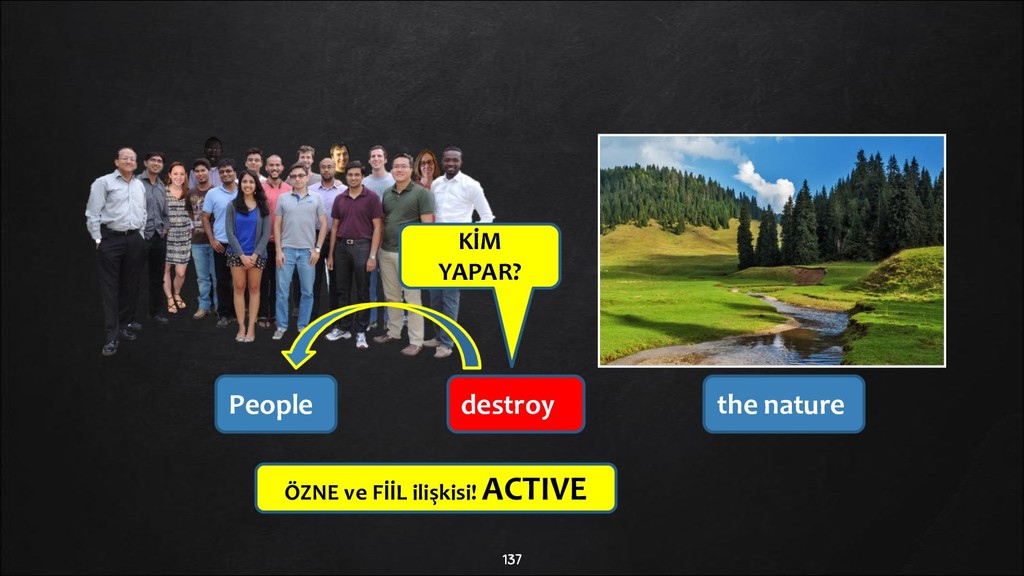
  94. 139 ACTIVE cümleler şimdiye kadar gördüğümüz cümlelerdir. Chronic illnesses affects

    young patients. Excessive consumption of alcohol causes lethal accidents. Strong feelings may cause inconvenient behaviours. Rapid changes are effecting the basic knowledge. Bu cümlelerin hepsinde FİİL’de belirtilen olayı ÖZNE yapmıştır.
  95. 140 PASSIVE cümleler FİİL’in yapısındaki bir değişimi kapsar. Bu değişimle

    birlikte FİİL artık ÖZNE’nin yaptığı işi tanımlamaz! FİİL, ÖZNE’nin etkilendiği işi tanımlar!
  96. 141 SUBJECT VERB OBJECT VERB / FİİL ile bildirilen olayı

    ya da durumu gerçekleştiren, VERB / FİİL ile bildirilen olaydan ya da durumdan etkilenen kişi, şey, durum.
  97. 142 SUBJECT VERB OBJECT OBJECT “TO BE” VERB3 SUBJECT PASSIVE

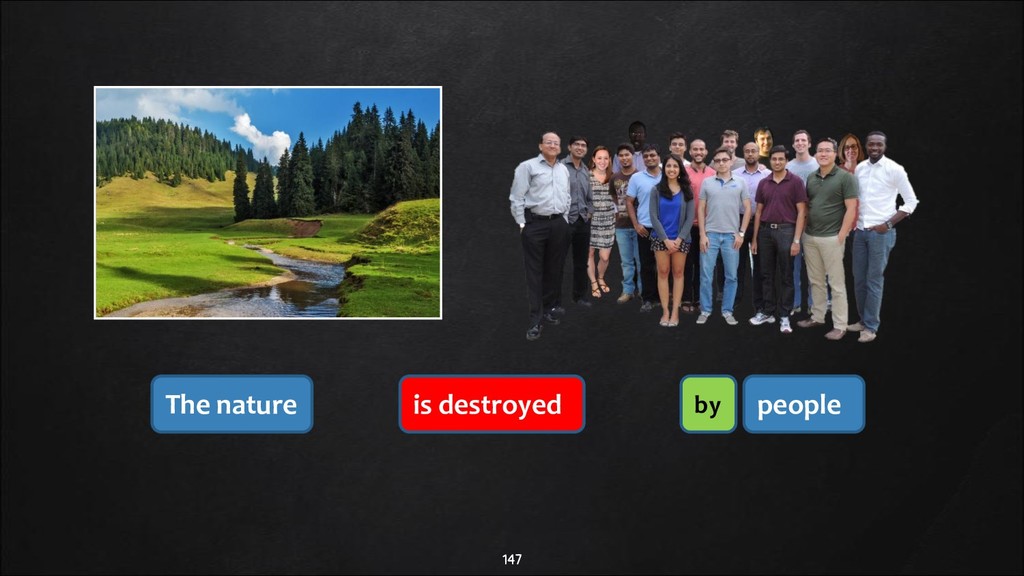
    nasıl oluşturulur? Germany manufactures BMW. BMW is manufactured by Germany
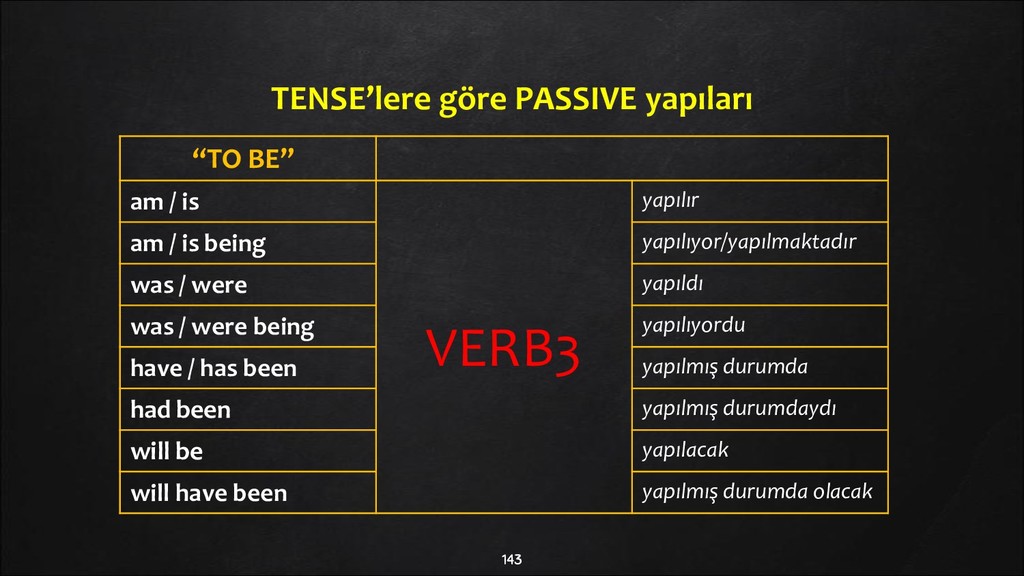
  98. 143 TENSE’lere göre PASSIVE yapıları “TO BE” am / is

    VERB3 yapılır am / is being yapılıyor/yapılmaktadır was / were yapıldı was / were being yapılıyordu have / has been yapılmış durumda had been yapılmış durumdaydı will be yapılacak will have been yapılmış durumda olacak
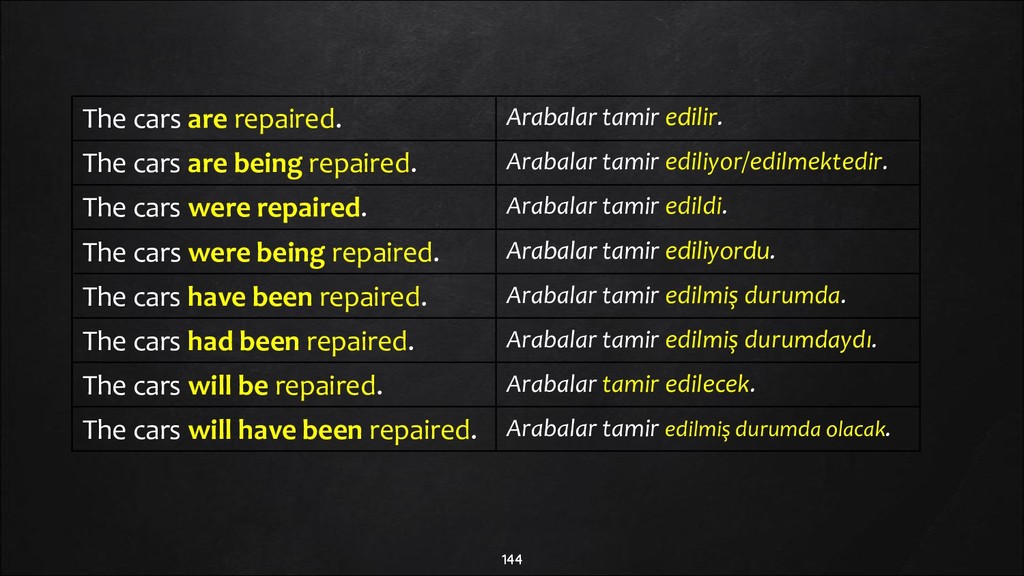
  99. 144 The cars are repaired. Arabalar tamir edilir. The cars

    are being repaired. Arabalar tamir ediliyor/edilmektedir. The cars were repaired. Arabalar tamir edildi. The cars were being repaired. Arabalar tamir ediliyordu. The cars have been repaired. Arabalar tamir edilmiş durumda. The cars had been repaired. Arabalar tamir edilmiş durumdaydı. The cars will be repaired. Arabalar tamir edilecek. The cars will have been repaired. Arabalar tamir edilmiş durumda olacak.
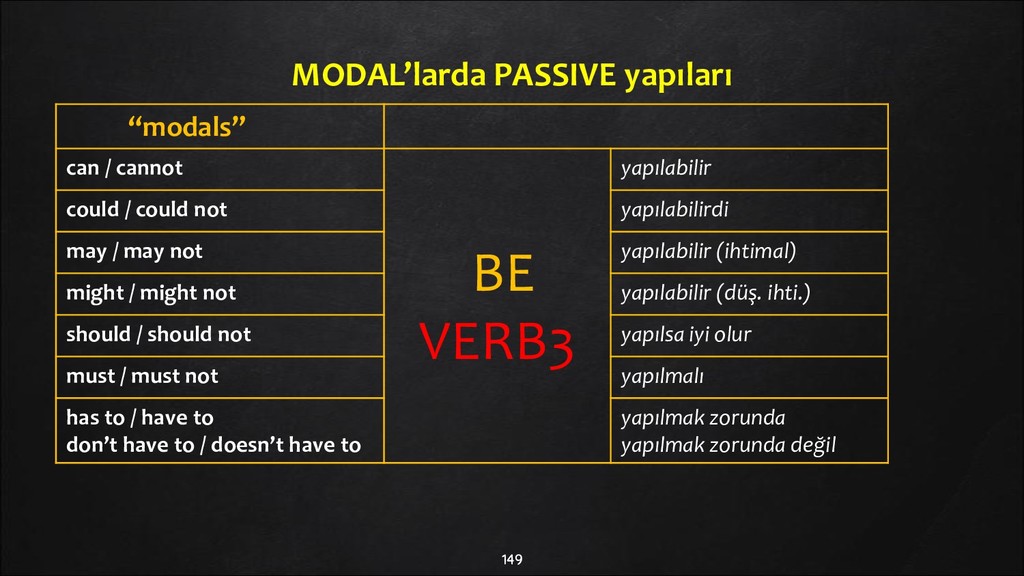
  100. 149 MODAL’larda PASSIVE yapıları “modals” can / cannot BE VERB3

    yapılabilir could / could not yapılabilirdi may / may not yapılabilir (ihtimal) might / might not yapılabilir (düş. ihti.) should / should not yapılsa iyi olur must / must not yapılmalı has to / have to don’t have to / doesn’t have to yapılmak zorunda yapılmak zorunda değil
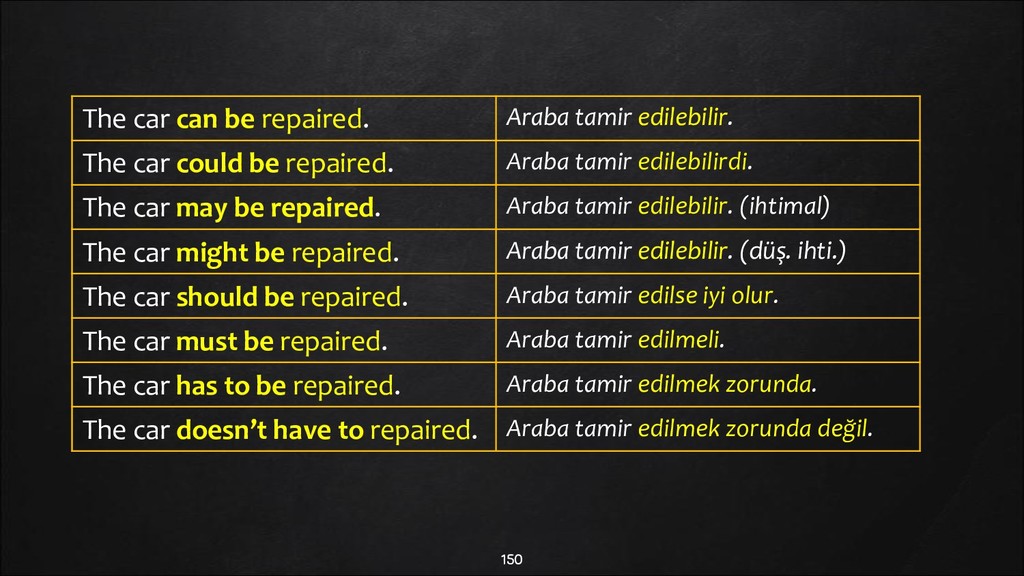
  101. 150 The car can be repaired. Araba tamir edilebilir. The

    car could be repaired. Araba tamir edilebilirdi. The car may be repaired. Araba tamir edilebilir. (ihtimal) The car might be repaired. Araba tamir edilebilir. (düş. ihti.) The car should be repaired. Araba tamir edilse iyi olur. The car must be repaired. Araba tamir edilmeli. The car has to be repaired. Araba tamir edilmek zorunda. The car doesn’t have to repaired. Araba tamir edilmek zorunda değil.
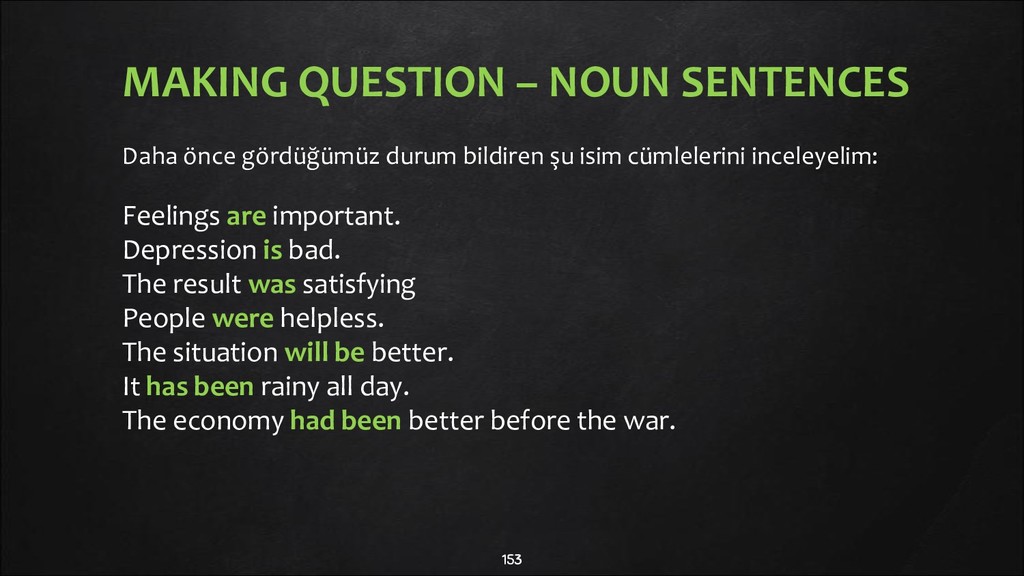
  102. 153 MAKING QUESTION – NOUN SENTENCES Daha önce gördüğümüz durum

    bildiren şu isim cümlelerini inceleyelim: Feelings are important. Depression is bad. The result was satisfying People were helpless. The situation will be better. It has been rainy all day. The economy had been better before the war.
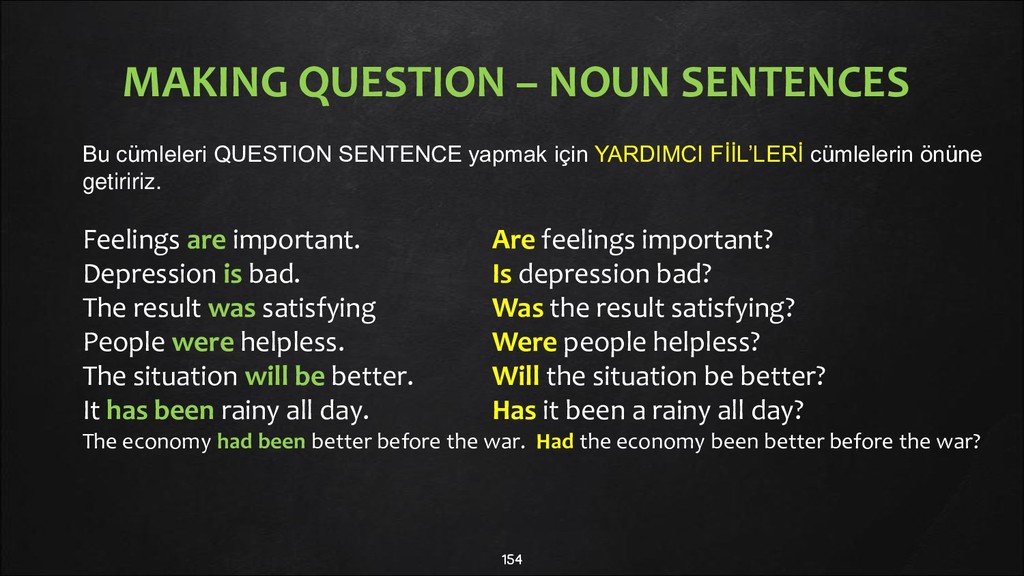
  103. 154 MAKING QUESTION – NOUN SENTENCES Bu cümleleri QUESTION SENTENCE

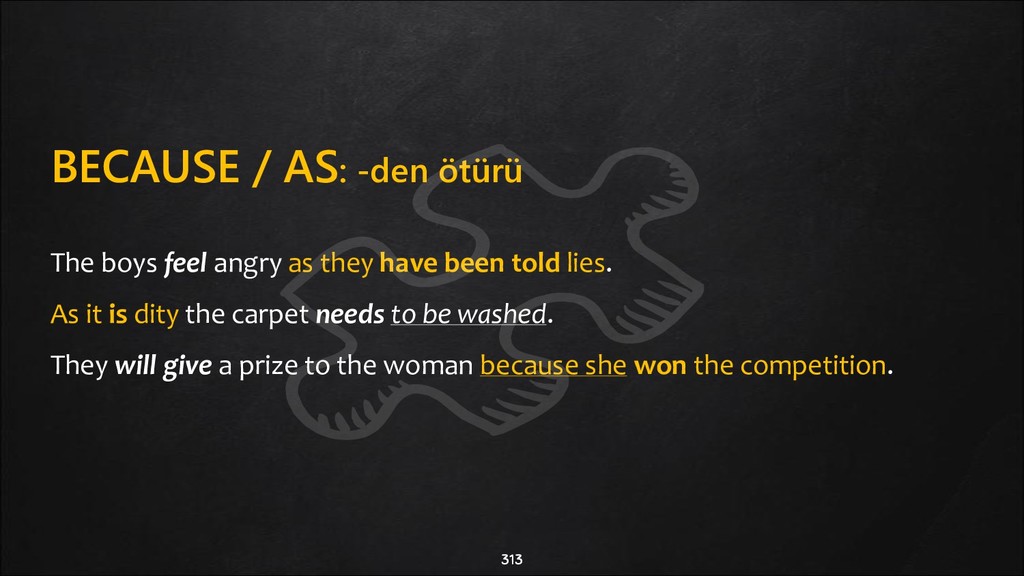
    yapmak için YARDIMCI FİİL’LERİ cümlelerin önüne getiririz. Feelings are important. Are feelings important? Depression is bad. Is depression bad? The result was satisfying Was the result satisfying? People were helpless. Were people helpless? The situation will be better. Will the situation be better? It has been rainy all day. Has it been a rainy all day? The economy had been better before the war. Had the economy been better before the war?
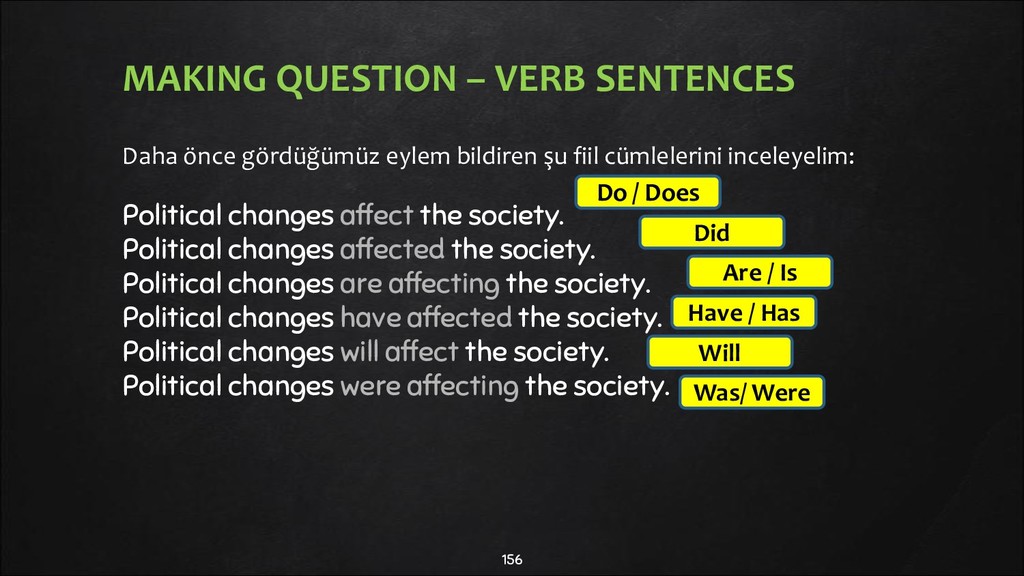
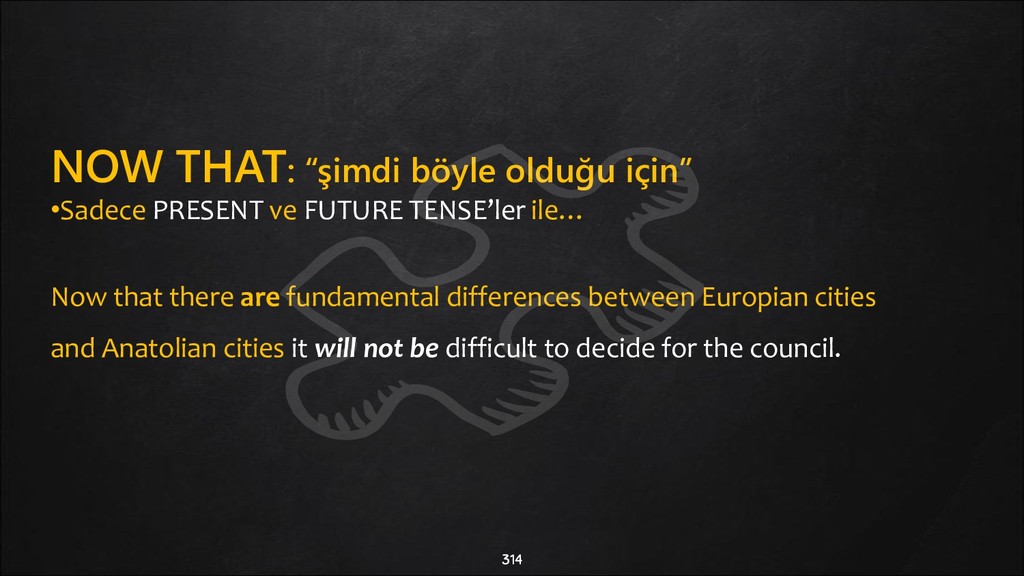
  104. 156 MAKING QUESTION – VERB SENTENCES Daha önce gördüğümüz eylem

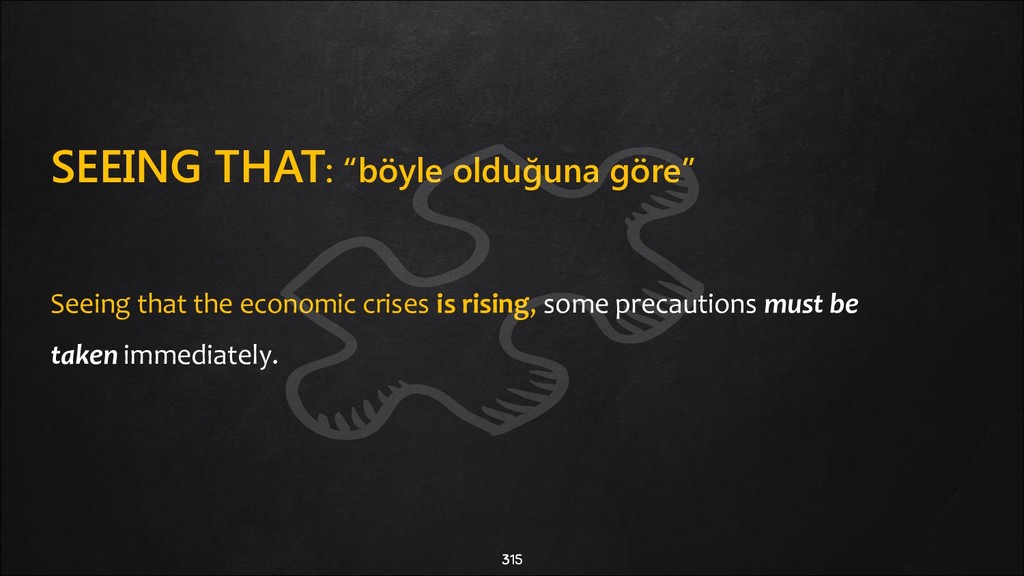
    bildiren şu fiil cümlelerini inceleyelim: Political changes affect the society. Political changes affected the society. Political changes are affecting the society. Political changes have affected the society. Political changes will affect the society. Political changes were affecting the society. Do / Does Did Are / Is Will Have / Has Was/ Were
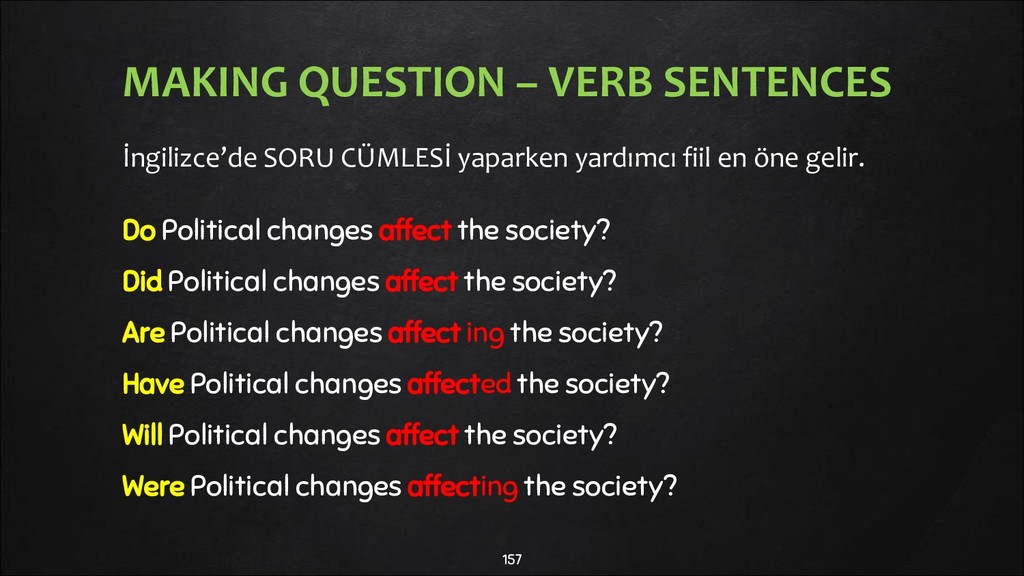
  105. 157 MAKING QUESTION – VERB SENTENCES İngilizce’de SORU CÜMLESİ yaparken

    yardımcı fiil en öne gelir. Do Political changes affect the society? Did Political changes affect the society? Are Political changes affect ing the society? Have Political changes affected the society? Will Political changes affect the society? Were Political changes affecting the society?
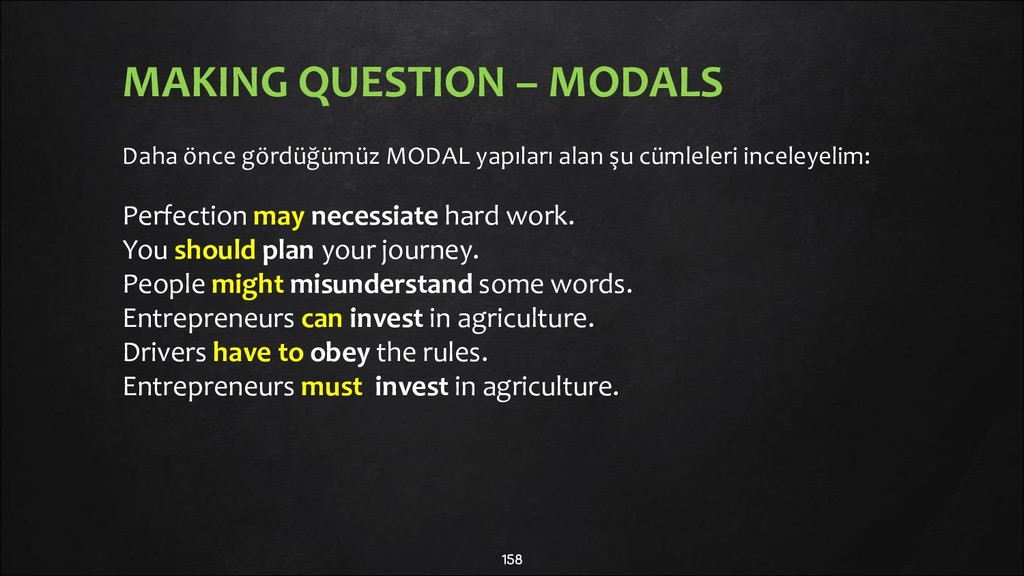
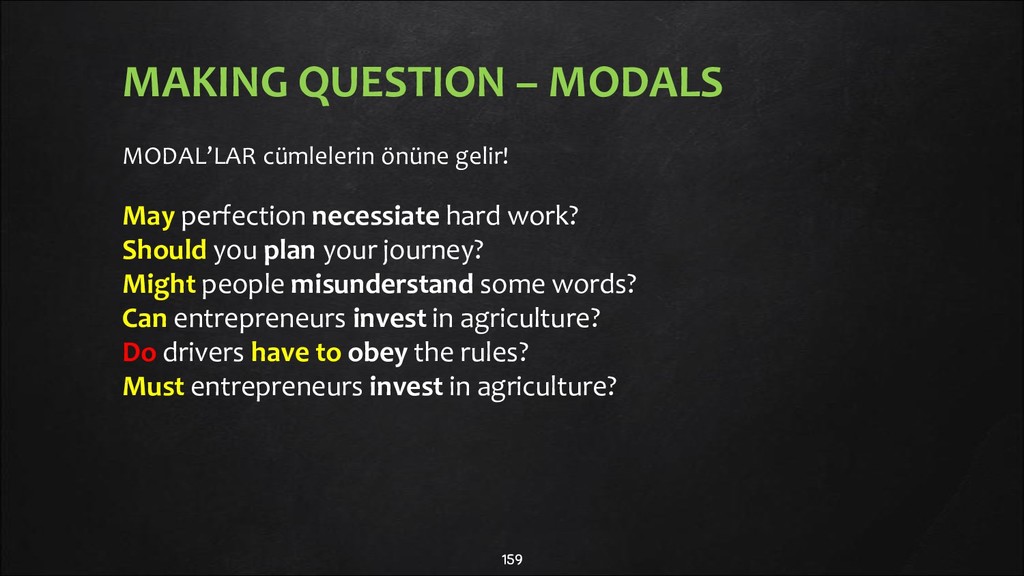
  106. 158 MAKING QUESTION – MODALS Daha önce gördüğümüz MODAL yapıları

    alan şu cümleleri inceleyelim: Perfection may necessiate hard work. You should plan your journey. People might misunderstand some words. Entrepreneurs can invest in agriculture. Drivers have to obey the rules. Entrepreneurs must invest in agriculture.
  107. 159 MAKING QUESTION – MODALS MODAL’LAR cümlelerin önüne gelir! May

    perfection necessiate hard work? Should you plan your journey? Might people misunderstand some words? Can entrepreneurs invest in agriculture? Do drivers have to obey the rules? Must entrepreneurs invest in agriculture?
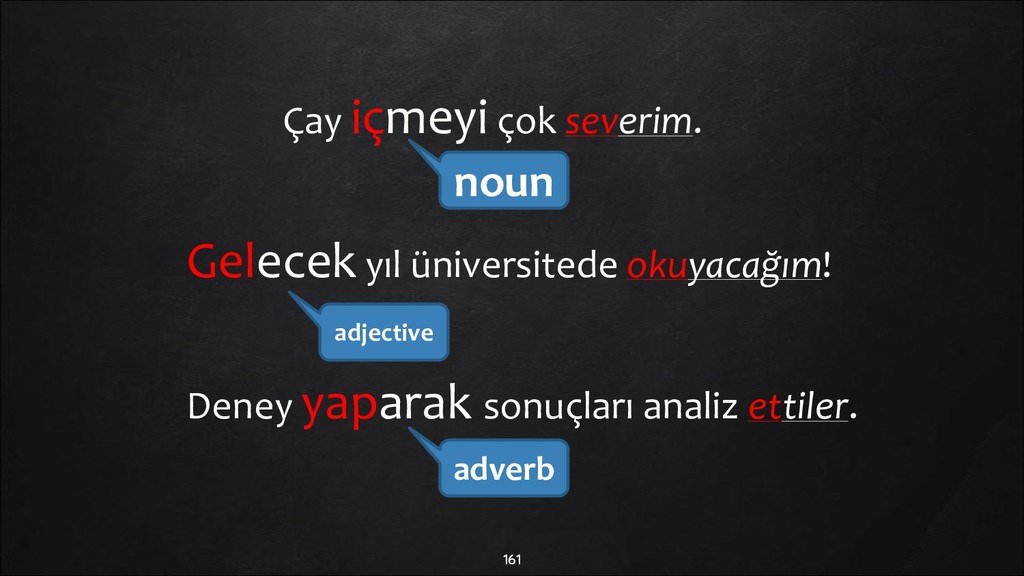
  108. 161 Gelecek yıl üniversitede okuyacağım! Çay içmeyi çok severim. Deney

    yaparak sonuçları analiz ettiler. noun adjective adverb
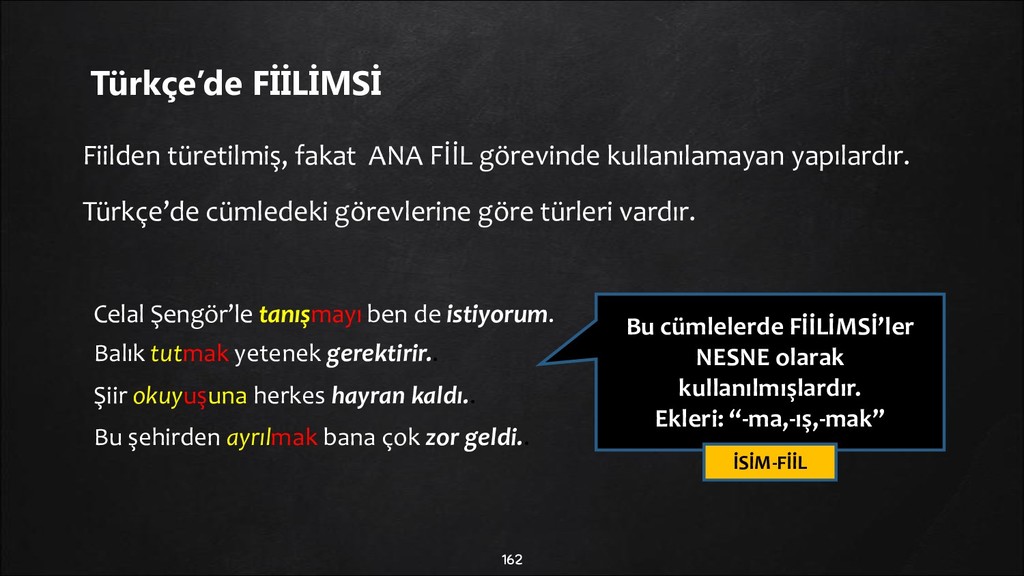
  109. 162 Türkçe’de FİİLİMSİ Fiilden türetilmiş, fakat ANA FİİL görevinde kullanılamayan

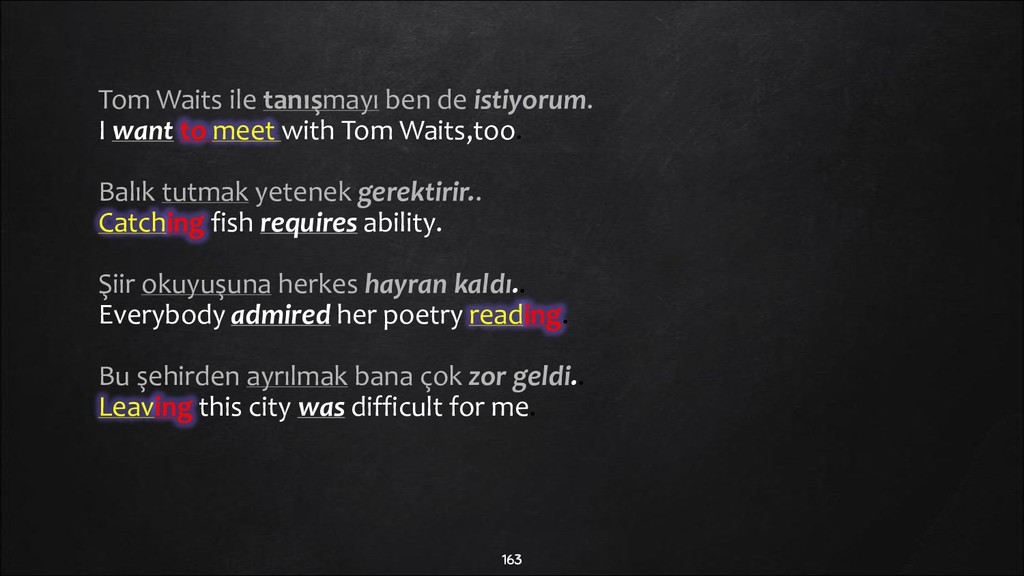
    yapılardır. Türkçe’de cümledeki görevlerine göre türleri vardır. Celal Şengör’le tanışmayı ben de istiyorum. Balık tutmak yetenek gerektirir.. Şiir okuyuşuna herkes hayran kaldı.. Bu şehirden ayrılmak bana çok zor geldi.. Bu cümlelerde FİİLİMSİ’ler NESNE olarak kullanılmışlardır. Ekleri: “-ma,-ış,-mak” İSİM-FİİL
  110. 163 Tom Waits ile tanışmayı ben de istiyorum. I want

    to meet with Tom Waits,too. Balık tutmak yetenek gerektirir.. Catching fish requires ability. Şiir okuyuşuna herkes hayran kaldı.. Everybody admired her poetry reading. Bu şehirden ayrılmak bana çok zor geldi.. Leaving this city was difficult for me.
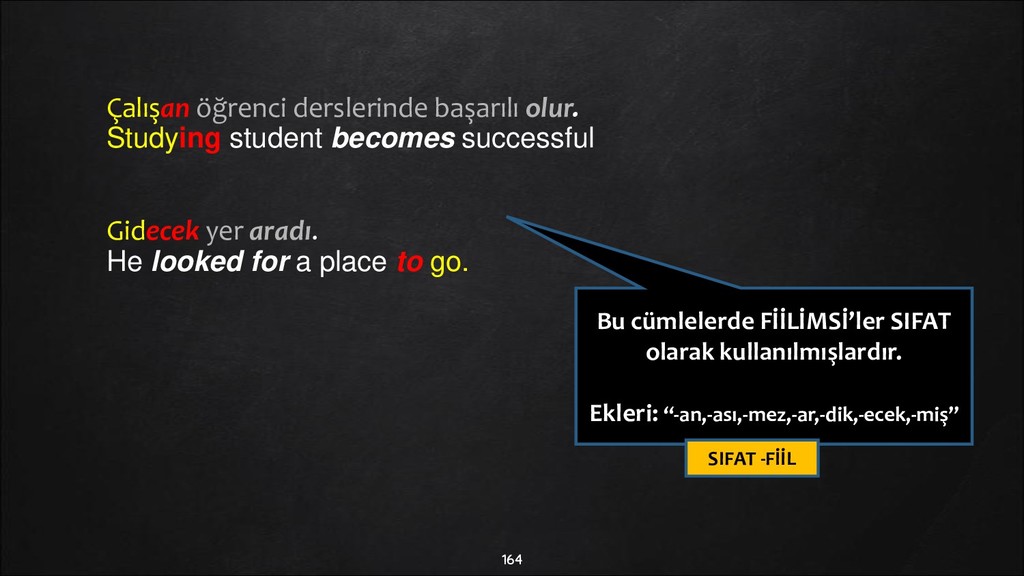
  111. 164 Çalışan öğrenci derslerinde başarılı olur. Studying student becomes successful

    Gidecek yer aradı. He looked for a place to go. Bu cümlelerde FİİLİMSİ’ler SIFAT olarak kullanılmışlardır. Ekleri: “-an,-ası,-mez,-ar,-dik,-ecek,-miş” SIFAT -FİİL
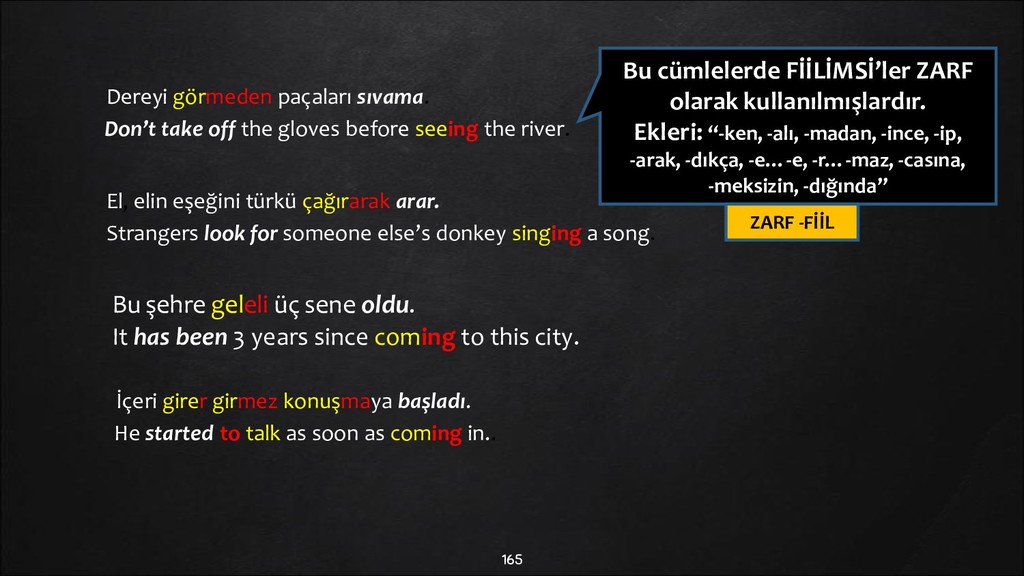
  112. 165 Dereyi görmeden paçaları sıvama. Don’t take off the gloves

    before seeing the river. Strangers look for someone else’s donkey singing a song. El, elin eşeğini türkü çağırarak arar. Bu şehre geleli üç sene oldu. It has been 3 years since coming to this city. İçeri girer girmez konuşmaya başladı. He started to talk as soon as coming in.. Bu cümlelerde FİİLİMSİ’ler ZARF olarak kullanılmışlardır. Ekleri: “-ken, -alı, -madan, -ince, -ip, -arak, -dıkça, -e…-e, -r…-maz, -casına, -meksizin, -dığında” ZARF -FİİL
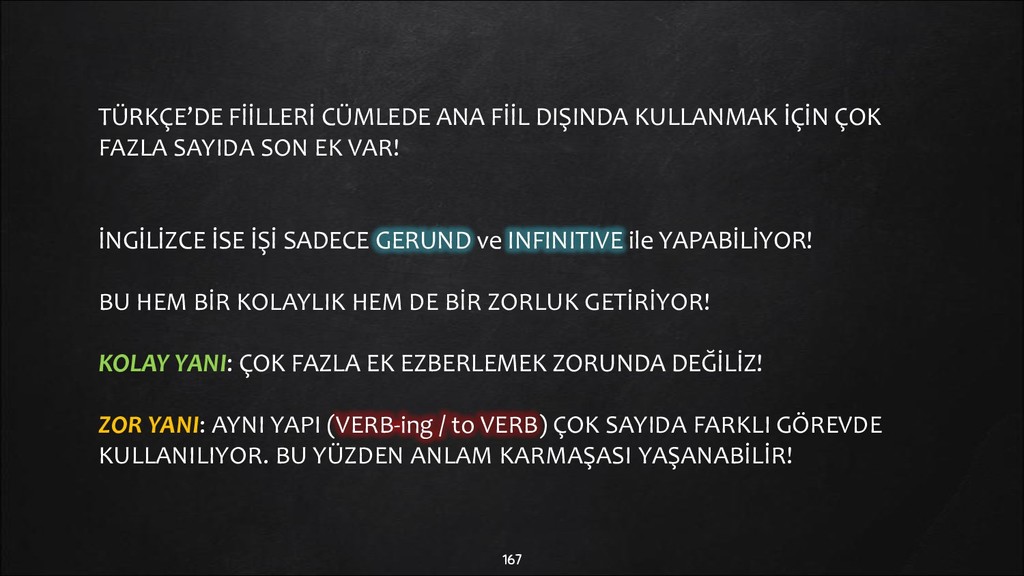
  113. 167 TÜRKÇE’DE FİİLLERİ CÜMLEDE ANA FİİL DIŞINDA KULLANMAK İÇİN ÇOK

    FAZLA SAYIDA SON EK VAR! İNGİLİZCE İSE İŞİ SADECE GERUND ve INFINITIVE ile YAPABİLİYOR! BU HEM BİR KOLAYLIK HEM DE BİR ZORLUK GETİRİYOR! KOLAY YANI: ÇOK FAZLA EK EZBERLEMEK ZORUNDA DEĞİLİZ! ZOR YANI: AYNI YAPI (VERB-ing / to VERB) ÇOK SAYIDA FARKLI GÖREVDE KULLANILIYOR. BU YÜZDEN ANLAM KARMAŞASI YAŞANABİLİR!
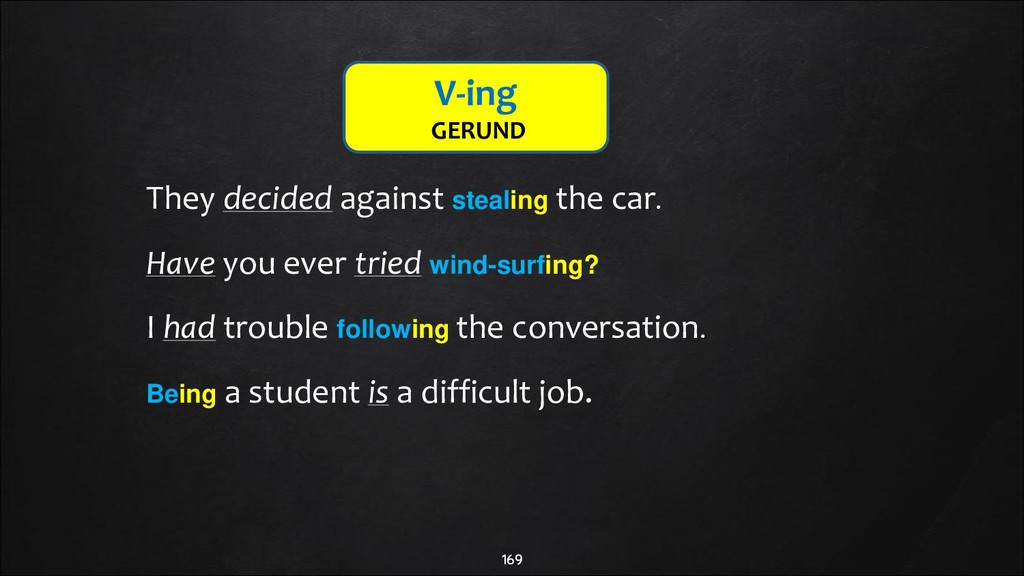
  114. 169 V-ing GERUND They decided against stealing the car. Have

    you ever tried wind-surfing? I had trouble following the conversation. Being a student is a difficult job.
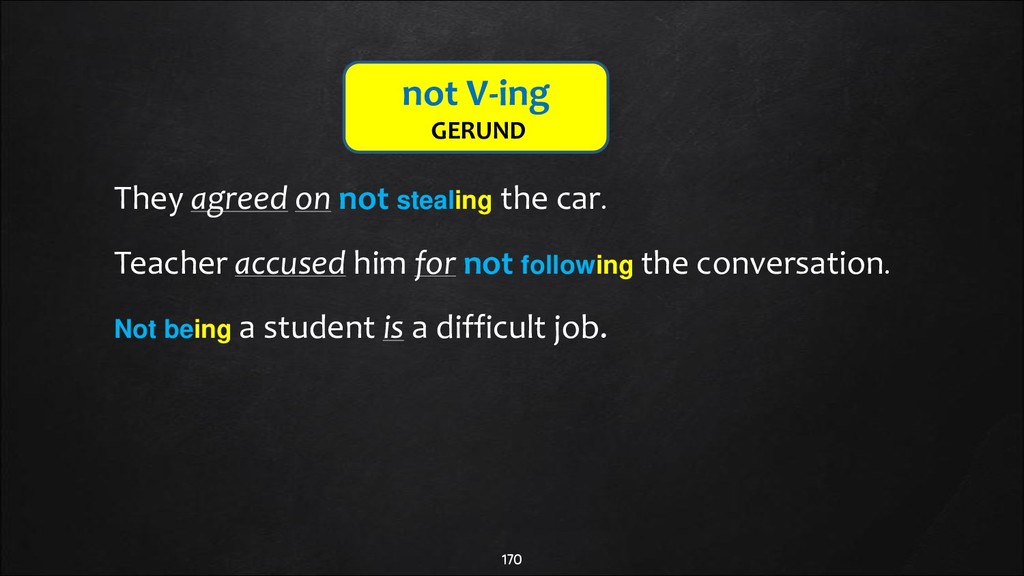
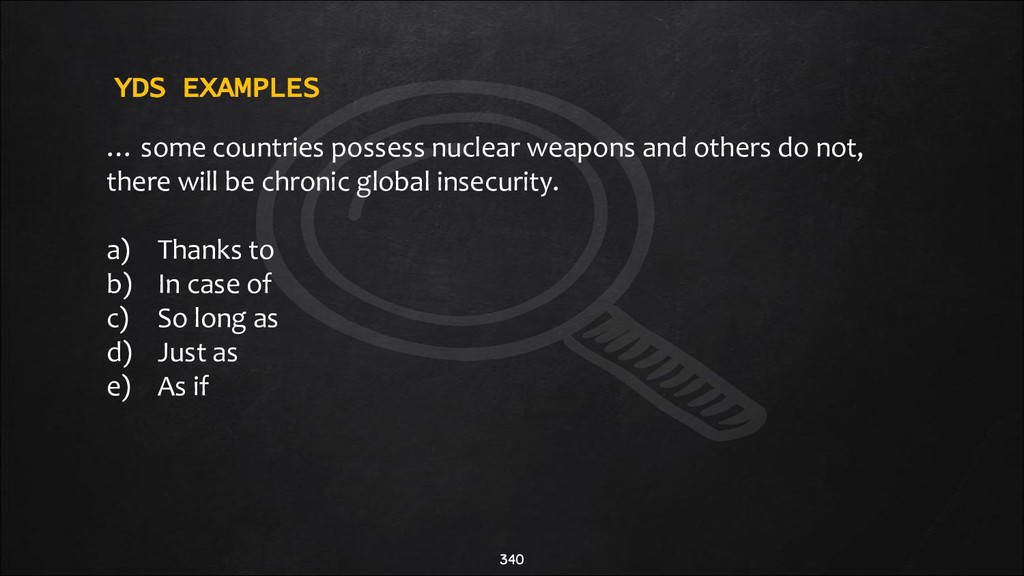
  115. 170 not V-ing GERUND They agreed on not stealing the

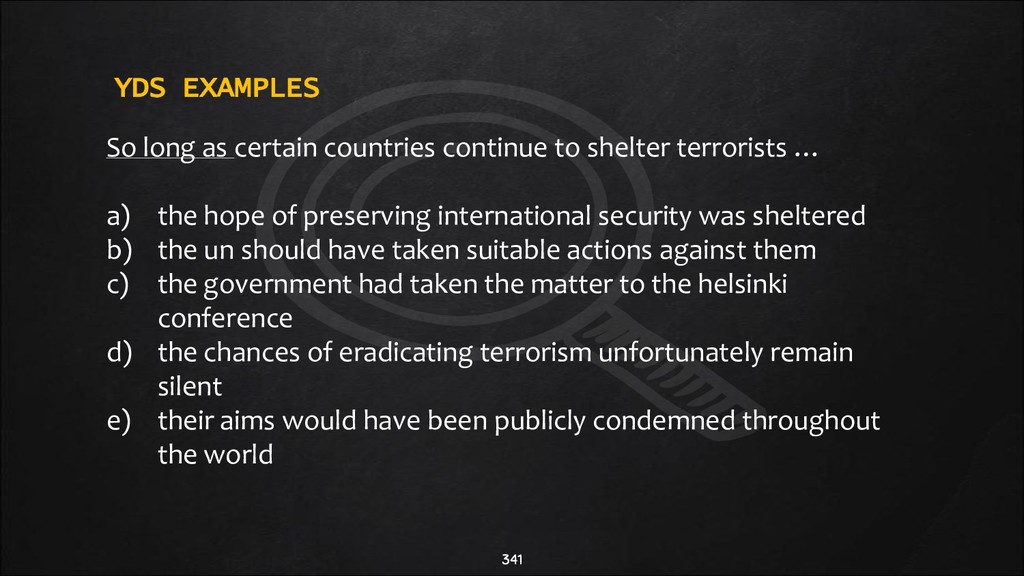
    car. Teacher accused him for not following the conversation. Not being a student is a difficult job.
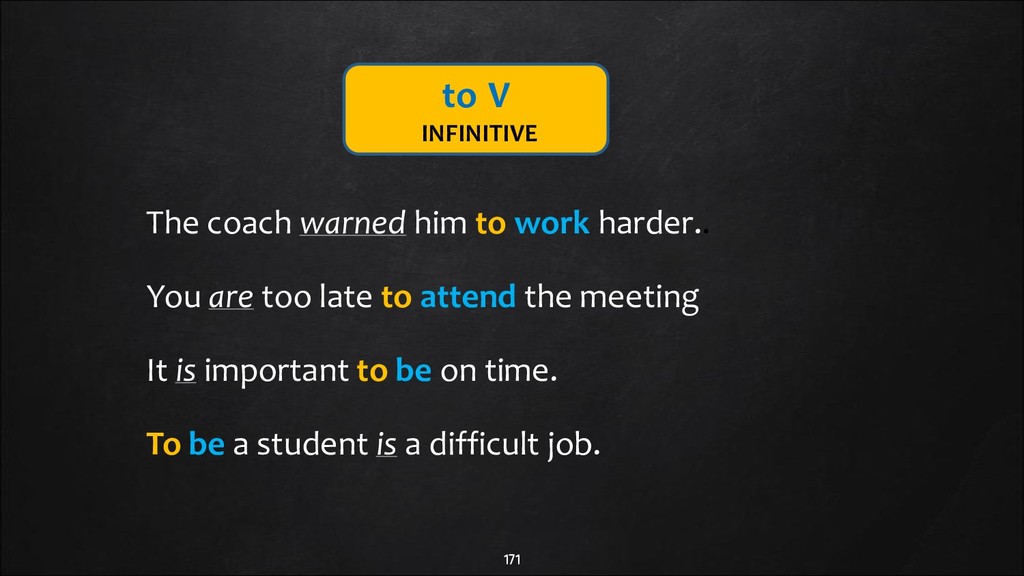
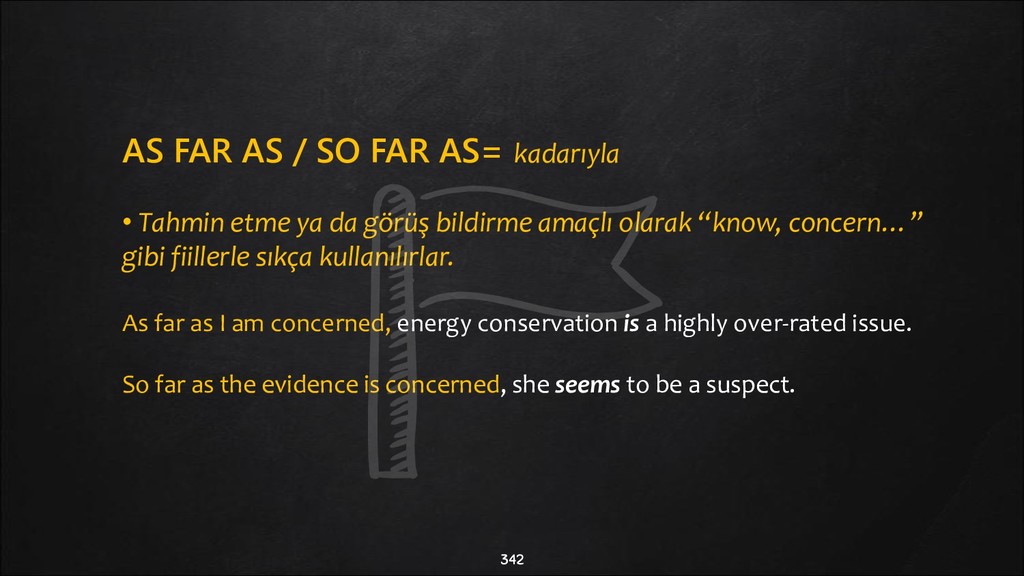
  116. 171 to V INFINITIVE The coach warned him to work

    harder.. You are too late to attend the meeting It is important to be on time. To be a student is a difficult job.
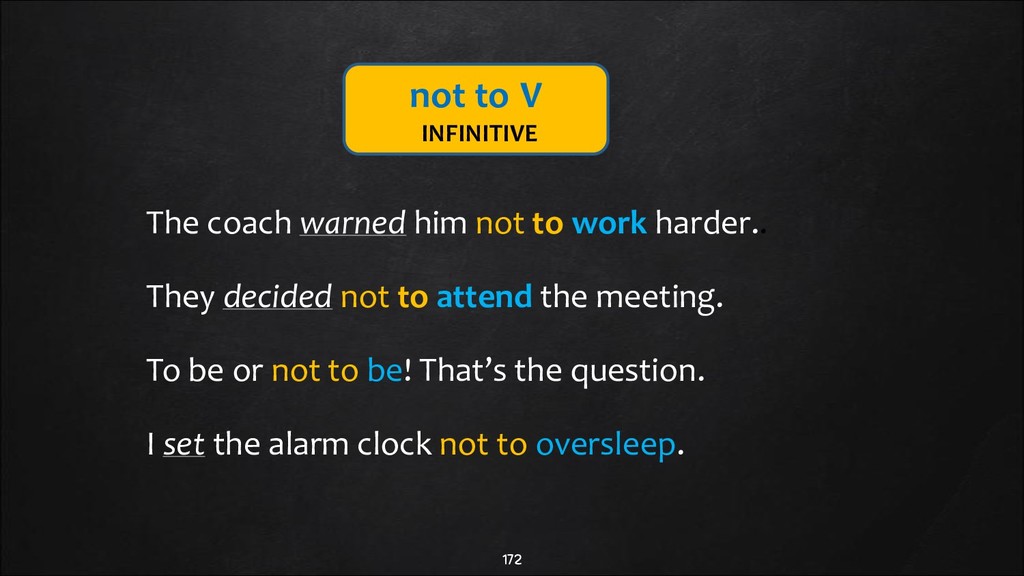
  117. 172 not to V INFINITIVE The coach warned him not

    to work harder.. They decided not to attend the meeting. To be or not to be! That’s the question. I set the alarm clock not to oversleep.
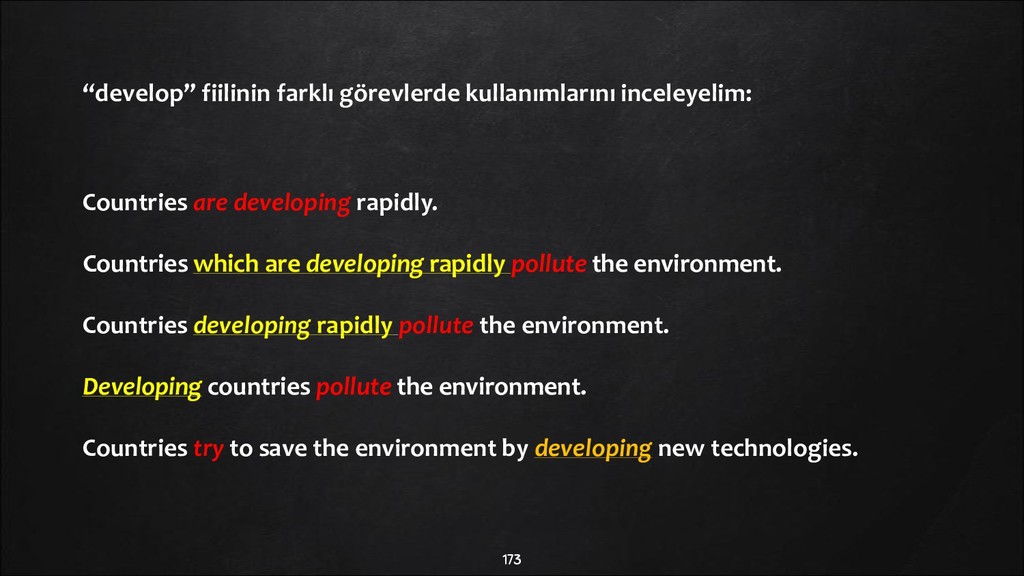
  118. 173 “develop” fiilinin farklı görevlerde kullanımlarını inceleyelim: Countries are developing

    rapidly. Countries which are developing rapidly pollute the environment. Countries developing rapidly pollute the environment. Developing countries pollute the environment. Countries try to save the environment by developing new technologies.
  119. 175 İNGİLİZCE BİR CÜMLEDEKİ FİİLİMSİLERİ ÜÇ BAKIMDAN TESBİT ETMEMİZ GEREKİR:

    1-CÜMLEDEKİ GÖREVİ 2-GÖNDERME YAPTIĞI ZAMAN (TENSE) 3-AKTİFLİK & PASİFLİK
  120. 177 Bilgisayar kullanmayı öğreniyor olmama memnumum. Bilgisayar kullanmayı öğrenmiş olduğum

    için memnunum. “öğrenme” işi şu an devam ediyor. “öğrenme” işi sona ermiş. (ANA FİİL’e göre geçmişte)
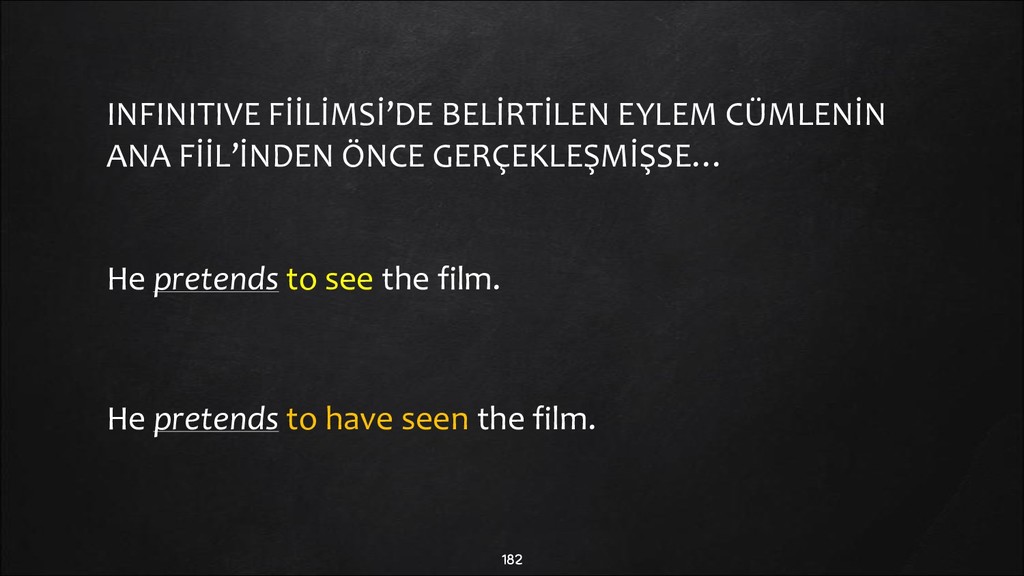
  121. 179 GERUND FİİLİMSİ’DE BELİRTİLEN EYLEM CÜMLENİN ANA FİİL’İNDEN ÖNCE GERÇEKLEŞMİŞSE…

    He appreciates learning to use computer. He appreciates having learned to use computer.
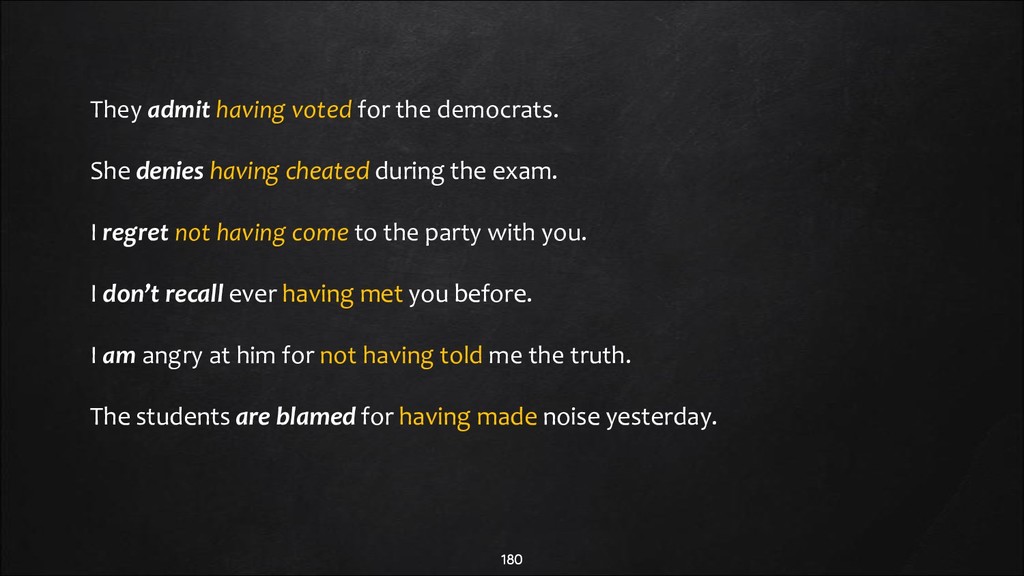
  122. 180 They admit having voted for the democrats. She denies

    having cheated during the exam. I regret not having come to the party with you. I don’t recall ever having met you before. I am angry at him for not having told me the truth. The students are blamed for having made noise yesterday.
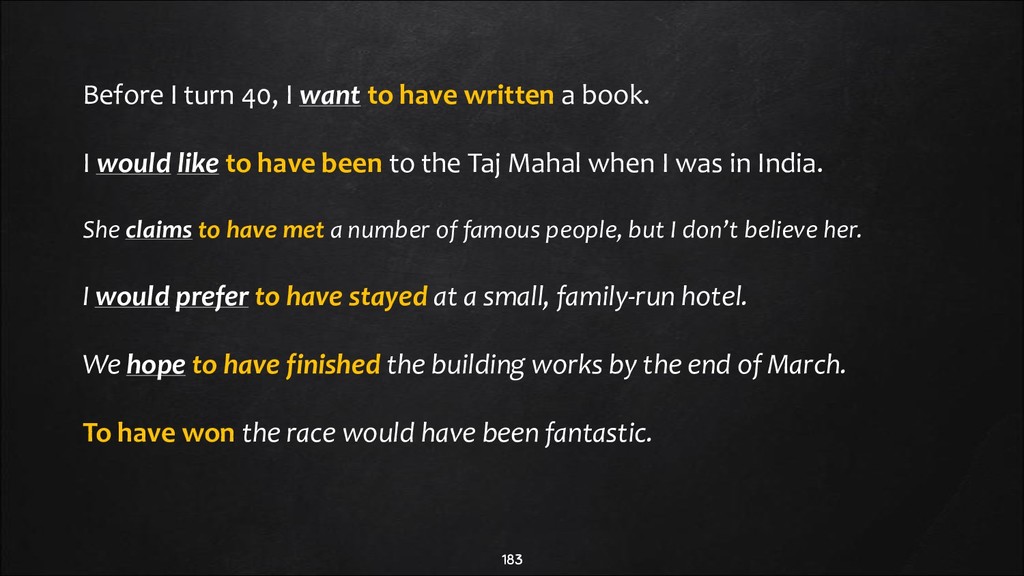
  123. 183 Before I turn 40, I want to have written

    a book. I would like to have been to the Taj Mahal when I was in India. She claims to have met a number of famous people, but I don’t believe her. I would prefer to have stayed at a small, family-run hotel. We hope to have finished the building works by the end of March. To have won the race would have been fantastic.
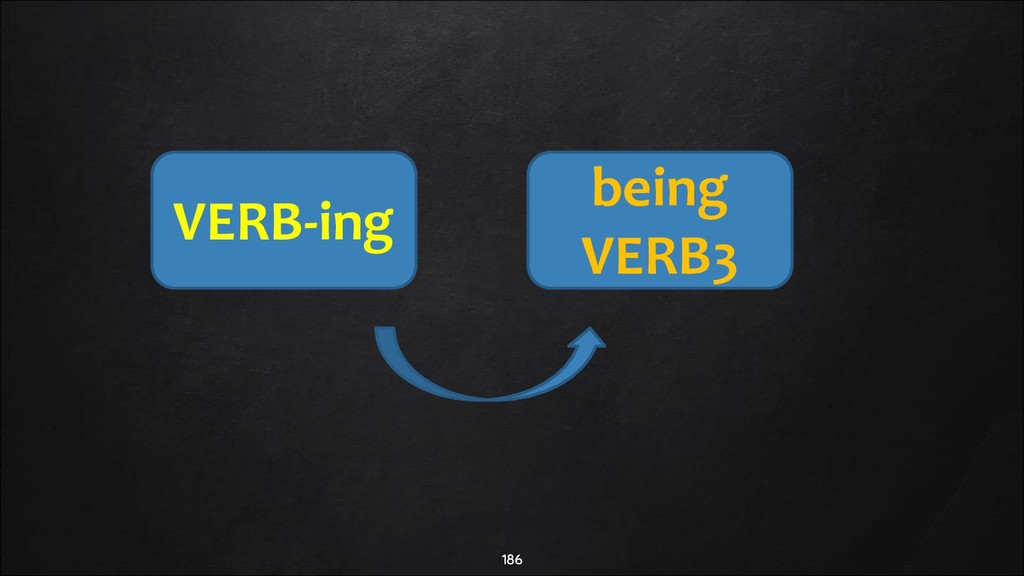
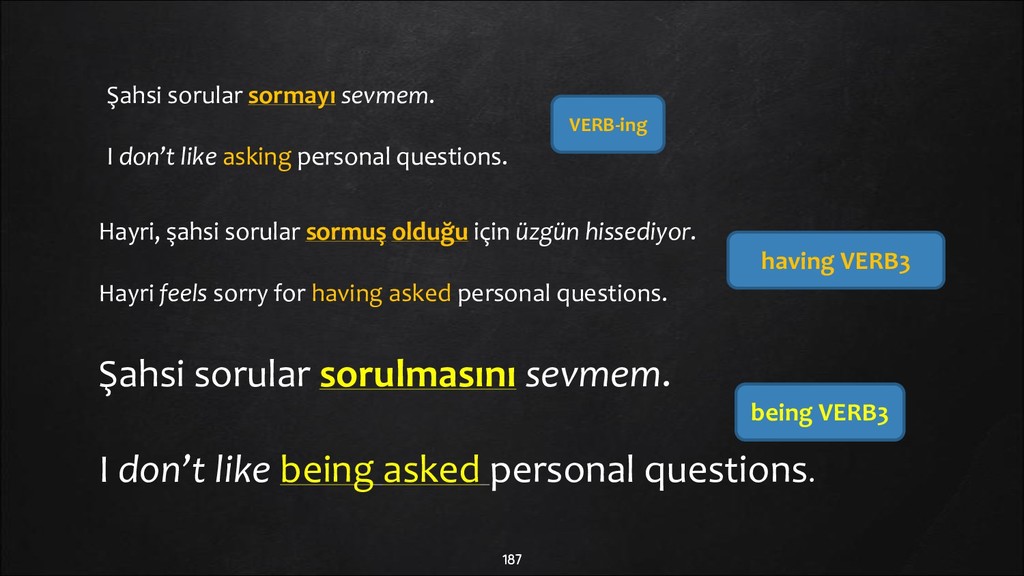
  124. 187 Şahsi sorular sormayı sevmem. I don’t like asking personal

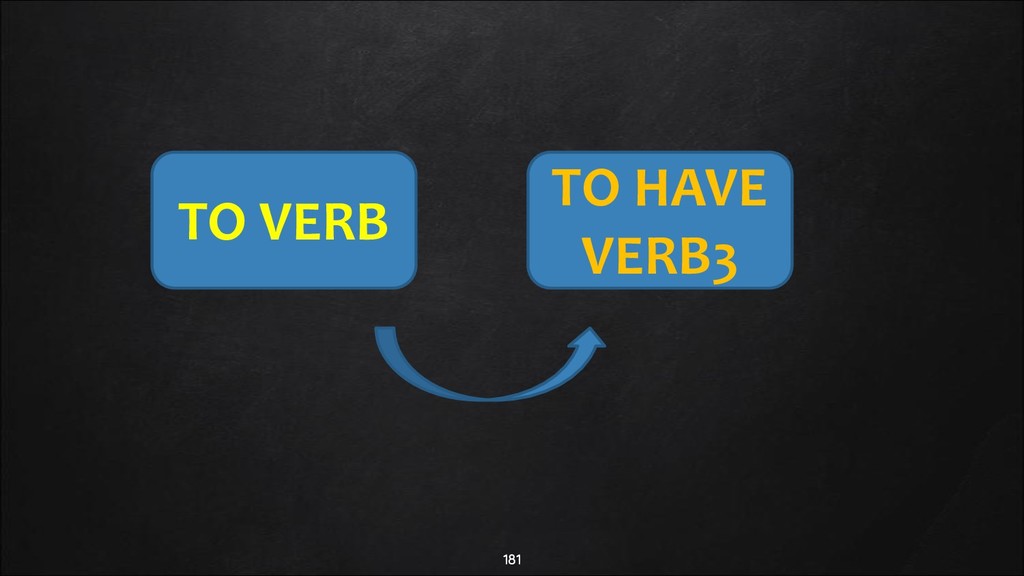
    questions. Hayri, şahsi sorular sormuş olduğu için üzgün hissediyor. Hayri feels sorry for having asked personal questions. Şahsi sorular sorulmasını sevmem. I don’t like being asked personal questions. VERB-ing being VERB3 having VERB3
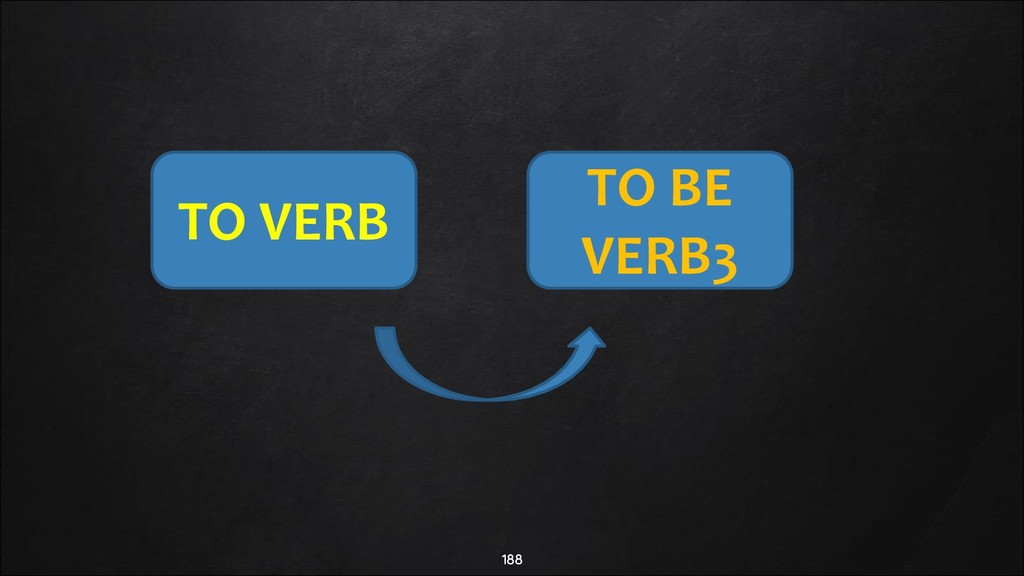
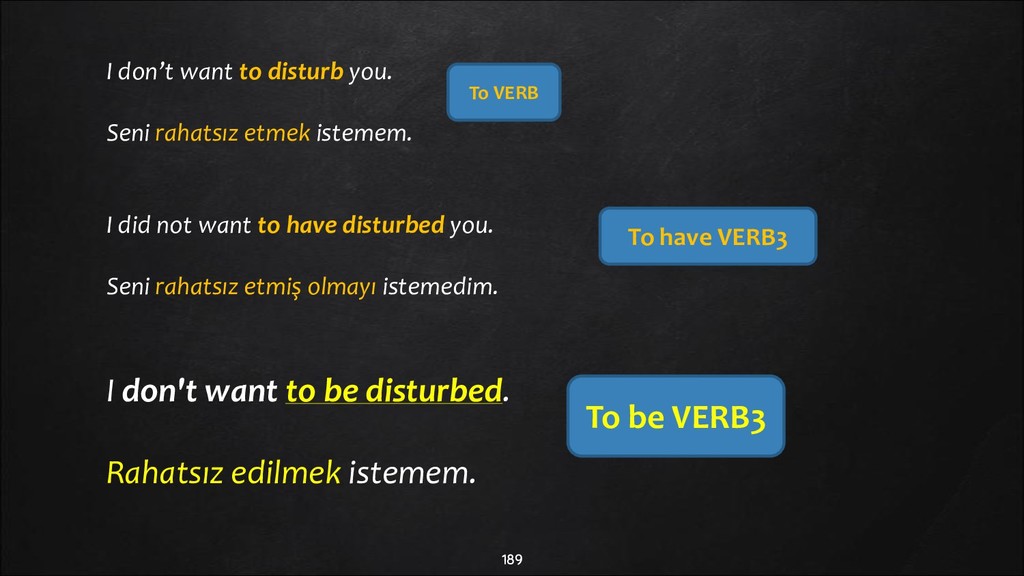
  125. 189 I don’t want to disturb you. Seni rahatsız etmek

    istemem. I did not want to have disturbed you. Seni rahatsız etmiş olmayı istemedim. I don't want to be disturbed. Rahatsız edilmek istemem. To VERB To be VERB3 To have VERB3
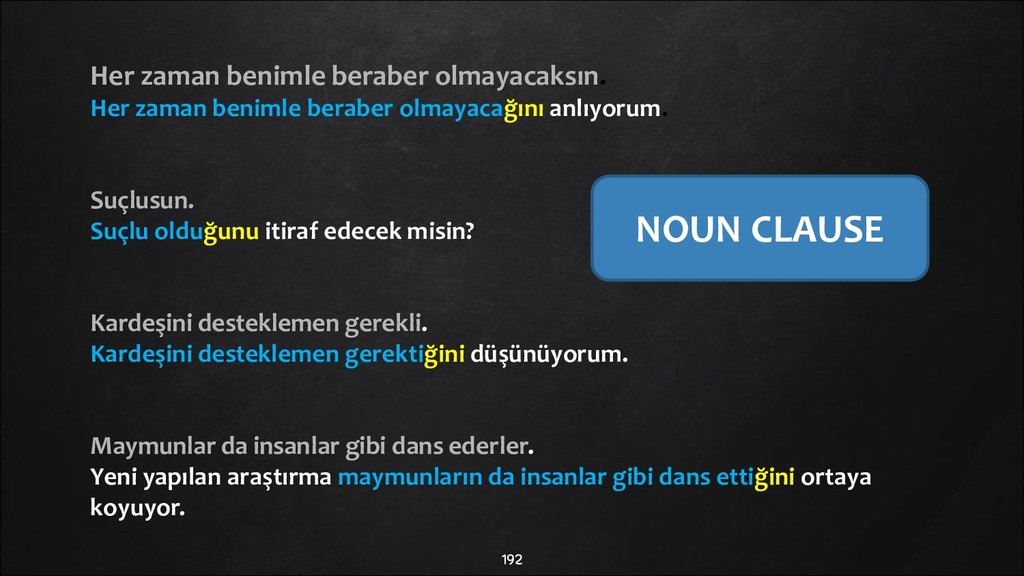
  126. 192 Her zaman benimle beraber olmayacaksın. Her zaman benimle beraber

    olmayacağını anlıyorum. Suçlusun. Suçlu olduğunu itiraf edecek misin? Kardeşini desteklemen gerekli. Kardeşini desteklemen gerektiğini düşünüyorum. Maymunlar da insanlar gibi dans ederler. Yeni yapılan araştırma maymunların da insanlar gibi dans ettiğini ortaya koyuyor. NOUN CLAUSE
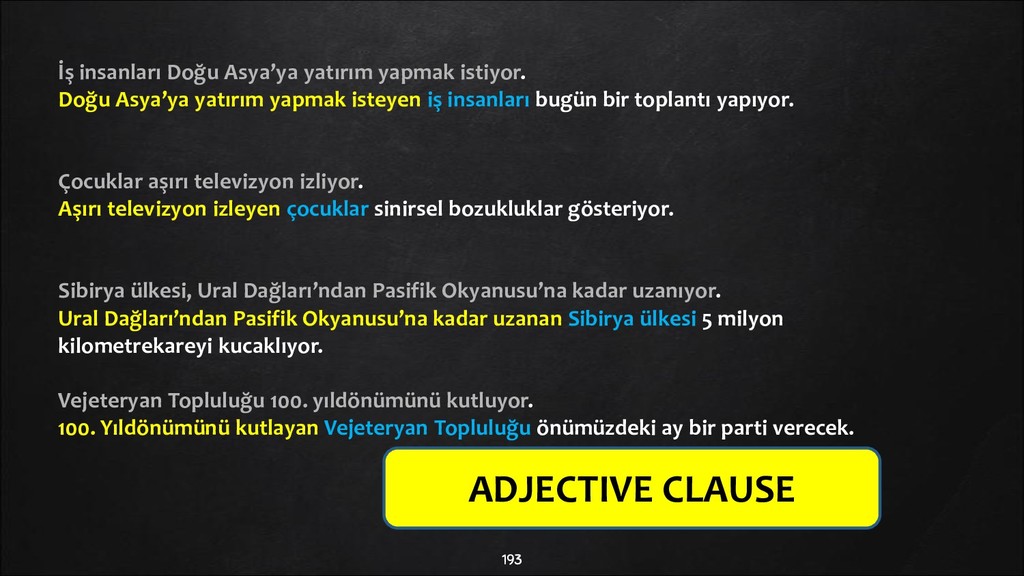
  127. 193 İş insanları Doğu Asya’ya yatırım yapmak istiyor. Doğu Asya’ya

    yatırım yapmak isteyen iş insanları bugün bir toplantı yapıyor. Çocuklar aşırı televizyon izliyor. Aşırı televizyon izleyen çocuklar sinirsel bozukluklar gösteriyor. Sibirya ülkesi, Ural Dağları’ndan Pasifik Okyanusu’na kadar uzanıyor. Ural Dağları’ndan Pasifik Okyanusu’na kadar uzanan Sibirya ülkesi 5 milyon kilometrekareyi kucaklıyor. Vejeteryan Topluluğu 100. yıldönümünü kutluyor. 100. Yıldönümünü kutlayan Vejeteryan Topluluğu önümüzdeki ay bir parti verecek. ADJECTIVE CLAUSE
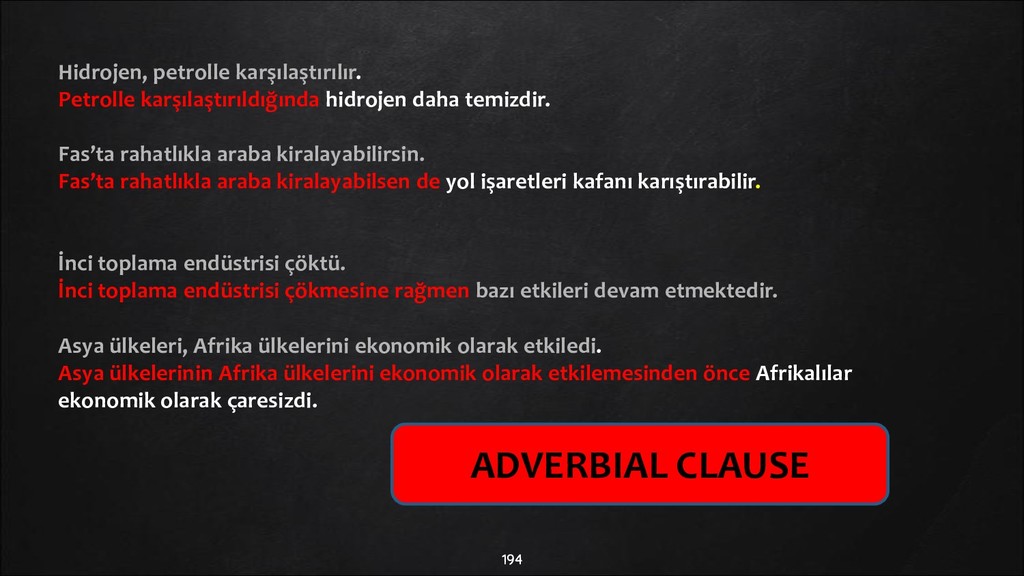
  128. 194 Hidrojen, petrolle karşılaştırılır. Petrolle karşılaştırıldığında hidrojen daha temizdir. Fas’ta

    rahatlıkla araba kiralayabilirsin. Fas’ta rahatlıkla araba kiralayabilsen de yol işaretleri kafanı karıştırabilir. İnci toplama endüstrisi çöktü. İnci toplama endüstrisi çökmesine rağmen bazı etkileri devam etmektedir. Asya ülkeleri, Afrika ülkelerini ekonomik olarak etkiledi. Asya ülkelerinin Afrika ülkelerini ekonomik olarak etkilemesinden önce Afrikalılar ekonomik olarak çaresizdi. ADVERBIAL CLAUSE
  129. 196 Dünyadaki her dilde iki -ya da daha fazla- cümleyi

    birbiri içinde kullanabiliriz. İngilizce’de bunu sağlamak için CLAUSE (cümlecik) yapıları kullanılır.
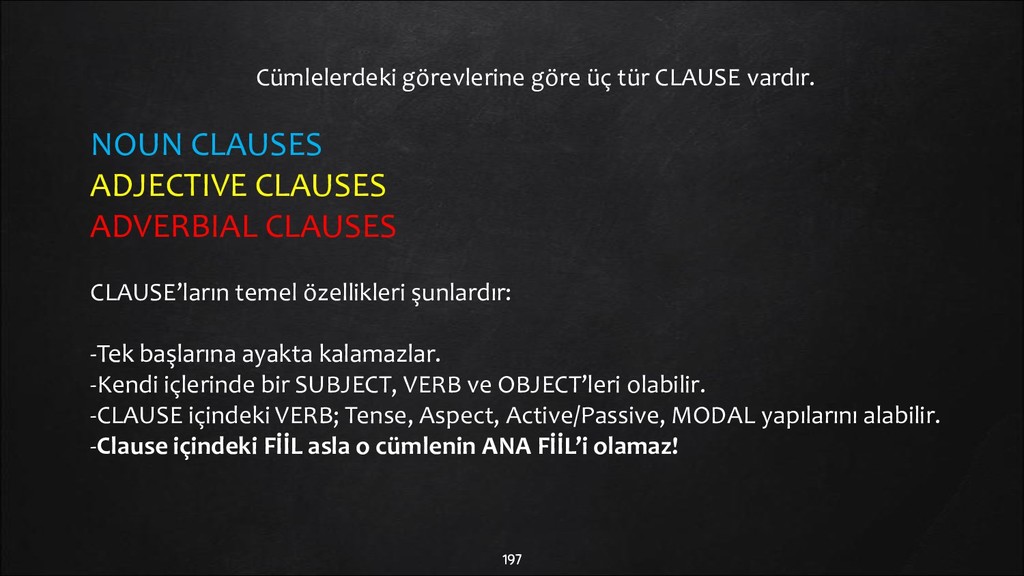
  130. 197 Cümlelerdeki görevlerine göre üç tür CLAUSE vardır. NOUN CLAUSES

    ADJECTIVE CLAUSES ADVERBIAL CLAUSES CLAUSE’ların temel özellikleri şunlardır: -Tek başlarına ayakta kalamazlar. -Kendi içlerinde bir SUBJECT, VERB ve OBJECT’leri olabilir. -CLAUSE içindeki VERB; Tense, Aspect, Active/Passive, MODAL yapılarını alabilir. -Clause içindeki FİİL asla o cümlenin ANA FİİL’i olamaz!
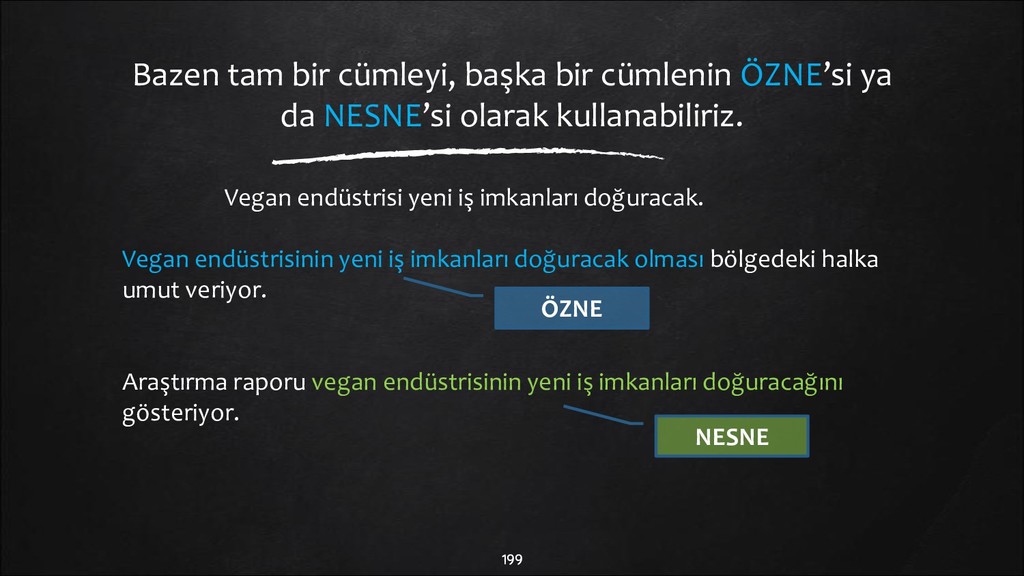
  131. 199 Bazen tam bir cümleyi, başka bir cümlenin ÖZNE’si ya

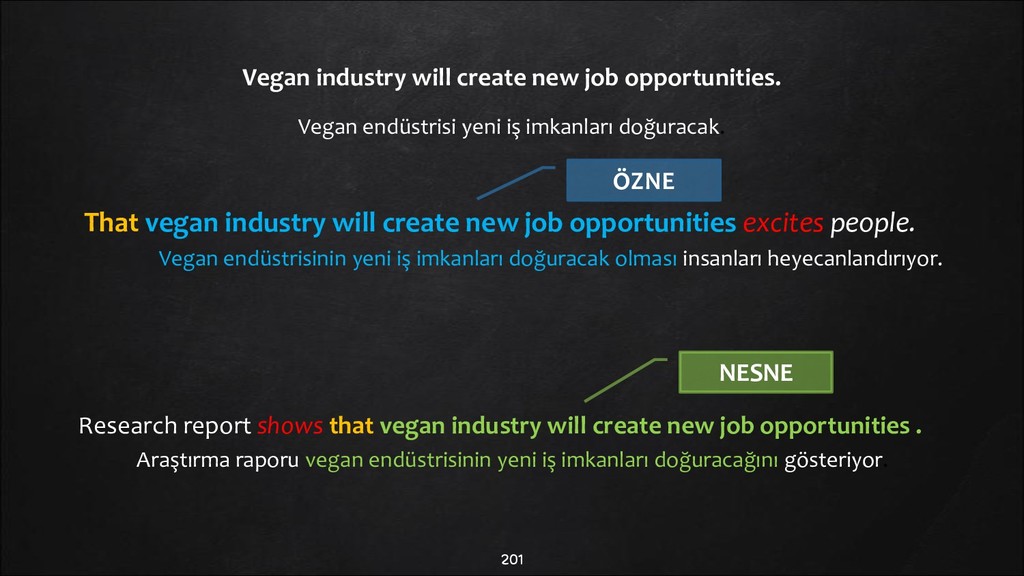
    da NESNE’si olarak kullanabiliriz. Vegan endüstrisi yeni iş imkanları doğuracak. Vegan endüstrisinin yeni iş imkanları doğuracak olması bölgedeki halka umut veriyor. Araştırma raporu vegan endüstrisinin yeni iş imkanları doğuracağını gösteriyor. ÖZNE NESNE
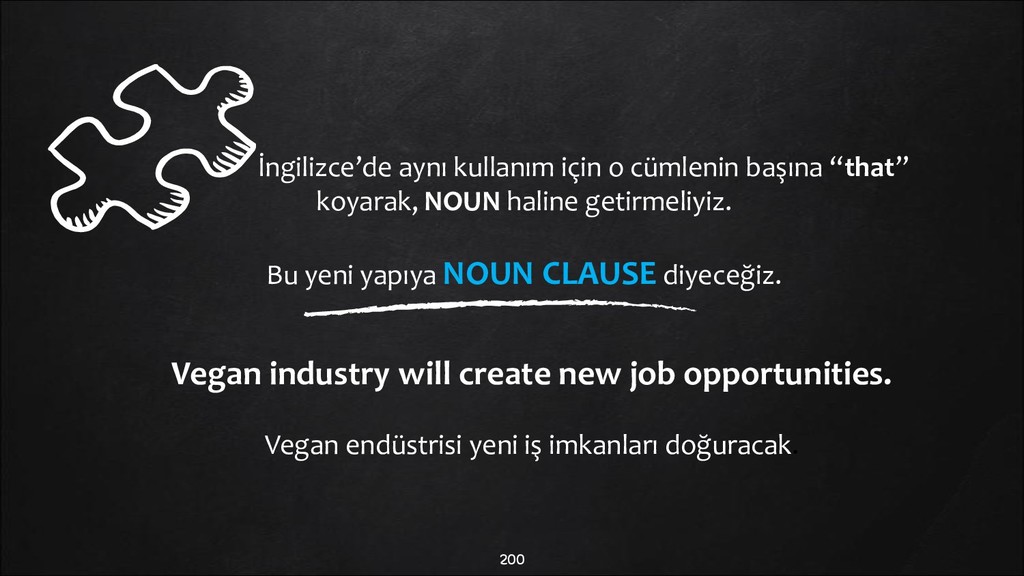
  132. 200 İngilizce’de aynı kullanım için o cümlenin başına “that” koyarak,

    NOUN haline getirmeliyiz. Bu yeni yapıya NOUN CLAUSE diyeceğiz. Vegan industry will create new job opportunities. Vegan endüstrisi yeni iş imkanları doğuracak.
  133. 201 That vegan industry will create new job opportunities excites

    people. Vegan endüstrisinin yeni iş imkanları doğuracak olması insanları heyecanlandırıyor. Research report shows that vegan industry will create new job opportunities . Araştırma raporu vegan endüstrisinin yeni iş imkanları doğuracağını gösteriyor. ÖZNE NESNE Vegan industry will create new job opportunities. Vegan endüstrisi yeni iş imkanları doğuracak.
  134. 202 Herhangi bir cümlenin başka bir cümlede ÖZNE ya da

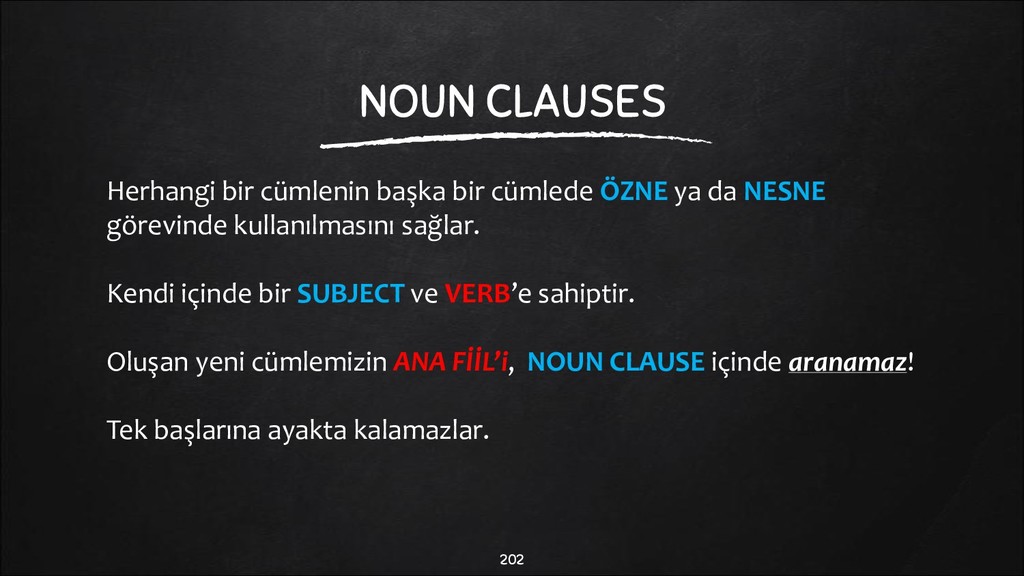
    NESNE görevinde kullanılmasını sağlar. Kendi içinde bir SUBJECT ve VERB’e sahiptir. Oluşan yeni cümlemizin ANA FİİL’i, NOUN CLAUSE içinde aranamaz! Tek başlarına ayakta kalamazlar. NOUN CLAUSES
  135. 203 Bir NOUN CLAUSE ‘da “that” yerine “the fact that”

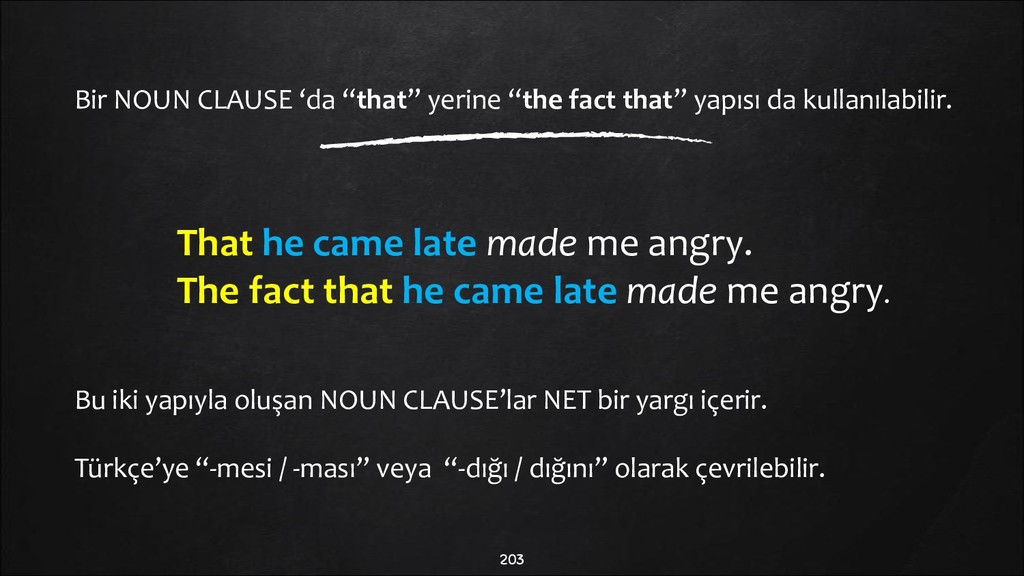
    yapısı da kullanılabilir. That he came late made me angry. The fact that he came late made me angry. Bu iki yapıyla oluşan NOUN CLAUSE’lar NET bir yargı içerir. Türkçe’ye “-mesi / -ması” veya “-dığı / dığını” olarak çevrilebilir.
  136. 204 SUBJECT VERB OBJECT / NESNE NOUN CLAUSE “that” ile

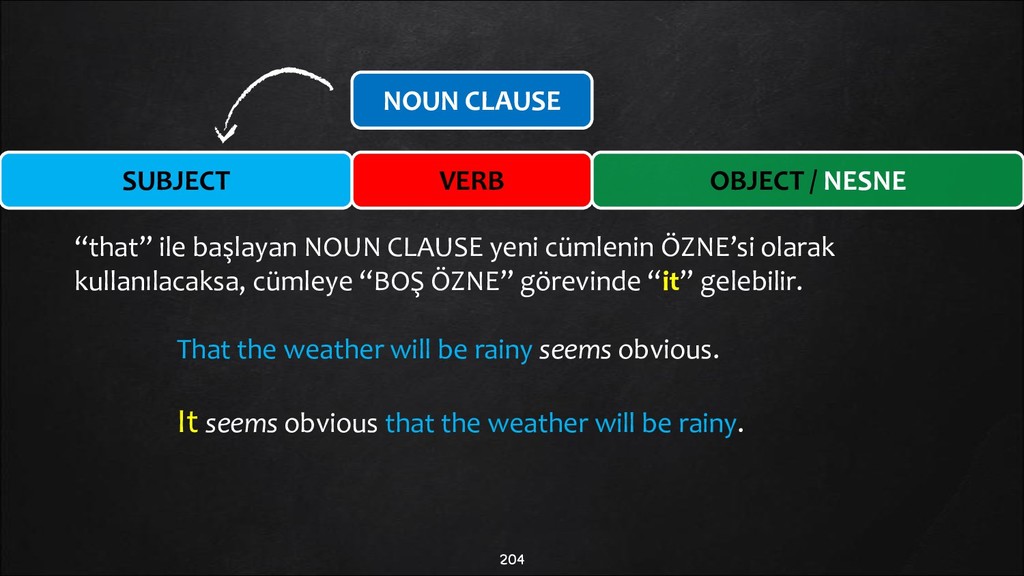
    başlayan NOUN CLAUSE yeni cümlenin ÖZNE’si olarak kullanılacaksa, cümleye “BOŞ ÖZNE” görevinde “it” gelebilir. That the weather will be rainy seems obvious. It seems obvious that the weather will be rainy.
  137. 205 SUBJECT VERB OBJECT / NESNE NOUN CLAUSE “that” ile

    başlayan NOUN CLAUSE yeni cümlenin NESNE’si olarak kullanılacaksa, yani FİİL’den sonra geliyorsa “that” cümleden atılabilir.. I know that the world is round. I know the world is round. He said that he won’t be able to come tomorrow. He said he won’t be able to come tomorrow.
  138. 207 SUBJECT VERB TAM CÜMLE NOUN CLAUSE that “that”den sonra

    tam bir cümle gelmişse önünde, “sıfat”, “fiil” ya da “it” ile başlayan bir yapı olmalıdır.
  139. 208 … that engineers do no restrict themselves to technical

    matter. a) The engineering curriculum has long required b) Many potential leaders were of the opinion c) The courses involved substantial reading and writing assignments d) The aim was to attract a wider audience e) He acquired a sophisticated knowledge of scientific and technical matters. “sıfat”, “fiil” ya da “it” ile biten bir yapı arıyoruz. 2006 KPDS
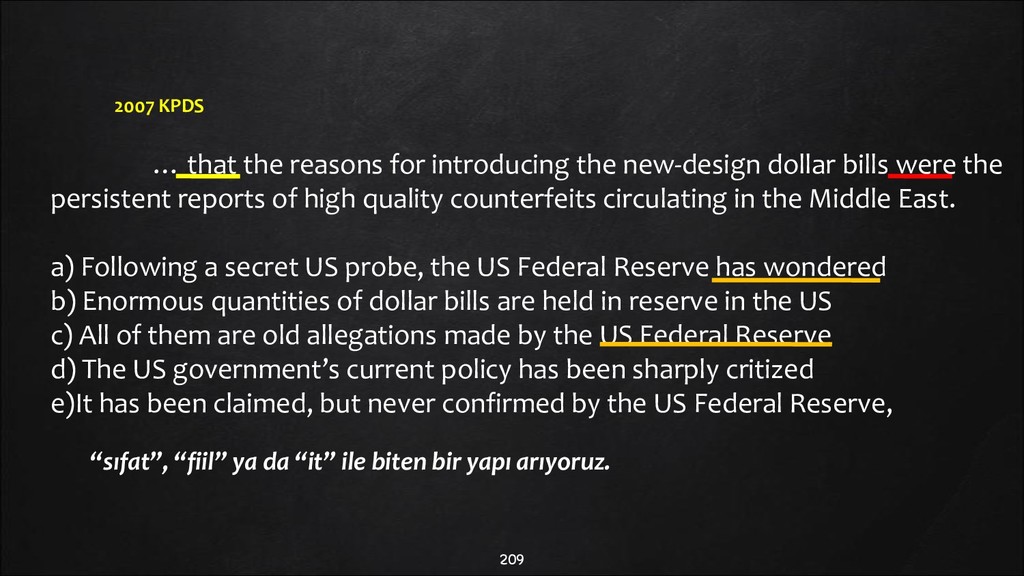
  140. 209 … that the reasons for introducing the new-design dollar

    bills were the persistent reports of high quality counterfeits circulating in the Middle East. a) Following a secret US probe, the US Federal Reserve has wondered b) Enormous quantities of dollar bills are held in reserve in the US c) All of them are old allegations made by the US Federal Reserve d) The US government’s current policy has been sharply critized e)It has been claimed, but never confirmed by the US Federal Reserve, “sıfat”, “fiil” ya da “it” ile biten bir yapı arıyoruz. 2007 KPDS
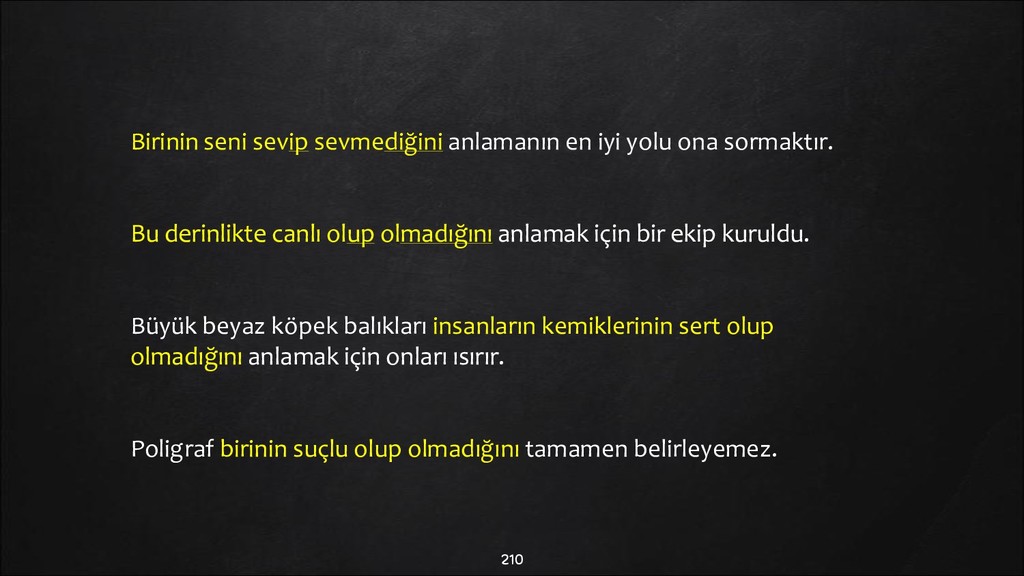
  141. 210 Birinin seni sevip sevmediğini anlamanın en iyi yolu ona

    sormaktır. Bu derinlikte canlı olup olmadığını anlamak için bir ekip kuruldu. Büyük beyaz köpek balıkları insanların kemiklerinin sert olup olmadığını anlamak için onları ısırır. Poligraf birinin suçlu olup olmadığını tamamen belirleyemez.
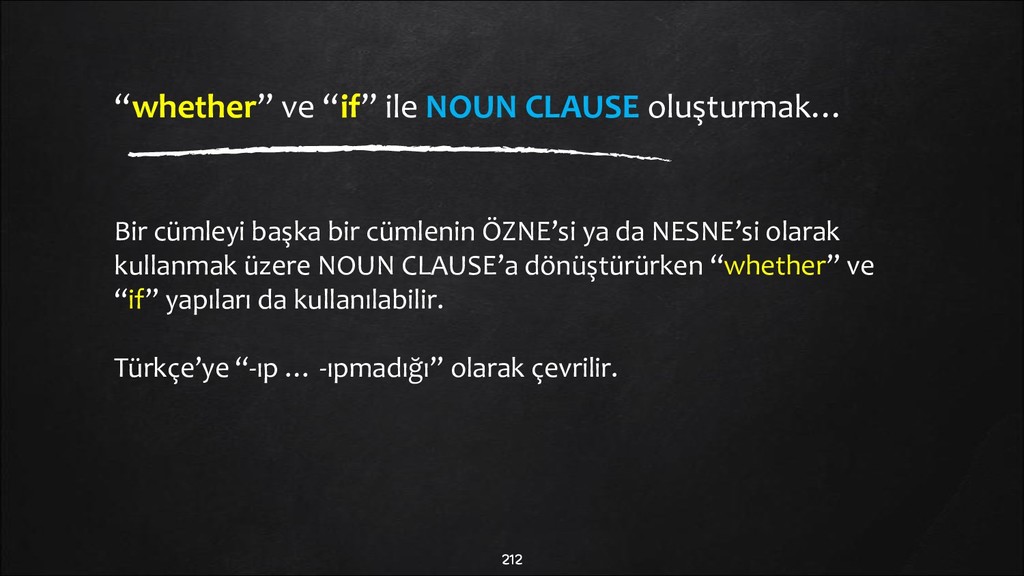
  142. 212 “whether” ve “if” ile NOUN CLAUSE oluşturmak… Bir cümleyi

    başka bir cümlenin ÖZNE’si ya da NESNE’si olarak kullanmak üzere NOUN CLAUSE’a dönüştürürken “whether” ve “if” yapıları da kullanılabilir. Türkçe’ye “-ıp … -ıpmadığı” olarak çevrilir.
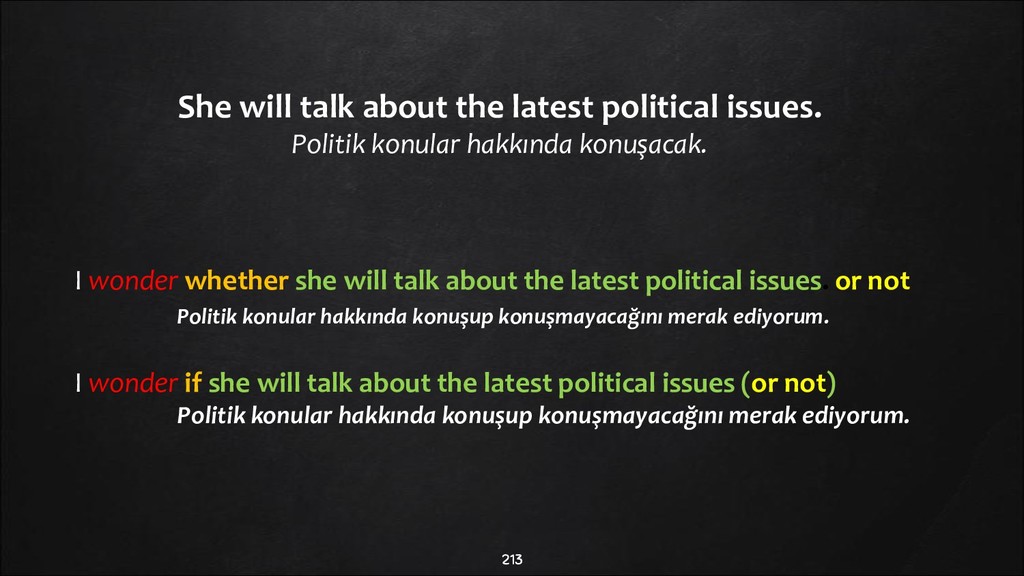
  143. 213 She will talk about the latest political issues. Politik

    konular hakkında konuşacak. I wonder whether she will talk about the latest political issues. or not Politik konular hakkında konuşup konuşmayacağını merak ediyorum. I wonder if she will talk about the latest political issues (or not) Politik konular hakkında konuşup konuşmayacağını merak ediyorum.
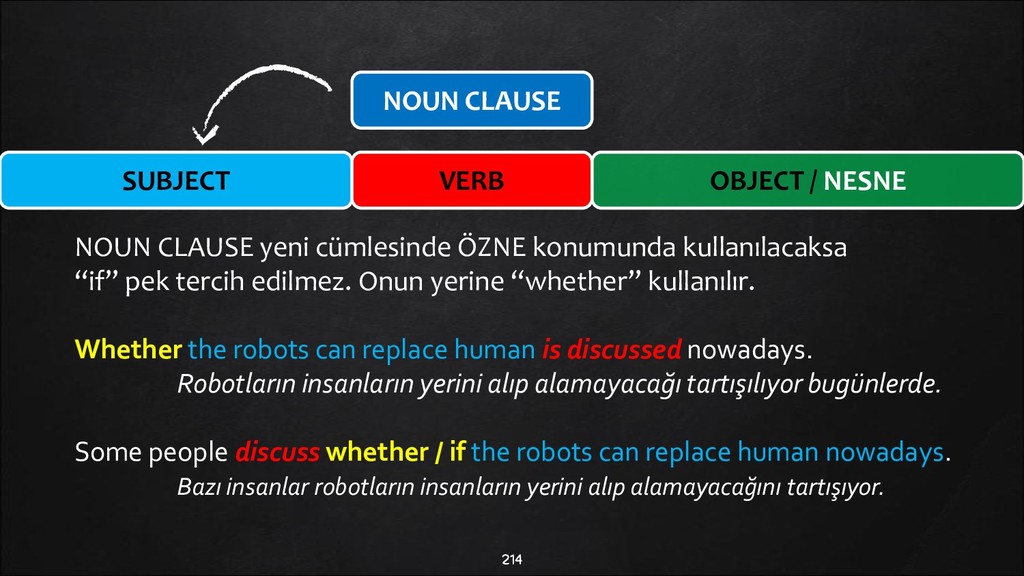
  144. 214 SUBJECT VERB OBJECT / NESNE NOUN CLAUSE NOUN CLAUSE

    yeni cümlesinde ÖZNE konumunda kullanılacaksa “if” pek tercih edilmez. Onun yerine “whether” kullanılır. Whether the robots can replace human is discussed nowadays. Robotların insanların yerini alıp alamayacağı tartışılıyor bugünlerde. Some people discuss whether / if the robots can replace human nowadays. Bazı insanlar robotların insanların yerini alıp alamayacağını tartışıyor.
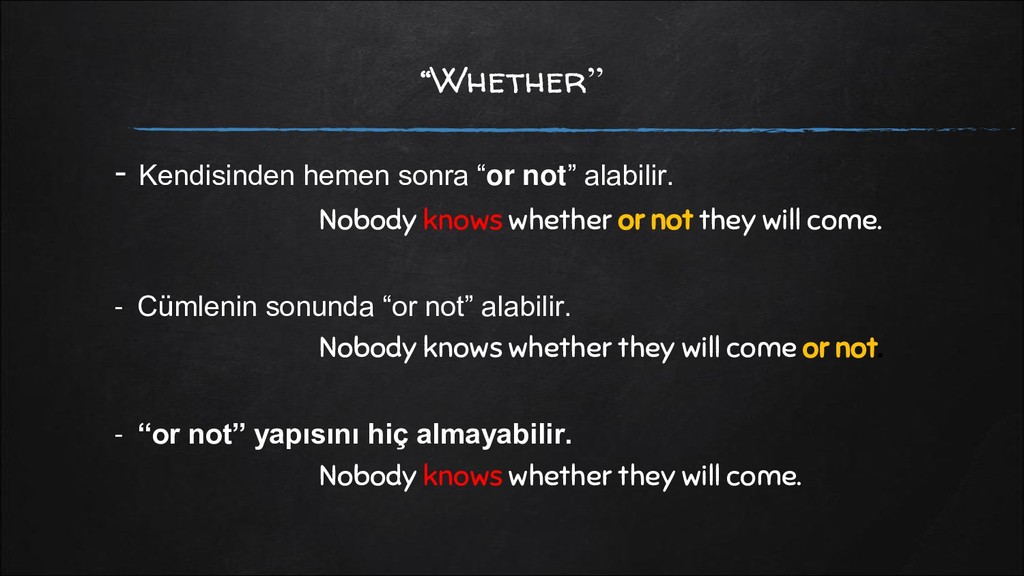
  145. “Whether” - Kendisinden hemen sonra “or not” alabilir. Nobody knows

    whether or not they will come. - Cümlenin sonunda “or not” alabilir. Nobody knows whether they will come or not. - “or not” yapısını hiç almayabilir. Nobody knows whether they will come.
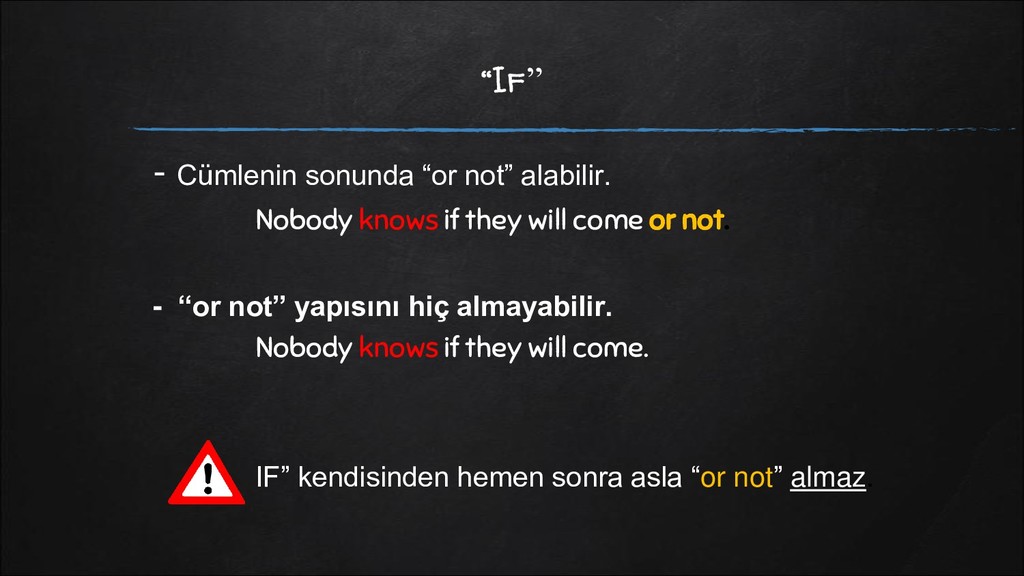
  146. “If” - Cümlenin sonunda “or not” alabilir. Nobody knows if

    they will come or not. - “or not” yapısını hiç almayabilir. Nobody knows if they will come. IF” kendisinden hemen sonra asla “or not” almaz.
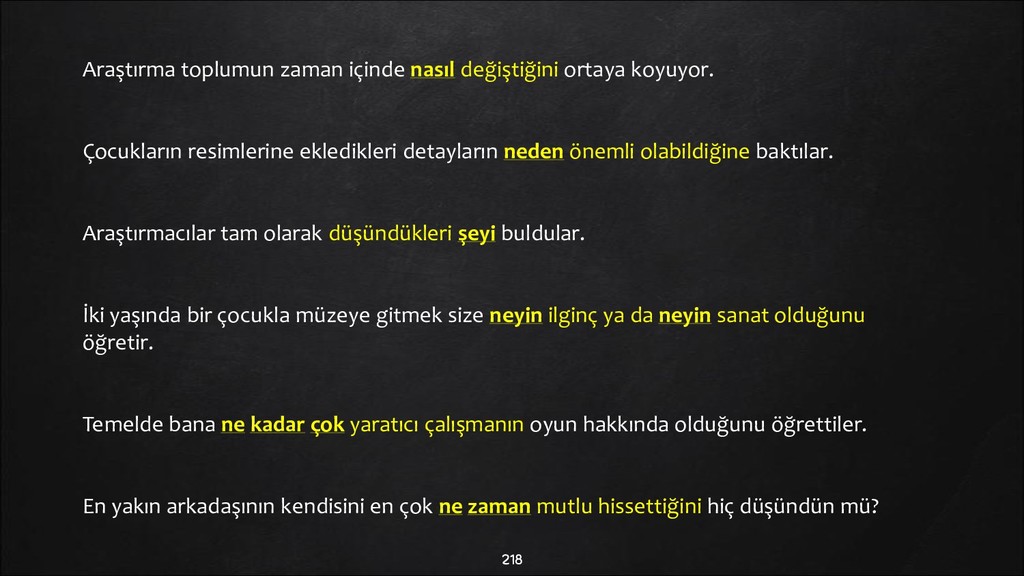
  147. 218 Araştırma toplumun zaman içinde nasıl değiştiğini ortaya koyuyor. Çocukların

    resimlerine ekledikleri detayların neden önemli olabildiğine baktılar. Araştırmacılar tam olarak düşündükleri şeyi buldular. İki yaşında bir çocukla müzeye gitmek size neyin ilginç ya da neyin sanat olduğunu öğretir. Temelde bana ne kadar çok yaratıcı çalışmanın oyun hakkında olduğunu öğrettiler. En yakın arkadaşının kendisini en çok ne zaman mutlu hissettiğini hiç düşündün mü?
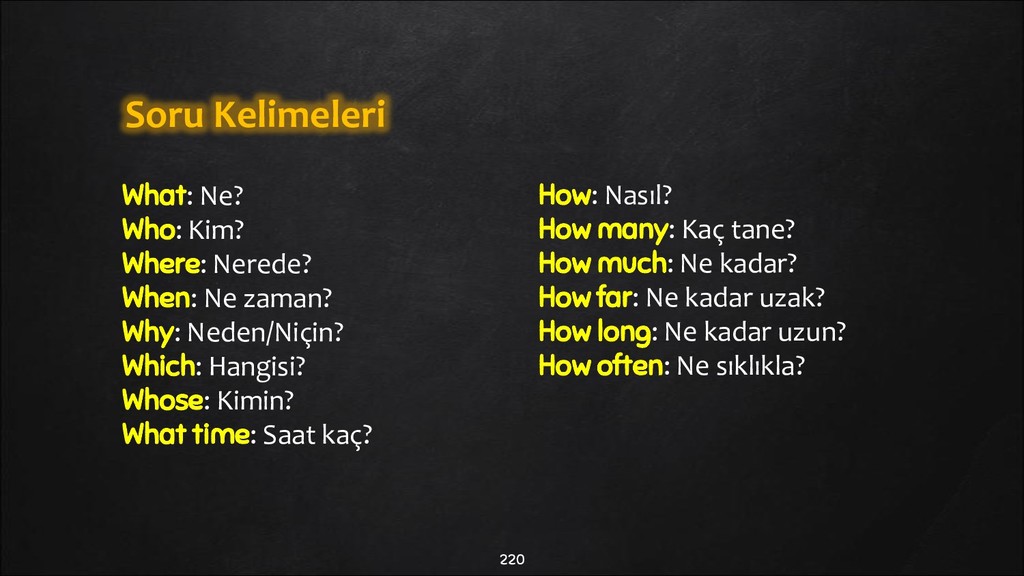
  148. 220 What: Ne? Who: Kim? Where: Nerede? When: Ne zaman?

    Why: Neden/Niçin? Which: Hangisi? Whose: Kimin? What time: Saat kaç? How: Nasıl? How many: Kaç tane? How much: Ne kadar? How far: Ne kadar uzak? How long: Ne kadar uzun? How often: Ne sıklıkla? Soru Kelimeleri
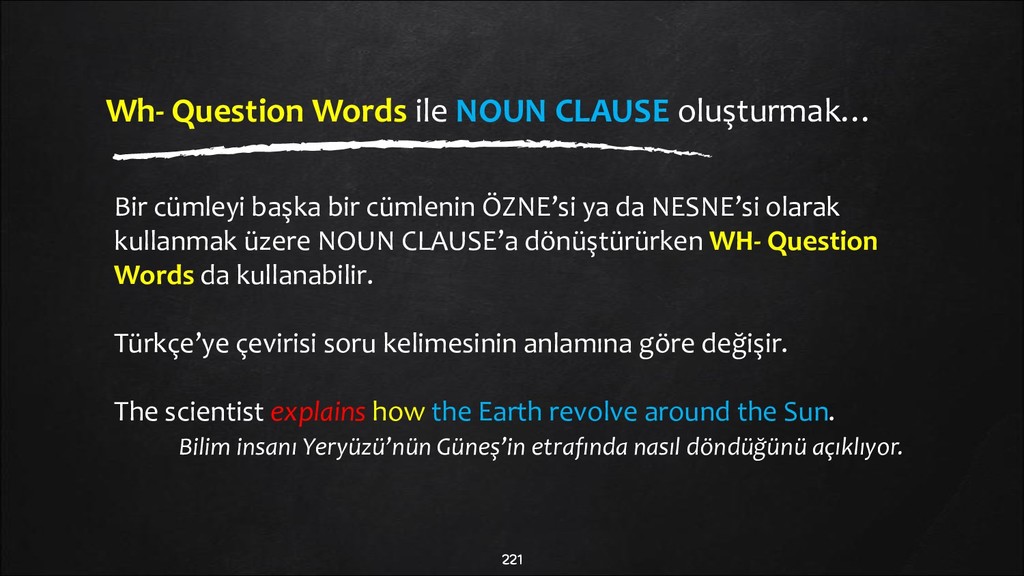
  149. 221 Wh- Question Words ile NOUN CLAUSE oluşturmak… Bir cümleyi

    başka bir cümlenin ÖZNE’si ya da NESNE’si olarak kullanmak üzere NOUN CLAUSE’a dönüştürürken WH- Question Words da kullanabilir. Türkçe’ye çevirisi soru kelimesinin anlamına göre değişir. The scientist explains how the Earth revolve around the Sun. Bilim insanı Yeryüzü’nün Güneş’in etrafında nasıl döndüğünü açıklıyor.
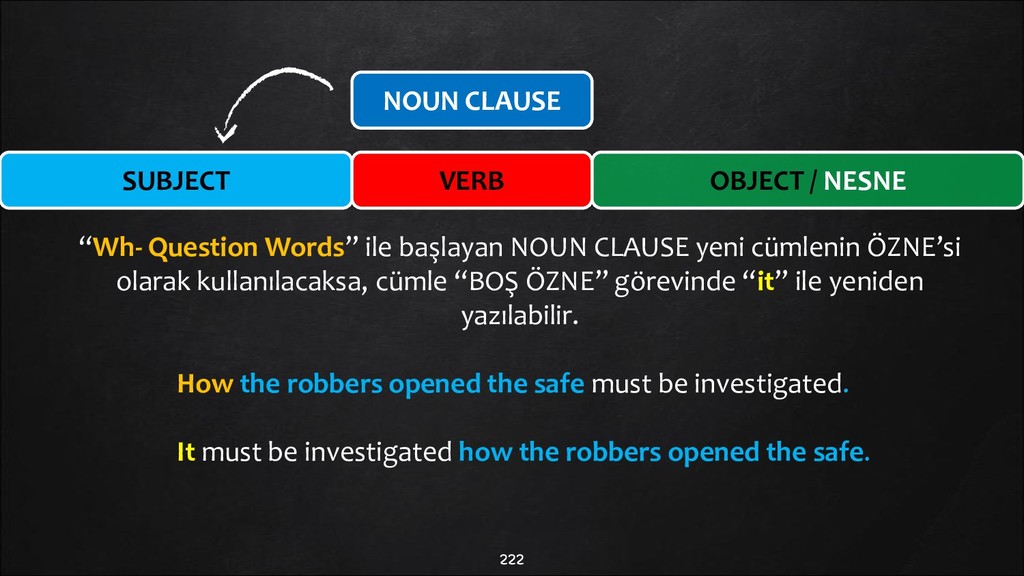
  150. 222 SUBJECT VERB OBJECT / NESNE NOUN CLAUSE “Wh- Question

    Words” ile başlayan NOUN CLAUSE yeni cümlenin ÖZNE’si olarak kullanılacaksa, cümle “BOŞ ÖZNE” görevinde “it” ile yeniden yazılabilir. How the robbers opened the safe must be investigated. It must be investigated how the robbers opened the safe.
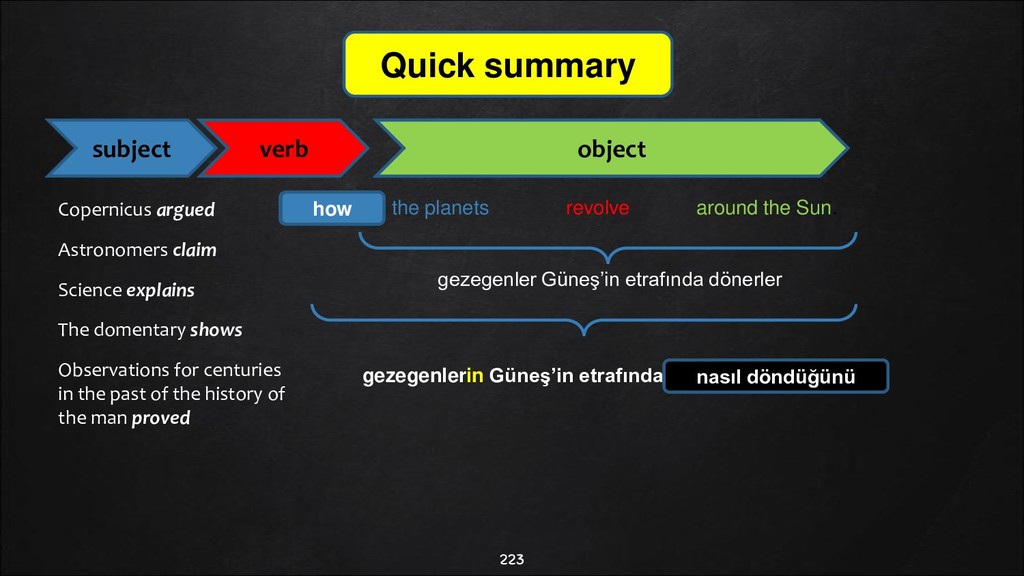
  151. 223 subject verb object the planets revolve around the Sun.

    gezegenler Güneş’in etrafında dönerler that gezegenlerin Güneş’in etrafında dönmesi/döndüğünü Copernicus argued Astronomers claim Science explains The domentary shows Observations for centuries in the past of the history of the man proved subject verb object whether dönüp dönmediğini how nasıl döndüğünü Quick summary
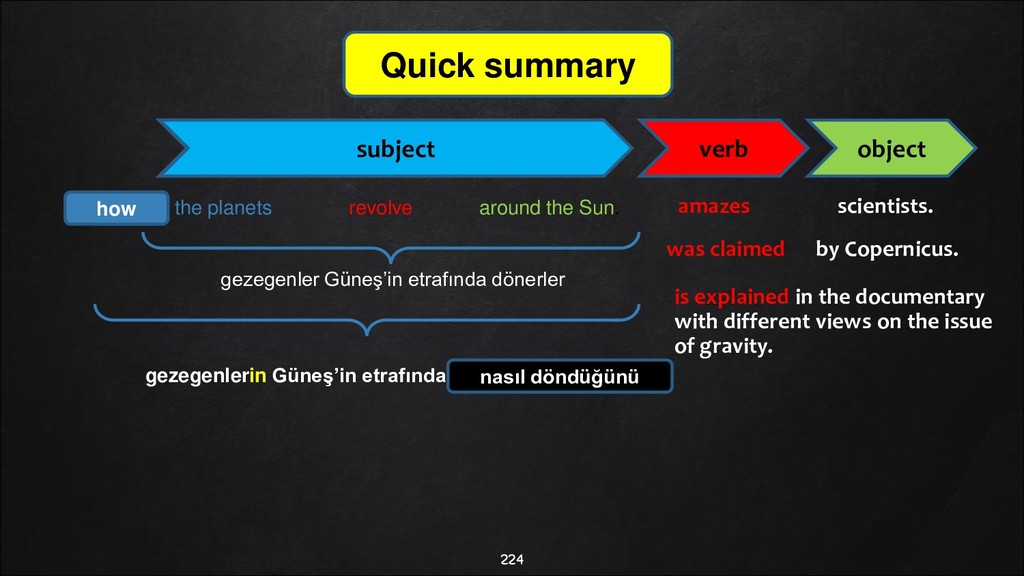
  152. 224 subject verb object the planets revolve around the Sun.

    gezegenler Güneş’in etrafında dönerler that gezegenlerin Güneş’in etrafında dönmesi/döndüğünü verb object subject whether dönüp dönmediğini how nasıl döndüğünü amazes scientists. was claimed by Copernicus. is explained in the documentary with different views on the issue of gravity. Quick summary
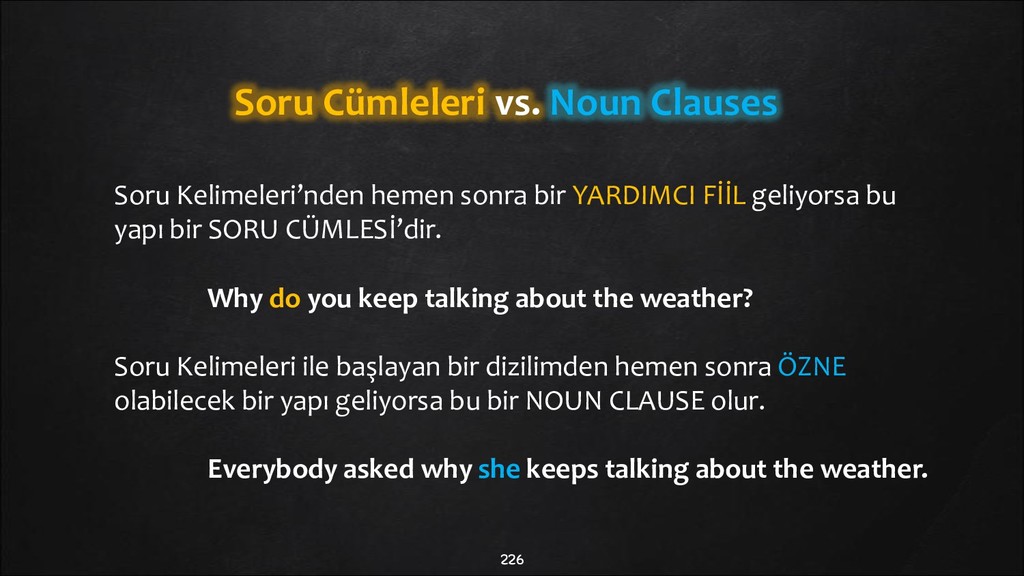
  153. 226 Soru Kelimeleri’nden hemen sonra bir YARDIMCI FİİL geliyorsa bu

    yapı bir SORU CÜMLESİ’dir. Why do you keep talking about the weather? Soru Kelimeleri ile başlayan bir dizilimden hemen sonra ÖZNE olabilecek bir yapı geliyorsa bu bir NOUN CLAUSE olur. Everybody asked why she keeps talking about the weather. Soru Cümleleri vs. Noun Clauses
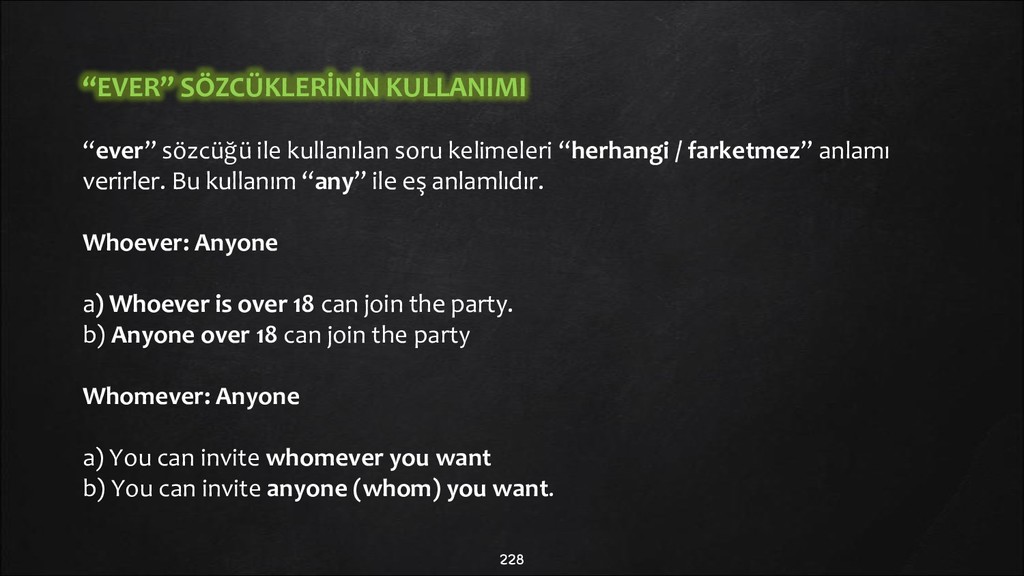
  154. 228 “EVER” SÖZCÜKLERİNİN KULLANIMI “ever” sözcüğü ile kullanılan soru kelimeleri

    “herhangi / farketmez” anlamı verirler. Bu kullanım “any” ile eş anlamlıdır. Whoever: Anyone a) Whoever is over 18 can join the party. b) Anyone over 18 can join the party Whomever: Anyone a) You can invite whomever you want b) You can invite anyone (whom) you want.
  155. 229 “EVER” SÖZCÜKLERİNİN KULLANIMI Whatever: Anything a) You can have

    whatever you like b) You can have anything you like Whichever:Any(one) a) You can have whichever one you like. b) You can have anyone you like.
  156. 230 “EVER” SÖZCÜKLERİNİN KULLANIMI Whenever: any time a) You may

    come whenever you want. b) You may come any time you want. Wherever: Anywhere a) I will find you wherever you go. b) I will find you anywhere you go.
  157. 231 “EVER” SÖZCÜKLERİNİN KULLANIMI However: Any way a) You may

    behave however you like. b) You may behave any way you like.
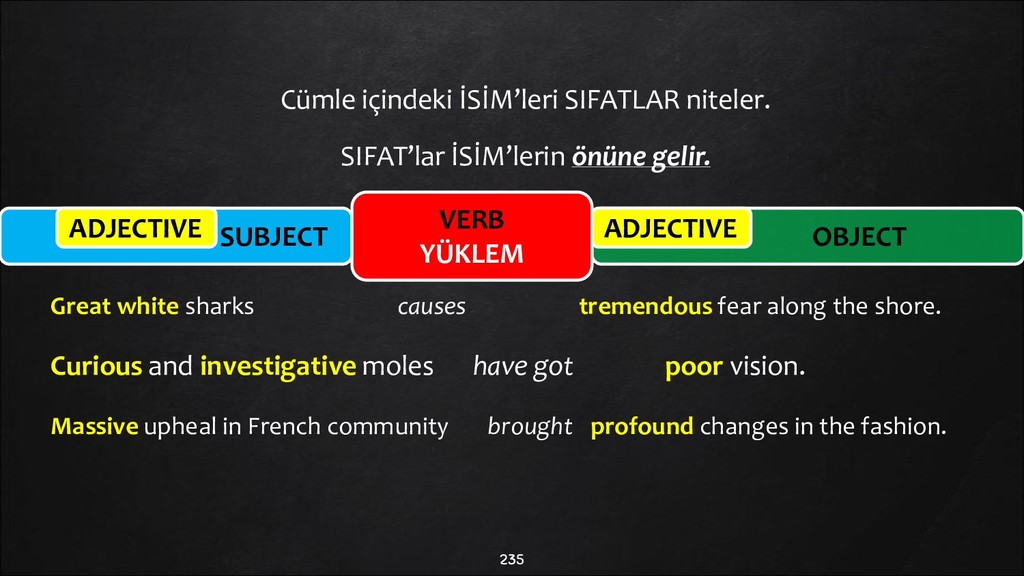
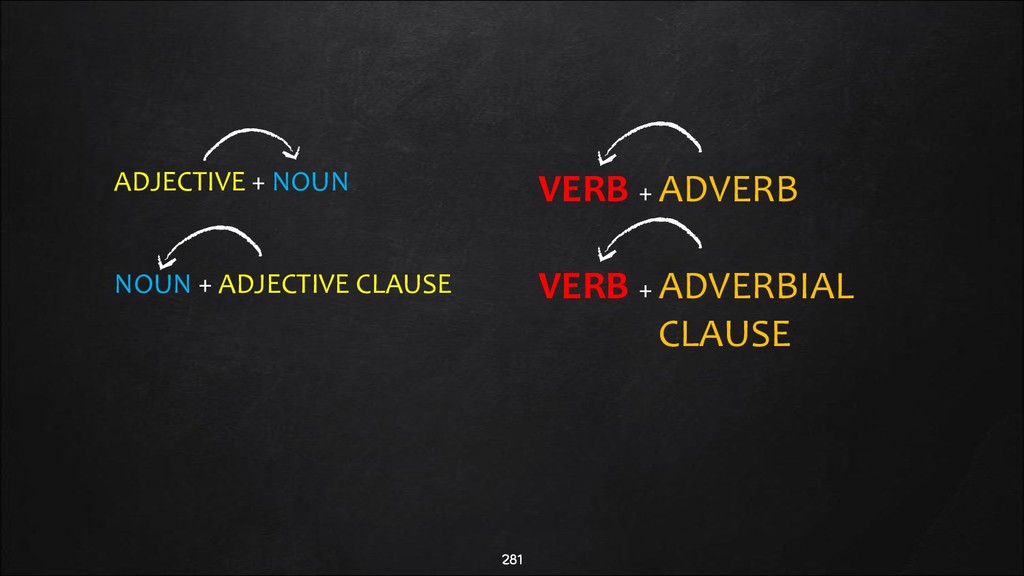
  158. 235 SUBJECT VERB YÜKLEM OBJECT Cümle içindeki İSİM’leri SIFATLAR niteler.

    SIFAT’lar İSİM’lerin önüne gelir. ADJECTIVE ADJECTIVE Great white sharks causes tremendous fear along the shore. Curious and investigative moles have got poor vision. Massive upheal in French community brought profound changes in the fashion.
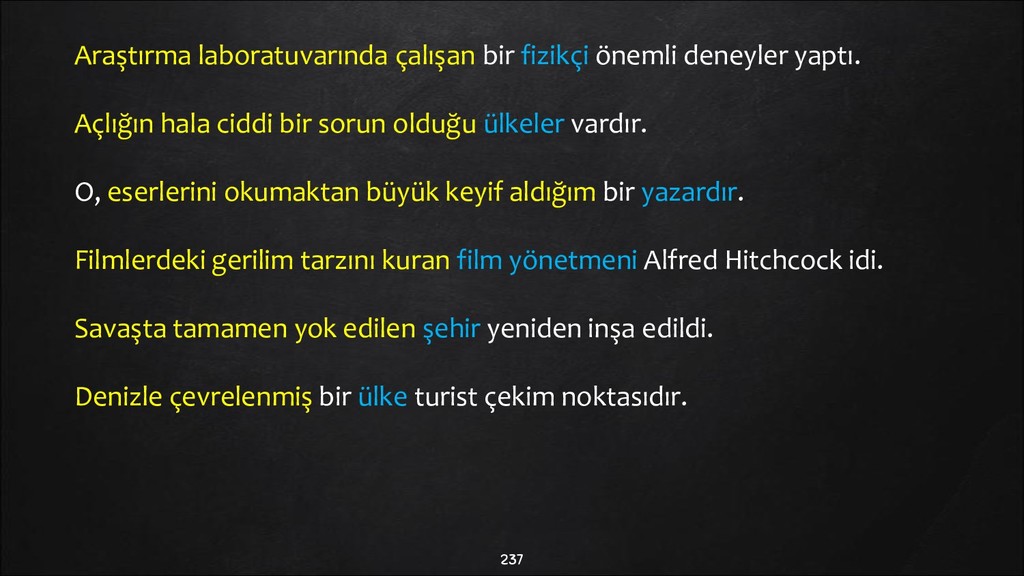
  159. 237 Araştırma laboratuvarında çalışan bir fizikçi önemli deneyler yaptı. Açlığın

    hala ciddi bir sorun olduğu ülkeler vardır. O, eserlerini okumaktan büyük keyif aldığım bir yazardır. Filmlerdeki gerilim tarzını kuran film yönetmeni Alfred Hitchcock idi. Savaşta tamamen yok edilen şehir yeniden inşa edildi. Denizle çevrelenmiş bir ülke turist çekim noktasıdır.
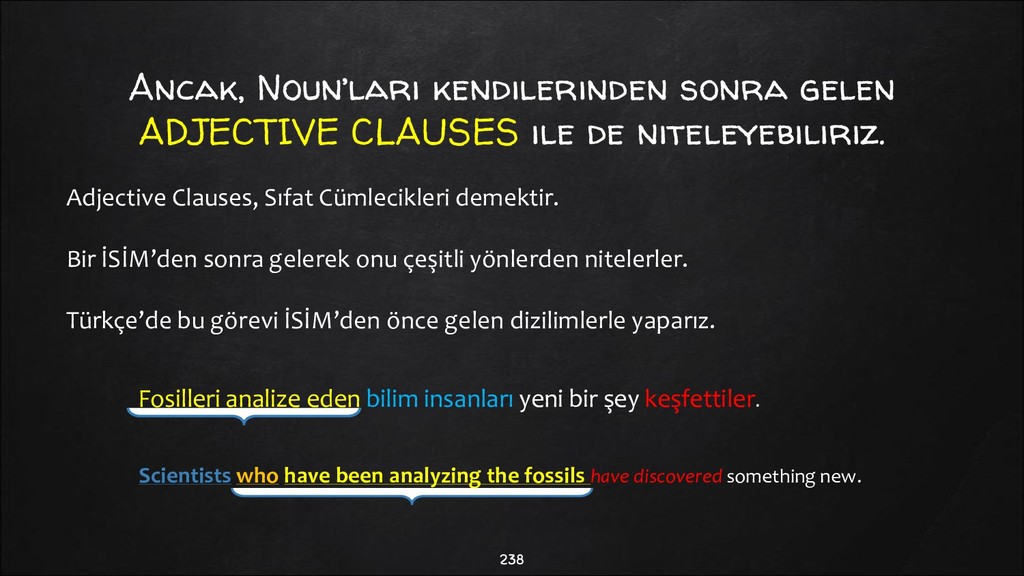
  160. Ancak, Noun’ları kendilerinden sonra gelen ADJECTIVE CLAUSES ile de niteleyebiliriz.

    238 Adjective Clauses, Sıfat Cümlecikleri demektir. Bir İSİM’den sonra gelerek onu çeşitli yönlerden nitelerler. Türkçe’de bu görevi İSİM’den önce gelen dizilimlerle yaparız. Fosilleri analize eden bilim insanları yeni bir şey keşfettiler. Scientists who have been analyzing the fossils have discovered something new.
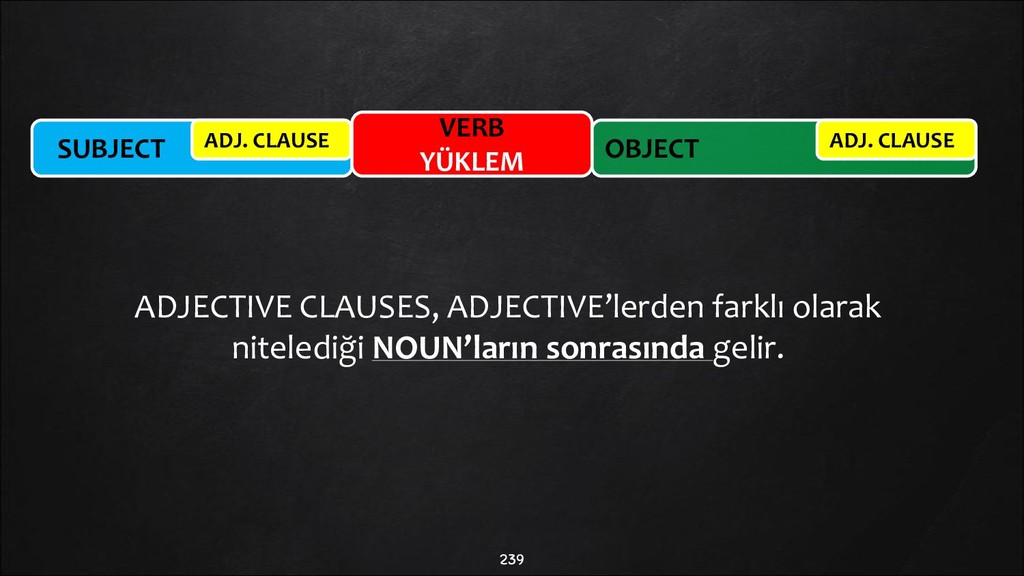
  161. 239 SUBJECT VERB YÜKLEM OBJECT ADJ. CLAUSE ADJ. CLAUSE ADJECTIVE

    CLAUSES, ADJECTIVE’lerden farklı olarak nitelediği NOUN’ların sonrasında gelir.
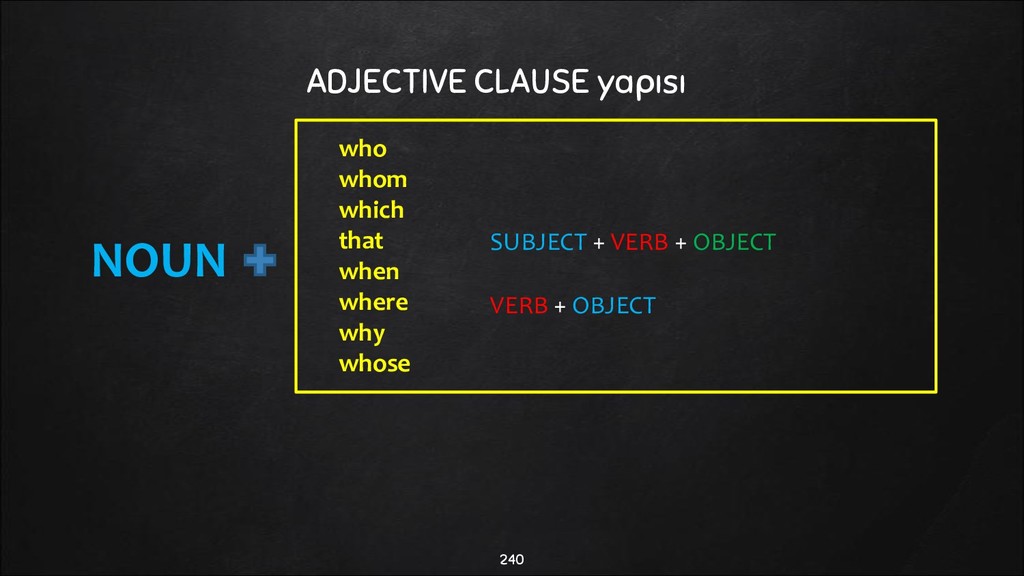
  162. 240 ADJECTIVE CLAUSE yapısı who whom which that when where

    why whose NOUN SUBJECT + VERB + OBJECT VERB + OBJECT
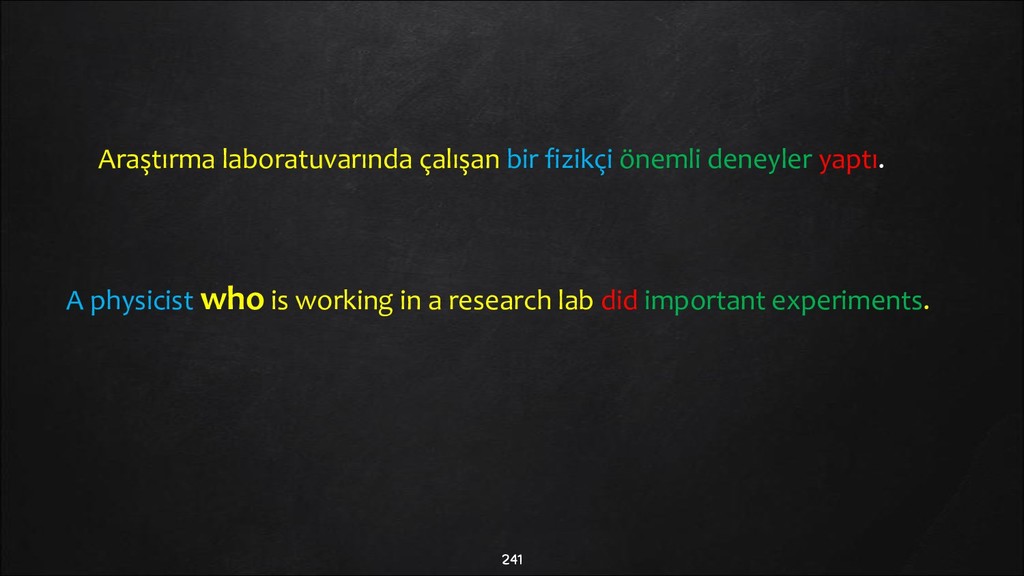
  163. 241 Araştırma laboratuvarında çalışan bir fizikçi önemli deneyler yaptı. A

    physicist who is working in a research lab did important experiments.
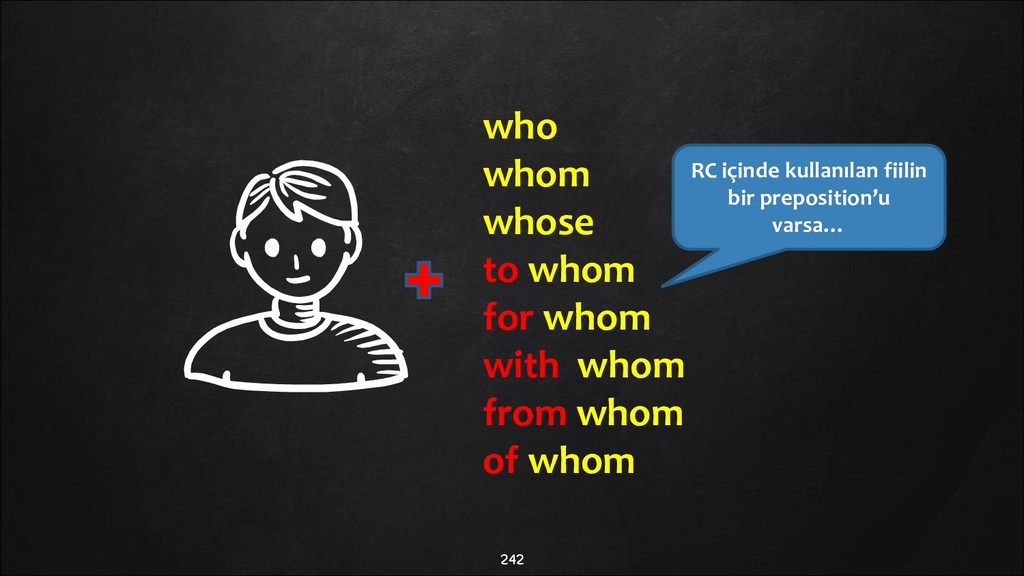
  164. 242 who whom whose to whom for whom with whom

    from whom of whom RC içinde kullanılan fiilin bir preposition’u varsa…
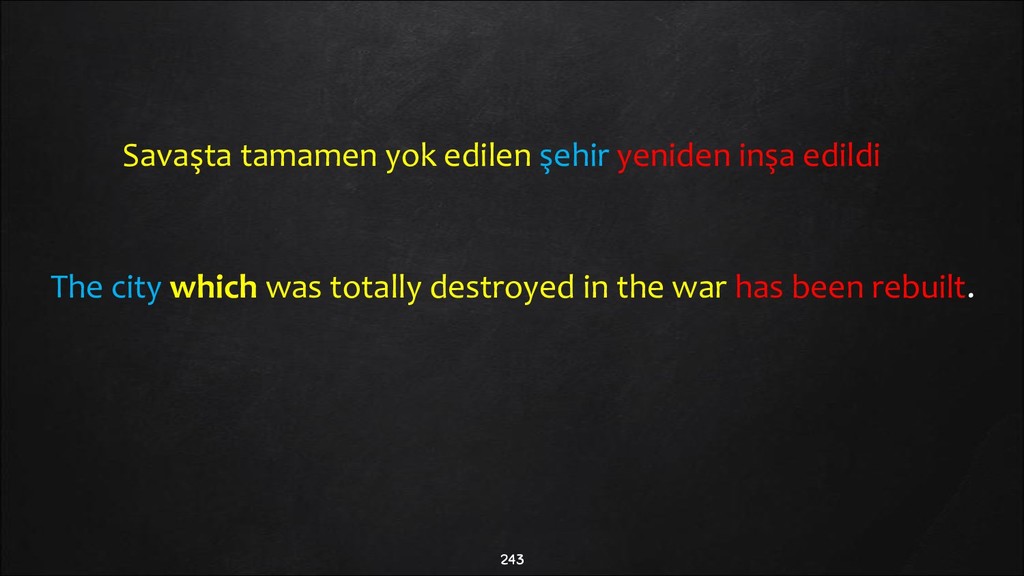
  165. 243 Savaşta tamamen yok edilen şehir yeniden inşa edildi The

    city which was totally destroyed in the war has been rebuilt.
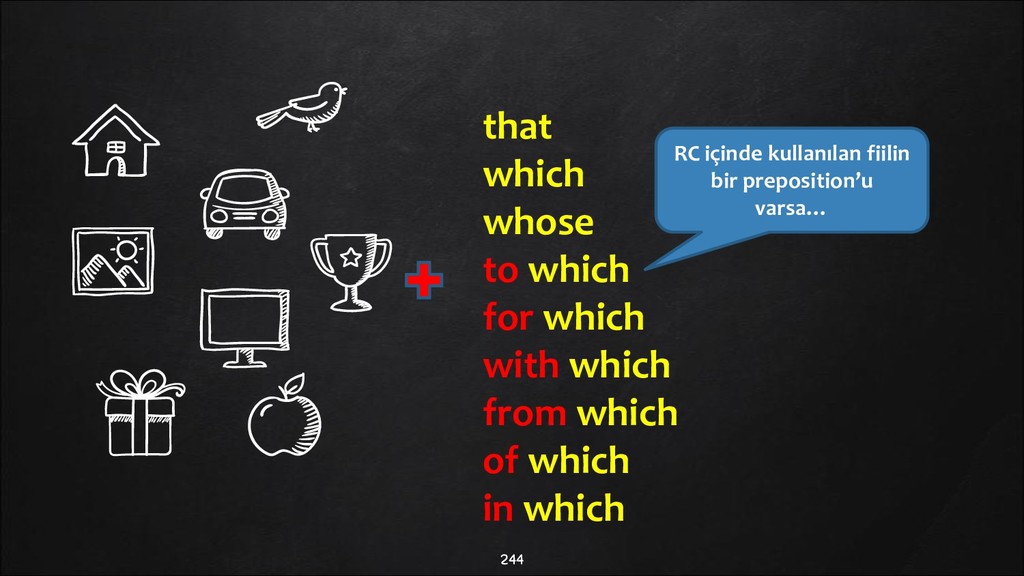
  166. 244 that which whose to which for which with which

    from which of which in which RC içinde kullanılan fiilin bir preposition’u varsa…
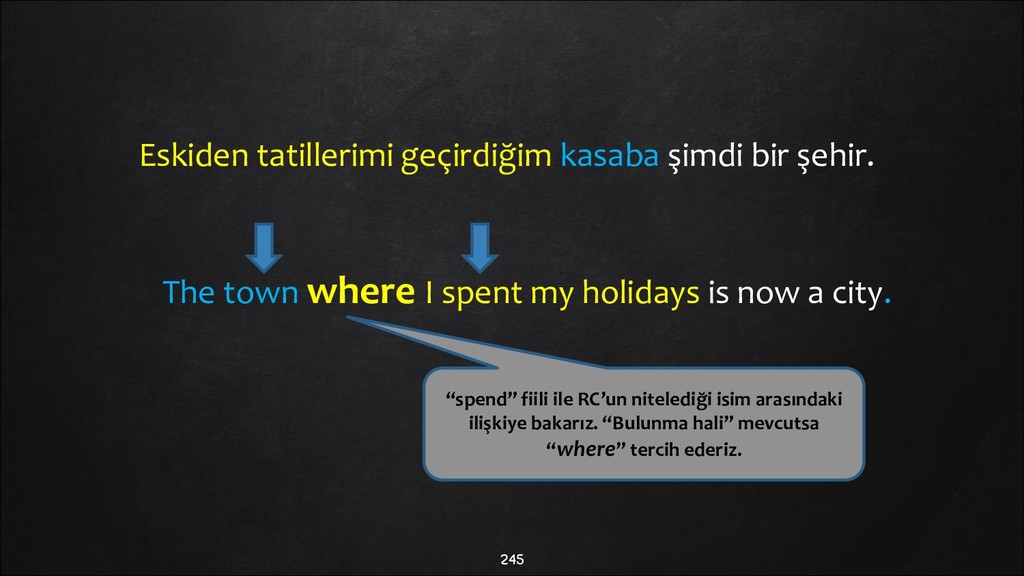
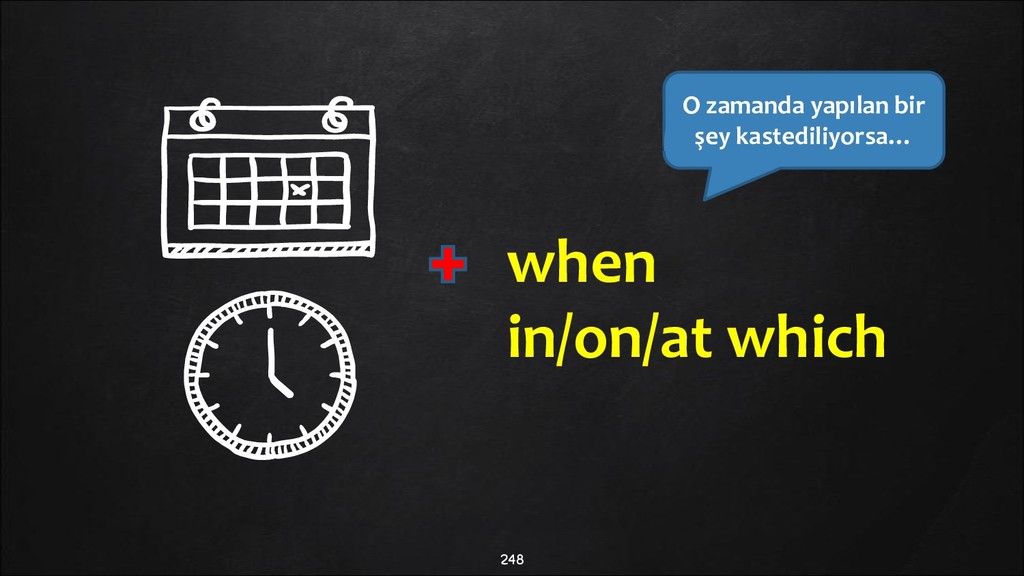
  167. 245 Eskiden tatillerimi geçirdiğim kasaba şimdi bir şehir. The town

    where I spent my holidays is now a city. “spend” fiili ile RC’un nitelediği isim arasındaki ilişkiye bakarız. “Bulunma hali” mevcutsa “where” tercih ederiz.
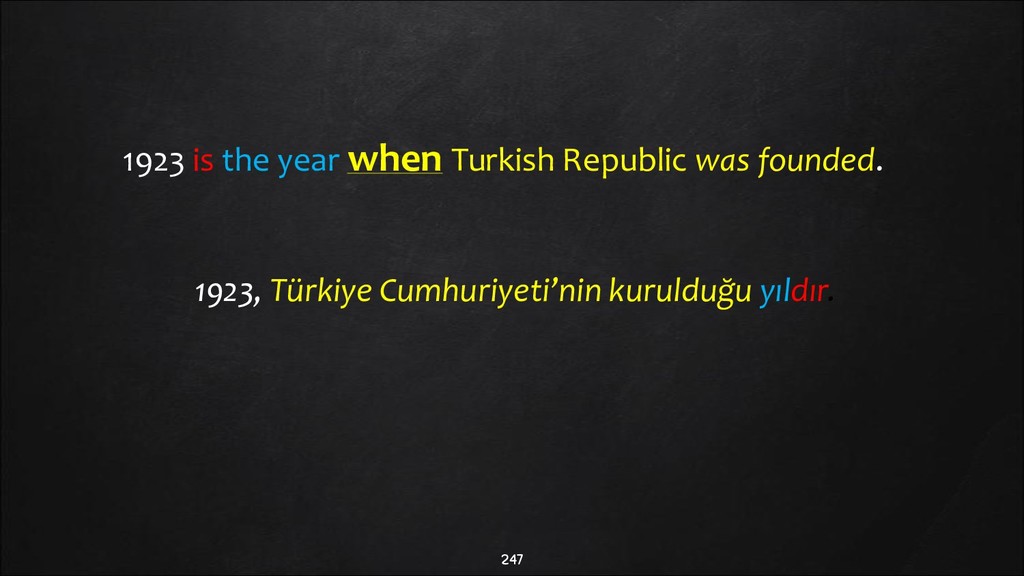
  168. 247 1923 is the year when Turkish Republic was founded.

    1923, Türkiye Cumhuriyeti’nin kurulduğu yıldır.
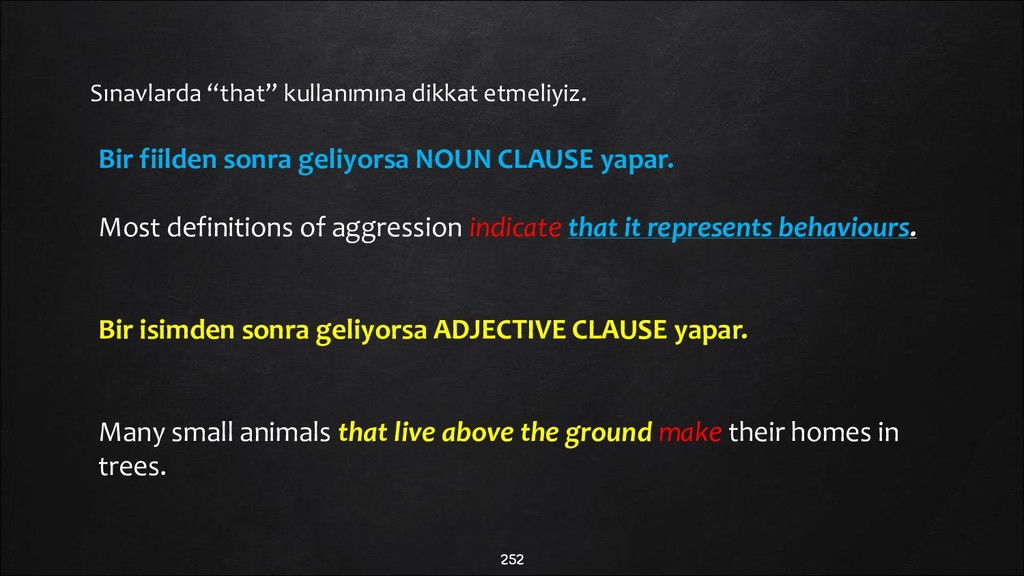
  169. 252 Sınavlarda “that” kullanımına dikkat etmeliyiz. Bir fiilden sonra geliyorsa

    NOUN CLAUSE yapar. Most definitions of aggression indicate that it represents behaviours. Bir isimden sonra geliyorsa ADJECTIVE CLAUSE yapar. Many small animals that live above the ground make their homes in trees.
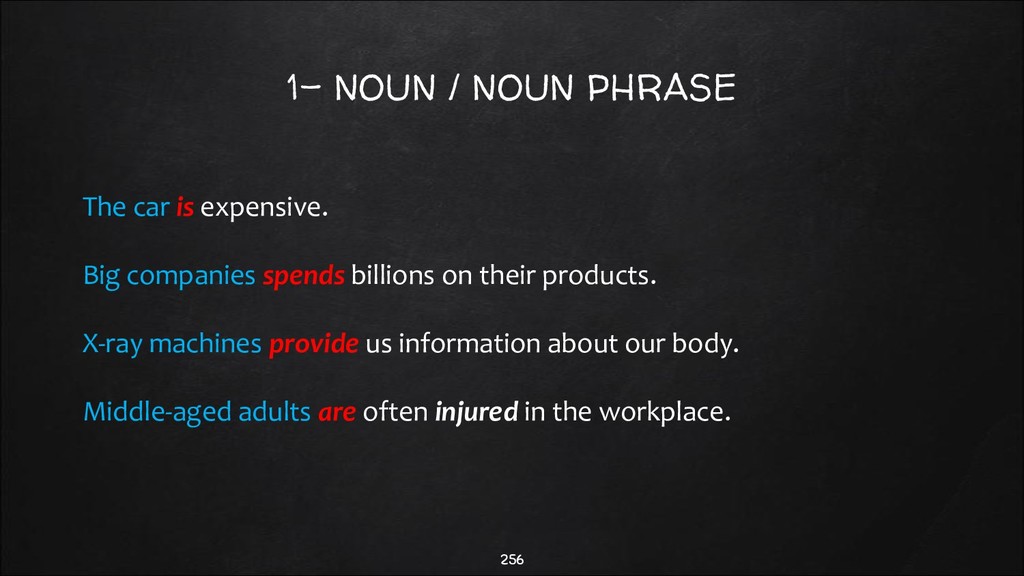
  170. 1- NOUN / NOUN PHRASE 256 The car is expensive.

    Big companies spends billions on their products. X-ray machines provide us information about our body. Middle-aged adults are often injured in the workplace.
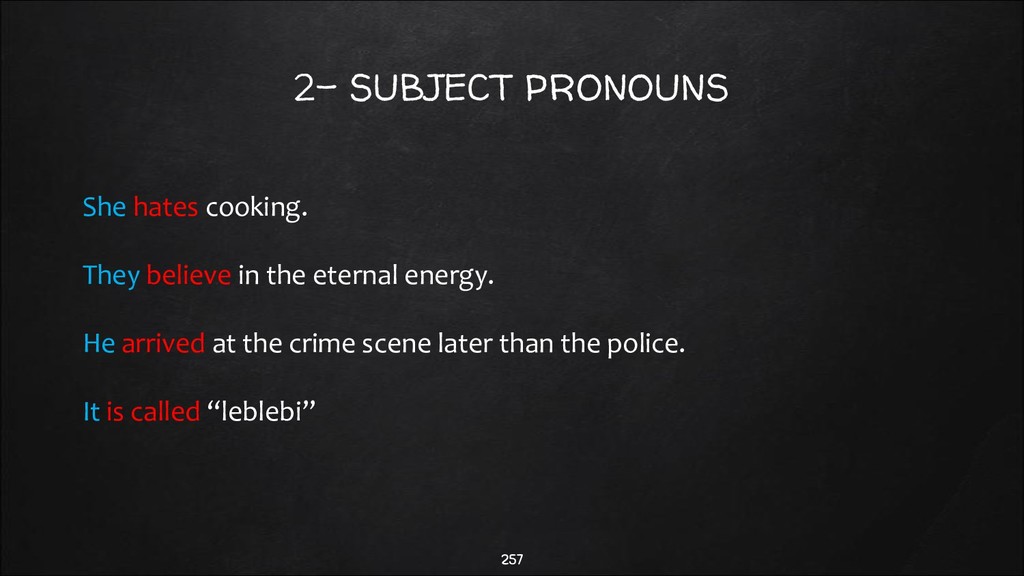
  171. 2- SUBJECT PRONOUNS 257 She hates cooking. They believe in

    the eternal energy. He arrived at the crime scene later than the police. It is called “leblebi”
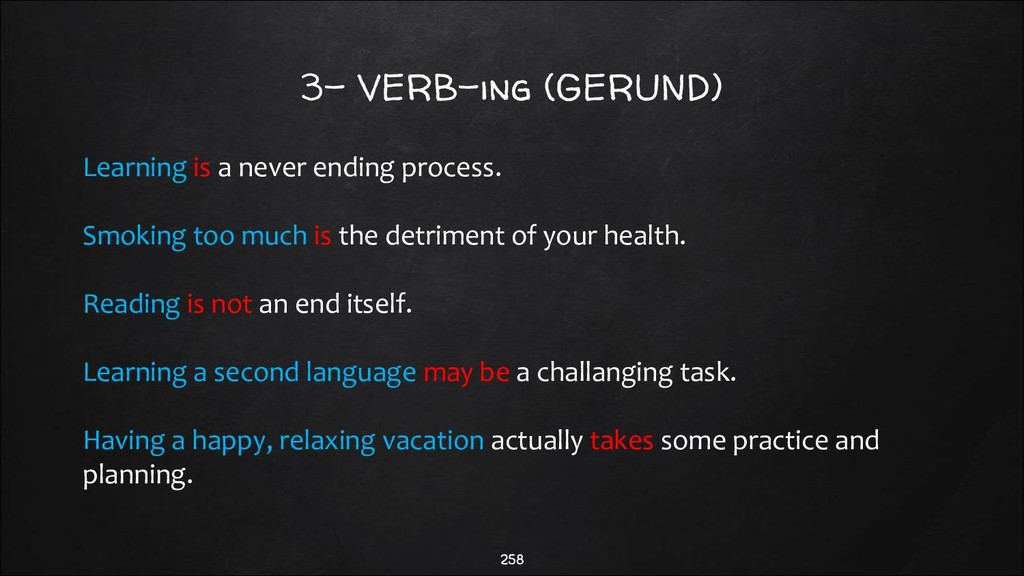
  172. 3- VERB-ing (GERUND) 258 Learning is a never ending process.

    Smoking too much is the detriment of your health. Reading is not an end itself. Learning a second language may be a challanging task. Having a happy, relaxing vacation actually takes some practice and planning.
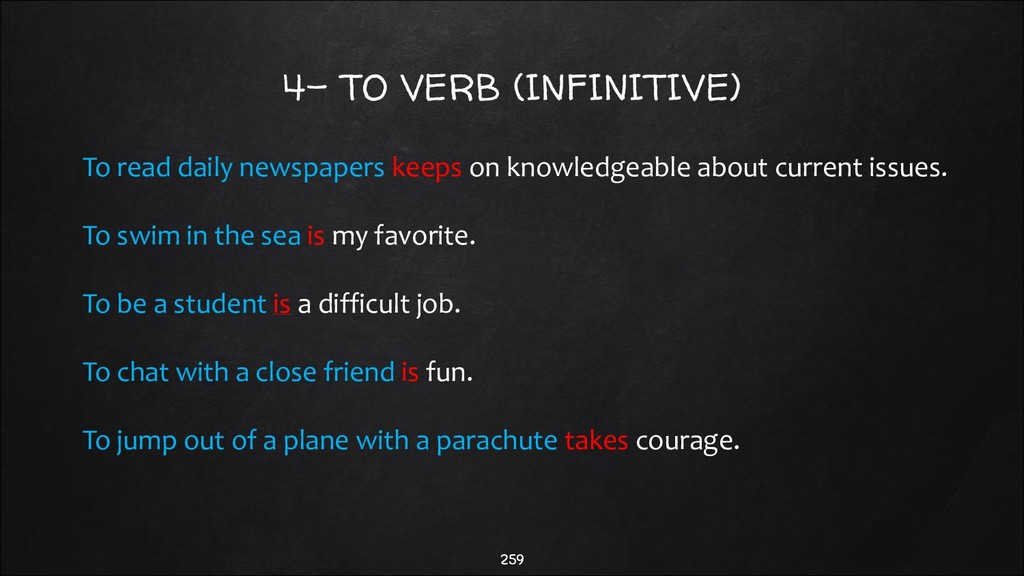
  173. 4- TO VERB (INFINITIVE) 259 To read daily newspapers keeps

    on knowledgeable about current issues. To swim in the sea is my favorite. To be a student is a difficult job. To chat with a close friend is fun. To jump out of a plane with a parachute takes courage.
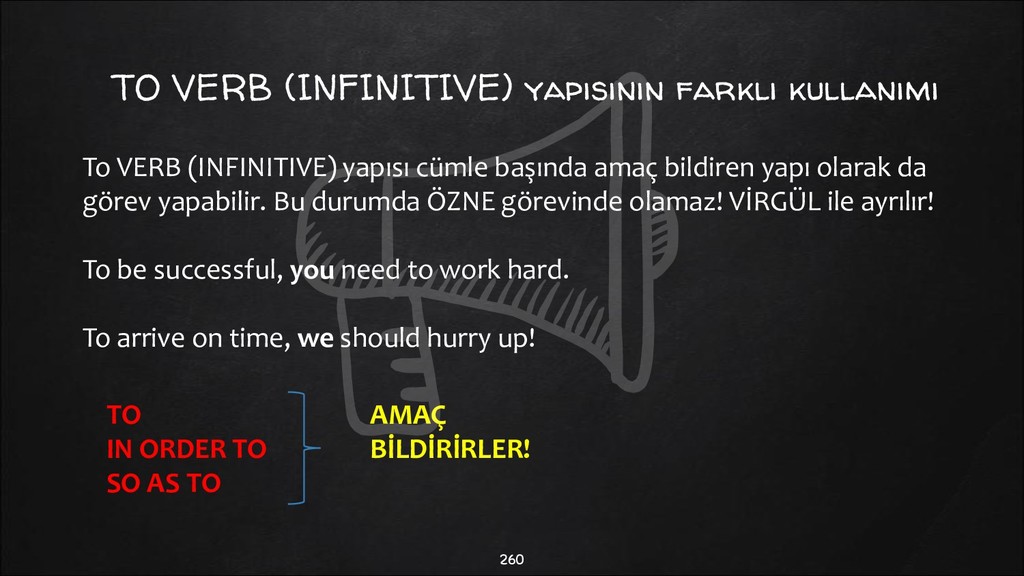
  174. TO VERB (INFINITIVE) yapısının farklı kullanımı 260 To VERB (INFINITIVE)

    yapısı cümle başında amaç bildiren yapı olarak da görev yapabilir. Bu durumda ÖZNE görevinde olamaz! VİRGÜL ile ayrılır! To be successful, you need to work hard. To arrive on time, we should hurry up! TO IN ORDER TO SO AS TO AMAÇ BİLDİRİRLER!
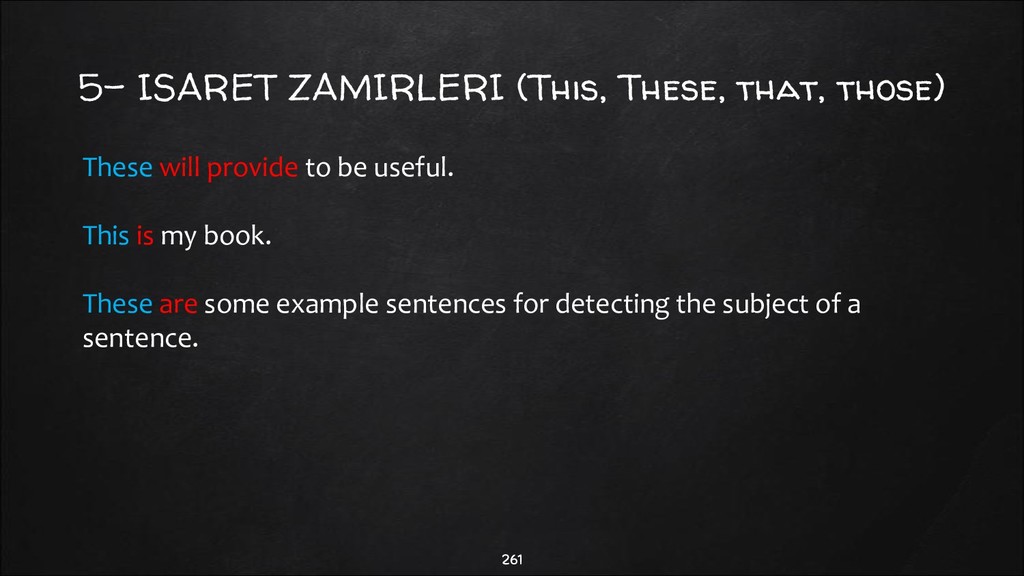
  175. 5- ISARET ZAMIRLERI (This, These, that, those) 261 These will

    provide to be useful. This is my book. These are some example sentences for detecting the subject of a sentence.
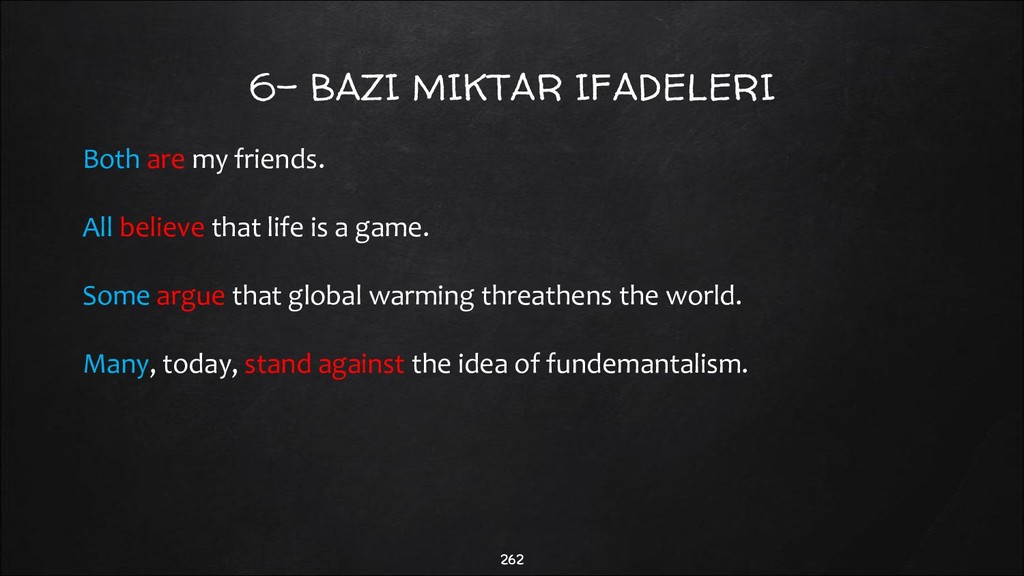
  176. 6- BAZI MIKTAR IFADELERI 262 Both are my friends. All

    believe that life is a game. Some argue that global warming threathens the world. Many, today, stand against the idea of fundemantalism.
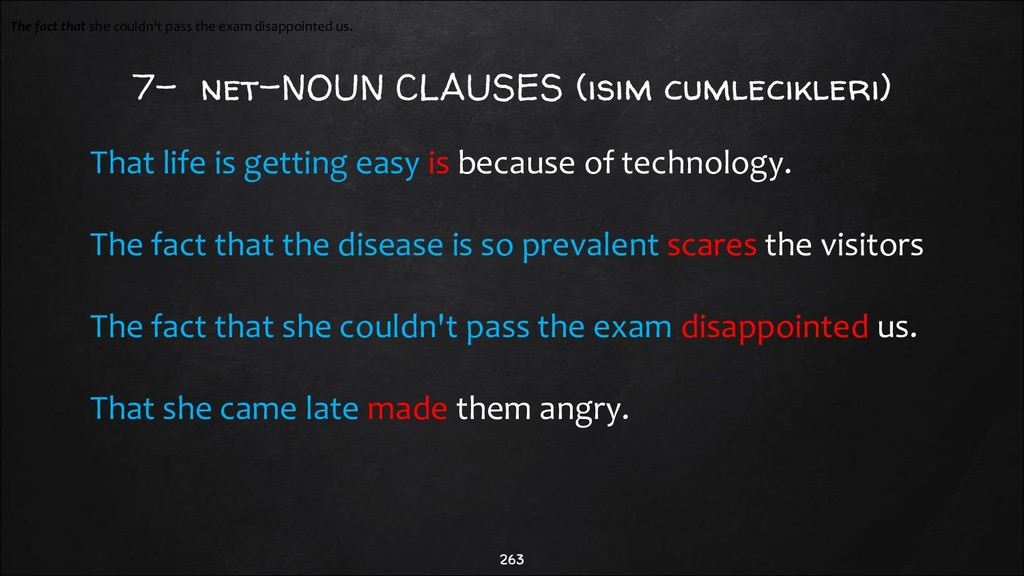
  177. 7- net-NOUN CLAUSES (ısım cumlecıklerı) 263 That life is getting

    easy is because of technology. The fact that the disease is so prevalent scares the visitors The fact that she couldn't pass the exam disappointed us. That she came late made them angry. The fact that she couldn't pass the exam disappointed us.
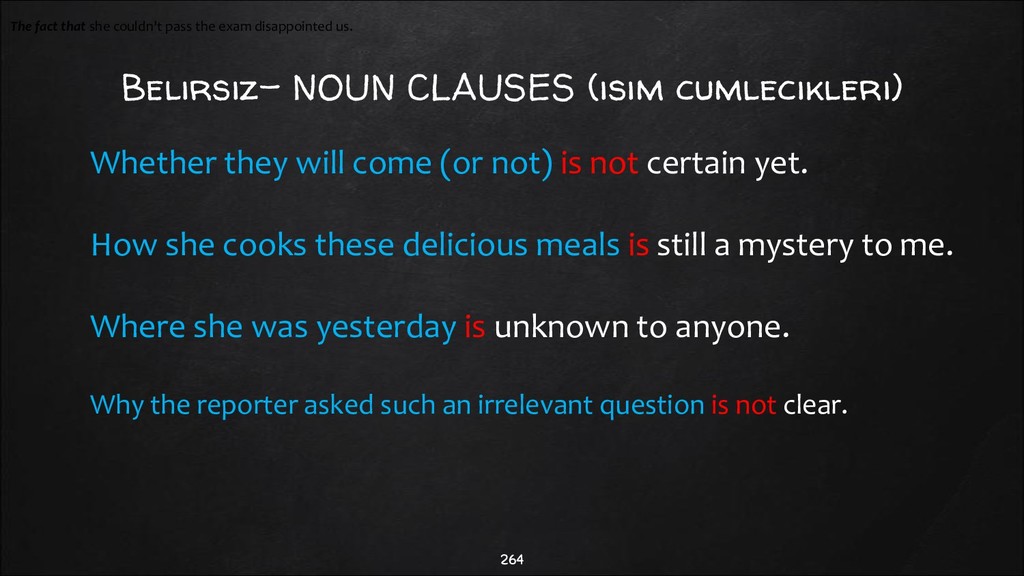
  178. Belirsız- NOUN CLAUSES (ısım cumlecıklerı) 264 Whether they will come

    (or not) is not certain yet. How she cooks these delicious meals is still a mystery to me. Where she was yesterday is unknown to anyone. Why the reporter asked such an irrelevant question is not clear. The fact that she couldn't pass the exam disappointed us.
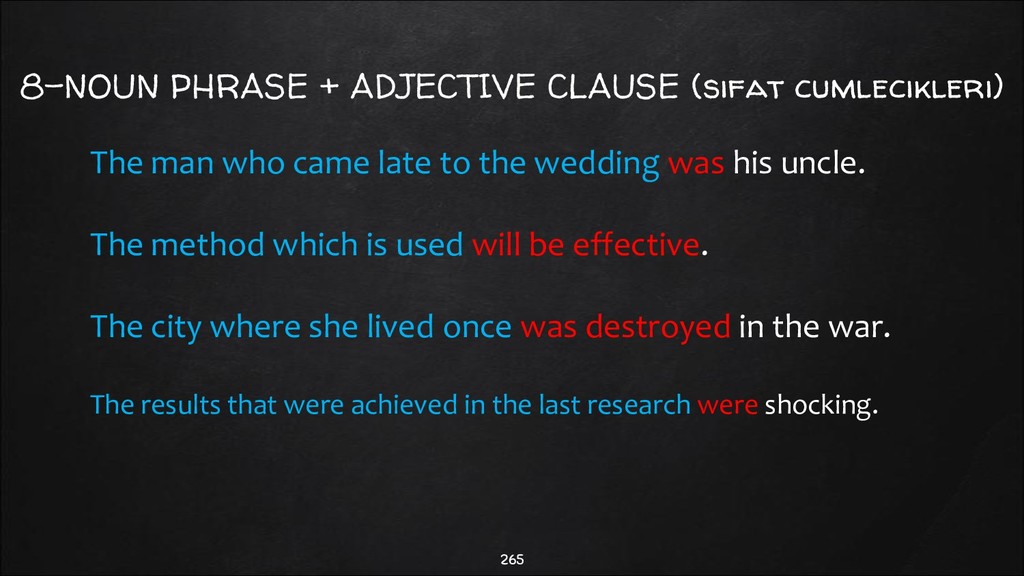
  179. 8-NOUN PHRASE + ADJECTIVE CLAUSE (sıfat cumlecıklerı) 265 The man

    who came late to the wedding was his uncle. The method which is used will be effective. The city where she lived once was destroyed in the war. The results that were achieved in the last research were shocking.
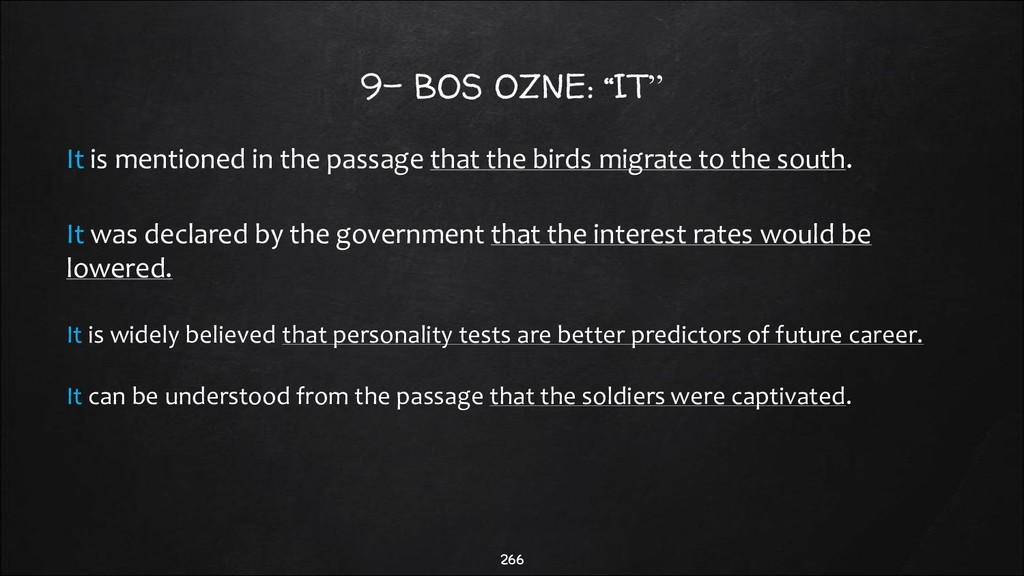
  180. 9- BOS OZNE: “IT” 266 It is mentioned in the

    passage that the birds migrate to the south. It was declared by the government that the interest rates would be lowered. It is widely believed that personality tests are better predictors of future career. It can be understood from the passage that the soldiers were captivated.
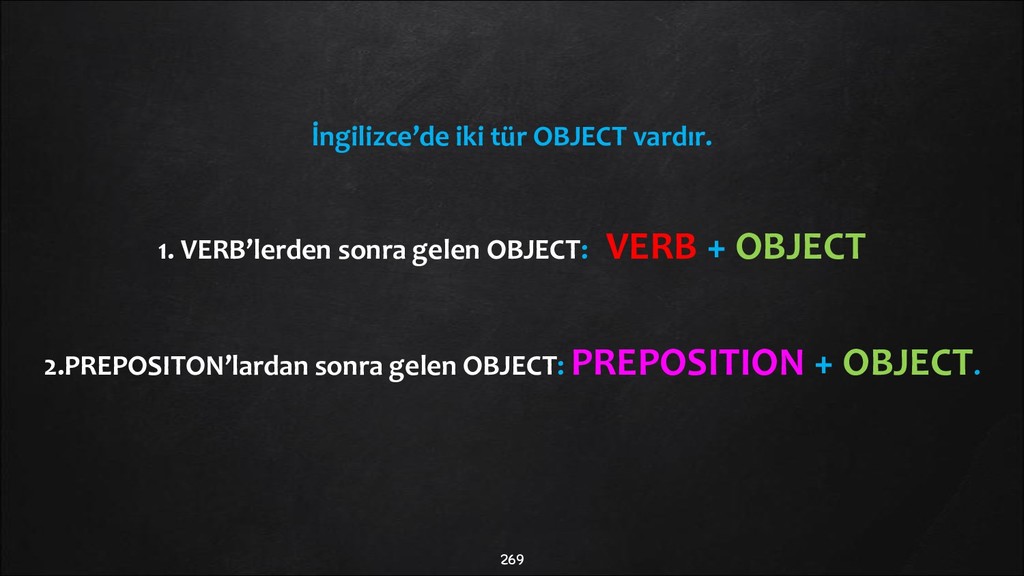
  181. İngilizce’de iki tür OBJECT vardır. 1. VERB’lerden sonra gelen OBJECT:

    VERB + OBJECT 2.PREPOSITON’lardan sonra gelen OBJECT: PREPOSITION + OBJECT. 269
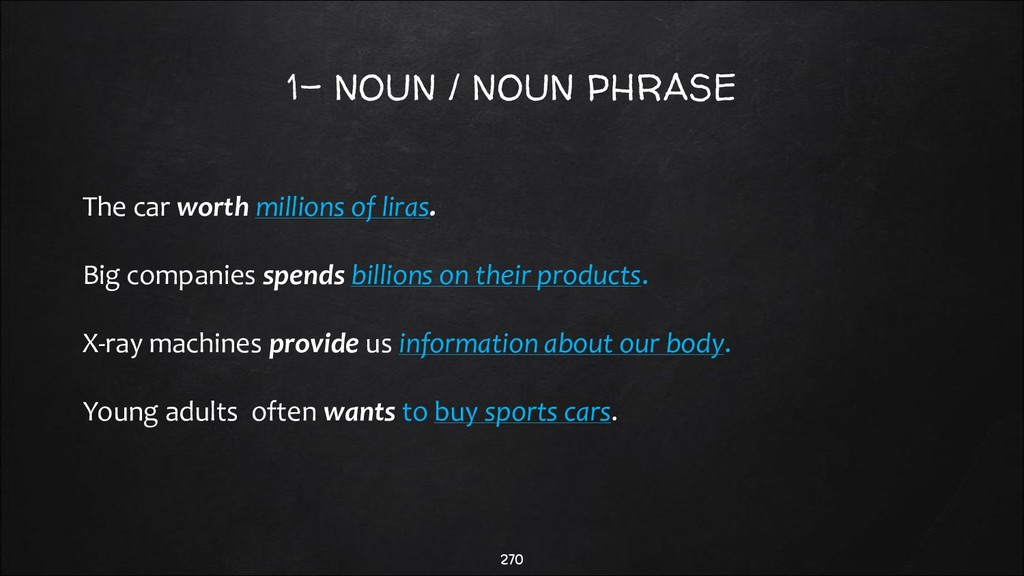
  182. 1- NOUN / NOUN PHRASE 270 The car worth millions

    of liras. Big companies spends billions on their products. X-ray machines provide us information about our body. Young adults often wants to buy sports cars.
  183. 2- OBJECT PRONOUNS (me, you, him, her, it, us, them)

    271 The meeting gave me a chance to explain myself. The flowers were sent to you for the Valentine’s Day. Learning a language helps us. They are the new interns, the manager has not met them yet.
  184. 3- VERB-ing (GERUNDS) 272 I appreciate being with friends. They

    had to postpone giving a party because of the car accident their son had. she sometimes can’t resist eating dessert. The researchers were interested in understanding the artificial intelligence (AI). PREPOSITION’lardan sonra “VERB-ing” yapısı tercih edilir
  185. 4- TO VERB (ınfınıtıve) 273 I came here to talk

    to you. Only men of "mature age and respected morals" were allowed to see the fossils. I would like to be sleeping in my bed now. I decided to quit smoking. I forgot to post the letter. I managed to do it. PREPOSITION’lardan sonra “to VERB” yapısı OBJECT olarak GELEMEZ!!!!!!!!!!
  186. 5- ISARET ZAMIRLERI (thıs, these, that, those) 274 I want

    to buy these. Sue knows this. A:“Palaeontolgy is the study of pre-historic life” B: Can you repeat that?
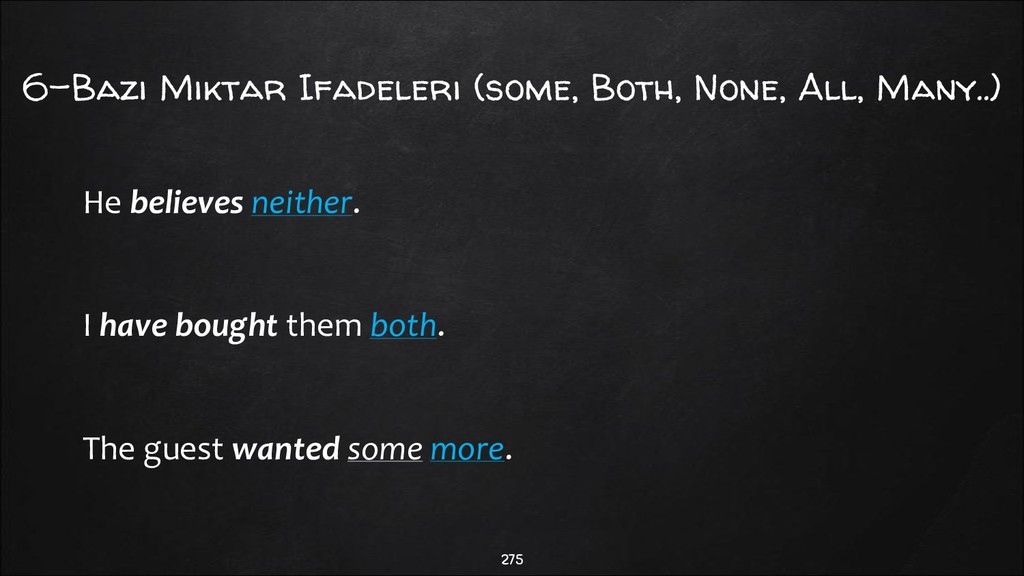
  187. 6-Bazı Mıktar Ifadelerı (some, Both, None, All, Many..) 275 He

    believes neither. I have bought them both. The guest wanted some more.
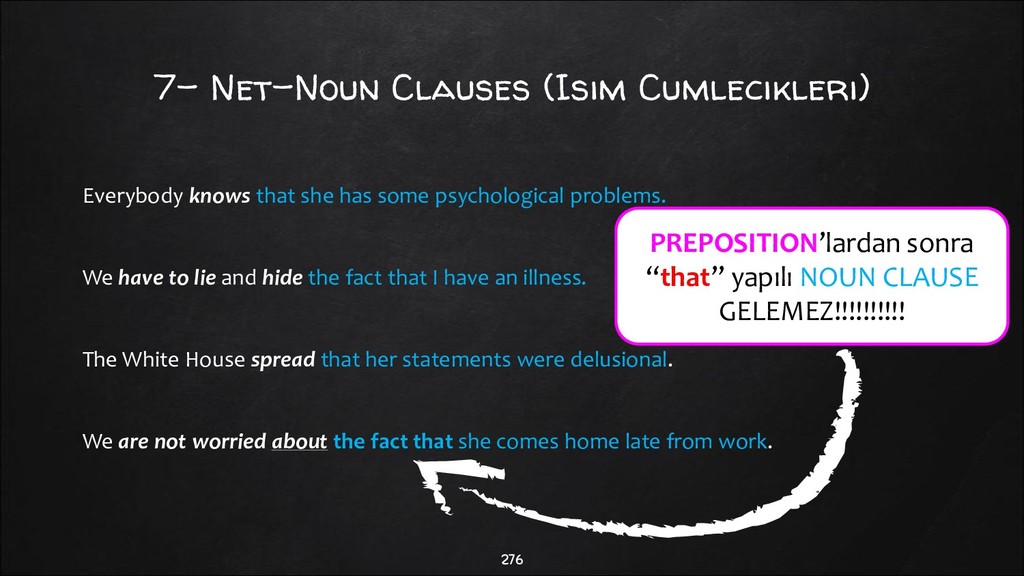
  188. 7- Net-Noun Clauses (Isım Cumlecıkleri) 276 Everybody knows that she

    has some psychological problems. We have to lie and hide the fact that I have an illness. The White House spread that her statements were delusional. We are not worried about the fact that she comes home late from work. PREPOSITION’lardan sonra “that” yapılı NOUN CLAUSE GELEMEZ!!!!!!!!!!
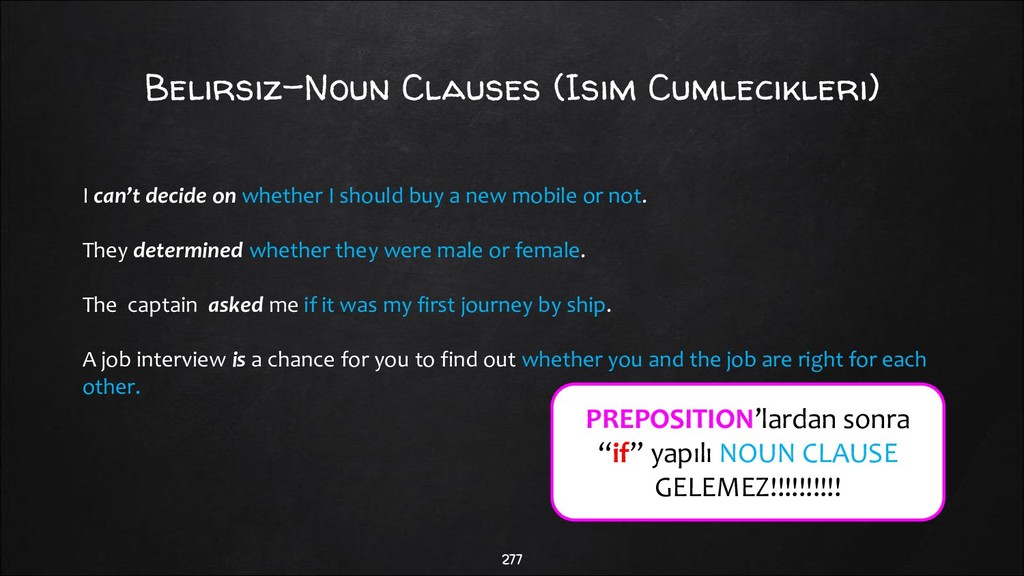
  189. Belırsız-Noun Clauses (Isım Cumlecıkleri) 277 I can’t decide on whether

    I should buy a new mobile or not. They determined whether they were male or female. The captain asked me if it was my first journey by ship. A job interview is a chance for you to find out whether you and the job are right for each other. PREPOSITION’lardan sonra “if” yapılı NOUN CLAUSE GELEMEZ!!!!!!!!!!
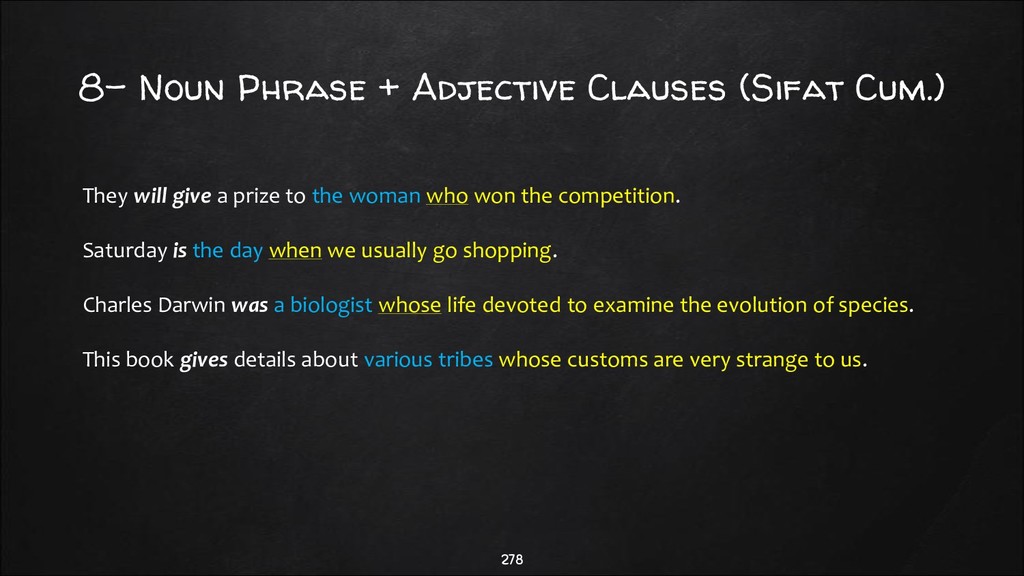
  190. 8- Noun Phrase + Adjectıve Clauses (Sıfat Cum.) 278 They

    will give a prize to the woman who won the competition. Saturday is the day when we usually go shopping. Charles Darwin was a biologist whose life devoted to examine the evolution of species. This book gives details about various tribes whose customs are very strange to us.
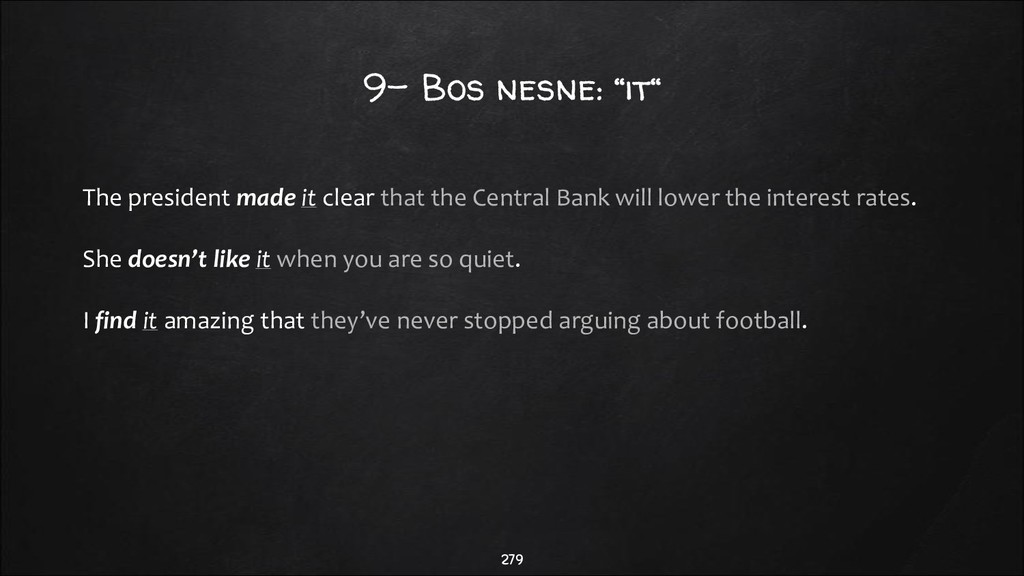
  191. 9- Bos nesne: “it“ 279 The president made it clear

    that the Central Bank will lower the interest rates. She doesn’t like it when you are so quiet. I find it amazing that they’ve never stopped arguing about football.
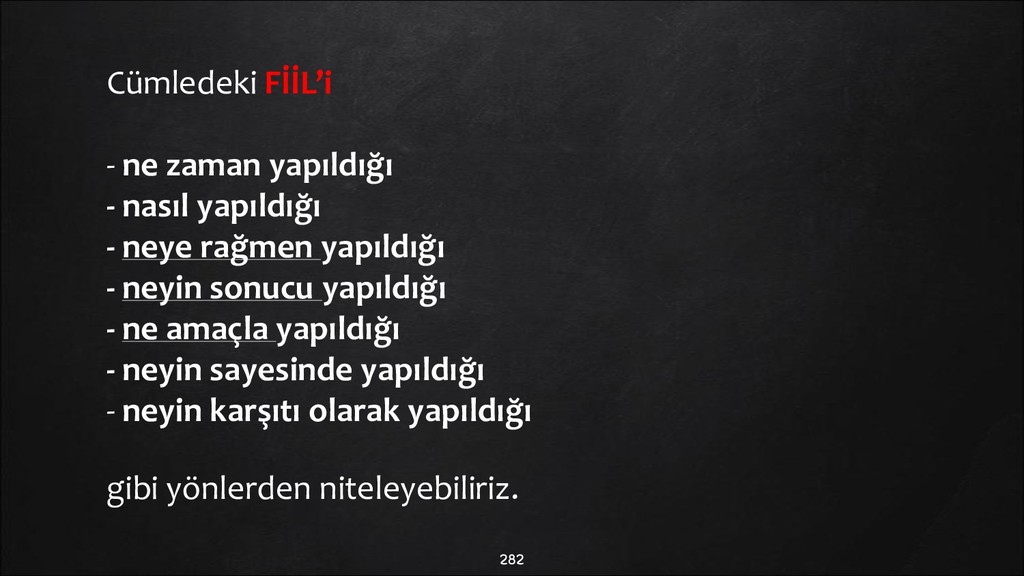
  192. 282 Cümledeki FİİL’i - ne zaman yapıldığı - nasıl yapıldığı

    - neye rağmen yapıldığı - neyin sonucu yapıldığı - ne amaçla yapıldığı - neyin sayesinde yapıldığı - neyin karşıtı olarak yapıldığı gibi yönlerden niteleyebiliriz.
  193. 284 Bu yapı, tıpkı diğer CLAUSE’lar gibi uzun cümleler kurmamızı

    sağlar. Ve, sınavlardaki okuma parçalarında kullanılmadıkları cümle neredeyse yoktur. Ve, bu yüzden iyi anlaşılmadığı takdirde tam bir baş belası olabilirler.
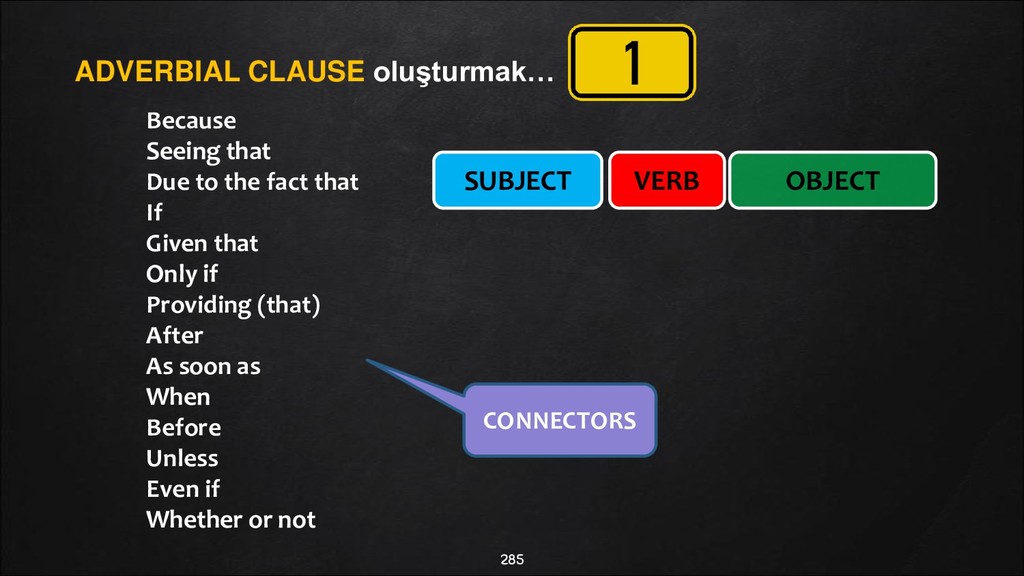
  194. 285 ADVERBIAL CLAUSE oluşturmak… SUBJECT VERB OBJECT Because Seeing that

    Due to the fact that If Given that Only if Providing (that) After As soon as When Before Unless Even if Whether or not CONNECTORS
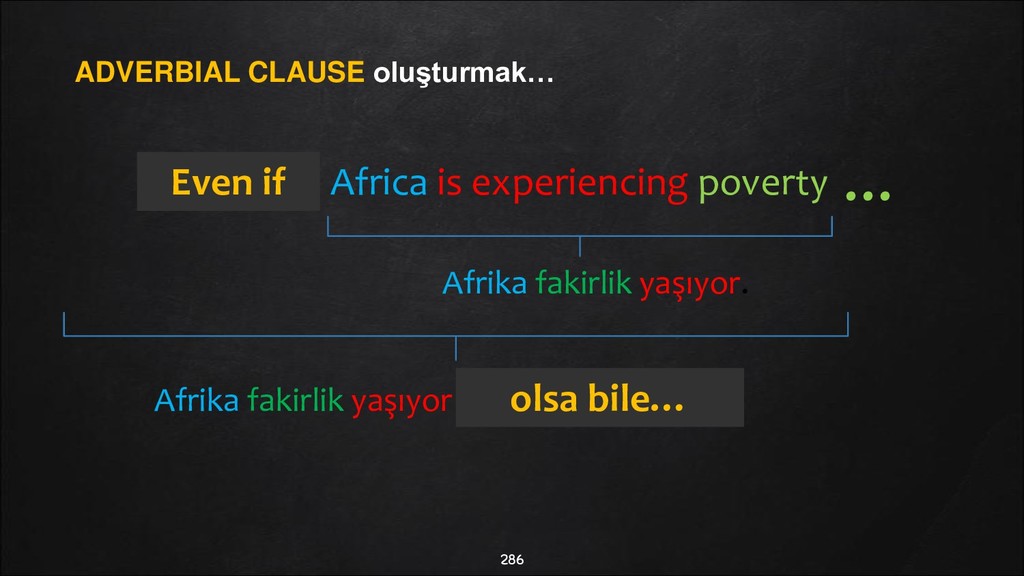
  195. 286 ADVERBIAL CLAUSE oluşturmak… Although Africa is experiencing poverty Afrika

    fakirlik yaşıyor. Afrika fakirlik yaşıyor olmasına rağmen… ... Even if olsa bile…
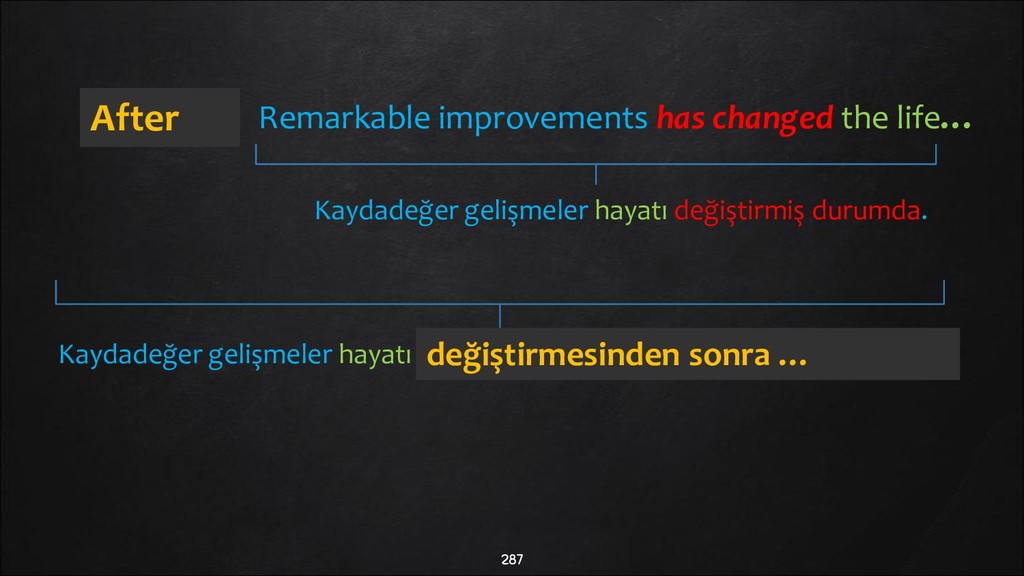
  196. 287 Remarkable improvements has changed the life Kaydadeğer gelişmeler hayatı

    değiştirmiş durumda. Given that Kaydadeğer gelişmeler hayatı değiştirmiş durumda olduğunu farzedersek… ... After değiştirmesinden sonra …
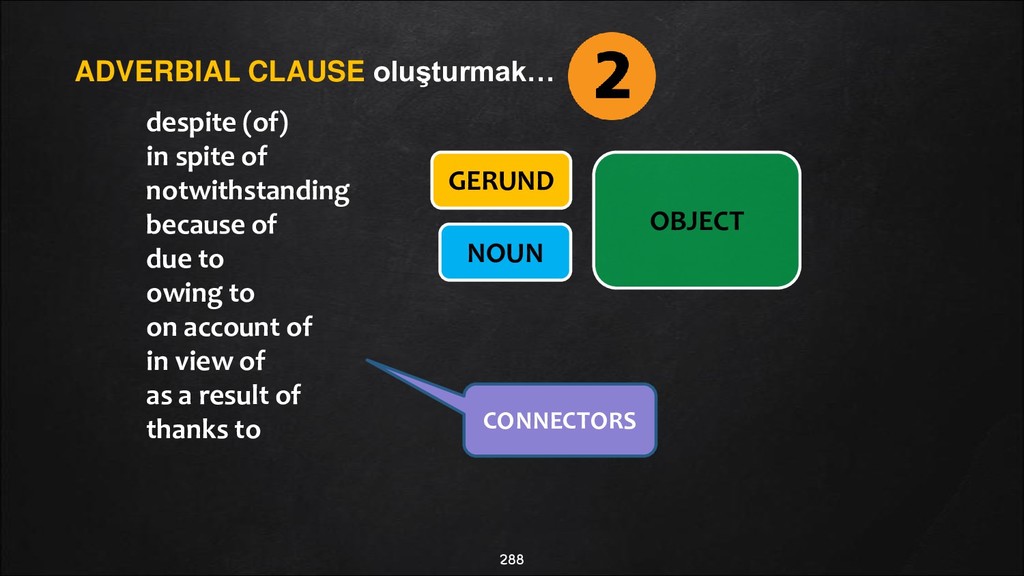
  197. 288 ADVERBIAL CLAUSE oluşturmak… GERUND OBJECT despite (of) in spite

    of notwithstanding because of due to owing to on account of in view of as a result of thanks to NOUN CONNECTORS
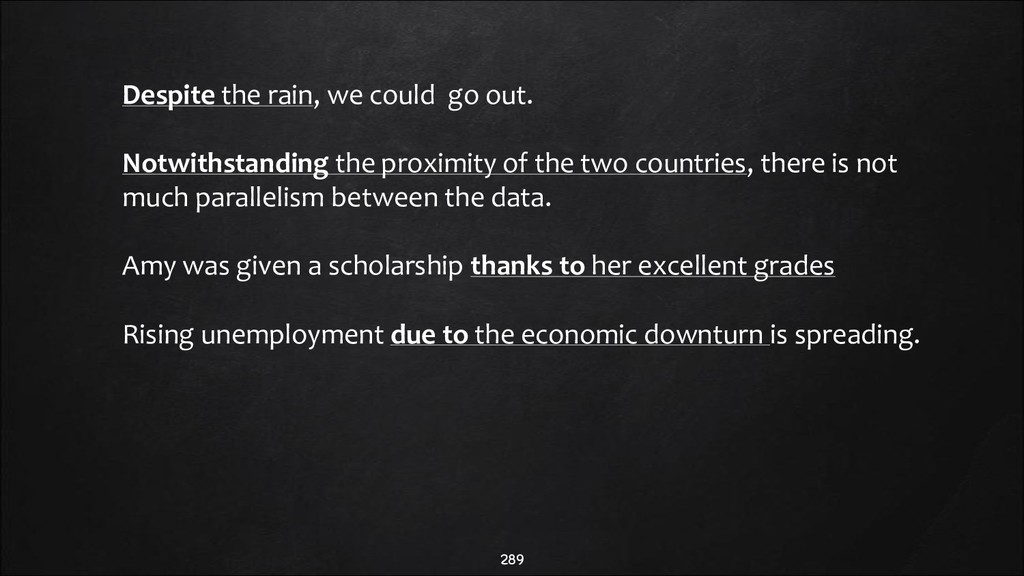
  198. 289 Despite the rain, we could go out. Notwithstanding the

    proximity of the two countries, there is not much parallelism between the data. Amy was given a scholarship thanks to her excellent grades Rising unemployment due to the economic downturn is spreading.
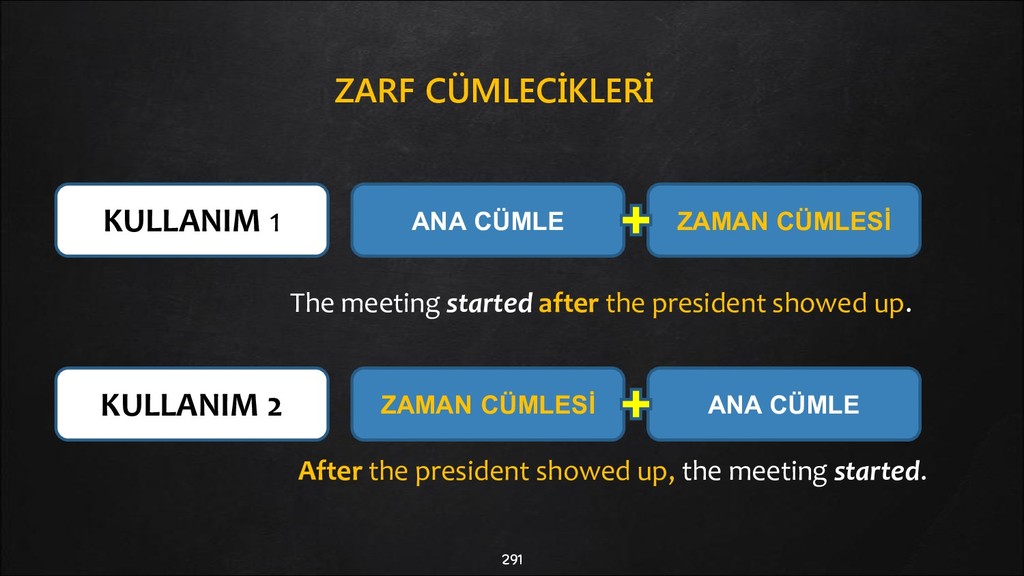
  199. 291 ZARF CÜMLECİKLERİ ANA CÜMLE ZAMAN CÜMLESİ ZAMAN CÜMLESİ ANA

    CÜMLE KULLANIM 1 KULLANIM 2 The meeting started after the president showed up. After the president showed up, the meeting started.
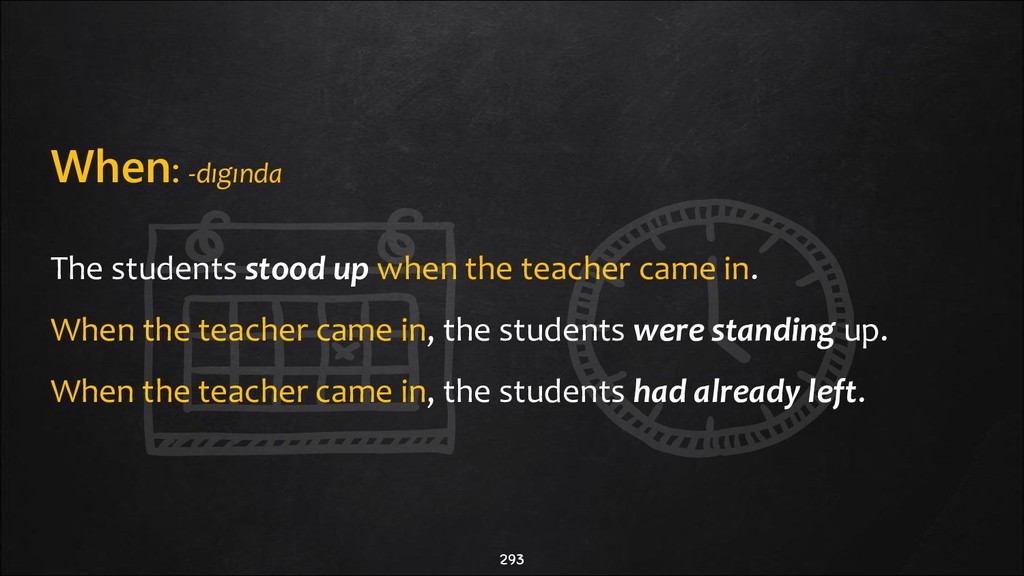
  200. 293 When: -dıgında The students stood up when the teacher

    came in. When the teacher came in, the students were standing up. When the teacher came in, the students had already left.
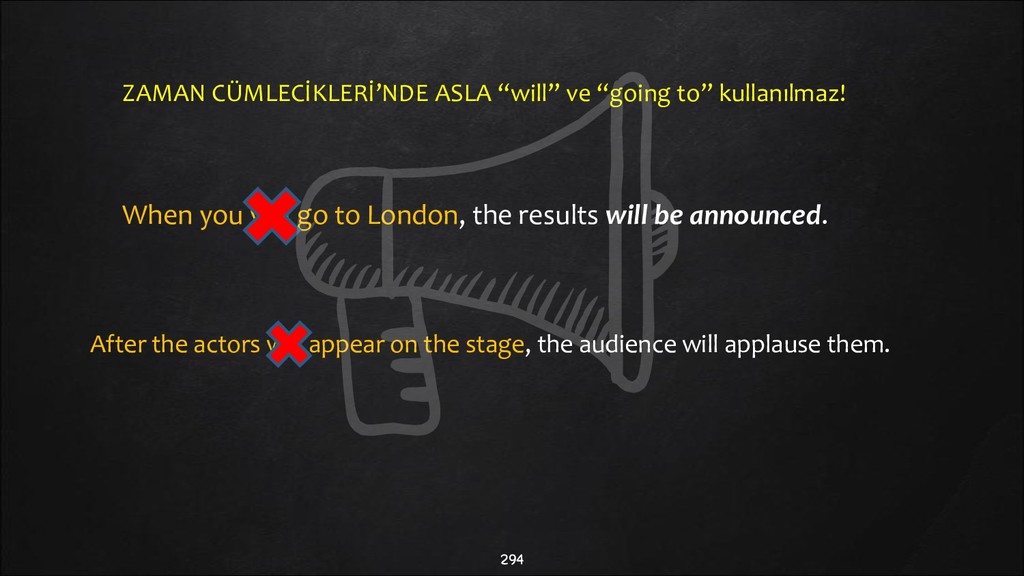
  201. 294 ZAMAN CÜMLECİKLERİ’NDE ASLA “will” ve “going to” kullanılmaz! When

    you will go to London, the results will be announced. After the actors will appear on the stage, the audience will applause them.
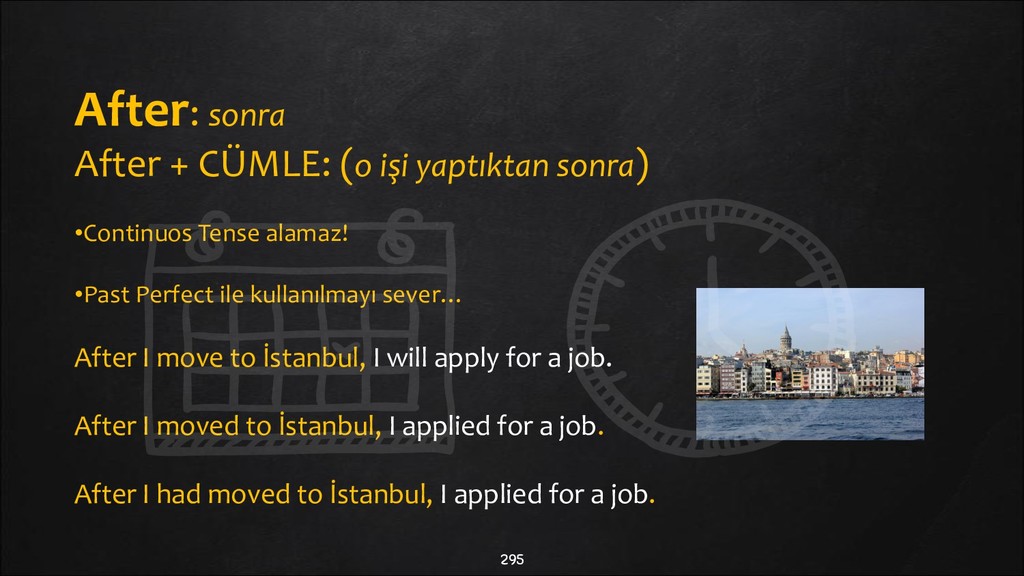
  202. 295 After: sonra After + CÜMLE: (o işi yaptıktan sonra)

    •Continuos Tense alamaz! •Past Perfect ile kullanılmayı sever… After I move to İstanbul, I will apply for a job. After I moved to İstanbul, I applied for a job. After I had moved to İstanbul, I applied for a job.
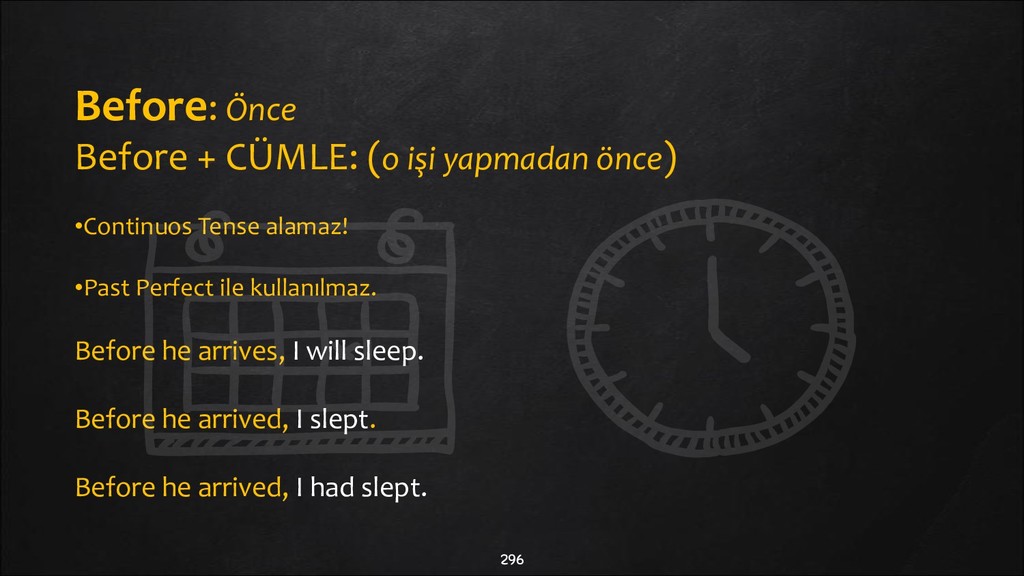
  203. 296 Before: Önce Before + CÜMLE: (o işi yapmadan önce)

    •Continuos Tense alamaz! •Past Perfect ile kullanılmaz. Before he arrives, I will sleep. Before he arrived, I slept. Before he arrived, I had slept.
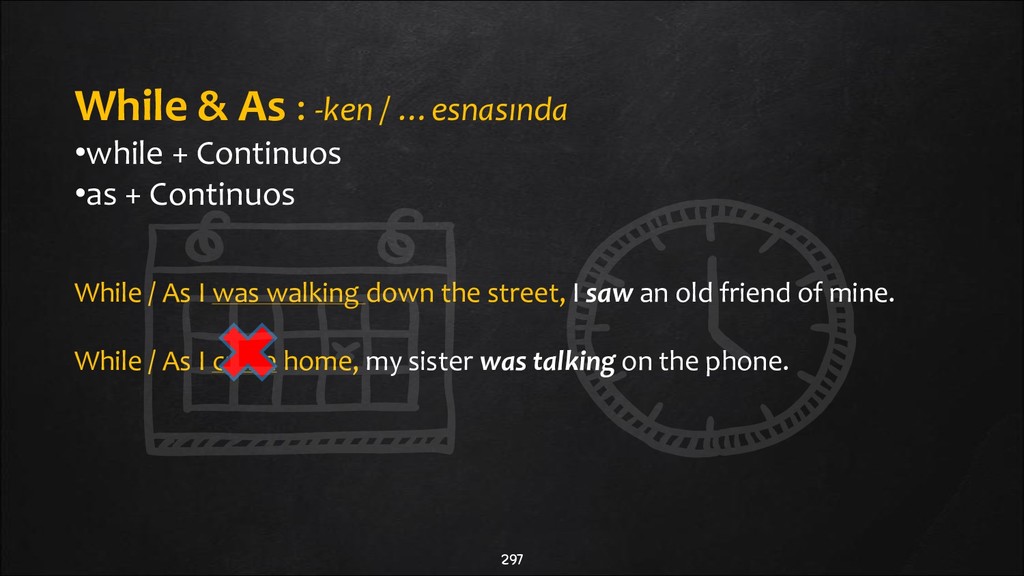
  204. 297 While & As : -ken / …esnasında •while +

    Continuos •as + Continuos While / As I was walking down the street, I saw an old friend of mine. While / As I came home, my sister was talking on the phone.
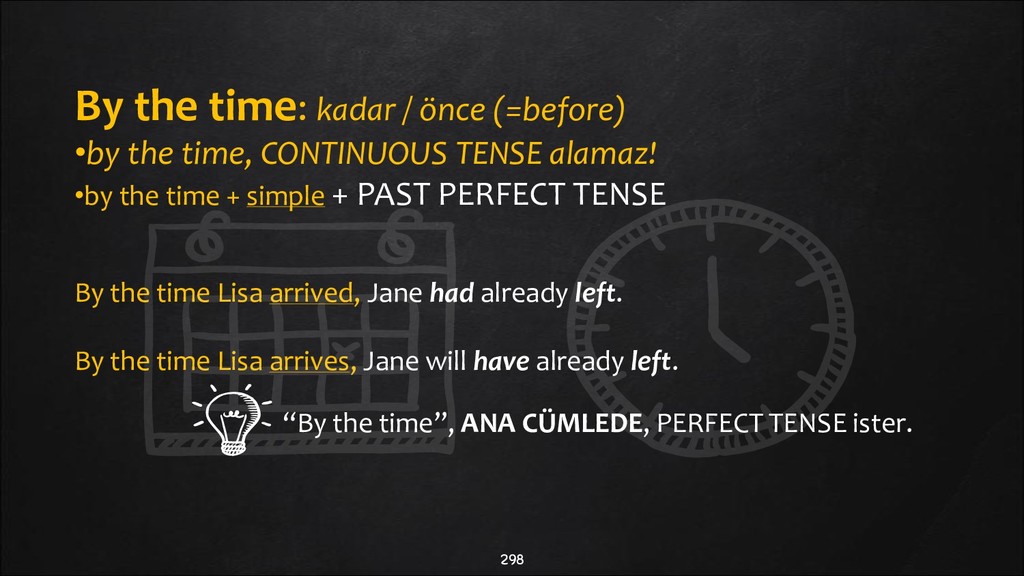
  205. 298 By the time: kadar / önce (=before) •by the

    time, CONTINUOUS TENSE alamaz! •by the time + simple + PAST PERFECT TENSE By the time Lisa arrived, Jane had already left. By the time Lisa arrives, Jane will have already left. “By the time”, ANA CÜMLEDE, PERFECT TENSE ister.
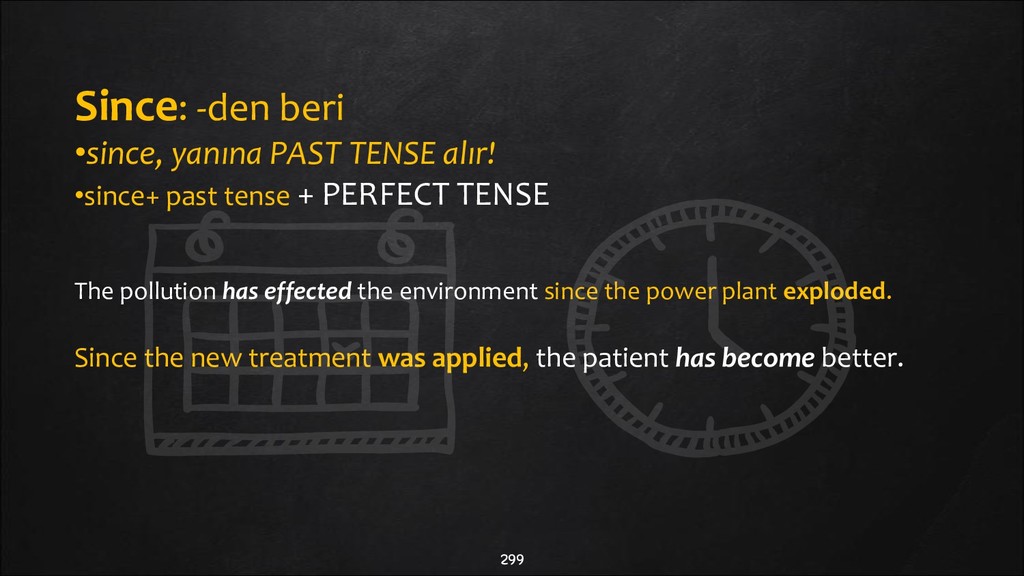
  206. 299 Since: -den beri •since, yanına PAST TENSE alır! •since+

    past tense + PERFECT TENSE The pollution has effected the environment since the power plant exploded. Since the new treatment was applied, the patient has become better.
  207. 301 UNTIL / TILL: -e kadar •“until”, yanına CoNTINUOS TENSE

    & FUTURE TENSE almaz! •“Until” THE SIMPLE PRESENT / SIMPLE PAST ile kullanılır. We don't need to be at the stadium until the first race is over. There will be not an agreed decision until the EU makes a new meeting.
  208. 302 AS SOON AS / ONCE / THE MOMENT: -ar

    -mez •“as soon as / once / the moment” CoNTINUOS TENSE ile kullanılamaz! I will look over the file as soon as I finish my work. I will look over the file once I finish my work. I will look over the file the moment I finish my work.
  209. 303 AS LONG AS / SO LONG AS: sürecince /

    boyunca As soon as you hand over your assignment, the assistant will start to check it. The fire department took action as soon as they heard the alarm. I realized that I forgot my keys as soon as I left home.
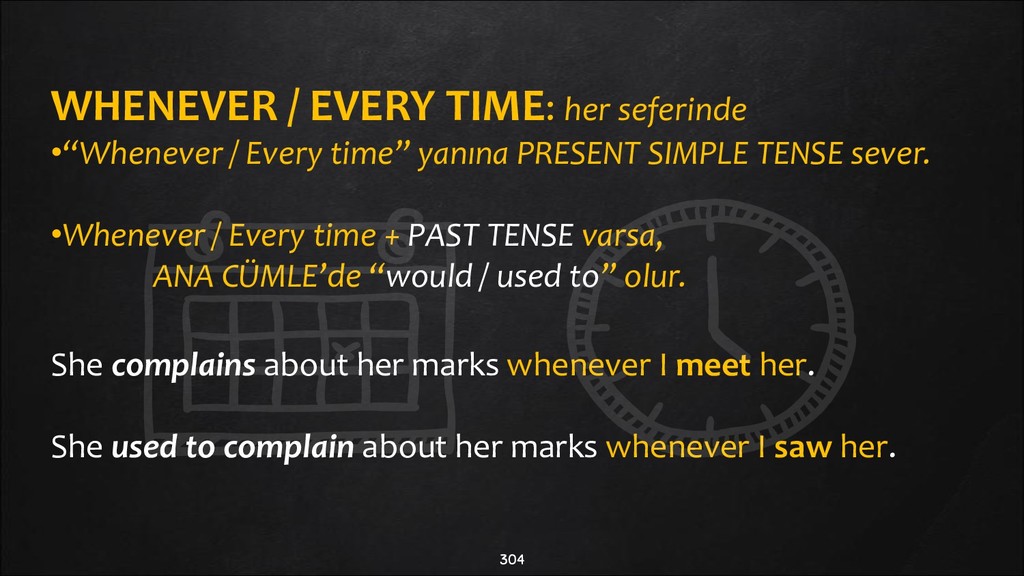
  210. 304 WHENEVER / EVERY TIME: her seferinde •“Whenever / Every

    time” yanına PRESENT SIMPLE TENSE sever. •Whenever / Every time + PAST TENSE varsa, ANA CÜMLE’de “would / used to” olur. She complains about her marks whenever I meet her. She used to complain about her marks whenever I saw her.
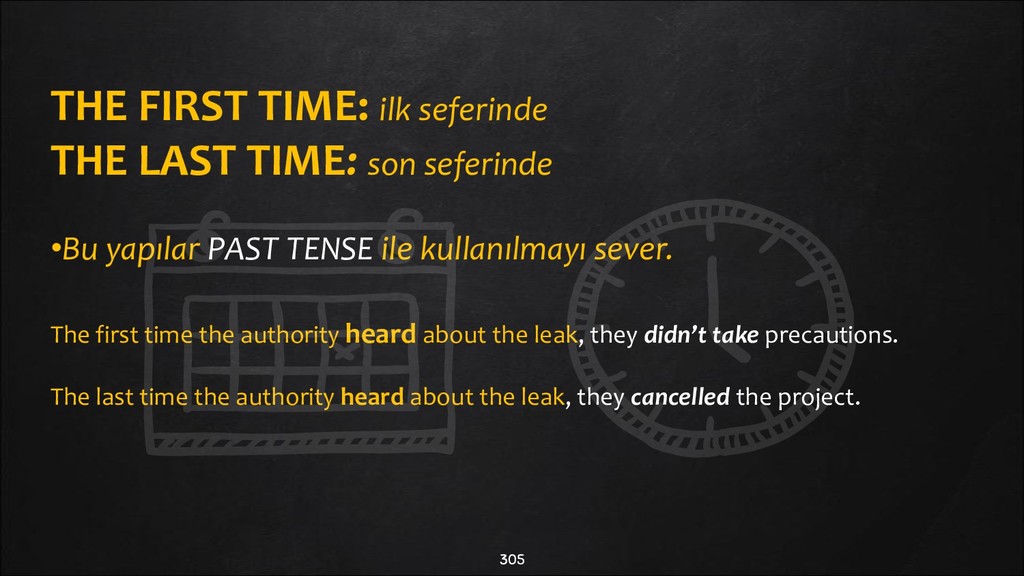
  211. 305 THE FIRST TIME: ilk seferinde THE LAST TIME: son

    seferinde •Bu yapılar PAST TENSE ile kullanılmayı sever. The first time the authority heard about the leak, they didn’t take precautions. The last time the authority heard about the leak, they cancelled the project.
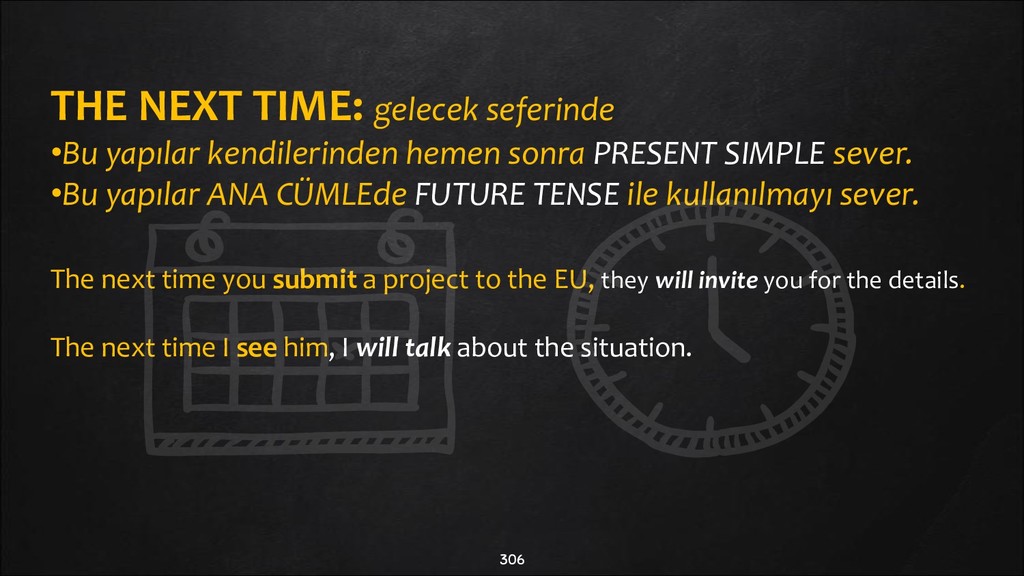
  212. 306 THE NEXT TIME: gelecek seferinde •Bu yapılar kendilerinden hemen

    sonra PRESENT SIMPLE sever. •Bu yapılar ANA CÜMLEde FUTURE TENSE ile kullanılmayı sever. The next time you submit a project to the EU, they will invite you for the details. The next time I see him, I will talk about the situation.
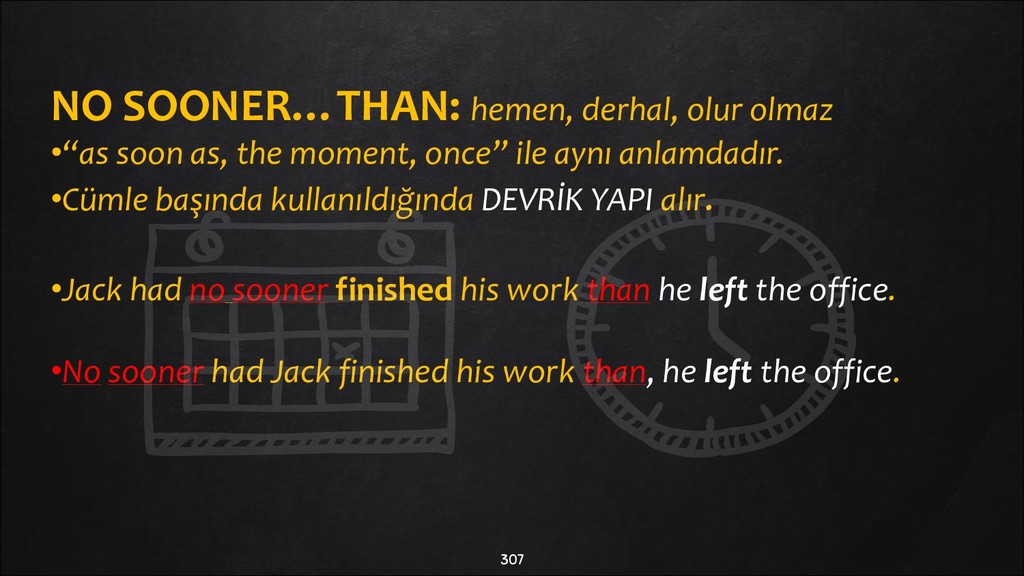
  213. 307 NO SOONER…THAN: hemen, derhal, olur olmaz •“as soon as,

    the moment, once” ile aynı anlamdadır. •Cümle başında kullanıldığında DEVRİK YAPI alır. •Jack had no sooner finished his work than he left the office. •No sooner had Jack finished his work than, he left the office.
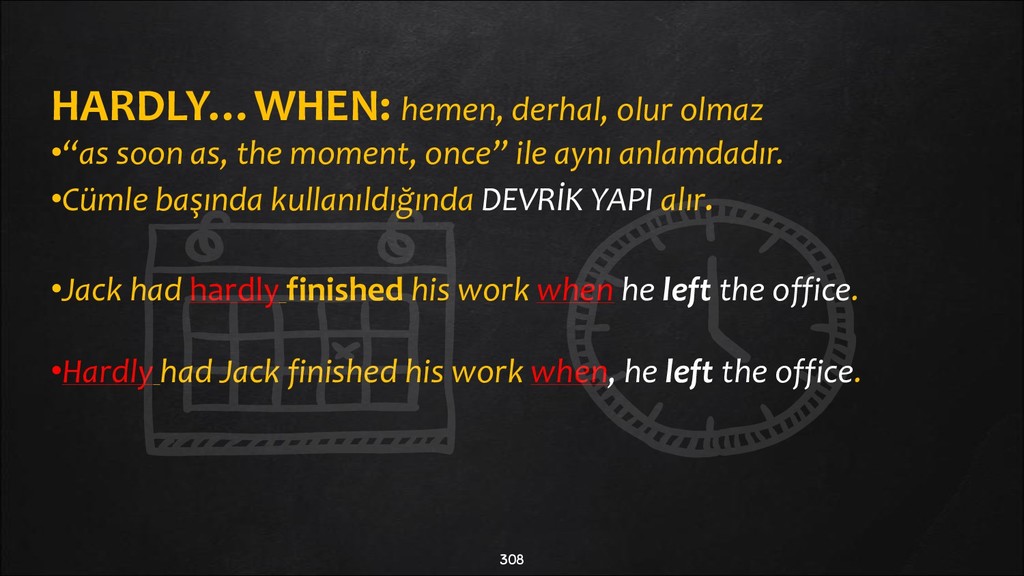
  214. 308 HARDLY…WHEN: hemen, derhal, olur olmaz •“as soon as, the

    moment, once” ile aynı anlamdadır. •Cümle başında kullanıldığında DEVRİK YAPI alır. •Jack had hardly finished his work when he left the office. •Hardly had Jack finished his work when, he left the office.
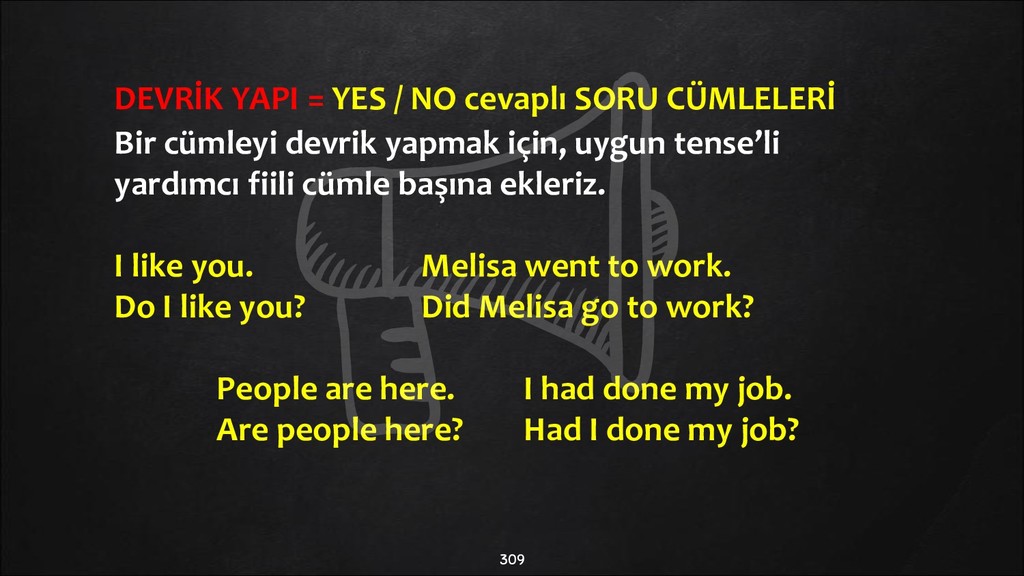
  215. 309 DEVRİK YAPI = YES / NO cevaplı SORU CÜMLELERİ

    Bir cümleyi devrik yapmak için, uygun tense’li yardımcı fiili cümle başına ekleriz. I like you. Melisa went to work. Do I like you? Did Melisa go to work? People are here. I had done my job. Are people here? Had I done my job?
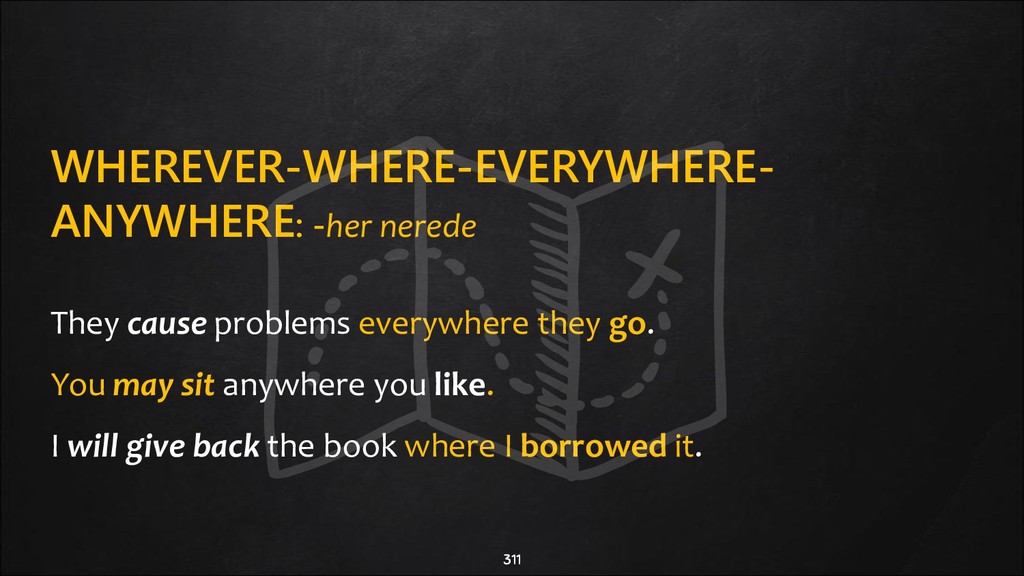
  216. 311 WHEREVER-WHERE-EVERYWHERE- ANYWHERE: -her nerede They cause problems everywhere they

    go. You may sit anywhere you like. I will give back the book where I borrowed it.
  217. 313 BECAUSE / AS: -den ötürü The boys feel angry

    as they have been told lies. As it is dity the carpet needs to be washed. They will give a prize to the woman because she won the competition.
  218. 314 NOW THAT: “şimdi böyle olduğu için” •Sadece PRESENT ve

    FUTURE TENSE’ler ile… Now that there are fundamental differences between Europian cities and Anatolian cities it will not be difficult to decide for the council.
  219. 315 SEEING THAT: “böyle olduğuna göre” Seeing that the economic

    crises is rising, some precautions must be taken immediately.
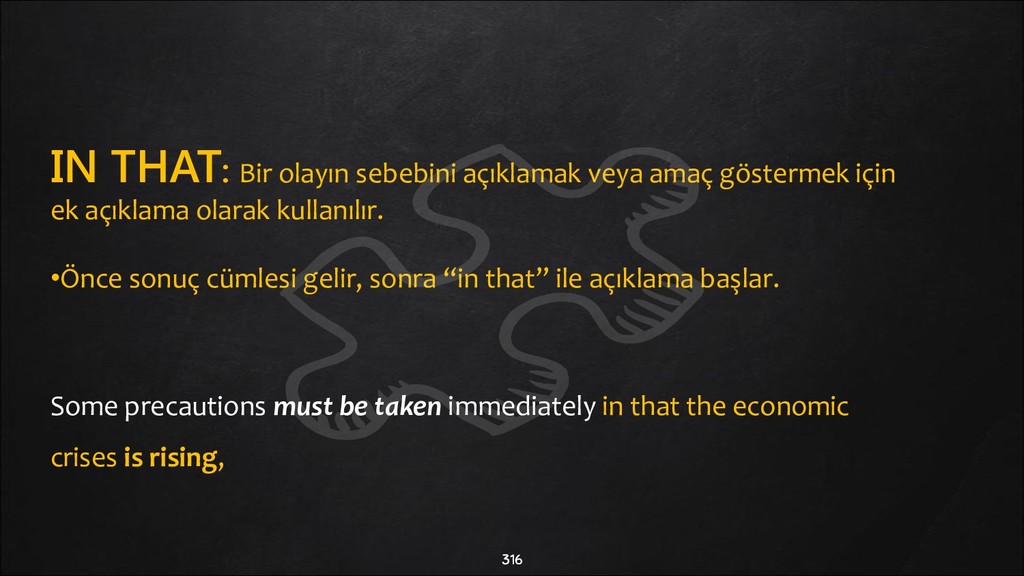
  220. 316 IN THAT: Bir olayın sebebini açıklamak veya amaç göstermek

    için ek açıklama olarak kullanılır. •Önce sonuç cümlesi gelir, sonra “in that” ile açıklama başlar. Some precautions must be taken immediately in that the economic crises is rising,
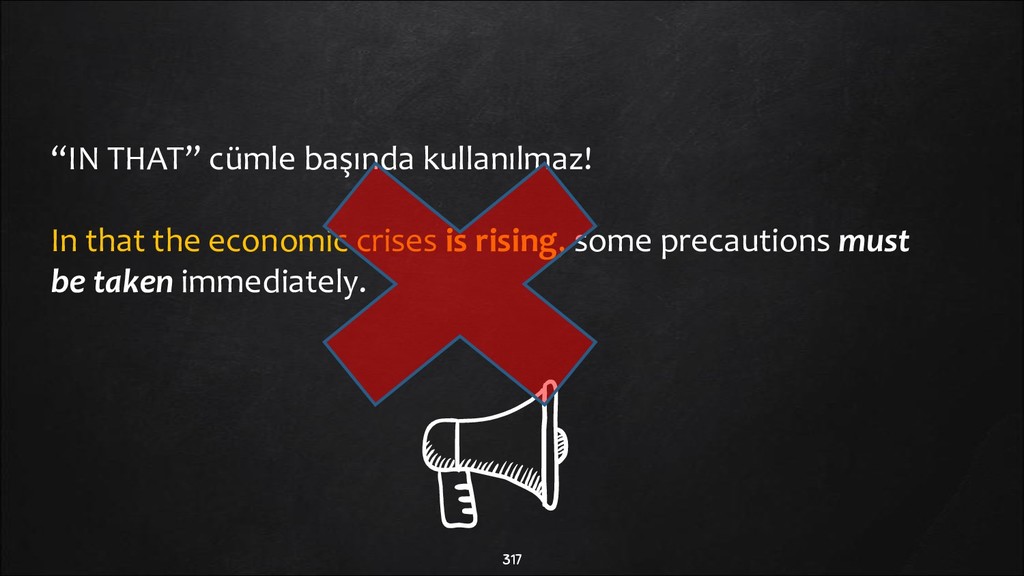
  221. 317 “IN THAT” cümle başında kullanılmaz! In that the economic

    crises is rising, some precautions must be taken immediately.
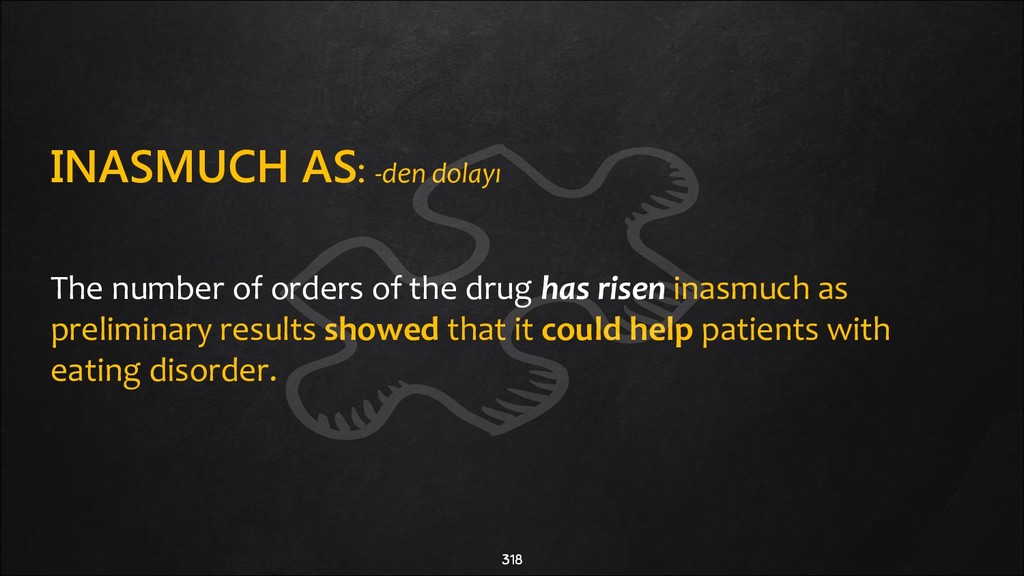
  222. 318 INASMUCH AS: -den dolayı The number of orders of

    the drug has risen inasmuch as preliminary results showed that it could help patients with eating disorder.
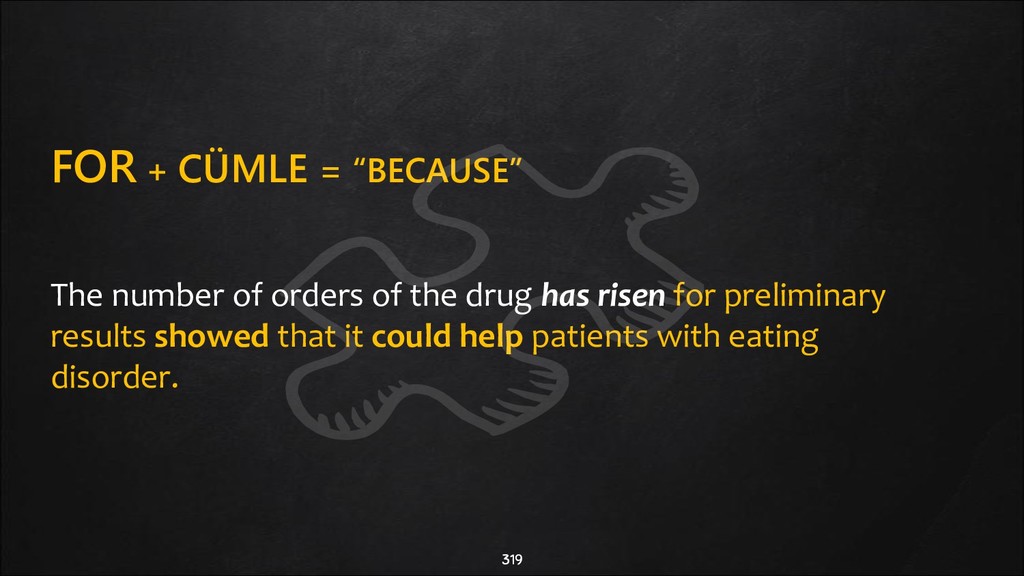
  223. 319 FOR + CÜMLE = “BECAUSE” The number of orders

    of the drug has risen for preliminary results showed that it could help patients with eating disorder.
  224. 320 FOR + CÜMLE = “BECAUSE” The number of orders

    of the drug has risen for preliminary results showed that it could help patients with eating disorder.
  225. 321 “FOR” cümle başında kullanılmaz! For preliminary results showed that

    it could help patients with eating disorder. the number of orders of the drug has risen.
  226. 322 DUE TO THE FACT THAT BECAUSE OF THE FACT

    THAT OWING TO THE FACT THAT IN VIEW OF THE FACT THAT ON THE GROUNDS THAT The research team decided to conduct the study in New York due to the fact that it is a culturally diverse city. = BECAUSE
  227. 324 THOUGH – ALTHOUGH – EVEN THOUGH = -e rağmen

    Although they require some expensive investments amazing developments in surgery saves lives. Even though some extremists think vice versa, opposing ideas should be regarded as a richness.
  228. 325 KPDS KASıM 2007 …, street crime in major Asian

    cities is still less common than in most European cities. a) Since the governmets are concerned b) Because severe measures had been taken c) Though it is rising sharply d) If one were to admit e) Before reliable statical data can be obtained “Still” iki yapıyla çalışır: 1- Present TENSE’ler 2- Zıtlık, tersi durum veya beklenmeyen sonuç bağlaçlarıyla
  229. 327 WHILE - WHEREAS= -ken Sue is sad, while Jack

    is happy. The quality of the goods was excellent, whereas the prices were too high.
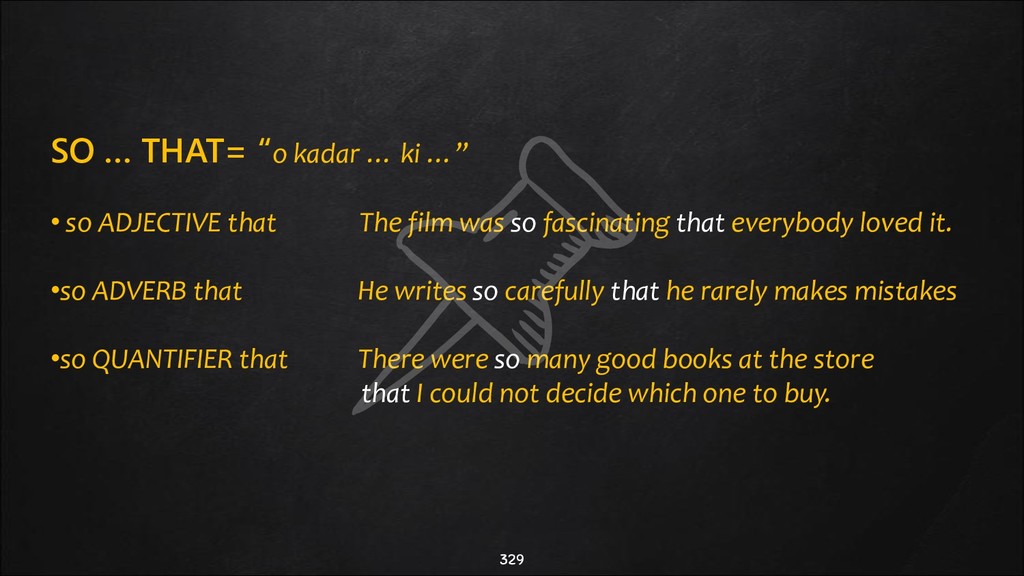
  230. 329 SO … THAT= “o kadar … ki …” •

    so ADJECTIVE that The film was so fascinating that everybody loved it. •so ADVERB that He writes so carefully that he rarely makes mistakes •so QUANTIFIER that There were so many good books at the store that I could not decide which one to buy.
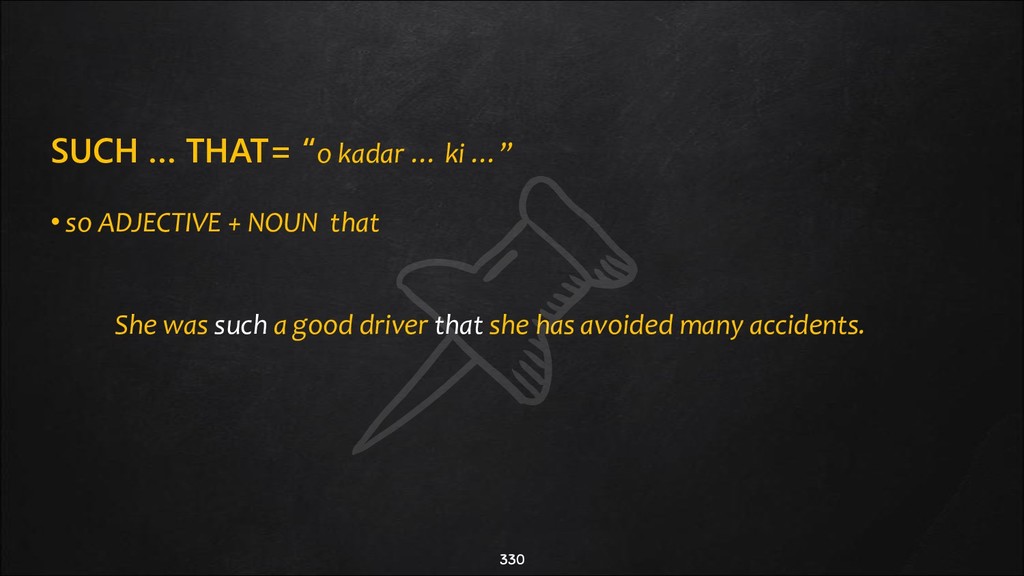
  231. 330 SUCH … THAT= “o kadar … ki …” •

    so ADJECTIVE + NOUN that She was such a good driver that she has avoided many accidents.
  232. 332 SO THAT= “böylelikle, bu yolla” SO THAT = IN

    ORDER THAT •“so that” sonrasındaki cümlede genellikle “can, will, would, may, might” kull. The foundation organised a new campaign so that more people will be awared of the danger.
  233. 333 IN ORDER THAT= “yapabilmek için” •“in order that” sonrasındaki

    cümlede genellikle “can, will, would, may, might” kullanılır. The foundation organised a new campaign in order that more people will be awared of the danger.
  234. 334 “in order that” ve “so that” hakkında bir not!

    “in order that” ve “so that” sonrasında genellikle “will, would, can, could, may, might” MODALLARI gelir. Ve bunlar kısaltılabilir. I came here in order that / so that I can see you. I came here in order to see you. I came here to see you.
  235. 335 FOR THE FEAR THAT= “endişesiyle / korkusuyla” The doctor

    tried a new medicine for the fear that the condition of the patient may get worse. They never trust anyone for the fear that they may encounter the crisis again.
  236. 336 LEST= “olur diye” I locked the door lest someone

    may enter. The sailor checked his compass lest he can learn the right direction.
  237. 337 AS LONG AS – SO LONG AS= müddetçe /

    takdirde • ANA CÜMLE ve CÜMLECİK’te zaman uyumu ister. As long as you pay me, I will work for you. I will send you the products so long as you send us the payment. I will always love you, as long as I live.
  238. 338 “as long as” vs. “as ADJECTIVE as”! “as long

    as” ve “as ADJECTIVE as” yapısı birbirine karıştırılmamalıdır. As long as you live here, you don’t have to pay for rent. The River Kızılırmak is not as long as the River Nile.
  239. 339 YDS EXAMPLES … economic development projects in developing countries

    are carefully thought out and implemented, they can actually contribute to enviromental deterioration. a) But for b) Unless c) Since d) So long as e) Whenever
  240. 340 YDS EXAMPLES … some countries possess nuclear weapons and

    others do not, there will be chronic global insecurity. a) Thanks to b) In case of c) So long as d) Just as e) As if
  241. 341 YDS EXAMPLES So long as certain countries continue to

    shelter terrorists … a) the hope of preserving international security was sheltered b) the un should have taken suitable actions against them c) the government had taken the matter to the helsinki conference d) the chances of eradicating terrorism unfortunately remain silent e) their aims would have been publicly condemned throughout the world
  242. 342 AS FAR AS / SO FAR AS= kadarıyla •

    Tahmin etme ya da görüş bildirme amaçlı olarak “know, concern…” gibi fiillerle sıkça kullanılırlar. As far as I am concerned, energy conservation is a highly over-rated issue. So far as the evidence is concerned, she seems to be a suspect.
  243. 344 THE MORE … THE MORE … = “ne kadar

    ….sa, o kadar…” • İki cümlenin önüne getirerek karşılaştırma yapar. The more you work, the more you earn. The older you get, the slower you will be.
  244. 345 IN SO FAR AS= “olduğu kadar” I will help

    you in so far as I can. His criminal connections are no more than suspicions in so far as the police are concerned.