Upgrade to Pro — share decks privately, control downloads, hide ads and more …

Air–Sea Interaction: drag that follows the sea ...

Sponsored · Your Podcast. Everywhere. Effortlessly. Share. Educate. Inspire. Entertain. You do you. We'll handle the rest. →

Air–Sea Interaction: drag that follows the sea state, not just the wind

MIKE 21 Spectral Waves FM adds the Janssen & Bidlot (2023) wind-input source term for young, steep seas. The drag coefficient is no longer capped. Validation covers six North Sea storms against satellite altimetry, plus Typhoon Saola. It matters for aquaculture sites, storm surge, offshore wind and enclosed seas. Release 2027.

MIKE Powered by DHI PRO

November 19, 2026

Transcript

9 slides
  1. MIKE 21 SPECTRAL WAVES FM Air–Sea Interaction A new wind-input

    source term for young, steep seas, after Janssen & Bidlot (2023) What's new | Release 2027 © DHI
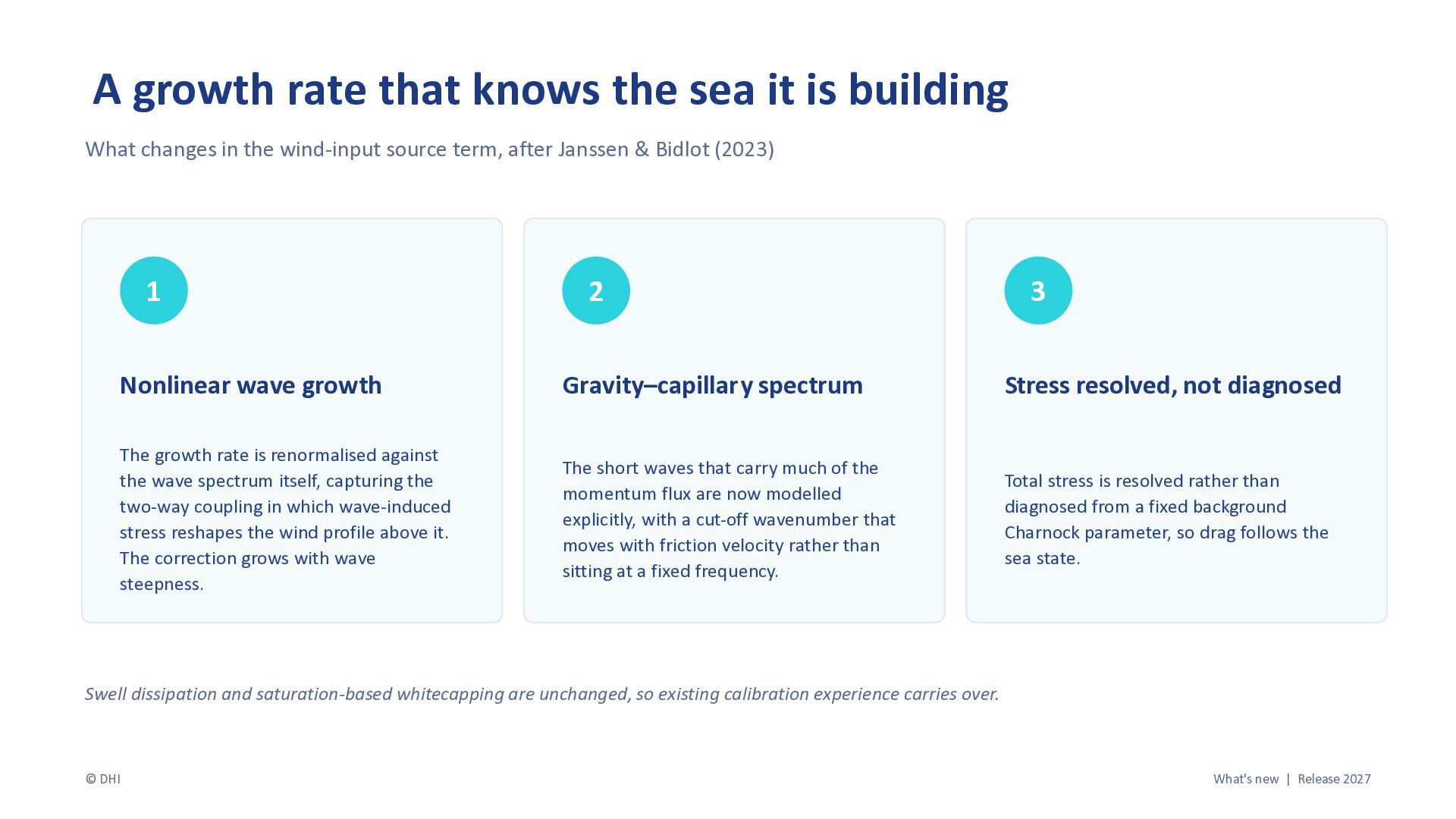
  2. A growth rate that knows the sea it is building

    What changes in the wind-input source term, after Janssen & Bidlot (2023) 1 2 3 Nonlinear wave growth Gravity–capillary spectrum Stress resolved, not diagnosed The growth rate is renormalised against the wave spectrum itself, capturing the two-way coupling in which wave-induced stress reshapes the wind profile above it. The correction grows with wave steepness. The short waves that carry much of the momentum flux are now modelled explicitly, with a cut-off wavenumber that moves with friction velocity rather than sitting at a fixed frequency. Total stress is resolved rather than diagnosed from a fixed background Charnock parameter, so drag follows the sea state. Swell dissipation and saturation-based whitecapping are unchanged, so existing calibration experience carries over. © DHI What's new | Release 2027
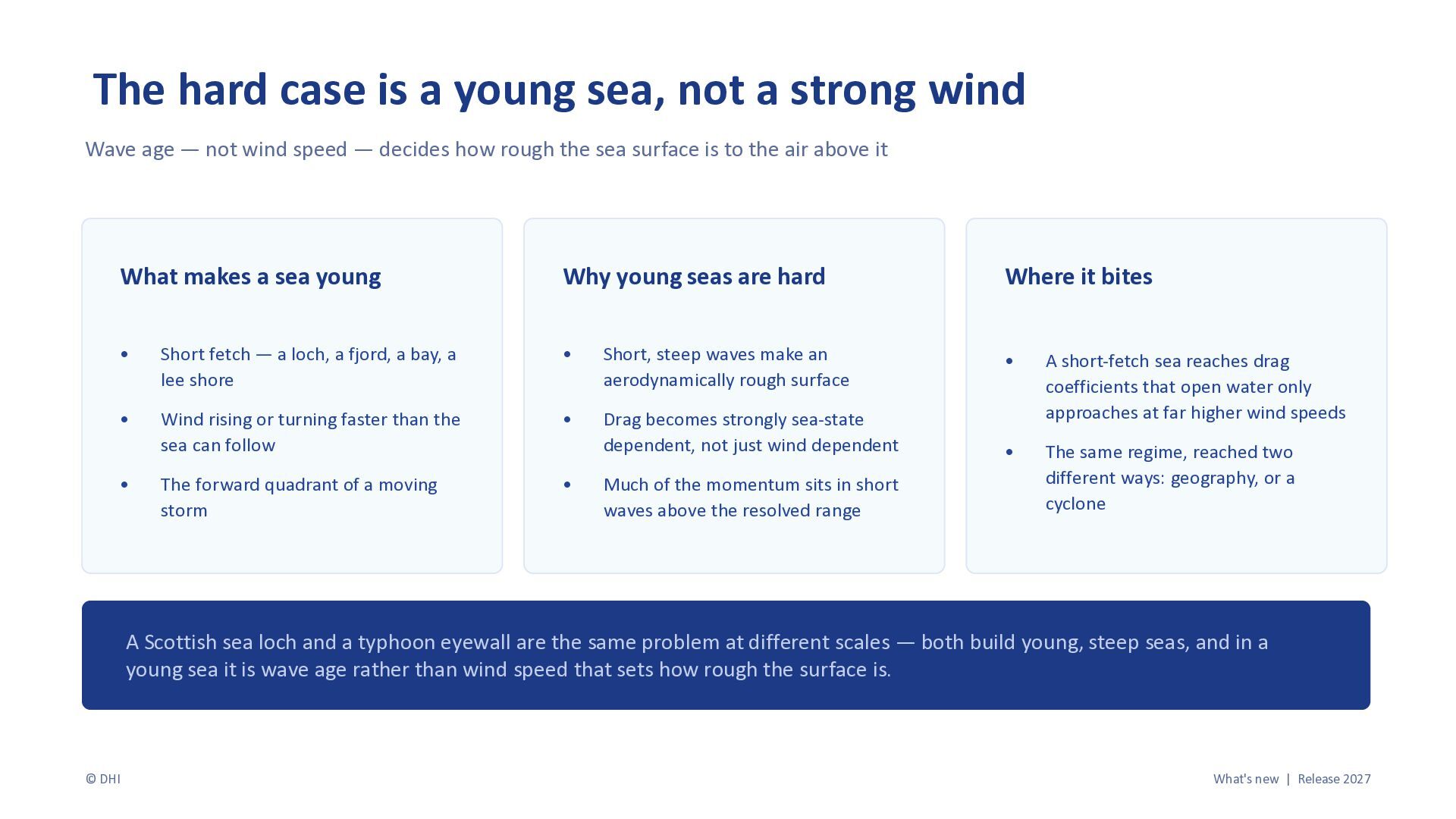
  3. The hard case is a young sea, not a strong

    wind Wave age — not wind speed — decides how rough the sea surface is to the air above it What makes a sea young Why young seas are hard Where it bites • Short fetch — a loch, a fjord, a bay, a lee shore • Short, steep waves make an aerodynamically rough surface • • Wind rising or turning faster than the sea can follow • Drag becomes strongly sea-state dependent, not just wind dependent A short-fetch sea reaches drag coefficients that open water only approaches at far higher wind speeds • The forward quadrant of a moving storm • The same regime, reached two different ways: geography, or a cyclone • Much of the momentum sits in short waves above the resolved range A Scottish sea loch and a typhoon eyewall are the same problem at different scales — both build young, steep seas, and in a young sea it is wave age rather than wind speed that sets how rough the surface is. © DHI What's new | Release 2027
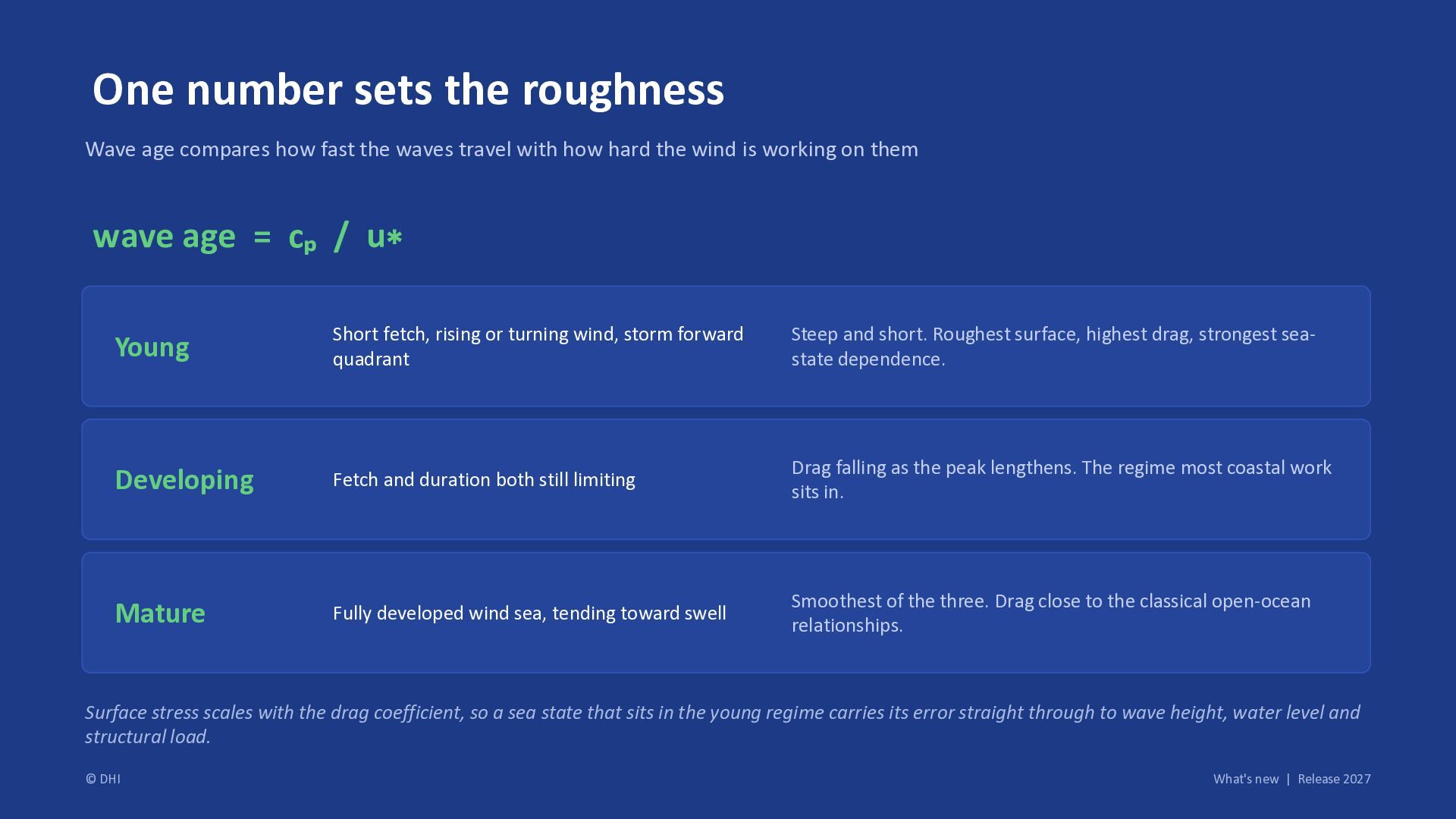
  4. One number sets the roughness Wave age compares how fast

    the waves travel with how hard the wind is working on them wave age = cₚ / u∗ Young Short fetch, rising or turning wind, storm forward quadrant Steep and short. Roughest surface, highest drag, strongest seastate dependence. Developing Fetch and duration both still limiting Drag falling as the peak lengthens. The regime most coastal work sits in. Mature Fully developed wind sea, tending toward swell Smoothest of the three. Drag close to the classical open-ocean relationships. Surface stress scales with the drag coefficient, so a sea state that sits in the young regime carries its error straight through to wave height, water level and structural load. © DHI What's new | Release 2027
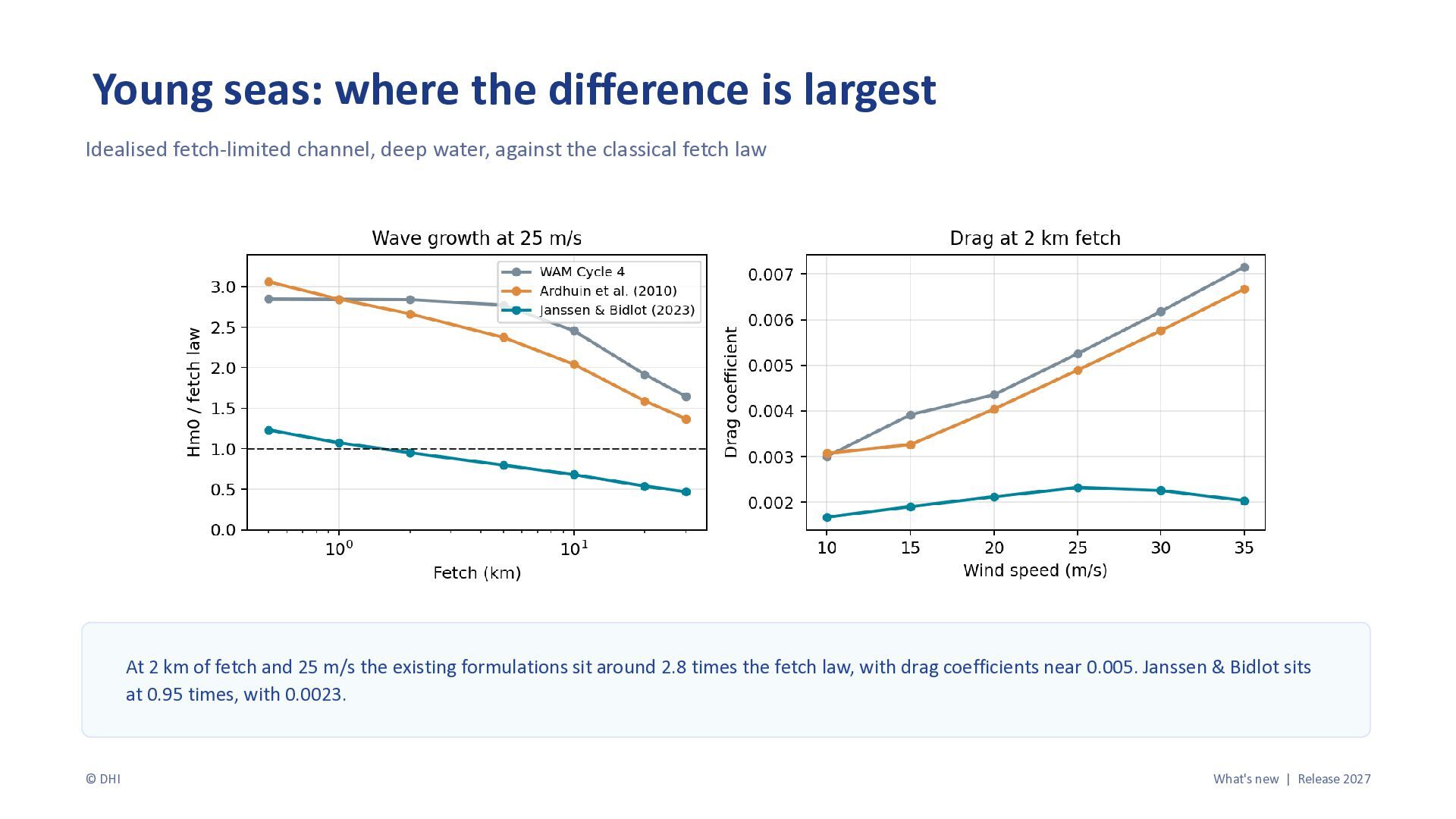
  5. Young seas: where the difference is largest Idealised fetch-limited channel,

    deep water, against the classical fetch law At 2 km of fetch and 25 m/s the existing formulations sit around 2.8 times the fetch law, with drag coefficients near 0.005. Janssen & Bidlot sits at 0.95 times, with 0.0023. © DHI What's new | Release 2027
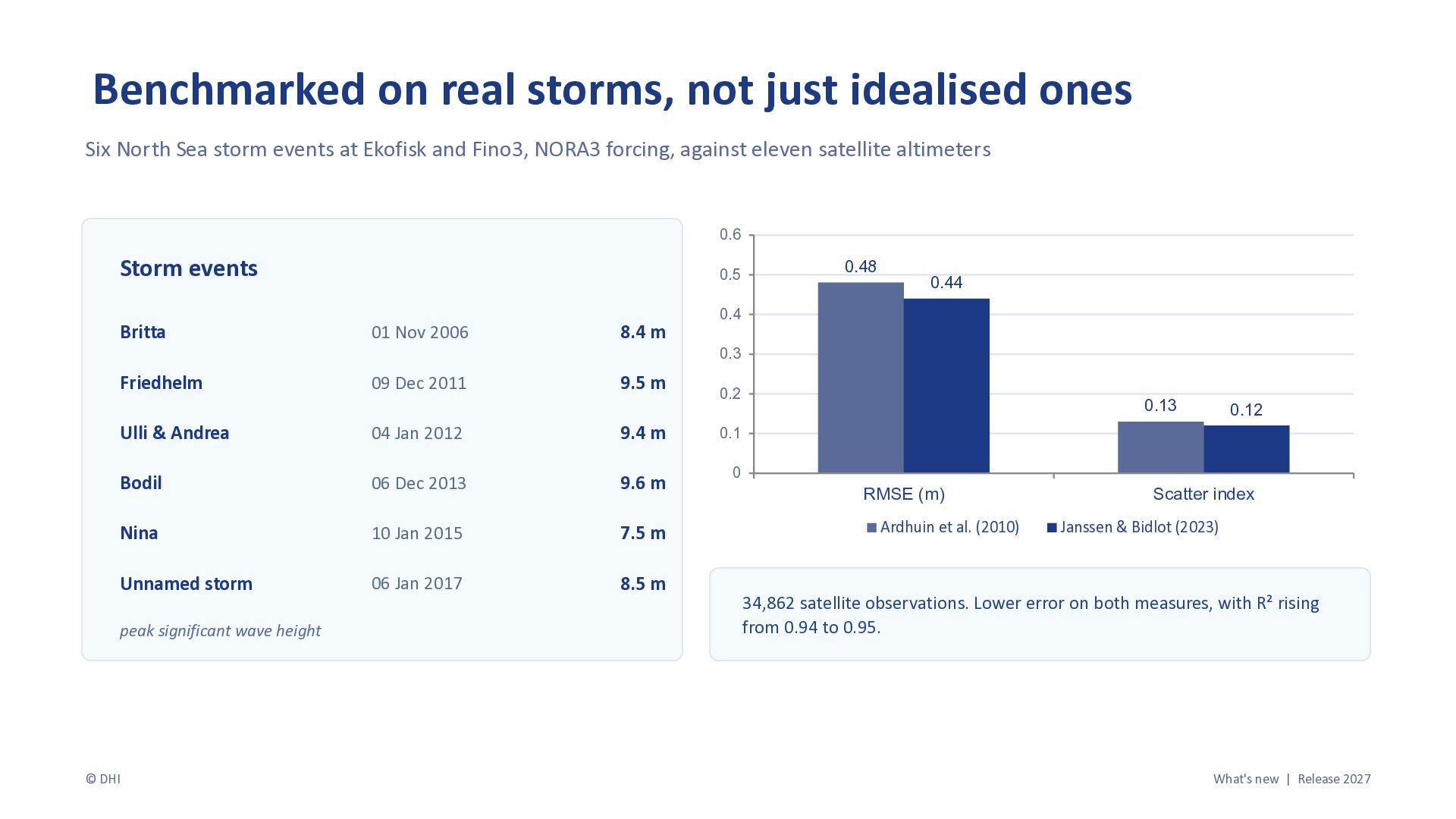
  6. Benchmarked on real storms, not just idealised ones Six North

    Sea storm events at Ekofisk and Fino3, NORA3 forcing, against eleven satellite altimeters 0.6 Storm events Britta 01 Nov 2006 8.4 m Friedhelm 09 Dec 2011 9.5 m 0.48 0.44 0.4 0.3 0.2 Ulli & Andrea 04 Jan 2012 9.4 m 0.1 Bodil 06 Dec 2013 9.6 m 0 Nina 10 Jan 2015 7.5 m Unnamed storm 06 Jan 2017 8.5 m peak significant wave height © DHI 0.5 0.13 RMSE (m) Ardhuin et al. (2010) 0.12 Scatter index Janssen & Bidlot (2023) 34,862 satellite observations. Lower error on both measures, with R² rising from 0.94 to 0.95. What's new | Release 2027
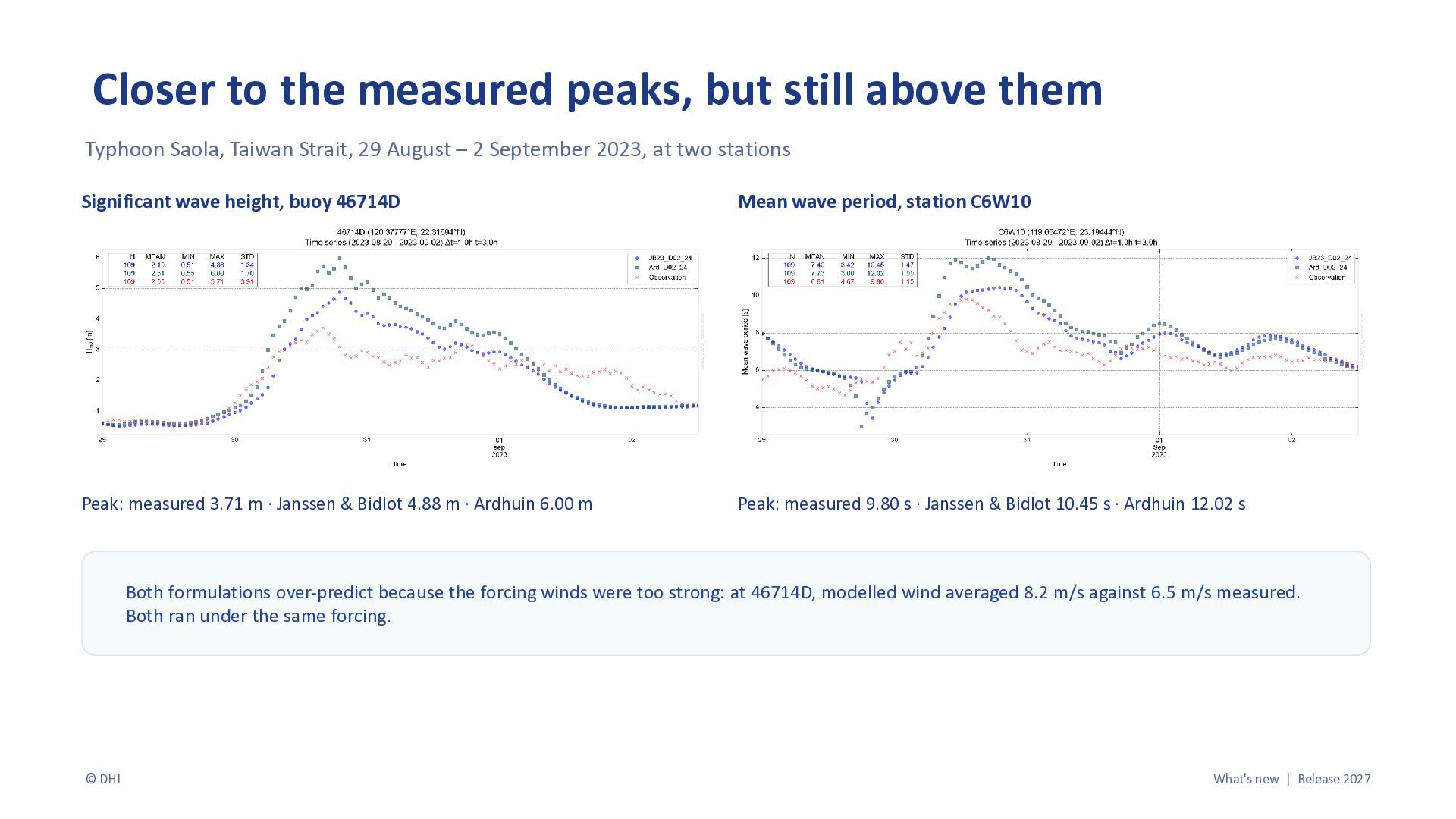
  7. Closer to the measured peaks, but still above them Typhoon

    Saola, Taiwan Strait, 29 August – 2 September 2023, at two stations Significant wave height, buoy 46714D Mean wave period, station C6W10 Peak: measured 3.71 m · Janssen & Bidlot 4.88 m · Ardhuin 6.00 m Peak: measured 9.80 s · Janssen & Bidlot 10.45 s · Ardhuin 12.02 s Both formulations over-predict because the forcing winds were too strong: at 46714D, modelled wind averaged 8.2 m/s against 6.5 m/s measured. Both ran under the same forcing. © DHI What's new | Release 2027
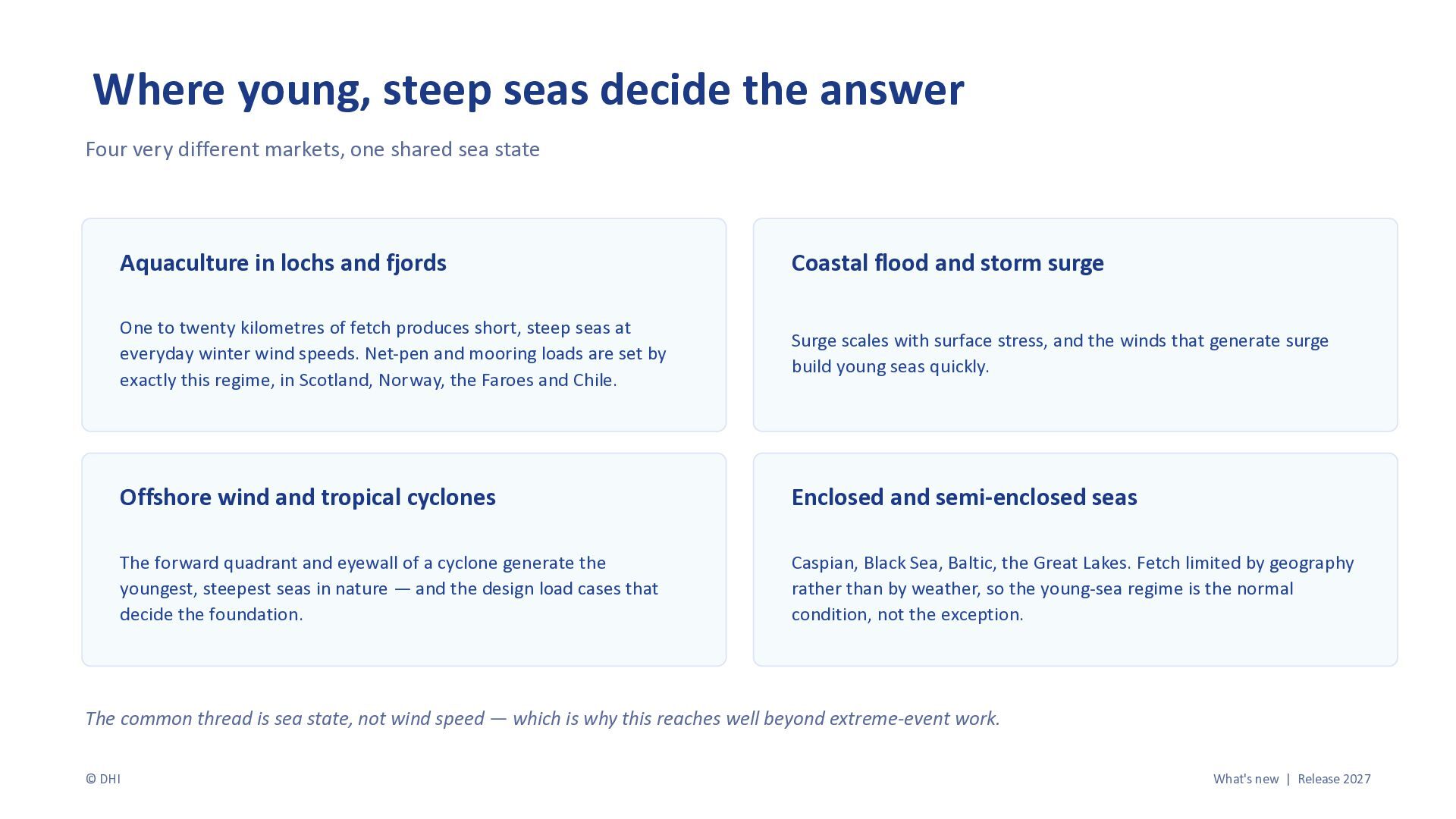
  8. Where young, steep seas decide the answer Four very different

    markets, one shared sea state Aquaculture in lochs and fjords Coastal flood and storm surge One to twenty kilometres of fetch produces short, steep seas at everyday winter wind speeds. Net-pen and mooring loads are set by exactly this regime, in Scotland, Norway, the Faroes and Chile. Surge scales with surface stress, and the winds that generate surge build young seas quickly. Offshore wind and tropical cyclones Enclosed and semi-enclosed seas The forward quadrant and eyewall of a cyclone generate the youngest, steepest seas in nature — and the design load cases that decide the foundation. Caspian, Black Sea, Baltic, the Great Lakes. Fetch limited by geography rather than by weather, so the young-sea regime is the normal condition, not the exception. The common thread is sea state, not wind speed — which is why this reaches well beyond extreme-event work. © DHI What's new | Release 2027
  9. Sea states that decide the design • Nonlinear wave growth

    and an explicit gravity–capillary spectrum, after Janssen & Bidlot (2023) • Drag coefficient resolved through the young, steep sea states that set design conditions • Benchmarked on six North Sea storms against satellite altimetry: RMSE in Hs 0.44 m against 0.48 m • No change to your mesh, your forcing or your calibration experience MIKE 21 Spectral Waves FM | Release 2027 © DHI What's new | Release 2027

More Decks by MIKE Powered by DHI

Other Decks in Science