Upgrade to Pro — share decks privately, control downloads, hide ads and more …

Why does the runup come out too low? Infragravi...

Why does the runup come out too low? Infragravity waves in MIKE 21/3 Coupled Model FM

Bound infragravity waves are generated from the parametric spectrum at the offshore boundary: two check boxes, and no wave-maker file. Waves, currents and sand transport respond to wave groups in the same run, for runup, overtopping, dune erosion and storm transport. Includes the new non-reflecting level boundary. Release 2027.

Avatar for MIKE Powered by DHI

MIKE Powered by DHI PRO

November 12, 2026

More Decks by MIKE Powered by DHI

Other Decks in Science

Transcript

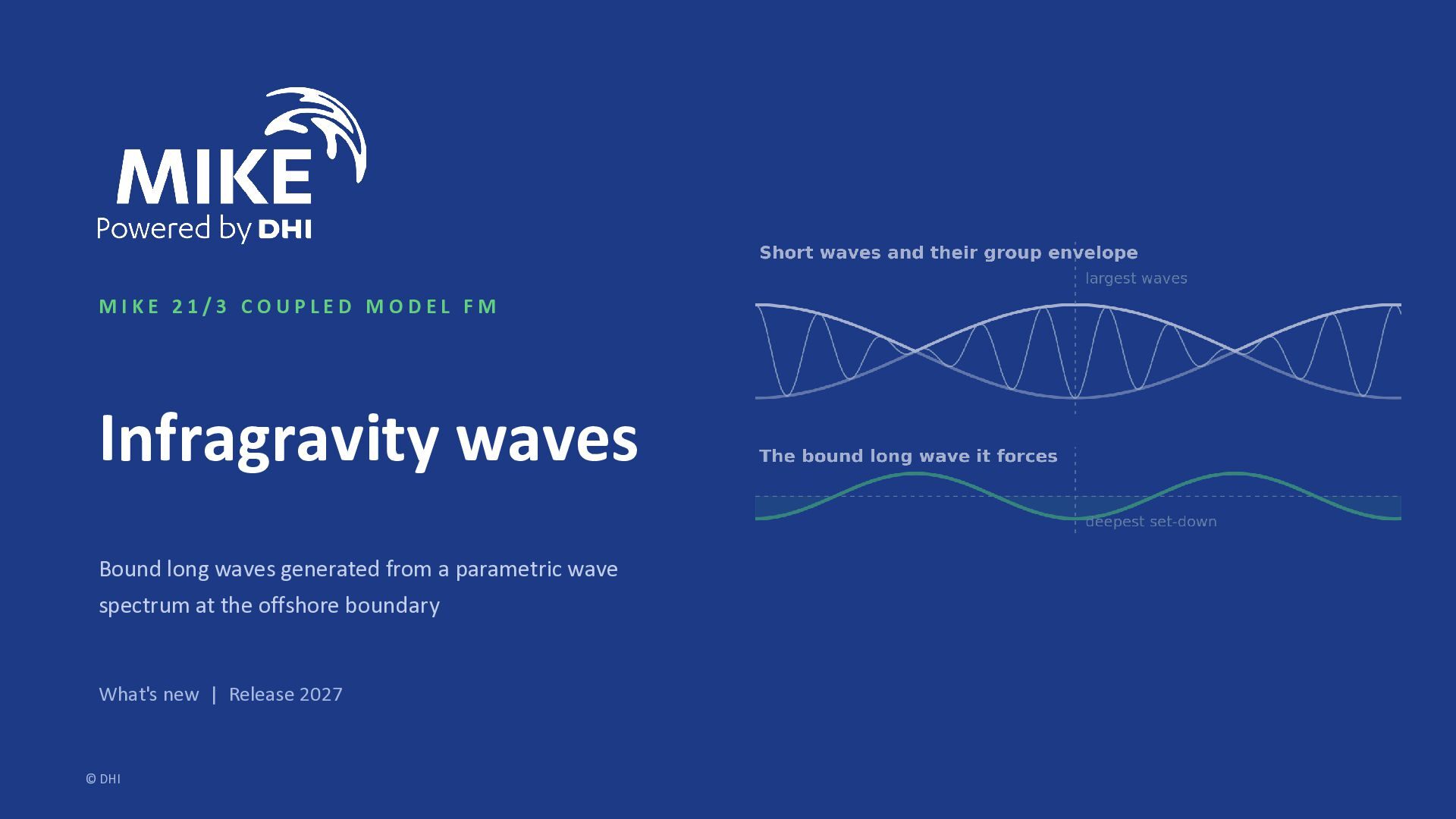
  1. MIKE 21/3 COUPLED MODEL FM Infragravity waves Bound long waves

    generated from a parametric wave spectrum at the offshore boundary What's new | Release 2027 © DHI
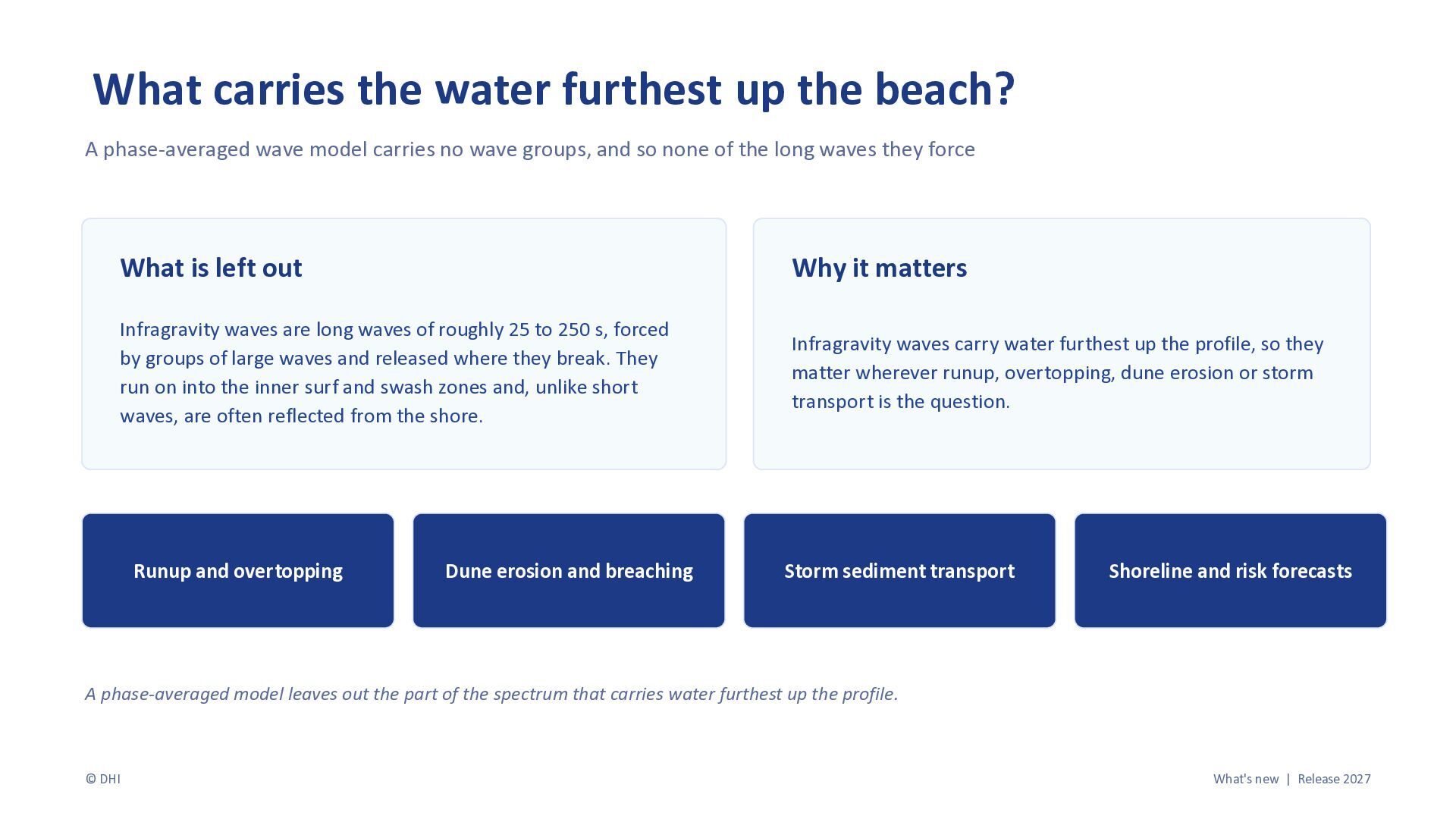
  2. What carries the water furthest up the beach? A phase-averaged

    wave model carries no wave groups, and so none of the long waves they force What is left out Why it matters Infragravity waves are long waves of roughly 25 to 250 s, forced by groups of large waves and released where they break. They run on into the inner surf and swash zones and, unlike short waves, are often reflected from the shore. Infragravity waves carry water furthest up the profile, so they matter wherever runup, overtopping, dune erosion or storm transport is the question. Runup and overtopping Storm sediment transport Dune erosion and breaching Shoreline and risk forecasts A phase-averaged model leaves out the part of the spectrum that carries water furthest up the profile. © DHI What's new | Release 2027
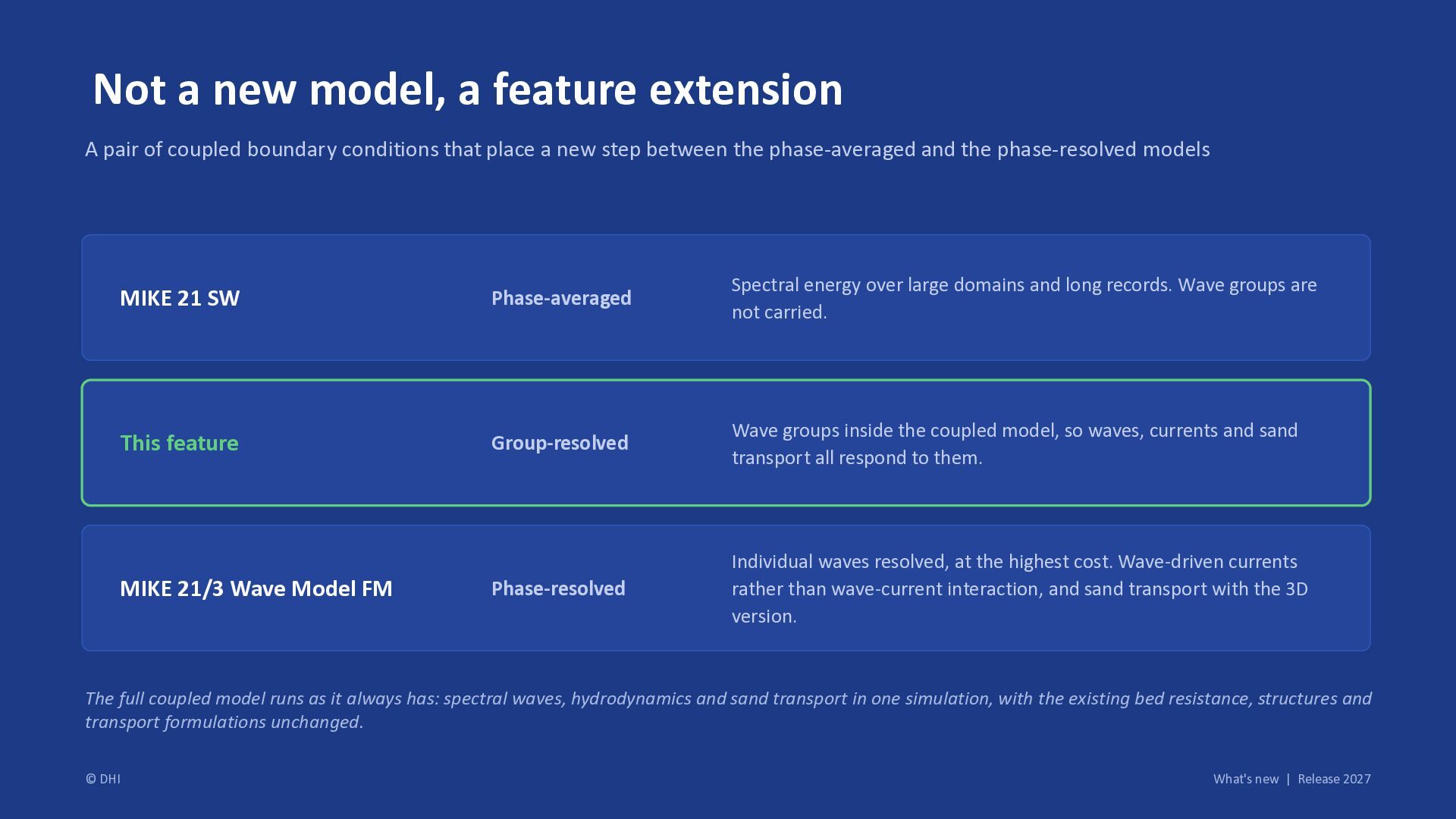
  3. Not a new model, a feature extension A pair of

    coupled boundary conditions that place a new step between the phase-averaged and the phase-resolved models MIKE 21 SW Phase-averaged Spectral energy over large domains and long records. Wave groups are not carried. This feature Group-resolved Wave groups inside the coupled model, so waves, currents and sand transport all respond to them. Phase-resolved Individual waves resolved, at the highest cost. Wave-driven currents rather than wave-current interaction, and sand transport with the 3D version. MIKE 21/3 Wave Model FM The full coupled model runs as it always has: spectral waves, hydrodynamics and sand transport in one simulation, with the existing bed resistance, structures and transport formulations unchanged. © DHI What's new | Release 2027
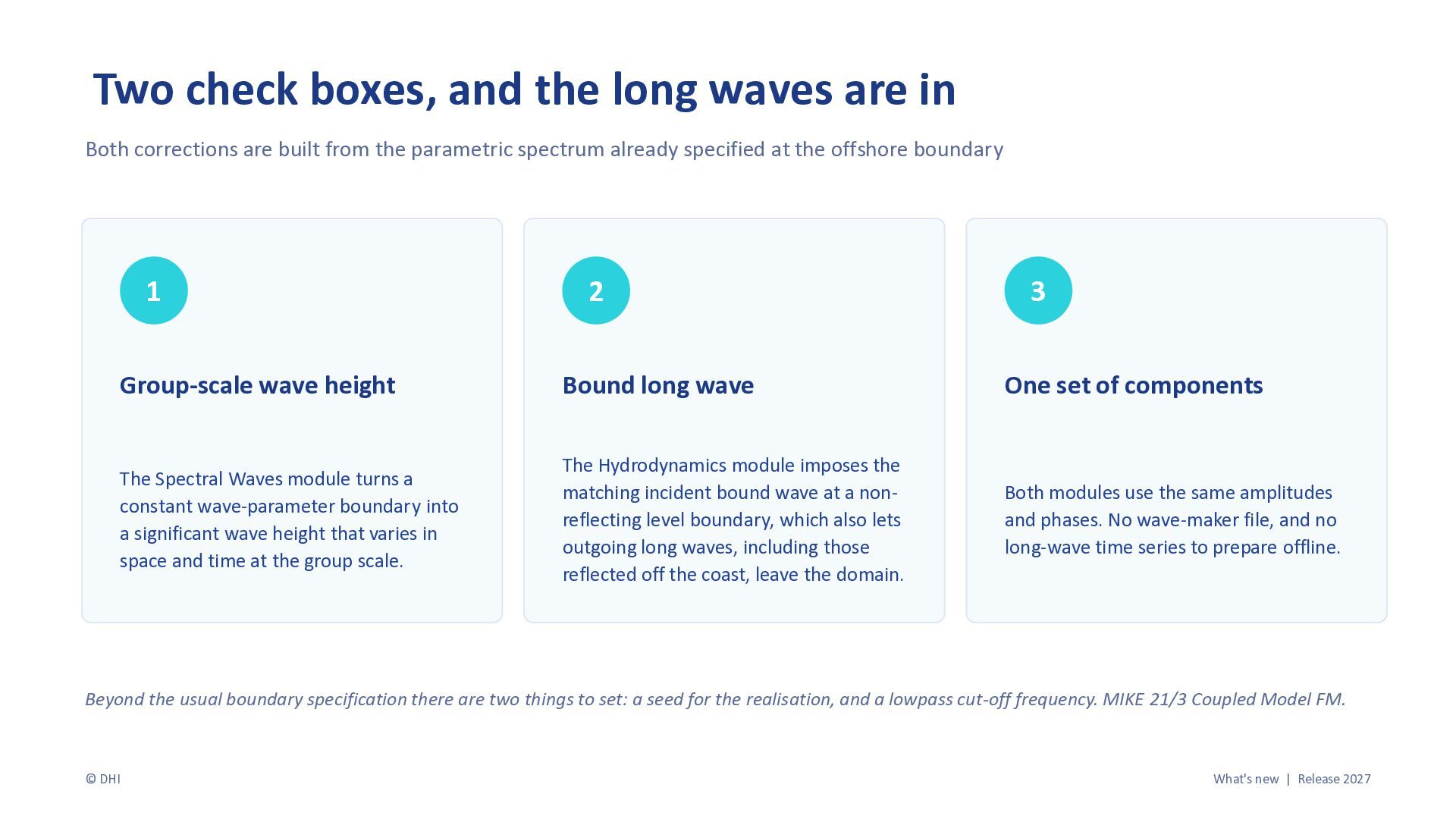
  4. Two check boxes, and the long waves are in Both

    corrections are built from the parametric spectrum already specified at the offshore boundary 1 2 3 Group-scale wave height Bound long wave One set of components The Spectral Waves module turns a constant wave-parameter boundary into a significant wave height that varies in space and time at the group scale. The Hydrodynamics module imposes the matching incident bound wave at a nonreflecting level boundary, which also lets outgoing long waves, including those reflected off the coast, leave the domain. Both modules use the same amplitudes and phases. No wave-maker file, and no long-wave time series to prepare offline. Beyond the usual boundary specification there are two things to set: a seed for the realisation, and a lowpass cut-off frequency. MIKE 21/3 Coupled Model FM. © DHI What's new | Release 2027
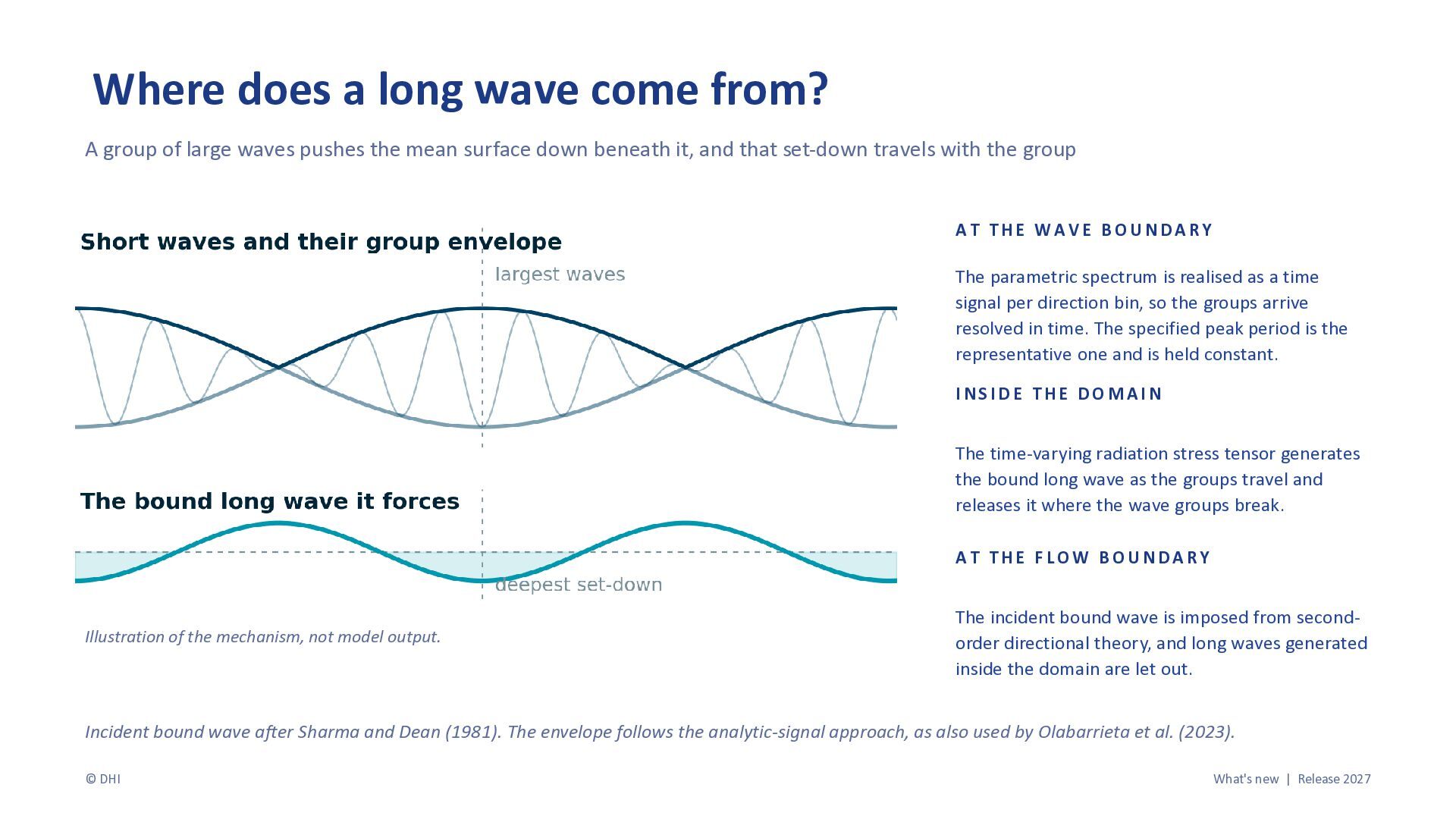
  5. Where does a long wave come from? A group of

    large waves pushes the mean surface down beneath it, and that set-down travels with the group AT THE WAVE BOUNDARY The parametric spectrum is realised as a time signal per direction bin, so the groups arrive resolved in time. The specified peak period is the representative one and is held constant. INSIDE THE DOMAIN The time-varying radiation stress tensor generates the bound long wave as the groups travel and releases it where the wave groups break. AT THE FLOW BOUNDARY Illustration of the mechanism, not model output. The incident bound wave is imposed from secondorder directional theory, and long waves generated inside the domain are let out. Incident bound wave after Sharma and Dean (1981). The envelope follows the analytic-signal approach, as also used by Olabarrieta et al. (2023). © DHI What's new | Release 2027
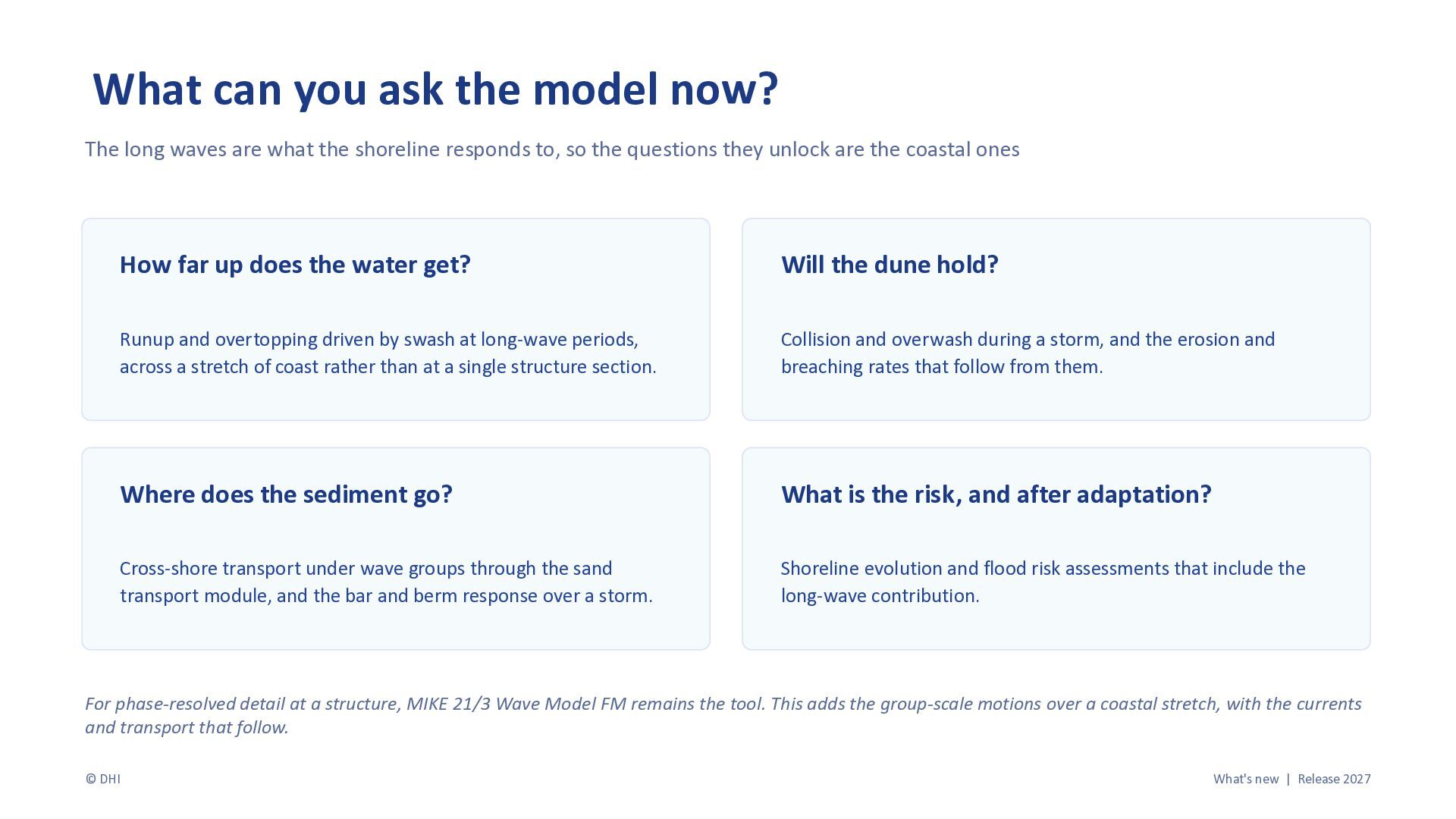
  6. What can you ask the model now? The long waves

    are what the shoreline responds to, so the questions they unlock are the coastal ones How far up does the water get? Will the dune hold? Runup and overtopping driven by swash at long-wave periods, across a stretch of coast rather than at a single structure section. Collision and overwash during a storm, and the erosion and breaching rates that follow from them. Where does the sediment go? What is the risk, and after adaptation? Cross-shore transport under wave groups through the sand transport module, and the bar and berm response over a storm. Shoreline evolution and flood risk assessments that include the long-wave contribution. For phase-resolved detail at a structure, MIKE 21/3 Wave Model FM remains the tool. This adds the group-scale motions over a coastal stretch, with the currents and transport that follow. © DHI What's new | Release 2027
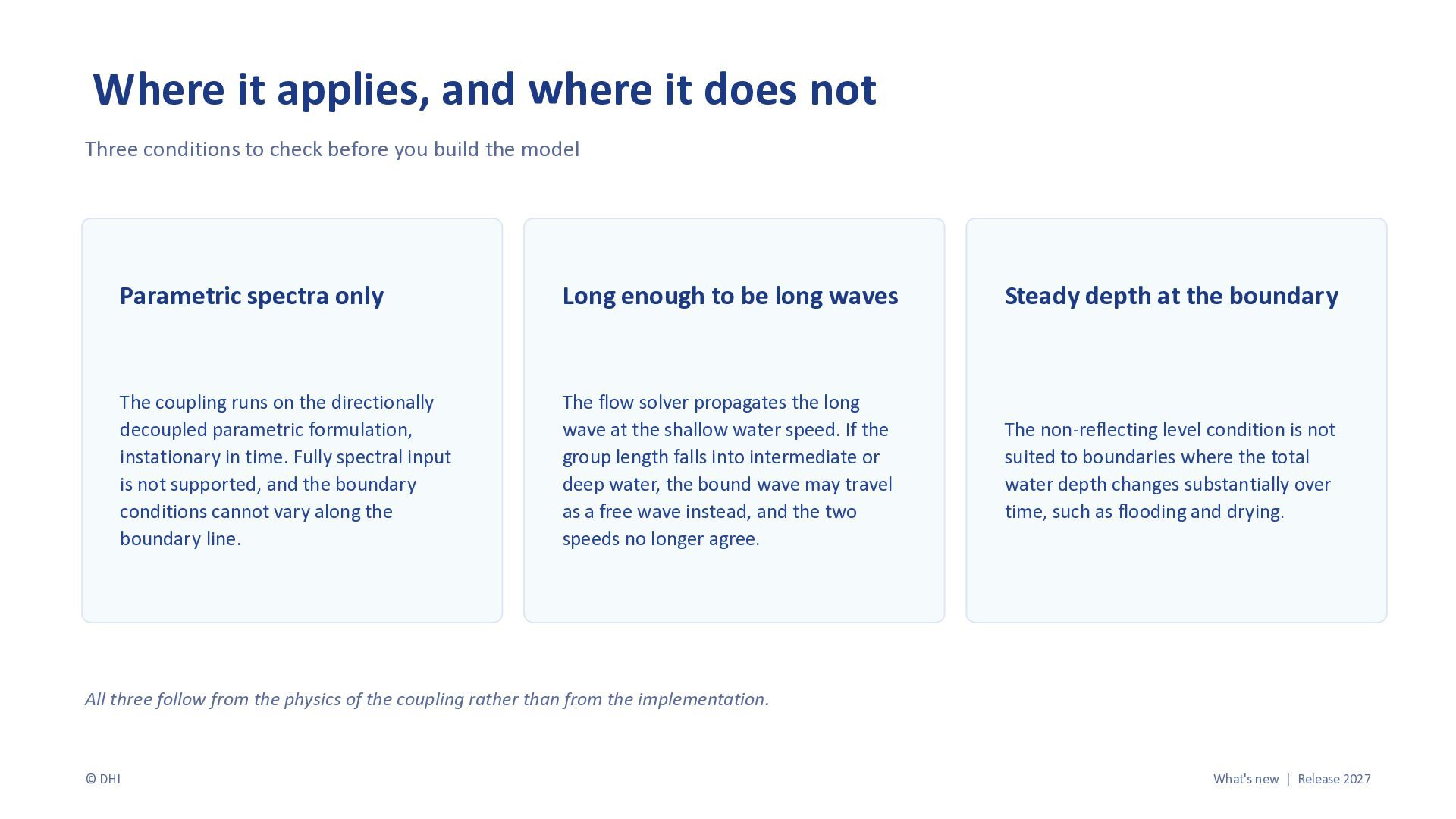
  7. Where it applies, and where it does not Three conditions

    to check before you build the model Parametric spectra only Long enough to be long waves Steady depth at the boundary The coupling runs on the directionally decoupled parametric formulation, instationary in time. Fully spectral input is not supported, and the boundary conditions cannot vary along the boundary line. The flow solver propagates the long wave at the shallow water speed. If the group length falls into intermediate or deep water, the bound wave may travel as a free wave instead, and the two speeds no longer agree. The non-reflecting level condition is not suited to boundaries where the total water depth changes substantially over time, such as flooding and drying. All three follow from the physics of the coupling rather than from the implementation. © DHI What's new | Release 2027
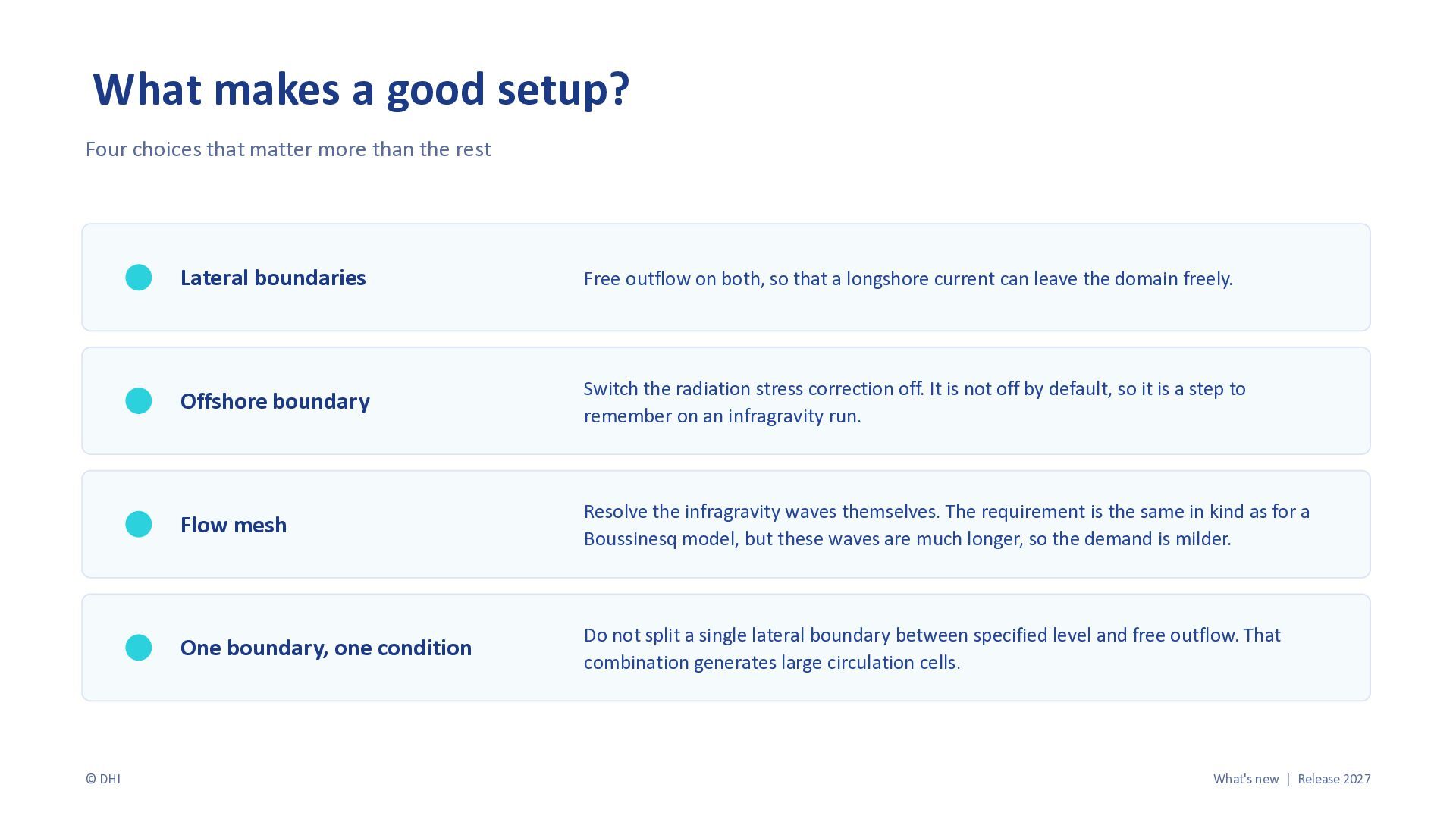
  8. What makes a good setup? Four choices that matter more

    than the rest © DHI Lateral boundaries Free outflow on both, so that a longshore current can leave the domain freely. Offshore boundary Switch the radiation stress correction off. It is not off by default, so it is a step to remember on an infragravity run. Flow mesh Resolve the infragravity waves themselves. The requirement is the same in kind as for a Boussinesq model, but these waves are much longer, so the demand is milder. One boundary, one condition Do not split a single lateral boundary between specified level and free outflow. That combination generates large circulation cells. What's new | Release 2027
  9. A boundary that lets long waves out New in the

    Hydrodynamics module of MIKE 21 Flow Model FM, MIKE 3 Flow Model FM and MIKE 21/3 Coupled Model FM Not only for infragravity Where that bites The same caveat as before The non-reflecting level boundary is a feature in its own right. You have seen it here carrying the incident bound wave, but it works without any of the infragravity settings, anywhere outgoing long waves would otherwise reflect off your offshore boundary and come back into the model. Harbour seiching and basin resonance. Tsunami and long-wave propagation. Storm surge on a shelf. Moored vessel response at a berth. In each case, energy reflected at the boundary is energy that never left, and it contaminates the interior solution for the rest of the run. Not suited to boundaries where the total water depth changes substantially over time, such as flooding and drying. A separate feature in this release, developed alongside the infragravity boundary conditions and usable without them. © DHI What's new | Release 2027
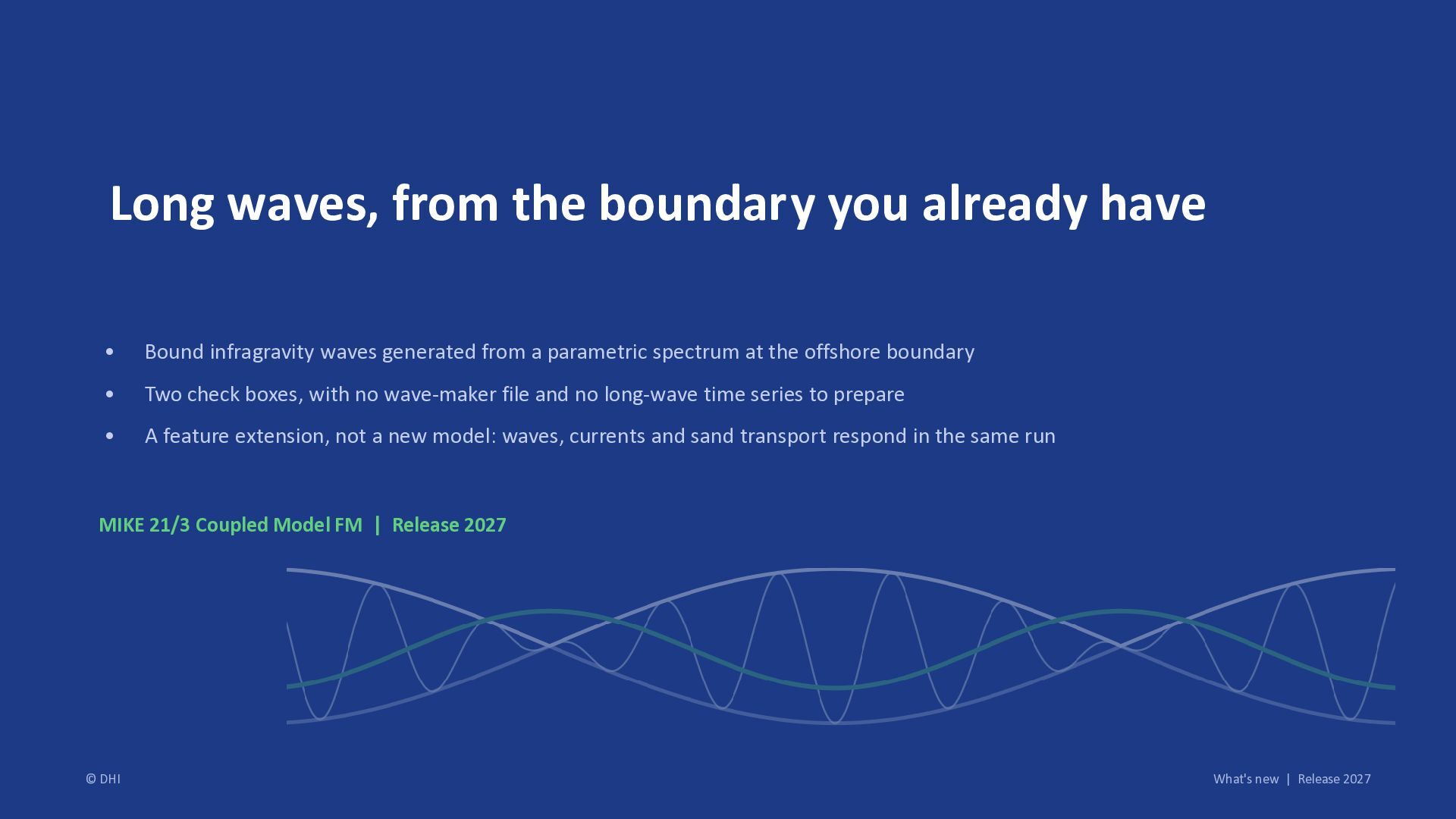
  10. Long waves, from the boundary you already have • Bound

    infragravity waves generated from a parametric spectrum at the offshore boundary • Two check boxes, with no wave-maker file and no long-wave time series to prepare • A feature extension, not a new model: waves, currents and sand transport respond in the same run MIKE 21/3 Coupled Model FM | Release 2027 © DHI What's new | Release 2027