Upgrade to Pro — share decks privately, control downloads, hide ads and more …

Moving Vessels: ship wake from the 3D Navier-St...

Moving Vessels: ship wake from the 3D Navier-Stokes solver

A vessel travels a defined track and generates its own wave field. Subcritical, transcritical and supercritical behaviour emerge from the solution. In a numerical towing tank, simulated wake angles fall within about 3% of Havelock theory. MIKE 21/3 Wave and Flow Models FM, Release 2027.

Avatar for MIKE Powered by DHI

MIKE Powered by DHI PRO

November 12, 2026

More Decks by MIKE Powered by DHI

Other Decks in Science

Transcript

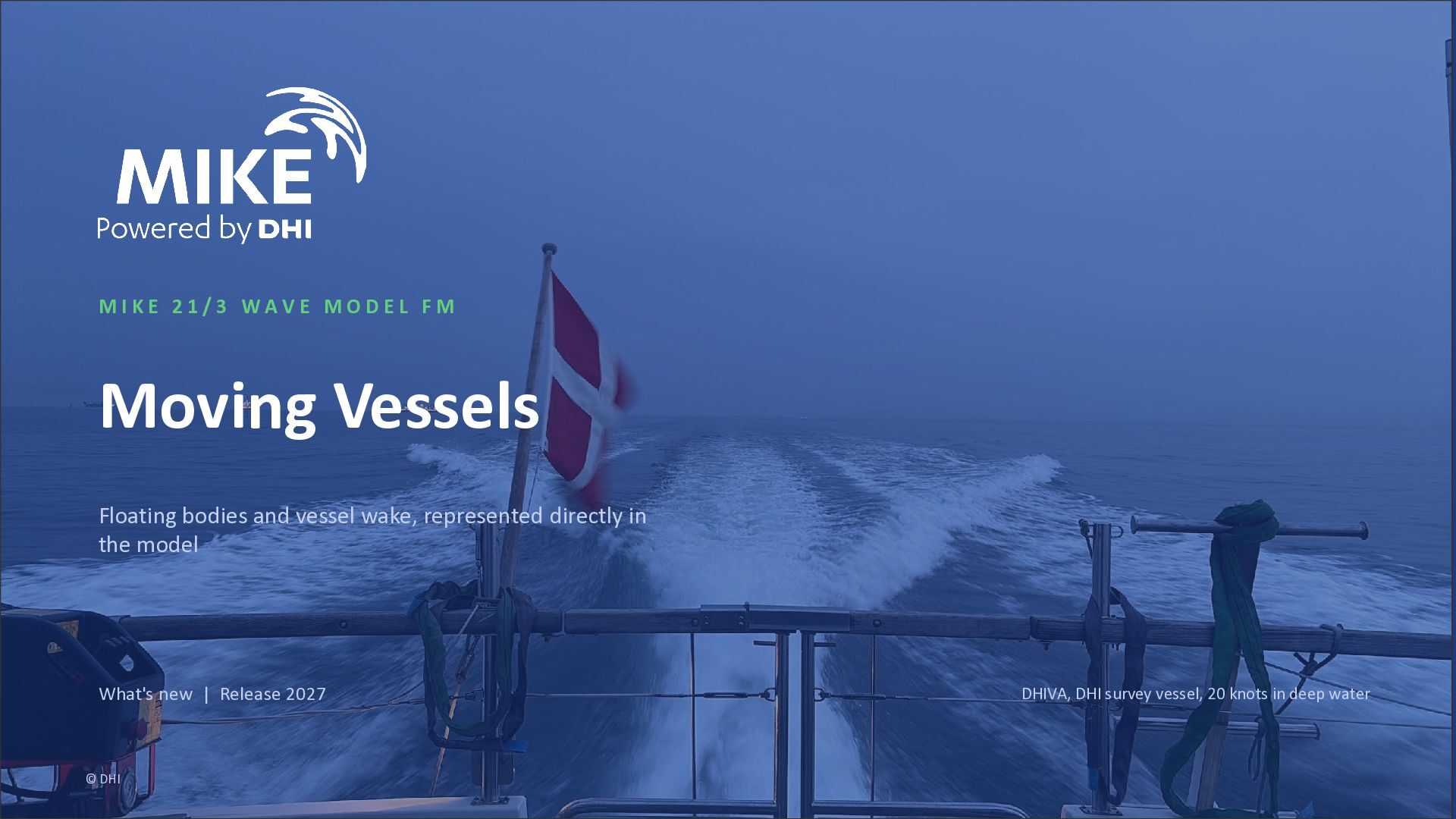
  1. MIKE 21/3 WAVE MODEL FM Moving Vessels Floating bodies and

    vessel wake, represented directly in the model What's new | Release 2027 © DHI DHIVA, DHI survey vessel, 20 knots in deep water
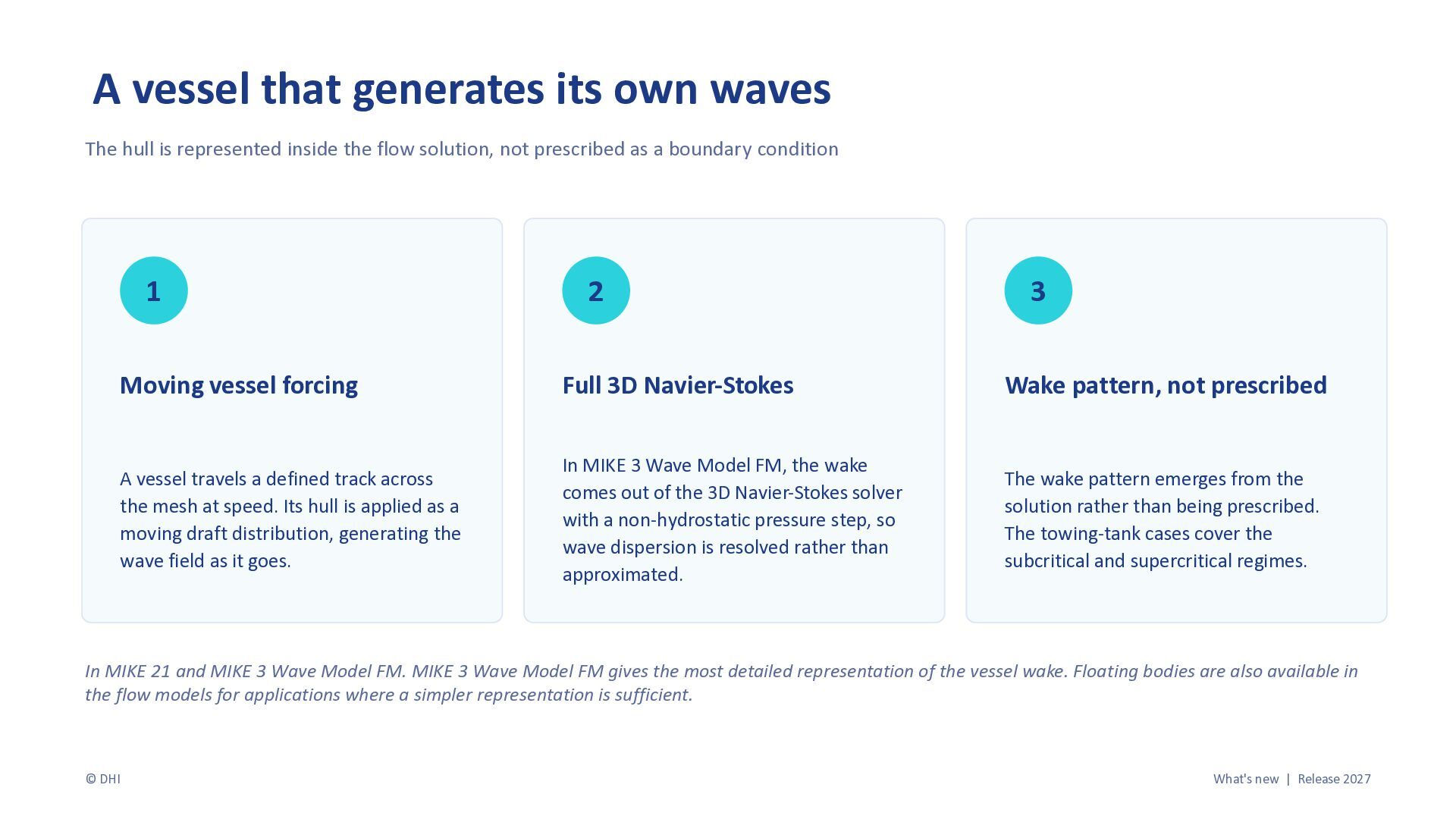
  2. A vessel that generates its own waves The hull is

    represented inside the flow solution, not prescribed as a boundary condition 1 2 3 Moving vessel forcing Full 3D Navier-Stokes Wake pattern, not prescribed A vessel travels a defined track across the mesh at speed. Its hull is applied as a moving draft distribution, generating the wave field as it goes. In MIKE 3 Wave Model FM, the wake comes out of the 3D Navier-Stokes solver with a non-hydrostatic pressure step, so wave dispersion is resolved rather than approximated. The wake pattern emerges from the solution rather than being prescribed. The towing-tank cases cover the subcritical and supercritical regimes. In MIKE 21 and MIKE 3 Wave Model FM. MIKE 3 Wave Model FM gives the most detailed representation of the vessel wake. Floating bodies are also available in the flow models for applications where a simpler representation is sufficient. © DHI What's new | Release 2027
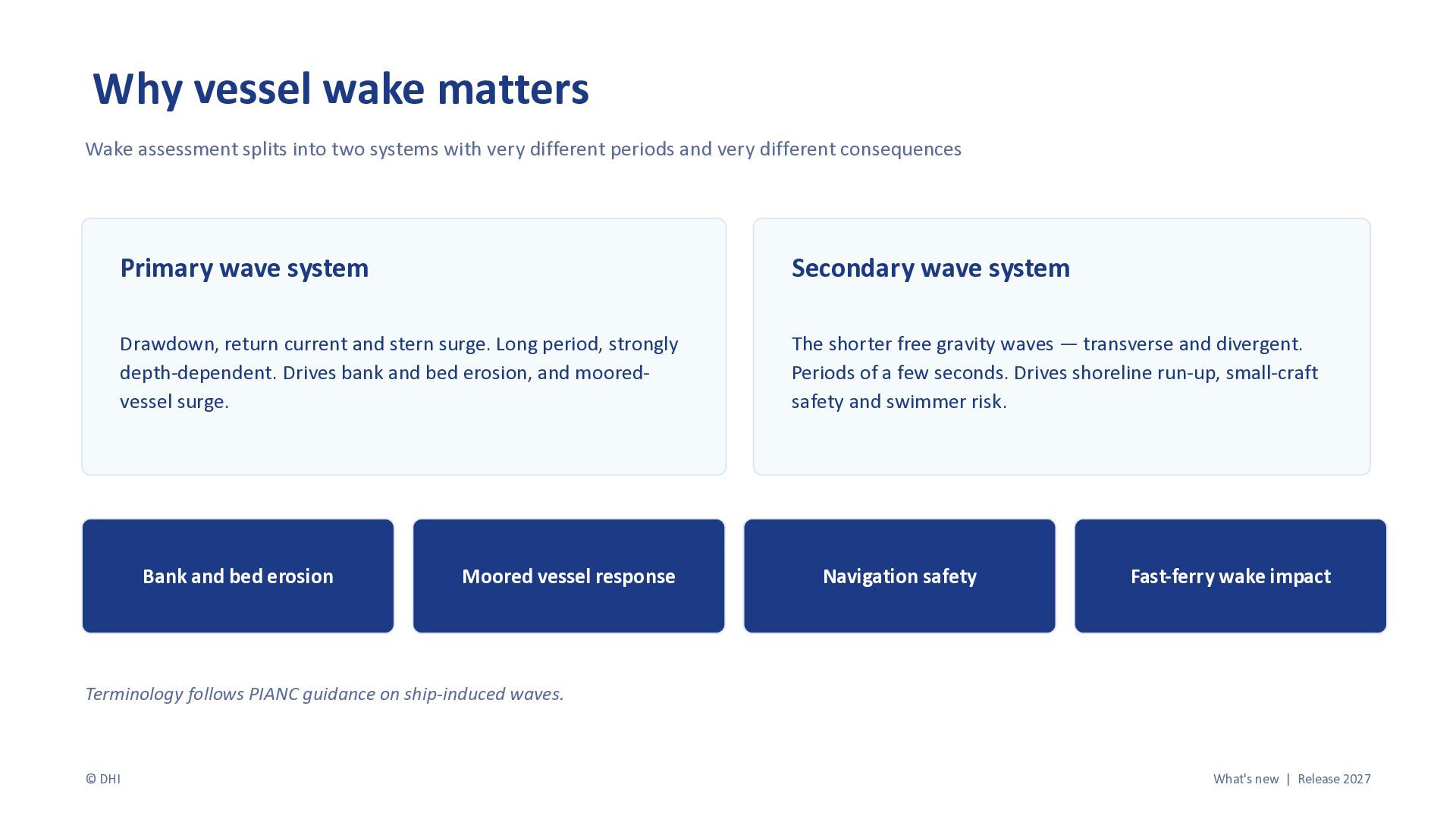
  3. Why vessel wake matters Wake assessment splits into two systems

    with very different periods and very different consequences Primary wave system Secondary wave system Drawdown, return current and stern surge. Long period, strongly depth-dependent. Drives bank and bed erosion, and mooredvessel surge. The shorter free gravity waves — transverse and divergent. Periods of a few seconds. Drives shoreline run-up, small-craft safety and swimmer risk. Bank and bed erosion Moored vessel response Navigation safety Fast-ferry wake impact Terminology follows PIANC guidance on ship-induced waves. © DHI What's new | Release 2027
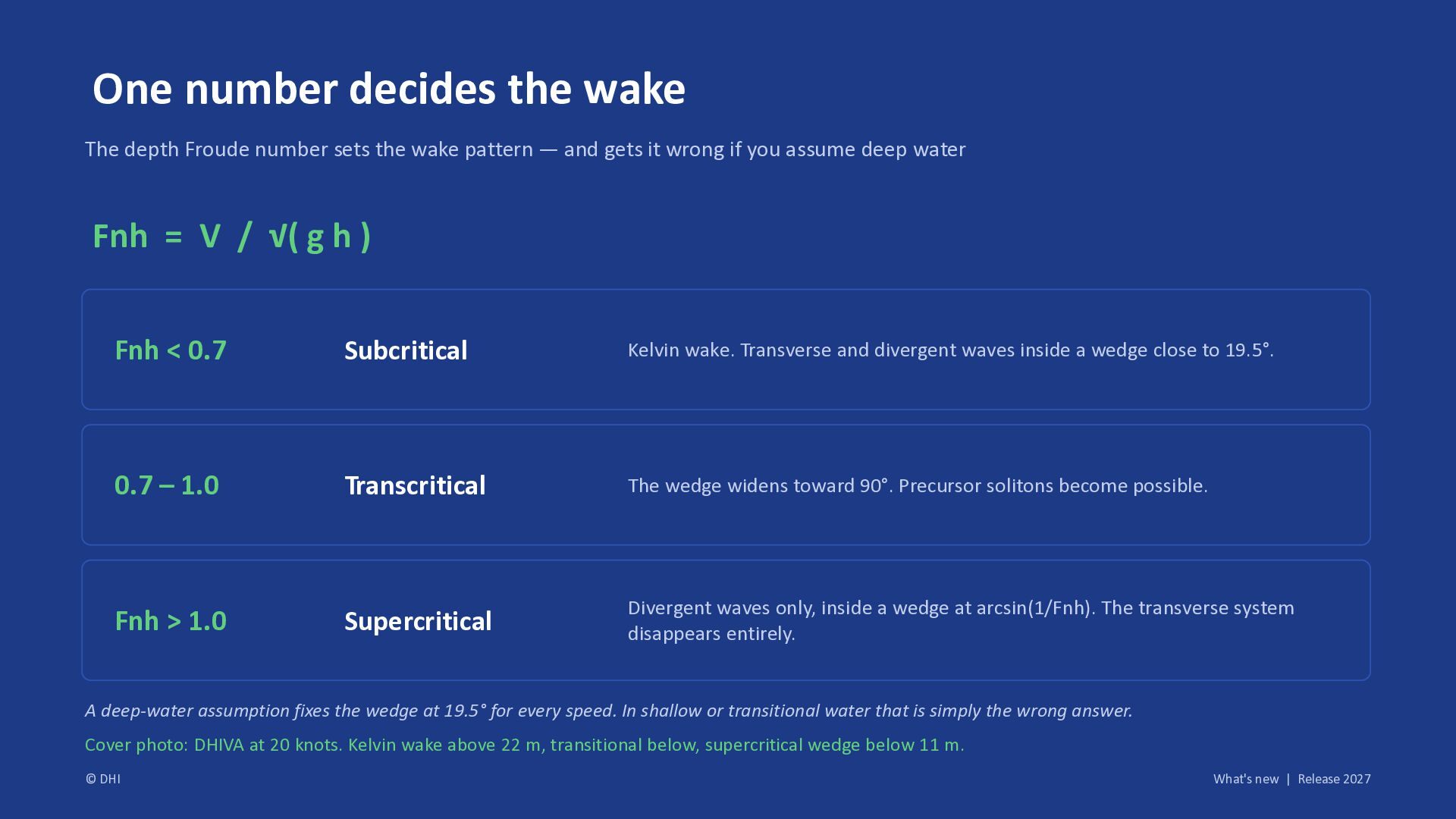
  4. One number decides the wake The depth Froude number sets

    the wake pattern — and gets it wrong if you assume deep water Fnh = V / √( g h ) Fnh < 0.7 Subcritical Kelvin wake. Transverse and divergent waves inside a wedge close to 19.5°. 0.7 – 1.0 Transcritical The wedge widens toward 90°. Precursor solitons become possible. Fnh > 1.0 Supercritical Divergent waves only, inside a wedge at arcsin(1/Fnh). The transverse system disappears entirely. A deep-water assumption fixes the wedge at 19.5° for every speed. In shallow or transitional water that is simply the wrong answer. Cover photo: DHIVA at 20 knots. Kelvin wake above 22 m, transitional below, supercritical wedge below 11 m. © DHI What's new | Release 2027
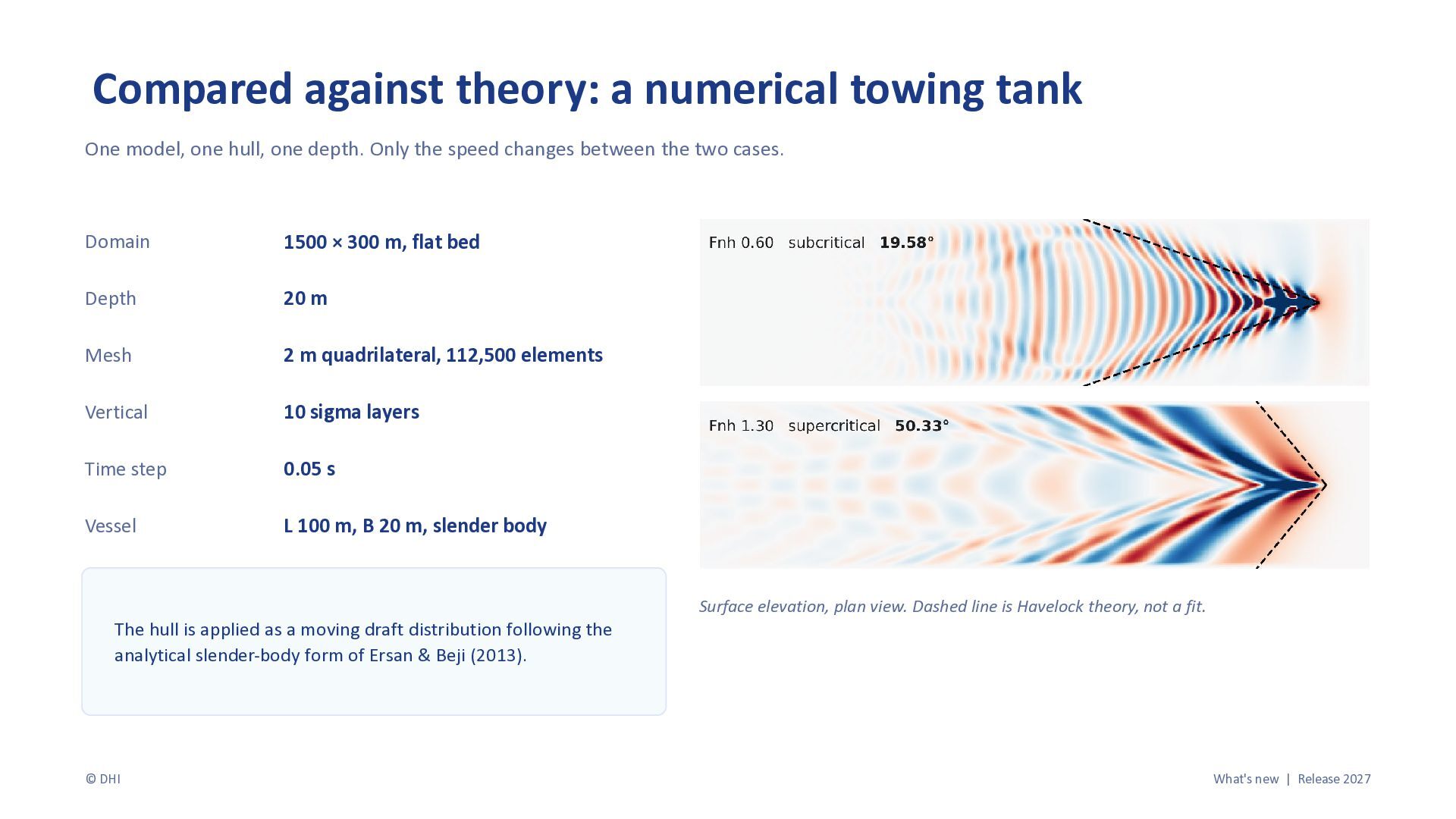
  5. Compared against theory: a numerical towing tank One model, one

    hull, one depth. Only the speed changes between the two cases. Domain 1500 × 300 m, flat bed Depth 20 m Mesh 2 m quadrilateral, 112,500 elements Vertical 10 sigma layers Time step 0.05 s Vessel L 100 m, B 20 m, slender body The hull is applied as a moving draft distribution following the analytical slender-body form of Ersan & Beji (2013). © DHI Surface elevation, plan view. Dashed line is Havelock theory, not a fit. What's new | Release 2027
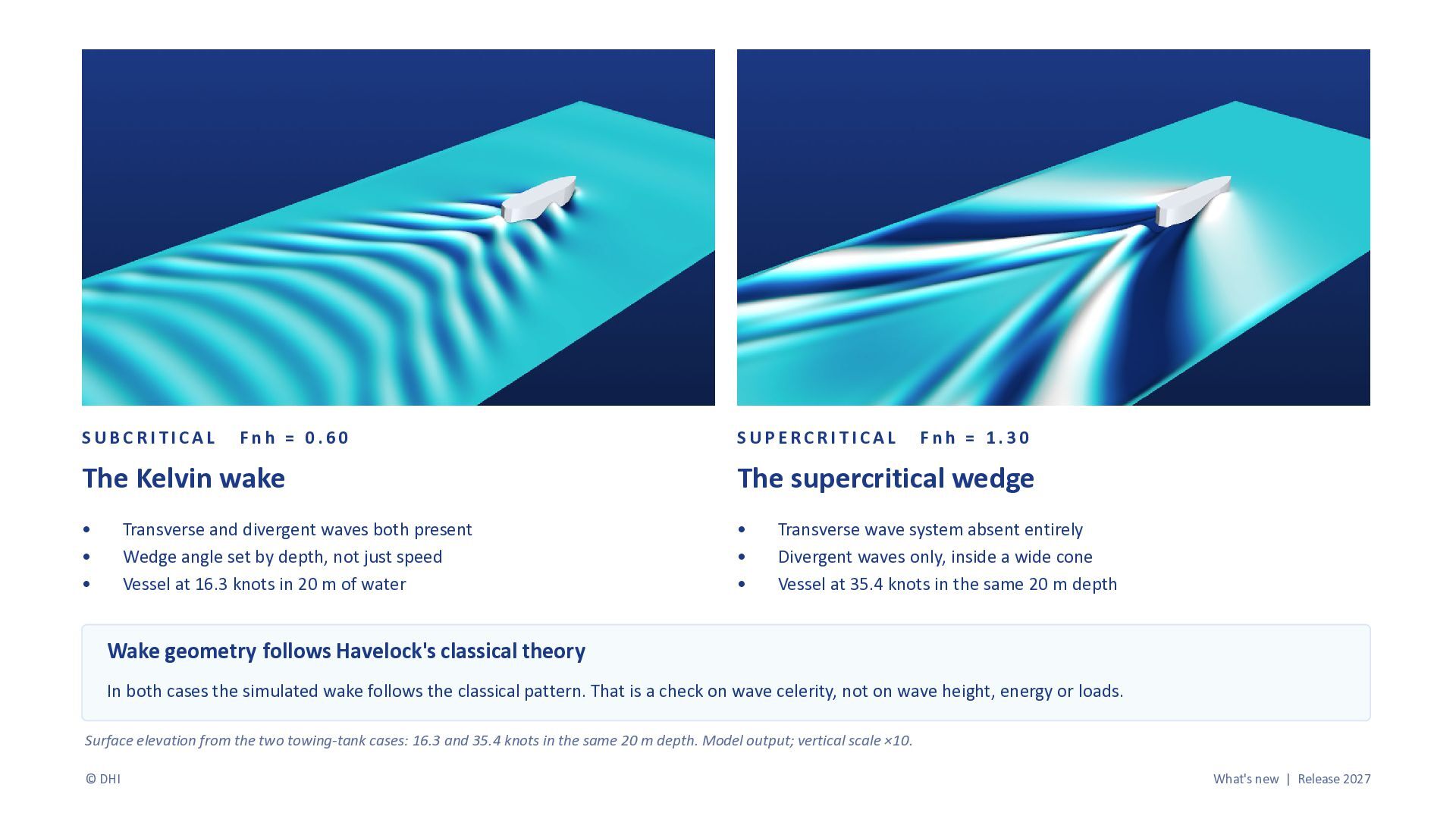
  6. SUBCRITICAL Fnh = 0.60 SUPERCRITICAL Fnh = 1.30 The Kelvin

    wake The supercritical wedge • • • • • • Transverse and divergent waves both present Wedge angle set by depth, not just speed Vessel at 16.3 knots in 20 m of water Transverse wave system absent entirely Divergent waves only, inside a wide cone Vessel at 35.4 knots in the same 20 m depth Wake geometry follows Havelock's classical theory In both cases the simulated wake follows the classical pattern. That is a check on wave celerity, not on wave height, energy or loads. Surface elevation from the two towing-tank cases: 16.3 and 35.4 knots in the same 20 m depth. Model output; vertical scale ×10. © DHI What's new | Release 2027
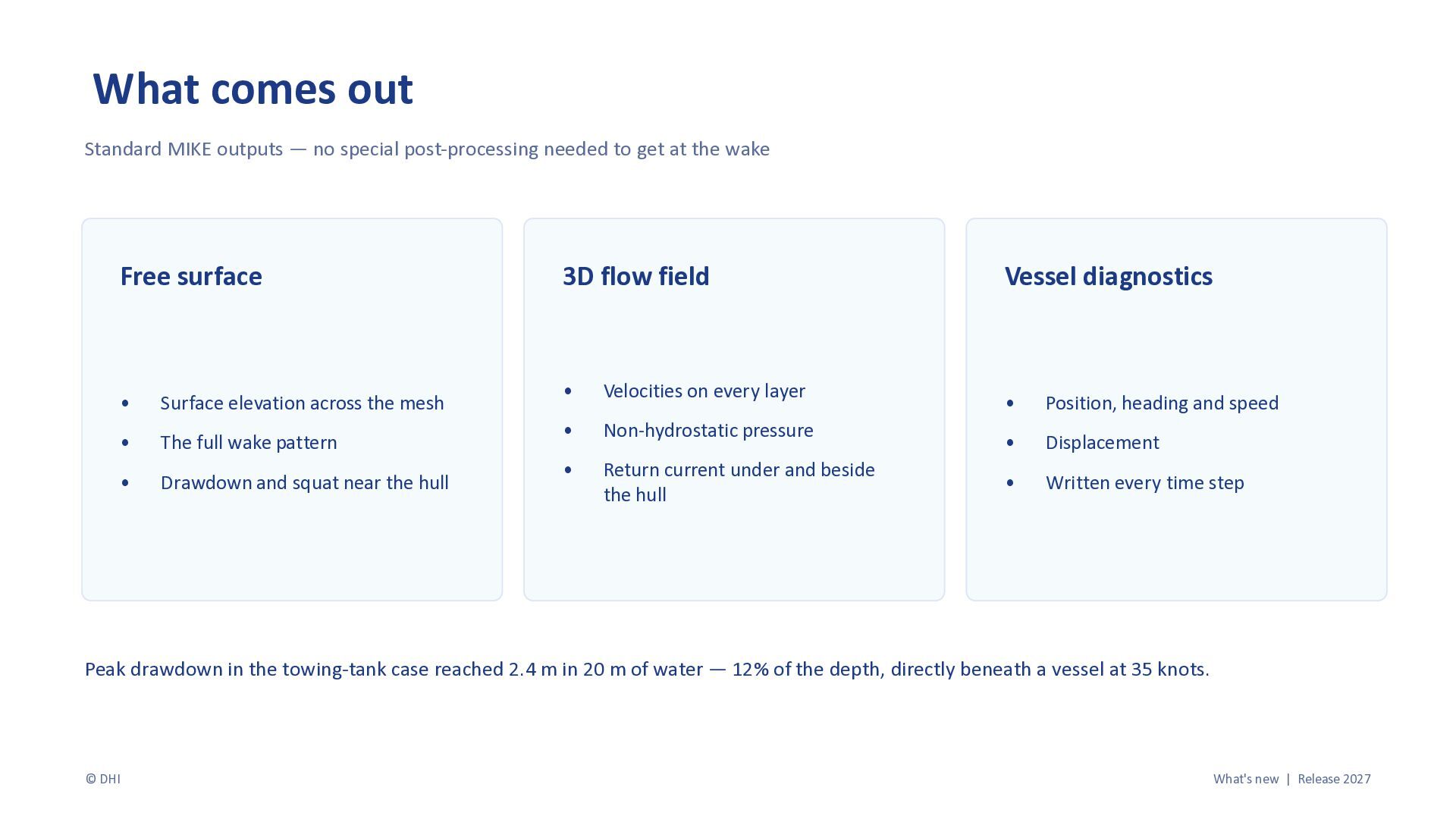
  7. What comes out Standard MIKE outputs — no special post-processing

    needed to get at the wake Free surface • Surface elevation across the mesh • The full wake pattern • Drawdown and squat near the hull 3D flow field • Velocities on every layer • Non-hydrostatic pressure • Return current under and beside the hull Vessel diagnostics • Position, heading and speed • Displacement • Written every time step Peak drawdown in the towing-tank case reached 2.4 m in 20 m of water — 12% of the depth, directly beneath a vessel at 35 knots. © DHI What's new | Release 2027
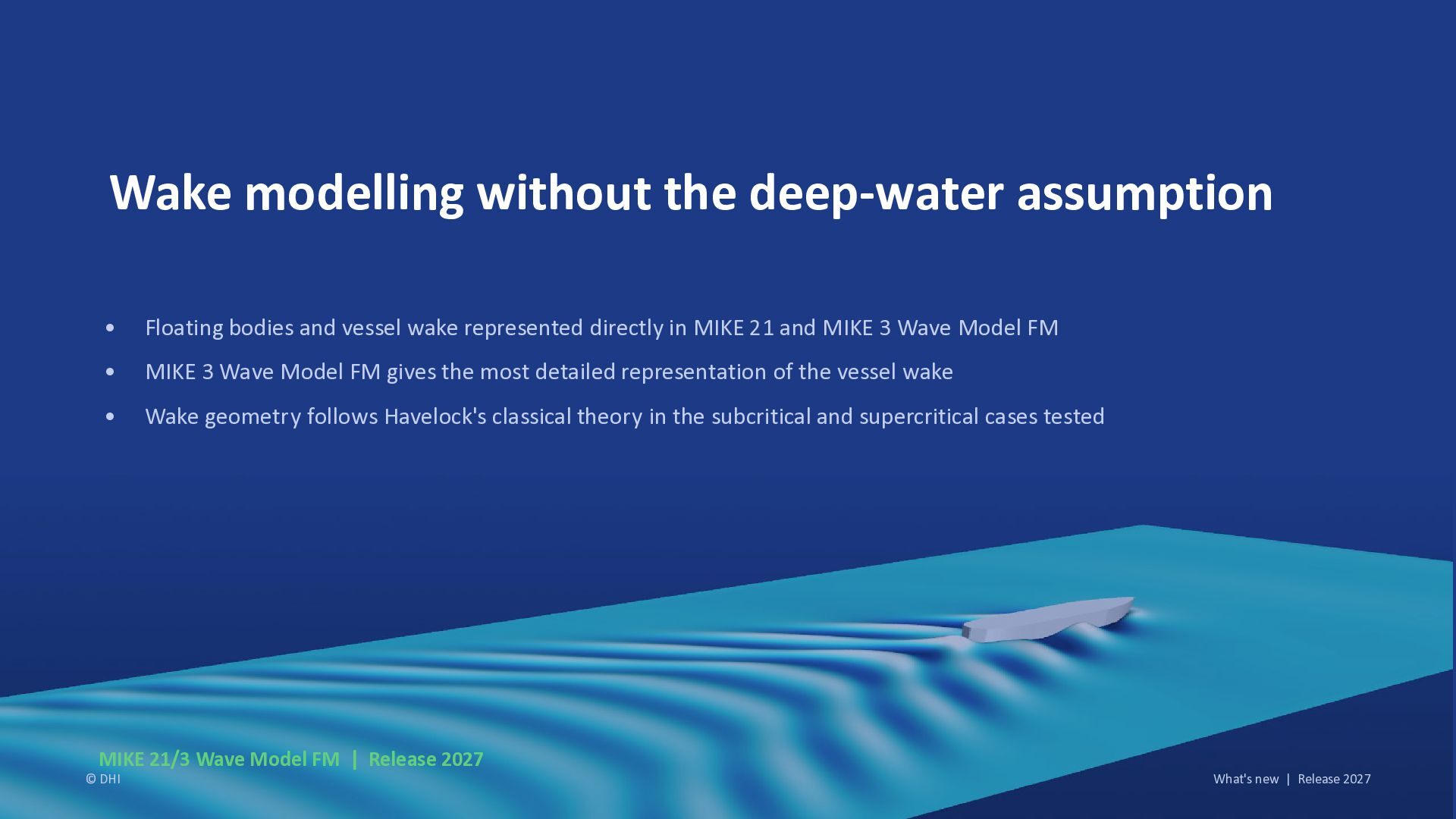
  8. Wake modelling without the deep-water assumption • Floating bodies and

    vessel wake represented directly in MIKE 21 and MIKE 3 Wave Model FM • MIKE 3 Wave Model FM gives the most detailed representation of the vessel wake • Wake geometry follows Havelock's classical theory in the subcritical and supercritical cases tested MIKE 21/3 Wave Model FM | Release 2027 © DHI What's new | Release 2027