Upgrade to Pro — share decks privately, control downloads, hide ads and more …

Axiomatic Design for Organization Design - a pr...

Sponsored · Your Podcast. Everywhere. Effortlessly. Share. Educate. Inspire. Entertain. You do you. We'll handle the rest. →

Axiomatic Design for Organization Design - a primer (Slides for Video 1)

These are slides that I use in the first of the four videos I have uploaded to YouTube:
https://www.youtube.com/@NicolayWorren/playlists
The videos are intended for lecturers and others who want an introduction to Axiomatic design, one of the main approaches I use in my book on organization design (published by Routledge). The third edition was published in September, 2026.

Routledge book page:
https://tinyurl.com/4uwz5j92

Amazon.com book page:
https://tinyurl.com/yzk5bphv

Avatar for Nicolay Worren

Nicolay Worren

October 04, 2026

More Decks by Nicolay Worren

Other Decks in Education

Transcript

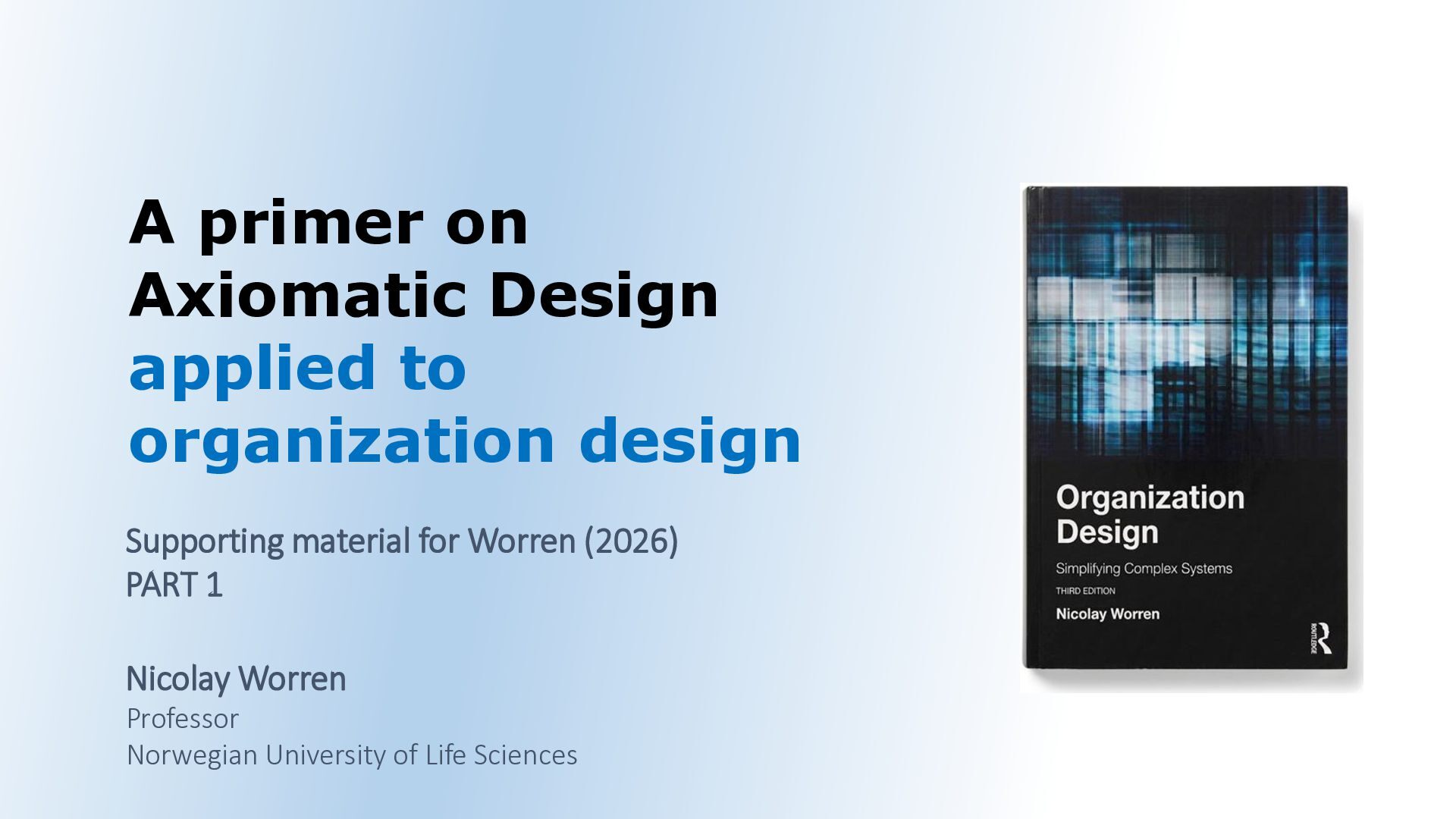
  1. A primer on Axiomatic Design applied to organization design Supporting

    material for Worren (2026) PART 1 Nicolay Worren Professor Norwegian University of Life Sciences
  2. Topics 1. Why Axiomatic Design? 2. The core axioms 3.

    Case studies 4. Beyond the basics
  3. Topics 1. Why Axiomatic Design? 2. The core axioms 3.

    Case studies 4. Beyond the basics
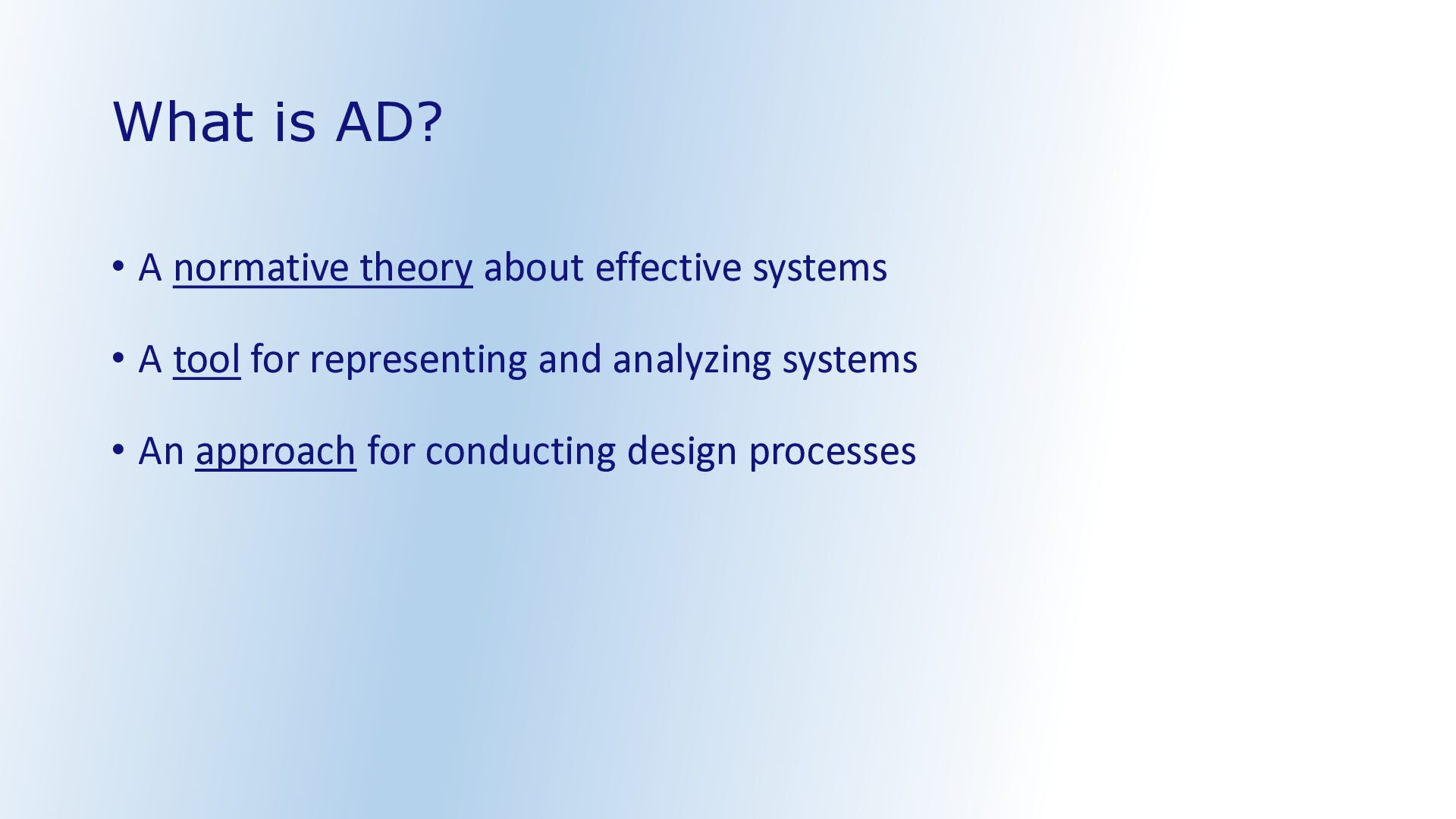
  4. What is AD? • A normative theory about effective systems

    • A tool for representing and analyzing systems • An approach for conducting design processes
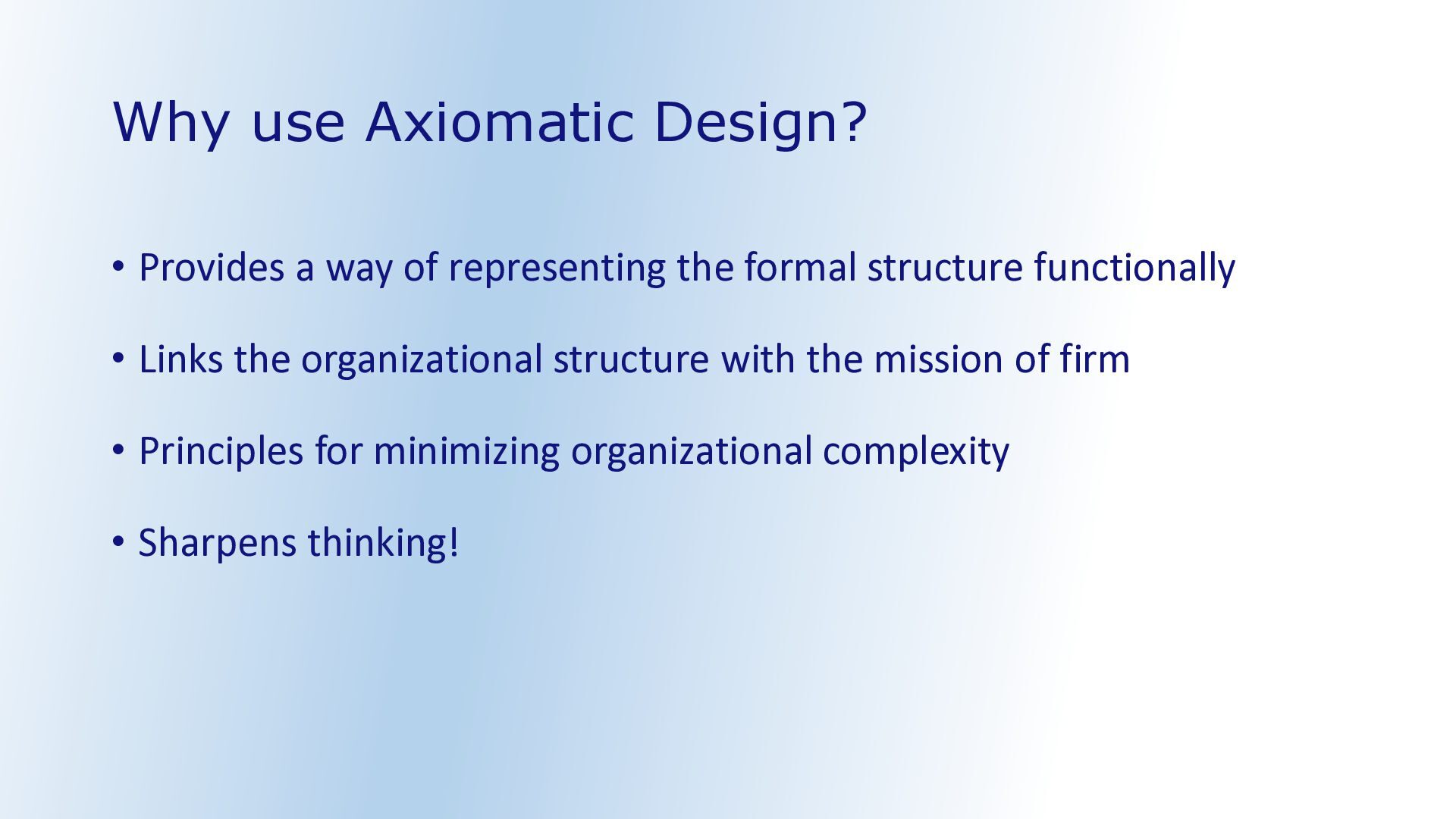
  5. Why use Axiomatic Design? • Provides a way of representing

    the formal structure functionally • Links the organizational structure with the mission of firm • Principles for minimizing organizational complexity • Sharpens thinking!
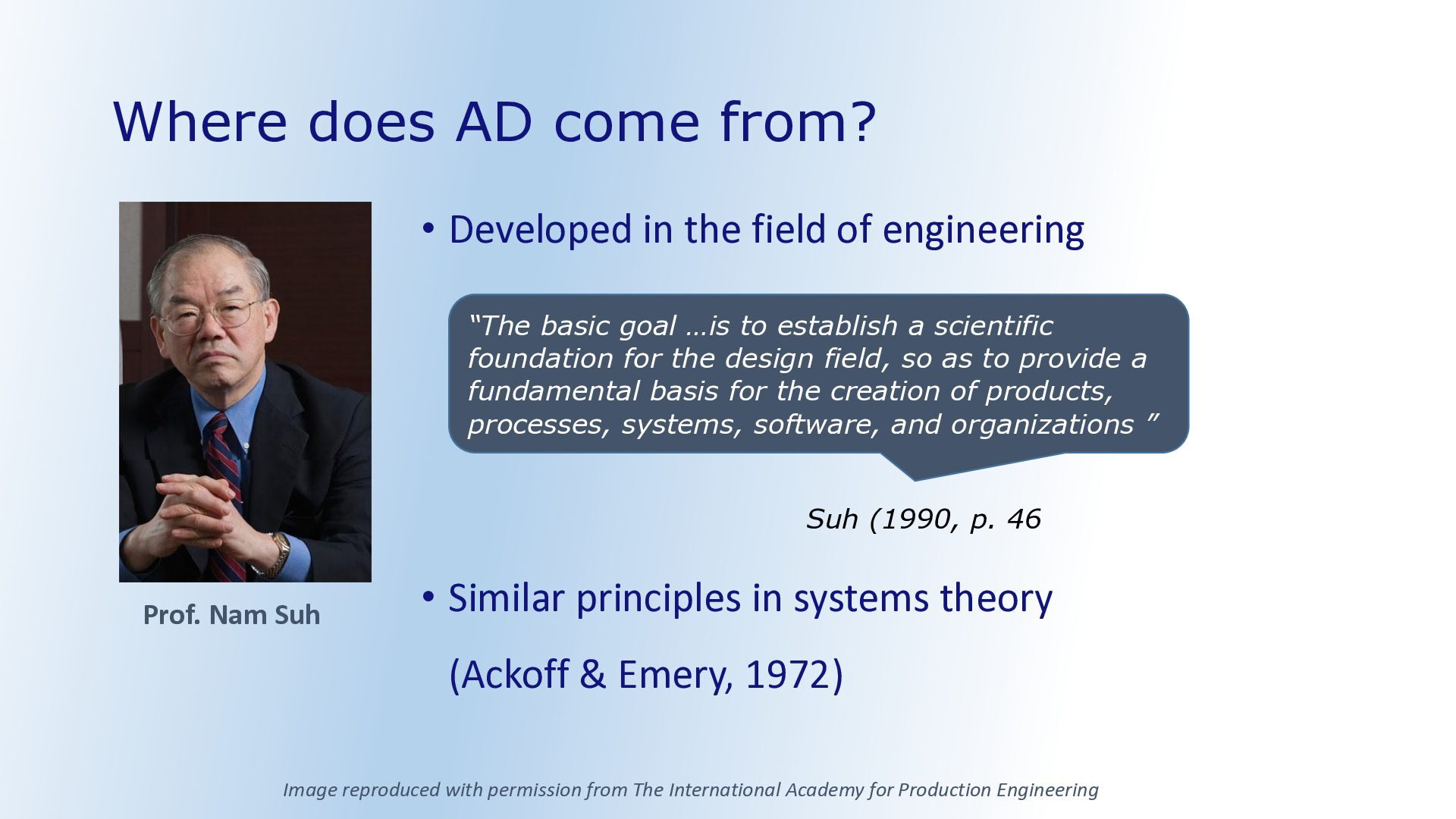
  6. Where does AD come from? • Developed in the field

    of engineering “The basic goal …is to establish a scientific foundation for the design field, so as to provide a fundamental basis for the creation of products, processes, systems, software, and organizations ” Suh (1990, p. 46 Prof. Nam Suh • Similar principles in systems theory (Ackoff & Emery, 1972) Image reproduced with permission from The International Academy for Production Engineering
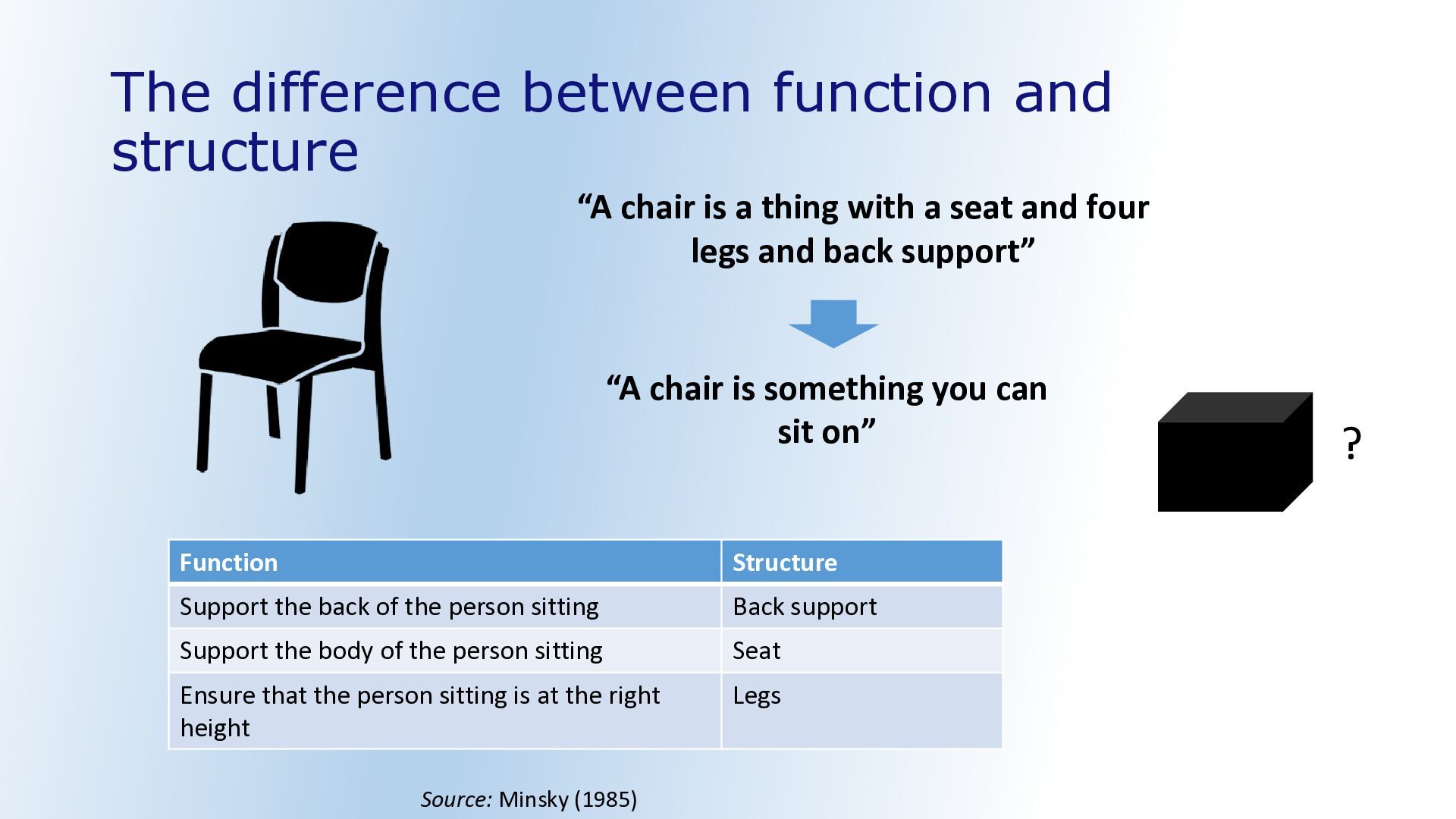
  7. The difference between function and structure “A chair is a

    thing with a seat and four legs and back support” “A chair is something you can sit on” Function Structure Support the back of the person sitting Back support Support the body of the person sitting Seat Ensure that the person sitting is at the right height Legs Source: Minsky (1985) ?
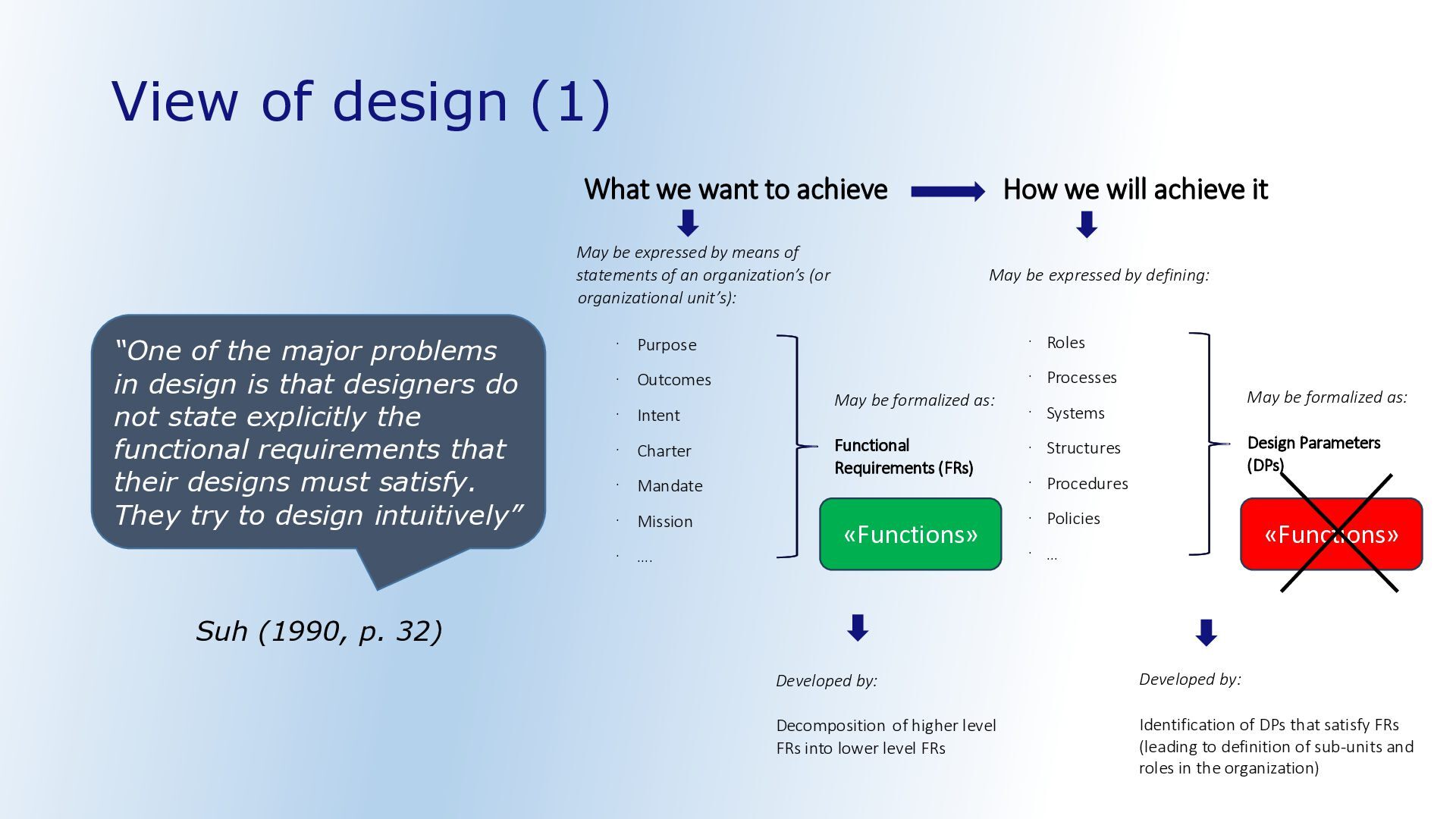
  8. View of design (1) What we want to achieve May

    be expressed by means of statements of an organization’s (or organizational unit’s): “One of the major problems in design is that designers do not state explicitly the functional requirements that their designs must satisfy. They try to design intuitively” How we will achieve it May be expressed by defining: · Purpose · Roles · Outcomes · Processes · Intent · Charter · Mandate · Mission · …. May be formalized as: Functional Requirements (FRs) «Functions» May be formalized as: · Systems Design Parameters (DPs) · Structures · Procedures · Policies «Functions» · … Suh (1990, p. 32) Developed by: Developed by: Decomposition of higher level FRs into lower level FRs Identification of DPs that satisfy FRs (leading to definition of sub-units and roles in the organization)
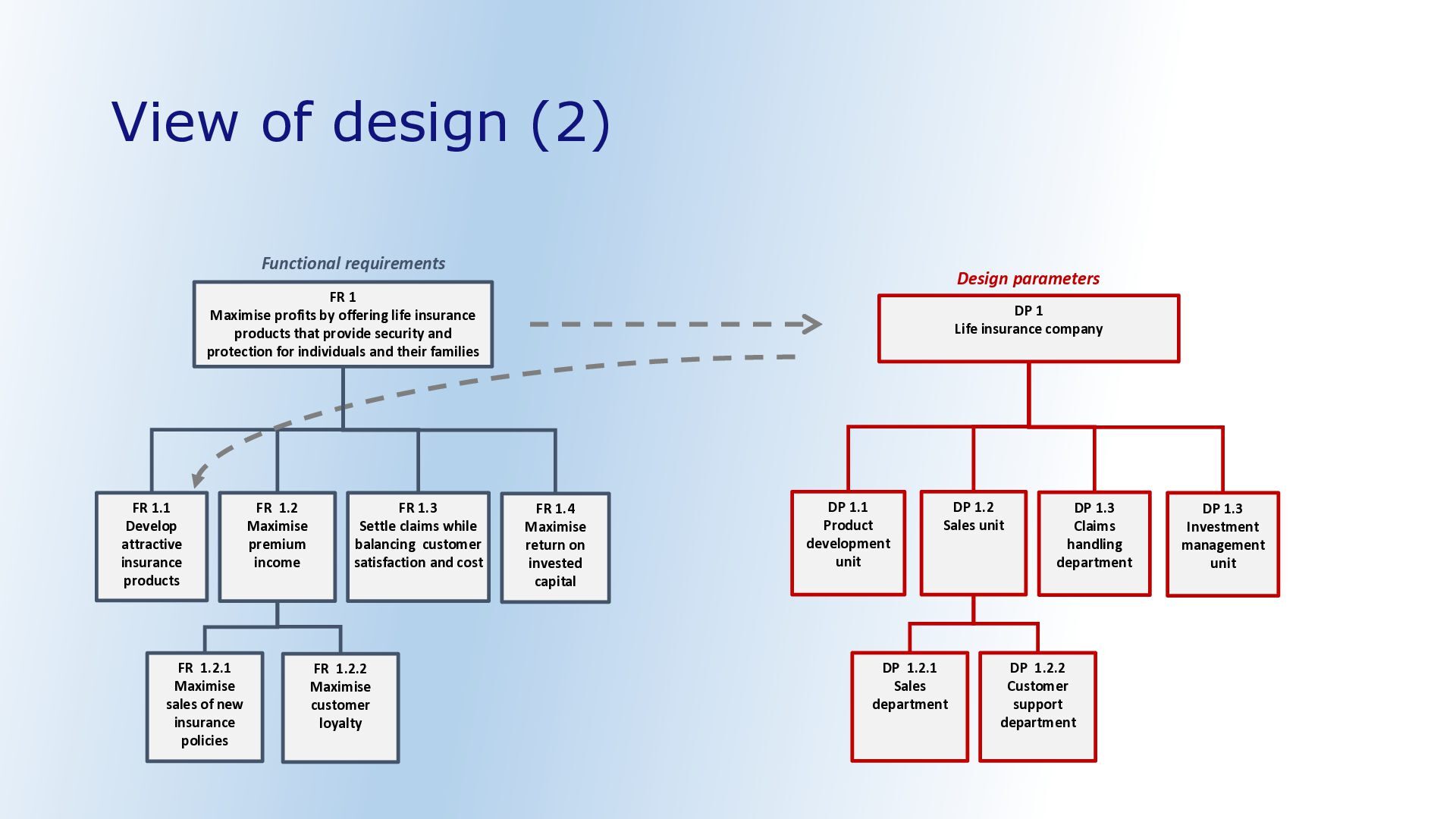
  9. View of design (2) Functional requirements Design parameters FR 1

    Maximise profits by offering life insurance products that provide security and protection for individuals and their families FR 1.1 Develop attractive insurance products FR 1.2.1 Maximise sales of new insurance policies FR 1.2 Maximise premium income FR 1.3 Settle claims while balancing customer satisfaction and cost FR 1.2.2 Maximise customer loyalty DP 1 Life insurance company FR 1.4 Maximise return on invested capital DP 1.1 Product development unit DP 1.2 Sales unit DP 1.2.1 Sales department DP 1.3 Claims handling department DP 1.2.2 Customer support department DP 1.3 Investment management unit
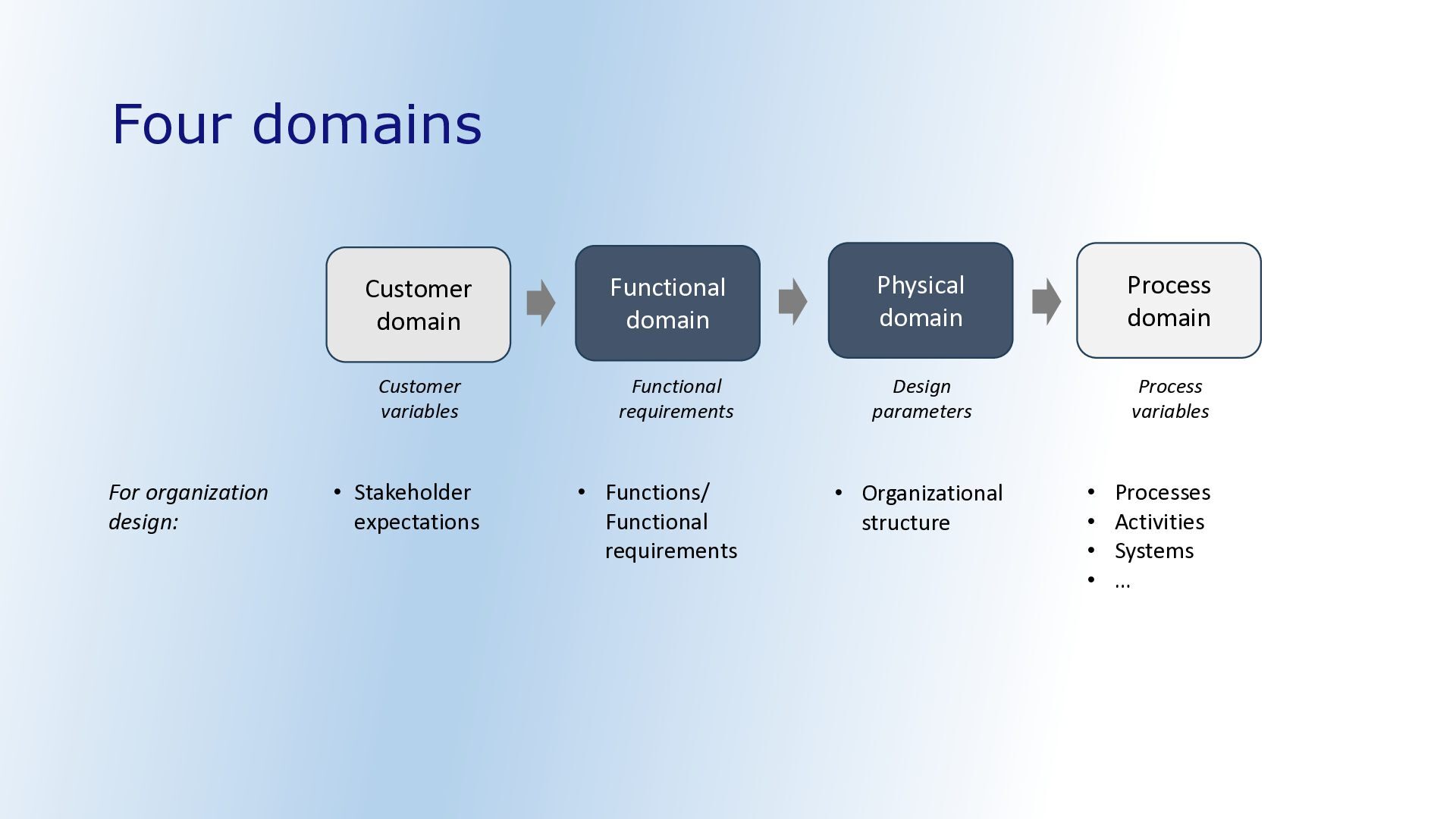
  10. Four domains For organization design: Customer domain Functional domain Physical

    domain Process domain Customer variables Functional requirements Design parameters Process variables • Stakeholder expectations • Functions/ Functional requirements • Organizational structure • • • • Processes Activities Systems …