Upgrade to Pro — share decks privately, control downloads, hide ads and more …

Axiomatic Design for Organization Design - a pr...

Axiomatic Design for Organization Design - a primer (Slides for Video 2)

These are slides that I use in the second of the four videos I have uploaded to YouTube:
https://www.youtube.com/@NicolayWorren/playlists
The videos are intended for lecturers and others who want an introduction to Axiomatic design, one of the main approaches I use in my book on organization design (published by Routledge). The third edition was published in September, 2026.

Routledge book page:
https://tinyurl.com/4uwz5j92

Amazon.com book page:
https://tinyurl.com/yzk5bphv

Avatar for Nicolay Worren

Nicolay Worren

October 05, 2026

More Decks by Nicolay Worren

Other Decks in Education

Transcript

  1. A primer on Axiomatic Design applied to organization design Supporting

    material for Worren (2026) PART 2 Nicolay Worren Professor Norwegian University of Life Sciences
  2. Topics 1. Why Axiomatic Design? 2. The core axioms 3.

    Case studies 4. Beyond the basics
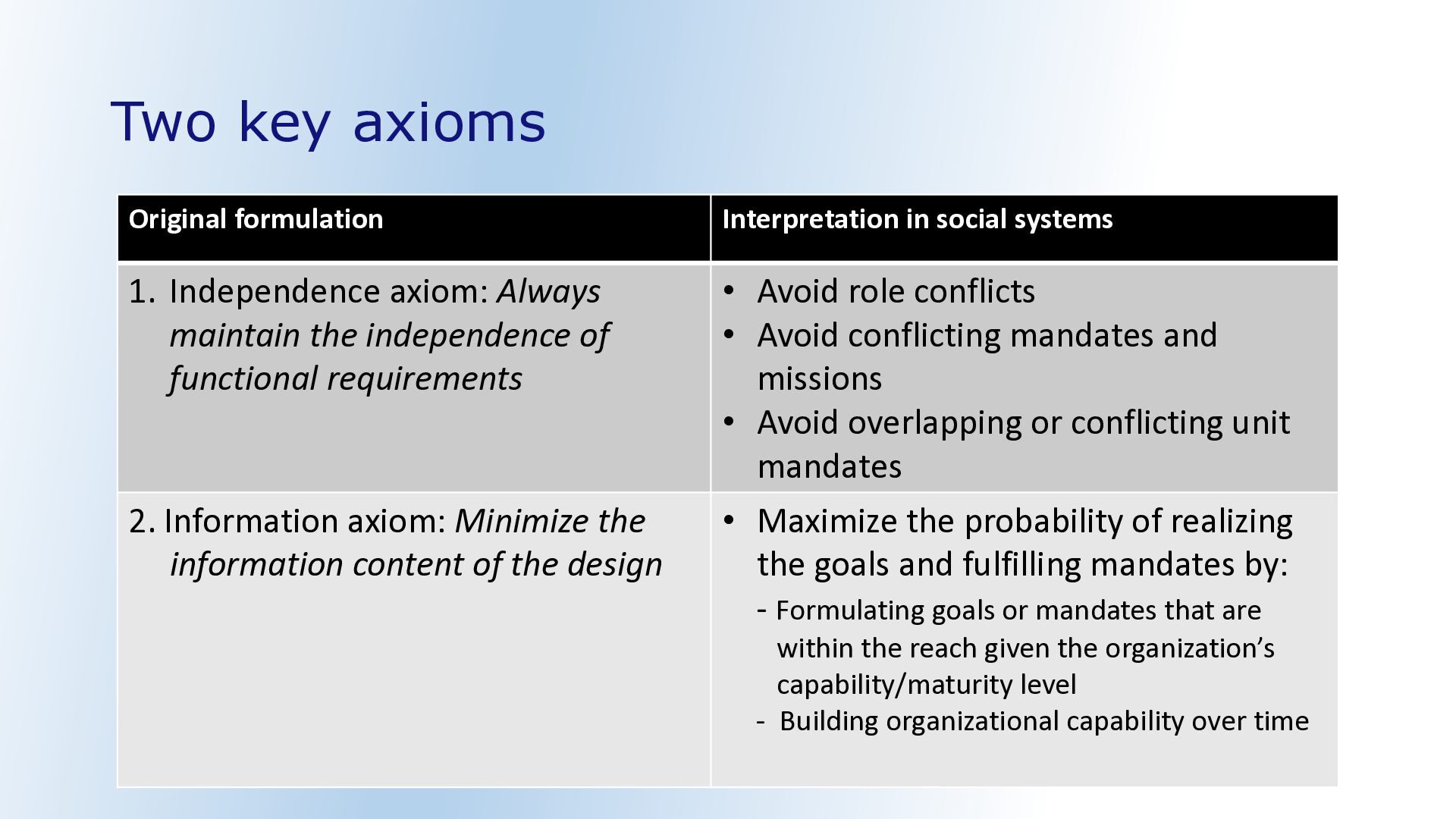
  3. Two key axioms Original formulation Interpretation in social systems 1.

    Independence axiom: Always maintain the independence of functional requirements • Avoid role conflicts • Avoid conflicting mandates and missions • Avoid overlapping or conflicting unit mandates • Maximize the probability of realizing the goals and fulfilling mandates by: - Formulating goals or mandates that are 2. Information axiom: Minimize the information content of the design within the reach given the organization’s capability/maturity level - Building organizational capability over time
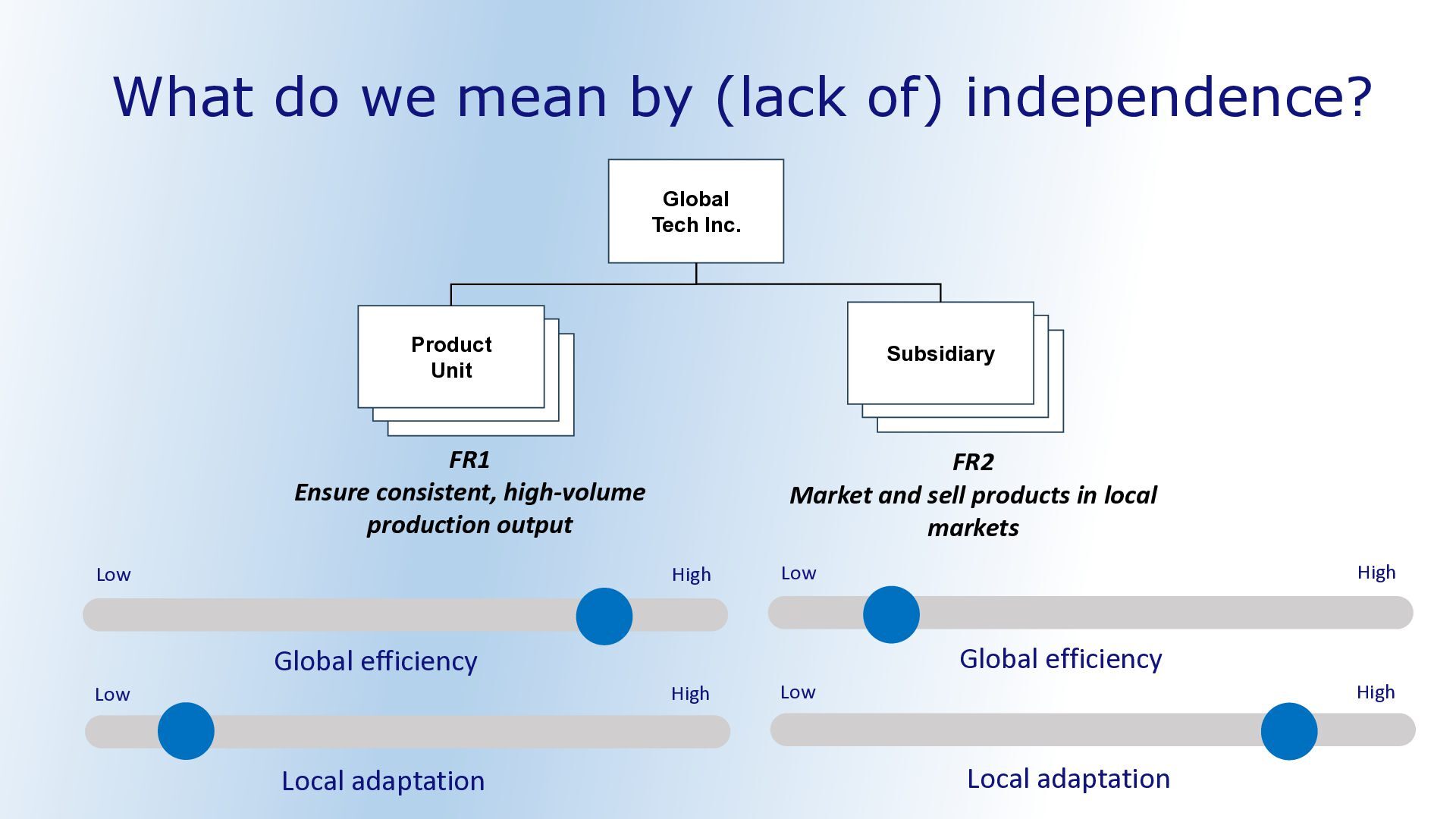
  4. What do we mean by (lack of) independence? Global Tech

    Inc. Product Unit Glo Glo Subsidiary Glo Glo FR1 Ensure consistent, high-volume production output FR2 Market and sell products in local markets High Low Global efficiency Global efficiency High Low Local adaptation High Low High Low Local adaptation
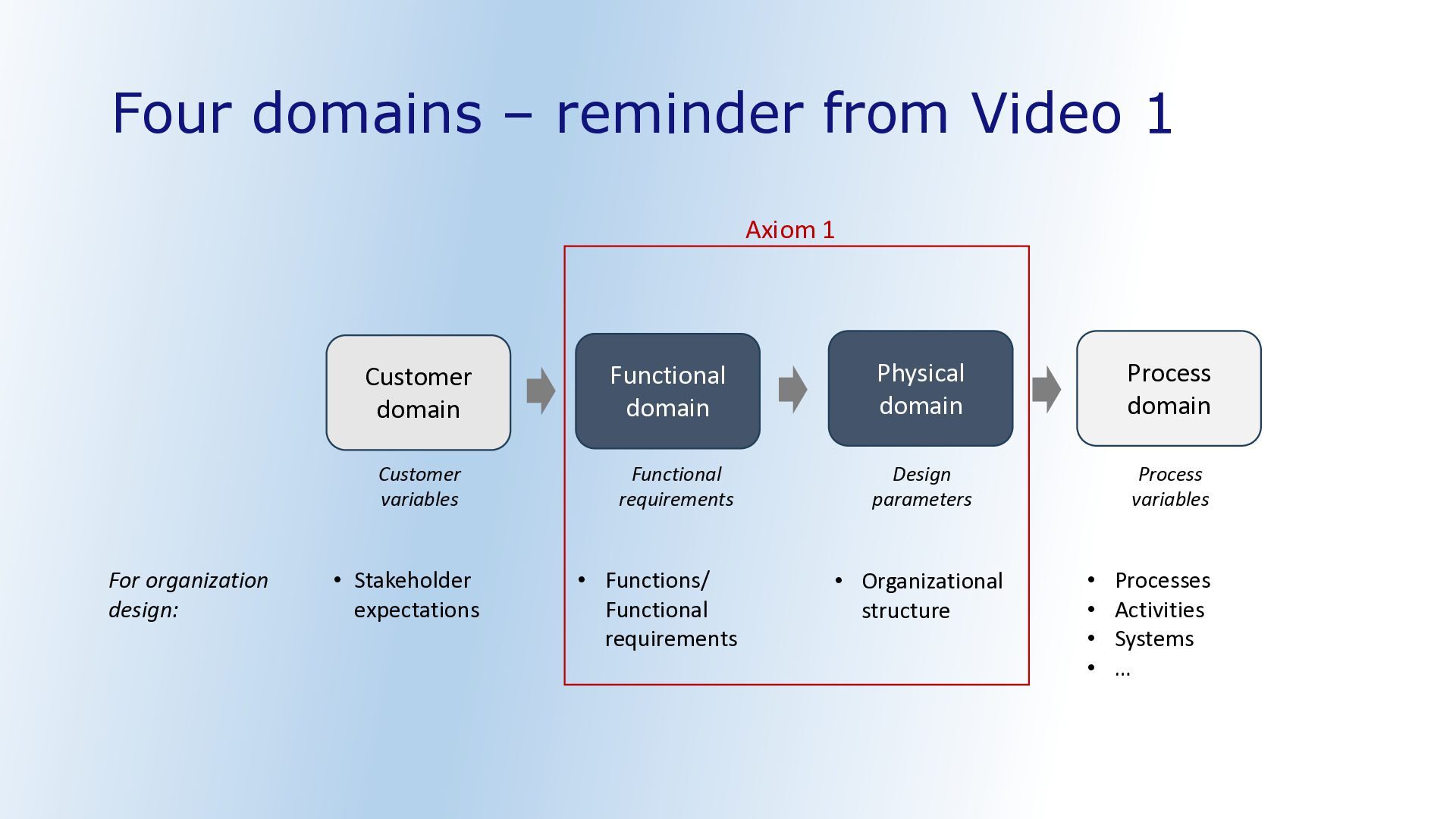
  5. Four domains – reminder from Video 1 Axiom 1 For

    organization design: Customer domain Functional domain Physical domain Process domain Customer variables Functional requirements Design parameters Process variables • Stakeholder expectations • Functions/ Functional requirements • Organizational structure • • • • Processes Activities Systems …
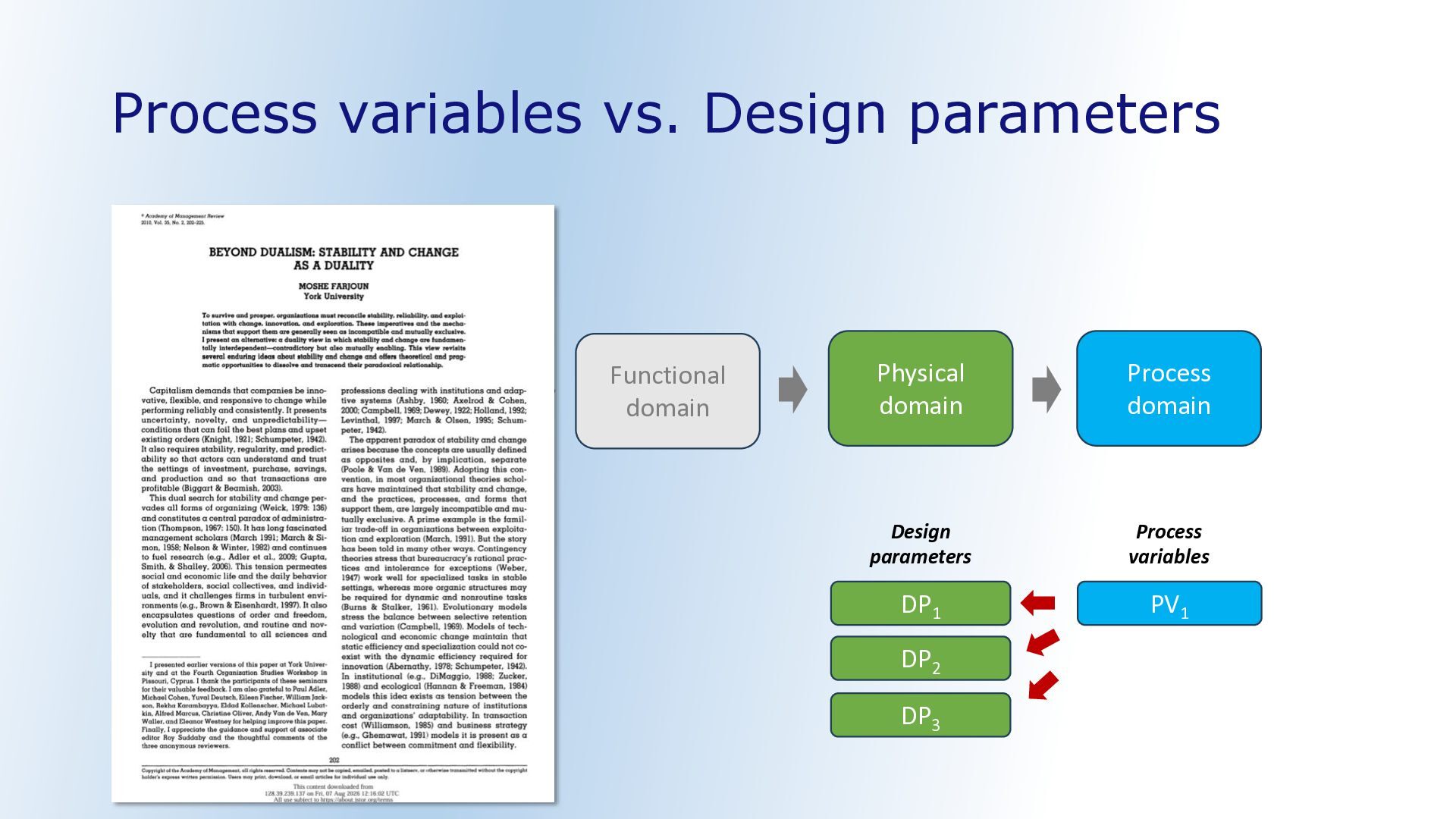
  6. Process variables vs. Design parameters Customer domain Functional domain Physical

    domain Process domain Design parameters Process variables DP1 PV1 DP2 DP3
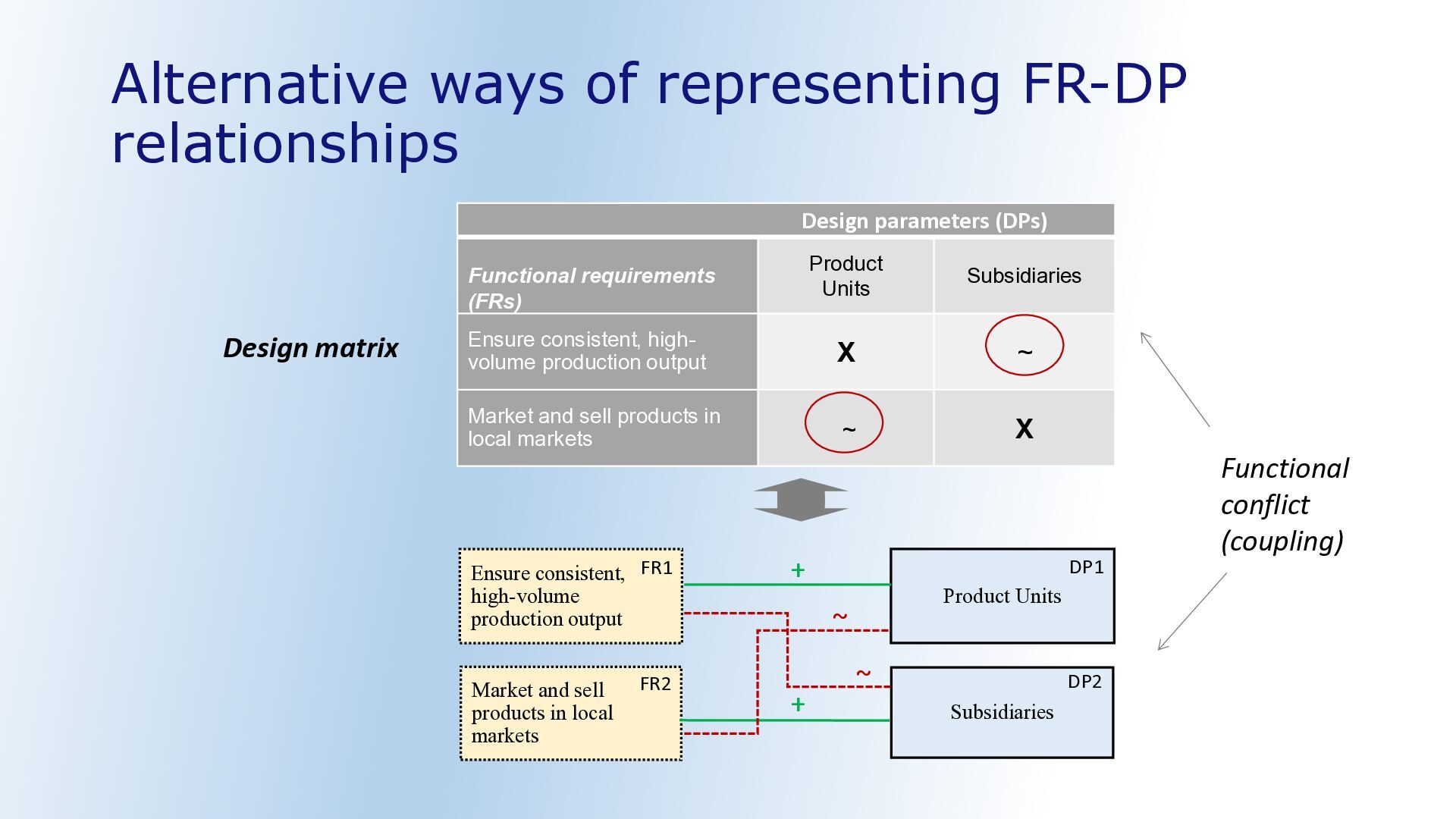
  7. Alternative ways of representing FR-DP relationships Design parameters (DPs) Product

    Units Subsidiaries Ensure consistent, highvolume production output X ~ Market and sell products in local markets ~ X Functional requirements (FRs) Design matrix Ensure consistent, FR1 high-volume production output Market and sell products in local markets FR2 + DP1 Product Units ~ + ~ DP2 Subsidiaries Functional conflict (coupling)
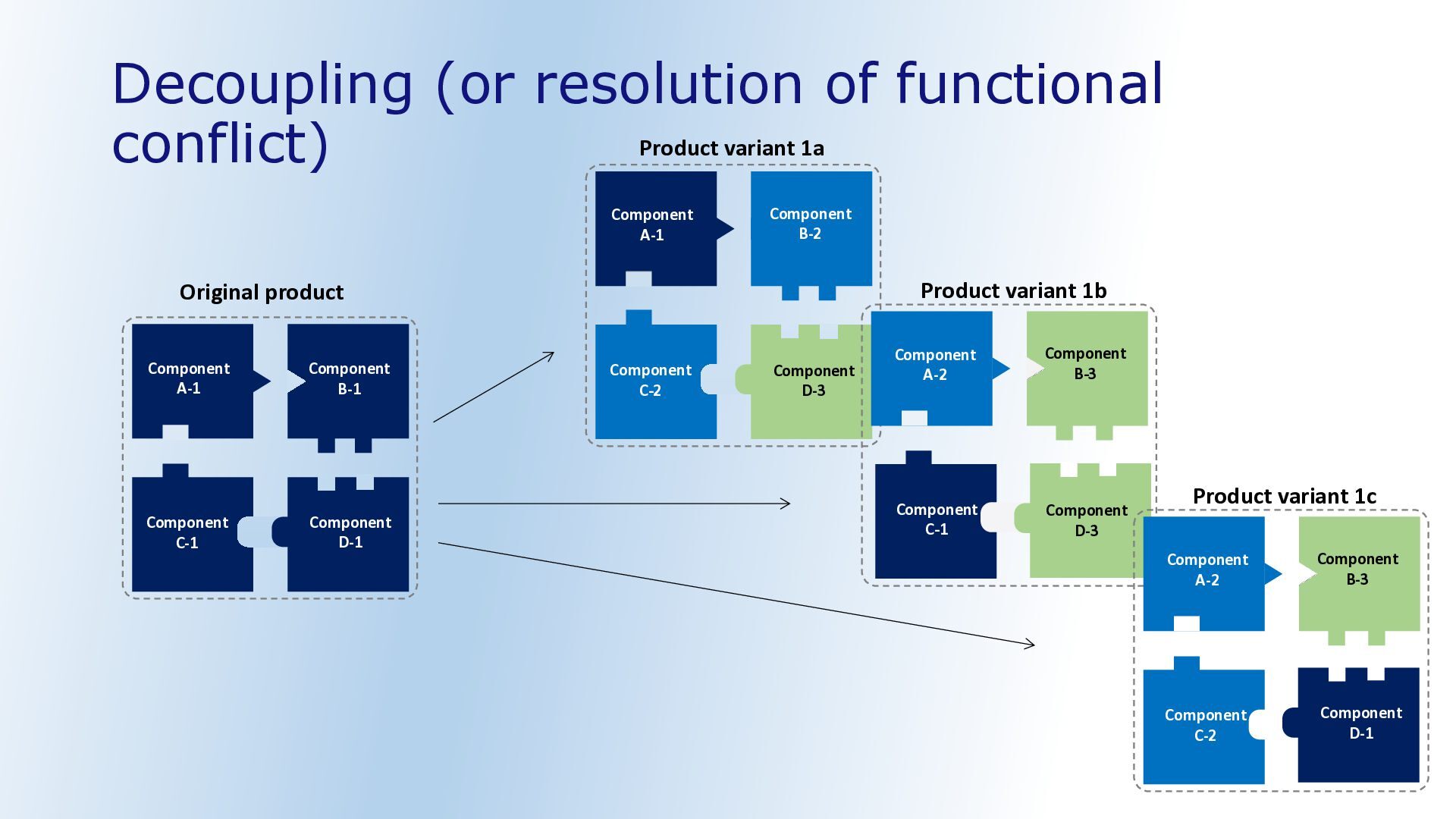
  8. Decoupling (or resolution of functional Product variant 1a conflict) Component

    A-1 Component B-2 Product variant 1b Original product Component A-1 Component B-1 Component C-1 Component D-1 Component C-2 Component D-3 Component A-2 Component B-3 Component C-1 Component D-3 Product variant 1c Component A-2 Component B-3 Component C-2 Component D-1
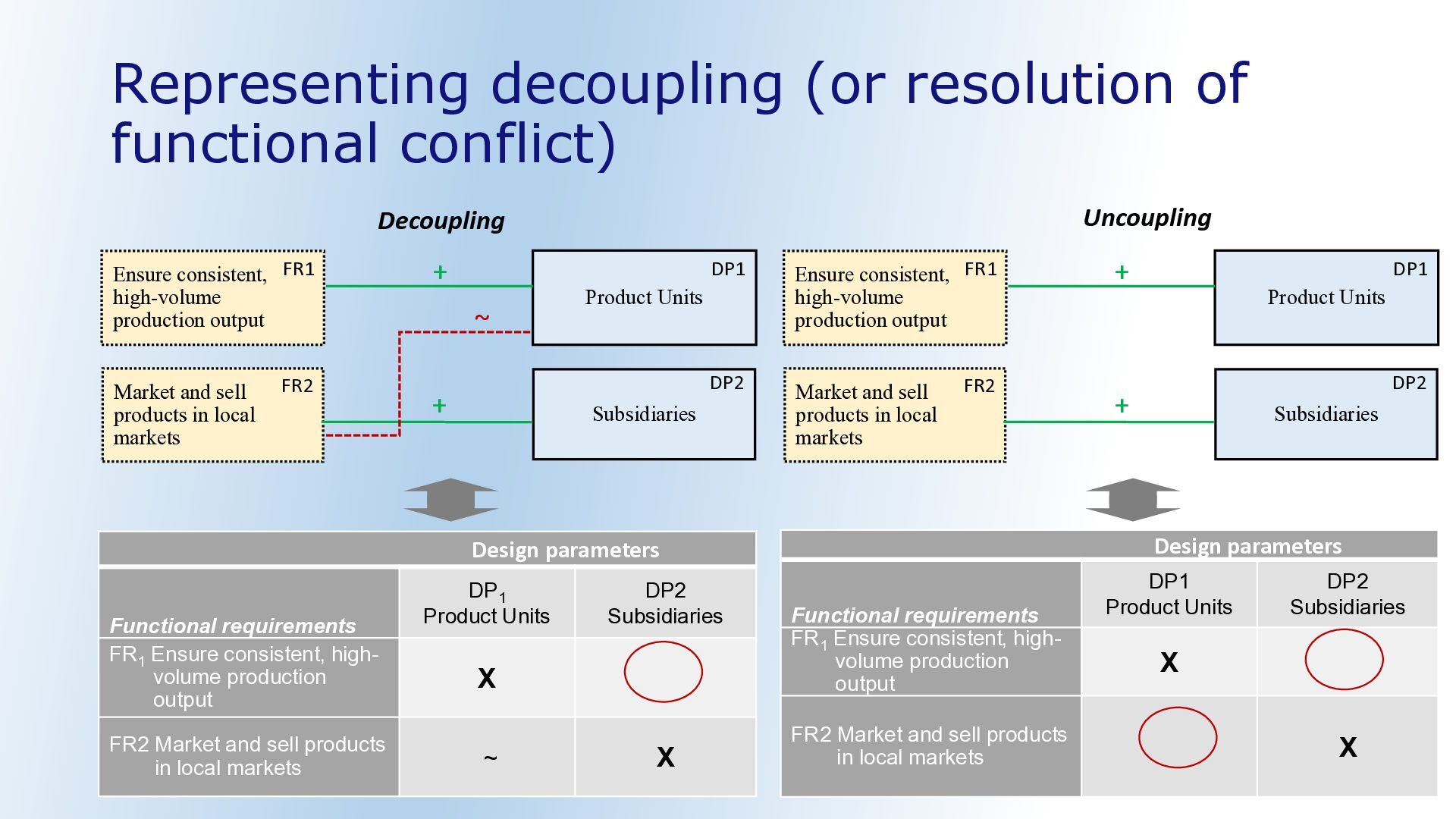
  9. Representing decoupling (or resolution of functional conflict) Uncoupling Decoupling Ensure

    consistent, FR1 high-volume production output Market and sell products in local markets FR2 + DP1 ~ Product Units DP2 + Subsidiaries Ensure consistent, FR1 high-volume production output Market and sell products in local markets FR2 Functional requirements FR1 Ensure consistent, highvolume production output FR2 Market and sell products in local markets DP2 Subsidiaries X Functional requirements FR1 Ensure consistent, highvolume production output ~ FR2 Market and sell products in local markets X DP1 Product Units DP2 + Subsidiaries Design parameters Design parameters DP1 Product Units + DP1 Product Units DP2 Subsidiaries X X