Upgrade to Pro — share decks privately, control downloads, hide ads and more …

Axiomatic Design for Organization Design - a pr...

Axiomatic Design for Organization Design - a primer (Slides for Video 3)

These are slides that I use in the third of the four videos I have uploaded to YouTube:
https://www.youtube.com/@NicolayWorren/playlists
The videos are intended for lecturers and others who want an introduction to Axiomatic design, one of the main approaches I use in my book on organization design (published by Routledge). The third edition was published in September, 2026.

Routledge book page:
https://tinyurl.com/4uwz5j92

Amazon.com book page:
https://tinyurl.com/yzk5bphv

Avatar for Nicolay Worren

Nicolay Worren

October 05, 2026

More Decks by Nicolay Worren

Other Decks in Business

Transcript

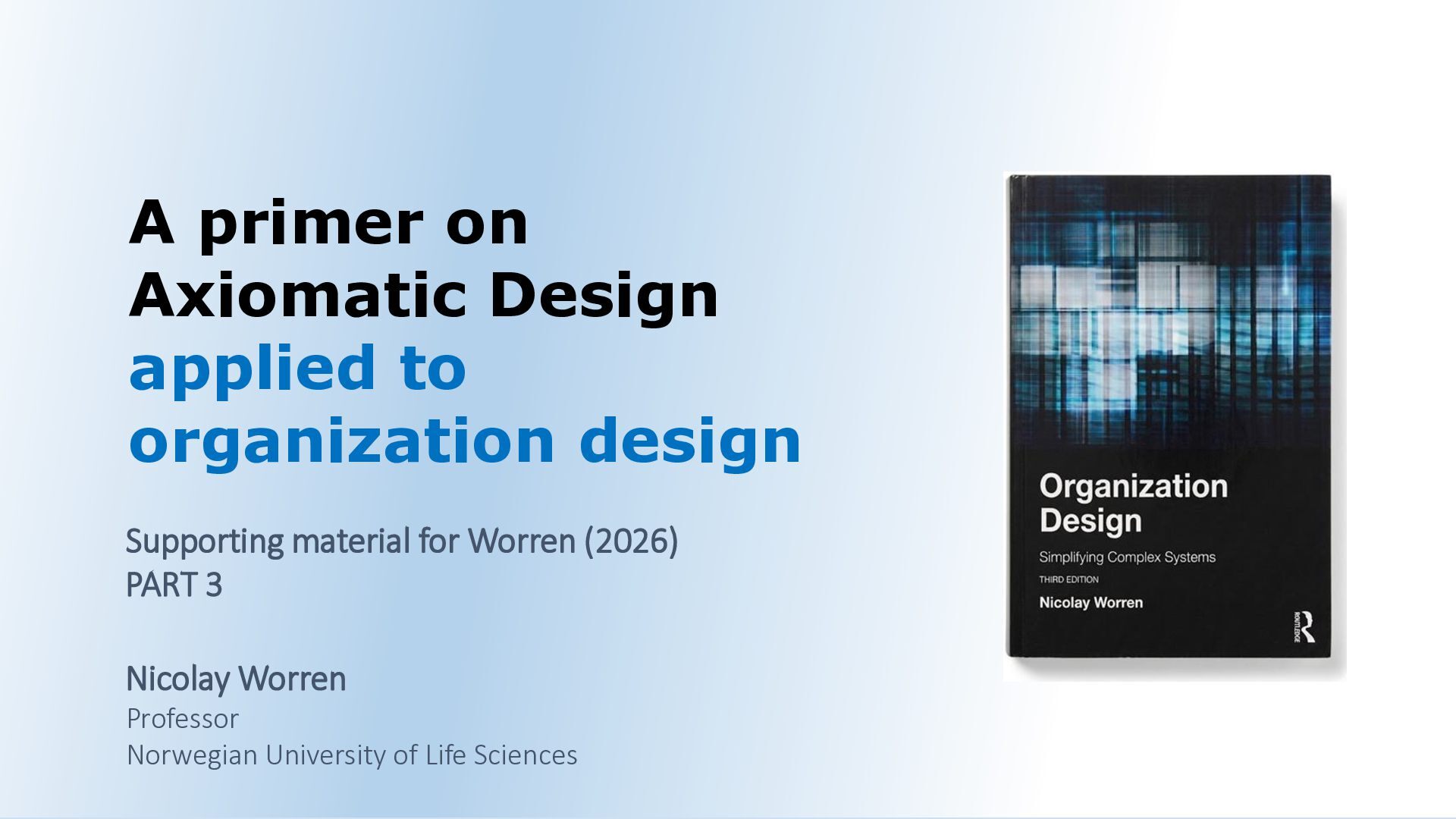
  1. A primer on Axiomatic Design applied to organization design Supporting

    material for Worren (2026) PART 3 Nicolay Worren Professor Norwegian University of Life Sciences
  2. Topics 1. Why Axiomatic Design? 2. The core axioms 3.

    Case studies 4. Beyond the basics
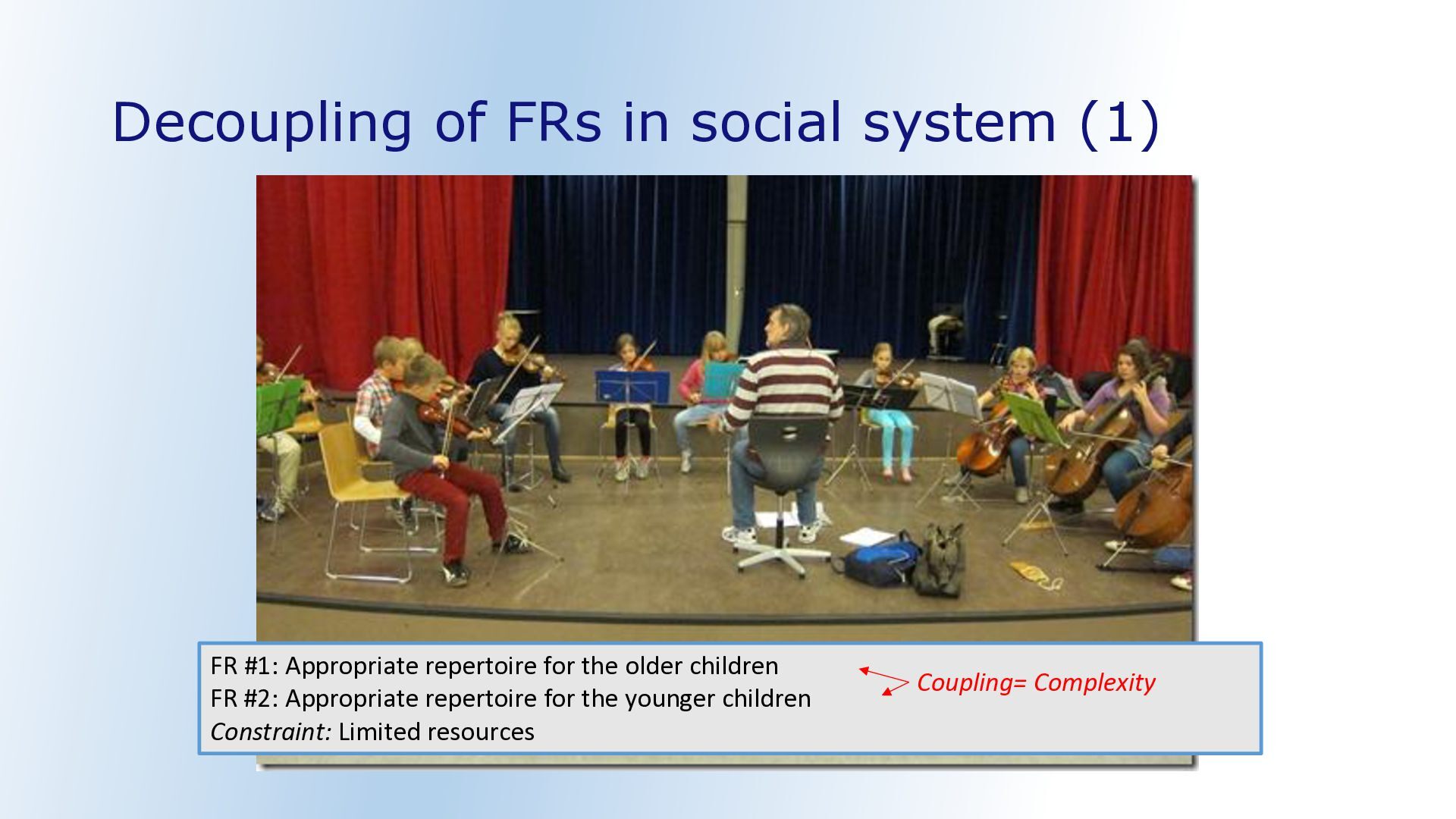
  3. Decoupling of FRs in social system (1) FR #1: Appropriate

    repertoire for the older children FR #2: Appropriate repertoire for the younger children Constraint: Limited resources Coupling= Complexity
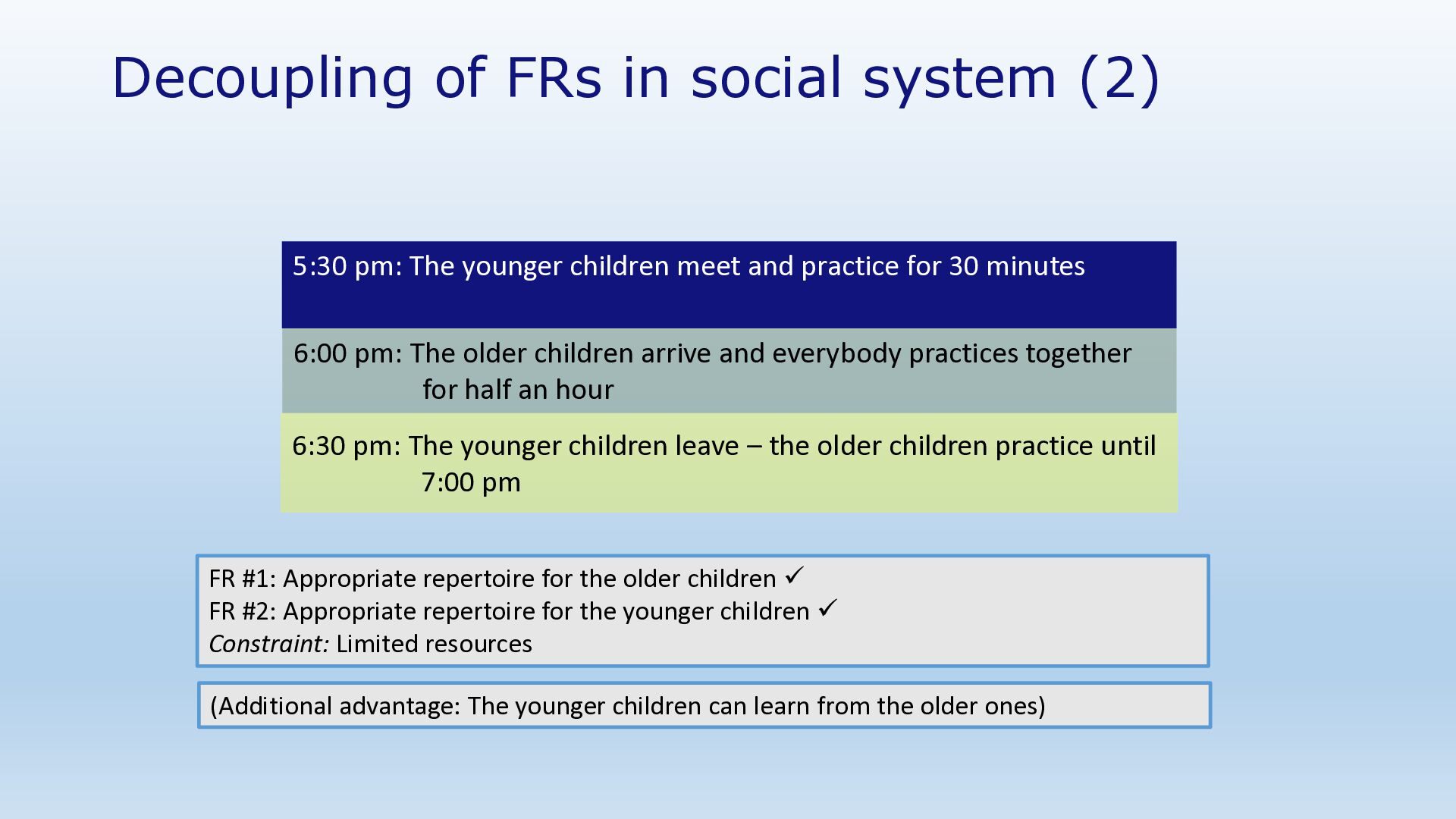
  4. Decoupling of FRs in social system (2) 5:30 pm: The

    younger children meet and practice for 30 minutes 6:00 pm: The older children arrive and everybody practices together for half an hour 6:30 pm: The younger children leave – the older children practice until 7:00 pm FR #1: Appropriate repertoire for the older children ✓ FR #2: Appropriate repertoire for the younger children ✓ Constraint: Limited resources (Additional advantage: The younger children can learn from the older ones)
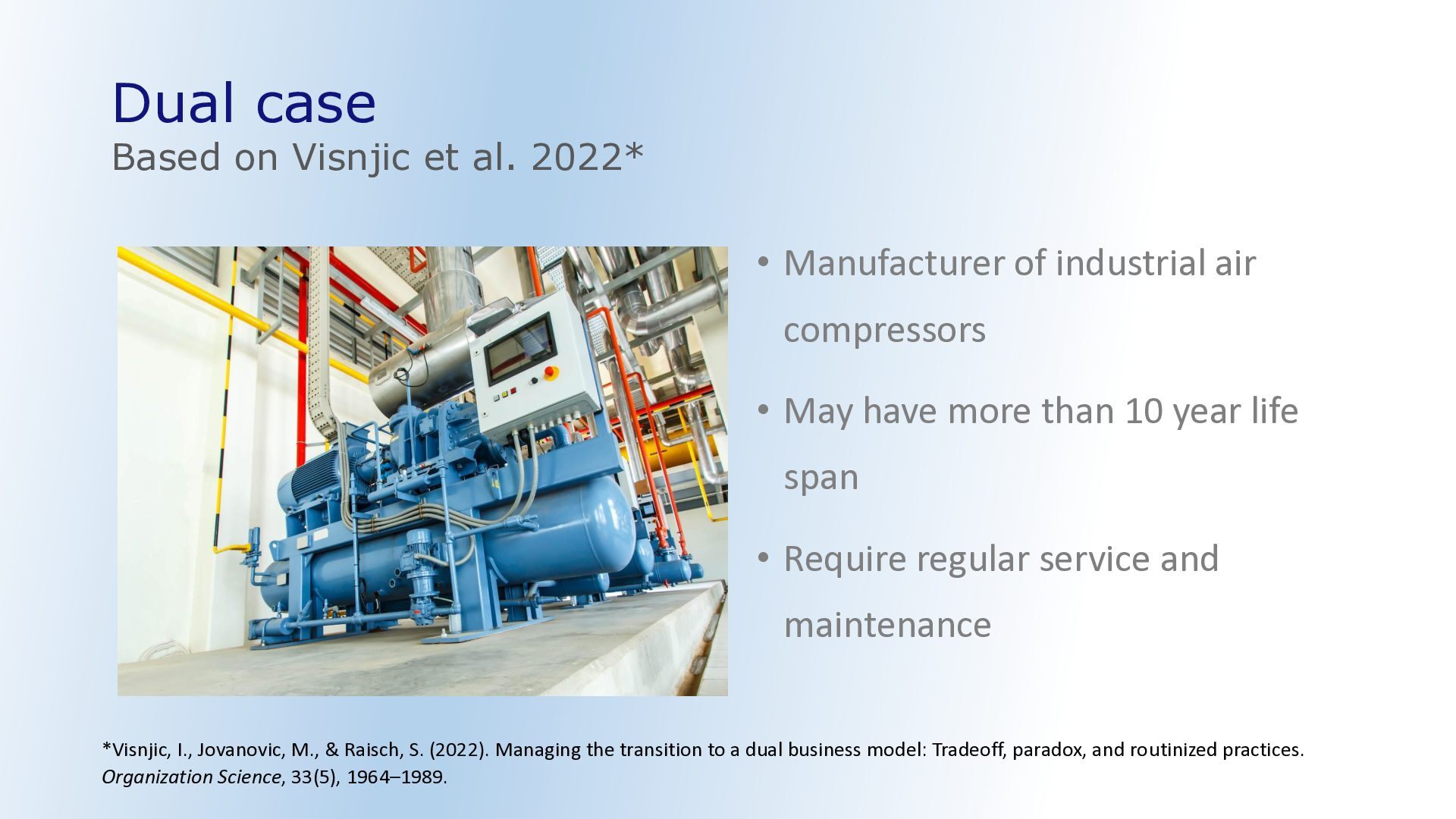
  5. Dual case Based on Visnjic et al. 2022* • Manufacturer

    of industrial air compressors • May have more than 10 year life span • Require regular service and maintenance *Visnjic, I., Jovanovic, M., & Raisch, S. (2022). Managing the transition to a dual business model: Tradeoff, paradox, and routinized practices. Organization Science, 33(5), 1964–1989.
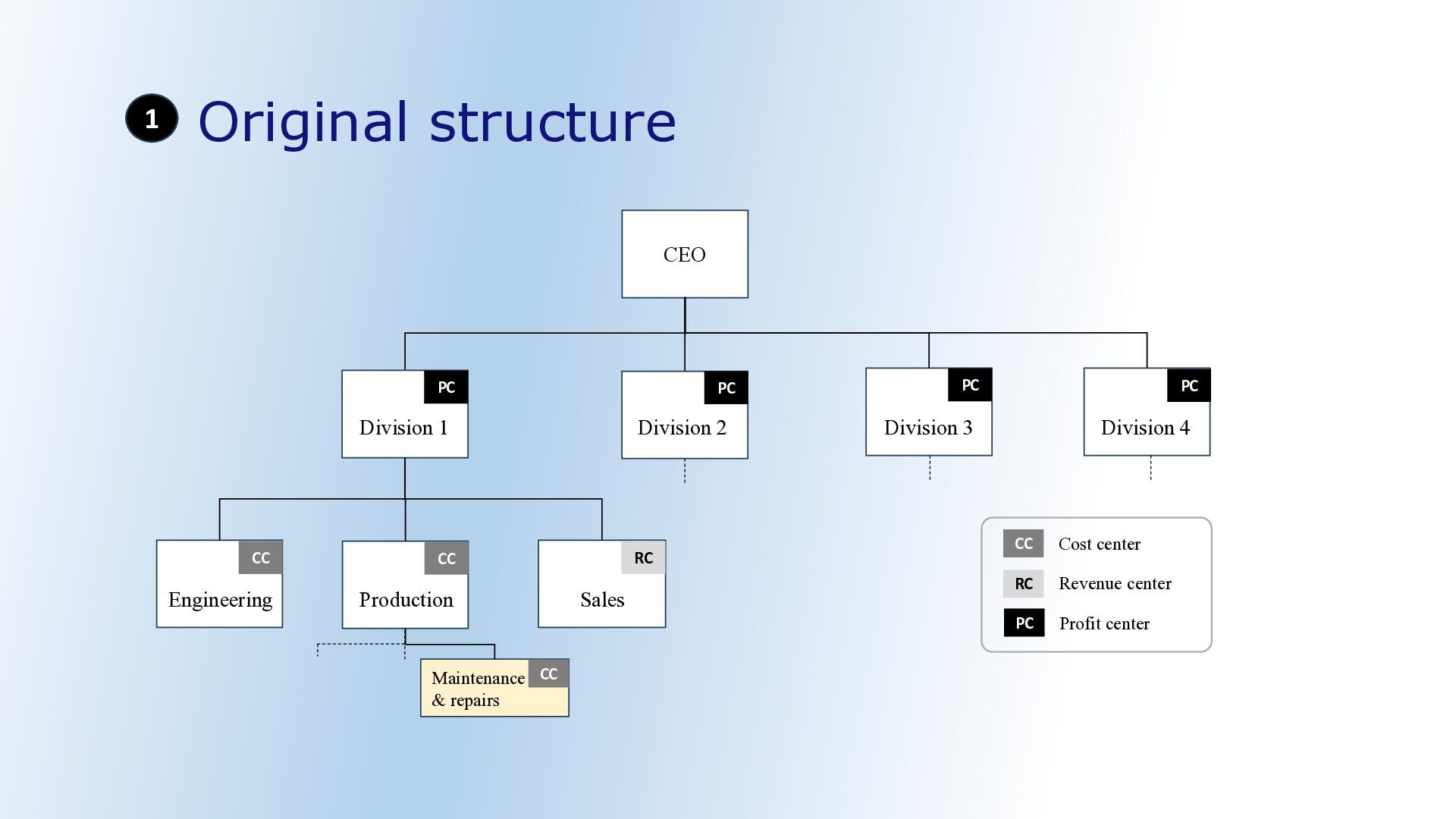
  6. 1 Original structure CEO PC PC PC PC Division 1

    Division 2 Division 3 Division 4 CC CC Engineering Production Maintenance CC & repairs RC Sales CC Cost center RC Revenue center PC Profit center
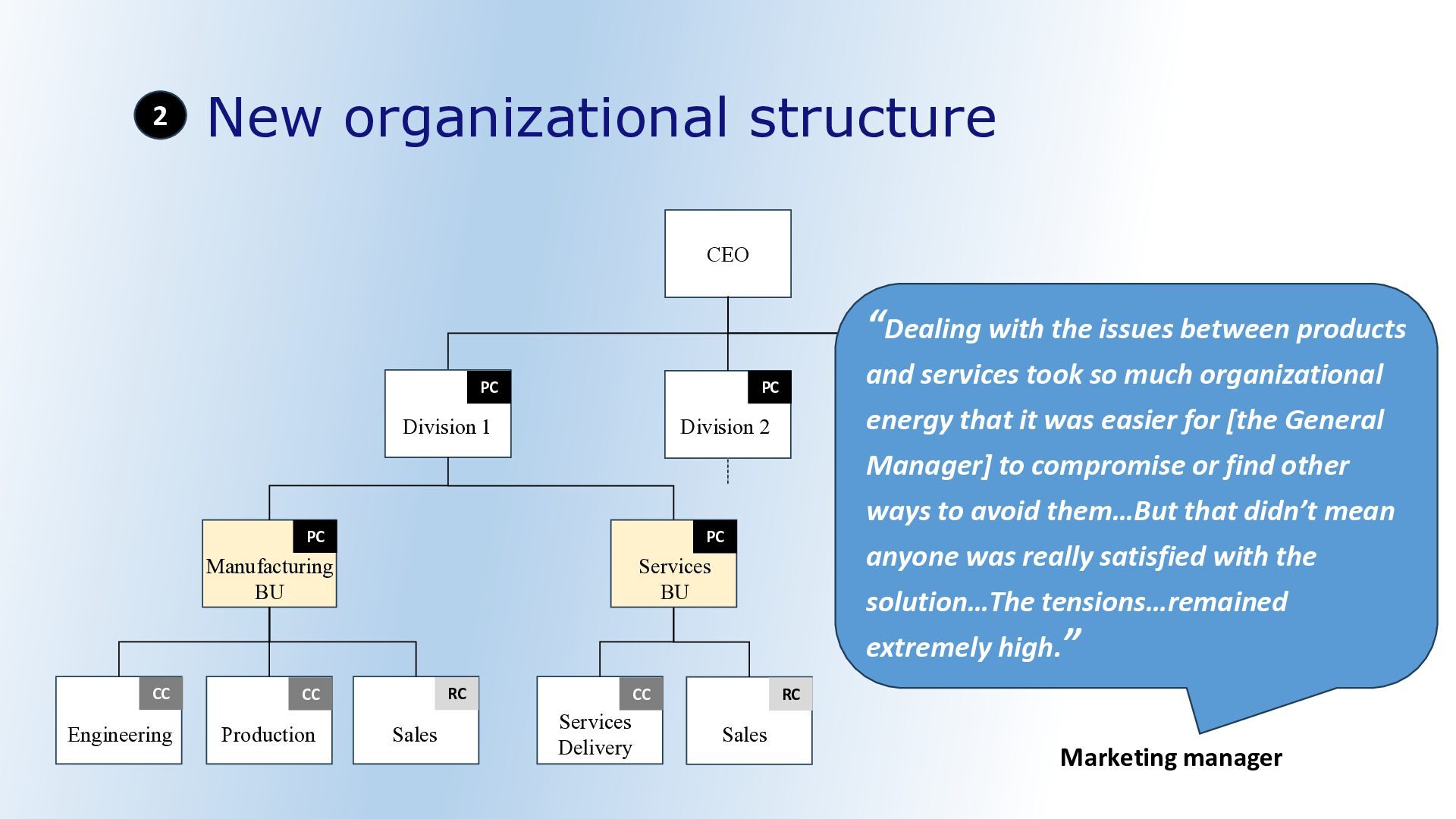
  7. 2 New organizational structure CEO “Dealing with the issues between

    products PC PC Division 1 Division 2 PC PC Manufacturing BU CC CC Engineering Production and servicesPC took so much organizational PC energy that3 it was easier for 4[the General Division Division Manager] to compromise or find other ways to avoid them…But that didn’t mean anyone was really satisfied with the CC Cost center solution…The tensions…remained Revenue center RC extremely high.PC” Profit center Services BU RC Sales CC Services Delivery RC Sales Marketing manager
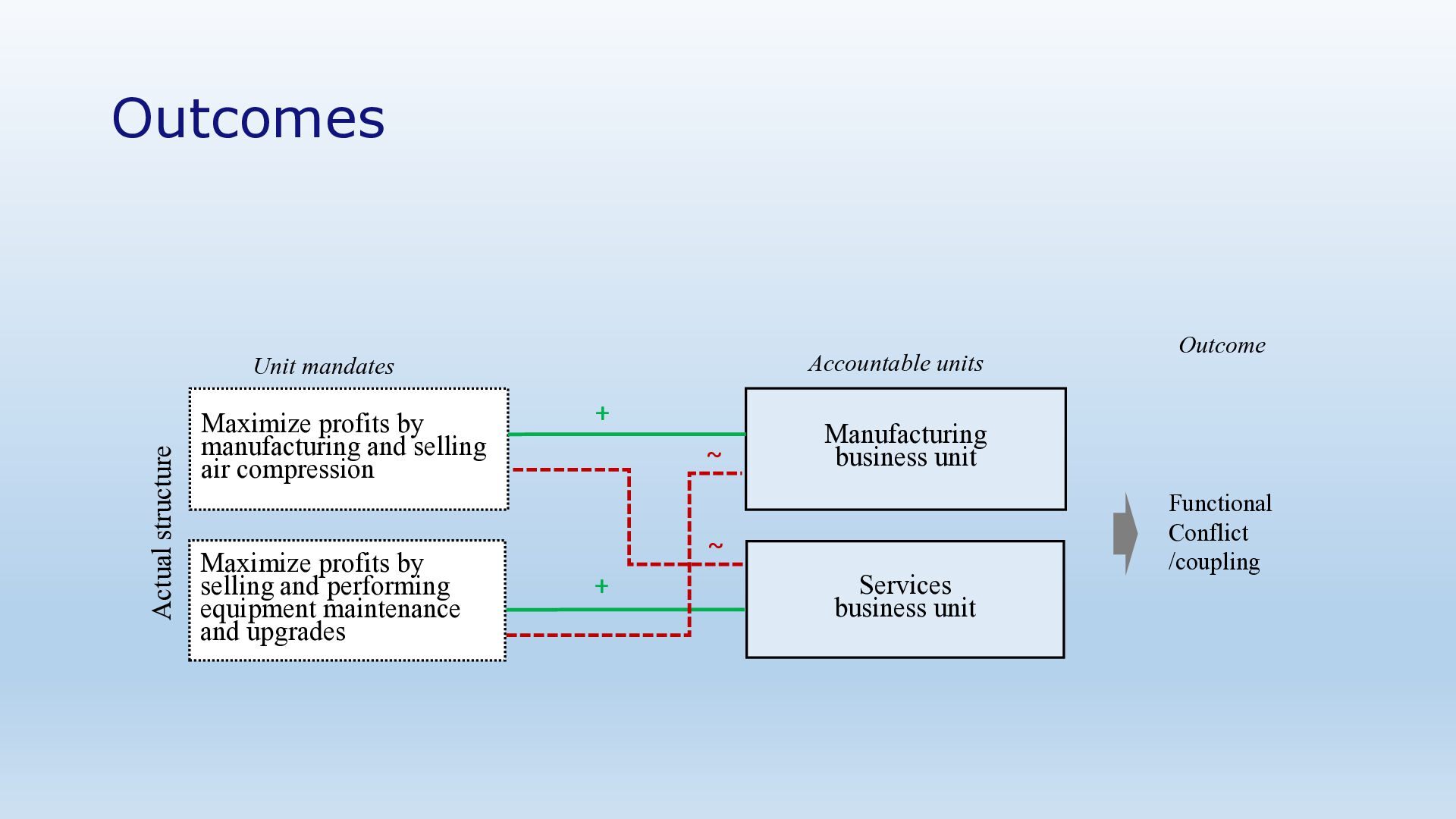
  8. Outcomes Accountable units Actual structure Unit mandates Maximize profits by

    manufacturing and selling air compression Maximize profits by selling and performing equipment maintenance and upgrades + ~ Manufacturing business unit ~ + Outcome Services business unit Functional Conflict /coupling
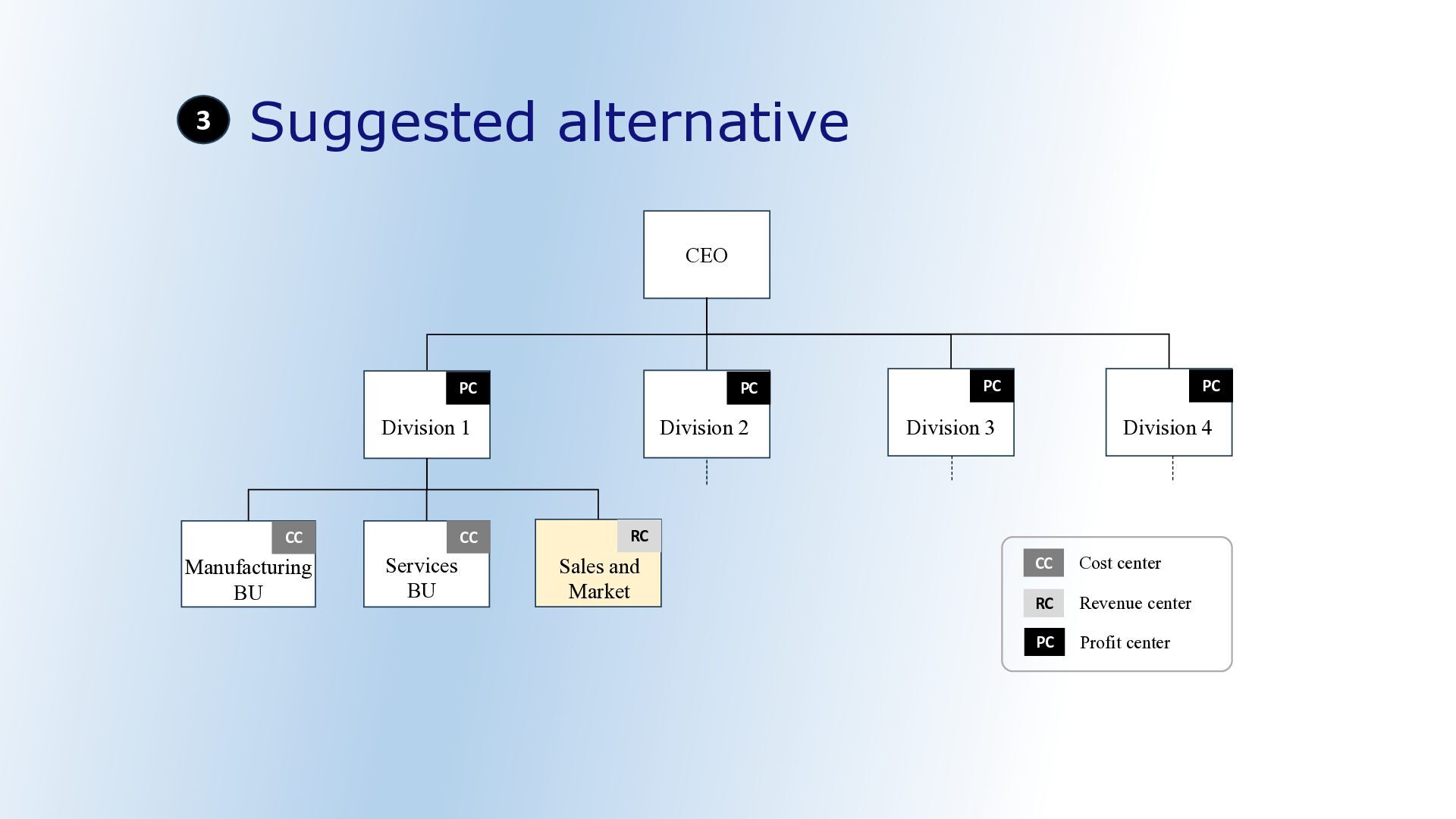
  9. 3 Suggested alternative CEO PC PC PC PC Division 1

    Division 2 Division 3 Division 4 CC CC Manufacturing BU Services BU RC Sales and Market CC Cost center RC Revenue center PC Profit center
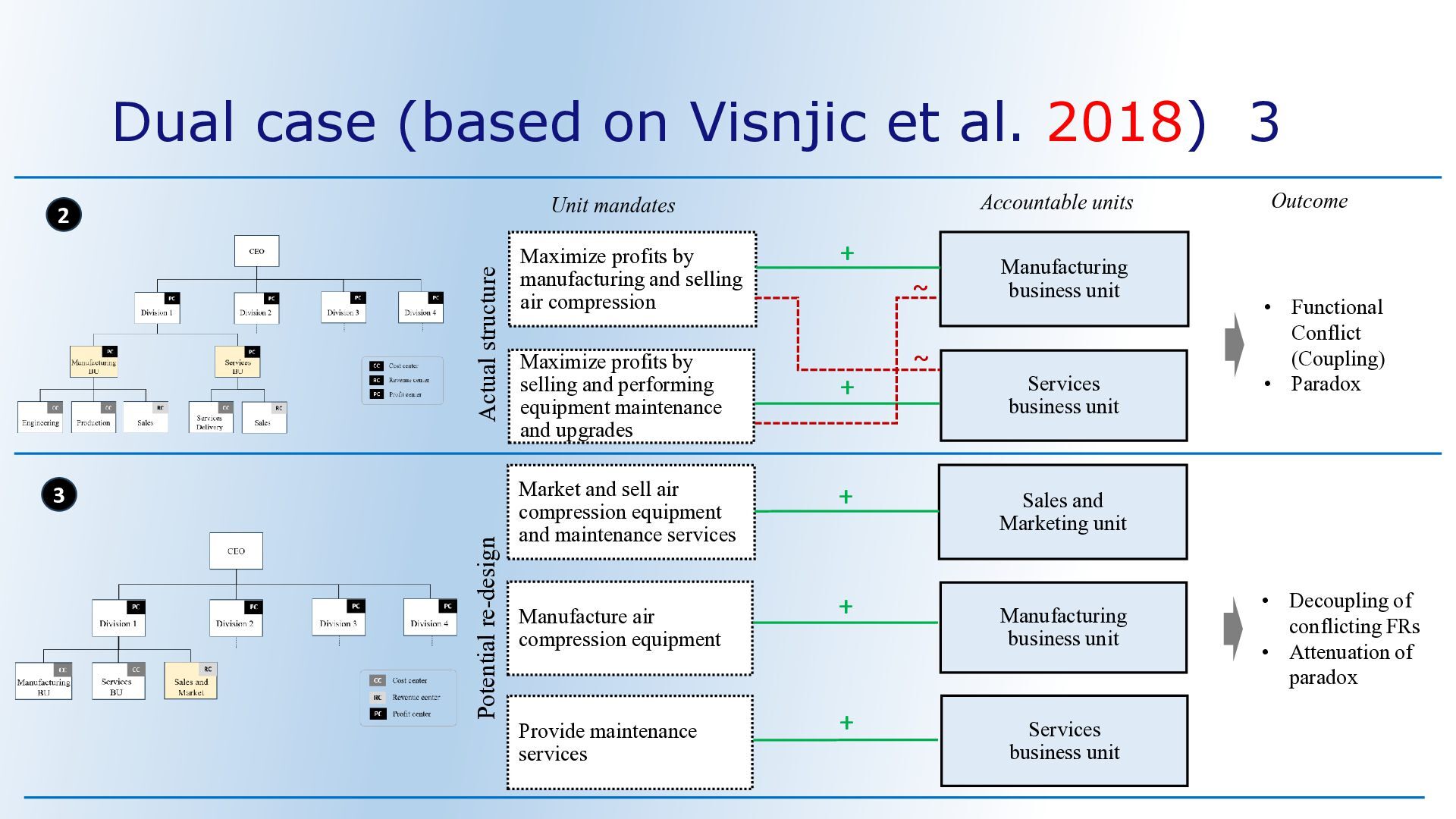
  10. Dual case (based on Visnjic et al. 2018) 3 Accountable

    units Unit mandates Actual structure 2 Potential re-design 3 Maximize profits by manufacturing and selling air compression Maximize profits by selling and performing equipment maintenance and upgrades Market and sell air compression equipment and maintenance services Manufacture air compression equipment Provide maintenance services + ~ + + + + ~ Manufacturing business unit Services business unit Outcome • Functional Conflict (Coupling) • Paradox Sales and Marketing unit Manufacturing business unit Services business unit • Decoupling of conflicting FRs • Attenuation of paradox
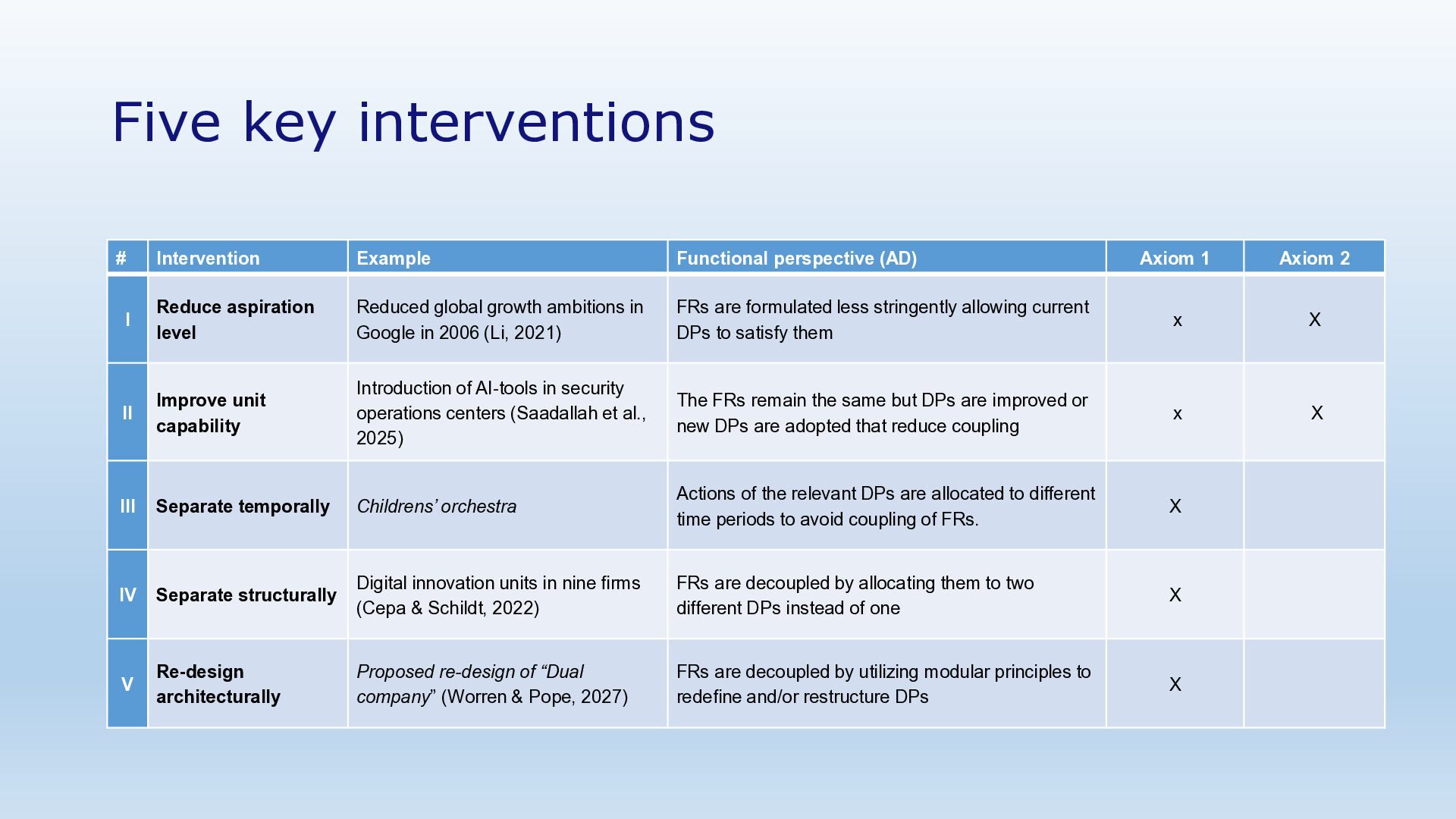
  11. Five key interventions # Intervention Example Functional perspective (AD) Axiom

    1 Axiom 2 I Reduce aspiration level Reduced global growth ambitions in Google in 2006 (Li, 2021) FRs are formulated less stringently allowing current DPs to satisfy them x X II Improve unit capability Introduction of AI-tools in security operations centers (Saadallah et al., 2025) The FRs remain the same but DPs are improved or new DPs are adopted that reduce coupling x X III Separate temporally Childrens’ orchestra Actions of the relevant DPs are allocated to different time periods to avoid coupling of FRs. X IV Separate structurally Digital innovation units in nine firms (Cepa & Schildt, 2022) FRs are decoupled by allocating them to two different DPs instead of one X V Re-design architecturally Proposed re-design of “Dual company” (Worren & Pope, 2027) FRs are decoupled by utilizing modular principles to redefine and/or restructure DPs X
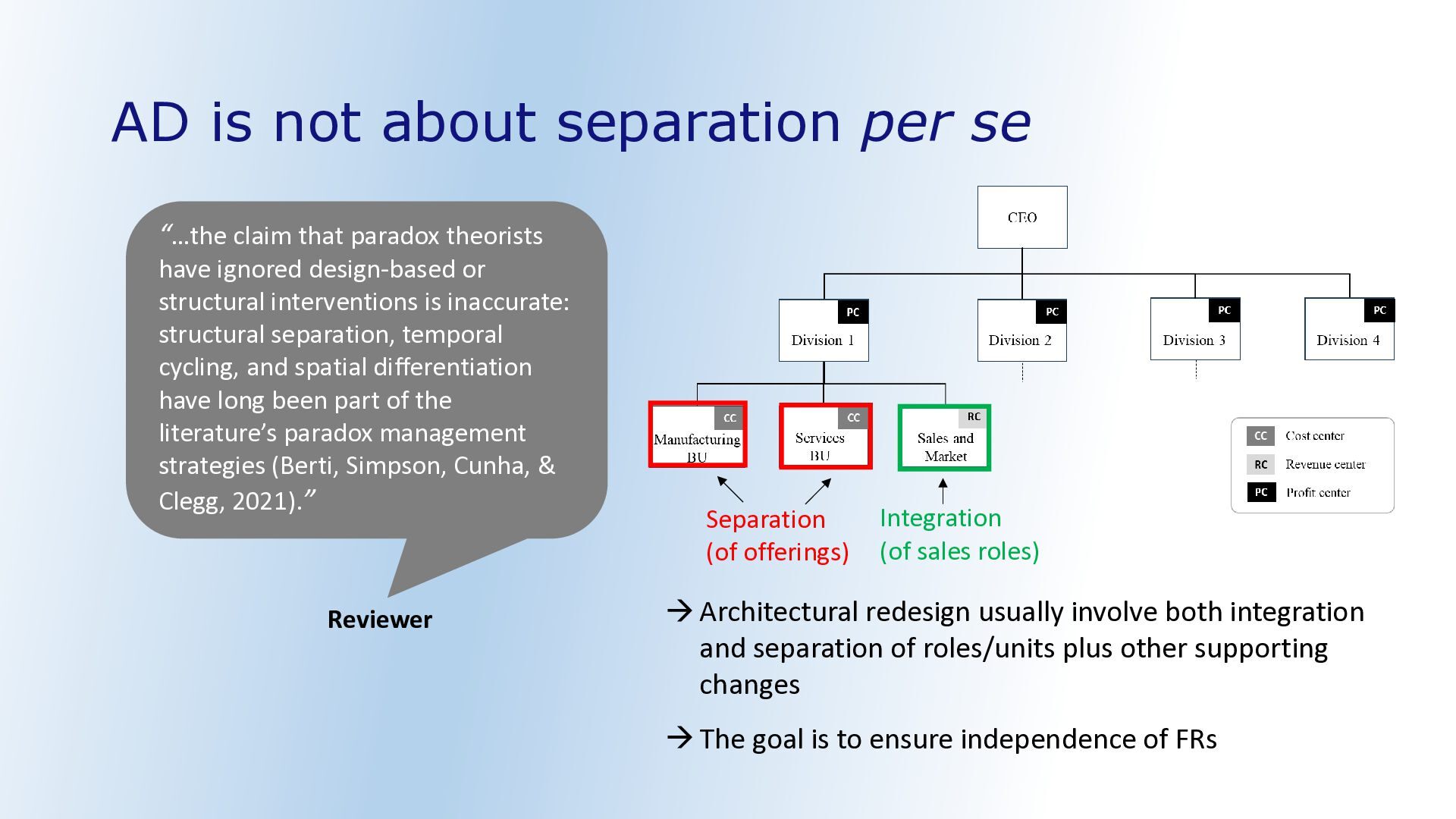
  12. AD is not about separation per se “…the claim that

    paradox theorists have ignored design-based or structural interventions is inaccurate: structural separation, temporal cycling, and spatial differentiation have long been part of the literature’s paradox management strategies (Berti, Simpson, Cunha, & Clegg, 2021).” Reviewer Separation (of offerings) Integration (of sales roles) → Architectural redesign usually involve both integration and separation of roles/units plus other supporting changes → The goal is to ensure independence of FRs