Upgrade to Pro — share decks privately, control downloads, hide ads and more …

Axiomatic Design for Organization Design - a pr...

Axiomatic Design for Organization Design - a primer (Slides for Video 4)

These are slides that I use in the last of the four videos I have uploaded to YouTube:
https://www.youtube.com/@NicolayWorren/playlists
The videos are intended for lecturers and others who want an introduction to Axiomatic design, one of the main approaches I use in my book on organization design (published by Routledge). The third edition was published in September, 2026.

Routledge book page:
https://tinyurl.com/4uwz5j92

Amazon.com book page:
https://tinyurl.com/yzk5bphv

Avatar for Nicolay Worren

Nicolay Worren

October 05, 2026

More Decks by Nicolay Worren

Other Decks in Education

Transcript

  1. A primer on Axiomatic Design applied to organization design Supporting

    material for Worren (2026) PART 4 Nicolay Worren Professor Norwegian University of Life Sciences
  2. Topics 1. Why Axiomatic Design? 2. The Core Axioms 3.

    Case studies 4. Beyond the Basics
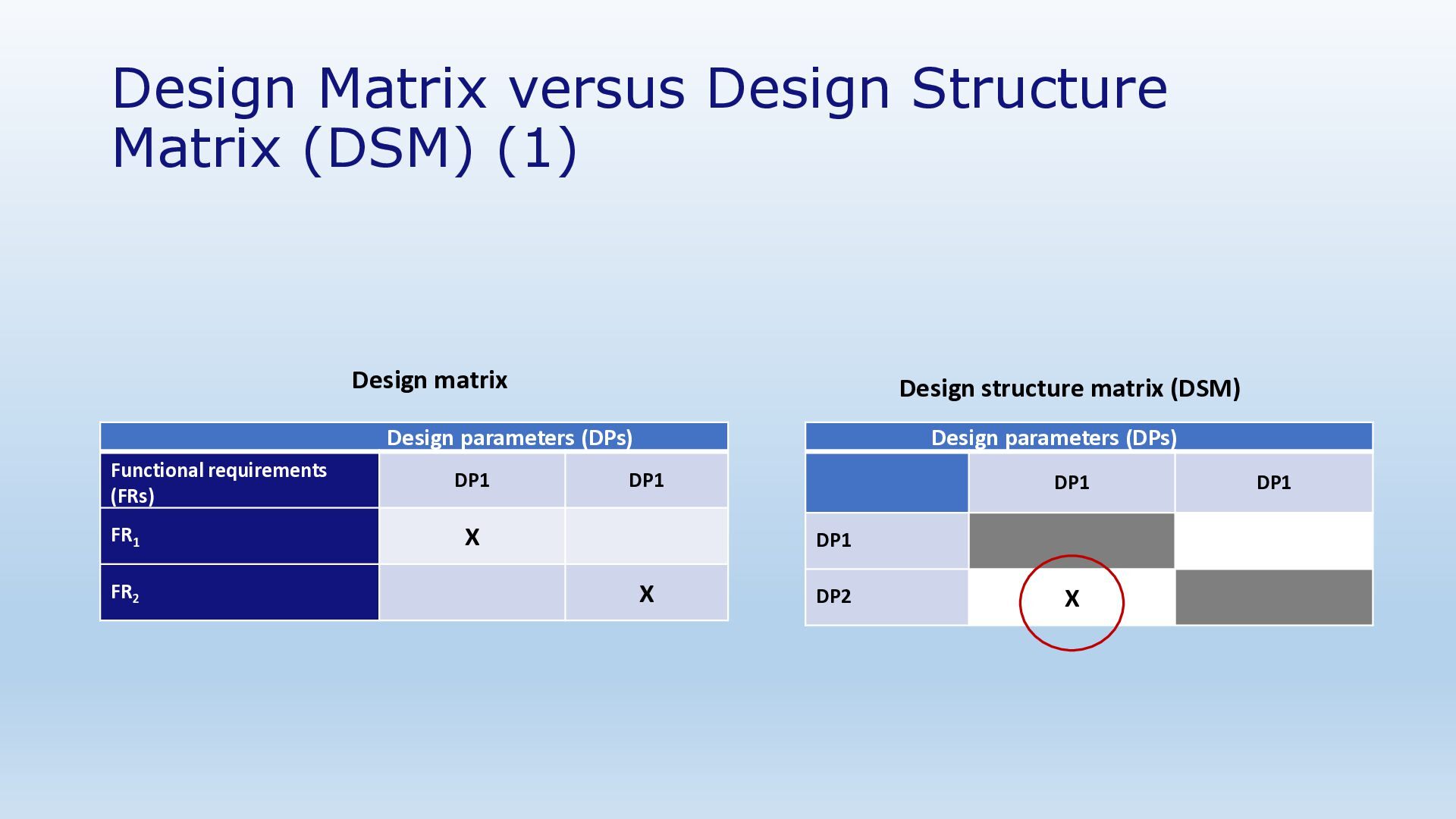
  3. Design Matrix versus Design Structure Matrix (DSM) (1) Design matrix

    Design structure matrix (DSM) Design parameters (DPs) Functional requirements (FRs) DP1 FR1 X FR2 Design parameters (DPs) DP1 DP1 DP1 X DP2 X DP1
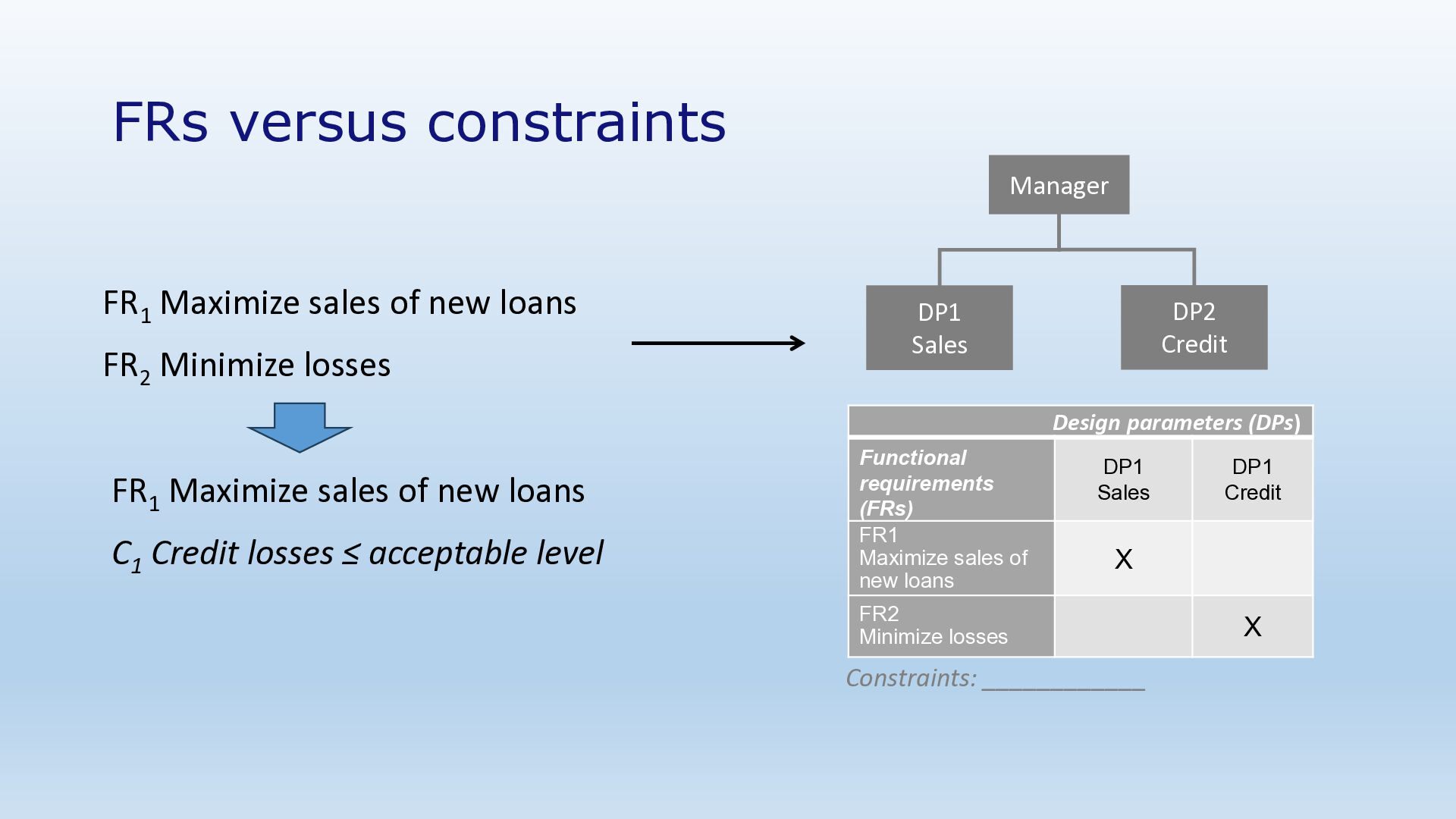
  4. FRs versus constraints Manager FR1 Maximize sales of new loans

    FR2 Minimize losses DP2 Credit DP1 Sales Design parameters (DPs) FR1 Maximize sales of new loans C1 Credit losses ≤ acceptable level Functional requirements (FRs) FR1 Maximize sales of new loans DP1 Sales DP1 Credit X FR2 Minimize losses Constraints: ____________ X
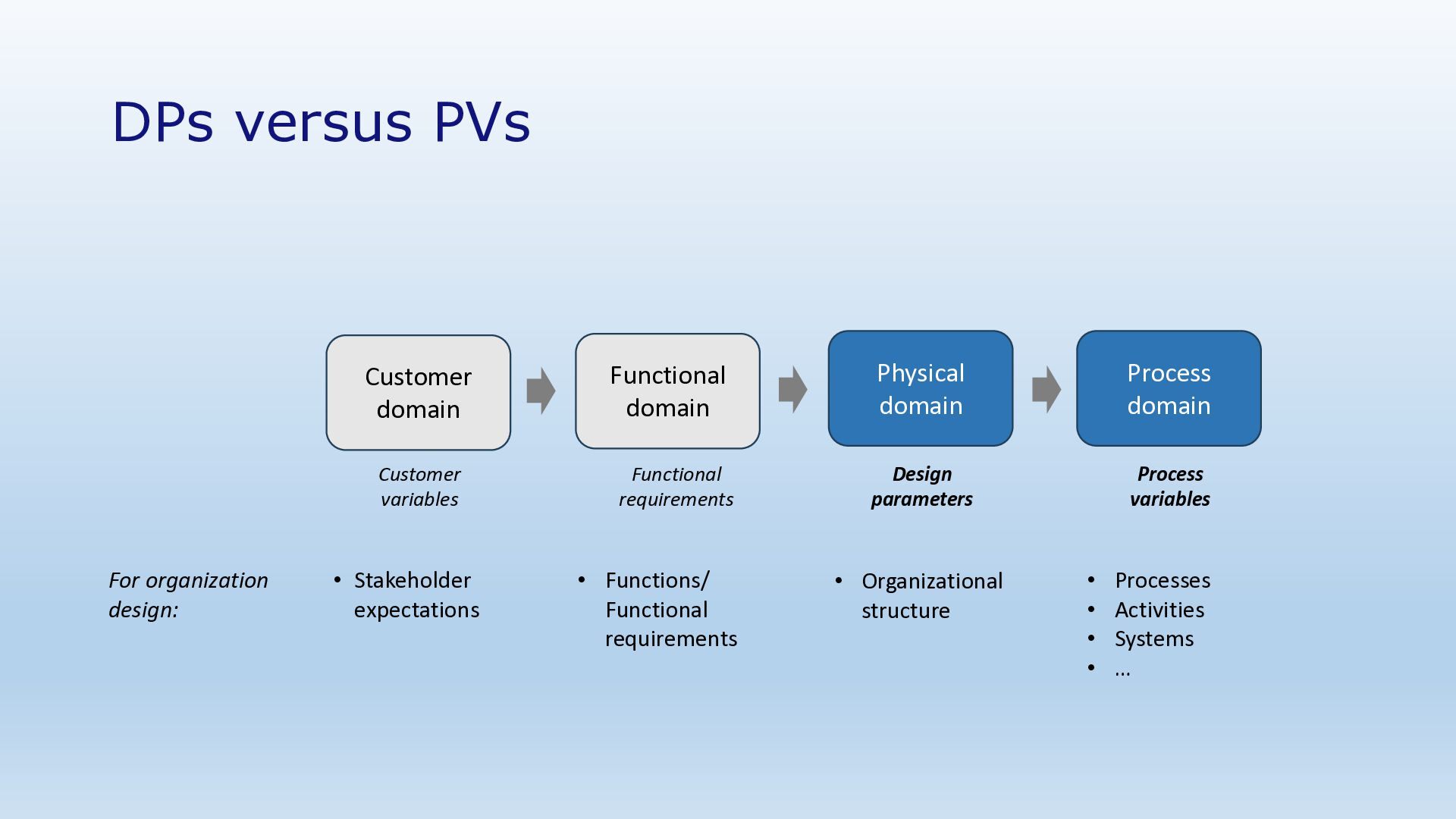
  5. DPs versus PVs For organization design: Customer domain Functional domain

    Physical domain Process domain Customer variables Functional requirements Design parameters Process variables • Stakeholder expectations • Functions/ Functional requirements • Organizational structure • • • • Processes Activities Systems …
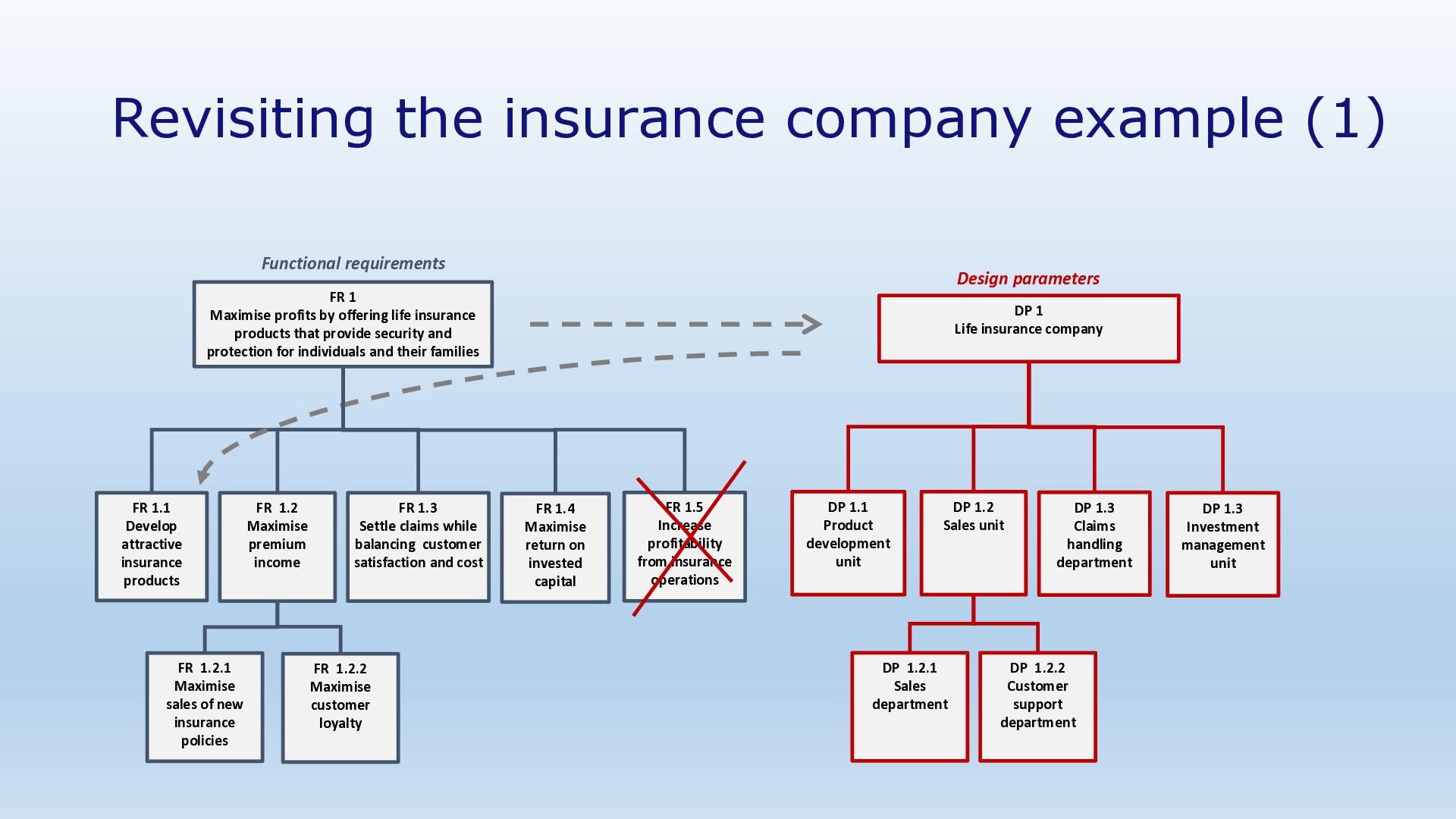
  6. Revisiting the insurance company example (1) Functional requirements Design parameters

    FR 1 Maximise profits by offering life insurance products that provide security and protection for individuals and their families FR 1.1 Develop attractive insurance products FR 1.2.1 Maximise sales of new insurance policies FR 1.2 Maximise premium income FR 1.3 Settle claims while balancing customer satisfaction and cost FR 1.2.2 Maximise customer loyalty DP 1 Life insurance company FR 1.4 Maximise return on invested capital FR 1.5 Increase profitability from insurance operations DP 1.1 Product development unit DP 1.2 Sales unit DP 1.2.1 Sales department DP 1.3 Claims handling department DP 1.2.2 Customer support department DP 1.3 Investment management unit
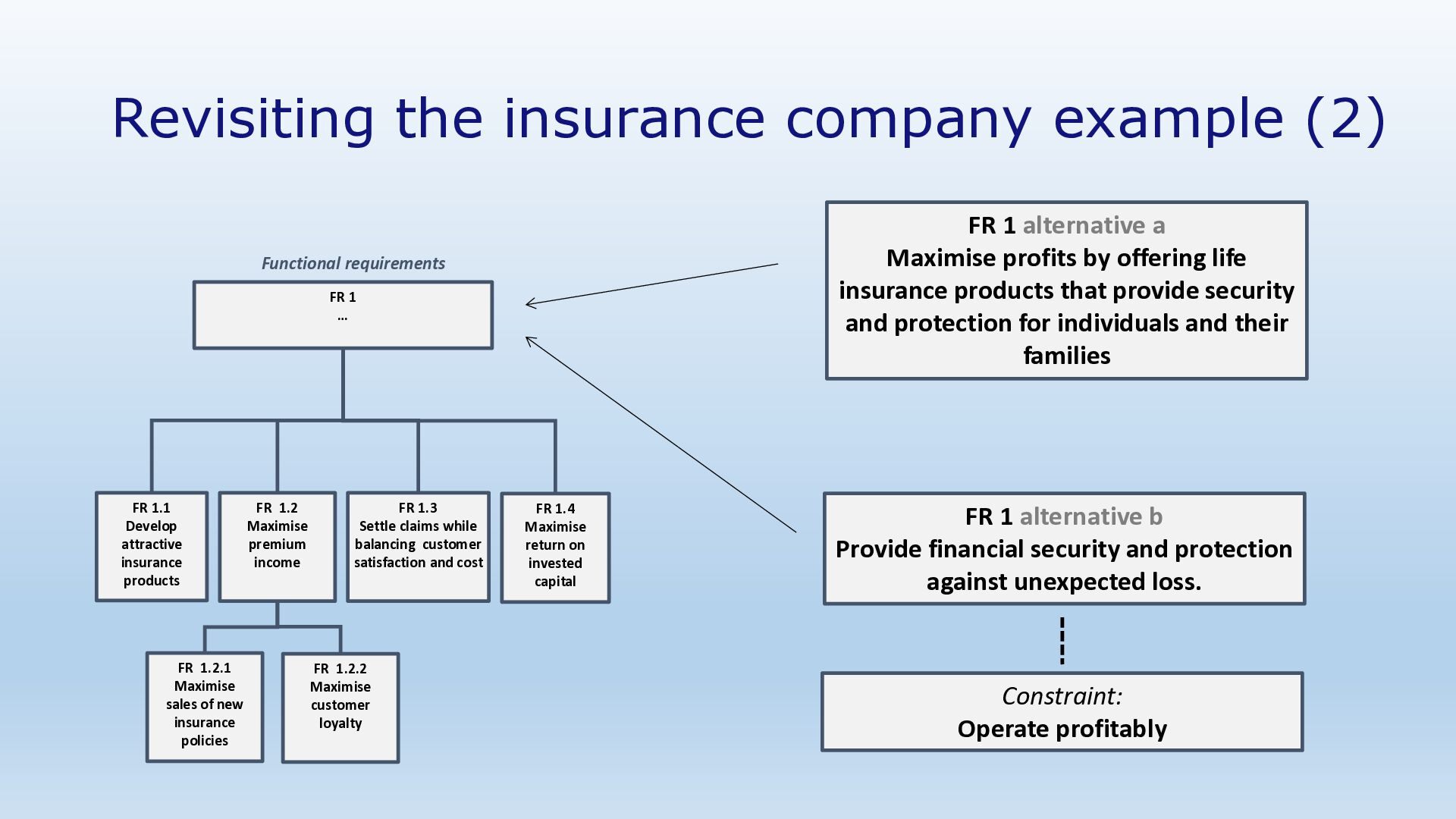
  7. Revisiting the insurance company example (2) FR 1 alternative a

    Maximise profits by offering life insurance products that provide security and protection for individuals and their families Functional requirements FR 1 … FR 1.1 Develop attractive insurance products FR 1.2.1 Maximise sales of new insurance policies FR 1.2 Maximise premium income FR 1.3 Settle claims while balancing customer satisfaction and cost FR 1.2.2 Maximise customer loyalty FR 1.4 Maximise return on invested capital FR 1 alternative b Provide financial security and protection against unexpected loss. Constraint: Operate profitably
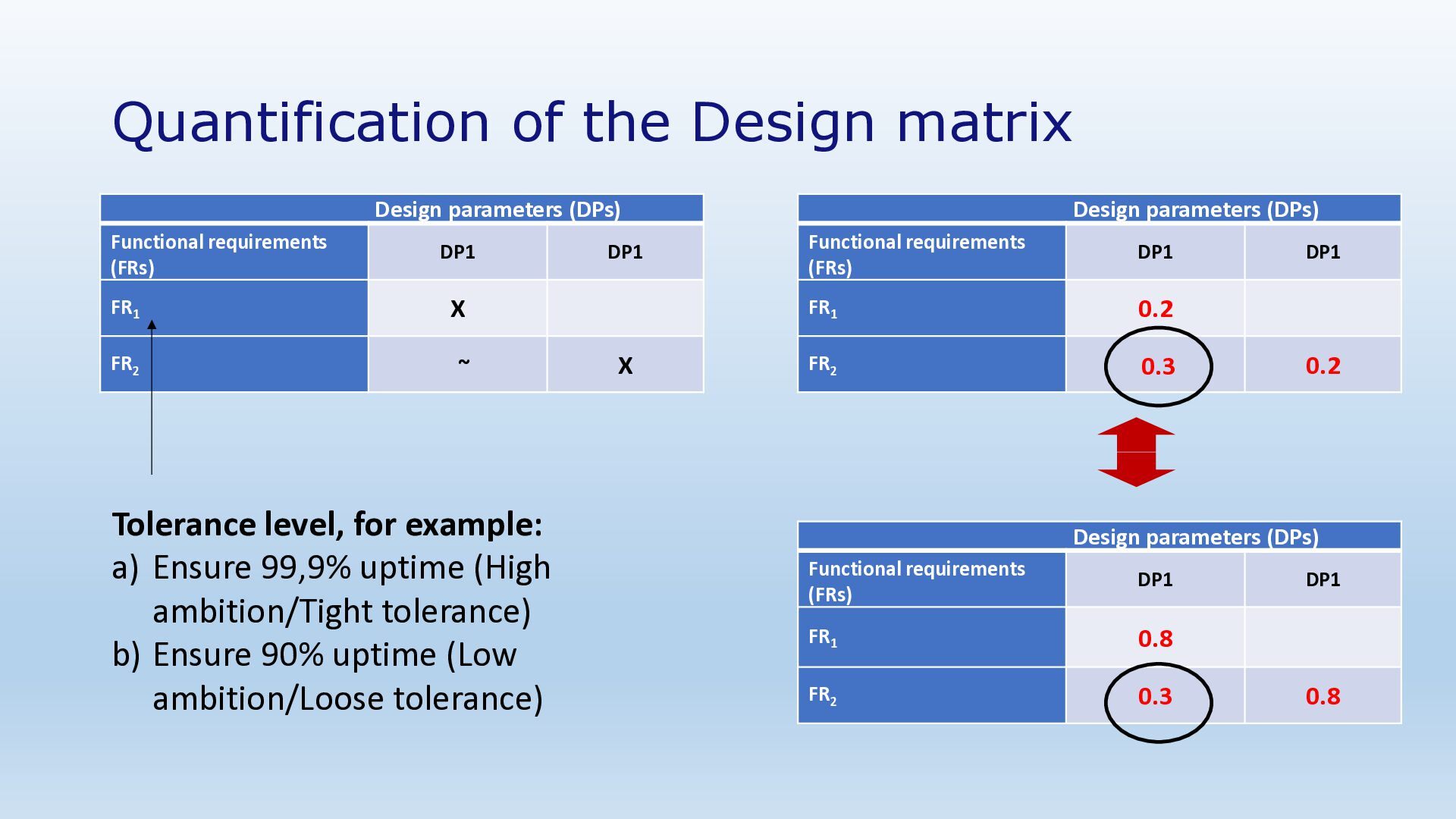
  8. Quantification of the Design matrix Design parameters (DPs) Functional requirements

    (FRs) DP1 FR1 X FR2 ~ Tolerance level, for example: a) Ensure 99,9% uptime (High ambition/Tight tolerance) b) Ensure 90% uptime (Low ambition/Loose tolerance) DP1 X Design parameters (DPs) Functional requirements (FRs) DP1 FR1 0.2 FR2 0.3 DP1 0.2 Design parameters (DPs) Functional requirements (FRs) DP1 FR1 0.8 FR2 0.3 DP1 0.8
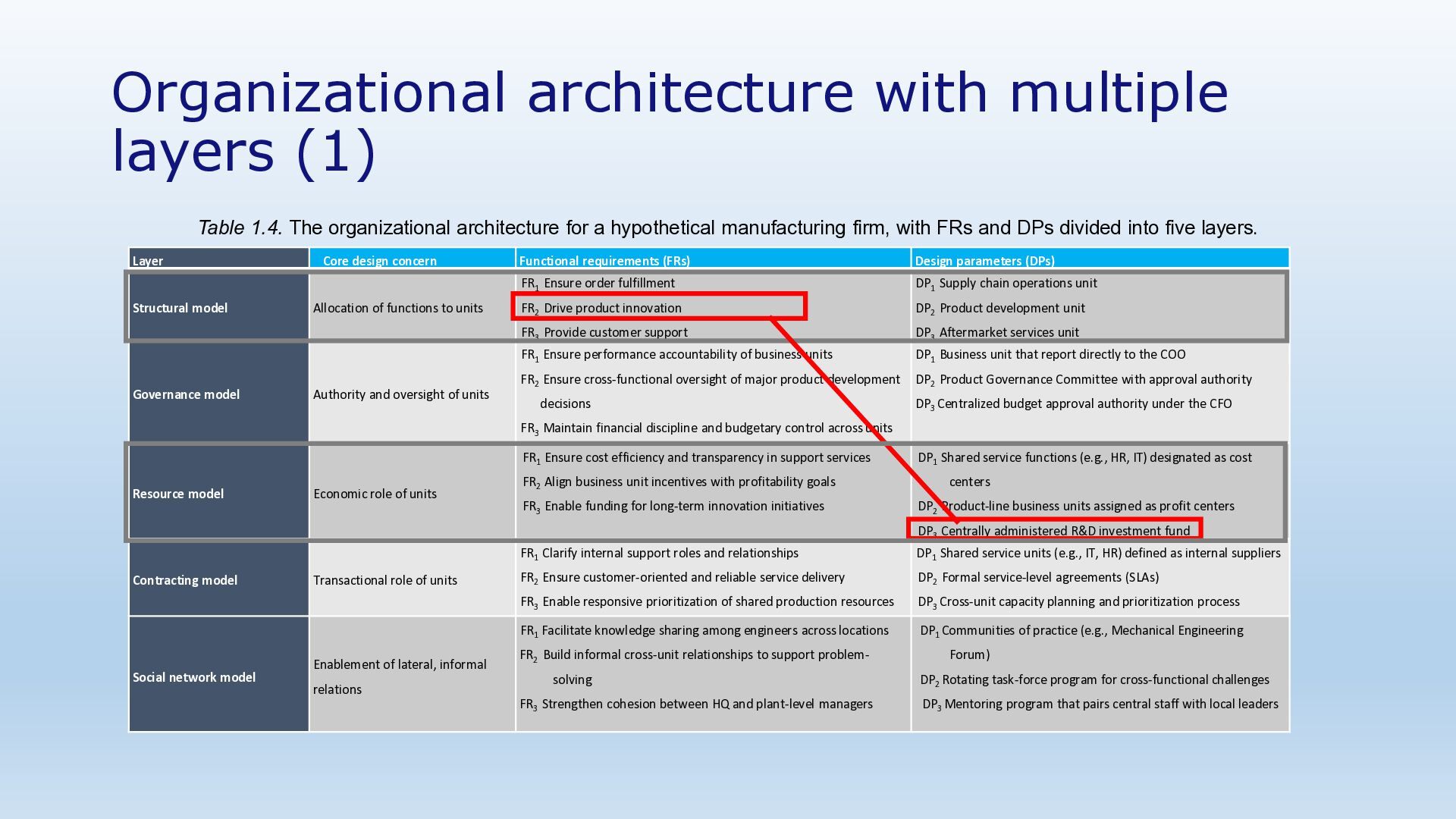
  9. Organizational architecture with multiple layers (1) Table 1.4. The organizational

    architecture for a hypothetical manufacturing firm, with FRs and DPs divided into five layers. Layer Structural model Governance model Core design concern Allocation of functions to units Authority and oversight of units Functional requirements (FRs) Design parameters (DPs) FR1 Ensure order fulfillment DP1 Supply chain operations unit FR2 Drive product innovation DP2 Product development unit FR3 Provide customer support DP3 Aftermarket services unit FR1 Ensure performance accountability of business units DP1 Business unit that report directly to the COO FR2 Ensure cross-functional oversight of major product development DP2 Product Governance Committee with approval authority decisions DP3 Centralized budget approval authority under the CFO FR3 Maintain financial discipline and budgetary control across units FR1 Ensure cost efficiency and transparency in support services Resource model Economic role of units FR2 Align business unit incentives with profitability goals DP1 Shared service functions (e.g., HR, IT) designated as cost centers FR3 Enable funding for long-term innovation initiatives DP2 Product-line business units assigned as profit centers FR1 Clarify internal support roles and relationships DP1 Shared service units (e.g., IT, HR) defined as internal suppliers FR2 Ensure customer-oriented and reliable service delivery DP2 Formal service-level agreements (SLAs) FR3 Enable responsive prioritization of shared production resources DP3 Cross-unit capacity planning and prioritization process FR1 Facilitate knowledge sharing among engineers across locations DP1 Communities of practice (e.g., Mechanical Engineering DP3 Centrally administered R&D investment fund Contracting model Social network model Transactional role of units Enablement of lateral, informal relations FR2 Build informal cross-unit relationships to support problemsolving FR3 Strengthen cohesion between HQ and plant-level managers Forum) DP2 Rotating task-force program for cross-functional challenges DP3 Mentoring program that pairs central staff with local leaders
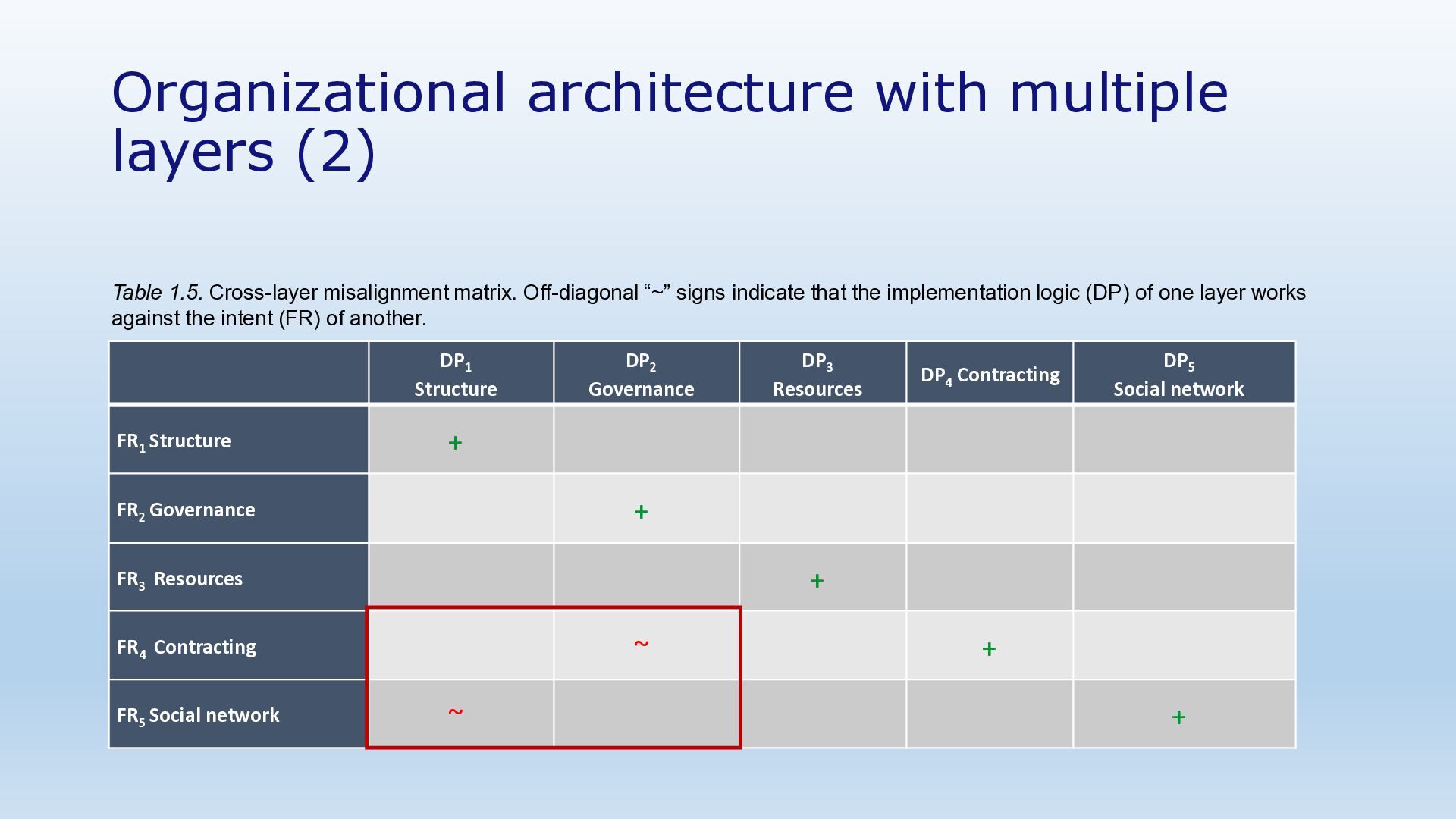
  10. Organizational architecture with multiple layers (2) Table 1.5. Cross-layer misalignment

    matrix. Off-diagonal “~” signs indicate that the implementation logic (DP) of one layer works against the intent (FR) of another. DP1 Structure FR1 Structure DP2 Governance DP4 Contracting DP5 Social network + + FR2 Governance + FR3 Resources ~ FR4 Contracting FR5 Social network DP3 Resources ~ + +
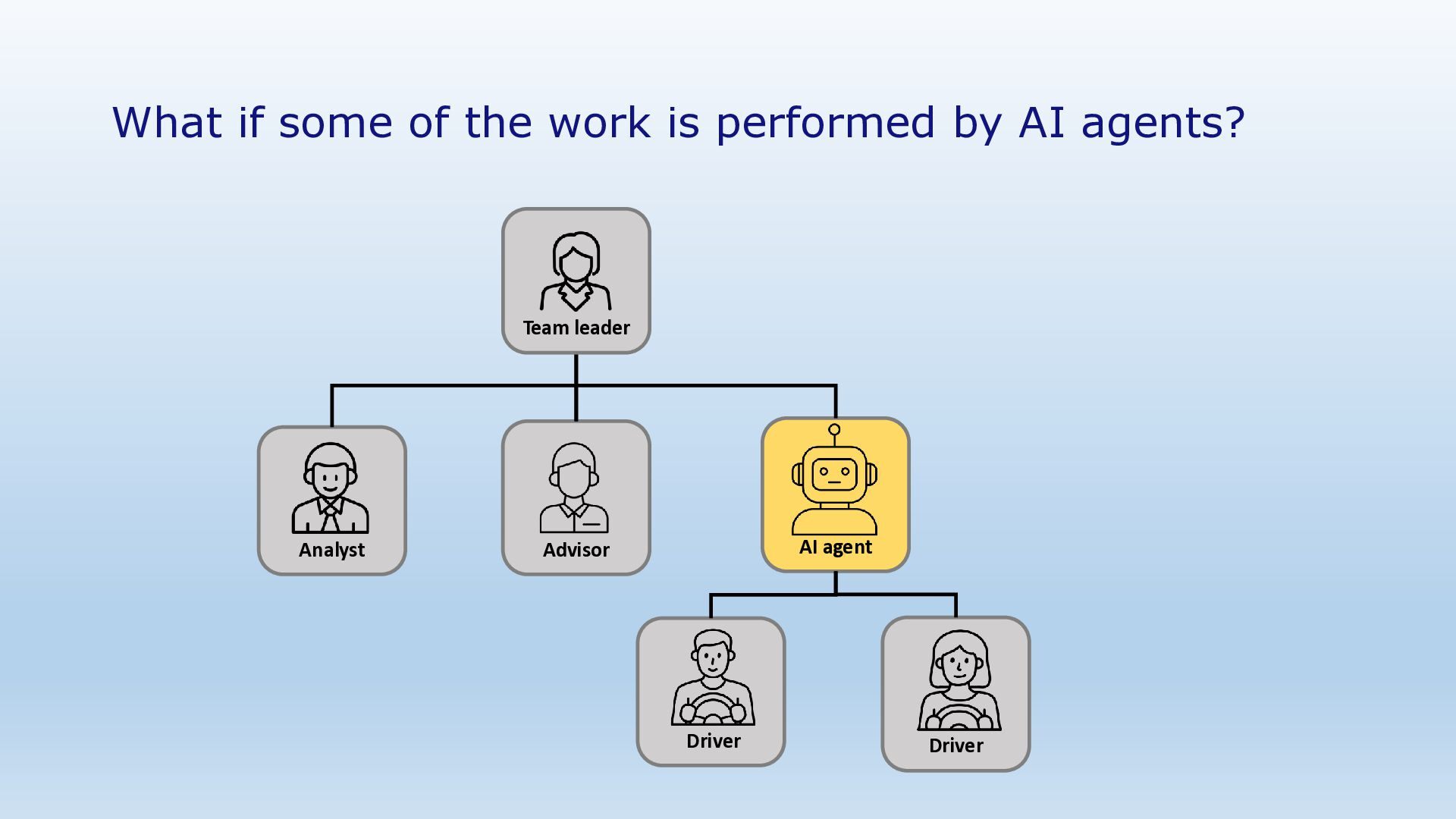
  11. What if some of the work is performed by AI

    agents? Team leader Analyst AI agent Advisor Driver Driver
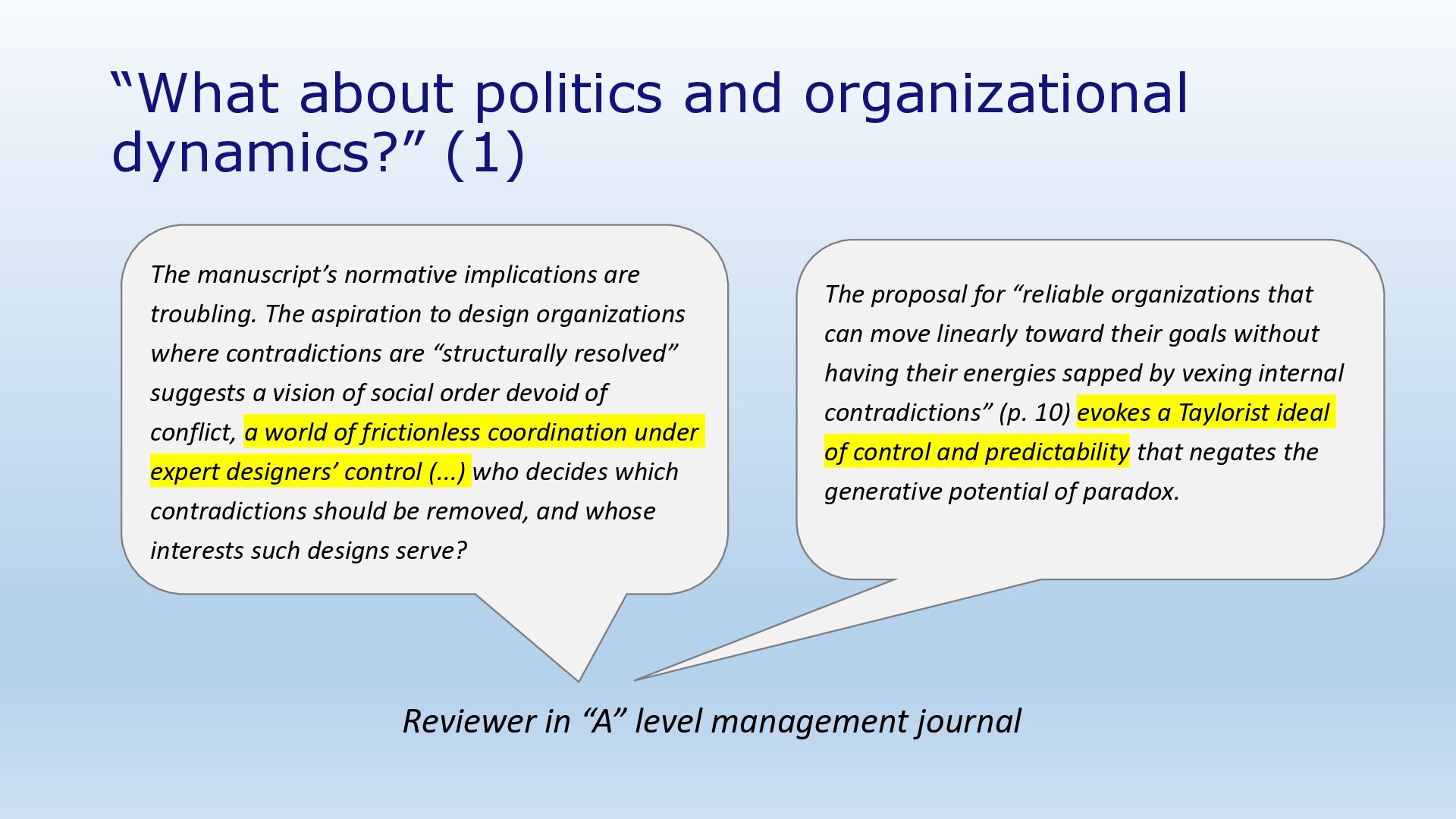
  12. “What about politics and organizational dynamics?” (1) The manuscript’s normative

    implications are troubling. The aspiration to design organizations where contradictions are “structurally resolved” suggests a vision of social order devoid of conflict, a world of frictionless coordination under expert designers’ control (...) who decides which contradictions should be removed, and whose interests such designs serve? The proposal for “reliable organizations that can move linearly toward their goals without having their energies sapped by vexing internal contradictions” (p. 10) evokes a Taylorist ideal of control and predictability that negates the generative potential of paradox. Reviewer in “A” level management journal
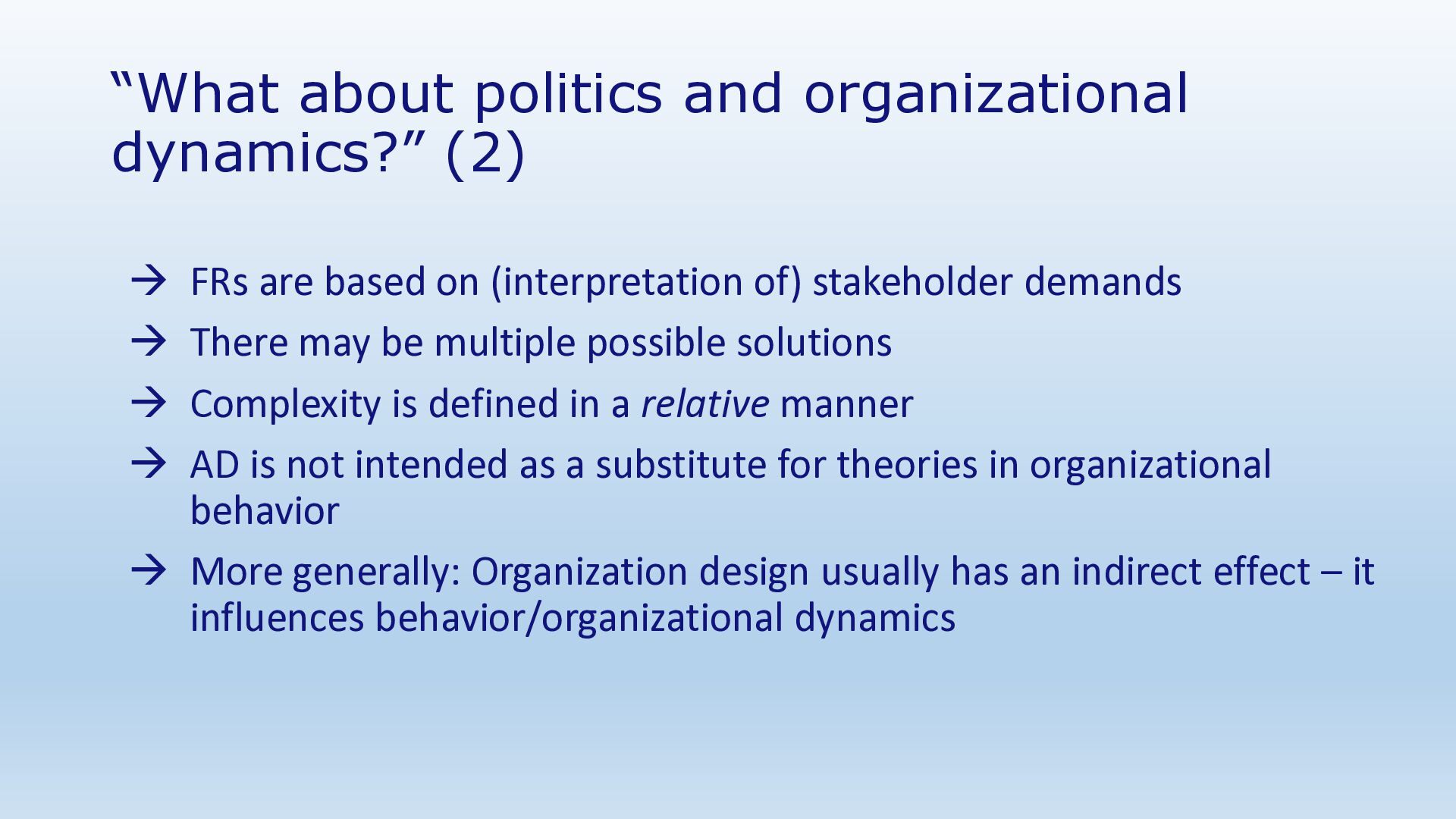
  13. “What about politics and organizational dynamics?” (2) → FRs are

    based on (interpretation of) stakeholder demands → There may be multiple possible solutions → Complexity is defined in a relative manner → AD is not intended as a substitute for theories in organizational behavior → More generally: Organization design usually has an indirect effect – it influences behavior/organizational dynamics
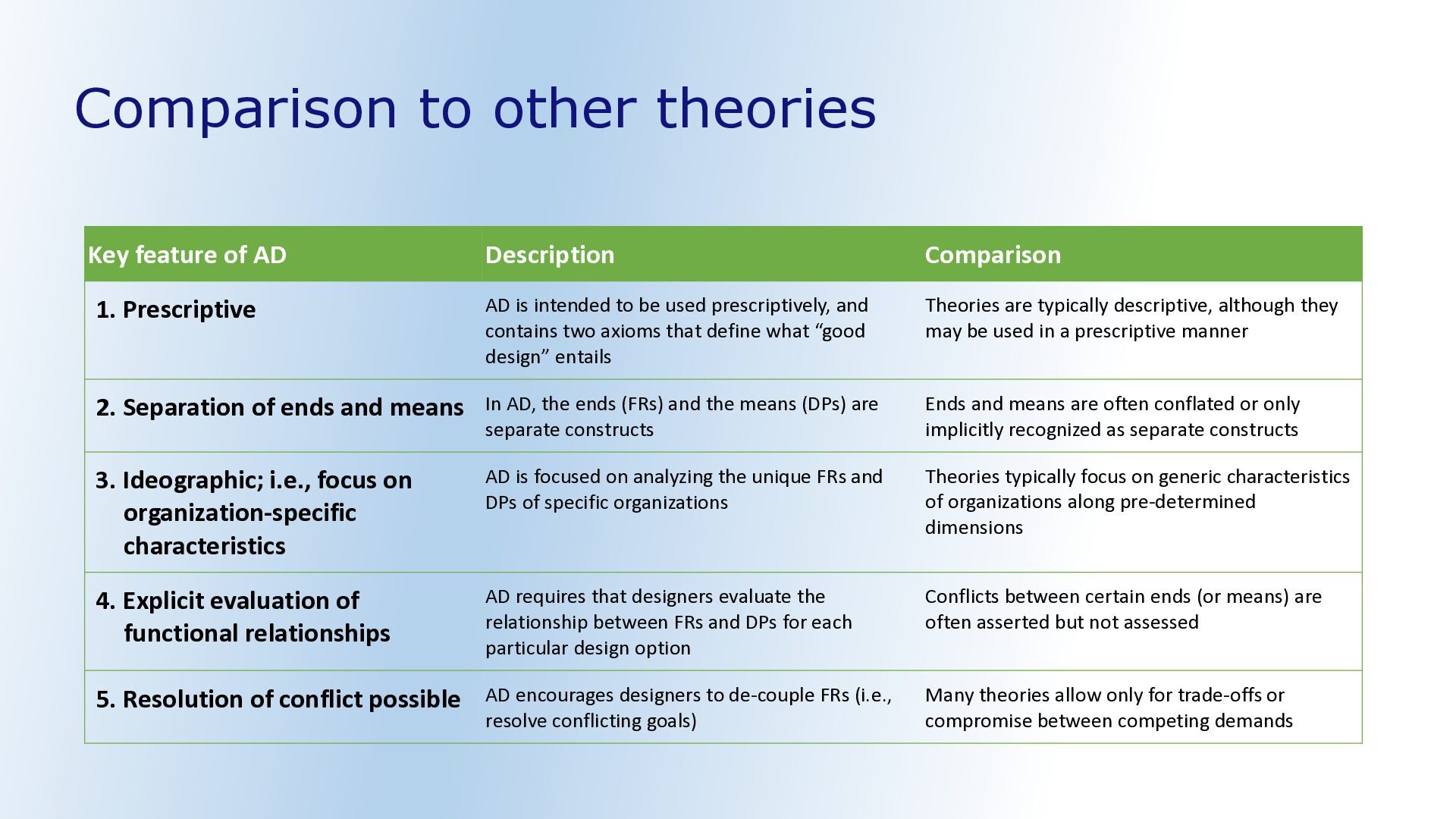
  14. Comparison to other theories Key feature of AD Description Comparison

    1. Prescriptive AD is intended to be used prescriptively, and contains two axioms that define what “good design” entails Theories are typically descriptive, although they may be used in a prescriptive manner 2. Separation of ends and means In AD, the ends (FRs) and the means (DPs) are separate constructs Ends and means are often conflated or only implicitly recognized as separate constructs 3. Ideographic; i.e., focus on organization-specific characteristics AD is focused on analyzing the unique FRs and DPs of specific organizations Theories typically focus on generic characteristics of organizations along pre-determined dimensions 4. Explicit evaluation of functional relationships AD requires that designers evaluate the relationship between FRs and DPs for each particular design option Conflicts between certain ends (or means) are often asserted but not assessed 5. Resolution of conflict possible AD encourages designers to de-couple FRs (i.e., resolve conflicting goals) Many theories allow only for trade-offs or compromise between competing demands
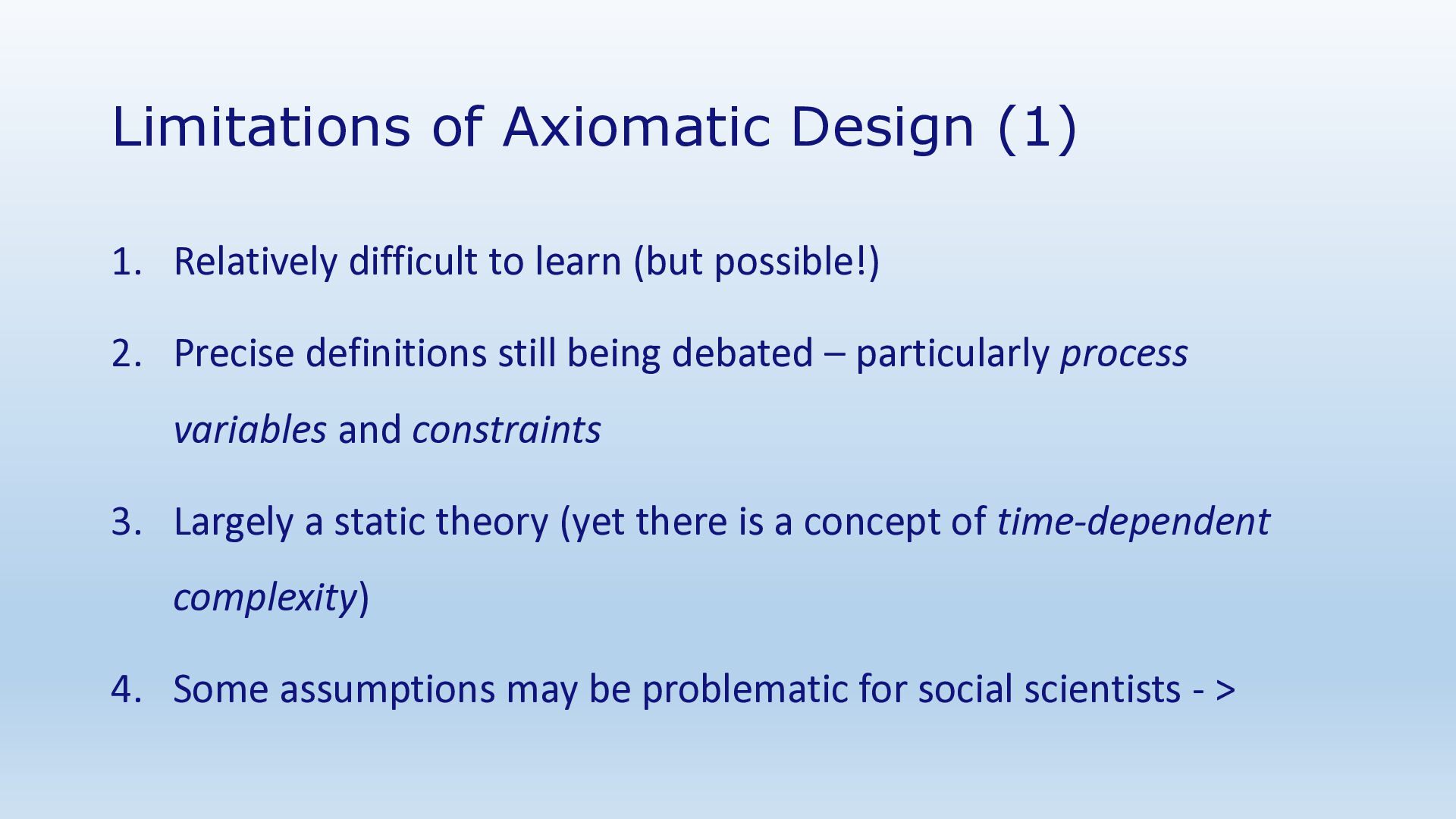
  15. Limitations of Axiomatic Design (1) 1. Relatively difficult to learn

    (but possible!) 2. Precise definitions still being debated – particularly process variables and constraints 3. Largely a static theory (yet there is a concept of time-dependent complexity) 4. Some assumptions may be problematic for social scientists - >
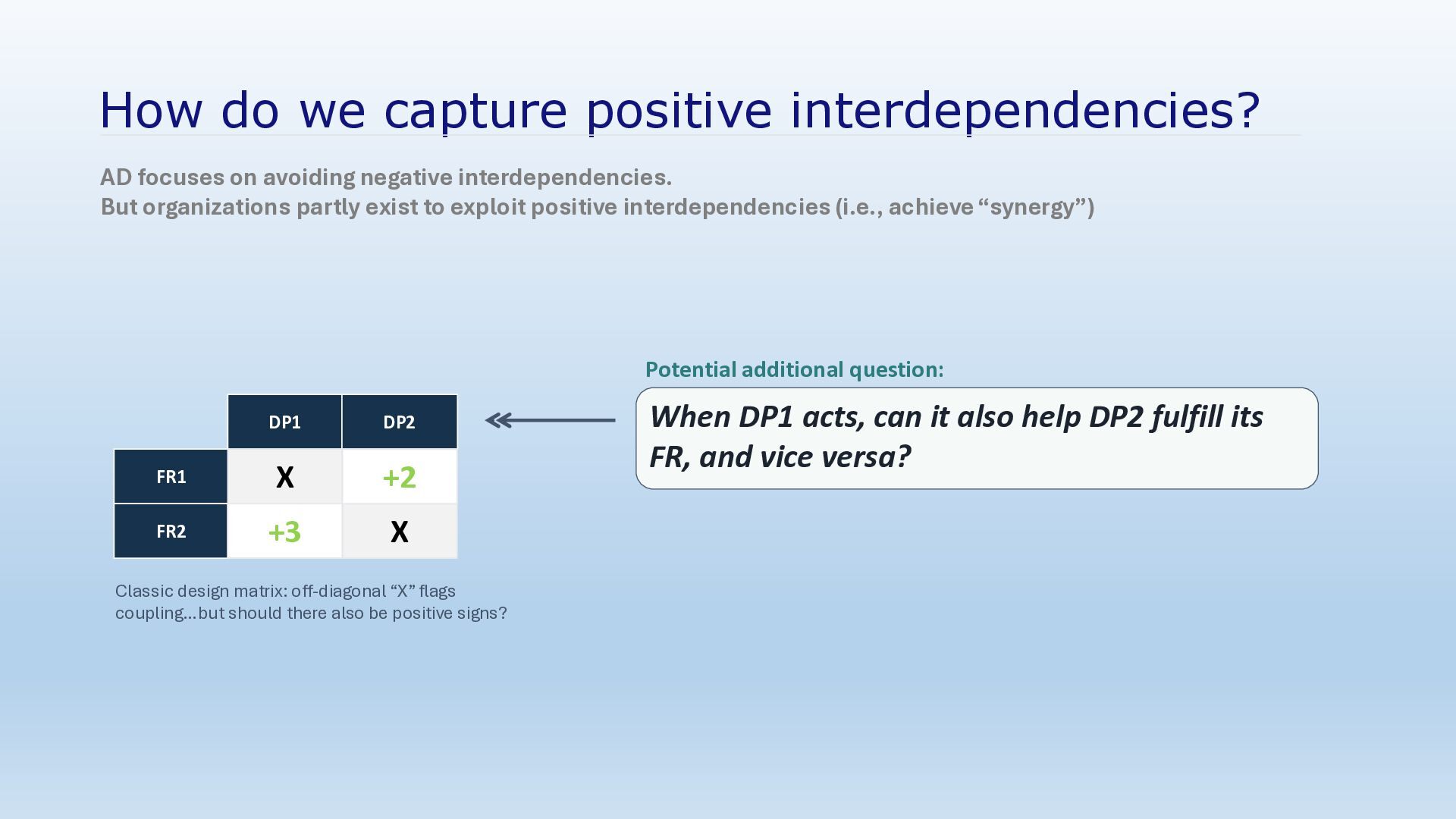
  16. How do we capture positive interdependencies? AD focuses on avoiding

    negative interdependencies. But organizations partly exist to exploit positive interdependencies (i.e., achieve “synergy”) Potential additional question: DP1 DP2 FR1 X +2 FR2 +3 X Classic design matrix: off-diagonal “X” flags coupling…but should there also be positive signs? When DP1 acts, can it also help DP2 fulfill its FR, and vice versa?
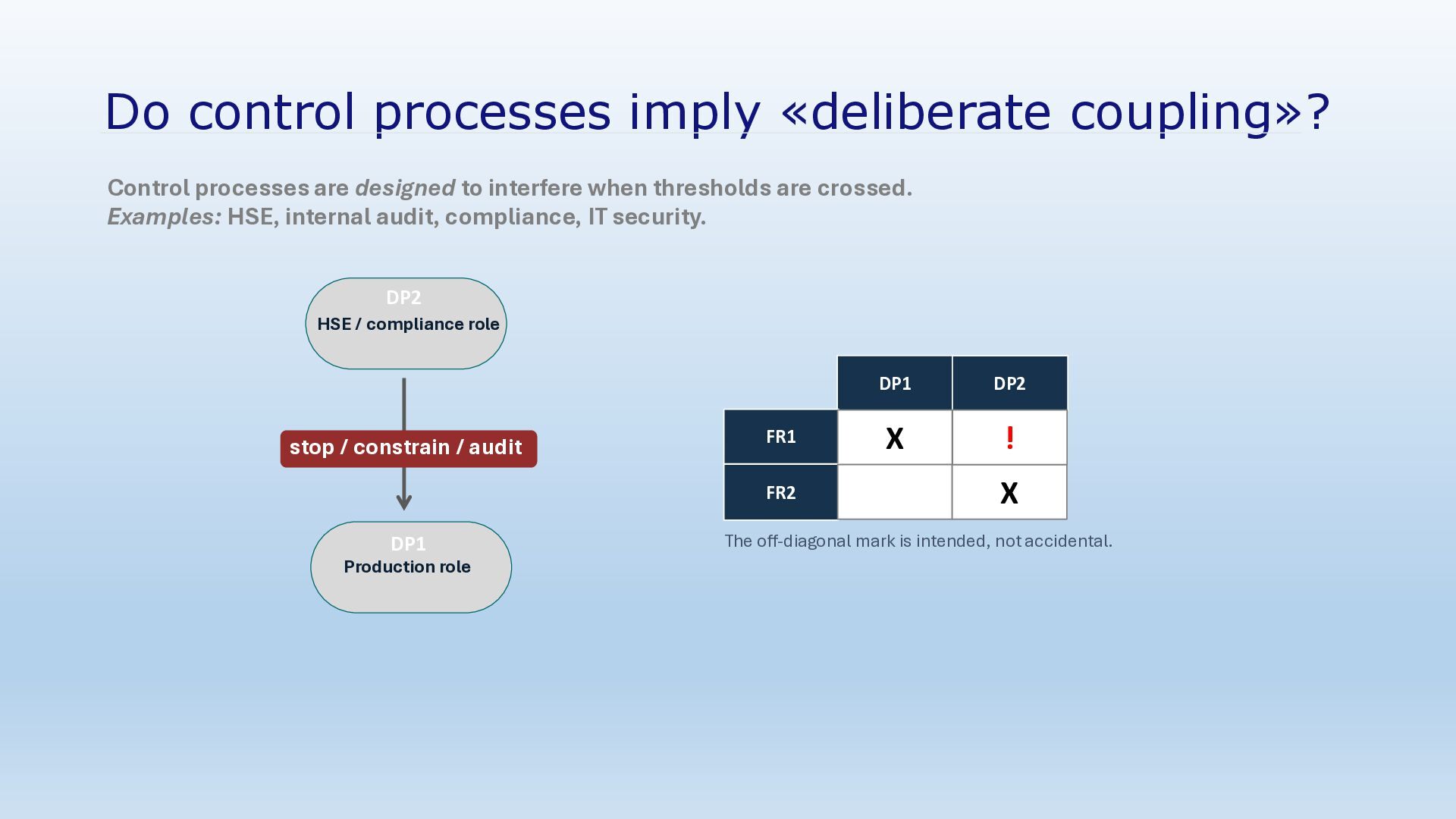
  17. Do control processes imply «deliberate coupling»? Control processes are designed

    to interfere when thresholds are crossed. Examples: HSE, internal audit, compliance, IT security. DP2 HSE / compliance role stop / constrain / audit FR1 FR2 DP1 Production role DP1 DP2 X ! X The off-diagonal mark is intended, not accidental.
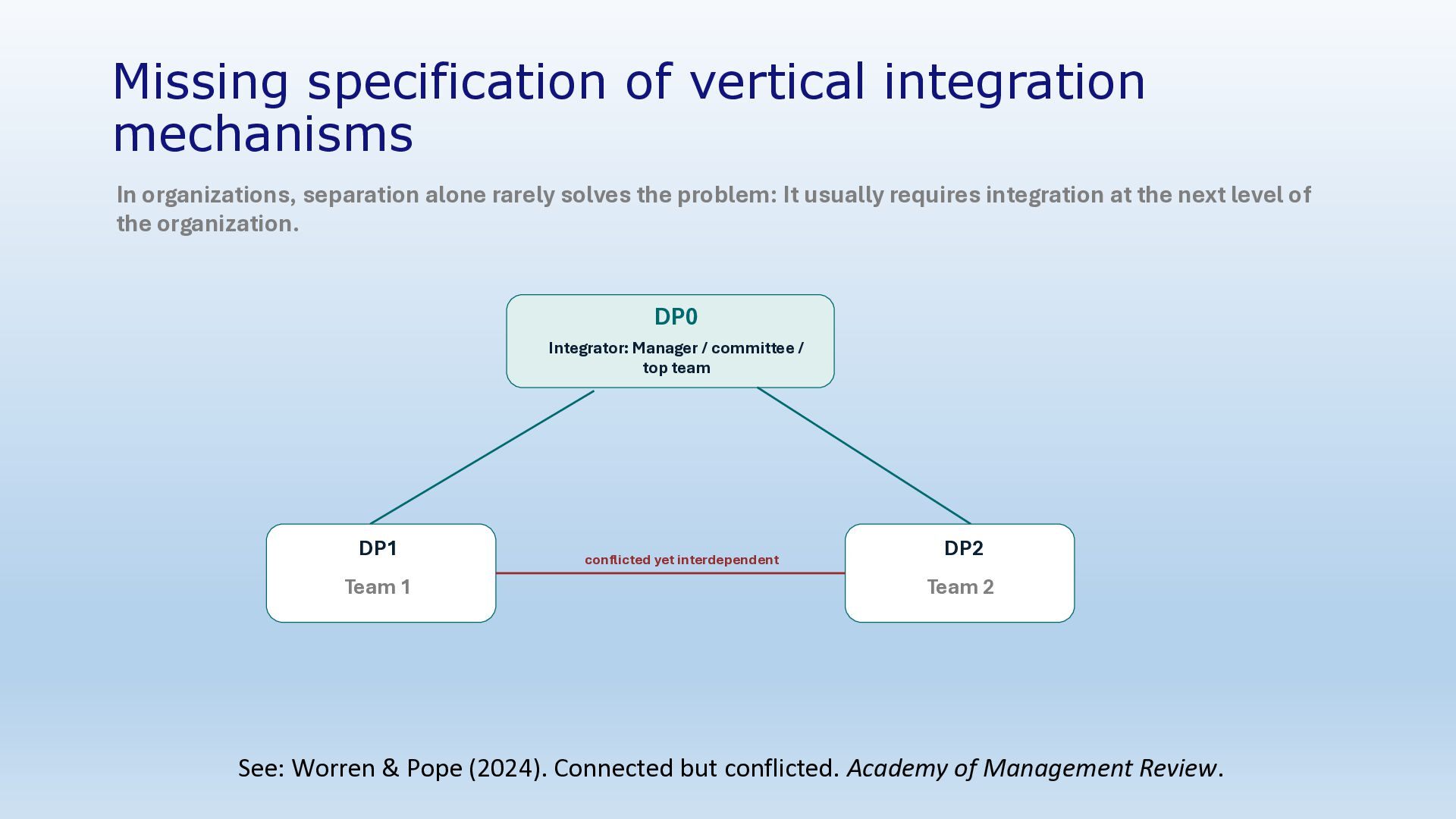
  18. Missing specification of vertical integration mechanisms In organizations, separation alone

    rarely solves the problem: It usually requires integration at the next level of the organization. DP0 Integrator: Manager / committee / top team DP1 Team 1 conflicted yet interdependent DP2 Team 2 See: Worren & Pope (2024). Connected but conflicted. Academy of Management Review.