Share
Embed
Up to Slimane 0.2 and the Server Side Swift Standards
2016 April 21 Tokyo Server Side Swift Meetup
Yuki Takei
April 22, 2016
Transcript
56 slides
-
Up to Slimane 0.2 and the Server Side Swift Standards
2016 April 21 Tokyo Server Side Swift Meetup Yuki Takei -
WHO AM I? Yuki Takei (noppoMan) Freelance software engineer/ Radio
Personality Recent Works ɾLead Developer at iDEAKITT inc. ɾBackend/Data Analysis at SmartDrive inc. Programming Language: Node.js, Python, Ruby and Swift I have a radio program that named MikeTOKYO!!! -
WHAT IS SLIMANE? Slimane is… ▸ Express inspired Lightweight Web
Framework in Swift ▸ Completely asynchronous (libuv) ▸ Faster ▸ Modular ▸ Multiprocess Supports ▸ Message passing between processes ▸ swift3 supports (swift 2.2? no longer working haha) ▸ Adopting Open-Swift -
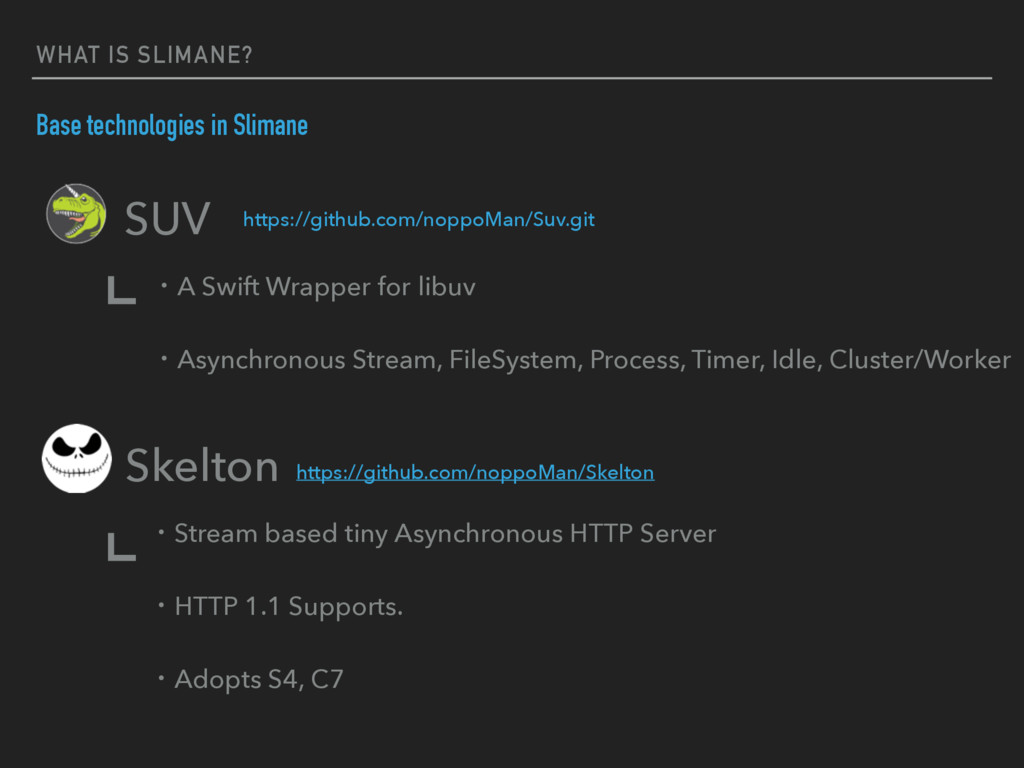
WHAT IS SLIMANE? Base technologies in Slimane SUV ᵎ ɾA
Swift Wrapper for libuv ɾAsynchronous Stream, FileSystem, Process, Timer, Idle, Cluster/Worker Skelton ᵎ ɾStream based tiny Asynchronous HTTP Server ɾHTTP 1.1 Supports. ɾAdopts S4, C7 https://github.com/noppoMan/Skelton https://github.com/noppoMan/Suv.git -
let app = Slimane() app.use { req, res, next print(req.uri.path)
next(.Next) } app.get { req, res in res.write(“Hello!") } try! app.listen() Slimane 0.1x Slimane 0.2x let app = Slimane() app.use { req, res, next print(req.path) next(.Chain(req, res)) } app.get { req, responder in responder { Response(body: "Hello!") } } try! app.listen() -
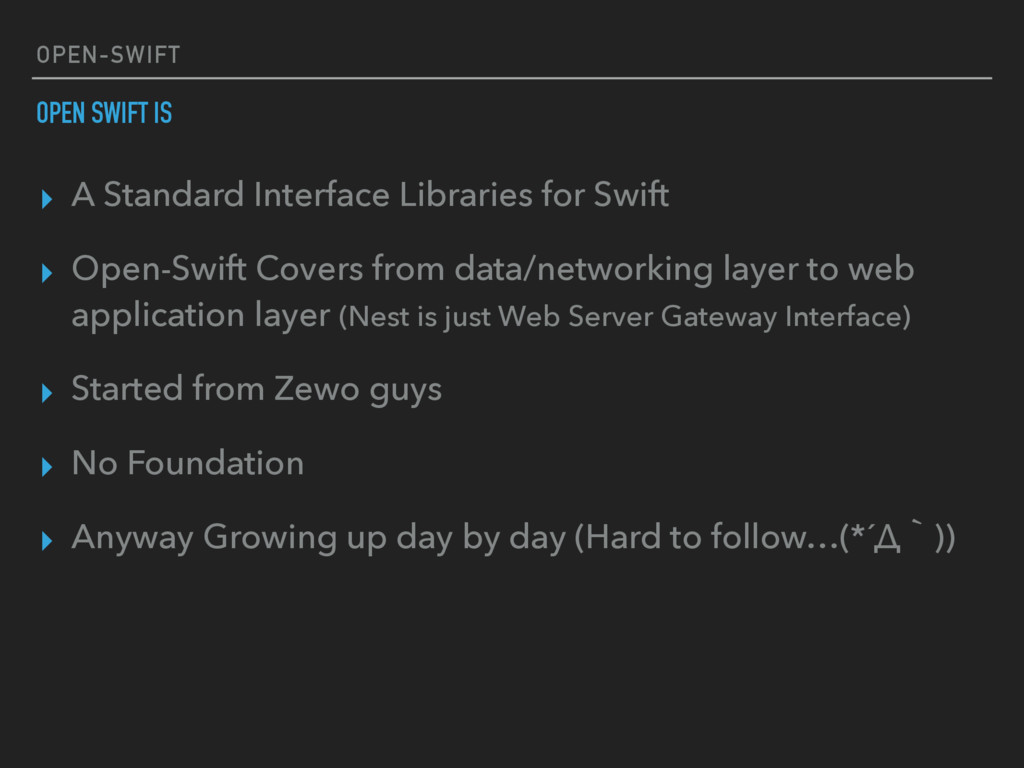
OPEN-SWIFT ▸ A Standard Interface Libraries for Swift ▸ Open-Swift
Covers from data/networking layer to web application layer (Nest is just Web Server Gateway Interface) ▸ Started from Zewo guys ▸ No Foundation ▸ Anyway Growing up day by day (Hard to follow…(*´Дʆ)) OPEN SWIFT IS -
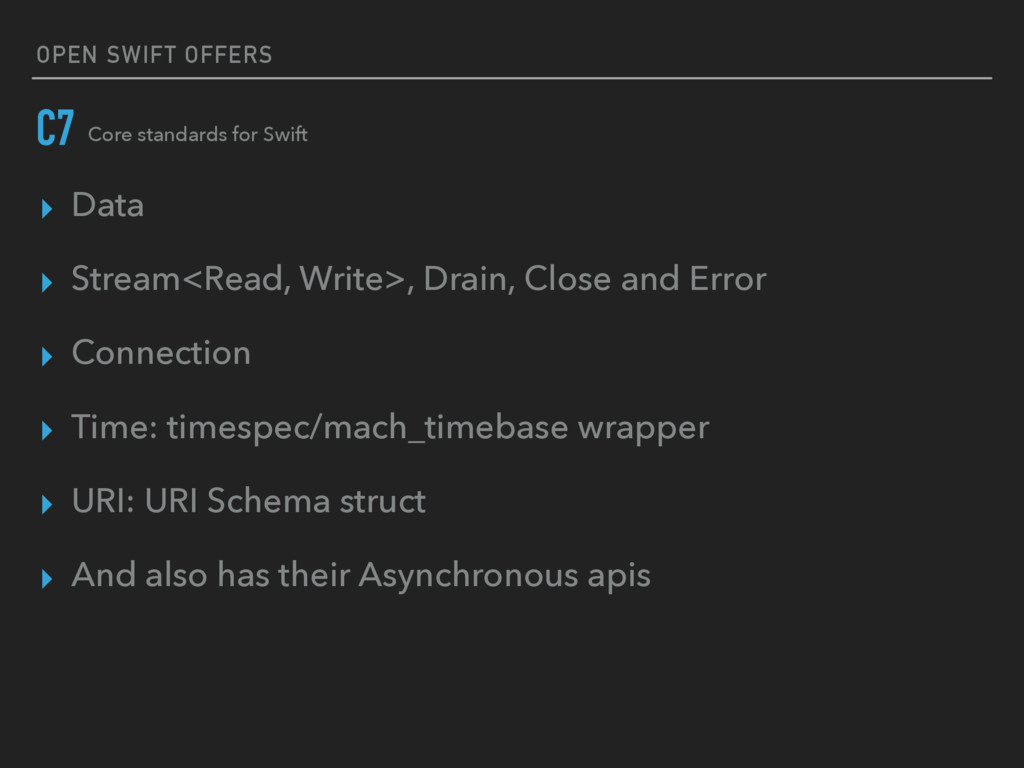
OPEN SWIFT OFFERS ▸ Data ▸ Stream<Read, Write>, Drain, Close
and Error ▸ Connection ▸ Time: timespec/mach_timebase wrapper ▸ URI: URI Schema struct ▸ And also has their Asynchronous apis C7 Core standards for Swift -
OPEN SWIFT OFFERS ▸ Request/Response ▸ Header, Body, Version, Status
and Method ▸ Middleware ▸ Responder ▸ Server/Client ▸ And also has their Asynchronous apis S4 HTTP standards for Swift -
FRAMEWORKS THAT ARE ADOPTING/CONSIDERING OPEN-SWIFT ▸ Zewo/Zewo (Adopting) ▸ qutheory/vapor
(Adopting) ▸ necolt/Swifton (Considering) ▸ noppoMan/Slimane (60% Adopting) -
Integrate interfaces from bottom layer to application layer and then
can make reusable modules. So it’s an Ecosystem for Swift. -
AsyncResponder is a Protocol for making the Respondable Objects in
S4. ɾIn S4, All of the routes have to confirm it ɾEven Middlewares -
Routing let app = Slimane() // Handy type routing app.get("/articles/:id")
{ req, responder in responder { Response( headers: ["content-type": "text/plain"], body: "Article id is \(req.params["id"]!)" ) } } Slimane has 2 ways for routing 1. Handy Routing -
Routing struct FooResponder: AsyncResponder { func respond(request: Request, result: (Void
throws -> Response) -> Void) { Redis.command(con, command: .PING) { result in if case .Success(let rep) = result { result { Responder(body: rep) } } } } } app.get("/foo", FooResponder()) 2. Routing with S4. AsyncResponder Slimane has 2 ways for routing -
AsyncMiddleware is a Protocol for making the Middleware ɾIn S4,
All of the middlewares have to confirm it ɾ[AsyncMiddleware] List has chain method to run the each middlewares in order. -
Middleware Slimane has 3 types registration ways for the middleware
// Handy is also standard middleware for Slimane app.use { req, res, next in print("[\(Time())] \(req.path ?? "/")") next(.Chain(req, res)) } 1. Handy Middleware -
Middleware Slimane has 3 types registration ways for the middleware
2. MiddlewareType // MiddlewareType is standard type to make middleware for Slimane struct AccessLogMiddleware: MiddlewareType { func respond(req: Request, res: Response, next: MiddlewareChain) { print("[\(Time())] \(req.path ?? "/")") next(.Chain(req, res)) } } app.use(AccessLogMiddleware()) -
Middleware Slimane has 3 types registration ways for the middleware
3. S4.AsyncMiddleware (Third party’s AsyncMiddleware) // Confirming S4.AsyncMiddleware directly struct AccessLogMiddleware: AsyncMiddleware { func respond(to request: Request, chainingTo next: AsyncResponder, result: (Void throws -> Response) -> Void) { next.respond(to: request, result: { do { let response = try $0() print("[\(Time())] \(req.path ?? "/")") result { response } } catch { result { throw error } } }) } } app.use(AccessLogMiddleware()) -
extension Slimane { public struct Static: MiddlewareType { let root:
String public init(root: String){ self.root = root } public func respond(req: Request, res: Response, next: MiddlewareChain) { guard let path = req.path , ext = path.split(by: “.").last else { return next(.Chain(req, res)) } guard mediaType = mediaTypeForFileExtension(ext) else { return next(.Chain(req, res)) } FS.readFile(root + path) { switch($0) { case .Success(let buffer): var res = res res.contentType = mediaType res.body = .buffer(buffer.data) next(.Chain(req, res)) case .Error(_): next(.Error(Error.ResourceNotFound("\(path) is not found"))) } } } } } Intercept Response at the middleware -
extension Slimane { public struct Static: MiddlewareType { let root:
String public init(root: String){ self.root = root } public func respond(req: Request, res: Response, next: MiddlewareChain) { guard let path = req.path , ext = path.split(by: “.").last else { return next(.Chain(req, res)) } guard mediaType = mediaTypeForFileExtension(ext) else { return next(.Chain(req, res)) } FS.readFile(root + path) { switch($0) { case .Success(let buffer): var res = res res.contentType = mediaType res.body = .buffer(buffer.data) next(.Chain(req, res)) case .Error(_): next(.Error(Error.ResourceNotFound("\(path) is not found"))) } } } } } Intercept Response at the middleware Pass the buffer to the response.body and call chain next, then the response is intercepted and respond soon. -
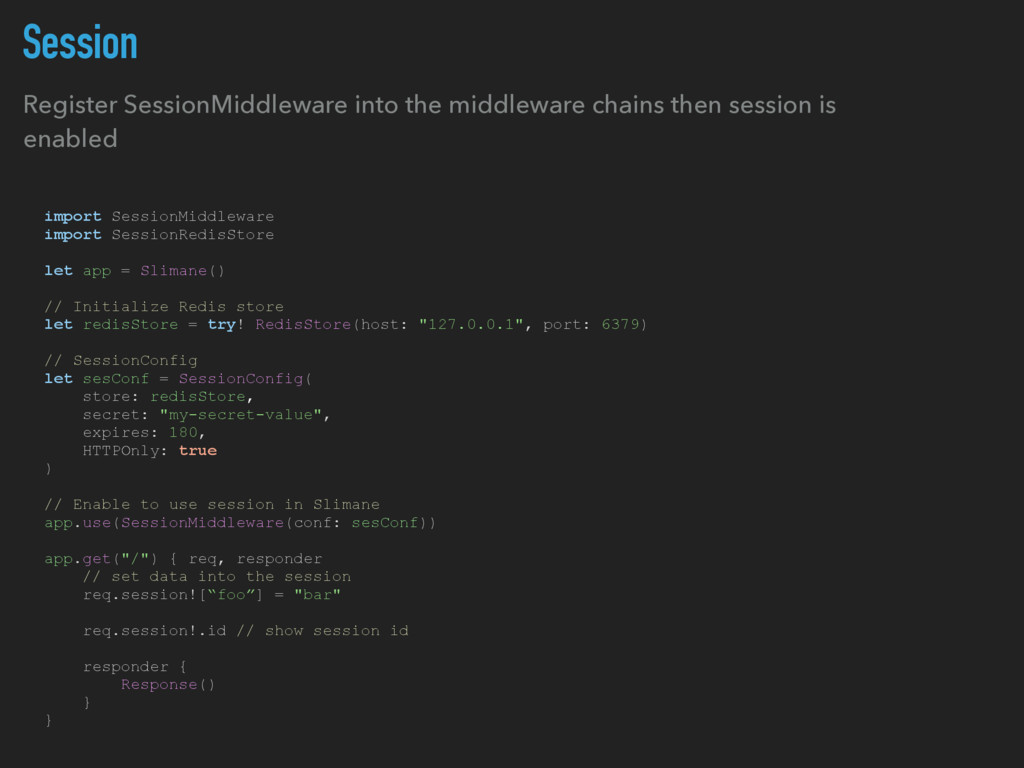
Session import SessionMiddleware import SessionRedisStore let app = Slimane() //
Initialize Redis store let redisStore = try! RedisStore(host: "127.0.0.1", port: 6379) // SessionConfig let sesConf = SessionConfig( store: redisStore, secret: "my-secret-value", expires: 180, HTTPOnly: true ) // Enable to use session in Slimane app.use(SessionMiddleware(conf: sesConf)) app.get("/") { req, responder // set data into the session req.session![“foo”] = "bar" req.session!.id // show session id responder { Response() } } Register SessionMiddleware into the middleware chains then session is enabled -
Slimane.Static Register Slimane.Static into the middleware chains then that enables
to serve static files let app = Slimane() // Enable to use session in Slimane app.use(Slimane.Static(root: ”/public”)) -
BodyParser Register BodyParser into the middleware chains to parse body
data. import BodyParser let app = Slimane() app.use(BodyParser()) // application/x-www-form-urlencoded app.post("/form_data") { req, responder in let foo = formData![“foo”] as! String responder { Response(body: "\(foo) is posted") } } // application/json app.post("/json") { req, responder in let foo = req.json![“foo"] as! String responder { Response(body: "\(foo) is posted") } } * application/x-www-form-urlencoded * application/json -
Response with Template Engine Respond to complex text with the
template engine let app = Slimane() // html render with MustacheViewEngine app.get("/render") { req, responder in responder { let templateData = ["name": "Slimane", "date": "\(Time())"] let mustacheEngine = MustacheViewEngine(templateData: templateData) return Response(custome: Render(engine: mustacheEngine, path: "index")) } } <!DOCTYPE html> <html lang="ja"> <head> <meta charset="utf-8"> </head> <body> <p>Welcome to {{ name }} !</p> <p>Today is {{ date }}</p> </body> </html> index.mustache app.swift -
You can make custom view engine with… Renderable Protocol *
Actually Reactify is not an existence module. just my imagine. import Reactify public struct ReactViewEngine: Renderable { public var fileExtension = "jsx" public let templateData: [String: AnyObject] public init(templateData: [String: AnyObject]){ self.templateData = templateData } // Should implement render method public func render(path: String, result: (Void throws -> Data) -> Void) { let event = Reactify(path: "\(path).\(fileExtension)", templateData: templateData) event.on(.End) { result { return $0 } } event.on(.Error) { result { throw $0 } } } } -
Cluster Use Cluster.fork to run Slimane app on the each
cores. // Check current process is master? if Cluster.isMaster { // Launch the worker processes the number of cores for _ in 0..<OS.cpuCount { try! Cluster.fork(silent: false) } try! Slimane().listen() } else { // on workers let app = Slimane() app.use("/") { req, responder in responder { Response(body: "Hello! I'm \(Process.pid)") } } try! app.listen() } -
IPC Between the Master and the Workers Can send/receive messages
each other let worker = try! Cluster.fork(silent: false) // Send message to the worker worker.send(.Message("message from master")) // Receive event from the worker worker.on { event in if case .Message(let str) = event { print(str) } else if case .Online = event { print("Worker: \(worker.id) is online") } else if case .Exit(let status) = event { print("Worker: \(worker.id) is dead. status: \(status)") } } // Receive event from the master Process.on { event in if case .Message(let str) = event { print(str) } } // Send message to the master Process.send(.Message("Hey!")) On the Master Process On the Worker Process -
Let it crash Crash recovery/Let it crash with observing the
worker processes // Worker observer func observeWorker(worker: inout Worker){ worker.send(.Message("message from master")) worker.on { event in if case .Message(let str) = event { if str == "restart please!!" { worker.process.kill(SIGTERM) // Refork a worker worker = try! Cluster.fork(silent: false) observeWorker(&worker) } } else if case .Exit(let status) = event { print("Worker: \(worker.id) is dead. status: \(status)") // Refork a worker worker = try! Cluster.fork(silent: false) observeWorker(&worker) } } } // Start fork and observe var worker = try! Cluster.fork(silent: false) observeWorker(&worker) -
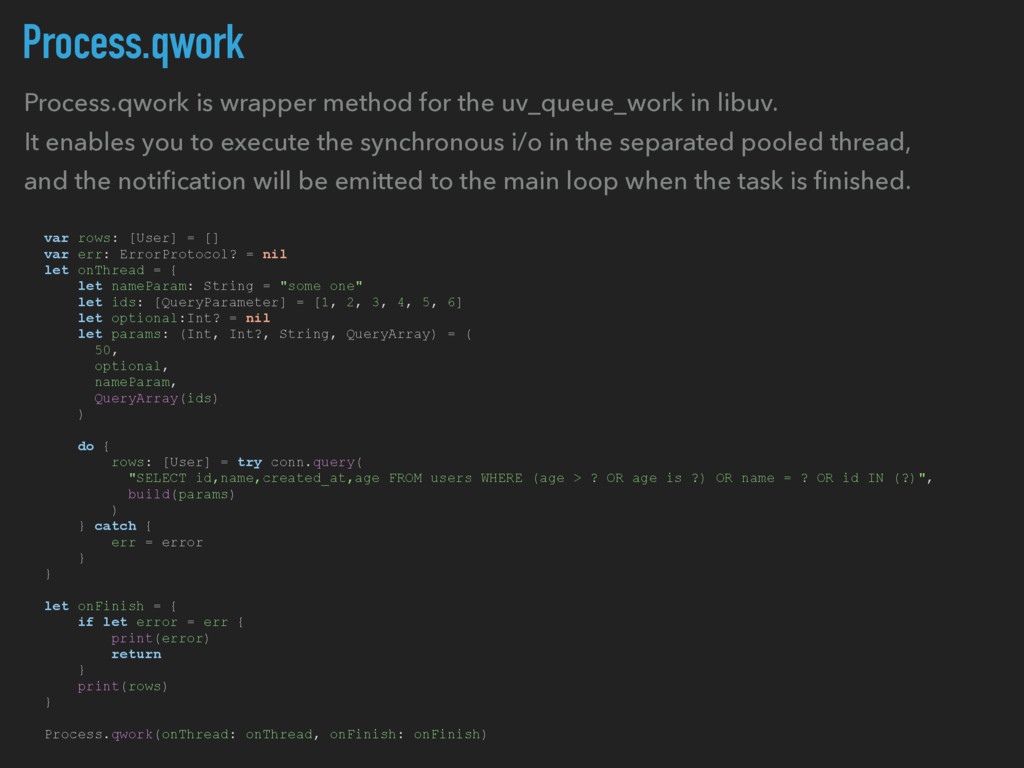
Process.qwork Process.qwork is wrapper method for the uv_queue_work in libuv.
It enables you to execute the synchronous i/o in the separated pooled thread, and the notification will be emitted to the main loop when the task is finished. var rows: [User] = [] var err: ErrorProtocol? = nil let onThread = { let nameParam: String = "some one" let ids: [QueryParameter] = [1, 2, 3, 4, 5, 6] let optional:Int? = nil let params: (Int, Int?, String, QueryArray) = ( 50, optional, nameParam, QueryArray(ids) ) do { rows: [User] = try conn.query( "SELECT id,name,created_at,age FROM users WHERE (age > ? OR age is ?) OR name = ? OR id IN (?)", build(params) ) } catch { err = error } } let onFinish = { if let error = err { print(error) return } print(rows) } Process.qwork(onThread: onThread, onFinish: onFinish) -
For now it is the best compromise way to deal
with Synchronous I/O -
Time 0 1.5 3 4.5 6 SLIMANE NGINX EXPRESS REVEL
VAPOR ɾ Command: ab -n 10000 -c 100 ɾServer: EC2 t2.medium(vCPU: 2, Mem: 4) ɾSwift-Version: swift-DEVELOPMENT-SNAPSHOT-2016-03-24-a-ubuntu14.04 Performance testing I also tried to build Zewo, Swifton and Kitura but that are failed to build… -
NEXT STEP ▸ Promise API ▸ Streaming Response ▸ Deal
with Mysql via asynchronous networking ▸ Command line interface ▸ More Test Codes ▸ Affinity for the Web Front End ▸ Community