Upgrade to Pro — share decks privately, control downloads, hide ads and more …

COFFEE-Japan PROJECT Impact Report(Uminomukou C...

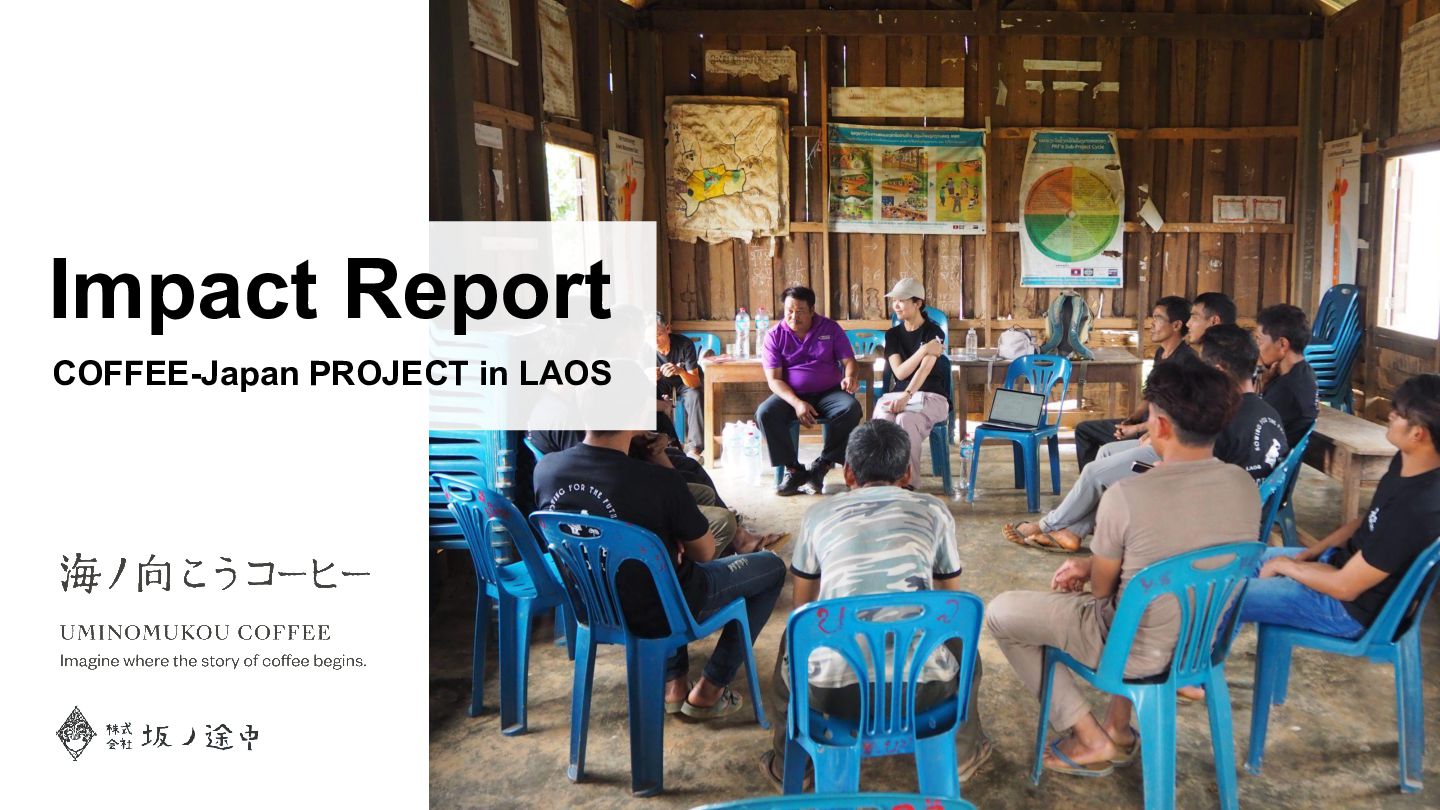
COFFEE-Japan PROJECT Impact Report(Uminomukou Coffee)

Avatar for 坂ノ途中

坂ノ途中

March 12, 2026
Tweet

More Decks by 坂ノ途中

Other Decks in Research

Transcript

  1. Table of Contents 2 1. Basic Information 2. Overview 3.

    Target & Background 4. Issue 5. Activity 6. Outcome & Impact 7. Closing
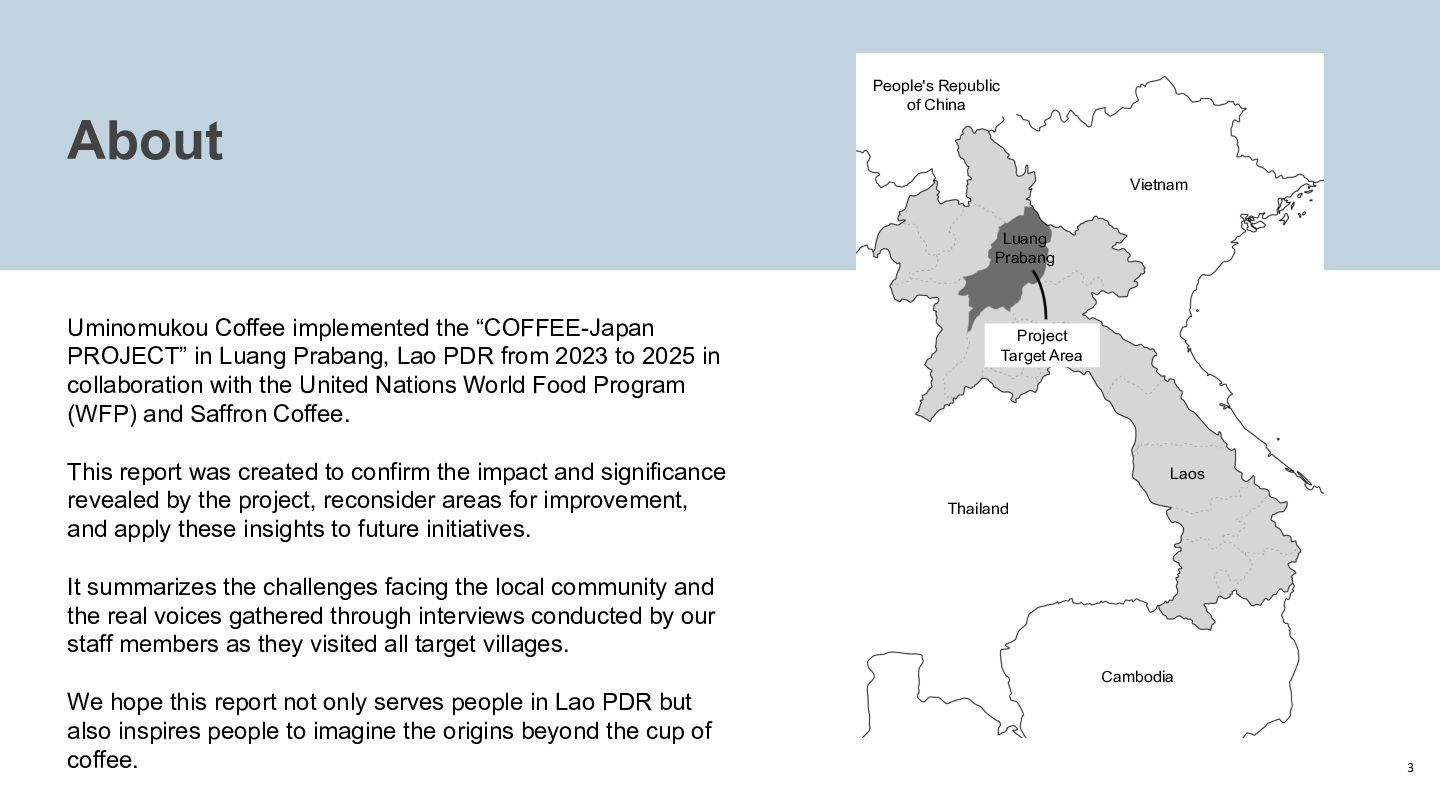
  2. Uminomukou Coffee implemented the “COFFEE-Japan PROJECT” in Luang Prabang, Lao

    PDR from 2023 to 2025 in collaboration with the United Nations World Food Program (WFP) and Saffron Coffee. This report was created to confirm the impact and significance revealed by the project, reconsider areas for improvement, and apply these insights to future initiatives. It summarizes the challenges facing the local community and the real voices gathered through interviews conducted by our staff members as they visited all target villages. We hope this report not only serves people in Lao PDR but also inspires people to imagine the origins beyond the cup of coffee. About ラオス Luang Prabang 3 Project Target Area People's Republic of China Vietnam Thailand Cambodia Laos
  3. About Lao PDR Forests, Mountains, and Ethnic Diversity Laos is

    the only landlocked country in Southeast Asia, largely covered by forests and mountains. It is a multiethnic nation of 7.7 million people, and Lao is the official language. Agriculture—mainly rice farming—remains the backbone of the economy, while coffee, introduced during the French colonial period, is an important industry. While coffee is mainly produced on the Bolaven Plateau in the south, it has recently expanded to the northern highlands, including the project area, as a new cash crop. Current Situation in Northern Rural Areas For the past 30 to 40 years, the government has been implementing projects to relocate upland villages to sites along main roads in the lowlands(*1). While some villages have benefited from relocation, many others—such as those in Phonxai District—remain accessible only by unpaved and poorly maintained roads. Overall, infrastructure remains inadequate, and significant challenges remain in improving living conditions. Basic Information Farming at the Heart of Local Livelihoods In the past, livelihoods were based on subsistence farming, including upland rice cultivation through slash-and-burn, as well as hunting and gathering in the forest. Even today, rice—the staple food—is mainly grown by slash-and-burn practices. However, forest conservation policies and population growth have shortened fallow periods, in some cases resulting in more intensive land use(*2). In response to these changes, people have introduced cash crops such as Job’s tears and raised livestock to earn income and support their livelihoods. Why Coffee? Unlike other cash crops, coffee can be grown without relying on slash-and-burn practices and can even contribute to forest conservation. It is expected to become a new livelihood option that combines forest conservation with income generation. (*1). Interviews with local farmers (*2). Shifting cultivation can be environmentally sustainable when practiced with adequate fallow periods. 5
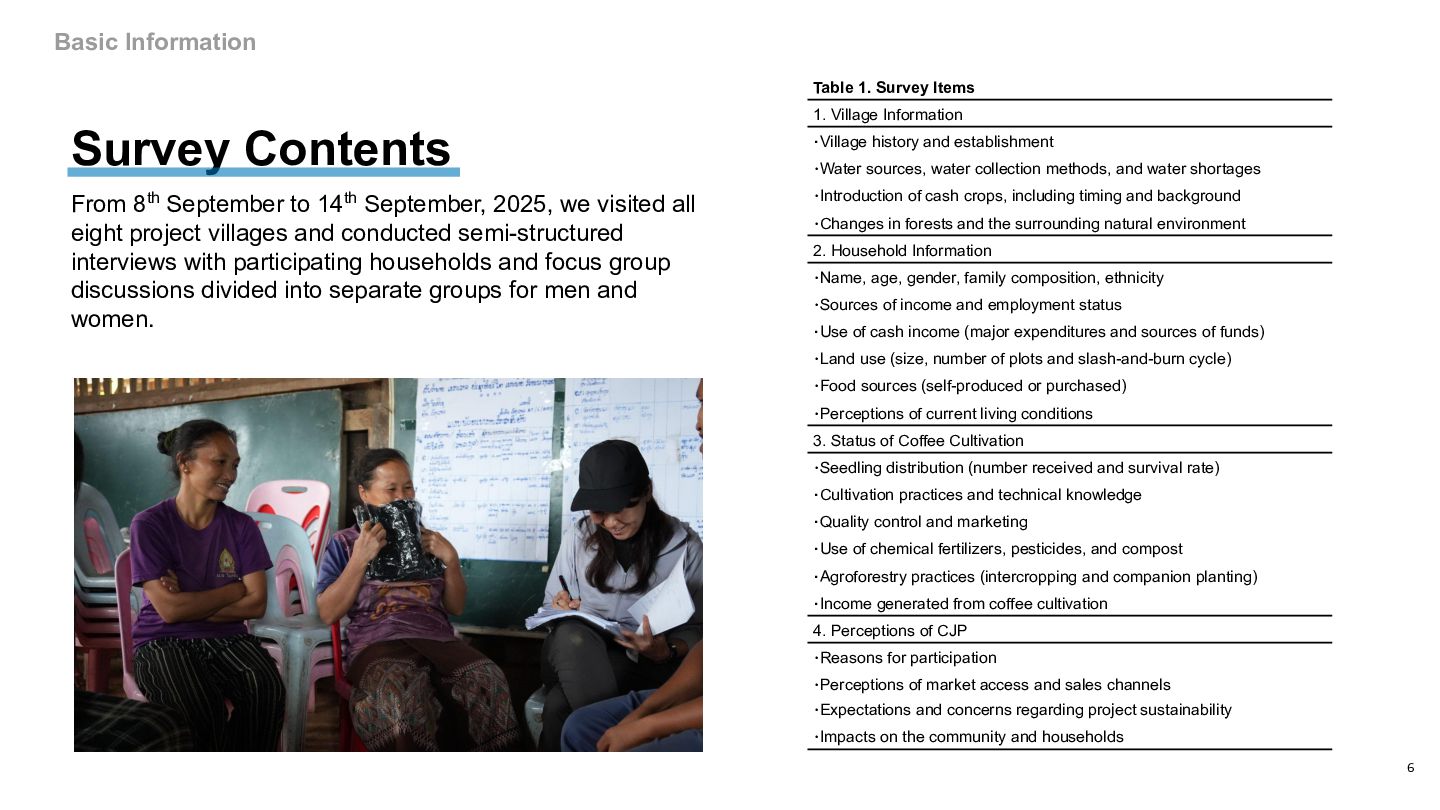
  4. From 8th September to 14th September, 2025, we visited all

    eight project villages and conducted semi-structured interviews with participating households and focus group discussions divided into separate groups for men and women. Table 1. Survey Items 1. Village Information ・Village history and establishment ・Water sources, water collection methods, and water shortages ・Introduction of cash crops, including timing and background ・Changes in forests and the surrounding natural environment 2. Household Information ・Name, age, gender, family composition, ethnicity ・Sources of income and employment status ・Use of cash income (major expenditures and sources of funds) ・Land use (size, number of plots and slash-and-burn cycle) ・Food sources (self-produced or purchased) ・Perceptions of current living conditions 3. Status of Coffee Cultivation ・Seedling distribution (number received and survival rate) ・Cultivation practices and technical knowledge ・Quality control and marketing ・Use of chemical fertilizers, pesticides, and compost ・Agroforestry practices (intercropping and companion planting) ・Income generated from coffee cultivation 4. Perceptions of CJP ・Reasons for participation ・Perceptions of market access and sales channels ・Expectations and concerns regarding project sustainability ・Impacts on the community and households Survey Contents 6 Basic Information
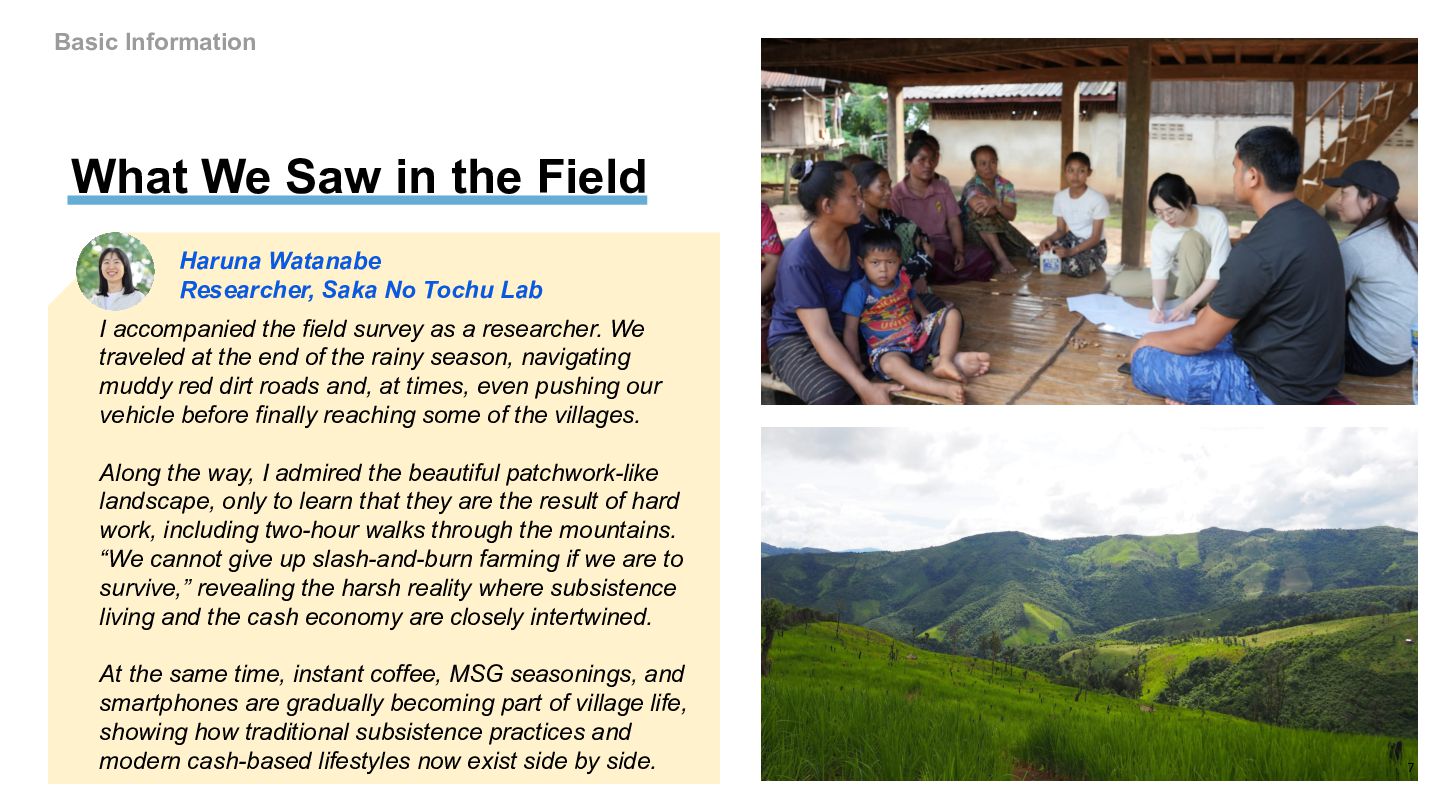
  5. What We Saw in the Field I accompanied the field

    survey as a researcher. We traveled at the end of the rainy season, navigating muddy red dirt roads and, at times, even pushing our vehicle before finally reaching some of the villages. Along the way, I admired the beautiful patchwork-like landscape, only to learn that they are the result of hard work, including two-hour walks through the mountains. “We cannot give up slash-and-burn farming if we are to survive,” revealing the harsh reality where subsistence living and the cash economy are closely intertwined. At the same time, instant coffee, MSG seasonings, and smartphones are gradually becoming part of village life, showing how traditional subsistence practices and modern cash-based lifestyles now exist side by side. Haruna Watanabe Researcher, Saka No Tochu Lab 7 Basic Information
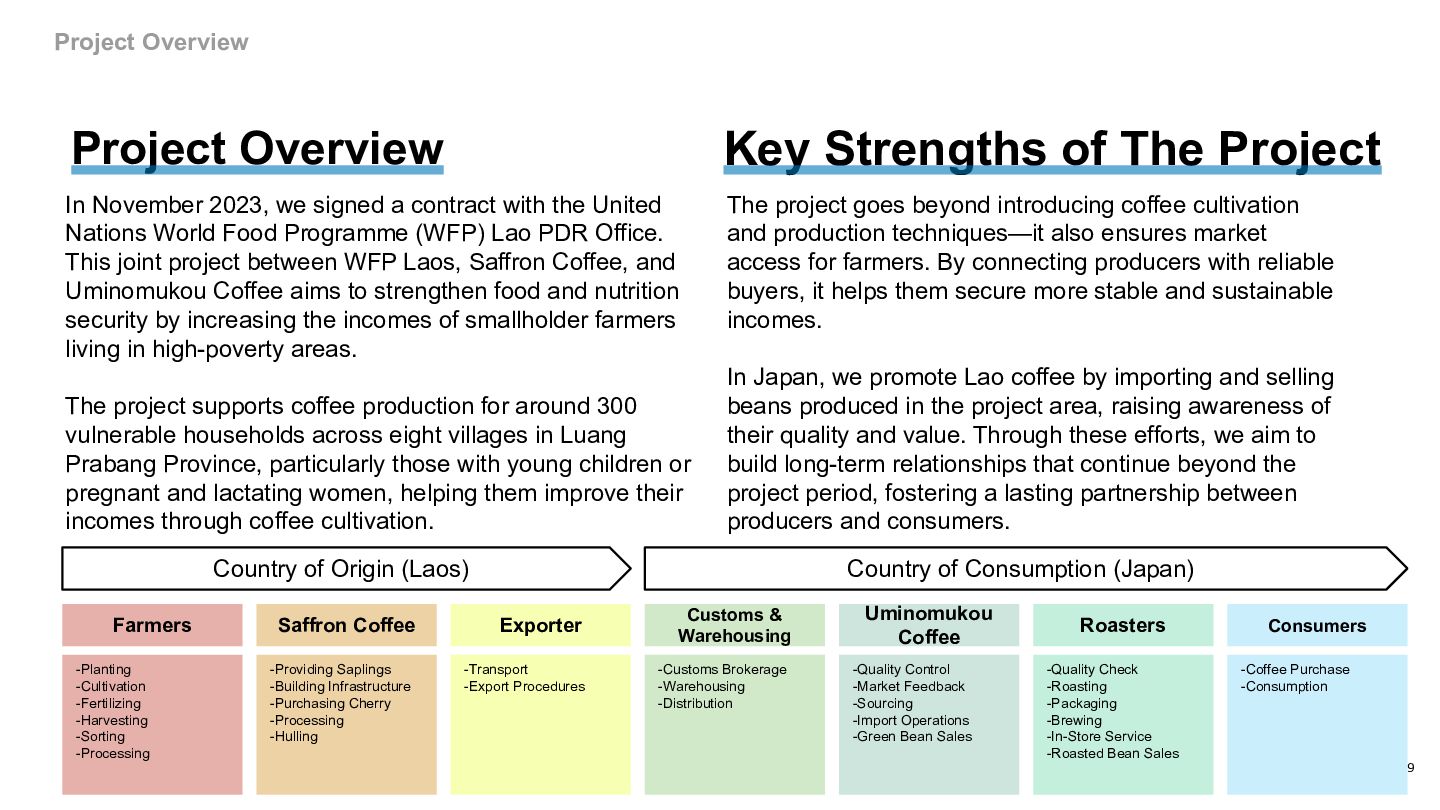
  6. Project Overview In November 2023, we signed a contract with

    the United Nations World Food Programme (WFP) Lao PDR Office. This joint project between WFP Laos, Saffron Coffee, and Uminomukou Coffee aims to strengthen food and nutrition security by increasing the incomes of smallholder farmers living in high-poverty areas. The project supports coffee production for around 300 vulnerable households across eight villages in Luang Prabang Province, particularly those with young children or pregnant and lactating women, helping them improve their incomes through coffee cultivation. Key Strengths of The Project The project goes beyond introducing coffee cultivation and production techniques—it also ensures market access for farmers. By connecting producers with reliable buyers, it helps them secure more stable and sustainable incomes. In Japan, we promote Lao coffee by importing and selling beans produced in the project area, raising awareness of their quality and value. Through these efforts, we aim to build long-term relationships that continue beyond the project period, fostering a lasting partnership between producers and consumers. 9 Country of Origin (Laos) Country of Consumption (Japan) Farmers -Planting -Cultivation -Fertilizing -Harvesting -Sorting -Processing Saffron Coffee -Providing Saplings -Building Infrastructure -Purchasing Cherry -Processing -Hulling Exporter -Transport -Export Procedures Customs & Warehousing -Customs Brokerage -Warehousing -Distribution Uminomukou Coffee -Quality Control -Market Feedback -Sourcing -Import Operations -Green Bean Sales Roasters -Quality Check -Roasting -Packaging -Brewing -In-Store Service -Roasted Bean Sales Consumers -Coffee Purchase -Consumption Project Overview
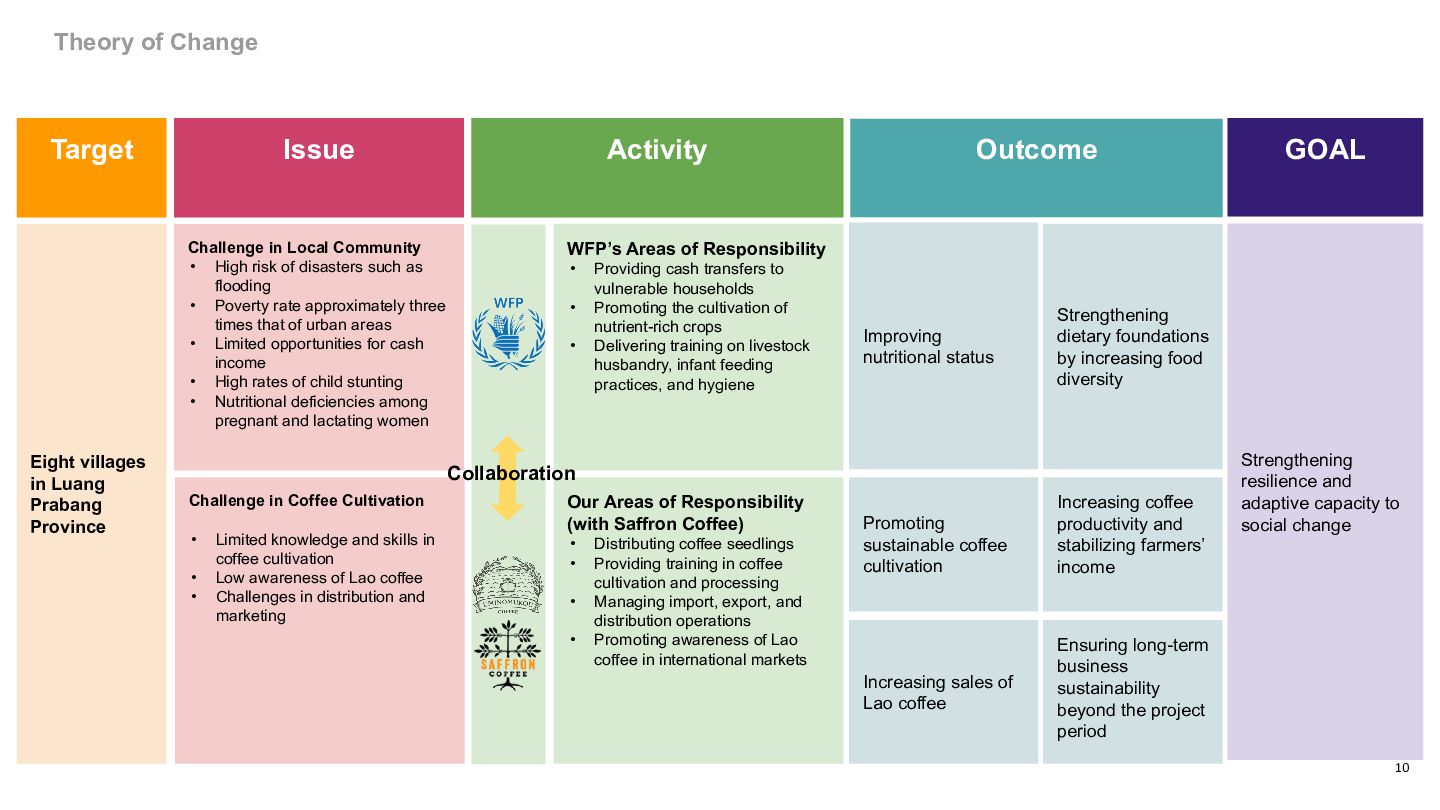
  7. Our Areas of Responsibility (with Saffron Coffee) • Distributing coffee

    seedlings • Providing training in coffee cultivation and processing • Managing import, export, and distribution operations • Promoting awareness of Lao coffee in international markets Challenge in Local Community • High risk of disasters such as flooding • Poverty rate approximately three times that of urban areas • Limited opportunities for cash income • High rates of child stunting • Nutritional deficiencies among pregnant and lactating women Target WFP’s Areas of Responsibility • Providing cash transfers to vulnerable households • Promoting the cultivation of nutrient-rich crops • Delivering training on livestock husbandry, infant feeding practices, and hygiene Activity Promoting sustainable coffee cultivation Outcome Issue Eight villages in Luang Prabang Province Strengthening dietary foundations by increasing food diversity Strengthening resilience and adaptive capacity to social change GOAL Challenge in Coffee Cultivation • Limited knowledge and skills in coffee cultivation • Low awareness of Lao coffee • Challenges in distribution and marketing Collaboration Improving nutritional status Increasing sales of Lao coffee Increasing coffee productivity and stabilizing farmers’ income Ensuring long-term business sustainability beyond the project period 10 Theory of Change
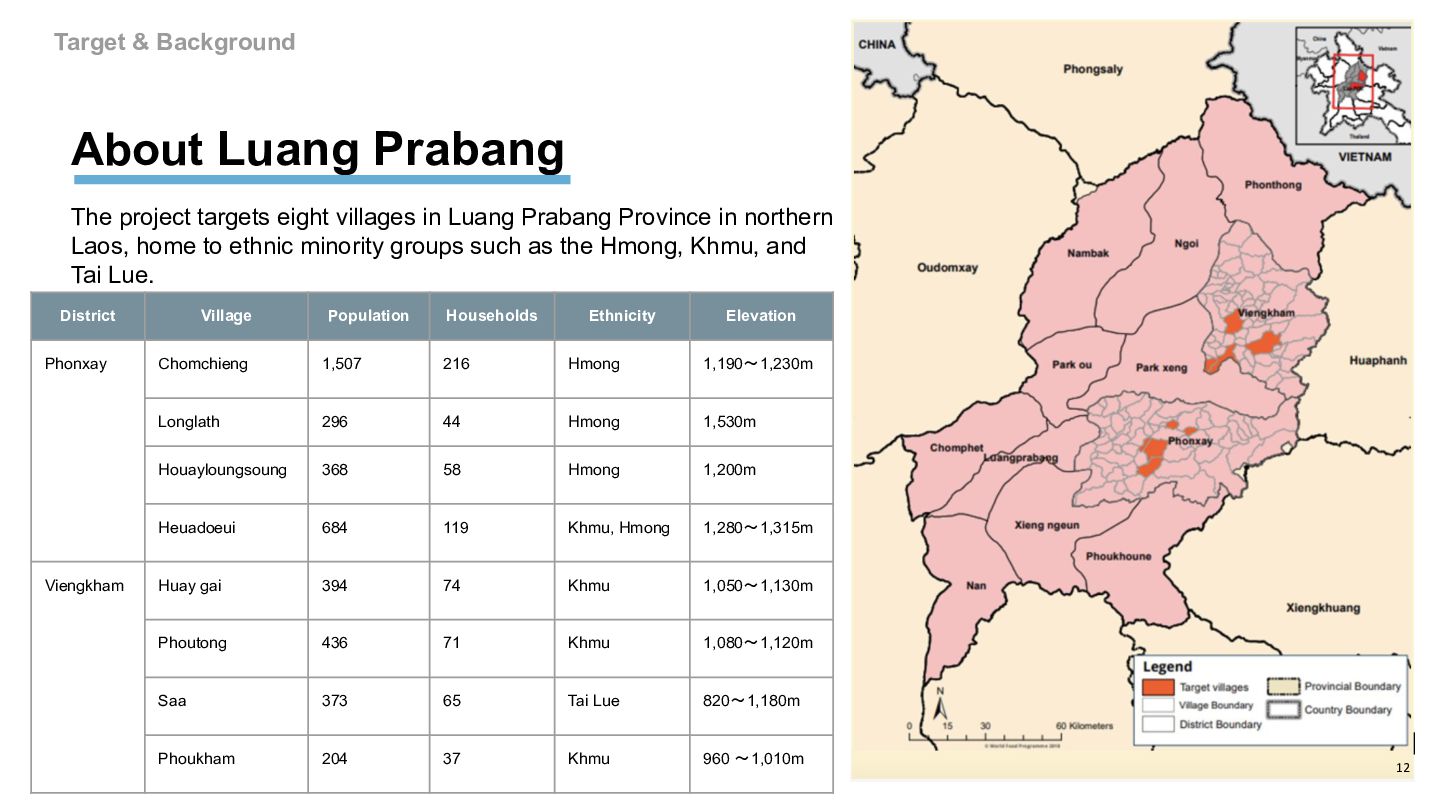
  8. About Luang Prabang The project targets eight villages in Luang

    Prabang Province in northern Laos, home to ethnic minority groups such as the Hmong, Khmu, and Tai Lue. 地図 WFPの資料からもらってくる District Village Population Households Ethnicity Elevation Phonxay Chomchieng 1,507 216 Hmong 1,190~1,230m Longlath 296 44 Hmong 1,530m Houayloungsoung 368 58 Hmong 1,200m Heuadoeui 684 119 Khmu, Hmong 1,280~1,315m Viengkham Huay gai 394 74 Khmu 1,050~1,130m Phoutong 436 71 Khmu 1,080~1,120m Saa 373 65 Tai Lue 820~1,180m Phoukham 204 37 Khmu 960 ~1,010m 12 Target & Background
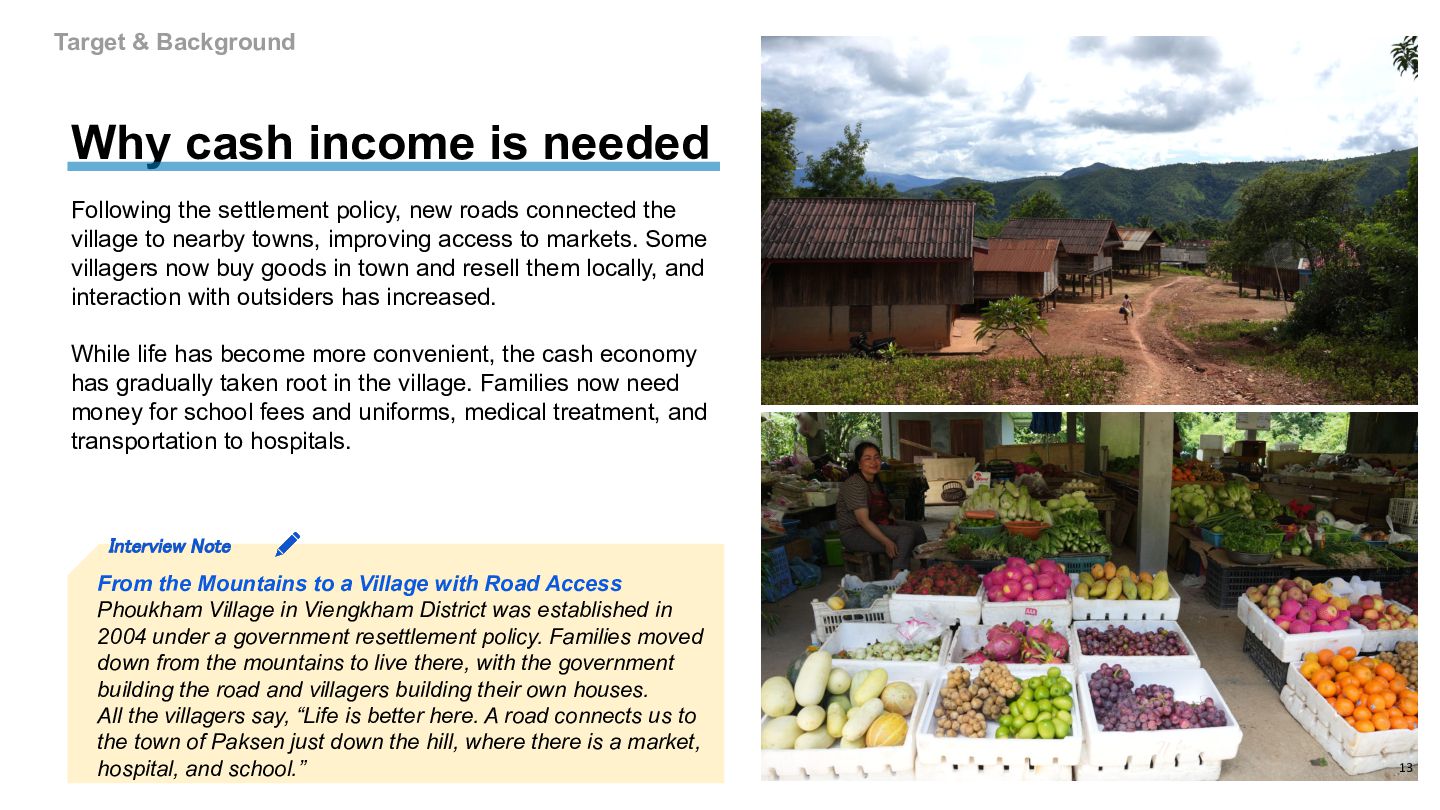
  9. Following the settlement policy, new roads connected the village to

    nearby towns, improving access to markets. Some villagers now buy goods in town and resell them locally, and interaction with outsiders has increased. While life has become more convenient, the cash economy has gradually taken root in the village. Families now need money for school fees and uniforms, medical treatment, and transportation to hospitals. Why cash income is needed From the Mountains to a Village with Road Access Phoukham Village in Viengkham District was established in 2004 under a government resettlement policy. Families moved down from the mountains to live there, with the government building the road and villagers building their own houses. All the villagers say, “Life is better here. A road connects us to the town of Paksen just down the hill, where there is a market, hospital, and school.” Interview Note 13 Target & Background
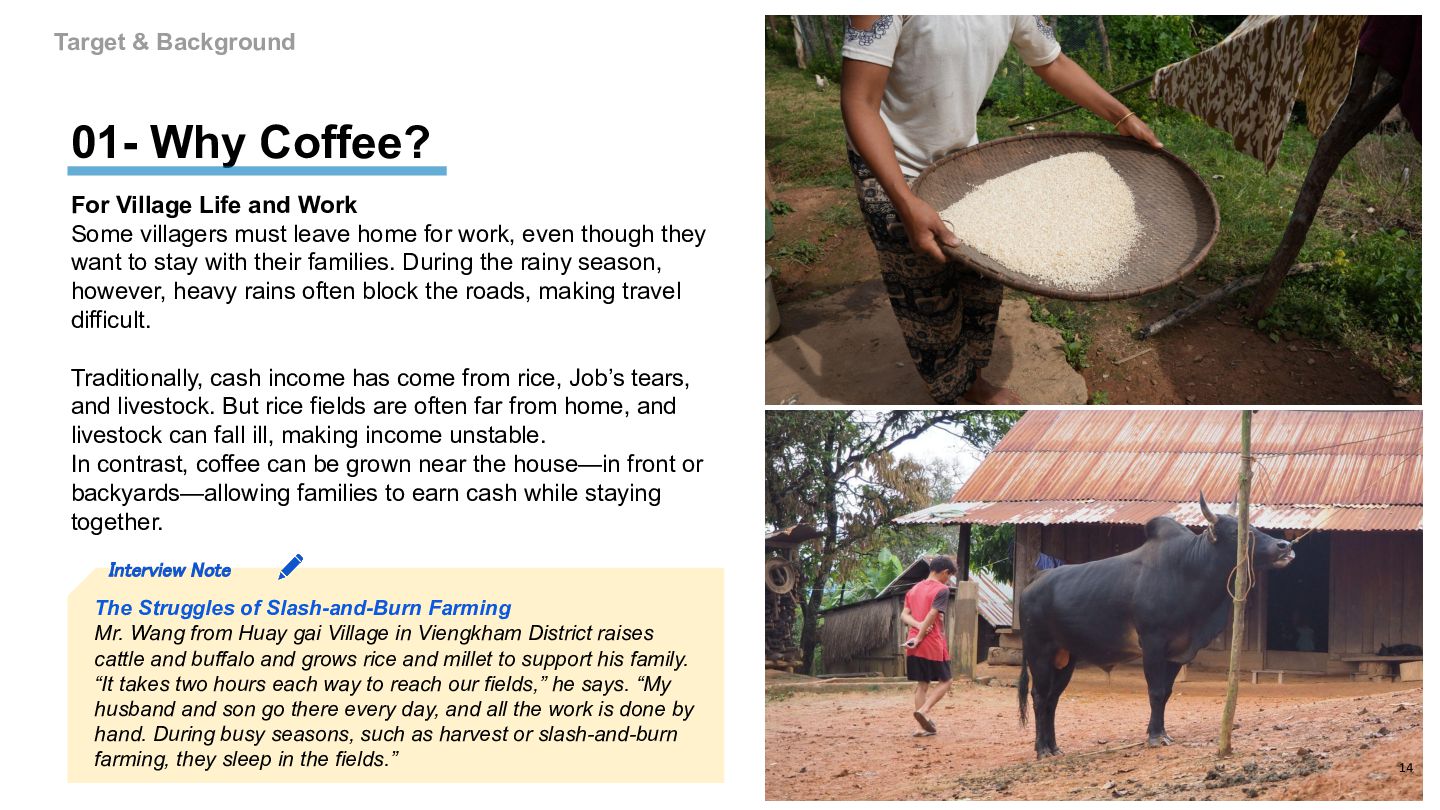
  10. 01- Why Coffee? For Village Life and Work Some villagers

    must leave home for work, even though they want to stay with their families. During the rainy season, however, heavy rains often block the roads, making travel difficult. Traditionally, cash income has come from rice, Job’s tears, and livestock. But rice fields are often far from home, and livestock can fall ill, making income unstable. In contrast, coffee can be grown near the house—in front or backyards—allowing families to earn cash while staying together. The Struggles of Slash-and-Burn Farming Mr. Wang from Huay gai Village in Viengkham District raises cattle and buffalo and grows rice and millet to support his family. “It takes two hours each way to reach our fields,” he says. “My husband and son go there every day, and all the work is done by hand. During busy seasons, such as harvest or slash-and-burn farming, they sleep in the fields.” Interview Note 14 Target & Background
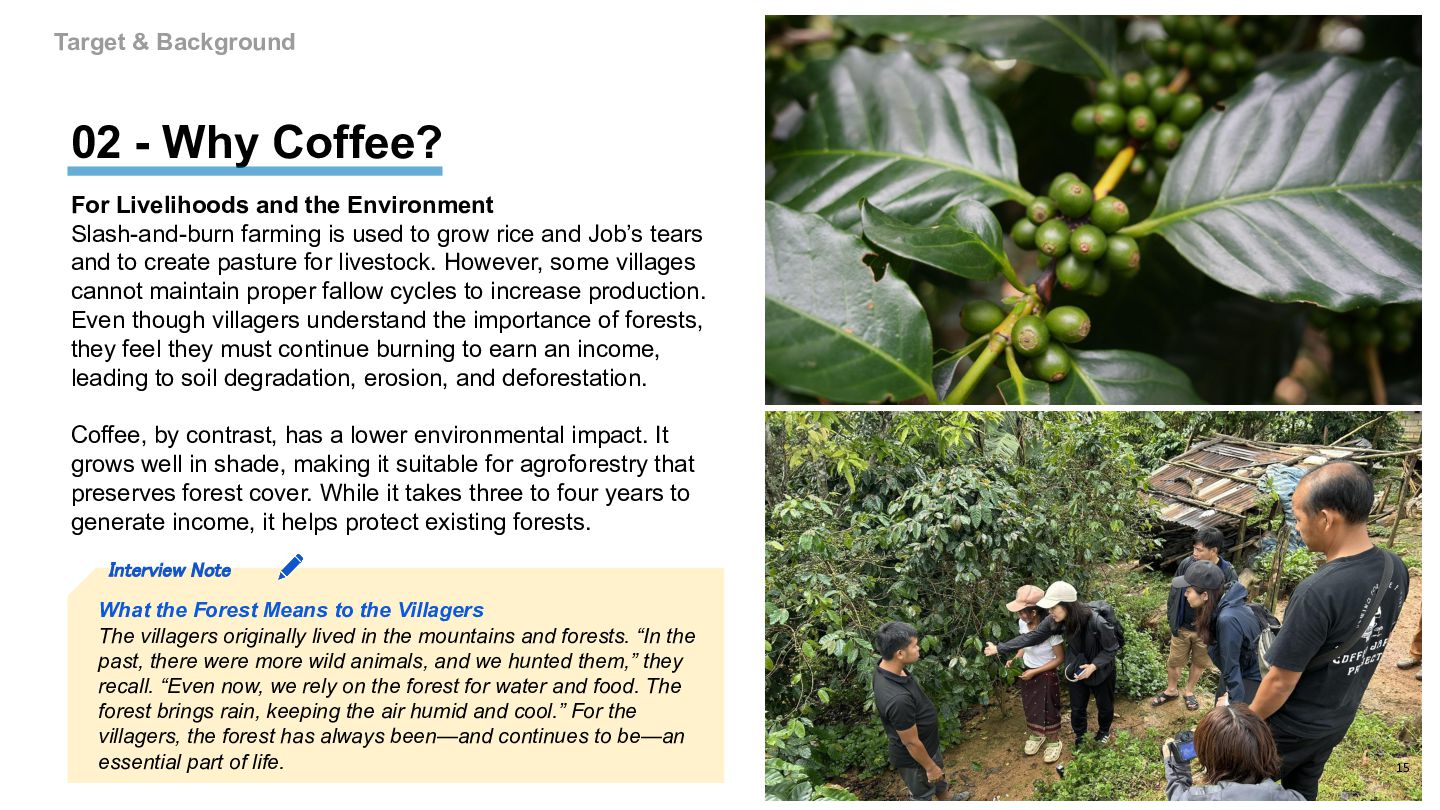
  11. 02 - Why Coffee? For Livelihoods and the Environment Slash-and-burn

    farming is used to grow rice and Job’s tears and to create pasture for livestock. However, some villages cannot maintain proper fallow cycles to increase production. Even though villagers understand the importance of forests, they feel they must continue burning to earn an income, leading to soil degradation, erosion, and deforestation. Coffee, by contrast, has a lower environmental impact. It grows well in shade, making it suitable for agroforestry that preserves forest cover. While it takes three to four years to generate income, it helps protect existing forests. What the Forest Means to the Villagers The villagers originally lived in the mountains and forests. “In the past, there were more wild animals, and we hunted them,” they recall. “Even now, we rely on the forest for water and food. The forest brings rain, keeping the air humid and cool.” For the villagers, the forest has always been—and continues to be—an essential part of life. Interview Note 15 Target & Background
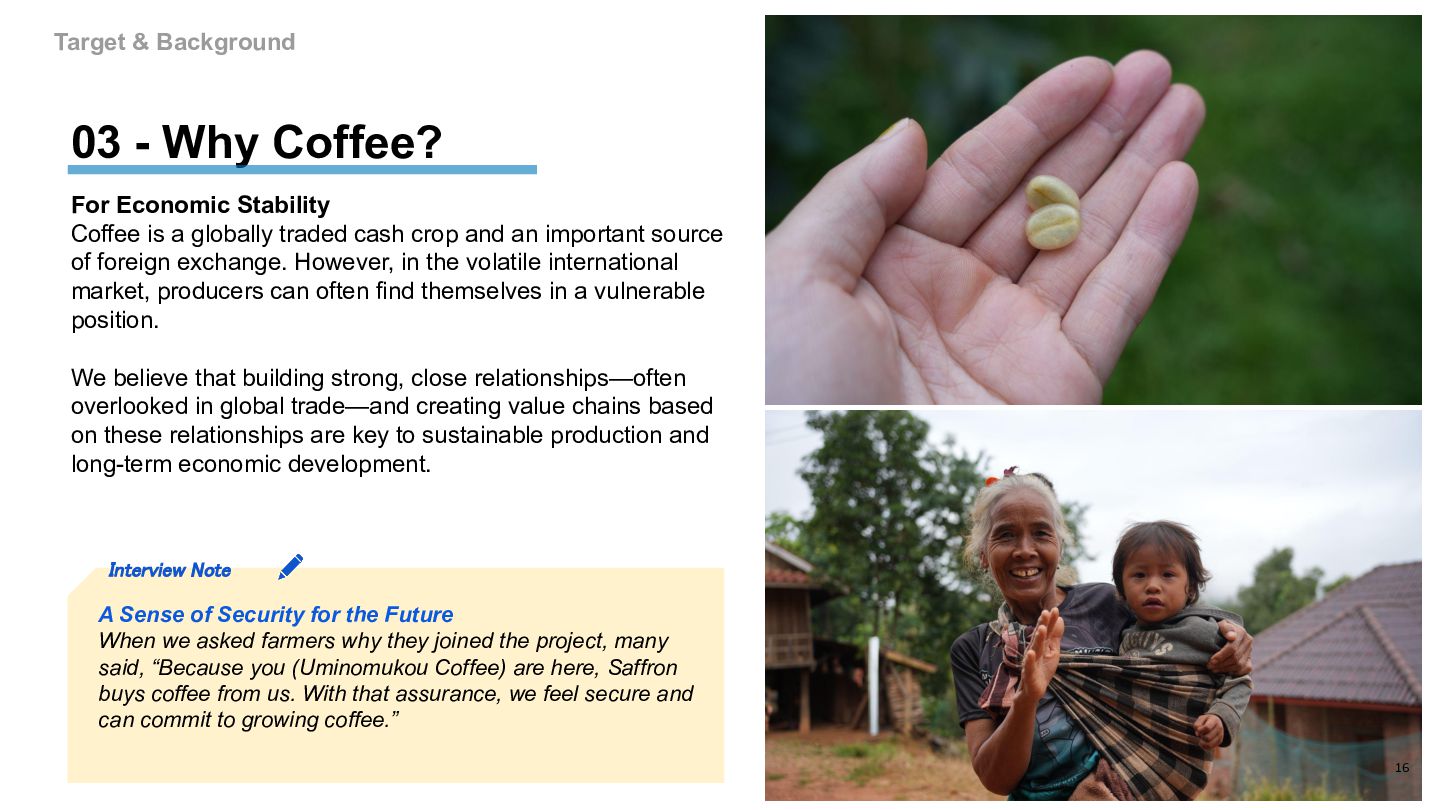
  12. 03 - Why Coffee?  For Economic Stability Coffee is a

    globally traded cash crop and an important source of foreign exchange. However, in the volatile international market, producers can often find themselves in a vulnerable position. We believe that building strong, close relationships—often overlooked in global trade—and creating value chains based on these relationships are key to sustainable production and long-term economic development. A Sense of Security for the Future When we asked farmers why they joined the project, many said, “Because you (Uminomukou Coffee) are here, Saffron buys coffee from us. With that assurance, we feel secure and can commit to growing coffee.” Interview Note 16 Target & Background
  13. COFFEE–Japan Project Challenges Challenge in Local Community The northern project

    area lacks adequate infrastructure. During the rainy season, flooding can cut off roads and isolate villages, delaying emergency response and access to essential services. Poverty rates are about three times higher than in urban areas, and opportunities to earn cash income are limited. As a result, some villagers seek work in cities or abroad. According to the World Food Programme (WFP), 33% of children under five in northern Laos are stunted, and more than half of pregnant and lactating women do not meet recommended nutritional levels. In Laos, there is a word, “Noi,” meaning “small.” We met many people whose names include "Noi". In areas where access to adequate nutrition is limited, smaller body size is often linked to long-term nutritional challenges. Challenges in Coffee Cultivation Most of Laos’s coffee is grown in the south, particularly on the Bolaven Plateau, where cultivation has a long history and well-established expertise. In contrast, coffee farming in the north is still new. Although the altitude and climate are suitable, most farmers are smallholders, and the cost of seedlings and equipment is a heavy burden. Because coffee takes several years to generate income, the financial risk is high. Technical knowledge is also limited. Farmers often say they do not know how to manage tree growth or deal with diseases. Training and extension services are still insufficient. In addition, coffee from northern Laos accounts for only about 5% of the country’s total production, and its recognition in Japan remains low. Building technical capacity and market awareness will be key to further development. 18 Issue
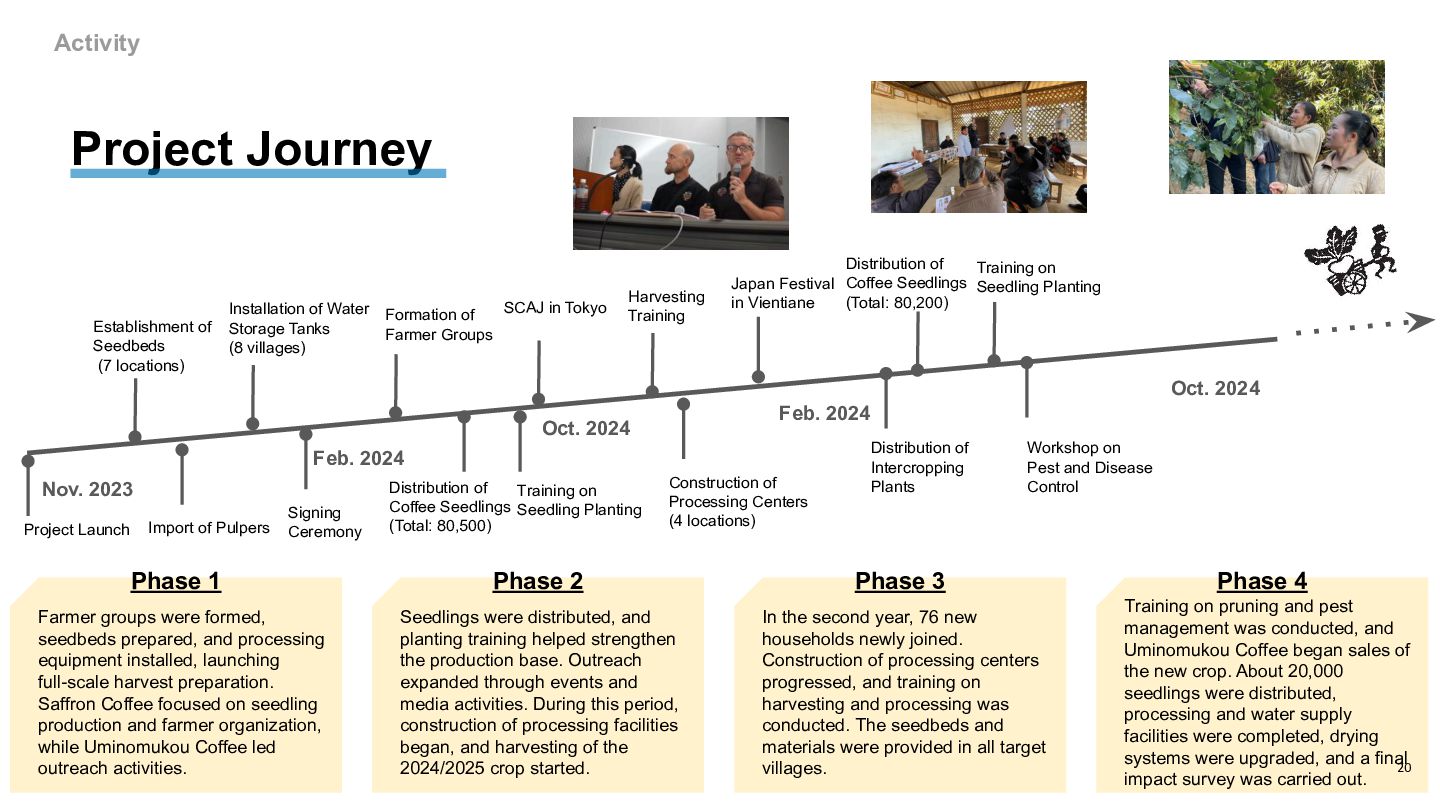
  14. Project Journey Training on Seedling Planting Nov. 2023 Feb. 2024

    Feb. 2024 Project Launch Oct. 2024 Establishment of Seedbeds (7 locations) Import of Pulpers Installation of Water Storage Tanks (8 villages) Distribution of Coffee Seedlings (Total: 80,500) Distribution of Coffee Seedlings (Total: 80,200) Signing Ceremony SCAJ in Tokyo Japan Festival in Vientiane Oct. 2024 Distribution of Intercropping Plants Harvesting Training Formation of Farmer Groups Workshop on Pest and Disease Control Training on Seedling Planting Construction of Processing Centers (4 locations) Farmer groups were formed, seedbeds prepared, and processing equipment installed, launching full-scale harvest preparation. Saffron Coffee focused on seedling production and farmer organization, while Uminomukou Coffee led outreach activities. Seedlings were distributed, and planting training helped strengthen the production base. Outreach expanded through events and media activities. During this period, construction of processing facilities began, and harvesting of the 2024/2025 crop started. In the second year, 76 new households newly joined. Construction of processing centers progressed, and training on harvesting and processing was conducted. The seedbeds and materials were provided in all target villages. Training on pruning and pest management was conducted, and Uminomukou Coffee began sales of the new crop. About 20,000 seedlings were distributed, processing and water supply facilities were completed, drying systems were upgraded, and a final impact survey was carried out. Phase 1 20 Activity Phase 2 Phase 3 Phase 4
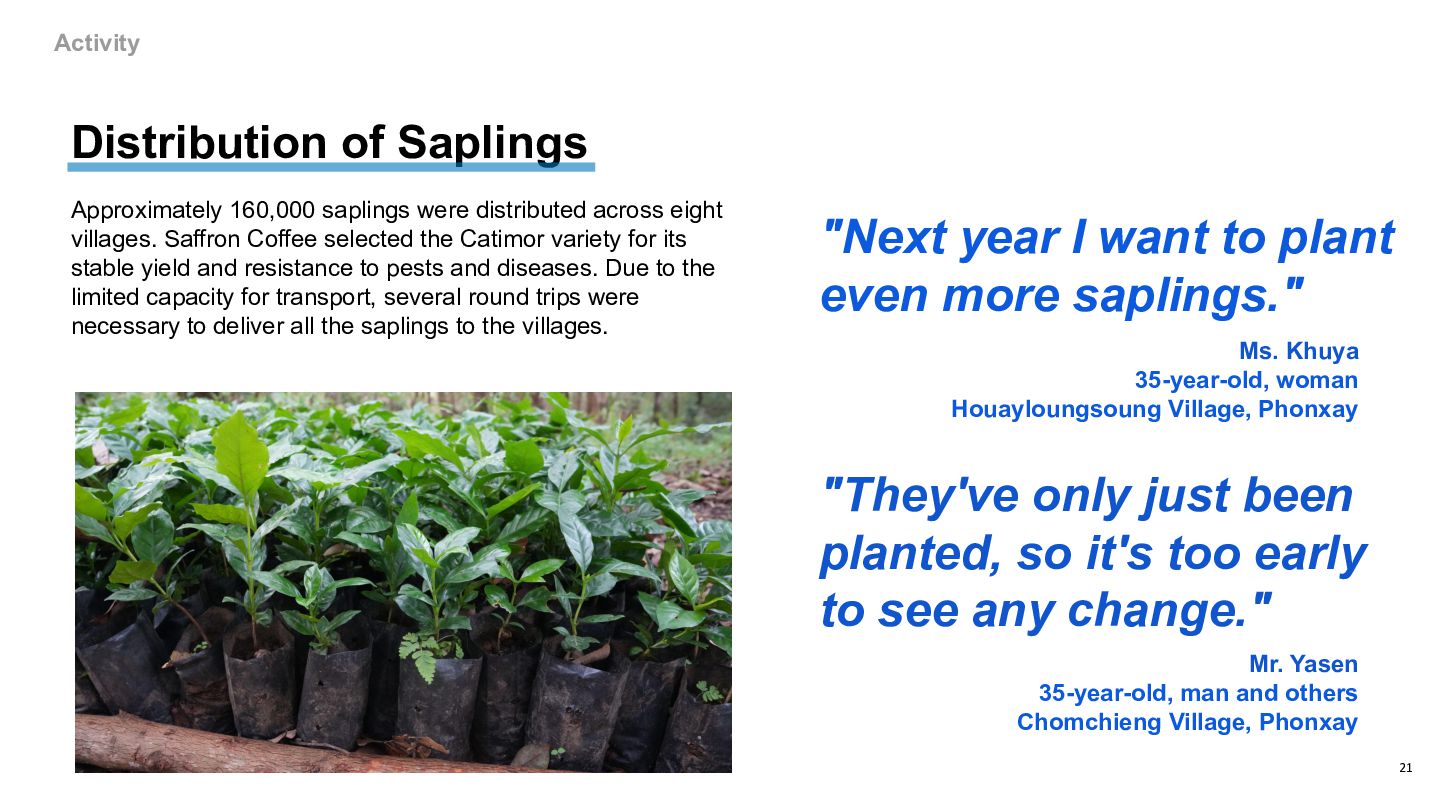
  15. Distribution of Saplings Approximately 160,000 saplings were distributed across eight

    villages. Saffron Coffee selected the Catimor variety for its stable yield and resistance to pests and diseases. Due to the limited capacity for transport, several round trips were necessary to deliver all the saplings to the villages. "Next year I want to plant even more saplings." Mr. Yasen 35-year-old, man and others Chomchieng Village, Phonxay "They've only just been planted, so it's too early to see any change."  Ms. Khuya 35-year-old, woman Houayloungsoung Village, Phonxay 21 Activity
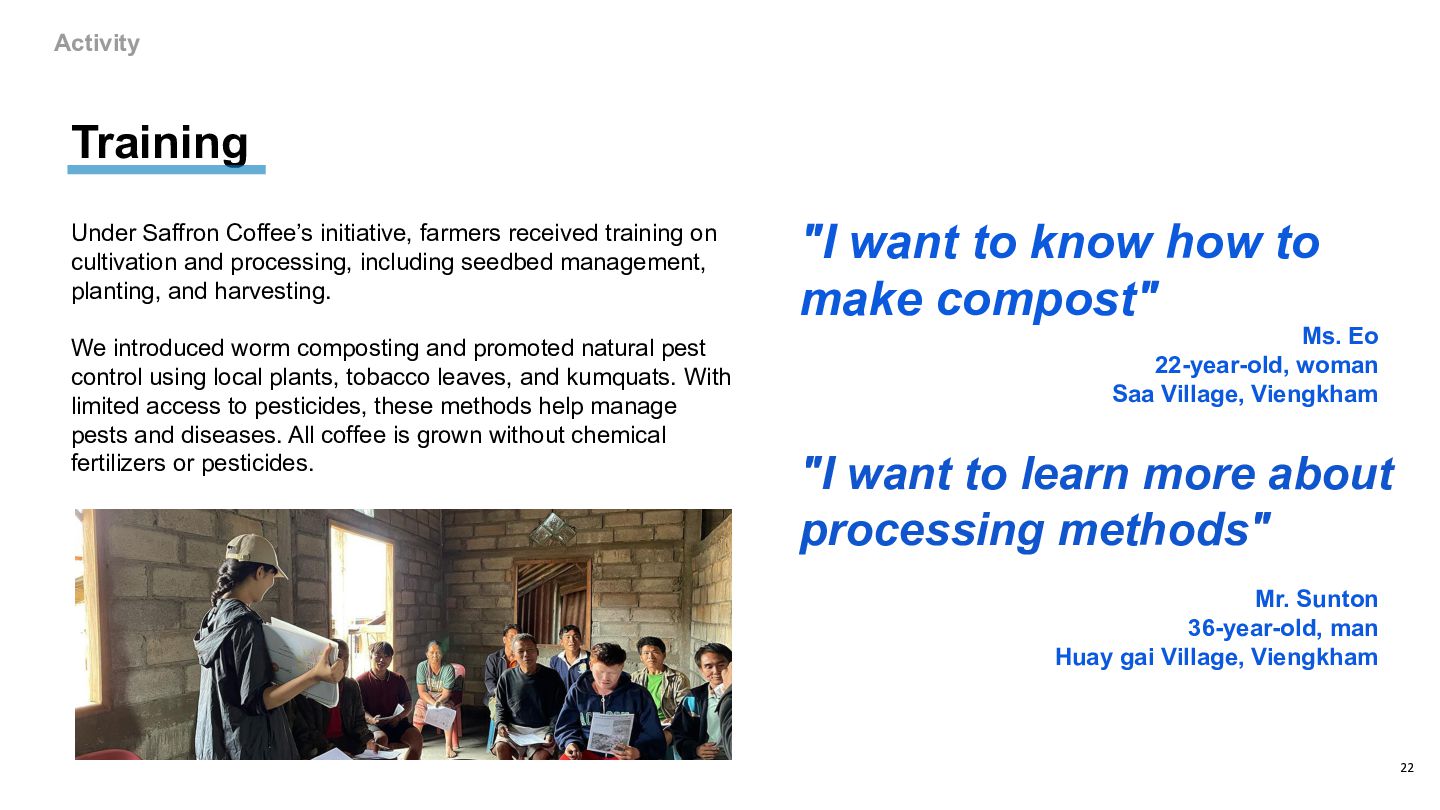
  16. Training Under Saffron Coffee’s initiative, farmers received training on cultivation

    and processing, including seedbed management, planting, and harvesting. We introduced worm composting and promoted natural pest control using local plants, tobacco leaves, and kumquats. With limited access to pesticides, these methods help manage pests and diseases. All coffee is grown without chemical fertilizers or pesticides. "I want to learn more about processing methods" Mr. Sunton 36-year-old, man Huay gai Village, Viengkham "I want to know how to make compost" Ms. Eo 22-year-old, woman Saa Village, Viengkham 22 Activity
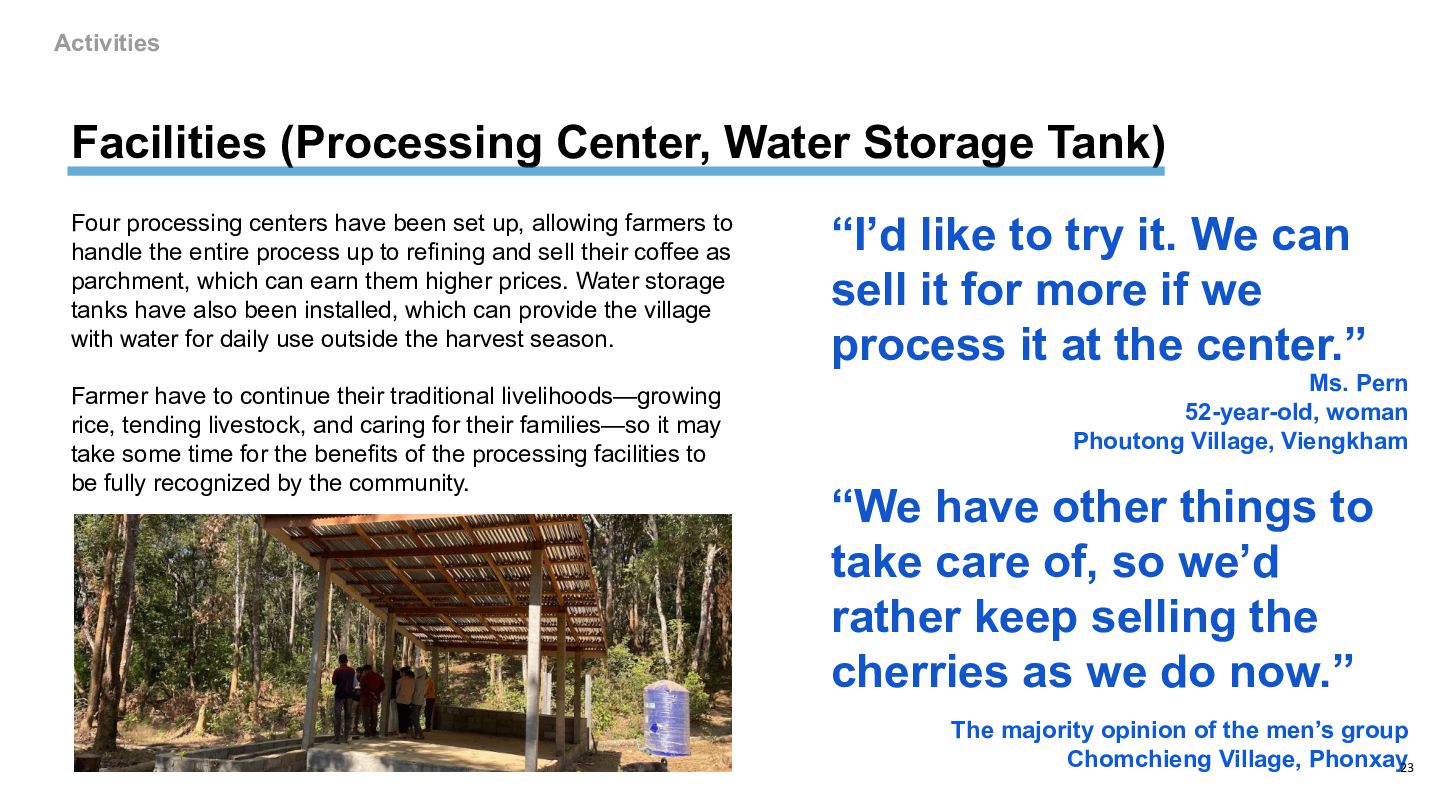
  17. Facilities (Processing Center, Water Storage Tank) Four processing centers have

    been set up, allowing farmers to handle the entire process up to refining and sell their coffee as parchment, which can earn them higher prices. Water storage tanks have also been installed, which can provide the village with water for daily use outside the harvest season. Farmer have to continue their traditional livelihoods—growing rice, tending livestock, and caring for their families—so it may take some time for the benefits of the processing facilities to be fully recognized by the community. “I’d like to try it. We can sell it for more if we process it at the center.” Ms. Pern     52-year-old, woman Phoutong Village, Viengkham “We have other things to take care of, so we’d rather keep selling the cherries as we do now.” The majority opinion of the men’s group Chomchieng Village, Phonxay 23 Activities
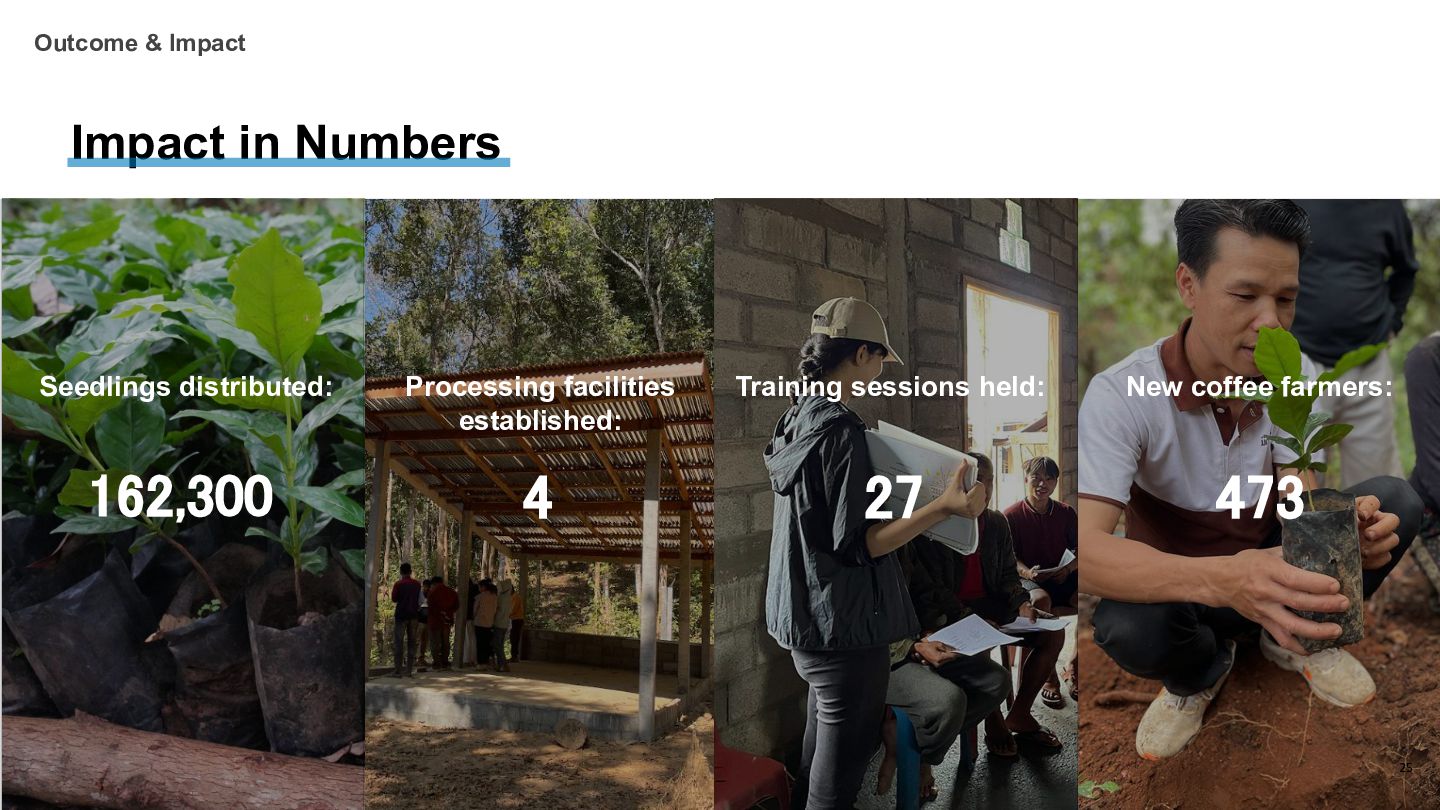
  18. Impact in Numbers Processing facilities established: 4 New coffee farmers:

    473 Training sessions held: 27 Seedlings distributed: 162,300 25 Outcome & Impact
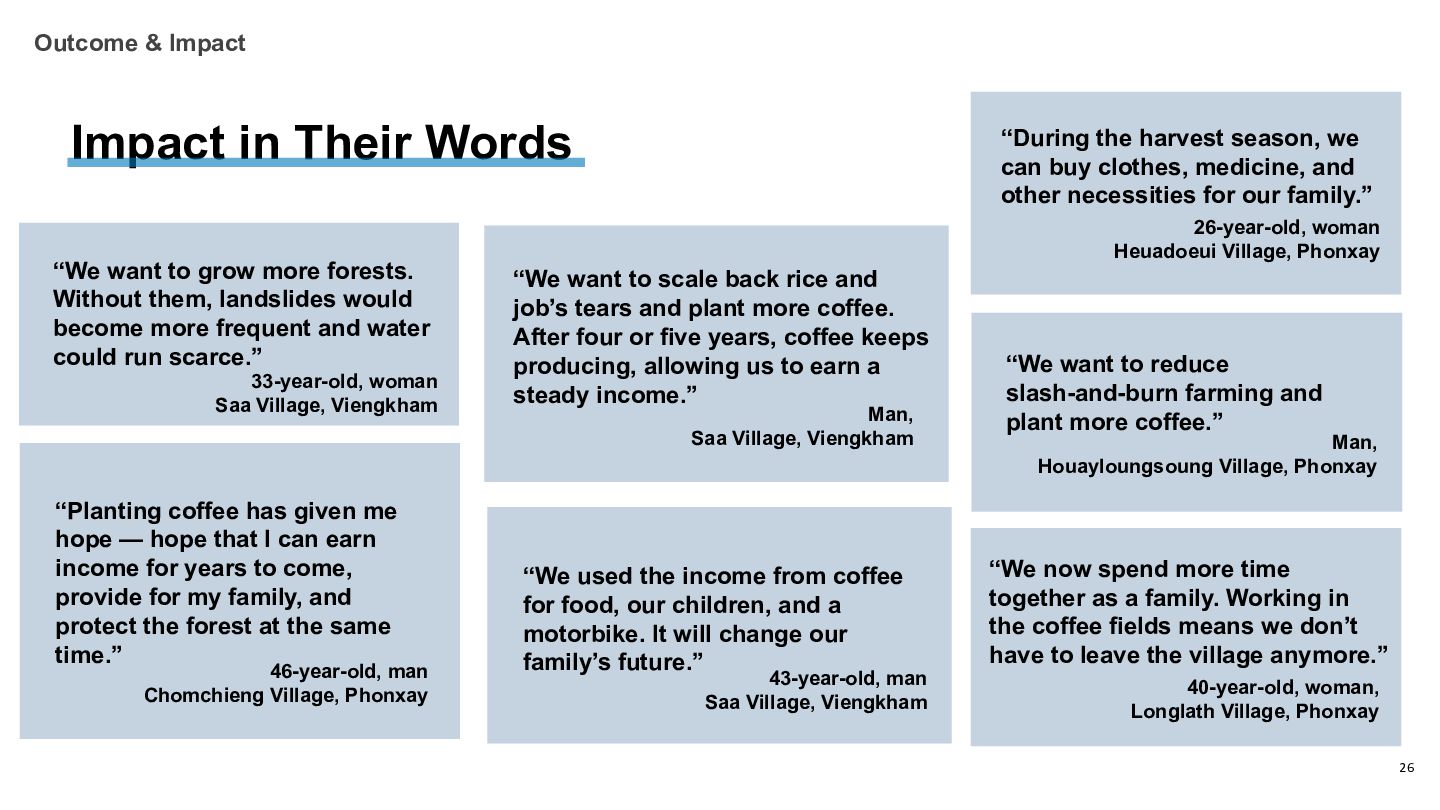
  19. Impact in Their Words “During the harvest season, we can

    buy clothes, medicine, and other necessities for our family.” 43-year-old, man Saa Village, Viengkham “Planting coffee has given me hope — hope that I can earn income for years to come, provide for my family, and protect the forest at the same time.” 46-year-old, man Chomchieng Village, Phonxay “We want to reduce slash-and-burn farming and plant more coffee.” Man, Houayloungsoung Village, Phonxay “We now spend more time together as a family. Working in the coffee fields means we don’t have to leave the village anymore.” 40-year-old, woman, Longlath Village, Phonxay “We used the income from coffee for food, our children, and a motorbike. It will change our family’s future.” “We want to grow more forests. Without them, landslides would become more frequent and water could run scarce.” 33-year-old, woman Saa Village, Viengkham Man, Saa Village, Viengkham “We want to scale back rice and job’s tears and plant more coffee. After four or five years, coffee keeps producing, allowing us to earn a steady income.” 26 Outcome & Impact 26-year-old, woman Heuadoeui Village, Phonxay
  20. Looking Back on the Project Throughout the project period, we

    distributed 160,000 coffee seedlings and built four processing centers. We also installed tanks for coffee processing and village water storage, and provided pulpers and other necessary equipment. These are the project’s measurable results. However, it is still difficult to measure changes such as increases in income or overall improvements in living standards. As one farmer told us, “Because you (Uminomukou Coffee) are here, Saffron buys coffee from us. With that assurance, we feel secure and can commit to growing coffee.” It is clear that our presence has strengthened farmers’ motivation to produce coffee. Although the project had a defined timeframe, the trust built through coffee does not end here. We will continue working alongside producing communities through ongoing purchasing, supporting environmentally responsible agriculture and a sustainable supply chain. By maintaining our purchases, we enable Saffron Coffee to continue sourcing from farmers. Building a lasting relationship beyond the project period is part of the significance of our involvement. Uminomukou Coffee works with farmers committed to environmentally responsible agriculture, creating supply chains that bring their products to consumers and generate new value. Our engagement in Laos began with the challenge of reducing the environmental impact of slash-and-burn farming. “There is nothing bad about coffee.” Shaun, a staff member of Saffron Coffee often said, coffee does not require slash-and-burn practices or clearing new forest. Though it takes time to mature, once established, it provides long-term income without harming the environment. In interviews conducted near the end of the project, most farmers expressed hope for the future of coffee production. Beyond measurable results, their confidence that they can continue into the future is itself an important outcome. While regional economies are steadily growing, disparities are also widening. Sustainable production and long-term trade have the potential to help bridge this gap. 28
  21. From Luang Prabang, even the nearest village is about three

    hours away. The roads are unpaved, and the journey often takes even longer. Despite these conditions, we are deeply grateful to Todd of Saffron Coffee and the entire project team, who visited the villages again and again to carry out the project activities. Through the project, we visited many villages. We stayed in the homes of local farmers, made fires, shared the cooking duties, and regularly gathered around the table together. Beyond the project activities themselves, sharing daily life helped us understand one another more deeply and build meaningful relationships. “There are many ways to provide support. Some simply distribute money. What makes you and Saffron Coffee different is that you come all the way to our village, meet us face to face, and stay involved. Please continue coming back.” These were words shared with us during a village visit. The work we have carried out together with Saffron Coffee and the farmers is gradual and often invisible—based on small, steady efforts. It takes time and patience to bear fruit, and even then, the outcome is never guaranteed. And yet, we continue to visit the villages—perhaps because there are people there who are waiting for us. If coffee production can help farmers move closer to the future they hope for—the future they say, “This is how we want it to be”—we are truly glad to be part of it. 29 Closing Remarks