Share
Embed
Advanced on-page SEO
Technical or On-page SEO is everything that helps a website generate more revenues from search engines and that webmasters have full control over.
Paradigma
November 20, 2013
Transcript
37 slides
-
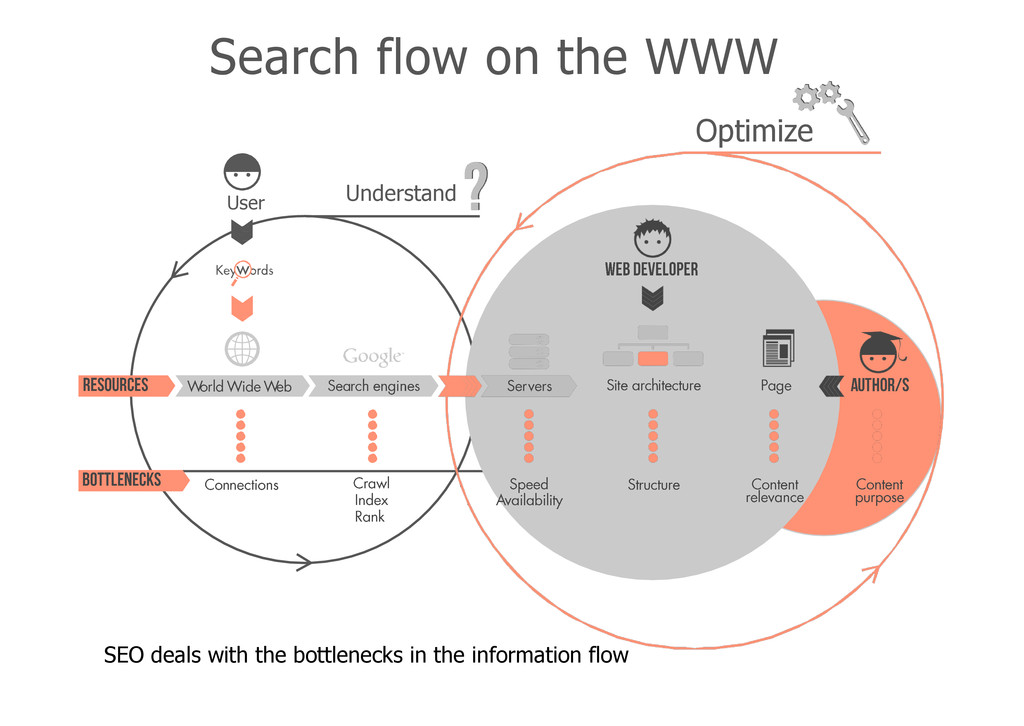
User Search flow on the WWW SEO deals with the
bottlenecks in the information flow Understand Optimize -
Technical or On-page SEO is everything that helps a website
generate more revenues from search engines and that webmasters have full control over. What is On-page SEO? Off-page SEO Technical SEO -
Why does technical SEO matter? It helps close the gap
between web servers, search engines and human beings Source: http://knowledgeoman.com -
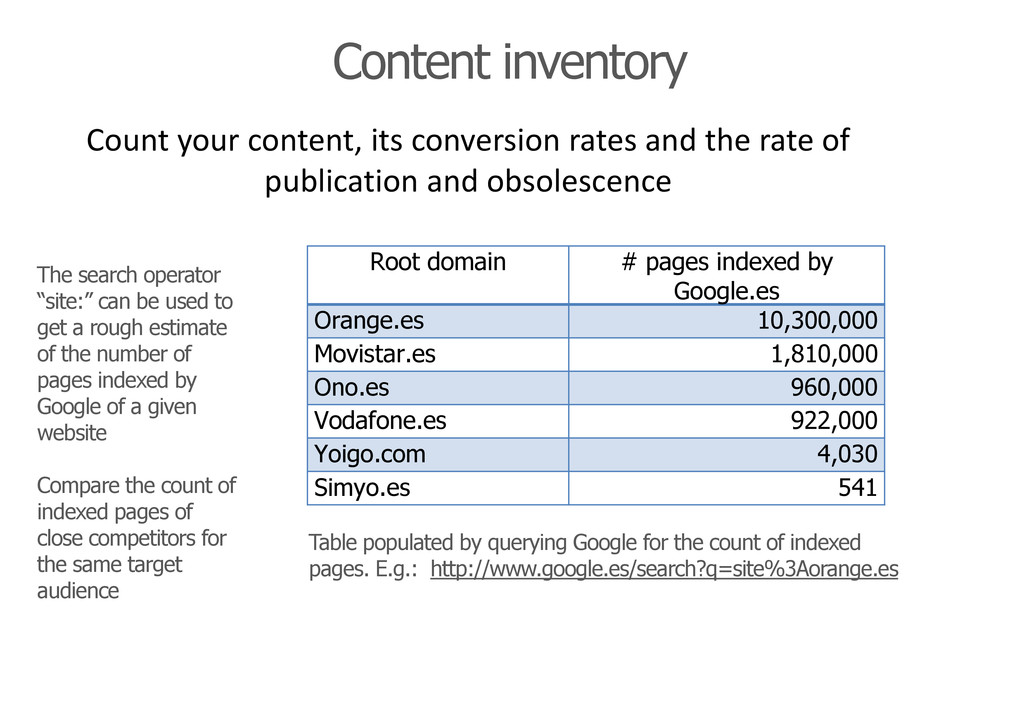
The search operator “site:” can be used to get a
rough estimate of the number of pages indexed by Google of a given website Compare the count of indexed pages of close competitors for the same target audience Content inventory Root domain # pages indexed by Google.es Orange.es 10,300,000 Movistar.es 1,810,000 Ono.es 960,000 Vodafone.es 922,000 Yoigo.com 4,030 Simyo.es 541 Table populated by querying Google for the count of indexed pages. E.g.: http://www.google.es/search?q=site%3Aorange.es Count your content, its conversion rates and the rate of publication and obsolescence -
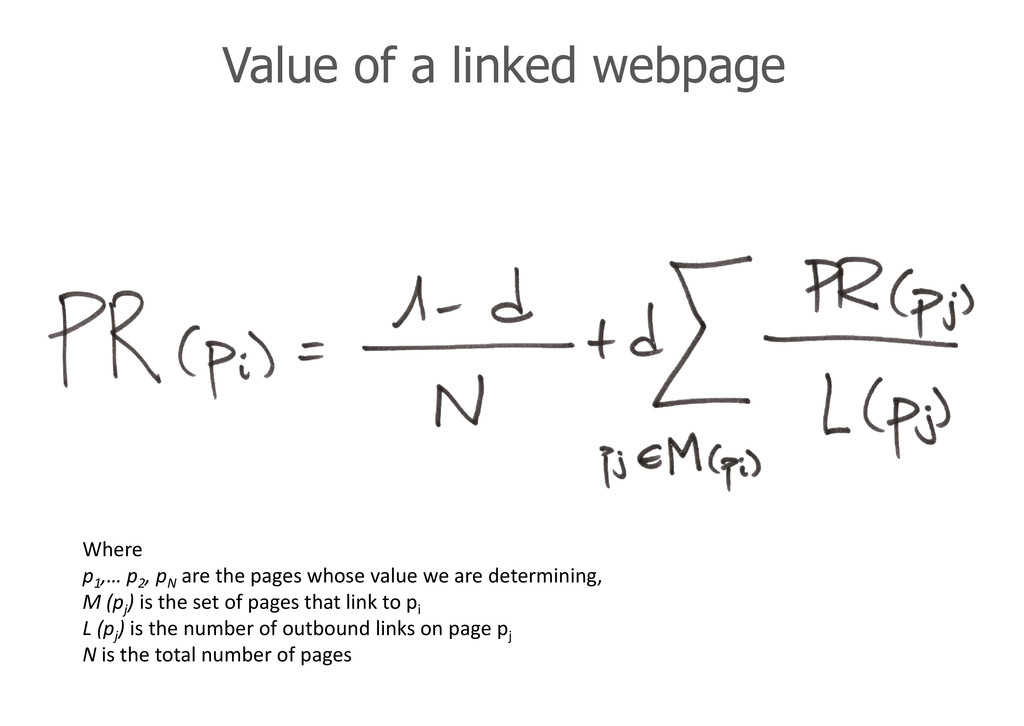
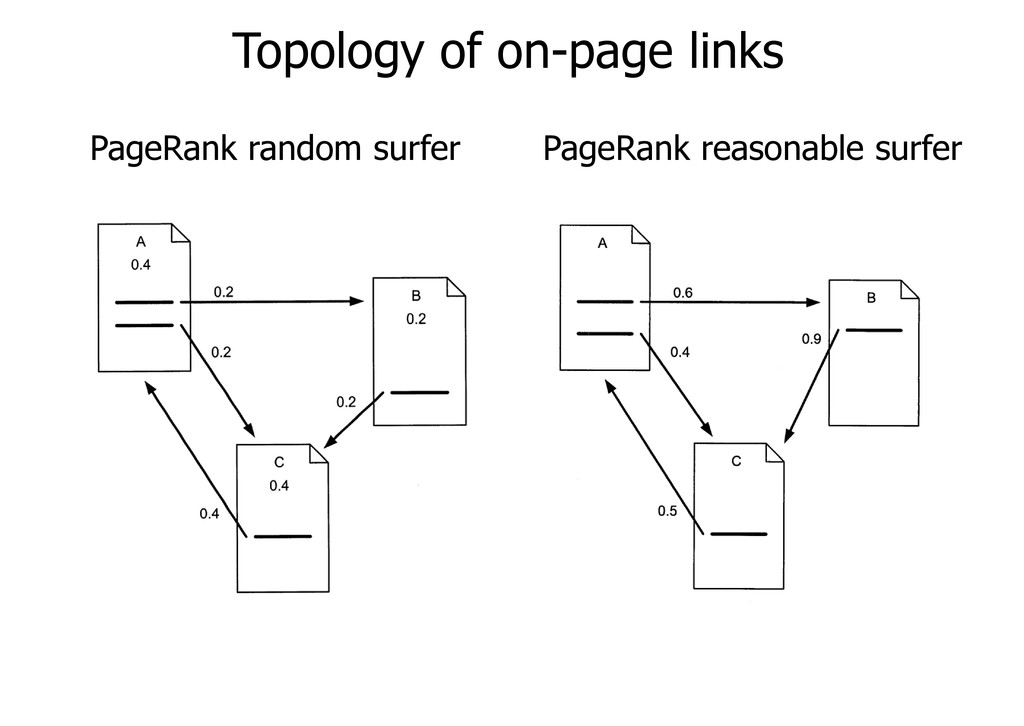
Value of a linked webpage Where p1 ,… p2 ,
pN are the pages whose value we are determining, M (pj ) is the set of pages that link to pi L (pj ) is the number of outbound links on page pj N is the total number of pages -
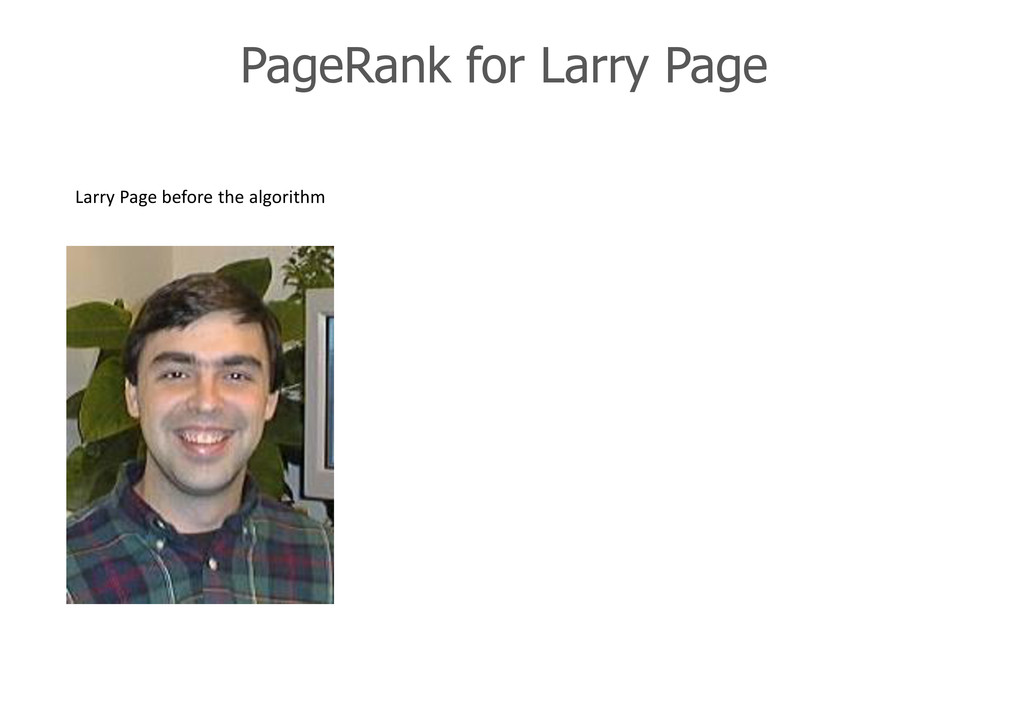
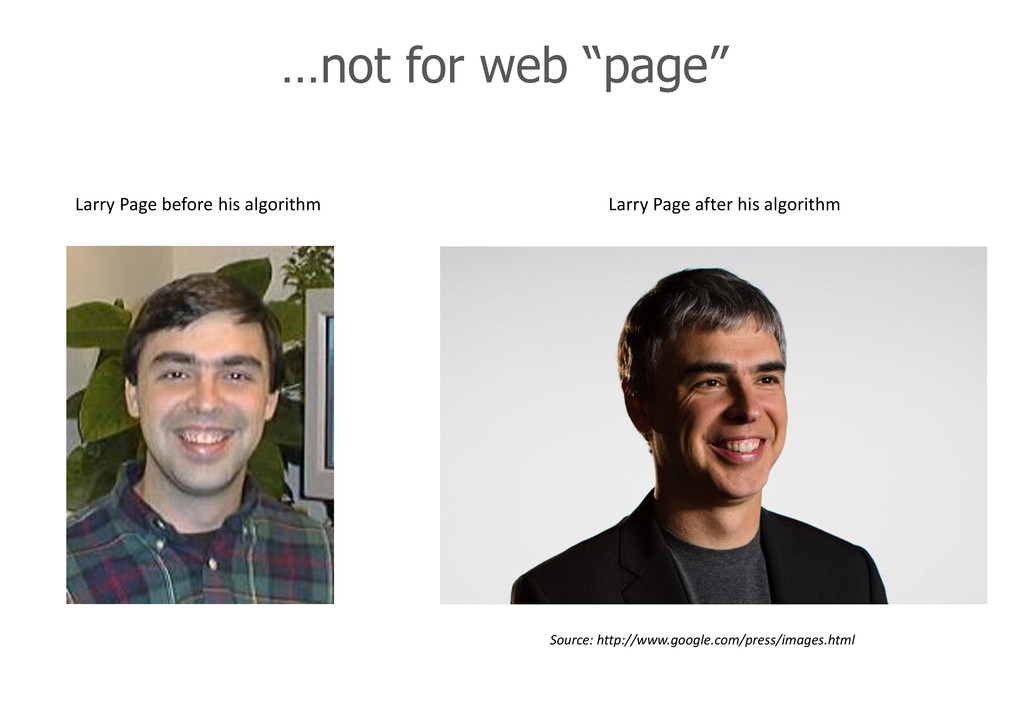
…not for web “page” Larry Page before his algorithm Larry
Page after his algorithm Source: http://www.google.com/press/images.html -
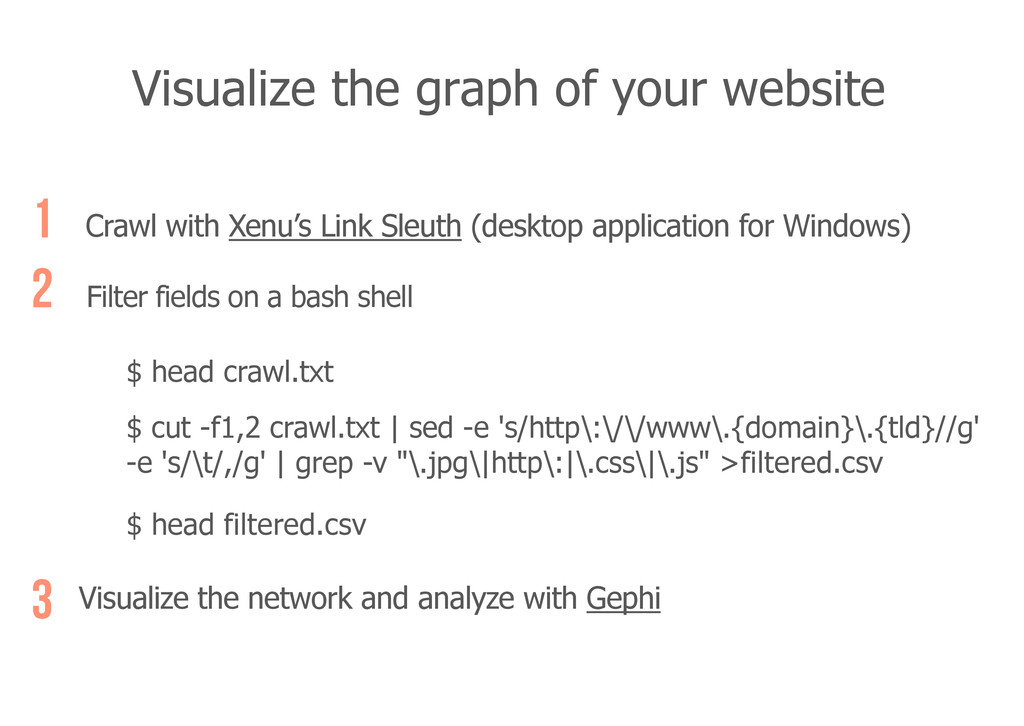
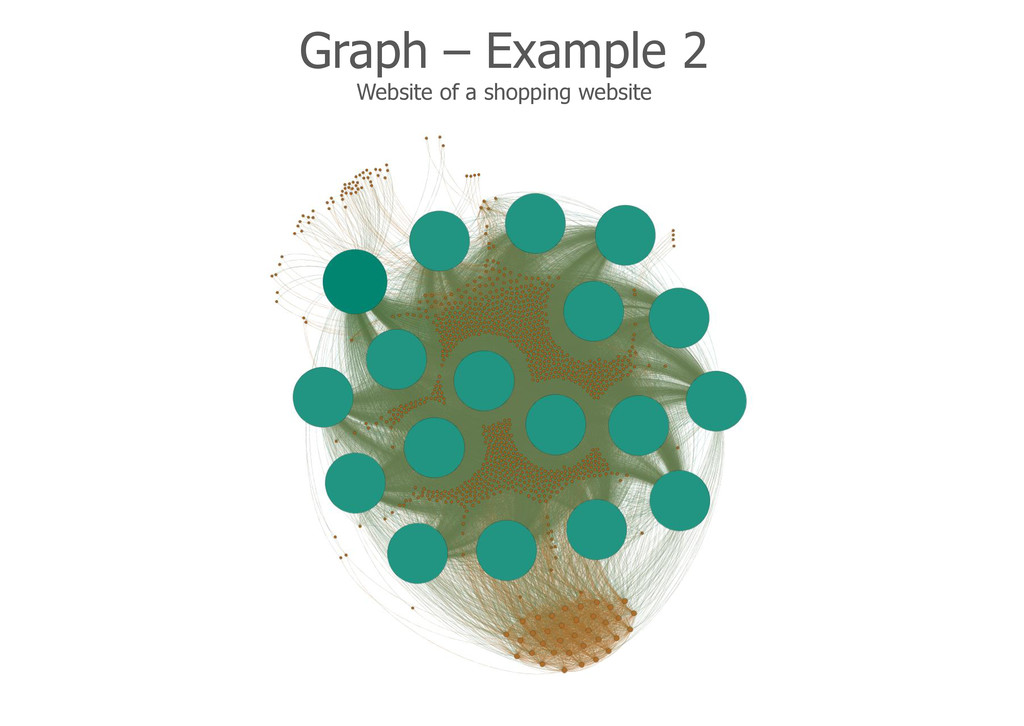
Visualize the network and analyze with Gephi Visualize the graph
of your website Crawl with Xenu’s Link Sleuth (desktop application for Windows) Filter fields on a bash shell $ head crawl.txt $ cut -f1,2 crawl.txt | sed -e 's/http\:\/\/www\.{domain}\.{tld}//g' -e 's/\t/,/g' | grep -v "\.jpg\|http\:|\.css\|\.js" >filtered.csv $ head filtered.csv -
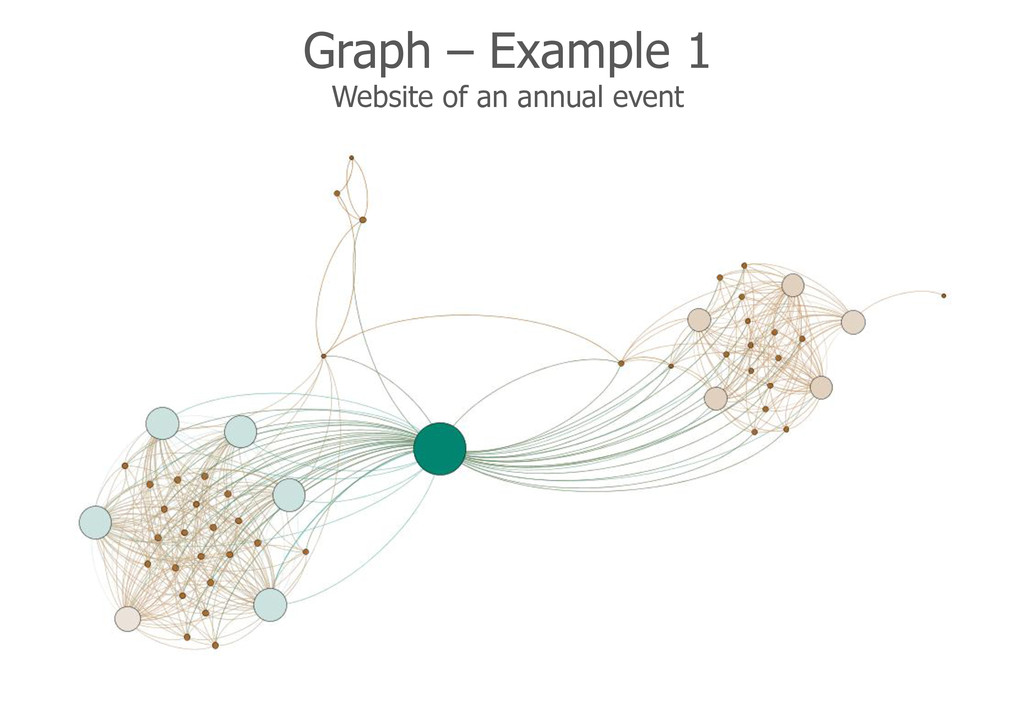
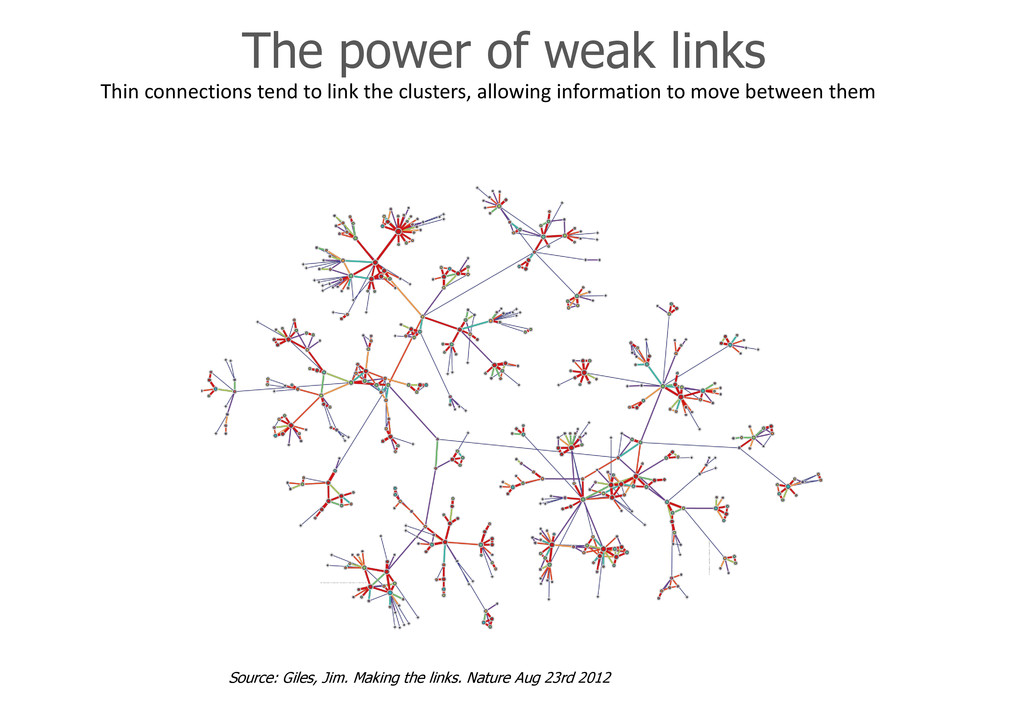
The power of weak links Thin connections tend to link
the clusters, allowing information to move between them Source: Giles, Jim. Making the links. Nature Aug 23rd 2012 -
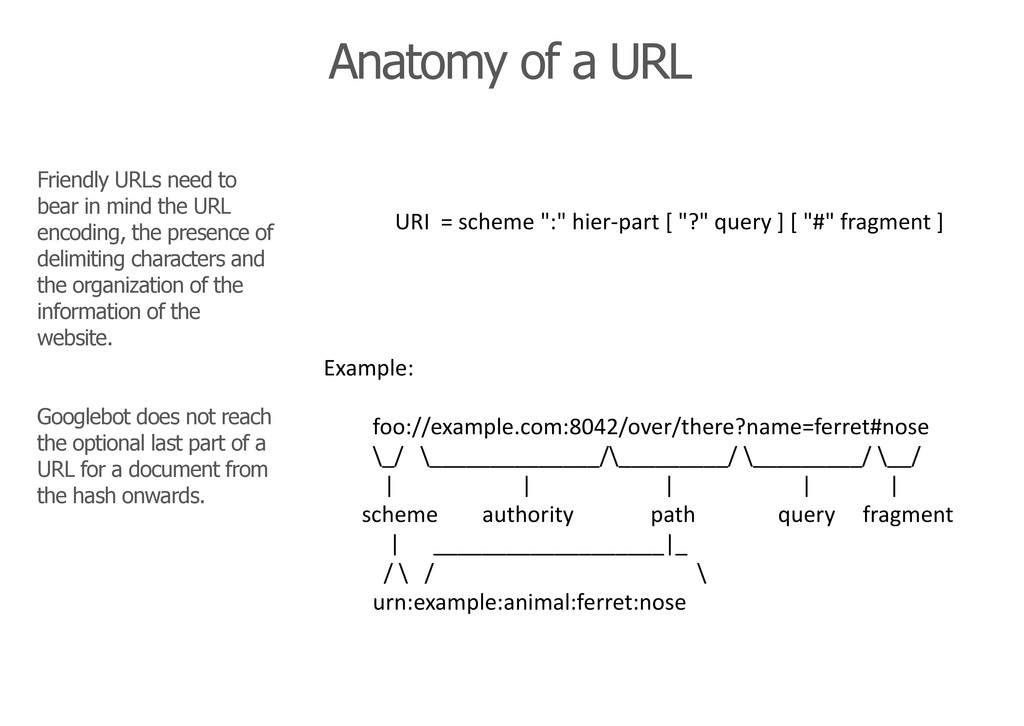
Friendly URLs need to bear in mind the URL encoding,
the presence of delimiting characters and the organization of the information of the website. Googlebot does not reach the optional last part of a URL for a document from the hash onwards. Anatomy of a URL URI = scheme ":" hier-part [ "?" query ] [ "#" fragment ] Example: foo://example.com:8042/over/there?name=ferret#nose \_/ \______________/\_________/ \_________/ \__/ | | | | | scheme authority path query fragment | ___________________|_ / \ / \ urn:example:animal:ferret:nose -

Single Page Applications Single Application Applications (SAP) pages free client
browsers from querying web servers. SAP are now growing in use thanks to AJAX and frameworks like backbone and angular.js. This is a major challenge for search engines because the fragments in the URLs prevent crawlers to scrape the content. Google are asking webmasters to make their AJAX-based websites crawlable -
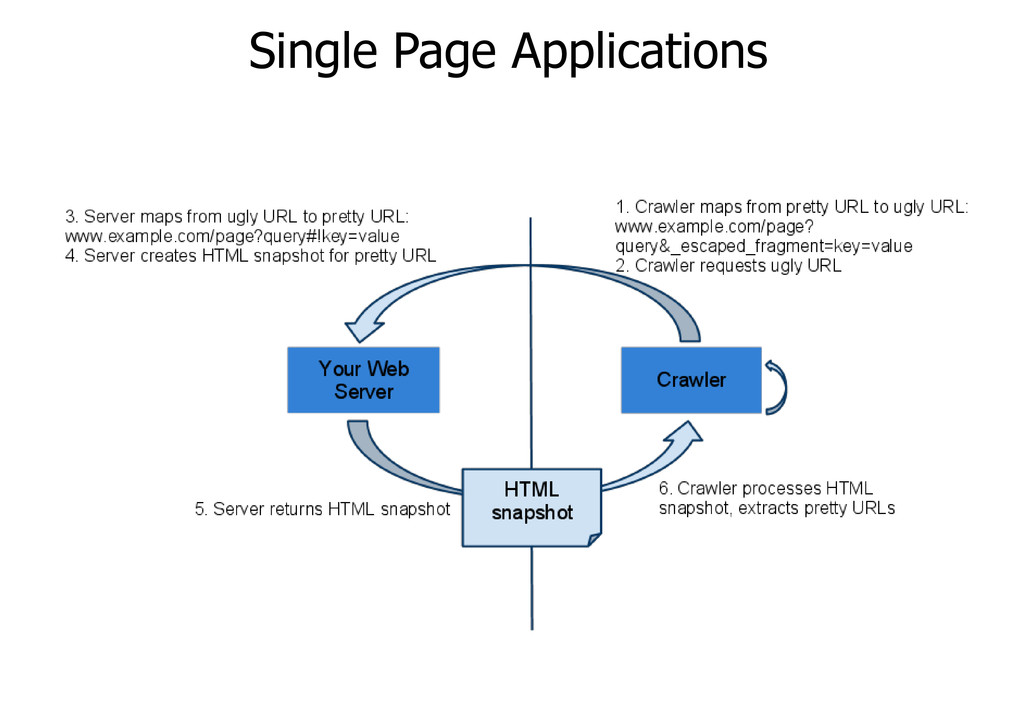
SEO for Single Page Applications Modify the URL fragments for
stateful AJAX pages http://example.com/page?query#!state Use a headless browser that outputs an HTML snapshot on your web server rather than a client machine Allow search engine crawlers to access these URLs by escaping the state http://example.com/page?query&_escaped_fragment_=state Show the original URL to users in the search results -
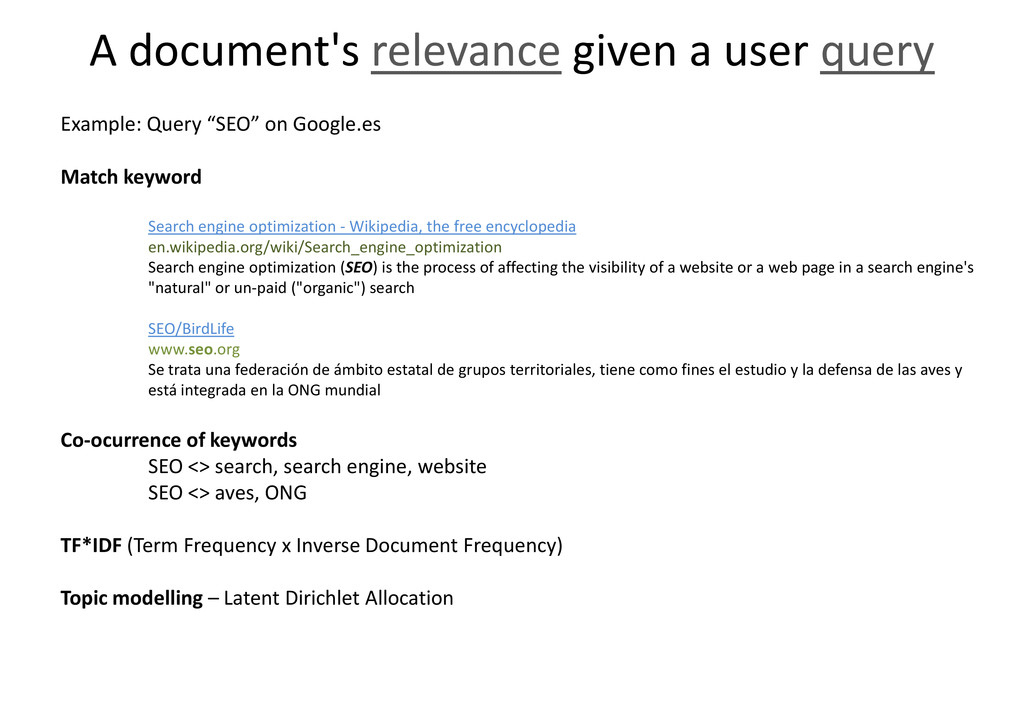
A document's relevance given a user query Example: Query “SEO”
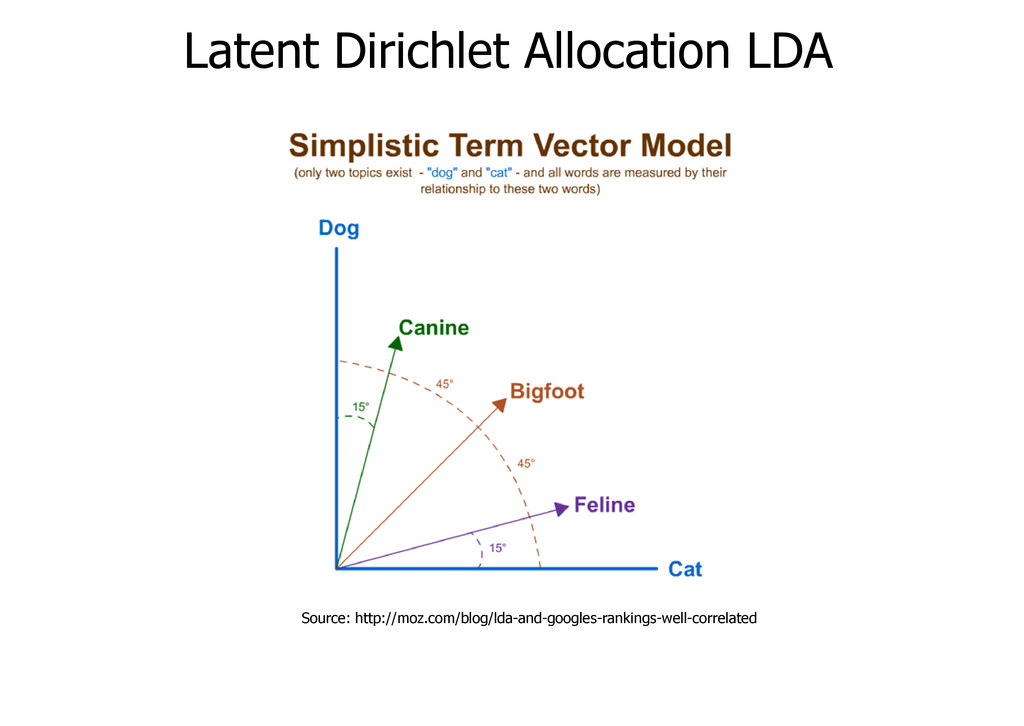
on Google.es Match keyword Search engine optimization - Wikipedia, the free encyclopedia en.wikipedia.org/wiki/Search_engine_optimization Search engine optimization (SEO) is the process of affecting the visibility of a website or a web page in a search engine's "natural" or un-paid ("organic") search SEO/BirdLife www.seo.org Se trata una federación de ámbito estatal de grupos territoriales, tiene como fines el estudio y la defensa de las aves y está integrada en la ONG mundial Co-ocurrence of keywords SEO <> search, search engine, website SEO <> aves, ONG TF*IDF (Term Frequency x Inverse Document Frequency) Topic modelling – Latent Dirichlet Allocation -
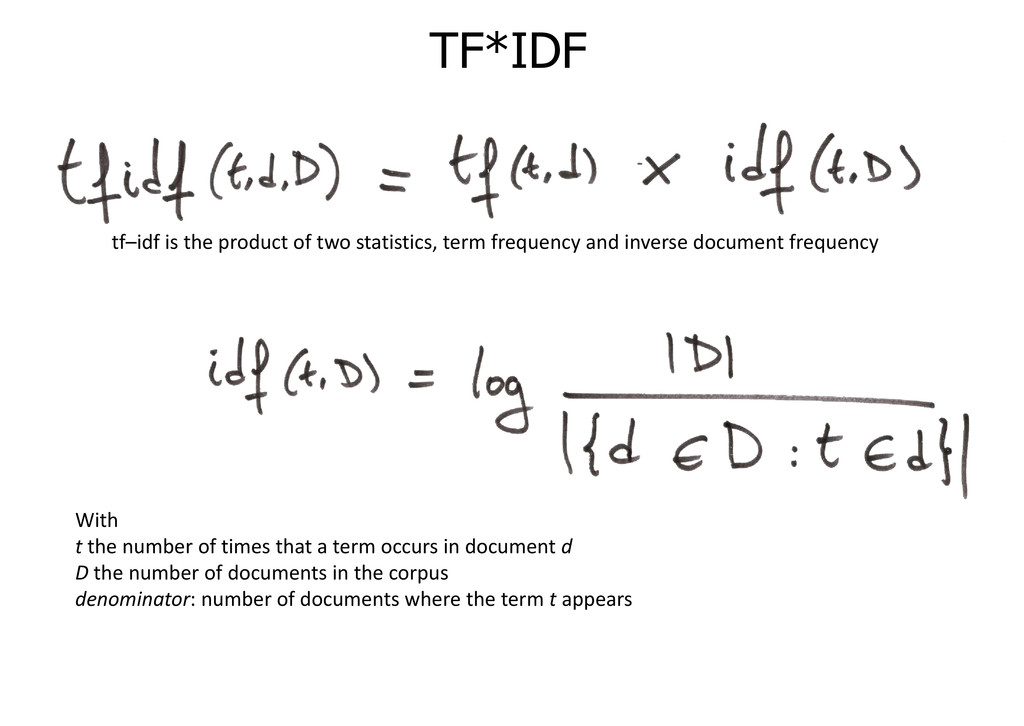
TF*IDF tf–idf is the product of two statistics, term frequency
and inverse document frequency With t the number of times that a term occurs in document d D the number of documents in the corpus denominator: number of documents where the term t appears -
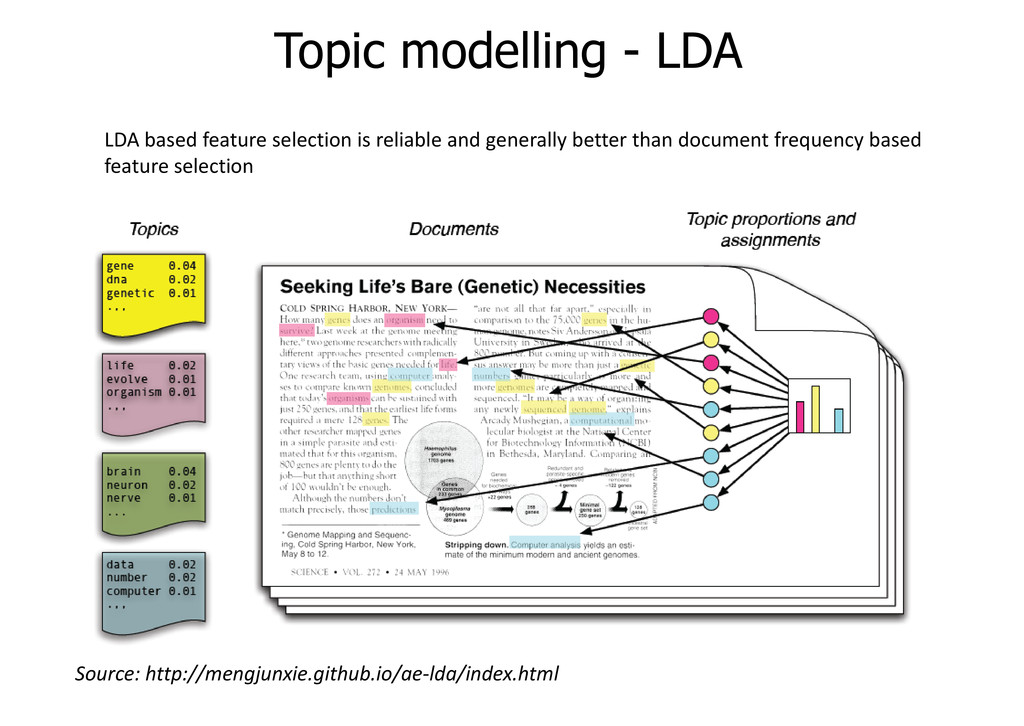
Topic modelling - LDA Source: http://mengjunxie.github.io/ae-lda/index.html LDA based feature selection
is reliable and generally better than document frequency based feature selection -
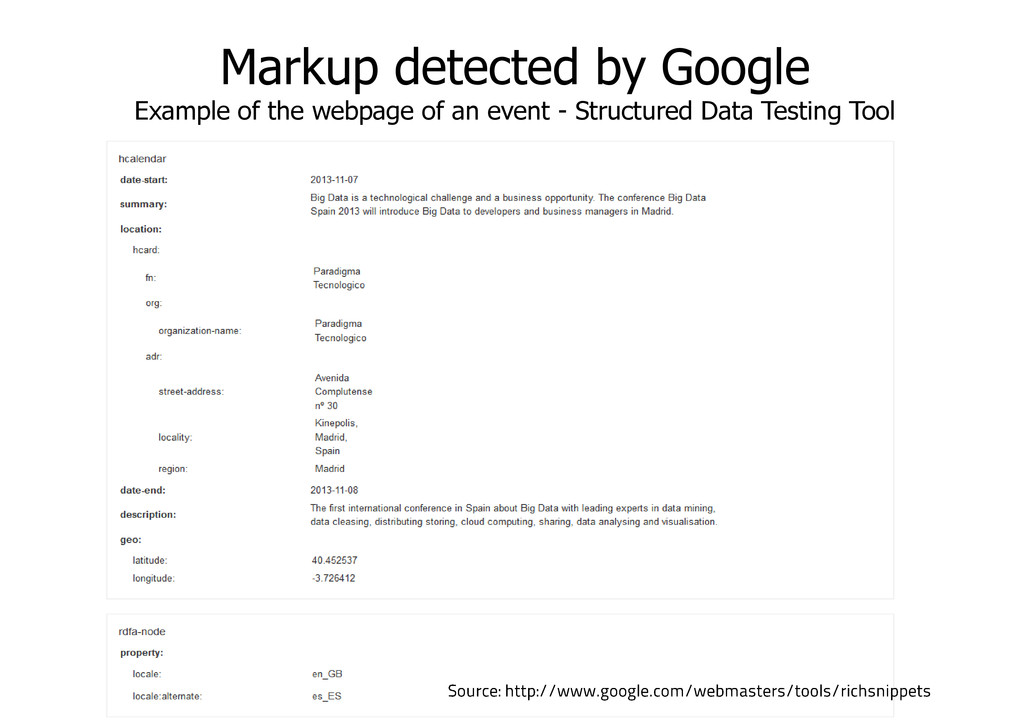
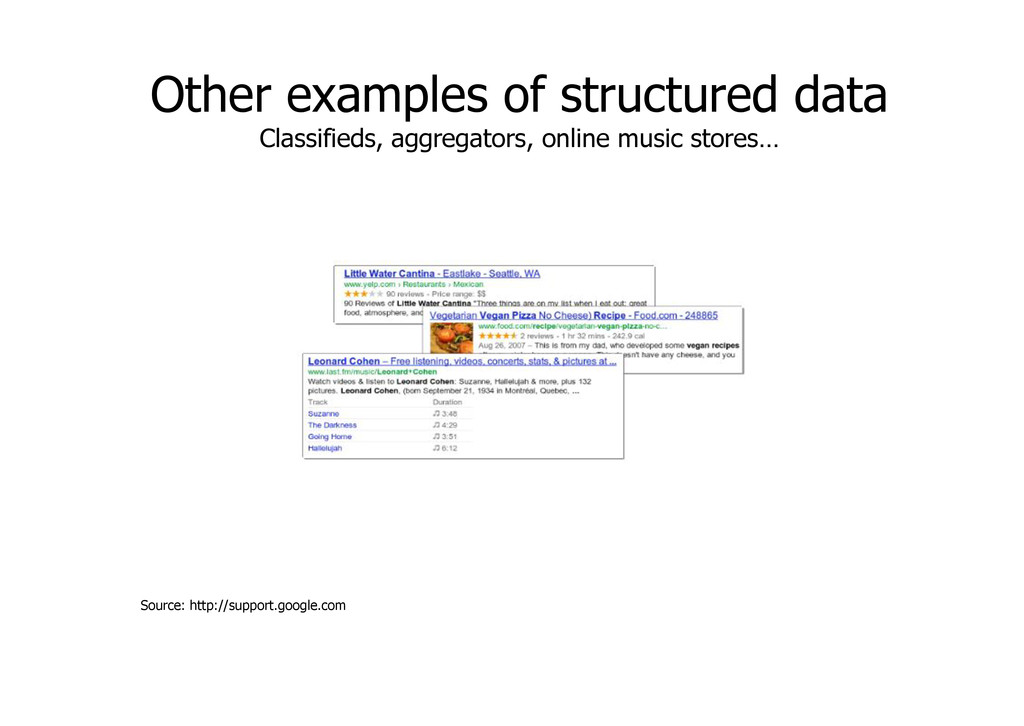
Markup detected by Google Example of the webpage of an
event - Structured Data Testing Tool -
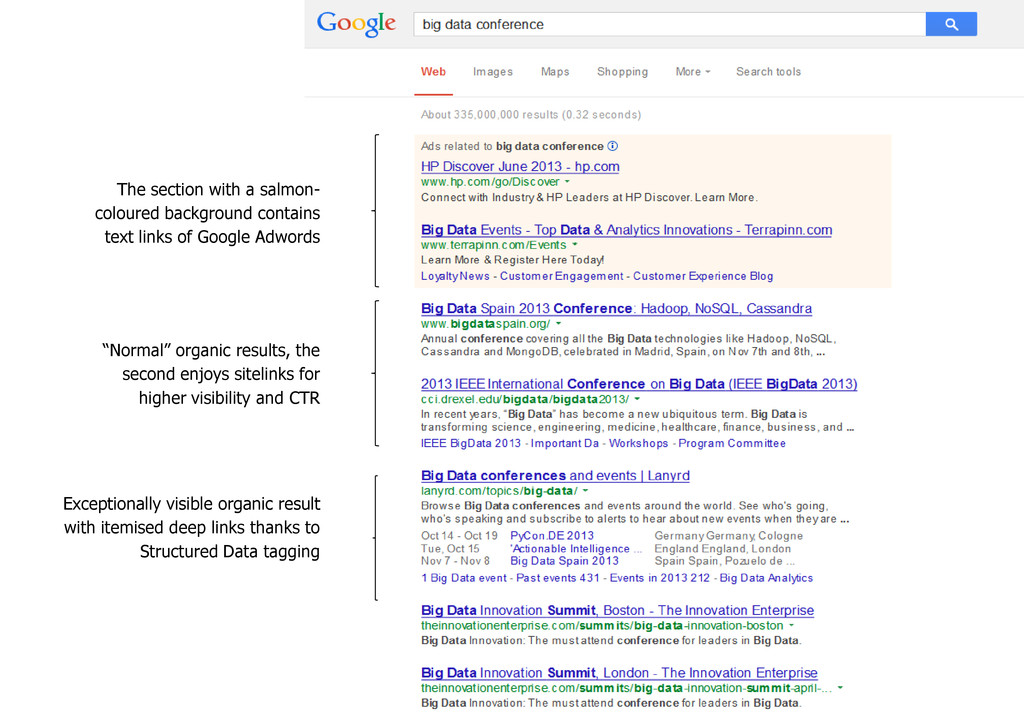
“Normal” organic results, the second enjoys sitelinks for higher visibility
and CTR Exceptionally visible organic result with itemised deep links thanks to Structured Data tagging The section with a salmon- coloured background contains text links of Google Adwords -
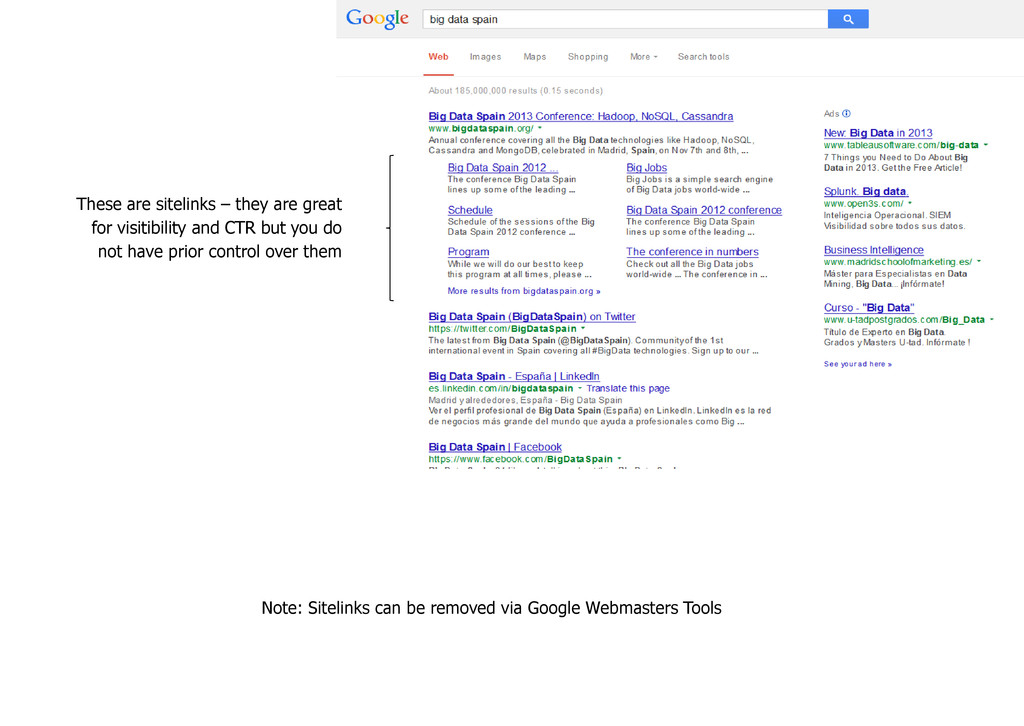
These are sitelinks – they are great for visitibility and
CTR but you do not have prior control over them Note: Sitelinks can be removed via Google Webmasters Tools -
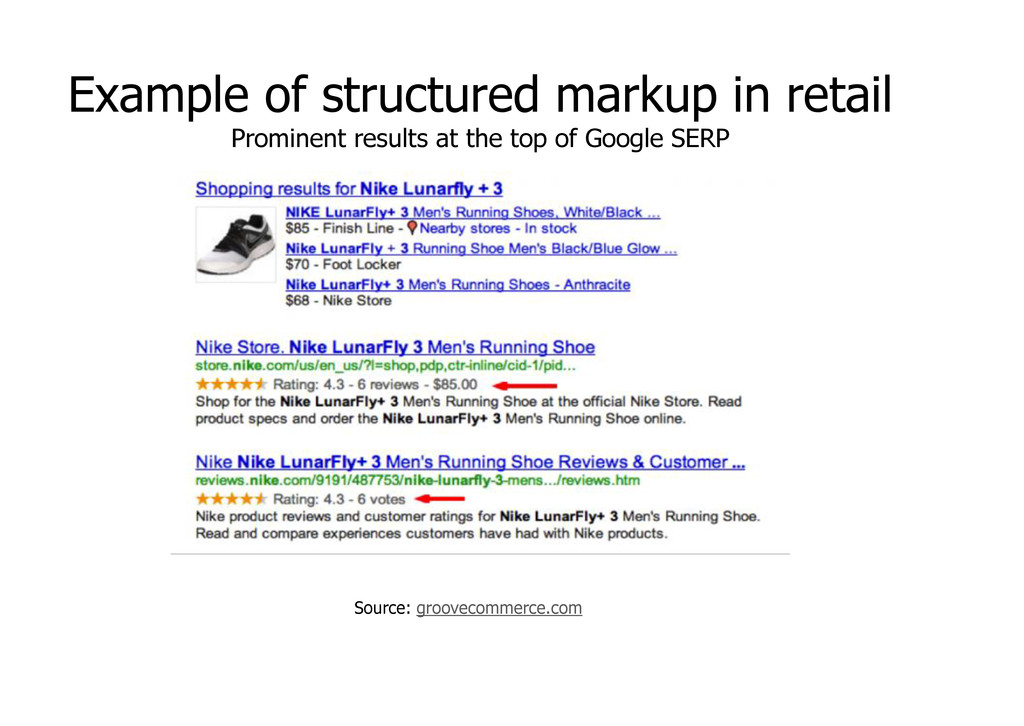
Source: groovecommerce.com Example of structured markup in retail Prominent results
at the top of Google SERP -
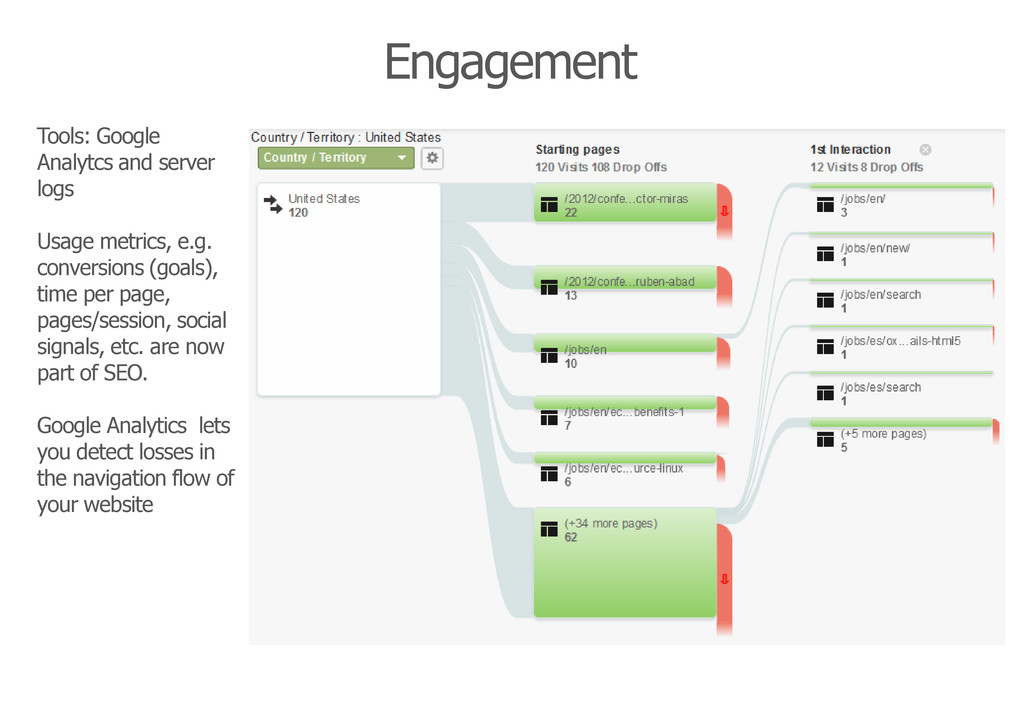
Tools: Google Analytcs and server logs Usage metrics, e.g. conversions
(goals), time per page, pages/session, social signals, etc. are now part of SEO. Google Analytics lets you detect losses in the navigation flow of your website Engagement -
Thank you If you enjoyed it, engage with us! @tucamon
@paradigmate @rubenmartinezs