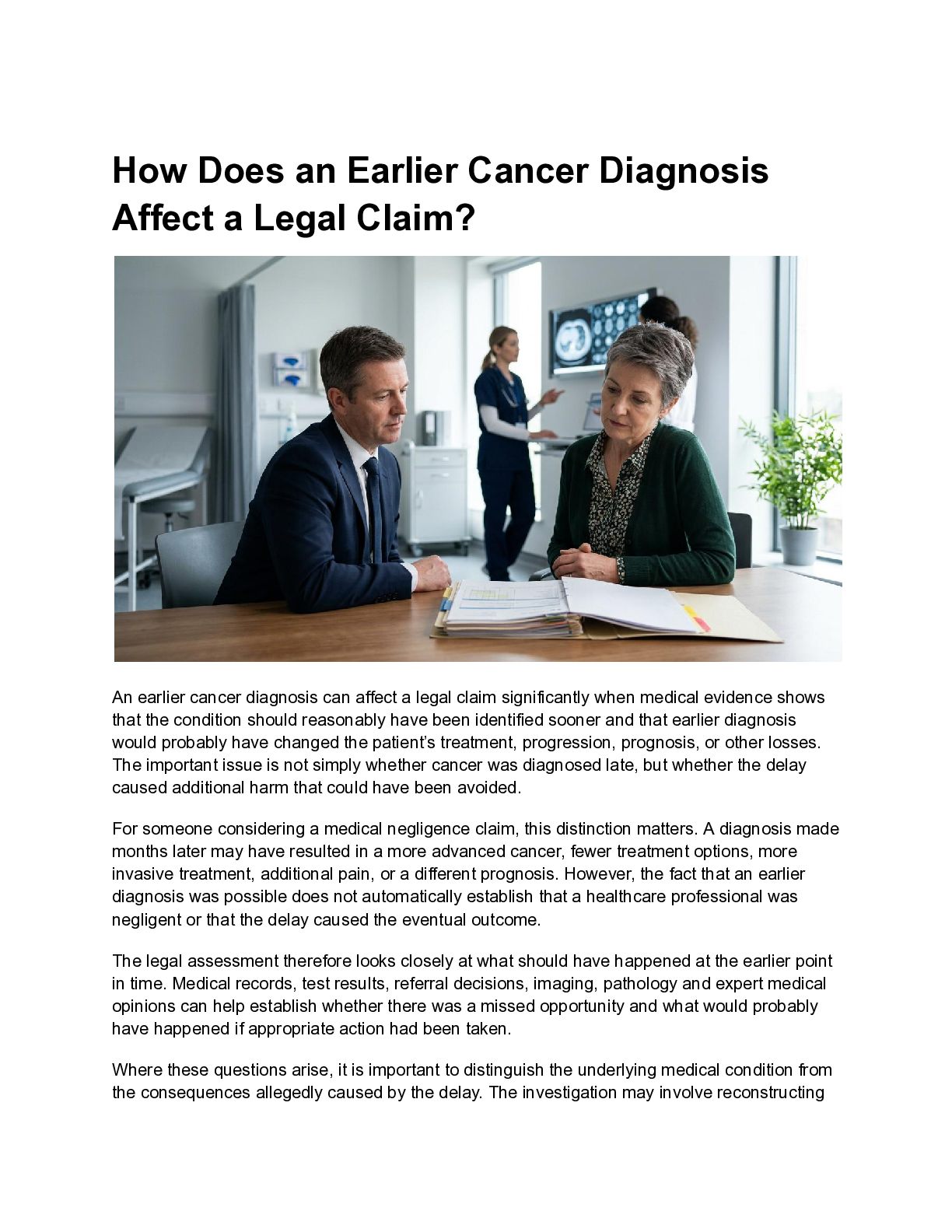
An earlier cancer diagnosis can have a significant effect on a legal claim when medical evidence shows that the condition should reasonably have been identified sooner and that the delay caused additional harm. The key issue is not simply that the diagnosis happened later than expected, but whether earlier investigation and treatment would probably have changed the patient's medical outcome. In Ireland, a claim involving delayed diagnosis generally requires careful consideration of the standard of care, the medical timeline, causation and the losses that followed. A later diagnosis alone does not automatically establish negligence, as some cancers can be difficult to detect and symptoms may not always clearly indicate cancer. Evidence may need to show that relevant symptoms, abnormal results, imaging or other warning signs should reasonably have prompted further investigation or referral. The next question is causation: what would probably have happened if the cancer had been identified at the earlier point? Medical experts may need to assess whether the cancer would have been at a different stage, whether less invasive treatment would have been available, or whether progression and additional harm could probably have been avoided. Medical records, referral letters, test results, scans, pathology reports and treatment records can all help reconstruct this alternative medical pathway. The assessment should remain focused on the individual patient rather than relying solely on general cancer survival statistics. Where the evidence demonstrates that a delay resulted in more extensive treatment, additional pain, reduced treatment options, disability or financial losses, those consequences may become relevant to compensation. A careful review is particularly important because proving that an earlier diagnosis was possible is different from proving that it would have made a legally significant difference. Ciano Carroll Solicitors handles medical negligence matters involving delayed and incorrect cancer diagnoses, with its work requiring detailed consideration of medical evidence and causation. For anyone concerned that a delay may have affected treatment or prognosis, reviewing the available medical records and obtaining appropriate legal guidance can help clarify the issues; readers can learn more about how causation is considered in cancer-related negligence claims through the firm's dedicated resources. Ultimately, the strength of a claim depends on evidence showing both the relevant failure in care and the harm that can reasonably be connected to it.


 takeuchigroup
 uniam
 so_kotani
 shunsuke_takeuchi
 kuraryu0128
 superstudio
 caddireat
 nishika_kae
 speakbuddy
 hubbleinc
 openwork
 loglass2019
 kneath
 kastner
 cassininazir
 zakiyama
 tmiket
 marktimemedia
 geoffreycrofte
 leimatthew05
 schlessera
 sarafernandez
 tonyrice
 samanthasiow