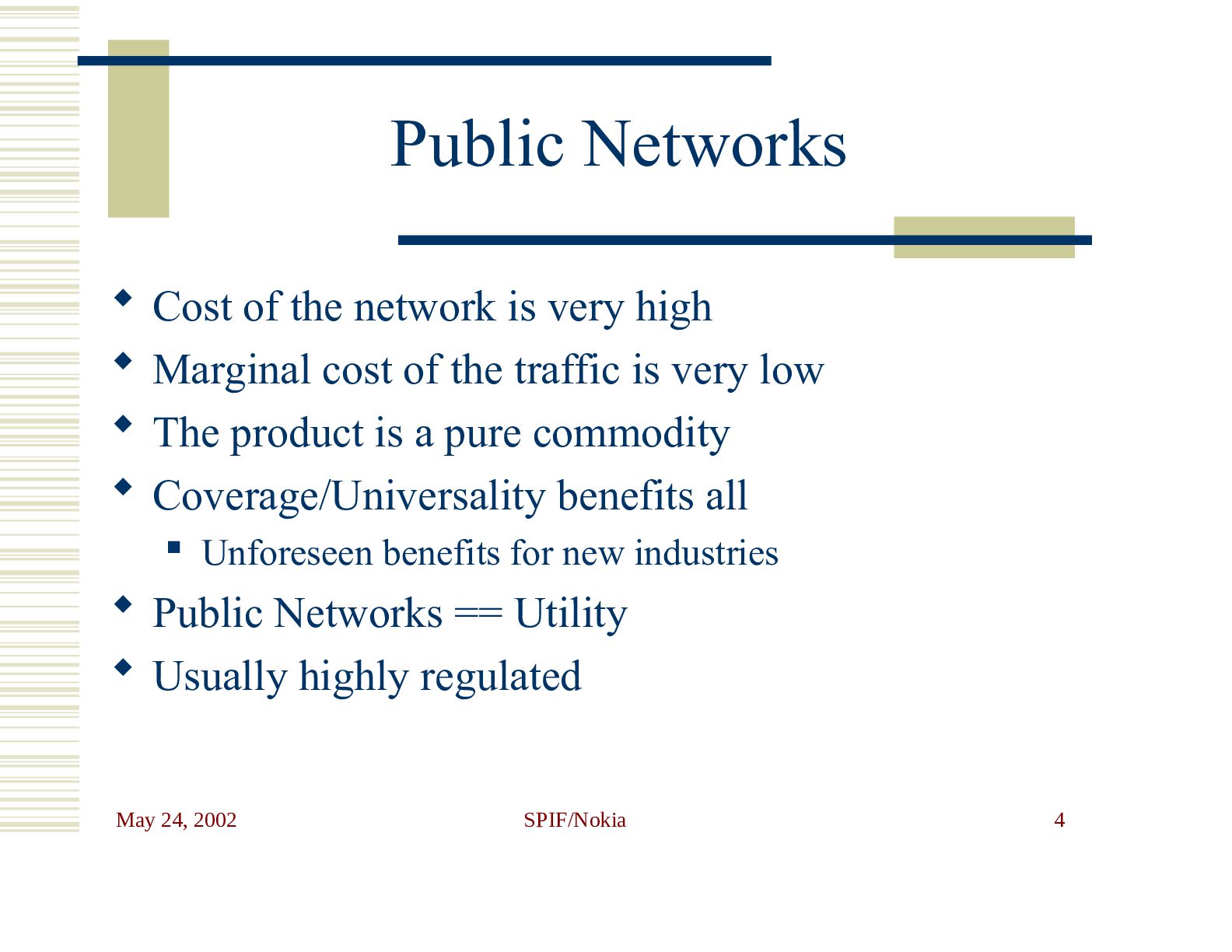
the network is very high Marginal cost of the traffic is very low The product is a pure commodity Coverage/Universality benefits all Unforeseen benefits for new industries Public Networks == Utility Usually highly regulated
funded by their users; often with subsidies to “share the pain” Competition (for users) is very rare Interconnection eases costs and increases capacity Users can become providers – water, electricity, mail rooms, …
live on other networks Enhanced way to deliver old service Dependent on interconnection with old network Mobile voice on fixed voice Internet on fixed network? Mobile Internet on what??
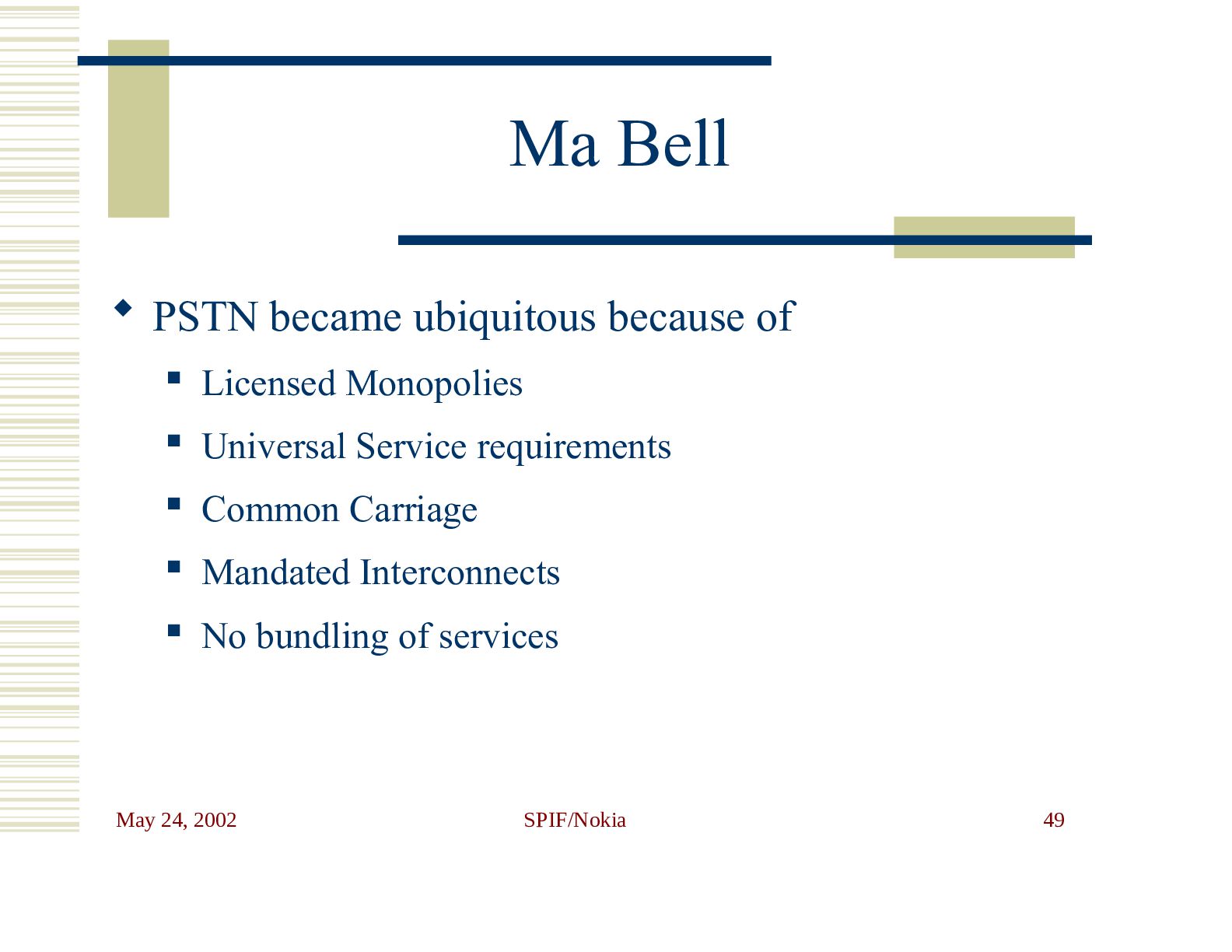
Bell System National P.T.T.s Highly regulated: “Universal” (voice) Service Common Carriage No bundled services “One Bell System – It Works”
Competitive in long-haul Unbundling of local loop – failed De-regulation = regulatory mess Market share battles; little growth in voice Competition seeks efficiency, but requires instability
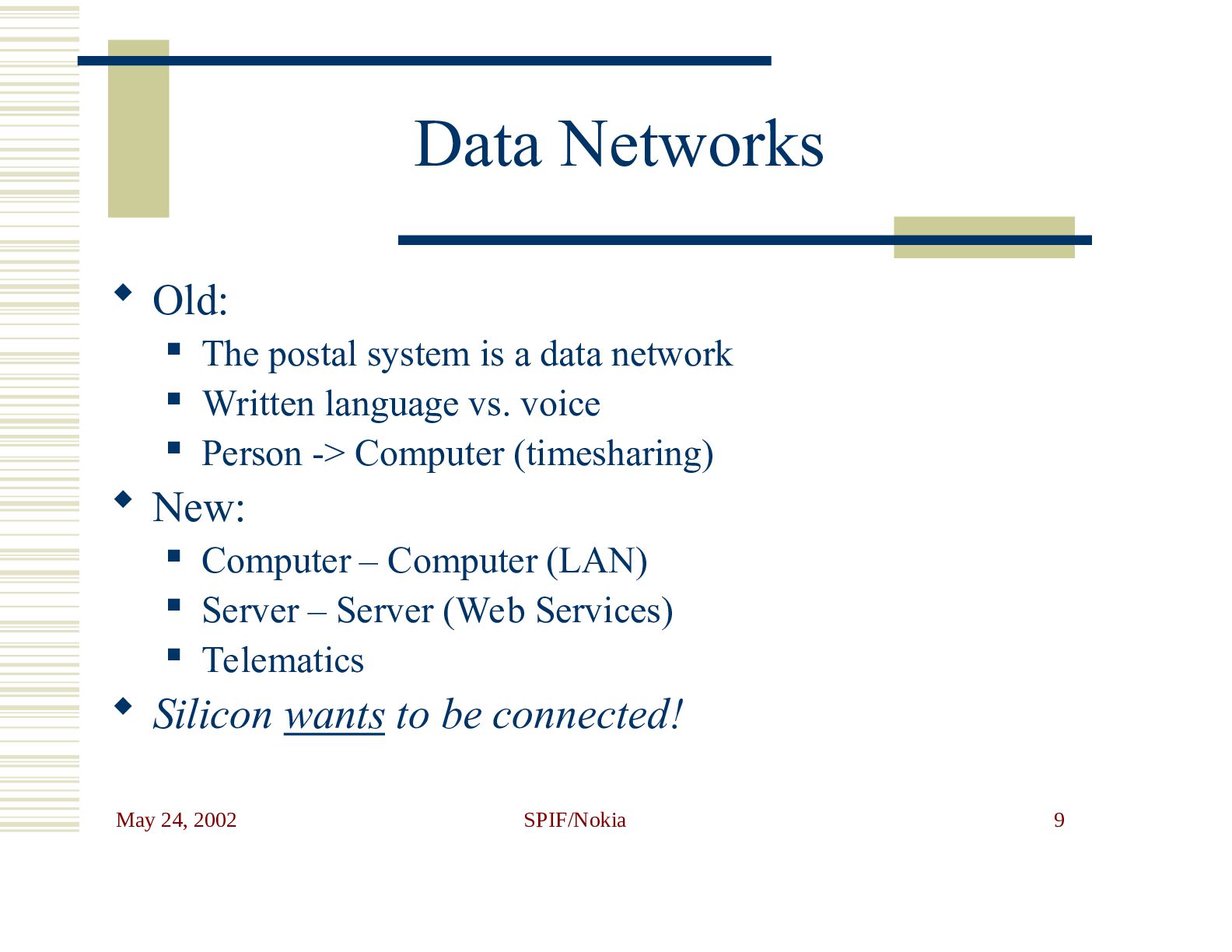
The postal system is a data network Written language vs. voice Person -> Computer (timesharing) New: Computer – Computer (LAN) Server – Server (Web Services) Telematics Silicon wants to be connected!
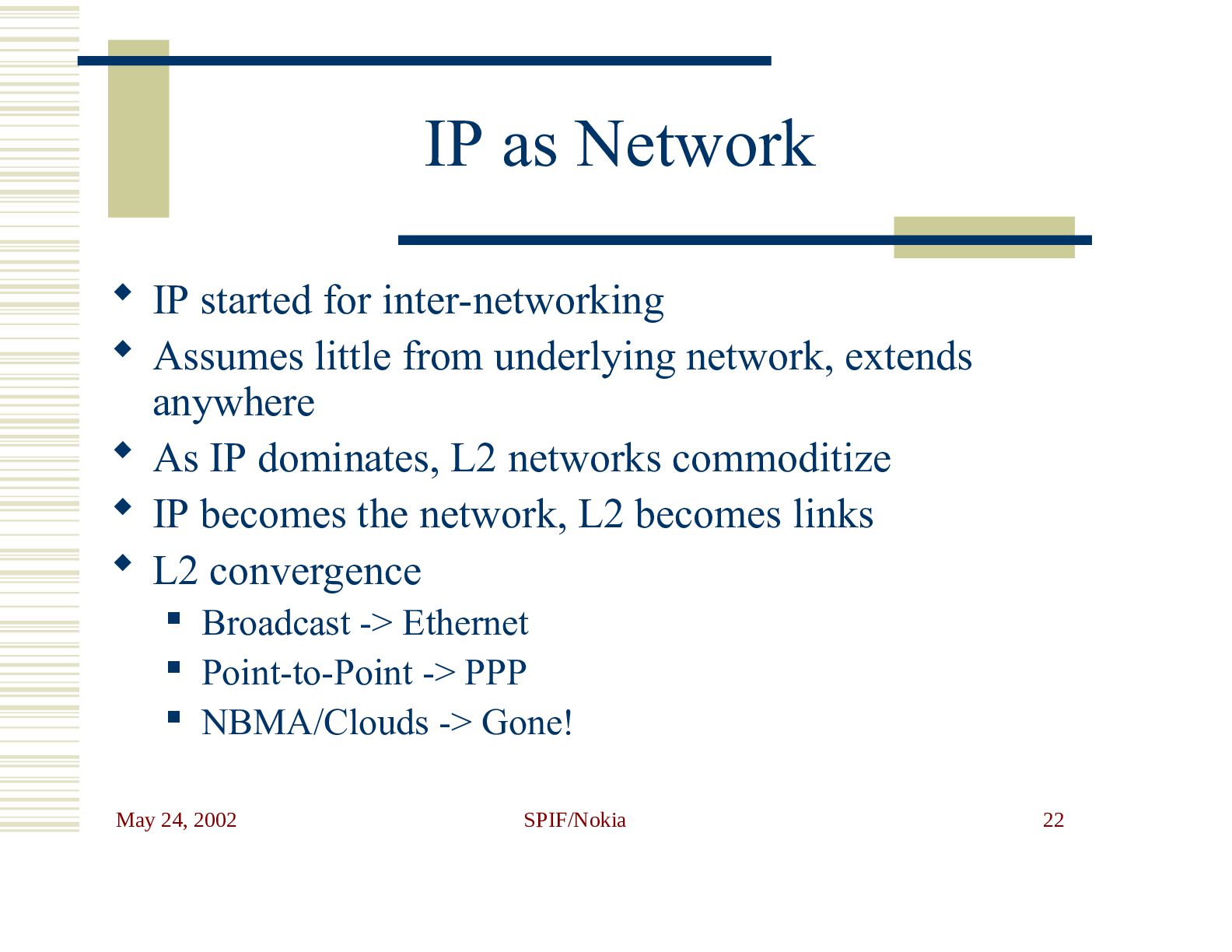
networks: The right way to build a network is to assume everything you connect to is also a network Your part of the network has a boundary, but the network doesn’t Do utility networks care about “terminals”?
proxy code for each network pair Early 80s: IP forwarding in UNIX Late 80s: Cisco & router “appliances” Early 90s: real router hardware Late 90s: routing ASICs, performance explosion
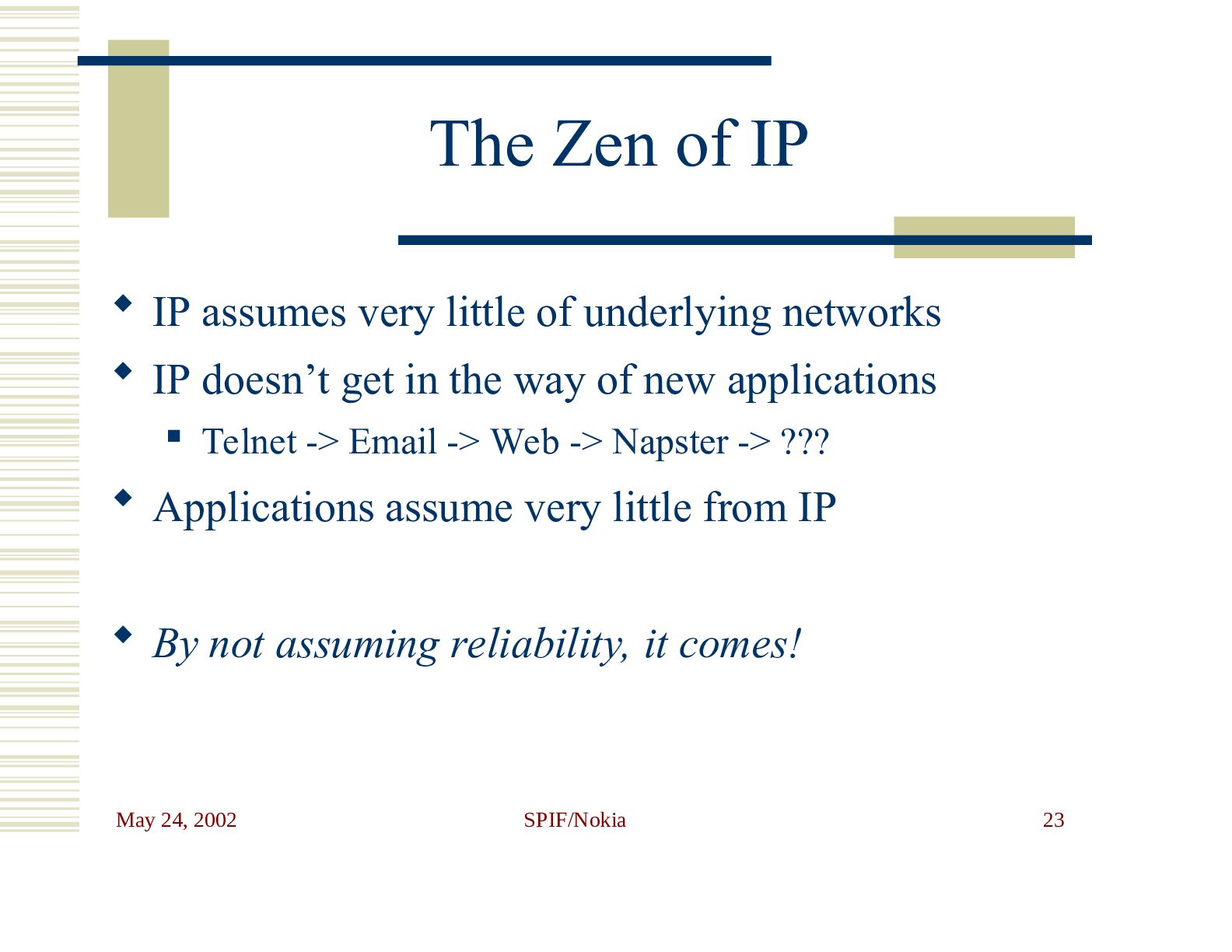
IP assumes very little of underlying networks IP doesn’t get in the way of new applications Telnet -> Email -> Web -> Napster -> ??? Applications assume very little from IP By not assuming reliability, it comes!
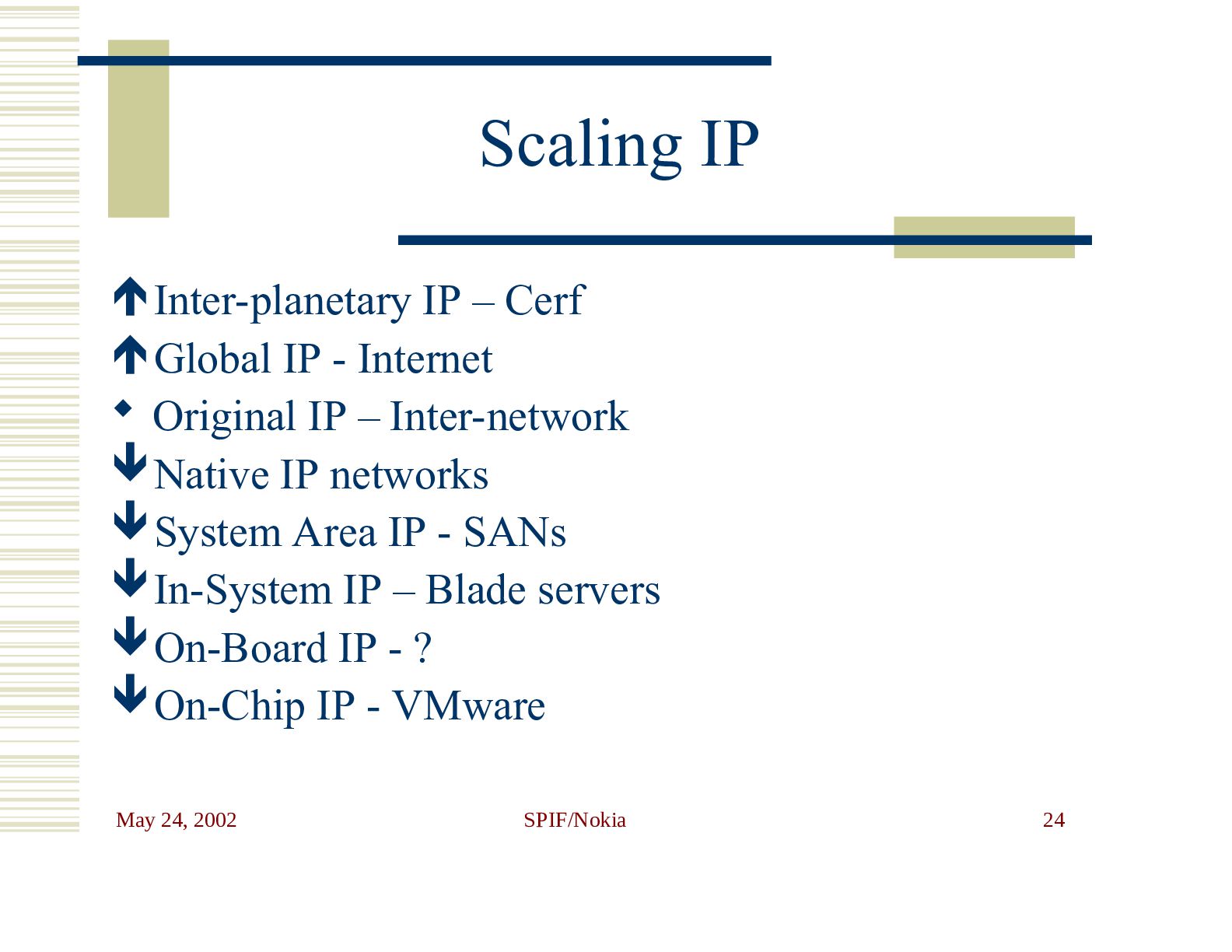
Cerf Global IP - Internet Original IP – Inter-network Native IP networks System Area IP - SANs In-System IP – Blade servers On-Board IP - ? On-Chip IP - VMware
are way too many disjoint IP networks in the world, driven by: Administrative concerns Security concerns Lack of public address space Lack of vision IP without the ‘I’
on the LAN wants Internet access Remote and Mobile users use Internet VPNs Servers are moving to IDCs Firewalls, routers, switches are being managed by MSPs 802.11 WLANs aren’t used as LANs M LAN << M Internet
many new cell users this year as total Internet users Cell phones becoming “Internet” capable DoCoMo I-mode: 0 to 30M users in 3 yrs, world’s 2nd largest “ISP” – but no IP! GPRS and 3G require IP to handset Not enough IP addresses for all this; Mobile-IP doubles it!
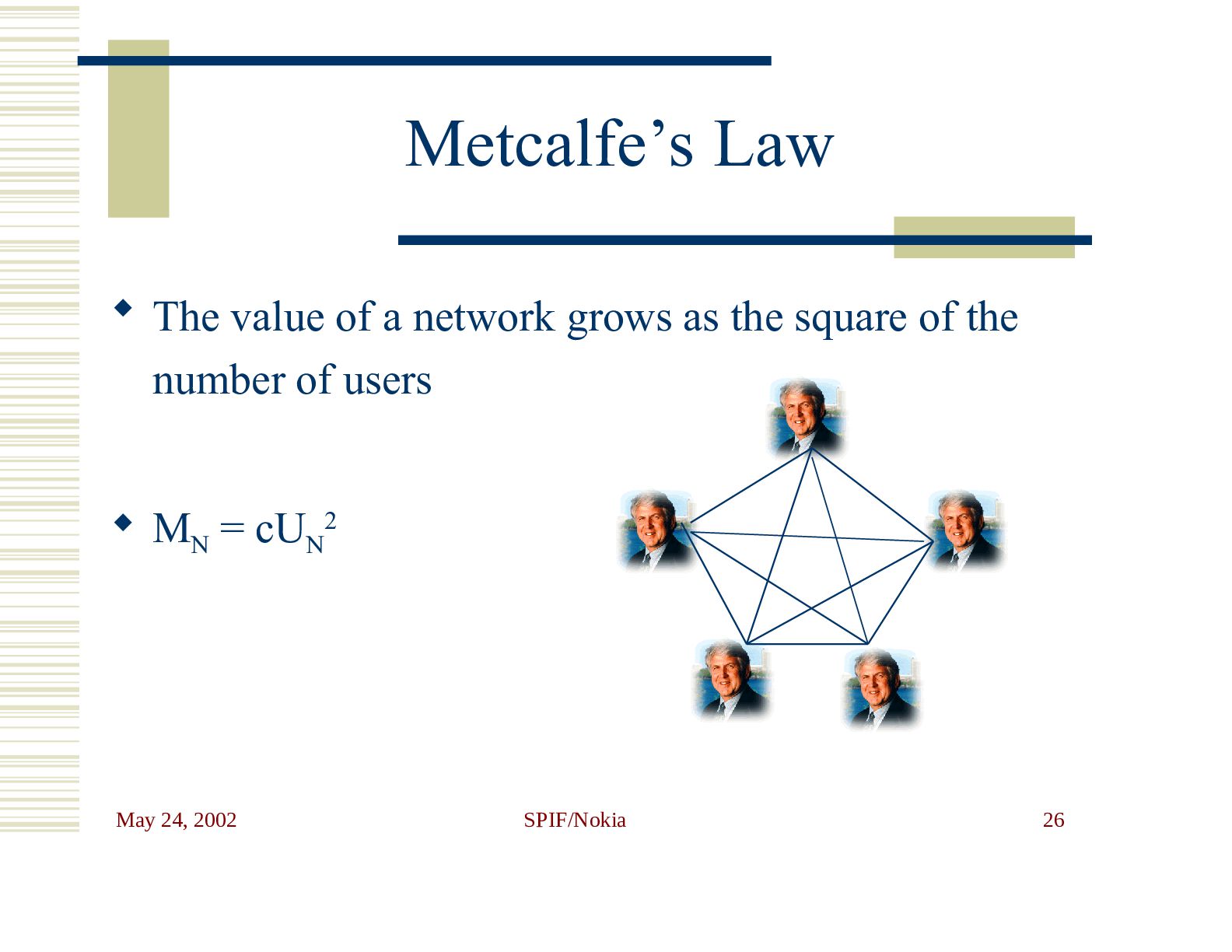
is deployable now, but is classic chicken & egg problem Mobile/3G will push IPv6 over the edge V6 Internet is easy if you have V4 V6 Internet is easier if you don’t V6 covers V4 like V4 covers PSTN Metcalfe’s Law means V6 will win
believes in IP now, even if they don’t know what it is Carriers view the Internet as a source of technology or users, not as their principal service They build non-IP or private IP nets and avoid the Internet But the Internet is just the interconnection of carriers’ own networks!
the Internet is unmanageable chaos 2. Go build a separate network 3. Discover that users, traffic, and applications are still defined by the Internet! 4. Repeat until bankrupt
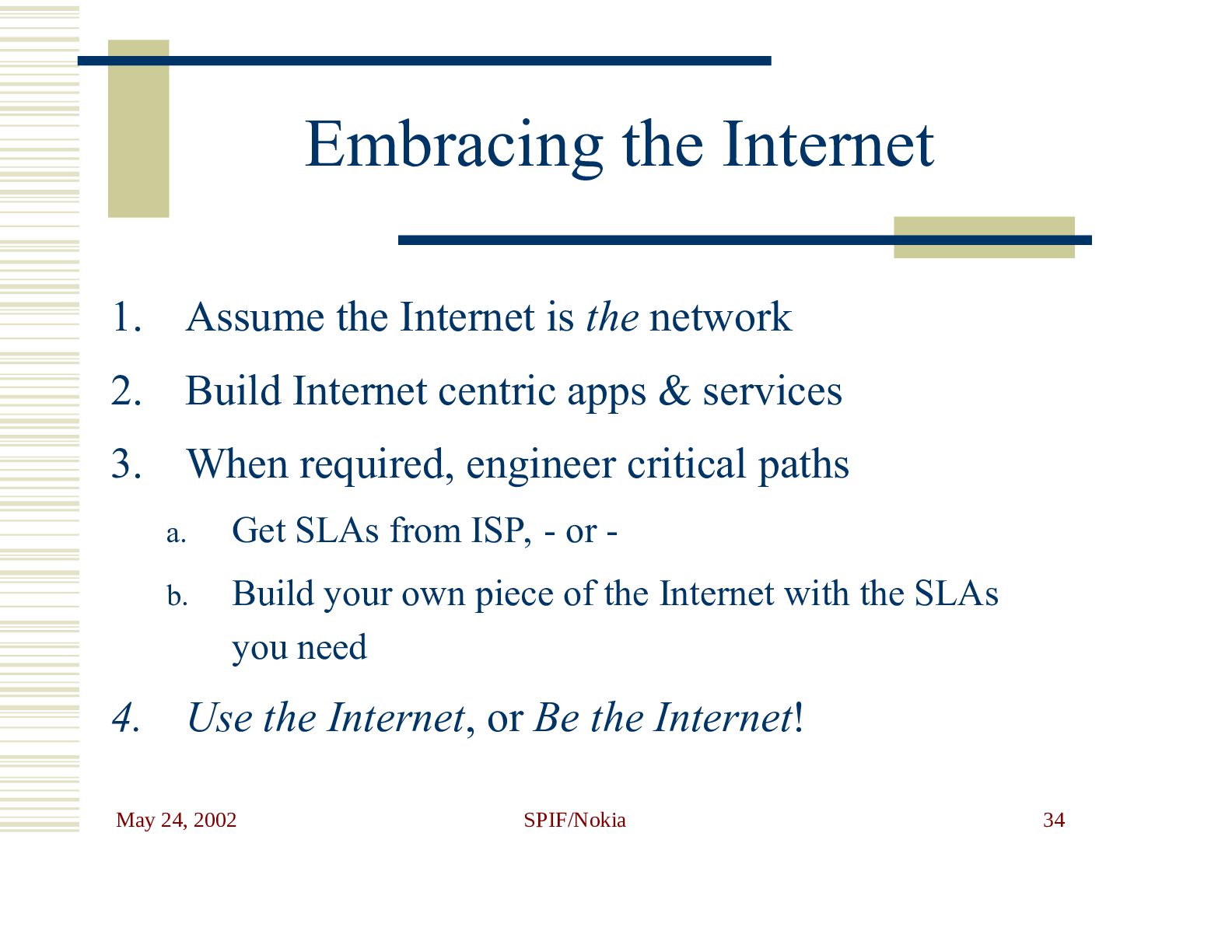
the Internet is the network 2. Build Internet centric apps & services 3. When required, engineer critical paths a. Get SLAs from ISP, - or - b. Build your own piece of the Internet with the SLAs you need 4. Use the Internet, or Be the Internet!
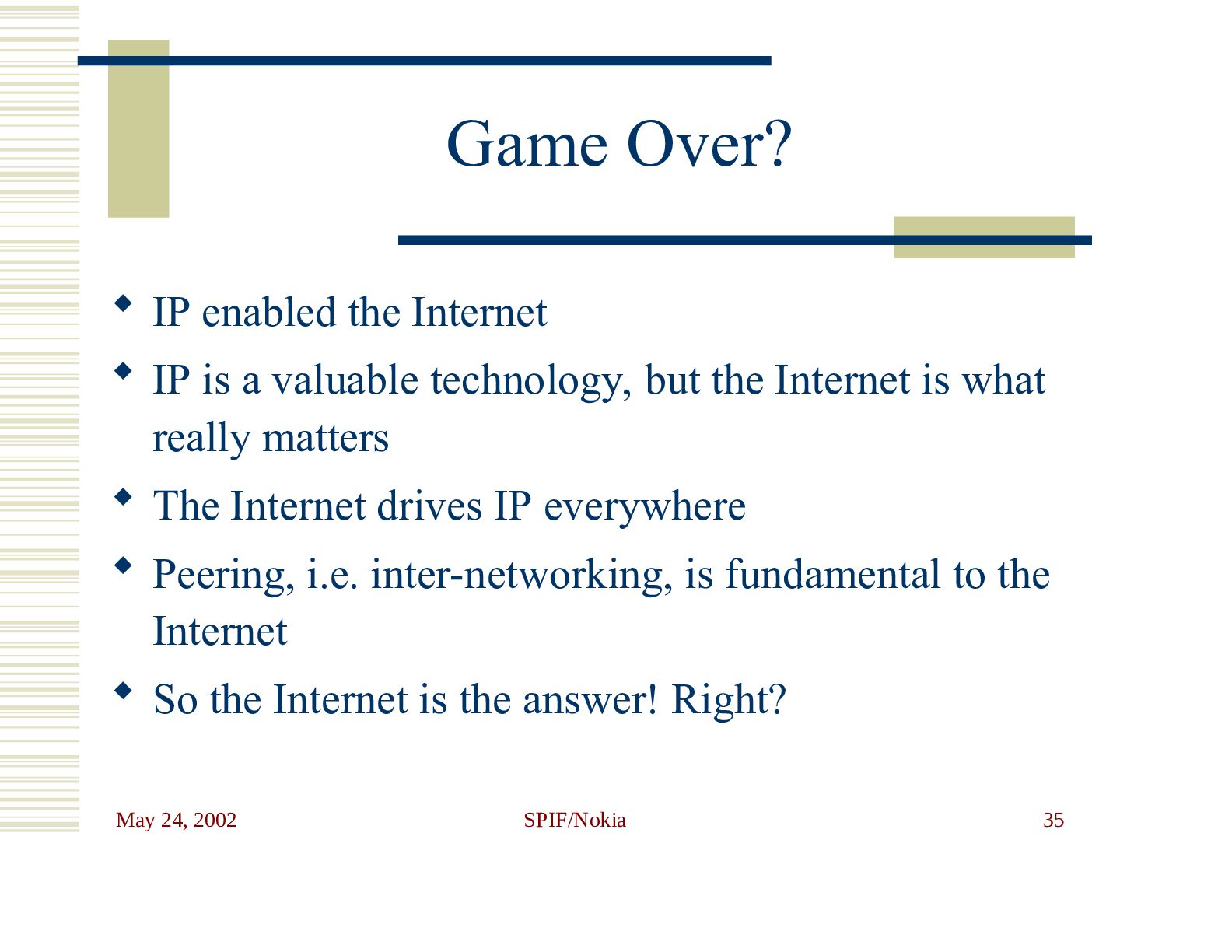
the Internet IP is a valuable technology, but the Internet is what really matters The Internet drives IP everywhere Peering, i.e. inter-networking, is fundamental to the Internet So the Internet is the answer! Right?
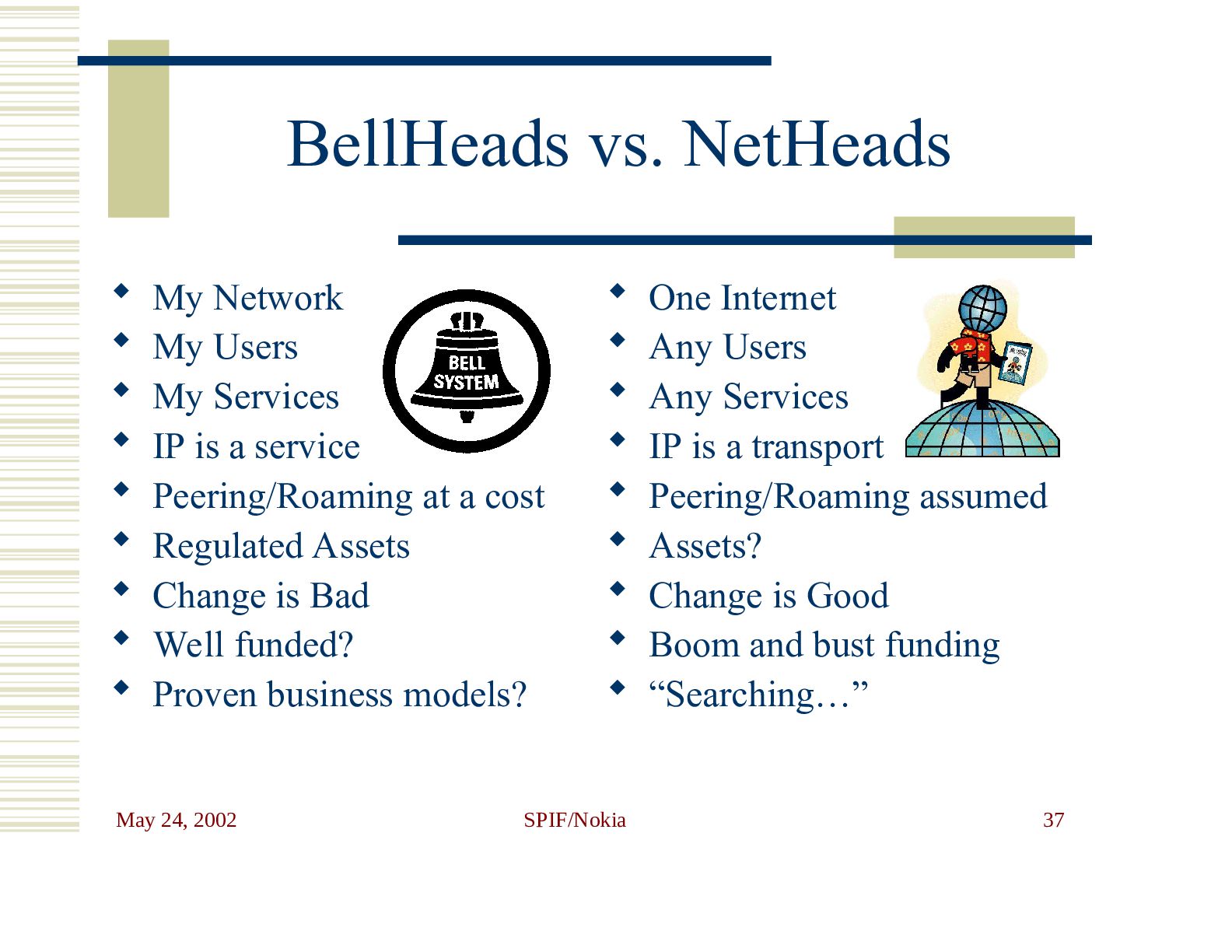
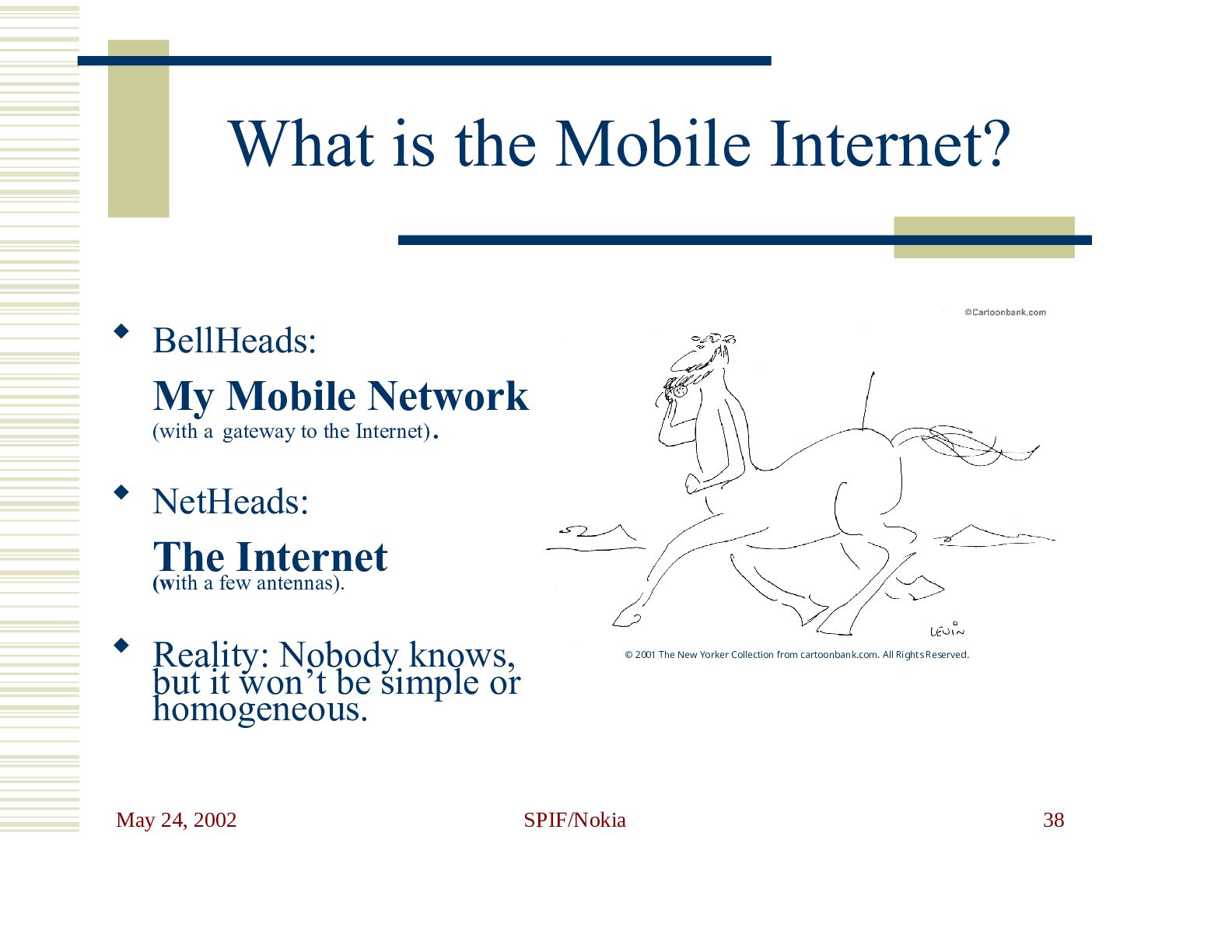
Network My Users My Services IP is a service Peering/Roaming at a cost Regulated Assets Change is Bad Well funded? Proven business models? One Internet Any Users Any Services IP is a transport Peering/Roaming assumed Assets? Change is Good Boom and bust funding “Searching…”
voice network has matured Mobile voice network is maturing How to grow revenue as # users slows? Lots of demand for data, but no good revenue models.
comes from innovation Control squashes innovation Mobile carriers control network, terminals, and services to lock-in users and squeeze them for revenue
is maturing, but data networks are still very young – especially in mobility Don’t raise R/U; raise U The customer is the microprocessor; R/U is tiny but U is huge! Silicon wants to be connected!
3G efforts all oriented towards keeping user under control of carrier Emphasis on services which cannot survive in an Internet context ringtones, SMS, MMS. Compare to wireless LAN – just packets and radio
may be cheap, but connectivity is very expensive Captive users pay for the network through captive services Peering lets my users go to your services How can I pay for the network? Peering lets your users come to my services How will I bill them? Examples – Voice, Roaming, SMS
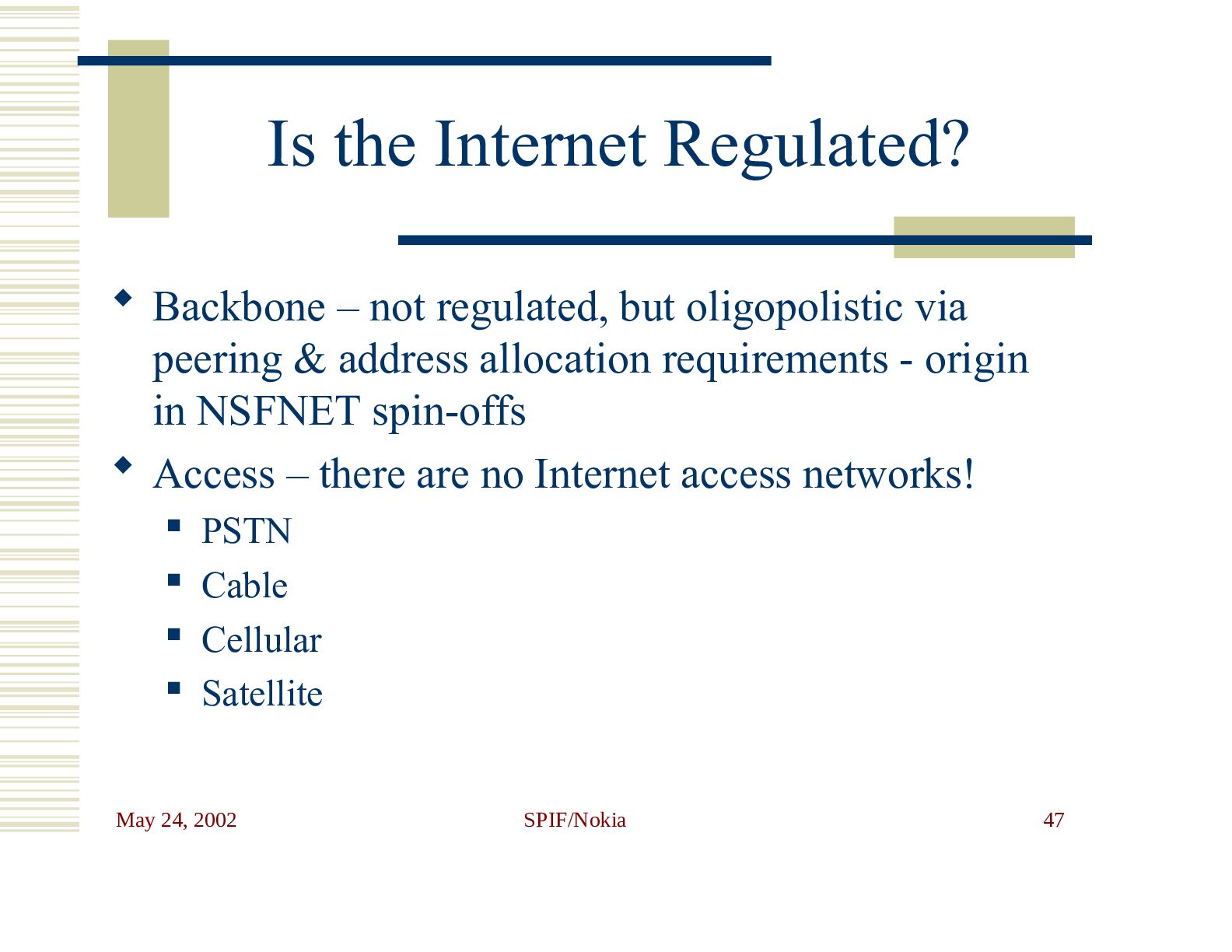
Backbone – not regulated, but oligopolistic via peering & address allocation requirements - origin in NSFNET spin-offs Access – there are no Internet access networks! PSTN Cable Cellular Satellite
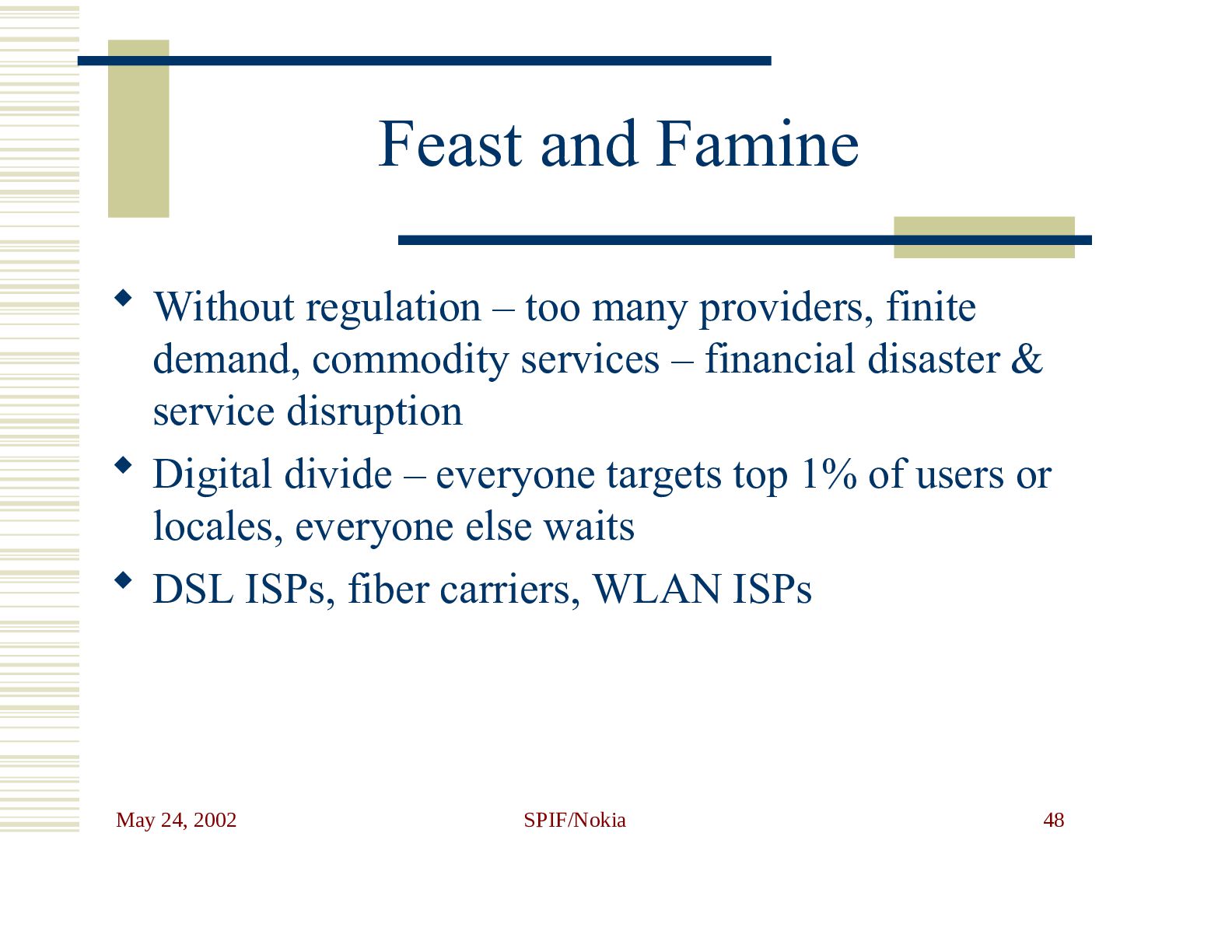
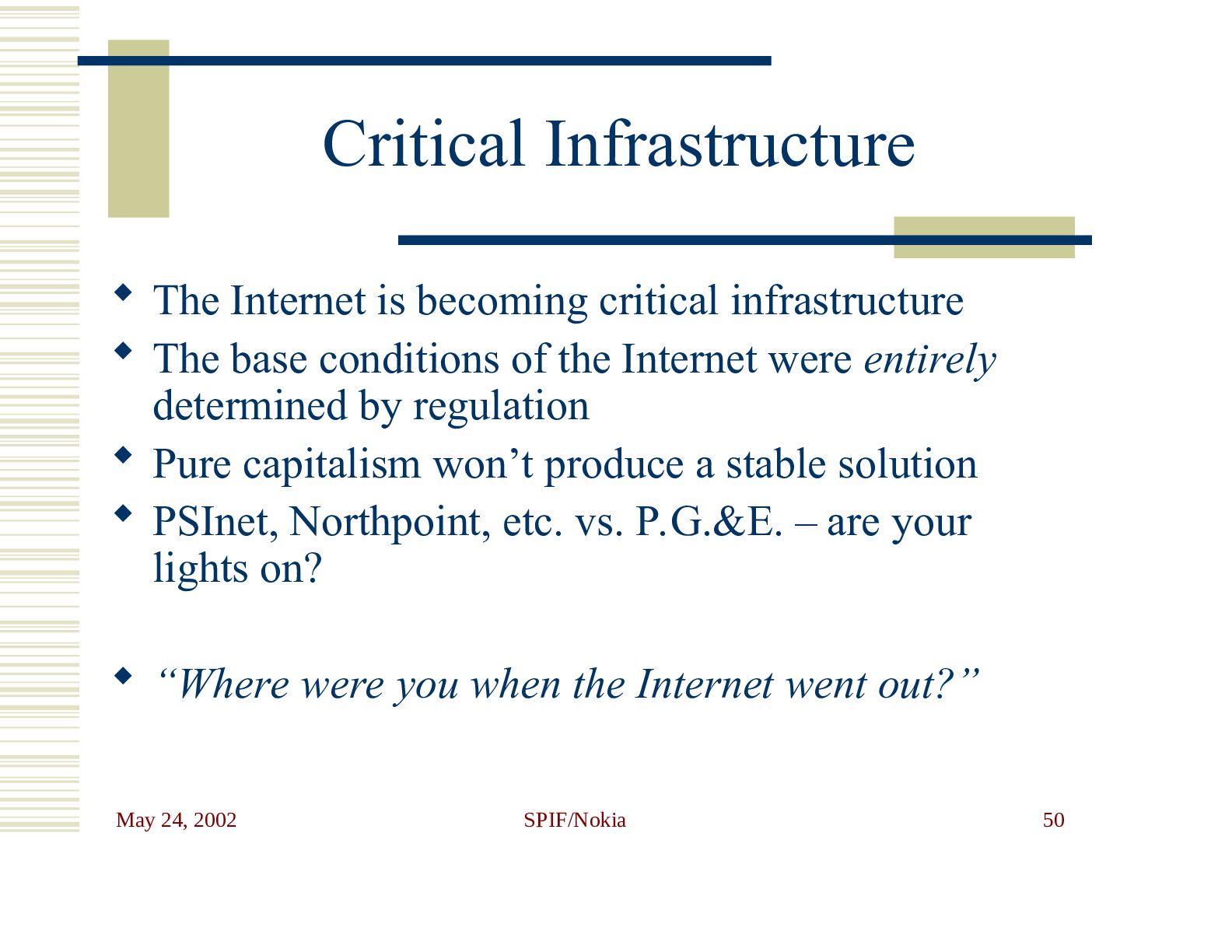
is becoming critical infrastructure The base conditions of the Internet were entirely determined by regulation Pure capitalism won’t produce a stable solution PSInet, Northpoint, etc. vs. P.G.&E. – are your lights on? “Where were you when the Internet went out?”
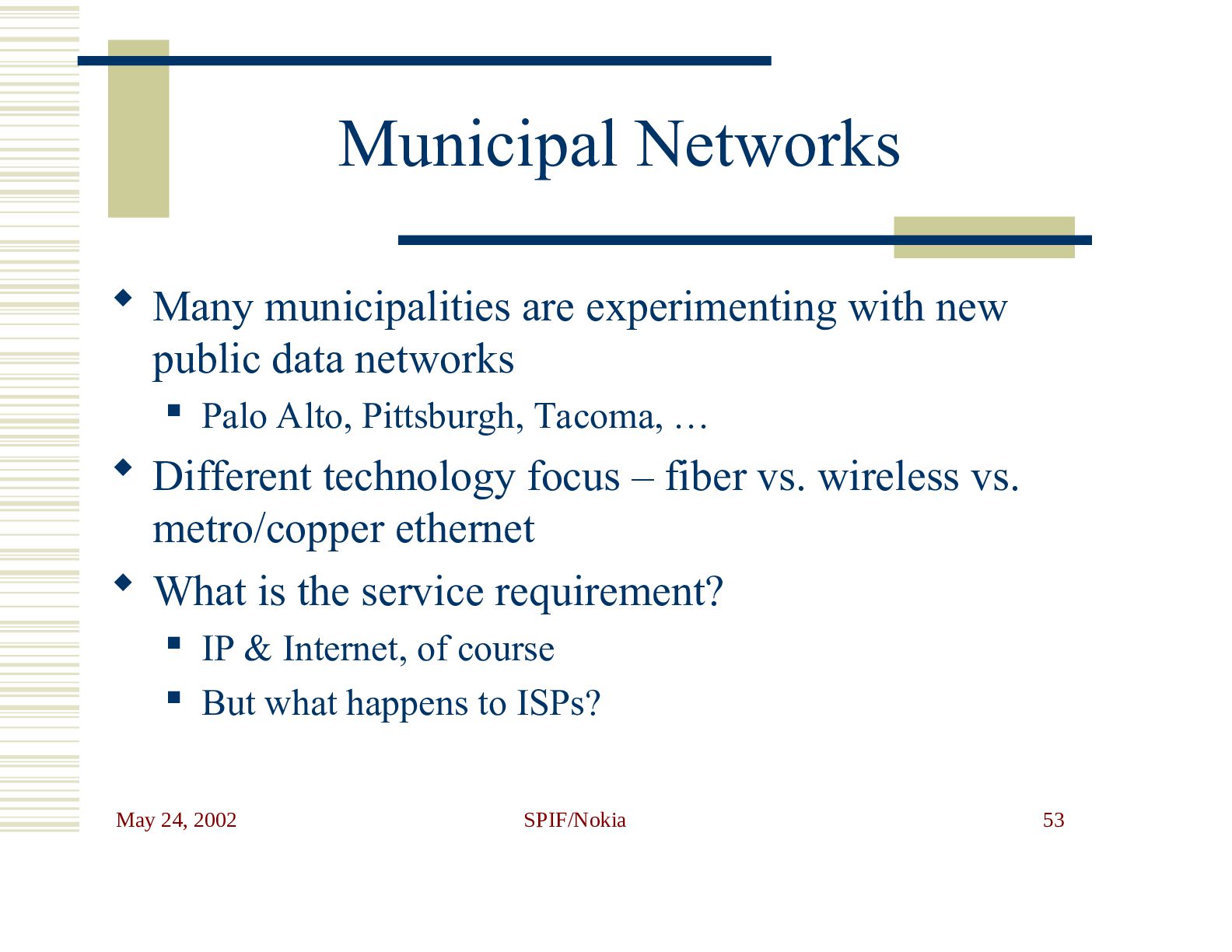
are experimenting with new public data networks Palo Alto, Pittsburgh, Tacoma, … Different technology focus – fiber vs. wireless vs. metro/copper ethernet What is the service requirement? IP & Internet, of course But what happens to ISPs?
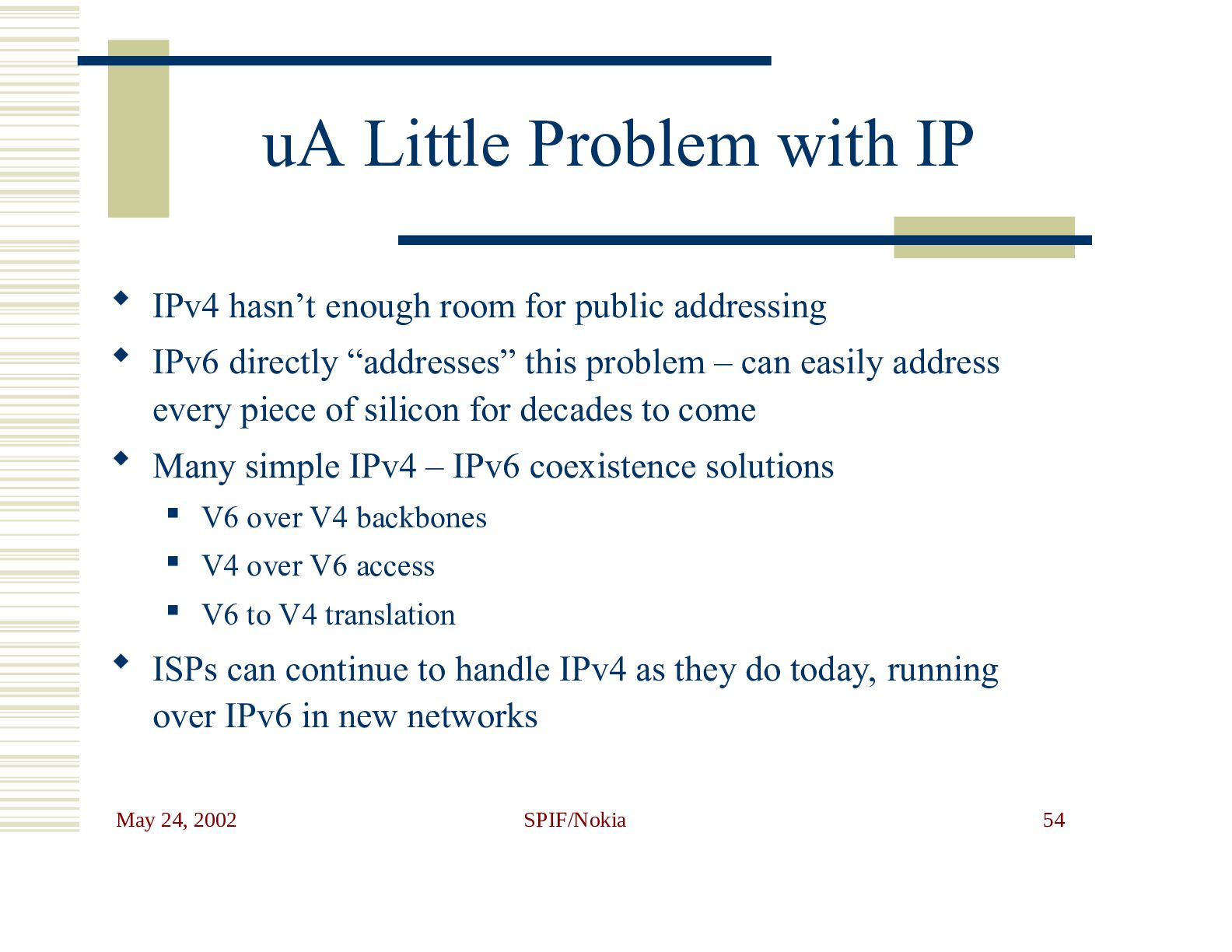
IPv4 hasn’t enough room for public addressing IPv6 directly “addresses” this problem – can easily address every piece of silicon for decades to come Many simple IPv4 – IPv6 coexistence solutions V6 over V4 backbones V4 over V6 access V6 to V4 translation ISPs can continue to handle IPv4 as they do today, running over IPv6 in new networks
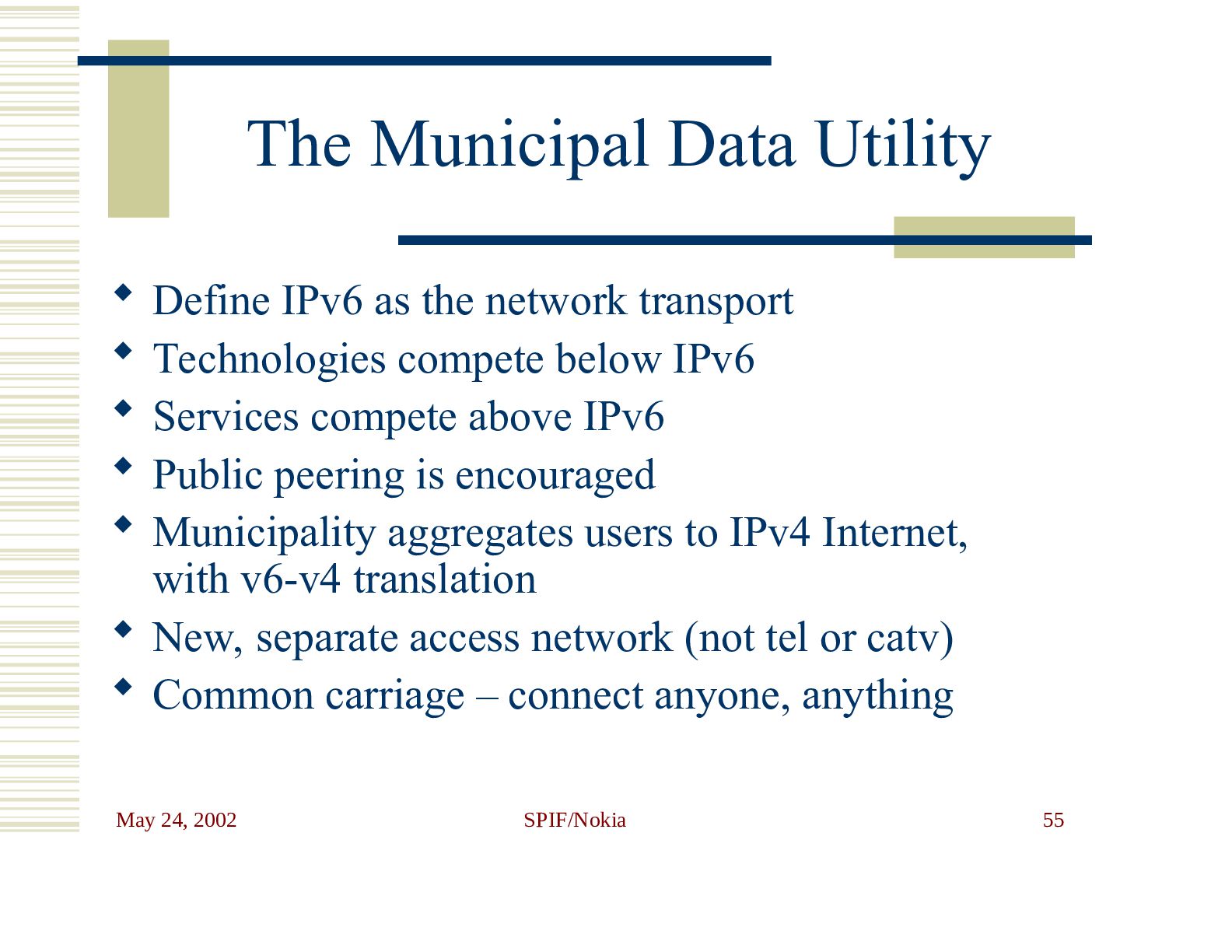
Define IPv6 as the network transport Technologies compete below IPv6 Services compete above IPv6 Public peering is encouraged Municipality aggregates users to IPv4 Internet, with v6-v4 translation New, separate access network (not tel or catv) Common carriage – connect anyone, anything
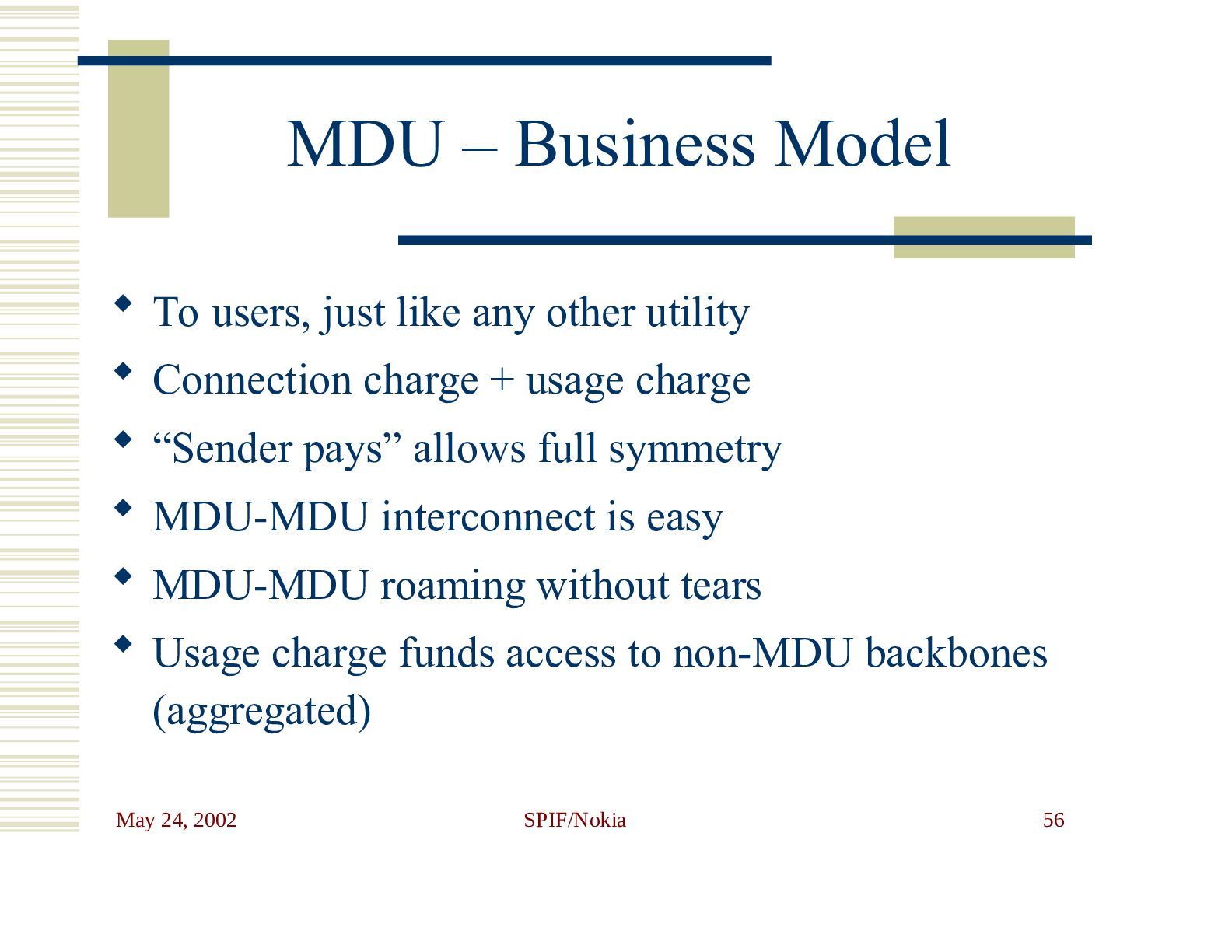
To users, just like any other utility Connection charge + usage charge “Sender pays” allows full symmetry MDU-MDU interconnect is easy MDU-MDU roaming without tears Usage charge funds access to non-MDU backbones (aggregated)
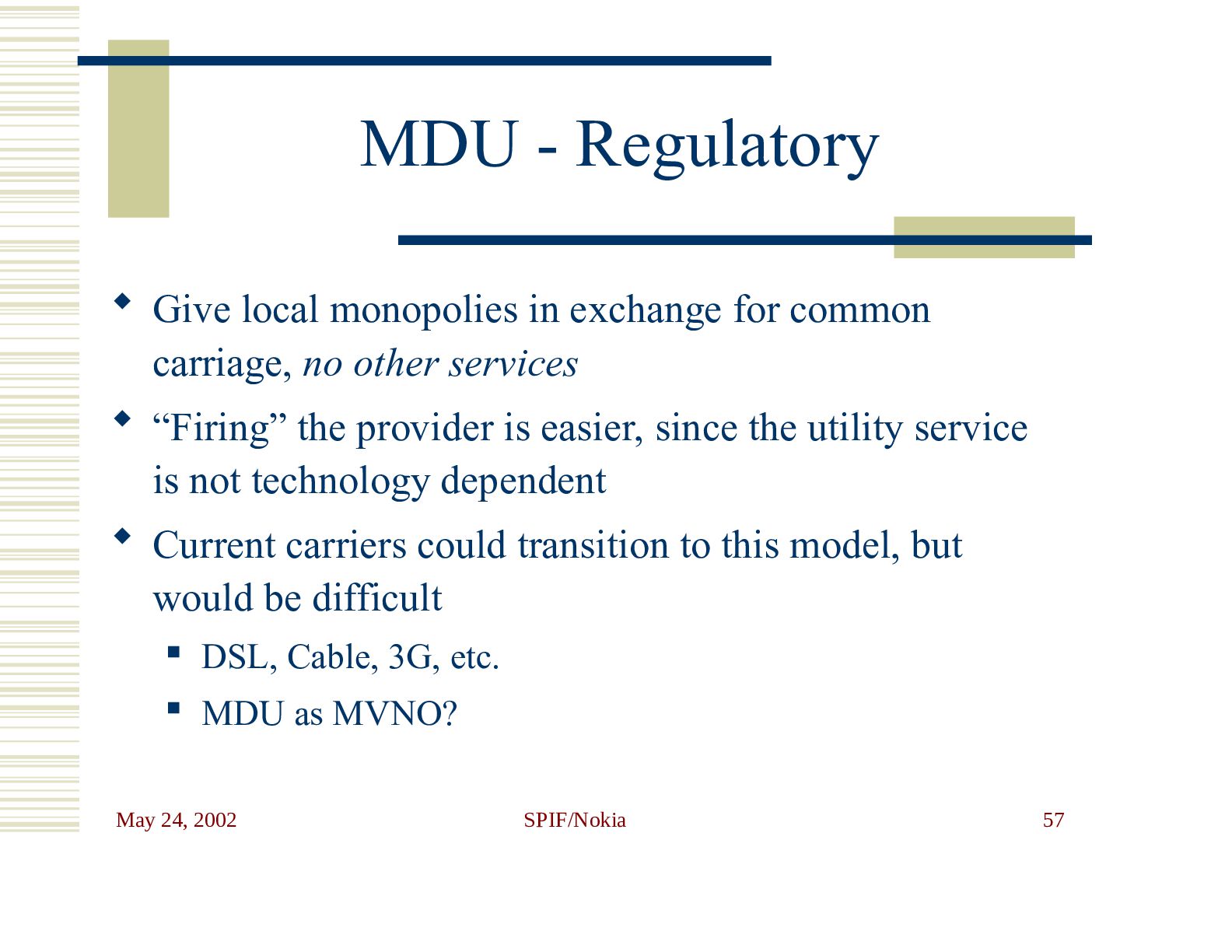
local monopolies in exchange for common carriage, no other services “Firing” the provider is easier, since the utility service is not technology dependent Current carriers could transition to this model, but would be difficult DSL, Cable, 3G, etc. MDU as MVNO?
The evolution and interconnection of MDUs will lead to the New Public Network This network is for silicon, not people Successful networks are service-independent IPv6 is the crystallizing point for the NPN


 pugs
pugs
 aoto
aoto
 tkuchiki
 shisyu_gaku
 marceloancelmo
 soudai
 mtpooh
 oracle4engineer
 judau
judau
 tanakaseiya
 kworkdev
 toru_kubota
 ryotarai
 rabernat
 davetheseo
 baasie
 popppiees
 geshan
 sergeychernyshev
 codingconduct
 bluesmoon
 eileencodes
 charlesmeaden
 jct
jct
 3n
3n