language. It is aimed at programming in the large. Mercury looks like Prolog, but it feels like strict Haskell or pure OCaml The Mercury Programming Language 2
very powerful. However creating large pieces of software is difficult. We aim to make programming in the large easier: • large programs • large teams • better program reliability • better program maintainability • program efficiency The Mercury Programming Language 3
you Mercury. Instead I will aim to give a guided tour of Mercury's main features, and how it differs from languages you may be familiar with. Time permitting I will introduce two very cool Mercury technologies: • declarative debugging, and • automatic parallelization. The purity of Mercury is key in making both of these feasible. The Mercury Programming Language 4
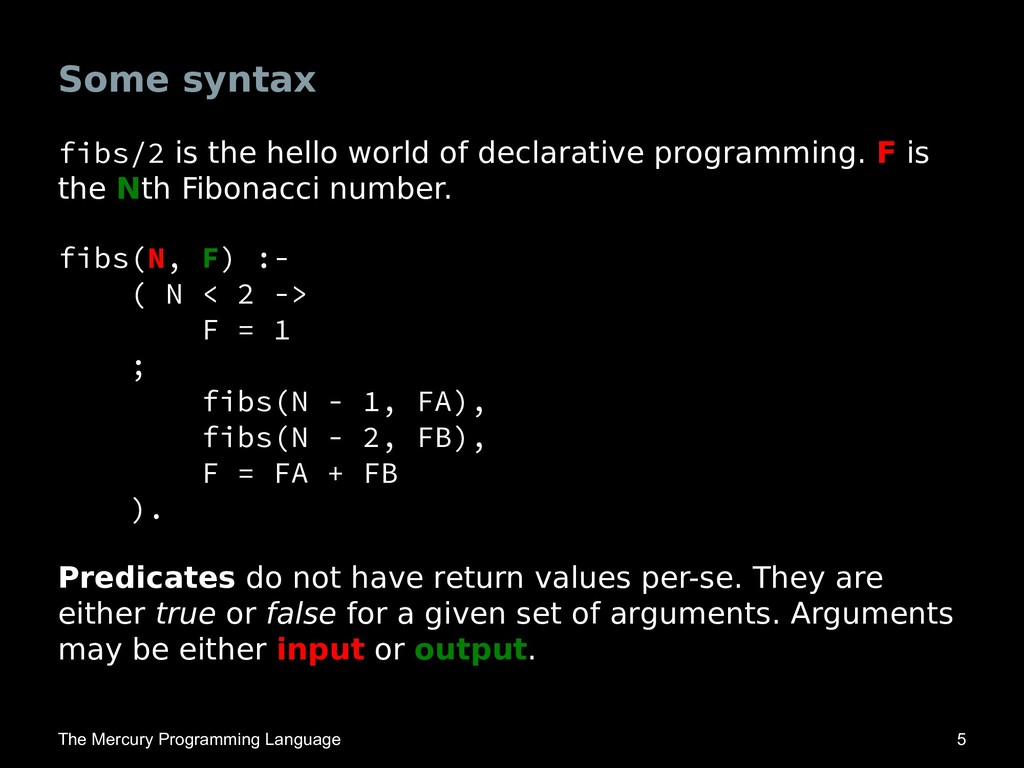
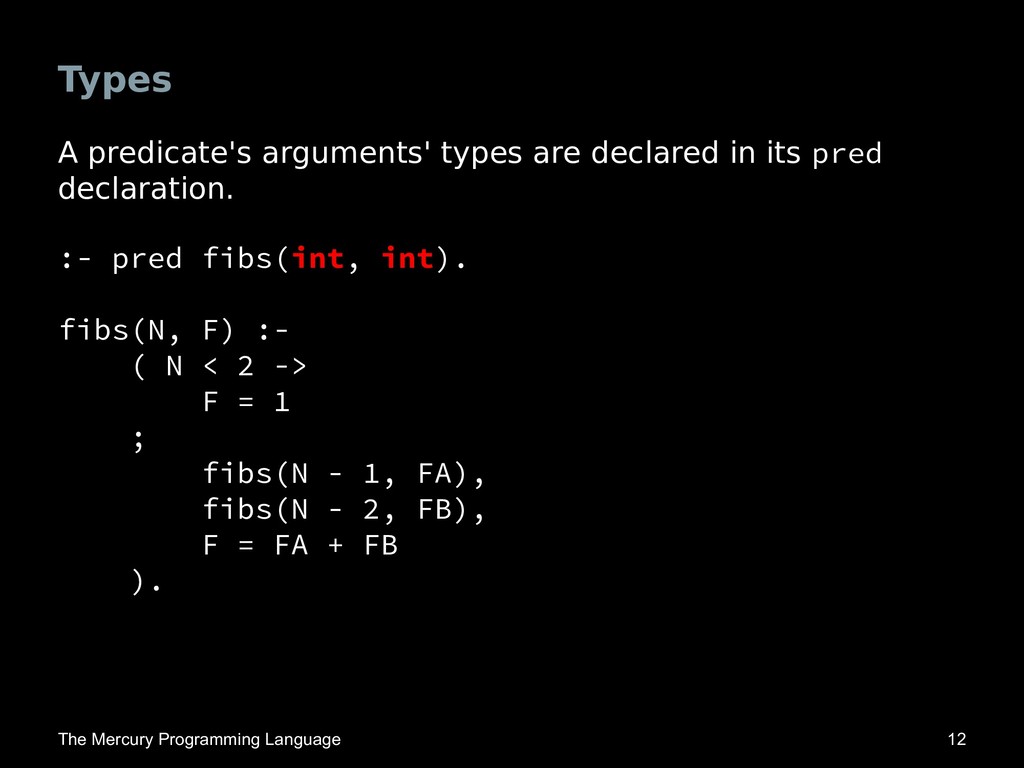
F is the Nth Fibonacci number. fibs(N, F) :- ( N < 2 -> F = 1 ; fibs(N - 1, FA), fibs(N - 2, FB), F = FA + FB ). Predicates do not have return values per-se. They are either true or false for a given set of arguments. Arguments may be either input or output. The Mercury Programming Language 5
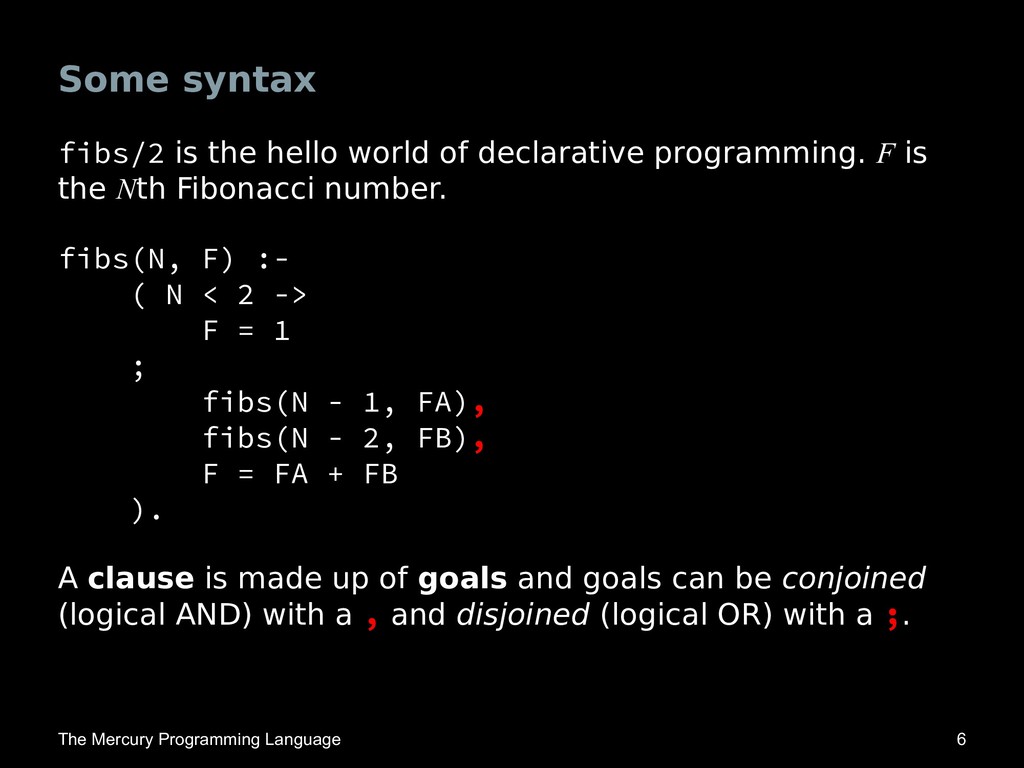
F is the Nth Fibonacci number. fibs(N, F) :- ( N < 2 -> F = 1 ; fibs(N - 1, FA), fibs(N - 2, FB), F = FA + FB ). A clause is made up of goals and goals can be conjoined (logical AND) with a , and disjoined (logical OR) with a ;. The Mercury Programming Language 6
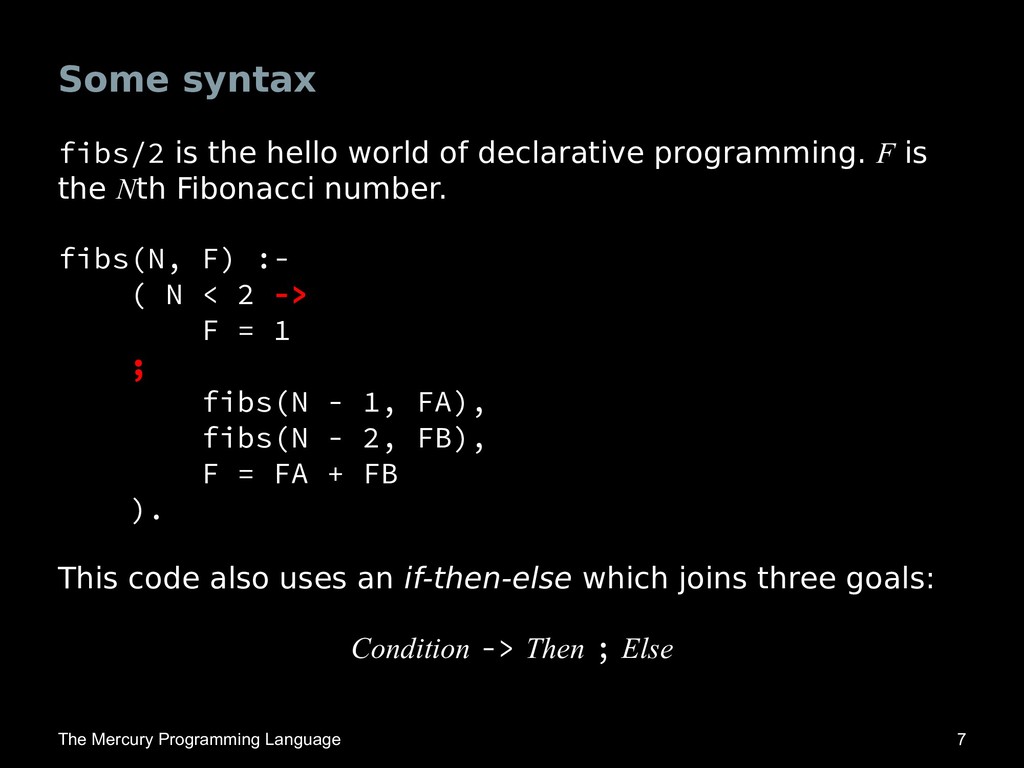
F is the Nth Fibonacci number. fibs(N, F) :- ( N < 2 -> F = 1 ; fibs(N - 1, FA), fibs(N - 2, FB), F = FA + FB ). This code also uses an if-then-else which joins three goals: Condition -> Then ; Else The Mercury Programming Language 7
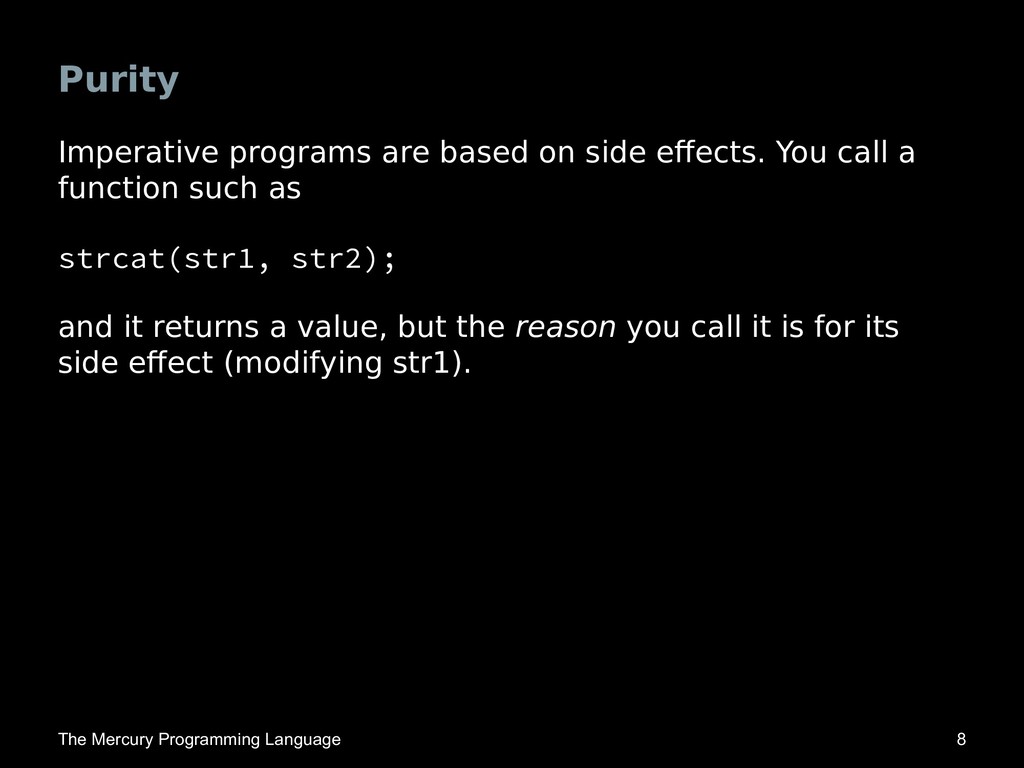
a function such as strcat(str1, str2); and it returns a value, but the reason you call it is for its side effect (modifying str1). The Mercury Programming Language 8
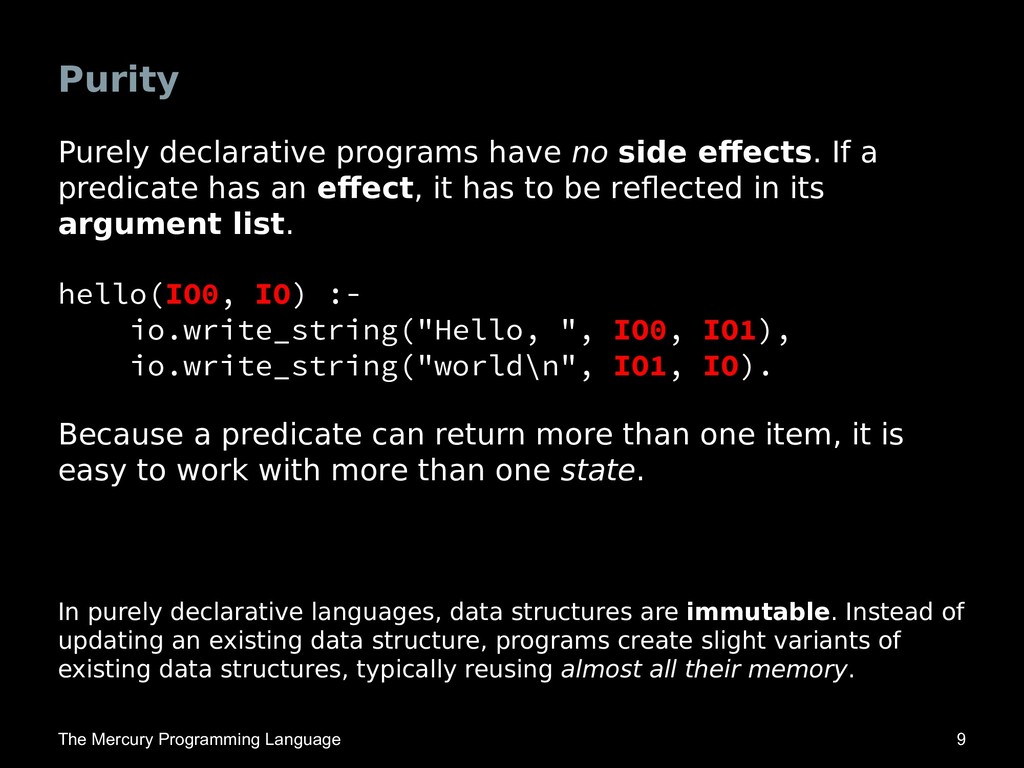
predicate has an effect, it has to be reflected in its argument list. hello(IO0, IO) :- io.write_string("Hello, ", IO0, IO1), io.write_string("world\n", IO1, IO). Because a predicate can return more than one item, it is easy to work with more than one state. In purely declarative languages, data structures are immutable. Instead of updating an existing data structure, programs create slight variants of existing data structures, typically reusing almost all their memory. The Mercury Programming Language 9
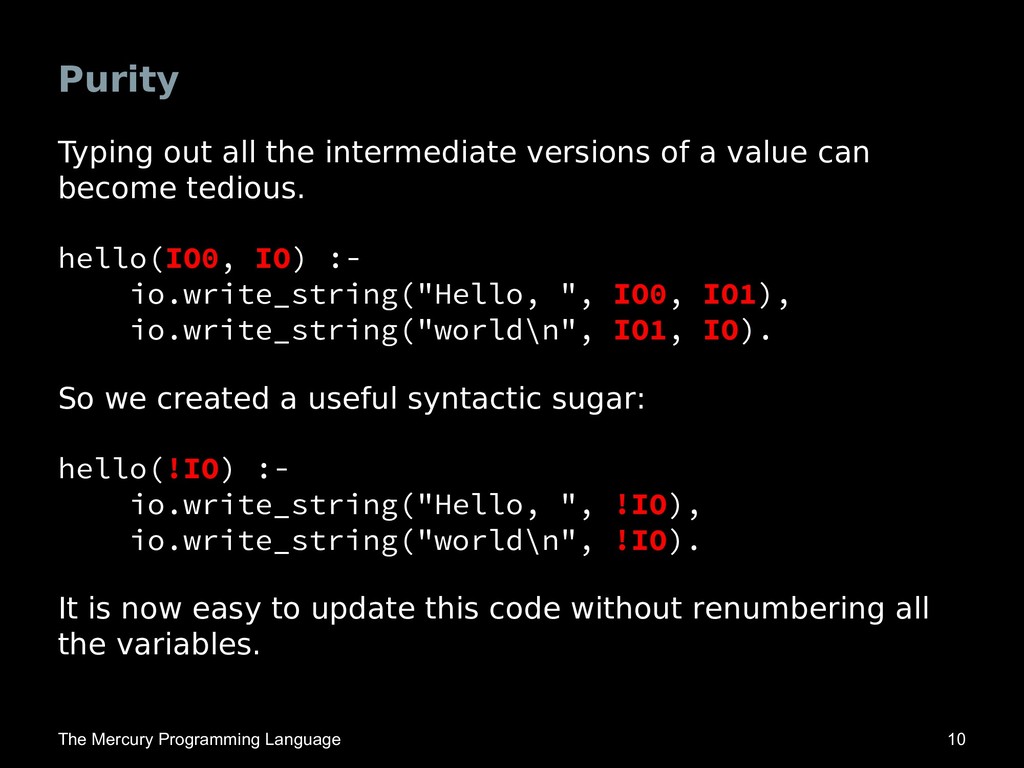
can become tedious. hello(IO0, IO) :- io.write_string("Hello, ", IO0, IO1), io.write_string("world\n", IO1, IO). So we created a useful syntactic sugar: hello(!IO) :- io.write_string("Hello, ", !IO), io.write_string("world\n", !IO). It is now easy to update this code without renumbering all the variables. The Mercury Programming Language 10
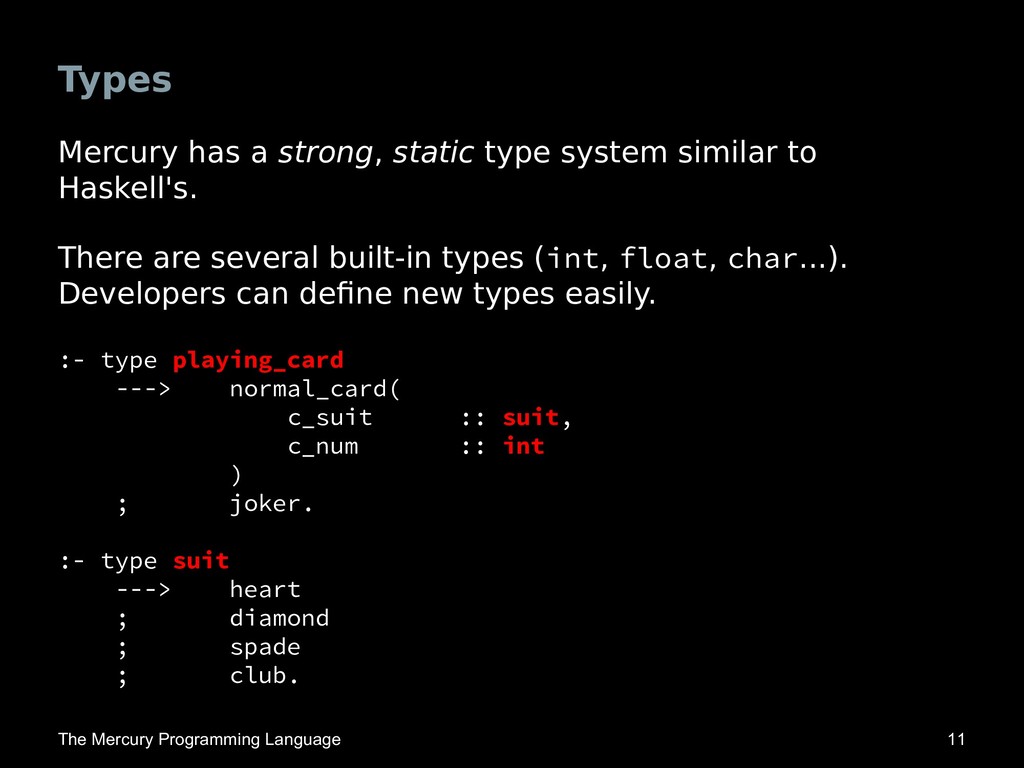
Haskell's. There are several built-in types (int, float, char...). Developers can define new types easily. :- type playing_card ---> normal_card( c_suit :: suit, c_num :: int ) ; joker. :- type suit ---> heart ; diamond ; spade ; club. The Mercury Programming Language 11
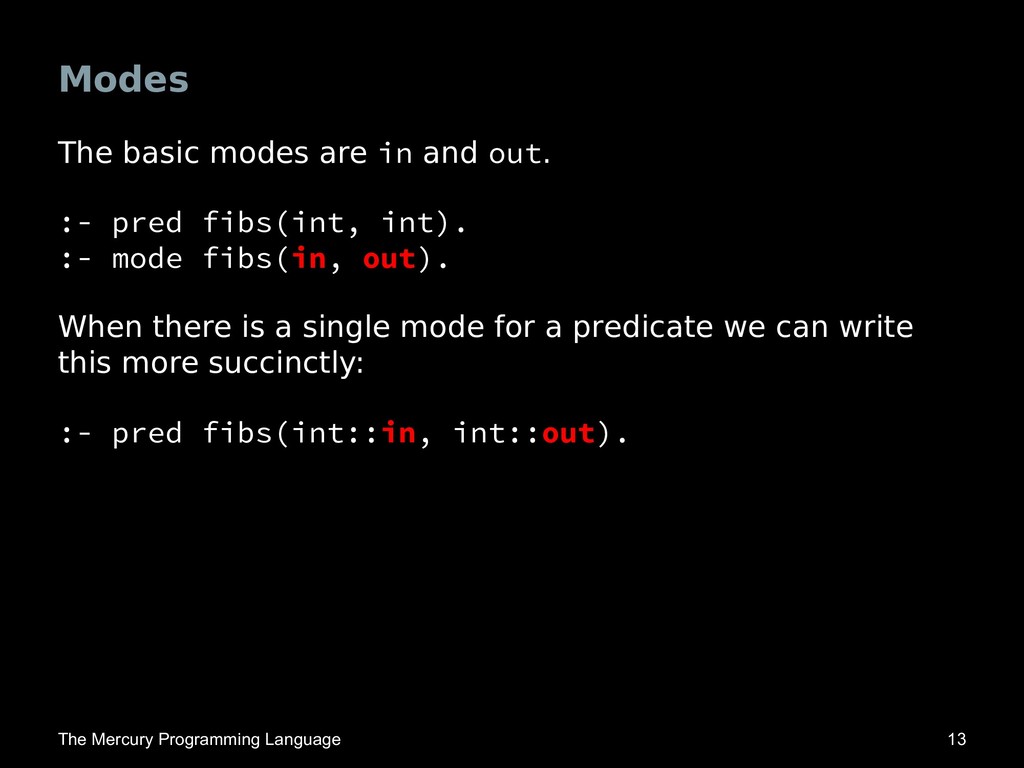
fibs(int, int). :- mode fibs(in, out). When there is a single mode for a predicate we can write this more succinctly: :- pred fibs(int::in, int::out). The Mercury Programming Language 13
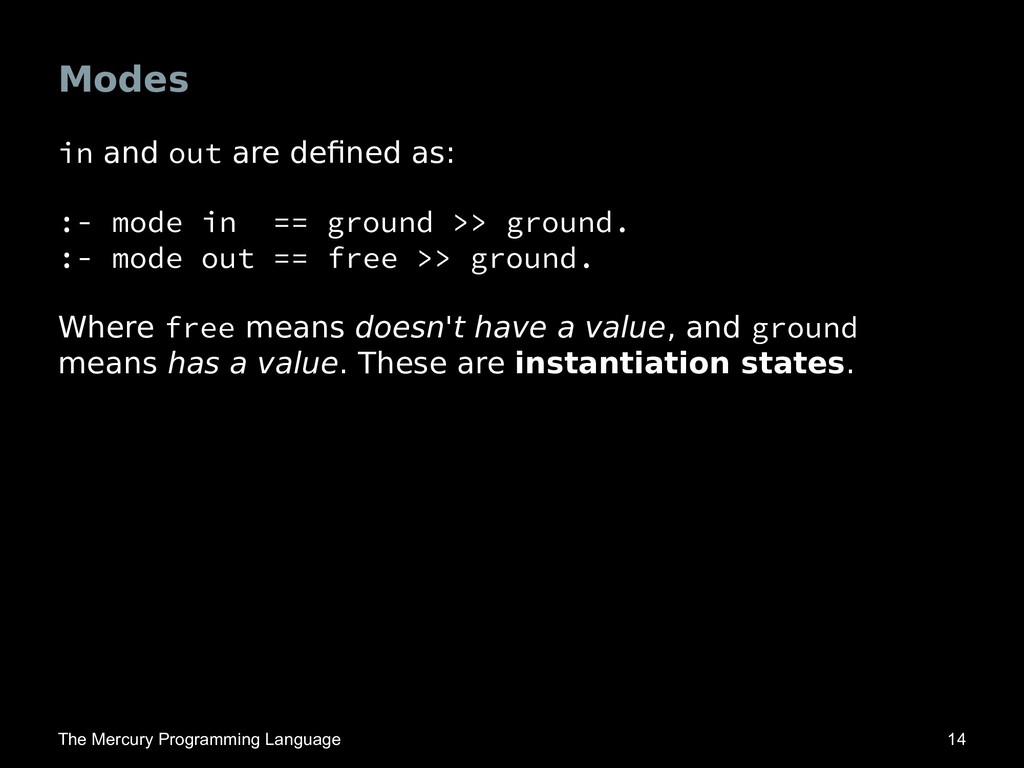
== ground >> ground. :- mode out == free >> ground. Where free means doesn't have a value, and ground means has a value. These are instantiation states. The Mercury Programming Language 14
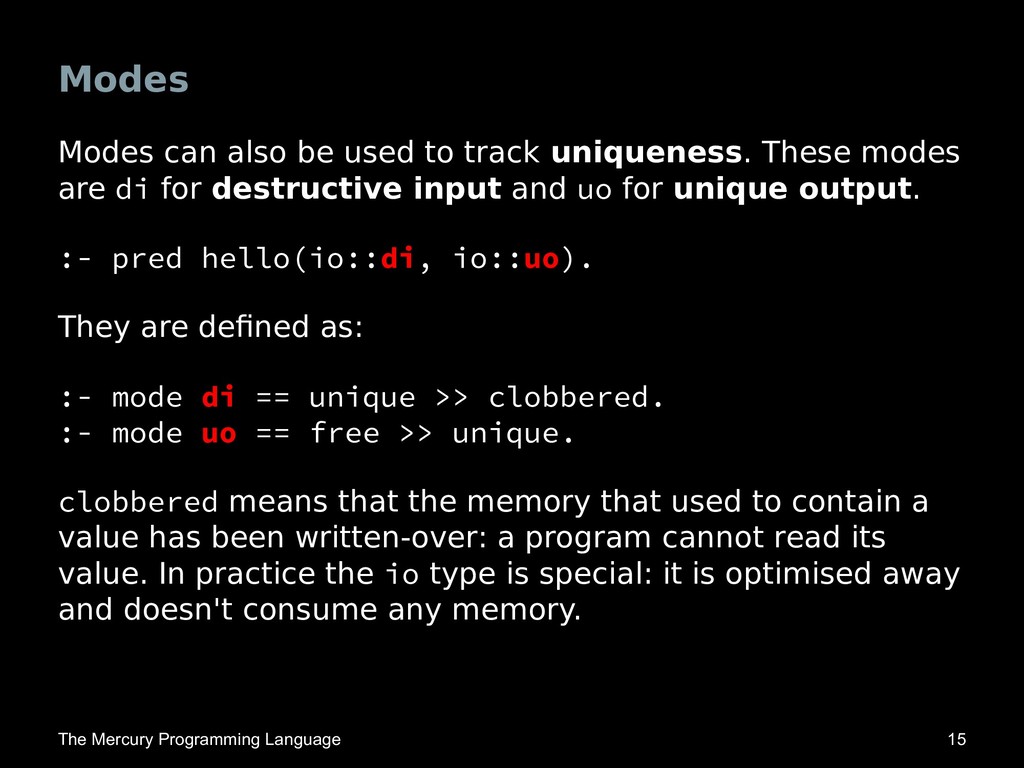
modes are di for destructive input and uo for unique output. :- pred hello(io::di, io::uo). They are defined as: :- mode di == unique >> clobbered. :- mode uo == free >> unique. clobbered means that the memory that used to contain a value has been written-over: a program cannot read its value. In practice the io type is special: it is optimised away and doesn't consume any memory. The Mercury Programming Language 15
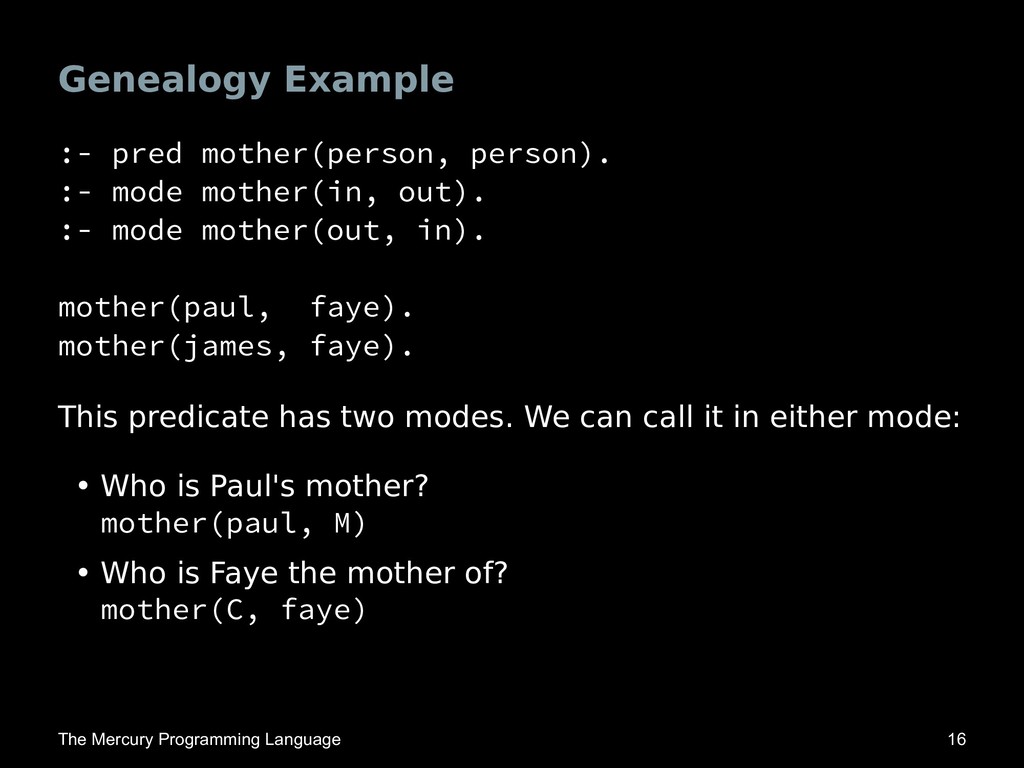
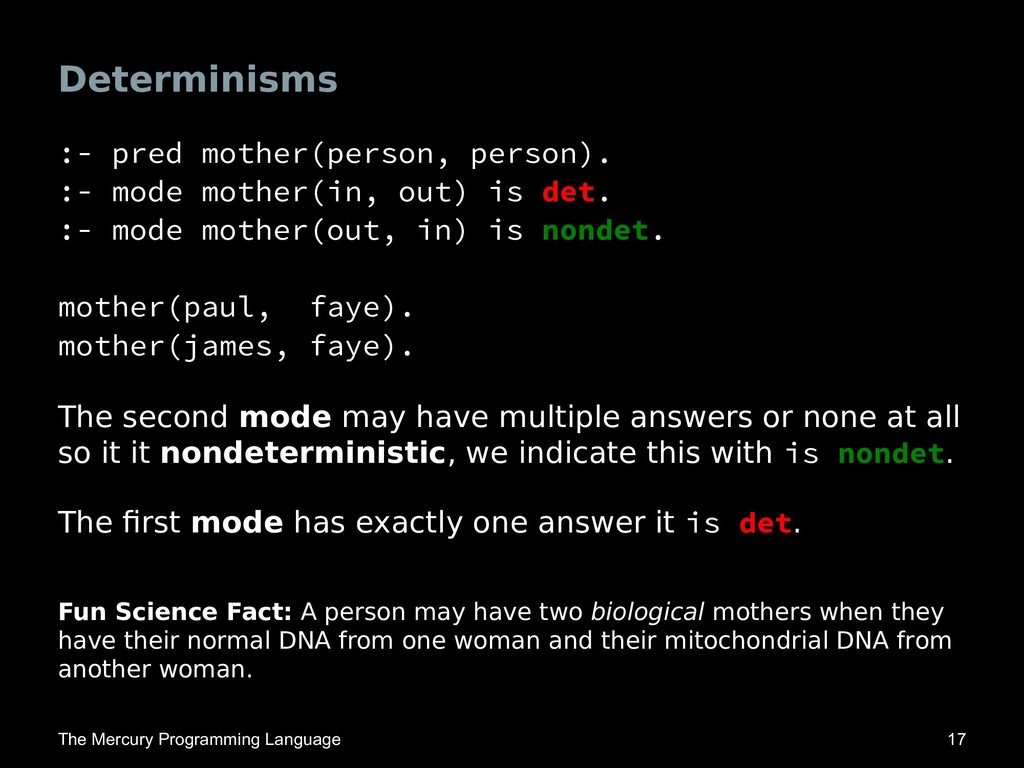
:- mode mother(out, in). mother(paul, faye). mother(james, faye). This predicate has two modes. We can call it in either mode: • Who is Paul's mother? mother(paul, M) • Who is Faye the mother of? mother(C, faye) The Mercury Programming Language 16
det. :- mode mother(out, in) is nondet. mother(paul, faye). mother(james, faye). The second mode may have multiple answers or none at all so it it nondeterministic, we indicate this with is nondet. The first mode has exactly one answer it is det. Fun Science Fact: A person may have two biological mothers when they have their normal DNA from one woman and their mitochondrial DNA from another woman. The Mercury Programming Language 17
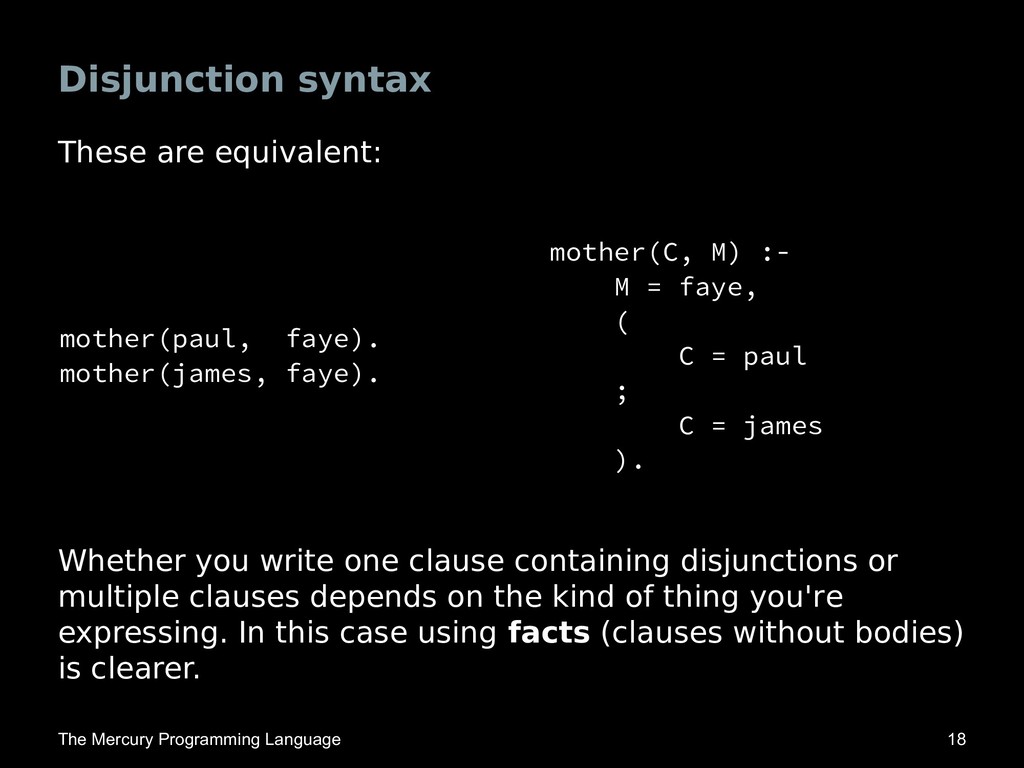
M) :- M = faye, ( C = paul ; C = james ). Whether you write one clause containing disjunctions or multiple clauses depends on the kind of thing you're expressing. In this case using facts (clauses without bodies) is clearer. The Mercury Programming Language 18
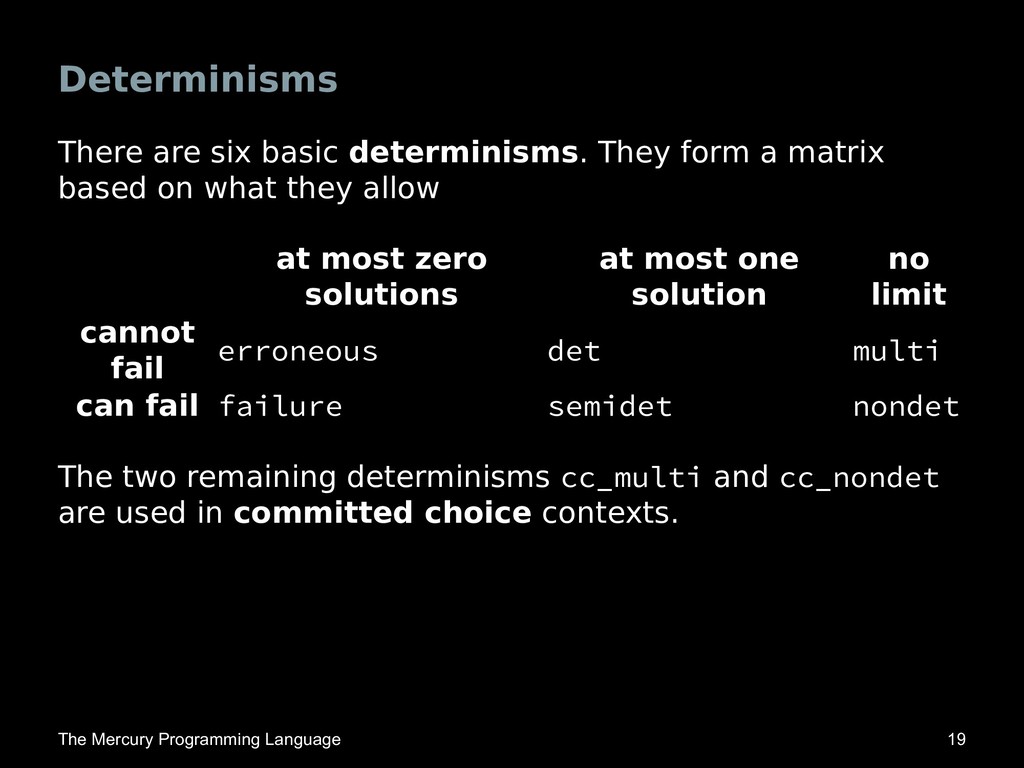
based on what they allow at most zero solutions at most one solution no limit cannot fail erroneous det multi can fail failure semidet nondet The two remaining determinisms cc_multi and cc_nondet are used in committed choice contexts. The Mercury Programming Language 19
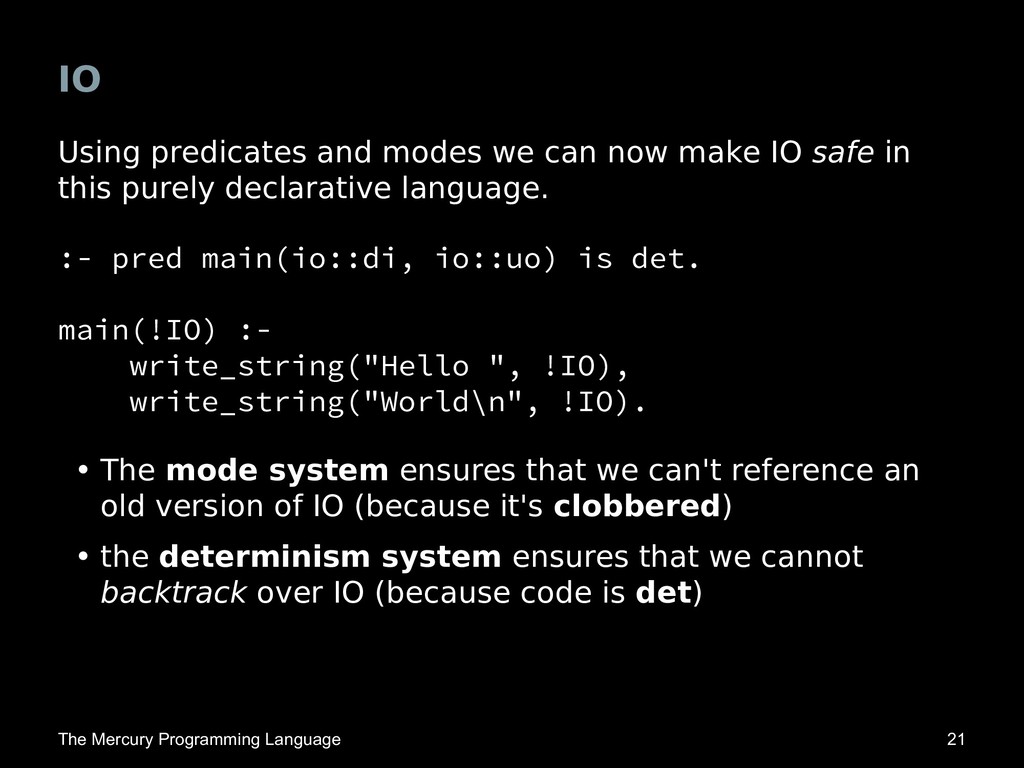
safe in this purely declarative language. :- pred main(io::di, io::uo) is det. main(!IO) :- write_string("Hello ", !IO), write_string("World\n", !IO). • The mode system ensures that we can't reference an old version of IO (because it's clobbered) • the determinism system ensures that we cannot backtrack over IO (because code is det) The Mercury Programming Language 21
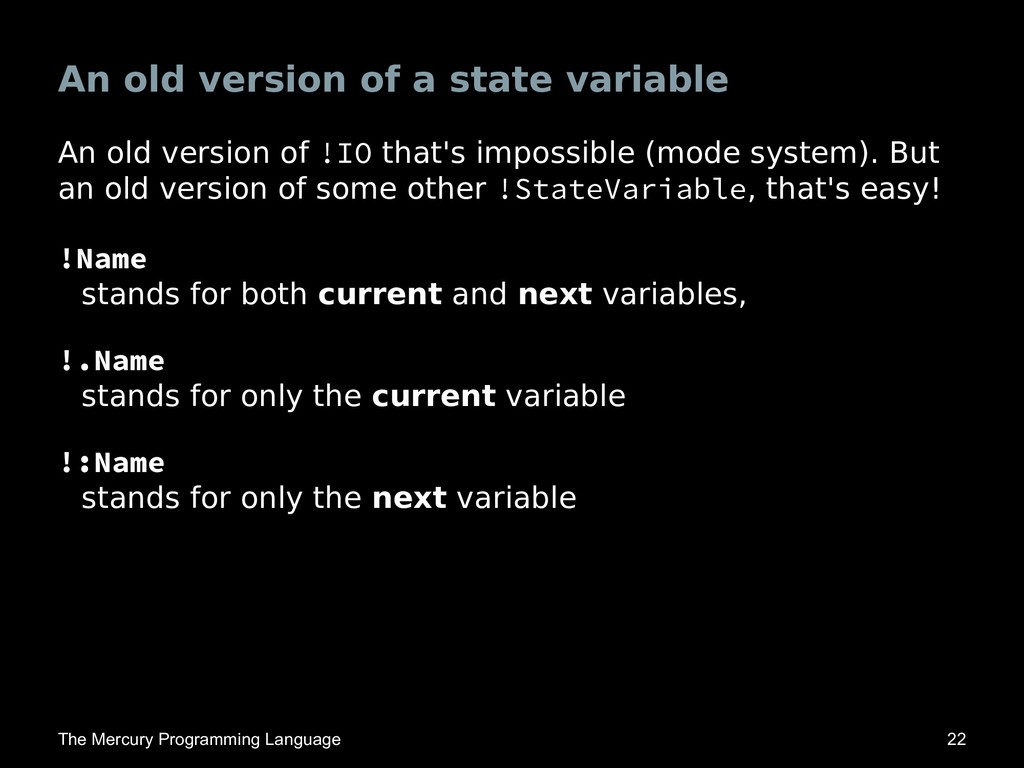
of !IO that's impossible (mode system). But an old version of some other !StateVariable, that's easy! !Name stands for both current and next variables, !.Name stands for only the current variable !:Name stands for only the next variable The Mercury Programming Language 22
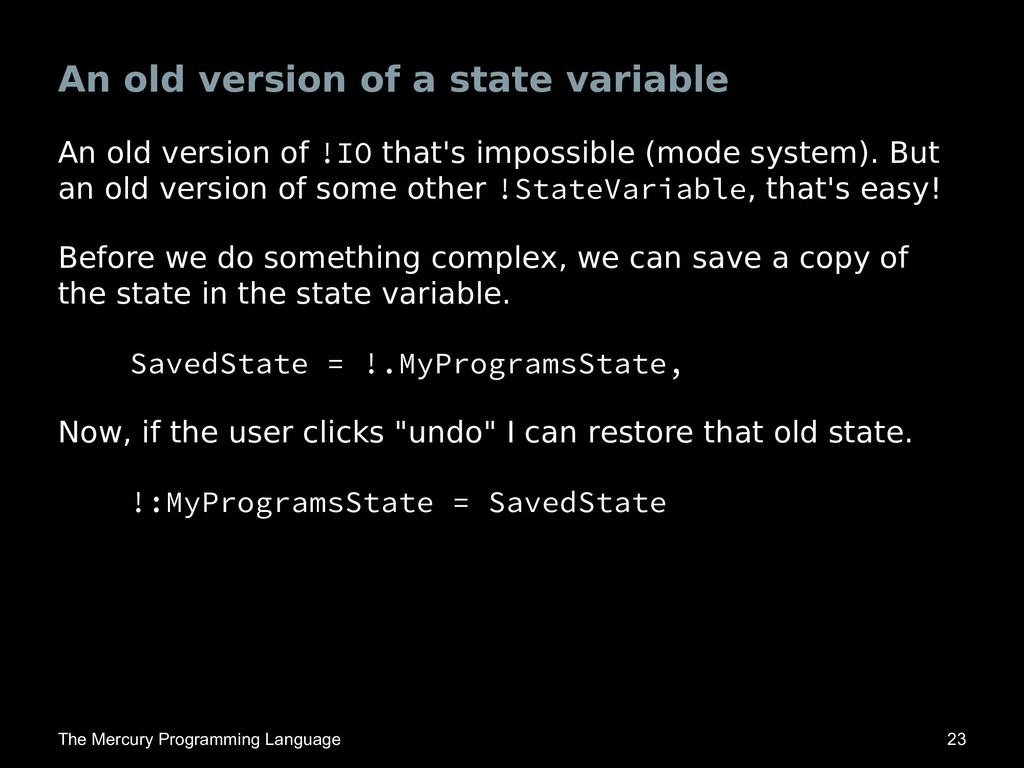
of !IO that's impossible (mode system). But an old version of some other !StateVariable, that's easy! Before we do something complex, we can save a copy of the state in the state variable. SavedState = !.MyProgramsState, Now, if the user clicks "undo" I can restore that old state. !:MyProgramsState = SavedState The Mercury Programming Language 23
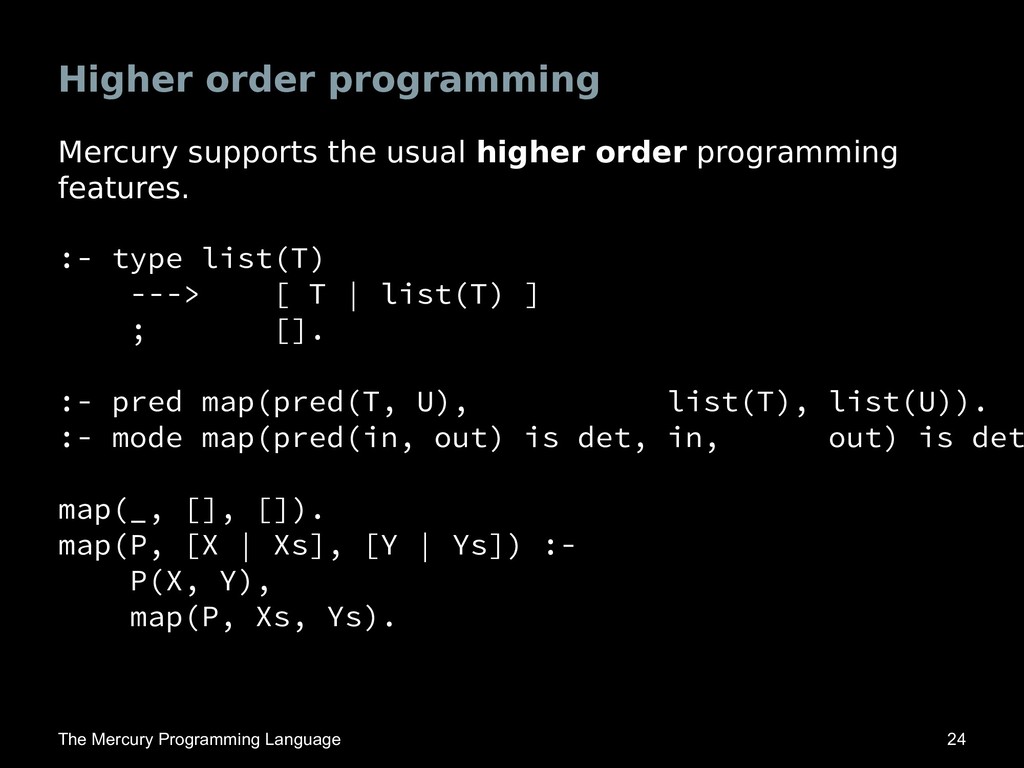
features. :- type list(T) ---> [ T | list(T) ] ; []. :- pred map(pred(T, U), list(T), list(U)). :- mode map(pred(in, out) is det, in, out) is det map(_, [], []). map(P, [X | Xs], [Y | Ys]) :- P(X, Y), map(P, Xs, Ys). The Mercury Programming Language 24


 uyuki234
 kenjiyoneyama
 marcoroth
 clockmaker
 ichirokano2
 koic
 siroemk
 minodriven
 teyamagu
 kinopeee
 gam0022
 yutobara
 lara
 bethany
 garrettdimon
 addyosmani
 brad_frost
 speakerdeck
 palkan
 helenjbeal
 deanohume
 swwweet
 aemeredith
 holman