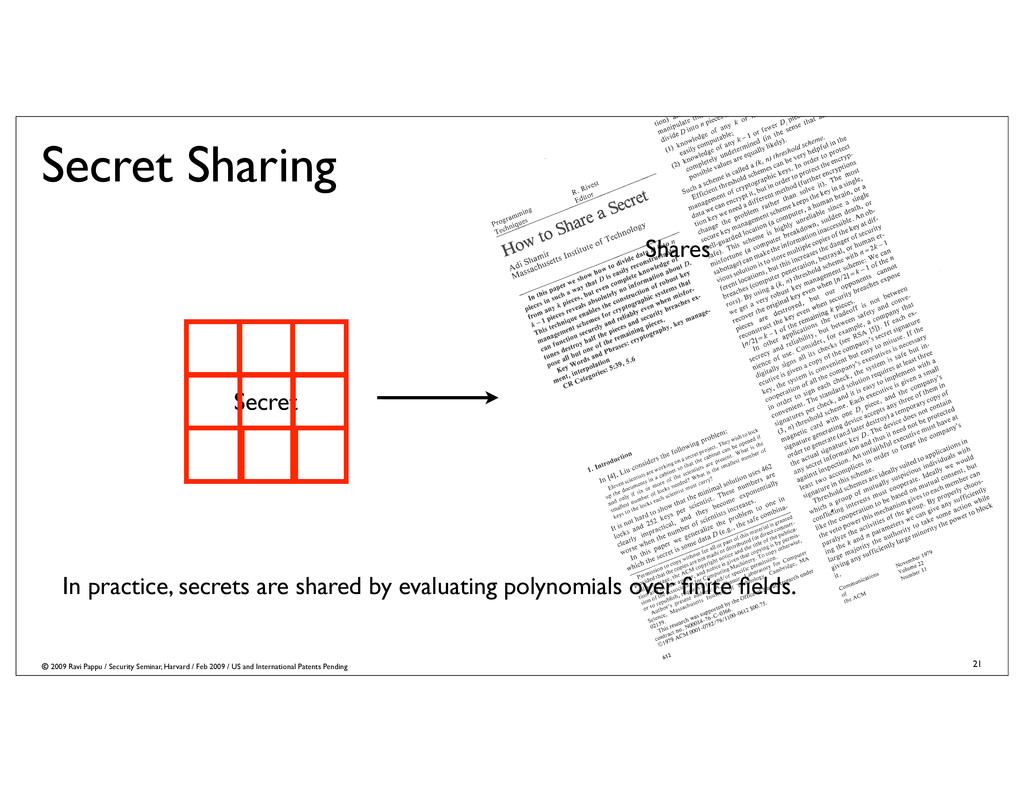
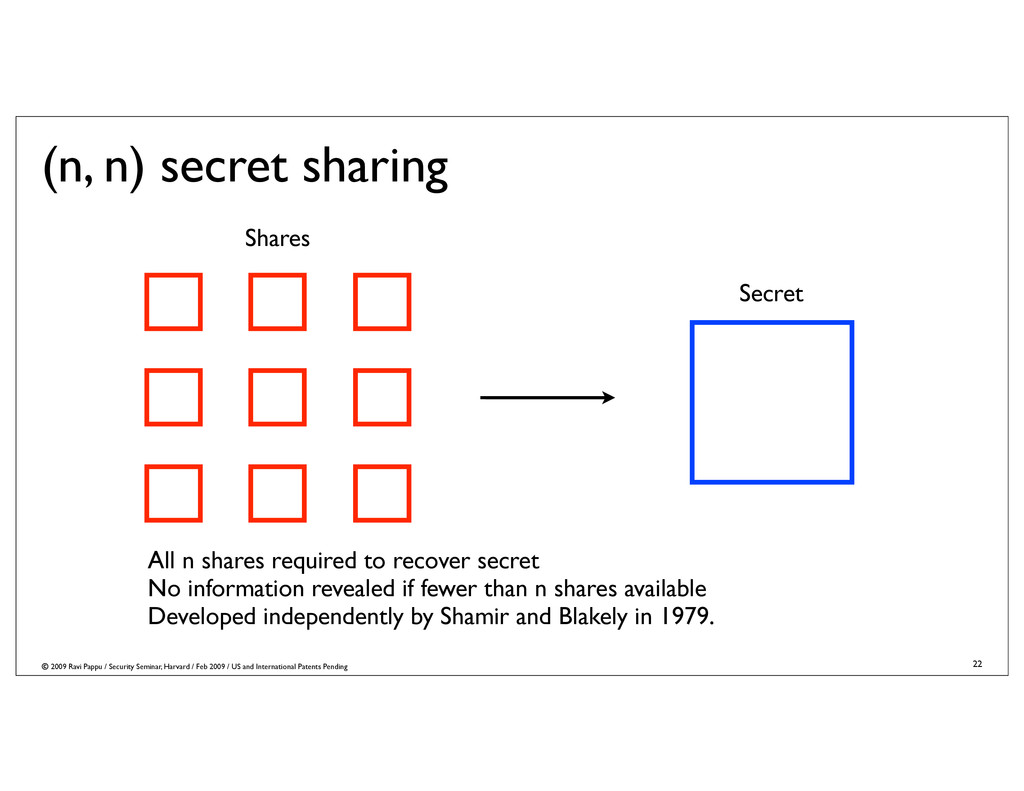
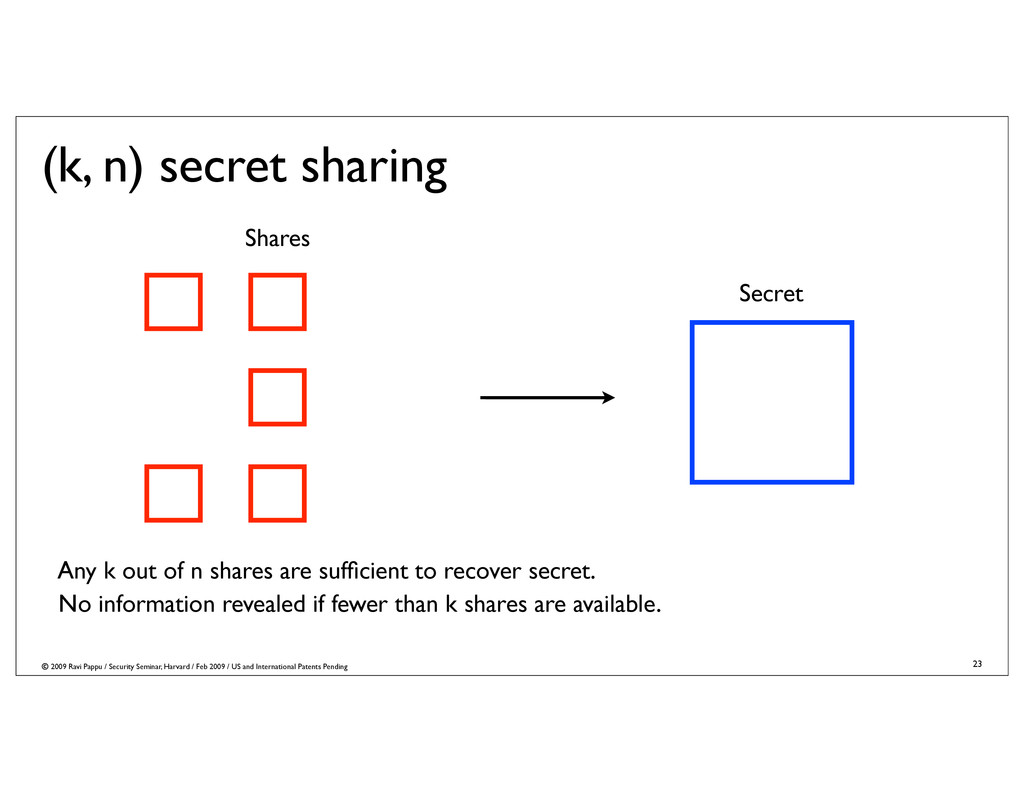
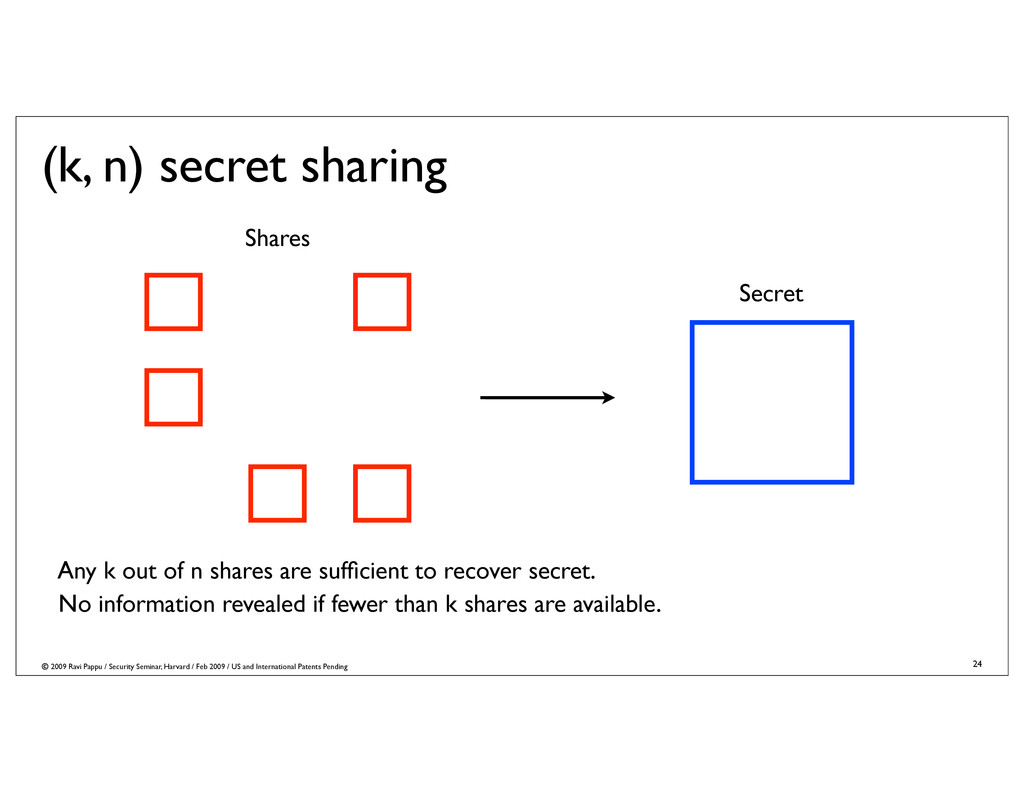
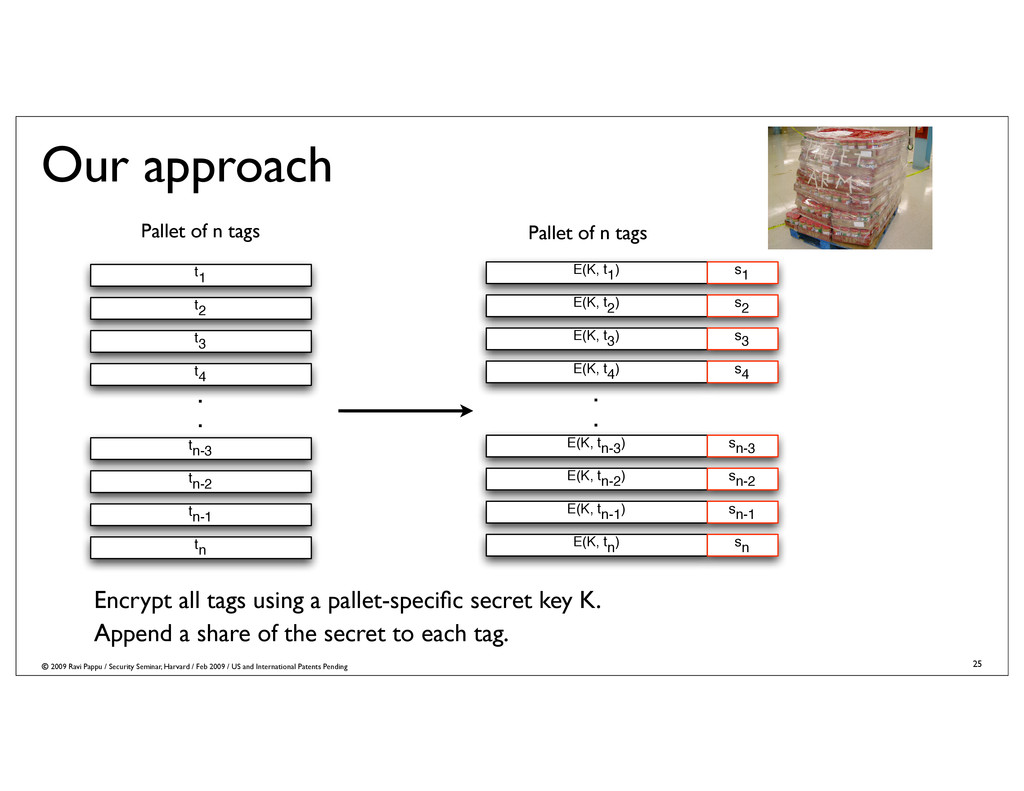
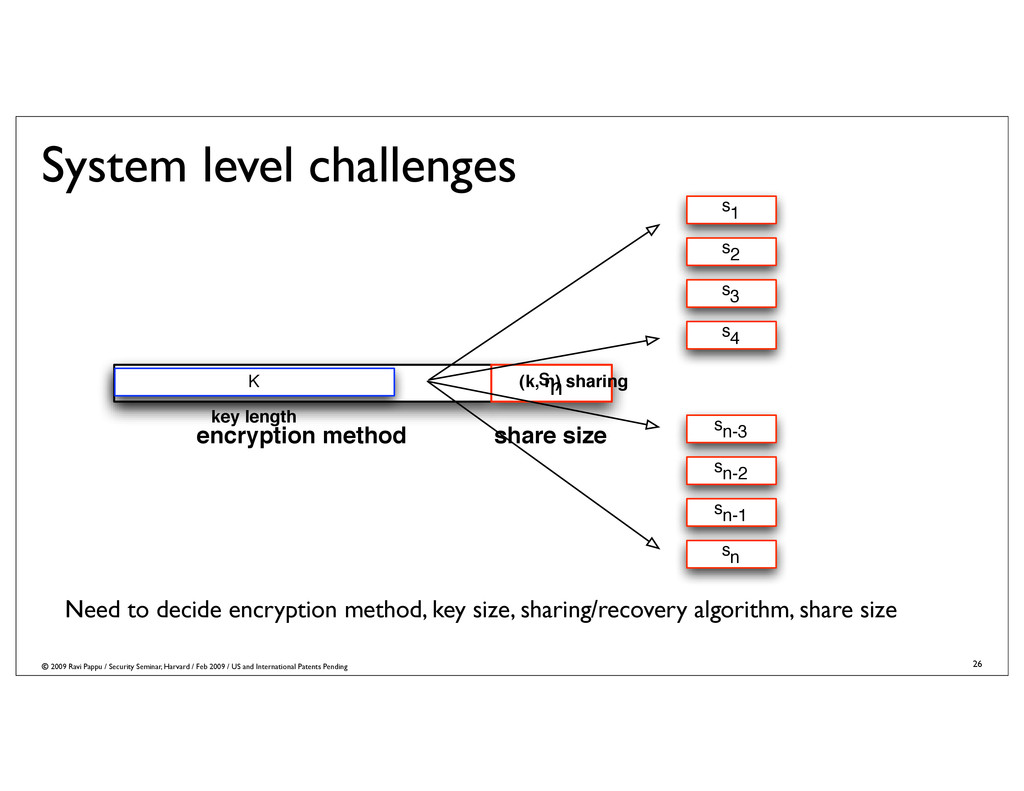
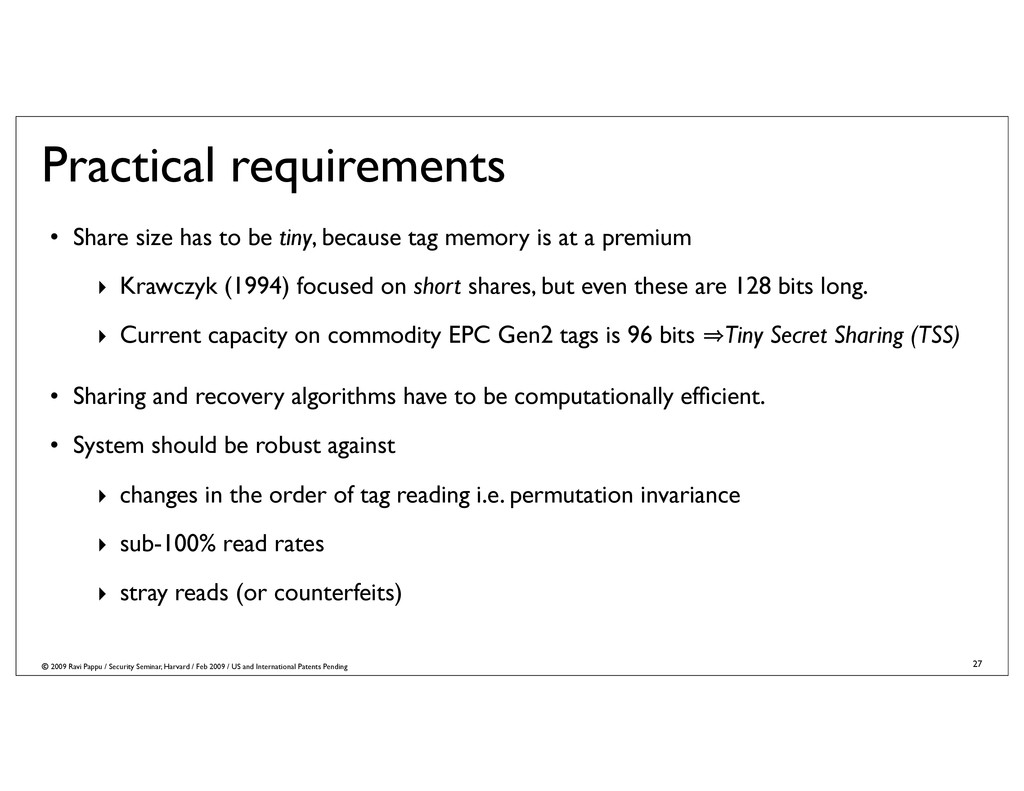
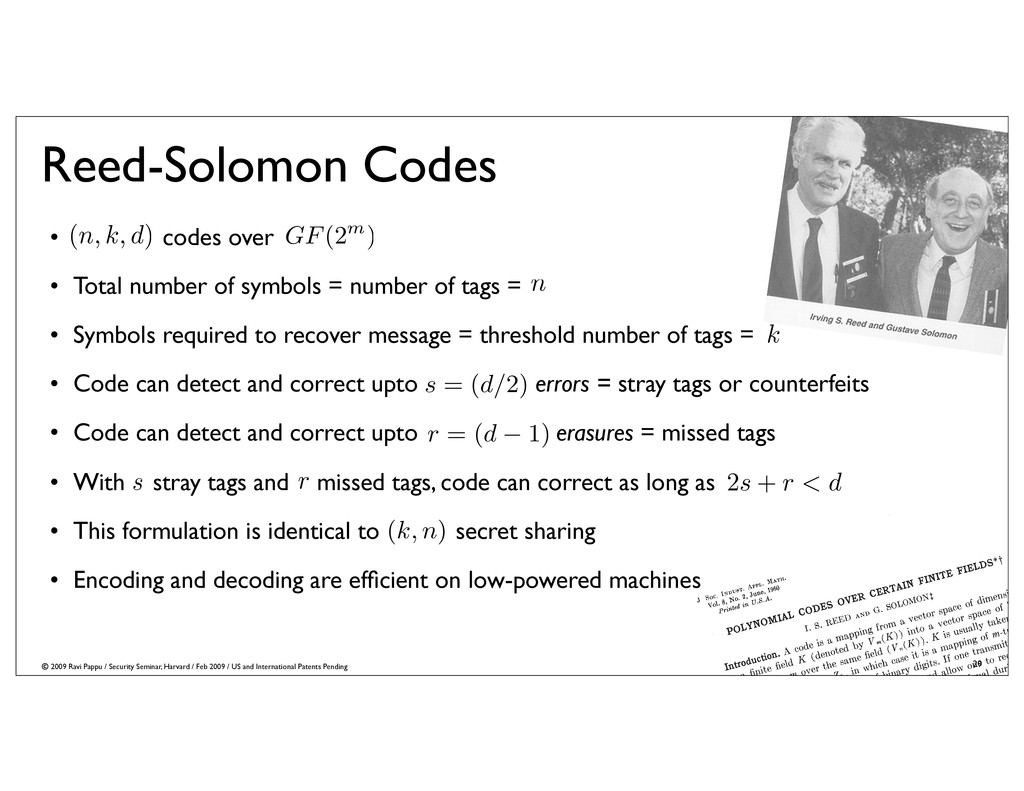
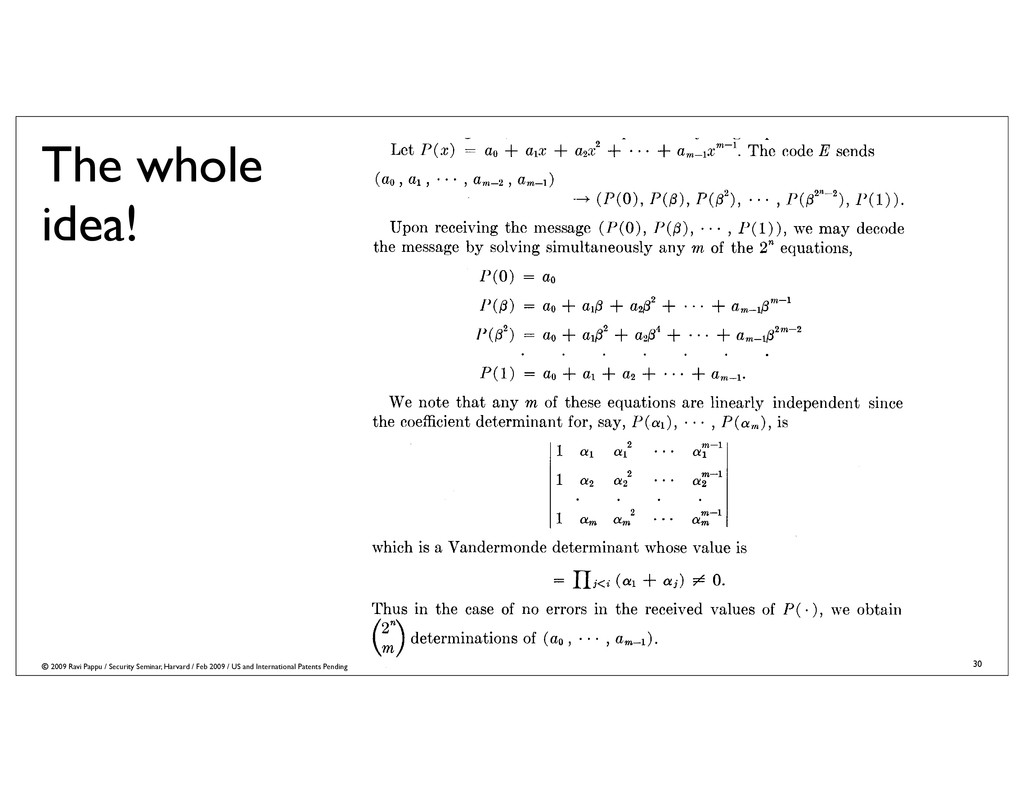
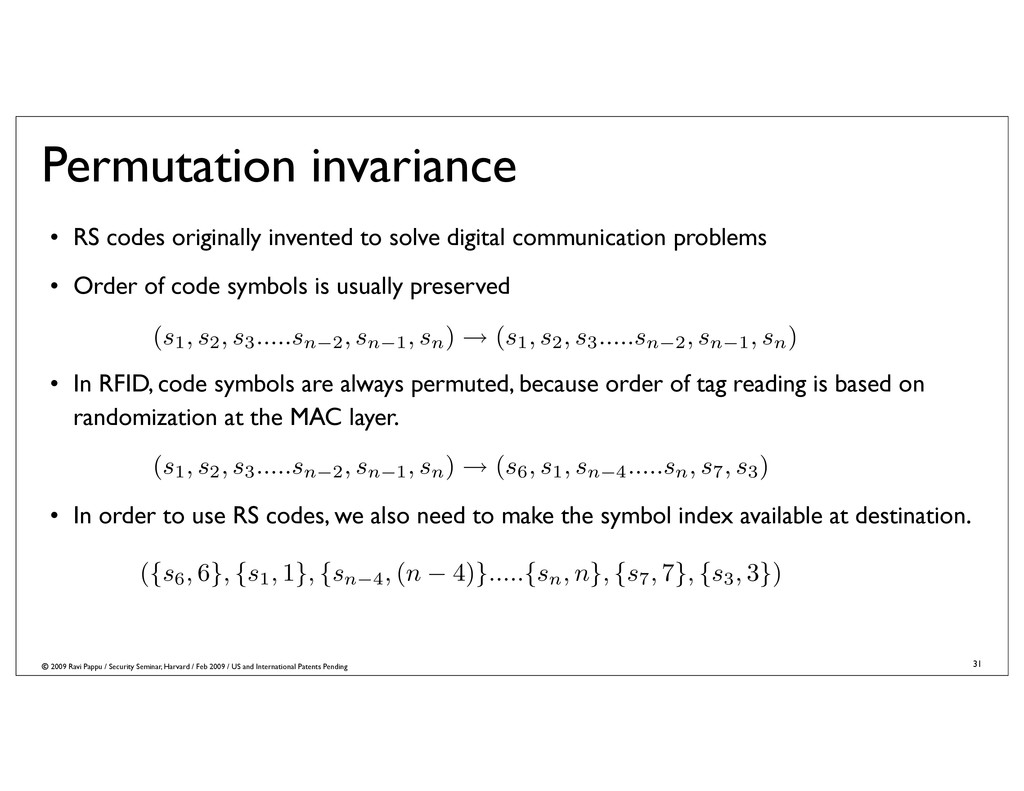
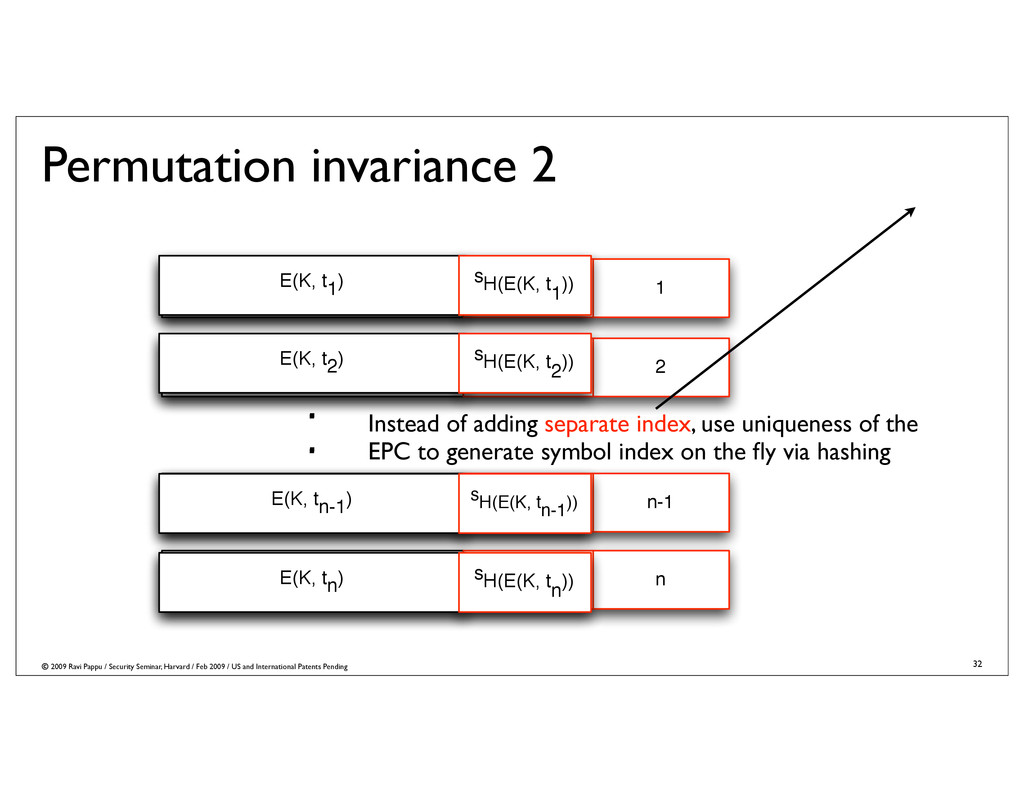
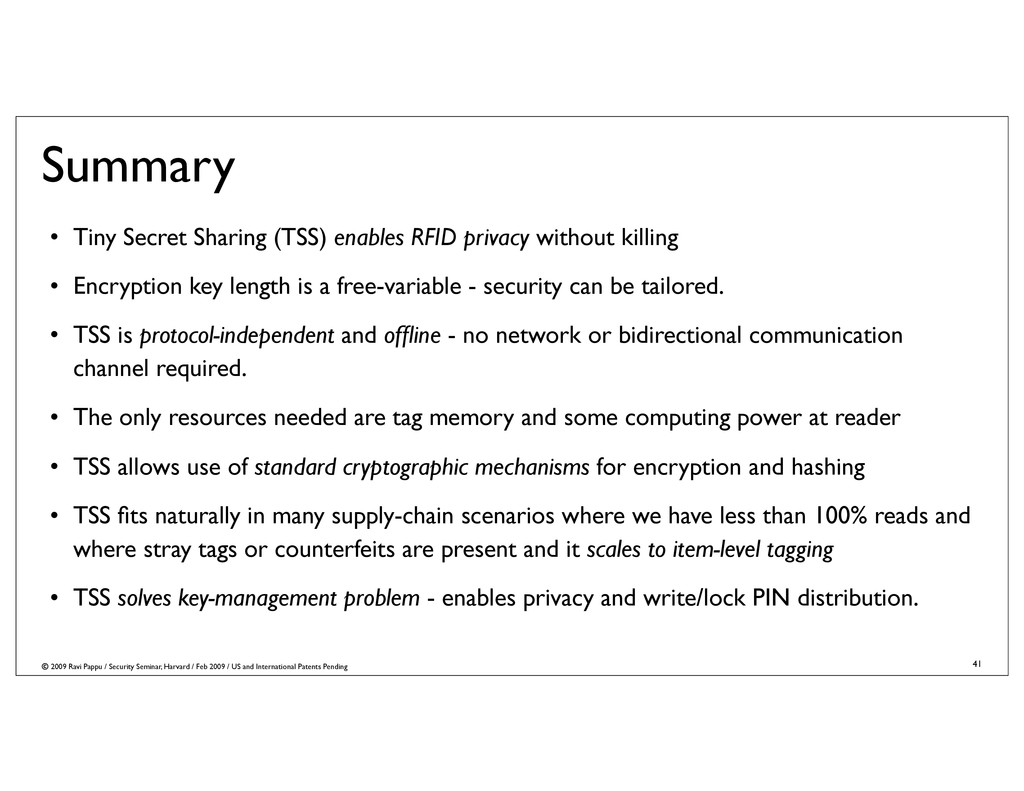
2009 / US and International Patents Pending Programming R. Rivest Techniques Editor How to Share a Secret Adi Shamir Massachusetts Institute of Technology In this paper we show how to divide data D into n pieces in such a way that D is easily reconstructable from any k pieces, but even complete knowledge of k - 1 pieces reveals absolutely no information about D. This technique enables the construction of robust key management schemes for cryptographic systems that can function securely and reliably even when misfor- tunes destroy half the pieces and security breaches ex- pose all but one of the remaining pieces. Key Words and Phrases: cryptography, key manage- ment, interpolation CR Categories: 5:39, 5.6 1. Introduction In [4], Liu considers the following problem: Eleven scientists are working on a secret project. They wish to lock up the documents in a cabinet so that the cabinet can be opened if and only if six or more of the scientists are present. What is the smallest number of locks needed? What is the smallest number of keys to the locks each scientist must carry? It is not hard to show that the minimal solution uses 462 locks and 252 keys per scientist. These numbers are clearly impractical, and they become exponentially worse when the number of scientists increases. In this paper we generalize the problem to one in which the secret is some data D (e.g., the safe combina- Permission to copy without fee all or part of this material is granted provided that the copies are not made or distributed for direct commer- cial advantage, the ACM copyright notice and the title of the publica- tion and its date appear, and notice is given that copying is by permis- sion of the Association for Computing Machinery. To copy otherwise, or to republish, requires a fee and/or specific permission. Author's present address: A. Shamir, Laboratory for Computer Science, Massachusetts Institute of Technology, Cambridge, MA 02139. This research was supported by the Office of Naval Research under contract no. N00014-76-C-0366. @1979 ACM 0001-0782/79/1100-0612 $00.75. tion) and manipulate this data) divide D into n pieces D, ..... (1) knowledge of any k or more easily computable; (2) knowledge of any k- 1 or fewer Di pieces leaves completely undetermined (in the sense that all its possible values are equally likely). Such a scheme is called a (k, n) threshold scheme. Efficient threshold schemes can be very helpful in the management of cryptographic keys. In order to protect data we can encrypt it, but in order to protect the encryp- tion key we need a different method (further encryptions change the problem rather than solve it). The most secure key management scheme keeps the key in a single, well-guarded location (a computer, a human brain, or a safe). This scheme is highly unreliable since a single misfortune (a computer breakdown, sudden death, or sabotage) can make the information inaccessible. An ob- vious solution is to store multiple copies of the key at dif- ferent locations, but this increases the danger of security breaches (computer penetration~ betrayal, or human er- rors). By using a (k, n) threshold scheme with n = 2k- 1 we get a very robust key management scheme: We can recover the original key even when [n/2J = k- 1 of the n pieces are destroyed, but our opponents cannot reconstruct the key even when security breaches expose [n/21 = k- 1 of the remaining k pieces. In other applications the tradeoff is not between secrecy and reliability, but between safety and conve- nience of use. Consider, for example, a company that digitally signs all its checks (see RSA [5]). If each ex- ecutive is given a copy of the company's secret signature key, the system is convenient but easy to misuse. If the cooperation of all the company's executives is necessary in order to sign each check, the system is safe but in- convenient. The standard solution requires at least three signatures per check, and it is easy to implement with a (3, n) threshold scheme. Each executive is given a small magnetic card with one Di piece, and the company's signature generating device accepts any three of them in order to generate (and later destroy) a temporary copy of the actual signature key D. The device does not contain any secret information and thus it need not be protected against inspection. An unfaithful executive must have at least two accomplices in order to forge the company's signature in this scheme. Threshold schemes are ideally suited to applications in which a group of mutually suspicious individuals with conflicting interests must cooperate. Ideally we would like the cooperation to be based on mutual consent, but the veto power this mechanism gives to each member can paralyze the activities of the group. By properly choos- ing the k and n parameters we can give any sufficiently large majority the authority to take some action while giving any sufficiently large minority the power to block it. 612 Communications November 1979 of Volume 22 the ACM Number 11 Secret Secret Sharing 21 Shares In practice, secrets are shared by evaluating polynomials over finite fields.


 ravipappu
 aleyda
 reverentgeek
 stephenakadiri
 deanohume
 morganepeng
 paigeccino
 axbom
 palkan
 inesmontani
 twada
 kneath
 cassininazir