Upgrade to Pro — share decks privately, control downloads, hide ads and more …

Introducing Renaissance International School Sa...

Introducing Renaissance International School SaiGon Programme

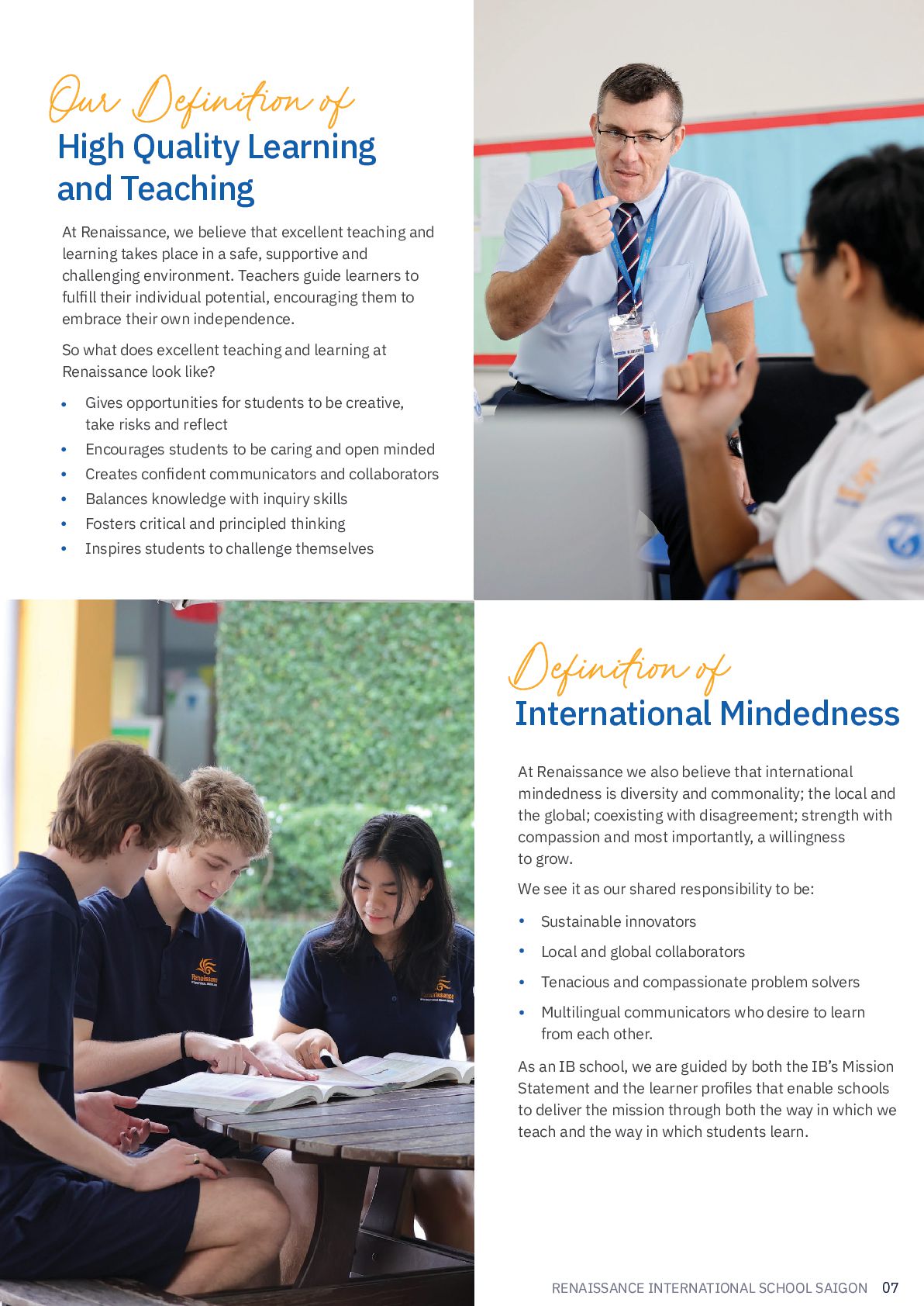
At Renaissance, we believe that excellent teaching and learning takes place in a safe, supportive and challenging environment. Teachers guide learners to fulfill their individual potential, encouraging them to embrace their own independence. So what does excellent teaching and learning at Renaissance look like?
- Gives opportunities for students to be creative, take risks and reflect
- Encourages students to be caring and open minded
- Creates confident communicators and collaborators
- Balances knowledge with inquiry skills
- Fosters critical and principled thinking
- Inspires students to challenge themselves

Readmore: https://renaissance.edu.vn/curriculum/

Other Decks in Programming

Transcript

  1. OUTSTANDING EDUCATORS EXCEPTIONAL EXPERIENCES FIRST CLASS FACILITIES UNPARALLELED SERVICE Secondary

    Parent Hdbook Hdbook Secondary Parent Student Hdbook Secondary Parent Student Hdbook Secondary Parent Student
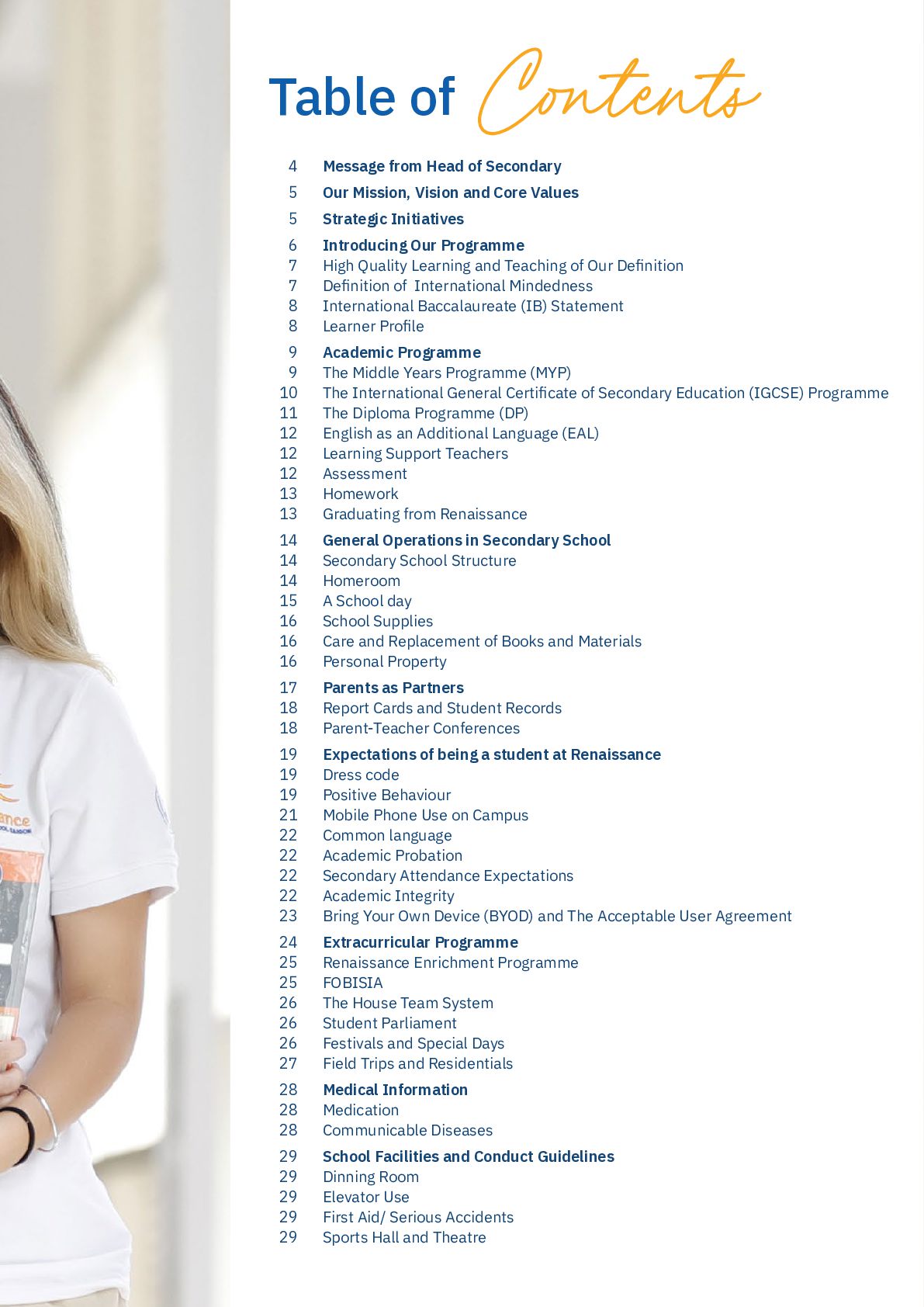
  2. Message from Head of Secondary Our Mission, Vision and Core

    Values Strategic Initiatives Introducing Our Programme High Quality Learning and Teaching of Our Definition Definition of International Mindedness International Baccalaureate (IB) Statement Learner Profile Academic Programme The Middle Years Programme (MYP) The International General Certificate of Secondary Education (IGCSE) Programme The Diploma Programme (DP) English as an Additional Language (EAL) Learning Support Teachers Assessment Homework Graduating from Renaissance General Operations in Secondary School Secondary School Structure Homeroom A School day School Supplies Care and Replacement of Books and Materials Personal Property Parents as Partners Report Cards and Student Records Parent-Teacher Conferences Expectations of being a student at Renaissance Dress code Positive Behaviour Mobile Phone Use on Campus Common language Academic Probation Secondary Attendance Expectations Academic Integrity Bring Your Own Device (BYOD) and The Acceptable User Agreement Extracurricular Programme Renaissance Enrichment Programme FOBISIA The House Team System Student Parliament Festivals and Special Days Field Trips and Residentials Medical Information Medication Communicable Diseases School Facilities and Conduct Guidelines Dinning Room Elevator Use First Aid/ Serious Accidents Sports Hall and Theatre Ctents Table of 4 5 5 6 7 7 8 8 9 9 10 11 12 12 12 13 13 14 14 14 15 16 16 16 17 18 18 19 19 19 21 22 22 22 22 23 24 25 25 26 26 26 27 28 28 28 29 29 29 29 29
  3. Dear Parents and Students, Welcome to the Secondary School at

    Renaissance International School Saigon, a vibrant and inclusive learning community dedicated to providing an exceptional education in the International Baccalaureate (IB) and International General Certificate of Secondary Education (IGCSE) curricula. At Renaissance, we firmly believe in the transformative power of education and the profound impact it can have on the lives of our students. We are proud to offer both the IB and IGCSE curricula, renowned worldwide for their academic rigor, holistic approach, and emphasis on developing well-rounded individuals prepared to thrive in a global society. The IB curriculum (Year 7 to Year 9, Years 12 and Year 13), with its focus on inquiry-based learning, critical thinking, and intercultural understanding, encourages our students to become lifelong learners and active global citizens. It challenges them to explore complex issues, develop a deep understanding of multiple perspectives, and apply their knowledge to real-world contexts. The IB curriculum fosters intellectual curiosity, creativity, and a genuine love for learning. In addition to the IB curriculum, we also offer the IGCSE programme (Years 10 and Year 11), which provides a strong foundation in essential subjects and equips our students with the necessary skills and knowledge to excel in their academic pursuits. The IGCSE programme promotes critical thinking, independent research, and effective communication, preparing our students for the challenges of higher education and future careers. At Renaissance, we firmly believe that education goes beyond the classroom walls. We emphasise the value of community service and actively encourage our students to engage in meaningful service projects. Through community service, our students develop empathy, compassion, and a strong sense of social responsibility. They learn to make a positive impact on their local and global communities, becoming agents of change and advocates for a more just and sustainable world. We are committed to fostering a supportive and nurturing environment where every student can thrive academically, socially, and emotionally. Our dedicated faculty and staff are passionate about education and are here to support and guide our students on their educational journey. We believe in the power of collaboration between home and school, and we value the partnership with parents and guardians in providing the best possible education for our students. This Parent-Student Handbook serves as a comprehensive guide to life in the secondary school. We encourage you to familiarise yourself with its contents, as it will be a valuable reference throughout your time at Renaissance. It outlines our expectations, procedures, and the various opportunities available to our students both inside and outside the classroom. We are excited to embark on this educational adventure with you and your child. Together, we will inspire a love for learning, foster personal growth, and empower our students to make a positive impact on the world around them. Once again, welcome to Renaissance. We look forward to a rewarding and enriching educational journey together! Warm regards, Andy Roberts Head of Secondary Message from Head of Secdy SECONDARY PARENT HANDBOOK 04
  4. At Renaissance International School Saigon, our core values are the

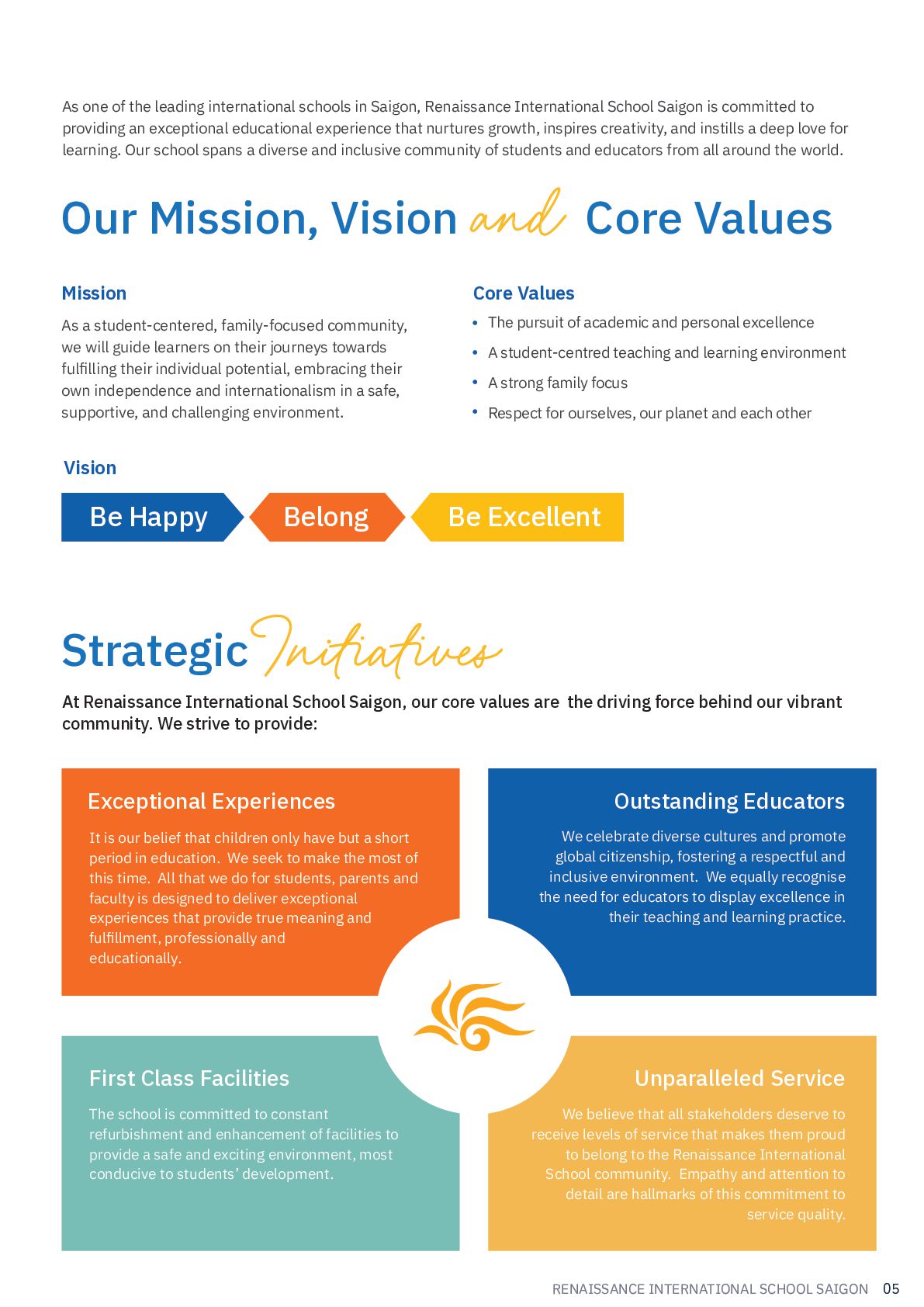
    driving force behind our vibrant community. We strive to provide: The school is committed to constant refurbishment and enhancement of facilities to provide a safe and exciting environment, most conducive to students’ development. We believe that all stakeholders deserve to receive levels of service that makes them proud to belong to the Renaissance International School community. Empathy and attention to detail are hallmarks of this commitment to service quality. Exceptional Experiences Outstanding Educators Unparalleled Service First Class Facilities It is our belief that children only have but a short period in education. We seek to make the most of this time. All that we do for students, parents and faculty is designed to deliver exceptional experiences that provide true meaning and fulfillment, professionally and educationally. We celebrate diverse cultures and promote global citizenship, fostering a respectful and inclusive environment. We equally recognise the need for educators to display excellence in their teaching and learning practice. Strategic Inias Our Mission, Vision Core Values d As a student-centered, family-focused community, we will guide learners on their journeys towards fulfilling their individual potential, embracing their own independence and internationalism in a safe, supportive, and challenging environment. Mission The pursuit of academic and personal excellence A student-centred teaching and learning environment A strong family focus Respect for ourselves, our planet and each other Core Values Vision Be Happy Belong Be Excellent As one of the leading international schools in Saigon, Renaissance International School Saigon is committed to providing an exceptional educational experience that nurtures growth, inspires creativity, and instills a deep love for learning. Our school spans a diverse and inclusive community of students and educators from all around the world. RENAISSANCE INTERNATIONAL SCHOOL SAIGON 05
  5. At Renaissance, we believe that excellent teaching and learning takes

    place in a safe, supportive and challenging environment. Teachers guide learners to fulfill their individual potential, encouraging them to embrace their own independence. So what does excellent teaching and learning at Renaissance look like? High Quality Learning and Teaching Gives opportunities for students to be creative, take risks and reflect Encourages students to be caring and open minded Creates confident communicators and collaborators Balances knowledge with inquiry skills Fosters critical and principled thinking Inspires students to challenge themselves O Defini of At Renaissance we also believe that international mindedness is diversity and commonality; the local and the global; coexisting with disagreement; strength with compassion and most importantly, a willingness to grow. We see it as our shared responsibility to be: As an IB school, we are guided by both the IB’s Mission Statement and the learner profiles that enable schools to deliver the mission through both the way in which we teach and the way in which students learn. International Mindedness Defini of Sustainable innovators Local and global collaborators Tenacious and compassionate problem solvers Multilingual communicators who desire to learn from each other. RENAISSANCE INTERNATIONAL SCHOOL SAIGON 07
  6. The IB develops inquiring, knowledgeable and caring young people who

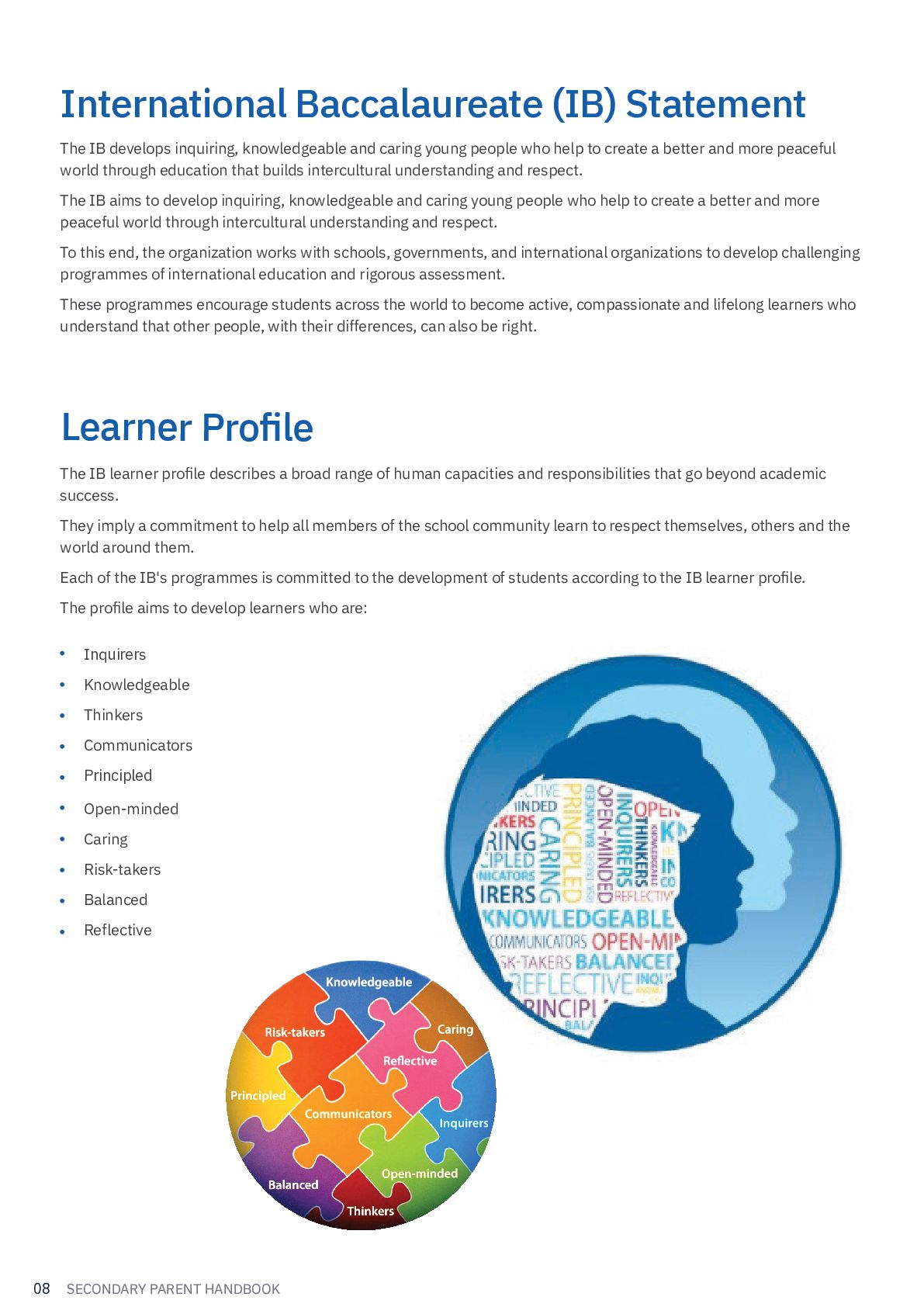
    help to create a better and more peaceful world through education that builds intercultural understanding and respect. The IB aims to develop inquiring, knowledgeable and caring young people who help to create a better and more peaceful world through intercultural understanding and respect. To this end, the organization works with schools, governments, and international organizations to develop challenging programmes of international education and rigorous assessment. These programmes encourage students across the world to become active, compassionate and lifelong learners who understand that other people, with their differences, can also be right. The IB learner profile describes a broad range of human capacities and responsibilities that go beyond academic success. They imply a commitment to help all members of the school community learn to respect themselves, others and the world around them. Each of the IB's programmes is committed to the development of students according to the IB learner profile. The profile aims to develop learners who are: International Baccalaureate (IB) Statement Learner Profile Open-minded Caring Risk-takers Balanced Reflective Inquirers Knowledgeable Thinkers Communicators Principled SECONDARY PARENT HANDBOOK 08
  7. RENAISSANCE INTERNATIONAL SCHOOL SAIGON 09 The curriculum from Year 7

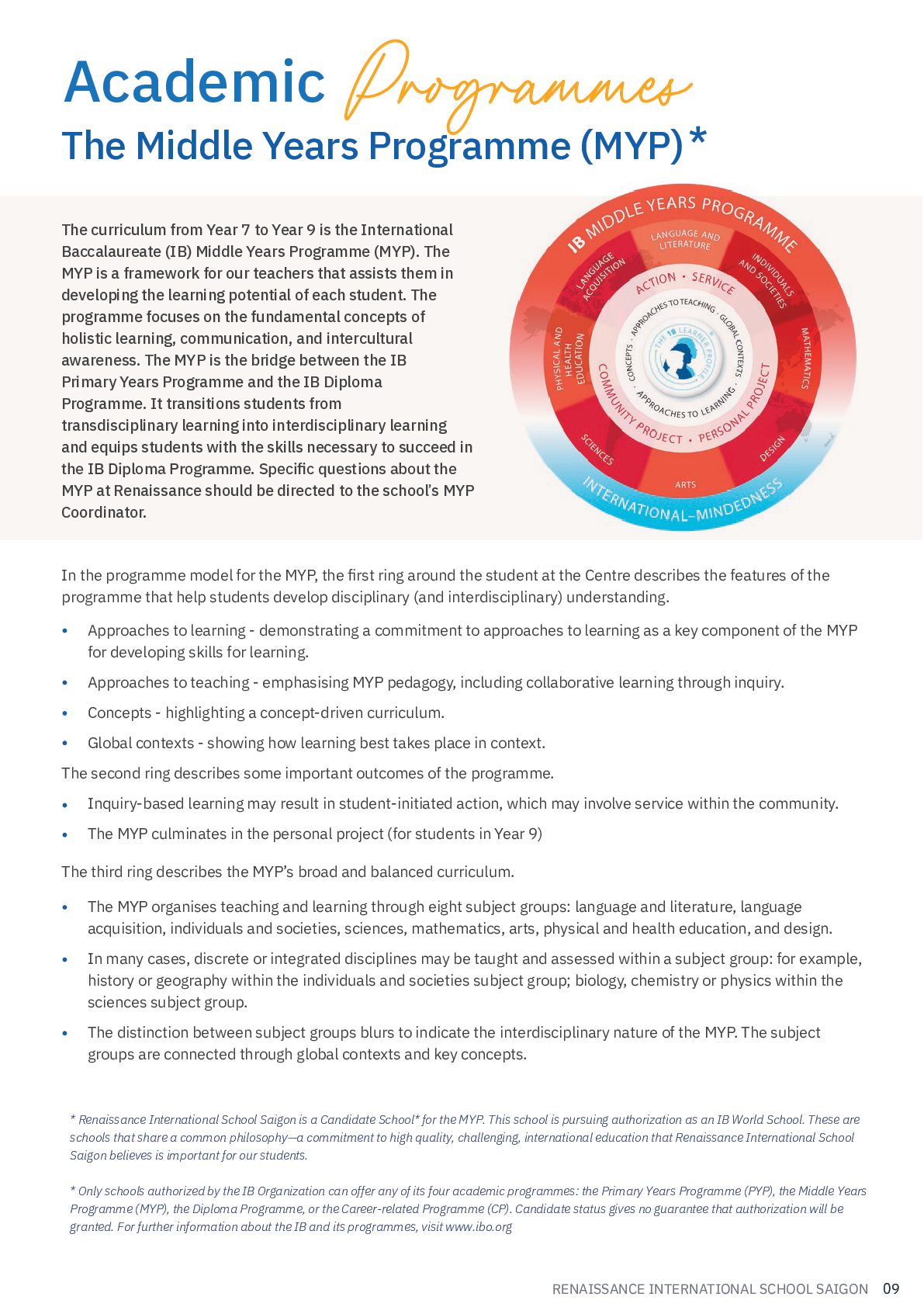
    to Year 9 is the International Baccalaureate (IB) Middle Years Programme (MYP). The MYP is a framework for our teachers that assists them in developing the learning potential of each student. The programme focuses on the fundamental concepts of holistic learning, communication, and intercultural awareness. The MYP is the bridge between the IB Primary Years Programme and the IB Diploma Programme. It transitions students from transdisciplinary learning into interdisciplinary learning and equips students with the skills necessary to succeed in the IB Diploma Programme. Specific questions about the MYP at Renaissance should be directed to the school’s MYP Coordinator. The Middle Years Programme (MYP) Proammes Academic Cmunica Home – School The third ring describes the MYP’s broad and balanced curriculum. In the programme model for the MYP, the first ring around the student at the Centre describes the features of the programme that help students develop disciplinary (and interdisciplinary) understanding. Approaches to learning - demonstrating a commitment to approaches to learning as a key component of the MYP for developing skills for learning. Approaches to teaching - emphasising MYP pedagogy, including collaborative learning through inquiry. Concepts - highlighting a concept-driven curriculum. Global contexts - showing how learning best takes place in context. Inquiry-based learning may result in student-initiated action, which may involve service within the community. The MYP culminates in the personal project (for students in Year 9) The MYP organises teaching and learning through eight subject groups: language and literature, language acquisition, individuals and societies, sciences, mathematics, arts, physical and health education, and design. In many cases, discrete or integrated disciplines may be taught and assessed within a subject group: for example, history or geography within the individuals and societies subject group; biology, chemistry or physics within the sciences subject group. The distinction between subject groups blurs to indicate the interdisciplinary nature of the MYP. The subject groups are connected through global contexts and key concepts. The second ring describes some important outcomes of the programme. * * Renaissance International School Saigon is a Candidate School* for the MYP. This school is pursuing authorization as an IB World School. These are schools that share a common philosophy—a commitment to high quality, challenging, international education that Renaissance International School Saigon believes is important for our students. * Only schools authorized by the IB Organization can offer any of its four academic programmes: the Primary Years Programme (PYP), the Middle Years Programme (MYP), the Diploma Programme, or the Career-related Programme (CP). Candidate status gives no guarantee that authorization will be granted. For further information about the IB and its programmes, visit www.ibo.org
  8. The IGCSE (International General Certificate (IGCSE) of Secondary Education) programme

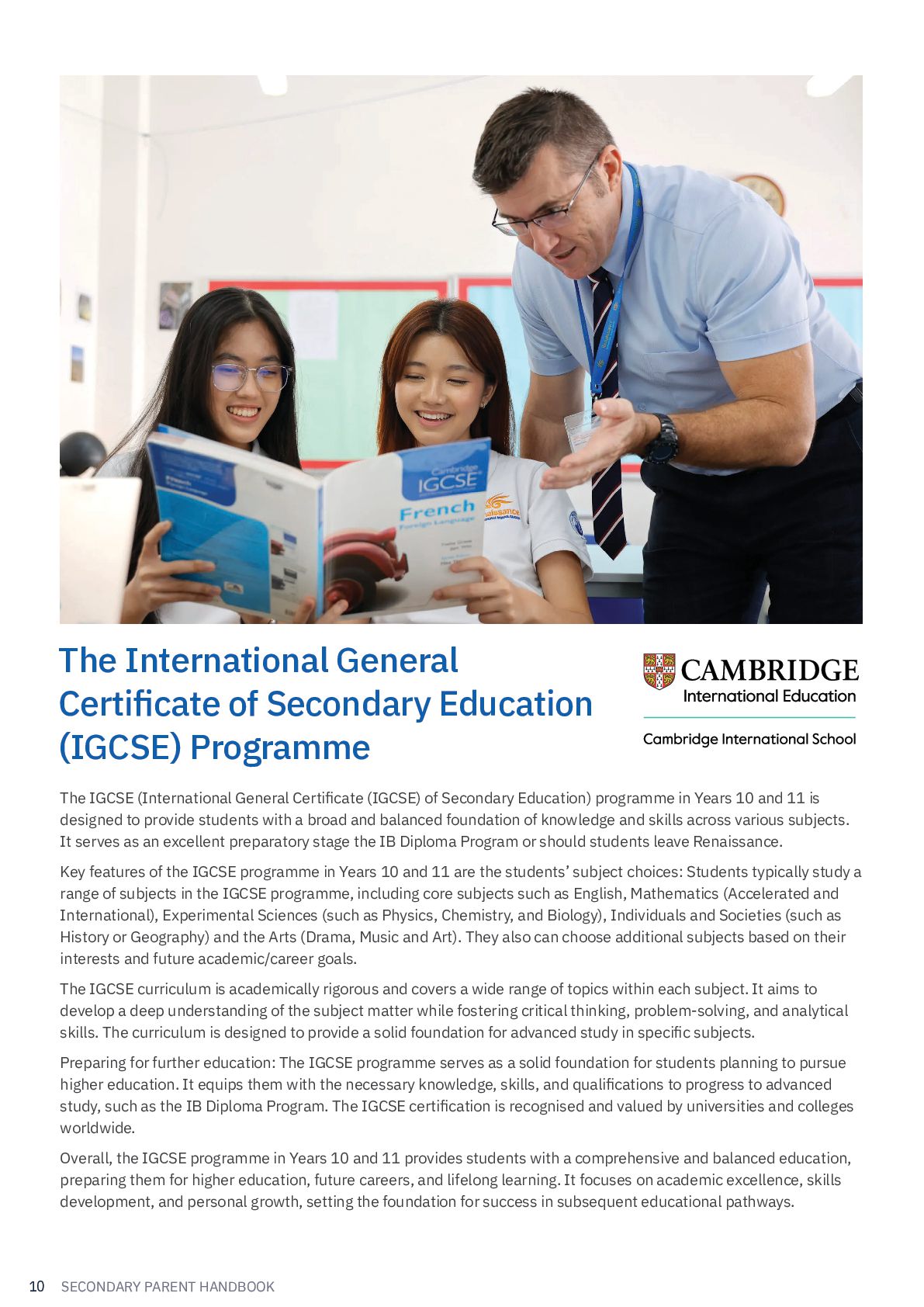
    in Years 10 and 11 is designed to provide students with a broad and balanced foundation of knowledge and skills across various subjects. It serves as an excellent preparatory stage the IB Diploma Program or should students leave Renaissance. Key features of the IGCSE programme in Years 10 and 11 are the students’ subject choices: Students typically study a range of subjects in the IGCSE programme, including core subjects such as English, Mathematics (Accelerated and International), Experimental Sciences (such as Physics, Chemistry, and Biology), Individuals and Societies (such as History or Geography) and the Arts (Drama, Music and Art). They also can choose additional subjects based on their interests and future academic/career goals. The IGCSE curriculum is academically rigorous and covers a wide range of topics within each subject. It aims to develop a deep understanding of the subject matter while fostering critical thinking, problem-solving, and analytical skills. The curriculum is designed to provide a solid foundation for advanced study in specific subjects. Preparing for further education: The IGCSE programme serves as a solid foundation for students planning to pursue higher education. It equips them with the necessary knowledge, skills, and qualifications to progress to advanced study, such as the IB Diploma Program. The IGCSE certification is recognised and valued by universities and colleges worldwide. Overall, the IGCSE programme in Years 10 and 11 provides students with a comprehensive and balanced education, preparing them for higher education, future careers, and lifelong learning. It focuses on academic excellence, skills development, and personal growth, setting the foundation for success in subsequent educational pathways. The International General Certificate of Secondary Education (IGCSE) Programme SECONDARY PARENT HANDBOOK 10
  9. At the end of the IBDP programme students will: The

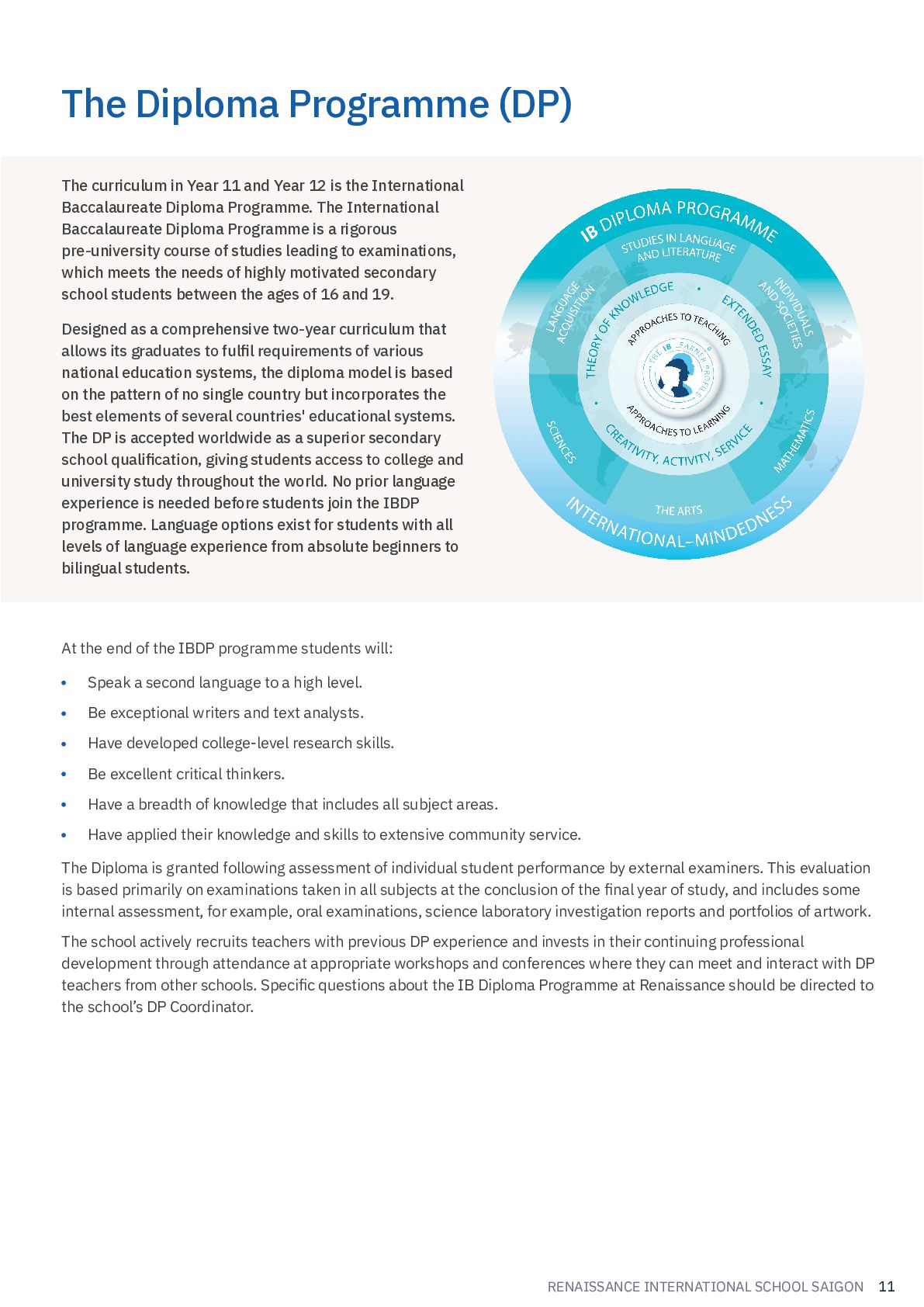
    Diploma is granted following assessment of individual student performance by external examiners. This evaluation is based primarily on examinations taken in all subjects at the conclusion of the final year of study, and includes some internal assessment, for example, oral examinations, science laboratory investigation reports and portfolios of artwork. The school actively recruits teachers with previous DP experience and invests in their continuing professional development through attendance at appropriate workshops and conferences where they can meet and interact with DP teachers from other schools. Specific questions about the IB Diploma Programme at Renaissance should be directed to the school’s DP Coordinator. The Diploma Programme (DP) The curriculum in Year 11 and Year 12 is the International Baccalaureate Diploma Programme. The International Baccalaureate Diploma Programme is a rigorous pre-university course of studies leading to examinations, which meets the needs of highly motivated secondary school students between the ages of 16 and 19. Designed as a comprehensive two-year curriculum that allows its graduates to fulfil requirements of various national education systems, the diploma model is based on the pattern of no single country but incorporates the best elements of several countries' educational systems. The DP is accepted worldwide as a superior secondary school qualification, giving students access to college and university study throughout the world. No prior language experience is needed before students join the IBDP programme. Language options exist for students with all levels of language experience from absolute beginners to bilingual students. RENAISSANCE INTERNATIONAL SCHOOL SAIGON 11 Speak a second language to a high level. Be exceptional writers and text analysts. Have developed college-level research skills. Be excellent critical thinkers. Have a breadth of knowledge that includes all subject areas. Have applied their knowledge and skills to extensive community service.
  10. SECONDARY PARENT HANDBOOK 12 English as an Additional Language (EAL)

    Our EAL teachers support English Language Learners (ELLs) to acquire proficiency and confidence in using English until they are able to work independently in all subjects. Students are supported by an EAL teacher in specific subjects during class time and where appropriate are pulled out to receive more specific help. Once students have reached a level of English that is considered proficient, they exit the EAL programme. Our EAL teachers work with classroom teachers to discuss differentiated instruction, assessment, and opportunities for co-teaching. Learning Support Teachers The Learning Support Teacher works with selected students across the Secondary School. The types of support include conducting informal and formal assessments, providing academic/behavioural/emotional support, consulting with parents/teachers, and making referrals to outside services. The collaborative work between Learning Support teachers, parents, students, and other teaching staff encourages individual students to meet their goals. Student learning support can take place in a number of ways, including: A referral for external evaluations is sometimes made for students who have not responded sufficiently to support or are exhibiting significant learning/behaviour challenges. Parents pay the fee and any other costs related to outside services. The results of the tests are discussed with the child's parents upon completion of the evaluation, and appropriate plans are formulated. Supporting students in accessing general education curriculum Providing explicit and specially designed instruction Supporting students with organisational, self-advocacy and study skills development Providing classroom accommodation and modification support Consulting with students, parents and teachers Supporting students in utilising assistive technology Promoting learning difference awareness Monitoring student progress Assessment informs the learner, and the learning community through the monitoring, documenting and measuring of learning. Assessment is a means for teachers to determine the effectiveness of teaching, guide curriculum development and review, and personalise learning. Assessment for students is to promote student responsibility for and ownership of learning and self-adjust based on the emerging data and feedback from teachers and peers. Assessment for parents is to communicate consistent, timely feedback and facilitate parents and teachers working together as advocates of student learning (Learning and Teaching). Assessment
  11. RENAISSANCE INTERNATIONAL SCHOOL SAIGON 13 Homework is typically defined as

    any tasks assigned to students by teachers that are meant to be carried out during non-school hours. At Renaissance the purpose of homework is to: practice skills and reinforce content, preview material for class discussion (in the flipped classroom) and study for quizzes and formative and summative assessments. Homework To be awarded an IB Diploma a student must: Satisfactorily complete a minimum of six IB subjects including Maths, English and another Language although, in some cases approved and validated online courses and/ or work experience can substitute for one certificate course. Satisfactorily complete the Creativity, Activity and Service (CAS) requirements in addition to the certificate course requirement outlined above. Meet all assignment deadlines within the time frame set by the faculty. Demonstrate a minimum attendance - including excused and unexcused absences - of at least 90%. All absences must be notified, approved and supported with a medical note where applicable. Adhere to all school policies and procedures and, in the process, demonstrate a high standard of conduct. IB Diploma The school offers an internal High School (HS) Diploma for students who are not involved in a full IB Diploma Programme. The HS Diploma requirements are identical to the requirements for a Renaissance Graduation Certificate although it should be noted that the school considers that a 3 is a passing grade for the purpose of a subject within this programme. If a Year 12 or Year 13 student wants to study an alternate course, then permission must be granted by the Head of Secondary and all applicable requirements met. High School Diploma Graduating from Renaissance
  12. SECONDARY PARENT HANDBOOK 14 Homeroom Each secondary student from Year

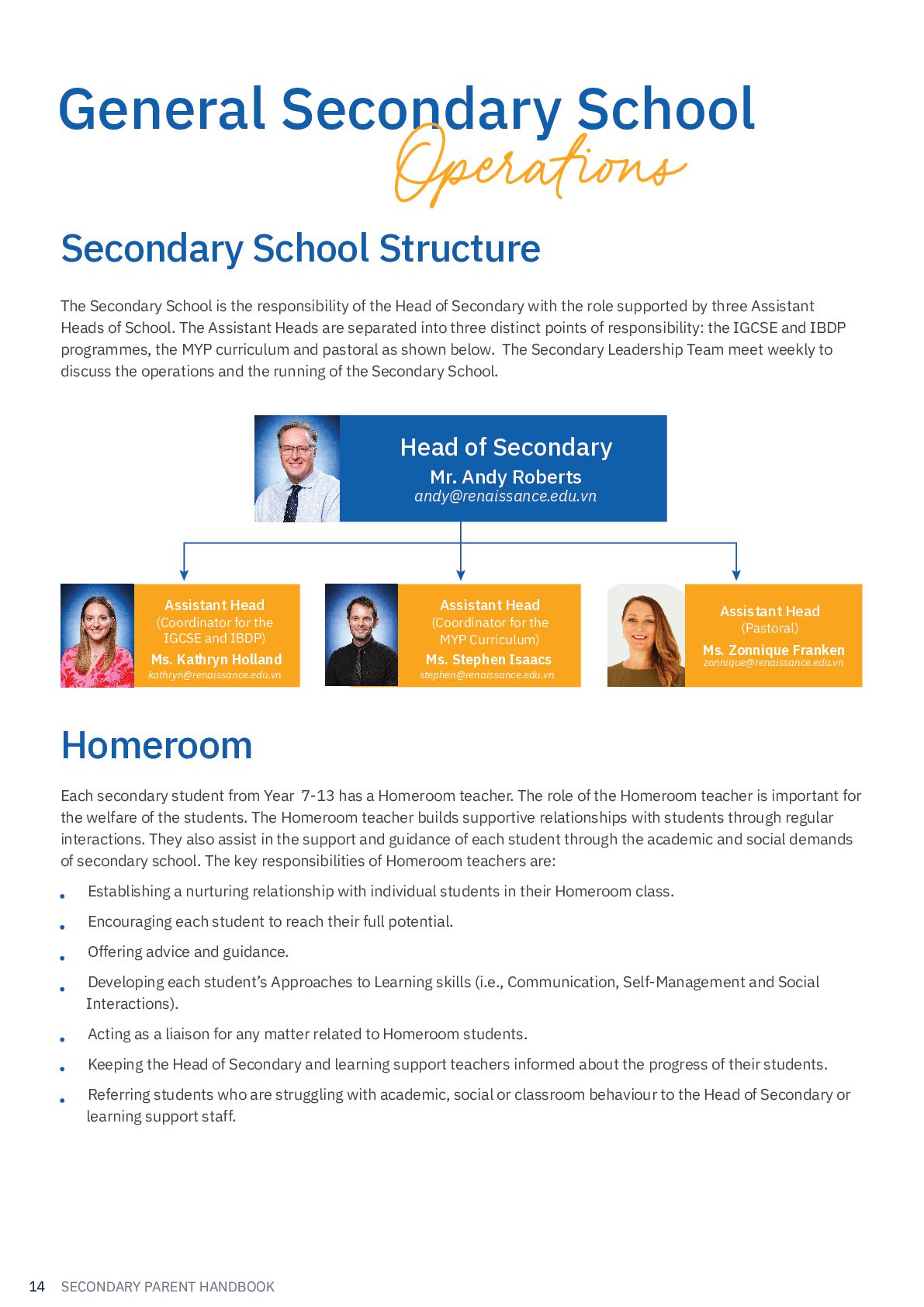
    7-13 has a Homeroom teacher. The role of the Homeroom teacher is important for the welfare of the students. The Homeroom teacher builds supportive relationships with students through regular interactions. They also assist in the support and guidance of each student through the academic and social demands of secondary school. The key responsibilities of Homeroom teachers are: Establishing a nurturing relationship with individual students in their Homeroom class. Encouraging each student to reach their full potential. Offering advice and guidance. Developing each student’s Approaches to Learning skills (i.e., Communication, Self-Management and Social Interactions). Acting as a liaison for any matter related to Homeroom students. Keeping the Head of Secondary and learning support teachers informed about the progress of their students. Referring students who are struggling with academic, social or classroom behaviour to the Head of Secondary or learning support staff. General Secondary School Opas Secondary School Structure The Secondary School is the responsibility of the Head of Secondary with the role supported by three Assistant Heads of School. The Assistant Heads are separated into three distinct points of responsibility: the IGCSE and IBDP programmes, the MYP curriculum and pastoral as shown below. The Secondary Leadership Team meet weekly to discuss the operations and the running of the Secondary School. [email protected] [email protected] Head of Secondary Assistant Head (Coordinator for the IGCSE and IBDP) Assistant Head (Coordinator for the MYP Curriculum) Assistant Head (Pastoral) Mr. Andy Roberts [email protected] Ms. Kathryn Holland Ms. Zonnique Franken Ms. Stephen Isaacs [email protected] [email protected] [email protected]
  13. RENAISSANCE INTERNATIONAL SCHOOL SAIGON 15 At 3.30 pm, school is

    dismissed. Sports practices start at 3.40 pm and conclude at 4.30 pm unless we have varsity games that go on longer. No supervision is provided after school for students, and parents who pick their children up from school are requested to be at the school by 3.30 pm. Unless involved in a designated school activity, students must leave the campus by no later than 4:00 pm. Students are not permitted to stay on campus unless they are participating in an extracurricular activity. Dismissal School is in session between 7.30 am and 3.30 pm. Students are supervised by their homeroom teachers until the start of classes at 8am. A School day Break Times Break times at Renaissance are 30 minutes in the morning and an hour for lunch. During these times students will be expected to move outside the school buildings. Staff on duty are expected to encourage students to move outside. The exceptions to this will be on rainy days and poor air quality days, when students remain indoors. The conditions on the day will obviously determine when this will be decided. Students are able to use the outside pitch, the library and the gymnasium or other venues deemed suitable. Students need to arrive by 7.50 am. Students who arrive late are to report to the Secondary School office to sign in so the attendance can be updated. Parents will be informed of repeated tardiness, which can greatly impact student learning and their school report. Arrival Students are not allowed to leave the campus during school hours. If a student needs to depart early, parents have several options. They can inform the secondary school office ahead of time via phone, email and pick the child up from the office at a predetermined time, or parents can report to the office in person and sign their child out. All students departing early with permission, must sign out from the secondary school office. Early Dismissal/Pick Up Absences The Secondary School Office should be informed of all absences as early as possible via phone or email. On a daily basis, the Secondary School Office will contact parents whose children are absent without reason. In the event of serious illness, parents are requested to inform the school, giving details of the nature of the illness and the anticipated length of absence. Parents should inform the school, in writing, of any ailment that might affect the student's participation in any class or sports activities. Late Arrival
  14. School Supplies It is suggested that students bring to school

    the following items: Backpack to carry their belongings School supplies that they may need such as a laptop, pens and pencils A Shatterproof water bottle to ensure they can remain hydrated throughout the day Healthy snacks and lunch (unless purchasing school lunch) Renaissance PE Uniform and sports shoes on PE days (this is compulsory) Care and Replacement of Books and Materials Students have a responsibility to look after any books and materials supplied by the school. If a student loses or damages a book or materials beyond reasonable wear and tear, they will be charged for a full cost replacement. Personal Property Students are discouraged from bringing non-essential belongings to school. The school accepts no financial responsibility for personal items that go missing at school. We recommend that items of value (monetary, personal, and sentimental) are not brought to school. Please make sure you label your clothes and school equipment prior to the start of the year. Do not bring to school overly valuable or breakable items. The school cannot be responsible for the security of any personal property that students bring onto the campus or take on field trips or school journeys. We discourage students from bringing any items of value to school as they are not needed during the regular day. If a student does lose any item, please check Lost and Found station located near the Canteen. Unclaimed items will be cleared at the end of each term and given to local charities or recycled. If items cannot be found students should contact the PA to Head of Secondary. SECONDARY PARENT HANDBOOK 16
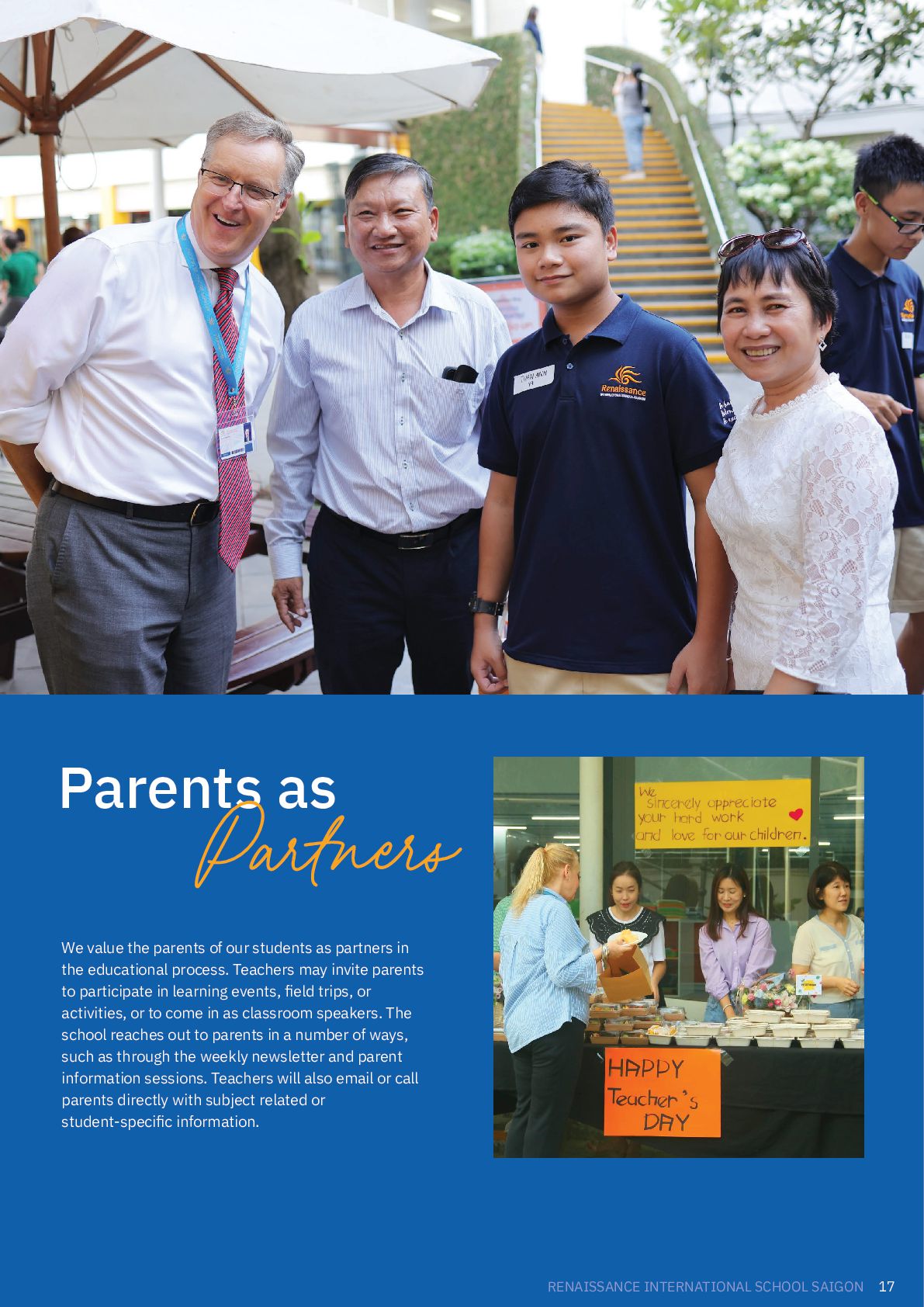
  15. We value the parents of our students as partners in

    the educational process. Teachers may invite parents to participate in learning events, field trips, or activities, or to come in as classroom speakers. The school reaches out to parents in a number of ways, such as through the weekly newsletter and parent information sessions. Teachers will also email or call parents directly with subject related or student-specific information. Parents as Ps Cmunica Home – School RENAISSANCE INTERNATIONAL SCHOOL SAIGON 17
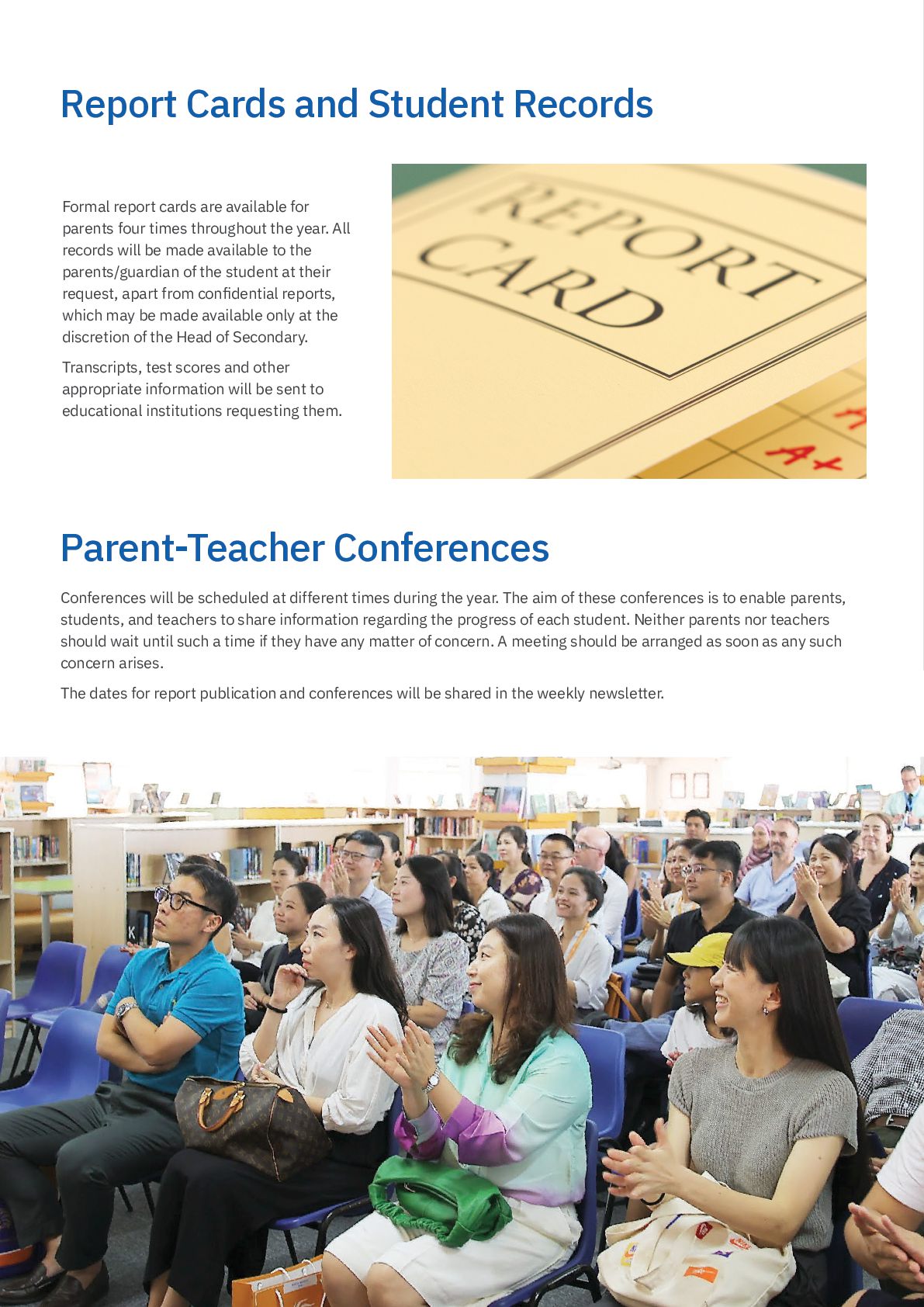
  16. PYP CURRICULUM HANDBOOK 24 Formal report cards are available for

    parents four times throughout the year. All records will be made available to the parents/guardian of the student at their request, apart from confidential reports, which may be made available only at the discretion of the Head of Secondary. Transcripts, test scores and other appropriate information will be sent to educational institutions requesting them. Conferences will be scheduled at different times during the year. The aim of these conferences is to enable parents, students, and teachers to share information regarding the progress of each student. Neither parents nor teachers should wait until such a time if they have any matter of concern. A meeting should be arranged as soon as any such concern arises. The dates for report publication and conferences will be shared in the weekly newsletter. Parent-Teacher Conferences Report Cards and Student Records
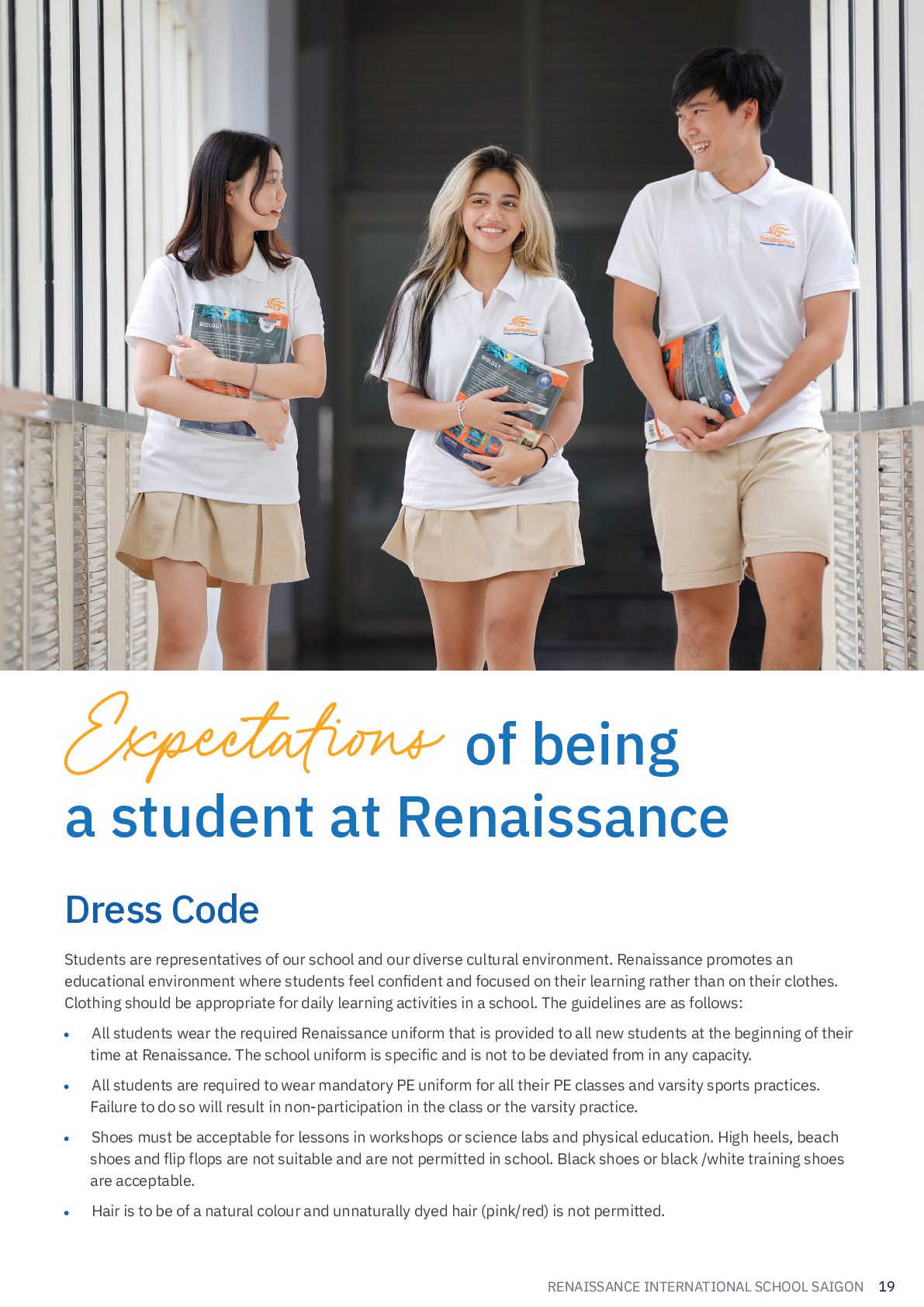
  17. Expectas of being a student at Renaissance Cmunica Home –

    School Dress Code Students are representatives of our school and our diverse cultural environment. Renaissance promotes an educational environment where students feel confident and focused on their learning rather than on their clothes. Clothing should be appropriate for daily learning activities in a school. The guidelines are as follows: All students wear the required Renaissance uniform that is provided to all new students at the beginning of their time at Renaissance. The school uniform is specific and is not to be deviated from in any capacity. All students are required to wear mandatory PE uniform for all their PE classes and varsity sports practices. Failure to do so will result in non-participation in the class or the varsity practice. Shoes must be acceptable for lessons in workshops or science labs and physical education. High heels, beach shoes and flip flops are not suitable and are not permitted in school. Black shoes or black /white training shoes are acceptable. Hair is to be of a natural colour and unnaturally dyed hair (pink/red) is not permitted. RENAISSANCE INTERNATIONAL SCHOOL SAIGON 19
  18. SECONDARY PARENT HANDBOOK 20 Student behavourial expectations values and beliefs

    are derived from the IB Learner Profile attributes and our expected levels of behaviour within the school on a daily basis. The Student Code of Conduct applies to all school activities including evening and weekend events as well as school sanctioned trips, local as well as international. Students are under the authority of all teachers at all times in the classroom and anywhere on campus or while attending or travelling to and from school activities. Infractions of the Student Code of Conduct are divided into two categories: misbehaviour and grave (extremely serious) misconduct. Renaissance uses a progressive discipline approach when dealing with instances of student misbehaviour and student misconduct – wherever necessary a differentiated approach is implemented. Positive Behaviour Disruptive or inappropriate behaviour in class, or in the school generally. Disruptive or inappropriate behaviour while travelling on school buses and/or failing to follow instructions from the bus driver. Littering, failing to put away garbage, making or leaving a mess in the classroom, the cafeteria or the hallways. Failing to obey established classroom expectations. Other behaviours, which in the judgement of the school disrupt the learning environment. Examples of Misbehaviour Consequences for misbehaviour may include Being assigned a different seat in the classroom Conference or detention with the teacher or Head of Secondary Parental telephone contact or conference Guidance referral or a case conference with teachers and the student Being assigned a lunchtime or after school detention Other consequences as determined by the Head of Secondary. Persistent misbehaviour. Noncompliance or defiant, argumentative, or oppositional behaviour toward teachers. Possession or use of tobacco products. Possession or use of products used for vaping or e-cigarettes. Possession or use of illicit drugs or alcohol. Stealing or being in possession of stolen goods. Fighting, inciting violence, bullying, harassing, intimidating or issuing threats. Making verbal or written statements that are bigoted, racist, homophobic, sexist, or defamatory. Using foul or profane language. Violating the privacy of others or subjecting them to ridicule in any way including the use of electronic means such as email, photography, or audio recording. All forms of vandalism including graffiti. Possession of a weapon or any behaviour that could jeopardise the health and safety of others. Any form of plagiarism or cheating on an internal or external assignment or exam. Other behaviours which in the opinion of the school constitute grave misconduct. Examples of Serious Misconduct
  19. RENAISSANCE INTERNATIONAL SCHOOL SAIGON 21 Consequences for Serious Misconduct may

    include Referral to Head of Secondary and detention or out of school suspension. Recording of the referral in the student’s file. Parental conference, cautionary letter to file, mandatory counselling. Compensation for damages or restitution of property. Student placed on a behavioural contract Loss of privileges (such as participation in school events) Recommendation for expulsion. Illegal activities such as the possession, use or distribution of banned substances including drugs and alcohol will be referred to the authorities. Other consequences as determined by the Educational Leadership Team. Detention Procedures Behavourial Contract Teachers may detain students in their classroom for a period of review and reflection following cases of misbehaviour. Teachers will contact parents when students are required to serve detention after school. An effort will be made to notify parents of all school detentions and a parent conference may be scheduled. Students will be placed on probation when there is a serious concern related to attendance, behaviour or academics. There will be a differentiation made between academic and behavioural probation. Students on probation will not be allowed to participate in any extracurricular activities (school related). The student’s parents will be notified, and a plan of action will be developed. Students will remain on probation until they have reached the conditions outlined in the plan. Out of School Suspension and Recommendation for Expulsion Out of school suspension will be utilised after other disciplinary methods have been used, except when, in the opinion of the school, an immediate suspension is warranted. Suspended students are responsible for all school work missed during the suspension. They may arrange to come to school before or after regular hours in order to obtain assignments and to submit work. Students must make prior arrangements with the Head of Secondary to come to the school. When, in the judgement of the Head of School and the Senior Leadership Team, it is in the best interest of the school and the other students, a suspended student may be recommended for expulsion. Expulsion is a very serious disciplinary procedure. The student is removed from school for the duration of a semester, a school year or permanently. The expelled student will not be allowed on campus after he/she is expelled. When a recommendation for expulsion is pending, a student will be suspended while a written recommendation for expulsion is prepared for approval by the Board of Governors. At Renaissance, mobile phones are not permitted to be used throughout the day and are to be kept in school bags or lockers. We are proud of the positive effects of our limited mobile phone policy during the day. By reducing phone usage, we create an environment that fosters focused learning, effective communication, and deeper interpersonal connections. Students are able to fully engage in classroom discussions, develop critical thinking skills, and cultivate face-to-face interactions. This policy encourages self-discipline, digital responsibility, and a healthy balance between technology and real-life experiences. We have witnessed the positive impact of this policy on our students' academic performance, social interactions, and overall well-being. It's important to note, the older students, in the DP cohort, are able to use their phones when in their common room as a privilege and point of responsibility. Mobile Phone Use on Campus
  20. SECONDARY PARENT HANDBOOK 22 Common Language At Renaissance, English is

    our common language and students are expected to communicate in English whenever and wherever possible. It’s important to note our language of instruction is English. Language can be both inclusive and exclusive and as an international school, we will always promote and uphold inclusivity over exclusivity. Academic Probation Academic probation is defined as any student with outstanding assignments or having multiple failing grades on the term reports or end of year report. Repeated failure to submit assignments on time or to be present for class summatives may also result in a student being placed on academic probation. Secondary Attendance Expectations At Renaissance, much of the work is integrated and done collaboratively. Every student is an essential contributor to the learning community at Renaissance. It is essential that students are present in the classroom for shared learning to be successful. During absences, students will potentially miss a portion of the academic programme, which could adversely affect learning outcomes and grades. We believe of the importance of Parents, teachers and administrators partnering together in supporting students to attend school regularly and to arrive at class on time. Repeated absences may have an effect on the evaluation of the student's progress. Planned dental and medical appointments, family trips, etc. should be arranged so that they do not conflict with school whenever possible. Our goals are to: Instill in students and parents the understanding that regular attendance is core to learning. Cultivate effective skills for self-management. Develop collaboration and communication skills through regular participation. Support students to take responsibility for their actions and the consequences that follow. Ensure students grow from the range of experiences offered in the school. Foster ongoing interdependence to allow for constructivist learning to take place. All community members, including students, should aim to achieve and develop the IB learner profile attributes. From a young age, students are expected to be able to distinguish between what is right and wrong. In the context of academic integrity, one of the most important attributes is to be "principled" and all students are expected to act honestly, responsibly, and ethically. Students are not just recipients of content but are also expected to create content and complete assessments that are authentic and genuine, and a true reflection of their personal level of achievement. It is expected that all students understand and accept the principle of academic integrity and face the challenges associated with it. All students are required to sign an agreement of understanding that they have read and fully understand the school’s Academic Integrity Policy. All students from Year 7 to Year 13 at Renaissance are responsible for: Ensuring that the work they submit is their own. Acknowledging sources of information appropriately. Reviewing their work prior to submission to check that all sources of information are acknowledged. Academic Integrity
  21. RENAISSANCE INTERNATIONAL SCHOOL SAIGON 23 The Bring Your Own Device

    (BYOD) Programme is applicable all students from Year 7 through to Year 13 and is guided by the school’s Acceptable Use Policy which all students have to read and sign before they are able to bring in their own device. For the purpose of the BYOD Programme students are allowed to bring their own devices to be used under the direct supervision of the teacher. A device under the terms of the BYOD Programme refers to a laptop, tablet, I-Pad, notebook or similar. A device under the terms of the BYOD Programme does not mean a mobile phone. The school, through its network, will provide wireless connectivity. This does not include access to Renaissance network resources such as file shares or printers. Any or all access through the wireless network may be monitored and/ or recorded for the purposes of network security and student safety. The student is responsible for their device and the school will not accept any liability for any loss/ theft/ damage of the student owned device. The student is responsible for ensuring that the device is in good condition, and this includes updates, anti-virus software and general repair. Device use is limited to classrooms where the teacher has given permission to use it and only the school’s provided email address can be used. Students may not use any device or service for non-educational purposes during class time unless permitted. No device may be used to record, store or transmit any kind of image, sound or video from the school unless previously authorised by the Head of School, Head of Divison or Director of Marketing and Communication. If a reasonable belief exists that a student has violated the terms of this agreement the device may be inspected and/ or confiscated and the student may be subject to further disciplinary action. If there is any risk of spam or virus on the device as detected by the IT Department, student access can be terminated without any advanced notice. Before accessing the network, students and a parent/ legal guardian must review and sign the Acceptable Use Policy which is regarded as a binding agreement and includes the following. Bring Your Own Device (BYOD) and The Acceptable User Agreement Having a full understanding of the academic integrity policy (Link to the academic policy) Meeting interim and final deadlines for a piece of work to allow the teacher to make checks of authentic authorship. Responding to acts of academic misconduct or school malpractice and reporting them to their teachers and /or programme coordinators Completing all assignments, tasks, examinations, and quizzes in an honest manner and to the best of their abilities. Giving credit to used sources in all work submitted for assessment in written and oral materials and/or artistic products. Abstaining from receiving non-permitted assistance in the completion or editing of work, such as from friends, relatives, other students, private tutors, essay writing or copy-editing services or pre-written essay banks or file sharing websites. Abstaining from giving undue assistance to peers in the completion of their work. Showing a responsible use of the internet and associated social media platforms. Our philosophy and guiding principles for academic integrity can be found in the Renaissance Academic Integrity Policy. Being aware of the consequences of academic misconduct Secondary students at Renaissance are also responsible for: Introduction: Guidelines:
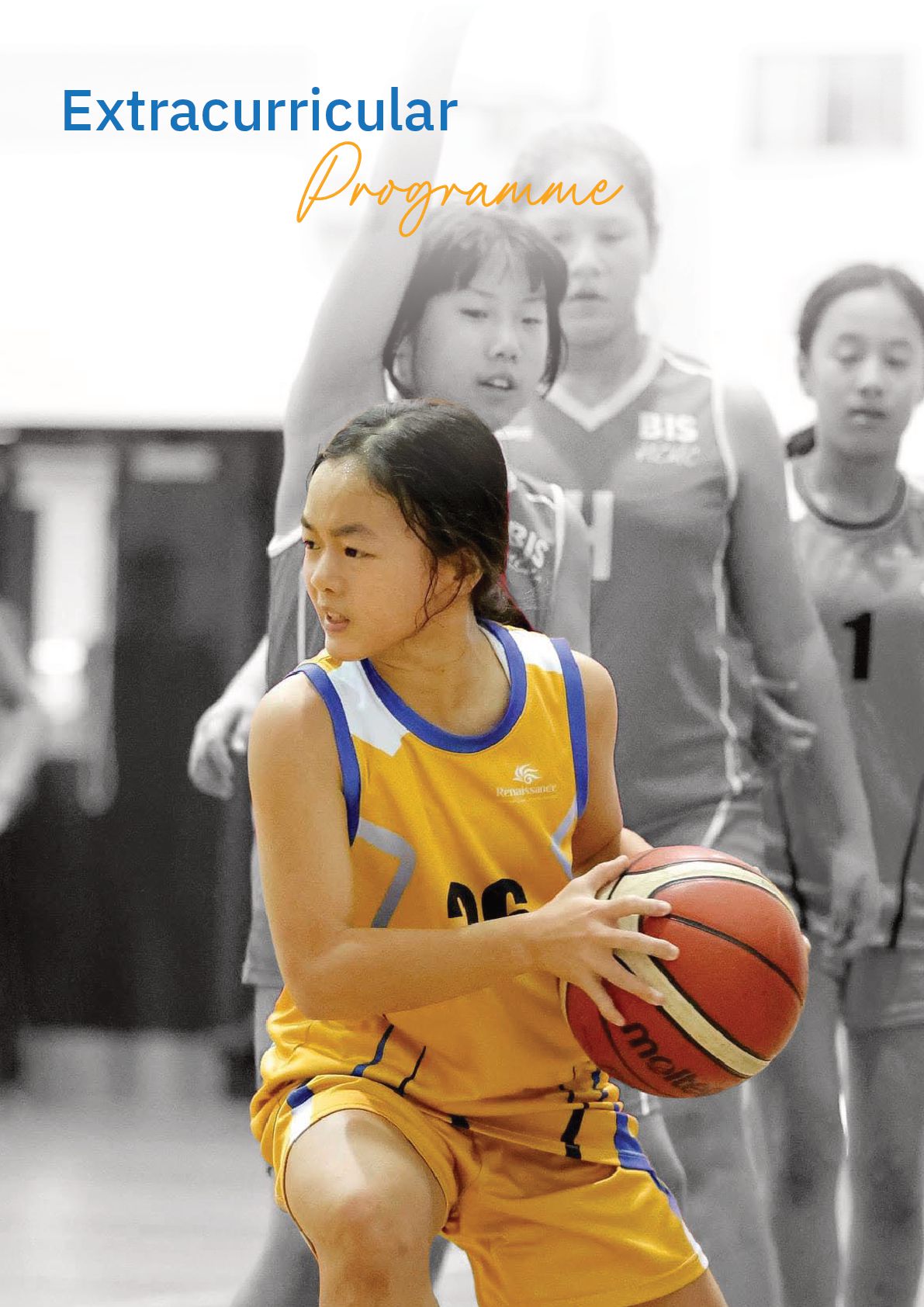
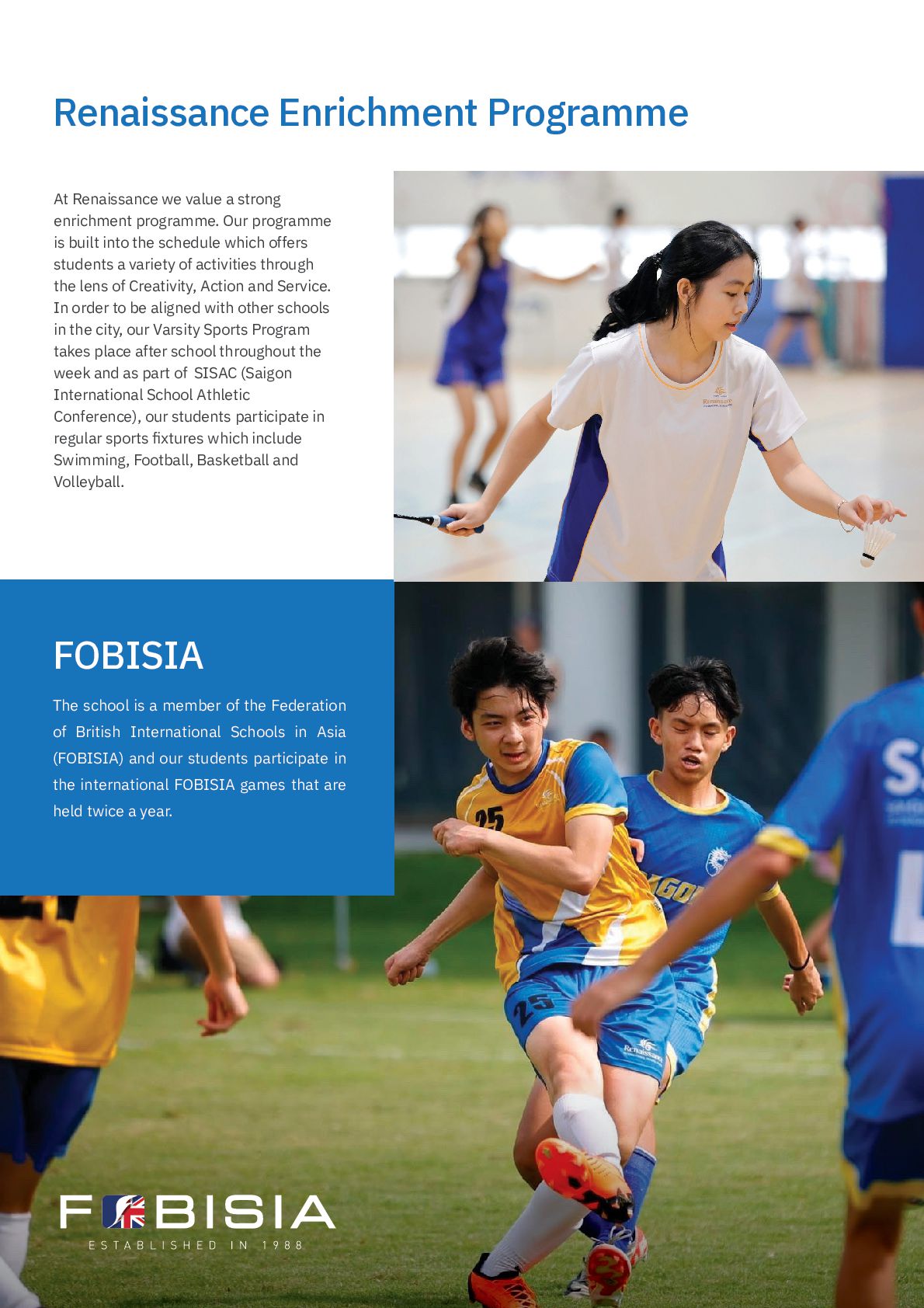
  22. At Renaissance we value a strong enrichment programme. Our programme

    is built into the schedule which offers students a variety of activities through the lens of Creativity, Action and Service. In order to be aligned with other schools in the city, our Varsity Sports Program takes place after school throughout the week and as part of SISAC (Saigon International School Athletic Conference), our students participate in regular sports fixtures which include Swimming, Football, Basketball and Volleyball. Renaissance Enrichment Programme The school is a member of the Federation of British International Schools in Asia (FOBISIA) and our students participate in the international FOBISIA games that are held twice a year. FOBISIA
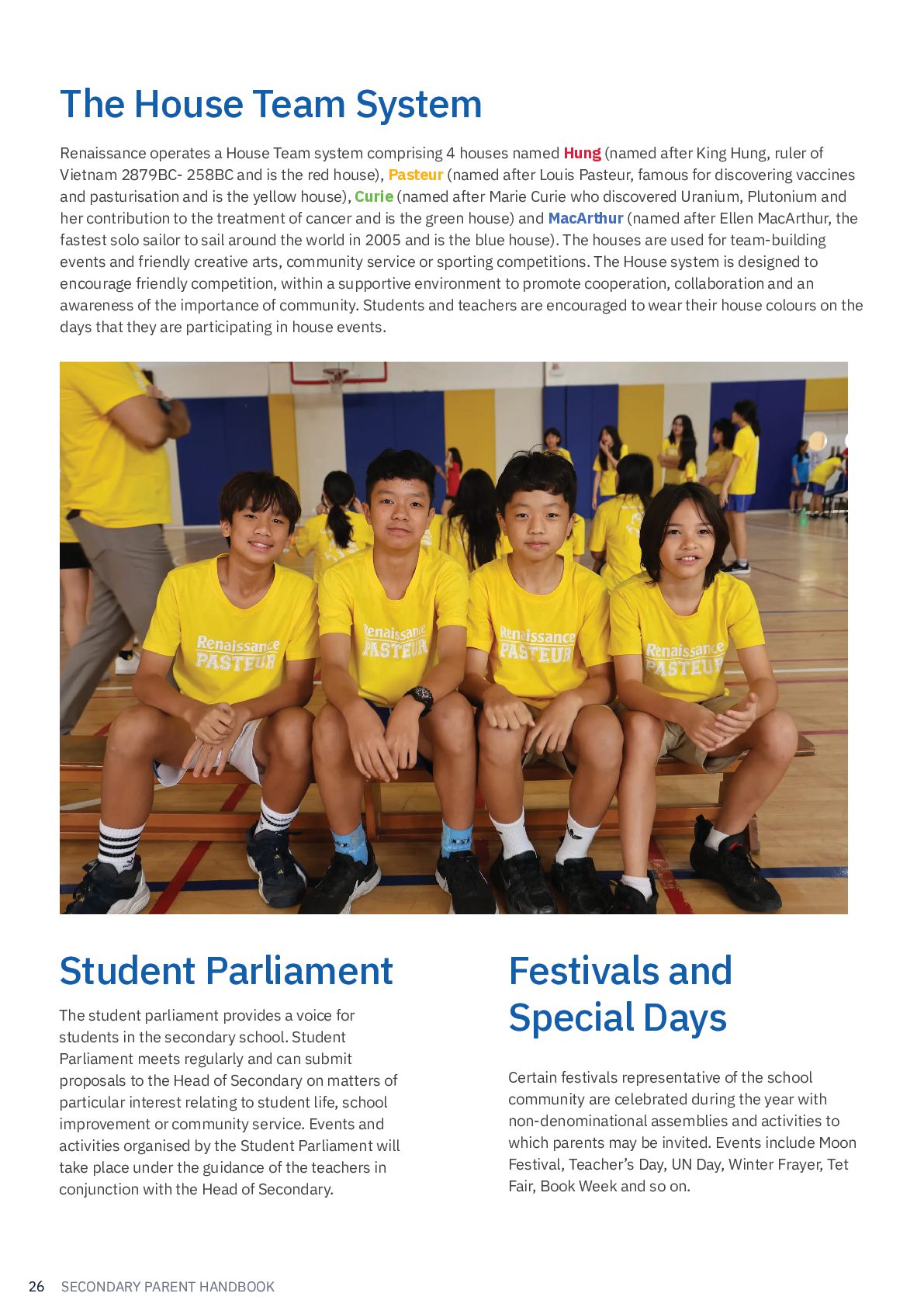
  23. The House Team System Renaissance operates a House Team system

    comprising 4 houses named Hung (named after King Hung, ruler of Vietnam 2879BC- 258BC and is the red house), Pasteur (named after Louis Pasteur, famous for discovering vaccines and pasturisation and is the yellow house), Curie (named after Marie Curie who discovered Uranium, Plutonium and her contribution to the treatment of cancer and is the green house) and MacArthur (named after Ellen MacArthur, the fastest solo sailor to sail around the world in 2005 and is the blue house). The houses are used for team-building events and friendly creative arts, community service or sporting competitions. The House system is designed to encourage friendly competition, within a supportive environment to promote cooperation, collaboration and an awareness of the importance of community. Students and teachers are encouraged to wear their house colours on the days that they are participating in house events. The student parliament provides a voice for students in the secondary school. Student Parliament meets regularly and can submit proposals to the Head of Secondary on matters of particular interest relating to student life, school improvement or community service. Events and activities organised by the Student Parliament will take place under the guidance of the teachers in conjunction with the Head of Secondary. Student Parliament Certain festivals representative of the school community are celebrated during the year with non-denominational assemblies and activities to which parents may be invited. Events include Moon Festival, Teacher’s Day, UN Day, Winter Frayer, Tet Fair, Book Week and so on. Festivals and Special Days SECONDARY PARENT HANDBOOK 26
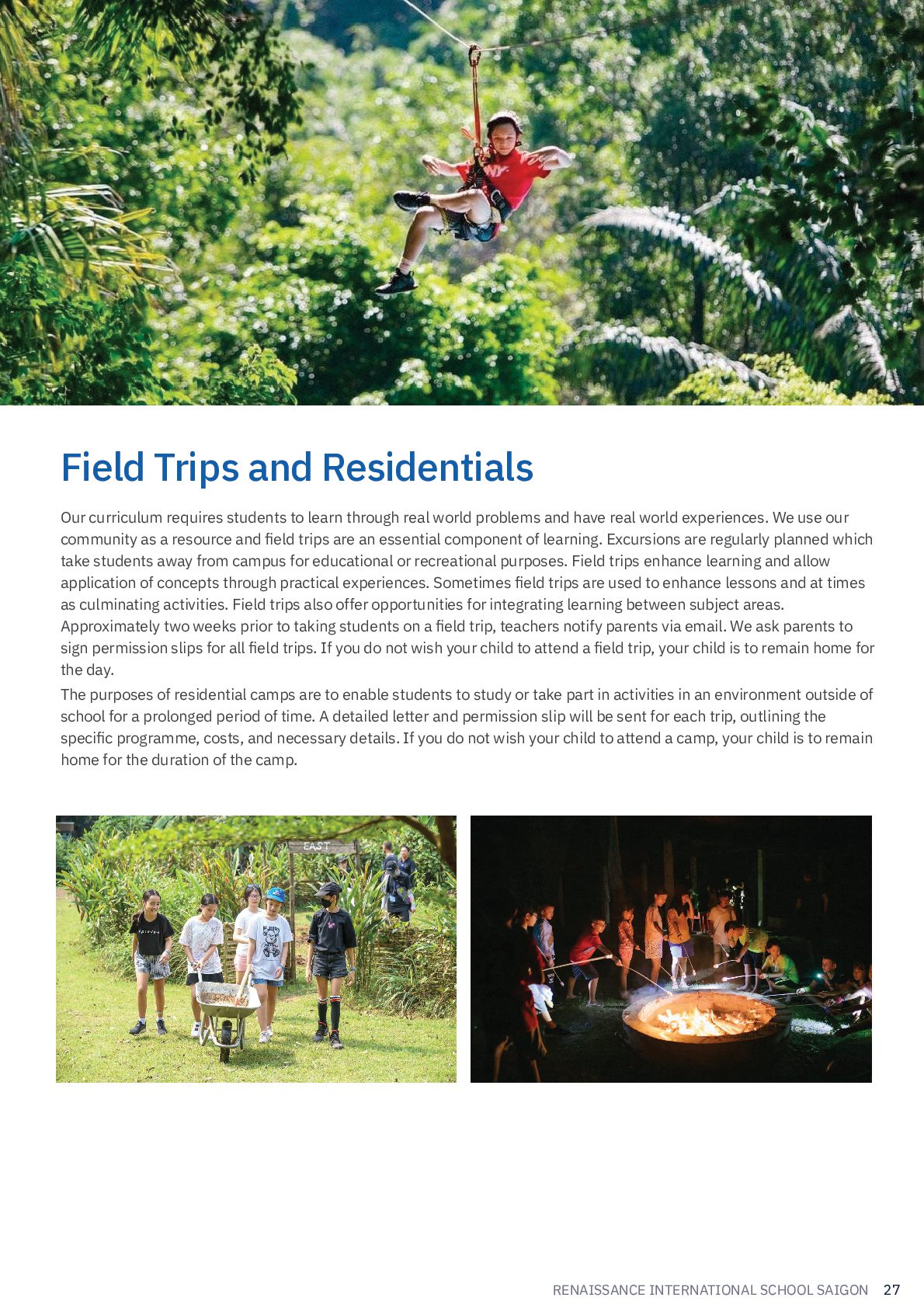
  24. Field Trips and Residentials Our curriculum requires students to learn

    through real world problems and have real world experiences. We use our community as a resource and field trips are an essential component of learning. Excursions are regularly planned which take students away from campus for educational or recreational purposes. Field trips enhance learning and allow application of concepts through practical experiences. Sometimes field trips are used to enhance lessons and at times as culminating activities. Field trips also offer opportunities for integrating learning between subject areas. Approximately two weeks prior to taking students on a field trip, teachers notify parents via email. We ask parents to sign permission slips for all field trips. If you do not wish your child to attend a field trip, your child is to remain home for the day. The purposes of residential camps are to enable students to study or take part in activities in an environment outside of school for a prolonged period of time. A detailed letter and permission slip will be sent for each trip, outlining the specific programme, costs, and necessary details. If you do not wish your child to attend a camp, your child is to remain home for the duration of the camp. RENAISSANCE INTERNATIONAL SCHOOL SAIGON 27
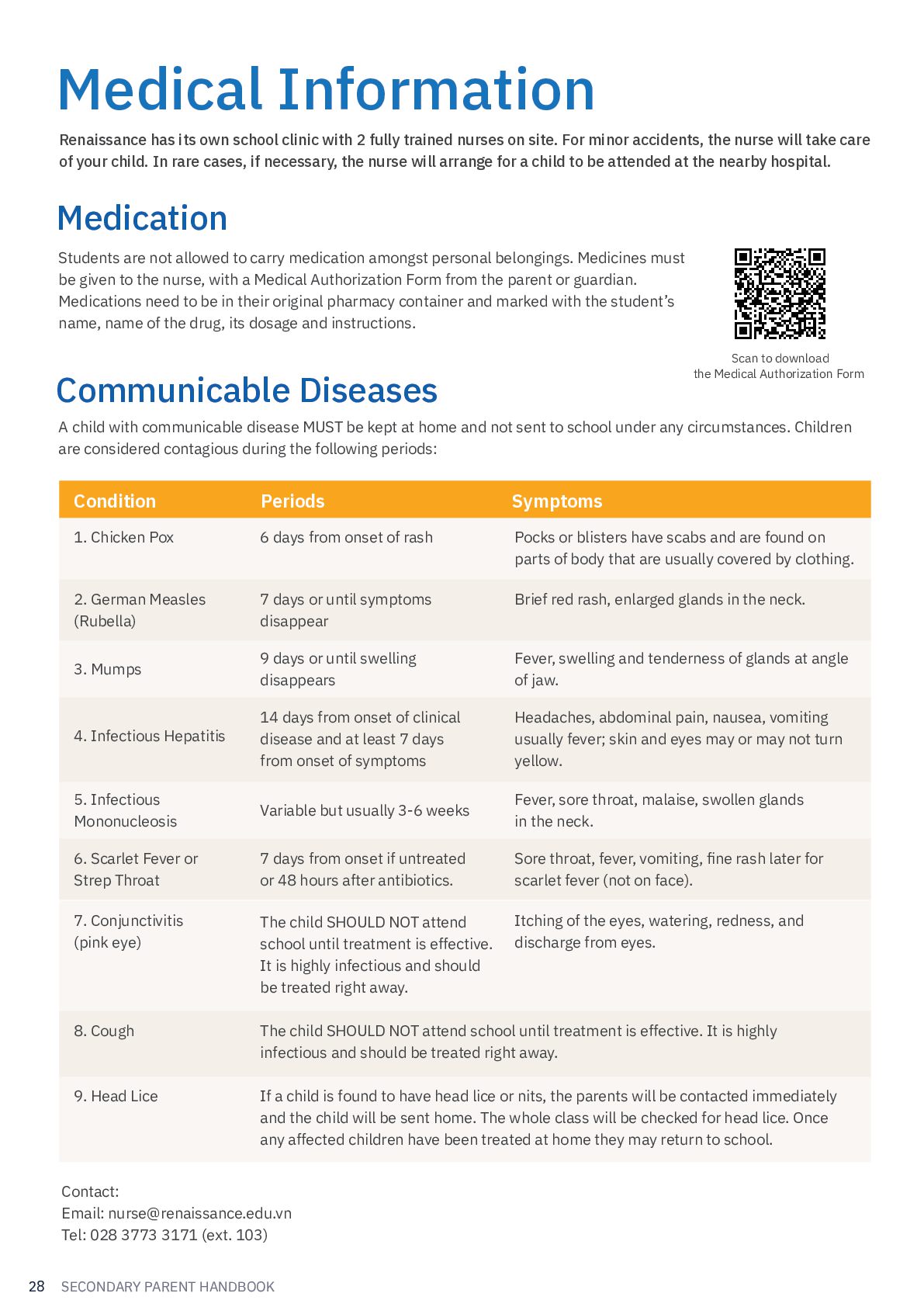
  25. SECONDARY PARENT HANDBOOK 28 Renaissance has its own school clinic

    with 2 fully trained nurses on site. For minor accidents, the nurse will take care of your child. In rare cases, if necessary, the nurse will arrange for a child to be attended at the nearby hospital. Medical Information Students are not allowed to carry medication amongst personal belongings. Medicines must be given to the nurse, with a Medical Authorization Form from the parent or guardian. Medications need to be in their original pharmacy container and marked with the student’s name, name of the drug, its dosage and instructions. Scan to download the Medical Authorization Form A child with communicable disease MUST be kept at home and not sent to school under any circumstances. Children are considered contagious during the following periods: Medication Communicable Diseases Periods Condition Symptoms 1. Chicken Pox 2. German Measles (Rubella) 6 days from onset of rash 7 days or until symptoms disappear Pocks or blisters have scabs and are found on parts of body that are usually covered by clothing. Brief red rash, enlarged glands in the neck. 3. Mumps 9 days or until swelling disappears Fever, swelling and tenderness of glands at angle of jaw. 4. Infectious Hepatitis 14 days from onset of clinical disease and at least 7 days from onset of symptoms Headaches, abdominal pain, nausea, vomiting usually fever; skin and eyes may or may not turn yellow. 5. Infectious Mononucleosis Variable but usually 3-6 weeks Fever, sore throat, malaise, swollen glands in the neck. 6. Scarlet Fever or Strep Throat 7 days from onset if untreated or 48 hours after antibiotics. Sore throat, fever, vomiting, fine rash later for scarlet fever (not on face). 7. Conjunctivitis (pink eye) The child SHOULD NOT attend school until treatment is effective. It is highly infectious and should be treated right away. Itching of the eyes, watering, redness, and discharge from eyes. 8. Cough The child SHOULD NOT attend school until treatment is effective. It is highly infectious and should be treated right away. 9. Head Lice If a child is found to have head lice or nits, the parents will be contacted immediately and the child will be sent home. The whole class will be checked for head lice. Once any affected children have been treated at home they may return to school. Contact: Email: [email protected] Tel: 028 3773 3171 (ext. 103)
  26. RENAISSANCE INTERNATIONAL SCHOOL SAIGON 29 Conduct Guidelines School Facilities Cmunica

    Home – School d Students can access the cafeteria during break and lunchtimes. Renaissance provides excellent food that provides healthy, balanced meals. Students may also bring in a packed lunch. However, food is not permitted to be ordered in during the day under any circumstances. Dinning Room The primary purpose of the elevator in Block A is to assist adults and mobility challenged students (crutches, wheelchairs, etc) with a safe travel option between the floors of the building. Additionally, the elevator is to assist with the moving of large and heavy equipment and instruments between floors. All other students are prohibited from using the school elevator in the building unless otherwise authorised to do so. The school nurse will provide a dated document to allow elevator use. Elevator Use Part of any good education, learned at home or in school, is how to behave appropriately in various social or cultural situations. Gymnasium and Auditorium etiquette may differ from time to time depending on the nature of the event. For example, shouting at a concert is inappropriate, while totally appropriate at a basketball game. In all situations, however, all students and spectators should behave with respect to performers and other spectators in a courteous manner. Students are to remember that they represent and are ambassadors of Renaissance. Any student or spectator that infringes on the rights of others may be asked to leave the venue. First aid boxes are held in the school office, the Secondary Office and in school buses when they are used for excursions. If a student requires minor First Aid they should, if able, make their way to the Secondary Main reception or the Nurse's room located on the first floor of the Elementary Building. First aid will be limited to cleaning wounds, use of cold compress etc. If there is need for any more serious treatment, the school nurse will coordinate the process. First Aid/ Serious Accidents Sports Hall and Theatre
  27. RENAISSANCE INTERNATIONAL SCHOOL SAIGON 74 Nguyen Thi Thap, Binh Thuan

    Ward, District 7, HCMC (028) 3773 3171 www.renaissance.edu.vn A P W