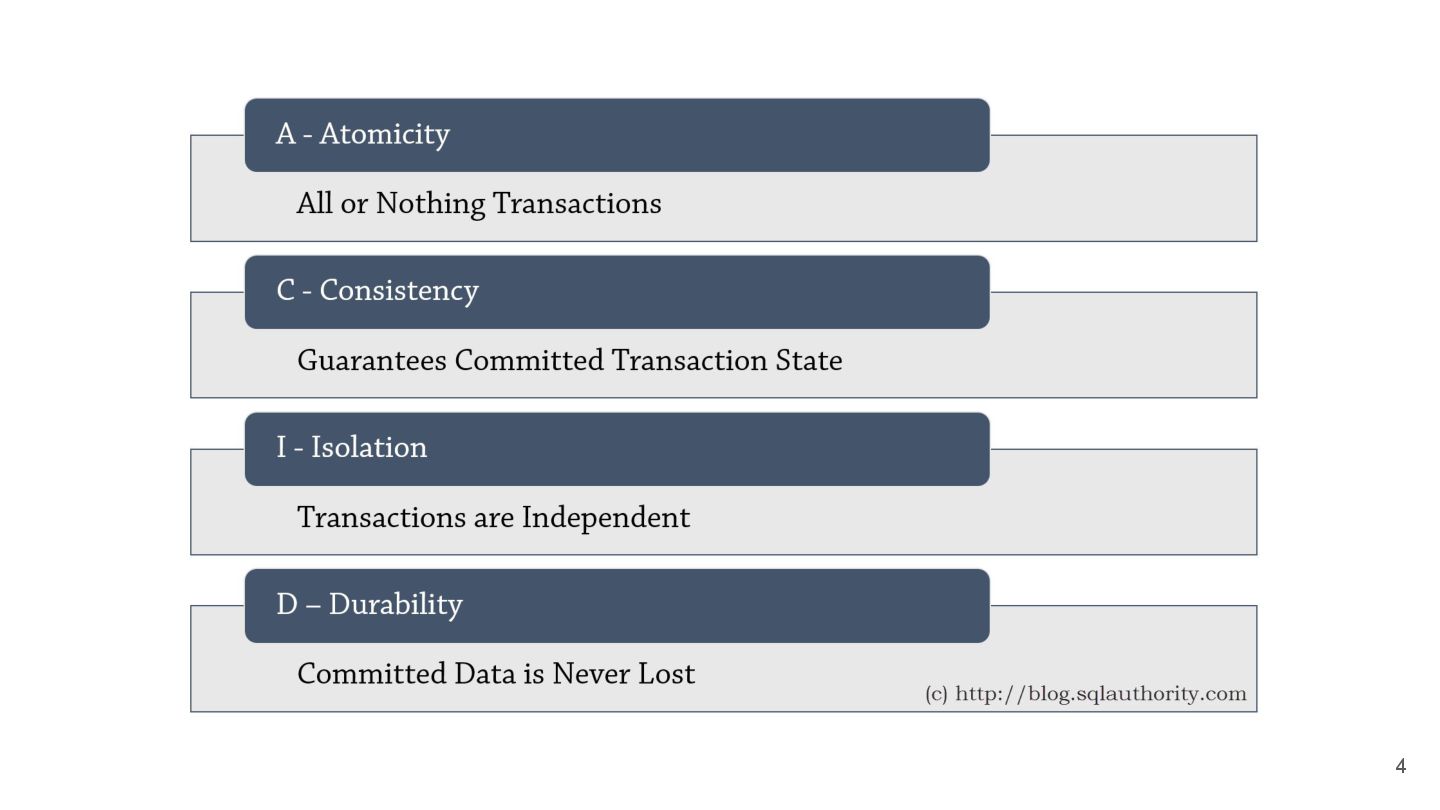
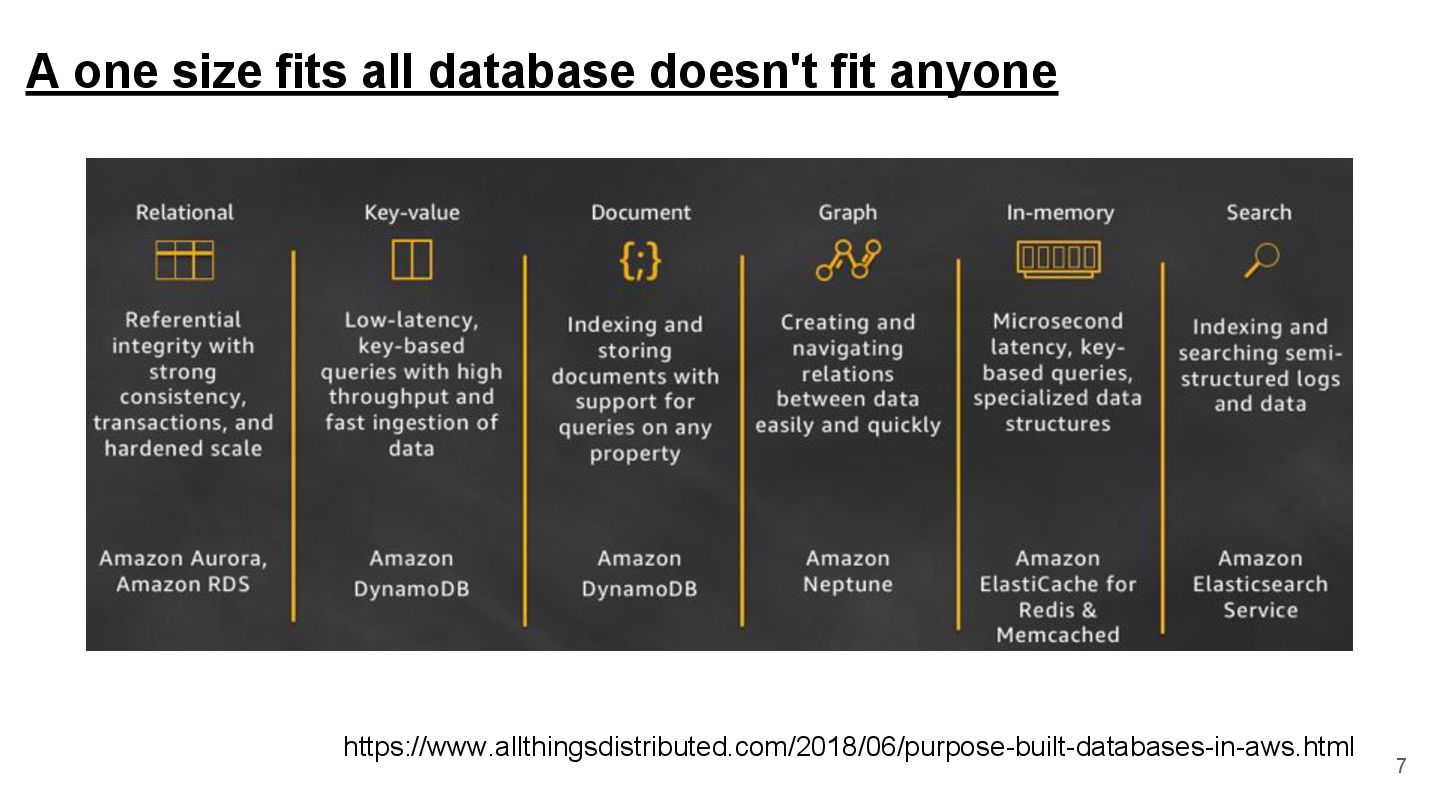
monolithic application typically has a single relational database. • A key benefit of using a relational database is: ◦ your application can use ACID transactions. ◦ relational database provides SQL, which is a rich, declarative, and standardized query language . 3
microservice is private to that microservice and can only be accessed via its API • Encapsulating the data ensures that the microservices are loosely coupled and can evolve independently of one another. • If multiple services access the same data, schema updates require time-consuming, coordinated updates to all of the services. 5
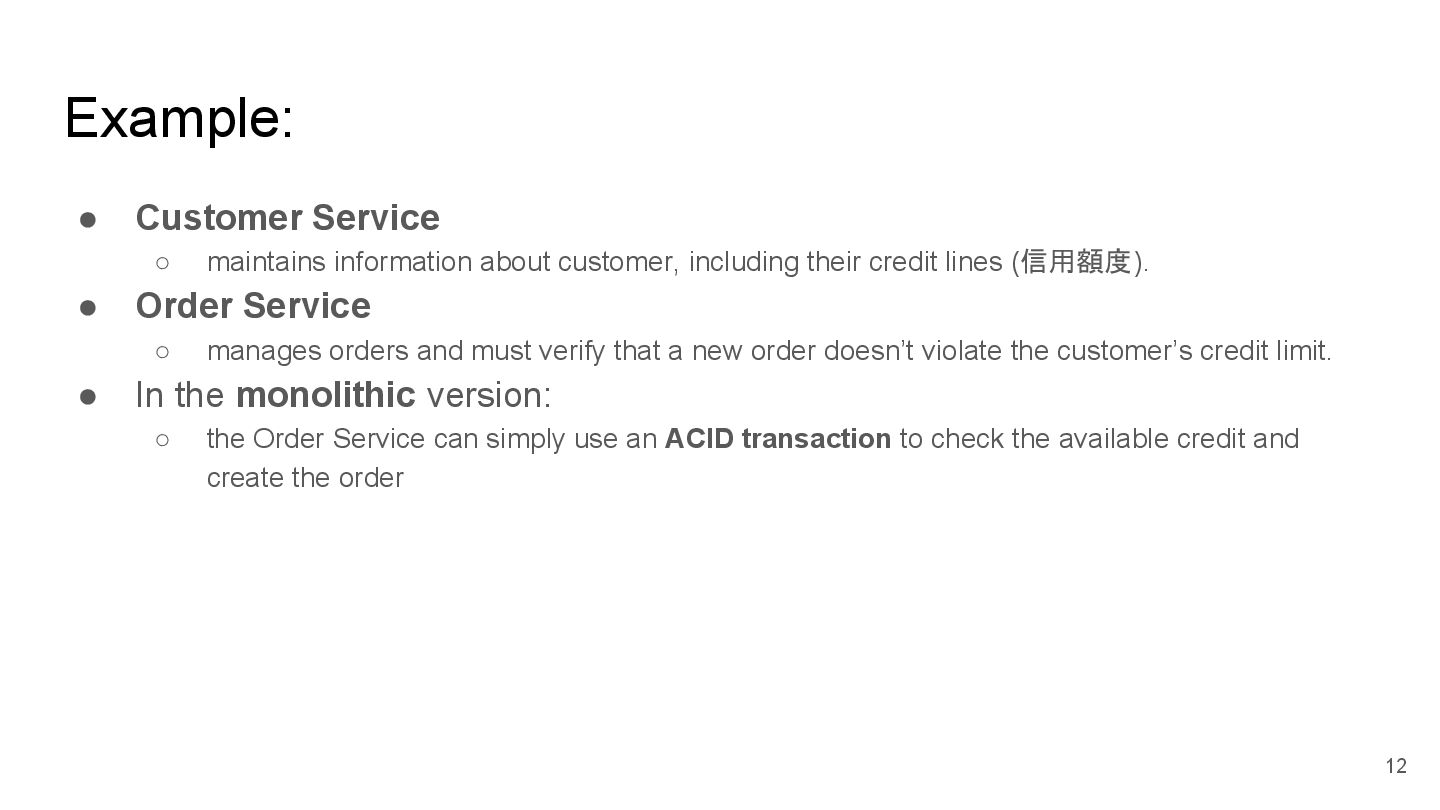
credit lines (信用額度). • Order Service ◦ manages orders and must verify that a new order doesn’t violate the customer’s credit limit. • In the monolithic version: ◦ the Order Service can simply use an ACID transaction to check the available credit and create the order Example: 12
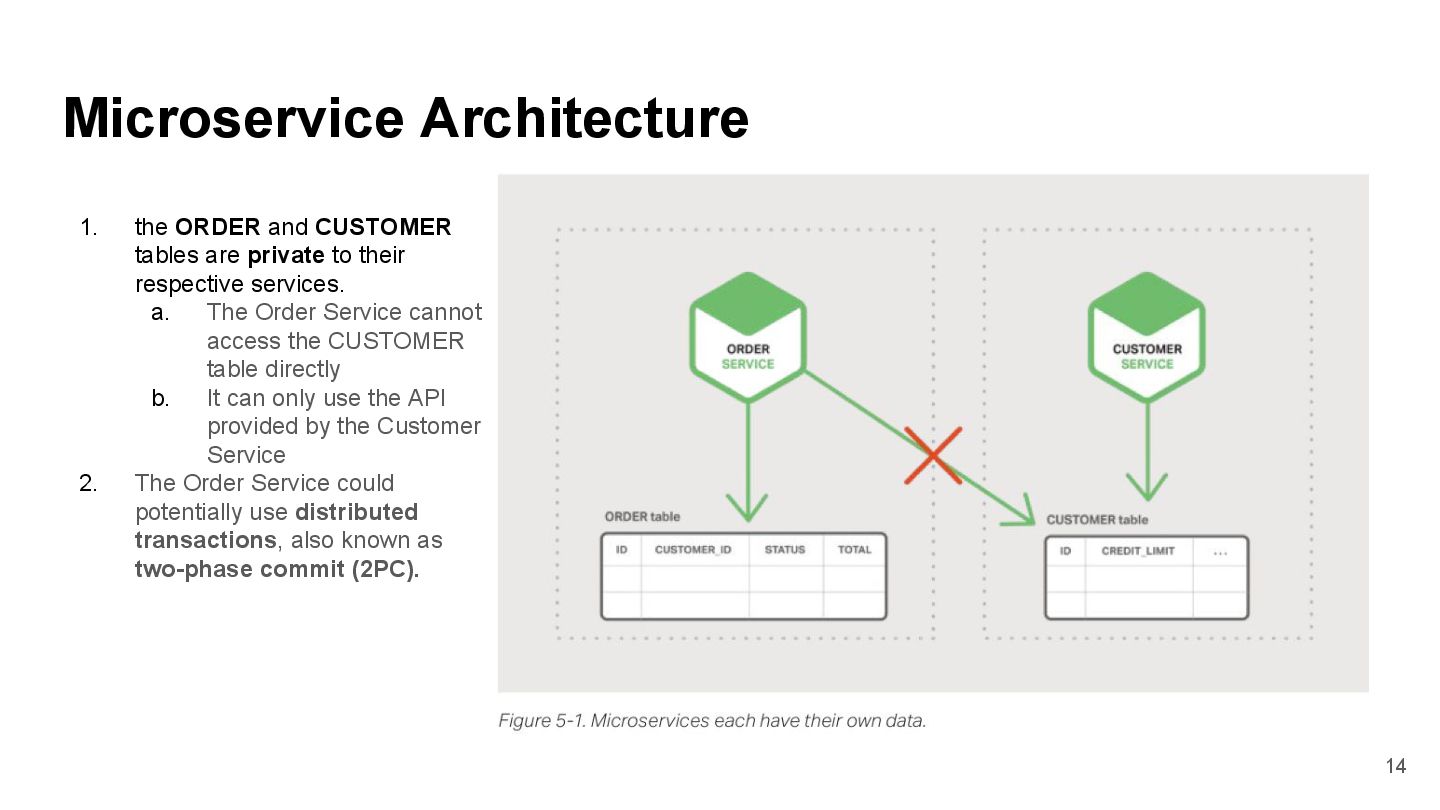
respective services. a. The Order Service cannot access the CUSTOMER table directly b. It can only use the API provided by the Customer Service 2. The Order Service could potentially use distributed transactions, also known as two-phase commit (2PC). Microservice Architecture 14
and ACID-style consistency, and availability is usually the better choice. Moreover, many modern technologies, such as most NoSQL databases, do not support 2PC Maintaining data consistency across services and databases is essential, so we need another solution.
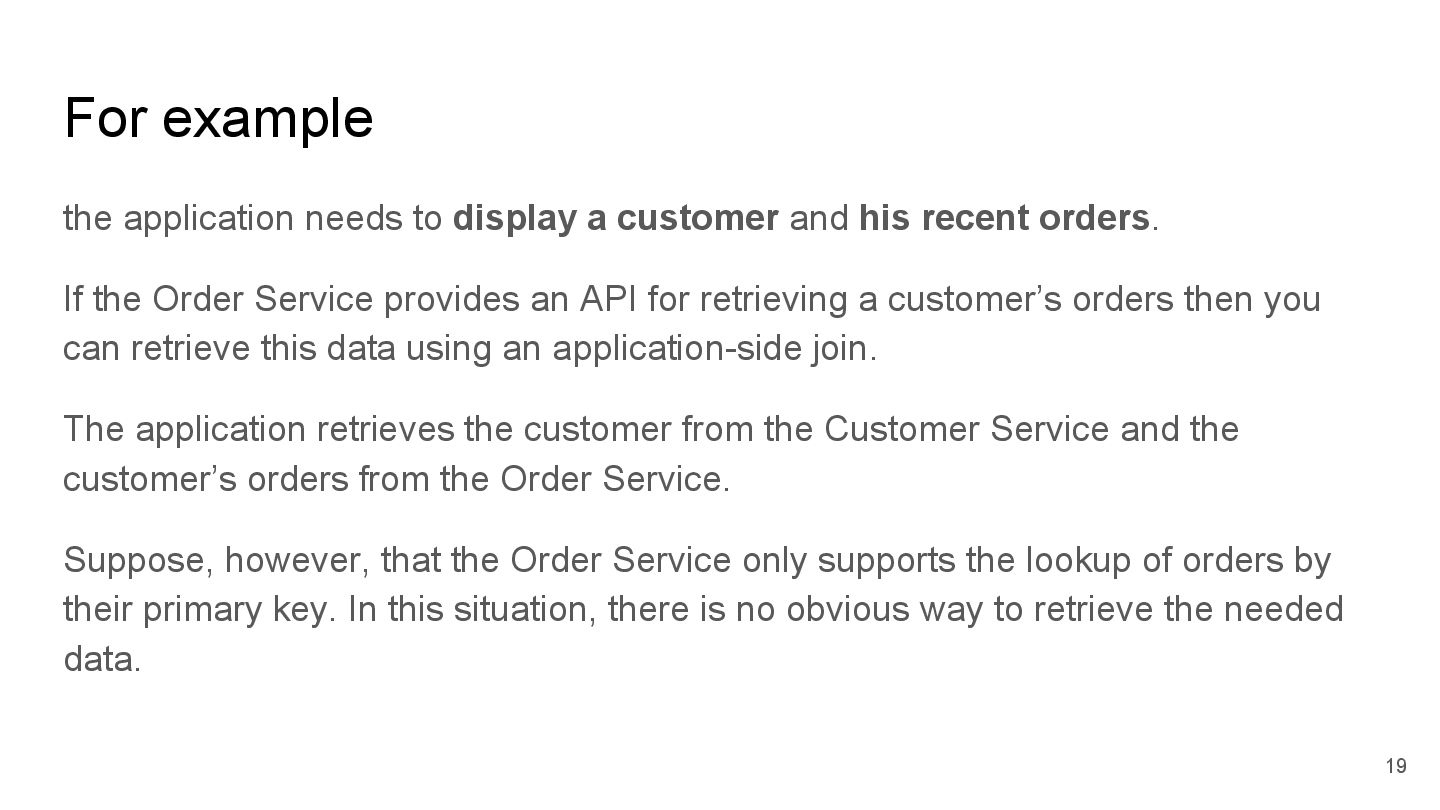
and his recent orders. If the Order Service provides an API for retrieving a customer’s orders then you can retrieve this data using an application-side join. The application retrieves the customer from the Customer Service and the customer’s orders from the Order Service. Suppose, however, that the Order Service only supports the lookup of orders by their primary key. In this situation, there is no obvious way to retrieve the needed data.
an event when something notable happens, such as when it updates a business entity. Other microservices subscribe to those events. When a microservice receives an event it can update its own business entities, which might lead to more events being published
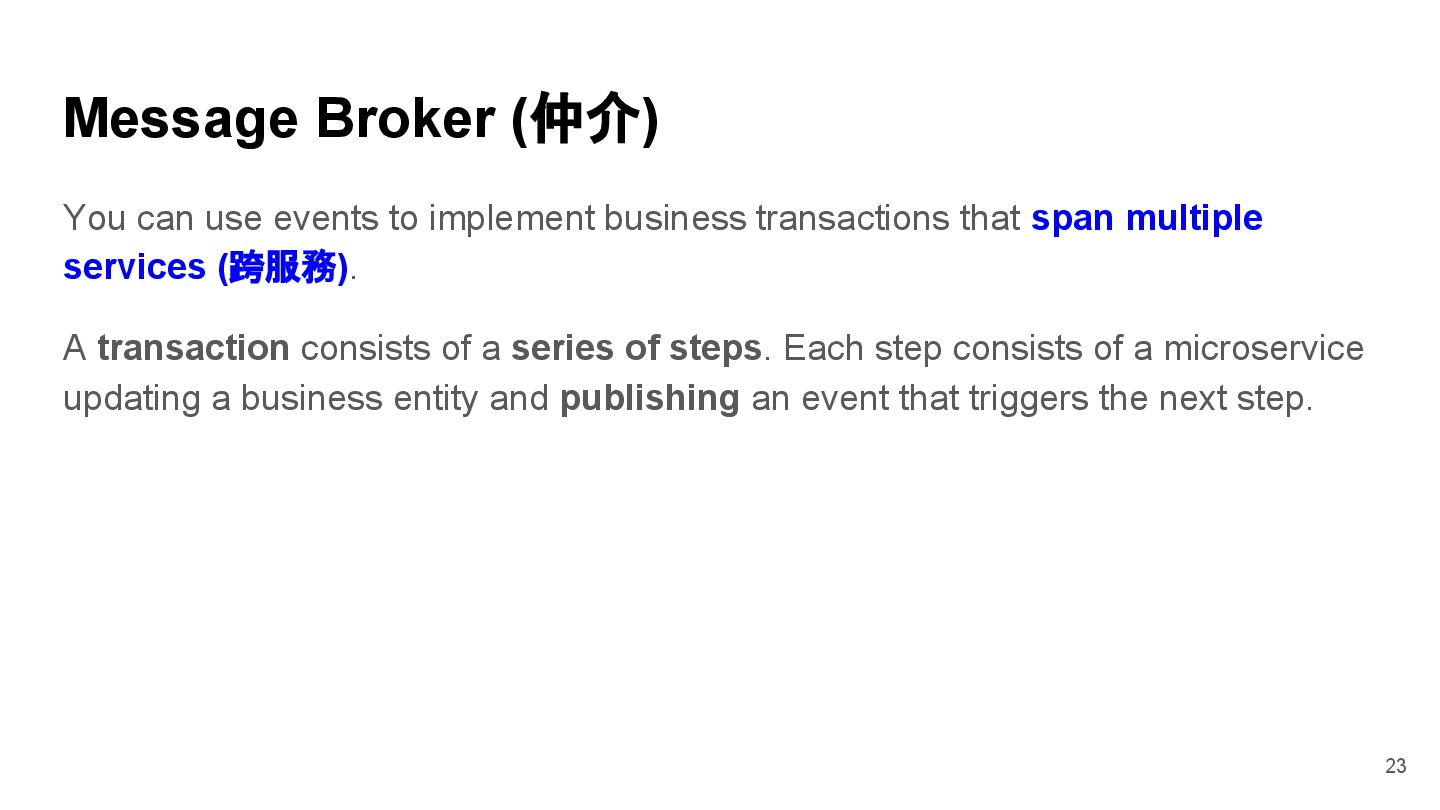
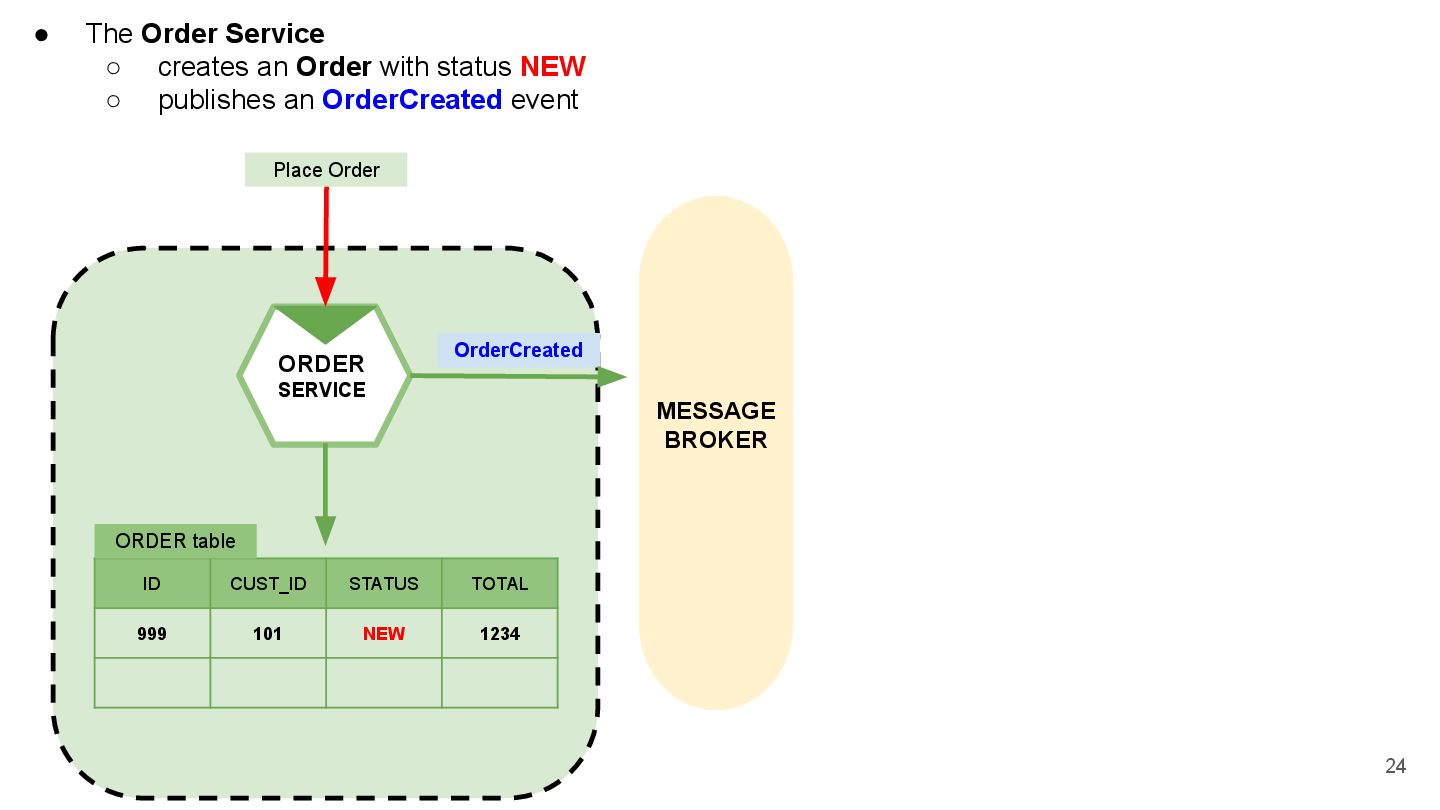
multiple services (跨服務). A transaction consists of a series of steps. Each step consists of a microservice updating a business entity and publishing an event that triggers the next step. Message Broker (仲介) 23
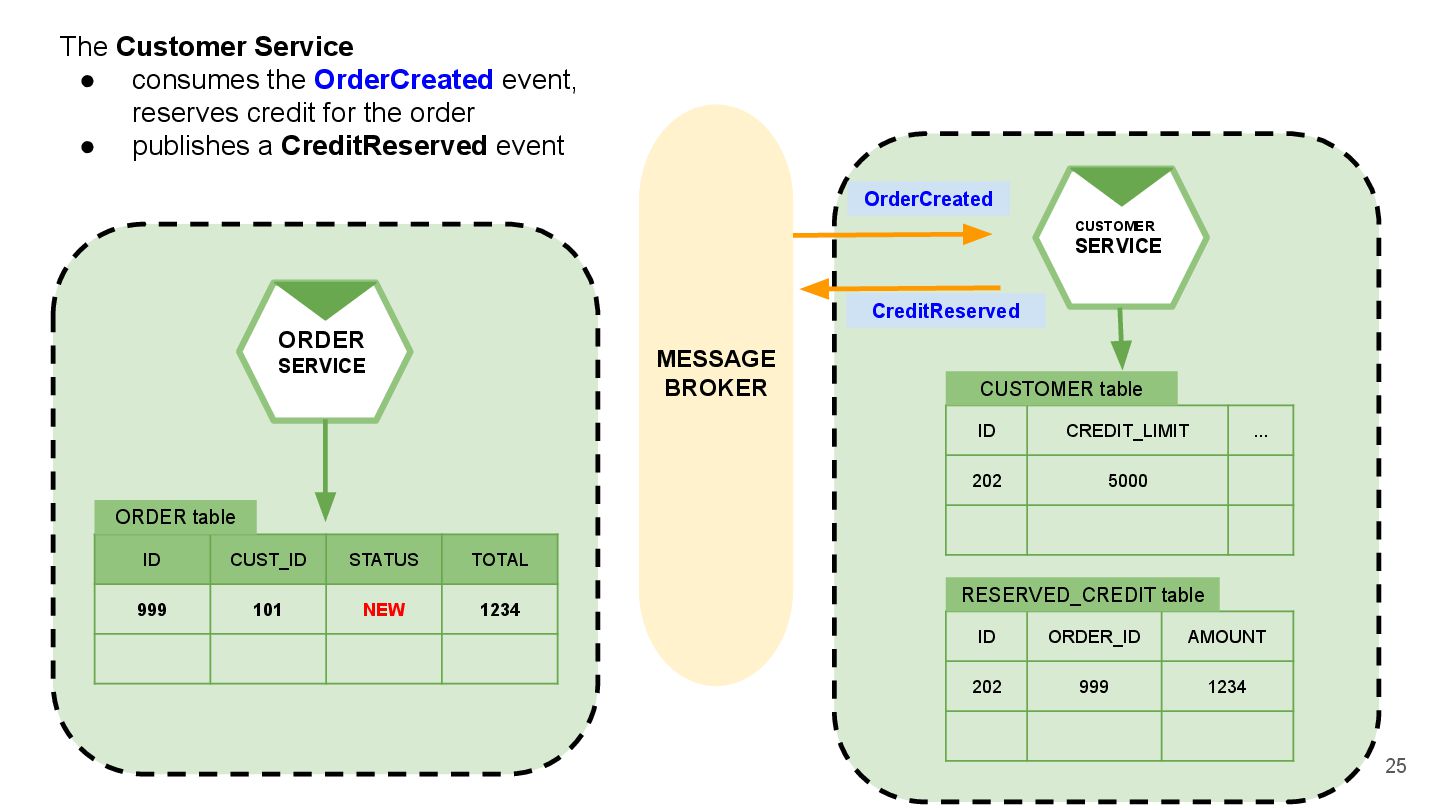
101 NEW 1234 ORDER table The Customer Service • consumes the OrderCreated event, reserves credit for the order • publishes a CreditReserved event CUSTOMER SERVICE ID CREDIT_LIMIT ... 202 5000 CUSTOMER table ID ORDER_ID AMOUNT 202 999 1234 RESERVED_CREDIT table OrderCreated CreditReserved
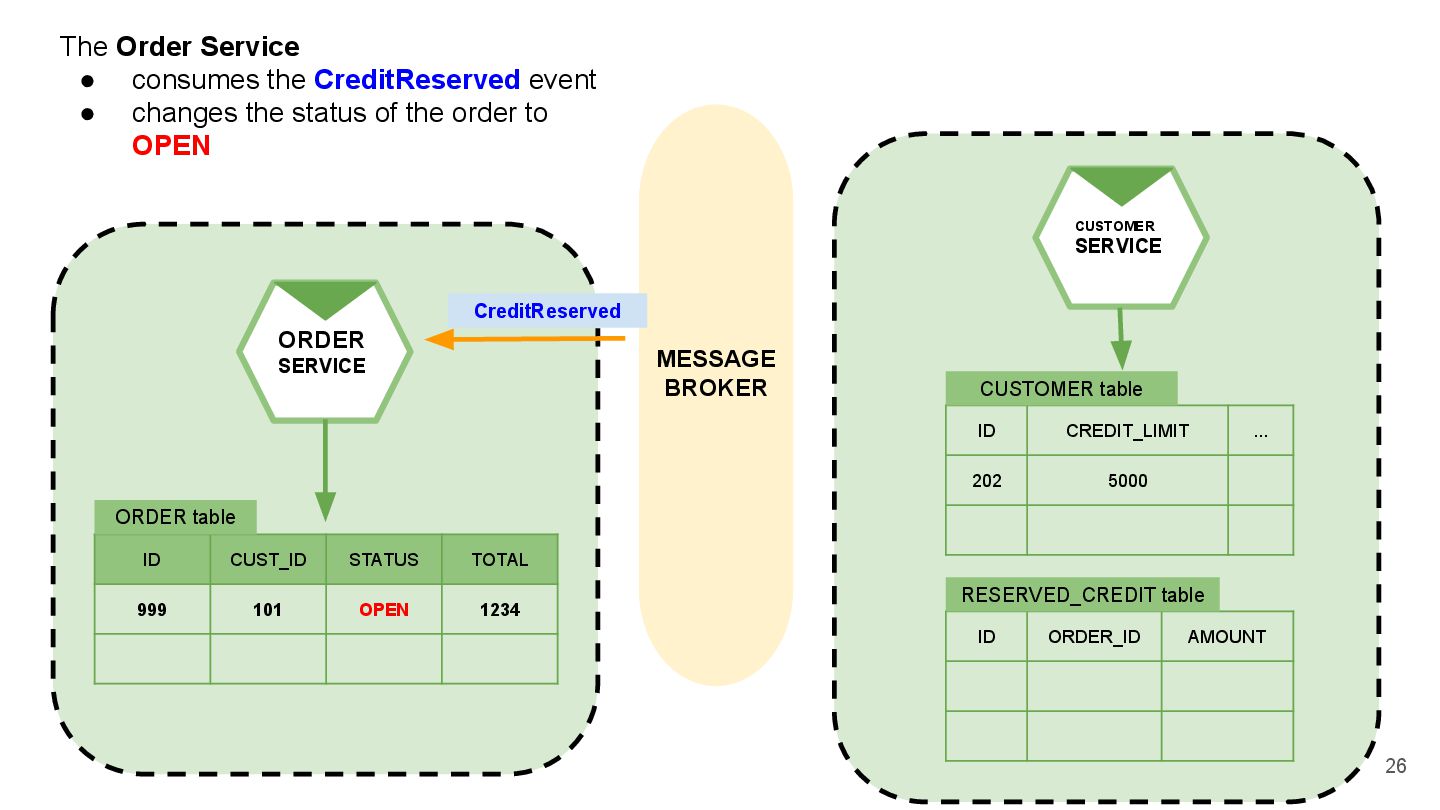
101 OPEN 1234 ORDER table The Order Service • consumes the CreditReserved event • changes the status of the order to OPEN CUSTOMER SERVICE ID CREDIT_LIMIT ... 202 5000 CUSTOMER table ID ORDER_ID AMOUNT RESERVED_CREDIT table CreditReserved
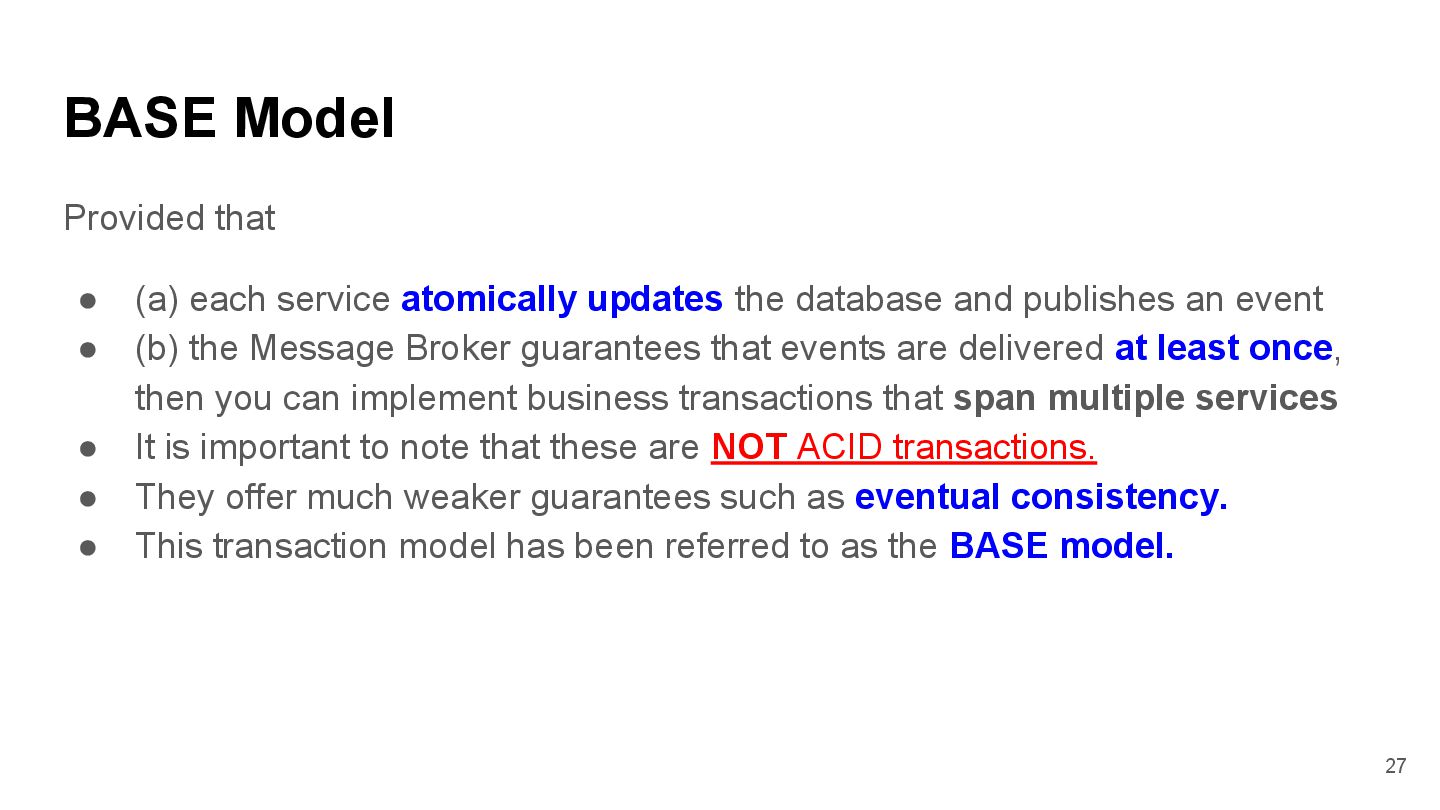
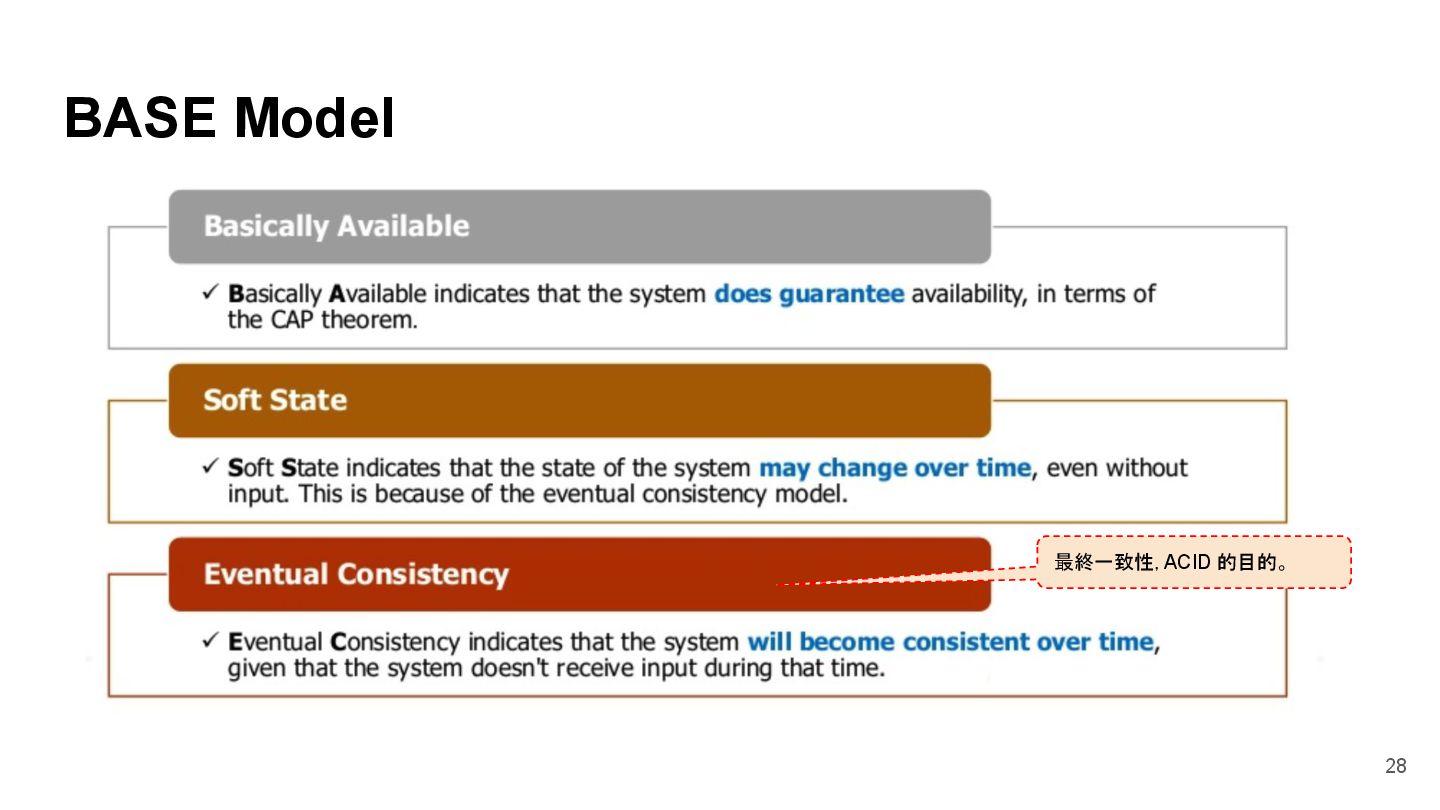
updates the database and publishes an event • (b) the Message Broker guarantees that events are delivered at least once, then you can implement business transactions that span multiple services • It is important to note that these are NOT ACID transactions. • They offer much weaker guarantees such as eventual consistency. • This transaction model has been referred to as the BASE model.
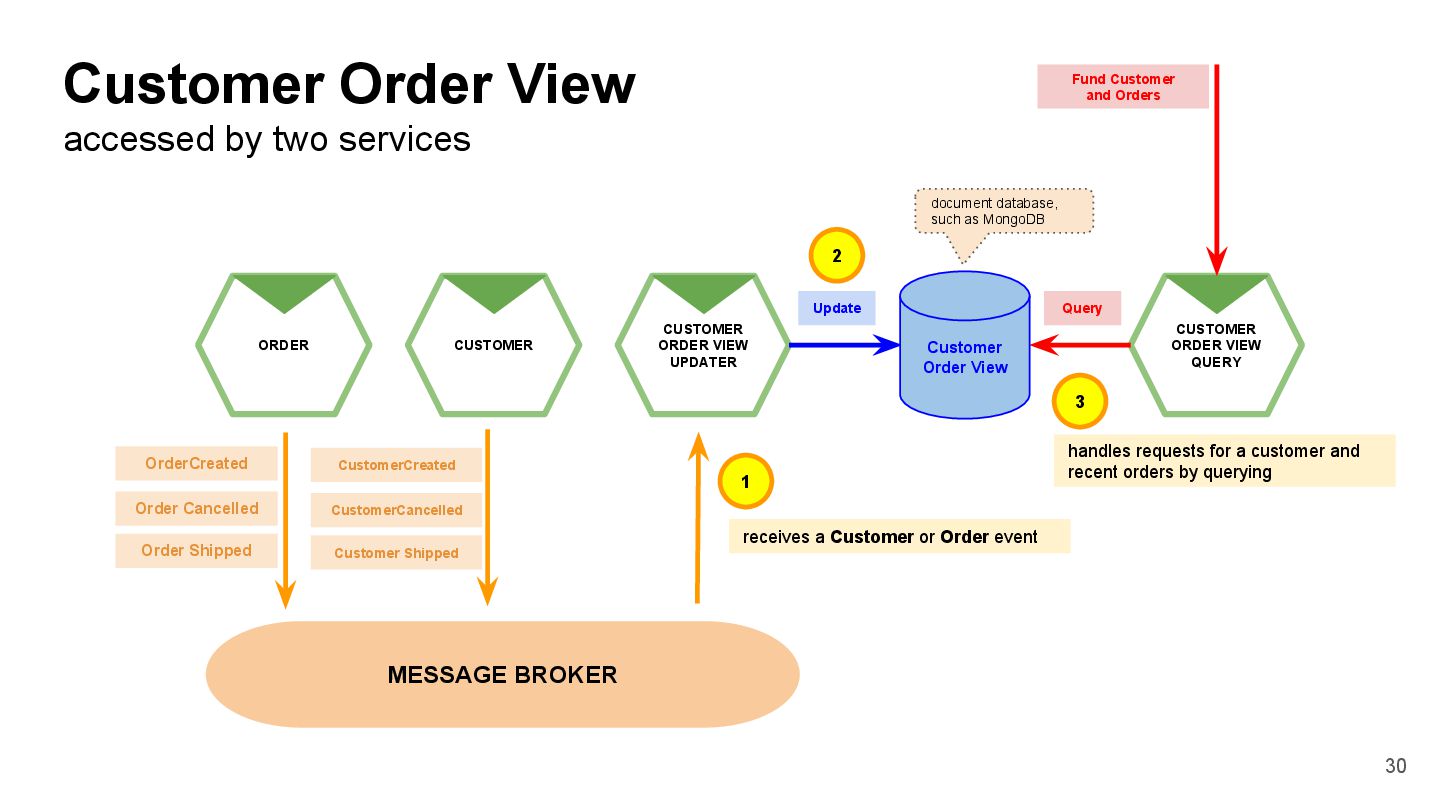
ORDER MESSAGE BROKER OrderCreated Order Cancelled Order Shipped CustomerCreated CustomerCancelled Customer Shipped Update Query Fund Customer and Orders Customer Order View accessed by two services 1 2 Customer Order View receives a Customer or Order event document database, such as MongoDB 3 handles requests for a customer and recent orders by querying
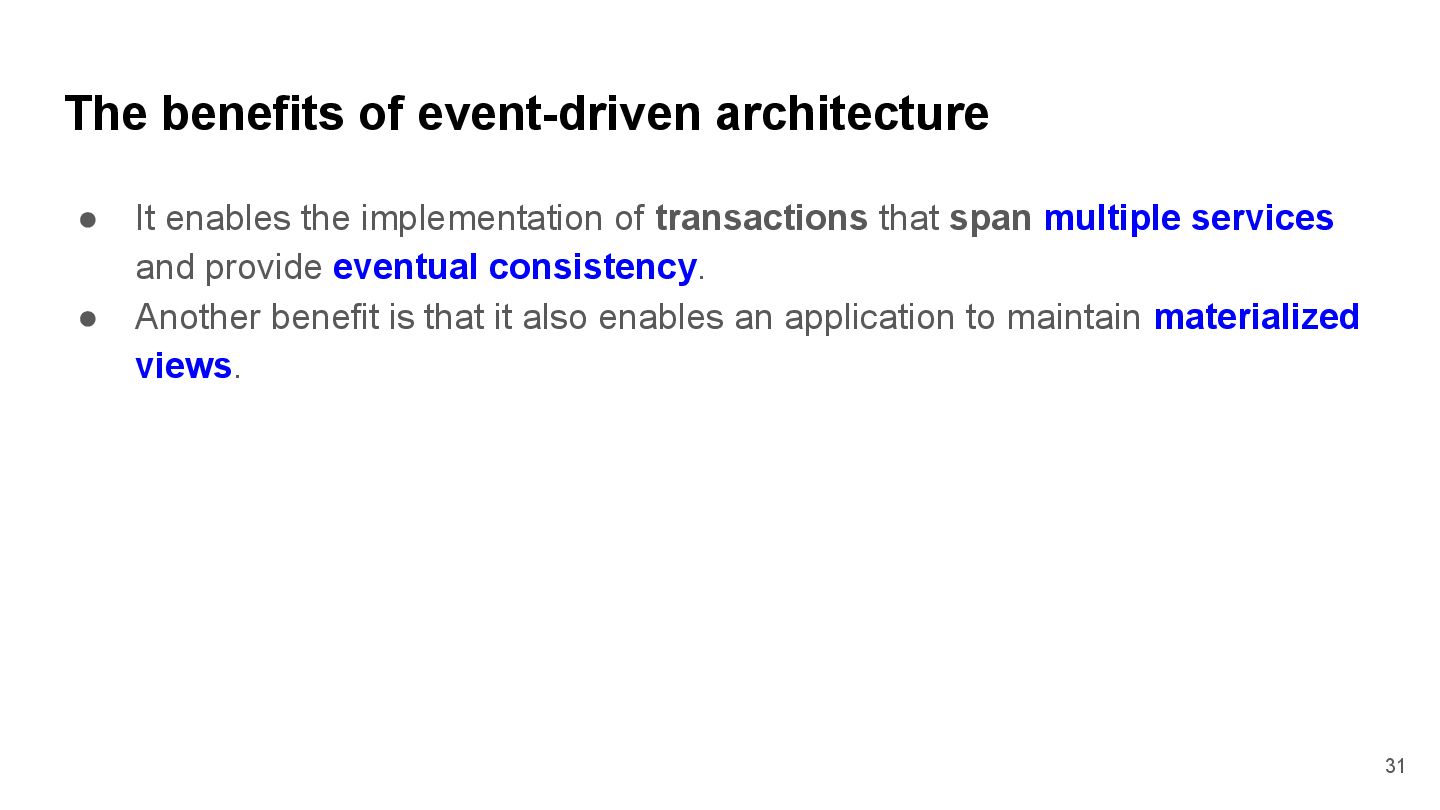
implementation of transactions that span multiple services and provide eventual consistency. • Another benefit is that it also enables an application to maintain materialized views.
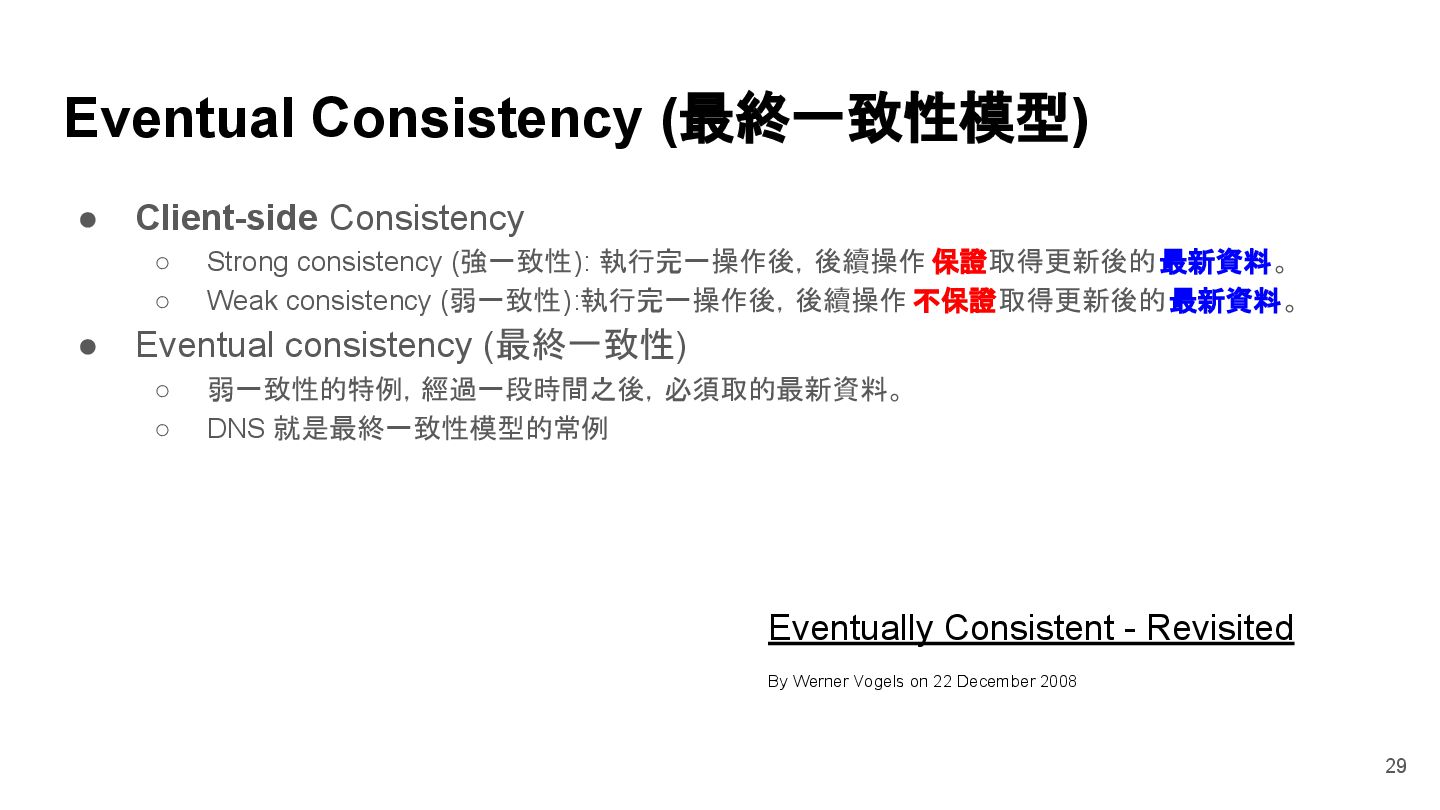
is more complex than when using ACID transactions. • Often you must implement compensating (補償) transactions to recover from application-level failures; ◦ you must cancel an order if the credit check fails, applications must deal with inconsistent data. That is because changes made by in-flight transactions are visible. ◦ The application can also see inconsistencies if it reads from a materialized view that is not yet updated. • subscribers must detect and ignore duplicate events
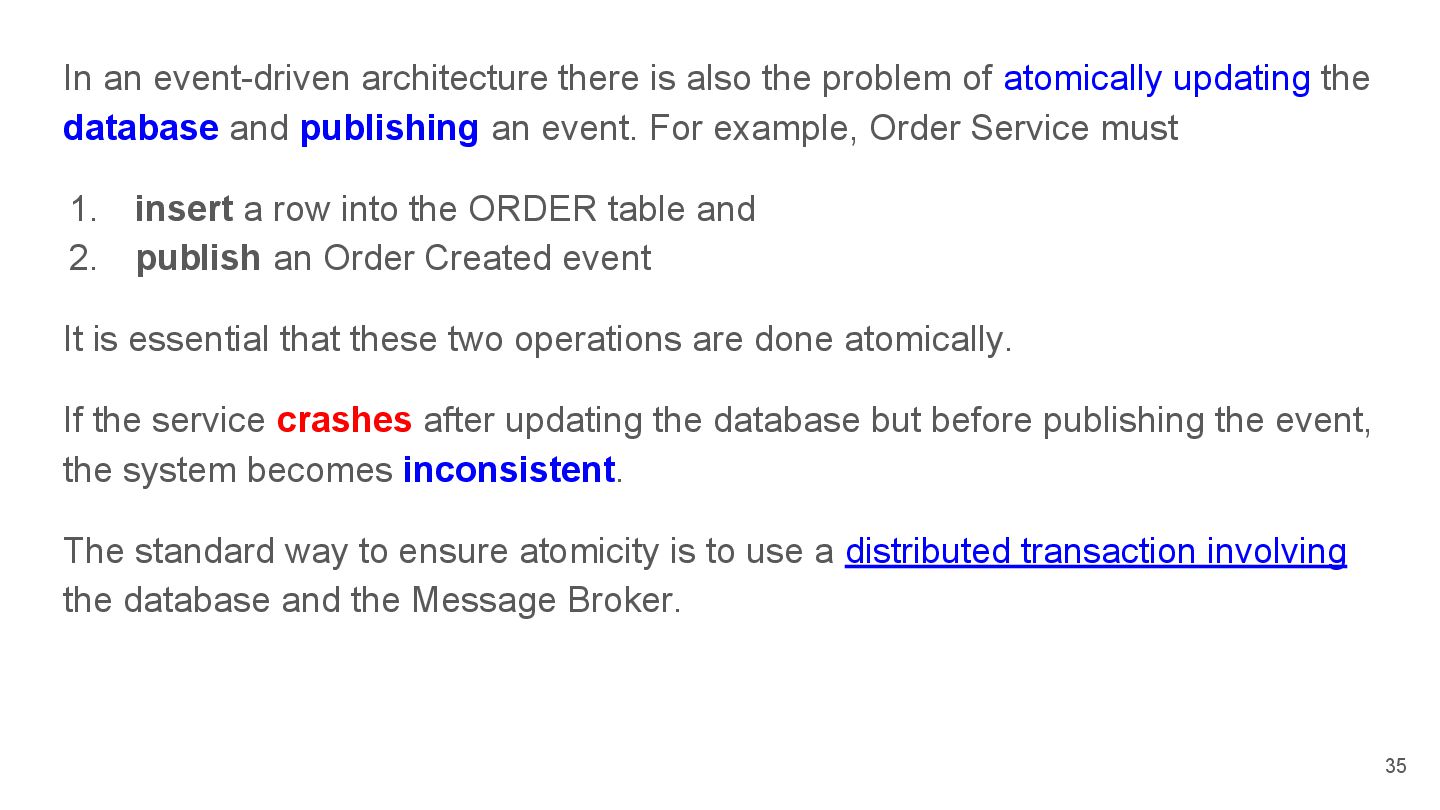
of atomically updating the database and publishing an event. For example, Order Service must 1. insert a row into the ORDER table and 2. publish an Order Created event It is essential that these two operations are done atomically. If the service crashes after updating the database but before publishing the event, the system becomes inconsistent. The standard way to ensure atomicity is to use a distributed transaction involving the database and the Message Broker.
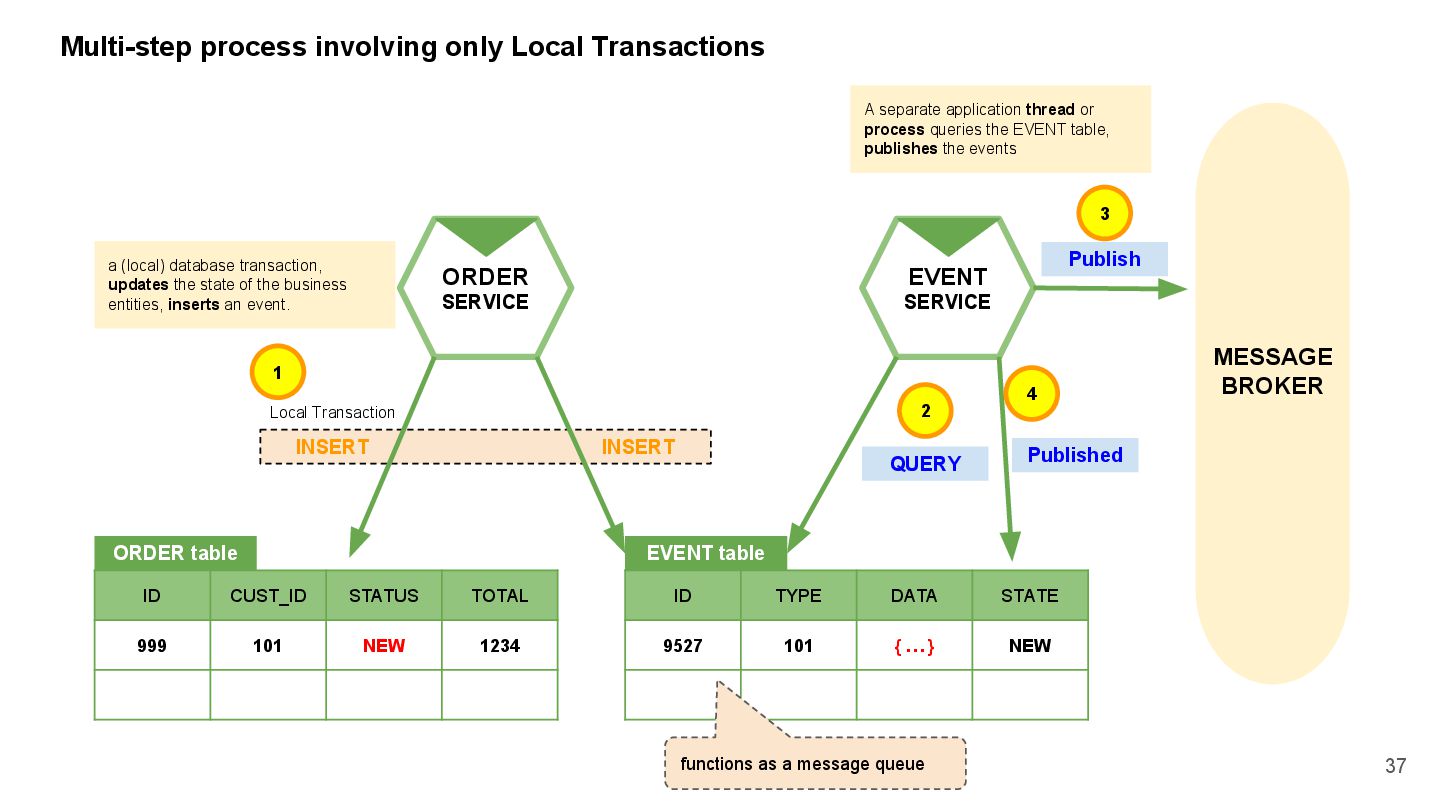
TOTAL 999 101 NEW 1234 ORDER table Multi-step process involving only Local Transactions ID TYPE DATA STATE 9527 101 { … } NEW EVENT table EVENT SERVICE Local Transaction QUERY Publish 1 a (local) database transaction, updates the state of the business entities, inserts an event. functions as a message queue A separate application thread or process queries the EVENT table, publishes the events 2 3 4 Published
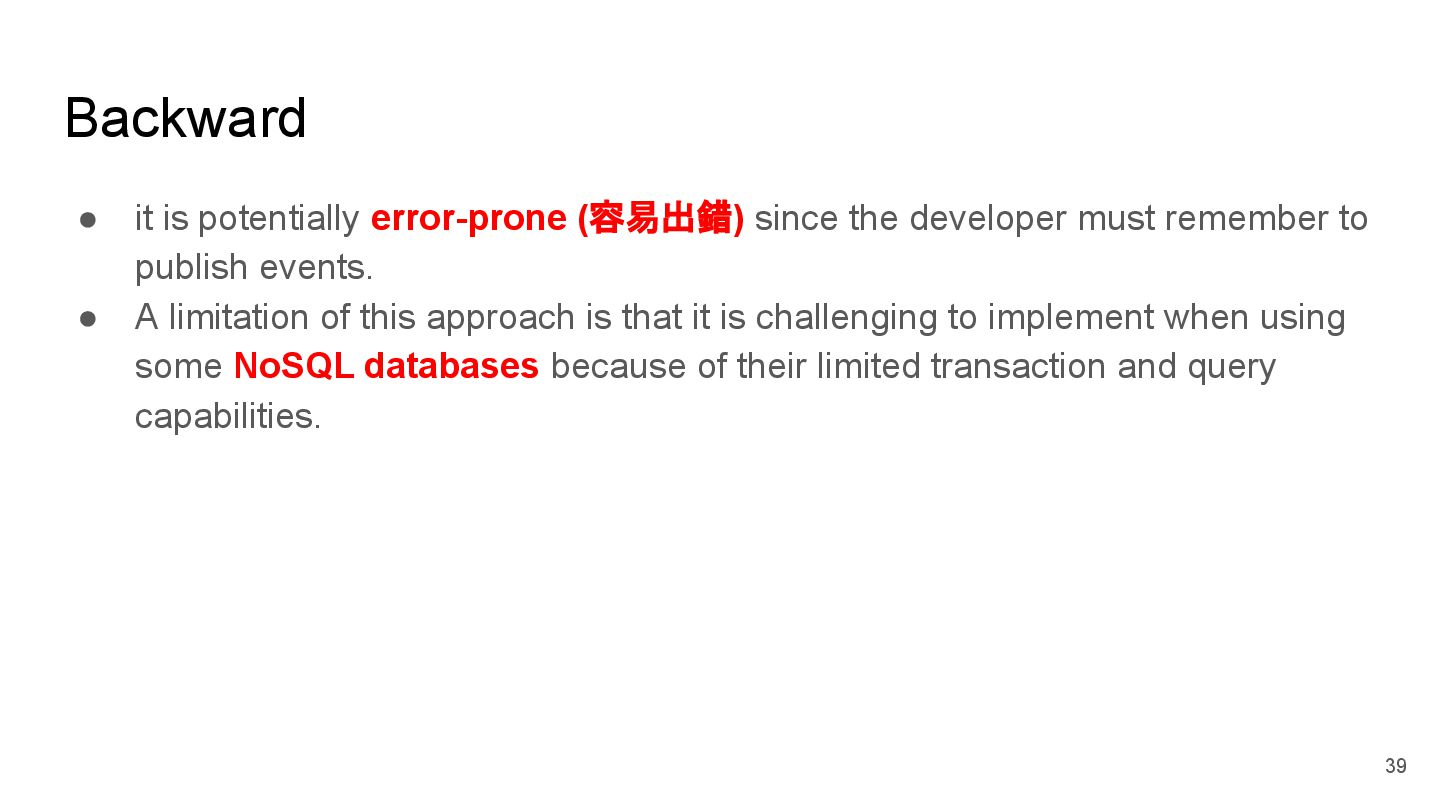
must remember to publish events. • A limitation of this approach is that it is challenging to implement when using some NoSQL databases because of their limited transaction and query capabilities. 39
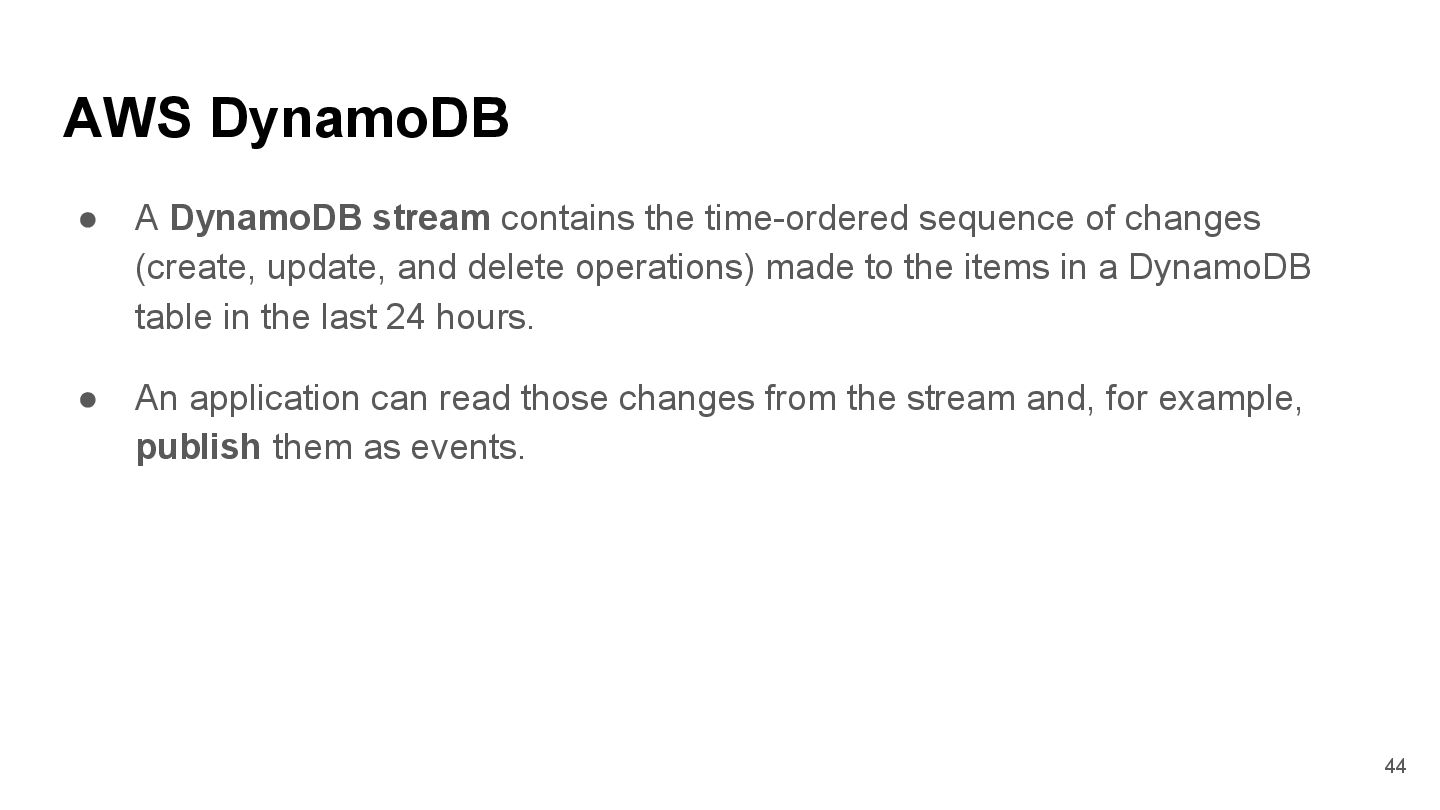
of changes (create, update, and delete operations) made to the items in a DynamoDB table in the last 24 hours. • An application can read those changes from the stream and, for example, publish them as events. 44
an event is published for each update without using 2PC. • Transaction log mining can also simplify the application by separating event publishing from the application’s business logic.
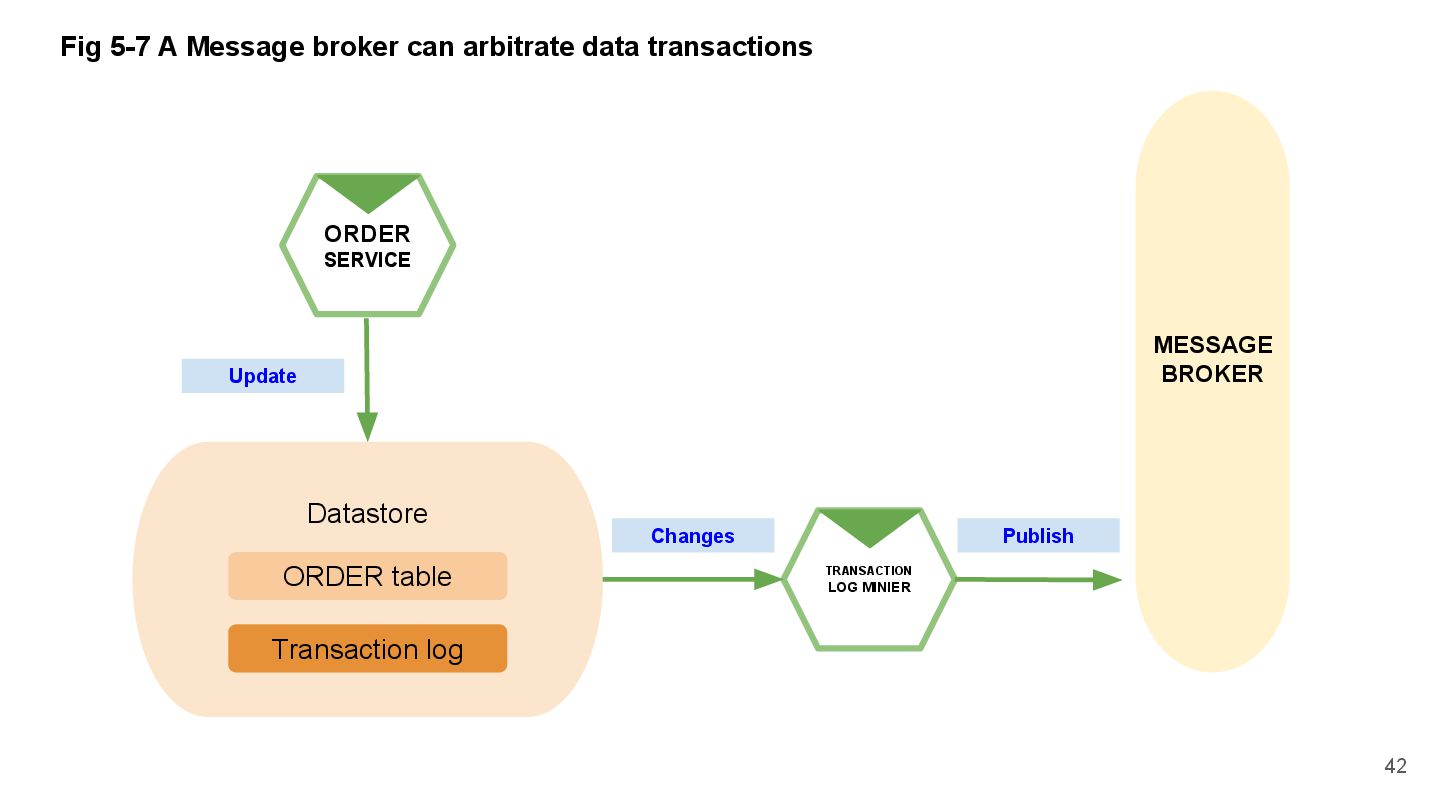
the transaction log is proprietary to each database and can even change between database versions. • it can be difficult to reverse engineer the high-level business events from the low-level updates recorded in the transaction log
by using a radically different, event-centric approach to persisting business entities. • Rather than store the current state of an entity, the application stores a sequence of state-changing events. • The application reconstructs an entity’s current state by replaying the events. • Whenever the state of a business entity changes, a new event is appended to the list of events. • Since saving an event is a single operation, it is inherently atomic.
can arbitrate data transactions Order: 9527 ORDER SERVICE Add Events ID STATUS TOTAL ... 999 ABCDE NEW ... ORDER table CUSTOMER SERVICE ORDER Cancelled ORDER Approved ... ORDER Shipped Find Events Subscribe to Events
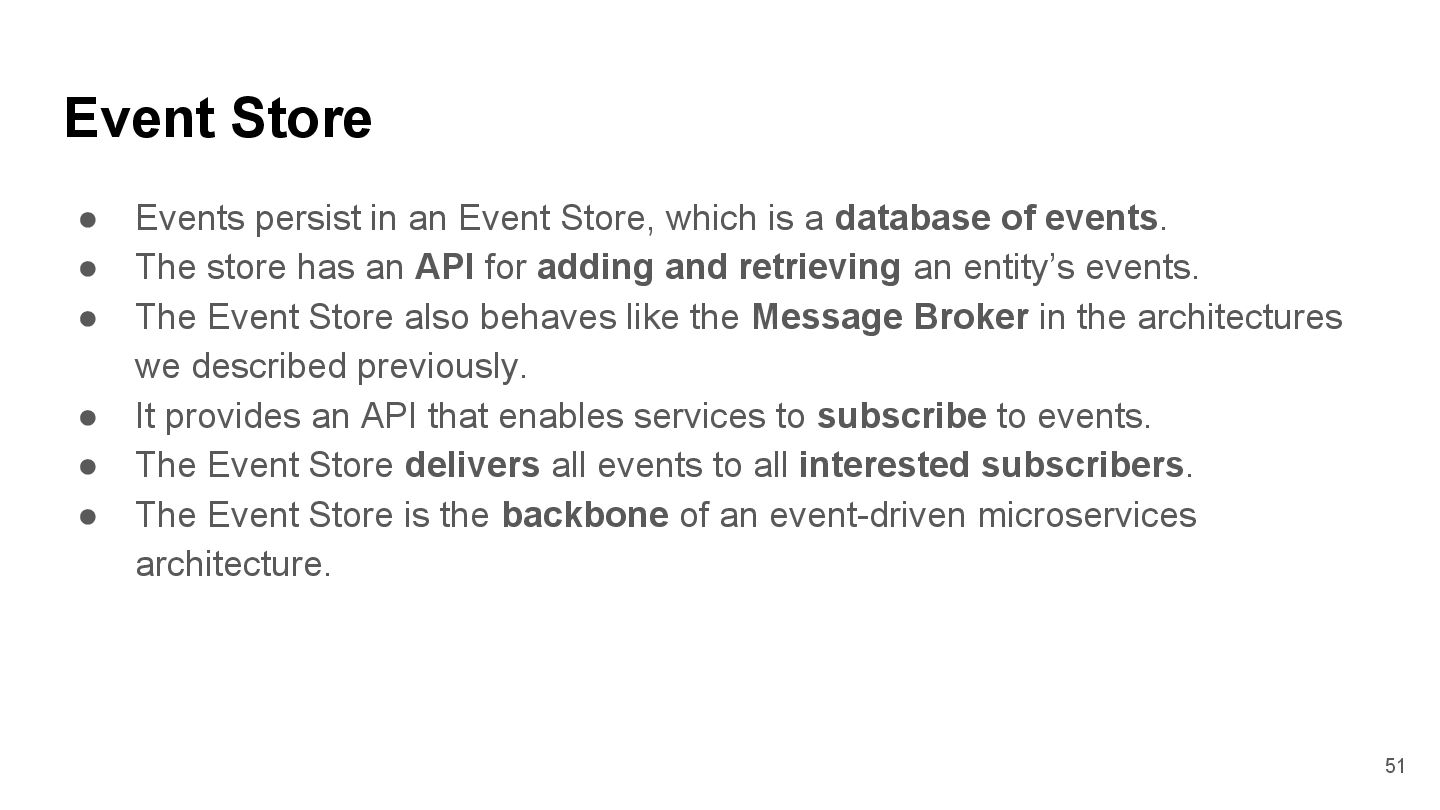
which is a database of events. • The store has an API for adding and retrieving an entity’s events. • The Event Store also behaves like the Message Broker in the architectures we described previously. • It provides an API that enables services to subscribe to events. • The Event Store delivers all events to all interested subscribers. • The Event Store is the backbone of an event-driven microservices architecture.
the key problems in implementing an event-driven architecture and makes it possible to reliably publish events whenever state changes. • As a result, it solves data consistency issues in a microservices architecture. • Also, because it persists events rather than domain objects, it mostly avoids the object-relational impedance mismatch problem. • Event sourcing also provides a 100% reliable audit log of the changes made to a business entity and makes it possible to implement temporal queries that determine the state of an entity at any point in time. • Another major benefit of event sourcing is that your business logic consists of loosely coupled business entities that exchange events. • This makes it a lot easier to migrate from a monolithic application to a microservices architecture 52
unfamiliar style of programming and so there is a learning curve. • The event store only directly supports the lookup of business entities by primary key. • You must use command query responsibility separation (CQRS) to implement queries. • As a result, applications must handle eventually consistent data. 55
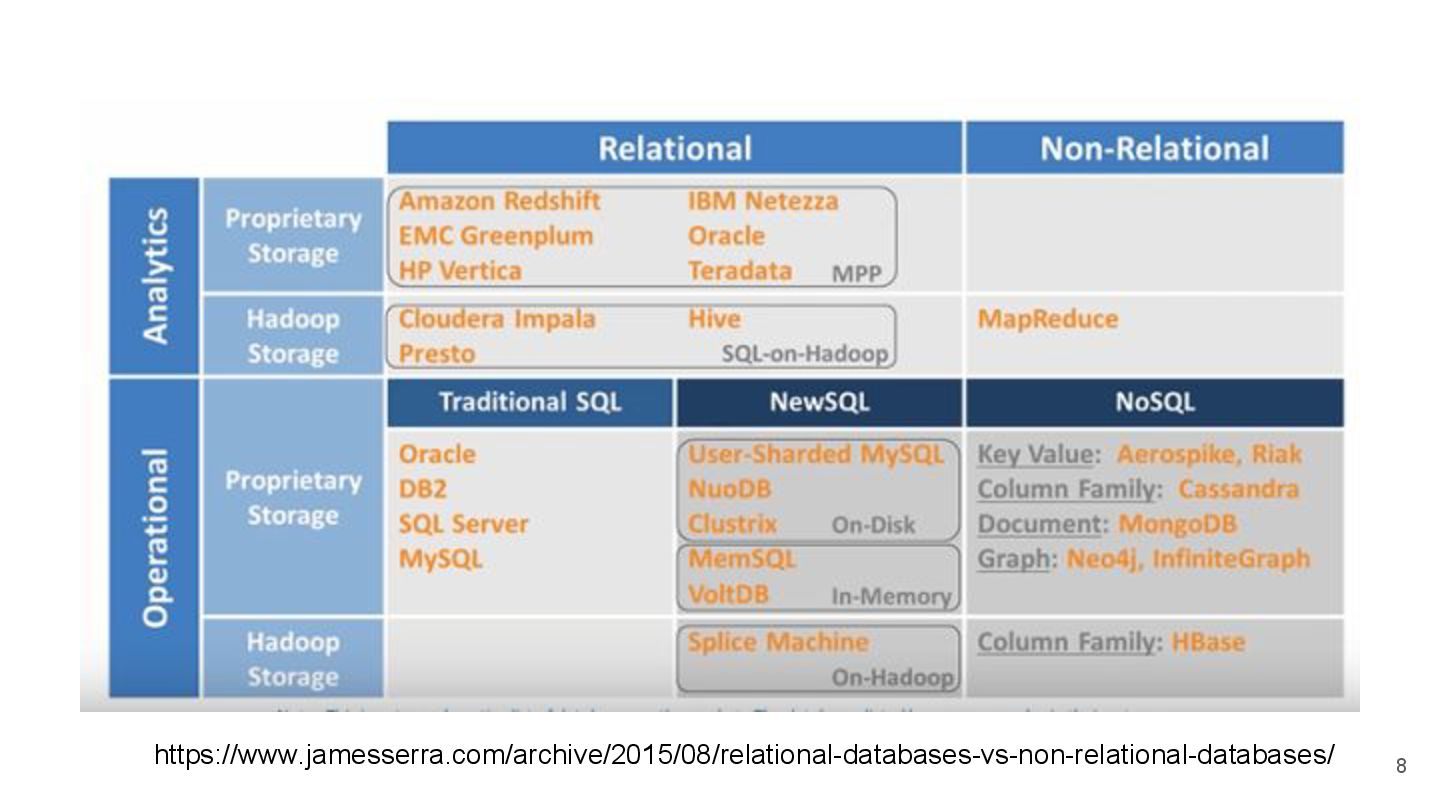
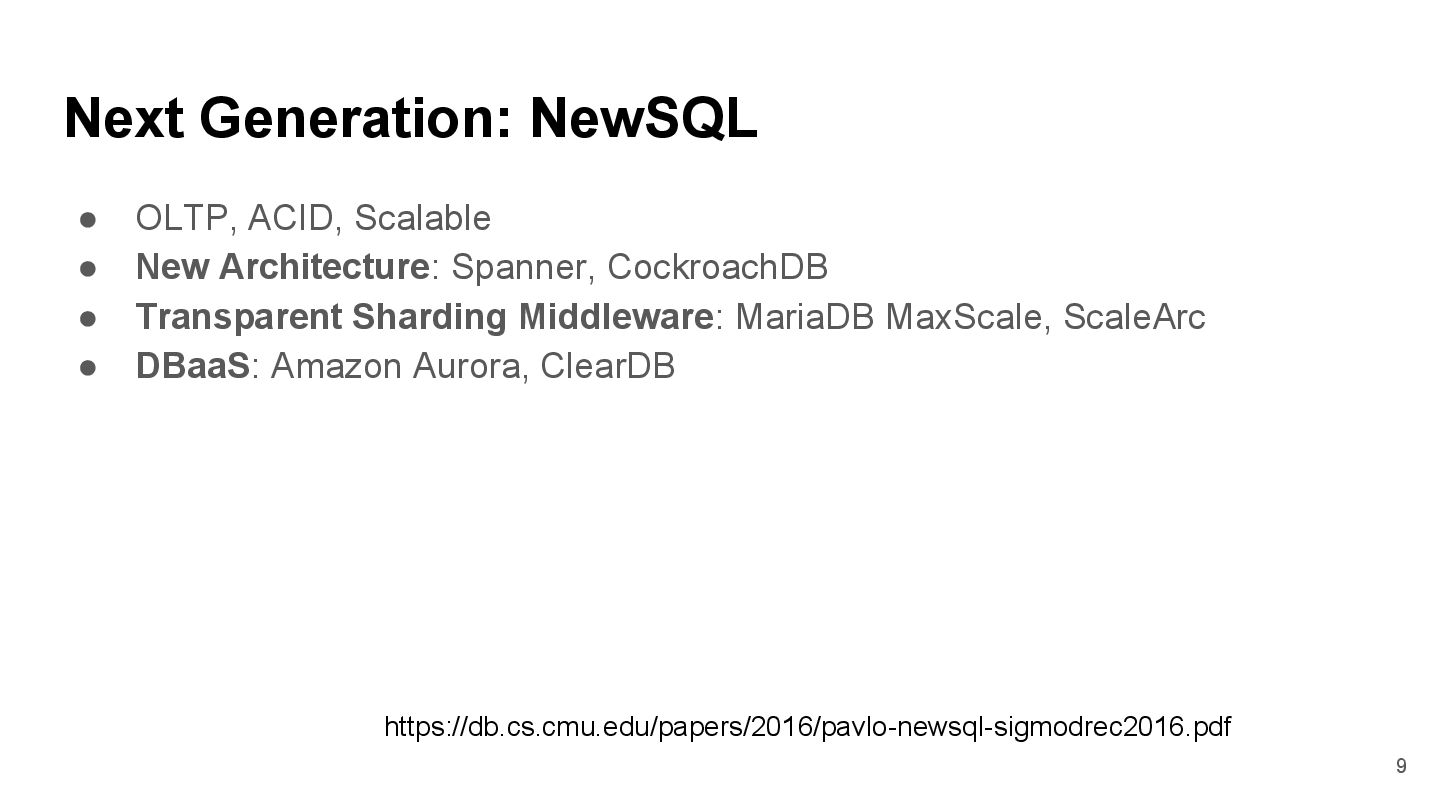
its own private datastore. • Different microservices might use different SQL and NoSQL databases. ◦ While this database architecture has significant benefits, it creates some distributed data management challenges. ◦ The first challenge is how to implement business transactions that maintain consistency across multiple services. ◦ The second challenge is how to implement queries that retrieve data from multiple services. • For many applications, the solution is to use an event-driven architecture ◦ One challenge with implementing an event-driven architecture is how to atomically update state and how to publish events. ◦ There are a few ways to accomplish this, including using the database as a message queue, transaction log mining, and event sourcing. •


 rickhwang
 suisan
 masakiokuda
 kekekenta
 ainischool
 yatabe
 juanmartin2026
 kenichiota0711
 uranoken
 mutomasa
 signer
 naoji_taniguchi_ksk_0827
 cassininazir
 mongodb
 philnash
 madoxten
 tammyeverts
 asonas
 kneath
 zakiyama
 sarafernandez
 brettharned
 aarron
 akashhashmi