Share
Embed
Transcript
34 slides
-
Panelists Matei Zaharia Michael Armbrust Joseph Bradley Paco Nathan Patrick
Wendell Tathagata Das Reynold Xin -
What is Apache Spark? Fast and general engine for big
data processing Generalizes the MapReduce model to support low-latency and complex analytics Most active open source project in big data -
About Databricks Founded by the creators of Spark in 2013
Drives open source Spark development, and offers a cloud service (Databricks Cloud) Largest organization contributing to Spark > Over 1000 patches in the past year -
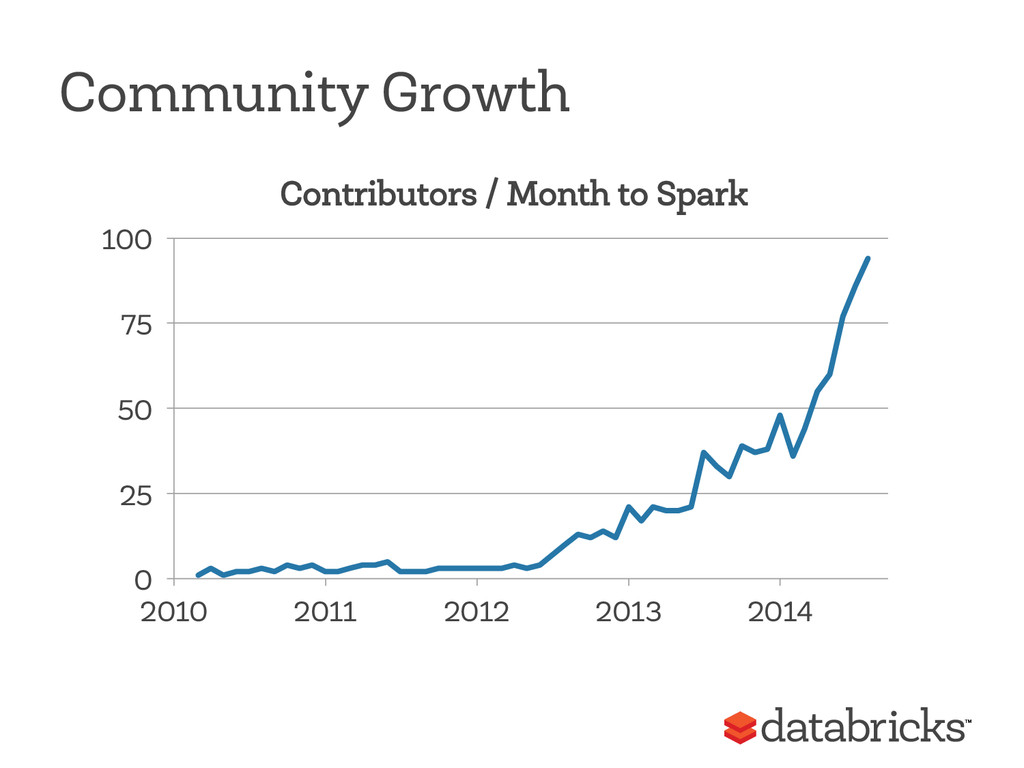
Community Growth 0 25 50 75 100 2010 2011 2012
2013 2014 Contributors / Month to Spark -
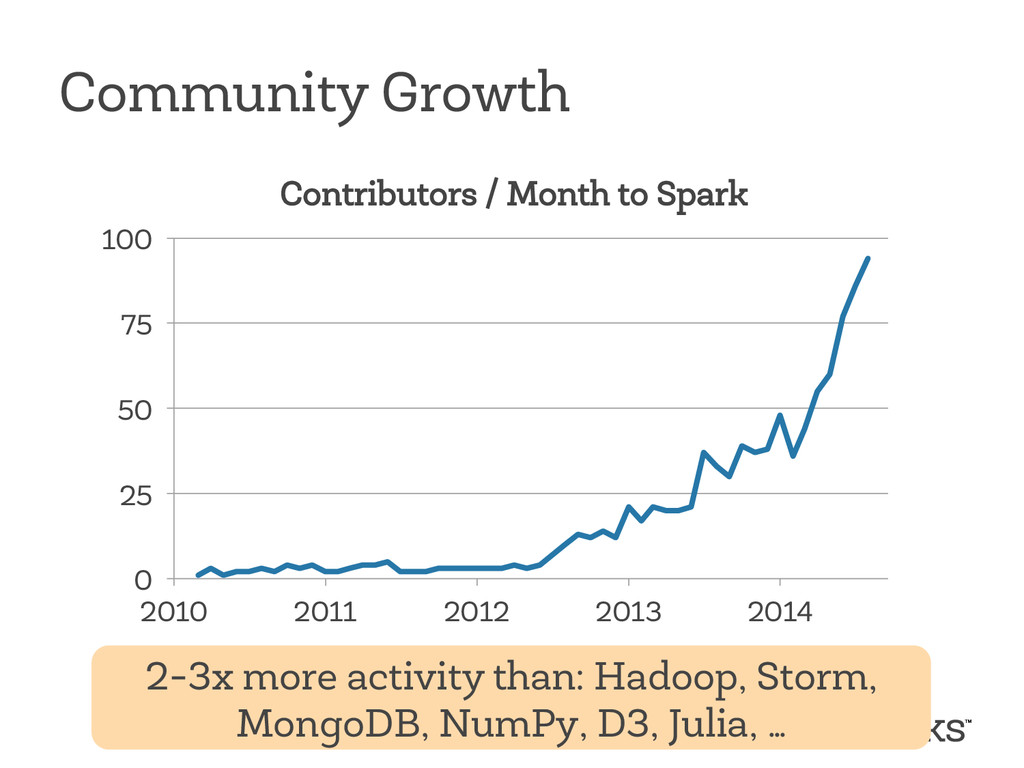
Community Growth 0 25 50 75 100 2010 2011 2012
2013 2014 Contributors / Month to Spark 2-3x more activity than: Hadoop, Storm, MongoDB, NumPy, D3, Julia, … -
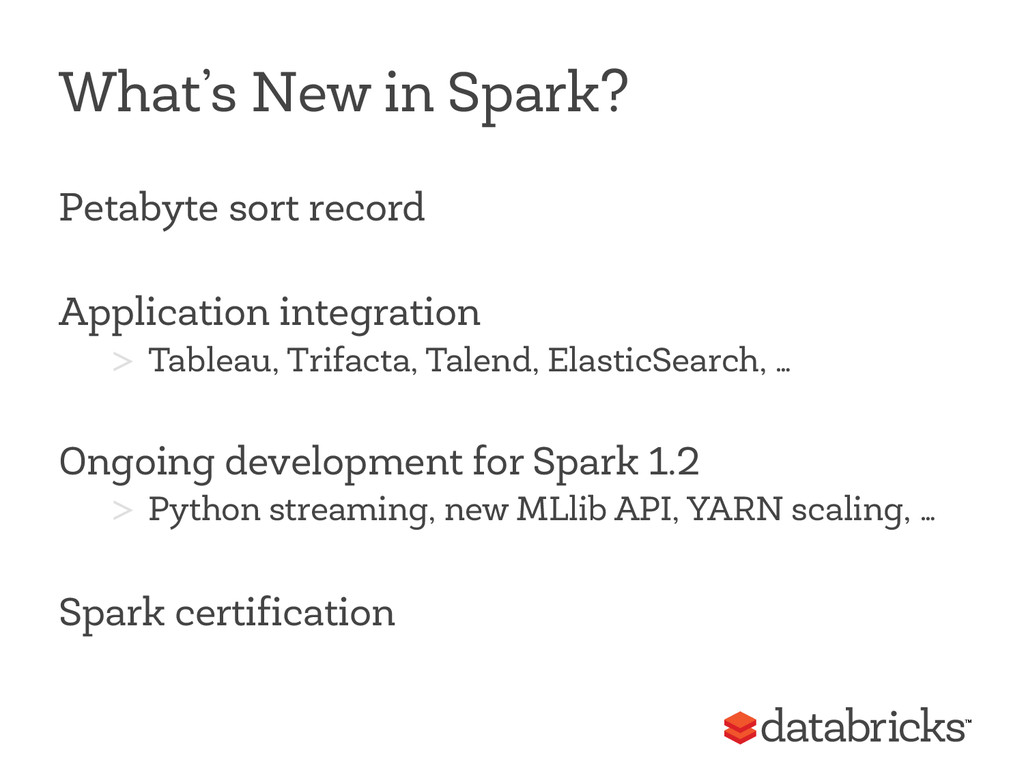
What’s New in Spark? Petabyte sort record Application integration >
Tableau, Trifacta, Talend, ElasticSearch, … Ongoing development for Spark 1.2 > Python streaming, new MLlib API, YARN scaling, … Spark certification -
Short Talks Petabyte sort (Reynold Xin) Spark 1.2 development (Patrick
Wendell) Machine learning pipelines (Joseph Bradley) -
Common Misconception About Spark “Spark is in-memory. It doesn’t work
with BIG DATA.” “It is too expensive to buy a cluster with enough memory to fit our data.” -
Spark Project Goals Works well with GBs, TBs, or PBs
or data Works well with different storage media (RAM, HDDs, SSDs) Works well from low-latency streaming jobs to long batch jobs -
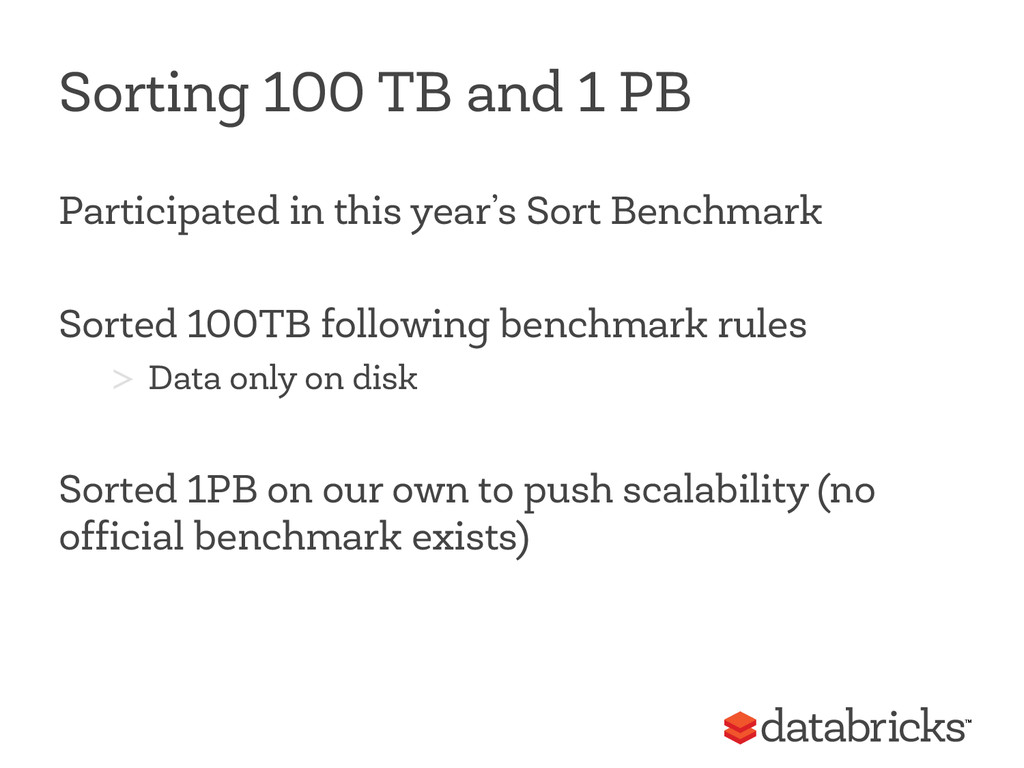
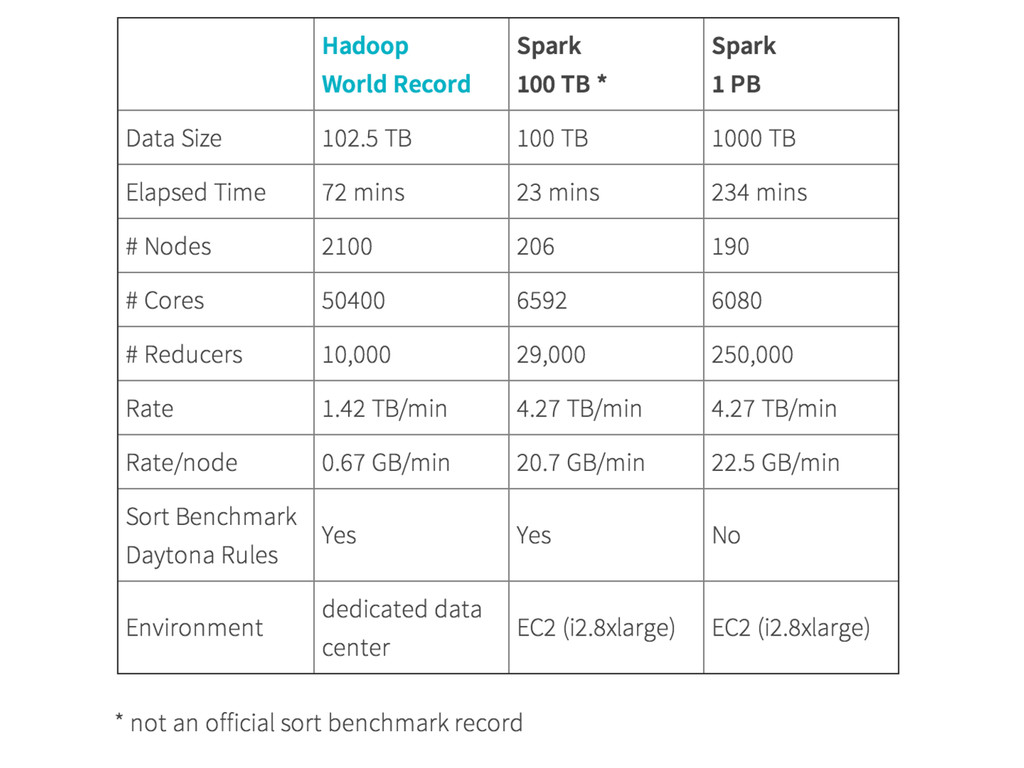
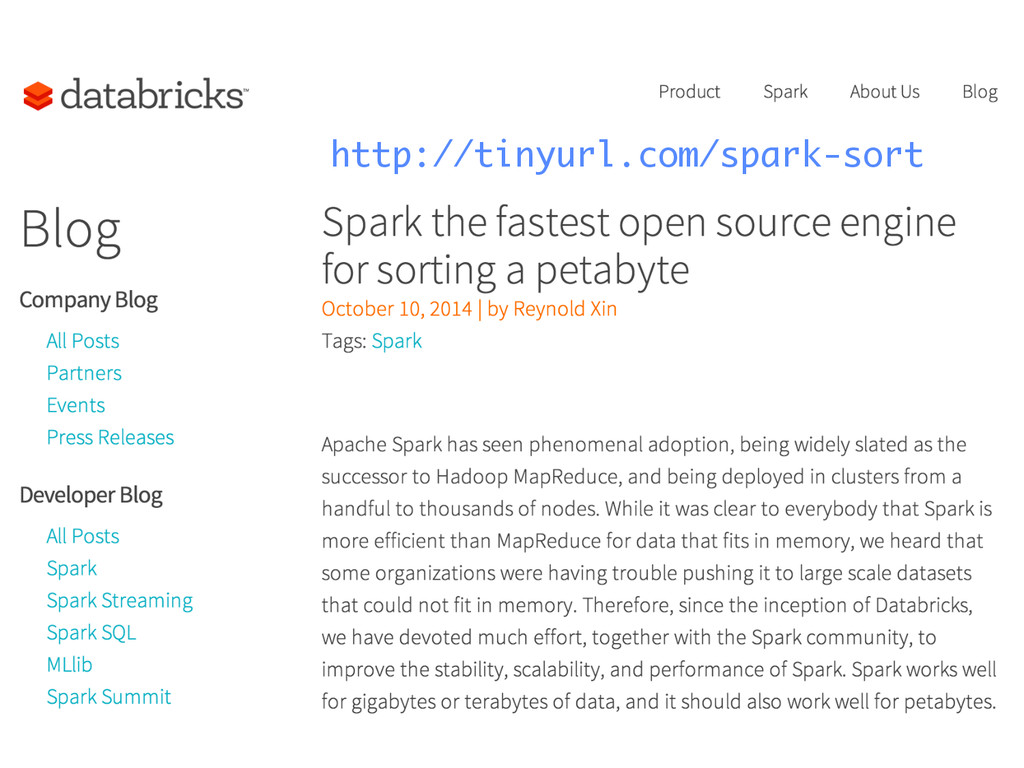
Sorting 100 TB and 1 PB Participated in this year’s
Sort Benchmark Sorted 100TB following benchmark rules > Data only on disk Sorted 1PB on our own to push scalability (no official benchmark exists) -
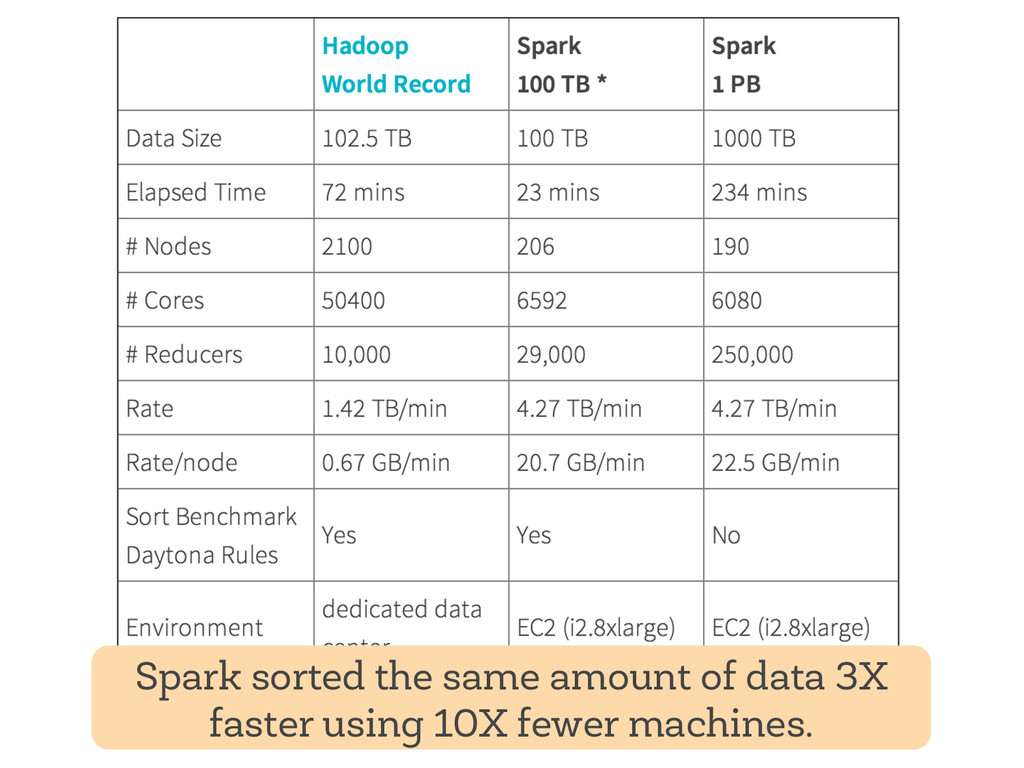
Spark sorted the same amount of data 3X faster using
10X fewer machines. -
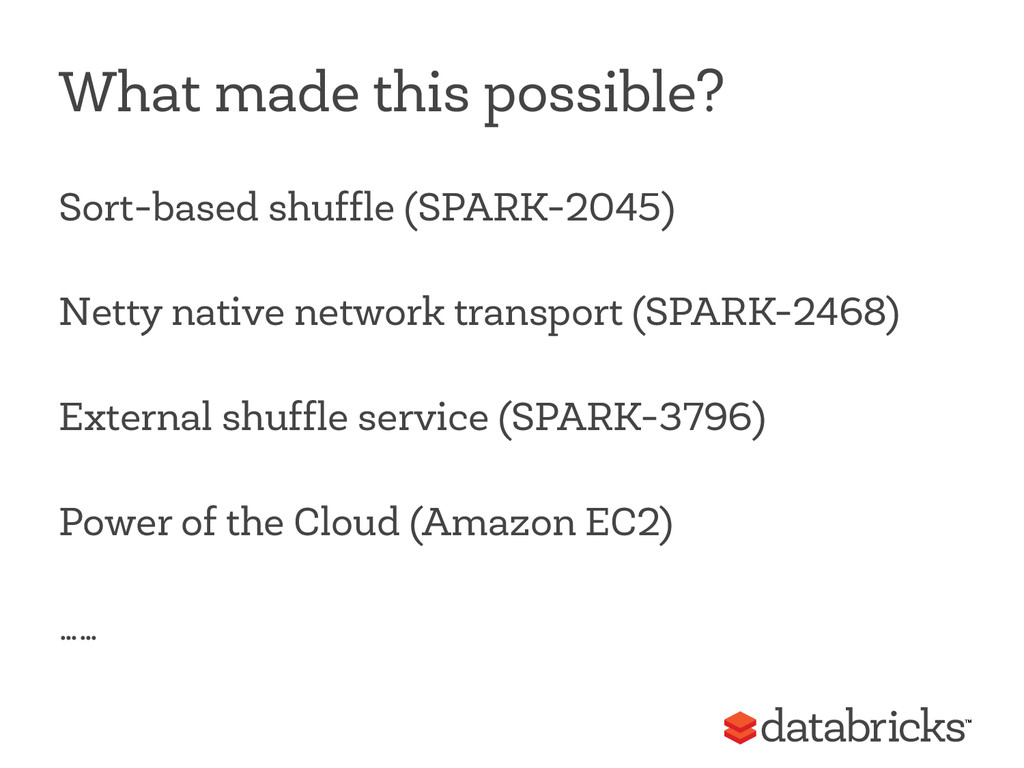
What made this possible? Sort-based shuffle (SPARK-2045) Netty native network
transport (SPARK-2468) External shuffle service (SPARK-3796) Power of the Cloud (Amazon EC2) …… -
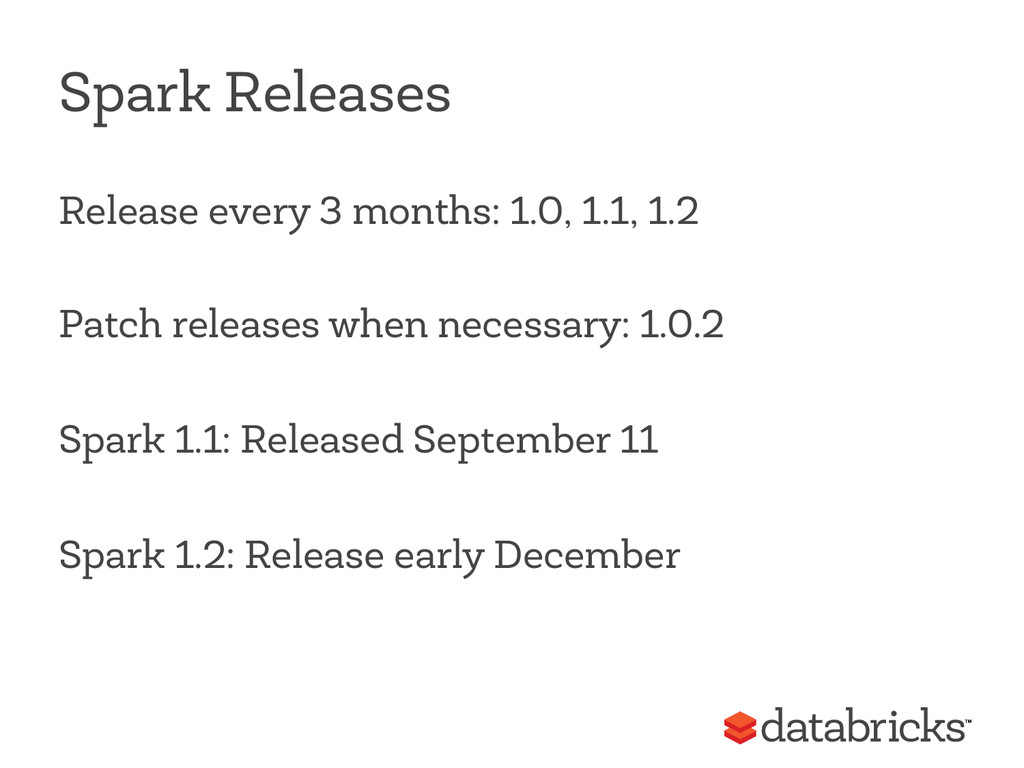
Spark Releases Release every 3 months: 1.0, 1.1, 1.2 Patch
releases when necessary: 1.0.2 Spark 1.1: Released September 11 Spark 1.2: Release early December -
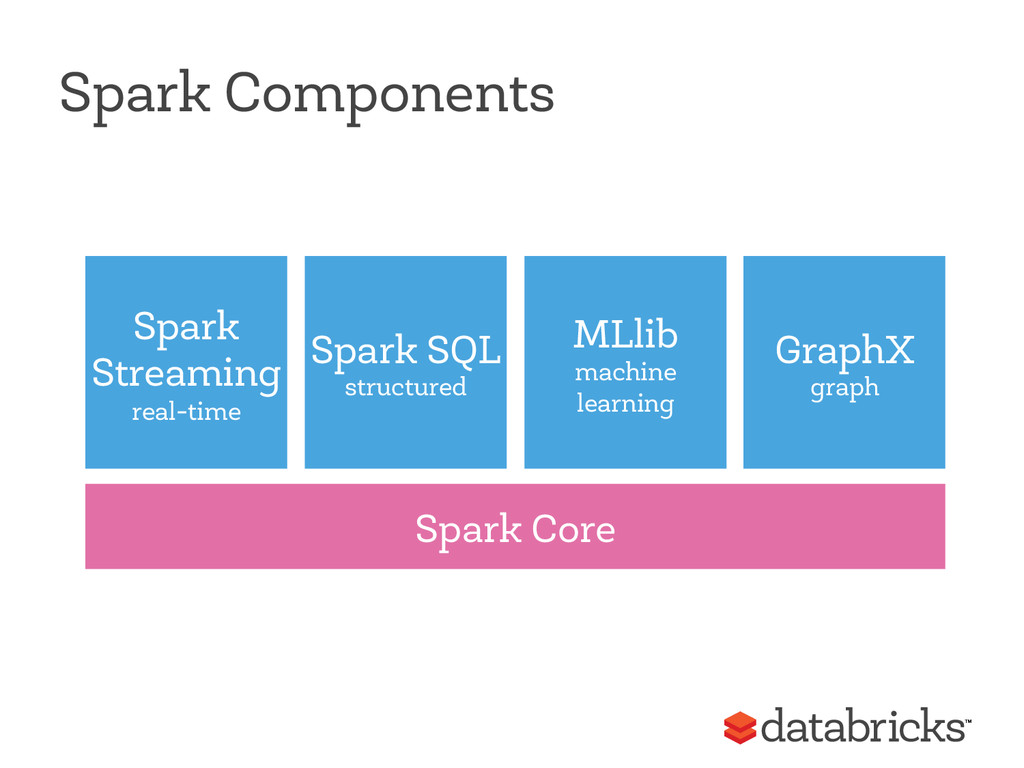
Spark Components Spark Core Spark SQL structured Spark Streaming real-time
MLlib machine learning GraphX graph -
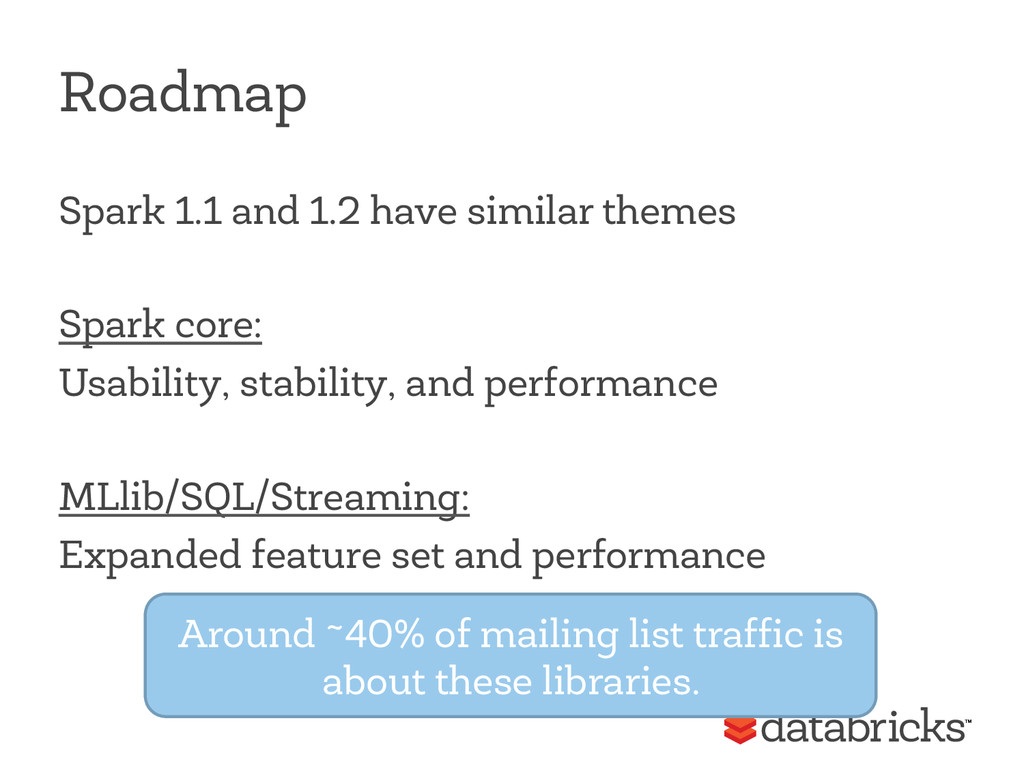
Roadmap Spark 1.1 and 1.2 have similar themes Spark core:
Usability, stability, and performance MLlib/SQL/Streaming: Expanded feature set and performance Around ~40% of mailing list traffic is about these libraries. -
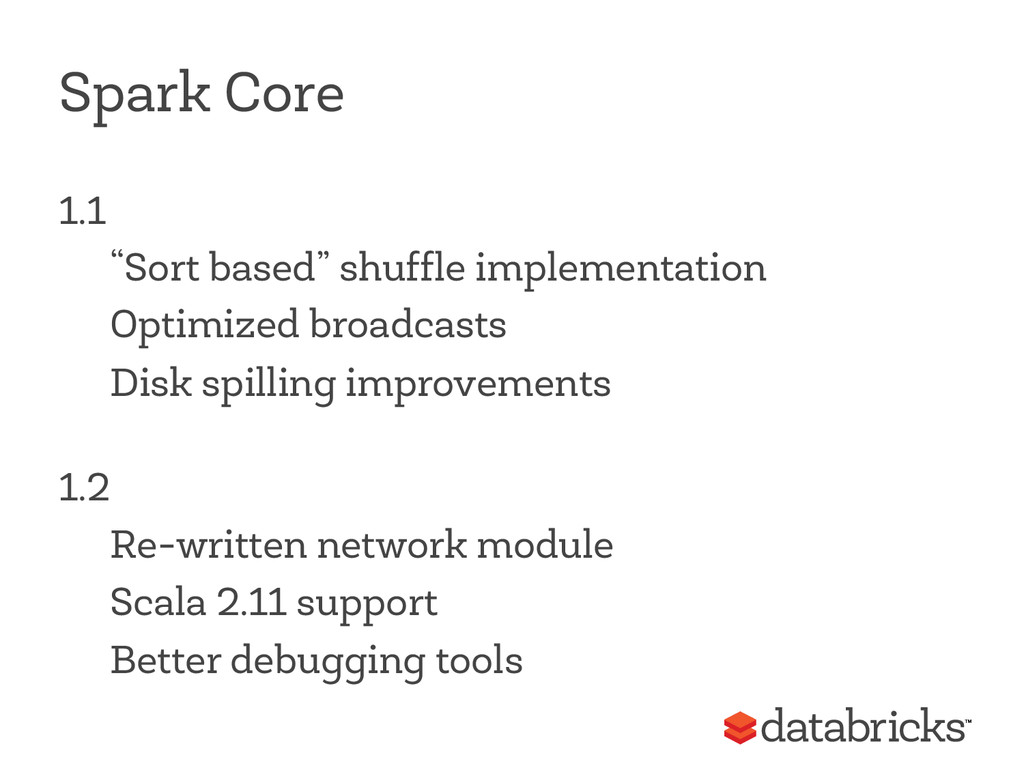
Spark Core 1.1 “Sort based” shuffle implementation Optimized broadcasts Disk
spilling improvements 1.2 Re-written network module Scala 2.11 support Better debugging tools -
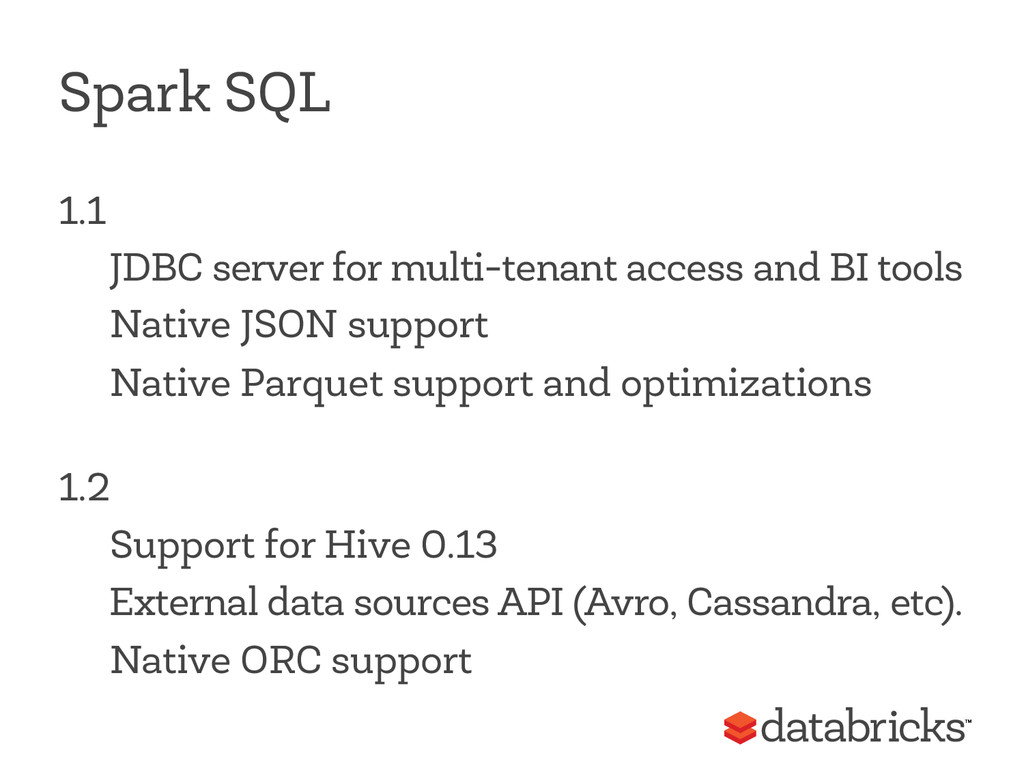
Spark SQL 1.1 JDBC server for multi-tenant access and BI
tools Native JSON support Native Parquet support and optimizations 1.2 Support for Hive 0.13 External data sources API (Avro, Cassandra, etc). Native ORC support -
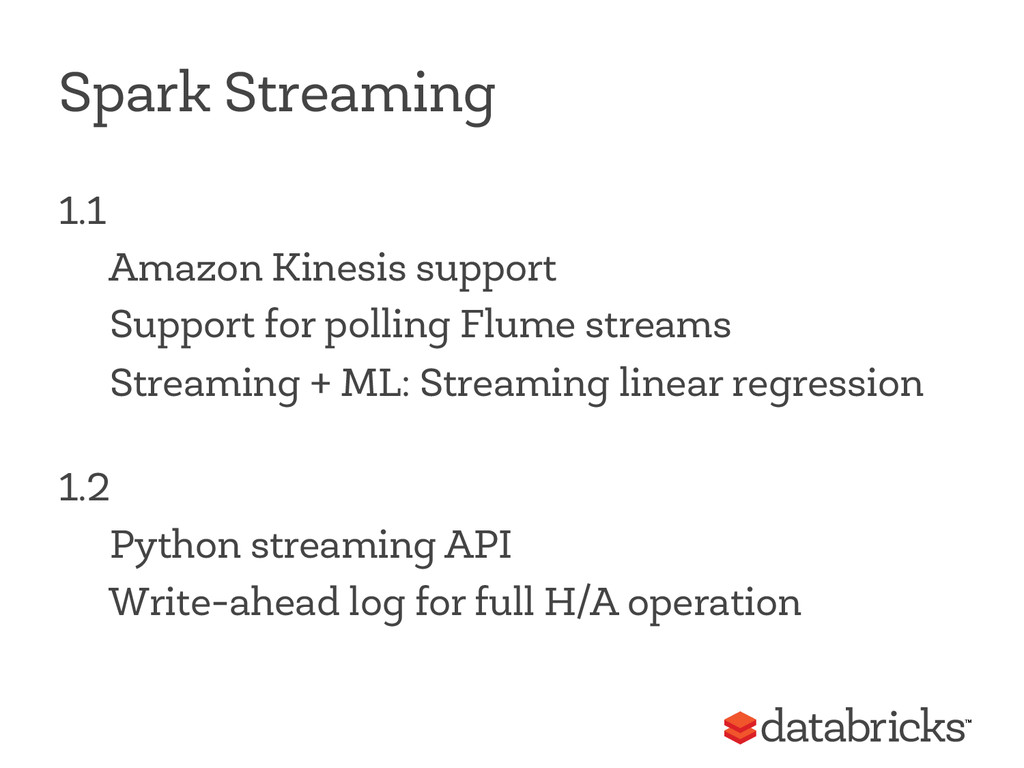
Spark Streaming 1.1 Amazon Kinesis support Support for polling Flume
streams Streaming + ML: Streaming linear regression 1.2 Python streaming API Write-ahead log for full H/A operation -
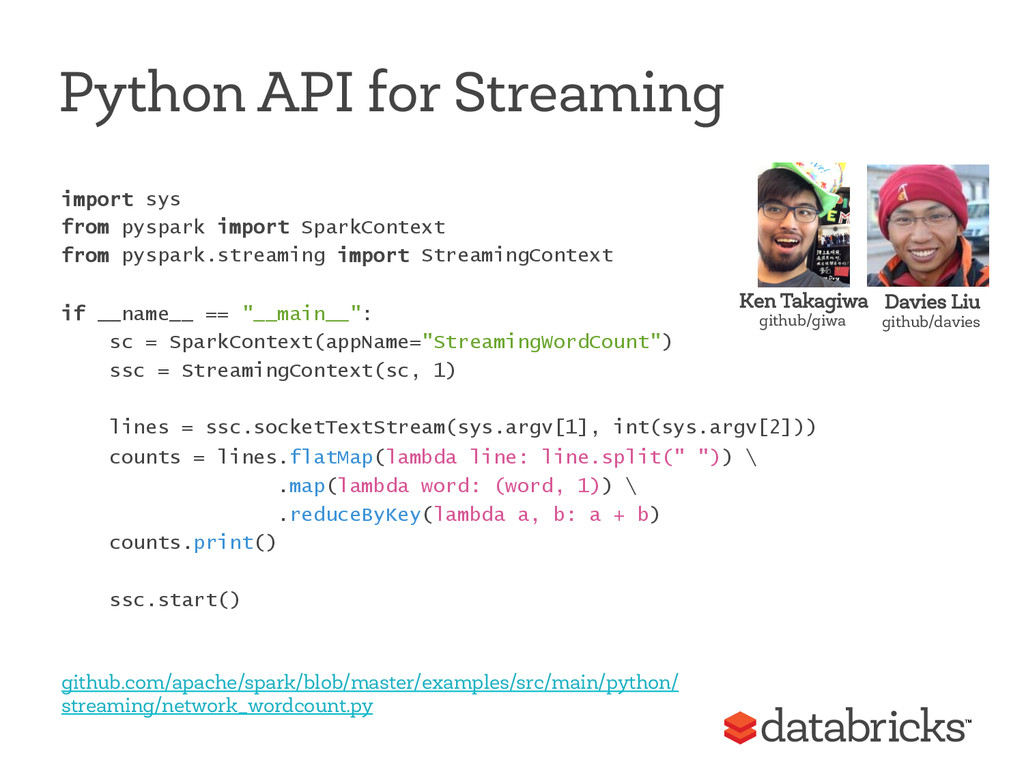
Python API for Streaming import sys from pyspark import SparkContext
from pyspark.streaming import StreamingContext if __name__ == "__main__": sc = SparkContext(appName="StreamingWordCount") ssc = StreamingContext(sc, 1) lines = ssc.socketTextStream(sys.argv[1], int(sys.argv[2])) counts = lines.flatMap(lambda line: line.split(" ")) \ .map(lambda word: (word, 1)) \ .reduceByKey(lambda a, b: a + b) counts.print() ssc.start() github.com/apache/spark/blob/master/examples/src/main/python/ streaming/network_wordcount.py Ken Takagiwa github/giwa Davies Liu github/davies -
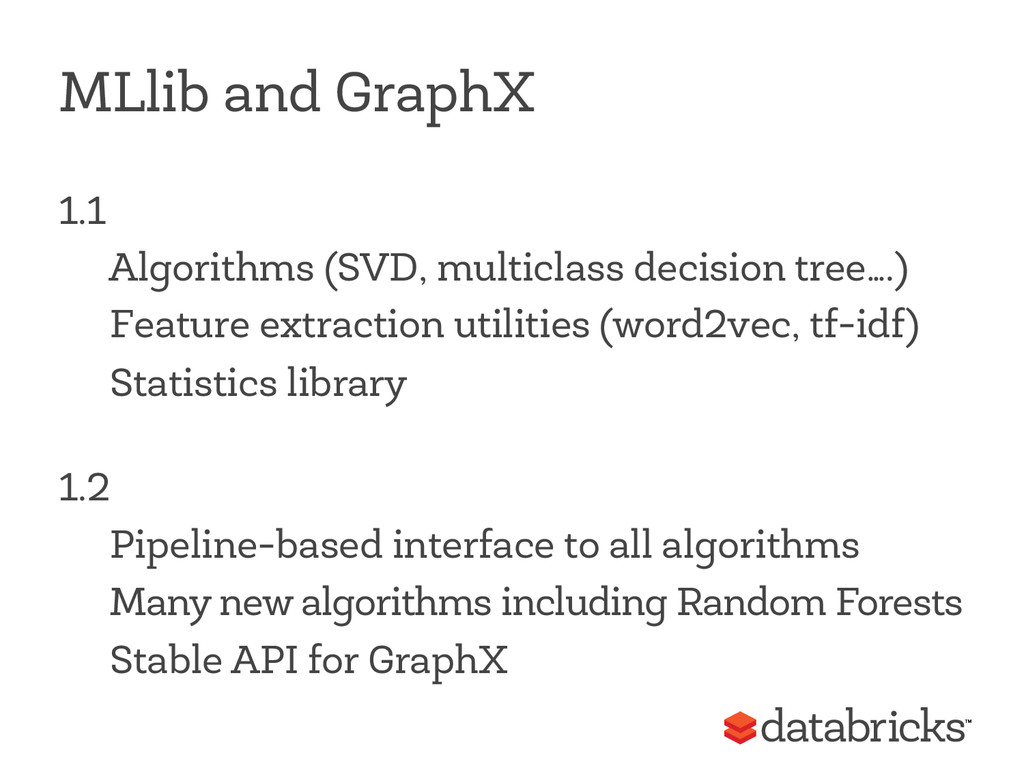
MLlib and GraphX 1.1 Algorithms (SVD, multiclass decision tree….) Feature
extraction utilities (word2vec, tf-idf) Statistics library 1.2 Pipeline-based interface to all algorithms Many new algorithms including Random Forests Stable API for GraphX -
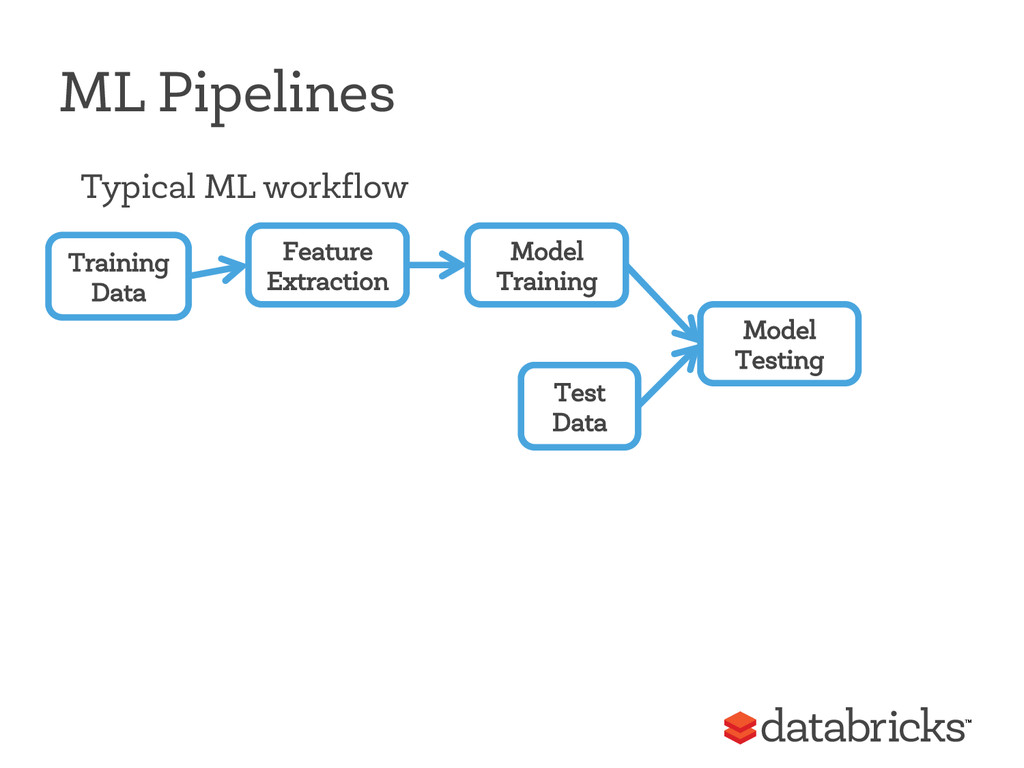
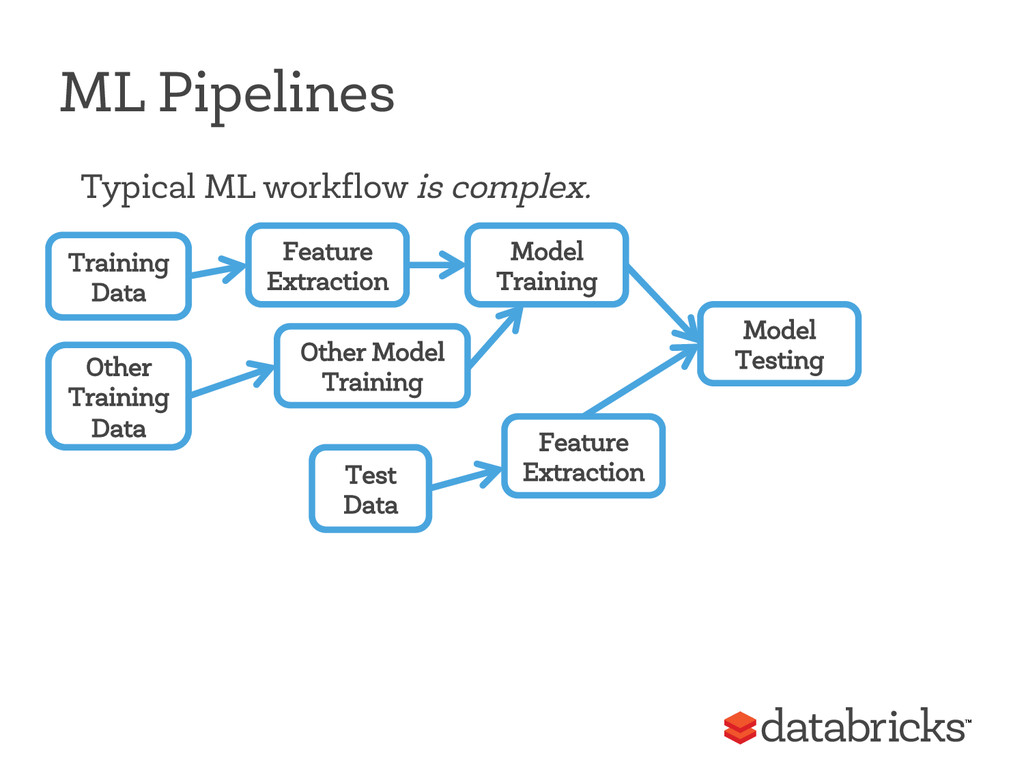
ML Pipelines Typical ML workflow Training Data Feature Extraction Model
Training Model Testing Test Data -
ML Pipelines Training Data Feature Extraction Model Training Model Testing
Test Data Feature Extraction Other Training Data Other Model Training Typical ML workflow is complex. -
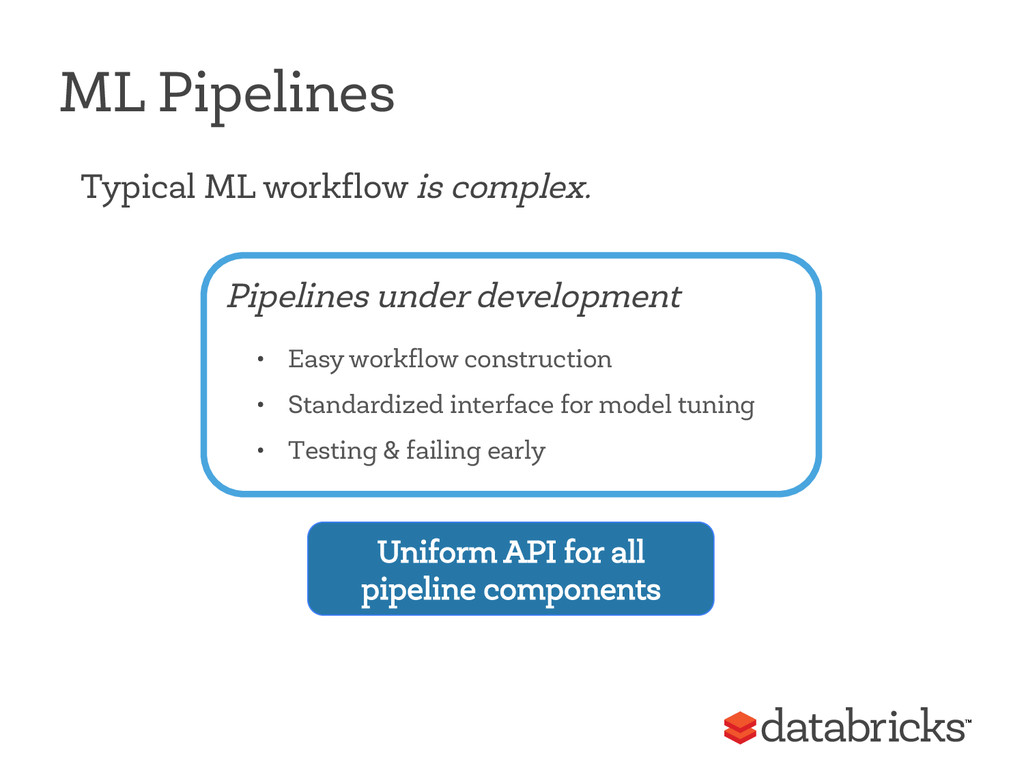
ML Pipelines Pipelines under development • Easy workflow construction •
Standardized interface for model tuning • Testing & failing early Typical ML workflow is complex. Uniform API for all pipeline components -
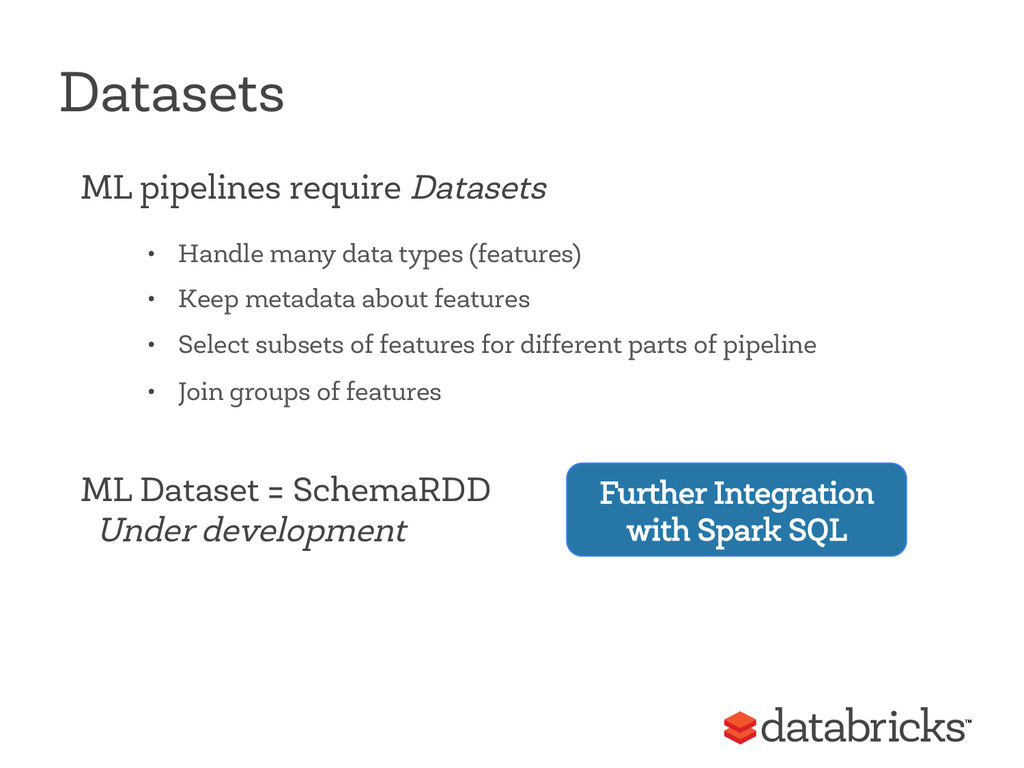
Datasets Further Integration with Spark SQL ML pipelines require Datasets
• Handle many data types (features) • Keep metadata about features • Select subsets of features for different parts of pipeline • Join groups of features ML Dataset = SchemaRDD Under development -
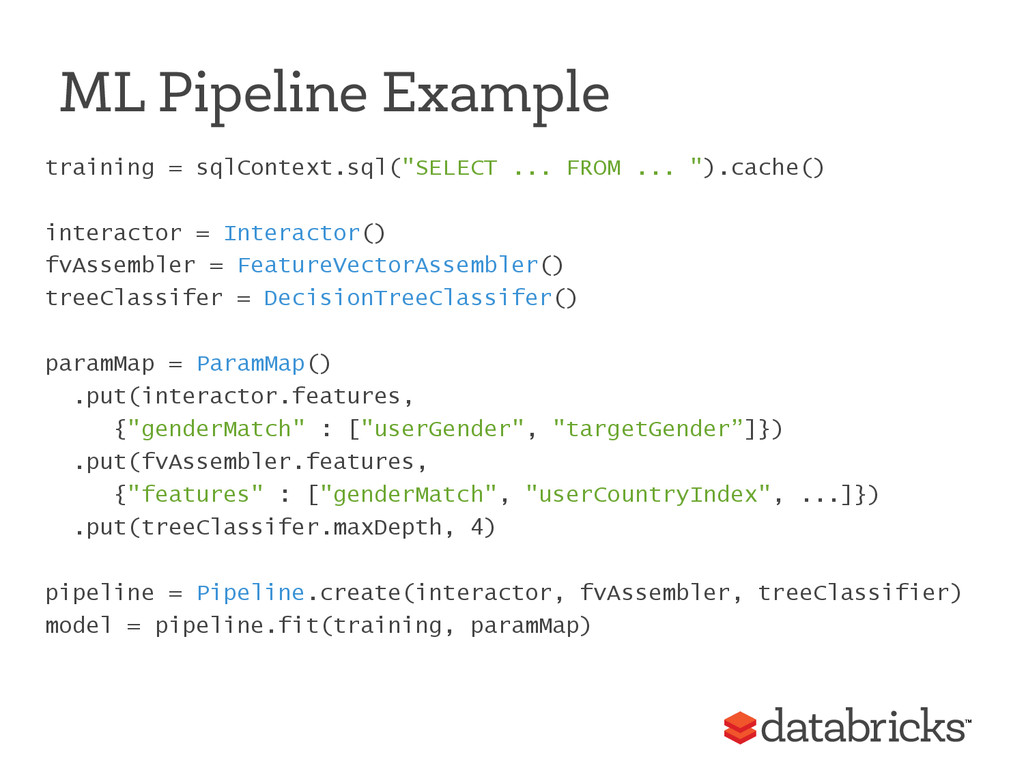
ML Pipeline Example training = sqlContext.sql("SELECT ... FROM ... ").cache()
interactor = Interactor() fvAssembler = FeatureVectorAssembler() treeClassifer = DecisionTreeClassifer() paramMap = ParamMap() .put(interactor.features, {"genderMatch" : ["userGender", "targetGender”]}) .put(fvAssembler.features, {"features" : ["genderMatch", "userCountryIndex", ...]}) .put(treeClassifer.maxDepth, 4) pipeline = Pipeline.create(interactor, fvAssembler, treeClassifier) model = pipeline.fit(training, paramMap) -
Spark Certification Apache Spark developer certificate program • http://www.oreilly.com/go/sparkcert •
Defined by Spark experts @Databricks • Assessed by O’Reilly Media