Upgrade to Pro — share decks privately, control downloads, hide ads and more …

Neuro-Symbolic AI: Combining Logic and Learning...

Avatar for aicourse aicourse
July 02, 2025

Neuro-Symbolic AI: Combining Logic and Learning in Machines

Neuro-Symbolic AI blends deep learning with logical reasoning for smarter, more interpretable systems. Learn more through an advanced AI course in Chennai.

https://www.learnbay.co/datascience/chennai/artificial-intelligence-ai-course-training-chennai

Avatar for aicourse

aicourse

July 02, 2025

Other Decks in Science

Transcript

  1. Neuro-Symbolic AI: Combining Logic and Learning in Machines Neuro-Symbolic AI

    aims to unite the power of deep learning with explicit knowledge and reasoning. This approach addresses the limitations of current AI—such as opacity, brittleness, and data dependency—striving for human-like intelligence that encompasses both perception and common-sense reasoning. For those interested in exploring this frontier, an AI course in Chennai offers the ideal foundation to understand and apply these hybrid techniques.
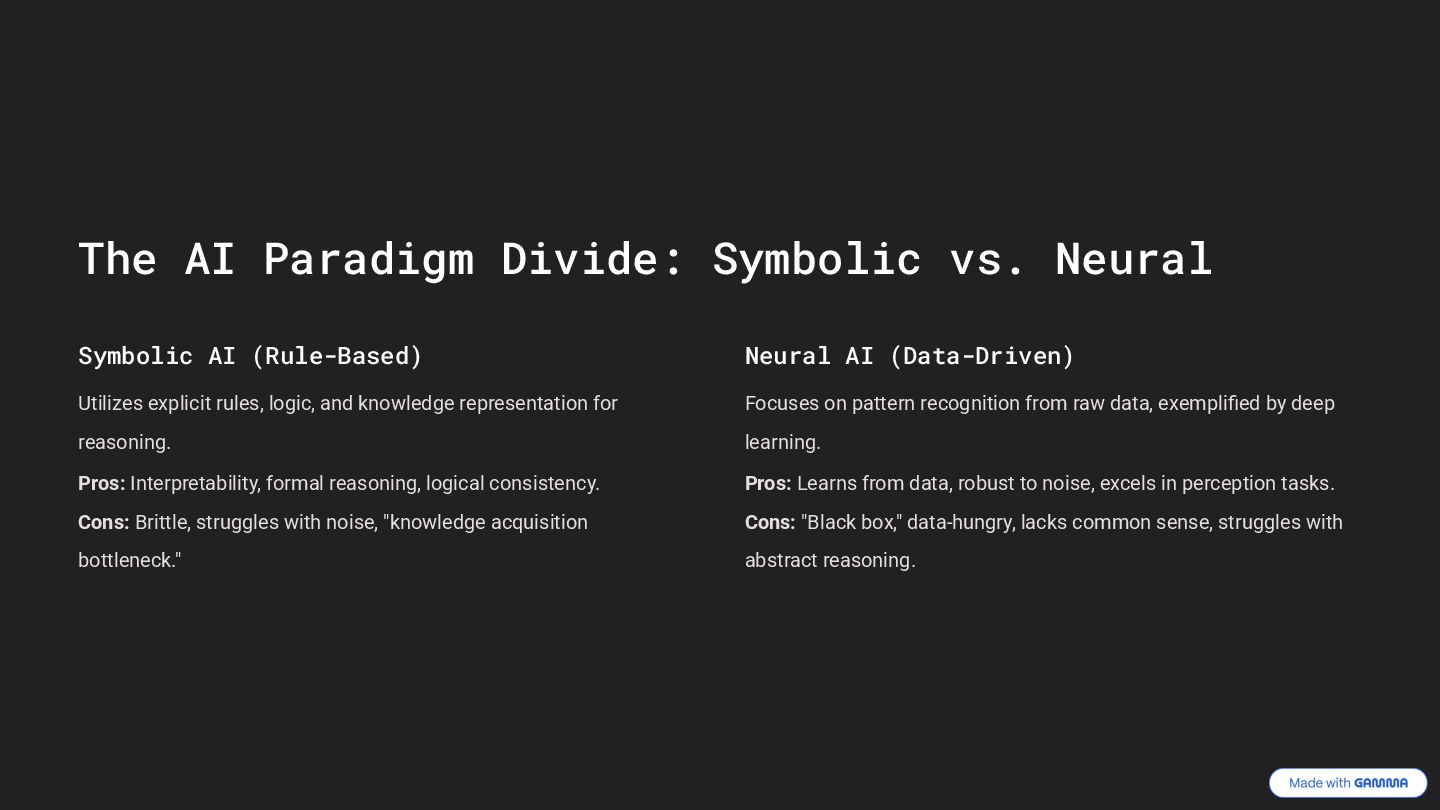
  2. The AI Paradigm Divide: Symbolic vs. Neural Symbolic AI (Rule-Based)

    Utilizes explicit rules, logic, and knowledge representation for reasoning. Pros: Interpretability, formal reasoning, logical consistency. Cons: Brittle, struggles with noise, "knowledge acquisition bottleneck." Neural AI (Data-Driven) Focuses on pattern recognition from raw data, exemplified by deep learning. Pros: Learns from data, robust to noise, excels in perception tasks. Cons: "Black box," data-hungry, lacks common sense, struggles with abstract reasoning.
  3. Symbolic AI: The Logic Core Foundation Built on expert systems,

    knowledge graphs, and logic programming like Prolog, enabling structured reasoning. Strengths Excels in deductive reasoning, planning, and formal verification, critical for explainable decisions in regulated sectors. Example: IBM's Deep Blue defeated Kasparov in 1997 using rule-based search. Limitations Suffers from brittleness to unforeseen inputs and costly manual rule creation, leading to scalability issues despite significant investment.
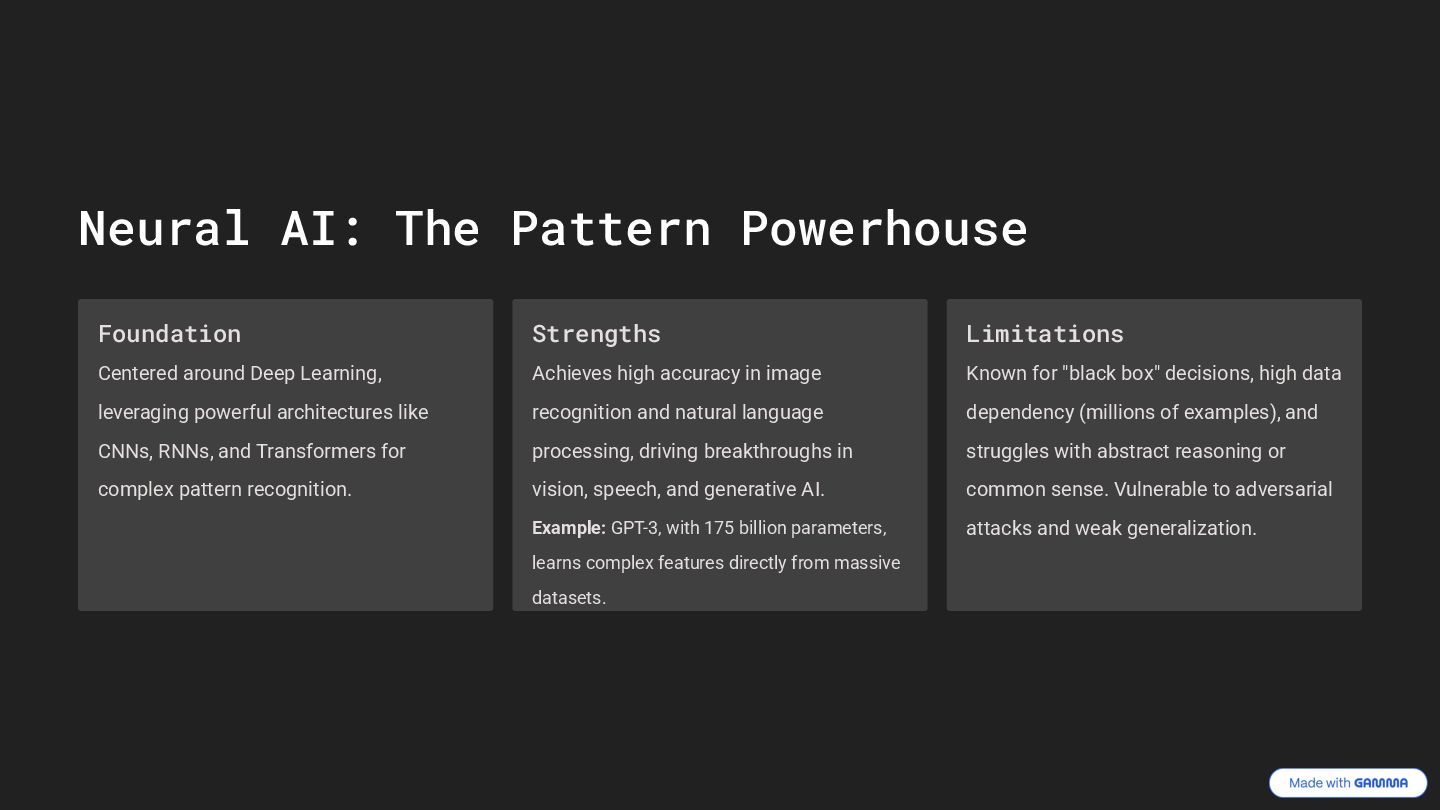
  4. Neural AI: The Pattern Powerhouse Foundation Centered around Deep Learning,

    leveraging powerful architectures like CNNs, RNNs, and Transformers for complex pattern recognition. Strengths Achieves high accuracy in image recognition and natural language processing, driving breakthroughs in vision, speech, and generative AI. Example: GPT-3, with 175 billion parameters, learns complex features directly from massive datasets. Limitations Known for "black box" decisions, high data dependency (millions of examples), and struggles with abstract reasoning or common sense. Vulnerable to adversarial attacks and weak generalization.
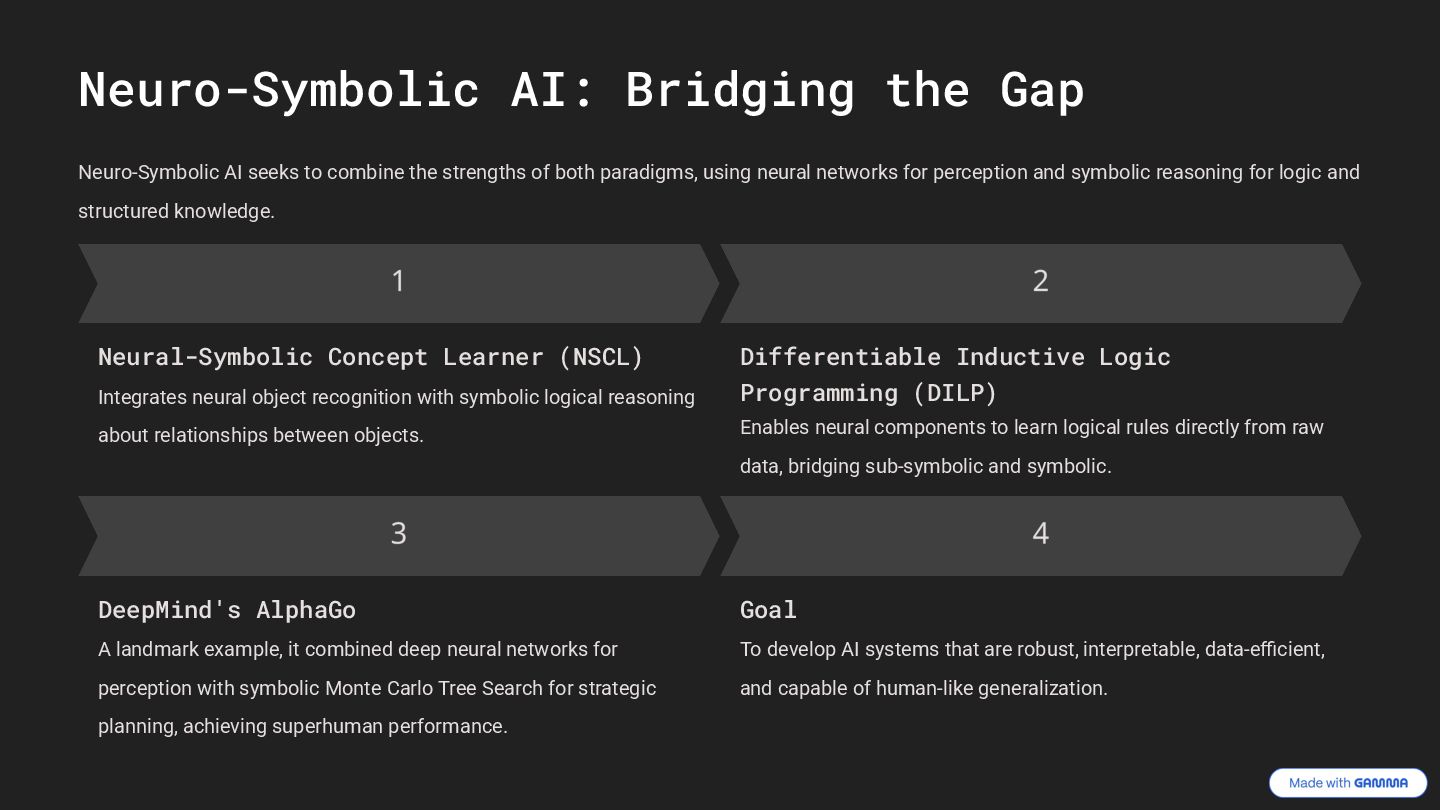
  5. Neuro-Symbolic AI: Bridging the Gap Neuro-Symbolic AI seeks to combine

    the strengths of both paradigms, using neural networks for perception and symbolic reasoning for logic and structured knowledge. Neural-Symbolic Concept Learner (NSCL) Integrates neural object recognition with symbolic logical reasoning about relationships between objects. Differentiable Inductive Logic Programming (DILP) Enables neural components to learn logical rules directly from raw data, bridging sub-symbolic and symbolic. DeepMind's AlphaGo A landmark example, it combined deep neural networks for perception with symbolic Monte Carlo Tree Search for strategic planning, achieving superhuman performance. Goal To develop AI systems that are robust, interpretable, data-efficient, and capable of human-like generalization.
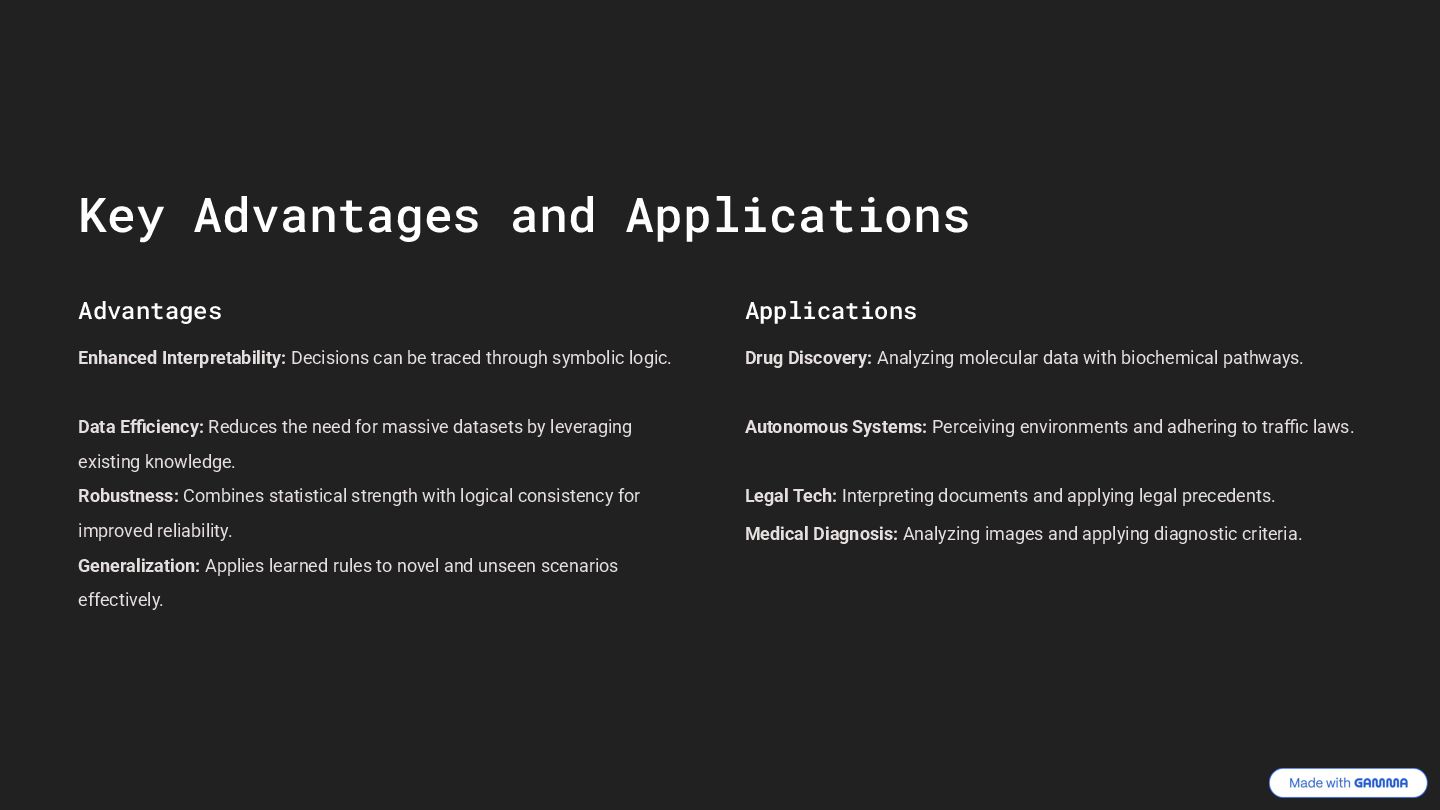
  6. Key Advantages and Applications Advantages Enhanced Interpretability: Decisions can be

    traced through symbolic logic. Data Efficiency: Reduces the need for massive datasets by leveraging existing knowledge. Robustness: Combines statistical strength with logical consistency for improved reliability. Generalization: Applies learned rules to novel and unseen scenarios effectively. Applications Drug Discovery: Analyzing molecular data with biochemical pathways. Autonomous Systems: Perceiving environments and adhering to traffic laws. Legal Tech: Interpreting documents and applying legal precedents. Medical Diagnosis: Analyzing images and applying diagnostic criteria.
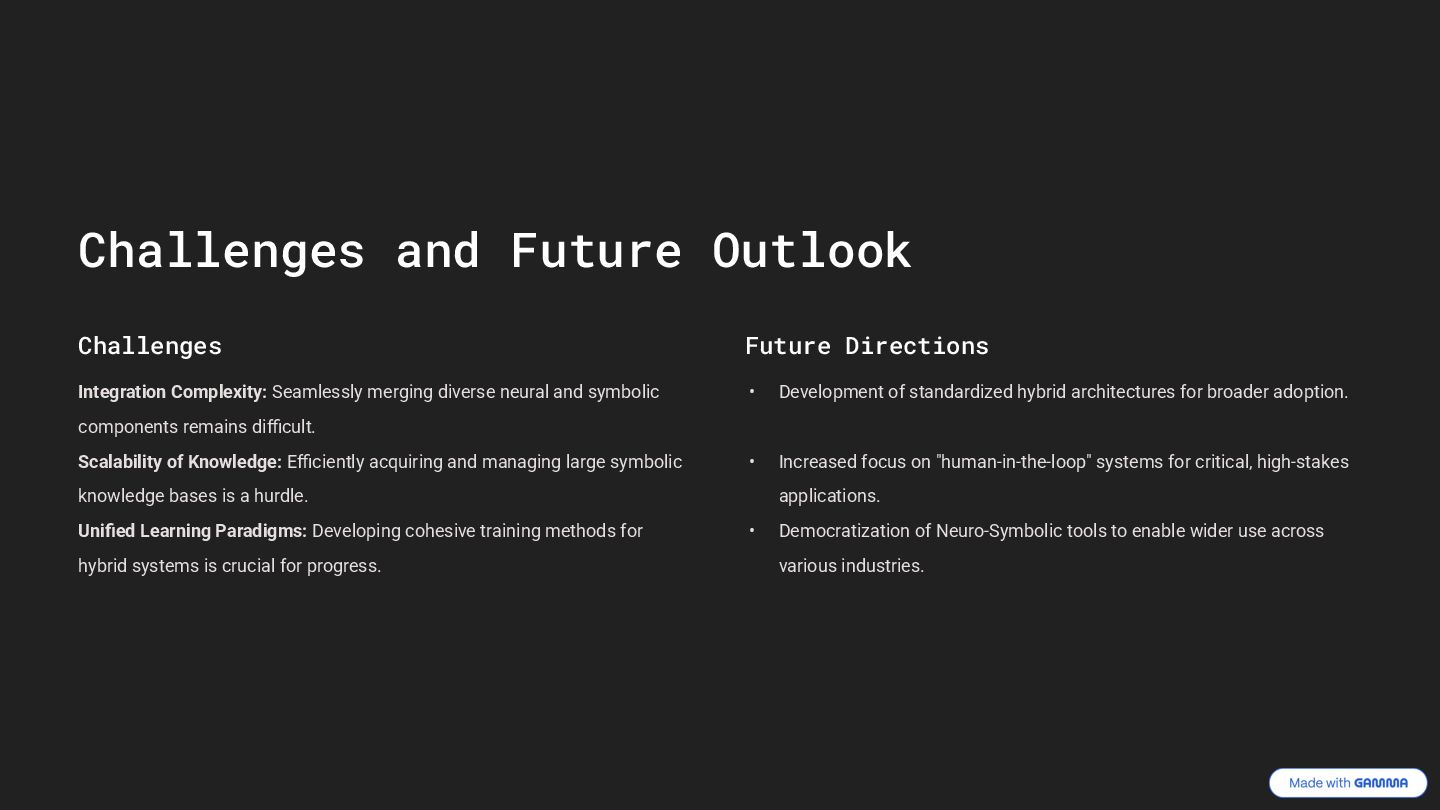
  7. Challenges and Future Outlook Challenges Integration Complexity: Seamlessly merging diverse

    neural and symbolic components remains difficult. Scalability of Knowledge: Efficiently acquiring and managing large symbolic knowledge bases is a hurdle. Unified Learning Paradigms: Developing cohesive training methods for hybrid systems is crucial for progress. Future Directions • Development of standardized hybrid architectures for broader adoption. • Increased focus on "human-in-the-loop" systems for critical, high-stakes applications. • Democratization of Neuro-Symbolic tools to enable wider use across various industries.
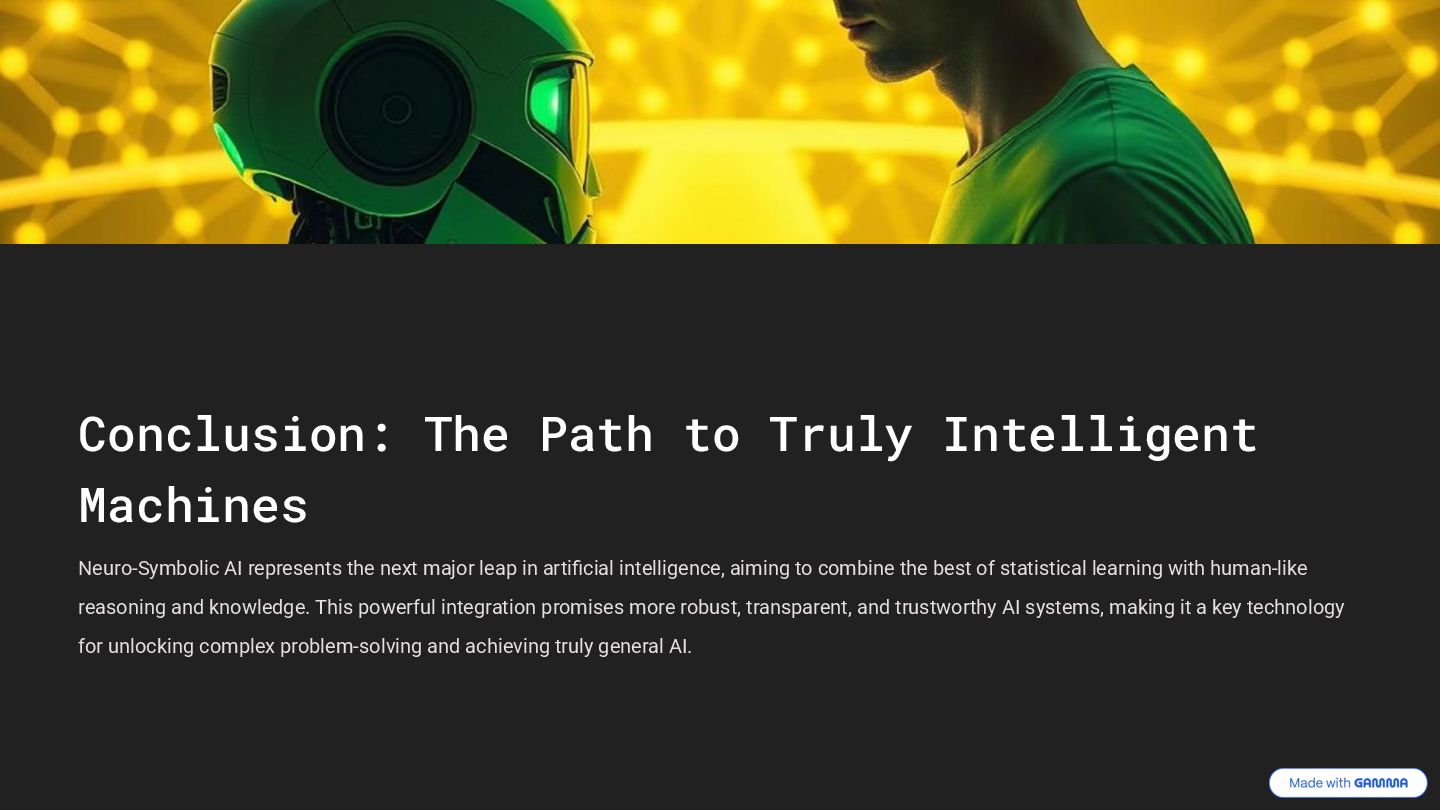
  8. Conclusion: The Path to Truly Intelligent Machines Neuro-Symbolic AI represents

    the next major leap in artificial intelligence, aiming to combine the best of statistical learning with human-like reasoning and knowledge. This powerful integration promises more robust, transparent, and trustworthy AI systems, making it a key technology for unlocking complex problem-solving and achieving truly general AI.