Upgrade to Pro — share decks privately, control downloads, hide ads and more …

O(log n)-Approximation Algorithms for Bipartite...

O(log n)-Approximation Algorithms for Bipartiteness Ratio

IPCO 2026

Avatar for Tasuku Soma

Tasuku Soma

June 17, 2026

More Decks by Tasuku Soma

Other Decks in Science

Transcript

  1. O(log n)-approximation algorithms for bipartiteness ratio Tasuku Soma (Institute of

    Statistical Mathematics & RIKEN AIP, Tokyo) Mingquan Ye (UC Santa Cruz) Yuichi Yoshida (National Institute of Informatics, Tokyo) IPCO 2026 @ Padova, Italy 1 / 18
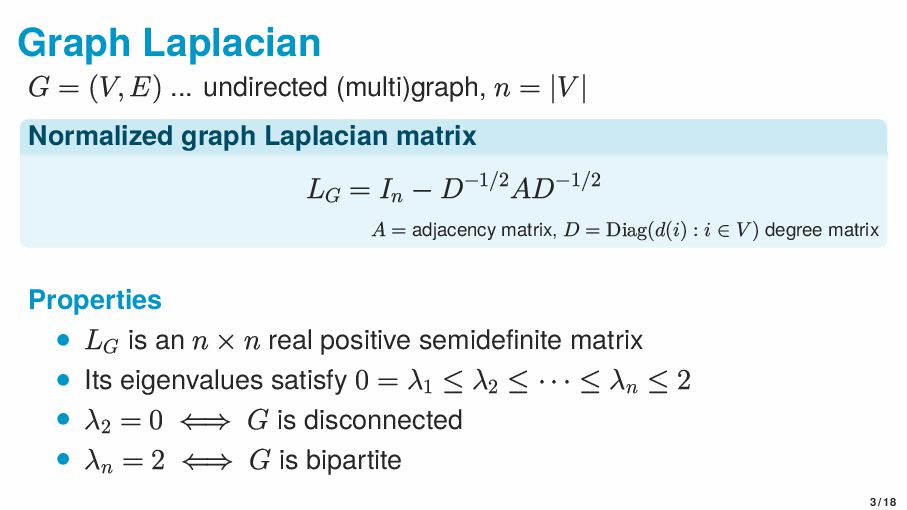
  2. Graph Laplacian G = (V, E) ... undirected (multi)graph, n

    = |V | Normalized graph Laplacian matrix LG = In − D−1/2AD−1/2 A = adjacency matrix, D = Diag(d(i) : i ∈ V ) degree matrix Properties • LG is an n × n real positive semidefinite matrix • Its eigenvalues satisfy 0 = λ1 ≤ λ2 ≤ · · · ≤ λn ≤ 2 • λ2 = 0 ⇐⇒ G is disconnected • λn = 2 ⇐⇒ G is bipartite 3 / 18
  3. Cheeger inequality Cheeger inequality for λ2 [Alon, Milman 1985] λ2

    2 ≤ φ(G) ≤ 2λ2 Conductance φ(G) = min S⊆V |E(S, ¯ S)| min{vol(S), vol(S)} vol(S) := i∈S d(i) 4 / 18
  4. Cheeger inequality Cheeger inequality for λ2 [Alon, Milman 1985] λ2

    2 ≤ φ(G) ≤ 2λ2 Conductance φ(G) = min S⊆V |E(S, ¯ S)| min{vol(S), vol(S)} Conductance φ(G) is small ⇐⇒ G has a small cut with large volume vol(S) := i∈S d(i) 4 / 18
  5. Cheeger inequality Cheeger inequality for λn [Trevisan 2012] 2 −

    λn 2 ≤ β(G) ≤ 2(2 − λn ) Bipartiteness ratio β(G) = min L, R: disjoint 2|E(L)| + 2|E(R)| + |E(L ∪ R, L ∪ R)| vol(L) + vol(R) Bipartiteness ratio β(G) is small ⇐⇒ G contains a large almost bipartite subgraph 5 / 18
  6. Cheeger inequality Cheeger inequality for λn [Trevisan 2012] 2 −

    λn 2 ≤ β(G) ≤ 2(2 − λn ) Bipartiteness ratio β(G) = min L, R: disjoint 2|E(L)| + 2|E(R)| + |E(L ∪ R, L ∪ R)| vol(L) + vol(R) Bipartiteness ratio β(G) is small ⇐⇒ G contains a large almost bipartite subgraph 5 / 18
  7. Cheeger inequality Cheeger inequality for λn [Trevisan 2012] 2 −

    λn 2 ≤ β(G) ≤ 2(2 − λn ) Bipartiteness ratio β(G) = min x∈{0,±1}V (i,j)∈E |x(i) + x(j)| i∈V d(i)|x(i)| Bipartiteness ratio β(G) is small ⇐⇒ G contains a large almost bipartite subgraph 5 / 18
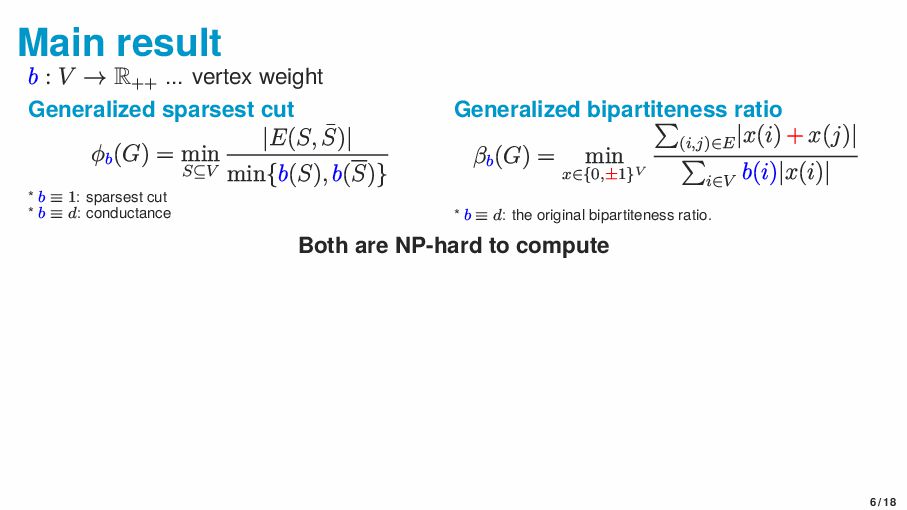
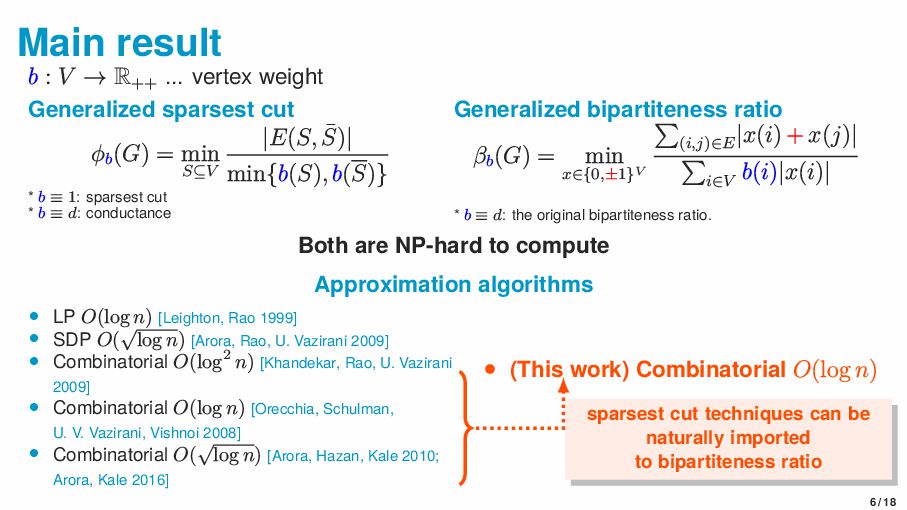
  8. Main result b : V → R++ ... vertex weight

    Generalized sparsest cut φb (G) = min S⊆V |E(S, ¯ S)| min{b(S), b(S)} * b ≡ 1: sparsest cut * b ≡ d: conductance Generalized bipartiteness ratio βb (G) = min x∈{0,±1}V (i,j)∈E |x(i) + x(j)| i∈V b(i)|x(i)| * b ≡ d: the original bipartiteness ratio. Both are NP-hard to compute 6 / 18
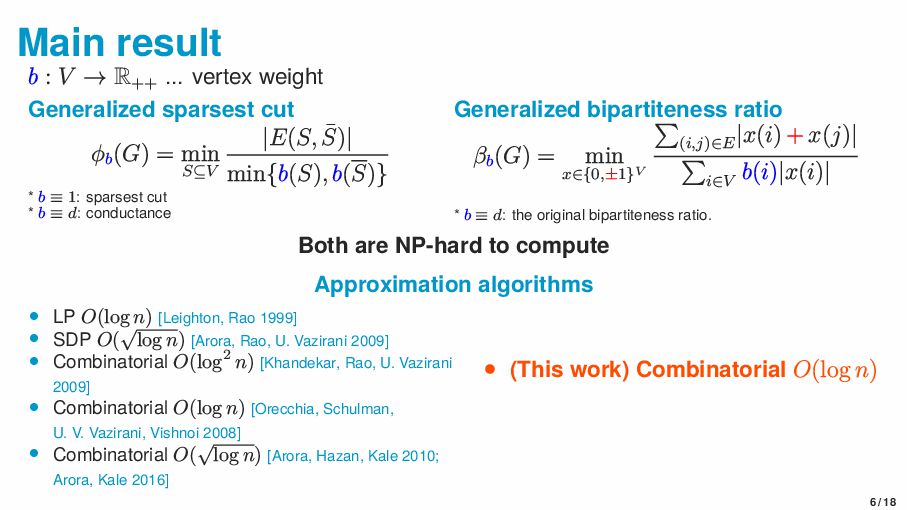
  9. Main result b : V → R++ ... vertex weight

    Generalized sparsest cut φb (G) = min S⊆V |E(S, ¯ S)| min{b(S), b(S)} * b ≡ 1: sparsest cut * b ≡ d: conductance Generalized bipartiteness ratio βb (G) = min x∈{0,±1}V (i,j)∈E |x(i) + x(j)| i∈V b(i)|x(i)| * b ≡ d: the original bipartiteness ratio. Both are NP-hard to compute Approximation algorithms • LP O(log n) [Leighton, Rao 1999] • SDP O( √ log n) [Arora, Rao, U. Vazirani 2009] • Combinatorial O(log2 n) [Khandekar, Rao, U. Vazirani 2009] • Combinatorial O(log n) [Orecchia, Schulman, U. V. Vazirani, Vishnoi 2008] • Combinatorial O( √ log n) [Arora, Hazan, Kale 2010; Arora, Kale 2016] • (This work) Combinatorial O(log n) 6 / 18
  10. Main result b : V → R++ ... vertex weight

    Generalized sparsest cut φb (G) = min S⊆V |E(S, ¯ S)| min{b(S), b(S)} * b ≡ 1: sparsest cut * b ≡ d: conductance Generalized bipartiteness ratio βb (G) = min x∈{0,±1}V (i,j)∈E |x(i) + x(j)| i∈V b(i)|x(i)| * b ≡ d: the original bipartiteness ratio. Both are NP-hard to compute Approximation algorithms • LP O(log n) [Leighton, Rao 1999] • SDP O( √ log n) [Arora, Rao, U. Vazirani 2009] • Combinatorial O(log2 n) [Khandekar, Rao, U. Vazirani 2009] • Combinatorial O(log n) [Orecchia, Schulman, U. V. Vazirani, Vishnoi 2008] • Combinatorial O( √ log n) [Arora, Hazan, Kale 2010; Arora, Kale 2016] • (This work) Combinatorial O(log n) sparsest cut techniques can be naturally imported to bipartiteness ratio 6 / 18
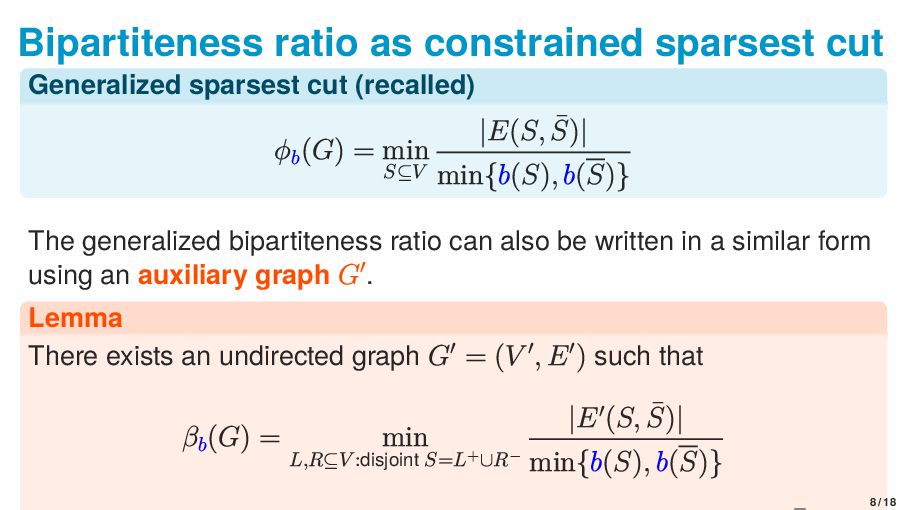
  11. Bipartiteness ratio as constrained sparsest cut Generalized sparsest cut (recalled)

    φb (G) = min S⊆V |E(S, ¯ S)| min{b(S), b(S)} The generalized bipartiteness ratio can also be written in a similar form using an auxiliary graph G′. Lemma There exists an undirected graph G′ = (V ′, E′) such that βb (G) = min L,R⊆V :disjoint S=L+∪R− |E′(S, ¯ S)| min{b(S), b(S)} 8 / 18
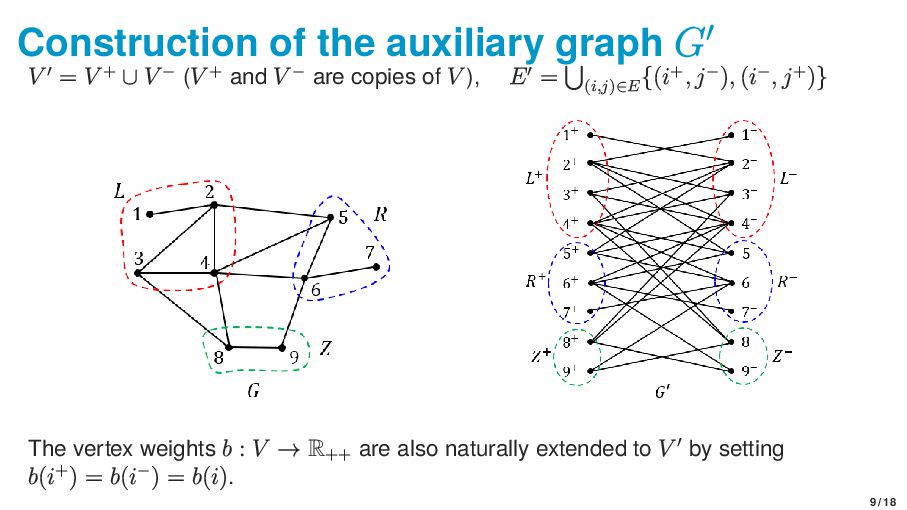
  12. Construction of the auxiliary graph G′ V ′ = V

    + ∪ V − (V + and V − are copies of V ), E′ = (i,j)∈E {(i+, j−), (i−, j+)} The vertex weights b : V → R++ are also naturally extended to V ′ by setting b(i+) = b(i−) = b(i). 9 / 18
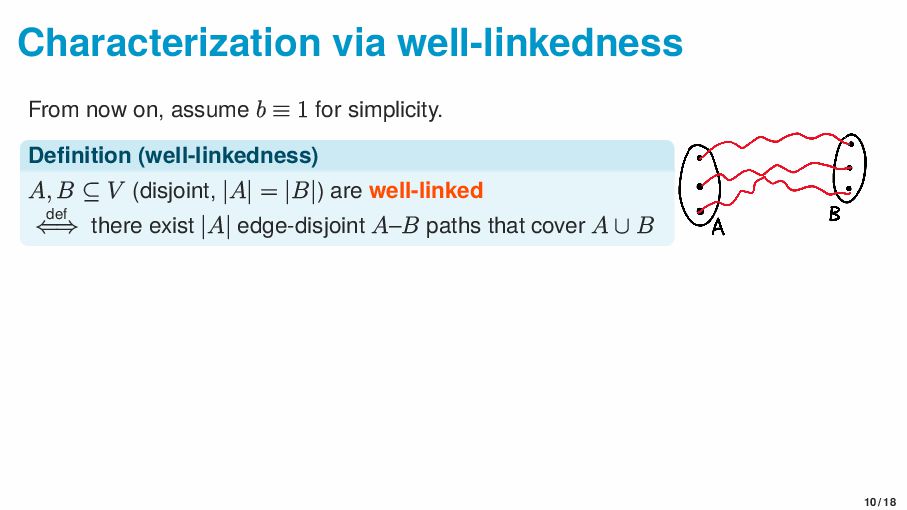
  13. Characterization via well-linkedness From now on, assume b ≡ 1

    for simplicity. Definition (well-linkedness) A, B ⊆ V (disjoint, |A| = |B|) are well-linked def ⇐⇒ there exist |A| edge-disjoint A–B paths that cover A ∪ B 10 / 18
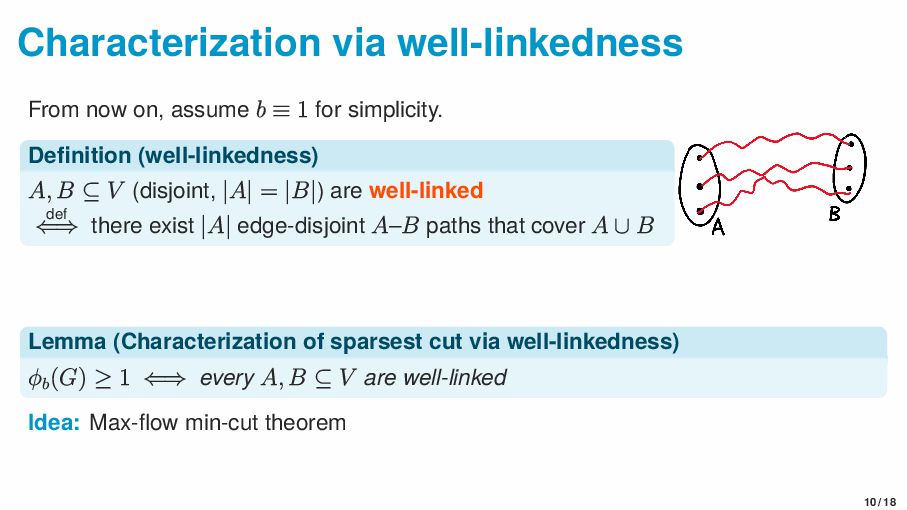
  14. Characterization via well-linkedness From now on, assume b ≡ 1

    for simplicity. Definition (well-linkedness) A, B ⊆ V (disjoint, |A| = |B|) are well-linked def ⇐⇒ there exist |A| edge-disjoint A–B paths that cover A ∪ B Lemma (Characterization of sparsest cut via well-linkedness) φb (G) ≥ 1 ⇐⇒ every A, B ⊆ V are well-linked Idea: Max-flow min-cut theorem 10 / 18
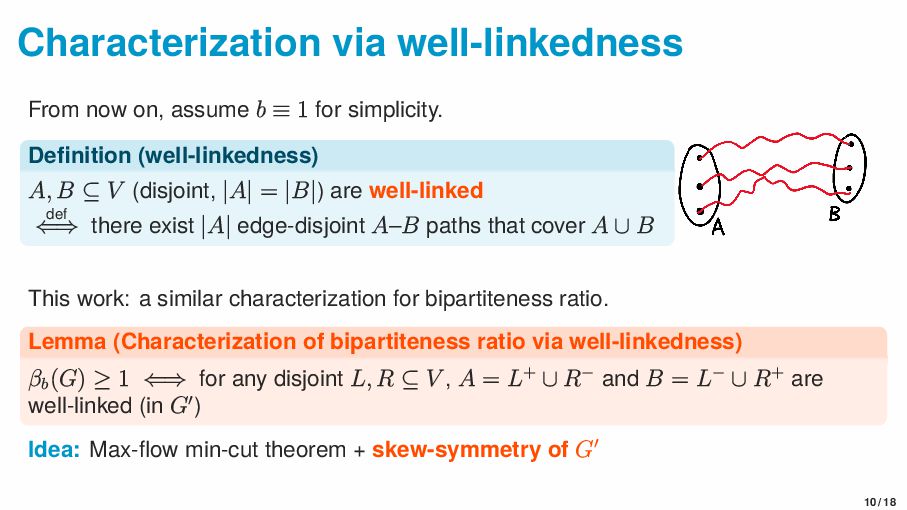
  15. Characterization via well-linkedness From now on, assume b ≡ 1

    for simplicity. Definition (well-linkedness) A, B ⊆ V (disjoint, |A| = |B|) are well-linked def ⇐⇒ there exist |A| edge-disjoint A–B paths that cover A ∪ B This work: a similar characterization for bipartiteness ratio. Lemma (Characterization of bipartiteness ratio via well-linkedness) βb (G) ≥ 1 ⇐⇒ for any disjoint L, R ⊆ V , A = L+ ∪ R− and B = L− ∪ R+ are well-linked (in G′) Idea: Max-flow min-cut theorem + skew-symmetry of G′ 10 / 18
  16. Cut-matching game [Khandekar, Rao, U. Vazirani 2009] H0 := empty

    multigraph on V For t = 1, 2, . . . , do the following: 1 Choose A, B ⊆ V (appropriately) 2 If A, B are not well-linked, then stop. . . . . . . . . . . . . . . . . . . . . . . . . . . . . . . . . φb (G) < 1 3 If A, B are well-linked, find edge-disjoint A–B paths in G and add the demand graph to Ht−1 to obtain Ht 4 If φb (Ht ) ≥ Ω(1), then stop. . . . . . . . . . . . . . . . . . . . . . . . . . . . . In fact, φb (G) ≥ Ω(1/t) 12 / 18
  17. Cut-matching game [Khandekar, Rao, U. Vazirani 2009] H0 := empty

    multigraph on V For t = 1, 2, . . . , do the following: 1 Choose A, B ⊆ V (appropriately) 2 If A, B are not well-linked, then stop. . . . . . . . . . . . . . . . . . . . . . . . . . . . . . . . . φb (G) < 1 3 If A, B are well-linked, find edge-disjoint A–B paths in G and add the demand graph to Ht−1 to obtain Ht 4 If φb (Ht ) ≥ Ω(1), then stop. . . . . . . . . . . . . . . . . . . . . . . . . . . . . In fact, φb (G) ≥ Ω(1/t) 12 / 18
  18. Cut-matching game [Khandekar, Rao, U. Vazirani 2009] H0 := empty

    multigraph on V For t = 1, 2, . . . , do the following: 1 Choose A, B ⊆ V (appropriately) 2 If A, B are not well-linked, then stop. . . . . . . . . . . . . . . . . . . . . . . . . . . . . . . . . φb (G) < 1 3 If A, B are well-linked, find edge-disjoint A–B paths in G and add the demand graph to Ht−1 to obtain Ht 4 If φb (Ht ) ≥ Ω(1), then stop. . . . . . . . . . . . . . . . . . . . . . . . . . . . . In fact, φb (G) ≥ Ω(1/t) Lemma ([Khandekar, Rao, U. Vazirani 2009]) There exists a polynomial-time randomized algorithm for choosing A, B such that the game terminates within t = O(log2 n) iterations with high probability. * Later improved to t = O( √ log n) [Arora, Hazan, Kale 2010; Arora, Kale 2016] 12 / 18
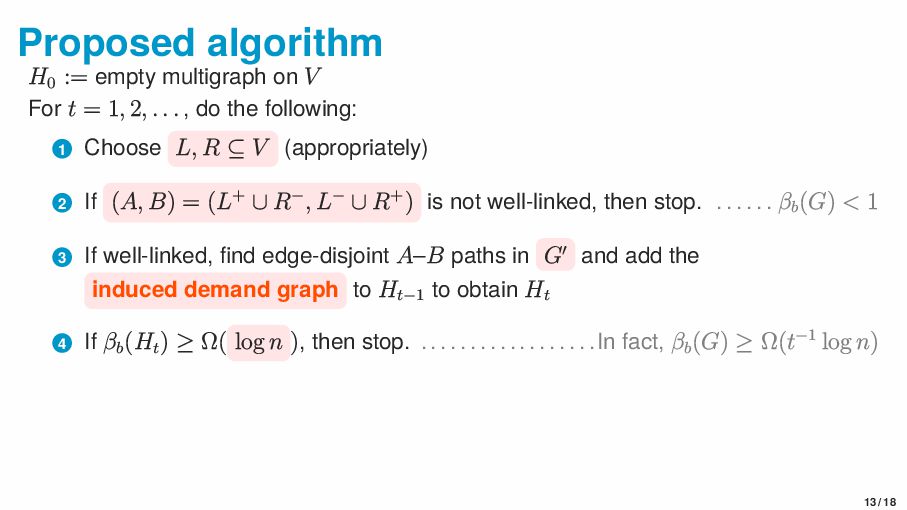
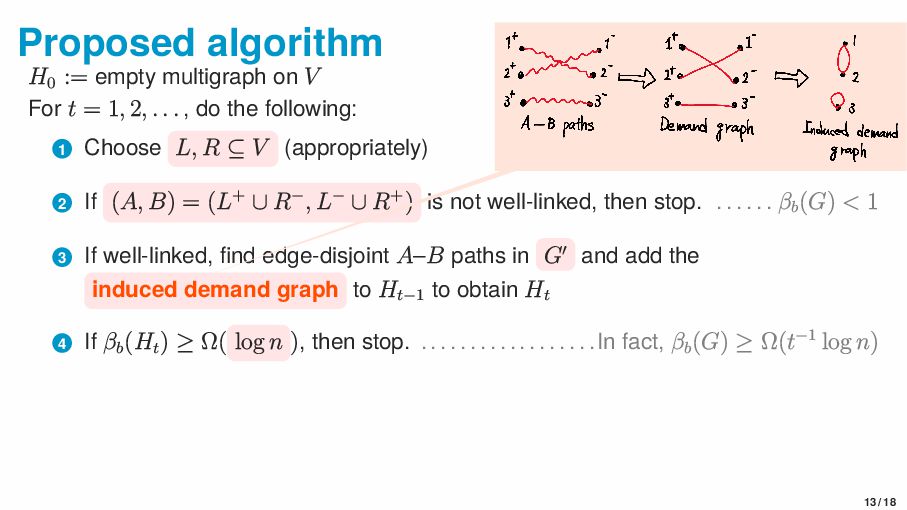
  19. Proposed algorithm H0 := empty multigraph on V For t

    = 1, 2, . . . , do the following: 1 Choose L, R ⊆ V (appropriately) 2 If (A, B) = (L+ ∪ R−, L− ∪ R+) is not well-linked, then stop. . . . . . . βb (G) < 1 3 If well-linked, find edge-disjoint A–B paths in G′ and add the induced demand graph to Ht−1 to obtain Ht 4 If βb (Ht ) ≥ Ω( log n ), then stop. . . . . . . . . . . . . . . . . . .In fact, βb (G) ≥ Ω(t−1 log n) 13 / 18
  20. Proposed algorithm H0 := empty multigraph on V For t

    = 1, 2, . . . , do the following: 1 Choose L, R ⊆ V (appropriately) 2 If (A, B) = (L+ ∪ R−, L− ∪ R+) is not well-linked, then stop. . . . . . . βb (G) < 1 3 If well-linked, find edge-disjoint A–B paths in G′ and add the induced demand graph to Ht−1 to obtain Ht 4 If βb (Ht ) ≥ Ω( log n ), then stop. . . . . . . . . . . . . . . . . . .In fact, βb (G) ≥ Ω(t−1 log n) 13 / 18
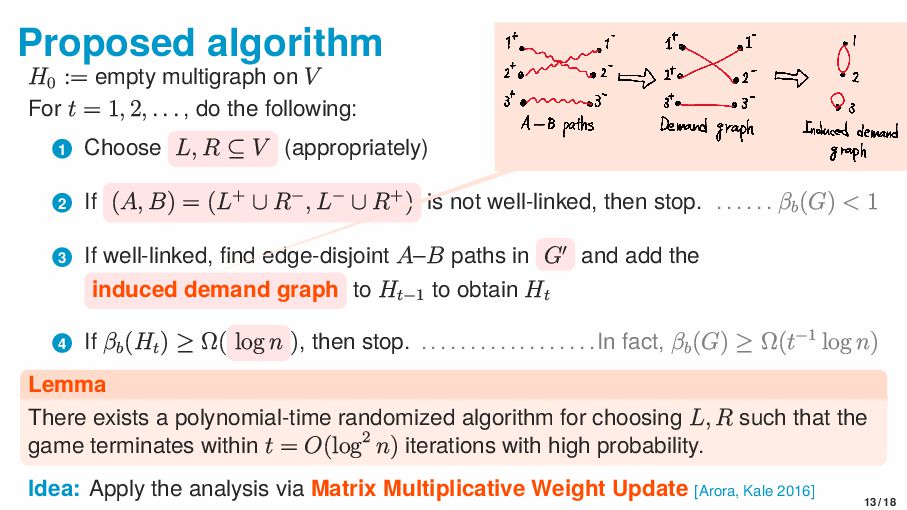
  21. Proposed algorithm H0 := empty multigraph on V For t

    = 1, 2, . . . , do the following: 1 Choose L, R ⊆ V (appropriately) 2 If (A, B) = (L+ ∪ R−, L− ∪ R+) is not well-linked, then stop. . . . . . . βb (G) < 1 3 If well-linked, find edge-disjoint A–B paths in G′ and add the induced demand graph to Ht−1 to obtain Ht 4 If βb (Ht ) ≥ Ω( log n ), then stop. . . . . . . . . . . . . . . . . . .In fact, βb (G) ≥ Ω(t−1 log n) Lemma There exists a polynomial-time randomized algorithm for choosing L, R such that the game terminates within t = O(log2 n) iterations with high probability. Idea: Apply the analysis via Matrix Multiplicative Weight Update [Arora, Kale 2016] 13 / 18
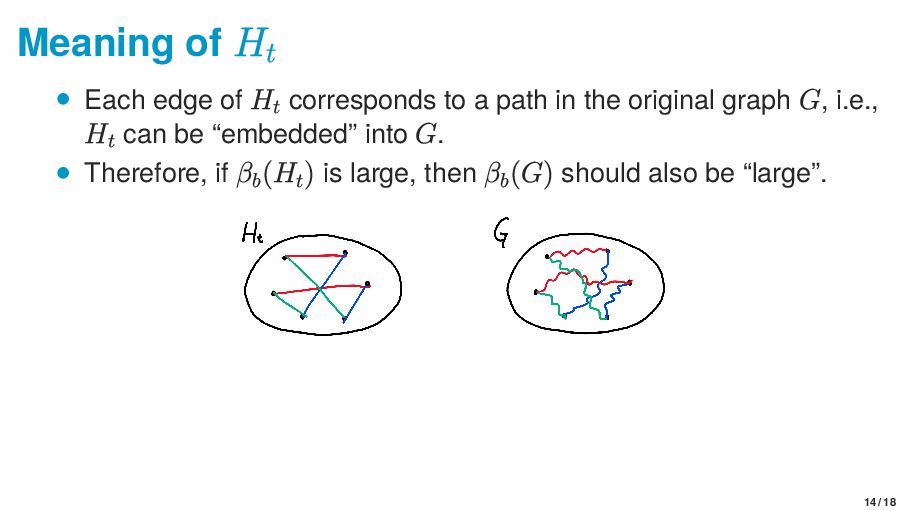
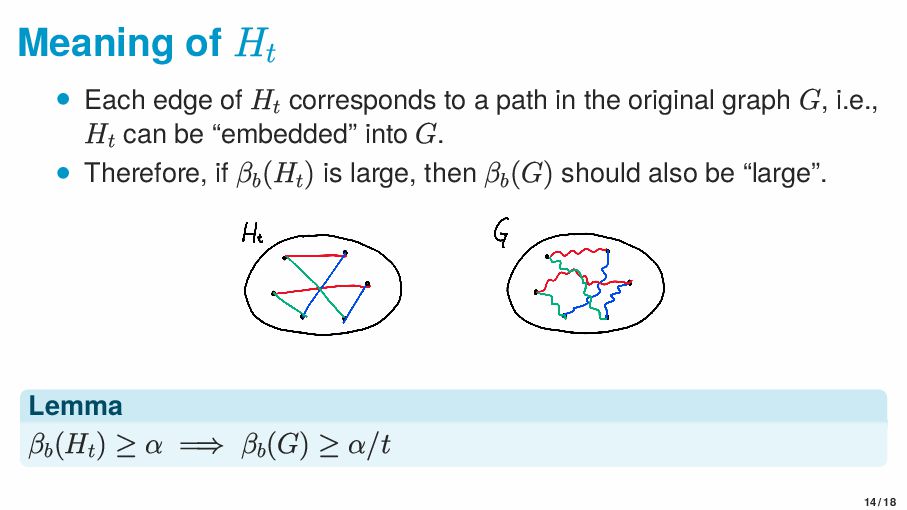
  22. Meaning of Ht • Each edge of Ht corresponds to

    a path in the original graph G, i.e., Ht can be “embedded” into G. • Therefore, if βb (Ht ) is large, then βb (G) should also be “large”. 14 / 18
  23. Meaning of Ht • Each edge of Ht corresponds to

    a path in the original graph G, i.e., Ht can be “embedded” into G. • Therefore, if βb (Ht ) is large, then βb (G) should also be “large”. Lemma βb (Ht ) ≥ α =⇒ βb (G) ≥ α/t 14 / 18
  24. Matrix Multiplicative Weight Update Let Ft := ij∈Et (ei +

    ej )(ei + ej )⊤ (Et : edges of the induced demand graph at iteration t). Then βb (HT ) = min x∈{0,±1}n x⊤ T t=1 Ft x x⊤x ≥ λmin T t=1 Ft 15 / 18
  25. Matrix Multiplicative Weight Update Let Ft := ij∈Et (ei +

    ej )(ei + ej )⊤ (Et : edges of the induced demand graph at iteration t). Then βb (HT ) = min x∈{0,±1}n x⊤ T t=1 Ft x x⊤x ≥ λmin T t=1 Ft Theorem (Matrix Multiplicative Weight Update [Kale 2007]) For SPD matrices O ⪯ Ft ⪯ ρIn (t = 1, . . . , T) and η > 0, Xt = exp(−η t−1 τ=1 Fτ ) tr exp(−η t−1 τ=1 Fτ ) (t = 1, . . . , T) satisfies λmin T t=1 Ft ≥ (1 − ρη) T t=1 ⟨Ft , Xt ⟩ − ρ log n η 15 / 18
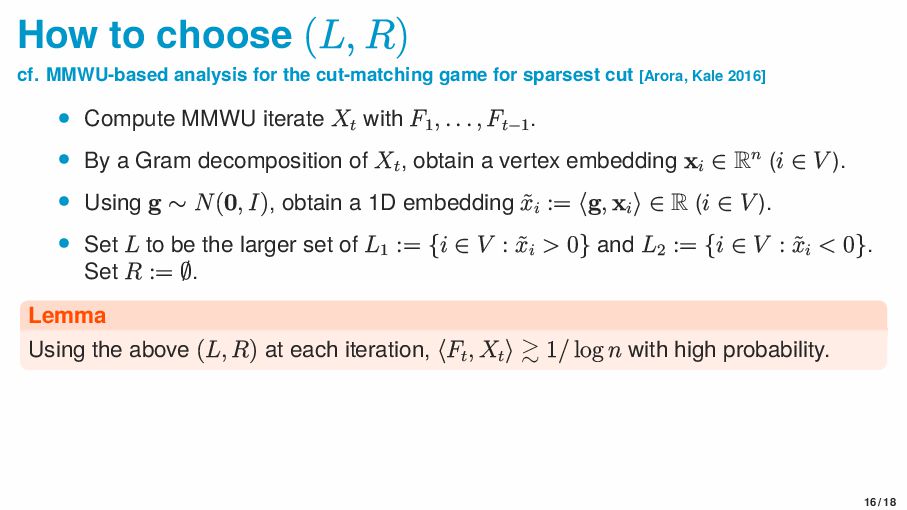
  26. How to choose (L, R) cf. MMWU-based analysis for the

    cut-matching game for sparsest cut [Arora, Kale 2016] • Compute MMWU iterate Xt with F1 , . . . , Ft−1 . • By a Gram decomposition of Xt , obtain a vertex embedding xi ∈ Rn (i ∈ V ). • Using g ∼ N(0, I), obtain a 1D embedding ˜ xi := ⟨g, xi ⟩ ∈ R (i ∈ V ). • Set L to be the larger set of L1 := {i ∈ V : ˜ xi > 0} and L2 := {i ∈ V : ˜ xi < 0}. Set R := ∅. Lemma Using the above (L, R) at each iteration, ⟨Ft , Xt ⟩ ≳ 1/ log n with high probability. 16 / 18
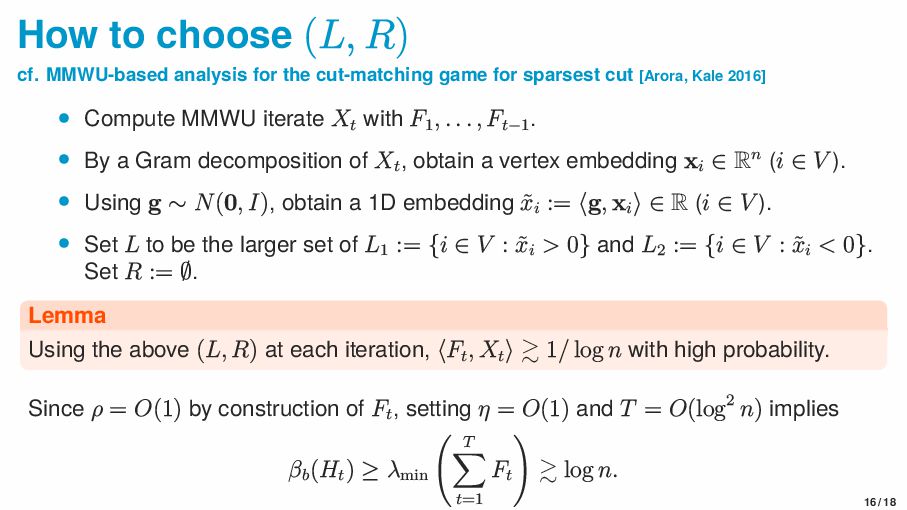
  27. How to choose (L, R) cf. MMWU-based analysis for the

    cut-matching game for sparsest cut [Arora, Kale 2016] • Compute MMWU iterate Xt with F1 , . . . , Ft−1 . • By a Gram decomposition of Xt , obtain a vertex embedding xi ∈ Rn (i ∈ V ). • Using g ∼ N(0, I), obtain a 1D embedding ˜ xi := ⟨g, xi ⟩ ∈ R (i ∈ V ). • Set L to be the larger set of L1 := {i ∈ V : ˜ xi > 0} and L2 := {i ∈ V : ˜ xi < 0}. Set R := ∅. Lemma Using the above (L, R) at each iteration, ⟨Ft , Xt ⟩ ≳ 1/ log n with high probability. Since ρ = O(1) by construction of Ft , setting η = O(1) and T = O(log2 n) implies βb (Ht ) ≥ λmin T t=1 Ft ≳ log n. 16 / 18
  28. Summary Main result • We proposed an O(log n)-approximation randomized

    algorithm for generalized bipartiteness ratio • Complexity: O(log2 n) max-flows on G′ + O(min{n2, b(V )}) arithmetics • Using the current fastest max-flow algorithm: O(m + min{n2, b(V )}) time • Application: approximation for MinUncut Future work • O( √ log n) approximation? • Other sparsest-cut techniques? (LP relaxation, SDP relaxation, ...) 18 / 18
  29. References I N. Alon, V. Milman (1985). “λ1, Isoperimetric Inequalities

    for Graphs, and Superconcentrators”. Journal of Combinatorial Theory, Series B 38.1, pp. 73–88. S. Arora, E. Hazan, S. Kale (2010). “O( √ log n)-Approximation to SPARSEST CUT in O(n2) Time”. SIAM Journal on Computing 39.5, pp. 1748–1771. S. Arora, S. Kale (2016). “A Combinatorial, Primal-Dual Approach to Semidefinite Programs”. Journal of the ACM 63.2, pp. 1–35. S. Arora, S. Rao, U. Vazirani (2009). “Expander Flows, Geometric Embeddings and Graph Partitioning”. Journal of the ACM 56.2, pp. 1–37. S. Kale (2007). “Efficient algorithms using the multiplicative weights update method”. PhD thesis. Princeton University. R. Khandekar, S. Rao, U. Vazirani (2009). “Graph Partitioning Using Single Commodity Flows”. Journal of the ACM 56.4, pp. 1–15. T. Leighton, S. Rao (1999). “Multicommodity Max-Flow Min-Cut Theorems and Their Use in Designing Approximation Algorithms”. Journal of the ACM 46.6, pp. 787–832. L. Orecchia, L. J. Schulman, U. V. Vazirani, N. K. Vishnoi (2008). “On partitioning graphs via single commodity flows”. In: Proceedings of the fortieth annual ACM symposium on Theory of computing, pp. 461–470. L. Trevisan (2012). “Max Cut and the Smallest Eigenvalue”. SIAM Journal on Computing 41.6, pp. 1769–1786. 1 / 1