and partition tary efficient priority queue (Lazy Partition Heaps). INSERT and DECREASE-KEY in O(log log n) time DELETE-MIN in O(log n) amortized time (Plus alternatives and extensions, see paper) Sebastian Wild Partition-based Simple Heaps 2026-04-16 2 / 11
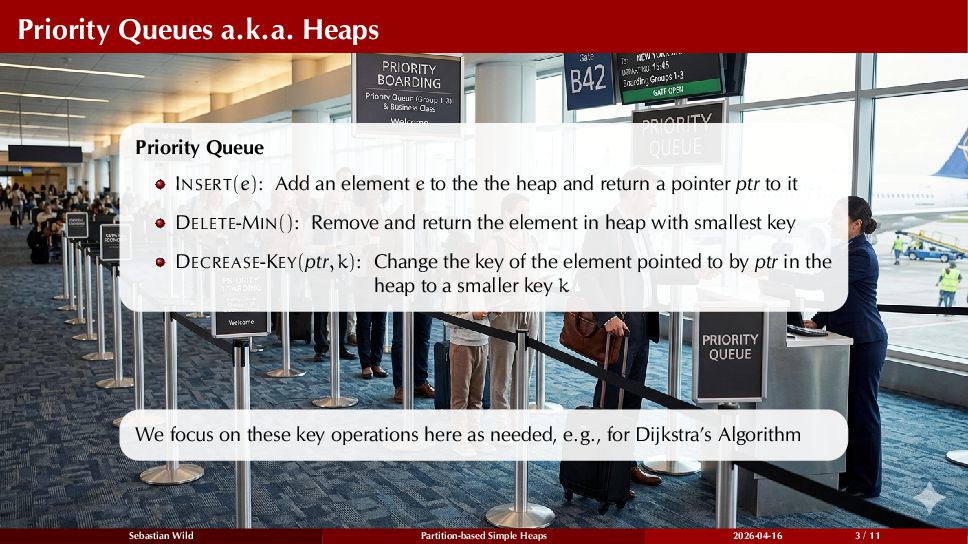
e to the the heap and return a pointer ptr to it DELETE-MIN(): Remove and return the element in heap with smallest key DECREASE-KEY(ptr, k): Change the key of the element pointed to by ptr in the heap to a smaller key k We focus on these key operations here as needed, e.g., for Dijkstra’s Algorithm Sebastian Wild Partition-based Simple Heaps 2026-04-16 3 / 11
part of Heapsort implicit heap-ordered binary tree part of standard intro courses to algorithms and data structures all operations in O(log n) time ⇝ same complexity as using a binary search tree But we can do (much) better: (Strict) Fibonacci heaps achieve O(1) time for all operations but inevitable by sorting lower bound DELETEMIN theoretical breakthroughs but rather complicated to analyze often slower in practice due to caching & constant-factor overhead Can’t we have a simple efficient PQ to teach? various prior attempts with partial success (discussed in paper) our verdict: all retain somewhat complicated structures and invariants, are nontrivial to analyze, or require Ω(log n) time for updates Sebastian Wild Partition-based Simple Heaps 2026-04-16 4 / 11
part of Heapsort implicit heap-ordered binary tree part of standard intro courses to algorithms and data structures all operations in O(log n) time ⇝ same complexity as using a binary search tree But we can do (much) better: (Strict) Fibonacci heaps achieve O(1) time for all operations but inevitable by sorting lower bound DELETEMIN theoretical breakthroughs but rather complicated to analyze often slower in practice due to caching & constant-factor overhead Can’t we have a simple efficient PQ to teach? various prior attempts with partial success (discussed in paper) our verdict: all retain somewhat complicated structures and invariants, are nontrivial to analyze, or require Ω(log n) time for updates Sebastian Wild Partition-based Simple Heaps 2026-04-16 4 / 11
part of Heapsort implicit heap-ordered binary tree part of standard intro courses to algorithms and data structures all operations in O(log n) time ⇝ same complexity as using a binary search tree But we can do (much) better: (Strict) Fibonacci heaps achieve O(1) time for all operations but inevitable by sorting lower bound DELETEMIN theoretical breakthroughs but rather complicated to analyze often slower in practice due to caching & constant-factor overhead Can’t we have a simple efficient PQ to teach? various prior attempts with partial success (discussed in paper) our verdict: all retain somewhat complicated structures and invariants, are nontrivial to analyze, or require Ω(log n) time for updates Sebastian Wild Partition-based Simple Heaps 2026-04-16 4 / 11
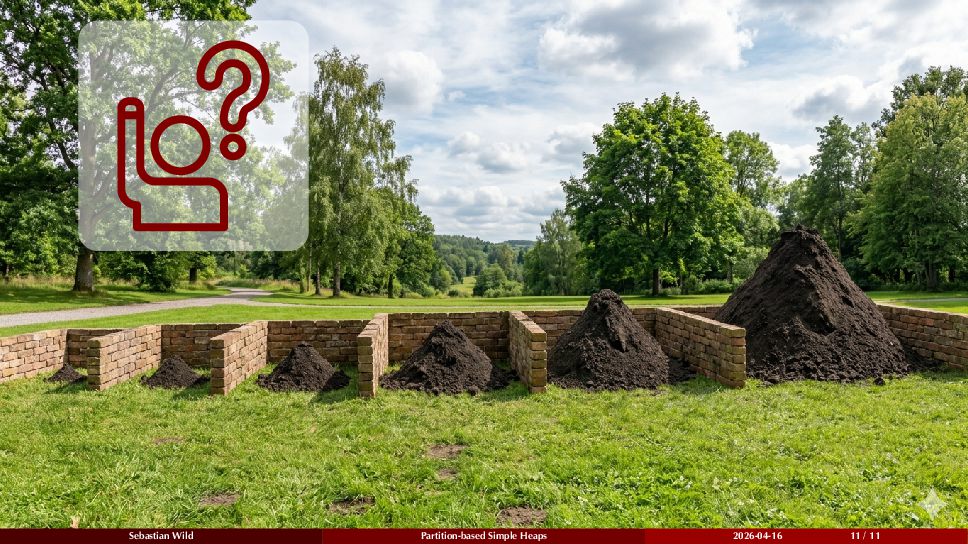
part of Heapsort implicit heap-ordered binary tree part of standard intro courses to algorithms and data structures all operations in O(log n) time ⇝ same complexity as using a binary search tree But we can do (much) better: (Strict) Fibonacci heaps achieve O(1) time for all operations but inevitable by sorting lower bound DELETEMIN theoretical breakthroughs but rather complicated to analyze often slower in practice due to caching & constant-factor overhead Can’t we have a simple efficient PQ to teach? various prior attempts with partial success (discussed in paper) our verdict: all retain somewhat complicated structures and invariants, are nontrivial to analyze, or require Ω(log n) time for updates Is that necessary?? Sebastian Wild Partition-based Simple Heaps 2026-04-16 4 / 11
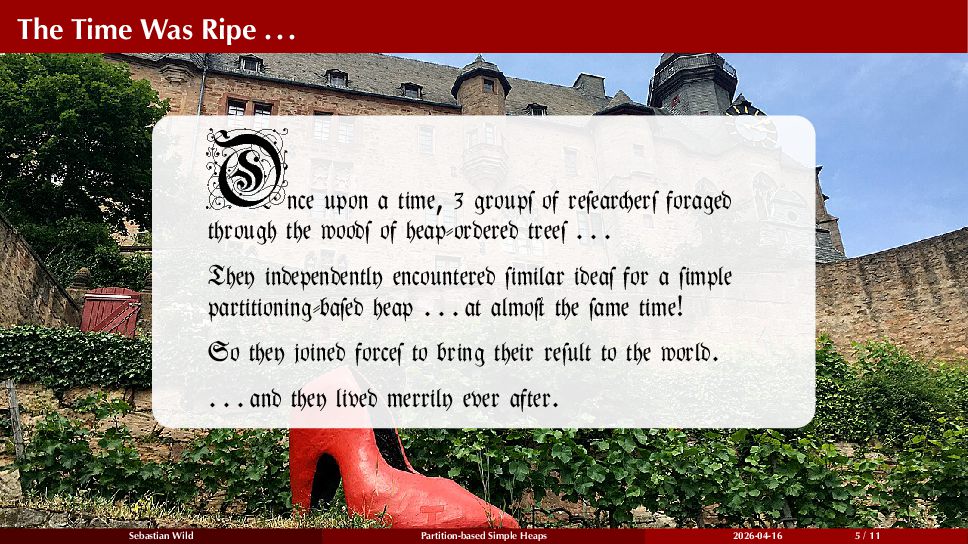
3 groups of researĚers foraged through the woods of heap-ordered trees . . . They independently encountered similar ideas for a simple partitioning-based heap . . . at almoĆ the same time! Sebastian Wild Partition-based Simple Heaps 2026-04-16 5 / 11
3 groups of researĚers foraged through the woods of heap-ordered trees . . . They independently encountered similar ideas for a simple partitioning-based heap . . . at almoĆ the same time! So they joined forces to bring their result to the world. Sebastian Wild Partition-based Simple Heaps 2026-04-16 5 / 11
3 groups of researĚers foraged through the woods of heap-ordered trees . . . They independently encountered similar ideas for a simple partitioning-based heap . . . at almoĆ the same time! So they joined forces to bring their result to the world. . . . and they lived merrily ever after. Sebastian Wild Partition-based Simple Heaps 2026-04-16 5 / 11
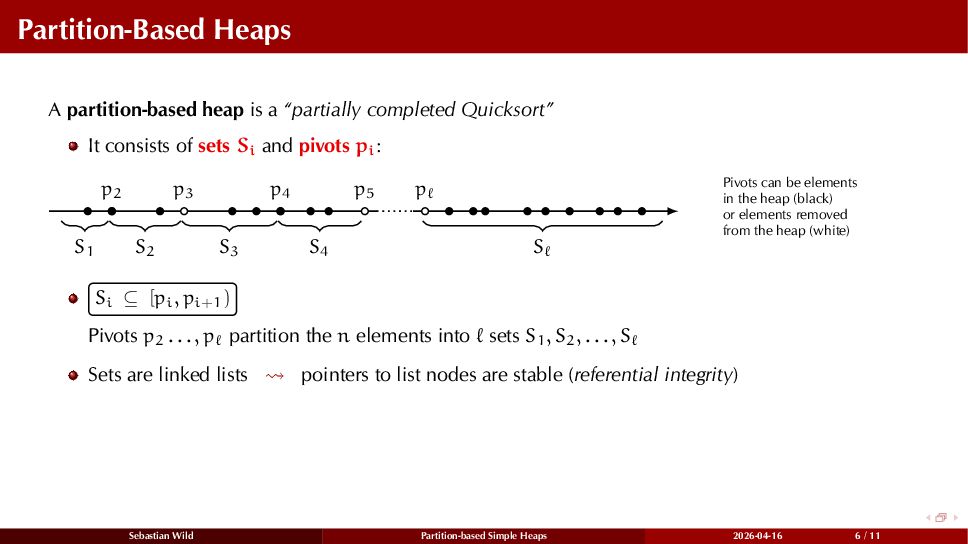
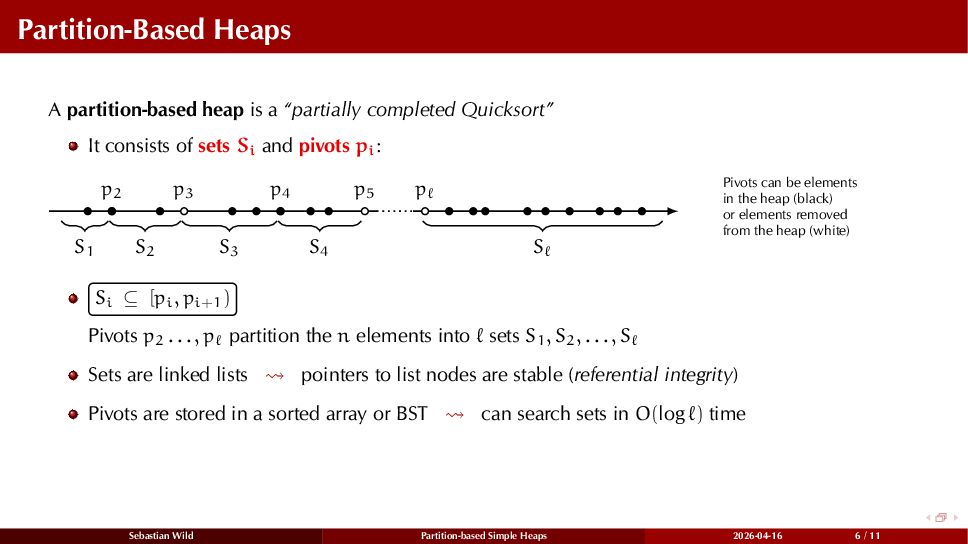
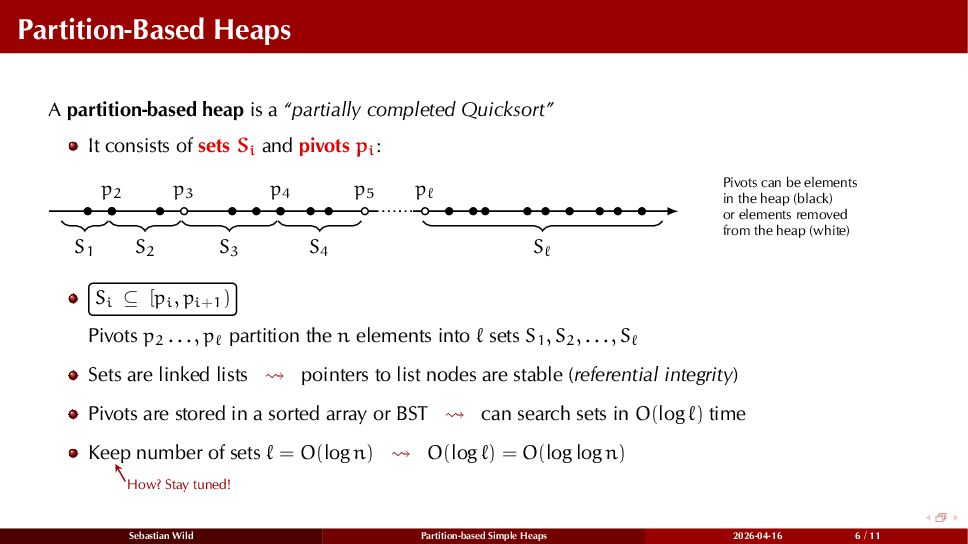
It consists of sets Si and pivots pi: Si ⊆ [pi , pi+1 ) Pivots p2 . . . , pℓ partition the n elements into ℓ sets S1 , S2 , . . . , Sℓ Sets are linked lists ⇝ pointers to list nodes are stable (referential integrity) Pivots are stored in a sorted array or BST ⇝ can search sets in O(log ℓ) time Keep How? Stay tuned! number of sets ℓ = O(log n) ⇝ O(log ℓ) = O(log log n) Sebastian Wild Partition-based Simple Heaps 2026-04-16 6 / 11
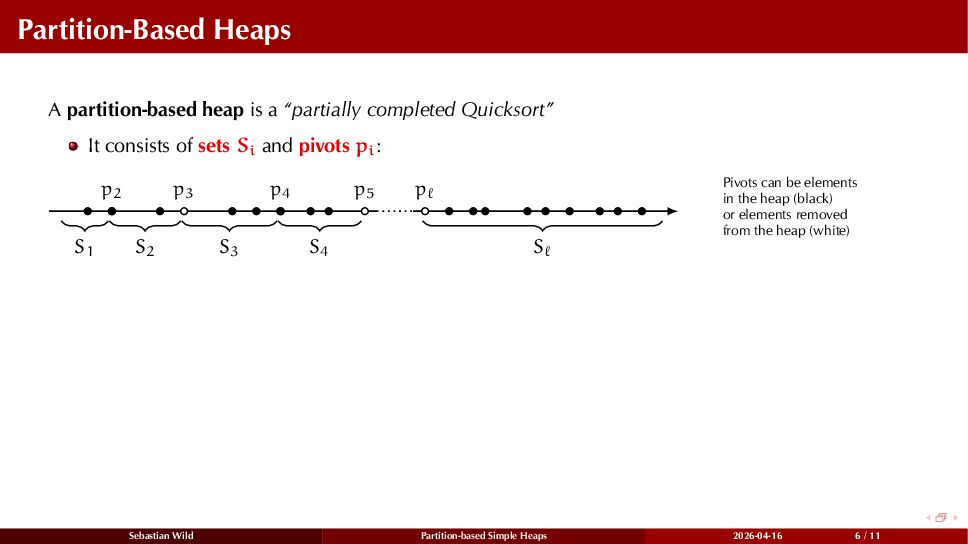
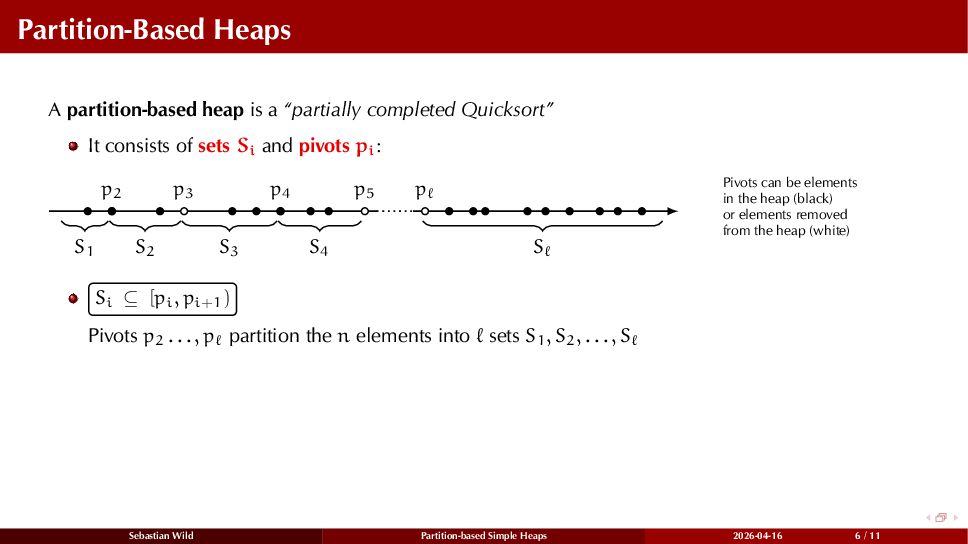
It consists of sets Si and pivots pi: p2 p3 p4 p5 pℓ S1 S2 S3 S4 Sℓ Pivots can be elements in the heap (black) or elements removed from the heap (white) Si ⊆ [pi , pi+1 ) Pivots p2 . . . , pℓ partition the n elements into ℓ sets S1 , S2 , . . . , Sℓ Sets are linked lists ⇝ pointers to list nodes are stable (referential integrity) Pivots are stored in a sorted array or BST ⇝ can search sets in O(log ℓ) time Keep How? Stay tuned! number of sets ℓ = O(log n) ⇝ O(log ℓ) = O(log log n) Sebastian Wild Partition-based Simple Heaps 2026-04-16 6 / 11
It consists of sets Si and pivots pi: p2 p3 p4 p5 pℓ S1 S2 S3 S4 Sℓ Pivots can be elements in the heap (black) or elements removed from the heap (white) Si ⊆ [pi , pi+1 ) Pivots p2 . . . , pℓ partition the n elements into ℓ sets S1 , S2 , . . . , Sℓ Sets are linked lists ⇝ pointers to list nodes are stable (referential integrity) Pivots are stored in a sorted array or BST ⇝ can search sets in O(log ℓ) time Keep How? Stay tuned! number of sets ℓ = O(log n) ⇝ O(log ℓ) = O(log log n) Sebastian Wild Partition-based Simple Heaps 2026-04-16 6 / 11
It consists of sets Si and pivots pi: p2 p3 p4 p5 pℓ S1 S2 S3 S4 Sℓ Pivots can be elements in the heap (black) or elements removed from the heap (white) Si ⊆ [pi , pi+1 ) Pivots p2 . . . , pℓ partition the n elements into ℓ sets S1 , S2 , . . . , Sℓ Sets are linked lists ⇝ pointers to list nodes are stable (referential integrity) Pivots are stored in a sorted array or BST ⇝ can search sets in O(log ℓ) time Keep How? Stay tuned! number of sets ℓ = O(log n) ⇝ O(log ℓ) = O(log log n) Sebastian Wild Partition-based Simple Heaps 2026-04-16 6 / 11
It consists of sets Si and pivots pi: p2 p3 p4 p5 pℓ S1 S2 S3 S4 Sℓ Pivots can be elements in the heap (black) or elements removed from the heap (white) Si ⊆ [pi , pi+1 ) Pivots p2 . . . , pℓ partition the n elements into ℓ sets S1 , S2 , . . . , Sℓ Sets are linked lists ⇝ pointers to list nodes are stable (referential integrity) Pivots are stored in a sorted array or BST ⇝ can search sets in O(log ℓ) time Keep How? Stay tuned! number of sets ℓ = O(log n) ⇝ O(log ℓ) = O(log log n) Sebastian Wild Partition-based Simple Heaps 2026-04-16 6 / 11
It consists of sets Si and pivots pi: p2 p3 p4 p5 pℓ S1 S2 S3 S4 Sℓ Pivots can be elements in the heap (black) or elements removed from the heap (white) Si ⊆ [pi , pi+1 ) Pivots p2 . . . , pℓ partition the n elements into ℓ sets S1 , S2 , . . . , Sℓ Sets are linked lists ⇝ pointers to list nodes are stable (referential integrity) Pivots are stored in a sorted array or BST ⇝ can search sets in O(log ℓ) time Keep How? Stay tuned! number of sets ℓ = O(log n) ⇝ O(log ℓ) = O(log log n) Sebastian Wild Partition-based Simple Heaps 2026-04-16 6 / 11
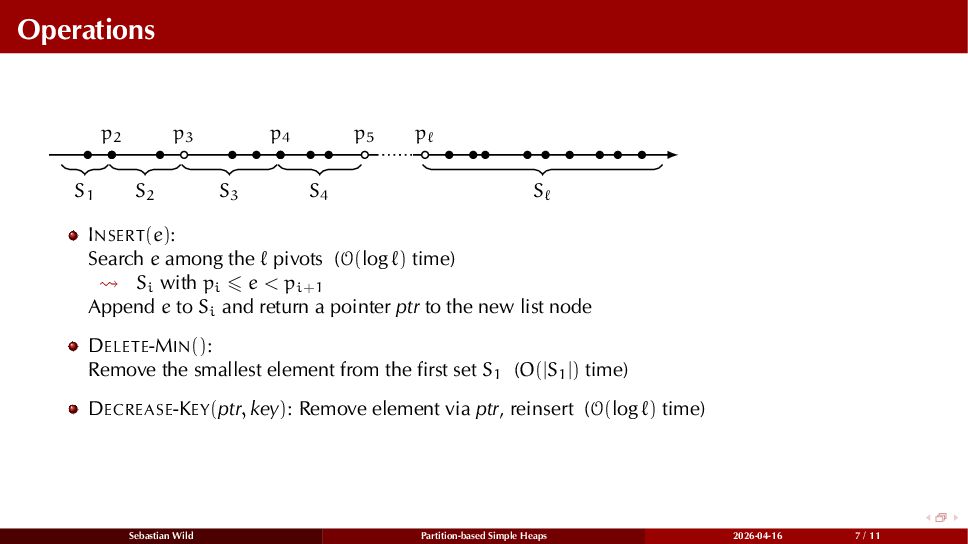
Sℓ INSERT(e): Search e among the ℓ pivots (O(log ℓ) time) ⇝ Si with pi ⩽ e < pi+1 Append e to Si and return a pointer ptr to the new list node DELETE-MIN(): Remove the smallest element from the first set S1 (O(|S1 |) time) DECREASE-KEY(ptr, key): Remove element via ptr, reinsert (O(log ℓ) time) Sebastian Wild Partition-based Simple Heaps 2026-04-16 7 / 11
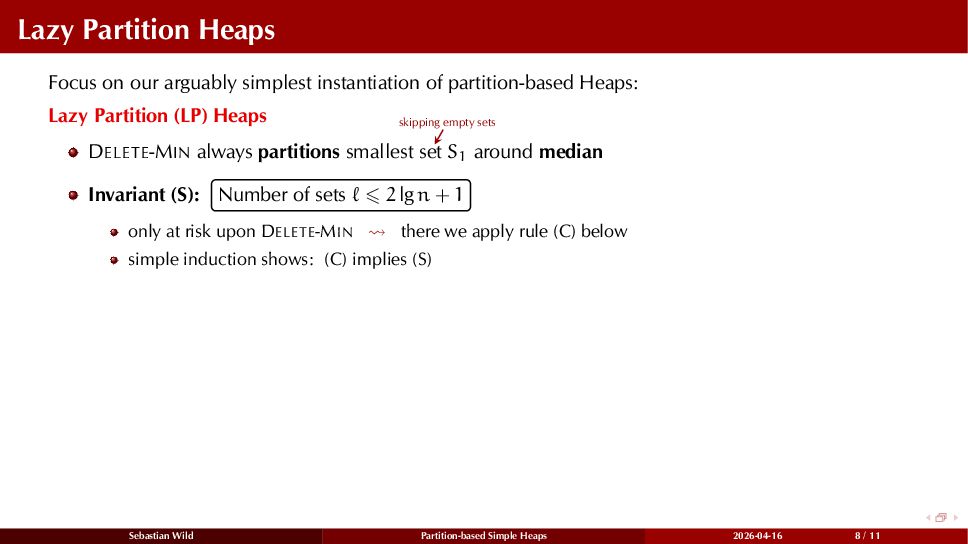
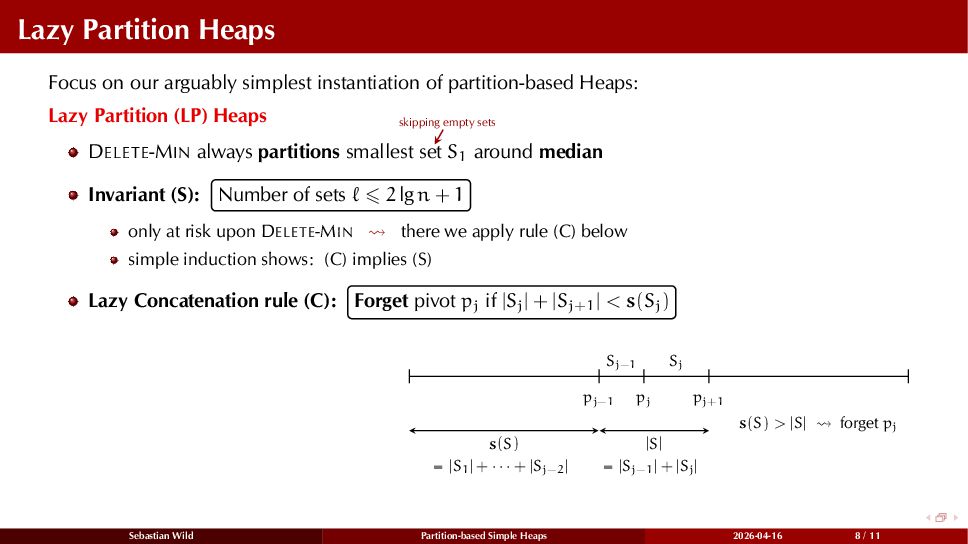
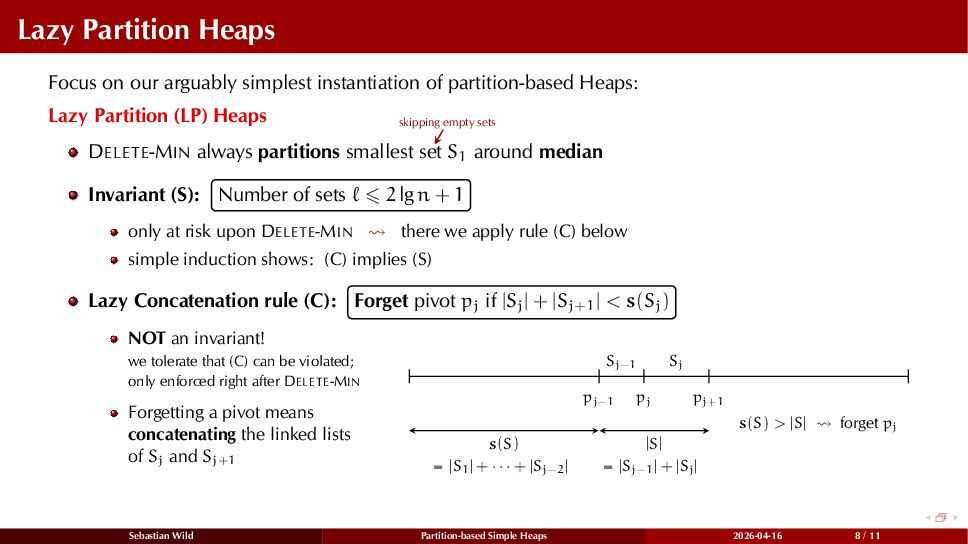
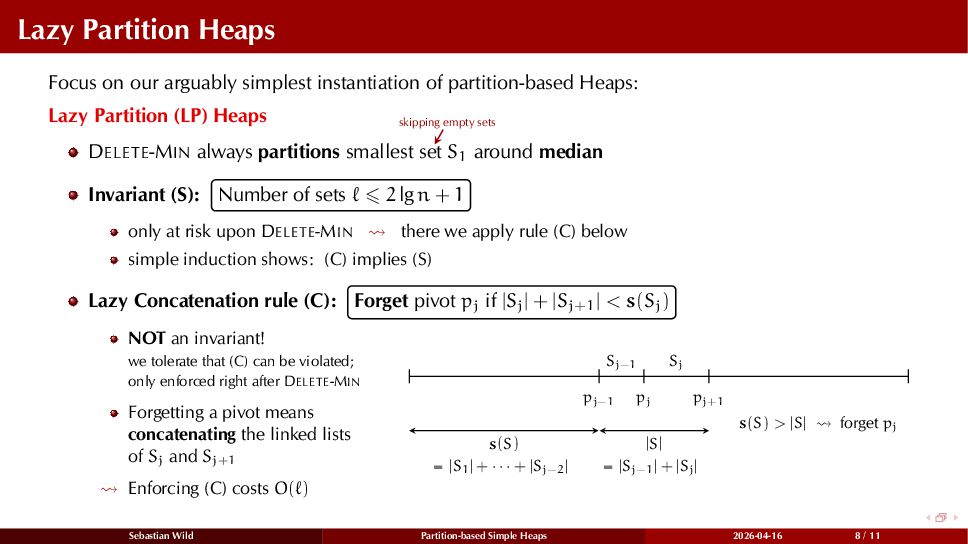
partition-based Heaps: Lazy Partition (LP) Heaps DELETE-MIN always partitions smallest set skipping empty sets S1 around median Invariant (S): Number of sets ℓ ⩽ 2 lg n + 1 only at risk upon DELETE-MIN ⇝ there we apply rule (C) below simple induction shows: (C) implies (S) Lazy Concatenation rule (C): Forget pivot pj if |Sj | + |Sj+1 | < s(Sj ) NOT an invariant! we tolerate that (C) can be violated; only enforced right after DELETE-MIN Forgetting a pivot means concatenating the linked lists of Sj and Sj+1 ⇝ Enforcing (C) costs O(ℓ) pj−1 pj pj+1 Sj−1 Sj s(S) = |S1 | + · · · + |Sj−2 | |S| = |Sj−1 | + |Sj | s(S) > |S| ⇝ forget pj Sebastian Wild Partition-based Simple Heaps 2026-04-16 8 / 11
partition-based Heaps: Lazy Partition (LP) Heaps DELETE-MIN always partitions smallest set skipping empty sets S1 around median Invariant (S): Number of sets ℓ ⩽ 2 lg n + 1 only at risk upon DELETE-MIN ⇝ there we apply rule (C) below simple induction shows: (C) implies (S) Lazy Concatenation rule (C): Forget pivot pj if |Sj | + |Sj+1 | < s(Sj ) NOT an invariant! we tolerate that (C) can be violated; only enforced right after DELETE-MIN Forgetting a pivot means concatenating the linked lists of Sj and Sj+1 ⇝ Enforcing (C) costs O(ℓ) pj−1 pj pj+1 Sj−1 Sj s(S) = |S1 | + · · · + |Sj−2 | |S| = |Sj−1 | + |Sj | s(S) > |S| ⇝ forget pj Sebastian Wild Partition-based Simple Heaps 2026-04-16 8 / 11
partition-based Heaps: Lazy Partition (LP) Heaps DELETE-MIN always partitions smallest set skipping empty sets S1 around median Invariant (S): Number of sets ℓ ⩽ 2 lg n + 1 only at risk upon DELETE-MIN ⇝ there we apply rule (C) below simple induction shows: (C) implies (S) Lazy Concatenation rule (C): Forget pivot pj if |Sj | + |Sj+1 | < s(Sj ) NOT an invariant! we tolerate that (C) can be violated; only enforced right after DELETE-MIN Forgetting a pivot means concatenating the linked lists of Sj and Sj+1 ⇝ Enforcing (C) costs O(ℓ) pj−1 pj pj+1 Sj−1 Sj s(S) = |S1 | + · · · + |Sj−2 | |S| = |Sj−1 | + |Sj | s(S) > |S| ⇝ forget pj Sebastian Wild Partition-based Simple Heaps 2026-04-16 8 / 11
partition-based Heaps: Lazy Partition (LP) Heaps DELETE-MIN always partitions smallest set skipping empty sets S1 around median Invariant (S): Number of sets ℓ ⩽ 2 lg n + 1 only at risk upon DELETE-MIN ⇝ there we apply rule (C) below simple induction shows: (C) implies (S) Lazy Concatenation rule (C): Forget pivot pj if |Sj | + |Sj+1 | < s(Sj ) NOT an invariant! we tolerate that (C) can be violated; only enforced right after DELETE-MIN Forgetting a pivot means concatenating the linked lists of Sj and Sj+1 ⇝ Enforcing (C) costs O(ℓ) pj−1 pj pj+1 Sj−1 Sj s(S) = |S1 | + · · · + |Sj−2 | |S| = |Sj−1 | + |Sj | s(S) > |S| ⇝ forget pj Sebastian Wild Partition-based Simple Heaps 2026-04-16 8 / 11
partition-based Heaps: Lazy Partition (LP) Heaps DELETE-MIN always partitions smallest set skipping empty sets S1 around median Invariant (S): Number of sets ℓ ⩽ 2 lg n + 1 only at risk upon DELETE-MIN ⇝ there we apply rule (C) below simple induction shows: (C) implies (S) Lazy Concatenation rule (C): Forget pivot pj if |Sj | + |Sj+1 | < s(Sj ) NOT an invariant! we tolerate that (C) can be violated; only enforced right after DELETE-MIN Forgetting a pivot means concatenating the linked lists of Sj and Sj+1 ⇝ Enforcing (C) costs O(ℓ) pj−1 pj pj+1 Sj−1 Sj s(S) = |S1 | + · · · + |Sj−2 | |S| = |Sj−1 | + |Sj | s(S) > |S| ⇝ forget pj Sebastian Wild Partition-based Simple Heaps 2026-04-16 8 / 11
partition-based Heaps: Lazy Partition (LP) Heaps DELETE-MIN always partitions smallest set skipping empty sets S1 around median Invariant (S): Number of sets ℓ ⩽ 2 lg n + 1 only at risk upon DELETE-MIN ⇝ there we apply rule (C) below simple induction shows: (C) implies (S) Lazy Concatenation rule (C): Forget pivot pj if |Sj | + |Sj+1 | < s(Sj ) NOT an invariant! we tolerate that (C) can be violated; only enforced right after DELETE-MIN Forgetting a pivot means concatenating the linked lists of Sj and Sj+1 ⇝ Enforcing (C) costs O(ℓ) pj−1 pj pj+1 Sj−1 Sj s(S) = |S1 | + · · · + |Sj−2 | |S| = |Sj−1 | + |Sj | s(S) > |S| ⇝ forget pj Sebastian Wild Partition-based Simple Heaps 2026-04-16 8 / 11
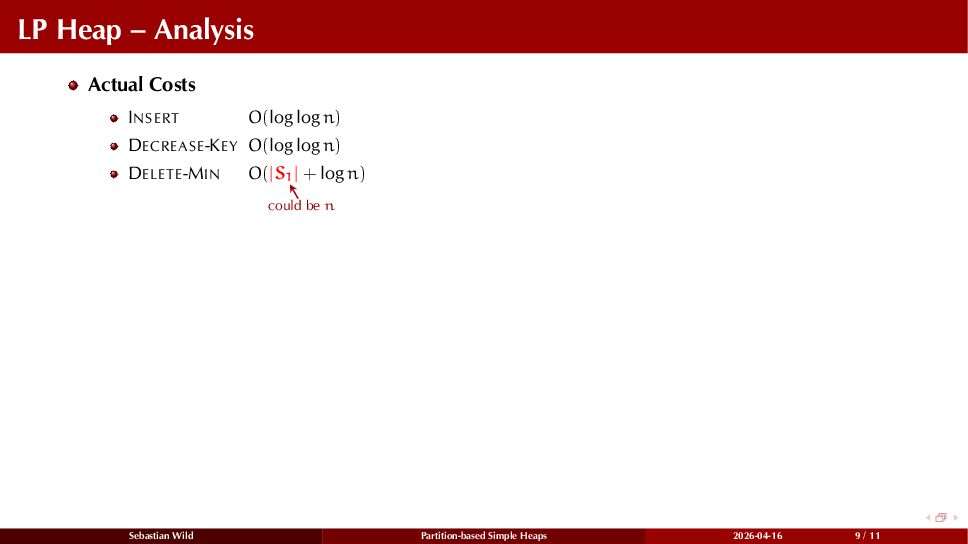
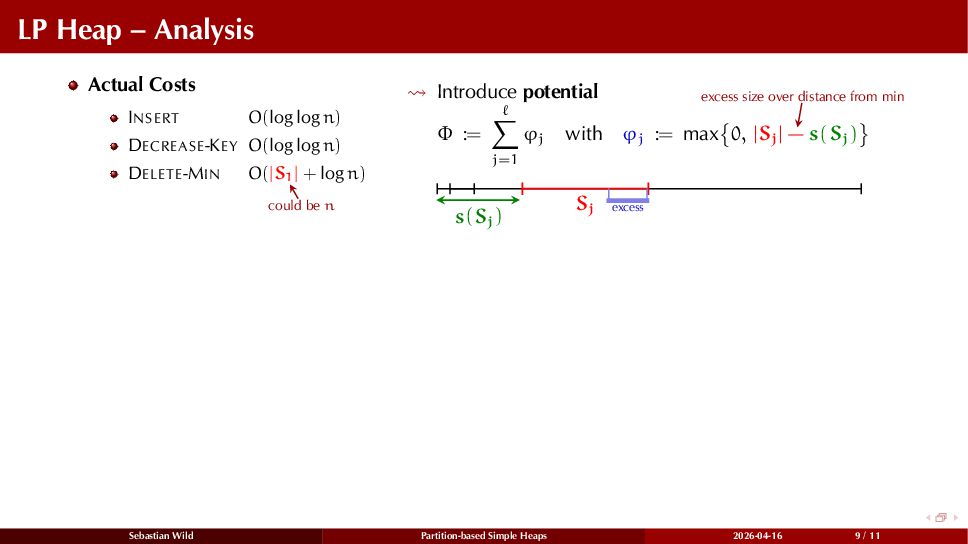
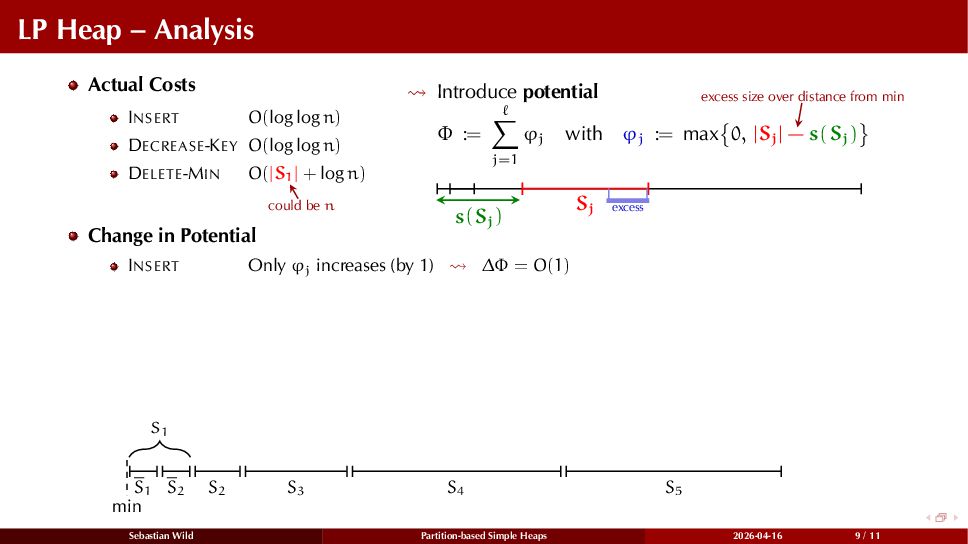
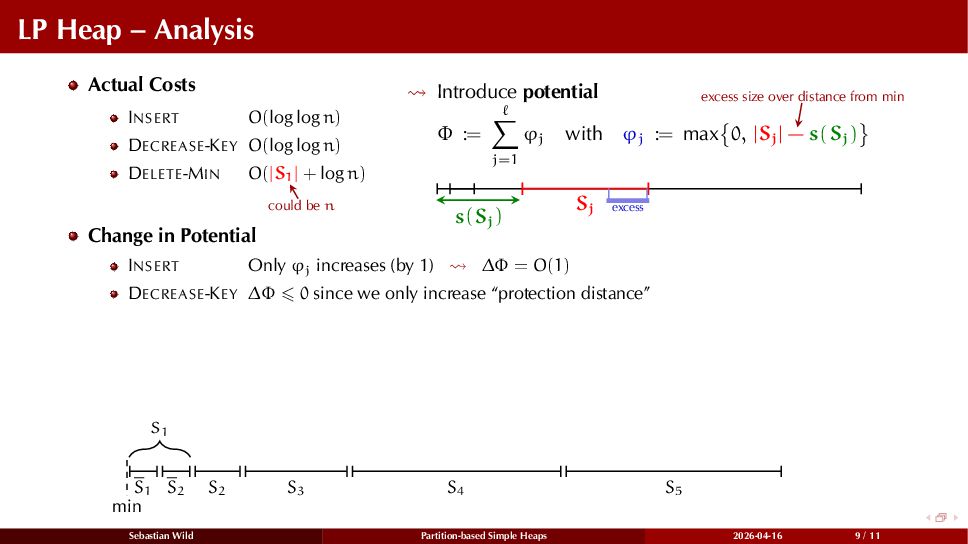
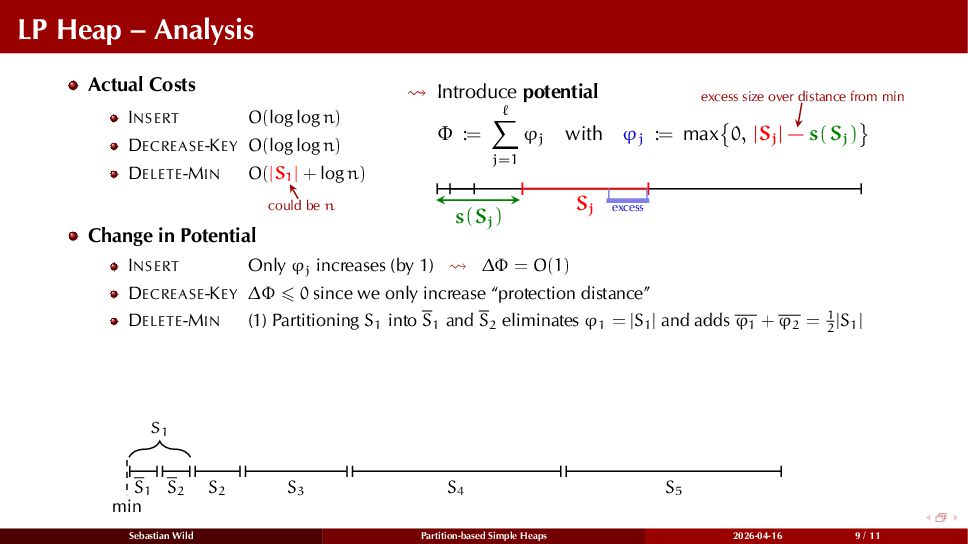
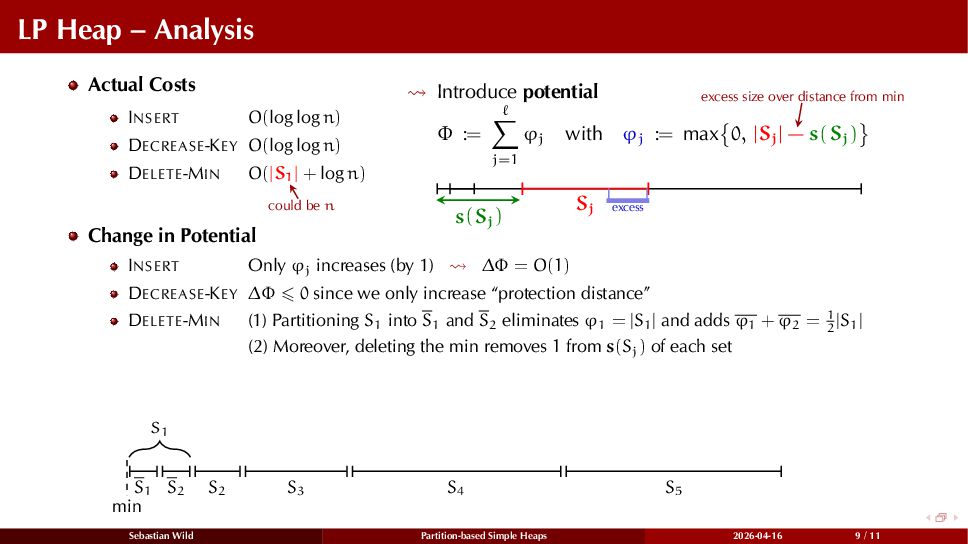
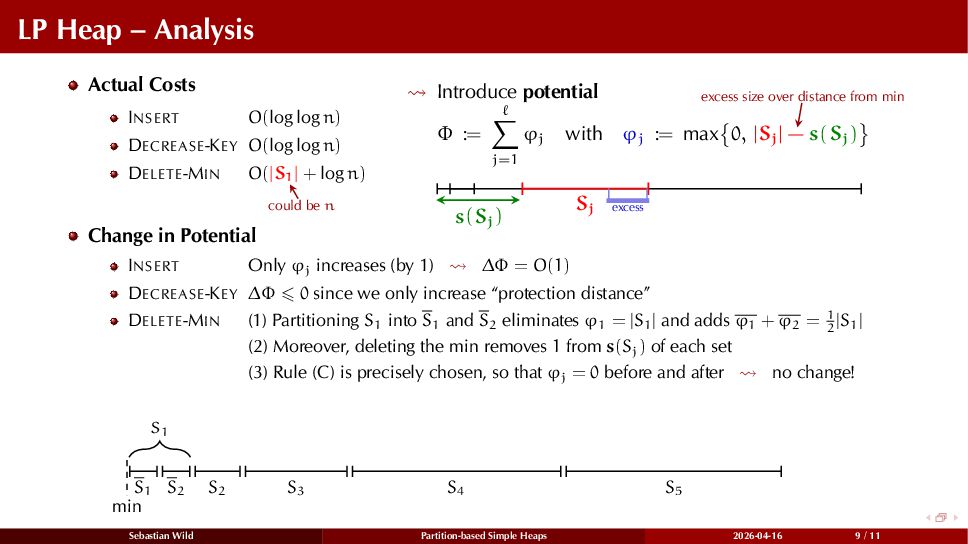
DECREASE-KEY O(log log n) DELETE-MIN O(|S1 | could be n + log n) ⇝ Introduce potential Φ := ℓ j=1 φj with φj := max 0, |Sj | − excess size over distance from min s(Sj ) Sj s(Sj ) excess Change in Potential INSERT Only φj increases (by 1) ⇝ ∆Φ = O(1) DECREASE-KEY ∆Φ ⩽ 0 since we only increase “protection distance” DELETE-MIN (1) Partitioning S1 into S1 and S2 eliminates φ1 = |S1 | and adds φ1 + φ2 = 1 2 |S1 | (2) Moreover, deleting the min removes 1 from s(Sj ) of each set S1 S2 S2 S3 S4 S5 S1 min Sebastian Wild Partition-based Simple Heaps 2026-04-16 9 / 11
DECREASE-KEY O(log log n) DELETE-MIN O(|S1 | could be n + log n) ⇝ Introduce potential Φ := ℓ j=1 φj with φj := max 0, |Sj | − excess size over distance from min s(Sj ) Sj s(Sj ) excess Change in Potential INSERT Only φj increases (by 1) ⇝ ∆Φ = O(1) DECREASE-KEY ∆Φ ⩽ 0 since we only increase “protection distance” DELETE-MIN (1) Partitioning S1 into S1 and S2 eliminates φ1 = |S1 | and adds φ1 + φ2 = 1 2 |S1 | (2) Moreover, deleting the min removes 1 from s(Sj ) of each set (3) Rule (C) is precisely chosen, so that φj = 0 before and after ⇝ no change! S1 S2 S2 S3 S4 S5 S1 min Sebastian Wild Partition-based Simple Heaps 2026-04-16 9 / 11
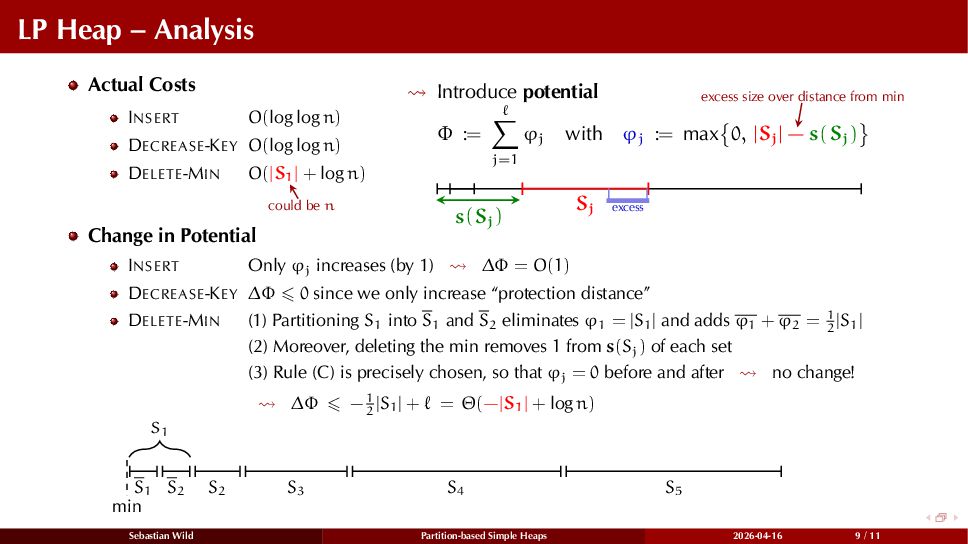
DECREASE-KEY O(log log n) DELETE-MIN O(|S1 | could be n + log n) ⇝ Introduce potential Φ := ℓ j=1 φj with φj := max 0, |Sj | − excess size over distance from min s(Sj ) Sj s(Sj ) excess Change in Potential INSERT Only φj increases (by 1) ⇝ ∆Φ = O(1) DECREASE-KEY ∆Φ ⩽ 0 since we only increase “protection distance” DELETE-MIN (1) Partitioning S1 into S1 and S2 eliminates φ1 = |S1 | and adds φ1 + φ2 = 1 2 |S1 | (2) Moreover, deleting the min removes 1 from s(Sj ) of each set (3) Rule (C) is precisely chosen, so that φj = 0 before and after ⇝ no change! ⇝ ∆Φ ⩽ −1 2 |S1 | + ℓ = Θ(−|S1 | + log n) S1 S2 S2 S3 S4 S5 S1 min Sebastian Wild Partition-based Simple Heaps 2026-04-16 9 / 11
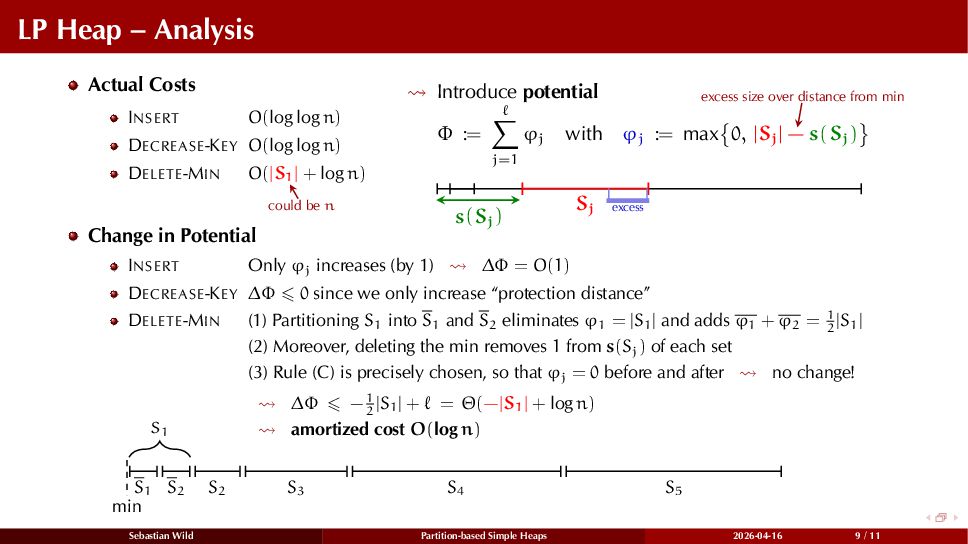
DECREASE-KEY O(log log n) DELETE-MIN O(|S1 | could be n + log n) ⇝ Introduce potential Φ := ℓ j=1 φj with φj := max 0, |Sj | − excess size over distance from min s(Sj ) Sj s(Sj ) excess Change in Potential INSERT Only φj increases (by 1) ⇝ ∆Φ = O(1) DECREASE-KEY ∆Φ ⩽ 0 since we only increase “protection distance” DELETE-MIN (1) Partitioning S1 into S1 and S2 eliminates φ1 = |S1 | and adds φ1 + φ2 = 1 2 |S1 | (2) Moreover, deleting the min removes 1 from s(Sj ) of each set (3) Rule (C) is precisely chosen, so that φj = 0 before and after ⇝ no change! ⇝ ∆Φ ⩽ −1 2 |S1 | + ℓ = Θ(−|S1 | + log n) ⇝ amortized cost O(log n) S1 S2 S2 S3 S4 S5 S1 min Sebastian Wild Partition-based Simple Heaps 2026-04-16 9 / 11
priority queue (Lazy Partition Heaps) amortized analysis suitable for undergrad teaching There’s more (→ paper!) alternative variants Fibonacci Heaps: The Next Generation and Exponential Bounded Sizes LP Heaps can be implemented in pointer machine with bounded indegree ⇝ persistence! partitioning around exact median can be replaced by single random pivot instead of linked lists, can use one big array ⇝ Quickheaps LP Heaps yield new simple optimal pivot-forgetting rule for Quickheaps Open Problems & Future Work (ongoing) empirical evaluation design space is huge; other/better partition-based heaps possible? Open: efficient support for MELD? Sebastian Wild Partition-based Simple Heaps 2026-04-16 10 / 11
priority queue (Lazy Partition Heaps) amortized analysis suitable for undergrad teaching There’s more (→ paper!) alternative variants Fibonacci Heaps: The Next Generation and Exponential Bounded Sizes LP Heaps can be implemented in pointer machine with bounded indegree ⇝ persistence! partitioning around exact median can be replaced by single random pivot instead of linked lists, can use one big array ⇝ Quickheaps LP Heaps yield new simple optimal pivot-forgetting rule for Quickheaps Open Problems & Future Work (ongoing) empirical evaluation design space is huge; other/better partition-based heaps possible? Open: efficient support for MELD? Sebastian Wild Partition-based Simple Heaps 2026-04-16 10 / 11
priority queue (Lazy Partition Heaps) amortized analysis suitable for undergrad teaching There’s more (→ paper!) alternative variants Fibonacci Heaps: The Next Generation and Exponential Bounded Sizes LP Heaps can be implemented in pointer machine with bounded indegree ⇝ persistence! partitioning around exact median can be replaced by single random pivot instead of linked lists, can use one big array ⇝ Quickheaps LP Heaps yield new simple optimal pivot-forgetting rule for Quickheaps Open Problems & Future Work (ongoing) empirical evaluation design space is huge; other/better partition-based heaps possible? Open: efficient support for MELD? Sebastian Wild Partition-based Simple Heaps 2026-04-16 10 / 11
Ware, Pause08, and Madebyoliver from www.flaticon.com. Other photos from www.pixabay.com or generated by Gemini. Sebastian Wild Partition-based Simple Heaps 2026-04-16 12 / 11
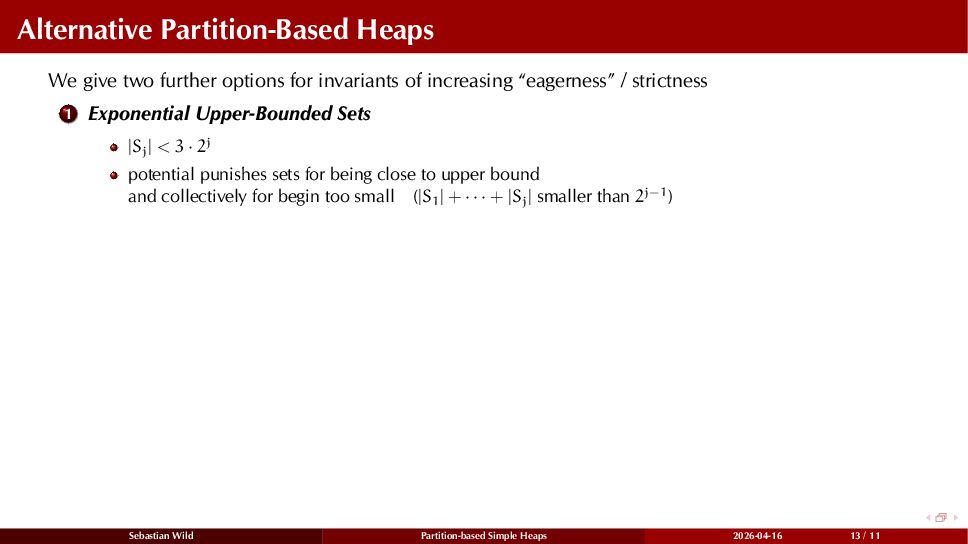
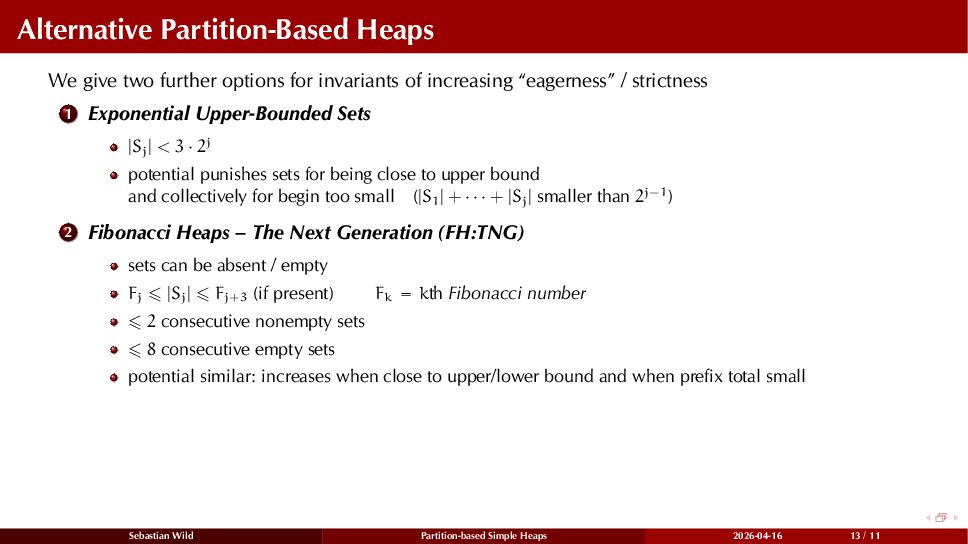
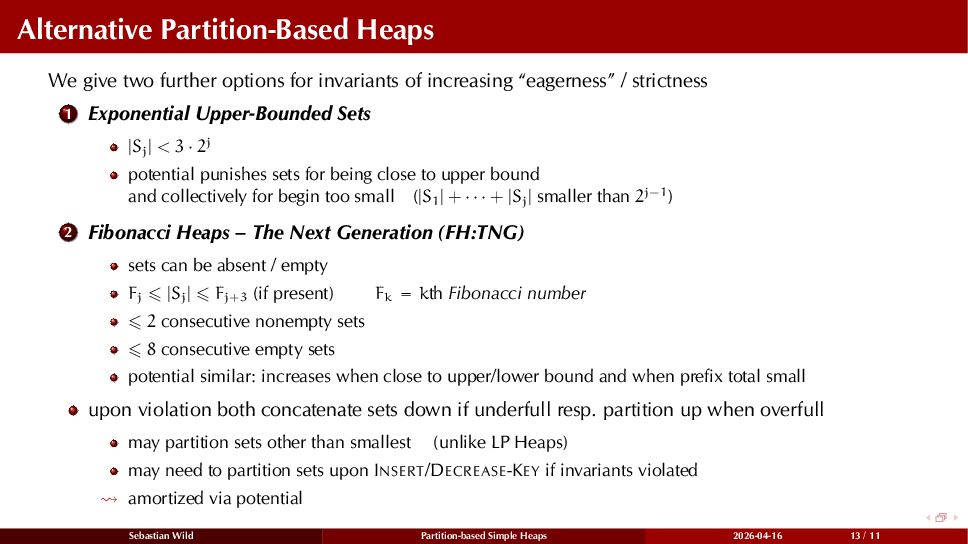
of increasing “eagerness” / strictness 1 Exponential Upper-Bounded Sets |Sj | < 3 · 2j potential punishes sets for being close to upper bound and collectively for begin too small (|S1 | + · · · + |Sj | smaller than 2j−1) 2 Fibonacci Heaps – The Next Generation (FH:TNG) sets can be absent / empty Fj ⩽ |Sj | ⩽ Fj+3 (if present) Fk = kth Fibonacci number ⩽ 2 consecutive nonempty sets ⩽ 8 consecutive empty sets potential similar: increases when close to upper/lower bound and when prefix total small upon violation both concatenate sets down if underfull resp. partition up when overfull may partition sets other than smallest (unlike LP Heaps) may need to partition sets upon INSERT/DECREASE-KEY if invariants violated ⇝ amortized via potential Sebastian Wild Partition-based Simple Heaps 2026-04-16 13 / 11
of increasing “eagerness” / strictness 1 Exponential Upper-Bounded Sets |Sj | < 3 · 2j potential punishes sets for being close to upper bound and collectively for begin too small (|S1 | + · · · + |Sj | smaller than 2j−1) 2 Fibonacci Heaps – The Next Generation (FH:TNG) sets can be absent / empty Fj ⩽ |Sj | ⩽ Fj+3 (if present) Fk = kth Fibonacci number ⩽ 2 consecutive nonempty sets ⩽ 8 consecutive empty sets potential similar: increases when close to upper/lower bound and when prefix total small upon violation both concatenate sets down if underfull resp. partition up when overfull may partition sets other than smallest (unlike LP Heaps) may need to partition sets upon INSERT/DECREASE-KEY if invariants violated ⇝ amortized via potential Sebastian Wild Partition-based Simple Heaps 2026-04-16 13 / 11
of increasing “eagerness” / strictness 1 Exponential Upper-Bounded Sets |Sj | < 3 · 2j potential punishes sets for being close to upper bound and collectively for begin too small (|S1 | + · · · + |Sj | smaller than 2j−1) 2 Fibonacci Heaps – The Next Generation (FH:TNG) sets can be absent / empty Fj ⩽ |Sj | ⩽ Fj+3 (if present) Fk = kth Fibonacci number ⩽ 2 consecutive nonempty sets ⩽ 8 consecutive empty sets potential similar: increases when close to upper/lower bound and when prefix total small upon violation both concatenate sets down if underfull resp. partition up when overfull may partition sets other than smallest (unlike LP Heaps) may need to partition sets upon INSERT/DECREASE-KEY if invariants violated ⇝ amortized via potential Sebastian Wild Partition-based Simple Heaps 2026-04-16 13 / 11
of increasing “eagerness” / strictness 1 Exponential Upper-Bounded Sets |Sj | < 3 · 2j potential punishes sets for being close to upper bound and collectively for begin too small (|S1 | + · · · + |Sj | smaller than 2j−1) 2 Fibonacci Heaps – The Next Generation (FH:TNG) sets can be absent / empty Fj ⩽ |Sj | ⩽ Fj+3 (if present) Fk = kth Fibonacci number ⩽ 2 consecutive nonempty sets ⩽ 8 consecutive empty sets potential similar: increases when close to upper/lower bound and when prefix total small upon violation both concatenate sets down if underfull resp. partition up when overfull may partition sets other than smallest (unlike LP Heaps) may need to partition sets upon INSERT/DECREASE-KEY if invariants violated ⇝ amortized via potential Sebastian Wild Partition-based Simple Heaps 2026-04-16 13 / 11


 sebawild
 rikkabotan7
 enochan
 institutdelelevage
 junkashihara
 stktu
stktu
 shunk031
 fkske
fkske
 kogoro
 nzw0301
 xspa2012
 pomcho555
 ryomasumura
 kimpetersen
 inesmontani
 keithpitt
 wjessup
 twada
twada
 techseoconnect
 marcduiker
 csswizardry
 quramy
 geoffreycrofte
 tammielis