Upgrade to Pro — share decks privately, control downloads, hide ads and more …

Lecture 16 sequencing technologies

Avatar for shaunmahony shaunmahony
March 14, 2022
56

Lecture 16 sequencing technologies

BMMB 554 2022 Lecture 16

Avatar for shaunmahony

shaunmahony

March 14, 2022
Tweet

Transcript

  1. Today’s learning objective • Understand how DNA sequencing works •

    Understand the relative advantages of current sequencing platforms.
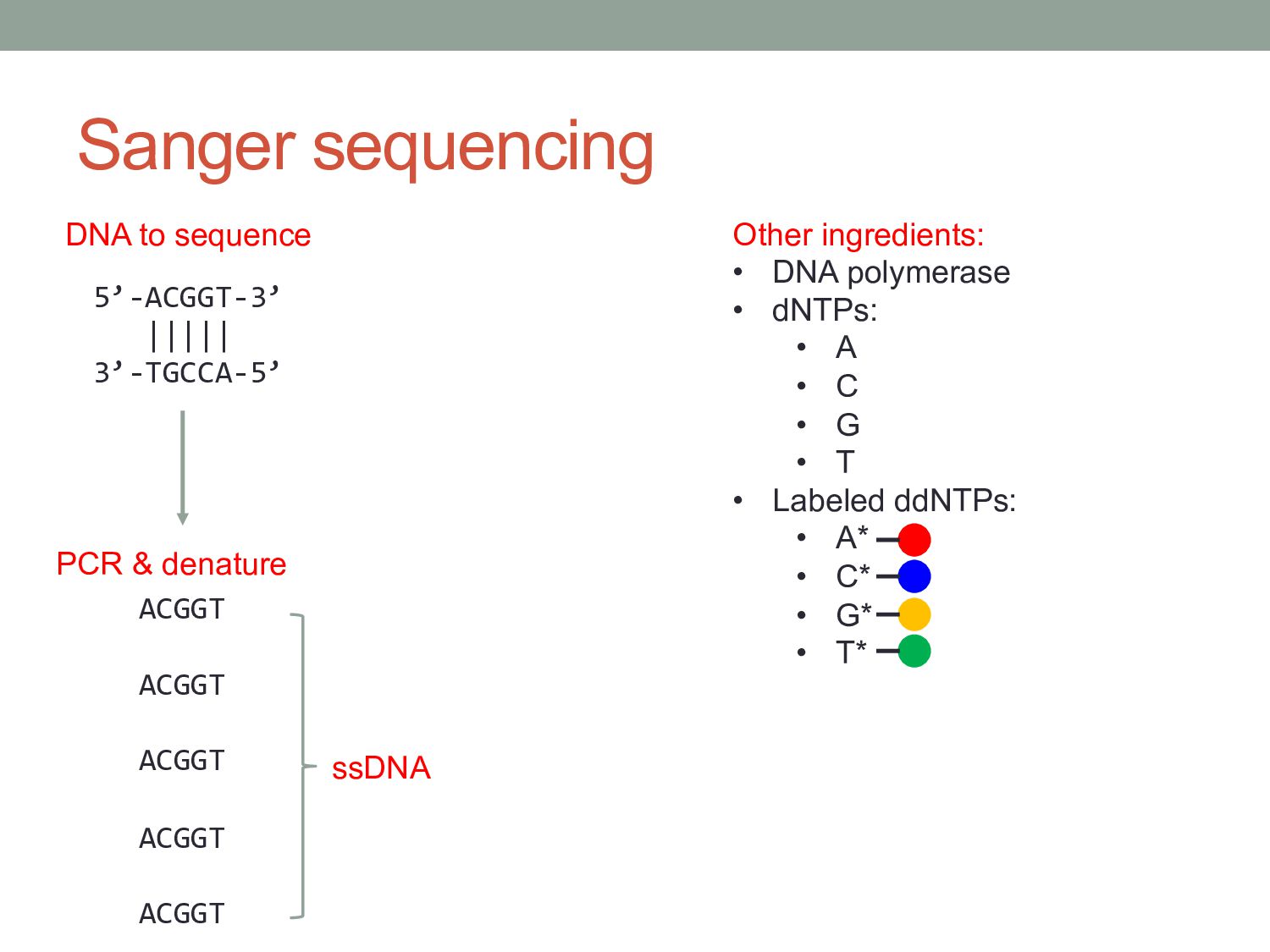
  2. Sanger sequencing 5’-ACGGT-3’ ||||| 3’-TGCCA-5’ DNA to sequence Other ingredients:

    • DNA polymerase • dNTPs: • A • C • G • T • Labeled ddNTPs: • A* • C* • G* • T* ACGGT ACGGT ACGGT ACGGT ACGGT PCR & denature ssDNA
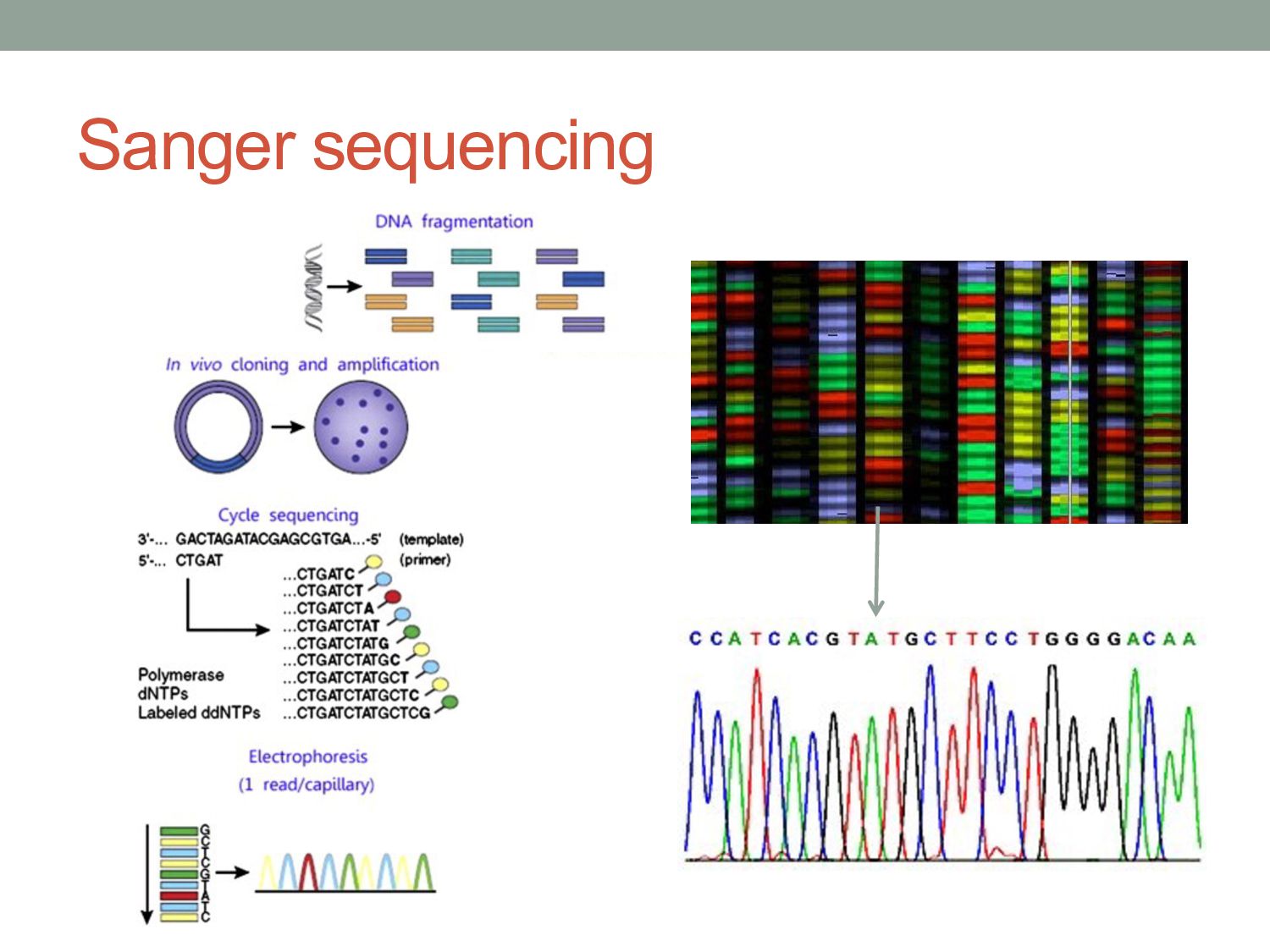
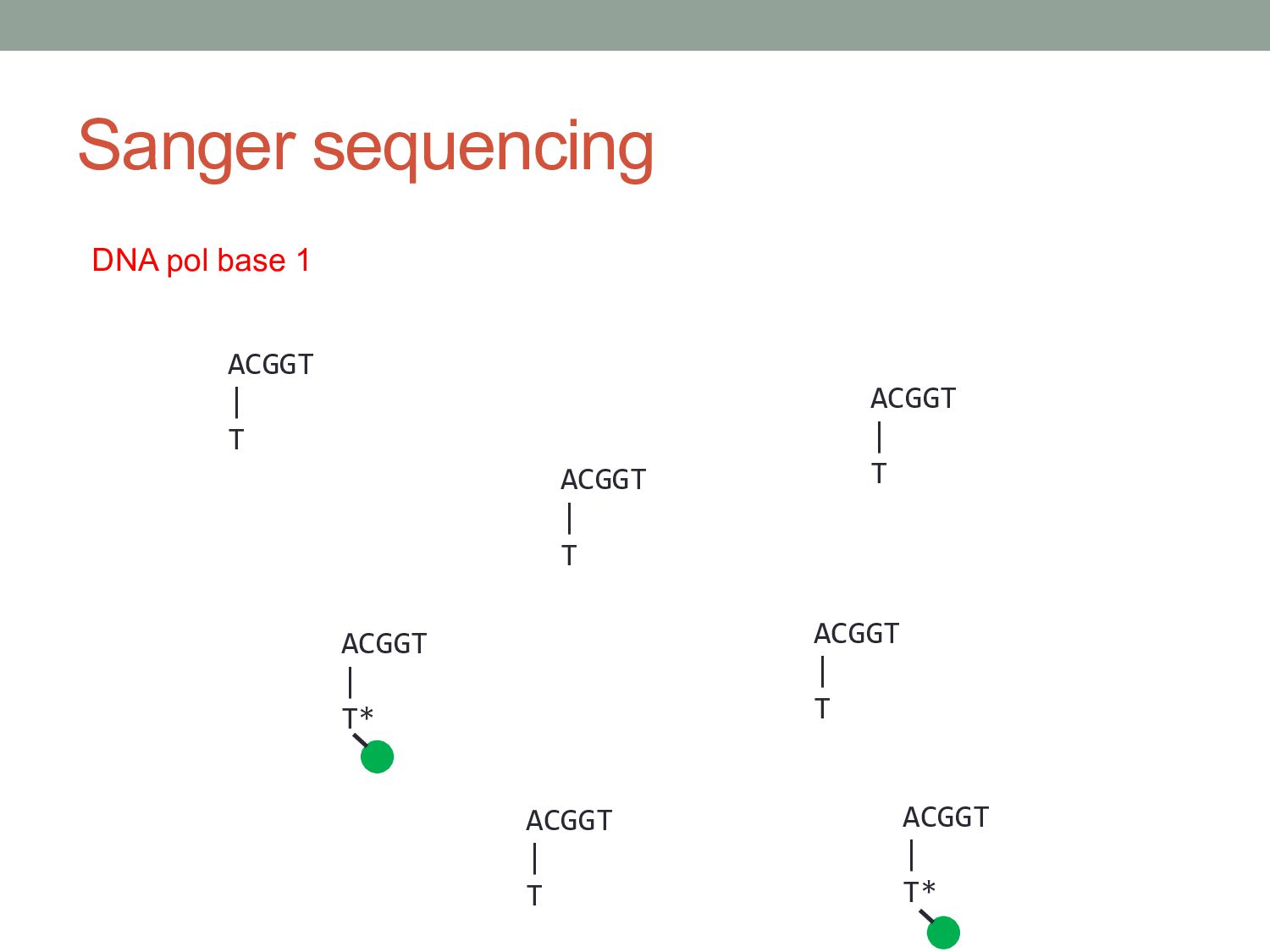
  3. Sanger sequencing ACGGT | T ACGGT | T ACGGT |

    T* ACGGT | T ACGGT | T ACGGT | T ACGGT | T* DNA pol base 1
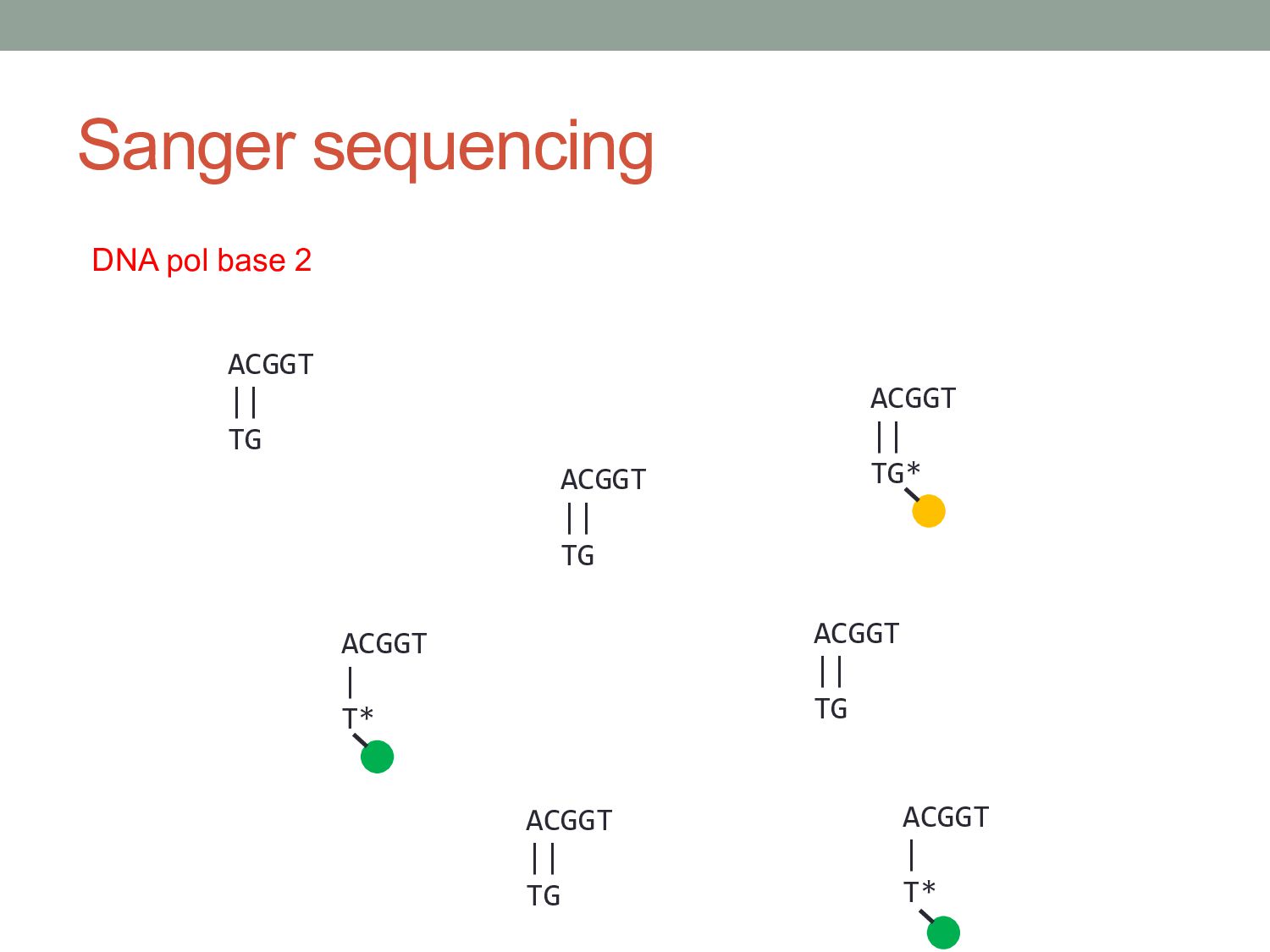
  4. Sanger sequencing ACGGT || TG ACGGT || TG ACGGT |

    T* ACGGT || TG* ACGGT || TG ACGGT || TG ACGGT | T* DNA pol base 2
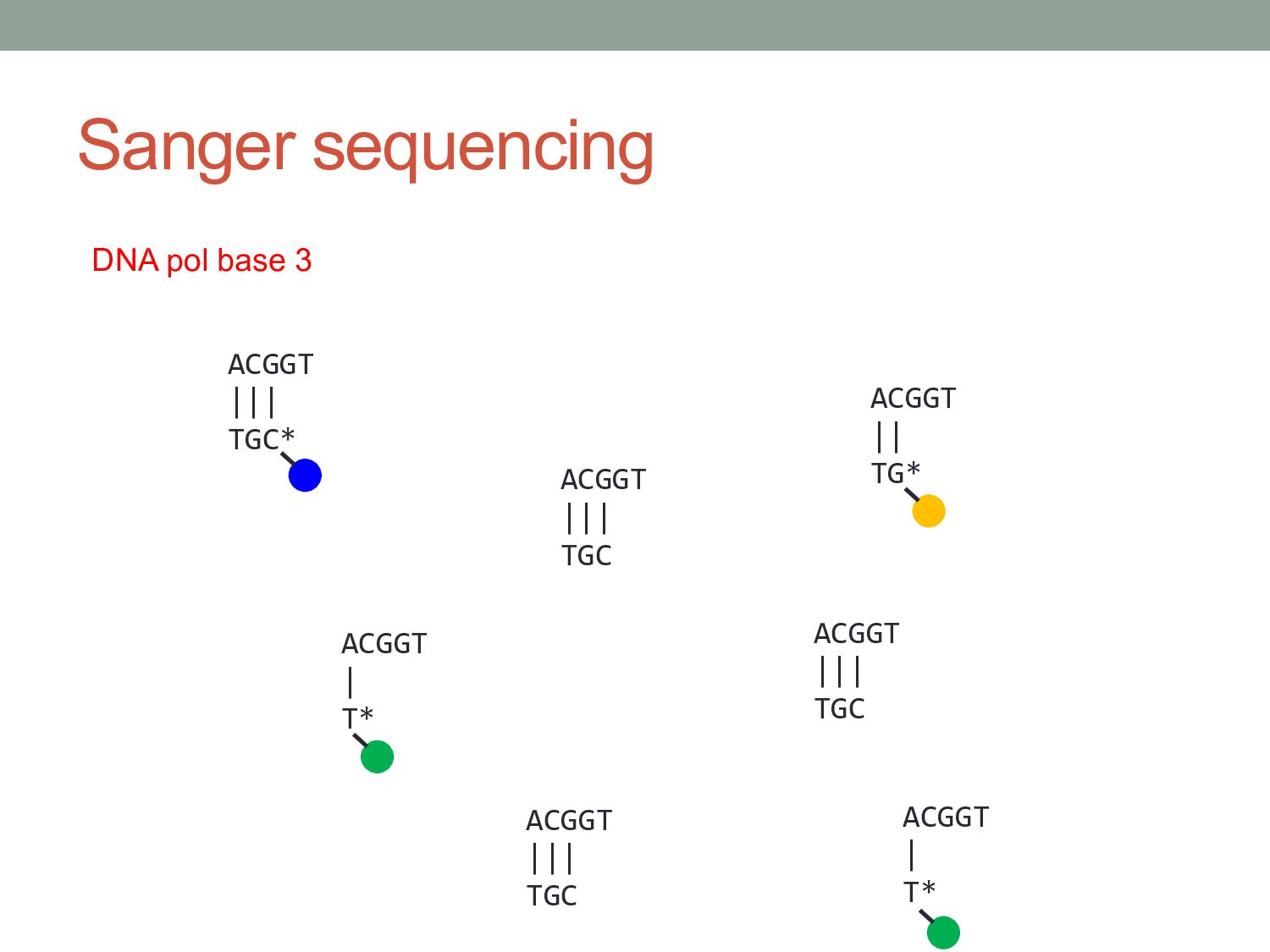
  5. Sanger sequencing ACGGT ||| TGC* ACGGT ||| TGC ACGGT |

    T* ACGGT || TG* ACGGT ||| TGC ACGGT ||| TGC ACGGT | T* DNA pol base 3
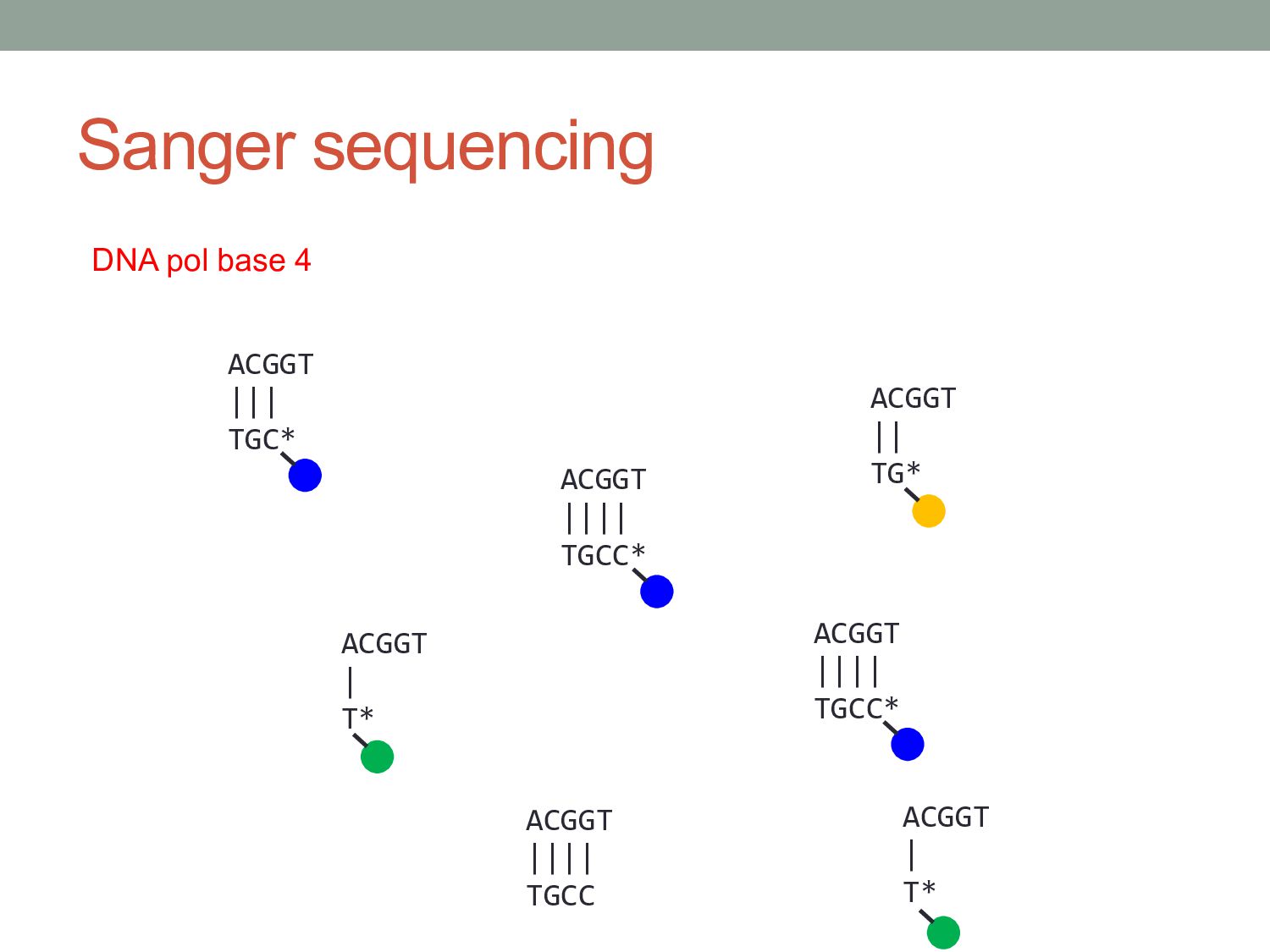
  6. Sanger sequencing ACGGT ||| TGC* ACGGT |||| TGCC* ACGGT |

    T* ACGGT || TG* ACGGT |||| TGCC* ACGGT |||| TGCC ACGGT | T* DNA pol base 4
  7. Sanger sequencing ACGGT ||| TGC* ACGGT |||| TGCC* ACGGT |

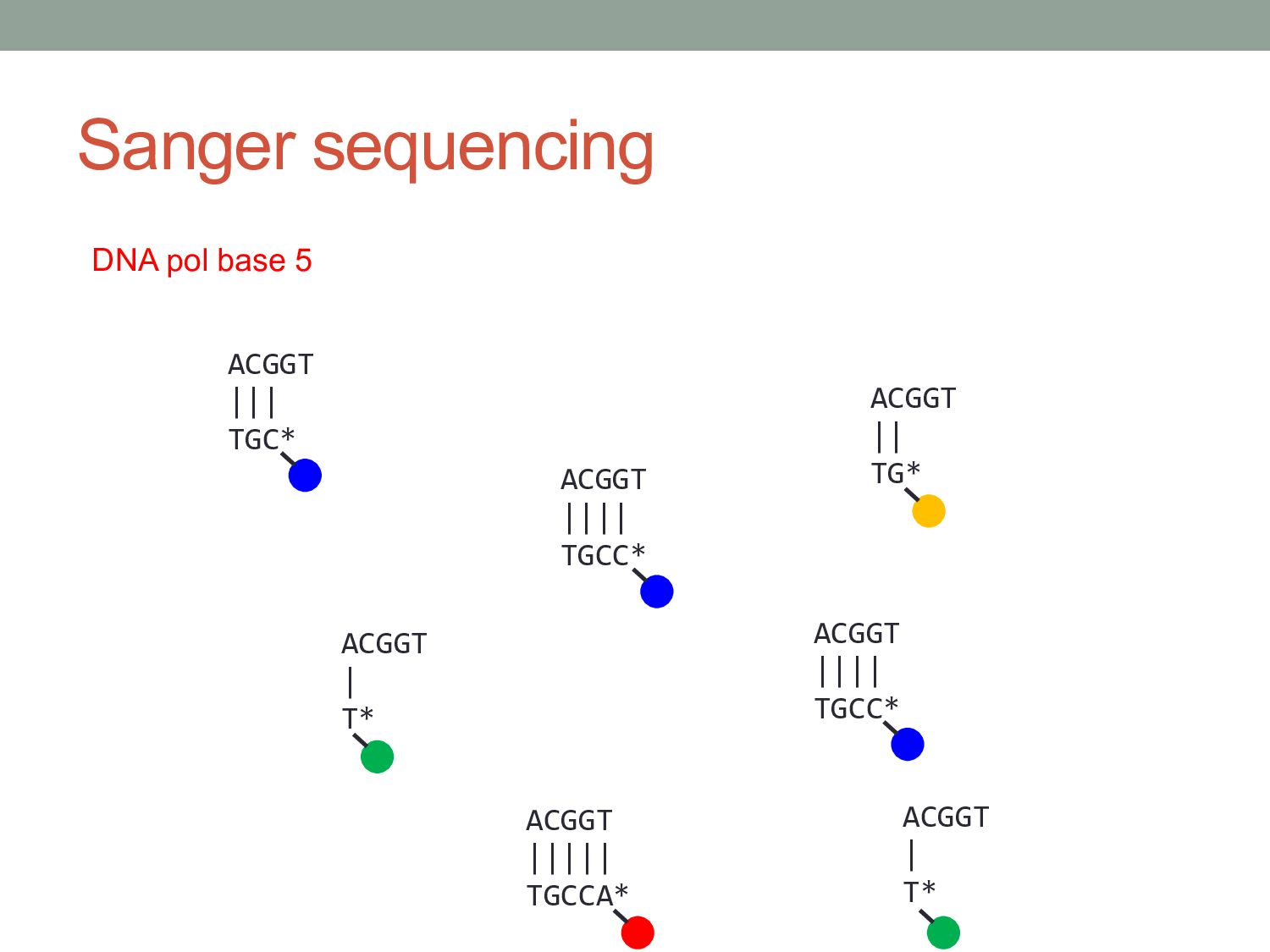
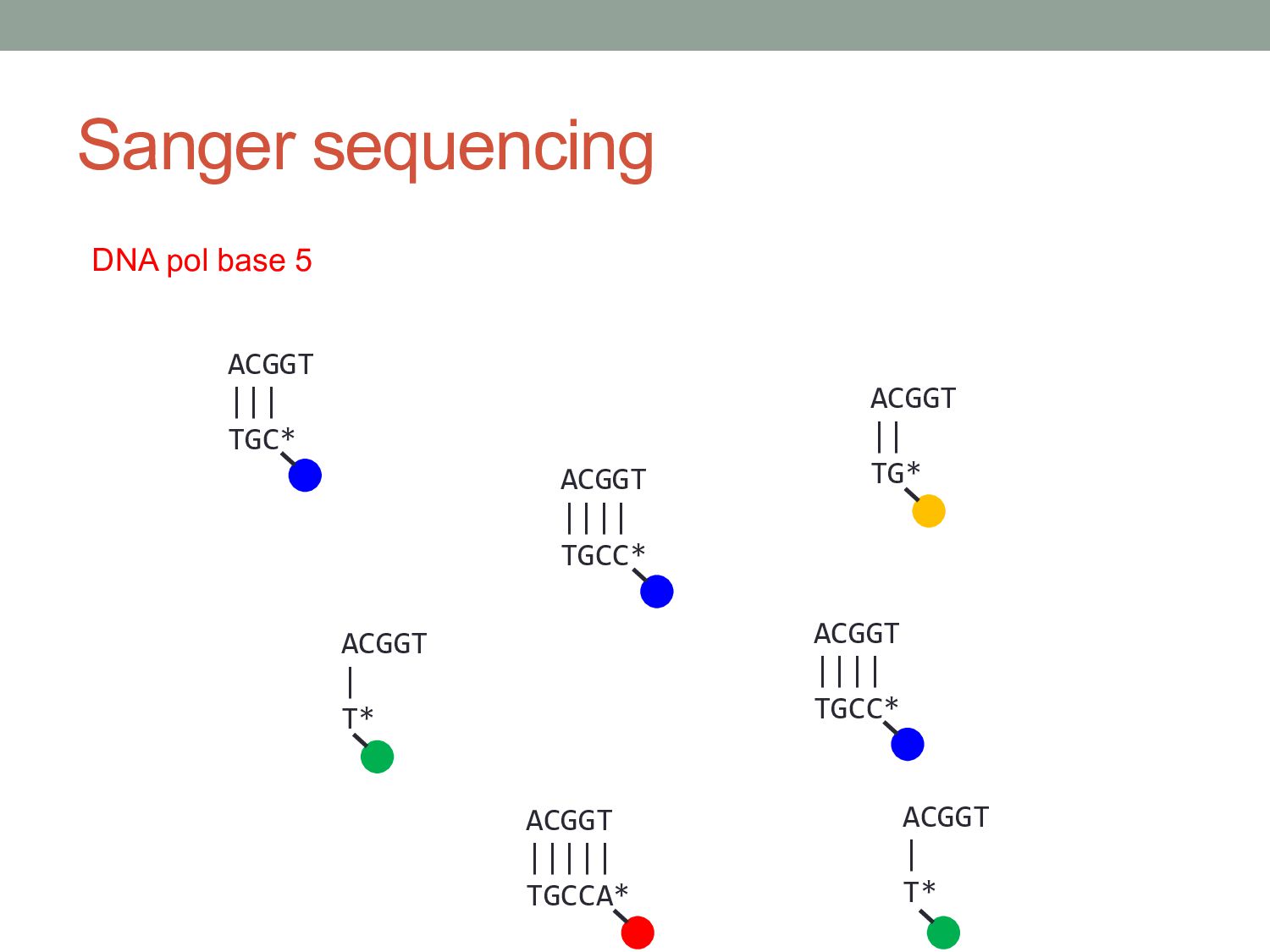
    T* ACGGT || TG* ACGGT |||| TGCC* ACGGT ||||| TGCCA* ACGGT | T* DNA pol base 5
  8. Sanger sequencing ACGGT ||| TGC* ACGGT |||| TGCC* ACGGT |

    T* ACGGT || TG* ACGGT |||| TGCC* ACGGT ||||| TGCCA* ACGGT | T* DNA pol base 5
  9. Sanger sequencing Electrophoresis (sort by size) Excite with laser ACGGT

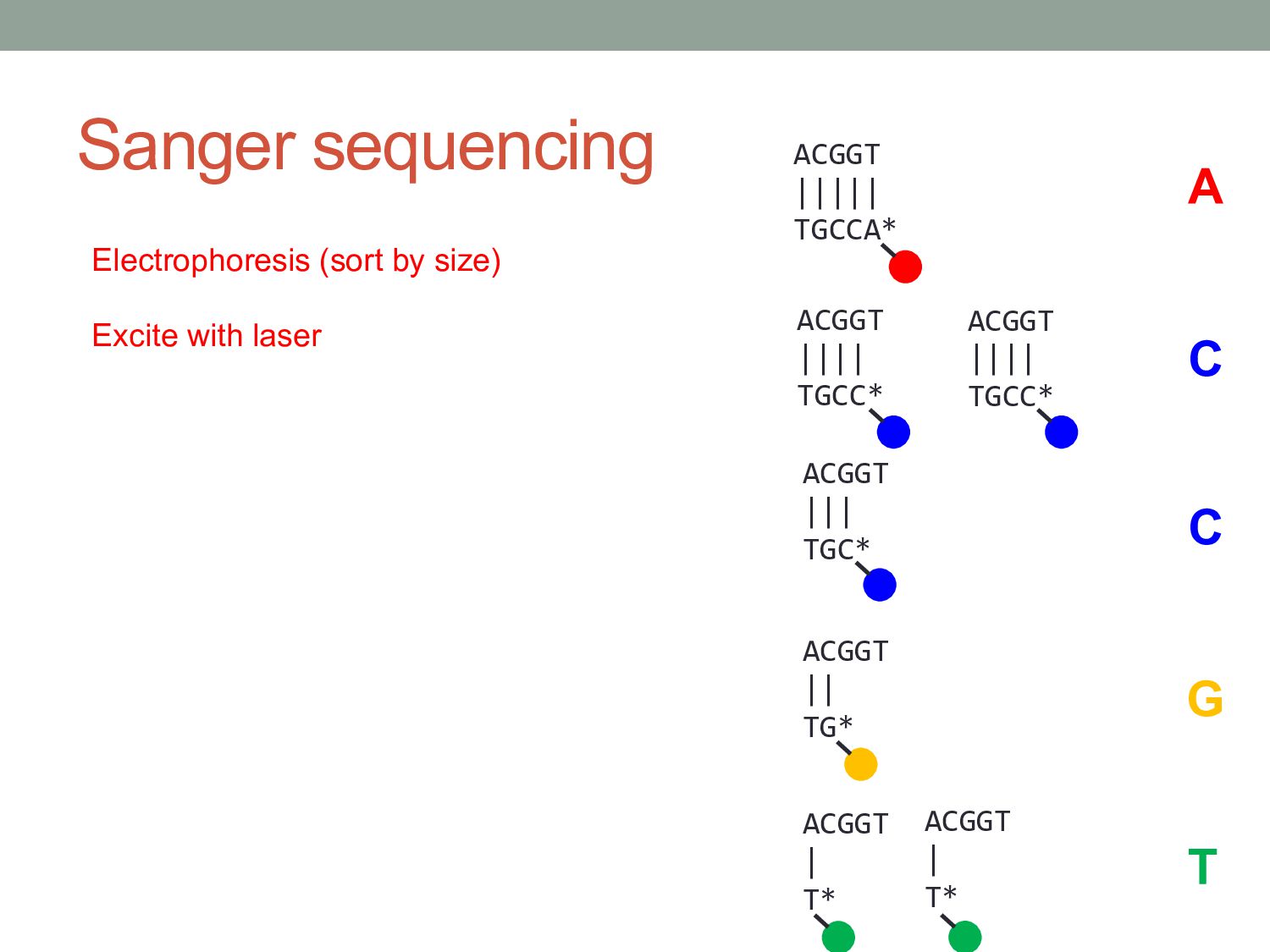
    | T* ACGGT | T* ACGGT || TG* ACGGT ||| TGC* ACGGT |||| TGCC* ACGGT |||| TGCC* ACGGT ||||| TGCCA* A C C G T
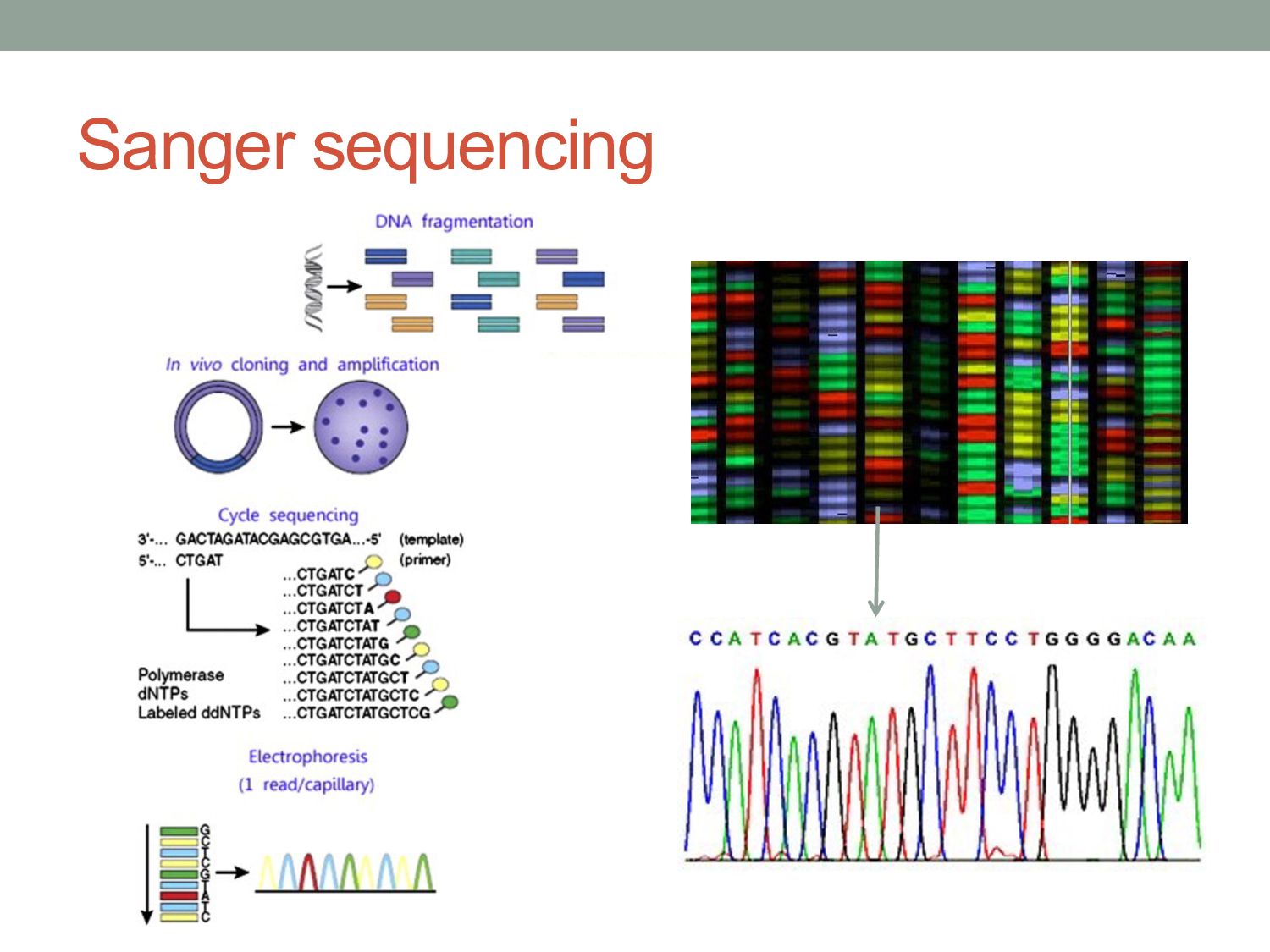
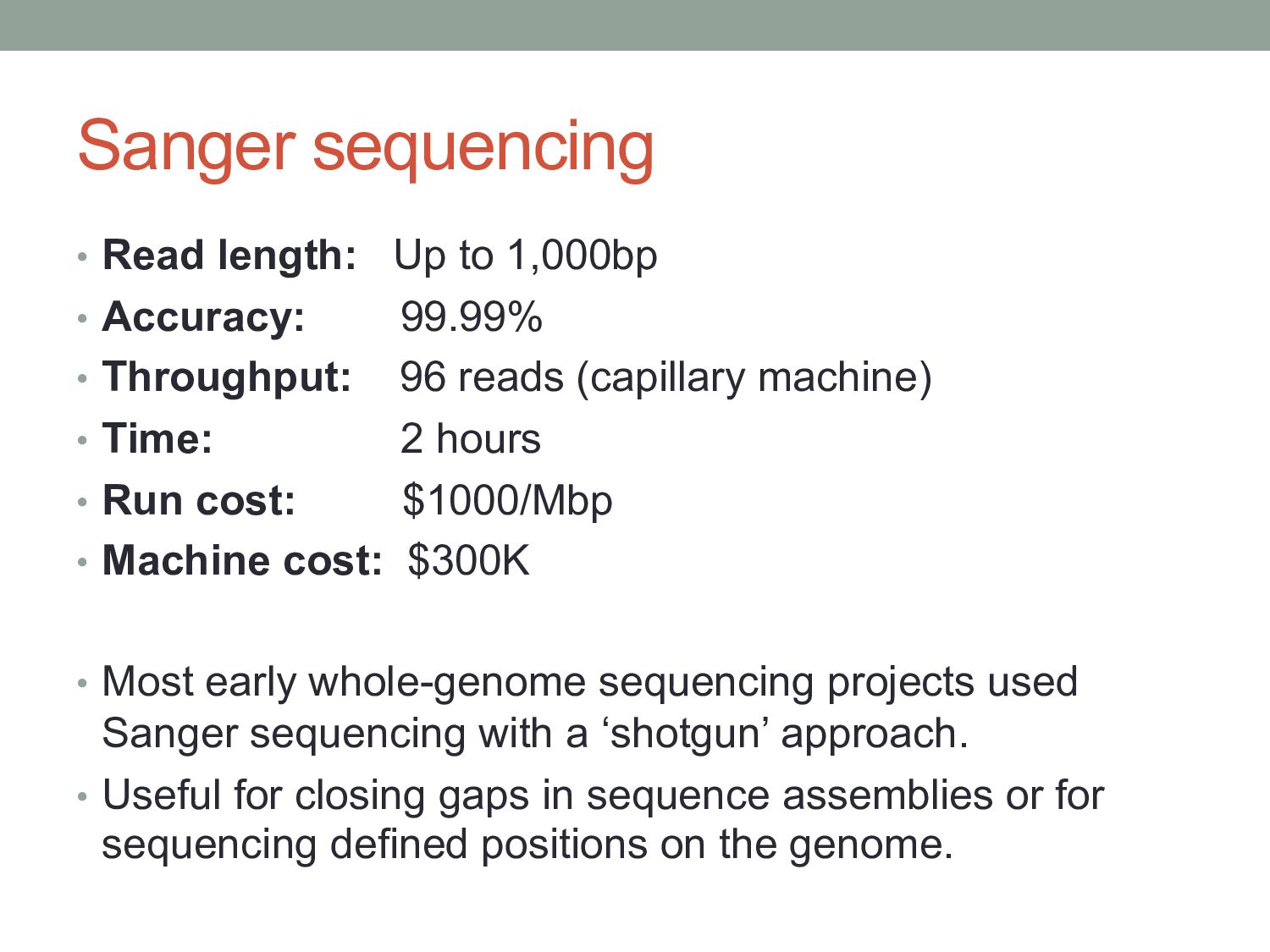
  10. Sanger sequencing • Read length: Up to 1,000bp • Accuracy:

    99.99% • Throughput: 96 reads (capillary machine) • Time: 2 hours • Run cost: $1000/Mbp • Machine cost: $300K • Most early whole-genome sequencing projects used Sanger sequencing with a ‘shotgun’ approach. • Useful for closing gaps in sequence assemblies or for sequencing defined positions on the genome.
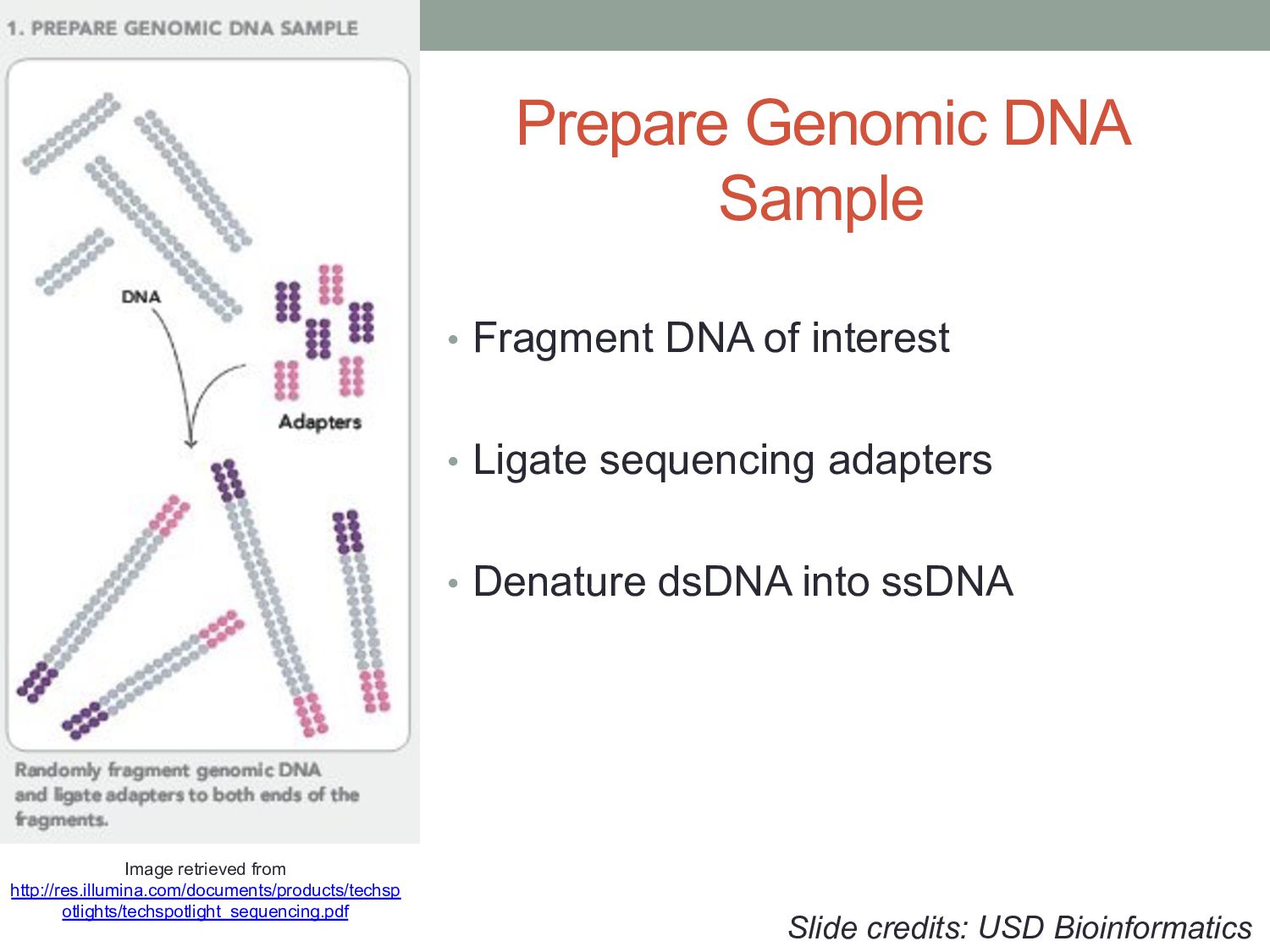
  11. Prepare Genomic DNA Sample • Fragment DNA of interest •

    Ligate sequencing adapters • Denature dsDNA into ssDNA Image retrieved from http://res.illumina.com/documents/products/techsp otlights/techspotlight_sequencing.pdf Slide credits: USD Bioinformatics
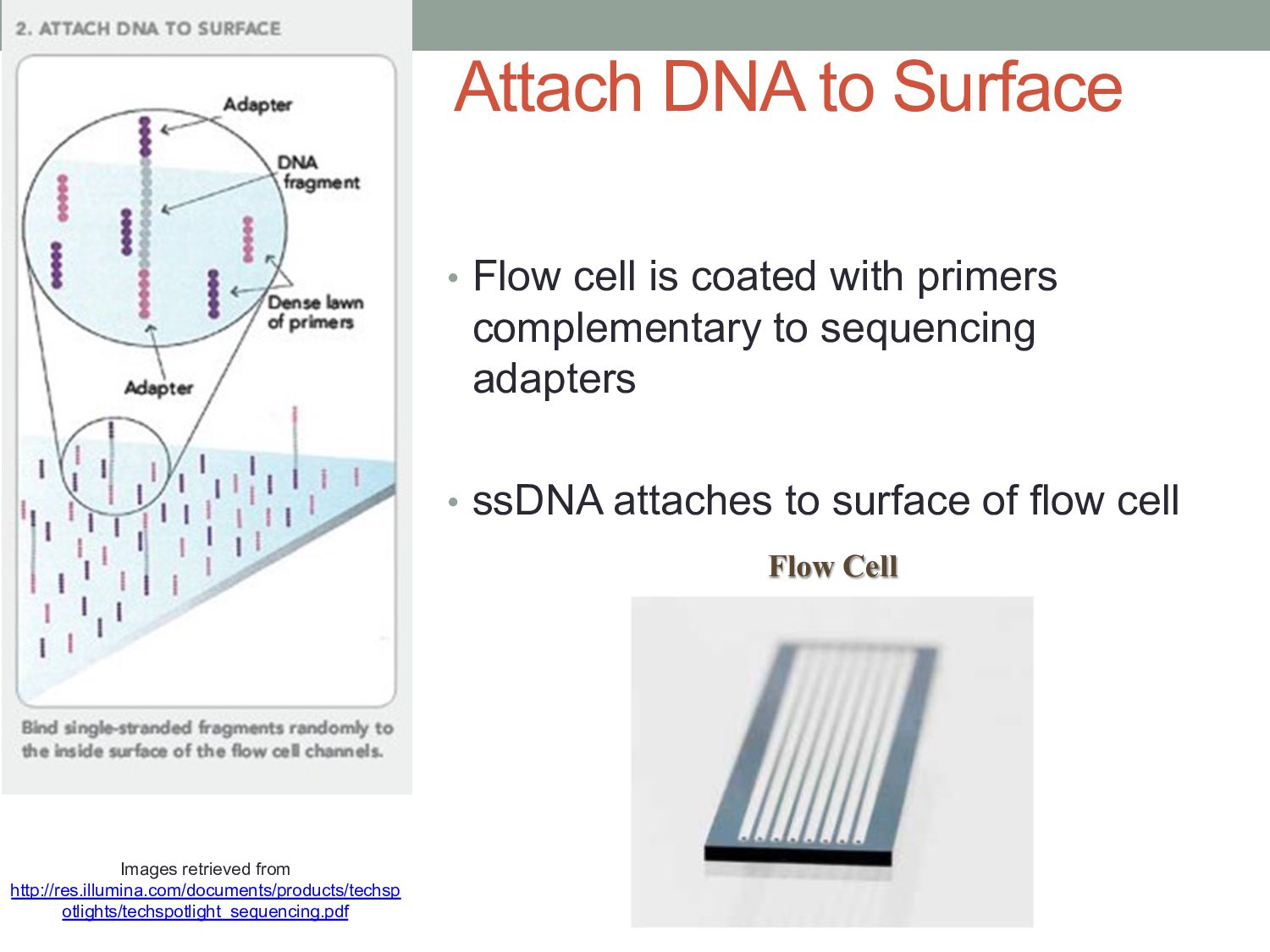
  12. Attach DNA to Surface • Flow cell is coated with

    primers complementary to sequencing adapters • ssDNA attaches to surface of flow cell Images retrieved from http://res.illumina.com/documents/products/techsp otlights/techspotlight_sequencing.pdf Flow Cell
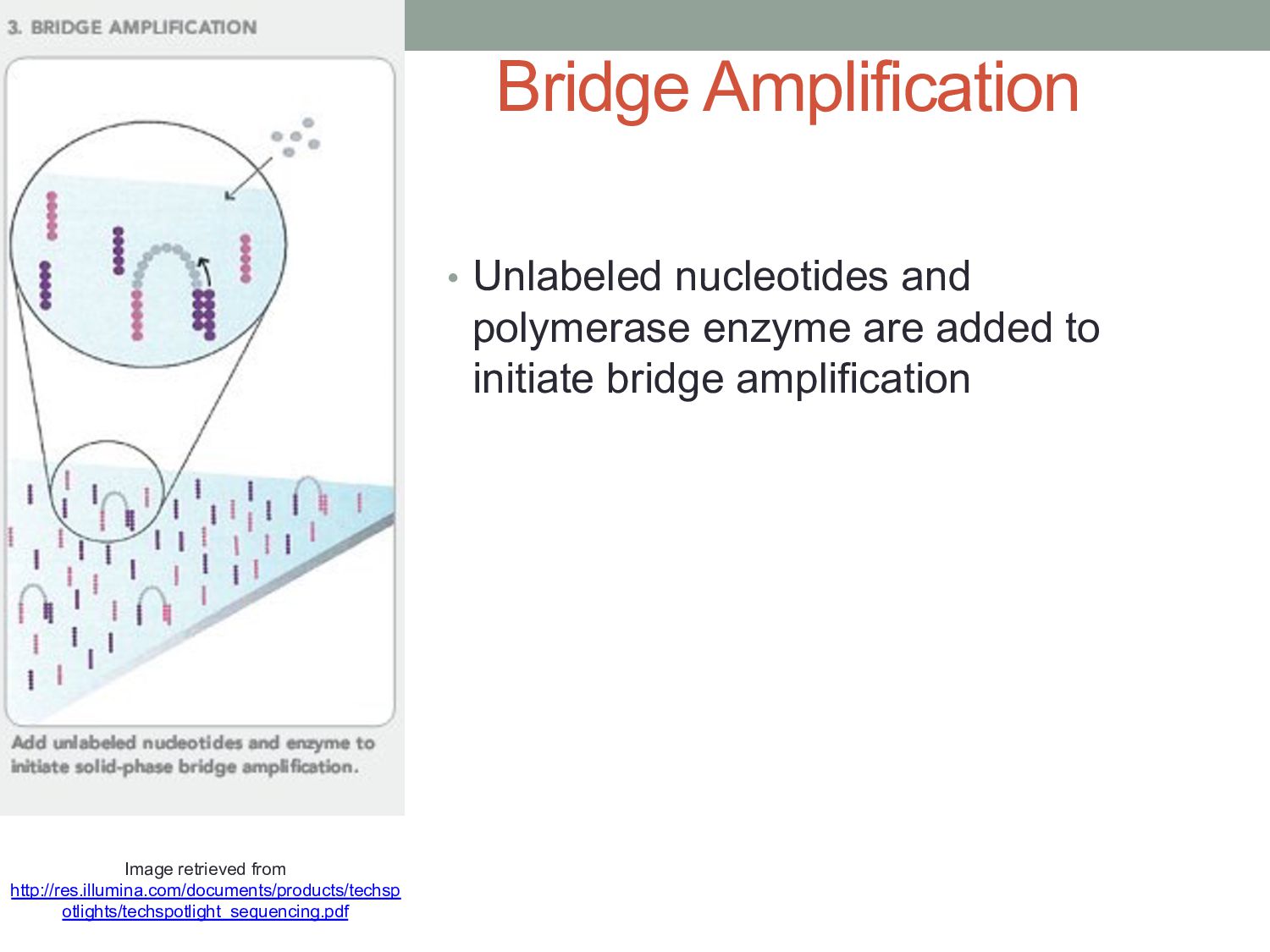
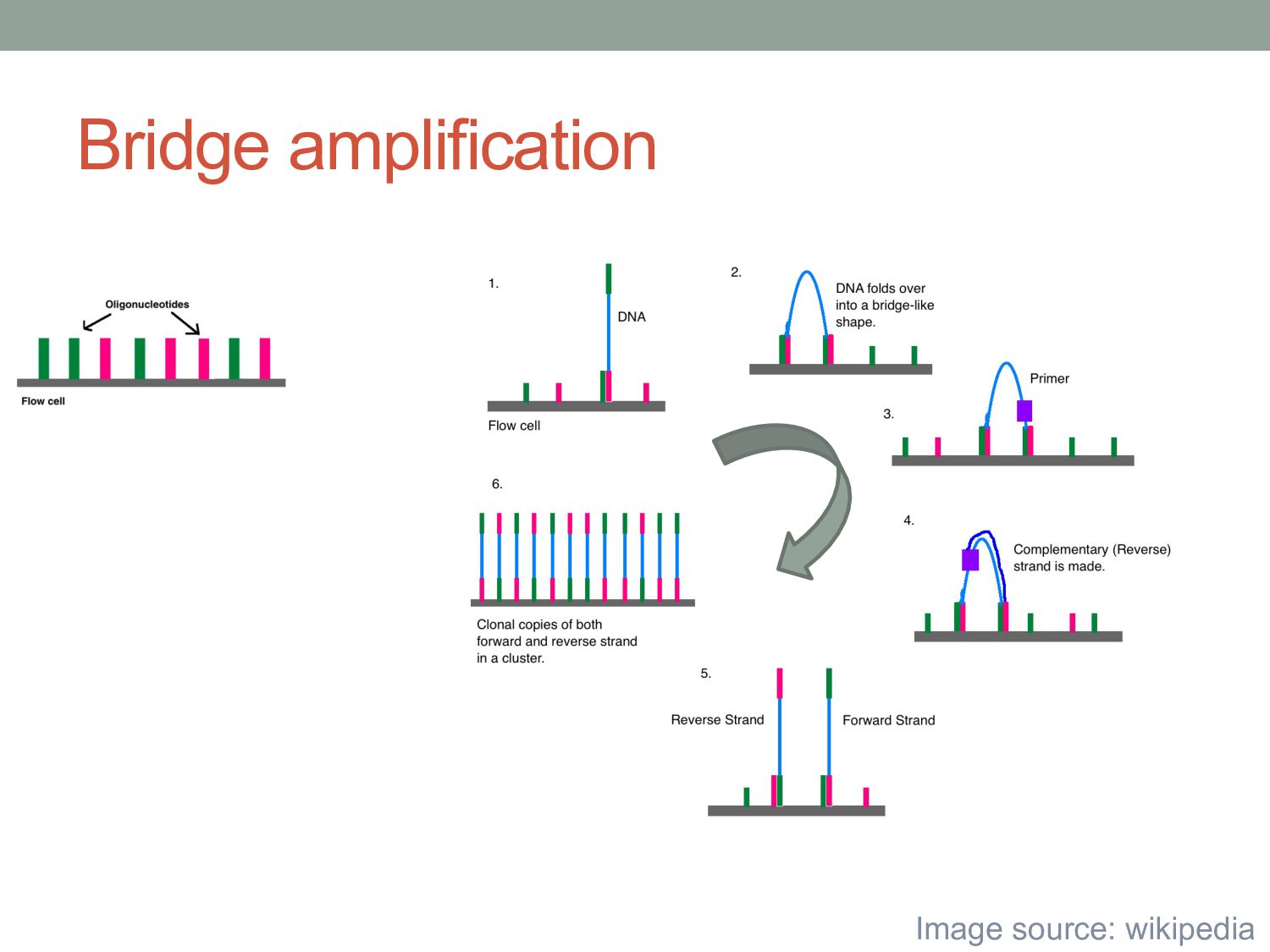
  13. Bridge Amplification • Unlabeled nucleotides and polymerase enzyme are added

    to initiate bridge amplification Image retrieved from http://res.illumina.com/documents/products/techsp otlights/techspotlight_sequencing.pdf
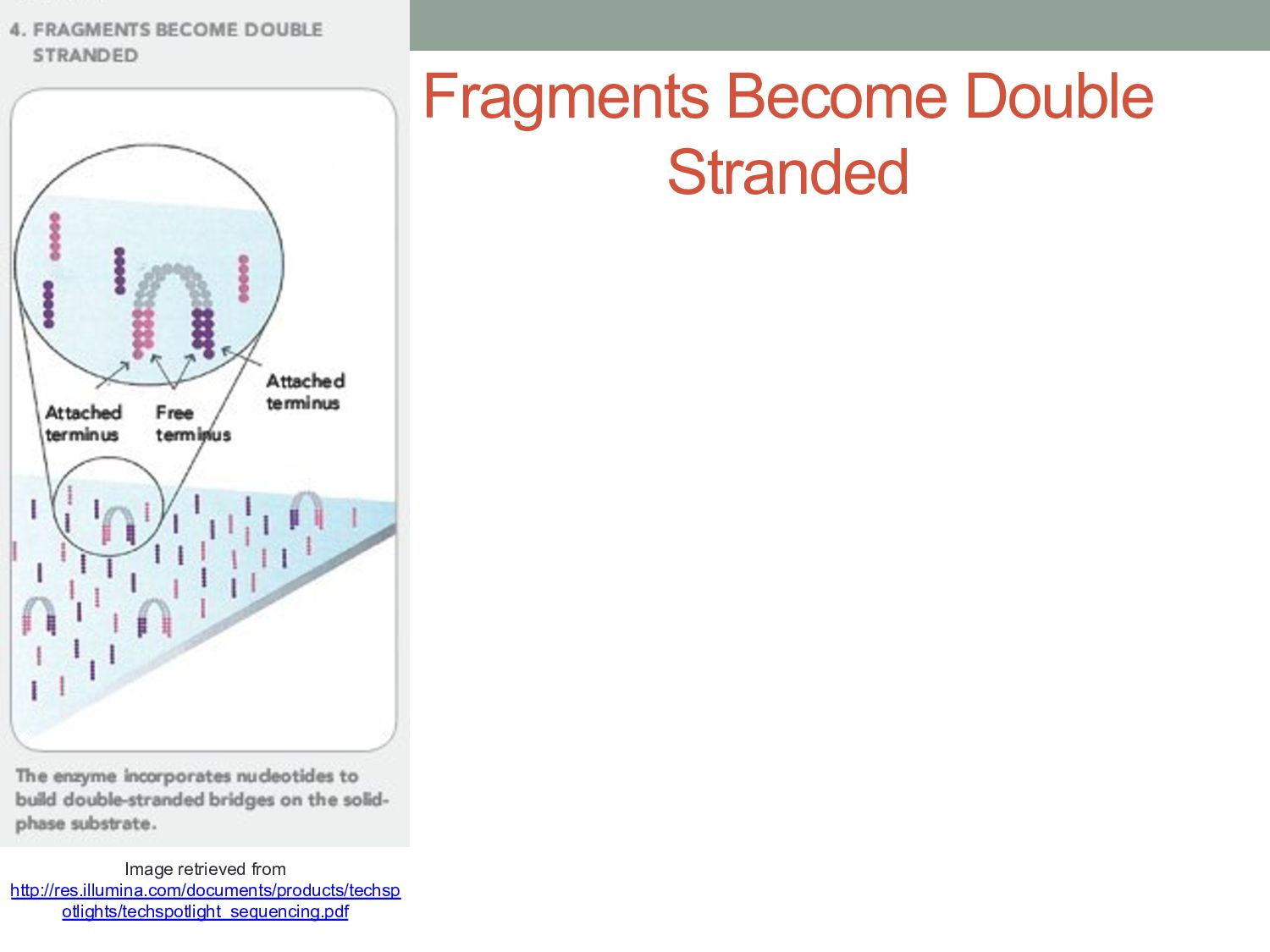
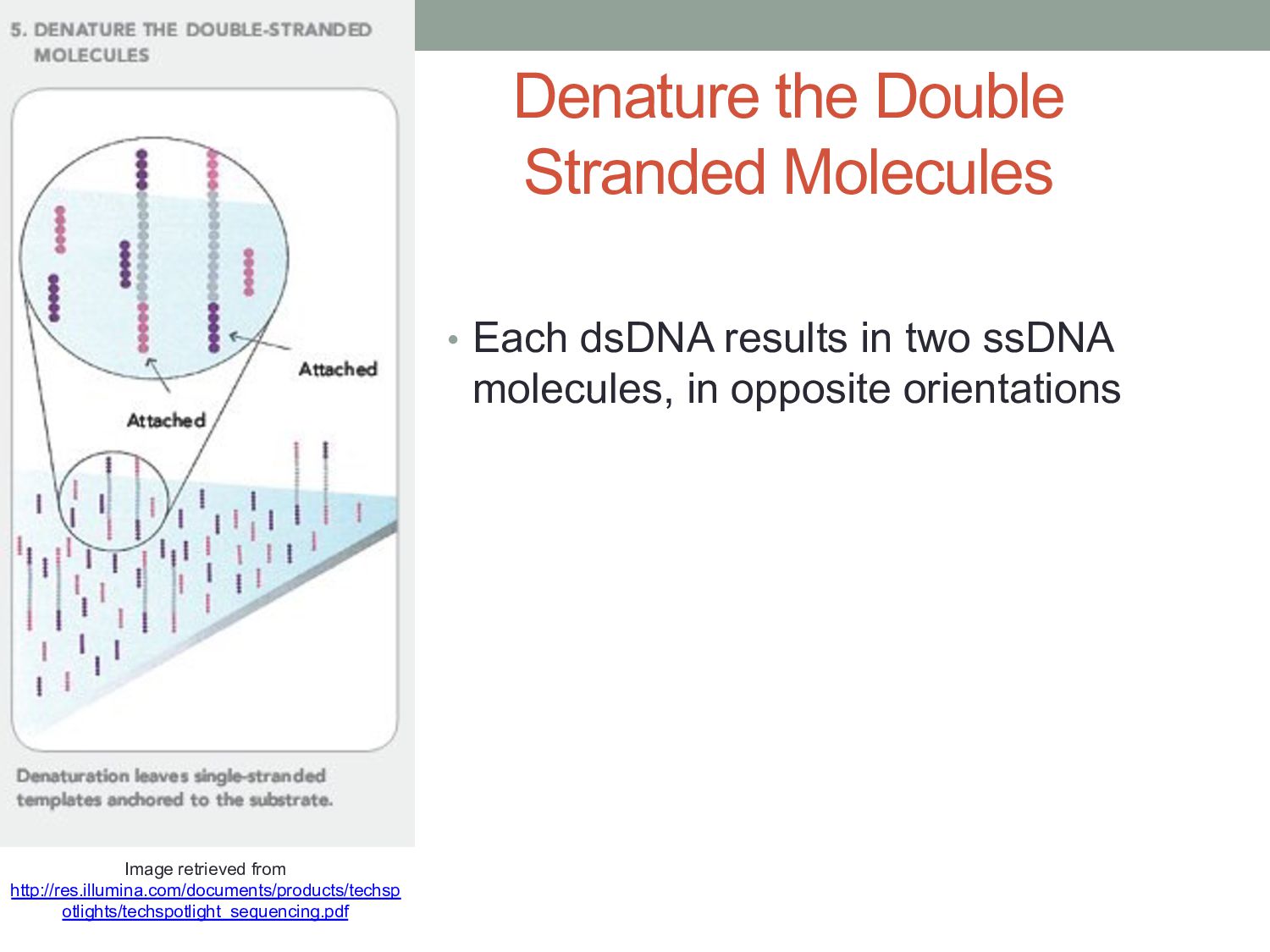
  14. Denature the Double Stranded Molecules • Each dsDNA results in

    two ssDNA molecules, in opposite orientations Image retrieved from http://res.illumina.com/documents/products/techsp otlights/techspotlight_sequencing.pdf
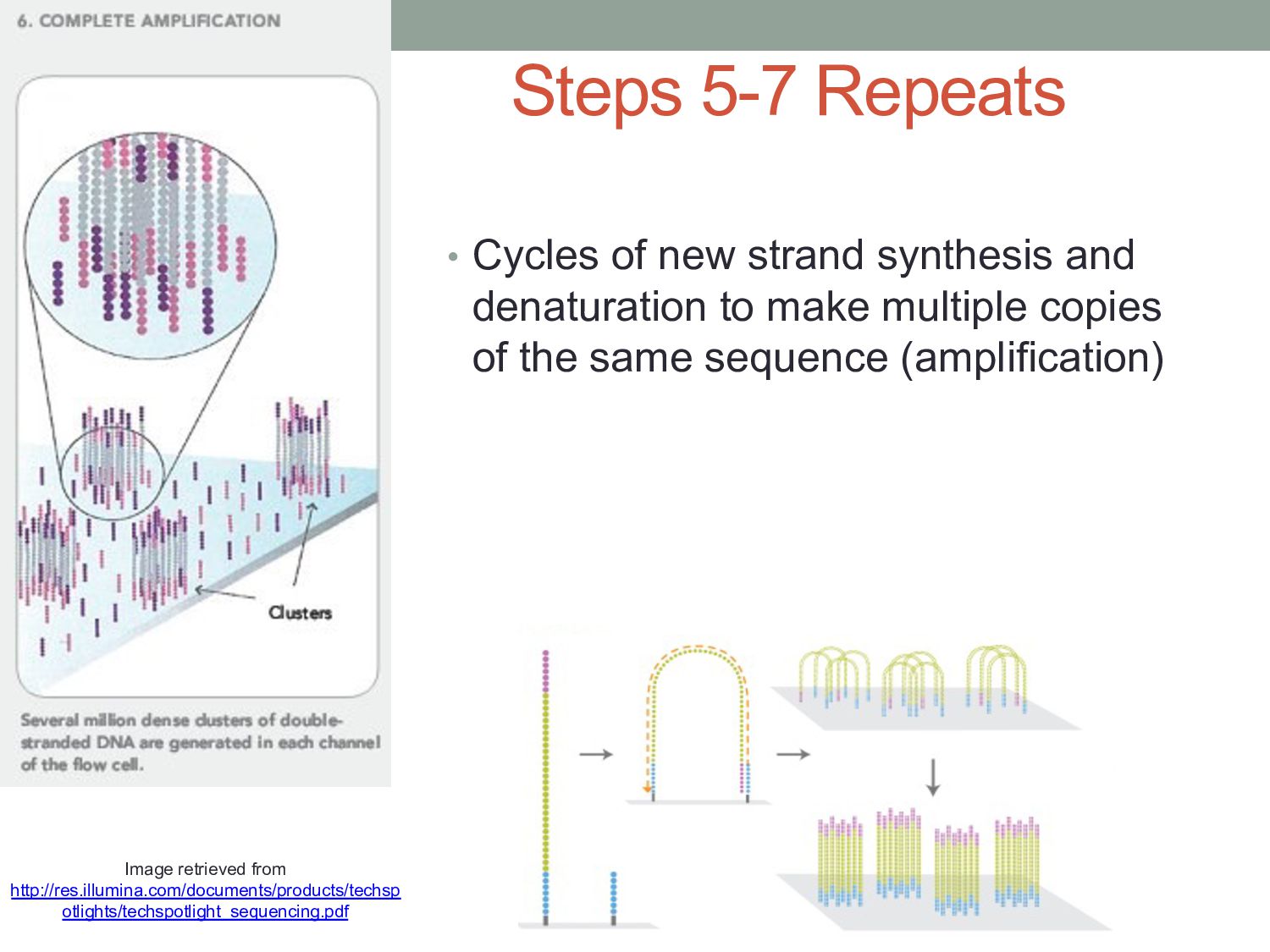
  15. Steps 5-7 Repeats • Cycles of new strand synthesis and

    denaturation to make multiple copies of the same sequence (amplification) Image retrieved from http://res.illumina.com/documents/products/techsp otlights/techspotlight_sequencing.pdf
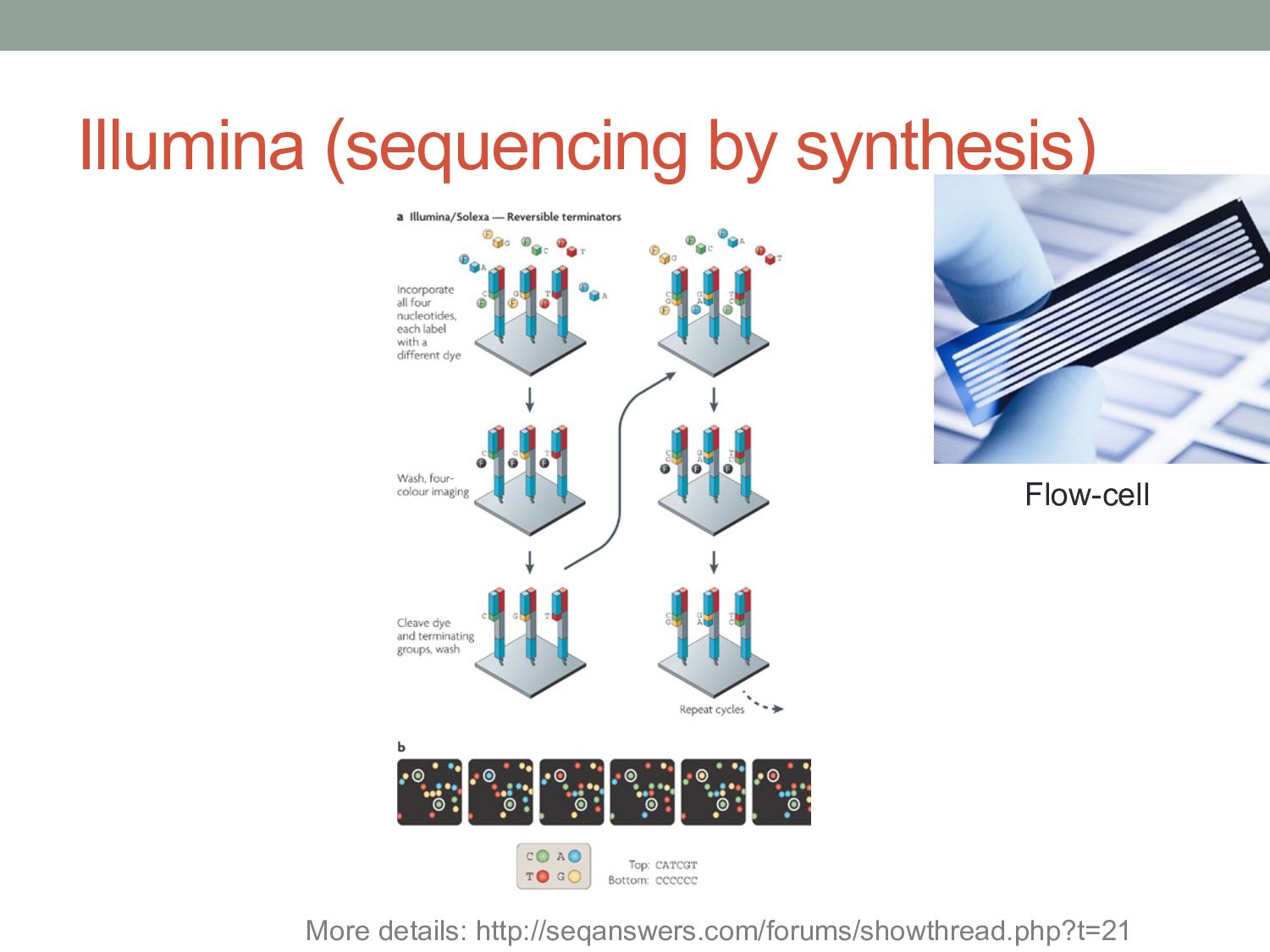
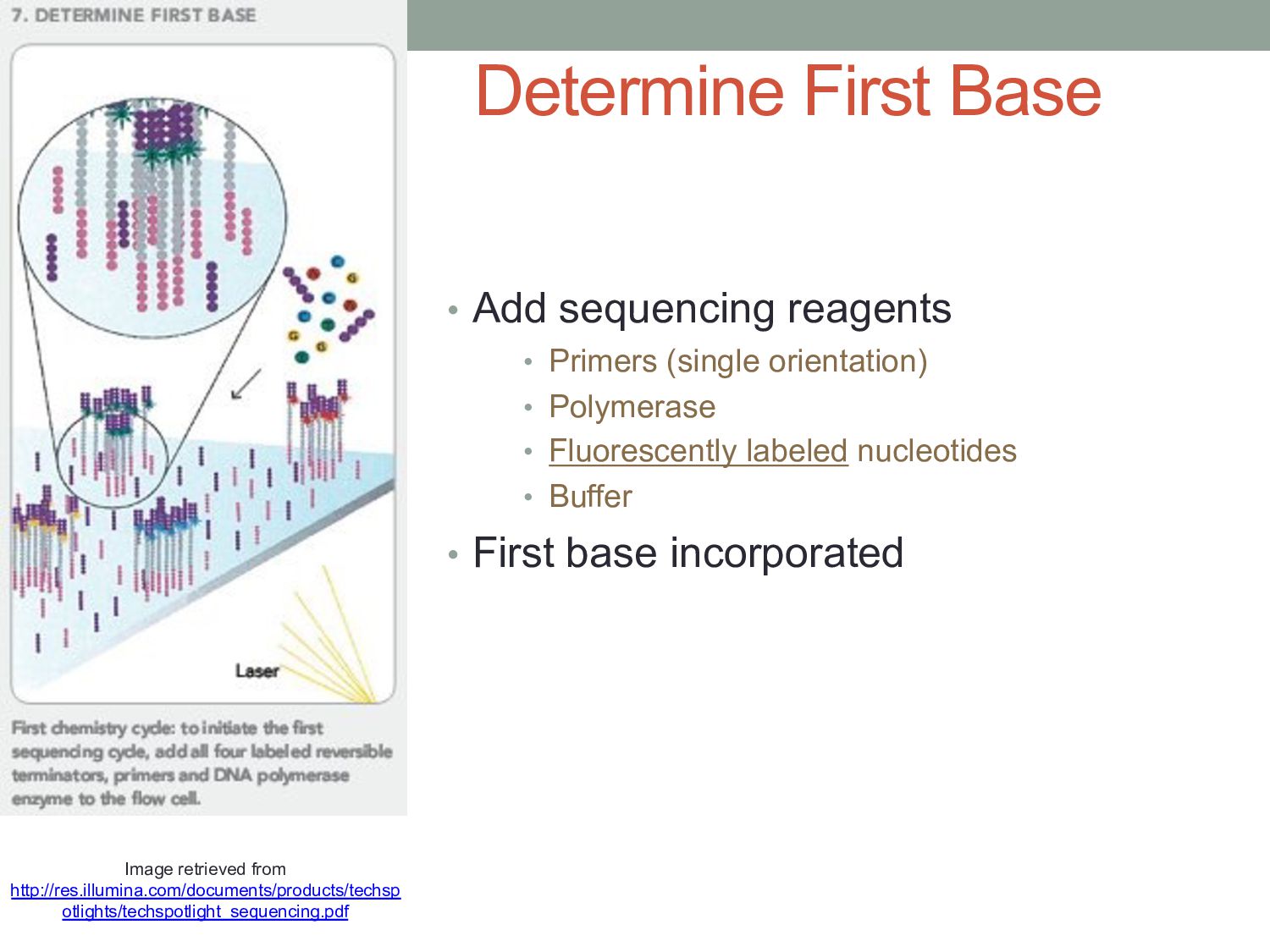
  16. Determine First Base • Add sequencing reagents • Primers (single

    orientation) • Polymerase • Fluorescently labeled nucleotides • Buffer • First base incorporated Image retrieved from http://res.illumina.com/documents/products/techsp otlights/techspotlight_sequencing.pdf
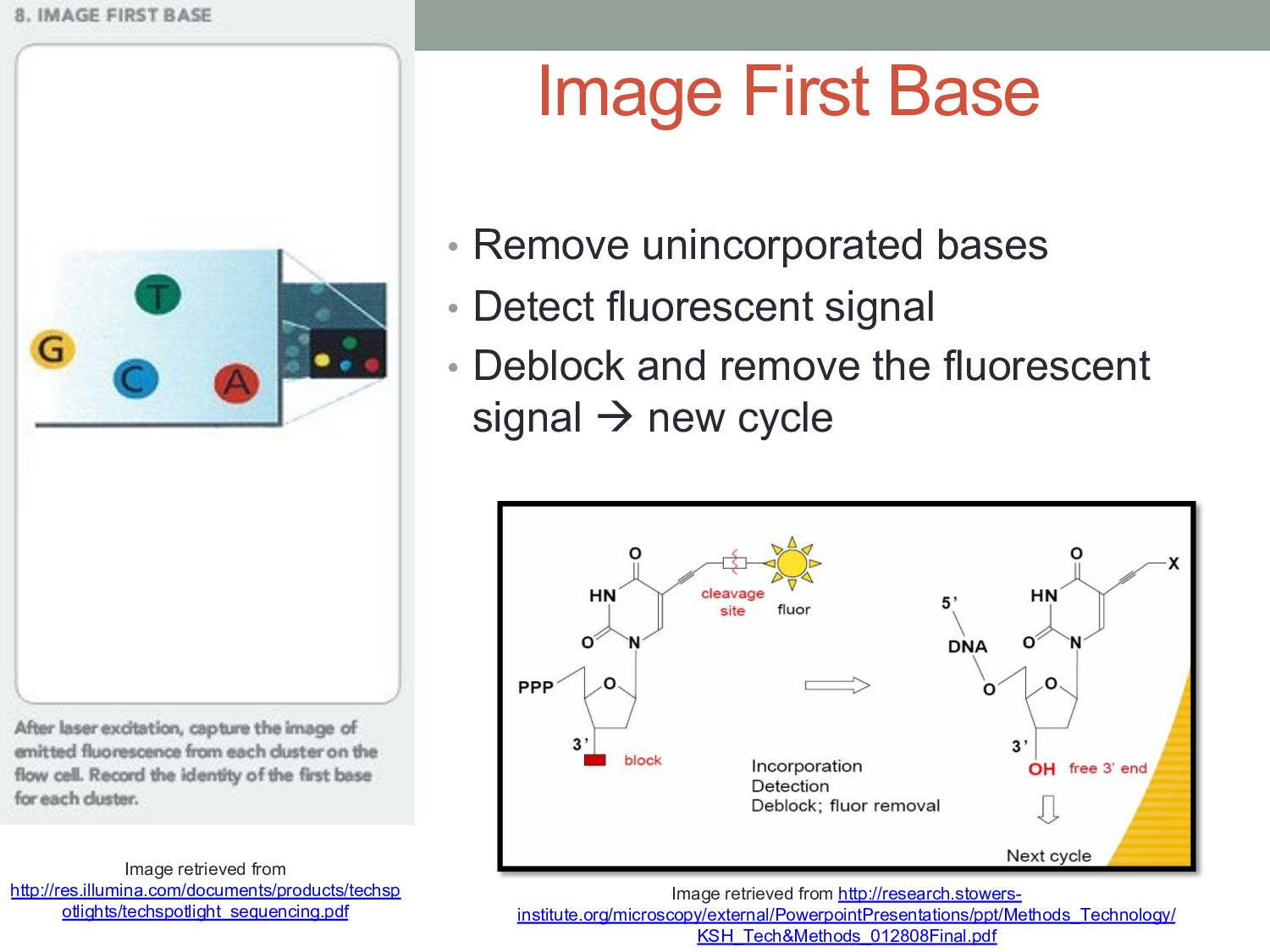
  17. Image First Base • Remove unincorporated bases • Detect fluorescent

    signal • Deblock and remove the fluorescent signal à new cycle Image retrieved from http://res.illumina.com/documents/products/techsp otlights/techspotlight_sequencing.pdf Image retrieved from http://research.stowers- institute.org/microscopy/external/PowerpointPresentations/ppt/Methods_Technology/ KSH_Tech&Methods_012808Final.pdf
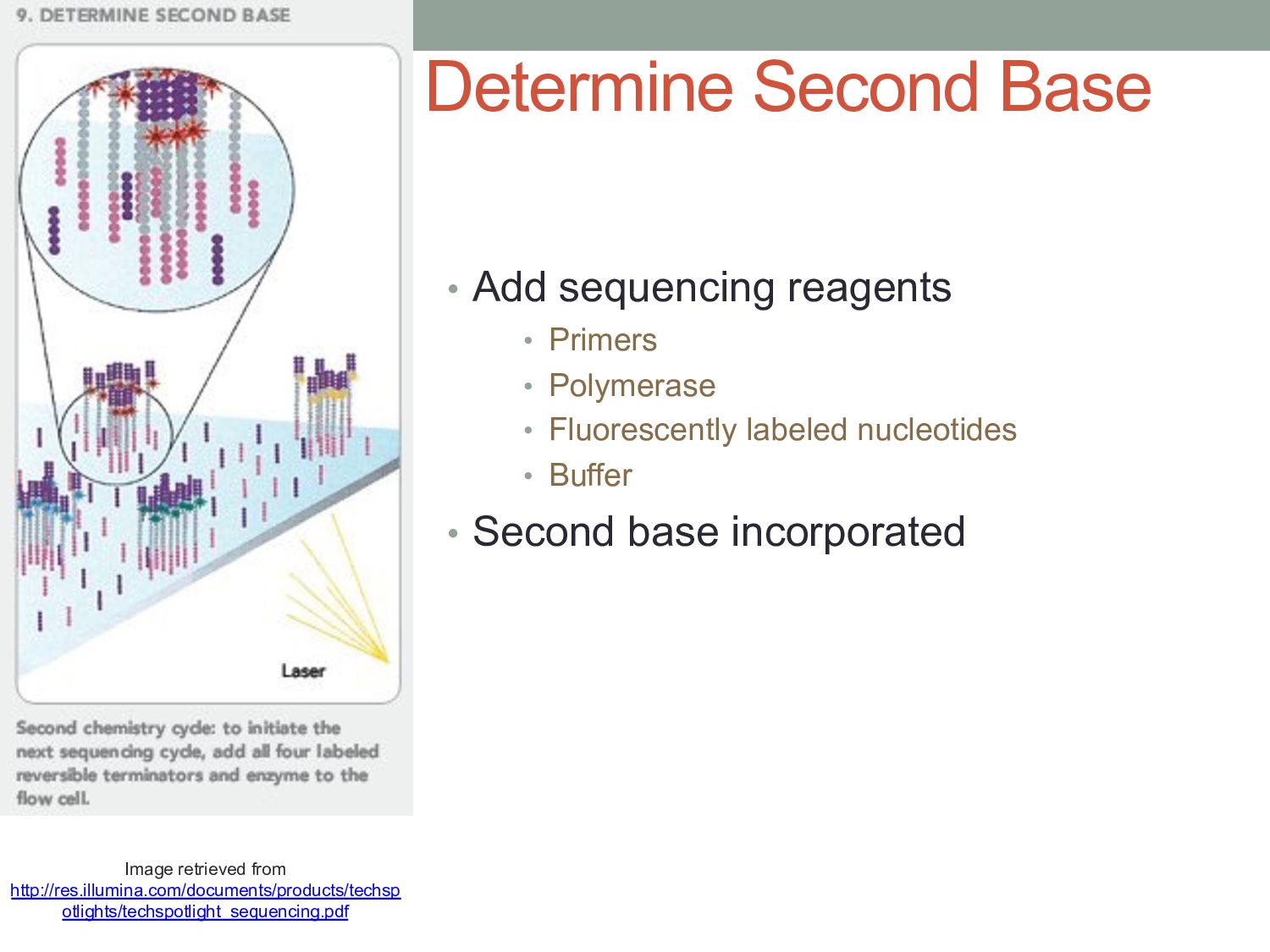
  18. Determine Second Base • Add sequencing reagents • Primers •

    Polymerase • Fluorescently labeled nucleotides • Buffer • Second base incorporated Image retrieved from http://res.illumina.com/documents/products/techsp otlights/techspotlight_sequencing.pdf
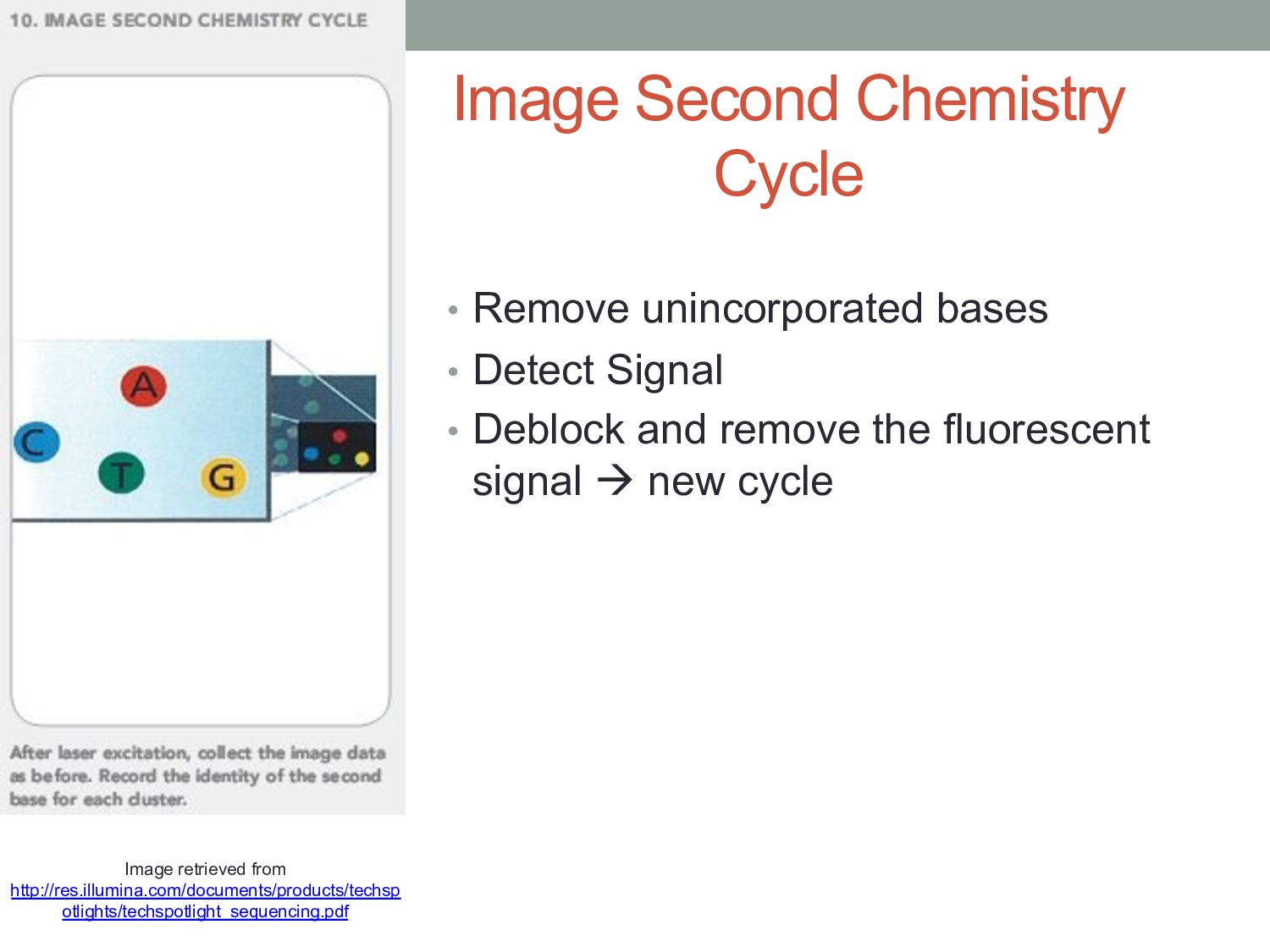
  19. Image Second Chemistry Cycle • Remove unincorporated bases • Detect

    Signal • Deblock and remove the fluorescent signal à new cycle Image retrieved from http://res.illumina.com/documents/products/techsp otlights/techspotlight_sequencing.pdf
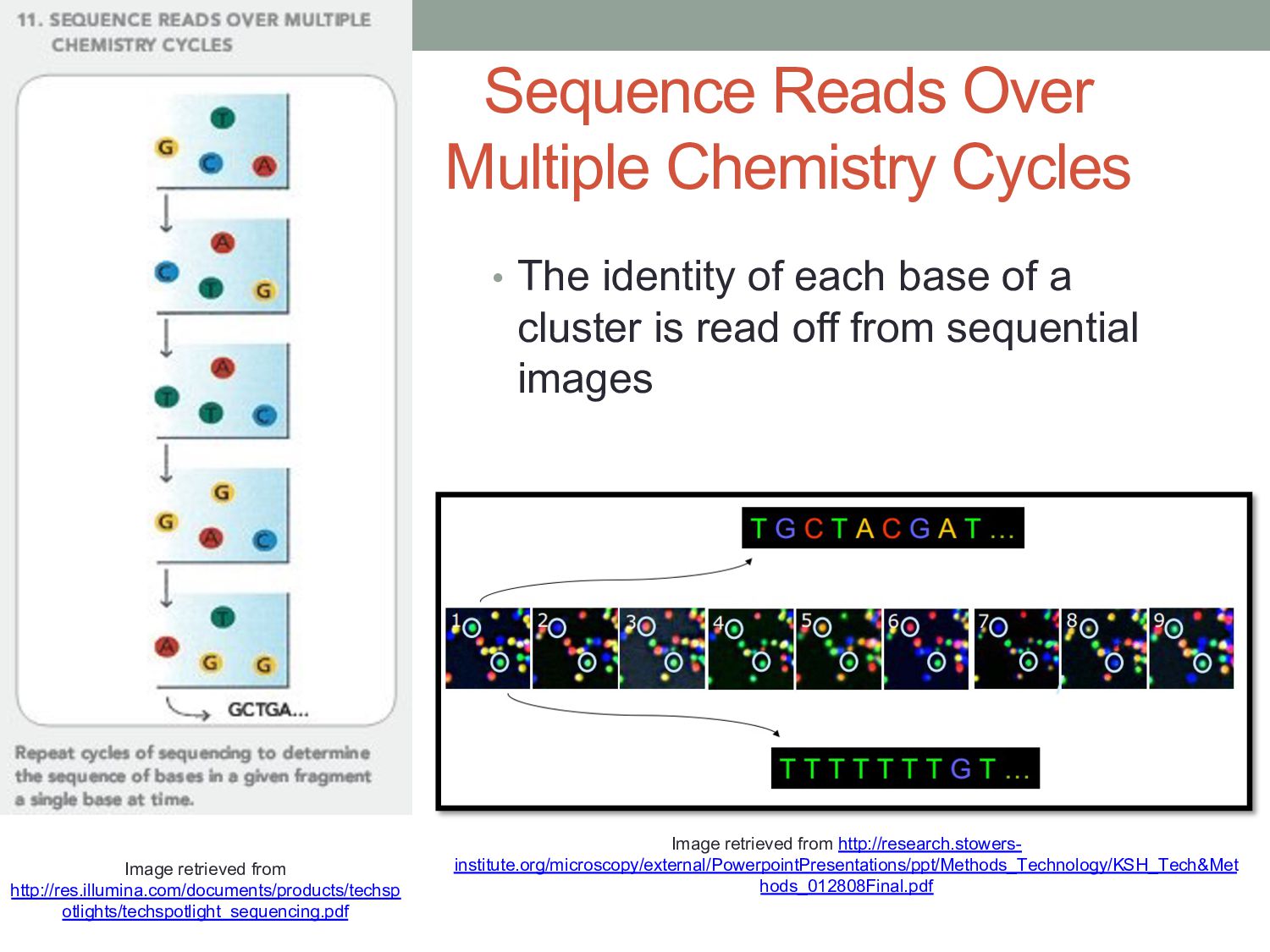
  20. Sequence Reads Over Multiple Chemistry Cycles • The identity of

    each base of a cluster is read off from sequential images Image retrieved from http://res.illumina.com/documents/products/techsp otlights/techspotlight_sequencing.pdf Image retrieved from http://research.stowers- institute.org/microscopy/external/PowerpointPresentations/ppt/Methods_Technology/KSH_Tech&Met hods_012808Final.pdf
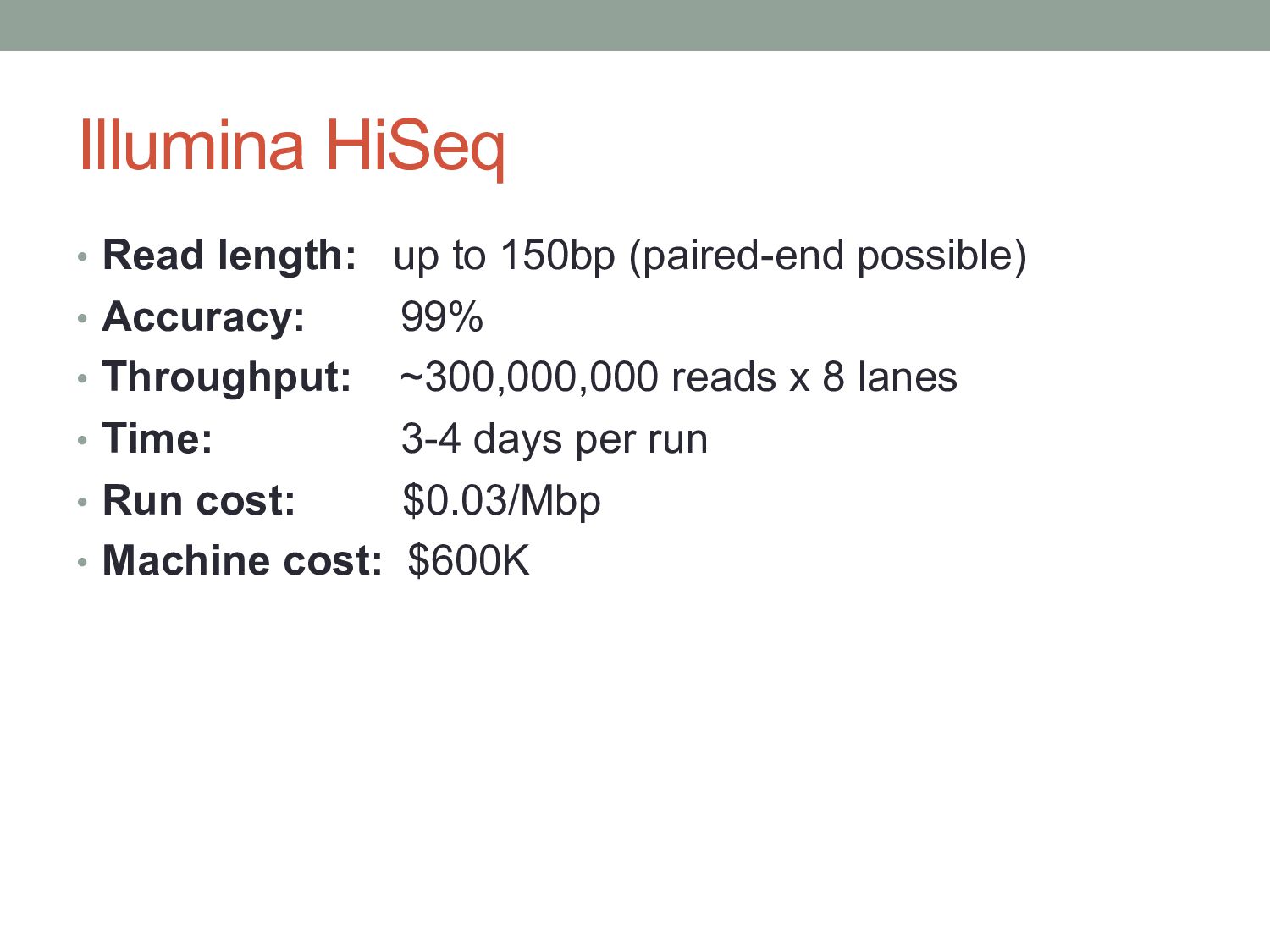
  21. Illumina HiSeq • Read length: up to 150bp (paired-end possible)

    • Accuracy: 99% • Throughput: ~300,000,000 reads x 8 lanes • Time: 3-4 days per run • Run cost: $0.03/Mbp • Machine cost: $600K
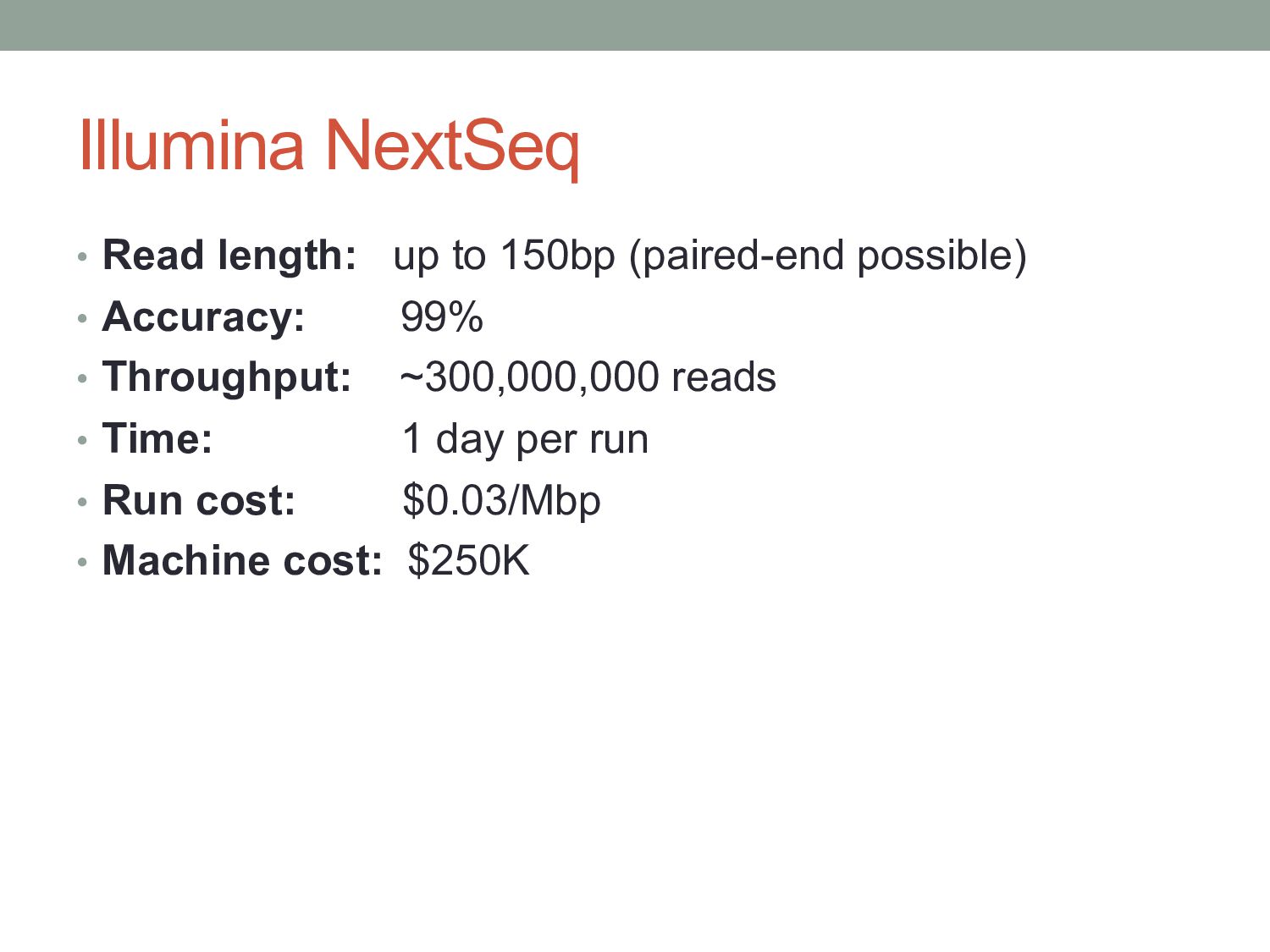
  22. Illumina NextSeq • Read length: up to 150bp (paired-end possible)

    • Accuracy: 99% • Throughput: ~300,000,000 reads • Time: 1 day per run • Run cost: $0.03/Mbp • Machine cost: $250K
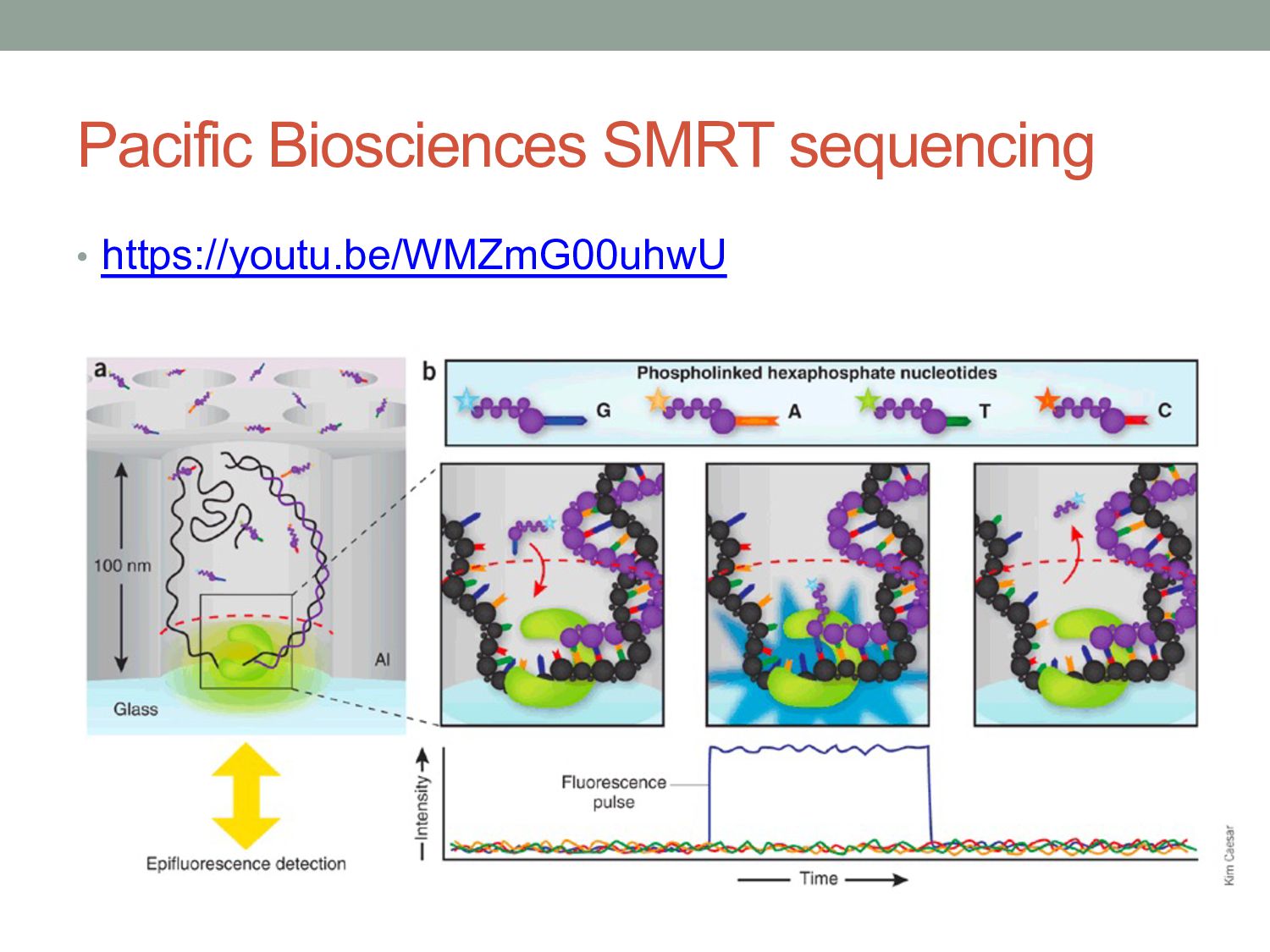
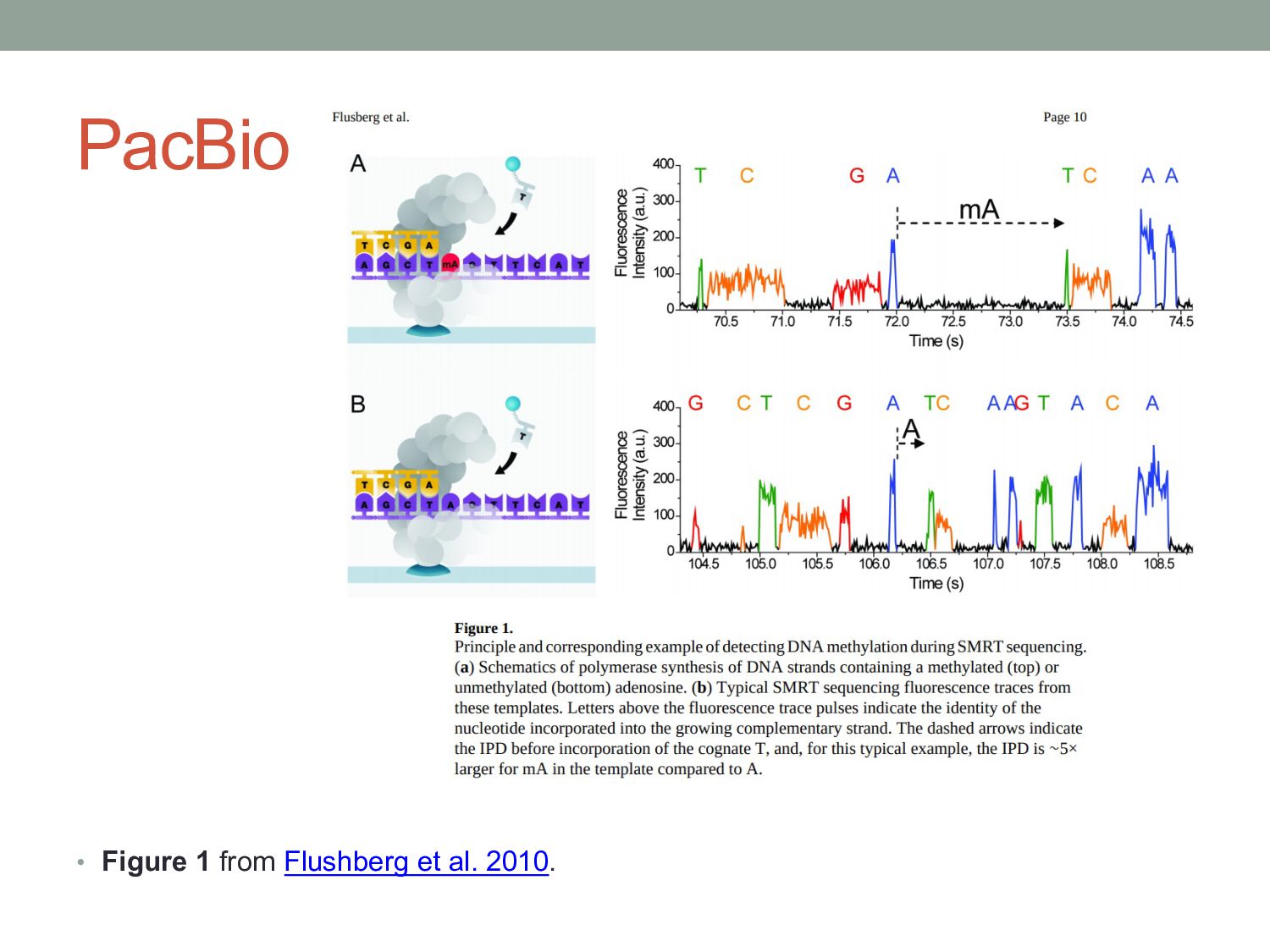
  23. PacBio • One of the major drawbacks of SNS technologies

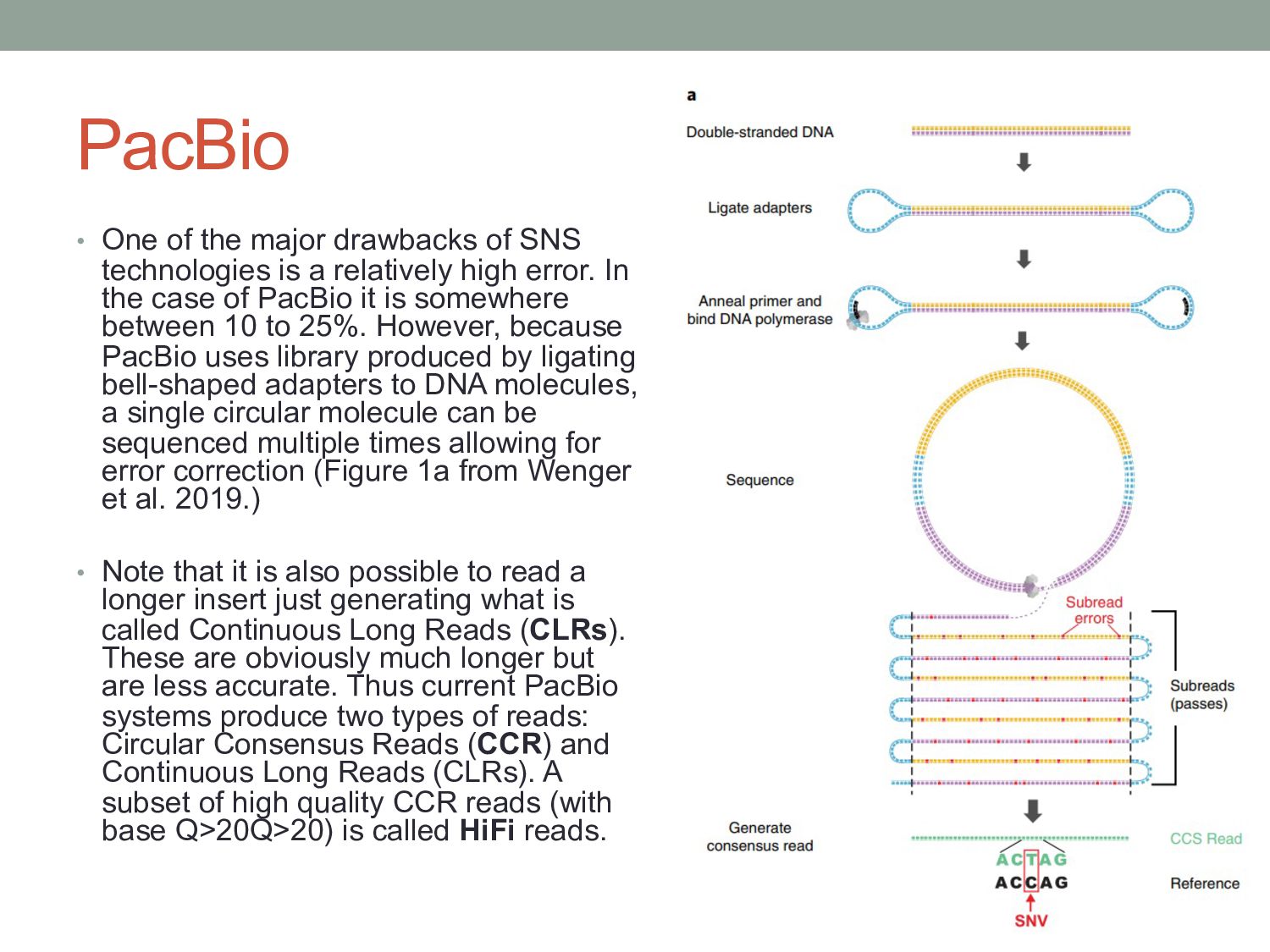
    is a relatively high error. In the case of PacBio it is somewhere between 10 to 25%. However, because PacBio uses library produced by ligating bell-shaped adapters to DNA molecules, a single circular molecule can be sequenced multiple times allowing for error correction (Figure 1a from Wenger et al. 2019.) • Note that it is also possible to read a longer insert just generating what is called Continuous Long Reads (CLRs). These are obviously much longer but are less accurate. Thus current PacBio systems produce two types of reads: Circular Consensus Reads (CCR) and Continuous Long Reads (CLRs). A subset of high quality CCR reads (with base Q>20Q>20) is called HiFi reads.
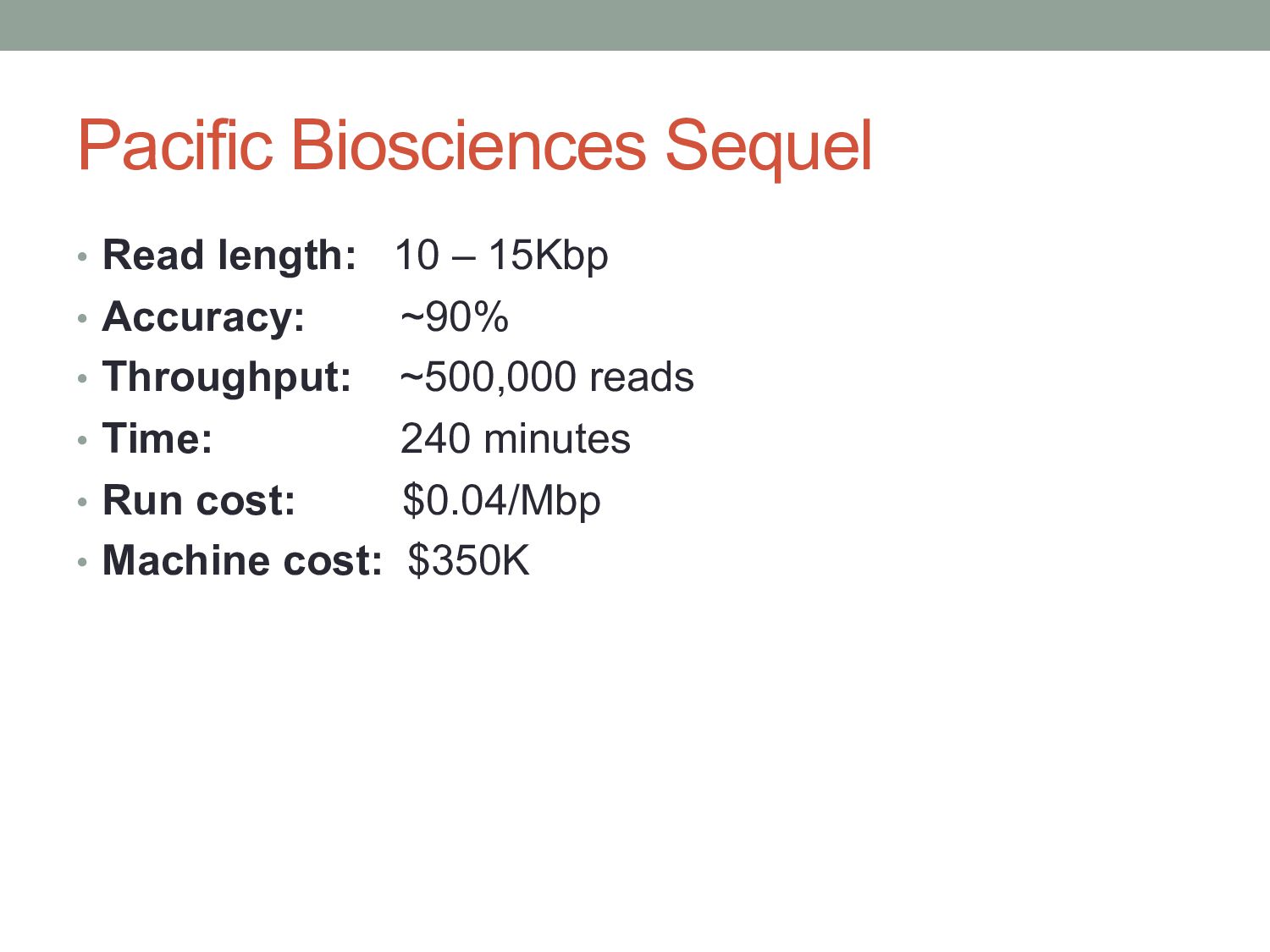
  24. Pacific Biosciences Sequel • Read length: 10 – 15Kbp •

    Accuracy: ~90% • Throughput: ~500,000 reads • Time: 240 minutes • Run cost: $0.04/Mbp • Machine cost: $350K
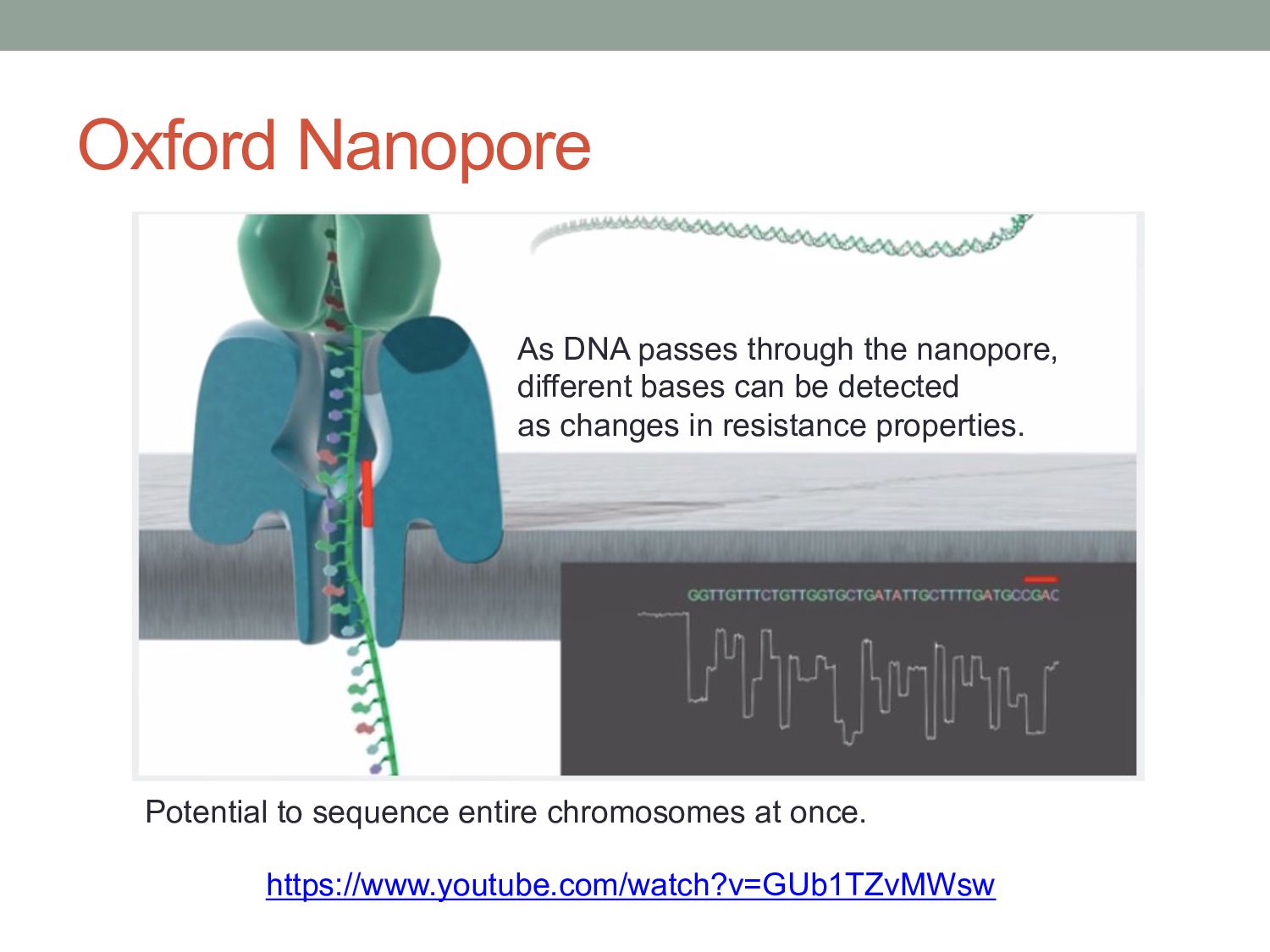
  25. Oxford Nanopore As DNA passes through the nanopore, different bases

    can be detected as changes in resistance properties. Potential to sequence entire chromosomes at once. https://www.youtube.com/watch?v=GUb1TZvMWsw
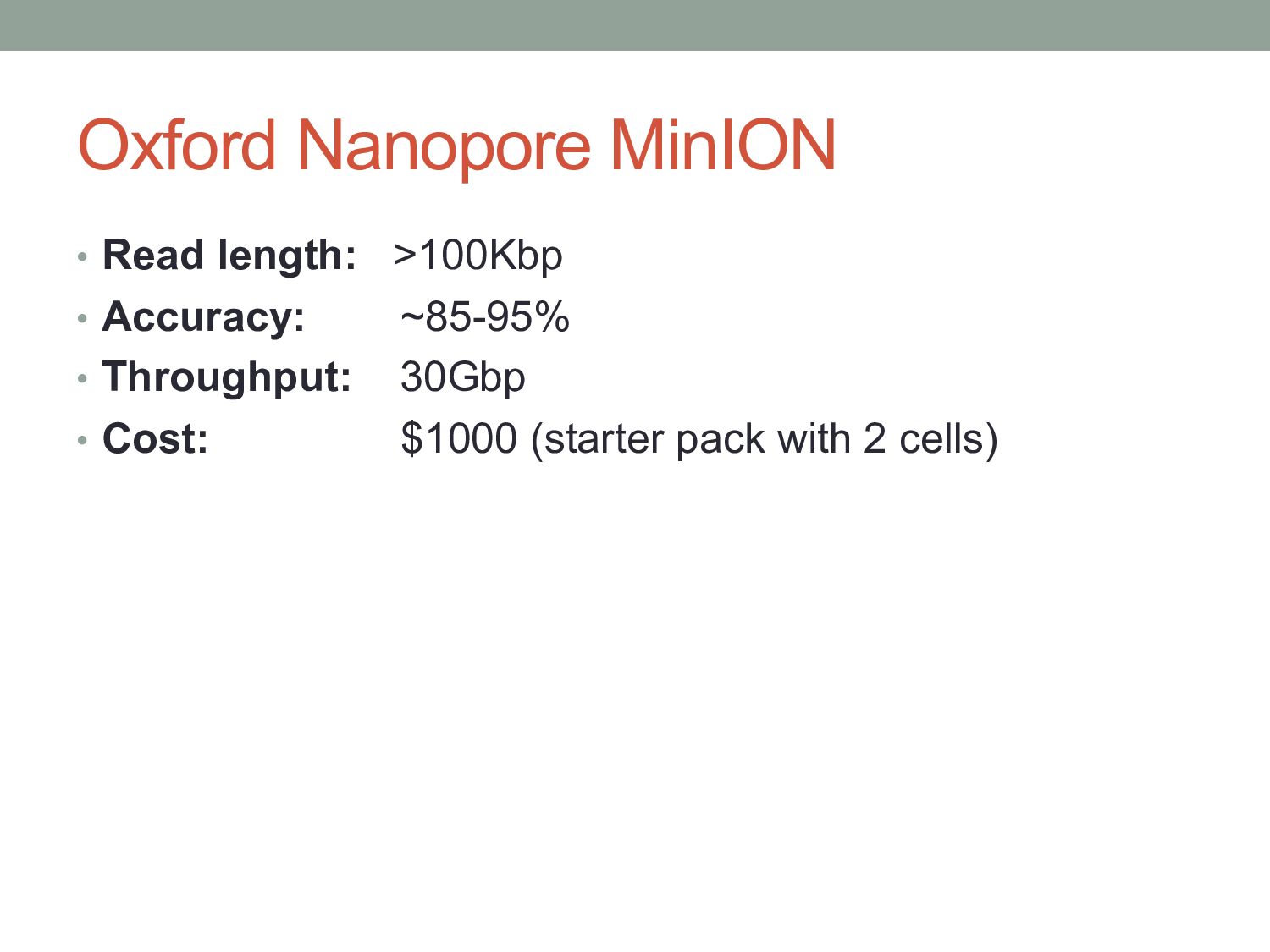
  26. Oxford Nanopore MinION • Read length: >100Kbp • Accuracy: ~85-95%

    • Throughput: 30Gbp • Cost: $1000 (starter pack with 2 cells)
  27. Summary • Current DNA sequencing platforms produce hundreds of millions

    of short sequence reads at low cost. • Sequencing platforms report on their confidence in their base calls.