Upgrade to Pro — share decks privately, control downloads, hide ads and more …

Where to Buy Old Facebook Account for Ads Now

Where to Buy Old Facebook Account for Ads Now

Where to Buy Old Facebook Account for Ads Now

Searching for “Where to Buy Old Facebook Account for Ads Now” often comes from advertisers looking for a faster way to start Facebook advertising campaigns. Older accounts are sometimes perceived as more established because they may have a longer activity history. However, account age alone does not guarantee advertising eligibility, better campaign performance, higher spending limits, or protection from restrictions.

If you want more information just contact me now.
🤝24/7 Hours Reply/Contact🤝
➤ Telegram:@smmivo
➤ WhatsApp: +1(410)493-5880
➤ Email: [email protected]

Before considering an old Facebook account, advertisers should understand the potential risks associated with transferred or third-party accounts. Ownership issues, identity mismatches, previous policy violations, unfamiliar login activity, payment problems, and account recovery difficulties can create serious challenges. Meta also has rules governing account ownership and the use of its services, so businesses should review current platform requirements before taking action.

A more sustainable approach is to build an authentic advertising setup connected to the business and its authorized users. This can include a genuine Facebook profile, an appropriate Facebook Page, properly configured business assets, accurate billing information, secure administrator access, and compliant advertising campaigns.

Advertisers should also focus on factors that directly influence campaign success. High-quality creative, relevant audiences, accurate messaging, strong landing pages, conversion tracking, appropriate budgets, and consistent optimization generally matter far more than account age.

If an advertising account is restricted, businesses should identify the reason, correct legitimate issues, and use Meta’s available review or appeal processes instead of attempting to bypass restrictions with another account.

Ultimately, the goal should not simply be finding an old Facebook account. The goal is creating a reliable advertising environment that the business can legitimately control and maintain over time. Understanding Meta policies, maintaining accurate information, protecting account access, and following advertising requirements can provide a stronger foundation for long-term Facebook and Instagram advertising success.

Other Decks in Education

Transcript

  1. Buy Old Facebook Account for Ads: Avoid Costly Mistakes Learn

    the risks of using old Facebook accounts for advertising, how Meta ad restrictions work, common mistakes, and safer compliant alternatives. ​ Abstract Using an older Facebook account for advertising may appear attractive because some marketers assume account age automatically means greater trust, better advertising access, or fewer restrictions. In reality, account age alone does not guarantee advertising eligibility, stability, or policy compliance. Account history, identity signals, business relationships, payment activity, advertising behavior, and current Meta enforcement systems can all matter. This guide explains what an “old Facebook account” means in an advertising context, why people consider aged accounts, what assumptions can lead to expensive mistakes, and how to evaluate advertising readiness without relying on account age alone. It also covers common account-security problems, policy risks, business verification, advertising restrictions,
  2. responsible troubleshooting, and safer ways to establish a legitimate advertising

    presence. The goal is educational: readers should understand the underlying system well enough to make informed, compliant decisions. Introduction The phrase “buy an old Facebook account for ads” reflects a common assumption in digital advertising: that an account created years ago will automatically be more trusted by Meta than a newly created account. That assumption is too simplistic. An older profile may have a longer history, but age by itself does not establish that the account is currently suitable for advertising. Advertising eligibility can involve multiple connected assets and signals, including the advertiser's identity, business information, payment activity, previous advertising behavior, account security, policy compliance, and the status of associated assets. This distinction is particularly important for businesses that depend on advertising for customer acquisition. If an advertising setup suddenly becomes restricted, the consequences can include interrupted campaigns, delayed launches, lost testing time, payment complications, and difficulty accessing business assets. Meta's advertising environment is also policy-driven. Its official resources emphasize advertising quality, policy compliance, and enforcement rather than simply the age of an account. Meta's published materials show that policy enforcement can affect advertising-related assets when prohibited or problematic activity occurs. Therefore, the better question is not: “How old is this Facebook account?” A more useful question is: “Is this advertising setup legitimately controlled, secure, policy-compliant, and appropriate for the business using it?” That change in perspective can prevent many costly mistakes. 2. Quick Answer Summary
  3. An old Facebook account does not guarantee reliable advertising access.

    Account age may be one historical characteristic, but it should not be treated as a shortcut around Meta's eligibility, identity, security, payment, or advertising policies. For long-term advertising, a legitimately controlled business setup with accurate information and compliant activity is generally more sustainable than relying on an account's age. 3. Key Terms and Definitions Old or aged Facebook account An account that was created some time ago and has therefore accumulated a longer existence. “Old” does not necessarily mean trustworthy, active, verified, or eligible for advertising. Personal profile A Facebook identity representing an individual. It is different from the advertising infrastructure a business may use. Meta ad account The advertising asset used to create, manage, and measure advertising campaigns. Business portfolio A business-management environment used to organize business assets and permissions. Advertising restriction A limitation placed on an account, asset, or advertising capability. Restrictions may result from policy, security, payment, identity, or other issues. Account history The accumulated activity and signals associated with an account. History can be relevant, but it should not be confused with age alone. Identity verification A process used to establish or confirm identity information where Meta requires it. Account security
  4. Protection against unauthorized access, suspicious login activity, credential compromise, and

    other security problems. These distinctions matter because marketers sometimes treat all of these concepts as if they were interchangeable. They are not. 4. Why Account Age Gets Attention The interest in older accounts is understandable. A newly created account may have little historical activity. Someone entering digital advertising may therefore assume that an older profile has already developed a reputation. However, this reasoning has several weaknesses. First, age does not tell you why an account exists or how it was previously used. An account could be old but inactive. Another could be old but previously associated with policy violations. Another could have unusual login or ownership history. A fourth could simply have an old creation date without possessing any special advertising advantage. Second, advertising systems are dynamic. A platform can change how it evaluates risk, identity, payment activity, advertising behavior, and suspicious activity. A characteristic that marketers considered useful several years ago may not provide the same benefit today. Third, advertising is not simply a profile-level activity. Businesses may interact with multiple assets and systems. A problem with one component can affect the ability to advertise effectively even when the personal profile itself appears normal. This is why using account age as the primary selection criterion can lead to poor decisions. 5. How Meta Advertising Access Works A useful way to understand the subject is to think of advertising as an ecosystem rather than a single account.
  5. A simplified structure may include: Person → Facebook identity →

    Business assets → Ad account → Payment method → Campaign → Landing page Each component can introduce its own requirements or risks. For example, imagine a legitimate business that has: •​ •​ •​ •​ •​ •​ an authentic administrator; accurate business information; a properly configured advertising account; a valid payment method; a compliant landing page; advertising creative that follows Meta's rules. That setup is fundamentally different from an arrangement where an advertiser depends on a previously used account whose ownership, history, recovery options, and associated assets are unclear. Meta's own published advertising materials emphasize policy compliance and quality rather than suggesting that account age itself is a substitute for those requirements. The practical lesson is simple: Advertising readiness is multidimensional. 6. Common Mistakes With Old Accounts Mistake 1: Assuming age equals trust A creation date is only one historical characteristic. Better approach: evaluate the entire legitimate advertising environment rather than focusing on age. Mistake 2: Ignoring ownership and recovery
  6. A transferred account can create serious problems if the original

    recovery information, authentication methods, or ownership relationships remain unclear. If access is lost, recovering the account may be difficult. Better approach: use accounts and business assets that your organization legitimately controls. Mistake 3: Treating a previous advertising history as a guarantee Previous advertising activity does not guarantee future approval. Policies, payment circumstances, business information, campaign content, and risk systems can change. Better approach: treat historical advertising activity as background information, not a guarantee. Mistake 4: Attempting to bypass a restriction When an account is restricted, some users search for ways to circumvent the restriction rather than resolving its cause. That can increase risk. Better approach: identify the reason for the restriction, correct the underlying issue, and use the platform's official review or appeal mechanisms when available. Mistake 5: Changing too many variables at once Suppose an advertiser changes account settings, payment information, business information, login environment, and campaign configuration simultaneously. If something goes wrong, determining the cause becomes difficult. Better approach: make legitimate changes systematically and document them.
  7. 7. Practical Examples and Case Studies Case Study 1: The

    “Old Means Safe” Assumption Hypothetical example. A small online business believes an older Facebook profile will provide more reliable advertising access than its new business setup. The company focuses heavily on the profile's creation date but ignores whether the account is securely controlled and whether the business information is accurate. After launching campaigns, the business encounters an advertising restriction. The lesson is not that old accounts are always problematic. The lesson is that age did not solve the underlying advertising-readiness problem. A better preparation process would examine business ownership, security, payment setup, advertising policies, landing pages, and campaign content. Case Study 2: The Recovery Problem Hypothetical example. A marketer receives access to an older account previously used by another person. Initially, everything appears functional. Months later, the account requires additional verification. The current user cannot provide information associated with the original owner or previous account history. The business now faces an operational problem. The important lesson is that access is not the same as ownership. A sustainable advertising infrastructure needs clear control over its accounts and recovery mechanisms.
  8. Case Study 3: A Legitimate New Business Hypothetical example. A

    new company creates its own legitimate Facebook presence and advertising infrastructure. Instead of trying to appear older than it is, the company concentrates on accurate business information, secure administrators, appropriate payment information, compliant advertisements, and a useful landing page. The company may still encounter ordinary reviews or restrictions. However, when problems arise, it has a clearer basis for explaining the business relationship and resolving issues. This demonstrates an important principle: A trustworthy advertising setup is built through consistent legitimate signals, not simply through historical age. 8. Step-by-Step Responsible Advertising Readiness Process Step 1: Define the real business owner Determine who actually owns the advertising activity. For a company, establish which organization or individual is legitimately responsible for the campaigns. Avoid arrangements where ownership is unclear. Step 2: Secure administrator access Use strong, unique passwords and appropriate authentication controls. Review who has administrative permissions. Remove unnecessary access when appropriate.
  9. Security is particularly important because advertising accounts can control budgets

    and valuable business assets. Step 3: Establish accurate business information Use information that accurately represents the business. Do not create misleading identities merely to make an advertising setup appear more established. Consistency is valuable across relevant business information, websites, payment arrangements, and advertising materials. Step 4: Review advertising requirements Before launching campaigns, understand the current advertising rules applicable to the products, services, audience, and destination. Policies can change, so old tutorials should not automatically be treated as current guidance. Step 5: Check the destination An advertisement can be acceptable while its destination creates problems. Review: •​ •​ •​ •​ •​ •​ landing-page accuracy; product claims; privacy information; user experience; prohibited or restricted content; consistency between the advertisement and destination. Step 6: Review payment readiness
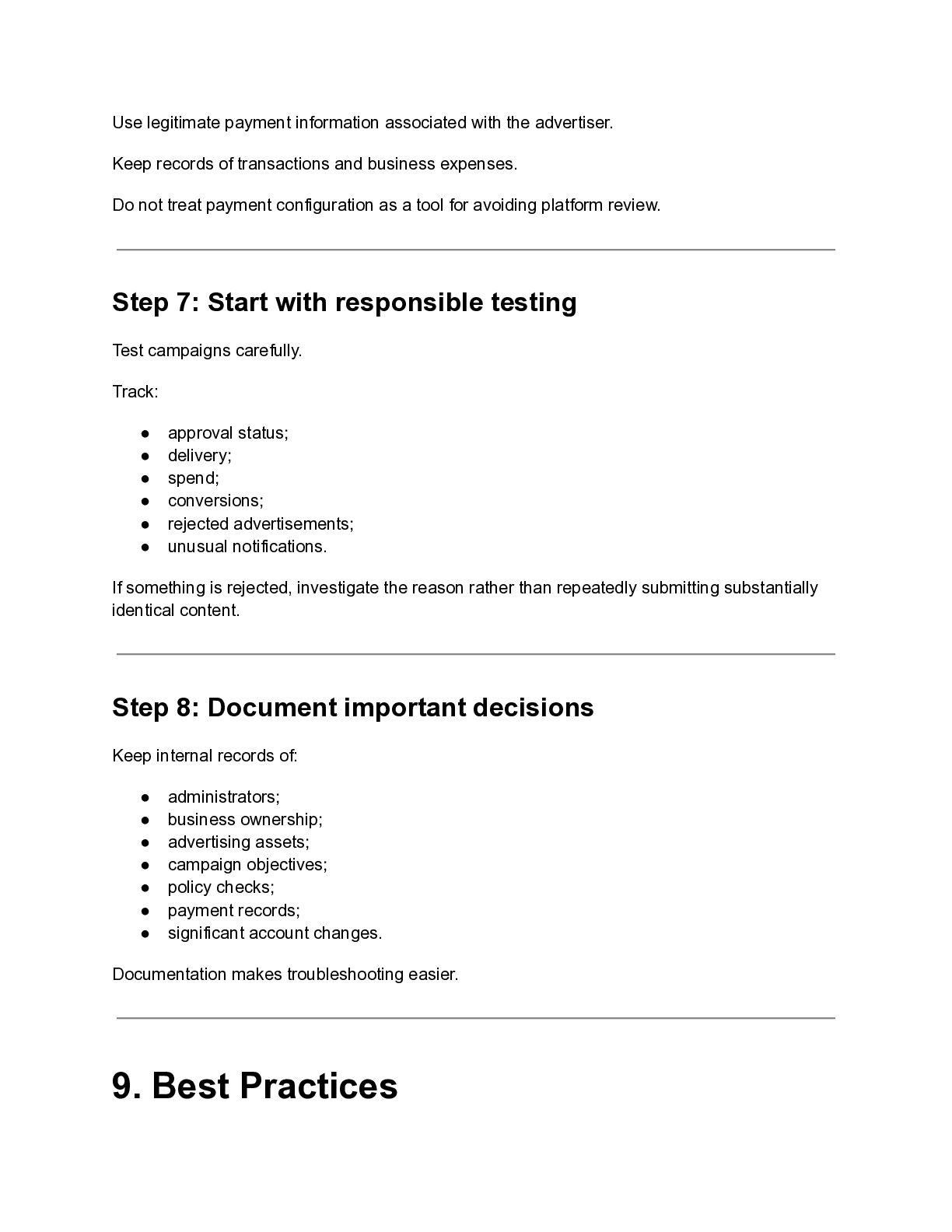
  10. Use legitimate payment information associated with the advertiser. Keep records

    of transactions and business expenses. Do not treat payment configuration as a tool for avoiding platform review. Step 7: Start with responsible testing Test campaigns carefully. Track: •​ •​ •​ •​ •​ •​ approval status; delivery; spend; conversions; rejected advertisements; unusual notifications. If something is rejected, investigate the reason rather than repeatedly submitting substantially identical content. Step 8: Document important decisions Keep internal records of: •​ •​ •​ •​ •​ •​ •​ administrators; business ownership; advertising assets; campaign objectives; policy checks; payment records; significant account changes. Documentation makes troubleshooting easier. 9. Best Practices
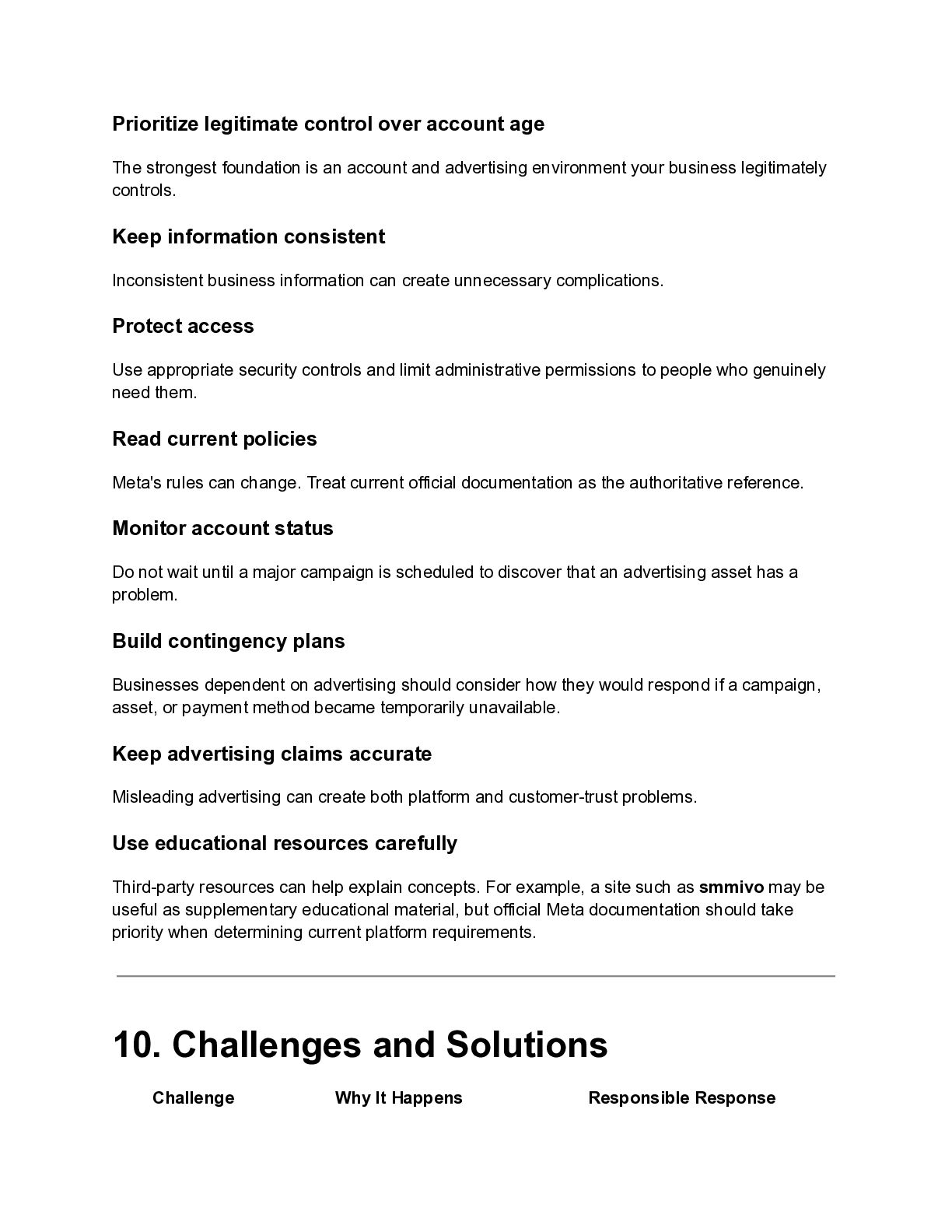
  11. Prioritize legitimate control over account age The strongest foundation is

    an account and advertising environment your business legitimately controls. Keep information consistent Inconsistent business information can create unnecessary complications. Protect access Use appropriate security controls and limit administrative permissions to people who genuinely need them. Read current policies Meta's rules can change. Treat current official documentation as the authoritative reference. Monitor account status Do not wait until a major campaign is scheduled to discover that an advertising asset has a problem. Build contingency plans Businesses dependent on advertising should consider how they would respond if a campaign, asset, or payment method became temporarily unavailable. Keep advertising claims accurate Misleading advertising can create both platform and customer-trust problems. Use educational resources carefully Third-party resources can help explain concepts. For example, a site such as smmivo may be useful as supplementary educational material, but official Meta documentation should take priority when determining current platform requirements. 10. Challenges and Solutions Challenge Why It Happens Responsible Response
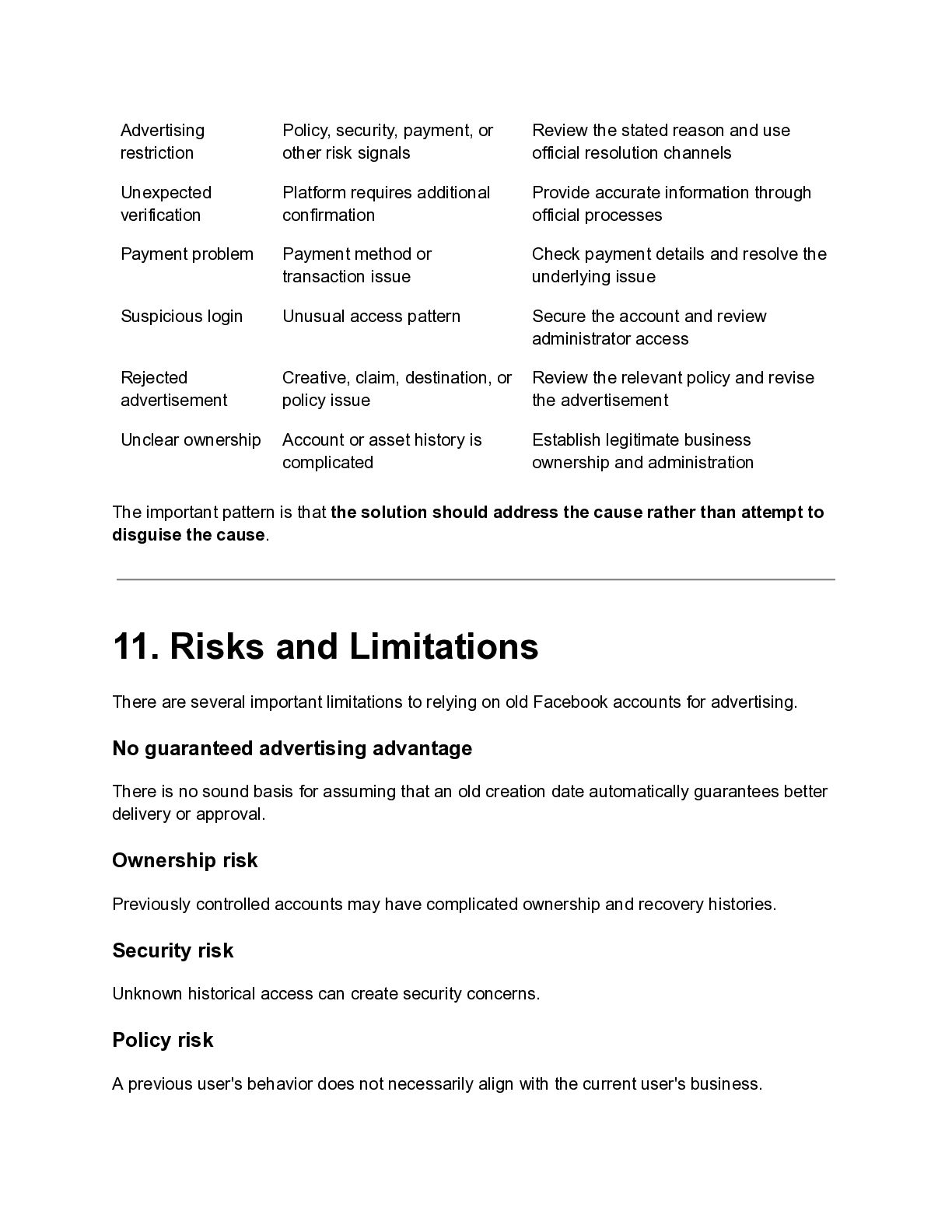
  12. Advertising restriction Policy, security, payment, or other risk signals Review

    the stated reason and use official resolution channels Unexpected verification Platform requires additional confirmation Provide accurate information through official processes Payment problem Payment method or transaction issue Check payment details and resolve the underlying issue Suspicious login Unusual access pattern Secure the account and review administrator access Rejected advertisement Creative, claim, destination, or policy issue Review the relevant policy and revise the advertisement Unclear ownership Account or asset history is complicated Establish legitimate business ownership and administration The important pattern is that the solution should address the cause rather than attempt to disguise the cause. 11. Risks and Limitations There are several important limitations to relying on old Facebook accounts for advertising. No guaranteed advertising advantage There is no sound basis for assuming that an old creation date automatically guarantees better delivery or approval. Ownership risk Previously controlled accounts may have complicated ownership and recovery histories. Security risk Unknown historical access can create security concerns. Policy risk A previous user's behavior does not necessarily align with the current user's business.
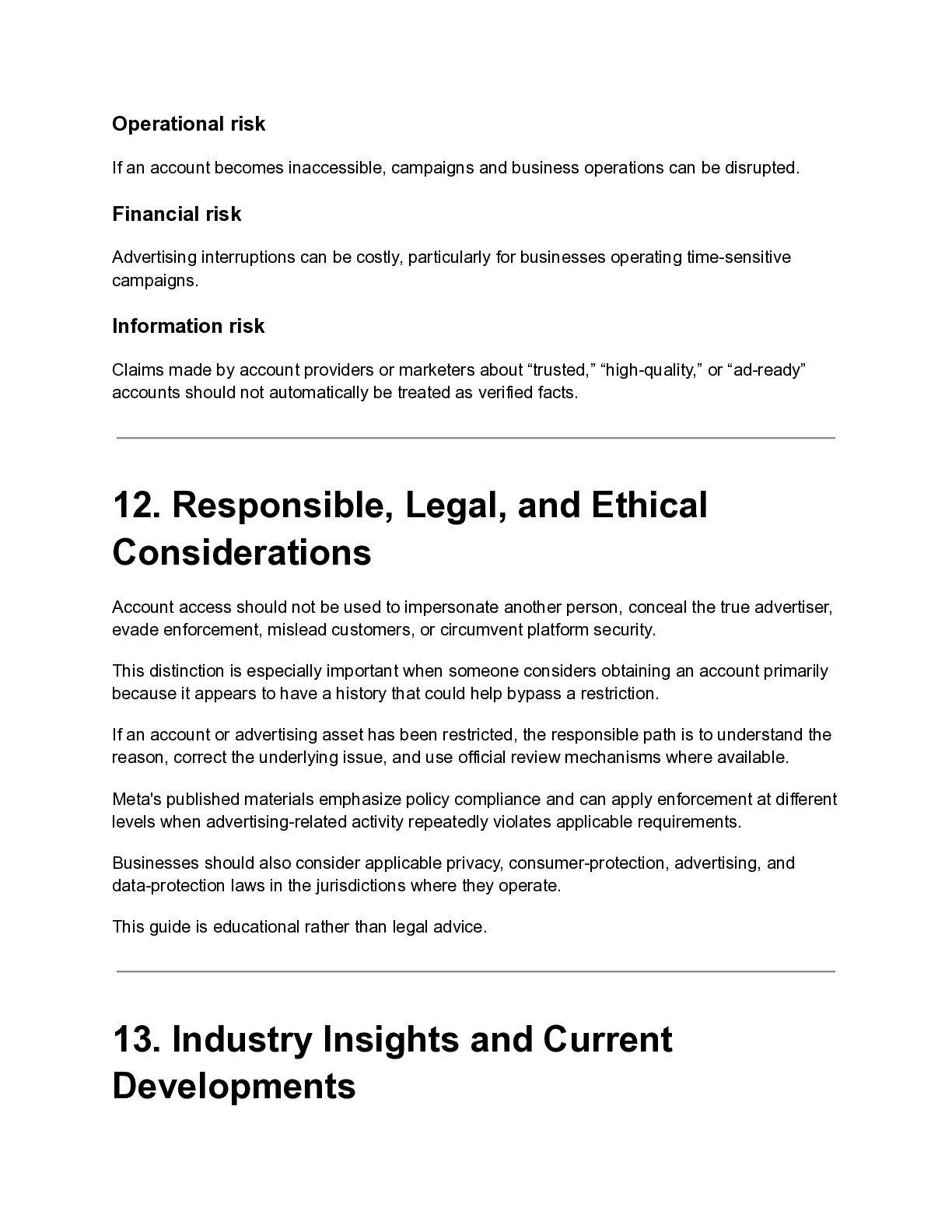
  13. Operational risk If an account becomes inaccessible, campaigns and business

    operations can be disrupted. Financial risk Advertising interruptions can be costly, particularly for businesses operating time-sensitive campaigns. Information risk Claims made by account providers or marketers about “trusted,” “high-quality,” or “ad-ready” accounts should not automatically be treated as verified facts. 12. Responsible, Legal, and Ethical Considerations Account access should not be used to impersonate another person, conceal the true advertiser, evade enforcement, mislead customers, or circumvent platform security. This distinction is especially important when someone considers obtaining an account primarily because it appears to have a history that could help bypass a restriction. If an account or advertising asset has been restricted, the responsible path is to understand the reason, correct the underlying issue, and use official review mechanisms where available. Meta's published materials emphasize policy compliance and can apply enforcement at different levels when advertising-related activity repeatedly violates applicable requirements. Businesses should also consider applicable privacy, consumer-protection, advertising, and data-protection laws in the jurisdictions where they operate. This guide is educational rather than legal advice. 13. Industry Insights and Current Developments
  14. Advertising platforms increasingly rely on multiple automated and human review

    mechanisms rather than a single simplistic measure of account age. Meta's current public advertising resources demonstrate an emphasis on advertising quality, policy compliance, and responsible ecosystem behavior. Its advertising infrastructure also provides tools such as the Meta Ad Library, which allows researchers and advertisers to examine advertisements and associated information in supported regions and categories. This has an important implication for advertisers in 2026: Historical age should be treated as context, not as a shortcut. The advertising environment is also becoming more interconnected. Business identity, payment systems, advertising assets, content quality, security, and user experience can all influence operational reliability. Future changes are likely to continue emphasizing authenticity, transparency, security, and automated detection. The exact mechanisms may change, so advertisers should verify current requirements rather than depending on old account-management advice. 14. Frequently Asked Questions 1. Does an old Facebook account automatically perform better for ads? No. Account age alone does not guarantee advertising eligibility, lower costs, higher delivery, or reduced enforcement risk. 2. Is account age completely irrelevant? Not necessarily. It is a historical characteristic, but it should not be treated as a guarantee of trust or advertising performance. 3. Why do advertisers sometimes prefer older accounts? Some advertisers believe historical activity creates greater trust. However, this assumption should not replace proper business setup, security, policy compliance, and legitimate account control. 4. Can a previously used account create security problems? Yes. Unknown recovery information, previous administrators, or historical access can create security and ownership complications.
  15. 5. What should I do if my advertising account is

    restricted? First identify the stated reason. Review the relevant policy or account notification, correct legitimate problems, secure the account, and use Meta's official review processes when available. 6. Can changing IP addresses solve an advertising restriction? Changing technical access conditions should not be treated as a legitimate solution for a platform restriction. The underlying reason for the restriction should be addressed instead. 7. Does previous advertising activity guarantee future approval? No. Platform rules and account circumstances can change. 8. What matters more than account age? Legitimate ownership, accurate information, security, appropriate payment arrangements, compliant advertising, and a suitable business structure are more meaningful foundations. 9. Should businesses depend on one advertising account? Businesses should consider operational continuity and maintain appropriate contingency planning rather than assuming any single advertising asset will always remain available. 10. Where should I verify current Meta advertising requirements? Start with Meta's official Business and advertising documentation. Third-party guides can provide explanations, but official policies should be treated as the authoritative source for current platform requirements. 15. Conclusion The biggest mistake surrounding the idea of an old Facebook account for advertising is confusing age with trust. An account may have existed for many years without being appropriate for a particular business, advertising strategy, or current platform environment. Likewise, a newer legitimate business setup is not automatically inferior simply because it lacks a long history.
  16. Advertising reliability is better understood as a combination of legitimate

    ownership, secure administration, accurate business information, appropriate payment arrangements, policy-compliant advertising, suitable landing pages, and responsible account management. The practical lesson is therefore straightforward: do not make account age the foundation of an advertising strategy. If you are evaluating an existing advertising setup, ask whether you legitimately control it, whether its history is understandable, whether its recovery information is secure, whether its associated business information is accurate, and whether the advertising activity complies with current requirements. If an account is restricted, attempting to circumvent the restriction can create additional problems. A more sustainable approach is to identify the cause, correct legitimate issues, and use official review mechanisms. For businesses investing real money into advertising, this approach may require more preparation than simply focusing on an account's creation date. However, the objective should not be to find the oldest possible account. The objective should be to build an advertising environment that is secure, transparent, compliant, and operationally sustainable.