Upgrade to Pro — share decks privately, control downloads, hide ads and more …

New Site Indexing Protocol: Launch Checklist fo...

New Site Indexing Protocol: Launch Checklist for a Fresh Domain

How does new site indexing actually work — and why do fresh domains sit unindexed for weeks while the homepage ranks alone?
This 6-page launch checklist turns the answer into a protocol: a pre-launch indexability audit, a small-and-dense launch cohort, sitemap-to-cohort matching, day-7/14/30 index baselines, and a triage that splits stalled URLs into demand problems versus acceptance problems. Includes a first-14-days log-watch plan and a launch-size decision matrix per page type. Built for site owners and SEO specialists getting a new website indexed by Google.
Method and tools: https://en.speedyindex.com/google-index-checker/

Avatar for Linda Bjorkvin

Linda Bjorkvin PRO

September 19, 2026

More Decks by Linda Bjorkvin

Other Decks in Marketing & SEO

Transcript

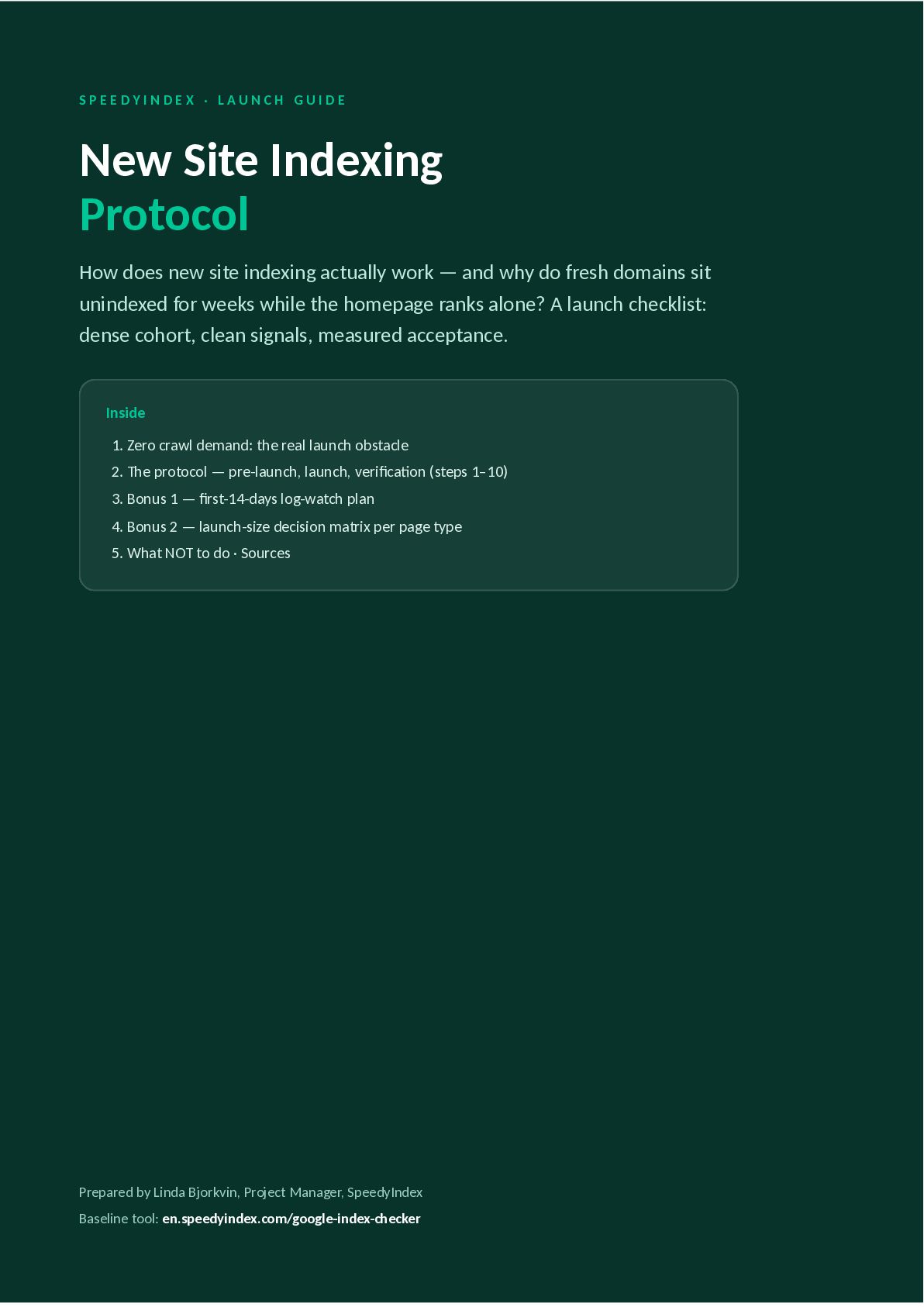
  1. SPEEDYINDEX · LAUNCH GUIDE New Site Indexing Protocol How does

    new site indexing actually work — and why do fresh domains sit unindexed for weeks while the homepage ranks alone? A launch checklist: dense cohort, clean signals, measured acceptance. Inside 1. Zero crawl demand: the real launch obstacle 2. The protocol — pre-launch, launch, verification (steps 1–10) 3. Bonus 1 — first-14-days log-watch plan 4. Bonus 2 — launch-size decision matrix per page type 5. What NOT to do · Sources Prepared by Linda Bjorkvin, Project Manager, SpeedyIndex Baseline tool: en.speedyindex.com/google-index-checker
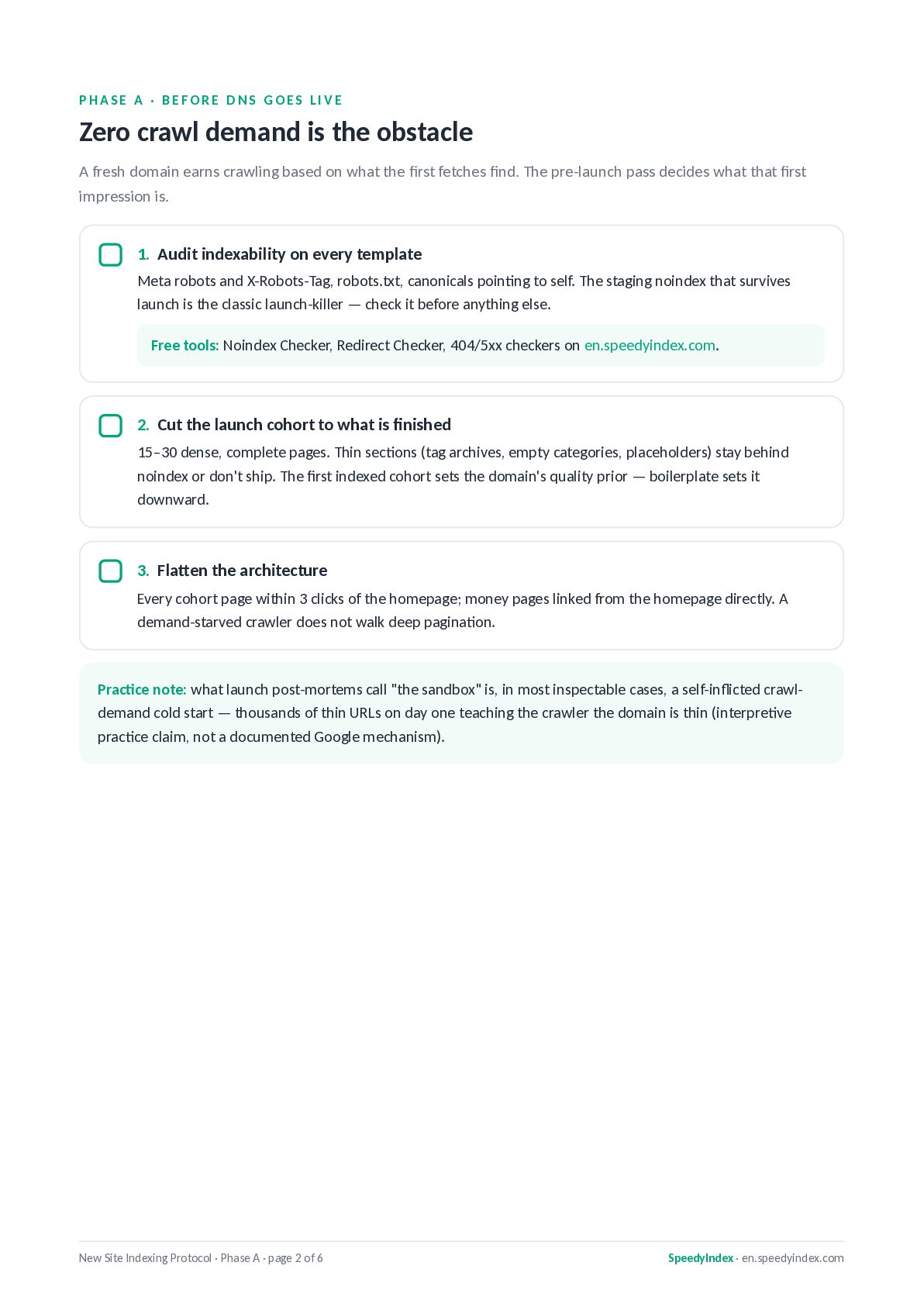
  2. PHASE A · BEFORE DNS GOES LIVE Zero crawl demand

    is the obstacle A fresh domain earns crawling based on what the first fetches find. The pre-launch pass decides what that first impression is. 1. Audit indexability on every template Meta robots and X-Robots-Tag, robots.txt, canonicals pointing to self. The staging noindex that survives launch is the classic launch-killer — check it before anything else. Free tools: Noindex Checker, Redirect Checker, 404/5xx checkers on en.speedyindex.com. 2. Cut the launch cohort to what is finished 15–30 dense, complete pages. Thin sections (tag archives, empty categories, placeholders) stay behind noindex or don't ship. The first indexed cohort sets the domain's quality prior — boilerplate sets it downward. 3. Flatten the architecture Every cohort page within 3 clicks of the homepage; money pages linked from the homepage directly. A demand-starved crawler does not walk deep pagination. Practice note: what launch post-mortems call "the sandbox" is, in most inspectable cases, a self-inflicted crawldemand cold start — thousands of thin URLs on day one teaching the crawler the domain is thin (interpretive practice claim, not a documented Google mechanism). New Site Indexing Protocol · Phase A · page 2 of 6 SpeedyIndex · en.speedyindex.com
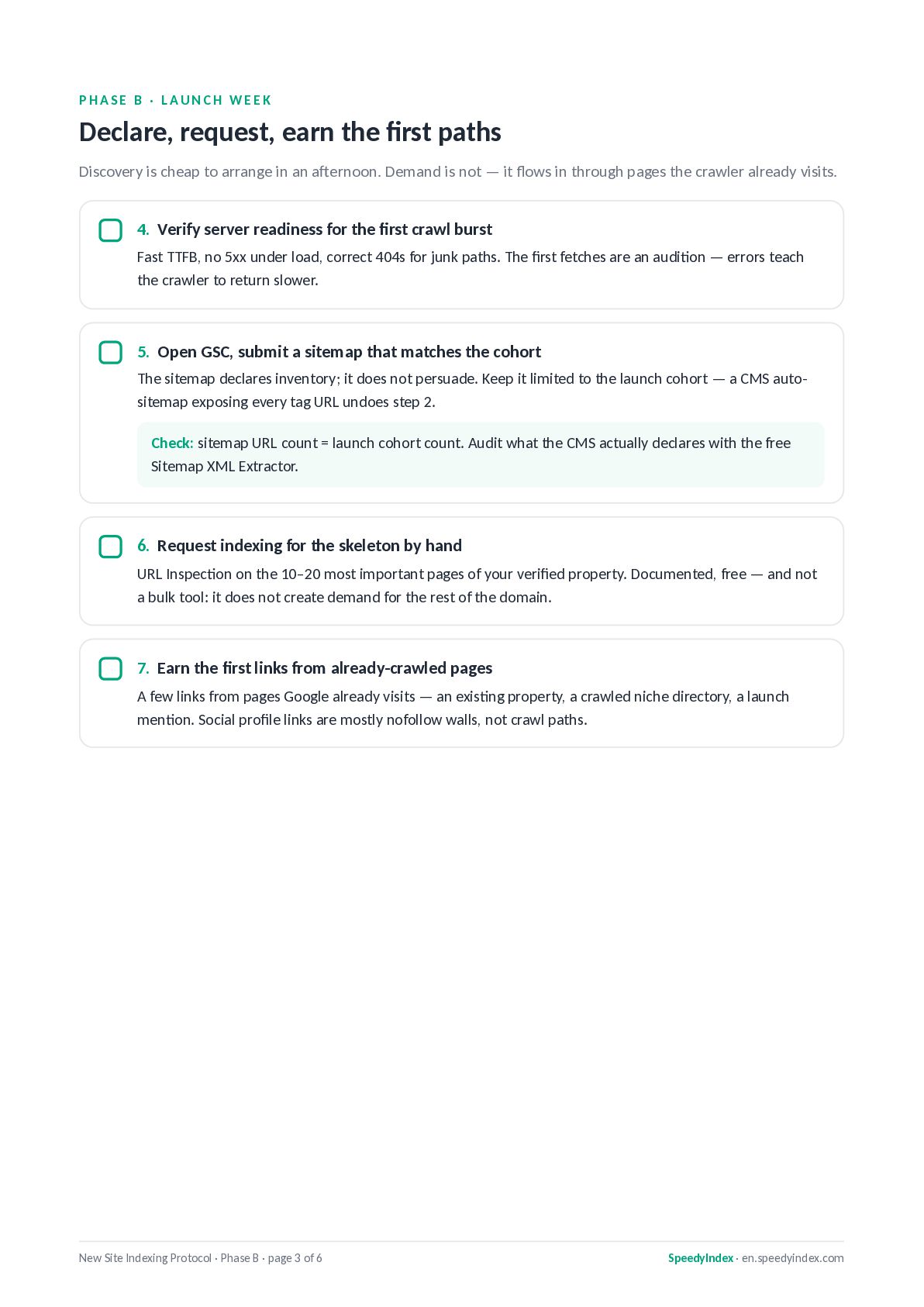
  3. PHASE B · LAUNCH WEEK Declare, request, earn the first

    paths Discovery is cheap to arrange in an afternoon. Demand is not — it flows in through pages the crawler already visits. 4. Verify server readiness for the first crawl burst Fast TTFB, no 5xx under load, correct 404s for junk paths. The first fetches are an audition — errors teach the crawler to return slower. 5. Open GSC, submit a sitemap that matches the cohort The sitemap declares inventory; it does not persuade. Keep it limited to the launch cohort — a CMS autositemap exposing every tag URL undoes step 2. Check: sitemap URL count = launch cohort count. Audit what the CMS actually declares with the free Sitemap XML Extractor. 6. Request indexing for the skeleton by hand URL Inspection on the 10–20 most important pages of your verified property. Documented, free — and not a bulk tool: it does not create demand for the rest of the domain. 7. Earn the first links from already-crawled pages A few links from pages Google already visits — an existing property, a crawled niche directory, a launch mention. Social profile links are mostly nofollow walls, not crawl paths. New Site Indexing Protocol · Phase B · page 3 of 6 SpeedyIndex · en.speedyindex.com
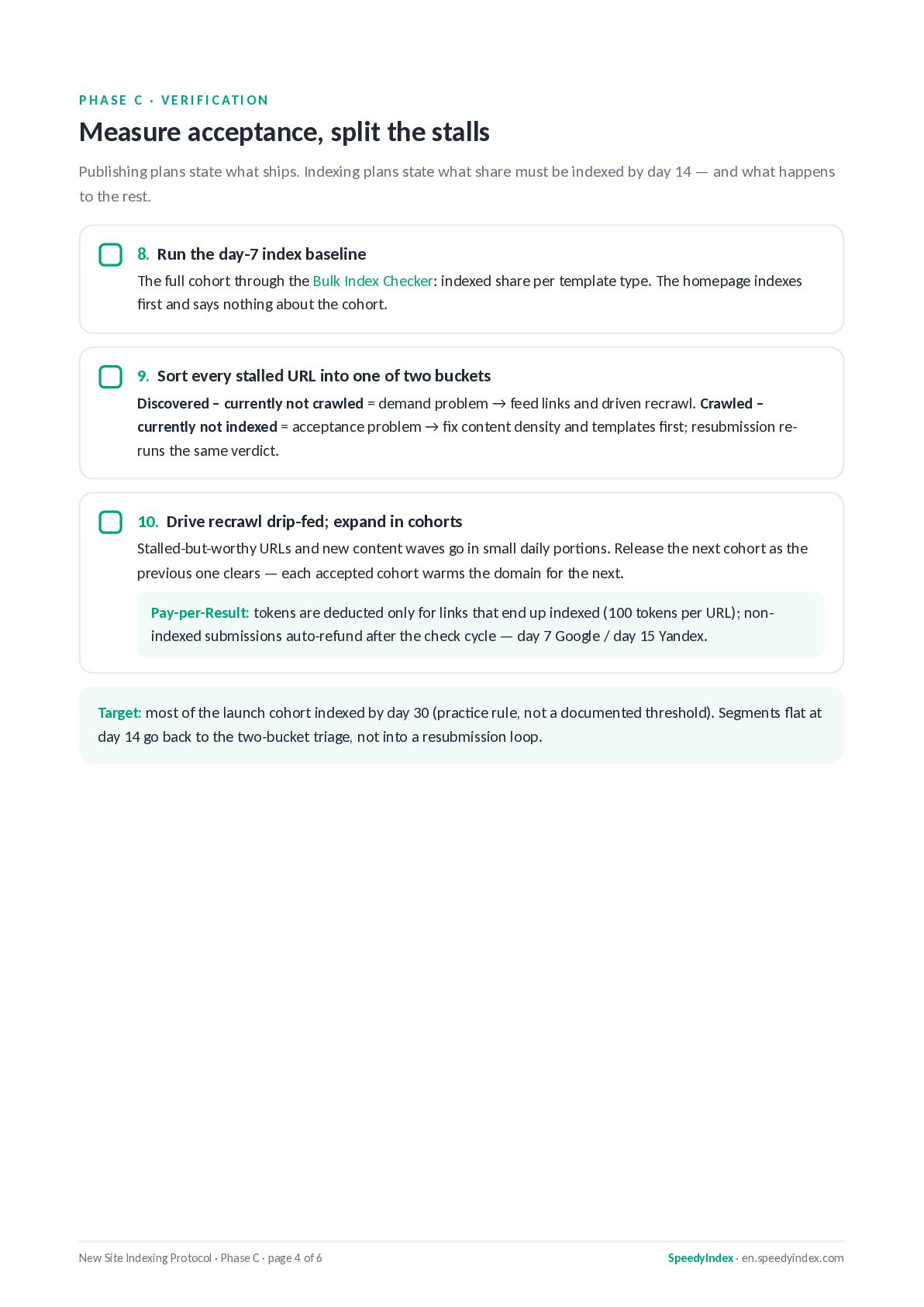
  4. P H A S E C · V E R

    I F I C AT I O N Measure acceptance, split the stalls Publishing plans state what ships. Indexing plans state what share must be indexed by day 14 — and what happens to the rest. 8. Run the day-7 index baseline The full cohort through the Bulk Index Checker: indexed share per template type. The homepage indexes first and says nothing about the cohort. 9. Sort every stalled URL into one of two buckets Discovered – currently not crawled = demand problem → feed links and driven recrawl. Crawled – currently not indexed = acceptance problem → fix content density and templates first; resubmission reruns the same verdict. 10. Drive recrawl drip-fed; expand in cohorts Stalled-but-worthy URLs and new content waves go in small daily portions. Release the next cohort as the previous one clears — each accepted cohort warms the domain for the next. Pay-per-Result: tokens are deducted only for links that end up indexed (100 tokens per URL); nonindexed submissions auto-refund after the check cycle — day 7 Google / day 15 Yandex. Target: most of the launch cohort indexed by day 30 (practice rule, not a documented threshold). Segments flat at day 14 go back to the two-bucket triage, not into a resubmission loop. New Site Indexing Protocol · Phase C · page 4 of 6 SpeedyIndex · en.speedyindex.com
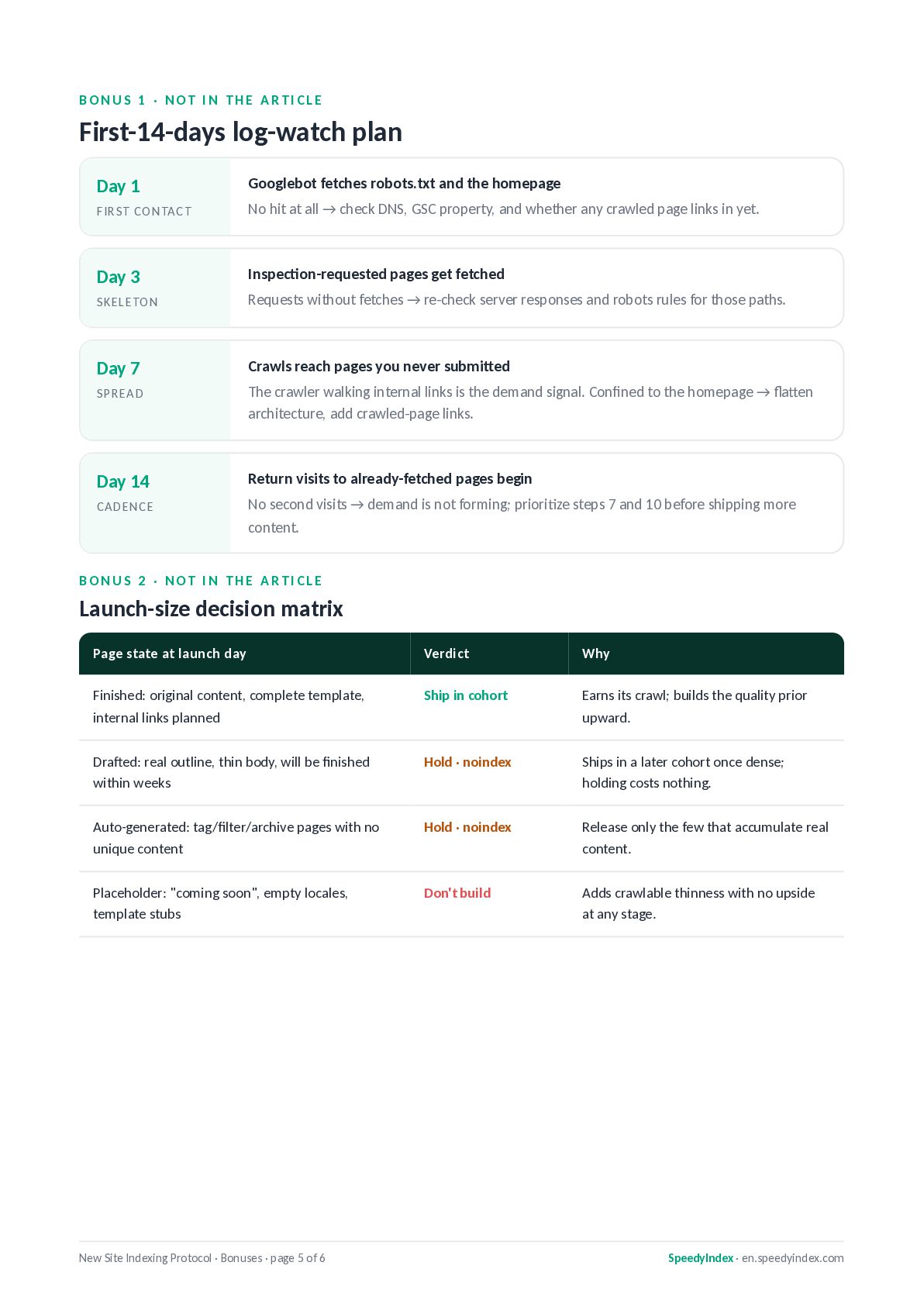
  5. BONUS 1 · NOT IN THE ARTICLE First-14-days log-watch plan

    Day 1 Googlebot fetches robots.txt and the homepage FIRST CONTACT No hit at all → check DNS, GSC property, and whether any crawled page links in yet. Day 3 Inspection-requested pages get fetched SKELETON Requests without fetches → re-check server responses and robots rules for those paths. Day 7 Crawls reach pages you never submitted SPREAD The crawler walking internal links is the demand signal. Confined to the homepage → flatten architecture, add crawled-page links. Day 14 Return visits to already-fetched pages begin CADENCE No second visits → demand is not forming; prioritize steps 7 and 10 before shipping more content. BONUS 2 · NOT IN THE ARTICLE Launch-size decision matrix Page state at launch day Verdict Why Finished: original content, complete template, Ship in cohort Earns its crawl; builds the quality prior internal links planned upward. Drafted: real outline, thin body, will be finished within weeks Hold · noindex Ships in a later cohort once dense; holding costs nothing. Auto-generated: tag/filter/archive pages with no Hold · noindex Release only the few that accumulate real unique content Placeholder: "coming soon", empty locales, template stubs New Site Indexing Protocol · Bonuses · page 5 of 6 content. Don't build Adds crawlable thinness with no upside at any stage. SpeedyIndex · en.speedyindex.com
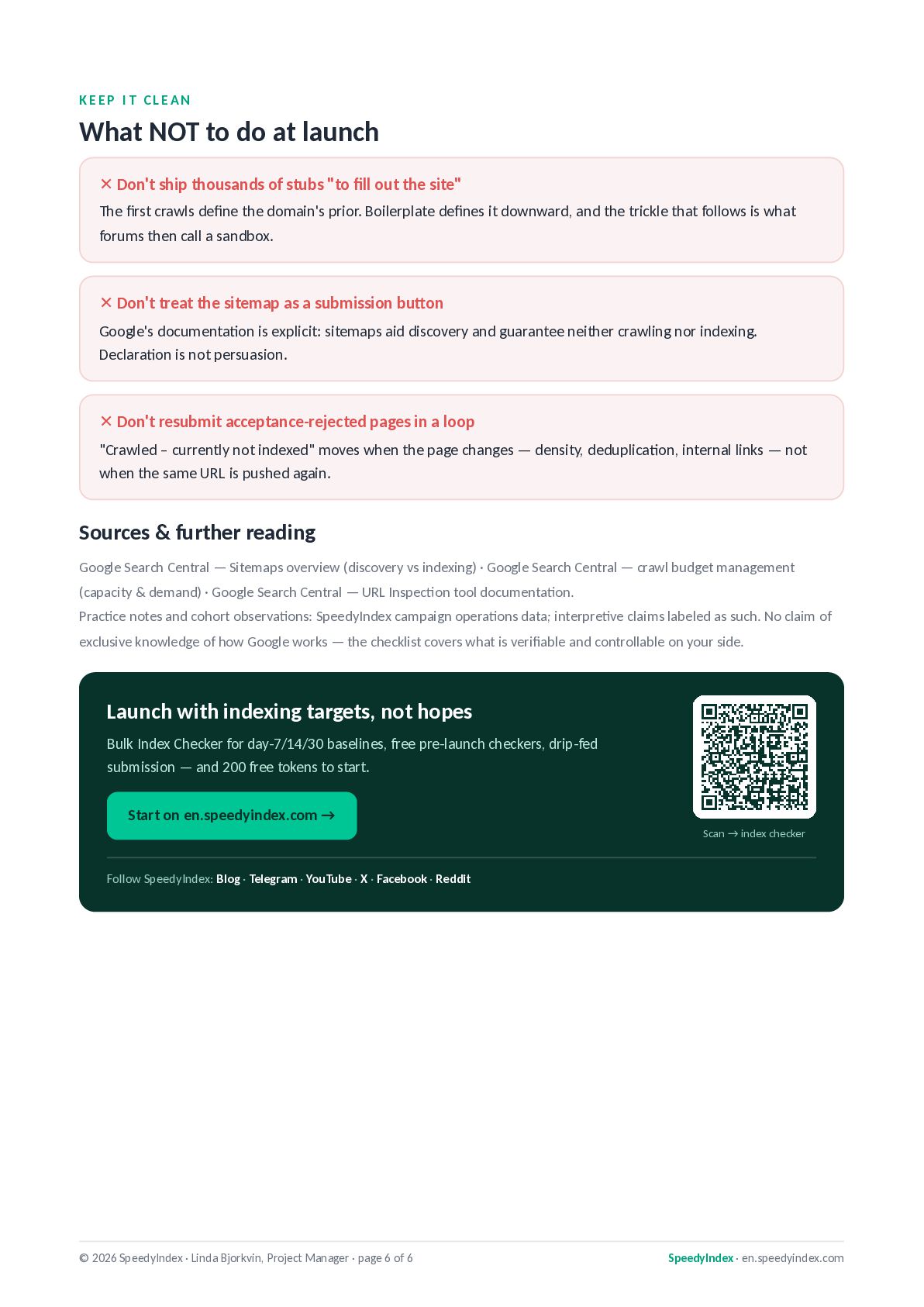
  6. KEEP IT CLEAN What NOT to do at launch ✕

    Don't ship thousands of stubs "to fill out the site" The first crawls define the domain's prior. Boilerplate defines it downward, and the trickle that follows is what forums then call a sandbox. ✕ Don't treat the sitemap as a submission button Google's documentation is explicit: sitemaps aid discovery and guarantee neither crawling nor indexing. Declaration is not persuasion. ✕ Don't resubmit acceptance-rejected pages in a loop "Crawled – currently not indexed" moves when the page changes — density, deduplication, internal links — not when the same URL is pushed again. Sources & further reading Google Search Central — Sitemaps overview (discovery vs indexing) · Google Search Central — crawl budget management (capacity & demand) · Google Search Central — URL Inspection tool documentation. Practice notes and cohort observations: SpeedyIndex campaign operations data; interpretive claims labeled as such. No claim of exclusive knowledge of how Google works — the checklist covers what is verifiable and controllable on your side. Launch with indexing targets, not hopes Bulk Index Checker for day-7/14/30 baselines, free pre-launch checkers, drip-fed submission — and 200 free tokens to start. Start on en.speedyindex.com → Scan → index checker Follow SpeedyIndex: Blog · Telegram · YouTube · X · Facebook · Reddit © 2026 SpeedyIndex · Linda Bjorkvin, Project Manager · page 6 of 6 SpeedyIndex · en.speedyindex.com