Upgrade to Pro — share decks privately, control downloads, hide ads and more …

The Search Signal Framework: Diagnosing and Enh...

Sponsored · SiteGround - Reliable hosting with speed, security, and support you can count on. →

The Search Signal Framework: Diagnosing and Enhancing AI and Google Visibility

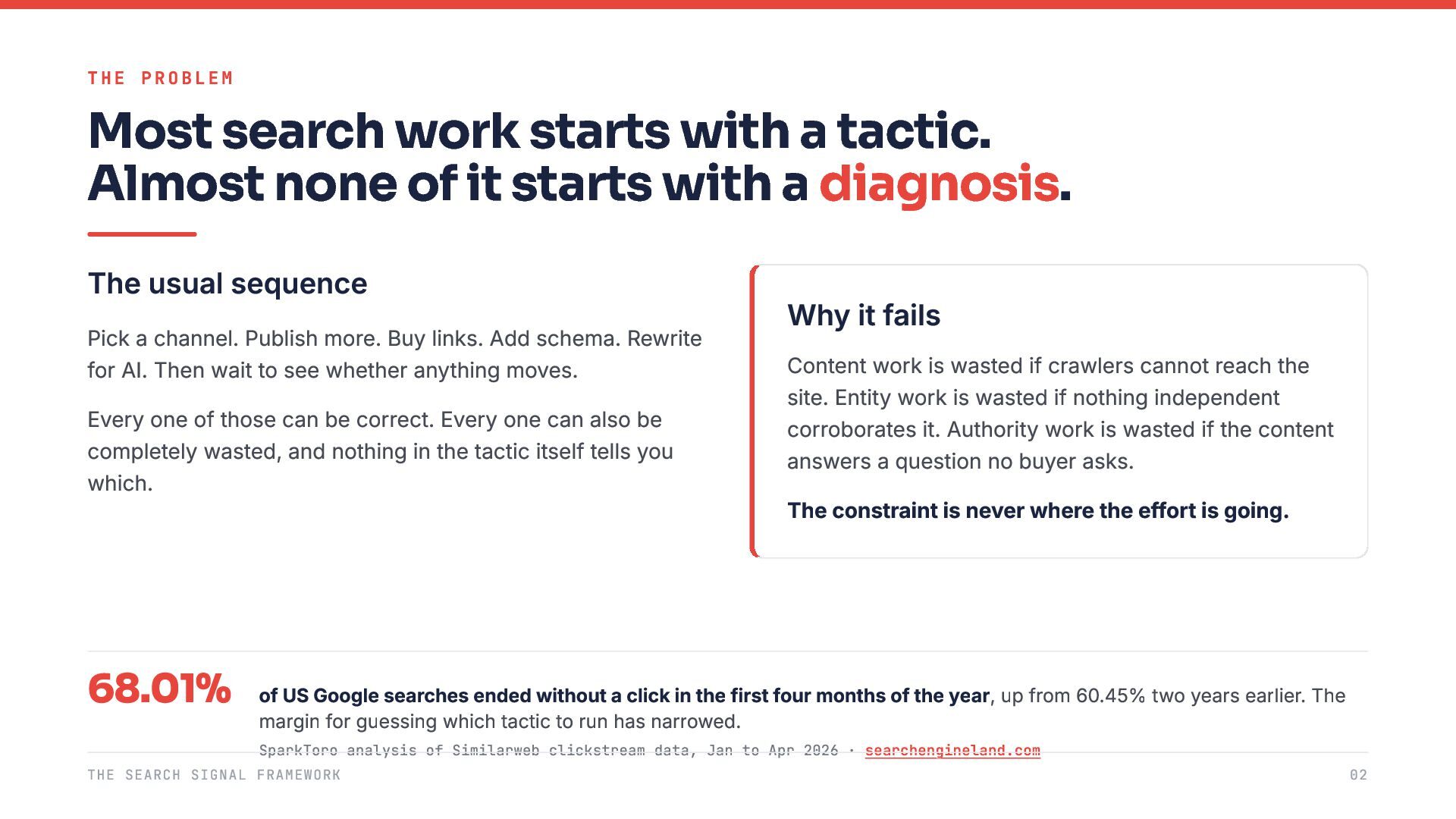
Most search work starts with a tactic. Almost none of it starts with a diagnosis.

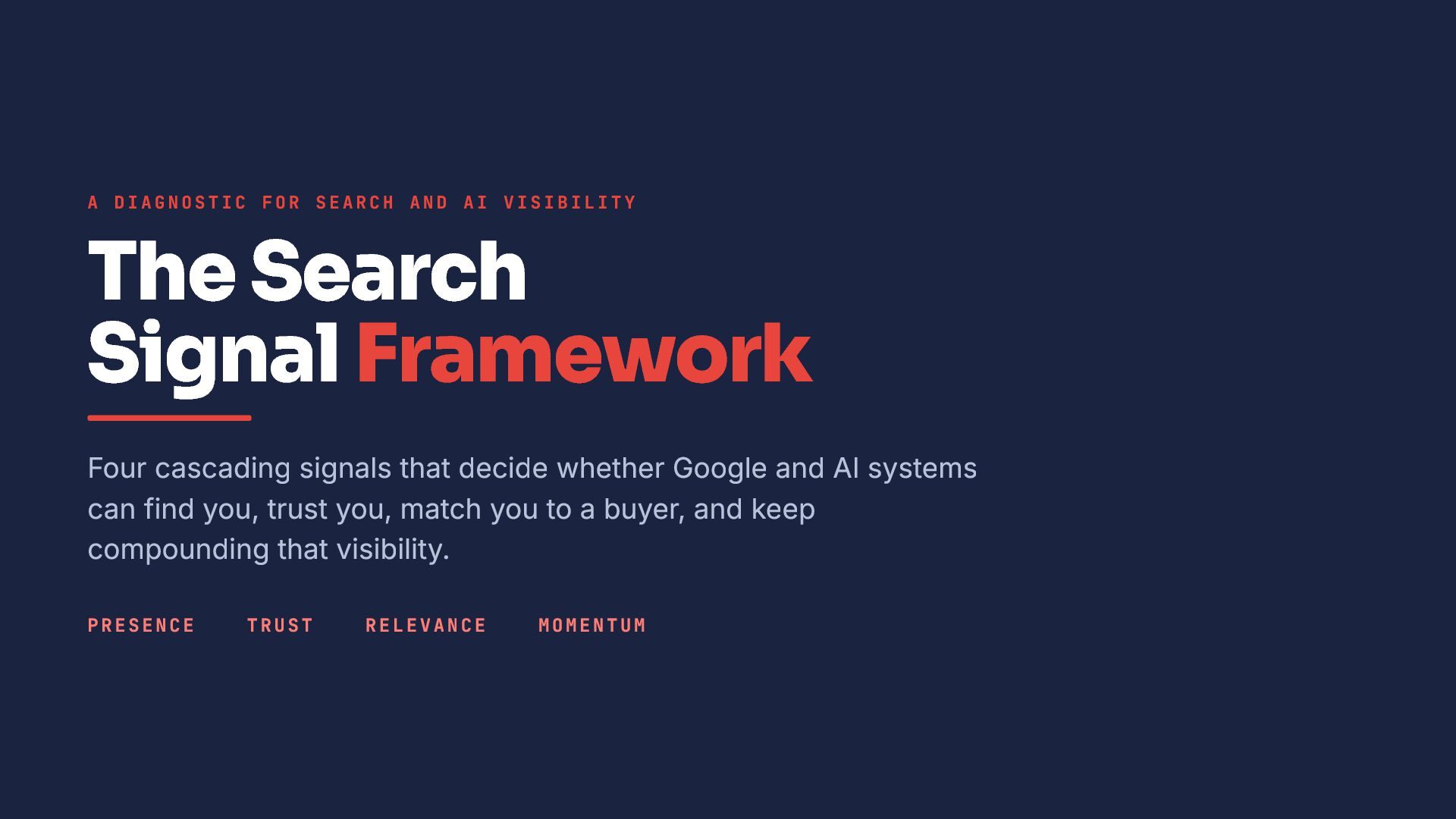
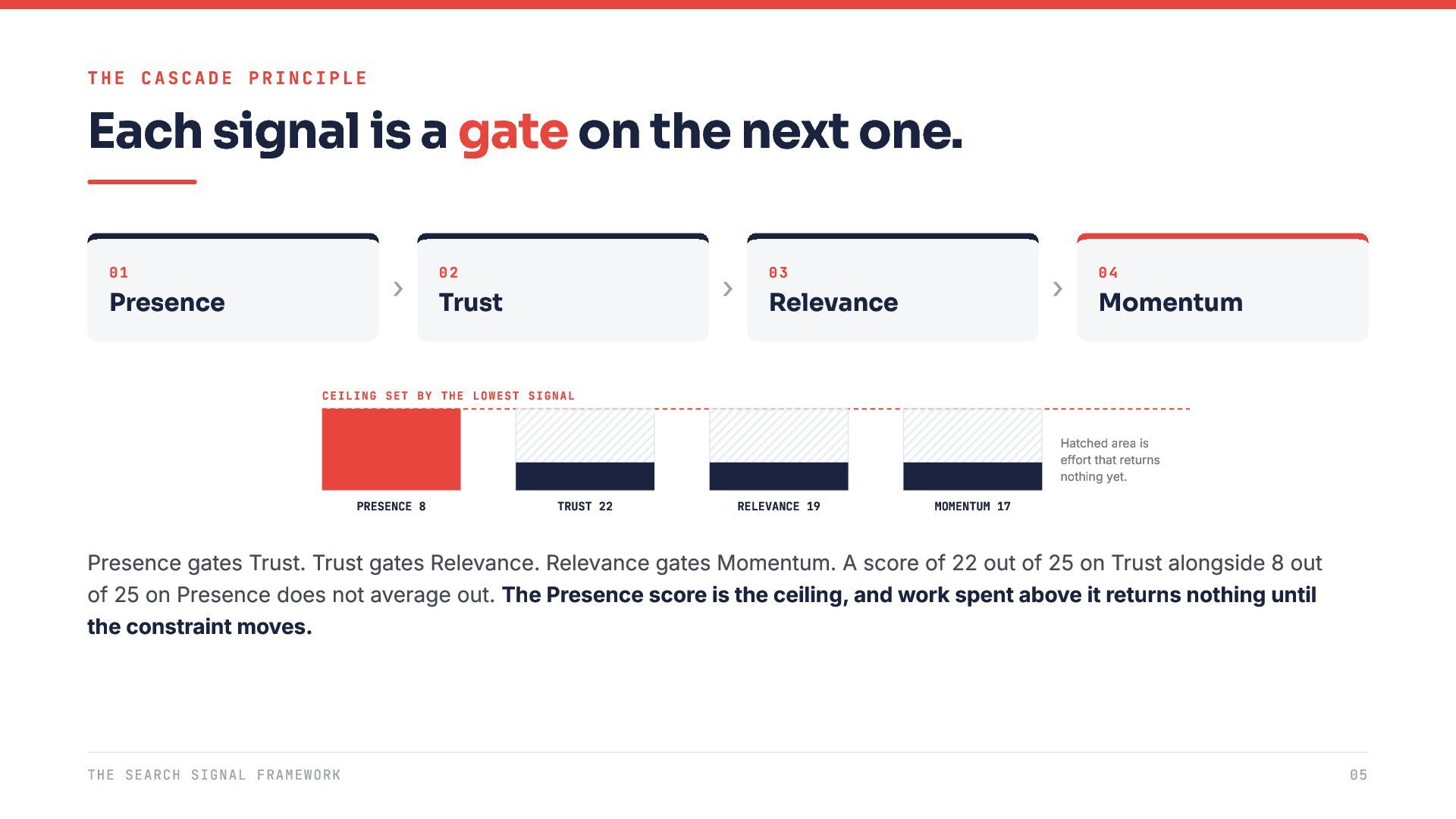
The Search Signal Framework organises Google and AI visibility into four cascading signals: Presence, Trust, Relevance and Momentum. Each one gates the next, so your lowest signal is your ceiling, and work spent above it returns nothing until the constraint moves. That single rule is what turns "should we do SEO or AI search" into a question with one answer.

Inside: the diagnostic tells for each signal, a 228-signal scoring model, four evidence slides with sourced data, and original research showing which platforms the major AI crawlers are actually allowed to read.

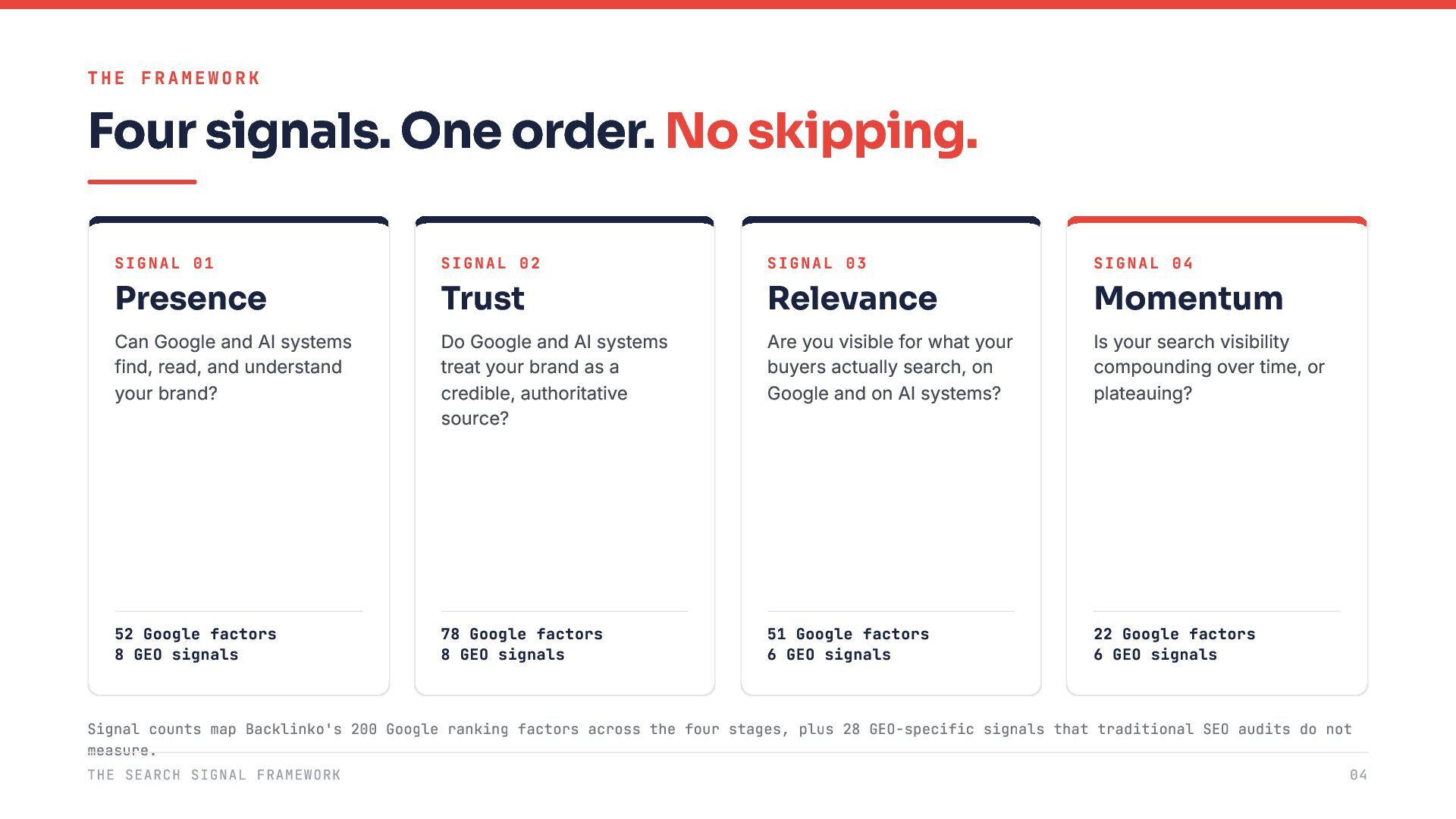
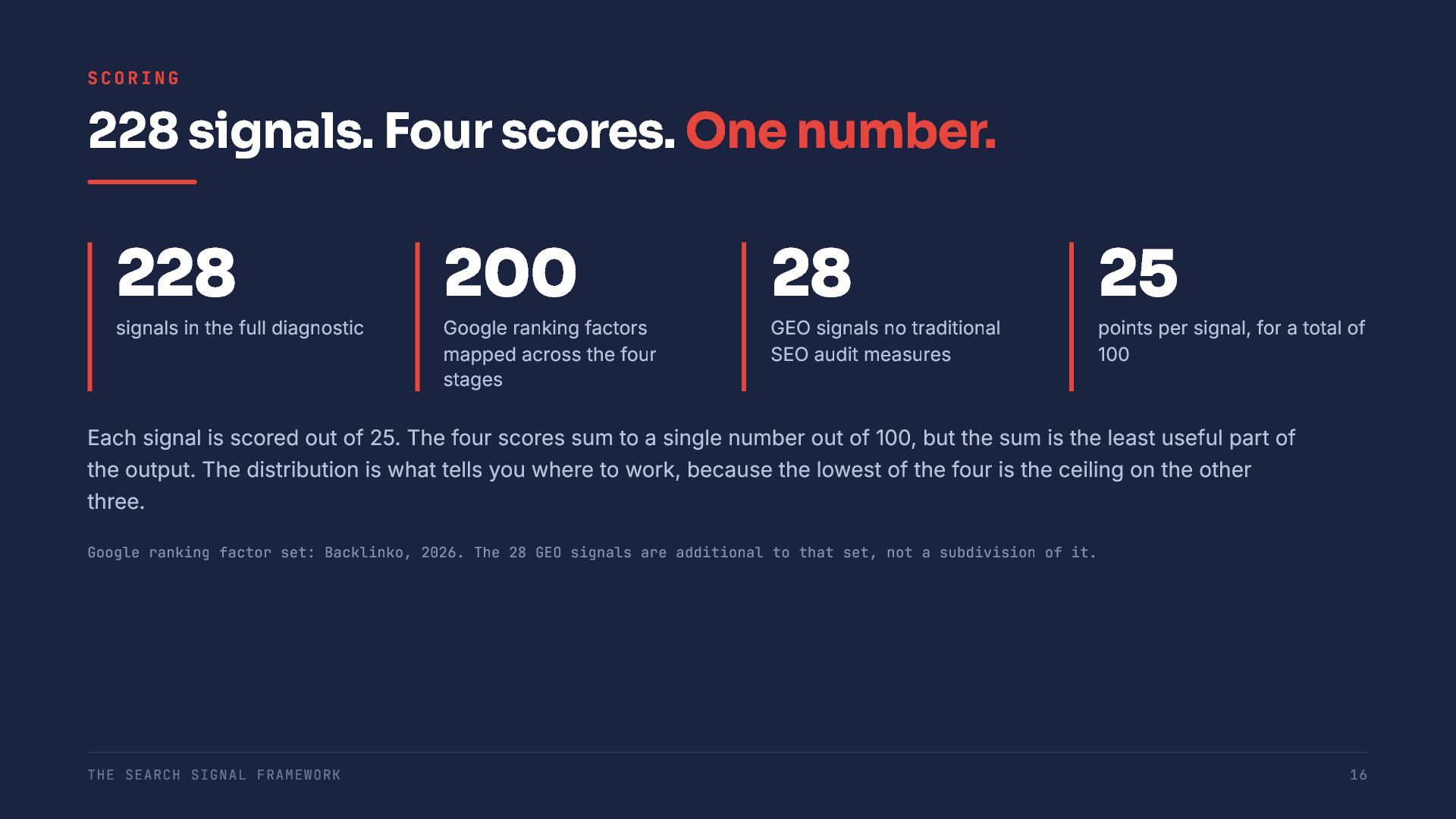
The framework maps 200 Google ranking factors across the four stages and adds 28 GEO-specific signals that traditional SEO audits do not measure, for a total of 228 signals.

WHY DIAGNOSIS BEATS TACTICS RIGHT NOW

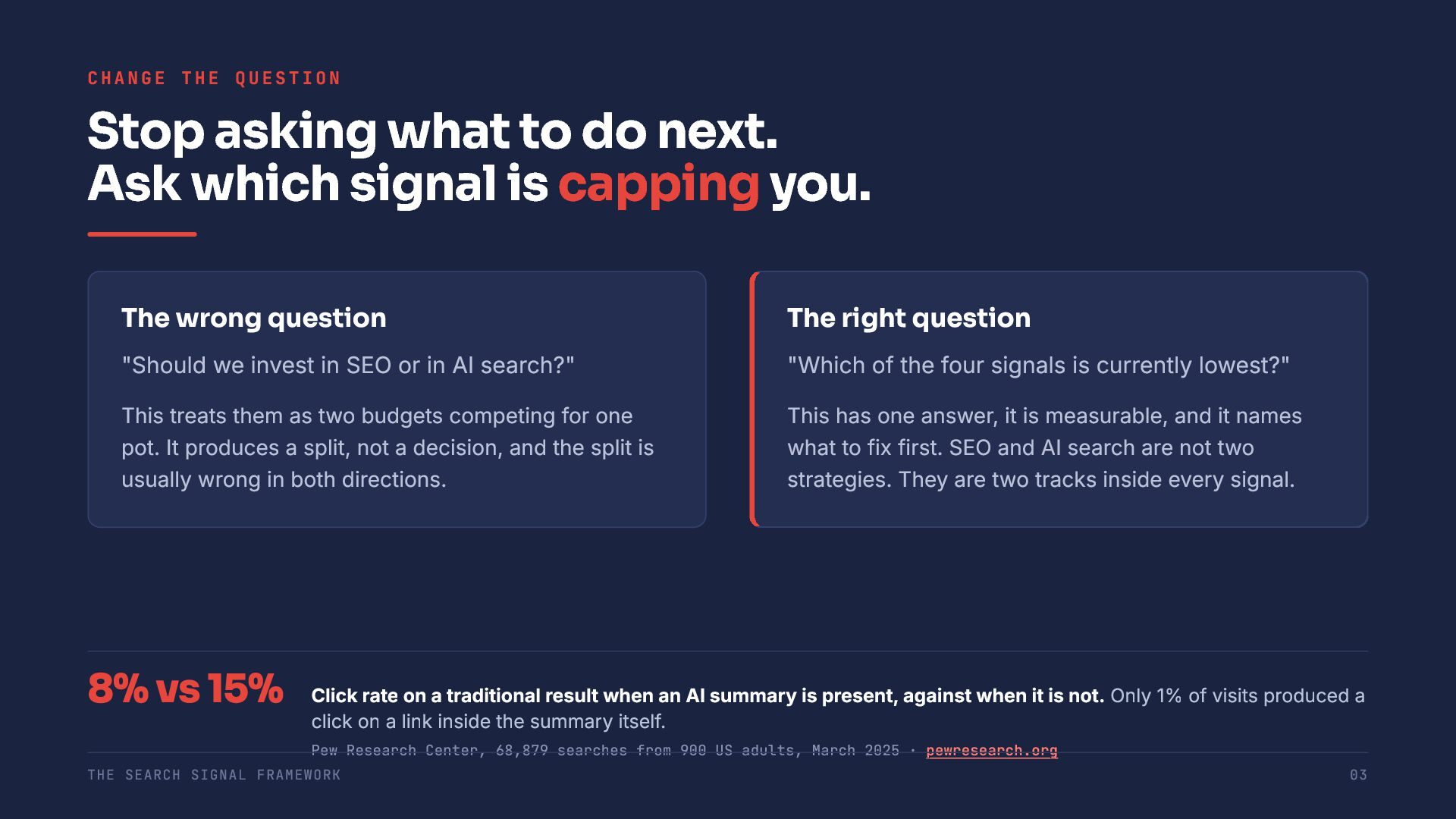
68.01% of US Google searches ended without a click in the first four months of 2026, up from 60.45% two years earlier (SparkToro on Similarweb clickstream data). When an AI summary is present, users click a traditional result on 8% of visits against 15% when it is absent, and click a link inside the summary on just 1% (Pew Research Center, 68,879 searches, March 2025). The margin for guessing which tactic to run has narrowed.

THE FOUR SIGNALS

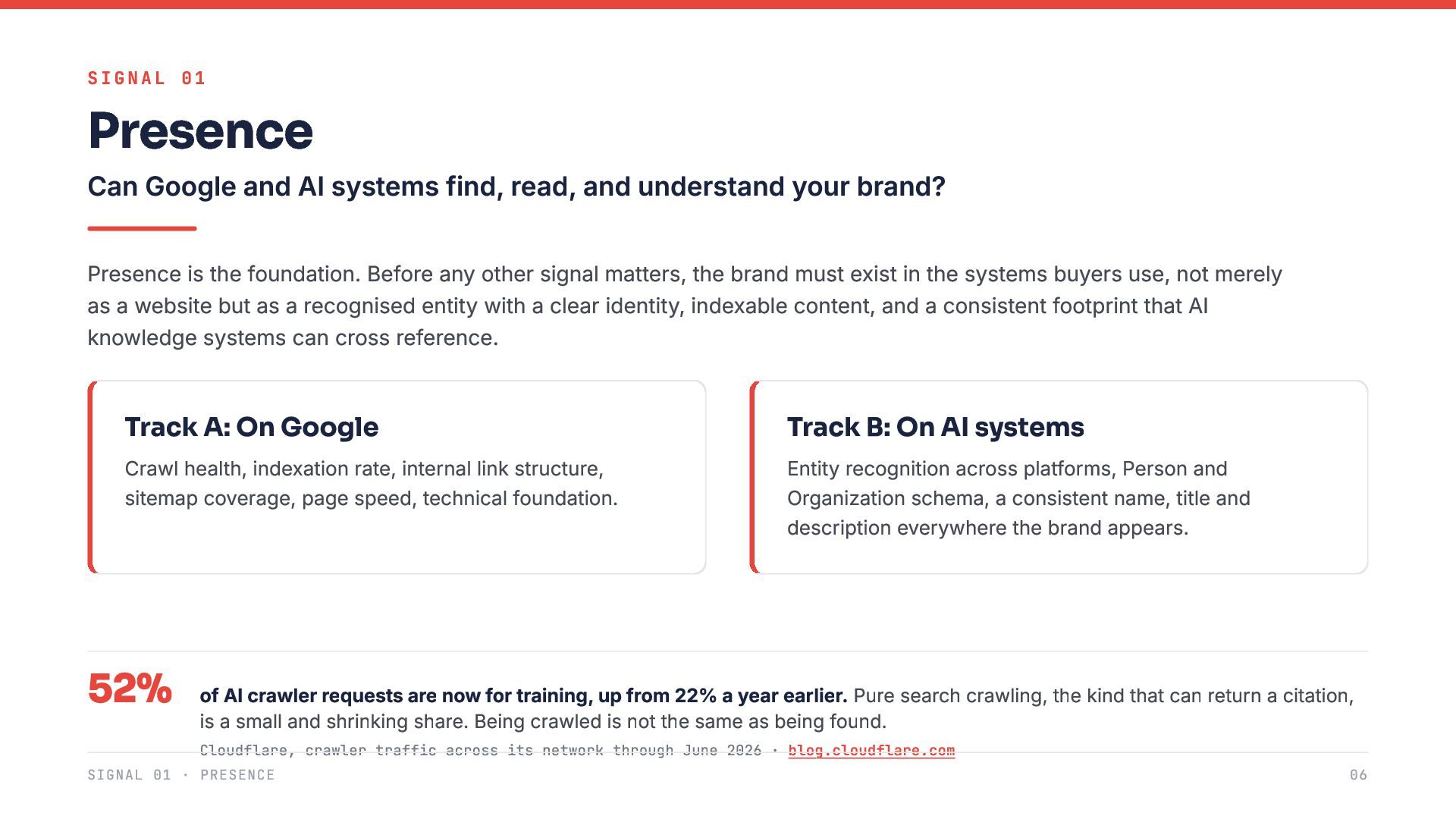
Presence (Signal 1). Can Google and AI systems find, read and understand your brand? Two tracks: crawl health, indexation, internal links, sitemap coverage and technical foundation on Google; entity recognition, Person and Organization schema, and a consistent footprint across platforms on AI systems. Roughly 52 Google factors plus 8 GEO signals.

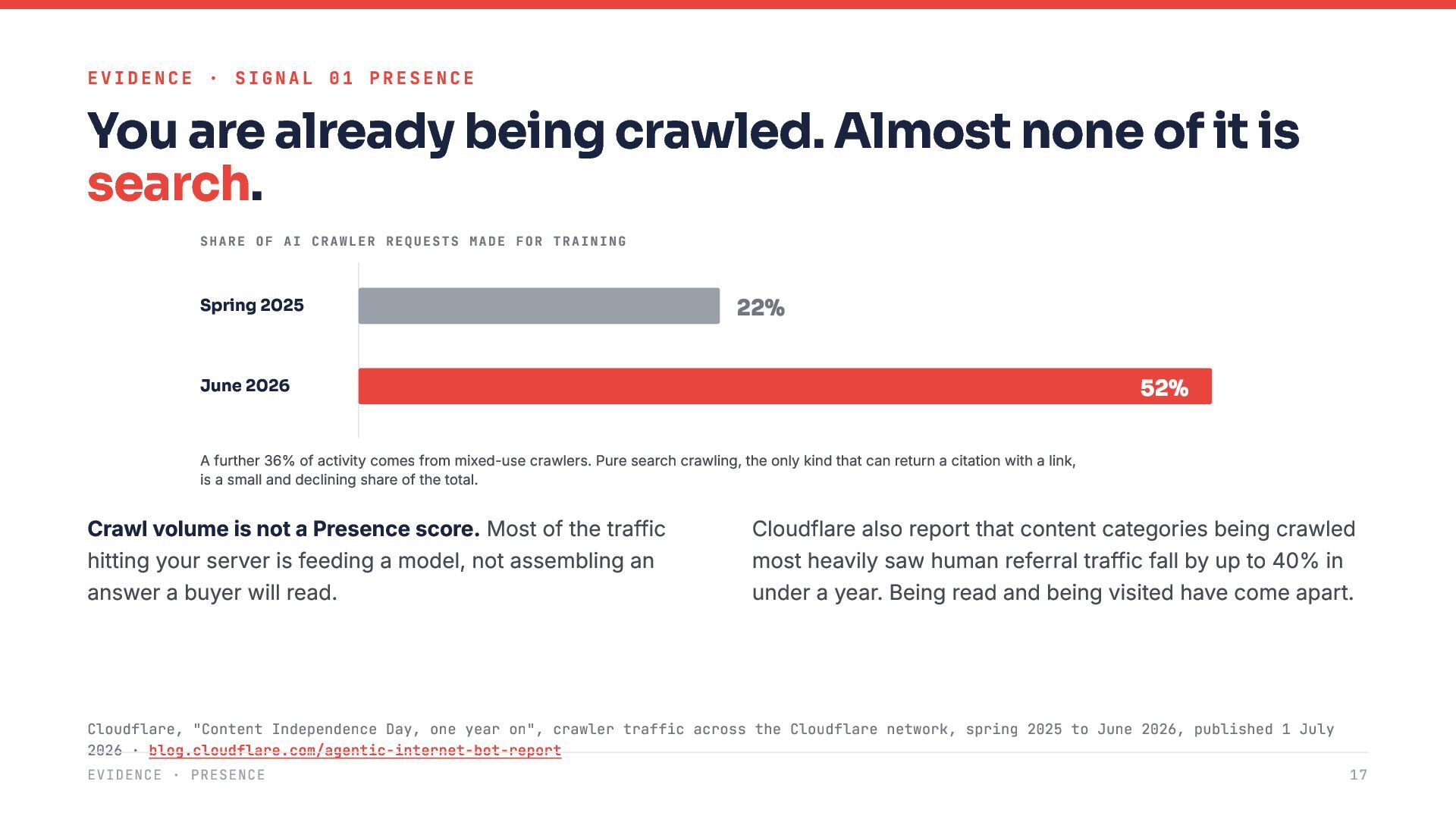
Evidence: 52% of AI crawler requests are now made for training, up from 22% in spring 2025. A further 36% of activity comes from mixed-use crawlers. Pure search crawling, the only kind that can return a citation with a link, is a small and declining share of the total. Cloudflare also report that the content categories crawled most heavily saw human referral traffic fall by up to 40% in under a year. Crawl volume is not a Presence score, and being read and being visited have come apart (Cloudflare, network data through June 2026, published 1 July 2026).

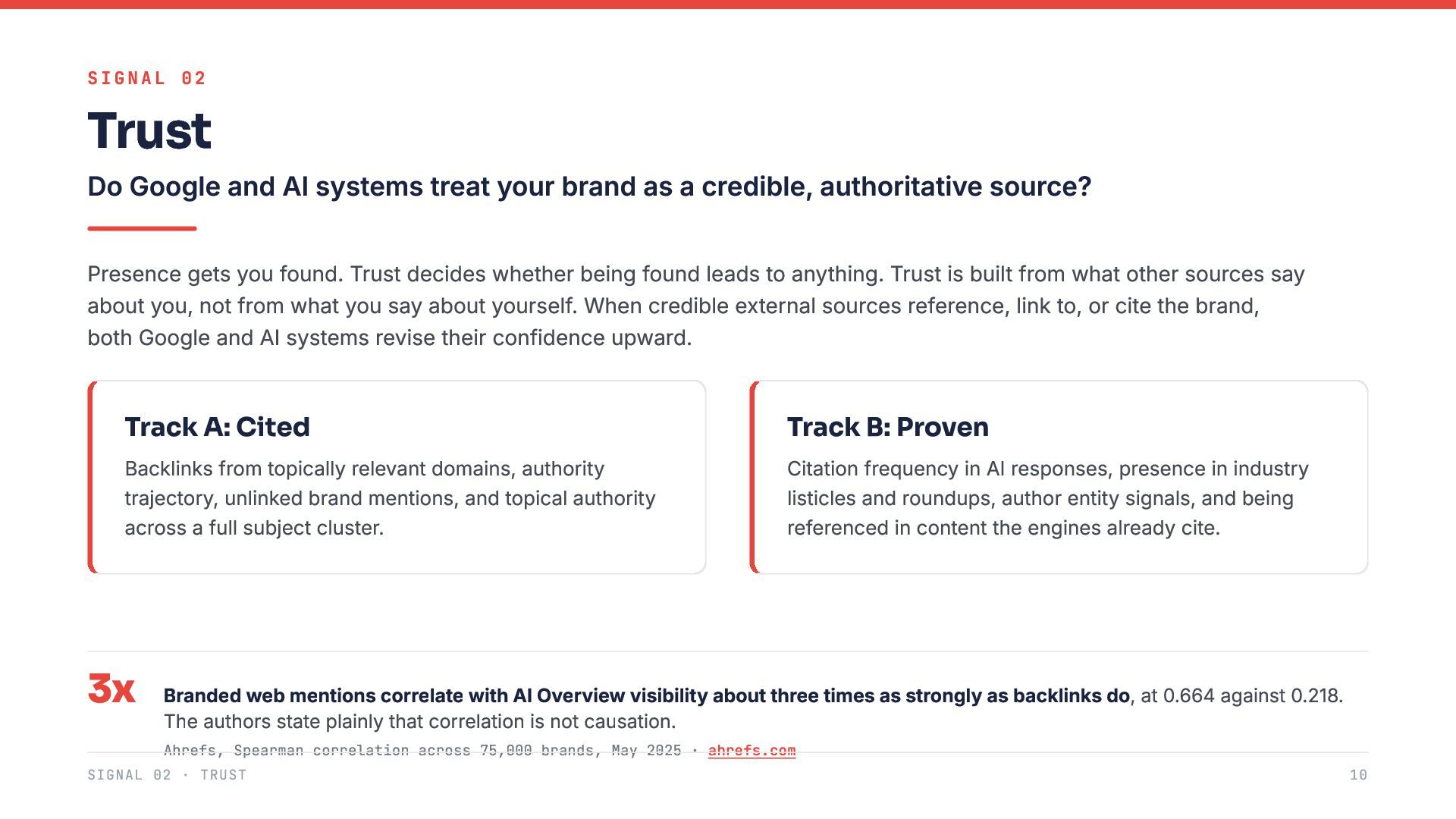
Trust (Signal 2). Do Google and AI systems treat your brand as a credible, authoritative source? Trust is built from what other sources say about you, not what you say about yourself. Two tracks: backlinks from topically relevant domains, authority trajectory, unlinked mentions and topical authority; then citation frequency in AI responses, presence in industry listicles and roundups, and author entity signals. Roughly 78 Google factors plus 8 GEO signals.

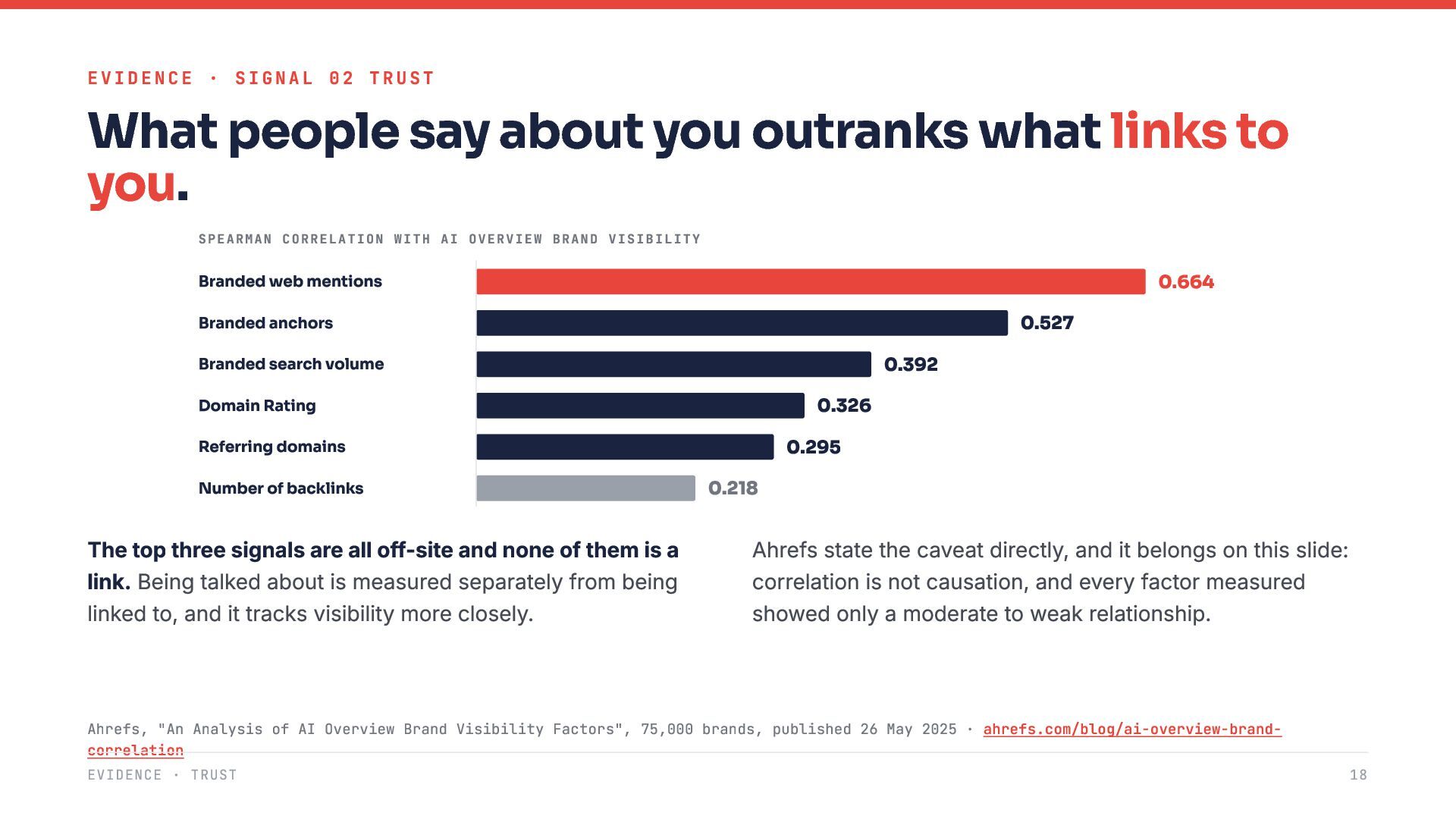
Evidence: across 75,000 brands, branded web mentions correlate with AI Overview visibility at 0.664, branded anchors at 0.527 and branded search volume at 0.392, while number of backlinks sits at 0.218. The top three signals are all off-site and none of them is a link. Ahrefs state explicitly that correlation is not causation and that all measured factors showed only moderate to weak relationships (Ahrefs, May 2025).

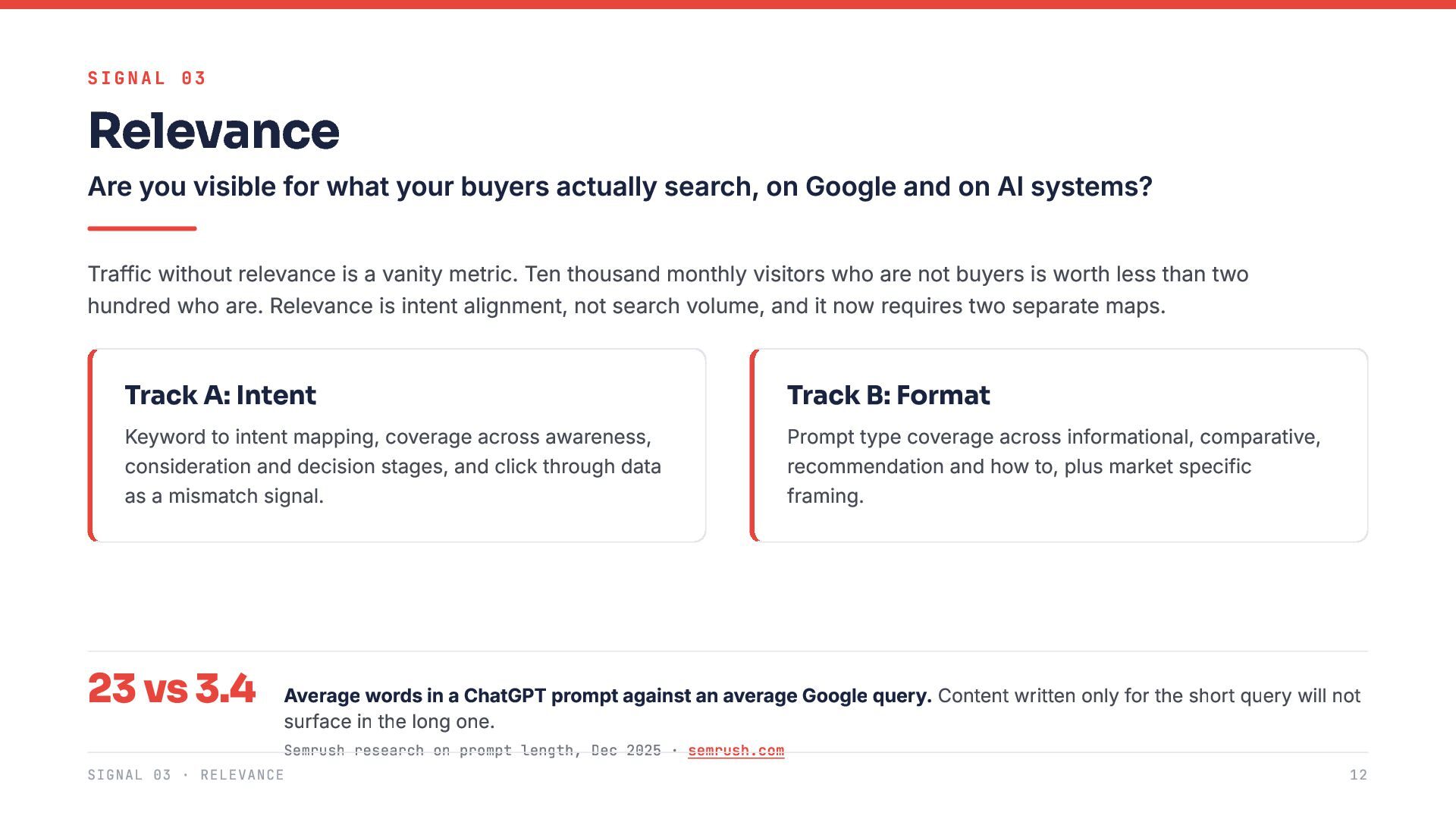
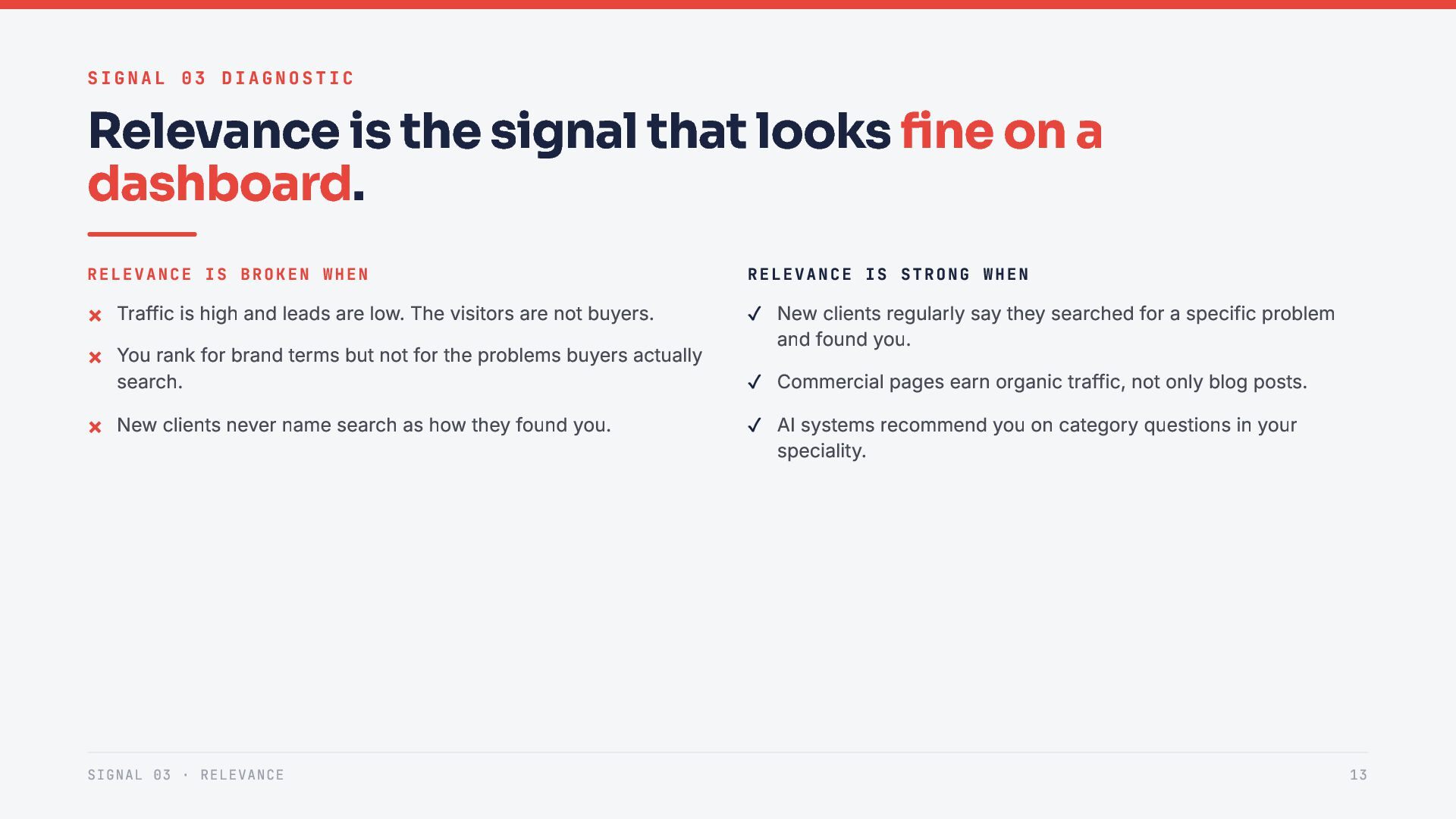
Relevance (Signal 3). Are you visible for what buyers actually search, on Google and on AI systems? Relevance is intent alignment, not search volume. Roughly 51 Google factors plus 6 GEO signals.

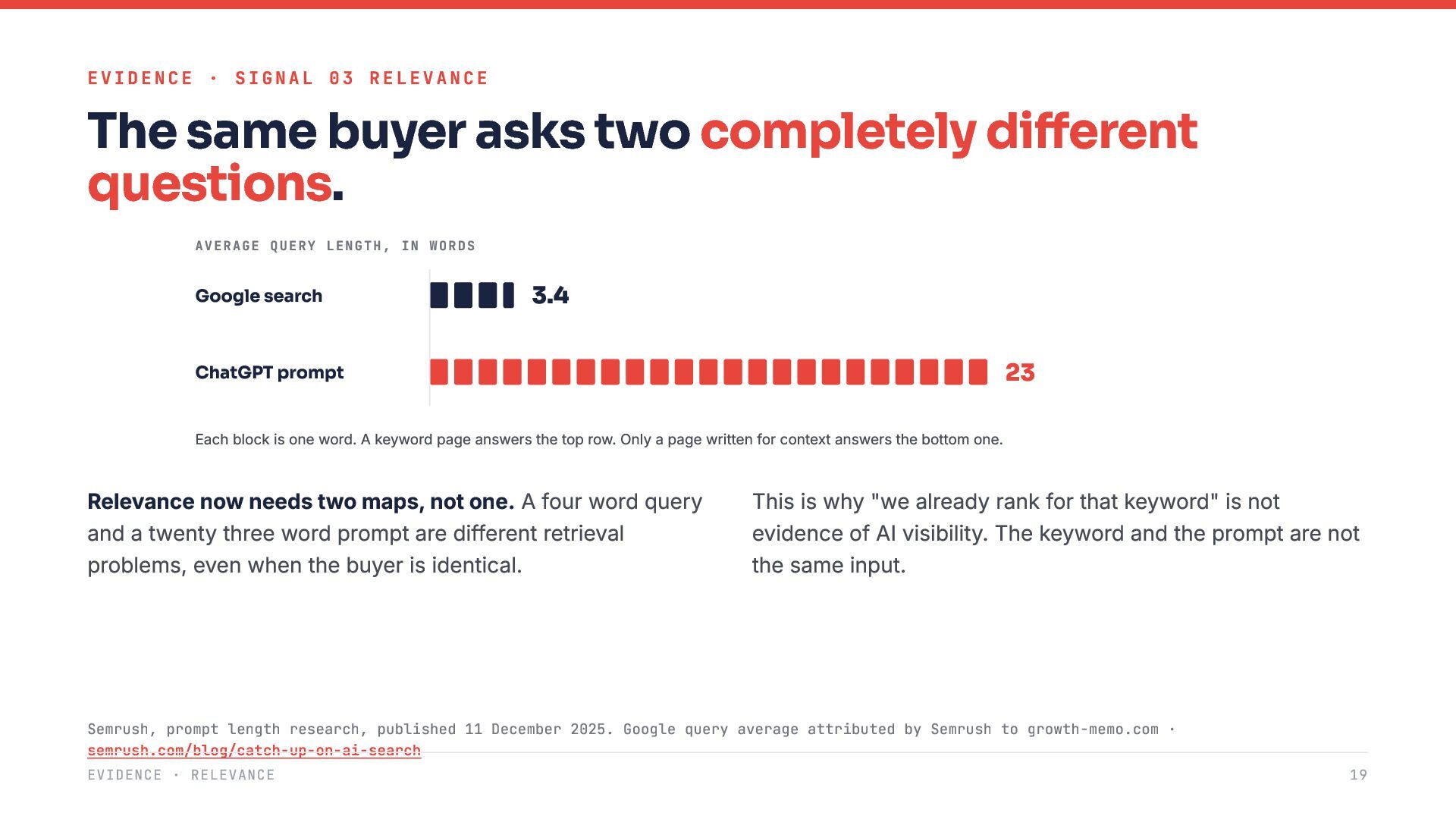
Evidence: the average ChatGPT prompt runs 23 words against 3.4 words for an average Google query (Semrush, December 2025). A four-word query and a twenty-three-word prompt are different retrieval problems even when the buyer is identical, which is why "we already rank for that keyword" is not evidence of AI visibility.

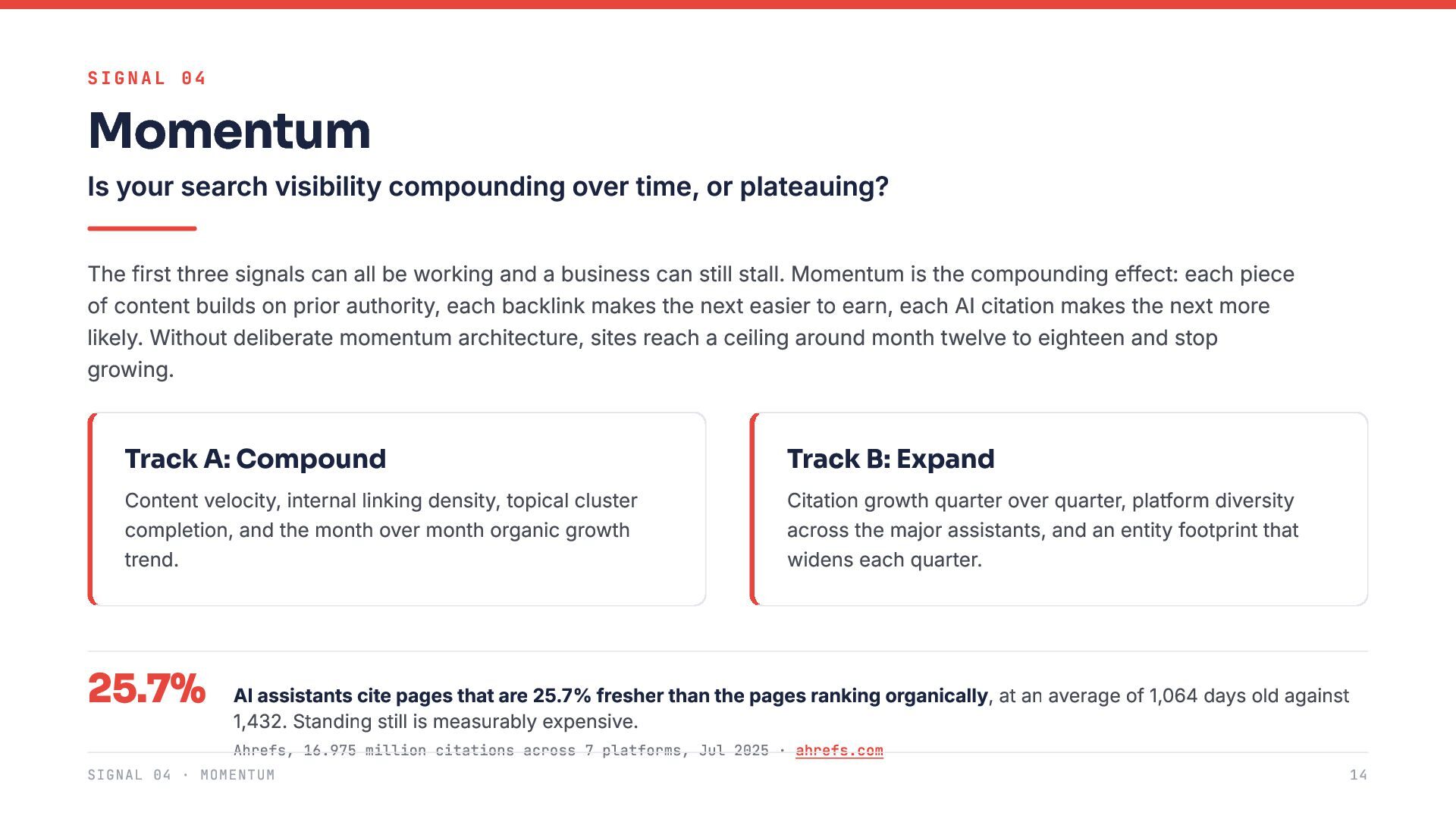
Momentum (Signal 4). Is visibility compounding, or plateauing? Without deliberate momentum architecture, sites reach a ceiling around month twelve to eighteen and stop growing. Roughly 22 Google factors plus 6 GEO signals.

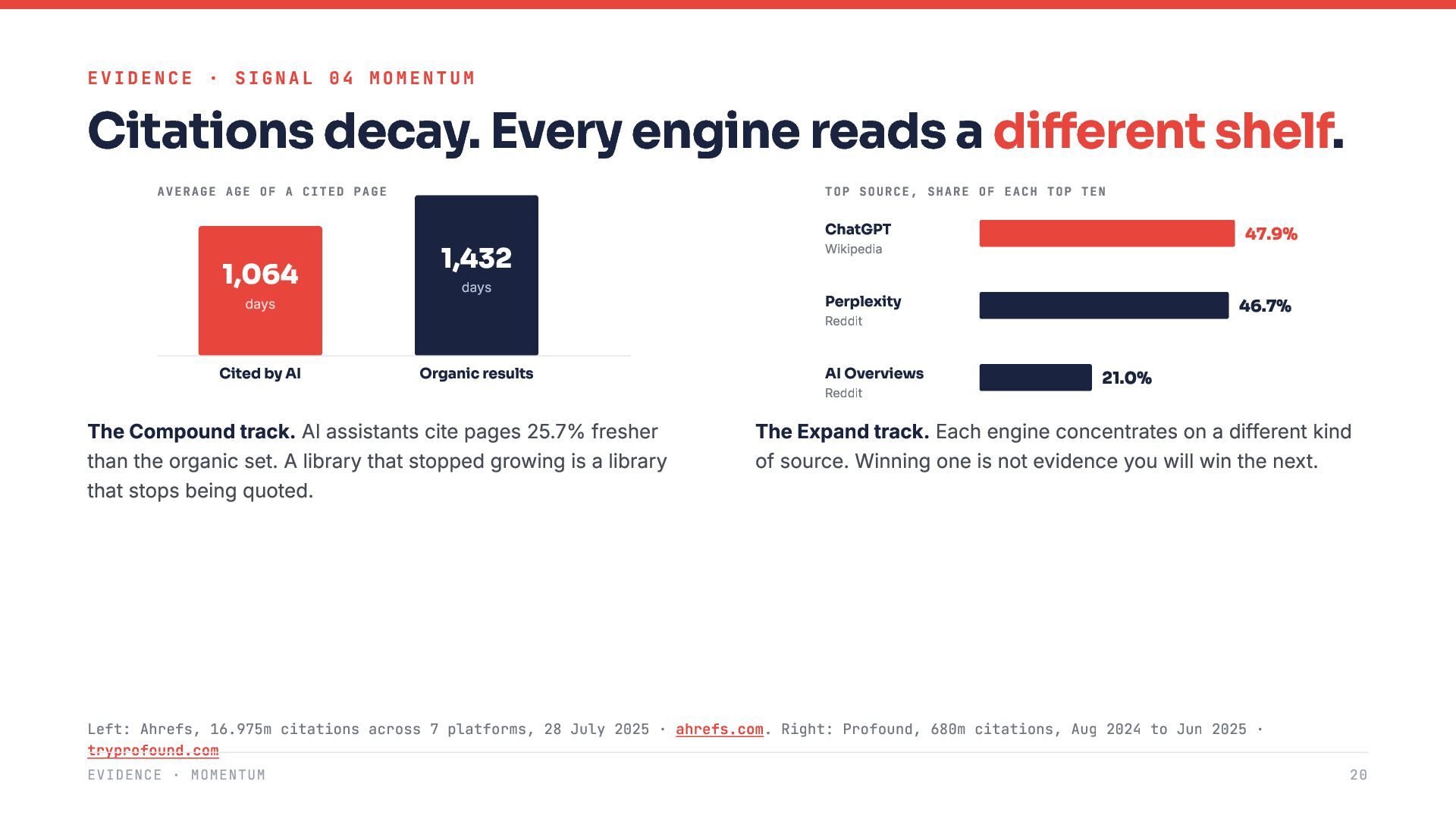
Evidence: AI assistants cite pages averaging 1,064 days old against 1,432 days for organic results, a 25.7% freshness advantage across 16.975 million citations on 7 platforms (Ahrefs, July 2025). And each engine concentrates on a different kind of source: Wikipedia is 47.9% of ChatGPT's top ten cited sources, while Reddit is 46.7% of Perplexity's and 21.0% of Google AI Overviews' (Profound, 680 million citations, August 2024 to June 2025). Winning one engine is not evidence you will win the next.

THE CASCADE PRINCIPLE

Presence gates Trust. Trust gates Relevance. Relevance gates Momentum. A score of 22 out of 25 on Trust alongside 8 out of 25 on Presence does not average out. The Presence score is the ceiling. Fix your lowest signal first, because work spent above the constraint returns nothing until the constraint moves.

ORIGINAL RESEARCH IN THIS DECK: AI CRAWLER ACCESS BY PLATFORM

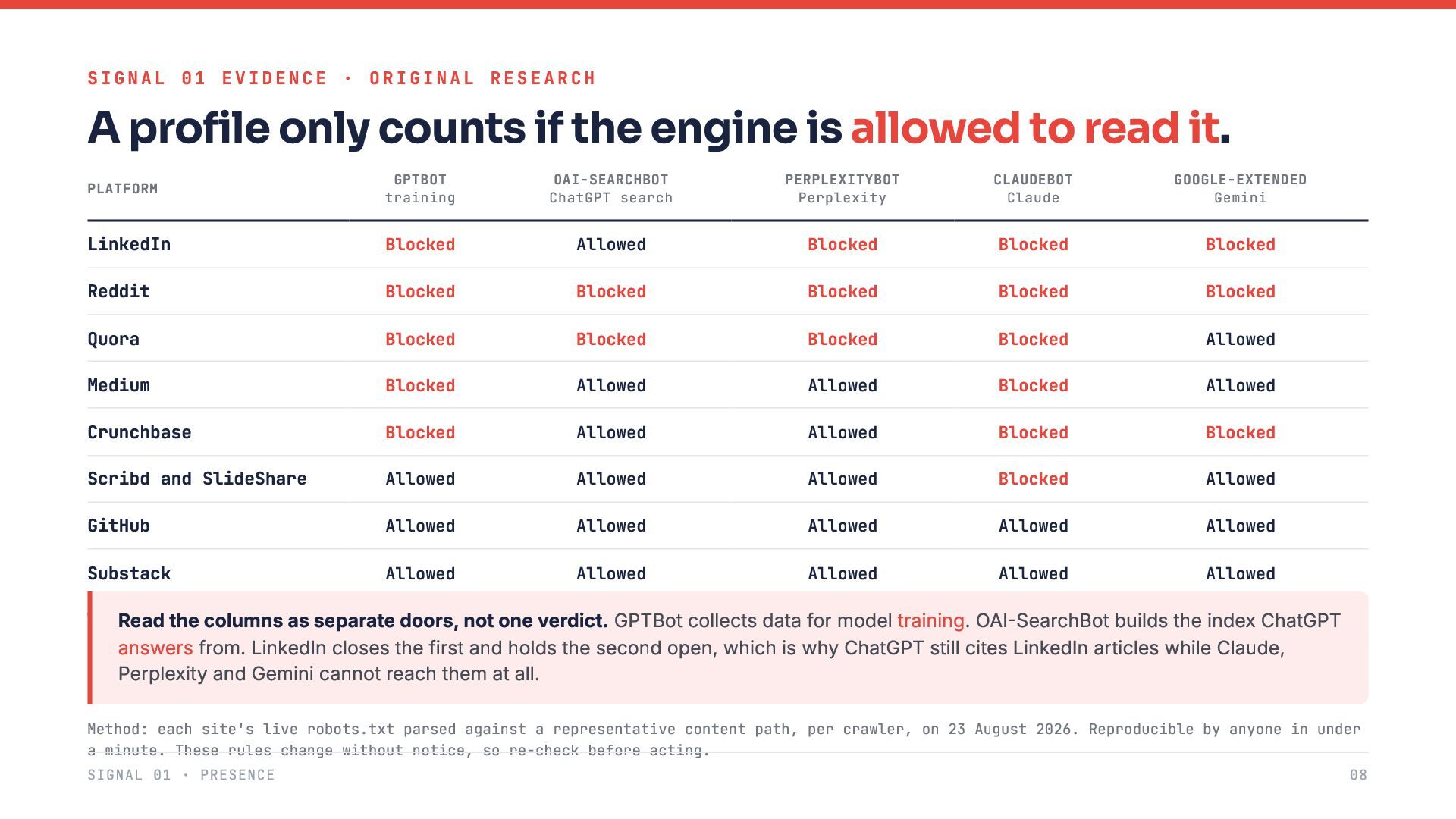
A profile only counts as an entity signal if the engine you are trying to reach is allowed to read it. Live robots.txt rules, parsed per crawler against a representative content path on 23 August 2026:

- LinkedIn: open to OAI-SearchBot only. GPTBot, PerplexityBot, ClaudeBot and Google-Extended are all disallowed.
- Reddit: a blanket disallow. Every listed AI crawler is blocked.
- Quora: open to Google-Extended only. The rest are disallowed.
- Medium: open to OAI-SearchBot, PerplexityBot and Google-Extended. GPTBot and ClaudeBot are disallowed.
- Crunchbase: open to OAI-SearchBot and PerplexityBot. GPTBot, ClaudeBot and Google-Extended are disallowed.
- SlideShare and Scribd: open to GPTBot, OAI-SearchBot, PerplexityBot and Google-Extended. ClaudeBot and CCBot are disallowed.
- GitHub, Substack and Wikipedia: open to all five.

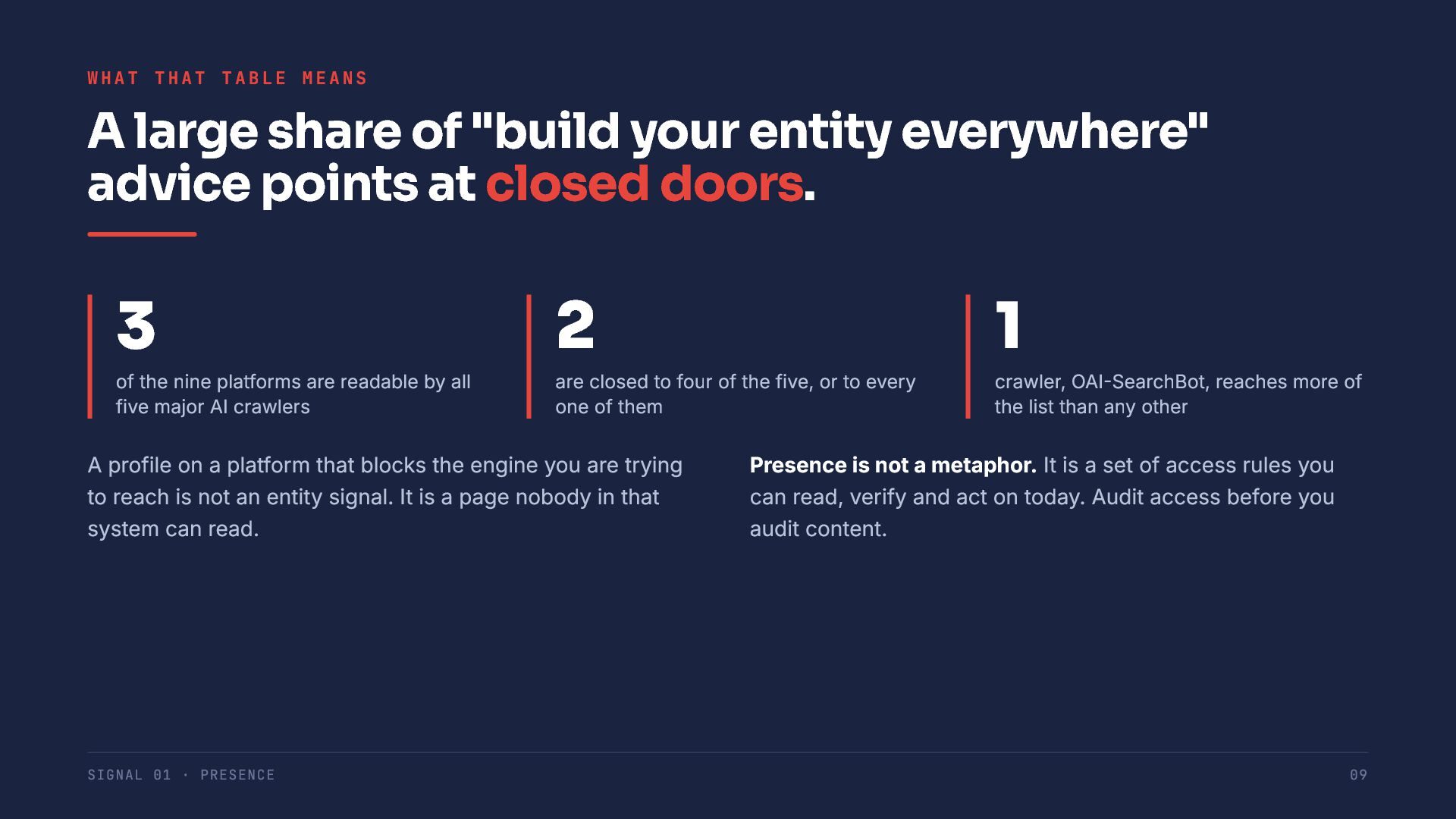
Three of the nine platforms are readable by all five major AI crawlers. Two are closed to four of the five or to every one of them. Reproducible by anyone in under a minute, and these rules change without notice, so re-check before acting.

Read those rows as separate doors, not as one verdict. GPTBot collects data for model training. OAI-SearchBot builds the index ChatGPT answers from. ChatGPT-User is the live fetch when someone pastes a URL. LinkedIn closes the training door and holds the search door open, which is why ChatGPT still cites LinkedIn articles while Claude, Perplexity and Gemini cannot reach them at all. Blocking a training crawler and blocking a search crawler have completely different consequences, and most robots.txt commentary treats them as the same decision.

The conclusion: a large share of the standard "build your entity everywhere" advice points at platforms that are closed to the engines being targeted. Audit access before you audit content.

SCORING

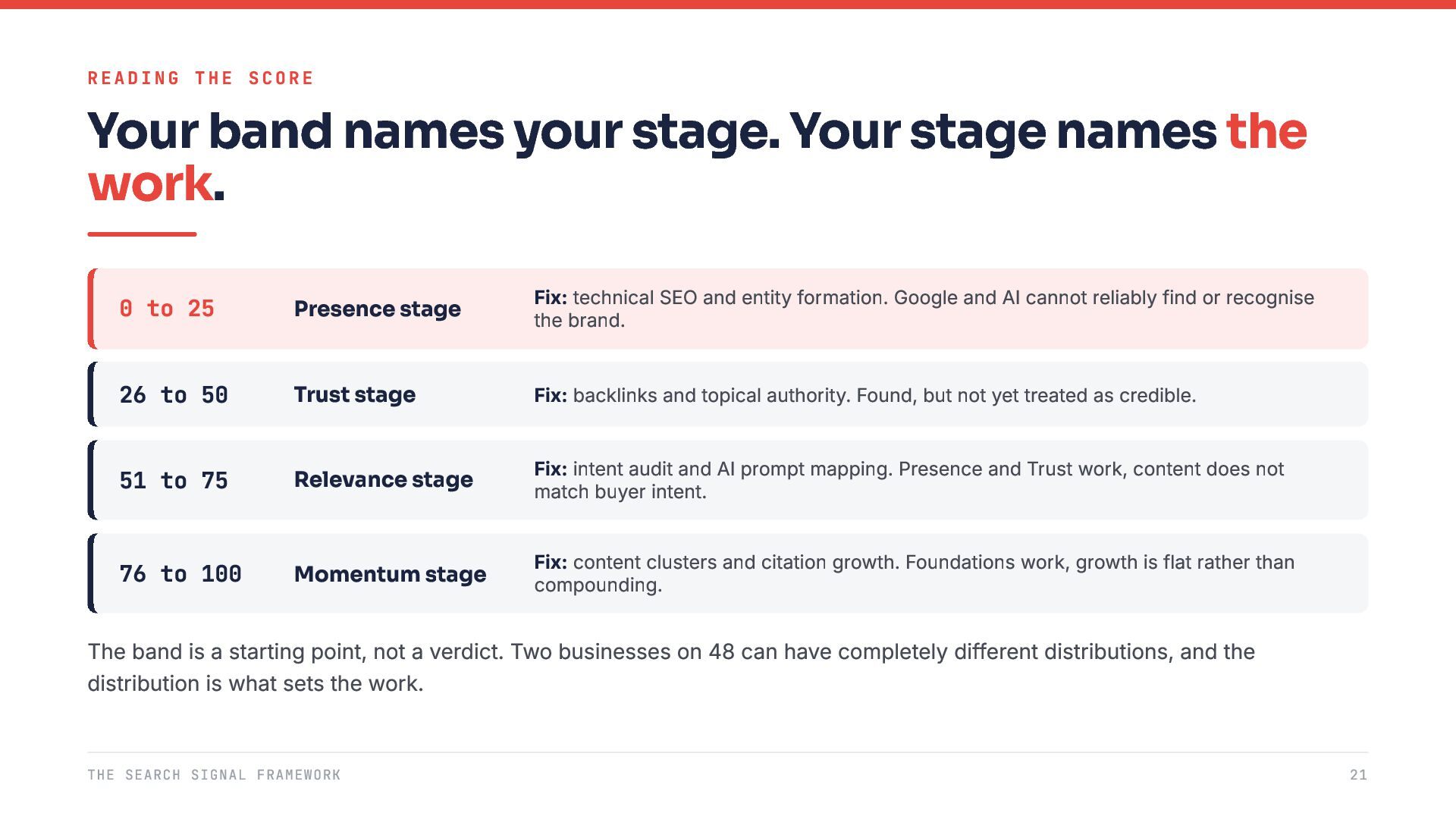
Each signal is scored out of 25, summing to 100. The total is the least useful part of the output. The distribution is what tells you where to work.

- 0 to 25, Presence stage. Fix technical SEO and entity formation.
- 26 to 50, Trust stage. Fix backlinks and topical authority.
- 51 to 75, Relevance stage. Fix intent audit and AI prompt mapping.
- 76 to 100, Momentum stage. Fix content clusters and citation growth.

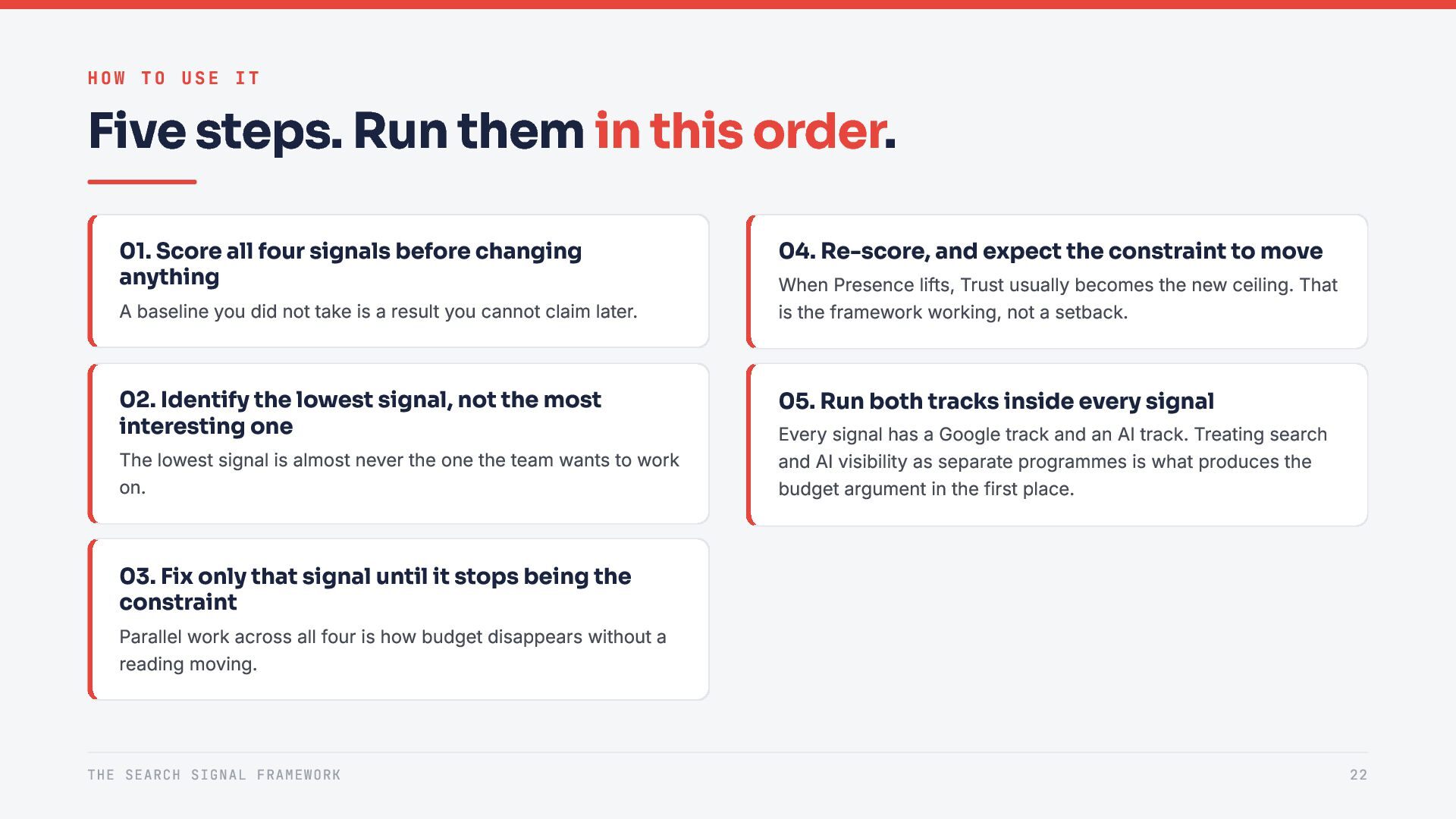
HOW TO USE IT

1. Score all four signals before changing anything.
2. Identify the lowest signal, not the most interesting one.
3. Fix only that signal until it stops being the constraint.
4. Re-score and expect the constraint to move. When Presence lifts, Trust usually becomes the new ceiling.
5. Run both tracks inside every signal. Every signal has a Google track and an AI track, which is why treating search and AI visibility as competing budgets produces the wrong decision in both directions.

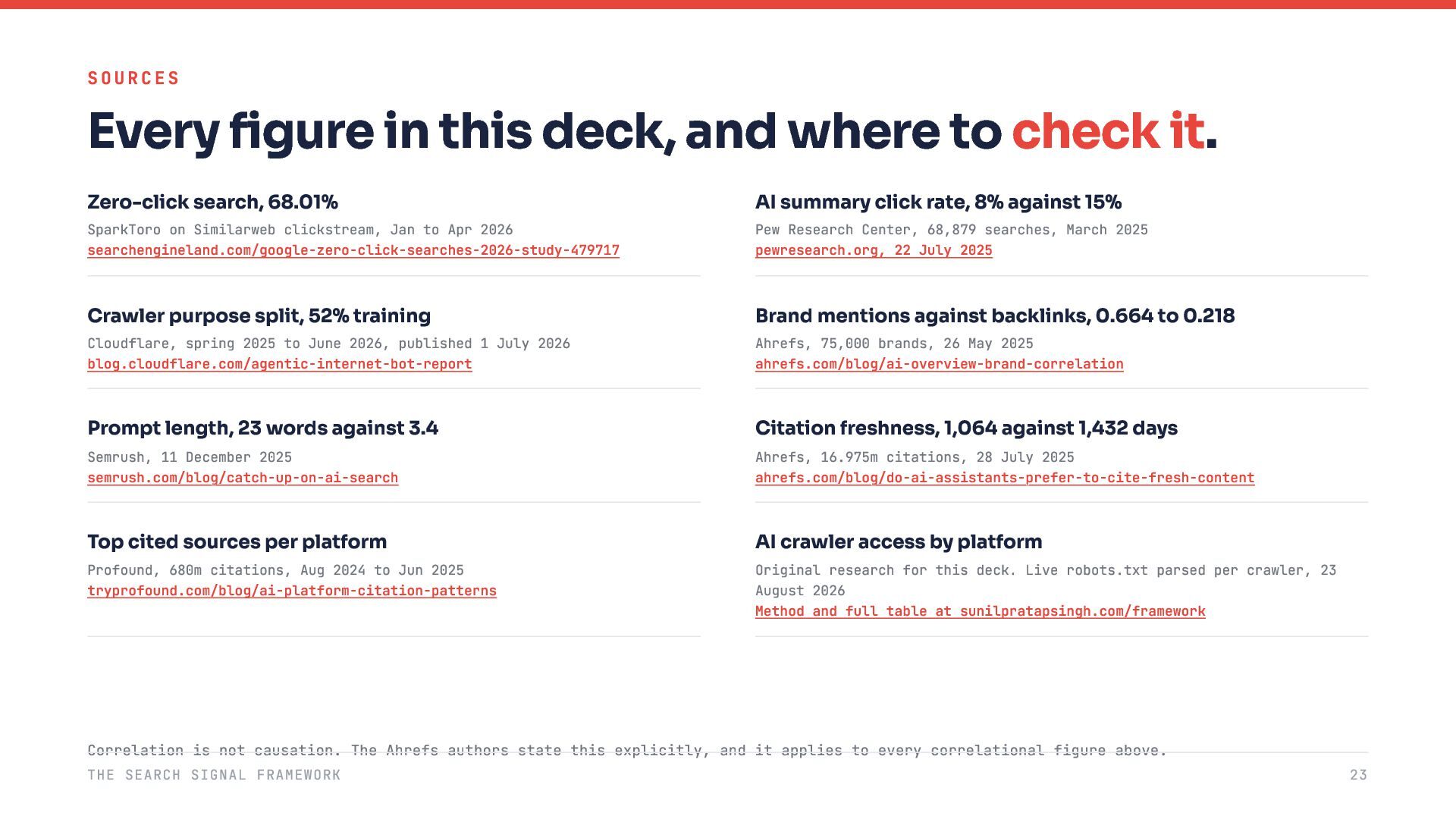
SOURCES

Zero-click search 68.01%: SparkToro on Similarweb clickstream, Jan to Apr 2026, via searchengineland.com/google-zero-click-searches-2026-study-479717
AI summary click rate 8% against 15%: Pew Research Center, 22 July 2025, pewresearch.org
Crawler purpose split, 52% training: Cloudflare, spring 2025 to June 2026, published 1 July 2026, blog.cloudflare.com/agentic-internet-bot-report
Brand mentions against backlinks, 0.664 to 0.218: Ahrefs, 26 May 2025, ahrefs.com/blog/ai-overview-brand-correlation
Prompt length 23 against 3.4 words: Semrush, 11 December 2025, semrush.com/blog/catch-up-on-ai-search
Citation freshness 1,064 against 1,432 days: Ahrefs, 28 July 2025, ahrefs.com/blog/do-ai-assistants-prefer-to-cite-fresh-content
Top cited sources per platform: Profound, tryprofound.com/blog/ai-platform-citation-patterns
Google ranking factor set: Backlinko, 2026
AI crawler access table: original research for this deck

Correlation is not causation. The Ahrefs authors state this explicitly and it applies to every correlational figure above.

Full framework, scoring detail and the free diagnostic:
https://sunilpratapsingh.com/framework?utm_source=speakerdeck&utm_medium=deck&utm_campaign=search-signal-framework

Sunil Pratap Singh

October 27, 2026

Transcript

24 slides
  1. The Search Signal Framework A DIAGNOSTIC FOR SEARCH AND AI

    VISIBILITY Four cascading signals that decide whether Google and AI systems can find you, trust you, match you to a buyer, and keep compounding that visibility. PRESENCE TRUST RELEVANCE MOMENTUM
  2. THE PROBLEM Most search work starts with a tactic. Almost

    none of it starts with a diagnosis. The usual sequence Pick a channel. Publish more. Buy links. Add schema. Rewrite for AI. Then wait to see whether anything moves. Every one of those can be correct. Every one can also be completely wasted, and nothing in the tactic itself tells you which. 68.01% Why it fails Content work is wasted if crawlers cannot reach the site. Entity work is wasted if nothing independent corroborates it. Authority work is wasted if the content answers a question no buyer asks. The constraint is never where the effort is going. of US Google searches ended without a click in the first four months of the year, up from 60.45% two years earlier. The margin for guessing which tactic to run has narrowed. SparkToro analysis of Similarweb clickstream data, Jan to Apr 2026 · searchengineland.com THE SEARCH SIGNAL FRAMEWORK 02
  3. CHANGE THE QUESTION Stop asking what to do next. Ask

    which signal is capping you. The wrong question The right question "Should we invest in SEO or in AI search?" "Which of the four signals is currently lowest?" This treats them as two budgets competing for one pot. It produces a split, not a decision, and the split is usually wrong in both directions. This has one answer, it is measurable, and it names what to fix first. SEO and AI search are not two strategies. They are two tracks inside every signal. 8% vs 15% Click rate on a traditional result when an AI summary is present, against when it is not. Only 1% of visits produced a click on a link inside the summary itself. Pew Research Center, 68,879 searches from 900 US adults, March 2025 · pewresearch.org THE SEARCH SIGNAL FRAMEWORK 03
  4. THE FRAMEWORK Four signals. One order. No skipping. SIGNAL 01

    Presence SIGNAL 02 Do Google and AI systems treat your brand as a credible, authoritative source? Relevance SIGNAL 04 Can Google and AI systems find, read, and understand your brand? Trust SIGNAL 03 Are you visible for what your buyers actually search, on Google and on AI systems? Is your search visibility compounding over time, or plateauing? 52 Google factors 8 GEO signals 78 Google factors 8 GEO signals 51 Google factors 6 GEO signals 22 Google factors 6 GEO signals Momentum Signal counts map Backlinko's 200 Google ranking factors across the four stages, plus 28 GEO-specific signals that traditional SEO audits do not measure. THE SEARCH SIGNAL FRAMEWORK 04
  5. THE CASCADE PRINCIPLE Each signal is a gate on the

    next one. › Trust 01 › Relevance 02 Presence › Momentum 03 04 CEILING SET BY THE LOWEST SIGNAL Hatched area is effort that returns nothing yet. PRESENCE 8 TRUST 22 RELEVANCE 19 MOMENTUM 17 Presence gates Trust. Trust gates Relevance. Relevance gates Momentum. A score of 22 out of 25 on Trust alongside 8 out of 25 on Presence does not average out. The Presence score is the ceiling, and work spent above it returns nothing until the constraint moves. THE SEARCH SIGNAL FRAMEWORK 05
  6. SIGNAL 01 Presence Can Google and AI systems find, read,

    and understand your brand? Presence is the foundation. Before any other signal matters, the brand must exist in the systems buyers use, not merely as a website but as a recognised entity with a clear identity, indexable content, and a consistent footprint that AI knowledge systems can cross reference. Track A: On Google Crawl health, indexation rate, internal link structure, sitemap coverage, page speed, technical foundation. 52% Track B: On AI systems Entity recognition across platforms, Person and Organization schema, a consistent name, title and description everywhere the brand appears. of AI crawler requests are now for training, up from 22% a year earlier. Pure search crawling, the kind that can return a citation, is a small and shrinking share. Being crawled is not the same as being found. Cloudflare, crawler traffic across its network through June 2026 · blog.cloudflare.com SIGNAL 01 · PRESENCE 06
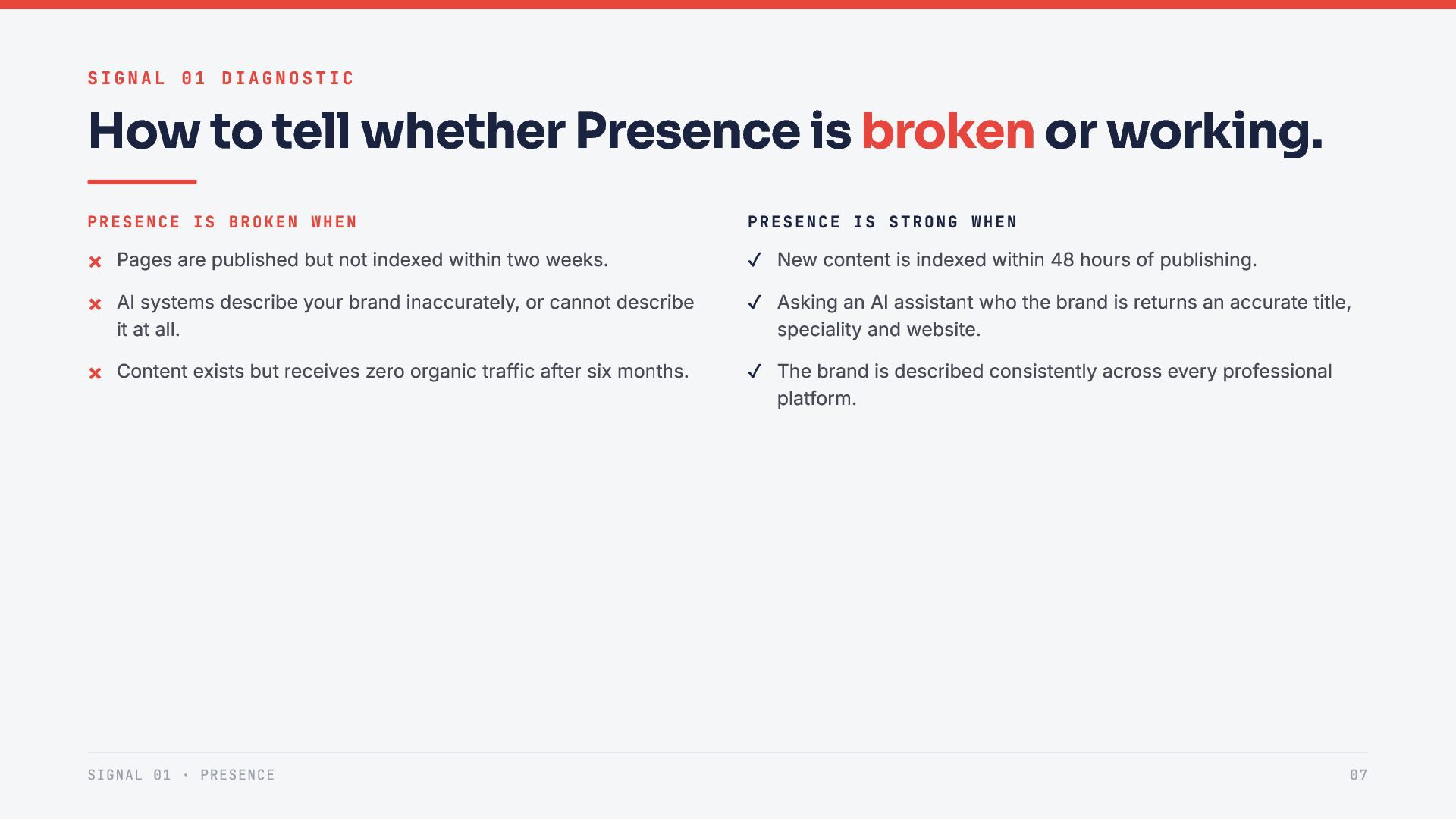
  7. SIGNAL 01 DIAGNOSTIC How to tell whether Presence is broken

    or working. PRESENCE IS BROKEN WHEN PRESENCE IS STRONG WHEN × Pages are published but not indexed within two weeks. × AI systems describe your brand inaccurately, or cannot describe ✓ New content is indexed within 48 hours of publishing. × Content exists but receives zero organic traffic after six months. ✓ The brand is described consistently across every professional it at all. SIGNAL 01 · PRESENCE ✓ Asking an AI assistant who the brand is returns an accurate title, speciality and website. platform. 07
  8. SIGNAL 01 EVIDENCE · ORIGINAL RESEARCH A profile only counts

    if the engine is allowed to read it. PLATFORM GPTBOT training OAI-SEARCHBOT ChatGPT search PERPLEXITYBOT Perplexity CLAUDEBOT Claude GOOGLE-EXTENDED Gemini LinkedIn Blocked Allowed Blocked Blocked Blocked Reddit Blocked Blocked Blocked Blocked Blocked Quora Blocked Blocked Blocked Blocked Allowed Medium Blocked Allowed Allowed Blocked Allowed Crunchbase Blocked Allowed Allowed Blocked Blocked Scribd and SlideShare Allowed Allowed Allowed Blocked Allowed GitHub Allowed Allowed Allowed Allowed Allowed Substack Allowed Allowed Allowed Allowed Allowed Wikipedia Allowed Allowed Allowed Read the columns as separateAllowed doors, not one verdict. GPTBot collects data for model training. OAI-SearchBot builds the Allowed index ChatGPT answers from. LinkedIn closes the first and holds the second open, which is why ChatGPT still cites LinkedIn articles while Claude, Perplexity and Gemini cannot reach them at all. Method: each site's live robots.txt parsed against a representative content path, per crawler, on 23 August 2026. Reproducible by anyone in under a minute. These rules change without notice, so re-check before acting. SIGNAL 01 · PRESENCE 08
  9. WHAT THAT TABLE MEANS A large share of "build your

    entity everywhere" advice points at closed doors. 3 of the nine platforms are readable by all five major AI crawlers 2 are closed to four of the five, or to every one of them A profile on a platform that blocks the engine you are trying to reach is not an entity signal. It is a page nobody in that system can read. SIGNAL 01 · PRESENCE 1 crawler, OAI-SearchBot, reaches more of the list than any other Presence is not a metaphor. It is a set of access rules you can read, verify and act on today. Audit access before you audit content. 09
  10. SIGNAL 02 Trust Do Google and AI systems treat your

    brand as a credible, authoritative source? Presence gets you found. Trust decides whether being found leads to anything. Trust is built from what other sources say about you, not from what you say about yourself. When credible external sources reference, link to, or cite the brand, both Google and AI systems revise their confidence upward. Track A: Cited Backlinks from topically relevant domains, authority trajectory, unlinked brand mentions, and topical authority across a full subject cluster. 3x Track B: Proven Citation frequency in AI responses, presence in industry listicles and roundups, author entity signals, and being referenced in content the engines already cite. Branded web mentions correlate with AI Overview visibility about three times as strongly as backlinks do, at 0.664 against 0.218. The authors state plainly that correlation is not causation. Ahrefs, Spearman correlation across 75,000 brands, May 2025 · ahrefs.com SIGNAL 02 · TRUST 10
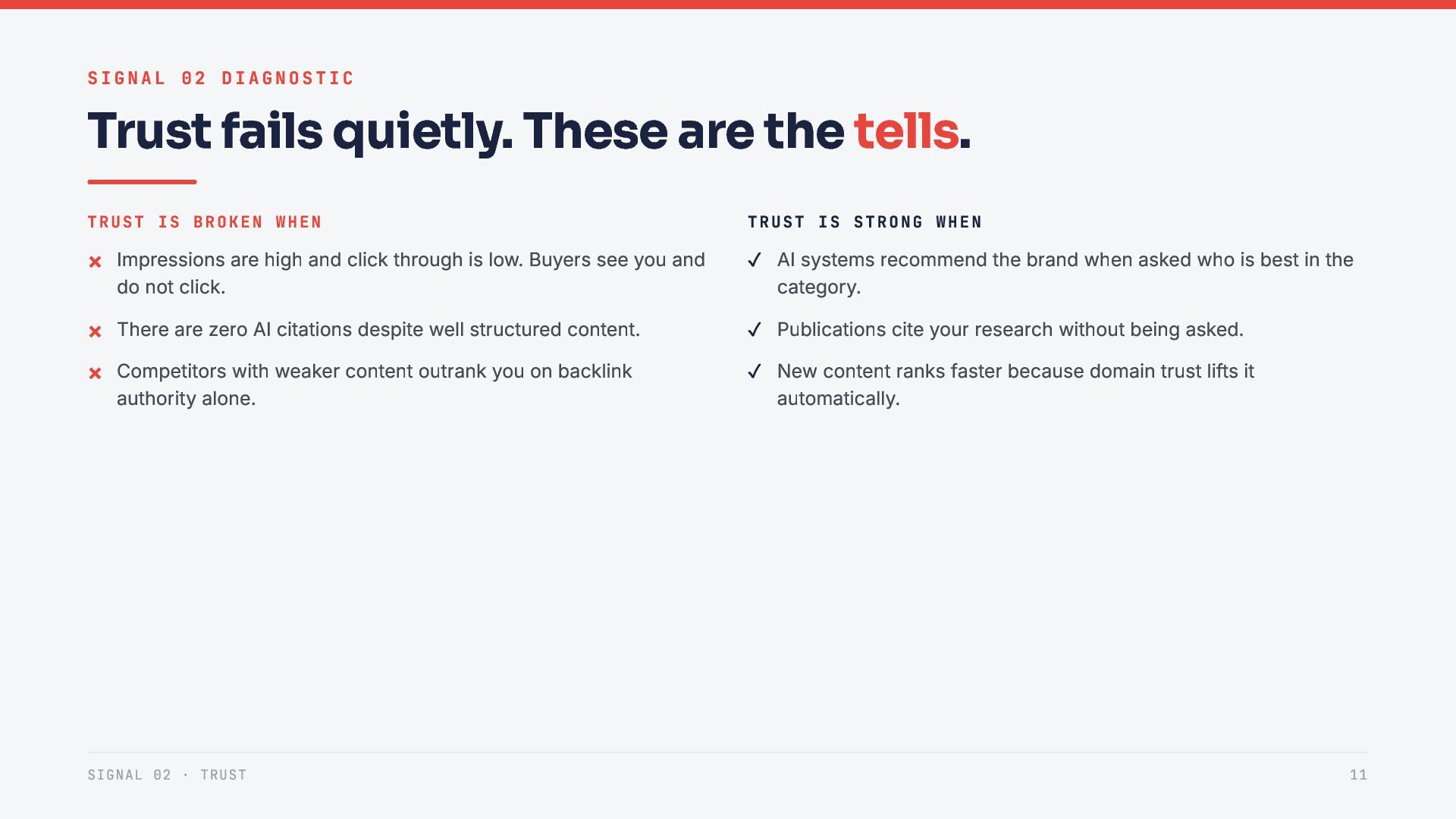
  11. SIGNAL 02 DIAGNOSTIC Trust fails quietly. These are the tells.

    TRUST IS BROKEN WHEN TRUST IS STRONG WHEN × Impressions are high and click through is low. Buyers see you and ✓ AI systems recommend the brand when asked who is best in the × There are zero AI citations despite well structured content. × Competitors with weaker content outrank you on backlink ✓ Publications cite your research without being asked. do not click. authority alone. SIGNAL 02 · TRUST category. ✓ New content ranks faster because domain trust lifts it automatically. 11
  12. SIGNAL 03 Relevance Are you visible for what your buyers

    actually search, on Google and on AI systems? Traffic without relevance is a vanity metric. Ten thousand monthly visitors who are not buyers is worth less than two hundred who are. Relevance is intent alignment, not search volume, and it now requires two separate maps. Track A: Intent Keyword to intent mapping, coverage across awareness, consideration and decision stages, and click through data as a mismatch signal. 23 vs 3.4 Track B: Format Prompt type coverage across informational, comparative, recommendation and how to, plus market specific framing. Average words in a ChatGPT prompt against an average Google query. Content written only for the short query will not surface in the long one. Semrush research on prompt length, Dec 2025 · semrush.com SIGNAL 03 · RELEVANCE 12
  13. SIGNAL 03 DIAGNOSTIC Relevance is the signal that looks fine

    on a dashboard. RELEVANCE IS BROKEN WHEN RELEVANCE IS STRONG WHEN × Traffic is high and leads are low. The visitors are not buyers. × You rank for brand terms but not for the problems buyers actually ✓ New clients regularly say they searched for a specific problem × New clients never name search as how they found you. ✓ AI systems recommend you on category questions in your search. SIGNAL 03 · RELEVANCE and found you. ✓ Commercial pages earn organic traffic, not only blog posts. speciality. 13
  14. SIGNAL 04 Momentum Is your search visibility compounding over time,

    or plateauing? The first three signals can all be working and a business can still stall. Momentum is the compounding effect: each piece of content builds on prior authority, each backlink makes the next easier to earn, each AI citation makes the next more likely. Without deliberate momentum architecture, sites reach a ceiling around month twelve to eighteen and stop growing. Track A: Compound Content velocity, internal linking density, topical cluster completion, and the month over month organic growth trend. 25.7% Track B: Expand Citation growth quarter over quarter, platform diversity across the major assistants, and an entity footprint that widens each quarter. AI assistants cite pages that are 25.7% fresher than the pages ranking organically, at an average of 1,064 days old against 1,432. Standing still is measurably expensive. Ahrefs, 16.975 million citations across 7 platforms, Jul 2025 · ahrefs.com SIGNAL 04 · MOMENTUM 14
  15. SIGNAL 04 DIAGNOSTIC Plateau is not bad luck. It is

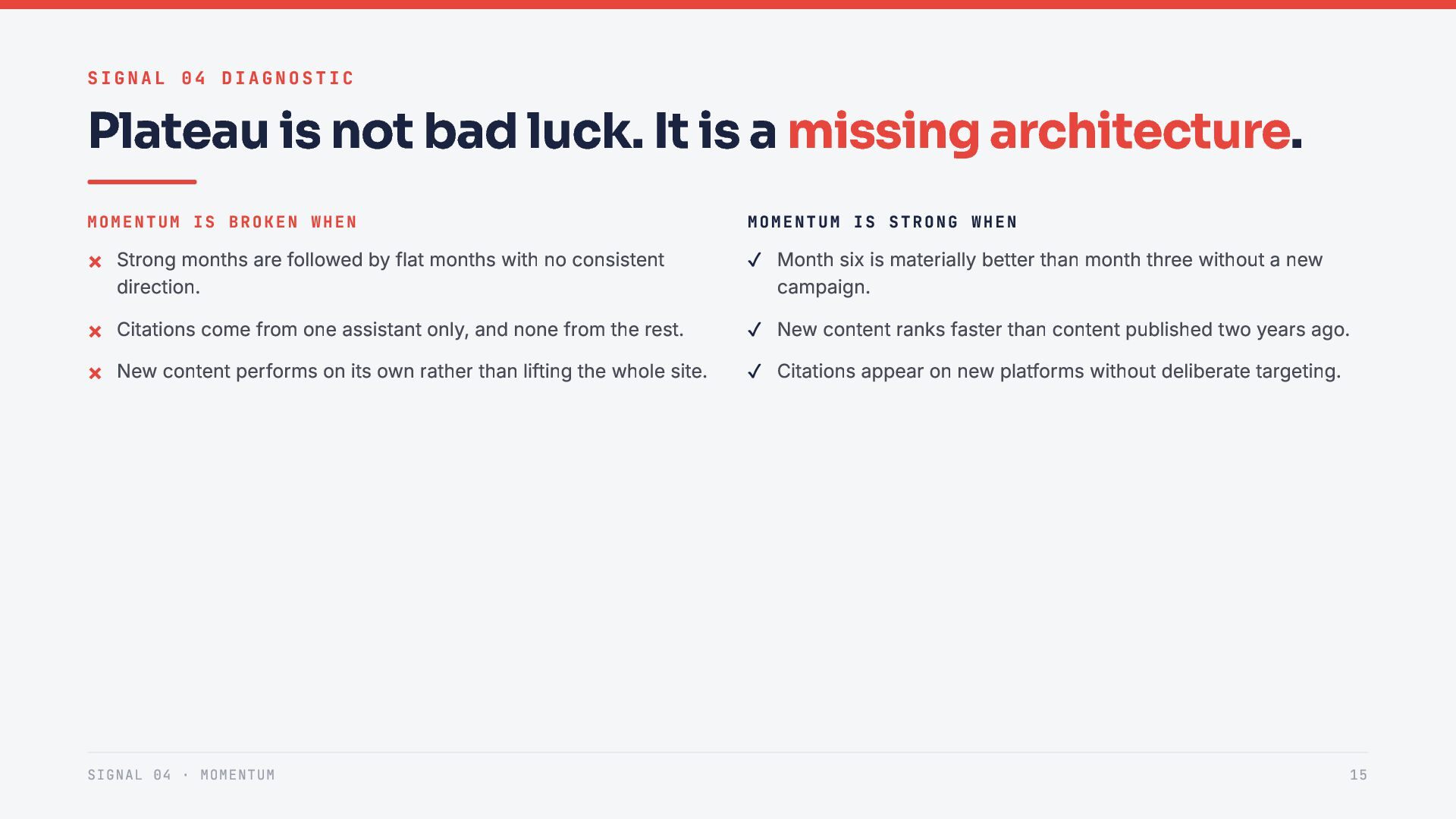
    a missing architecture. MOMENTUM IS BROKEN WHEN MOMENTUM IS STRONG WHEN × Strong months are followed by flat months with no consistent ✓ Month six is materially better than month three without a new × Citations come from one assistant only, and none from the rest. × New content performs on its own rather than lifting the whole site. ✓ New content ranks faster than content published two years ago. direction. SIGNAL 04 · MOMENTUM campaign. ✓ Citations appear on new platforms without deliberate targeting. 15
  16. SCORING 228 signals. Four scores. One number. 228 signals in

    the full diagnostic 200 Google ranking factors mapped across the four stages 28 GEO signals no traditional SEO audit measures 25 points per signal, for a total of 100 Each signal is scored out of 25. The four scores sum to a single number out of 100, but the sum is the least useful part of the output. The distribution is what tells you where to work, because the lowest of the four is the ceiling on the other three. Google ranking factor set: Backlinko, 2026. The 28 GEO signals are additional to that set, not a subdivision of it. THE SEARCH SIGNAL FRAMEWORK 16
  17. EVIDENCE · SIGNAL 01 PRESENCE You are already being crawled.

    Almost none of it is search. SHARE OF AI CRAWLER REQUESTS MADE FOR TRAINING Spring 2025 22% 52% June 2026 A further 36% of activity comes from mixed-use crawlers. Pure search crawling, the only kind that can return a citation with a link, is a small and declining share of the total. Crawl volume is not a Presence score. Most of the traffic hitting your server is feeding a model, not assembling an answer a buyer will read. Cloudflare also report that content categories being crawled most heavily saw human referral traffic fall by up to 40% in under a year. Being read and being visited have come apart. Cloudflare, "Content Independence Day, one year on", crawler traffic across the Cloudflare network, spring 2025 to June 2026, published 1 July 2026 · blog.cloudflare.com/agentic-internet-bot-report EVIDENCE · PRESENCE 17
  18. EVIDENCE · SIGNAL 02 TRUST What people say about you

    outranks what links to you. SPEARMAN CORRELATION WITH AI OVERVIEW BRAND VISIBILITY 0.664 Branded web mentions 0.527 Branded anchors 0.392 Branded search volume 0.326 0.295 Domain Rating Referring domains Number of backlinks The top three signals are all off-site and none of them is a link. Being talked about is measured separately from being linked to, and it tracks visibility more closely. 0.218 Ahrefs state the caveat directly, and it belongs on this slide: correlation is not causation, and every factor measured showed only a moderate to weak relationship. Ahrefs, "An Analysis of AI Overview Brand Visibility Factors", 75,000 brands, published 26 May 2025 · ahrefs.com/blog/ai-overview-brandcorrelation EVIDENCE · TRUST 18
  19. EVIDENCE · SIGNAL 03 RELEVANCE The same buyer asks two

    completely different questions. AVERAGE QUERY LENGTH, IN WORDS Google search 3.4 23 ChatGPT prompt Each block is one word. A keyword page answers the top row. Only a page written for context answers the bottom one. Relevance now needs two maps, not one. A four word query and a twenty three word prompt are different retrieval problems, even when the buyer is identical. This is why "we already rank for that keyword" is not evidence of AI visibility. The keyword and the prompt are not the same input. Semrush, prompt length research, published 11 December 2025. Google query average attributed by Semrush to growth-memo.com · semrush.com/blog/catch-up-on-ai-search EVIDENCE · RELEVANCE 19
  20. EVIDENCE · SIGNAL 04 MOMENTUM Citations decay. Every engine reads

    a different shelf. AVERAGE AGE OF A CITED PAGE 1,064 days Cited by AI TOP SOURCE, SHARE OF EACH TOP TEN 1,432 days ChatGPT 47.9% Perplexity 46.7% Wikipedia Reddit Organic results The Compound track. AI assistants cite pages 25.7% fresher than the organic set. A library that stopped growing is a library that stops being quoted. AI Overviews Reddit 21.0% The Expand track. Each engine concentrates on a different kind of source. Winning one is not evidence you will win the next. Left: Ahrefs, 16.975m citations across 7 platforms, 28 July 2025 · ahrefs.com. Right: Profound, 680m citations, Aug 2024 to Jun 2025 · tryprofound.com EVIDENCE · MOMENTUM 20
  21. READING THE SCORE Your band names your stage. Your stage

    names the work. 0 to 25 Presence stage Fix: technical SEO and entity formation. Google and AI cannot reliably find or recognise the brand. 26 to 50 Trust stage Fix: backlinks and topical authority. Found, but not yet treated as credible. 51 to 75 Relevance stage Fix: intent audit and AI prompt mapping. Presence and Trust work, content does not match buyer intent. 76 to 100 Momentum stage Fix: content clusters and citation growth. Foundations work, growth is flat rather than compounding. The band is a starting point, not a verdict. Two businesses on 48 can have completely different distributions, and the distribution is what sets the work. THE SEARCH SIGNAL FRAMEWORK 21
  22. HOW TO USE IT Five steps. Run them in this

    order. 01. Score all four signals before changing anything 04. Re-score, and expect the constraint to move 02. Identify the lowest signal, not the most interesting one 05. Run both tracks inside every signal A baseline you did not take is a result you cannot claim later. The lowest signal is almost never the one the team wants to work on. When Presence lifts, Trust usually becomes the new ceiling. That is the framework working, not a setback. Every signal has a Google track and an AI track. Treating search and AI visibility as separate programmes is what produces the budget argument in the first place. 03. Fix only that signal until it stops being the constraint Parallel work across all four is how budget disappears without a reading moving. THE SEARCH SIGNAL FRAMEWORK 22
  23. SOURCES Every figure in this deck, and where to check

    it. Zero-click search, 68.01% AI summary click rate, 8% against 15% Crawler purpose split, 52% training Brand mentions against backlinks, 0.664 to 0.218 Prompt length, 23 words against 3.4 Citation freshness, 1,064 against 1,432 days Semrush, 11 December 2025 semrush.com/blog/catch-up-on-ai-search Ahrefs, 16.975m citations, 28 July 2025 ahrefs.com/blog/do-ai-assistants-prefer-to-cite-fresh-content Top cited sources per platform AI crawler access by platform SparkToro on Similarweb clickstream, Jan to Apr 2026 searchengineland.com/google-zero-click-searches-2026-study-479717 Cloudflare, spring 2025 to June 2026, published 1 July 2026 blog.cloudflare.com/agentic-internet-bot-report Profound, 680m citations, Aug 2024 to Jun 2025 tryprofound.com/blog/ai-platform-citation-patterns Pew Research Center, 68,879 searches, March 2025 pewresearch.org, 22 July 2025 Ahrefs, 75,000 brands, 26 May 2025 ahrefs.com/blog/ai-overview-brand-correlation Original research for this deck. Live robots.txt parsed per crawler, 23 August 2026 Method and full table at sunilpratapsingh.com/framework Correlation is not causation. The Ahrefs authors state this explicitly, and it applies to every correlational figure above. THE SEARCH SIGNAL FRAMEWORK 23
  24. Presence gates Trust. Trust gates Relevance. Relevance gates Momentum. Fix

    your lowest signal first. THE WHOLE FRAMEWORK IN ONE LINE Everything else is a tactic waiting for the right diagnosis. THE FULL FRAMEWORK, THE SCORING DETAIL AND THE FREE DIAGNOSTIC sunilpratapsingh.com/framework

Other Decks in Marketing & SEO